Category Archives: writing

Author motivation #amwriting

What motivates a writer to write? What makes an ordinary person believe they can write a book that others will want to read?

For me, I want to read certain books, and for some reason, my favorite authors refuse to churn out a book a week–go figure.

So, I try to write the kind of stories I want to read. An idea occurs, a wild moment of “what if” and I must write it.

Sometimes it’s just a scene or a drabble. Sometimes it is a poem. Other times it will be a short story or a novel.

No matter where I am, I want to talk about books. Books and the craft of writing absorbs me. The internet offers me the chance to learn new things about writing craft and gives me a hundred places to discuss them and people to “talk shop” with.

Reading books and writing obsesses me, and everything motivates me.

I’m not sure why, but I do my most creative work when I should be doing something else. My best writing gets done when I should be getting ready to leave the house for an appointment.

As writers, we talk and talk and talk about a character’s motivation, but the author’s motivation is critical. WHY are you writing?

When I am fired up, I do my best work. Life can be complicated here on the homefront, so writing is an escape from dealing with the realities of being the family caregiver and living with chronic pain. I can write anytime, anywhere, under any circumstances. Sometimes I don’t feel too creative, but at that point, my blogging skills kick in. For me, blogging is talking about writing, and that’s writing too. It keeps me thinking.

In many ways, I am a social justice warrior. I write about all kinds of people experiencing hard times and injustice, and the fallout that sometimes occurs. Sometimes the good people don’t win, and how they handle defeat is the real story.

When I have an idea for a story, it’s never with the intention of preaching a sermon—I leave that to better qualified people and more adept authors. The stories I want to write are about people who face great challenges and how those events shape their actions.

Life and all its many detours intrigues me, and as a reader, I gravitate to those kinds of novels, in all genres. Memorable characters grow on you over the course of the book–they are not delivered fully formed on the first page. They are intriguing, and we don’t always know what they will do next. There is a hint of mystery about them, and if the author did their job, at the end of the book we don’t want those characters to leave.

We want to instill an air of mystery in all our characters, whether we write sci-fi, romance, fantasy, pot-boilers, or cozy mysteries. People cease to intrigue you once you think you know all there is to know about them.

It is the complexities of your friends that keep them interesting, the little things you never knew that surprise you when they are revealed.

Developing a character, deploying just enough information at the right moments to pique the reader’s curiosity is a balancing act, and not everyone can do it with finesse. Thus, I read and read and read—classic literature, epic fantasy, cozy mysteries, spy novels, vampire romances, and space operas—I read in all genres, hoping to gain an idea of how it’s done right.

I also find many examples of how it’s done wrong.

My advice today? Read widely, read daily, read in all genres, even those you “don’t like”—but read. Reading widens your mind, and an open mind is creative, and a creative mind puts out great work.

Trying to master the balancing act of creating compelling characters and setting them in intriguing circumstances motivates me. I love the feeling of meeting the challenge, picking up the gauntlet tossed down by my favorite authors, the “ah hah” of having written a story I would want to read.

8 Comments

Filed under writing

Hyphens #amwriting

When creating my world of Neveyah for the Tower of Bones series, I discovered that hyphens are the gateway  to writer’s hell. I put together compound words, hyphenated to make them specific to that world.

I did this, not realizing I would be stuck writing these words consistently hyphenated for years… and years….

Take my advice and do not use a hyphen in your invented words unless the universe will dissolve without it.

In the real world, if a compound adjective cannot be misread or its meaning is firmly established, a hyphen is not necessary.

Words that are single words and don’t need a hyphen:

  • backstabbing
  • backstabber
  • (a) breakup as in (a) divorce, break up as in taking apart
  • breathtaking
  • comeback as in succeeding again, come back as in return to me
  • counterintuitive
  • counterproductive
  • downright
  • herself
  • himself
  • hobnob
  • latchkey
  • mainstream
  • midweek
  • myself
  • nevertheles
  • newfound
  • nighttime
  • nonetheless
  • nonstop
  • overdo
  • overexpose
  • overpriced
  • overrated
  • oversized
  • roundup as in a rodeo, round up as in a review or the next highest round number
  • secondhand
  • selfish
  • sidekick
  • sightseeing
  • straightforward
  • woebegone
  • yourself

A few words do require a hyphen to ensure their meaning is what you intended:

Wikipedia says: Compound modifiers are groups of two or more words that jointly modify the meaning of another word. When a compound modifier other than an adverb–adjective combination appears before a term, the compound modifier is often hyphenated to prevent misunderstandings, such as in American-football player or little-celebrated paintings. Without the hyphen, there is potential confusion about whether the writer means a “player of American football” or an “American player of football” and whether the writer means paintings that are “little celebrated” or “celebrated paintings” that are little.

Compound modifiers can extend to three or more words, as in ice-cream-flavored candy, and can be adverbial as well as adjectival (spine-tinglingly frightening). However, if the compound is a familiar one, it is usually unhyphenated. For example, at least one style guide prefers the construction high school students, to high-school students.

Words that DO need a hyphen:

  • An English-speaking country
  • A time-saving device
  • A thirty-floor building

Some compounds are improvised to fulfill a specific need (on-the-spot creations). Permanent compounds start out as improvised compounds but become so widely accepted that they are included in the dictionary as permanent compounds. Examples of temporary compounds that have made the transition to permanent compounds are words like

  • know-it-all
  • heart-stopping
  • free-for-all (as in a rumpus)
  • down-at-the-heels

Context determines whether to hyphenate or not.  Ask yourself, “How will the words be interpreted by the reader if I don’t hyphenate?” If your intended meaning is clear without the hyphen, leave it out.

Wikipedia offers the following examples:

  • Man-eating shark (as opposed to man eating shark, which could be interpreted as a man eating the meat of a shark)
  • Wild-goose chase (a hunt for resulting in nothing) as opposed to wild goose chase, which could be interpreted as a chasing a goose that is wild.
  • Long-term contract (as opposed to long term contract, which in legalese could be interpreted as a long contract about a term)
  • Zero-liability protection (as opposed to zero liability protection, which implies you have no liability protection).

A crucial task for you as an author is to make a stylesheet that pertains to your manuscript. Create a list detailing words that must be capitalized, which ones are hyphenated, and include the proper spellings of names for all people and places.

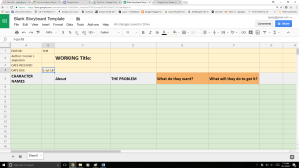
Some people use Scrivener for this and swear by it. For myself, I don’t need a fancy word-processing program with a difficult learning curve—my life is complicated enough as it is. You can make a simple list or go wild and make a spreadsheet. I use Excel to make storyboards that are my style guides for each novel or tale I write, and for every book I edit.

You can do this in Google Docs too, and that program is free–the perfect price for the starving author.

Regardless of how you create your stylesheet, I suggest you include these elements:

  • List invented Words and all Names spelled the way you intend them to be written forever, noting whether it is two words (De Mal), hyphenated (De-Mal), or two syllables connected with an apostrophe (D’Mal)
  • Note the page number on which the word first appears so you can check back for consistency.
  • If it is not a person’s name, list the meaning and how it is used, for example, if the word denotes a city, or an animal, or plant, etc.

Refer to this style sheet frequently and update it with every change you make to spelling in your manuscript.

I learned this the hard way. Making a stylesheet for a book after it has been written is a daunting task, and most editors will ask you for one when they accept your submission. Some editors refer to this as the ‘bible’ for that manuscript because all editorial decisions regarding consistency will be based on the spellings and style treatments you have established for your work.

I do suggest you go lightly when it comes to hyphens and apostrophes in your invented words. The reader likely won’t notice them too much, but they can become annoyances for you when you’re trying to ensure consistency in your narrative. Whether it is a handwritten list, an Excel spreadsheet, a WORD document, or in a program like Scrivener, a simple directory of compound words and phrases that are unique to the world you have created will be invaluable to you and your editor.


Credits and Attributions:

Wikipedia contributors, “Hyphen,” Wikipedia, The Free Encyclopedia, https://en.wikipedia.org/w/index.php?title=Hyphen&oldid=824118099 (accessed February 11, 2018).


12 Comments

Filed under writing

#Writerlife101 Day 7: Worst writing advice #amwriting

Writing advice is good because beginning authors need to learn the craft, and simple sayings are easy to remember. They encourage us to write lean, descriptive prose and craft engaging conversations. The craft of writing involves learning the rules of grammar, developing a wider vocabulary, learning how to develop characters, build worlds, etc., etc. Authors spend a lifetime learning their craft and never learn all there is to know about the subject.

Writing advice is bad because it is so frequently taken to extremes by novice authors armed with a little dangerous knowledge.

  • Remove all adverbs.
    This advice is complete crap. Use common sense and don’t use unnecessary adverbs.
  • Don’t use speech tags.
    What? Who said that and why are there no speech tags in this drivel?
  • Show, Don’t Tell. Don’t Ever Don’t do it!

Quote from Susan Defreitas for Lit Reactor: Sure, hot tears, a pounding pulse, and clenched fists can stand in for sadness, fear, and anger. But that type of showing can not only become cartoony, it doesn’t actually show what this specific character is specifically feeling. In order to do that, you either have to relay the thought process giving rise to those emotions or you should have already set up some key bits of exposition.

  • Write what you know.

Well, that takes all the adventure out of writing. Did Tolkien actually go to Middle Earth and visit a volcano? No, but he did serve in WWI, and lived and worked in Oxford, which is not notable for abounding in elves, hobbits, or orcs. Your life experiences and interests shape your writing, but your imagination is the fuel and the source of the story.

  • If you’re bored with your story, your reader will be too.

Quote from Helen Scheuerer for Writer’s Edit: Your reader hasn’t spent the last year or more combing through your novel like you have, so that’s just silly. I’ve seen this advice everywhere in the last year, and it bothers me – it just doesn’t take into consideration how hard writing is. Yes, we love it, yes, we don’t want to do anything else, but that doesn’t mean it’s not a challenge at times, it doesn’t mean that it’s not work.

Bad writing advice goes on and on.

Kill your darlings. It’s true we shouldn’t be married to our favorite prose. Sometimes we must cut a paragraph or chapter we love because it no longer fits the story. But just because you like something you wrote doesn’t mean you should cut it. Maybe it does belong there—maybe it was the best part of that paragraph.

Cut all exposition. So, why we are in this handbasket, and where we are going? Some background is essential. How you deploy the exposition is what makes a great story.

Bad advice is good advice taken to an extreme. It has become a part of our writing culture because all writing advice has roots in truth.

  • Overuse of adverbs ruins the taste of an author’s work.
  • Too many speech tags can stop the eye, especially if the characters are snorting, hissing, and ejaculating their dialogue.
  • Too much telling takes the adventure out of the reading experience.
  • Too much showing is boring and can be disgusting. Find that happy medium!
  • Know your subject . Do the research and if necessary, interview people in that profession. Readers often know more than you do about certain things.

New authors rely on handy, commonly debated mantras because they must educate themselves. Unless they are fortunate enough to be able to get a formal education in the subject, beginning authors must rely on the internet and handy self-help guides to learn the many nuances of writing craft. These guides are great, useful books, but they are written by people who assume you will use common sense as you develop your voice and style.

Hack writers bludgeon their work to death, desperately trying to fit their square work into round holes. In the process, every bit of creativity is shaved off the corners, and a great story with immense possibilities becomes boring and difficult to read. As an avid reader and reviewer, I see this all too often.

Great authors learn the craft of writing and apply the advice of the gurus gently, producing work that stays with the reader long after the last line has been read.


Credits and Attributions:

The Ten Worst Pieces of Writing Advice You Will Ever Hear (and Probably Already Have), by Susan Defreitas April 11, 2014, https://litreactor.com/columns/the-ten-worst-pieces-of-writing-advice-you-will-ever-hear-and-probably-already-have,  © 2016 LitReactor, LLC (Accessed 05 February 2018.)

The Worst Writing Advice, by Helen Scheuerer, https://writersedit.com/fiction-writing/worst-writing-advice/, Writer’s Edit Copyright © 2018. (Accessed 05 February 2018.)

46 Comments

Filed under writing

To schedule writing time or to wing it? #amwriting

I think that to be a writer, you must be obsessed with your own art, taking and making time to write. There is no other way to produce a finished book.

But to be a happy writer, you must have a balanced life. What is the point of life if you’re so busy writing about fictional lives that you aren’t present in your own?

That need to be present in my real life is why I schedule my writing time.

Some people manage to fit short bursts of writing into their daily schedule, writing at work while on break or at lunch. Others must schedule a dedicated block of time for writing, by either rising two hours before they must depart for work or by skipping TV in the evening.

I fall into both categories.

When I am gripped with a new idea, I find myself stopping off and on all day as I go about the business of daily life, making notes, quickly getting down any thoughts that occur. This is a habit I developed when I was employed outside my home. Until 2012, I was like everyone else, with a job and commitments that took precedence over any writing I might have wanted to do. I saw very little television in those days, as evenings and weekends were my only time for writing, making art, or for reading.

Now that I’m retired from working outside my home, six in the morning until noon are my best working hours. Unfortunately, being retired means you are always available when a crisis occurs. Events happen that disturb my writing schedule, but I usually forgive the perpetrators and allow them to live. At that point, I revert to writing whenever I have a free moment.

I’m a less than enthusiastic housekeeper even when not writing, but I keep things dug out. I’m like every other person. I make a stab at vacuuming and dusting, and cleaning bathrooms. I do laundry and change the beds regularly. These are the tasks everyone does, chores that keep our homes livable. I fit these chores into my writing time the way I used to fit writing into my working life.

But there is one hard, inviolable rule in my home, a rule of my own making. Whatever else happens during the day, we sit down to the table and eat dinner together. We turn off the television and turn on quiet music and enjoy the meal as a family. Then we work together to clear the table and clean the kitchen, continuing any discussions that were begun during dinner. This time of the day is dedicated to keeping the lines of communication open and maintaining the connections that bind us.

When my children were in school, I made dinner a priority. After school activities and sports sometimes interfered but for the most part, the evening meal was the one sure meeting place for my family all through “the blender years” of child-rearing.

Balance is the key to a happy life. We want to feel productive and creative, and we want to share our lives and interests with others. Creativity applies to everything from making a meal, to painting, to coming up with a business plan. Your spouse or child’s creative bent may be wildly different from yours, but if you want their support, you must be supportive of them. Therefore, we who write should set aside a specific time to write, allowing us to be creative and still be supportive of our families who all have activities and interests of their own.

In many ways, to be a writer is to be supremely selfish—about every aspect of life. It also requires discipline and the ability to set aside an hour or two just for that pursuit, a pocket of time where no one is allowed to disturb you. It might be good to encourage your family members to use that time to indulge in their interests and artistic endeavors.

Write when and where you can, and the rest of the time you must live and love with the same intensity that you write.

20 Comments

Filed under writing

Chapter length #amwriting

Authors just starting out often wonder how long should a chapter be.

A good rule of thumb is to consider the comfort of your reader. Many readers want to finish a chapter in one sitting. With that said, you must decide what your style is going to be.

Some authors make each scene, no matter how short, a chapter. They will end up with 100 or more chapters in their books, and that is perfectly fine.

Other authors try to set a word-count limit. I personally have found that 2,500 to 3,000 words is a good length, and most scenes seem to average that. One series of my books has  longer chapters, as it is really a collection of stories surrounding the main character. In that series, each story forms a chapter and sometime they are longer than 3,000 words.

Within the arc of the entire story are smaller arcs, arcs of conflict and reflection, each created by scenes. The arc of the scene is like any other: it begins, rises to a peak, and ebbs, ending on a slightly higher point of the overall story arc than when it began. Once you have decided what length you are comfortable with for your chapters, longer scenes can be an entire chapter on their own, or several scenes can be chained together to make a chapter.

When you chain scenes together within one chapter, conversations can serve as good transitions that propel the story forward to the next scene. In literary terms, a good conversation is about something we didn’t know and builds toward something we are only beginning to understand.

That is true of every aspect of a scene or chapter—it must reveal something and push the story forward toward something.

With each scene we are also pushing the character arc, raising the stakes a little. Our protagonist grows and is shaped by receiving needed information through action and conversation, followed by reaction and regrouping. This allows the reader to experience the story as the protagonist does, and then to reflect and absorb the information gained before moving on to the next scene.

Some editors suggest you change chapters, no matter how short, when you switch to a different character’s point of view, and this is my preferred choice. I don’t think that is completely necessary in every case, but you should limit point of view changes. It’s easier for the reader to follow the story when they are only in one character’s mind for the majority of the story. If you do switch POV characters, you must change scenes with a hard, visual break such as two blank spaces between paragraphs, to avoid head-hopping. (Head-hopping: first you’re in his head, then you’re in hers, then you’re back in his—it gives the reader “tennis neck.”)

So now we come to a second question: Should I just use numbers, or give the chapter a name?

What is your gut feeling for how you want to construct this book or series? If snappy titles pop up in your mind for each chapter, by all means go for it. Otherwise, numbered chapters are perfectly fine and don’t throw the reader out of the book. One series of my books has numbered chapters, the other has titled chapters.

How do you want your book constructed? You must make the decision as to the right length and end chapters at a logical place. But do end each chapter with a hook that begs the reader to continue on to the next chapter.

20 Comments

Filed under writing

A Favorite Fantasy Monster: The Shapeshifter #amwriting

Every fantasy tale has a fantasy villain, a monster of some sort, whether it is human or a mythical creature.

First, let’s examine the word monster. What does this word actually mean? The word originated in the late middle ages, after the Norman conquest, and is of old French origin. It evolved from the word ‘monere,’ which meant ‘to warn.’ Originally, it meant any creature that was different and frightening and might have supernatural powers. In our current usage, the word monster has evolved to mean an imaginary creature that is large, ugly, and frightening.

Shapeshifters are an intriguing ‘monster,’ wonderful villains or companions to add to a cast of characters.

Shapeshifting is the ability of a person or creature to completely transform its physical form or shape. This is usually inherent ability. It can also be an ability granted by divine intervention, or it can involve using magic to alter one’s shape. The most common form of shapeshifting myths is that of therianthropy, which is the ability of human beings to metamorphose into other animals.

Other forms of shapeshifting allow the character to perfectly mimic their surroundings or assume the form of an inanimate object. Thus, they go unnoticed until it is too late.

In historical mythology, the ability to alter one’s shape was thought to enable the creature to trick, deceive, hunt, and most importantly, kill humans. In modern fantasy fiction, this ability to completely camouflage themselves makes them the perfect candidate to fill the role of the unseen assassin.

One of my favorite shapeshifters of legend is the Selkie. Selkies are creatures found in Faroese, Icelandic, Irish, and Scottish mythology, and are possessed of the ability to transform themselves from the shape of a seal to human form. Seal shapeshifters like the selkie exist in the folklore of many cultures, even among the Chinook people of North America, who have a similar tale of a boy who changes into a seal.

In legend, Selkies shapeshift by shedding their seal skin. This can be a chancy thing because they must reapply the same skin that they originally shed to return to seal form. The selkie must have a good hiding place for his seal skin, or he will be trapped in human form forever.

As you might imagine, stories surrounding these creatures are usually romantic tragedies. It’s an idea that offers a great deal of opportunity for mayhem, murder, and magic.

What makes a selkie good fodder for fantasy romance, is that they can remain in human form for only a short amount of time before they must find their seal skin and return to the sea. In many stories, humans have unknowingly fallen in love with selkies—a plot twist that creates the tension in a story.

Many famous stories tell of humans finding and hiding the skin of the selkie, thus preventing it from returning to seal form. The unhappy selkie may not regain the sealskin until years later, but when they do, the selkie returns to the sea, abandoning their human family.

Legend says that in their human form male selkies are exceedingly handsome and are possessed of great powers of seduction. They’re said to seek those who are dissatisfied with their lives, lonely women waiting for their fishermen husbands who have been away at sea for too long.

Female selkies are also possessed of seductive beauty, stealing the hearts of men. These stories tell of men finding and stealing the selkie’s seal skin, placing her under his power, forcing her to become his wife. In other tales, selkies have been known to lure humans into the sea by using the ability to create illusions.

Those kinds of stories don’t usually end well for the selkie or the human.

I haven’t written a shapeshifter into any of my work, but now the idea of the selkie is rolling around in the back of my mind. I may include one in a piece I have currently in the planning stage.

How this article came about:

The Challenge

I was challenged to write a post on a fantasy monster, by fantasy author Lindsay Schopfer. The creature could not be from my own books, which rules out minotaurs and dragons. I had to challenge another author to do the same, and I couldn’t pick the same creature as that which my predecessor had written about. Then I was to provide links forward to the other posts:

Lindsay Schopfer’s article on dragons can be found here: A Favorite Fantasy Monster: Jane Yolen’s Dragons

He was challenged by Aaron Volner, whose article on Darkhounds can be found here: A Favorite Fantasy Monster: The Darkhound

I, in turn, am challenging author Stephen Swartz, whose website can be found here: www.http://stephenswartz.blogspot.com

This is the challenge for others who choose to take up this sword and create their own chain:

The Rules:

  • You must write a blog post about the subject of a favorite fantasy creature of yours and why it’s a favorite.
  • The creature may not be from one of your own books.
  • You must challenge one other author to do the same.
  • You may not pick the same creature as the person who challenged you.
  • You must provide a link back to the post of the person who challenged you, and a link forward to the person you challenged once they publish their post, so people can follow the chain if they want.

Credits and Attributions:

Wikipedia contributors, “Selkie,” Wikipedia, The Free Encyclopedia, https://en.wikipedia.org/w/index.php?title=Selkie&oldid=818257141 (accessed January 27, 2018).

By Edward Fuglø, Postverk Føroya (faroestamps.fo) [Public domain], via Wikimedia Commons

9 Comments

Filed under writing

#FineArtFriday: Prusik Peak from Gnome Tarn

The above picture of Gnome Tarn was found on Wikimedia Commons. This serene alpine pool is approachable only on foot, a hike that usually takes two days each way. It a long, steep, and grueling hike that is not for the inexperienced. The trail through The Enchantments (where this photograph was taken) climbs 6.5 miles (10.5 km) to Snow Lake, gaining 4,100 feet (1,200 m). The trail climbs over sloping granite rock to the Lower Enchantments. The entire hike is 9 miles (14 km) one-way, with 6,000 feet (1,800 m) of elevation gain to an end elevation of 7,800 feet (2,400 m).

But those of us no longer able to make such a grueling jaunt can still enjoy the scenery, thanks to Wikimedia Commons and the wonderful imagery of photographers like Niko Kurov. 

Quote from Wikipedia: By the 1940s climbers discovered the area and began naming the crags. Bill and Peg Stark of Leavenworth, became frequent visitors who drew upon various mythologies to name features of the landscape. When they made their first visit in the fall of 1959, they were captivated by the golden splendor of the larch trees in the fall, the numerous lakes and tarns, and jagged peaks towering above. They used fairy names such as Gnome Tarn, Troll Sink, Naiad Lake (officially Temple Lake), Sprite and King Arthur legends in the Lower Enchantment Basin because “the lower basin was not as austere as the upper basin,” according to Peg. They used Norse names and mythology for features of the upper basin, for example Brynhild Lake (officially Inspiration Lake), Lake Freya (officially Tranquil Lake), and Valhalla Cirque because, Peg said, it felt “as if the Ice Age had just gone off.”

I grew up in the Pacific Northwest, not too far from where this image was taken. Pictures like this remind me of my youth, bringing back the memories of places where I have walked and the sights that produced such a profound respect for the natural world. These memories find their way into my work, hopefully with the magic still intact!


Credits and Attributions:

By Niko Kirov (Own work) [CC BY-SA 4.0 (https://creativecommons.org/licenses/by-sa/4.0)%5D, via Wikimedia Commons

Wikipedia contributors, “The Enchantments,” Wikipedia, The Free Encyclopedia, https://en.wikipedia.org/w/index.php?title=The_Enchantments&oldid=803292318 (accessed January 26, 2018).

2 Comments

Filed under #FineArtFriday, writing

Hard truths about the industry #amwriting

I love reading,  and always review the books I enjoyed. For every book I feel good about recommending, I may have to read six that are just plain awful. I’m not only talking Indies here—large publishing houses publish many novels every year that are a waste of paper and digital space. These travesties should never have made it past the gateway editor, much less the eye of an experienced agent.

This goes beyond my not caring for the style or voice of the piece. I’m talking lack of proofreading, garbled sentences, lack of knowledge of how to use words like ‘its’ and ‘it’s’, and misspelled words. This happens in traditionally published work as well as Indie, which should be embarrassing to the Big 5, but apparently isn’t.

Some books are so badly edited it seems like the author is the only person who has ever seen the manuscript. One glance at the first pages of the “look inside” option at Amazon and the other large online booksellers can show how abysmal a book is going to be, so use that tool and don’t buy a book that you haven’t had a look at first.

Other novels are moderately edited but not by a professional or someone who understands the craft of writing. This is a flaw that can drive away all but the most determined readers, people who would ignore most typos and slight inconsistencies for a good tale.

My own first novel was published by a small press. It was a good example of bad editing: the unbiased eye of an experienced, educated editor could have made a great novel out of a promising tale. Instead, I paid for work that wasn’t done (having to pay your publisher for editing is a red flag, btw) and the book was published without my seeing the changes my publisher made. That experience was painful, but it was an education I have taken to heart.

Sadly, rushing to publish isn’t limited to Indies. It happens all the time with traditionally published books, especially when the first novel in a series has had good success. These publishers set impossible deadlines and race to launch what they hope will be a follow-up best seller, but because they were rushed, these books sometimes fail to live up to the hype.

I see this as evidence that editing and proofreading by the large houses for many successful traditionally published authors are sometimes overlooked in the rush to cash in on commercial success. And while this means that they publish crap too, Indie authors face a double-standard: the stink of bad editing and proofing washes off the traditional houses, but clings to the Indie industry as a whole.

This brings me to my point: The big 5 traditional publishers pretend everything they publish is sheer magic, while loudly pointing out the faults inherent in self-publishing. And, while it makes me laugh that they decry us as worthless but leap to publish us the minute we show any sign of real success, there are hard truths here we indies who are committed to the craft of writing must face.

Consider your readers—they deserve the best you can give them. For this reason, I refuse to attempt to churn out more than one or two books a year. Some authors can write three decent novels a year, but it takes me four years to take a novel from concept to publication, so I have three manuscripts in various stages at all times. I understand that romance novels are a different kind of animal, but I write for readers with different expectations.

Some general advice for authors who are first starting out:

  1. Learn the mechanics of how to write in your native language. Grammar and punctuation are essential, no matter what genre you are writing.
  2. Join a writing group and meet other authors, either in your local area or on-line. This will help you with steps 3 and 4. Enter writing contests and participate in the boards and threads. Ignore the trolls; they pop-up everywhere (usually with badly written ego-stroking crap to their publishing credit.)
  3. Develop a thick hide, and find an unbiased eye among your trusted acquaintances to read your work as you are writing it so you can make changes more effectively at an early stage. This way you won’t be overwhelmed at the prospect of rewriting an entire manuscript from scratch.
  4. Lose your ego. Your ego gets in the way of your writing.  Are you writing for yourself or for others to read and enjoy your work?
  5. Find a good, professional editor. There are hidden aspects to every great book, and they are all centered around knowledge of the craft. An external eye is essential to the production of a good book. Check their references, and when you do engage their services, do not take their observations personally—editorial comments are intended only to make a manuscript readable. This editor must be someone you can work closely with, who makes suggestions and allows you to make the changes in your masterpiece yourself. They must understand it is your work and you have the right to disagree with any suggested changes. If you have this symbiotic relationship, you will turn out a good final product.
  6. Don’t give up your day job. Even authors receiving hefty advances have to struggle to make ends meet. (Read Thu-Huong Ha’s article, A New Book Shows the Financial Cost of Leading a Creative Life.)

It’s far more affordable now for a dedicated reader to buy enough books to keep themselves happy, but making your way  through the many offerings in our eBookstores is a perilous journey. You can’t always trust the quality by reading the publisher’s label. You just have to realize that whether a novel is traditionally published or Indie, some books are frogs, and some are princes.

To write well, you must read widely, no matter what your favorite genre is. You may have to read a few books you wish you hadn’t on your way to finding the book that sweeps you away. In the process of reading for the purpose of writing book reviews, I have discovered many wonderful books by talented authors in all genres, and on both the indie and traditional sides of the industry. Finding those gems makes wading through the lemons worthwhile.


Sources and Attributions:

A New Book Shows the Financial Cost of Leading a Creative Life,  by Thu-Huong Ha, Jan 11, 2017, Flipboard

IBM Selectric, By Oliver Kurmis (Self-photographed) [CC BY 2.5], via Wikimedia Commons

31 Comments

Filed under writing

Ten-dollar words #amwriting

Words with few alternatives become problems for me, as in certain circumstances they can become repetitive. For that reason, I have the Oxford American Writers’ Thesaurus on my desk, and I refer to it regularly. I have found it saves time to use the hard copy book rather than the internet because I am not so easily distracted and led down rabbit trails.

But this leads me to the problem of using words that are jarring and obscure.

The important thing is to remember the audience you are writing for. If you are writing for a YA (Young Adult) audience, remember their reading level. They are just embarking on the reading journey, so don’t use words that my editor refers to as “ten-dollar words.”

Quote from Blogging.com: What is a Ten-Dollar Word? A ten-dollar word is a longer word that is used in place of a smaller and more well-known word. The origin of ten-dollar words dates back to the early 19th century when writers and speakers would use highfalutin words to inflate their appearance and seem smarter than the more average man. Words like these serve a very important purpose; they make you seem smarter than you actually are. One profession that’s very intelligent with their use of these words is the legal profession.

These words will stop the eye of the newer reader, who must set the book down, get the dictionary, and then look the word up. Or they will simply set the book down and not return to it.

The reason new readers often don’t like Literary Fiction is that they don’t understand many of the words and feel “talked down to.” Literary Fiction is work written for the experienced reader with a wide vocabulary. Children’s books and Middle Grade and Young Adult novels are the training grounds for readers, enabling them to gradually widen their vocabulary without their realizing it.

One of the worst places to get creative word-wise is with dialogue tags because it becomes telling rather than showing. Your punctuation and the physical action should convey the emotions. Some tags that are jarring and unnecessary are:

  • Ejaculated
  • Exclaimed
  • Moaned

I’ve mentioned before that I prefer simple attributions such as said, replied, and answered because they are not as likely to stop the reader’s eye.

Something authors must consider: People don’t snort, smirk, smile, or frown dialogue as it is physically impossible.

They can say it with a smile, but the smile is a facial expression and cannot speak.

This means that we add gestures and actions to the conversation to show the emotions, making it meaningful.  Otherwise, stick with a simple dialogue tag, like said, or replied.

Conversely, don’t make the mistake of getting rid of attributions entirely because the verbal exchanges become confusing and the action takes over, making the dialogue fade into the background noise of foot shuffling and paper rattling.

Where you place the speech tags in a sentence is important. Dialogue tags, or attributions (said, replied) can come before the dialogue if you want the dialogue tag to be noticed. To make them less noticeable put them in the middle or at the end of sentences. In my own work, I want the dialogue and not the attribution to stand out.

However, when more than two people are involved in a conversation, I move the dialogue tags further to the front, so the reader isn’t left wondering who is speaking.

You can skip using dialogue tags altogether for a back-and-forth or two, but

  • not if there are more than two speakers in the scene, and
  • not for more than a few exchanges.

Authors must create a balanced narrative.

Readers want to be able to track who is saying what, and don’t like being confused. They like being challenged, but don’t want to have stop and look more than one or two words up. They don’t want to be jarred out of the book by ten-dollar words. And finally, they don’t want to be told a story. They want to see it happen.


Credits and Attributions:

Ten Dollar Words for Copywriters, Copyright © 2007 – 2018 Blogging.com WordPress Blogs https://blogging.com/ten-dollar-copy-words

13 Comments

Filed under writing

Formatting Short Stories for Submission #amwriting

If you are serious about writing and submitting short stories, you must learn to use the features that come with your word processing program.

Publishers have specific, standardized formatting they want you to use, and these guidelines are posted on their websites. When a call for submissions goes out, their editors will have no time to deal with badly formatted manuscripts.

If you can’t be bothered to follow their guidelines, they won’t be bothered to read your work.

For the most part, the requirements are basically the same from company to company with minor differences. To make sure your work conforms to the intended recipient’s requirements go to the publication’s website and read the standards they have laid out.

William Shunn has established a standard format that is acceptable to most publishers. All of the following steps will come into play when you make your document look like his. The link for his website where the example can be viewed is here: William Shunn: Proper Manuscript Format : Short Story Format

To get your paragraphs and line spacing right, you need to know a few simple tricks for using your word processing program. These tools come with the software and are there to make your documents look as professional as is possible.

First, you must open the toolbox.

Open your document. I use Word, but most word processing programs (Open Office, Google Docs) follow a similar process as my program does. Running across the top of the page is something called the ribbon, and this is your toolbox. Everything you need to create a manuscript is right there, waiting for you to learn to use it. On the right-hand side, by the question mark is a tiny arrow for expanding or hiding the ribbon – and we are going to expand it so we have access to all the tools we will need.

Now we must select the font. As I said before, I use Microsoft WORD, and like every other word-processing program, it has many fancy fonts you can choose from and a variety of sizes.

You don’t want fancy. Stick with the industry standard fonts: Times New Roman or Courier in 12 pt. These are called ‘Serif’ fonts and have little extensions that make them easier to read when in a wall of words.

If you are using MS WORD, here are a few simple instructions: to change your fonts, open your manuscript document, and Click on the tab marked ‘Home.’  In the upper right-hand corner of the ribbon across the top of the page in the editing group, click:

select> select all. This will highlight the entire manuscript.

With the ms still highlighted, go to the font group, on the left-hand end of the ribbon. The default font, or predesigned setting, will probably say ‘Calibri (Body)’ and the size will be .11.

You can change this by opening the menu. Scroll down to Times New Roman or Courier (depending on the publisher’s guidelines). Click on that, and the font for the entire ms will be that font. If you have clicked on the wrong font, it can be undone by clicking the back-arrow (upper left hand corner).  Once you are satisfied with your changes, click save.

Now we are going to format our paragraphs and line spacing. Editors and publishers want their copies double-spaced so they can insert comments as needed in the reviewing pane, which will be on the right side of the page when you receive your work back for revisions. Having it double-spaced allows for longer comments and is easier for an editor to read.

Do NOT ever use the tab key or the space bar to indent your paragraphs.

You have no idea what a mess that makes out of an electronic manuscript. Too many extra spaces in an electronic document cause the formatting to fail when converted to electronic publishing formats (mobi, epub, etc.) so keep extra spaces to a minimum. Most publishers require manuscripts to be submitted electronically, so you will have to go in and remove these tabs by hand, and it’s a tedious job, but do it now, if you have been using the tab key.

You can format the paragraphs by either opening the home tab and choosing ‘normal’ from the styles tab on the ribbon. This is simplest, but what is ‘normal’ on your software may not be what your publisher requires. The best way is to format by using the formatting tool, which requires 6 steps, detailed below.

Step 1: Once again, select all to highlight the entire document. Then, on the home tab, look in the group labeled ‘Paragraph.’ On the lower right-hand side of that group is a small grey square. Click on it.  A pop-out menu will appear, and this is where you format your paragraphs.

Step 2: On the indents and spacing tab of the menu: Use standard alignment, align LEFT. The reason we use this format is we are not looking at a finished product here. We are looking at a rough draft that will be sliced, diced, and otherwise mutilated many times before we get to the final product.

Step 3: Indentation: leave that alone or reset both numbers to ‘0’ if you have inadvertently altered it.

Step 4: Where it says ‘Special’: on drop-down menu select ‘first line.’ On the ‘By’ menu, select ‘0.5.’ (Some publishers will specify a different number, 0.3 or 0.2, but 0.5 is standard.)

Step 5: ‘Spacing’: set both before and after to ‘0.’

Step 6: ‘Line Spacing’: set to ‘double.’

To summarize, standard paragraph format has:

  • margins of 1 inch all the way around
  • indented paragraphs with no extra space between
  • double-spaced text
  • Align Left. This is critical.

Do not justify the text. In justified text, the spaces between words, and letters (known as “tracking”) are stretched or compressed. Justified text aligns with both the left and right margins. It gives you straight margins on both sides, but this type of alignment only comes into play when a manuscript is published, and at that point, the publisher will handle the formatting.

Now we need to make the “Header.”  This is the heading at the top of each page of a word-processed or faxed document, consisting of the title and your name, followed by the page number.

Many publishers and editors want this because when they receive a print copy, each page is clearly marked with your name and/or the title of the book as well as the page number. Remember, they want print copies UNBOUND. Accidents happen: if the printout of the manuscript accidentally falls off a desk, it can easily be reassembled, and the editor will always know that you wrote that brilliant work.

We insert this by opening the “insert” tab, and clicking on “page number.”  This opens a new menu. We add the page numbers using the small dropdown menu. We insert our title and author name just before the page number, and that will be our header.

This is how the ribbon and menus look:

Now you know how to use your software to make your manuscript submission ready. You have changed the font to Times New Roman or Courier .12 font and  the body of the manuscript is

  1. Aligned left
  2. 1 in. margins
  3. Double-spaced
  4. Has formatted indented paragraphs
  5. Header contains title and author name
  6. The first page contains the author’s mailing address and contact information in upper left hand corner

This may seem like overkill to you, but I assure you, if you are serious about submitting your work to agents, editors, or publishers, it must be in as professional a format as is possible.

I hope these instructions will help you find the way to format properly in other word-processing programs. MS WORD is the one I use because it is easy and has all the tools I need. Just don’t get too fancy with formatting your work before you submit it. No matter how pretty you make that manuscript, if it doesn’t follow the submission guidelines for the place you are submitting it, you have wasted your time.

18 Comments

Filed under writing