Using polarity in literature #amwriting

We all know opposites attract—it seems to be a fundamental law of physics. It is as if the one end of the magnetic spectrum supplies a needed missing element for the other, something they can’t resist.

In literature, polarity gives your theme dimension. Remember, the theme is the backbone of your story, the thread that runs though it and connects the disparate parts. Themes are often polarized: One obvious polarity in literature is good vs. evil. Another is love vs. hate.

The circle of life explores birth, growth, degeneration, and death. Young vs. old is a common polarity—many times we find opportunities for conflict within the family. Both sides of this age-old conflict tend to be arrogant and sure of their position in each skirmish.

Wealth vs. poverty offers the opportunity to delve into social issues and inequities.

But looking beyond the obvious are the subtle polarities we can instill into our work, the small subliminal conflicts that support the theme and add texture to the narrative.

Consider justice. Without injustice, there is no need for justice. Justice only exists because of injustice.

Or pain–the absence of pain, emotional or physical, is only understood when someone has suffered pain. Until we have felt severe pain, we don’t even think about the lack of it. In literature, emotional pain can be a thread adding dimension to an otherwise stale relationship.

Truth and falsehood (reality/unreality) go a long way toward adding drama to a plot and provide a logical way to underscore the larger theme.

Ease should be framed with difficulty.

Many commonly used words have opposites, such as the word attractive, the opposite of which is repulsive. When you really want to add texture to your narrative, look at how you could apply the ideas generated by your list of antonyms, words with the opposite meanings.

Think about how some of the concepts of the more common “D” words with opposites could be used to good effect:

  • dangerous – safe
  • dark – light
  • decline – accept
  • deep – shallow
  • definite – indefinite
  • demand – supply
  • despair – hope
  • discourage – encourage
  • dreary – cheerful
  • dull – bright, shiny
  • dusk – dawn

I love and regularly use the Oxford Dictionary of Synonyms and Antonyms to spur my creativity. It can be purchased in paperback, so it’s not too spendy. Often you can find these sorts of reference books second hand.

The internet is also your friend. A large, comprehensive list of common antonyms can be found at Enchanted Learning. If you don’t have the Oxford Dictionary of Synonyms and Antonyms and are feeling the financial pinch most authors feel, this is a free resource.

Applied with a deft hand, opposites add dimension and rhythm to our work. Polarity is an essential tool of world building, as small polarities in the interactions your characters have with each other add to the atmosphere and serve to show their world in subtle ways.

  • courage – cowardice
  • create – destroy
  • crooked – straight/honorable
  • cruel – kind

What polarities can you use to your advantage in your current work in progress? When inserted unobtrusively they become invisible, an organic part of the larger picture. Yet, each small polarity will create a little conflict, push your characters a bit further, and underscore your larger theme.

These are just a few ideas and thoughts to help you jump start your work, if you’re a little stranded. Happy writing!

14 Comments

Filed under writing

#FineArtFriday: The Kiss, by Bernardien Sternheim

It is a rare treat when we can view modern art as painted by living authors via Wikimedia Commons. Today we are looking at The Kiss, by Bernardien Sternheim. It is dated 2001 and can be found on Wikimedia Commons, in the category Dutch Independent Realism.

What I love about this painting: It is raw, and real, and speaks to the humanity of the throng who are gathered for… what? Are they watching a race? Perhaps they are waiting for a train.

Regardless of what they are waiting for, the crowd faces forward, not watching the man and woman who steal a kiss.

Yet a nod to voyeurism is found here, as one man is reading The Observer, a woman reads over his shoulder, and an elderly man whispers into the ear of a woman.

I love the colors, the detail, and the expressions on each individual in the crowd. This painting is sure and bold, a window showing us a view of… ourselves.

About the artist:

Quote from the artist’s website, Bernardien Sternheim: “Central to the work of Bernardien Sternheim is man, in all his vulnerability and strength.

“Bernardien was born in Amsterdam in 1948. Against the spirit of the age, she opts for realism, figurative art.

“That is how she had to develop herself, with as great examples Pyke Koch, Caravaggio and Rembrandt.”


Credits and Attributions:

The Kiss, by Bernardien Sternheim via Wikimedia Commons contributors, “File:WLANL – Marcel Oosterwijk – De Kus.jpg,” Wikimedia Commons, the free media repository,

https://commons.wikimedia.org/w/index.php?title=File:WLANL_-_Marcel_Oosterwijk_-_De_Kus.jpg&oldid=282201684 (accessed June 22, 2018).

Comments Off on #FineArtFriday: The Kiss, by Bernardien Sternheim

Filed under #FineArtFriday

Thoughts on revisions and self-editing #amwriting

New and beginning authors often (loudly) assert their ability to edit their own work. If you are “editing” your own manuscript, you have a fool for a client. There is no such thing as self-editing—the best you can do is make revisions and admire your work. For that reason, we need other eyes on our work.

As authors, we see what we intended to write rather than what was written. We misread clumsy sentences and overlook words that are missing or are included twice in a row.  If you are in a critique group, you have a great resource in your fellow authors—they will spot things you have overlooked your work just as you do in theirs.

The first draft of any manuscript is the story as it flowed out of your mind and onto the paper. Yes, there is life and energy in your words, but your manuscript is not publishable at this stage, no matter how many times you go over it.

You need an unbiased eye upon your work, or your book will be published with typos, awkward sentences, dropped words—the list of inadvertent errors goes on.

Every author needs someone to read their work before it is published. Just because I can see six instances of the word ‘long’ in one paragraph of someone else’s work does not mean that I will spot it in my own.

To the author in the first flush of victory, the completed first draft of his manuscript is a thing of beauty, a flawless diamond to be cherished and adored.  It is the child of their creative muse and is perfect in every way.

Let us consider the word ‘that.’ The following passage is from one of my original manuscripts as it emerged from the first draft in 2008, ten years ago.

 Jeanne was not upset over something that he had not done or not said. Now he sensed that it was a mixture of anger, hurt, and guilt that she was feeling.

In just two sentences, my stream-of-consciousness writing included 3 instances of the word ‘that’ and 3 of ‘not.’  Yet, in my own mind, it was as good as I could make it. I didn’t see those unnecessary words.

This is how that paragraph read in my mind and is how I would write it now, ten years on:

Jeanne wasn’t upset over something he had done or said. He sensed she felt a mixture of anger, hurt, and guilt.

I began working with an editor in 2012, and that is when I truly began to grow as an author. Each time they showed me where I had gone wrong, I learned from it and gradually, my stream-of-consciousness writing improved. I use fewer unnecessary words, and my prose is leaner.

Better writing habits are learned over time by writing regularly and by consciously applying the tricks and tips you learn from other authors.

Once your writing/critique group has given you their best opinions on your manuscript and you have revised it to your best ability, you need an editor. Ask other authors who they might recommend as an editor and see if you can work well with that person.

Your editor will likely point some things out that you didn’t see, but that a reader will.  At that point, you might be slightly shocked and hurt, but if you’re smart you’ll consider each comment and make your revisions accordingly.

Once you see your work through someone else’s unbiased eyes, you will be able to take your story to the next level.

The fact is, unless you can accept criticism, your work will never be what you want it to be. You must be open to viewing your work the way the reader will see it. You’re not obligated to follow every suggestion an editor makes, but 9 times out of 10 I make changes along the lines they suggest because when I look at the problem area, I can see exactly what they meant.

Writing seems like a solitary craft, and much of the time it is. However, joining a local writing support group or a critique group will give you a sounding board that costs you nothing, but from which you will reap many benefits.

28 Comments

Filed under writing

Crisis and the point of no return #amwriting

In literature what is the “point of no return?” Scott Driscoll, on his blog, says, “This event or act represents the point of maximum risk and exposure for the main character (and precedes the crisis moment and climax).”

Crises, even small ones on the most personal of levels, are the fertile ground from which adventure springs. Most disasters are preceded by one or more points of no return; places where the protagonist could have made a different choice and trouble could have been avoided.

Our task as authors is to identify this plot point and make it subtly clear to the reader, even if only in hindsight.

In life we often find ourselves boxed into a corner, frantically dealing with things we could have avoided if only we had paid attention and not ignored the metaphoric “turn back now” signs.

I’ve used this prompt before, but it’s a good one, so here it is again:

Imagine a road trip where you are sent off on a detour in a city you’re unfamiliar with. What would happen if some of the signs were missing, detour signs telling you the correct way to go? Also missing is a one-way street warning sign.

At some point, before you realized the signs had been removed, there was a place you could have turned back. Unaware of the danger, you passed that stopping point and turned left when you should have turned right. Now you find yourself driving into oncoming traffic on a one-way street.

That place where you could have turned around before you entered the danger zone was the point of no return for your adventure. Fortunately, in our hypothetical road-trip, no one was harmed, although you were honked at and verbally abused by the people who were endangered by your wrong turn. You made it safely out of danger, but you’ll never take a detour again without fearing the worst.

In contemporary fiction, literary fiction, romance—no matter what genre you are writing in, “arcs of action” drive the plot. A point of no return comes into play in every novel to some degree. The protagonists are in danger of losing everything because they didn’t recognize the warning signs, and they are pushed to the final confrontation whether they are ready for it or not.

Speculative fiction generally features a plot driven by a chain of events, small points of no return, each one progressively forcing the protagonist and his/her companions to their meeting with destiny.

Contemporary and literary fiction is also driven by a chain of small events. In some novels, this takes the protagonist to a confrontation with himself, or a family is forced to deal with long-simmering problems. Many times in literary fiction the point of no return looks like a non-event on the surface. But nevertheless, these events are the impetus of change.

In most literature, these scenes of action form arcs that rise to the Third Plot Point: the event that is either an actual death or a symbolic death. This event forces the protagonist to be greater than they believed they could be, OR it breaks them down to their component parts. Either way, the protagonist is changed by this crisis.

The struggle may have been fraught with hardship, but the final point of no return is the ultimate event that forces the showdown and face-to-face confrontation with the enemy—the climactic event.

No matter the genre, the story arc has certain commonalities—in literary fiction, they will be more subtle and internal than in an action adventure or space opera, but in all novels the characters experience growth/change forced on them by events.

During the build-up to the final point of no return, you must develop your characters’ strengths. You must identify the protagonist’s goals early on and clarify why he/she must struggle to achieve them.

  1. How does the protagonist react to being thwarted in his efforts?
  2. How does the antagonist currently control the situation?
  3. How does the protagonist react to pressure from the antagonist?
  4. How does the struggle deepen the relationships between the protagonist and his cohorts/romantic interest?
  5. What complications arise from a lack of information regarding the conflict?
  6. How will the characters acquire that necessary information?

Misfortune and struggle create opportunities for your character to grow as a person or to change for the worse. We must place obstacles in our protagonists’ path that will stretch their abilities, and which are believable, so that by the end of the book they are strong enough to face the final event and denouement.

Remember, each time the characters in a book overcome an obstruction, the reader is rewarded with a feeling of satisfaction. That reward keeps the reader turning pages.

It doesn’t matter what genre you are writing in: you could be writing romances, thrillers, paranormal fantasy, or contemporary chick lit—obstacles in the protagonist’s path to happiness make for satisfying conclusions.

The books I love to read are crafted in such a way that we get to know the characters, see them in their environment, and then an incident happens, thrusting the hero down the road to divorce court, or trying to head off a nuclear melt-down.

After all, sometimes a dinner party happens, and the next day our Hobbit finds himself walking to the Misty Mountains with a group of Dwarves he only just met, leaving home with nothing but the clothes on his back. In chasing after them, Bilbo has passed the first point of no return. I say this because after having heard the stories and listened to their song, and after having seen the map, even if he were to turn back and stay home, Bilbo would have been forever changed by regret for what he didn’t have the courage to do.

9 Comments

Filed under writing

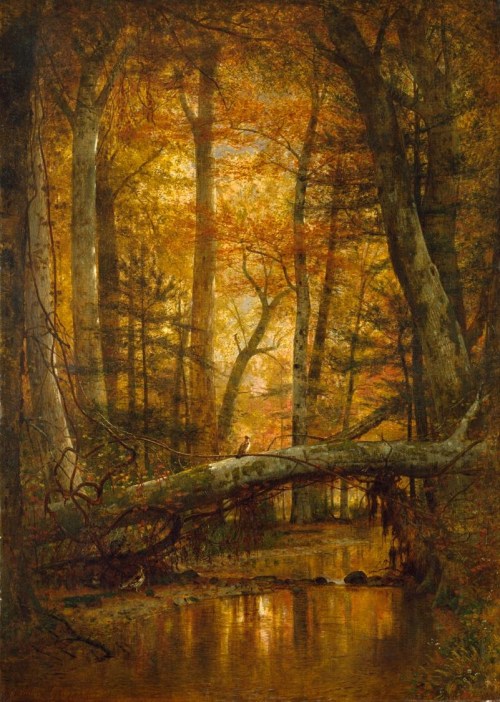
The Catskills, by Asher Brown Durand 1858

Quote from Wikimedia Commons on The Catskills: This painting was commissioned by William T. Walters in 1858, when the 62-year-old Durand was at the height of his fame and technical skill. The vertical format of the composition was a trademark of the artist, allowing him to exploit the grandeur of the sycamore trees as a means of framing the expansive landscape beyond. Durand’s approach to the “sublime landscape” was modeled on that of Thomas Cole (1801-48), founder of the Hudson River school of painting. The painters of this school explored the countryside of the eastern United States, particularly the Adirondack Mountains and the Catskills. Their paintings often reflect the Transcendental philosophy of Ralph Waldo Emerson (1803-82), who believed that all of nature bore testimony to a spiritual truth that could be understood through personal intuition.

>>><<<

Quote from Wikipedia (the fount of all knowledge): Asher Brown Durand is remembered particularly for his detailed portrayals of trees, rocks, and foliage. He was an advocate for drawing directly from nature with as much realism as possible. Durand wrote, “Let [the artist] scrupulously accept whatever [nature] presents him until he shall, in a degree, have become intimate with her infinity…never let him profane her sacredness by a willful departure from truth.”

Like other Hudson River School artists, Durand also believed that nature was an ineffable manifestation of God. He expressed this sentiment and his general opinions on art in his essay “Letters on Landscape Painting” in The Crayon, a mid-19th century New York art periodical. Wrote Durand, “[T]he true province of Landscape Art is the representation of the work of God in the visible creation…”

I grew up in a forested place, not unlike that depicted here. That sentiment has endeared this style of art to me. I have become attached to the modern fantasy painters, those modern artists like Michael Whelan and the late Darrell K. Sweet, who paint images in this style for fantasy novels and RPG games. Their style is called Imaginative Realism.

What strikes me the most about this particular painting is not only the attention to detail, but the fairy-tale quality of Durand’s vision of realism. Viewed as a whole, this composition has an otherworldly quality to it, almost as if Elrond or Galadriel lurk just out of view, beyond the edges.


Credits and Attributions

Wikipedia contributors, “Asher Brown Durand,” Wikipedia, The Free Encyclopedia, https://en.wikipedia.org/w/index.php?title=Asher_Brown_Durand&oldid=845716778 (accessed June 14, 2018).

Wikimedia Commons contributors, “File:Asher Brown Durand – The Catskills – Walters 37122.jpg,” Wikimedia Commons, the free media repository, https://commons.wikimedia.org/w/index.php?title=File:Asher_Brown_Durand_-_The_Catskills_-_Walters_37122.jpg&oldid=164572034 (accessed June 14, 2018).

4 Comments

Filed under #FineArtFriday, writing

Conflict, the core of the story #amwriting

cuckoo_definition_thefreedictionary_lirfI began my current project with an idea for a character, and I knew what the ultimate end of the story is because it is already canon in the Tower of Bones series. The difficulty I have had was devising a completely different culture, the pre-culture if you will.

In the time of the Tower of Bones series, the Temple of Aeos is a finely-tuned machine that serves to distribute food and medical care to the poorer communities, provides education to everyone, provides military protection when needed, and maintains the roads that connect the communities. Mages are sworn to serve the goddess Aeos, and the people of Neveyah, even at the cost of their lives. Although it’s not bandied about, the Temple’s primary function is to find mage-gifted children before their untrained gift wreaks havoc in their communities. Untrained mages have a high chance of becoming the tool of the Bull God, Tauron.

In the current work-in-progress the Temple doesn’t exist. It is born into existence because of the struggles of two larger-than-life characters and the events of these two books.

When I decided to write this story, I had to ask myself three questions. The answers to these questions are what shapes the story arc.

1: The Problem: What is the core conflict?

My protagonist and antagonist are each chosen as champions of their deities. The one who wins decides which deity rules Neveyah, the usurper or the rightful goddess. There is more than simply a world at stake here—the balance of the worlds is threatened as there must be one world for each living god, and even though he is imprisoned, Ariend still lives.

One deity, the mad god Tauron, is the cuckoo in their nest. He was not born a child of the Mother of All as were the others, but simply appeared one day and was taken in, which upset the balance of the universe.  When no new goddess appeared to be his mate, Tauron’s loneliness caused his descent into madness.

Angry at being denied a wife, Tauron desires to rule the universe and began his quest by assaulting his brother Ariend to claim Aeos as his wife. This was the apocalyptic “Sundering of the Worlds” and nearly destroyed the societies of three worlds.

He has claimed half of Ariend’s world and intends to have the rest. He will take Aeos and her world, believing it is his due.

However, with the imprisonment of Ariend, the gods can no longer interact directly with each other, but must instead act through their champions, who have free will. Religion features strongly in this series, and the concepts of good and evil, moral right and wrong.

2: What do they want? What does each character desire?

Each man desires to unite Neveyah under the banner of his deity. Alf follows Aeos, Goddess of Hearth and Home, who created the world of Neveyah.

Daryk follows Tauron, the Bull God, who created the world of Serende and who imprisoned Aeos’s husband, Ariend the Mountain God, in his effort to force Aeos to become his wife.

Map of the North and the Barbarian Towns, in the time of AelfridAlf’s best friend has triggered a mage trap and fallen to the Dark God. His wife has left him and dumped their sick child on him, and he has been chosen for a task he doesn’t want—that of Shaman. He believes that the Barbarian Tribes are the key to defeating Tauron because their culture is strongly rooted in the concept of community. Each member of the community can defend themselves against raiders, something the people living in the citadels of the south have forgotten.

With the triggering of the trap, Daryk has shed the weakness that was his life as a follower of Aeos. He now understands that only the strong deserve to survive and rule Neveyah, and he believes the Barbarian Tribes are the key to defeating Aeos, as they are trained in war craft.


3: What will they do to get it? How far will each go to achieve their desire?

At times, the line between what is moral and immoral is blurred, as both societies are fundamentally flawed. Both men will stop at nothing to achieve their goals, although of the two, only Alf is burdened with regrets for the choices he makes.

This is the core conflict. How my characters deal with it is the story.


Credits and Attributions:

Cuckoo in the nest definition, The Free Dictionary,

https://idioms.thefreedictionary.com/a+cuckoo+in+the+nest, accessed June 12, 2018.

5 Comments

Filed under writing

Craft and Intention #amwriting

You’ve heard the saying, “a little knowledge is a dangerous thing.” A small amount of knowledge can lead to overconfidence. A person might leap to invalid conclusions based on what they know without considering the things they don’t know.

New authors eagerly soak up the wisdom offered through writing groups, seminars, and handbooks on the craft of writing.

It is only when we begin reading widely, and in many different genres, that we discover a difficult truth: great writing is not simply a matter of following rules.

I know, the editor is implying that grammar doesn’t matter.

But I am not, exactly.

What I am saying is that applying rigid rules to literature is akin to expecting your two-year-old to behave perfectly every moment of every day. The books that move me are young and wild and have occasional tantrums. They’re sometimes messy, dirty little things.

Producing a book is a form of parenthood. Like the unruly toddler, when an author puts her manuscript to bed at the end of the day, it’s the most amazing creature she has ever seen.

As an editor, sometimes I discover life in a manuscript that has broken all the rules.

Grammar rules exist for a purpose, and if done wrong, this breaking of certain rules can destroy a reader’s enjoyment of a story.

However, sometimes when it is done deliberately by someone who understands how to write, this work shines because the writer’s style struck the right chord. Life is a natural consequence of the rush of creativity and is set into the manuscript when the first words are written.

Unfortunately, it is easy to murder what began as a beautiful story. Consider those writers who spend years carefully combing every spark of accidental passion out of their work, creating textbook-perfect sentences that are flat, toneless. When the prose is perfectly flat, the author has no voice and the reader may have no desire to care about the characters or their struggle.

Then, we find authors who randomly have characters swear, not consistently, but off and on, apparently for the shock value. Others might inject a little graphic violence or sex into the spots where they couldn’t think of what to do next.

When you do anything that breaks a rule, you must do it consistently and with purpose. “Shock value” has no value to offer a well-written manuscript, although a well-written manuscript may shock and challenge you.

When you have taken the time to understand how a story is constructed, you begin to find creative ways to phrase things so they keep the story interesting. My suggestion is to learn the rules. When what you write breaks with what is considered accepted practice, do it intentionally. Then, tell your editor what rules you are choosing to ignore and why, and she will make sure you are consistent.

Great authors (and good editors) understand balance.

You want to create a balanced narrative:

  • Information must be delivered only as the protagonist (or reader) needs it. Speaking as an author, it can be difficult to know when to dole out the background, but this is where writing becomes work.
  • The information can never be something everyone already knows, as that is boring.
  • Write with intention, use good grammar, but write using the phrasing and words you think best conveys your story. Refuse to be bullied by people who don’t like work published in your genre and who can’t understand what you are trying to achieve.
  • Write with consistency. If you choose not to use commas to join compound sentences, be consistent, or your narrative will look unedited. If you are consistent, most casual readers won’t notice, although they may think you use too many run-on sentences. However, many more readers are becoming authors, so be wary of breaking that rule.
  • No one will die if you use an adjective or adverb when they are needed. The caveat is don’t use descriptors excessively—creative writers find many ways to show the story, but sometimes only a descriptor will do. At that point, use a “telling” word, rather than going to absurd lengths to show an awkward moment.
  • Show who your people are but allow the reader to form their own idea of beauty. Do give the reader a good general framework to build their visualization around.
  • For the most part, stick to simple basic speech tags like said and replied, and if the conversation has only two people, skip speech tags for an exchange or two. Not for more than two exchanges, however, as lengthy discussions with no speech tags will become confusing.
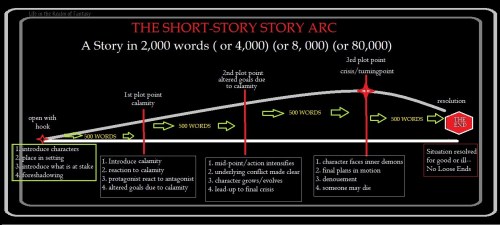
  • Follow the story arc: it must have a beginning, a middle, and an end. A story consists of
  1. A setting
  2. One or more developed characters
  3. A conflict that forces growth/change
  4. A resolution.

Some authors are like pendulums, swinging wildly from one extreme to the other. They leave each meeting of their writing group confused and hurt, burdened with the notion that they are terrible writers. These people work hard and go all out in applying suggestions made by the group. Unfortunately, they’re making their manuscript more unpalatable with each misguided effort.

Their book is being written by a committee, and we all know how poorly some committees function.

First, we must realize that no one writes a perfect, completely flawless manuscript. Even Neil Gaiman and Alexander Chee begin their new works with imperfect first drafts. No novel emerges fully formed, no matter how brilliant the author.

This means we all begin at the same place as writers, all of us mortals with flaws.

So now that we understand we all begin with flawed work, I must ask you this question: are you writing for the critics who might be out there, or because you have a story you are burning to write?

If you are not writing for the joy of writing, quit now.

Otherwise, keep writing. Only by continued practice and attention to learning the craft will you develop the balance you know you need. Buy the Chicago Guide to Grammar Usage and Punctuation, and learn how sentences and paragraphs are constructed. Then learn how to fit those sentences and paragraphs into a story arc.

When you break a rule, be knowledgeable and do it with style.

You can gain a handle on balance by writing short-stories and essays.

With each short-story you write, you increase your ability to tell a story with minimal exposition and intentional prose. This is especially true if you limit yourself to writing the occasional practice story—telling the whole story in 1000 words or less. These practice shorts serve several purposes:

  • You have a finite amount of time to tell what happened, so only the most crucial of information will fit within that space.
  • You have a limited amount of space so your characters will be restricted to just the important ones.
  • There is no room for anything that does not advance the plot or influence the outcome.
  • You will build a backlog of short stories and characters to draw on when you need a good story to submit to a contest.

Go for the gusto, and try writing flash fiction–give yourself less than 1000 words to tell a story.

You can also challenge yourself to tell a story in around 100 words. That is called a drabble and is an art form in itself.

I write epic and medieval fantasy, but I also write short literary fiction and poetry. I read in all genres and learn from what I read—I learn many things I like and much I do not, simply by reading. I read everything from vampire romances, to science fiction, to classical literature. Think about this: the first superhero adventure, a pair of genre fiction novels written for the entertainment of the masses were two books written by Cervantes, and which are now known as “Don Quixote.”

Today’s novel has a chance of becoming tomorrow’s classic if you are brave and bold enough to write it.

9 Comments

Filed under writing

#FineArtFriday: Rembrandt through his own eyes, 1659

Rembrandt Harmenszoon van Rijn, commonly known simply as Rembrandt, is considered the finest artist of the 17th century. Some art historians consider him the finest artist in the history of art, and the most important artist in Dutch art history.

Speaking strictly as a Rembrandt fangirl and abject admirer, I consider his self-portraits to be more honest than those of any other artist.

Quote from Wikipedia: His self-portraits form a unique and intimate biography, in which the artist surveyed himself without vanity and with the utmost sincerity.

This honesty comes across in all his works featuring himself as the subject, even those where he portrays himself as a shepherd or the prodigal son. Each portrait shows an aspect of his personality, his sense of humor, his affection for Saskia who was the love of his life, and his wry acceptance of his own human frailties.

Rembrandt knew he was talented, but didn’t see himself as a creative genius. He was just a man with a passion for art, who lived beyond his means and died a pauper, as did Mozart, and as do most artists and authors.

I feel I know this man, more so than I do the person he was in his earlier self-portraits. He’s matured, lost some of the brashness of his youth. When I observe the man in this self-portrait, painted ten years before his death, I see a good-humored man just trying to live a frequently difficult life as well as he can. His face is lined and blemished, not as handsome as he once was. But his eyes seem both kind and familiar, filled with the understanding that comes from living with all one’s heart and experiencing both great joy and deep sorrow.

The art of Rembrandt van Rijn shows us his world as he saw it. Others may disagree with me, but I feel his greatest gift was the ability to convey personality with each portrait. This gift allowed him to portray every person he painted as they really were, blemished and yet beautiful. This is a gift he taught his students, and they were able to copy his style quite effectively, making discerning his true work difficult even for the experts.


Credits and Attributions:

Wikipedia contributors, “Rembrandt,” Wikipedia, The Free Encyclopedia, https://en.wikipedia.org/w/index.php?title=Rembrandt&oldid=844357531(accessed June 8, 2018).

Wikimedia Commons contributors, “File:Rembrandt van Rijn – Self-Portrait – Google Art Project.jpg,” Wikimedia Commons, the free media repository, https://commons.wikimedia.org/w/index.php?title=File:Rembrandt_van_Rijn_-_Self-Portrait_-_Google_Art_Project.jpg&oldid=292800848 (accessed June 8, 2018).

4 Comments

Filed under #FineArtFriday

Creating your author blog part 3 #amwriting

Today marks the end of my three-part series on author blogs. (Edited to add: Parts 1 & 2 can be found at these links:)

Creating Your Author Blog, Part 1

Creating your Author Blog, Part 2

One of the comments authors make most often when explaining why they don’t keep their blogs updated, is that they don’t know what to write about. One well-known author told me she sees it as a job that is as exciting as doing laundry.

I think it’s because it hasn’t occurred to her to write about her passions. She is a woman who has many different hobbies—climbing, cooking, and kick-boxing, as well as writing. It just hasn’t occurred to her to write a 500-word article about what she did over the weekend and post it for her fans to read. As a fan, I’d love to hear about her trip to the Sasquatch! Music Festival at the Gorge and get her opinion on the various bands that played there.

However, my friend regularly tweets about her hobbies. The fact is, many authors who use twitter to connect with fans don’t think that their lives are worthy of more than the 280 characters you must work with in a tweet. But a blogpost doesn’t have to be long. Think of it as a long tweet or Facebook post, and you will have 300 – 500 words written in no time.

That is an acceptable blogpost. My first posts averaged 400 words.

A great many of us are quite adept with Facebook as a medium for connecting with readers. The work you put into a Facebook post for your author page or a tweet could easily be turned into a short blog post.

If you fall into that category, even a bi-monthly update on your works in progress and where you will be signing books is a good option. We just need something to  keep our fans engaged.

Needing a blogpost is also an opportunity to quickly dash off a flash-fiction, a drabble, or a haiku. Authors need to write and keeping our blogs updated is a good way to keep those juices flowing when we are having a creative lull in other areas.

Life, my family, and the nuts-and-bolts of writing craft are my inspiration. I am always educating myself in this craft, and since writing is my obsession, that is usually what I riff on for 500 – 1000 words at a time.

However, I sometimes write about the challenges life hands us. I will talk about the worry of having two adult children who live with epilepsy. I have discussed how being vegan adds culinary adventure to attending conventions. I also have many creative grandchildren, some of whom who give me career advice, some of the more hilarious of which have made fun posts.

Sometimes, during the week, interesting things will come up in conversations in the writing groups I visit on Facebook. Often these little questions and how they relate to my own works-in-progress are subjects that I think might make a good topic for a blogpost. So, I keep a sticky note up on my desktop and note my ideas for topics as I come across them.

Usually, the only day I write blog posts is Sunday, but I write the entire week’s posts that day. Sometimes, I write them the day before I intend to schedule them, but I like to do them well in advance, so I can proofread them with fresh eyes before their posting.

Sometimes there is research involved, and I need to quote other websites. When that is the case, I make footnotes at the bottom of my composition document as I go. Pretend I need to quote from an article on Gallows humor. Footnotes or attributions are written like this:

Wikipedia contributors, “Gallows humor,” Wikipedia, The Free Encyclopedia, https://en.wikipedia.org/w/index.php?title=Gallows_humor&oldid=759474185 (accessed January 30, 2017).

If you are using images or quotes found on the web, only publish those you have the legal right to use. Do the right thing, and source your images and quotes responsibly. To find out more on that subject, see my article of September 4, 2017, Citing Sources and Image Attribution.

Some people wonder why I make footnotes at the end of most of my posts. I didn’t always do this, because I didn’t understand that even public domain and royalty free images found on Wikipedia should be attributed correctly. It’s our legal obligation, but there is a moral one here too: photographers and artists are as proud of their work as we are of ours—if you wrote something good and someone quoted you verbatim, wouldn’t you want to be credited? When you see your book offered for free on a pirate’s website, don’t you feel anger?

After my post is written in a document, I open WordPress or Blogger and select new blog post. Then, before I do anything else, I insert the title and schedule the date for publishing, so the post is prescheduled for the right publishing date. Prescheduling allows my blog to post a new article three times a week at 06:00 am my time (on a Monday, Wednesday, or Friday) which is 09:00 US Eastern time. It updates without my having to babysit it.

I do have to be observant when I am scheduling my posts. Occasionally, I accidentally hit the “publish immediately” button, which means I end up with an extra post that week whether I meant to or not. When that happens, I sometimes use naughty words. When I get done cursing, I either skip the Monday post or write an extra one.

Once I have the post scheduled, I select the categories and tags.

For an author who is posting once a week or twice a month, it won’t take an hour to put together a post if you write in a word document, spell-check it, and paste it into the body of the post. I spell-check and self-edit my posts as well as possible. Blogposts don’t require an editor, but you should, at a minimum, check for these things:

  • We need to look for incorrectly spelled words and doublecheck the spelling of proper names. We also need to look for words that sound the same but are spelled differently.
  • We need to use good grammar—when we are blogging, it doesn’t have to be perfect but do your best. It will sound like you, and that is important.
  • Also look at sentence structure. Did you use complete sentences? What about run-on sentences? Lo-o-o-o-o-ng sentences can make reading a post confusing.
  • Numbers. This is especially an issue when using digits, as the difference between 10 and 100 is substantial.
  • Look carefully for dropped words or repeated words—my big bugaboo is the extra and or to in a sentence: and and.

Once I have my post edited as well as I can, I paste the document into the body of the post. It is a good idea to use the preview function and read your post. It looks different there than it does in a word doc, so you will find many things you want to change and can make any adjustments needed before the blog is actually posted. Even so, I always miss a lot of typos and other bloopers, so don’t freak if you have to go back and take the apostrophe of a plural word that is not a possessive: sharks vs shark’s (as I regularly have to do.)

Blogs look nice with an image, so insert pictures. I love looking for images on Wikimedia Commons and other free public domain sites, or sometimes I use my own photographs/graphics.

Blogging is where I come to talk about things that are on my mind, which are usually ideas about writing craft. Having the ability to write each post ahead of time, edit them, and select the date for publishing allows me to work the rest of the week at my true job, which is writing novels.


(07 June 2018) Edited to add the links to the previous posts:

Creating Your Author Blog, Part 1

Creating your Author Blog, Part 2

10 Comments

Filed under writing

Creating your author blog part 2 #amwriting

As last week’s post, Creating your author blog part 1, much of this is taken from earlier posts on this subject, so if you have seen it before, thank you for stopping by, and the next post will be on sourcing content for our blog posts.


Once you have your blog set up, and the catchy title picked out, etc., it’s time to start writing. Both WordPress and Blogger offer you the ability to use html (Text) if you choose, which I don’t have a clue about, or to go with the Visual (what you see is what you get). Unless you are a programmer, stay with ‘Visual.

In WordPress, choose a category now for your post–do it first, so you don’t forget to do it. I published this post in the category of writing.  Each blog post may have a different category, but you decide what your categories are. If you should forget to choose the category, it will go into the ‘uncategorized’ pile–the dreaded WordPress slush-pile where blogs go to die.

Also in WordPress, chose a few TAGS now, if you know what you’re writing about, so that you don’t forget to tag the post. That button is below the Categories list. Chose tags that most represent the core of your post, so that searchers for that subject will find your post.

For this post, I am using ‘blogger, blogspot, blogging, WordPress, WordPress blog how-to.’

If you are using Blogger, PICK YOUR LABELS NOW–Blogger doesn’t use categories, so your labels are very important. On the right-hand side, click on ‘LABELS’ and simply type your key words into the BOX, separated by commas. In Blogger, LABELS are what TAGS are in WordPress, so use words that represent the core of what you are blogging about so that interested searcher will find your blog.

Next, schedule your post: In WordPress, in the the right-hand menu-list you will open the the ‘status bar.’ Use the calendar to pick the date and set the time of day you want the post to go live.

Here is the screenshot that shows you where everything is in WordPress:

Wordpress_how2blog_screenshot2018

And for Blogger it looks like this:

blogger_details_screenshot

Now that you have that out-of-the-way, it’s time to blog!

  1. Hook me with that catchy blog post title! Pretend this post is called “Blogging for beginners.” Pretty boring, but hey – it is what it is.
  2. Put that title in the white box at the top of the page and DO IT NOW, so you don’t forget to give your post a title.

Now there are two paths for you. You can choose to wing it, keying directly into the post box as I sometimes do, or you can write it on a WORD document, edit it at your leisure, and copy and paste it into the body of the post. (In WordPress, depending on the platform’s mood, you may have to key “cntrl V” to paste it into the post box.)

Both Blogger and WordPress have spell check functions, and both will save at times as you go. However, spell check only picks up misspelled worlds, and doesn’t catch errors that involve correct spelling. When I key directly into the post box, some errors may get overlooked in the proofing process. I do try to correct them but I sometimes don’t notice them for several months, so blogging can be a lesson in learning to laugh at yourself.

Now we want to add a picture. In WordPress, place your cursor in the body of the blog post and click once at the spot where you will want the image. Then scroll up to the left side of the ribbon (tool box) and click on the circle with a + sign in it, where it says ‘Add’ (when you hover your mouse over it, it will say ‘insert image.’ This symbol is a little obscure, but once you find it, you are good to go.

If this is your first blog post, you won’t have anything in your media library yet, so click on “Upload Files.” Practice uploading images and inserting them, playing with it until you feel comfortable and know how to ensure the image will appear where you want it and will be the size you want it to be. Then, once the image in the body of the post you click on the picture, and a new toolbox opens. That is where you make your adjustments for positioning and size. You can even add captions if you wish.

In Blogger you also click on the little picture in the ribbon (when you hover your mouse over it, it will say ‘insert image’). A pop-up menu will appear, and then you will upload the image, decide the placement and the size.  This nearly foolproof simplicity is why most people who have “never done this before” like Blogger more than WordPress.

All you have to do now is post your links to Twitter, Facebook, Tumbler and all other social media you can think of. It is quite easy to set up, and you rarely need to refresh those connections.

This is where WordPress really excels.

In WordPress, we have the “publicize” option which will automatically post to our other social sites. In the Settings menu, open “sharing” and click on it. that will take you to the “Sharing Settings” page. Click on the button that says, “Publicize Settings.” That will open a list of what I think of as blog warehouses, places that collect blogs and offer them to their regular readers. You want to activate as many of them as you can.

It will take a long time for you to build up good traffic – when I began in 2011 I averaged 4 to 10 visits a day. I see those months as my training months, a time when I was able to get a feel for this craft. I have a lot more readers now because I have gained many good friends here through WordPress and am diligent about keeping this blog updated.

I highly recommend blogging if you are serious about being an author, as it helps develops your writing craft, especially when you must go in and edit out your mistakes after they have posted. People expect blogs to be a little rougher than other work as it is usually written on the wing but try to do your best work—you want people to buy your books, and they won’t if your blog posts seem illiterate.

As I mentioned above, my next post will discuss the nuts and bolts of sourcing content and writing the posts, including little tricks I use for catching most typos and misspelled words before my work posts.

9 Comments

Filed under blogging, writing