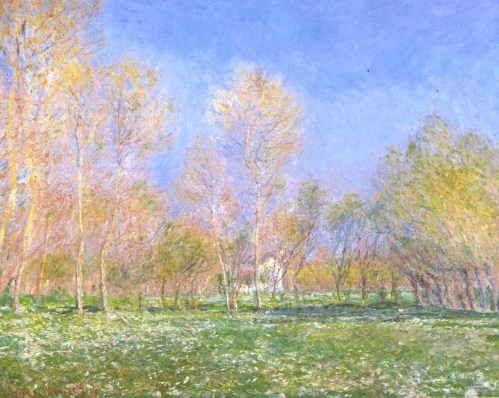
#FineArtFriday: Spring in Giverny by Claude Monet 1890

Monet_-Spring_in_GivernyArtist: Claude Monet  (1840–1926)

Title: Spring in Giverny

Date: 1890

Medium: oil on canvas

Dimensions: height: 64.8 cm (25.5 in); width: 81 cm (31.8 in)

Inscriptions: Signature and date bottom left: Claude Monet 90

What I love about this painting:

The fruit trees are flowering in the part of the world where I live. All along the streets, in back yards, and public areas, apple, cherry, and flowering plum trees are covered in buds, their branches tinted with shades of pink and white. The Pacific Northwest is bursting into color. The streets in our town are lined with trees of pink and white.

Yellow forsythia is blooming, and dogwood brightens each neighborhood. Flowering trees and ornamental shrubs bring swathes of welcome color to the gray and rainy days of March.

Monet’s trees show us the appreciation the artist had for nature. His fruit trees and ornamental trees make me happy too. We need the color, need the sunshine.

Thank you, Claude Monet, for sharing this moment in time with us.

About the Artist, via Wikipedia:

Oscar-Claude Monet 14 November 1840 – 5 December 1926) was a French painter and founder of impressionist painting who is seen as a key precursor to modernism, especially in his attempts to paint nature as he perceived it. During his long career, he was the most consistent and prolific practitioner of impressionism’s philosophy of expressing one’s perceptions of nature, especially as applied to plein air (outdoor) landscape painting.  The term “Impressionism” is derived from the title of his painting Impression, soleil levant, exhibited in 1874 (the “exhibition of rejects”) initiated by Monet and his associates as an alternative to the Salon. [1]

Read the rest of the article at Claude Monet – Wikipedia


Credits and Attributions:

IMAGE: Wikimedia Commons contributors, “File:Monet – Frühling in Giverny.jpg,” Wikimedia Commons, https://commons.wikimedia.org/w/index.php?title=File:Monet_-_Fr%C3%BChling_in_Giverny.jpg&oldid=654964112 (accessed March 21, 2024).

[1] Wikipedia contributors, “Claude Monet,” Wikipedia, The Free Encyclopedia, https://en.wikipedia.org/w/index.php?title=Claude_Monet&oldid=1213738859 (accessed March 21, 2024).

4 Comments

Filed under writing

The potential for drama #writing

Last week, we talked about transition scenes. We talked about how the resolution of one event takes us to a linking point that takes us further into the story. We talked about how, without transition scenes to link them, moments in time appear random, as if they don’t go together. They push the plot forward. Action, transition, action, transition—this is pacing.

MyWritingLife2021BBut how do we recognize when a moment of action has true dramatic potential? We try to inject action and emotion into our scenes, but some dramatic events don’t advance the story.

  • How do we recognize when an action scene is not crucial, not central to the overall plot arc?

I find that my writing group is essential in helping me eliminate the scenes that don’t move the plot forward, even though they might be engaging stories within the story.

It’s easy to be so attached to a particular scene that we don’t notice that it’s a side quest to nowhere.

If that happens to you, don’t throw it out! Save it in a file labeled “outtakes,” and with a few minor changes, you can reuse that idea elsewhere. A side quest might slow down the pacing of one story. But that quest, with different characters and places, could be the seed of an entirely different story.

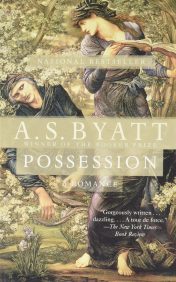
Possession_ASByatt_coverRecognizing where the real drama begins is tricky. Let’s have a look at the novel Possession: A Romance by A.S. Byatt (pen name of the late Dame Antonia Susan Duffy DBE), winner of the 1990 Booker Prize.

The story details two complex relationships viewed across time. The modern relationship begins in an unexpected way. The novel opens in a library, a place of silence and solitude where one would think the only opportunity for drama is within the pages of the tomes lining the shelves.

But Byatt saw the potential for real drama in that quiet, dusty place. Her protagonist, Roland Michell, a scholar and professional man of high morals, commits a crime. There isn’t anything exciting about a professor sitting in a library and researching the lives of dead poets—that is, until he pockets the original drafts of letters he has come across in his research.

A person unfamiliar with academic research might not understand how such a small, seemingly inconsequential theft could possibly have a dire outcome.

  • This is the moment that has the potential of ruining his career, destroying everything he has worked for.
  • The consequences of this act hang over him to the end.

About the book, via Wikipedia:

The novel follows two modern-day academics as they research the paper trail around the previously unknown love life between famous fictional poets Randolph Henry Ash and Christabel LaMotte. Possession is set both in the present day and the Victorian era, contrasting the two time periods, as well as echoing similarities and satirizing modern academia and mating rituals. The structure of the novel incorporates many different styles, including fictional diary entries, letters and poetry, and uses these styles and other devices to explore the postmodern concerns of the authority of textual narratives. The title Possession highlights many of the major themes in the novel: questions of ownership and independence between lovers; the practice of collecting historically significant cultural artifacts; and the possession that biographers feel toward their subjects.

AS. Byatt, in part, wrote Possession in response to John Fowles‘ novel The French Lieutenant’s Woman(1969). In an essay in Byatt’s nonfiction book, On Histories and Stories, she wrote:

“Fowles has said that the nineteenth-century narrator was assuming the omniscience of a god. I think rather the opposite is the case—this kind of fictive narrator can creep closer to the feelings and inner life of characters—as well as providing a Greek chorus—than any first-person mimicry. In ‘Possession’ I used this kind of narrator deliberately three times in the historical narrative—always to tell what the historians and biographers of my fiction never discovered, always to heighten the reader’s imaginative entry into the world of the text.” [1]

So, Byatt changes narrative point of view in this tale when necessary, as a means to better explore an aspect of the story. That is a neat trick, if done right, which she does. (Done wrong, it has the potential of adding chaos to the narrative.)

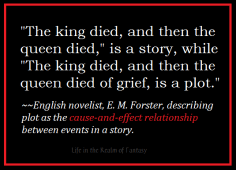
e.m. forster plot memeI admire the audacity of having Michell, a protagonist who considers his professional reputation as his most prized possession, commit such a catastrophic action as stealing those original letters. It proves there is potential for drama in the least likely places.

I have been known to spend months writing the wrong story.

Instead of following the original outline, I took the plot off on a tangent and wrote myself into a corner. Then, once I admitted to myself that there was no rescuing it, I moved on to something else.

Most writers don’t see where they’ve gone awry until someone else points it out, or they step away from it for a while.

Once I give up and set a work that is stalled aside for a month or two, these things are easier to see. In the case of one novel, I cut it back to the 20,000-word mark and made a new, more logical outline. Writing went well after that, and so far, I’m getting good, useable feedback.

Creators see their work the way parents see their children. We tend to think every scene is golden. Unfortunately, some events I might believe are necessary—aren’t.

In reality, they lead the story nowhere.

desk_via_microsoft_stickers

courtesy Office 360 graphics

But I love my children, even the unruly ones. Nothing is a waste of time, and those scenes become the basis of novellas and short stories.

The ability to recognize the potential for a crucial dramatic moment is a matter of perspective. It is the ability to see the story arc as a whole before it is fully formed.

It is also the knack of knowing what kind of drama the story needs and where it should fit within the plot arc.


Credits and Attributions:

[1] Wikipedia contributors, “Possession (Byatt novel),” Wikipedia, The Free Encyclopedia, https://en.wikipedia.org/w/index.php?title=Possession_(Byatt_novel)&oldid=1189753614 (accessed March 19, 2024).

1 Comment

Filed under writing

Random thoughts about #Writing #Romance

Fantasy is a popular genre because it involves people, and sometimes it features romantic love.  People are creatures of biology and emotion. When you throw them together in close quarters, romantic connections can form within the narrative.

WritingCraftSeries_romanceI’m not a Romance writer, but I do write about relationships. Readers expecting a standard romance would be disappointed in my work which is solidly fantasy. The people in my tales fall in love, and while they don’t always have a happily ever after, most do. The other aspect that would disappoint a Romance reader is the shortage of smut.

I think of sex the way I do violence. Both occur in life, and we want our characters to live. While I have been graphic when the story demanded it (Huw the Bard, Julian Lackland, and Billy Ninefingers), the stories are about them as people and how events shaped them. I’m more for allowing my characters a little privacy.

I flounder when writing without an outline. Even in the second draft, I’ve been known to lose my way.

I struggle when attempting to write the subtler nuances of attraction and antipathy. We are sometimes repulsed by a person, and when trying to show that, I find myself at a loss for words.

When I’m building the first draft, emotions seem to come out of nowhere and feel forced.

monkey_computer_via_microsoft

courtesy Office360 graphics

For me, the struggle is in foreshadowing these relationships and showing the gradual connection as it grows between two people.

I have friends who write Romance. I read their work, and I’ve attended workshops given by Romance writers and learned a great deal from them. However, being on the spectrum, as they say nowadays, I learn by pursuing independent study.

That works for me because I can’t pass up buying any book on the craft of writing.

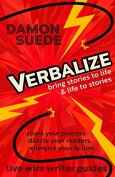
Two books in my writing craft library that have seen heavy use were written by Damon Suede, who writes Romance. He explains how word choices can make or break the narrative.

As a reader, I have found his viewpoint to be accurate. As a writer, I have found putting it into practice takes work.

Verbalize_Damon_SuedeIn his book Verbalize, Mr. Suede explains how actions make other events possible. Crucially for me, he reminds us that even gentler, softer emotions must have verbs to set them in motion.

Emotions are nouns. I sometimes struggle to find the best verbs to push my nouns to action.

Matching nouns with verbs is key to bringing a scene to life.

This is where writing becomes work. It’s time to get out the Oxford Dictionary of Synonyms and Antonyms and delve into the many words that relate to and describe attraction. Or I can go online: ATTRACTION Synonyms: 33 Synonyms & Antonyms for ATTRACTION | Thesaurus.com

I make a list of the words that I think will fit my characters’ personalities. Then, I have to choose the words that say what I mean and fit them into the narrative. Sometimes, this means I will rewrite a sentence two or three times before it says what I intend and flows naturally.

desk_via_microsoft_stickers

courtesy Office 360 graphics

I have written two accidental novels. Both feature romances, and because the novels were spewed onto the page, the relationships developed without preplanning.

Now, I’m in the final stages of one of these novels. The last two years have been spent fine-tuning the attractions and showing the growth of their relationships while exploring the central theme through the events my protagonists experience. (Have I mentioned it takes me four years to get a book from concept to publication?)

For me as a person and as a reader, true Romance has an air of mystery, of something undiscovered. It has to be a little bit magical, or I can’t suspend my disbelief.

I have no trouble writing adventures for my people. I have no difficulty noticing when two characters are gravitating toward one another. Writing the mystery of attraction, injecting the feeling of magic into it is the tricky part.

Book- onstruction-sign copyWhen a beta reader tells me the relationship seems forced, I go back to the basics and make an outline of how that relationship should progress from page one through each chapter. I make a detailed note of what their status should be at the end. This gives me jumping-off points so that I don’t suffer from brain freeze when trying to show the scenes.

As I am rewriting the scenes involving a romance, I want to avoid weak phrasing. I look at the placement of verbs in my sentences. If it feels weak, as if told by an observer, I move the verbs to the beginning of the sentence so that my characters do things. I don’t want someone saying they did it. I want the reader to experience doing it.

    1. Nouns followed by verbs feel active. Bystanders narrate, but characters do.

Don’t get me wrong—some stories need an all-encompassing narrator. But most of the time, we’re not interested in being told what happened. We want to experience it ourselves, which is why I gravitate to one character’s point of view. Our characters are unreliable narrators, giving us their opinions and shading the truth, and are more interesting because of that.

lute-clip-artI think our characters have to be a little clueless about Romance, even if they are older. They need to doubt, need to worry. They need to fear they don’t have a chance, either to complete their quest or to find love.

Romance writers have it right: overcoming the roadblocks to happiness makes for great love stories. This is why I read in every genre. I try to learn what I can from the masters, seeing how they use their words to write their scenes and construct their stories.

Romance is drama, but it isn’t the entire story.

Adam Savage said something about drama and creativity on his recent podcast, talking about Stanley Kubrick’s creative process. He said that what Kubrick was good at was recognizing the points when a story could create drama.

And recognizing those places with potential is crucial to creating a great novel or short story. We will explore that thought further on Wednesday.

5 Comments

Filed under writing

#FineArtFriday: The Louvre, Morning, Spring by Camille Pissarro 1902

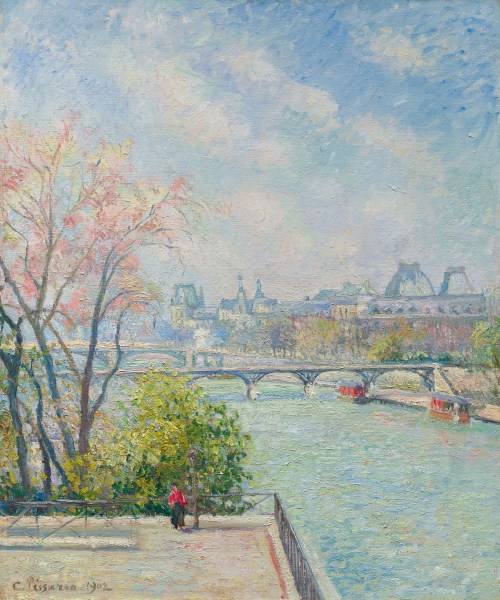
1902_Camille_Pissarro_Le_Louvre,_matin,_printempsArtist: Camille Pissarro  (1830–1903)

Title: French: Le Louvre, Matin, Printemps (English: the Louvre, morning, spring)

Date:1902

Medium: oil on canvas

Dimensions: height: 54 cm (21.2 in), width: 64.8 cm (25.5 in)

References: https://www.sothebys.com/en/buy/auction/2023/modern-evening-auction-5/le-louvre-matin-printemps

What I love about this picture:

This is the way spring begins, tentative and holding back as if gauging the audience before leaping to center stage. The style of brushwork lends itself to the misty quality of the pastels of March and early April.

This was one of Pissarro’s final works. It is a pretty picture, a simple scene not unlike one I might see here in the Pacific Northwest this weekend. We are supposed to see a sunny stretch tomorrow through Tuesday, a few days of warmth without rain. The flowering plum trees in my town are poised to burst forth, and we will take a long drive, soaking up the sunlight while we can.

As I said above, this is a pretty picture, not profound or revolutionary, not highbrow in any way. But sometimes, what the soul needs is a pretty picture featuring the beauty and serenity of a sunny day.

About the artist, via Wikipedia:

Jacob Abraham Camille Pissarro (10 July 1830 – 13 November 1903) was a Danish-French Impressionist and Neo-Impressionist painter born on the island of St Thomas (now in the US Virgin Islands, but then in the Danish West Indies). His importance resides in his contributions to both Impressionism and Post-Impressionism. Pissarro studied from great forerunners, including Gustave Courbet and Jean-Baptiste-Camille Corot. He later studied and worked alongside Georges Seurat and Paul Signac when he took on the Neo-Impressionist style at the age of 54.

In 1873 he helped establish a collective society of fifteen aspiring artists, becoming the “pivotal” figure in holding the group together and encouraging the other members. Art historian John Rewald called Pissarro the “dean of the Impressionist painters”, not only because he was the oldest of the group, but also “by virtue of his wisdom and his balanced, kind, and warmhearted personality”. Paul Cézanne said “he was a father for me. A man to consult and a little like the good Lord”, and he was also one of Paul Gauguin‘s masters. Pierre-Auguste Renoir referred to his work as “revolutionary”, through his artistic portrayals of the “common man”, as Pissarro insisted on painting individuals in natural settings without “artifice or grandeur”.

Pissarro is the only artist to have shown his work at all eight Paris Impressionist exhibitions, from 1874 to 1886. He “acted as a father figure not only to the Impressionists” but to all four of the major Post-Impressionists, Cézanne, Seurat, Gauguin, and van Gogh.

Founder of a Dynasty:

Camille’s son Lucien was an Impressionist and Neo-impressionist painter as were his second and third sons Georges Henri Manzana Pissarro and Félix Pissarro. Lucien’s daughter Orovida Pissarro was also a painter. Camille’s great-grandson, Joachim Pissarro, became Head Curator of Drawing and Painting at the Museum of Modern Art in New York City and a professor in Hunter College’s Art Department. Camille’s great-granddaughter, Lélia Pissarro, has had her work exhibited alongside her great-grandfather. Another great-granddaughter, Julia Pissarro, a Barnard College graduate, is also active in the art scene. From the only daughter of Camille, Jeanne Pissarro, other painters include Henri Bonin-Pissarro (1918–2003) and Claude Bonin-Pissarro (born 1921), who is the father of the Abstract artist Frédéric Bonin-Pissarro (born 1964).

The grandson of Camille Pissarro, Hugues Claude Pissarro (dit Pomié), was born in 1935 in the western section of Paris, Neuilly-sur-Seine, and began to draw and paint as a young child under his father’s tutelage. During his adolescence and early twenties he studied the works of the great masters at the Louvre. His work has been featured in exhibitions in Europe and the United States, and he was commissioned by the White House in 1959 to paint a portrait of U.S. President Dwight Eisenhower. He now lives and paints in Donegal, Ireland, with his wife Corinne also an accomplished artist and their children. [1]


Credits and Attributions:

IMAGE: Wikimedia Commons contributors. File:1902 Camille Pissarro Le Louvre, matin, printemps.jpeg [Internet]. Wikimedia Commons; 2024 Feb 20, 05:48 UTC [cited 2024 Mar 13]. Available from: https://commons.wikimedia.org/w/index.php?title=File:1902_Camille_Pissarro_Le_Louvre,_matin,_printemps.jpeg&oldid=853770801.

[1] Wikipedia contributors. Camille Pissarro [Internet]. Wikipedia, The Free Encyclopedia; 2024 Feb 12, 07:32 UTC [cited 2024 Mar 13]. Available from: https://en.wikipedia.org/w/index.php?title=Camille_Pissarro&oldid=1206477040.

2 Comments

Filed under #FineArtFriday

#PiDay: Elegy for Hawking

Stephen Hawking, Star Child,

Entered the world in the Year of the Horse

While bombs fell over London.

Rebel,

Always went his own way

Even when his way was difficult.

Revolutionary,

Freed his mind to travel the cosmos.

Sat taller in his chair than giants stand.

Quantum thinker,

Body shrunken to a singularity,

Mind as expansive as the universe.

Dreamer,

Stephen Hawking

Left us in the Year of the Dog

While we baked Pi for Einstein

And marveled at what we had lost.


Stephen Hawking,

Born 8 Jan 1942; died 14 Mar 2018 at age 76.

Author, Motivational Speaker, English Theoretical Physicist.

Hawking was the Lucasian Professor of Mathematics at Cambridge University, a position once held by such notables as Charles Babbage and  Sir Isaac Newton. Afflicted with amyotrophic lateral sclerosis (Lou Gehrig’s disease, or ALS), Hawking was confined to a wheelchair and was unable to speak without the aid of a computer voice synthesizer. However, despite his challenges, he made remarkable contributions to the field of cosmology, which is the study of the universe. His principal areas of research were theoretical cosmology and quantum gravity.

Hawking also co-authored five children’s books with his daughter, Lucy.

Hawking’s book list can be found at Amazon: Stephen Hawking’s Author Page 

Popular books

  • A Brief History of Time (1988)
  • Black Holes and Baby Universes and Other Essays (1993)
  • The Universe in a Nutshell (2001)
  • On the Shoulders of Giants (2002)
  • God Created the Integers: The Mathematical Breakthroughs That Changed History (2005)
  • The Dreams That Stuff Is Made of: The Most Astounding Papers of Quantum Physics and How They Shook the Scientific World (2011)
  • My Brief History (2013)

Co-authored

  • The Nature of Space and Time (with Roger Penrose) (1996)
  • The Large, the Small and the Human Mind (with Roger Penrose, Abner Shimony and Nancy Cartwright) (1997)
  • The Future of Spacetime (with Kip Thorne, Igor Novikov, Timothy Ferris and introduction by Alan Lightman, Richard H. Price) (2002)
  • A Briefer History of Time (with Leonard Mlodinow) (2005)
  • The Grand Design (with Leonard Mlodinow) (2010)

Forewords

  • Black Holes & Time Warps: Einstein’s Outrageous Legacy (Kip Thorne, and introduction by Frederick Seitz) (1994)

Children’s fiction

Co-written with his daughter Lucy

  • George’s Secret Key to the Universe (2007)
  • George’s Cosmic Treasure Hunt (2009)
  • George and the Big Bang (2011)
  • George and the Unbreakable Code (2014)
  • George and the Blue Moon (2016)

Stephen Hawking, StarChild, Image By NASA [Public domain], via Wikimedia Commons

Wikipedia contributors, “Stephen Hawking,” Wikipedia, The Free Encyclopedia, https://en.wikipedia.org/w/index.php?title=Stephen_Hawking&oldid=830584312 (accessed March 15, 2018).

Elegy for Hawking, by Connie J. Jasperson © 2018 – 2024 All Rights Reserved

This poem has been posted every year on Pi Day since the day after Hawking’s death.

Comments Off on #PiDay: Elegy for Hawking

Filed under #FlashFictionFriday, Poetry, writing

Transitions – bookend scenes that determine pacing #writing

In the previous post, we talked about scene framing. Scenes are word pictures, portraits of a moment in a character’s life framed by the backdrop of the world around them. Everything depicted in that scene has meaning.

transitionsBut the scenes themselves are pictures within the larger picture of the story arc. Think of the story arc as a blank wall. We place the scenes on that blank wall in the order we want them, but without transition scenes, these moments in time appear random, as if they don’t go together.

Transitions bookend each scene, and the way we use those transitions determines the importance of the passage. The bookends determine the narrative’s pacing.

Transition scenes get us smoothly from one event or conversation to the next. They push the plot forward. Action, transition, action, transition—this is pacing.

The pacing of a story is created by the rise and fall of action.

  • Action: Our characters do
  • Visuals: We see the world through their eyes; they show us something.
  • Conversations: They tell us something, and the cycle begins again.

Do.

Show.

Tell.

I picked up my kit and looked around. No wife to kiss goodbye, no real home to leave behind, nothing of value to pack. Only the need to bid Aeoven and my failures goodbye. The quiet snick of the door closing behind me sounded like deliverance.

The character in the above transition scene completes an action in one scene and moves on to the next event. It reveals his mood and some of his history in 46 words and propels him into the next scene.

He does somethingI picked up my kit and looked around.

He shows us something: No wife to kiss goodbye, no real home to leave behind, nothing of value to pack. Only the need to bid Aeoven and my failures goodbye.

He tells us somethingThe quiet snick of the door closing behind me sounded like deliverance. 

The door has closed, there is no going back, and he is now in the next action sequence. We find out who and what is waiting for him on the other side of that door.

All fiction has one thing in common regardless of the genre: characters we can empathize with are thrown into chaos with a plot.

Remember the blank wall from above and the random pictures placed on it?

Hieronymus Franken the arts

Our narrative begins as a blank wall strewn with pictures. We take those pictures and add transition pictures to create a coherent story out of the visual chaos.

This is where project management comes into play—we assign an order to how the scenes progress.

  • Processing the action.
  • Action again.
  • Processing/regrouping.

Our job is to make the transitions subliminal. We are constantly told, “Don’t waste words on empty scenes.” To be honest, I know a lot of words, and wasting them is my best skill.
bookendOur bookend scenes are not empty words. They should reveal something and push us toward something unknown. They lay the groundwork for what comes next.

What makes a memorable story? In my opinion, the emotions it evoked are why I loved a particular novel. The author allowed me to process the events and gave me a moment of rest and reflection between the action. 

I was with the characters when they took a moment to process what had just occurred. That moment transitions us to the next scene.

These information scenes are vital to the reader’s understanding of why these events occur. They show us what must be done to resolve the final problem.

The transition is also where you ratchet up the emotional tension. As shown in the example above, introspection offers an opportunity for clues about the characters to emerge. A “thinking scene” opens a window for the reader to see who they are and how they react. It illuminates their fears and strengths, and makes them seem real and self-aware.

Internal monologues should humanize our characters and show them as clueless about their flaws and strengths. It should even show they are ignorant of their deepest fears and don’t know how to achieve their goals.

With that said, we must avoid “head-hopping.” The best way to avoid confusion is to give a new chapter to each point-of-view character. (Head-hopping occurs when an author describes the thoughts of two point-of-view characters within a single scene.)

Fade-to-black is a time-honored way of moving from one event to the next. However, I dislike using fade-to-black scene breaks as transitions within a chapter. Why not just start a new chapter once the scene has faded to black?
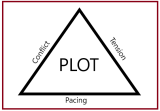
The_Pyramid_Conflict_Tension_PacingOne of my favorite authors sometimes has chapters of only five or six hundred words, keeping each character thread separate and flowing well. A hard scene break with a new chapter is my preferred way to end a nice, satisfying fade-to-black.

Chapter breaks are transitions. I have found that as I write, chapter breaks fall naturally at certain places.

Every author develops habits that either speed up or slow down the workflow. I use project management skills to keep every aspect of life moving along smoothly, and that includes writing.

In my world, the first draft of any story or novel is really an expanded outline. It is a series of scenes that have characters talking or doing things. But those scenes are disconnected. The story is choppy, nothing but a series of events. All I was concerned about was getting the story written from the opening scene to the last page and the words “the end.”

Book- onstruction-sign copyThe second draft is where the real work begins. I set the first draft aside for several weeks and then go back to it. I look at my outline to make sure the events fall in the proper order. At that point, I can see how to write the transitions to ensure each scene flows naturally into the next.

Yes, that first draft manuscript was finished in the regard that it had a beginning, middle, and ending.

But I was too involved and couldn’t see that while each scene was a picture of a moment in time, it was only a skeleton, a pile of bones.

By setting it aside for a while, I’m able to see it still needs muscles and heart and flesh. Transitions layer those elements on, creating a living, breathing story.


Credits and attributions:

IMAGE: Title: The Sciences and Arts

Artist: Hieronymous Francken II  (1578–1623)  or Adriaen van Stalbemt  (1580–1662)

Genre: interior view

Date:   between 1607 and 1650

Medium: oil on panel

Dimensions: height: 117 cm (46 in); width: 89.9 cm (35.3 in)

Collection: Museo del Prado

Notes: This work’s attribution has not been determined with certainty with some historian preferring Francken over van Stalbemt. See Sotheby’s note. Sold 9 July 2014, lot 57, in London, for 422,500 GBP

Wikimedia Commons contributors, “File:Stalbent-ciencias y artes-prado.jpg,” Wikimedia Commons, https://commons.wikimedia.org/w/index.php?title=File:Stalbent-ciencias_y_artes-prado.jpg&oldid=699790256 (accessed March 12, 2024).

4 Comments

Filed under writing

Scene Framing, or how worldbuilding helps tell the story #writing

When I am reading, I become invested in the characters and their problems. The authors I like best use the environment to highlight the characters’ moods and darken or lighten the atmosphere. Their worldbuilding conveys a perception of drama with minimal exposition.

ScenesIn a novel or story, each scene occurs within the framework of the environment.
I think of the written narrative as a camera and visualize my narrative as a movie. The challenge of writing for me is discovering how to best use the set dressing to underscore the drama.

Scene framing is a necessary skill for writers of all stripes. Directors will tell you they focus the scenery so it frames the action. Their intent is that viewer’s attention is drawn to the subtext the director wants to convey.

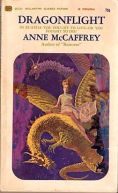
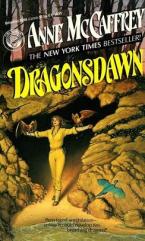
An example of how this works in literature is one I’ve used before, a pivotal scene from Anne McCaffrey’s 1988 novel Dragonsdawn

AnneMcCaffrey_DragonflightThe Dragonriders of Pern series is considered science fiction because McCaffrey made clear at the outset that the star (Rukbat) and its planetary system had been colonized two millennia before, and the protagonists were their descendants.

Some elements of the narrative are considered fantasy because they feature dragons and telepathy.

The early novels detail the gradual rediscovery of lost technology and the revelation of their forgotten history. The stand-alone novel I’m discussing today, Dragonsdawn, is a how-it-all-began novel, and it reinforces the science fiction nature of the series.

  • It explains the science behind McCaffrey’s dragons and why they were genetically engineered to be what they are.

The story follows several POV characters, giving us a comprehensive view of the colony’s successes and failures. For the first ten years, the planet Pern seemed a paradise to its new colonists, who were seeking to return to a less technologically centered, agrarian-based way of life. They believe Pern is the place where they can leave their recent wars and troubles behind.

A decade after arriving on the planet, however, a new threat appears. It is a deadly, unstoppable spore that periodically rains from the skies in the form of a silvery Thread that mindlessly devours every carbon-based thing it touches.

Plot-exists-to-reveal-characterThe scenes we are looking at today have two distinct environments to frame them. In both settings, the surroundings do the dramatic heavy lifting. This chapter is filled with emotion, high stakes, and rising dread for the sure and inevitable tragedy that we hope will be averted.
  • While there is high drama in Sallah Telgar‘s direct interaction with Avril Bitra, the visuals and sensory elements of each environment reinforce the perception of impending doom.

The story at this point: We are at the halfway point of the book. Before the advent of Thread, Avril disappeared, gathering resources and intending to leave the planet with as much treasure as she can carry. She has been pretty much forgotten by the others but has an agenda and refuses to be thwarted.

In the first scene of this chapter, we are focused on Sallah, one of our protagonists. We see her leaving her children at the daycare. Such a common, ordinary thing, dropping off your children on your way to work.

The focus zooms out, and we see Kenjo, the pilot, putting the last of the precious fuel into the only working shuttle, the Mariposa. This shuttle has been refitted for one last science expedition: to discover the source of the deadly Threads. He is to retrieve a sample, knowing that if this mission fails, there will be no other.

The focus returns to Sallah, who observes a woman she recognizes as Avril Bitra slipping through the abandoned shuttles on the landing grid.

Sallah wonders what Avril is up to. The view widens again as we see Avril following the pilot, Kenjo, who vanishes. We then see her entering the Mariposa alone.

Sallah makes a spur-of-the-moment decision to follow Avril to see what she’s up to. This plot point is an example of a point of no return, which we discussed last week,

Here is where the sparse visual mentions of the environment become crucial as they emphasize the stark reality of Sallah’s situation.

compositionANDsceneFramingLIRF03092024Sallah enters the shuttle just as the airlock door closes, catching and crushing her heel. She manages to pull it out so that she isn’t trapped, but she is severely injured.
Later, the dark, abandoned interior of the Yokohama reinforces Sallah’s gut-wrenching realization that her five children will grow up without a mother.

Something we haven’t talked about is subtext.

Subtext is what lies below the surface. It is the hidden story, the hints and allegations, the secret reasoning we infer from the narrative. It’s conveyed by the images we place in the environment and how the setting influences our perception of the mood and atmosphere.

Subtext supports the dialogue and gives purpose to the personal events.

Scene framing is the way we stage the people and visual objects. What furnishings, sounds, and odors are the visual necessities for that scene?

Whatever you mention of the environment focuses the reader’s attention when the characters enter the frame.

  • In this chapter of Dragonsdawn, we see the junk and scrap on the grid and the decaying shuttles.
  • Two shuttles have been dismantled and parted out. Their components are crucial in keeping the few cargo sleds that have been converted to Thread-fighting gunships in working order.
  • Only one shuttle remains in usable condition.
  • On the Yokohama, it is dark and frigid, and the interior has been partially gutted. Anything that could be carried away has been taken to the ground and repurposed.

Sensory details are vital, showing how the environment affects or is affected by the characters.

  • Conversely, not mentioning the scenery during a conversation brings the camera in for a close-up, focusing solely on the speaker or thinker.

A balance must be struck in how your characters are framed in each scene. We flow from wide-angle, seeing Salla floating in freefall, blood pooling in her boot. The camera moves in, a close-up showing Avril’s rage at the fact that she can’t control the course of the Mariposa, which is programmed to dock at the Yokohama.

We are there when Avril taunts Sallah for her matronly body. A feeling of helplessness comes over us as Avril ties a cord to Sallah’s crushed foot and forces her to make the navigational calculations for Avril’s escape. The camera moves in, and we hear the interaction.

Sallah pretends to do as Avril asks. But really, she sets her enemy’s doom in action. The camera moves to the wider view again, seeing her at the controls in the dark, using the last of her energy. Worst of all, we know she is dying, and she understands there is no rescue for her.

  • We hear the interaction with her frantic husband on the ground.

Dragonsdawn_coverThis is an incredibly emotional scene: we are caught up in her determination to seize this only chance, using her last breaths to get the information about the thread spores to the scientists on the ground.
We learn how to write from reading the masters. We learn by observing how others use the setting to support and reinforce the subtext of the conversations and events.

Scene framing is a cornerstone of worldbuilding, and when it is done right, it can make a scene feel powerful.

Next up: Transitions

6 Comments

Filed under writing

#FineArtFriday: A second look at two paintings by H. A. Brendekilde

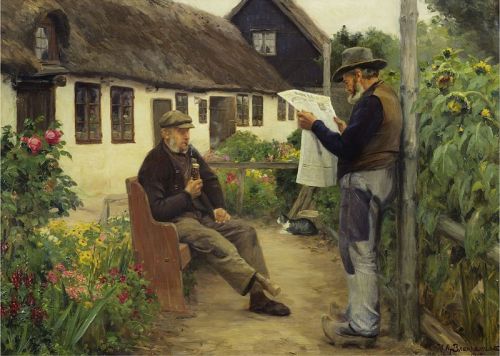
H. A. Brendekilde is one of my favorite artists, which is why I wanted to revisit these two paintings. There is a story in the above painting. I love the details—the patched trousers of the gardener, the mud on his clogs, the other man’s wooden leg—juxtaposed against the lush spring garden and prosperous village life of Denmark in 1912. Their hands and clothes indicate they have stopped work to read the newspaper. Both men seem stunned. Are they perhaps reading of the death of King Frederick VIII, who died on 14 May 1912?

Whatever they are reading, the cat remains undisturbed by the news. Even in 1912, cats were notoriously unconcerned about the life or death of kings.

The next painting also tells a powerful story.

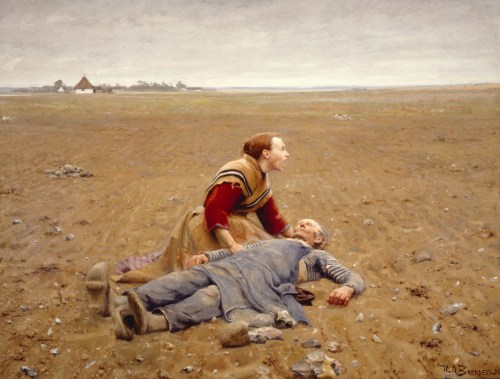
H. A. Brendekilde was a forerunner of the social realist style, embraced by Diego Rivera. His early work often depicted the daily lives of the rural working class. One of his most famous paintings, “Worn Out” (1889) shows an elderly man lying fallen on his back in the plowed field. He has collapsed while picking stones, preparing a field for planting. The stones he had gathered have scattered across the ground, and one of his clogs has fallen off his foot.

Has he worked himself to death? Will he recover? His entire world is this rocky barren field.  A story is in this stark painting.


About the Artist via Wikipedia (be patient–this was written by a non-native English-speaker. We should all speak a foreign language so well!)

[1] Hans Andersen Brendekilde (7 April 1857 – 30 March 1942) was a Danish painter.

Brendekilde’s influence was great not only on society, but also on his many friends among painters and potters. Among the painters especially on L.A. Ring. During their young and poor years they were sharing room and studio in Copenhagen for periods. They painted similar themes, both had the family name Andersen and they were therefore often confused with one another. So in 1884 they changed their family names Andersen to the names of their native villages instead, Brendekilde and Ring. Brendekilde was always in a good mood, was deeply committed to paint life in the small villages, and furthermore was an ardent socialist. Ring was of a more depressive disposition and Brendekilde encouraged him to continue painting and join exhibitions. Brendekilde also introduced Ring to Lars Ebbesen, who had a farm “Petersminde” in “Raagelund” close to Odense. In 1883, Ring was living in extreme poverty in Copenhagen, but the introduction to Lars Ebbesen meant that he could live and paint without worrying about the cost of rent and food for long periods. Both Brendekilde and Ring remained lifelong friends with farm owner Ebbesen. Several of Brendekilde’s paintings became very famous and won medals e.g. at the World Expositions in Paris 1889, in Chicago 1893 and at the “Jahresausstellung” im Glaspalast in München 1891. He also inspired painters like his friends Julius PaulsenPeder MønstedHans Smidth, Paul FischerSøren Lund [da] and H. P. Carlsen.

Brendekilde was the first painter bringing the arts and crafts movement to Denmark when from about 1884 he designed and made integrated frames around his paintings, the frames being part of the paintings and their story. Some frames were symbolistic and others more ornamental.

Many of his paintings are obviously related to those by Anna and Michael AncherP.S. Krøyer and the Swedish painters Carl Larsson and Anders Zorn. All of these displayed their paintings at the international exhibitions in Copenhagen 1888, Paris 1889, Munich 1891 and Chicago 1893. [1]


Credits and Attributions:

[1] Wikipedia contributors, “H. A. Brendekilde,” Wikipedia, The Free Encyclopedia, https://en.wikipedia.org/w/index.php?title=H._A._Brendekilde&oldid=1019433991 (accessed March 11, 2022). Translated from Dutch.

While reading the newspaper news by H. A. Brendekilde 1912 [Public domain], via Wikimedia Commons

Worn Out by H. A. Brendekilde [Public domain], via Wikimedia Commons

2 Comments

Filed under #FineArtFriday

Theme –Escape from Spiderhead analysis #writing

Last week, we talked about emotions and how they drive each scene. On Monday, we talked about points of no return.

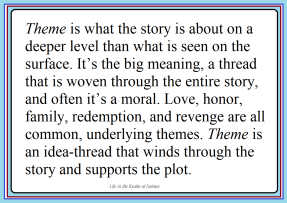
how the universe works themeSo, let’s take a look at theme, the thread that binds emotions and points of no return together. It’s time to take another look at how George Saunders employed themes in his sci-fi masterpiece, Escape from Spiderhead.

In 2015, I took George Saunders’ book, Tenth of December, to Cannon Beach as my summer beach read. For me, the most compelling tale in that collection of short stories was “Escape from Spiderhead.” 

Escape from Spiderhead was first published in the December 12, 2010 edition of the New Yorker. It is a science fiction story set in a prison. It is built around several themes. The central theme is crime and punishment, and Saunders grabs hold of this theme and runs with it.

He asks us to consider where punishment ends, and inhumanity begins.

Tenth of December, George SaundersSaunders gives us the character of Ray Abnesti, a scientist developing pharmaceuticals and using convicted felons as guinea pigs as part of the justice system. The wider world has forgotten about those whose crimes deserve punishment, whose fate goes unknown and unlamented.
Saunders poses questions that challenge us to re-examine our own virtue. Do we have the right to treat a person inhumanely just because they have committed a crime?

He takes a deep dive into the theme of redemption in this tale. He didn’t take the expected path with his plot arc and didn’t opt for revenge by giving Abnesti the drug, which was the obvious choice.

Instead, he takes us on a journey through Jeff’s personal redemption, which is why this story impacted me.

Of course, the scenario is exaggerated, as it is set in a future world. It exposes the callous view modern society has regarding criminals and what punishment they might deserve.

That raises the theme of morality vs. immorality. Who is the real criminal here, Jeff, Abnesti, or a society that would even consider operating such a prison?

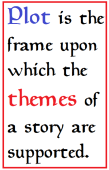
plot is the frame upon which the themes of a story are supportedThen there is the theme of compassion. Abnesti explores love vs. lust for his own amusement. The different drugs Jeff is given prove that both are illusionary and fleeting. Yet Saunders implies that the truth of love is compassion. Jeff’s final action shows us that he is a man of compassion.
What does it mean to be human? This theme is a foundational trope of Science Fiction. Saunders shows us that to be human is to be aware and compassionate.

The character of Dr. Abnesti demonstrates that one may be genetically and technically of the human species, yet not human in spirit. He is not aware of others as people; without that awareness, he has no compassion and no humanity.

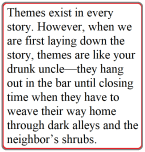
Theme_1_A common theme in science fiction is the use of drugs to alter people’s behavior and control them emotionally. That theme is explored in detail here, ostensibly as a means to do away with prisons and reform prisoners. But really, these experiments are for Abnesti, a psychopath, to exercise his passion for the perverse and inhumane and for him to have power over the helpless.
Jeff is aware of the crimes he and his fellow prisoners have committed. Still, he sees Heather struggling with her dose of Darkenfloxx and states his belief that every person is worthy of love.

Spiderhead (the movie) premiered in Sydney on June 11, 2022, and was released on Netflix on June 17, 2022. The film received mixed reviews from critics, and to be honest, I wasn’t impressed.

I will say now – the story and the movie are two different things. The film bears some resemblance to the story it is based on, but – it goes in a different direction and is not that story.

  • All writers should be aware of this important fact: you give up control of your story when you sell the movie rights.

In the short story, Escape from Spiderhead, Saunders’ voice, style, and worldbuilding are impeccable. It is a stark journey into the depths to which some humans are capable of sinking in the pursuit of knowledge for the sake of knowledge.

theme_meme_lirf06302020This short story was as powerful as any novel I’ve ever read, proving that a good story stays with the reader long after the final words have been read, no matter the length. His questions resonate, asking us to think about our true motives.

Where do we draw the line between crime and punishment? When is a legal act really a form of criminal behavior? What does it mean to be human?

For me, that is what good science fiction does—it raises questions and requires us to think.

To learn more about this story, go to Escape from Spiderhead Summary – Litbug.


The majority of this post first appeared here on Life in the Realm of Fantasy on June 29, 2022, https://conniejjasperson.com/2022/06/29/how-the-written-universe-works-exploring-theme-part-3-escape-from-spiderhead-by-george-saunders/.

Comments Off on Theme –Escape from Spiderhead analysis #writing

Filed under writing

#writing good mayhem: points of no return

Most engineering disasters (and divorces) are preceded by one or more points of no return. The average hydroelectric dam is a miracle of applied physics, modern construction materials and knowledge, and years of engineering and planning.

writing craft functions of the sceneBut what happens when a few insignificant cracks appear in that construction? What is the point of no return for the people living downstream?

Wikipedia says:

Dams are considered “installations containing dangerous forces” under International humanitarian law due to the massive impact of a possible destruction on the civilian population and the environment. Dam failures are comparatively rare, but can cause immense damage and loss of life when they occur. In 1975 the failure of the Banqiao Reservoir Dam and other dams in Henan Province, China caused more casualties than any other dam failure in history. The disaster killed an estimated 171,000 people and 11 million people lost their homes. [1]

A chain of events is set into motion when even a tiny, seemingly inconsequential mistake is made in the planning or construction of a hydroelectric dam.

Despite the diligence of the engineers, the construction workers, and the maintenance personnel, the flaw may go unseen until it is too late, and the dam experiences catastrophic failure.

If this is the plot for an epic disaster film or novel, where do we feature the first point of no return. What will be the opening incident from which there is no turning back?

Book- onstruction-sign copyWe must identify this plot point, and by mentioning it in passing, we make it subtly clear to the reader that this moment in time will have far-reaching consequences. Knowing something might be wrong and seeing the workers unaware of a problem ratchets up the tension.
For the writer, the moment cracks appear in the dam, the dangers previously hinted at are put into action, and the story is off and running.

I’ve faced personal disasters many times in my real life, unpleasant things that could have been avoided had I noticed the cracks in the metaphoric dam. When you look at history, humanity seems hardwired to ignore the “turn back now” signs.

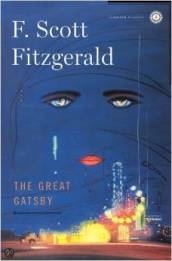
In every novel, a point of no return, large or small, comes into play. Let’s look at the points of no return, moments when disaster could have been averted in F. Scott Fitzgerald’s novel of reckless excess and gray morality, The Great Gatsby.

  1. f scott fitzgerald The Great GatsbyNick Carraway, the unreliable narrator, leaves the Midwest and moves to New York. He sells bonds, so ambition and greener pastures drive him there. His new neighbor is a mysterious millionaire, Jay Gatsby.
  2. Nick reconnects with a cousin, Daisy, and her husband, Tom Buchanan. They introduce him to Jordan, and the two begin an affair of convenience. It emerges as the narrative progresses that neither is entirely straight sexually.
  3. Nick attends a party at Gatsby’s mansion and is intrigued by the man and his history. Jay Gatsby is the protagonist, but we only know him through Nick’s eyes, and Nick is a bit bedazzled by him. This bias is critical to how the reader perceives the story.
  4. Nick tacitly accepts Tom’s affair with Myrtle despite his utter dislike of the man.
  5. Nick facilitates Gatsby’s reunion with Daisy.

Of course, the infidelities come out. Tom loves Daisy but won’t let go of Myrtle, whose husband is unaware of the affair. Daisy declares she loves both Tom and Gatsby.

That doesn’t go well.

Later, while driving Gatsby’s car, Daisy strikes and kills her husband’s mistress, Myrtle, who is standing on the highway because she thinks Tom is driving the car and she is waiting for him.

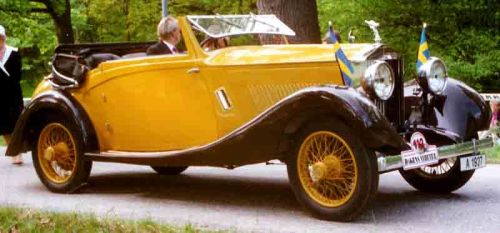
Rolls-Royce_20_HP_Drophead_Coupe_1927Fitzgerald is deliberately unclear if this act is deliberate or accidental—the murkiness of Daisy’s intent and the chaos of that incident lend an atmosphere of uncertainty to the narrative. If Nick had turned back at any of the above-listed points, Daisy wouldn’t have been driving Gatsby’s yellow Rolls Royce and wouldn’t have killed Myrtle in a hit-and-run accident.
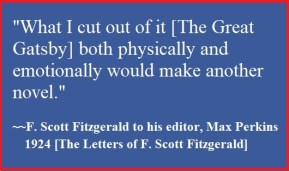
The tragedy of this dive into the decadence and dissolution of the 1920s is this: Nick knows he could have changed the outcome if he had turned back at any time before he reunited Daisy and Gatsby. That was the point where nothing good was going to come of the whole debacle. Something terrible was bound to happen, but Myrtle, poor silly woman that she was, wouldn’t have died.

Tom Buchannon wouldn’t have sought revenge by telling Myrtle’s husband, George, that Gatsby owned the car that had run her down, implying Gatsby was driving. George wouldn’t have murdered Jay Gatsby and then killed himself.

f scott fitzgerald quoteWhen I am writing a first draft, the crucial turning points don’t always make themselves apparent. It’s only when I have begun revisions that I see the opportunities for mayhem that my subconscious mind has embedded in the narrative.

If I am paying attention, those scenes become pivotal.

And sometimes, scenes I thought were important (because I was hyper-focused on the wrong story-within-the-story) end up being discarded. I don’t always see what the story is really about until someone in my writing group points out where I’ve missed an opportunity.


Credits and Attributions:

[1] Wikipedia contributors, “Dam failure,” Wikipedia, The Free Encyclopedia, https://en.wikipedia.org/w/index.php?title=Dam_failure&oldid=943367090 (accessed March 2, 2024).

IMAGE: Wikimedia Commons contributors, “File:Rolls-Royce 20 HP Drophead Coupe 1927.jpg,” Wikimedia Commons, https://commons.wikimedia.org/w/index.php?title=File:Rolls-Royce_20_HP_Drophead_Coupe_1927.jpg&oldid=824489843 (accessed March 2, 2024).

1 Comment

Filed under writing