How the Written Universe Works: Theme #amwriting

Epic Fantasy is often dark in tone and always epic in scope. It usually explores the struggle against supernatural, evil forces.
how the universe works themeTad Williams’s Memory Sorrow and Thorn is a classic Epic Fantasy series. Many of the themes and tropes he explores are rooted in J.R.R. Tolkien’s work. However, Williams took those themes and tropes down a darker, more violent path, laying bare the evil and the good of which humanity is capable.

This trilogy revolves around a schism in the family of the late king, Prester John. That enmity drives the larger narrative. In this 3-book series, the underpinning theme is the circle of life represented through birth, growth, degeneration, and death. A prominent theme driving the action is the family dynamics, warped by lies and secrets kept across three generations.

The other fundamental themes are the hero’s journey and coming of age. Both Simon (the kitchen boy turned hero) and Miriamele (the princess turned hero) are driven by these themes, as are Jiriki and Binabik to a certain extent.

I’ve mentioned before that theme is the backbone of the story. It’s an idea, a thread that winds through a plot arc and connects events that would otherwise appear random.

Themes are often polarized, good vs. evil, faith vs. doubt, fate vs. free will, human vs. nature,

Epic fantasy novels, being longer in word count than other genres, leaves room in the plot for multiple themes to appear. This creates opportunities for the subplots to add depth, revealing the backstory without an info dump.

Polarity is a fundamental aspect of the inferential layer of a story.

The inferential layer is the unspoken, the knowledge a reader gains by extrapolation, interpretation, and reasoning. It is the layer that requires the reader to think. Polarity guides the reader as they make sense of the clues.
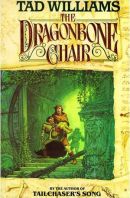
300px-The_Dragonbone_ChairWhen the story opens with the first novel, The Dragonbone Chair, events show the royal family is fraught with violent emotions, creating conflict. King Prester John’s sons, Elias and Josua, appear to be the center of a storm that will destroy Osten Ard.

In any story that explores the relationships within a family as part of the larger narrative, we begin with the circle of life.

Hubris is another theme that drives the plot and is expressed in the character of the apparent antagonist, Pryrates. Hubris refers to excessive self-confidence and the terrible decisions that arise from it.

This conflict allows Williams to employ the subtheme of chaos and stability. Evil is portrayed by taking this theme to an extreme: Pryrates enables Elias’s possession by the true antagonist, the Storm King.

Williams also riffs on the Hero’s Journey, the bonds of friendship, and the gray area between good and evil—moral ambiguity.

A crucial consideration in planning a fantasy novel is plot structure or how the story is arranged. As in all works, the central underlying theme is introduced in the early pages and supports the plot through to the end.

Subthemes are introduced and combined with the main theme to create a backbone for the story. Without that backbone, the narrative can wander all over the place, and readers will lose interest.

The hero’s journey is a theme that allows authors to employ the subthemes of brother/sisterhood and love of family. These concepts are heavily featured in the books that inspired me, so they find their way into my writing.

Tad Williams supported his themes by adding these layers to his narrative:

  • character studies
  • allegories
  • imagery

These three layers are driven by the central themes and advance the story arc.

Williams’s large cast of characters is portrayed as if they are real people. They are a mix of good and bad at the same time. Some lean more toward good, others toward bad. Either way, he has them act and react with good, logical intentions. Each desperately wants what they think they deserve.
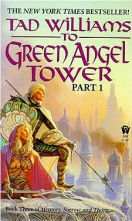
Green_Angel_Tower_P1By the end of the third book, To Green Angel Tower, Williams has employed the theme of Truth vs. Falsehoods to completely corrupt the Circle of Life theme. All the characters – the antagonists and the protagonists – deceive themselves about their own motives.

Regardless of their race, they share some characteristics with humans. Each character hides the truths they can’t face behind other, more palatable truths.

I always think that inserting a whiff of human frailty into a character makes them more interesting, more relatable.

Memory Sorrow and Thorn is considered a cornerstone of modern epic fantasy. This is because in the early 1980s, when Tad Williams began writing this trilogy, he took traditional themes and tropes and applied his original angle to them, along with modern prose and phrasing. He took each of the themes binding his narrative together and went one step farther, adding a hint of horror.

The horror would have been gratuitous if he hadn’t supported his narrative so well with all the themes and subthemes. Williams was inspired by Tolkien, and in turn, Memory, Sorrow, and Thorn has inspired countless authors.

Your assignment: on a new document, pick a theme from the following list, create a character or two, and write two paragraphs exploring that theme.
  • plot is the frame upon which the themes of a story are supportedFate vs. free will
  • Faith vs. doubt
  • Good vs. evil
  • Greed
  • Hubris
  • Humanity vs. nature
  • Justice
  • Lust for Power
  • Pursuit of Love
  • Revenge
  • Sacrificial Love
  • Survival against the odds
  • War

All genres are made specific by the tropes that define them. Epic fantasy shares some tropes with high fantasy.

It often includes elements such as elves, fairies, dwarves, dragons, demons, magic or sorcery, constructed languages, quests, coming-of-age themes, and multi-volume narratives.

My next post will discuss the tropes featured in the Memory, Sorrow, and Thorn trilogy and how the themes we’ve discussed support them.
3 Comments

Filed under writing

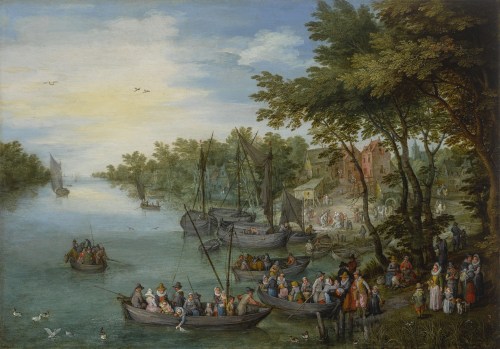
#FineArtFriday: River Landscape by Jan Brueghel the Elder 1614

A_Wooded_River_Landscape_with_a_Landing_Stage,_Boats…_by_Jan_Brueghel_the_ElderArtist: Jan Brueghel the Elder (1568–1625)

Title: River Landscape (Wooded river landscape with a landing stage, boats, various figures and a village beyond).

Date: 1614

Medium: oil on copper

Dimensions: height: 25.9 cm (10.1 in); width: 37 cm (14.5 in)

What I love about this painting:

Men, women, and children fill the boats for a day on the river, dressed in colorful garb. Everyone is in good spirits, looking forward to a day of relaxing and perhaps a little fishing. Onshore, crews will fillet and smoke or salt whatever can’t be eaten right way. When weather is fine and the fish are plentiful, the party is on. Everyone will eat well for a few days.

About this painting, via Wikipedia:

Jan Brueghel’s father, Pieter Bruegel the Elder, is regarded as an important innovator of landscape art. By introducing greater naturalism in his Alpine mountain settings, his father had expanded on the world landscape tradition that had been founded mainly by Joachim Patinir. Some of Pieter the Elder’s works also foreshadowed the forest landscape that would start to dominate landscape painting around the turn of the 16th century. Pieter the Elder also developed the village and rural landscape, placing Flemish hamlets and farms in exotic prospects of mountains and river valleys.

Jan developed on the formula he learned from his father of arranging country figures traveling a road, which recedes into the distance. He emphasized the recession into space by carefully diminishing the scale of figures in the foreground, middle-ground, and far distance. To further the sense of atmospheric perspective, he used varying tones of brown, green, and blue progressively to characterize the recession of space. His landscapes with their vast depth are balanced through his attention to the peasant figures and their humble activities in the foreground.

Jan Brueghel’s landscape paintings with their strong narrative elements and attention to detail had a significant influence on Flemish and Dutch landscape artists in the second decade of the 17th century. His river views were certainly known to painters working in Haarlem, including Esaias van de Velde and Willem Buytewech, whom Brueghel may have met there when he accompanied Peter Paul Rubens on a diplomatic mission to the Dutch Republic in 1613. [1]

About the Artist, via Wikipedia:

Jan Brueghel (also Bruegel or Breughelthe Elder 1568 – 13 January 1625) was a Flemish painter and draughtsman. He was the son of the eminent Flemish Renaissance painter Pieter Bruegel the Elder. A close friend and frequent collaborator with Peter Paul Rubens, the two artists were the leading Flemish painters in the first three decades of the 17th century.

Brueghel worked in many genres including history paintings, flower still lifes, allegorical and mythological scenes, landscapes and seascapes, hunting pieces, village scenes, battle scenes and scenes of hellfire and the underworld. He was an important innovator who invented new types of paintings such as flower garland paintings, paradise landscapes, and gallery paintings in the first quarter of the 17th century. He further created genre paintings that were imitations, pastiches and reworkings of his father’s works, in particular his father’s genre scenes and landscapes with peasants. Brueghel represented the type of the pictor doctus, the erudite painter whose works are informed by the religious motifs and aspirations of the Catholic Counter-Reformation as well as the scientific revolution with its interest in accurate description and classification. He was court painter of the Archduke and Duchess Albrecht and Isabella, the governors of the Habsburg Netherlands.

The artist was nicknamed “Velvet” Brueghel, “Flower” Brueghel, and “Paradise” Brueghel. The first is believed to have been given him because of his mastery in the rendering of fabrics. The second nickname is a reference to his fame as a painter of (although not a specialist in) flower pieces and the last one to his invention of the genre of the paradise landscape. His brother Pieter Brueghel the Younger was traditionally nicknamed “de helse Brueghel” or “Hell Brueghel” because it was believed he was the author of a number of paintings with fantastic depictions of fire and grotesque imagery. These paintings have now been reattributed to Jan Brueghel the Elder. [1]


Credits and Attributions:

Image:  River Landscape by Jan Brueghel the Elder, 1614. Wikimedia Commons contributors, “File:A Wooded River Landscape with a Landing Stage, Boats… by Jan Brueghel the Elder.jpg,” Wikimedia Commons, the free media repository, https://commons.wikimedia.org/w/index.php?title=File:A_Wooded_River_Landscape_with_a_Landing_Stage,_Boats%E2%80%A6_by_Jan_Brueghel_the_Elder.jpg&oldid=358393285 (accessed June 17, 2022).

[1] Wikipedia contributors, “Jan Brueghel the Elder,” Wikipedia, The Free Encyclopedia, https://en.wikipedia.org/w/index.php?title=Jan_Brueghel_the_Elder&oldid=1082625249 (accessed June 17, 2022).

Comments Off on #FineArtFriday: River Landscape by Jan Brueghel the Elder 1614

Filed under #FineArtFriday

#RoadTrip! The Resort, The Vegan, and June-uary #amwriting

Traveling, even in the Great Pacific Northwest can be—intriguing—if one is vegan. Sometimes the food is good, other times not so much. This week we are at Alderbrook Resort and Spa on the Olympic Peninsula of Washington State.

road tripNow, we probably wouldn’t have plumped for such a fancy getaway, but my husband has a conference there, and what with him not driving right now, I am along as chauffeur.
Anyway, the restaurant, like most here in the Northwest, does offer a few vegan entrees and I have been well (if unusually) fed.

I will get to the unusual part in a minute.

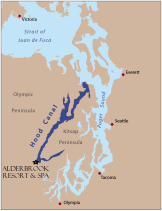
This place is built in the style of a Timber Chalet, but it wasn’t always so elegant. It was begun in 1909 by Henry Stumer, a Seattle business owner. He had previously owned the Hotel Stumer in Union City (now Union, WA). He and his friends at Seattle’s Swedish Club bought several parcels of beachfront property just east of Union City. The resort is situated on the fjord known as Hood Canal, which is a part of Puget Sound.

Locmap-hoodcanal-ssIt’s a fjord, not a canal, so why they named it that, I don’t know. But there it is, one more thing our pioneering ancestors have to answer for.

Stumer built tent cabins out of frames covered in black and orange striped canvas. They had no windows or electricity, only a wood stove for heat and cooking. The creek running through the property was used for refrigeration.

There was no road when Alderbrook opened in 1913, so guests arrived by boat from Union City or on horseback.

Alderbrook went through many iterations over the years, including a hotel. In 1959, Wes Johnson, a Hood Canal realtor from Hoodsport purchased the Alderbrook Inn. Johnson’s redevelopment plans included an indoor swimming pool, marina, 18-hole golf course, and 70-room hotel. To finance the redevelopment, Johnson sold the vacation cottages individually.

Zoom forward in time to 2022, and Alderbrook Resort is a posh palace for those with money to burn. Greg’s wallet is on fire! So much to do, so many ways to spend money, and so little time. The staff here is marvelous, and there are many activities for families. They have a fabulous spa, a high-end restaurant, yacht tours of Hood Canal, and numerous trails for hiking.

But I’m not into spa treatments, for which my husband’s budget is grateful. It’s peaceful and pleasant to just sit on my balcony and observe the waterfront and the forest around us. I have done quite a bit on my writing projects while visiting here.

I’ve spent a lot of time (and $$$) in the restaurant, where I have terrific views of the activities of my fellow guests.

I’ll just say I’ve seen some stuff worthy of a novel. Here is one people-watching moment that sticks out:

Kimball_BostonDirectory_1868The man and the baby: We arrived on Sunday afternoon. We sat at a romantic table for two for our first dinner, overlooking the beach. It’s the Pacific Northwest, so people come dressed for January in June (or June-uary as June is known here). The lawn chairs were full of guests lounging in their summer finery of Gore-Tex and wool, ignoring the intermittent misty rain and drinking steaming coffees. Off to one side was a young man sitting alone. Beside him was the fanciest baby pram I’ve ever seen.

Seated above it all in the restaurant, I had ordered grilled cauliflower. I was not disappointed in the quality of that entrée. It was seasoned perfectly, with just the right amount of tenderness, and was a delicious, satisfying dinner.

I just happened to look up from my meal in time to see the young man wheel the pram to the side of an enclosed area, park it, and walk away. This baby was very tiny, not more than a month old.

That was not a happy moment for me, as you don’t do that here in the US. I later discovered that the enclosure is an outdoor coffee bar on weekends, but I didn’t know it then. Here in America, you never leave a baby or small child unattended in a public place, whether outdoors or in a car. People will assume it’s been abandoned and call the police and Child Protective Services.

The longest five minutes I’ve ever lived passed while I watched that baby carriage like the hawk-eyed grandma that I am. Then a young man emerged from the coffee bar with a steaming cup. He walked to the pram, placed his cup in the cupholder, and pushed the baby out of my visual range.

I’m a terrible witness. I couldn’t remember if it was the same young man, but they both had red jackets. The author in me went into overload. Perhaps the baby was a doll, and I had witnessed a spy transaction, two men handing off secrets. Or maybe it was a big-time drug deal.

Ooh, the possibilities. Now, if Ellen King Rice will only write that novel!

So back to the food.

peas and vinesOn Monday, I decided to be adventurous. I thought I would try the spring salad with fresh peas, pea vines, fennel, watermelon radishes, and a champagne vinaigrette. I had never thought of eating pea vines, but I’m not afraid to try new things.

That was … interesting. The vinaigrette was divine, and the peas and radishes were delicious, as were the dandelion greens. Unfortunately, while the pea vines were good, they were difficult to get into my mouth without embarrassing myself.

Somehow, I had thought the vines would be cut to a manageable size, but alas, they were five to eight inches long and wiry. Not only that, but they were impossible to cut with the lovely silver flatware set so neatly beside our plates.

I tried wadding them up into little bales and pitchforking them as one might do spinach, but they sprang apart before I could get them into my mouth. Vinaigrette splattered all over my face and glasses.

I had been raised with manners, so I wiped my face with the white linen napkin and soldiered on.

I tried twirling them around a fork – with the same result.

I ended up leaving most of it on my plate, something I rarely ever do.

This supports my experience that punishment food is on the menu in the most unlikely places and is often labeled vegan. Usually, it’s soggy eggplant or limp portobello mushrooms, which are much easier to get into your mouth than my elegant pea vine salad was.

avacado dinner saladToday we are on our way home, where we will indulge in budget-friendly home-cooked meals and other economies for a few weeks to make up for this splurge.
And next Monday, here on Life in the Realm of Fantasy, we will delve into some of my favorite books and see how the authors employed themes to emphasize atmosphere and unite the threads of their stories.


Credits and Attributions:

Baby Pram, Wikimedia Commons contributors, “File:Kimball BostonDirectory 1868.png,” Wikimedia Commons, the free media repository, https://commons.wikimedia.org/w/index.php?title=File:Kimball_BostonDirectory_1868.png&oldid=463698022 (accessed June 14, 2022).

Map of Hood Canal, Wikimedia Commons contributors, “File:Locmap-hoodcanal-ss.png,” Wikimedia Commons, the free media repository, https://commons.wikimedia.org/w/index.php?title=File:Locmap-hoodcanal-ss.png&oldid=449541623 (accessed June 14, 2022).

Peas and vines, Wikimedia Commons contributors, “File:Doperwt rijserwt peulen Pisum sativum.jpg,” Wikimedia Commons, the free media repository, https://commons.wikimedia.org/w/index.php?title=File:Doperwt_rijserwt_peulen_Pisum_sativum.jpg&oldid=483824040 (accessed June 14, 2022).

2 Comments

Filed under Vegan, writing

How the Written Universe Works: 7 Rules of Construction #amwriting

Words, carefully chosen and arranged with care, have the power to bring your writing to life.

7 rules of constructionWe who write because we love words spend a great deal of time framing what our words say. We choose some words above others because they say what we mean more precisely, or they color our prose with the right emotion.
We take our chosen words and bind them into small packets we call sentences. We take those sentences and build paragraphs, which become novels.

The author’s job is to understand how the grammar of their native language works. The great authors use those rules to energize their prose.

However, when it comes to word choices, some things are universal to the best work in all genres, from literary fiction and poetry to sci-fi and fantasy, to thrillers and cozy mysteries, or even Romance.

The world is in a state of flux—money is tight. In the US, the cost of getting a university education is prohibitive, with students incurring massive debt that follows them for years afterward. Some people have the luxury and the desire to seek a degree in writing.

Others must rely on self-education. To that end, here are seven rules professional writing programs teach about sentence and paragraph construction.

One: Verbs—we choose words with power. In English, words that begin with hard consonants sound tougher and carry more power.

Verbs are power words. Fluff words and obscure words used too freely are kryptonite, sapping the strength from our prose.

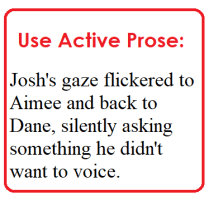
Use Active ProseTwo: Placement of verbs in the sentence can strengthen or weaken it.
  • Moving the verbs to the beginning of the sentence makes it stronger.
  • Nouns followed by verbs make active prose.

I ran toward danger, never away.

Three: Parallel construction smooths awkward phrasing. When two or more ideas are compared in one sentence, each clause should use the same grammatical structure. They are parallel, and the reader isn’t jarred by them, absorbing what is said naturally.

What parallelism means can be shown by a quote attributed to Julius Caesar, who used the phrase “I came; I saw; I conquered” in a letter to the Roman Senate after he had achieved a quick victory in the Battle of Zela. Caesar gives equal importance to the different ideas of arriving, seeing, and conquering.

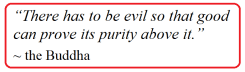
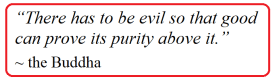
Buddha quoteFour: Contrast—In literature, we use contrast to describe the difference(s) between two or more things in one sentence. The blue sun burned like fire, but the ever-present wind chilled me.
Five: Similes show the resemblances between two things through the use of words such as “like” and “as.” The blue sun burned like fire.

Similes differ from metaphors, which suggest something “is” something else. The pale moon shone, a lamp in the sky that comforted me.

Six: Deliberate repetition used occasionally emphasizes emotion and atmosphere but doesn’t increase wordiness.

  • Repetition of the last word in a line or clause.
  • Repetition of words at the start of clauses or verses.
  • Repetition of words or phrases in the opposite sense.
  • Repetition of words broken by some other words.
  • Repetition of the same words at the end and start of a sentence.
  • Repetition of a phrase or question to stress a point.
  • Repetition of the same word at the end of each clause.
  • Repetition of an idea, first in negative terms and then in positive terms.
  • Repetition of words of the same root with different endings.
  • Repetition at both the end and beginning of a sentence, paragraph, or scene.
  • Repetition is a construction in poetry where the last word of one clause becomes the first word of the next clause.

Every book is a quotation, and every house is a quotation out of all forests, and mines, and stone quarries; and every man is a quotation from all his ancestors.”  Ralph Waldo Emerson, Prose and Poetry. [1]

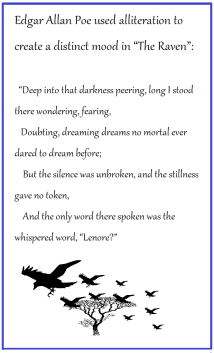
alliterationSeven: Alliteration is the occurrence of the same letter (or sound) at the beginning of successive words, such as the familiar tongue-twister: Peter Piper picked a peck of pickled peppers. Alliteration lends a poetic feeling to passages and enhances the atmosphere of a given scene without creating wordiness.
Once upon a midnight dreary, while I pondered, weak and weary, (The Raven, by Edgar Allan Poe 1845) [2]

When I see birches bend to left and right

Across the lines of straighter darker trees, (Birches, by Robert Frost 1916) [3]

The way we habitually construct our prose is our voice, and that voice determines the impact of our work. Different readers have widely different tastes, but no one enjoys bad writing.

Constructing our work to fit the market we are writing for is crucial to finding readers. However, all readers want to find good writing and are attracted to work that tells a story with atmosphere and emotion.

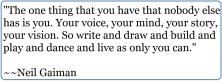
Neil_Gaiman_QuoteActive phrasing generates emotion. Sometimes, using similes, repetition, and alliteration in subtle applications enhances the worldbuilding without beating your reader over the head.
We all know worldbuilding must be organic and natural, but we don’t all know how to achieve it. Subtle application of these seven rules will empower your worldbuilding. The casual reader will be immersed but unaware of the mechanics. They won’t realize why the work is powerful.


Credits and Attributions:

[1] Ralph Waldo Emerson, The Complete Works. Published in 1904. Vol. VIII. Letters and Social Aims, VI. Quotation and Originality, Bartleby.com, accessed (June 11, 2022)

[2] Wikipedia contributors, “The Raven,” Wikipedia, The Free Encyclopedia, https://en.wikipedia.org/w/index.php?title=The_Raven&oldid=908701892 (accessed June 11, 2022).

[3] Wikipedia contributors, “Birches (poem),” Wikipedia, The Free Encyclopedia, https://en.wikipedia.org/w/index.php?title=Birches_(poem)&oldid=886359747 (accessed June 11, 2022).

6 Comments

Filed under writing

#FineArtFriday: The Bird Concert by Jan Brueghel the Younger ca. 1640 – 45

OLYMPUS DIGITAL CAMERA

Artist: Jan Brueghel the Younger (1601–1678)

Title: the Bird Concert

Date: between circa 1640 and circa 1645

Medium: oil on copper

Dimensions: height: 13.2 cm (5.1 in); width: 17.9 cm (7 in)

Collection: Herzog Anton Ulrich Museum

What I love about this painting:

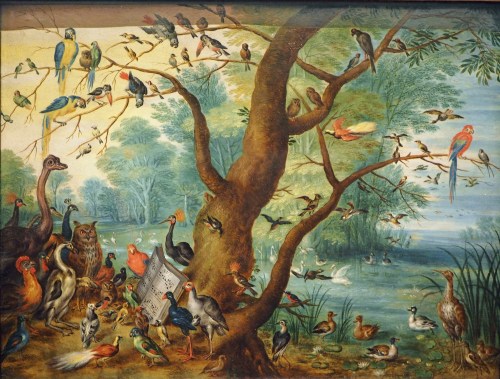
This is a joyous, surreal exploration of all the birds the artist had ever seen in his native Antwerp, and many rare birds that he could only imagine. Brueghel has gathered birds from all over the world into a mystical, fairytale glen, posing them around a songbook.

They are learning to sing a in a language they all can understand, a wonderful allegory of the aspirations of the artist for humanity in the turbulent times during which he lived.

This painting also celebrates the new discoveries made by European explorers, as Brueghel had only seen scientific drawings of many of these birds. Even though he hadn’t seen some of these birds personally, he paints them as if they are before him.

The amazing flock of birds gathered here gives us an insight into the mind and sense of humor of Jan Brueghel the Younger, a man not too different from us even though he lived over 300 years ago.

This composition must have been important to Brueghel and says something about him. He went to the expense of getting copper as the base upon which he painted this scene. He was comfortable but not rich, so that tells me he intended this painting to last, to be something he would be remembered for.

About the medium of Oil on Copper, via Wikipedia:

Oil on copper paintings were prevalent in the mid sixteenth century in Italy and Northern Europe. The use of copper as a substrate for an oil painting dates back to Medieval times. The Flemish masters and other artists including Jan Breughel the ElderClaudeEl GrecoGuido ReniGuercinoRembrandtCarlo SaraceniAmbrosius Bosschaert IICopley Fielding and Vernet painted on copper. They favored copper for its smooth surface which allowed fine detail, and its durability. Copper is more durable than canvas or wood panel as a support for oil painting, as it will not rot, mildew or be eaten by insects. Contemporary painters also use copper as a base for paintings, some of them allowing the metal or patina to show through.

The old masters prepared the copper for painting first by rubbing it with fine pumice abrasive. The copper surface was then treated with garlic juice which is believed to improve adhesion of the paint. Finally a white or grey ground layer of oil paint was applied as a primer. After drying the copper panel was ready for the artist to begin painting. Later artists used the patina process, in which the copper is oxidized with the use of various acidic solutions, as part of the art work itself. The resulting patina or verdigris includes darkening of the metal, green and blue tones, depending on the chemical solution used. Patina is characterized by beautiful, variated patterns and textures which occur on the metal’s surface. [1]

About the Artist, via Wikipedia:

Jan Brueghel the Younger was born in Antwerp on 13 September 1601 as the son of Jan Brueghel the Elder and Isabella de Jode. His mother was the daughter of the cartographer, engraver and publisher Gerard de Jode. He trained and collaborated with his father in his workshop. His father was a friend and close collaborator of Peter Paul Rubens. Brueghel likely assisted with his father’s large-scale commissions.

On the wishes of his father he traveled around 1622 to Milan where he was welcomed by Cardinal Federico Borromeo. The cardinal was a patron and friend of his father who had met in Rome about 30 years earlier. In what was likely an act of rebellion against his father, he went to Genoa where he stayed with his cousins, the Antwerp painters and art dealers Lucas de Wael and Cornelis de Wael. Their mother was a sister of Brueghel’s mother. At the time his friend and fellow Antwerp artist Anthony van Dyck was also active in Genoa. He later worked in Valletta on Malta in 1623. From 1624 to 1625 he also resided in Palermo on Sicily at the time when van Dyck was also working there.

Brueghel learned that his father had died on 13 January 1625 from cholera only after his return to Northern Italy in Turin. Wanting to return to Antwerp immediately, he had to delay his departure for 16 days due to a severe fever. After recovering from his illness, he set off for his homeland by way of France. In Paris he met the Antwerp art dealer and painter Peter Goetkint the Younger, who was the son of Peter Goetkint the Elder, the master of Jan’s father. Goetkint was eager to return to Antwerp because his wife was expected to deliver a baby soon. The child was born on 25 August, the day on which Breughel arrived in Antwerp with his traveling companion who himself died a few days later.

Brueghel took over the management of his father’s workshop, sold the finished works of his father and finished some of his father’s unfinished paintings after completing them. In the Guild year 1624-1625, Brueghel became a master painter of the Guild of Saint Luke of Antwerp.

In 1626 he married Anna Maria Janssens, daughter of Abraham Janssens, a prominent history painter in Antwerp. He continued to operate the large workshop of his father. He became dean of the Guild of Saint Luke in 1630. That same year he was commissioned by the French court to paint a series of paintings on the life of Adam. It seems that his studio declined after this period and that he started to paint smaller scale paintings which commanded lower prices than those produced earlier.

In later years, he worked independently in Paris in the 1650s and produced paintings for the Austrian court in 1651. He is recorded again in Antwerp in 1657 where he remained until his death. [2]


Credits and Attributions:

[1] Wikipedia contributors, “Oil on copper,” Wikipedia, The Free Encyclopedia, https://en.wikipedia.org/w/index.php?title=Oil_on_copper&oldid=1060711380 (accessed June 9, 2022).

[2] Wikipedia contributors, “Jan Brueghel the Younger,” Wikipedia, The Free Encyclopedia, https://en.wikipedia.org/w/index.php?title=Jan_Brueghel_the_Younger&oldid=1086952033 (accessed June 9, 2022).

Image: The Bird Concert by Jan Brueghel the Younger ca. 1640 -1645, PD|100. Wikimedia Commons contributors, “File:Bruegel Vogelkonzert@Herzog Anton Ulrich Museum (1).JPG,” Wikimedia Commons, the free media

2 Comments

Filed under #FineArtFriday, writing

How the Written Universe Works: Choreographing Disaster #amwriting

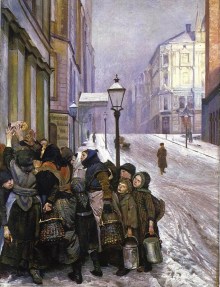
The most powerful books in the Western Canon of Great Literature explore the human experience. Drama, heartache, disaster, and violence are the backdrop against which our lives play out.

Buddha quoteReaders connect with these stories across generations and across the centuries because the fundamental concerns of human life aren’t unique to one society, one technological era, or one point in time.
In my last post, we touched upon choreographing violence, but didn’t discuss some of the root causes. Violence often follows disaster.

Some disasters are caused by the cyclical ebb and flow of weather patterns, and others are the effects of human activity.

  • Possible effects of famine: food deprivation leads to starvation and disease.
  • Possible effects of severe drought: droughts lead to wildfires, famines, and pandemics.

Drought and famine feed societal unrest:

  • Lust for power: The bullies rise to the top, inciting their followers to violence against those perceived as weaker.
  • Lust for wealth: Bully warlords may mount an armed invasion to steal resources a neighboring society has acquired.

Even a slight lowering of the standard of living can feed civil unrest.

One disaster we may all face at some point is famine. Hunger exists in this world, and while many worthwhile charities do their best to alleviate it, famine is an enemy that takes no prisoners.

On a human level, hunger affects a person forever after. People can survive on very little, and unfortunately, many do. To have only enough food to keep you alive forms a person in a singular way. Their physical growth will be less than that of a well-nourished person, and their worldview is narrower. They have no energy to spare for anything beyond their day-to-day existence.

Christian_Krohg-Kampen_for_tilværelsen_1889Acquiring food becomes their first priority. Having a surplus of food becomes a reason to celebrate. To go without adequate food for any length of time changes a person and makes one determined to never go hungry again.
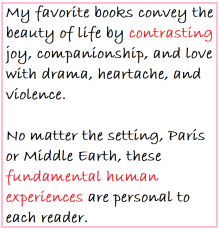
Unfortunately, for some, their desire to be well-fed will lead them to make choices that challenge the accepted morality of those who are not hungry.

Droughts often cause famines and worse. To go without water is to die. Thirst is a more immediate pain than hunger. The human animal can survive for up to three weeks without food but only three to four days without water. Rarely, one might survive up to a week.

Even brackish water must taste sweet when one suffers from a lack of potable water. And when one is without food, foods they would consider repugnant under other circumstances will fill their belly.

Look at the continual strife in third-world countries (not Ukraine, which is different and not a third-world country). You will see how long-term droughts have precipitated widespread famine, leading to civil unrest. Gang wars are fought over the right to own a water source, and these conflicts can erupt into revolution.

We forget this when we have plenty to eat and never have to worry if we will have water in our faucet as long as we can pay the bills.

But if we learn anything from the empty grocery store shelves in 2020 and the current supply chain crisis, it is that our well-fed lives are perched on a one-legged ladder.

Disaster on a wide scale can and will happen. But what of those small tragedies people face each day, deeply personal catastrophes, which only they are experiencing? These are also the seeds of a good story.

ContrastsLove and loss, safety and danger, loyalty and betrayal—the eternal themes of tragedy and resolution. Hardship contrasted against ease provides the story with texture, turning a wall of “bland” into something worth reading.
In real life, everything seems to be going along well. Life is good, calm, and peaceful. Then the tornado hits, the wildfire comes through, or the tidal wave—whatever the tool nature uses to destroy you, it decimates your home, your community, leaving you and your neighbors with nothing.

Then we must deal with the aftermath, cleaning up, searching for belongings, and searching for loved ones. This kind of disaster cuts deep into a person’s psyche.

Severe weather, fires, famines, and floods are terrible to live through, and many harrowing stories emerge from these experiences. Stories of apocalyptic catastrophes resonate because disaster drives humanity to bigger and better things, and those who survive and rise above it become heroes.

However, disasters regularly happen on what seems an unimportant level to people who have resources.

Consider the situation of a single mother working two part-time jobs. If she lives in my town, she lives where there is no public transportation. Other cities in my county have access to public transit, but not my community.

She struggles to pay for fuel, but what if her car breaks down? How will she get to work? All her money goes to fuel, childcare, rent, and utilities. What little she has left after those bills are paid goes to food.

She has no resources and no way to pay to repair her car. Without her car, she will lose both jobs. That is a profoundly personal disaster, one she and her children might not recover from.

How would you write her story?

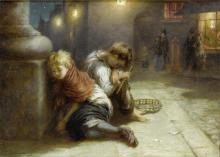
Augustus_Edwin_Mulready_Fatigued_Minstrels_1883We writers must make our words count. We have to show the comfort zone in the moments leading up to the disaster, not too much, but just enough to show what will soon be lost.
Then, we have to bring on the disaster and write it logically so that the events make sense. We can’t tell the story. We must show it as if we were painters—and we have to inject real, believable emotion into the experience.

Open a new document and save it to your background file. Describe the disaster in great detail. Then save and walk away from it. Let that scene rest and move on to something else. When you return to it, re-read it, and see what you can cut and condense and still have the bones of the action. Use verbs and power words and go light on descriptors.

The window shatters, and I stare, dumbstruck. A two-by-four impales itself in the wall beside David amid a slow-motion shower of glass shards. The wind roars, tearing the door from my hand and slamming it shut.

Verbs in that scene are: stare, impales, shower, roars, tearing, slamming. Show the bones of the event by using verbs with powerful visuals, and the reader’s mind will fill in the rest.

Once the events are in order, we must show the aftermath of the calamity and the roadblocks they must overcome to recovery. We add the characters’ real-time reactions and emotions. Finally, we must leave our characters in a place of comparative happiness and security.

Employing contrast—ease against hardship—gives texture to the fabric of a narrative. When an author makes good use of courage in the face of personal disasters, readers think about the story and those characters long after it has ended.


CREDITS AND ATTRIBUTIONS:

Struggle for Survival by Christian Krohg, 1889, oil on canvas.  Now hanging in the National Gallery of Norway. Wikimedia Commons contributors, “File:Christian Krohg-Kampen for tilværelsen 1889.jpg,” Wikimedia Commons, the free media repository, https://commons.wikimedia.org/w/index.php?title=File:Christian_Krohg-Kampen_for_tilv%C3%A6relsen_1889.jpg&oldid=301415583 (accessed June 7, 2022)

Fatigued Minstrels, by Augustus Edwin Mulready, 1883, oil on canvas. Wikimedia Commons contributors, “File:Augustus Edwin Mulready Fatigued Minstrels 1883.jpg,” Wikimedia Commons, the free media repository, https://commons.wikimedia.org/w/index.php?title=File:Augustus_Edwin_Mulready_Fatigued_Minstrels_1883.jpg&oldid=335802594 (accessed June 7, 2022)

6 Comments

Filed under writing

How the Written Universe Works: Choreographing Violence #amwriting

In most genres, whether it’s mystery, fantasy, sci-fi, thrillers, or horror, the characters are forced to do a certain amount of fighting. However, scenes involving physical action can become a wall of mindless mayhem.

toolsScenes of conflict are crucial to the advancement of the story. They should be inserted into the novel as if one were staging a pivotal scene in a film.

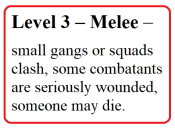
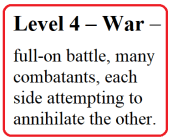
For my own planning purposes, I have four levels of conflict, ranked by the escalation of action and the broadness of the conflict.

Level 1 – Quarrel – interpersonal disagreements, disputes, angry words, shouting, everyone walks away.

Level 2 – Skirmish – 1 to 5 combatants total, with one-on-one physical violence. Minor wounds, everyone walks away.

Level 3 – Melee – small gangs or squads clash, some combatants are seriously wounded, and someone may die.

Level 4 – War – full-on battle, many combatants, each side attempting to annihilate the other.

level 1 confrontation LIRF06052022If you have no experience with combat or fighting, you don’t understand the limits of a normal athlete’s physical abilities. So, you must do the research. Think of how the human body works in reality. If your character knees a foe in the jaw, how is it possible?

Are you really going to go into that much detail to explain how Joe slapped Mary and then bent down for whatever reason, and Mary kneed him in the jaw?

I suggest you don’t include that particular assault because a knee to the jaw is a weird move if both combatants are standing. If Mary has a blackbelt in Tae Kwon Do, she could have clocked him with her foot, but not her knee.

level 2 skirmish LIRF06052022If you don’t show how such a strange hit could happen, the reader will say, “That’s impossible.” It’s a risky choice though, because going into that kind of detail bores the heck out of our readers. Our readers mind will fill in the details and if it’s confusing, they may stop reading.
We must consider what is physically possible and what is not.

After the action is laid down, the next step is fine-tuning it. The reactions and responses of your characters are what make the experience feel authentic to the reader. After you have established that Joe was somehow hit in the jaw, what happened next? Did it knock him out?

Many authors get hung up on the technical side of each fight—how they were dressed, what weapons they had, and so on.

level 3 melee LIRF06052022Don’t do this for every incident. After they are armed and armored as much as they are going to be the first time, just have them meet the enemy, skirmish, and continue on. The reader already knows what armor and weapons they had.
The fight must advance the story.

  • Ask yourself why the quarrel happened.
  • What is the purpose of injecting that conflict into the narrative?
  • And once you establish that the fight happened, did you foreshadow it well enough, or does it seem gratuitous?

level 4 war LIRF06052022In real life, conflict happens on a sliding scale. It begins with a disagreement and escalates to an all-out war. While my outline will have a note alerting me to the level of conflict that must happen, I choreograph my fights to reflect that sliding level of intensity.
Billy Ninefingers begins with a level 1 quarrel that escalates to a level 2 fight. Billy’s sword hand is wounded. Besides the fact Billy is seriously injured in this opening fight, which is the inciting incident and core plot point of the book, I had two other goals with that fight scene:

  1. I needed to show how the Bastard is jealous and acts on any thought that passes through his alcohol-soaked mind.
  2. In the resolution of that scene, I demonstrated that Billy, even with his life in ruins, has a sense of fair play.

Just as physical attacks are in real life, Billy’s confrontation with the Bastard was over in less than a minute. From personal fistfights to waging war, actual combat is quick, bloody, and brutal.

Author-thoughtsPerson-to-person combat doesn’t stretch for hours because no matter how well trained a fighter is, no one has that kind of strength.
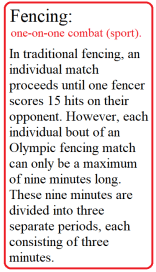
Skirmishes may happen in bursts that take place over a length of time, but there are pauses between clashes, allowing the combatants to briefly rest and get their breath.

It may feel like an hour is passing while you are in the middle of each clash, but in reality, each one-on-one fight only lasts a few minutes. At that point, even the strongest fighters are exhausted. Exhausted people make mistakes, and someone will be injured or die.

I suggest that for your own purposes, you map your violence out. Describe it for yourself as you would a journey. On a background document, write every slap and curse word. Write every hack and slash or gunshot, and make sure each occurs at its proper point in the melee.

Then walk away from it. Let that scene rest and move on to something else. When you return to it, ask yourself how many blows and hits your characters have taken.

combat - fencing LIRF06052022A typical fencing match goes until one has scored 15 hits on their opponent, and that match lasts nine minutes or less. Ask yourself how your fighter can survive the injuries that such blows would leave them with in real combat.

They most likely couldn’t.

Combatants block and defend as much as they attack. For the author, acting out each skirmish ensures that the moves are reasonable and make sense. But you aren’t done writing that scene just because the hacking, slashing, and gunshots are on paper.

Open a new document, take what you have already choreographed and consolidate it. While a war will justify ten paragraphs of description, a skirmish won’t. Write a one or two paragraph narrative that hits the high points and end it.

In each quarrel, we have to consider that every character in the fight is, and must remain, a unique individual. There should be no blurring of personalities, which can happen when an author focuses too intently on the action of the fight scene.

It’s a lot of work, but I go back to the first part of that section and make sure the character’s reactions are portrayed so the reader can suspend their disbelief.

powerwordsWordCloudLIRF06192021I try to show this discreetly by sitting back and visualizing the scene after the choreography is laid on paper. I replay it in my mind as if I were a witness to the events and look for each combatant’s facial expressions and reactions.
The strongest reactions get briefly mentioned in the story, the responses that push the plot forward. The other reactions are witnessed but given less prominence, becoming part of the scenery.

When I choreograph a fight, I think of it as if I were composing a conversation. In our literary conversations, we paint the impression of their individuality without boring the reader with insignificant details.

We must approach the fight scene the same way. I keep it concise and linear when it comes to fighting, as drawn-out fight scenes bore me to tears. Just the facts, the immediate emotional impact, and we move on to the recovery scene.

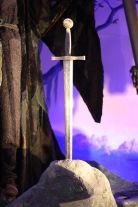
Excalibur London_Film_Museum_ via Wikipedia

Excalibur, London Film Museum, via Wikipedia

While it feels chaotic to those who are involved, violence is orderly and happens in a sequence of actions within a fundamental framework of order.

They block, dodge, hack and slash or shoot – the swiftness of the event and the emotional impact of the violence do the work of conveying the overwhelming sense of chaos.

My next post will examine how to choreograph personal disasters.

13 Comments

Filed under writing

#FineArtFriday: Sheep Grazing in the Dunes on an Italian Coast by Edith Corbet

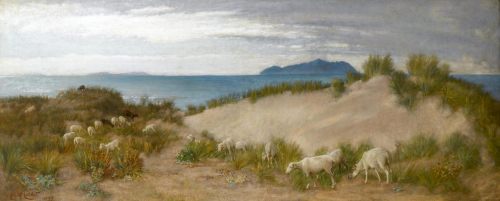
Edith_Corbet_Sheep_Grazing_in_the_Dunes,_on_an_Italian_CoastTitle: Sheep Grazing in the Dunes, on an Italian Coast
Artist: Edith Corbet (1846 – 1920),

Description: Landscape Art

Medium: oil on canvas

Dimensions: 83.5 x 203 cm. (33 x 80 in.)

What I love about this painting:

There is a softness to this image, and yet it feels as if we are there, viewing the beach and the sheep. We know it was painted in late spring, as the sheep have just been shorn, and a few lambs can be seen with their mothers. To the right of the scene, the sky has darkened, and a storm is moving in.

The beach grass, the color of the dunes, and the shades of the water reflecting the ever-changing colors of the sky feel real, perfectly recreated for us by the artist’s hands. She gives us a peaceful serene moment, a chance to just breathe deeply and let go of the stress of our modern lives.

This kind of day is familiar to me, a scene that could be found on many beaches here in my Northwestern part of the world. I love it when a brief storm moves in over the dunes, stirring the waters, and showing how the sky is the most important part of the scene. It’s as if the sky says to the sea, “You may be big and important, but I am larger and more powerful.”

Little is known about Edith’s life. She travelled a great deal and loved Italy. I suspect her first marriage, to illustrator Arthur Murch, was difficult, as he was in poor health much of the time. It has been said that while he was talented, he rarely finished a project. His reputation was based on the two illustrations he produced for Dalziels’ Bible Gallery, while Edith’s landscapes had begun to bring her some fame. Murch died in Germany, and most of Edith’s life at that time was in Italy.

By the time she painted this scene, in 1897, Edith and her second husband, Matthew Ridley Corbet, may have been living in England for at least part of the year.

About the Artist, via Wikipedia:

Edith Corbet née Edenborough (28 December 1846 – 1920) was a Victorian landscape painter, having close associations with the Macchiaioli group (also known as the Tuscans or Etruscans), who, in a break with tradition, painted outdoors in order to capture natural light effects and favoured a panoramic format for their paintings.

She married the Victorian painter and illustrator Arthur Murch and moved to Rome, where she painted with Giovanni Costa, leader of the Macchiaioli group. In 1876 they both stayed in Venice. Olivia Rossetti Agresti wrote: Costa had a very high opinion of this artist’s gifts and used to remember with pleasure how on that occasion they used to go out together to paint from nature at Fusino (Agresti, 1904).

She frequently exhibited from 1880 to 1890 at the Grosvenor Gallery and the New Gallery. In 1891, after the death of her first husband, she married Matthew Ridley Corbet, one of the Macchiaioli group’s leading members, after which she exhibited mainly at the Royal Academy, visiting Italy and living in London for the remainder of her life. Corbet exhibited her work at the Palace of Fine Arts at the 1893 World’s Columbian Exposition in Chicago, Illinois. She died in Hampstead, north London, in 1920. [1]


Credits and Attributions:

Image: Wikimedia Commons contributors, “File:Edith Corbet Sheep Grazing in the Dunes, on an Italian Coast.jpg,” Wikimedia Commons, the free media repository, https://commons.wikimedia.org/w/index.php?title=File:Edith_Corbet_Sheep_Grazing_in_the_Dunes,_on_an_Italian_Coast.jpg&oldid=617254333 (accessed June 2, 2022).

Comments Off on #FineArtFriday: Sheep Grazing in the Dunes on an Italian Coast by Edith Corbet

Filed under #FineArtFriday, writing

How the Written Universe Works: The Inciting Incident #amwriting

Whether we show it in the prologue or the opening chapter, the first event, the inciting incident, is the one that changes everything and launches the story. The universe that is our story begins expanding at that moment.

the inciting incidentThe first incident has a domino effect. More events occur, pushing the protagonist out of his comfortable life and into danger. Fear of death, fear of loss, fear of financial disaster, fear of losing a loved one—terror is subjective and deeply personal.

I love stories about good people solving terrible problems, but I want them to mean something.

While I have experienced violent situations, I’ve also faced many things that shook my world but didn’t threaten my physical safety.

Arguments and confrontations are chaotic, leaving us wondering what just happened. We want to convey that sense of chaos in writing, but we must consider the reader. Readers want to see the scene and understand what they just read. We must design every action scene to ensure they fit naturally into a narrative from the first incident onwards.

The threat and looming disaster must be made clear to the reader at the outset. Nebulous threats mean nothing in real life, although they cause a lot of stress in our daily lives.

Those vague threats might be the harbinger of what is to come in a book, but they only work if the danger materializes quickly and the roadblocks to happiness soon become apparent.

Resolving disaster is the story. Hold the solution just out of reach for the following ¾ of the narrative. Every time we nearly have it fixed, we don’t, and things get worse.

The arc of the story begins with the first event, the inciting incident. The story’s arc occurs because the characters keep reaching for a resolution but can’t quite grasp it. Every attempt is blocked somehow.

959px-One_Ring_Blender_Render

The One Ring, Peter J. Yost, CC BY-SA 4.0

The characters reap the rewards of minor successes but not the golden ring. Those small rewards keep hope alive and keep the reader involved.

If the first problem was taken care of too quickly, why? What sort of trap was laid, and why did the characters take the bait?

If we do this right, we will move our readers emotionally and they will remain invested in our book.

I mentioned that confrontations are chaotic. It’s our job to control that chaos and make a narrative out of it. Nothing upsets a reader more than a book where the author contradicts something that was said or that happened before.

I choreograph action sequences, which can take a little time. Each character’s reactions must be portrayed in such a way the reader doesn’t say, “He wouldn’t do that.”

In real life, people don’t all react the same way. So, our characters can’t all be superheroes in a fight scene. It’s easy to lose the characters’ individuality in the jumble of actions that a confrontation is.

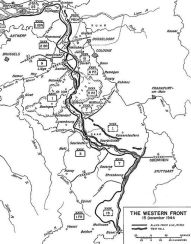
If your violence is war, go to history and see how battles were waged historically. Any war will do, but let’s say you are writing an account of a soldier’s experiences in modern warfare. Go to the Battle of the Bulgealso known as the Ardennes Counteroffensive.

512px-Western_Front_Ardennes_1944

US Army Center for Military History, Public domain, via Wikimedia Commons

I’ve used this battle as an example before because it was a pivotal point in World War II, and the placement of all the forces on both sides is well documented.

Also, one of my uncles fought and was wounded in that battle. Uncle Don came home with a metal plate in his head. American forces endured most of the attack, suffering their highest casualties of any operation during the war.

But you can look at any historical battle. Just remember that even though your book may explore a real soldier’s experiences, you are still writing a fantasy. The past is just hearsay, stories written by the victors. The future is a rumor that may not happen. The only moment that happens for sure is this moment, that moment you experience now.

Our characters exist in their own now, and the inciting incident kicks off their story. Perhaps the soldier’s inciting incident occurs when they join the army. From that point on, the actions and reactions of our soldiers must be logical even amidst the chaos of battle, or the reader will skip over that scene and possibly put the book down.

We make our characters knowable and likable (or not, as the case may be) through physical actions and conversational interactions. In the early part of the story, each scene should illuminate the characters’ motives. The reader must gain information at the same time as the protagonist does.

toolsHowever, the reader has an edge—they will be offered clues from the antagonists’ side, which the characters don’t know. The antagonist’s actions will affect the plot in the future. Even if the antagonist isn’t an overt enemy at the outset, the readers’ knowledge creates a sense of unease, a subliminal worry that things will go wrong.

Through the first half of the book, subtle foreshadowing is essential. This knowledge raises the stakes, increasing the tension.

Next week, we will look at ways to choreograph confrontations and violent encounters.

10 Comments

Filed under writing

In Flanders’ Fields, by John McCrae #MemorialDay

Here in the US, we are celebrating Memorial Day. Originally known as Decoration Day, it’s a federal holiday dedicated to honoring those who died while serving in the US military. It used to be observed on May 30 regardless of the day of the week but in 1970 it was moved to the last Monday in May.

The beautiful image of poppies that graces this post is by Tijl Vercaemer from Gent, Flanders and was found on Wikimedia commons. The beauty and serenity of the poppies, rising from the fields where such terrible conflict once happened, is a fitting accompaniment for the poem, In Flanders Fields, by John McCrae, the text of which follows the picture.

From Wikipedia:  “In Flanders Fields” is a war poem in the form of a rondeau, written during the First World War by Canadian physician, Lieutenant-Colonel John McCrae. He was inspired to write it on May 3, 1915, after presiding over the funeral of friend and fellow soldier Alexis Helmer, who died in the Second Battle of Ypres. According to legend, fellow soldiers retrieved the poem after McCrae, initially dissatisfied with his work, discarded it. In Flanders Fields was first published on December 8 of that year in the London-based magazine Punch.

In Flanders Fields and Other Poems, a 1919 collection of McCrae’s works, contains two versions of the poem: a printed text as below and a handwritten copy where the first line ends with “grow” instead of “blow.” (…)

In Flanders fields the poppies blow
Between the crosses, row on row,
That mark our place; and in the sky
The larks, still bravely singing, fly
Scarce heard amid the guns below.

We are the Dead. Short days ago
We lived, felt dawn, saw sunset glow,
Loved and were loved, and now we lie
In Flanders fields.

Take up our quarrel with the foe:
To you from failing hands we throw
The torch; be yours to hold it high.
If ye break faith with us who die
We shall not sleep, though poppies grow
In Flanders fields.

While bed-ridden and recovering in the Veterans Administration Hospital in Vancouver, Washington, after World War II, my father had little to do but read or crochet. To keep busy, he and the other recovering soldiers in his ward made endless numbers of Remembrance Poppies to commemorate fallen American soldiers. Dad always wore his poppy on his left lapel, as it was close to his heart.

Memorial Day is more than just the official launch of Summer here in the US, more than just an Indy car race. Families have always cared for their family graves, but it became a designated day after the American Civil War in 1868, established  as “Decoration Day.” It was a specific time for the nation to decorate the graves of the war dead with flowers. Every family had soldiers who served and gave their lives in the never-ending wars, as we do today.

Officially, Memorial Day is a 3-day holiday weekend. Banks are closed on Monday, and the US Postal Service is also closed. The American flag is traditionally set at half-staff until noon to honor all those whose lives have been given in the service of our country. At noon, it is raised to the top of the staff, signifying that we, as a nation, will rise again.

My paternal grandmother never failed to keep our family’s graves neat and tidy, bringing flowers every week for my uncle, who had died while serving in the Korean War. As she got older, this tradition aggravated my father, who just wanted to listen to the Indianapolis 500 car race on the radio. He couldn’t bear dwelling on the loss of his brother, or the friends he had lost in France in WWII.

But he took her to the cemetery, anyway.

After each great and terrible war of the last two centuries, the hope was always that we had fought a “war to end all wars.” World War I, also known as The Great War, was spoken of in literature as just that: a war to end all wars.

With each conflict we still hope, but we are less able to believe it, today less than ever.


Sources and Attributions

In Flanders Fields, by Lieutenant Colonel John McCrae, MD, PD|75 years

John McCrae died of pneumonia January 28, 1918, near the end of the Great War. In Flanders’ Fields is a staple poem for Memorial Day services.

Wikipedia contributors. “In Flanders Fields.” Wikipedia, The Free Encyclopedia. Wikipedia, The Free Encyclopedia, 1 May. 2018. Web. 24 May. 2018

Poppies Field in Flanders, image By Tijl Vercaemer from Gent, Flanders #Belgium. File:Poppies Field in Flanders.jpg. (2018, January 13). Wikimedia Commons, the free media repository. Retrieved 15:55, May 24, 2018.

Comments Off on In Flanders’ Fields, by John McCrae #MemorialDay

Filed under #FineArtFriday, #FlashFictionFriday, Poetry