COVID Brain and the Writer #amwriting

The pandemic (and the politics surrounding it) has affected everyone differently, especially in how we go to work, or even if we have a job to go to. For those in my area of Washington State, we first became aware on February 29, 2020, when the first death from coronavirus in the U.S. was reported at Evergreen Health Medical Center in Kirkland, Washington. That was followed by two other confirmed cases in a nursing home in the same city.

Since that day, officials passed down a series of unprecedented orders. They closed down schools, businesses, and restaurants; only takeout and delivery were exempt.

Terrified, newly unemployed people made a run on grocery stores, buying everything they could lay their hands on and stockpiling it.

Stores quickly became large, empty warehouses. People who shopped as they normally did were unable to find such necessary items as soap or toilet paper.

Things have changed and restrictions have loosened a little, but life will never go back to the way it was. Residents are now trying to settle into what has become a new normal, following social distancing guidelines and staying at home as much as possible.

While shopping has returned to a new kind of normal and stores now have most of the basic necessities, life is not returning to what once was ordinary, nor will it ever. Wearing face masks and maintaining social distancing has become de rigueur. In my home state of Washington, these are mandatory.

No shoes, no shirt, no face-mask, no service.

Remote school was a struggle for many parents. Now, for many, their spouse is either laid off or working from home. During the spring, their kids were home-schooled, then summer happened. They ended up with a house full of bored kids and no place open to take them for entertainment.

For those who live in apartments, even most parks are closed. Going for an afternoon walk quickly loses its charm for the average four-year-old.

Unfortunately, in my state of Washington, schools will remain closed through the fall, and online classes will be the norm. This is a disaster for the poorest families, those without access to the internet. The schools provide your child with a Chromebook, but what do they connect it to? And in most really poor families, the parents have no idea how to hook up a computer or use one.

Even parents who are financially better off are trying to keep their children focused and entertained. This, while they attempt to work from home and are once again faced with also trying to educate them.

Zoom meetings are frequently interrupted by toddler tantrums and cats—the way business is done in our new world.

I know several prolific authors whose ability to write has gone out the window. Many people are only now getting back into some sort of schedule.
This is for a variety of reasons. First of all, if you are writing full time, you rely on those quiet hours of the day while the spouse is at work and kids are at school.

For those whose day jobs meant they scrambled to find time for writing, unemployment was a blessing as far as their writing went. They now had time to write and plenty of apocalyptic stories to tell.

However, we who write full time were thrown out of the normal routine and into a world where every day felt like Saturday, but no one would leave the house and just let you get on with your work.

We had what my Texas editor, Irene, calls “COVID Brain.”

If you are one of the many whose ability to think and write has been affected by the way our world has changed, you are not alone.

However, we are adaptable. All those hours of playing Stardew Valley when you should have been writing weren’t wasted. Your mind was resting, taking a break from the craziness.

I am so grateful for the tools that participating in National Novel Writing Month  (NaNoWriMo) every year has given me. If you are struggling to connect two sentences together, here are some thoughts for you:

Writing daily is easier once it becomes a behavioral habit. First, you must give yourself permission to write.

Your perception that it is selfish will be your biggest obstacle. Trust me, it is not asking too much of your family for you to have some time every day that is sacred and dedicated to writing.

You must decide what is more important, your dream of writing that novel, or watching a television show that is someone else’s dream.

Do you want to create, or do you want to be entertained?

Give up that 8:00 p.m. TV show. If you want to create, you must turn off the television or log out of your video game for a certain length of time every day because you’re not writing if you’re playing a game or watching a show.

Trust me about the six hours a day playing Stardew Valley thing.

But you don’t have to give up the things that keep you sane. Do this in baby steps.

You have the right to take an hour in the morning and the evening to use for your own creative outlet. Get up an hour early and write until the time you would usually get up. That will be the quietest time you will have all day.
Write for five minutes here and ten minutes there all day long if that is all you can do around the demands of educating your children and working from home.

Every word, every idea counts toward your finished manuscript. By writing in short bursts whenever you have the opportunity, you are redeveloping the discipline you once had.

Normal has changed. We have had to wrap our heads around this new way of life, but we are adaptable.

For those who are now faced with schooling their children at home, I offer you this YouTube video from Kathryn at Do it on a Dime, which has some useful tips for making their learning time productive and reducing your stress. Toward the end, Kathryn offers some excellent advice, words we all need to hear.
Remote Learning Made Easy

5 Comments

Filed under writing

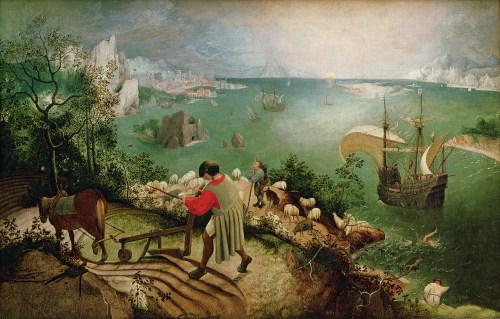
#FineArtFriday: Landscape with the Fall of Icarus, Pieter Bruegel the Elder, c. 1560

Artist: Pieter Bruegel the Elder

Year: c. 1560

Medium: oil on canvas

Dimensions: 73.5 cm × 112 cm (28.9 in × 44 in)

Location: Royal Museums of Fine Arts of Belgium, Brussels

The story depicted in this painting, via Wikipedia, The Free Encyclopedia:

In Greek mythologyIcarus succeeded in flying, with wings made by his father Daedalus, using feathers secured with beeswax. Ignoring his father’s warnings, Icarus chose to fly too close to the sun, melting the wax, and fell into the sea and drowned. His legs can be seen in the water just below the ship. The sun, already half-set on the horizon, is a long way away; the flight did not reach anywhere near it. Daedalus does not appear in this version of the painting.

The ploughman, shepherd and angler are mentioned in Ovid’s account of the legend; they are: “astonished and think to see gods approaching them through the aether”, which is not entirely the impression given in the painting. The shepherd gazing into the air, away from the ship, may be explained by another version of the composition. In the original work there was probably also a figure of Daedalus in the sky to the left, at which he stares.

There is also a Flemish proverb (of the sort imaged in other works by Bruegel): “And the farmer continued to plough…” The painting may, as Auden’s poem suggests, depict humankind’s indifference to suffering by highlighting the ordinary events which continue to occur, despite the unobserved death of Icarus.

What I love about this painting:

This is a wonderful painting, despite its disputed provenance. Pieter Bruegel the Elder tells us a story bluntly: Icarus flew too close to the sun and the wax holding his wings together melted. He fell into the sea and drowned.

Bruegel’s earthy sense of humor comes to the fore in this painting as it does in his other works depicting Flemish proverbs. Always ready to point out humanity’s failings, the artist makes him look ridiculous showing us only his pale, thrashing legs.

In saying that humankind shouldn’t try to fly too high, Bruegel tells us to stop trying to be what we aren’t. He says that one should be content with one’s place in life.

The controversy surrounding this painting, via Wikipedia, The Free Encyclopedia:

Landscape with the Fall of Icarus is a painting in oil on canvas measuring 73.5 by 112 centimetres (28.9 in × 44.1 in) in the Royal Museums of Fine Arts of Belgium in Brussels. It was long thought to be by the leading painter of Dutch and Flemish Renaissance paintingPieter Bruegel the Elder. However, following technical examinations in 1996 of the painting hanging in the Brussels museum, that attribution is regarded as very doubtful, and the painting, perhaps painted in the 1560s, is now usually seen as a good early copy by an unknown artist of Bruegel’s lost original, perhaps from about 1558. According to the museum: “It is doubtful the execution is by Bruegel the Elder, but the composition can be said with certainty to be his”, although recent technical research has re-opened the question.

Since its acquisition by the Royal Museums of Fine Arts of Belgium in 1912, its authenticity has been challenged by several specialists, mainly for two reasons: (i) the relatively weak quality of the painting compared to other Bruegels, although this question is complicated by later overpainting; (ii) it is an oil painting on canvas, an exception in the work of Peter Bruegel the Elder who made all his oil paintings on panel.

In 1963, Philippe Roberts-Jones, curator at the museum, and the Bruegel specialist Georges Marlier, hypothesized that an original panel painting had been later moved onto canvas, as was once common.

In 1998, a mixed team of scientists from the Belgian Royal Institute for Cultural Heritage and the University of Utrecht[7] attempted to solve the authenticity problem by a radiocarbon dating of the canvas that was supposed to be the original support. As mentioned here above, the conclusion of this dating was that P. Bruegel the Elder cannot have painted on this canvas. Later, in 2006, Prof. J. Reisse (Université libre de Bruxelles) challenged this dating on technical grounds.

A sample of blue paint taken from the right edge in 1973 was re-examined by performing analysis such as scanning electron microscopy (SEM) coupled to the energy dispersive X-ray spectroscopy (EDX), which in connection with optical microscopy revealed the following structure and composition. From bottom to top:

  1. Canvas (from transposition);
  2. Oily lead white (adhesive);
  3. Thick oily layer with azurite (repaint);
  4. Chalk ground;
  5. Oily lead white with scarce particles of charcoal;
  6. Oily blue with azurite;

with layers 4 to 6 being original.

The presence of chalk ground under the original blue proves that this is a panel painting transposed on a canvas. The original blue layer is lead white with azurite containing a few grains of ochre and charcoal. These structure and composition match perfectly those found on other certified panels of Peter Bruegel. Moreover, it is noticeable that the wood charcoal particles are very peculiar, being very long and acicular, exactly the same as those found only in The Census from the same Museum.

Recently, a study of the underdrawing using infrared reflectography has been published.

Reflectography is based on the fact that the infrared light penetrates all colors except black. As a result, the drawing, mostly black, can be made visible. The interpretation of these reflectograms is of course more subjective, but in a global way, the drawing from the Fall of Icarus is not really different from other certified works from Peter Bruegel the Elder. This drawing is generally limited to a layout of the elements. Probably because the thin, weakly covering paint on white ground would hide imperfectly a detailed graphism.

A re-interpretation of the reflectograms in agreement with the other analysis suggested the conclusion that the work in the Museum of Fine Arts in Brussels is a panel painting transferred to canvas. The paint layer and maybe also the underdrawing have been severely damaged by this intervention as well as by two more relinings, responsible for the heavy overpainting. In the paint sample remains a fragment with structure and composition matching perfectly the technique of the large panels attributed to Peter Bruegel the Elder. It is therefore unlikely that this version of the Fall of Icarus might be from the hand of a copyist, except perhaps from P. Bruegel the Younger. Conversely, the Van Buuren copy with a different technique cannot be attributed to either Peter Bruegel.


Transfer of panel paintings, via Wikipedia, The Free Encyclopedia:

The practice of conserving an unstable painting on panel by transferring it from its original decayed, worm-eaten, cracked, or distorted wood support to canvas or a new panel has been practised since the 18th century. It has now been largely superseded by improved methods of wood conservation.

The process is described by Henry Mogford in his Handbook for the Preservation of Pictures. Smooth sheets of paper were pasted over the painted surface of the panel, and a layer of muslin over that. The panel was then fixed, face down, to a table, and the wood planed away from the back until it was “as thin as a plane may safely go”, and the remainder scraped off with a sharp instrument such as a razor. The ground of the painting was then removed by solvents or scraping, until nothing remained but a thin skin of colour, pasted over with paper and held together by the muslin. A prepared canvas was then attached to the back of the paint layer, using the same method as was used for lining pictures. When the glue had dried, the paper and muslin were removed by careful damping.


Credits and Attributions:

“Landscape with the Fall of Icarus,” Pieter Brueghel the Elder ca.1558 / Public domain

Wikipedia contributors, “Landscape with the Fall of Icarus,” Wikipedia, The Free Encyclopedia, https://en.wikipedia.org/w/index.php?title=Landscape_with_the_Fall_of_Icarus&oldid=963660790 (accessed August 14, 2020).

Wikipedia contributors, “Transfer of panel paintings,” Wikipedia, The Free Encyclopedia, https://en.wikipedia.org/w/index.php?title=Transfer_of_panel_paintings&oldid=945009923 (accessed August 14, 2020).

2 Comments

Filed under #FineArtFriday

The Pyramid of Conflict, Tension, and Pacing #amwriting

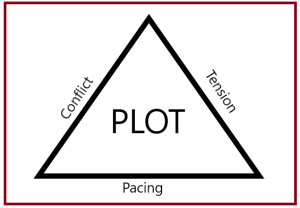
In any story, the crucial underpinnings of conflict, tension, and pacing are bound together. Go too heavily on one aspect of the triangle, and the story fails to engage the reader. Balance the three, and the story works even if the reader doesn’t care for the writer’s style or the way they write prose.

Scenes involving conflict are controlled chaos—controlled on the part of the author.

Stories that lack conflict are just character studies.

A story that opens with a teenager leaving her parents’ home, angry, then meeting a manager on a bus and being offered a gig as lead guitar player for a big-name band, and ending on that happy note lacks conflict. It is a case of authorly wish-fulfilment.

An angry, naïve teenager and a “successful manager” on a bus…what could possibly go wrong? The roadblocks and obstacles that happen between her leaving home and finally gaining success are conflict, and they are what makes a story more than just a character study.

First, if it is a violent confrontation, there must be a logical reason for the problem. Don’t insert a fight just because you can’t think of any other way to liven things up. Most people have to be pushed into angry confrontations. The emotional triggers that cause them to snap must make sense to a reader and be logical within the established storyline.

Long, drawn-out fight scenes bore me to tears. For that reason, I keep my violence concise and linear.

I’ve read books where the authors focused too firmly on the technical side of the fight. Too many words were spent on how they were dressed, who hit who with what weapon, in minute detail. Yes, these are necessary elements of the scene. Just remember that long paragraphs with too much detail can be confusing to the reader.

Conflict is not only fighting.

Conflict is what keeps the protagonist from achieving their goals. Overcoming the opposition is the reward for sticking with the story.

No one is going to stick with a novel where random, convoluted quarrels and roadblocks happen for no good reason. The most important consideration in plotting conflict is need.

What does the protagonist gain by overcoming it?

Why did it happen?

What is the purpose of injecting that conflict into the narrative?

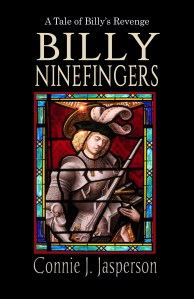
Let’s look at Billy Ninefingers. Besides the obvious fact that he is seriously injured in the opening fight, which is the core plot point of the book, I had two other goals to accomplish with the inciting incident.

First, I knew one of the fundamental laws of writing; that plausible literary conflict is not random.

For Billy’s plight to be believable, the reader must see that the Bastard is jealous of his success and acts on any thought that passes through his alcohol-soaked mind. Because the conflict is not random, the reader must later be allowed to discover how the Bastard is manipulated, why he’s being used in this way, and by whom.

In the resolution of the initial scene, my intention was to demonstrate that Billy, even with his life in ruins, has a sense of fair-play.

Billy’s resilience, his creativity, and how he overcomes one roadblock after another despite his maimed hand is the story.

In other words, conflict drives and forces the momentum of the story. It must stir emotions in the reader. The reader must feel the sense of justification or sorrow or triumph that the protagonist experiences with each interaction.

Tension is experienced during the build-up to an incident. The resolution of one conflict leads to another, which is resolved and turns into another. In maintaining good tension, the author keeps the pressure on, raising the anxiety by always raising the stakes.

Pacing is the underpinning, the way the scenes are structured. As our narrative follows the arc of the story, our characters experience action and reaction. The story has a feeling of life, almost as if it is breathing. It moves forward, then allows a brief moment where the reader and the protagonist process what just happened, and then it moves forward again. The speed with which these things occur is called “pacing.”

Pacing allows the conflict to continue raising the tension yet gives both the reader and the protagonists a chance to rest between incidents.

One of the most challenging aspects of writing the first draft of any action scene is to ensure that each character remains a unique individual. A blurring of personalities is a problem that occurs when an author focuses too intently on the mechanics, the action and interaction of a scene, writing it as if they lived it.

For the author, acting out the action ensures that the moves are reasonable and make sense. But you aren’t done writing that scene just because the hacking, slashing, and gunshots are on paper.

Tension is heightened as scenes are connected to each other, and more deadlines and showdowns approach. This feeling of subtle anxiety is controlled by pacing.

Thus, the plot of any story is composed of a triangle formed by conflict and tension, set on a foundation of good pacing.

On the positive side, once we get the pacing right, it’s easier to use the conflict to ratchet up the tension.

2 Comments

Filed under writing

Plotting the End #amwriting

Maybe you’re a “pantser,” not a “plotter.” Unlike me, you like to wing it when you write, just let the ideas flow freely. I have “pantsed it” on occasion, and it can be liberating.

For me there comes a point where I realize my manuscript has gone way off track and is no longer fun to write. This is when I must go back and find the point where the story stopped working.

Perhaps you are working on a manuscript you began writing during last year’s NaNoWriMo (National Novel Writing Month). Maybe you’re 80,000 words in and need to write the final 20,000 words to finish the book. You have a vague idea of how it ends but can’t figure out how to get there.

This is what I am dealing with in regard to two novels right now. One began as a serial published in 2015 – 2016 on Edgewise Words Inn, which was how I discovered that writing and publishing a chapter a week is not my forte. This book has been on hold for several years because of other writing commitments.

The other unfinished business is book one of a duology. I’ve committed to writing the second book in this set before publishing the first. This will ensure the wait time for the second book’s release will be reasonable. Even though the entire story will span two books, this first half must have a finite ending.

It’s at what would be considered the midpoint of the 2-book story arc. The problem has been deciding where in the overall story arc of the duology the ending of book 1 occurs, and how it leads into the action of the opening chapters in the second half.

I have stopped floundering and (literally) cut my losses with both unfinished books. I trimmed both back to the place where they dissolved into chaos. After a lot of writing and rewriting, I have the first three-quarters of both books in good shape. But now I’m suffering from “pandemic brain.” I don’t know what to do or how to bring either story to its intended conclusion.

This isn’t unusual. Fortunately, my years of doing NaNoWriMo have given me some tools for just such an emergency.

The first tool is a sense of balance. Every published novel has entire sections that had to be rewritten at least once before it got to the editing stage.

Much of what you cut out can be recycled, reshaped, and reused, so never just delete weeks of work.

  1. Save everything you cut to a new document, labeled, and dated: “Outtakes_Bleakbourne_rewrite1_08-08-2020.” (that stands for Outtakes, Bleakbourne on Heath, rewrite 1, Aug-08-2020)

Now, we must consider what will be the most logical way to end this mess.

What is the core conflict? For me, a good way to pull the ending out of my subconscious is to revisit the outline I made of the story arc. Fortunately, I have been on top of things in both worlds, so deviations from the original plans have been noted. I’m looking at the current blueprint of both works-in-progress to this point.

The problem I am experiencing now is that I didn’t know exactly where either of these books were going to end when I began writing them, so that part never got plotted. Now I can see how the internal growth of the characters has caused two of them to fundamentally change from what was originally planned. Their personal goals have radically deviated from what I had initially thought.

By seeing the whole picture of the story to this point, I usually find the inspiration to put together the final scenes that I know must happen. Something big and important must be achieved in the final chapters, so for me, pausing to do some more plotting and loose outlining is crucial to writing a logical sequence of events.

I sit down with a notebook (or in my case a spreadsheet) and make a list of what events must occur between the place where the plot was derailed and the end. This is just a list of chapters with the keywords for each scene noted.

Once I have refreshed my memory with what has gone before and made a few notes as ideas occur to me, I start a new document and save it with a name that clearly denotes that it’s a worksheet for that novel.

HA_Final_Chpts_Worksheet_08-08-2020 (Heaven’s Altar, final chapters worksheet, and the date)

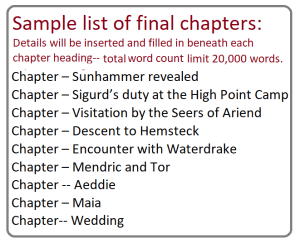
At first, the page is only a list of  headings that detail the events I must write for each chapter. I know what end I have to arrive at, but the chapter headings are pulled out of the ether, accompanied by the howling of demons as I force my plot to take shape:

  • Chapter – Sunhammer revealed/swearing the vows of protection
  • (and so on until the last event)

You’ll note that while the word chapter is there, and a rudimentary title, there are no numbers. I don’t number my chapters until the third draft is complete, although I do head each section with the word “chapter” written out, so it is easy to find with a global search. The titles will disappear, or be changed, depending on which series it is.

This is because in my world, first drafts are not written linearly. For me, things change structurally with each rewrite. It’s less confusing if the numbers are only put in when the manuscript is finalized.

I begin writing details that pertain to the section beneath each chapter heading as they occur to me. Once that list is complete, those sketchy details get expanded on and grow into complete chapters, which I then copy and paste into the manuscript.

When I begin designing the ending, it’s as challenging and yet easy as plotting the opening scenes. I go back to the basics and ask the same questions I asked in the beginning.

It’s a good idea to have a separate worksheet that lists each character and contains notes detailing what they wanted at the beginning. That way you can see how that has changed by the events they have experienced.

  1. What do the characters want now that they have achieved a significant milestone?
  2. What will they have to sacrifice next?
  3. What stands in the way of their achieving the goal?
  4. Do they get what they wanted in the end, or do their desires evolve away from that goal when new information is presented?

When I’m forced to do a lot of rewriting, I never delete anything. Everything we write should be kept in a file labeled “outtakes.”

Don’t be afraid to rewrite what isn’t working. Save everything you cut, because I guarantee you will want to reuse some of that prose later, at a place where it makes more sense.

Not having to reinvent those useful sections will significantly speed things up, which is why I urge you to save them with a file name that clearly labels them as background or outtakes.

Something we all suffer from is the irrational notion that if we wrote it, we have to keep it, even though it no longer fits.

Let’s be honest. No amount of rewriting and adjusting will make a scene or chapter work if it’s no longer needed to advance the story. If the story is stronger without that great episode, cut it.

What you have written but not used in the finished novel is a form of world-building. It contributes to the established canon of that world and makes it more real in your mind.

Use it as fodder for a short story or novella set in that world. This is how prolific authors end up with so many short stories to make into compilations. It’s useful to know that every side-quest not used in the final manuscript can quickly be made into a short story.

7 Comments

Filed under writing

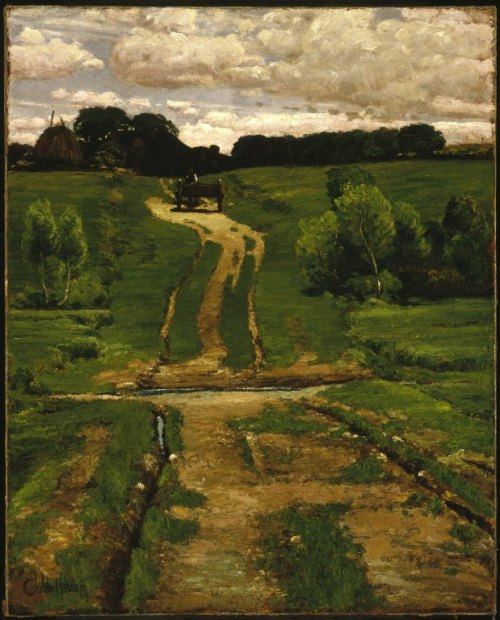
#FineArtFriday: A Back Road, by Childe Hassam 1884 (reprise)

We have been talking about world-building all this week. World-building can be a challenge at times. Some days, we need a visual boost to get our minds working. Historical fiction and fantasy authors have a marvelous resource in the images of great art that has been compiled and is available for viewing on Wikimedia Commons.

For instance, if you want to know what a road looked like to travelers before the advent of blacktop and concrete made the modern freeways and highways possible, turn to art.

The above painting by Frederick Childe Hassam, shows what a good road looked like.  It goes across the land, cut into the earth by the travelers who use it. Along the better roads, such as this one, ditches were dug to enable drainage.

No bridge crosses the small creek–travelers must cross the water on foot or in the wagon. In winter it becomes a mushy, muddy track, and in summer it’s sun baked and hard. In spring, the grass grows green, making it a pleasant place.

A Back Road (1884) was painted in his early years, while Hassam was still influenced by the works of William Morris Hunt, who like the great French landscape painter Jean-Baptiste-Camille Corot, emphasized the Barbizon tradition of working directly from nature.

From Wikipedia: In 1885, a noted critic, in part responding to Hassam’s early oil painting A Back Road (1884), stated that “the Boston taste for landscape painting, founded on this sound French school, is the one vital, positive, productive, and distinctive tendency among our artists today…the truth is poetry enough for these radicals of the new school. It is a healthy, manly muscular kind of art.”

I like the composition of this piece, the way the land is larger than the sky. The grass feels damp and the clouds herald more spring rain–this painting has life.

In his later years, Hassam moved away from realism and became known as one of the best of the American impressionists.


Credits and Attributions:

A Back Road, Childe Hassam 1884 [No restrictions or Public domain], via Wikimedia Commons

Wikipedia contributors, “Childe Hassam,” Wikipedia, The Free Encyclopedia, https://en.wikipedia.org/w/index.php?title=Childe_Hassam&oldid=831999910 (accessed April 6, 2018).

2 Comments

Filed under #FineArtFriday

World-building, part 2: building reality #amwriting

When I write a world that my characters might live in, I want to express more than merely the sights, the sounds, and the smells. I want to convey the emotions that place evokes for me, the author.

The fact is, unless we are there physically, other places don’t really exist for us. For this reason, the only world that really exists in this incarnation is the space we physically occupy as individuals.

The only true reality is the space we can see, hear, smell, and touch. This is our setting, the world in which our life story plays out.

In literary terms, what is setting? It is the environment your characters live and interact with. It is scenery, topography, plants, and animals. The setting is also comprised of a place in time, defined by an era, or a level of technology.

These aspects of the setting are crucial to making a story real to a reader. However, if they are shown as unconnected elements, this setting lacks something. We must inject these elements with the indefinable fantasy thingamajig we call atmosphere.

Perhaps you experience a sense of longing when remembering a particular place.  For me, one place represents a feeling of home and lingers in my heart. When I am writing in my fictional world, I am drawing on the memory of that long-ago place.

That lost time and place has a hold on my emotions and is made brighter and shinier by the false lighting of memory. This is why, despite the fact my childhood home is a real place, it is also a fantasy.

A reader’s perception of a setting’s reality is affected by emotions they aren’t even aware of. We must give the reader something they can subliminally recognize, something they can relate to. We need to convey a sense of familiarity to a place the reader has never been.

“Familiar” does not mean safe or comforting. It means the elements of the environment are recognizable on a subconscious level, something the reader can understand without having experienced it, or being bluntly told.

This is why I draw maps. If your characters must do any traveling in a fantasy world, you probably should make a rudimentary map. The map is my indispensable tool for keeping my story straight.

It doesn’t have to be fancy. All that is required is a pencil sketch showing a few lines for roads and the general location of any cities or topographical features that come into the story.

When your characters are traveling great distances, they may pass through villages on their way, and if these places figure in the events of the book, they should be noted on the map. This prevents you from:

  • accidentally naming a second village the same name later in the manuscript
  • misspelling the town’s name later in the narrative
  • forgetting where the characters were in chapter four

Perhaps the land itself will impede your characters. If geologic features are pertinent to the story, you will want to note their location on your map so that you don’t contradict yourself if your party must return the way they came:

  • rivers
  • swamps
  • mountains
  • hills
  • towns
  • forests
  • oceans

Even if your work is wholly set on a space station/ship, consider making a floor plan.

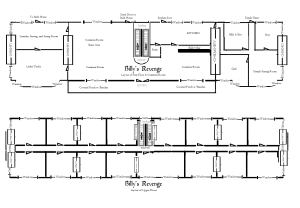
My novel, Billy Ninefingers, is set almost entirely in a wayside inn. I made a drawing of the floorplan for my purposes because that is the world in which the story takes place.

In the narrative, if you are writing fantasy, I suggest you keep the actual distances mushy because some readers will nitpick the details, no matter how accurate you are. Yes, you wrote it, but they don’t see it the way you do.

Using medieval distances won’t help, because they’re not concrete—a league might be three miles or one and a half, depending on the country and era. Some readers will argue that their version of a league is the only real version and blah blah blah….

When it comes to creating reality on paper, a perception of familiarity is everything. Use your memory to visualize the scenery:

Imagine the surface of a pond. On a windless day, the pool will be calm, still. The sky and any overhanging trees will be reflected in it.

Add in a storm, and things change. The waters move. Ripples and small waves stir the surface, which now only reflects the dark gray of the stormy sky.

Atmosphere is the part of a world that is created by colors, scents, ambient sounds, and how the visuals are shown. It is visual and tied to the setting, but the perception of it is affected by the moods and emotions of the characters.

From the first paragraph of a story, we want to use the setting to establish a feeling of atmosphere, the general mood that will hint at what is to come.

We do this by employing lighter or darker descriptions. A dark, gloomy setting created by “weighted words” establishes an ominous atmosphere, which will be reflected in the mood of your characters.

I think of “weighted words” as those with strong descriptive power, and which don’t need a lot of support from adjectives and adverbs to convey their intensity.

Lighter words will create an atmosphere that feels brighter.

We have mentioned before that while the two terms, mood and atmosphere, are usually used as synonyms, they are different from each other. In literature, mood refers to the internal feelings and emotions of an individual as often as it does the overall atmosphere of a piece. The term atmosphere is always associated with a setting.

Many sci-fi and fantasy novels are set in real-world environments. The settings are familiar, so close to what we know, that readers have no trouble accepting that world.

I love books where the author’s gift for world-building creates a layer of reality I can immediately “fall” into. Setting, action, interaction—these most obvious components combine to showcase the more profound aspects of the story.

I have been returning to the works of other authors to see how they create their worlds, how they choose words to build a setting and create atmosphere and mood.

Some of their tricks work, and some not so much, but I keep reading and learning. By figuring out what didn’t work for me in a novel, I hope to avoid those mistakes in my own work.

8 Comments

Filed under writing

World-building, part 1: Place #amwriting

My novel, Mountains of the Moon, was born in 2008. It began life as a storyline for an anime-based RPG that never went past planning into production. The original title was Neveyah, named after the world in which it was set.

MOTM is set in an alternate universe and takes place in an environment that was ground zero for a war between gods. As a result of that battle, the gods were prohibited from acting directly against each other and must now act through their people.

When the story opens, the World of Neveyah has been recovering for a thousand years.

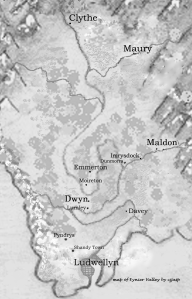
I had created the maps for the role-play game, so before I began writing Wynn’s story as a novel, I knew the topography of his world.

Of course, I got distracted and wrote Tower of Bones, a story set two generations later before I finished MOTM, but that’s how writing works for me.

I went to science to see how long it takes for an environment to recover from cataclysmic events. I took my information from a place I live a two-hour drive away from, the Channeled Scablands of Washington State. This vast desert area is  comprised of the scars of a natural disaster that occurred around 18,000 years ago.

From Wikipedia: The Cordilleran Ice Sheet dammed up Glacial Lake Missoula at the Purcell Trench Lobe.[10] A series of floods occurring over the period of 18,000 to 13,000 years ago swept over the landscape when the ice dam broke. The eroded channels also show an anastomosing, or braided, appearance.

I had to first build and then destroy the ecology for the game. All RPG players will tell you that a hazardous environment and correspondingly dangerous creatures are a core part of a game’s story. Hazards present threats the protagonist must learn to coexist with. Overcoming and surviving danger raises a player’s skills and strength.

That concept of personal growth through action is a feature of all adventure stories.

Thanks to that year of prep-work on the game, when I began writing the book, all the hard work was done. Many hours of work and years of writing is why the world seems so solid from the opening paragraphs.

When we first brainstormed the idea of writing a fun, yet deep and meaningful story and making a computer game out of it, my partner had two requests. He wanted the central character to be under a curse. Also, he wanted Wynn’s arc to take him from the most naïve, sheltered twenty-year-old ever to walk the planet, to a strong adult capable of making a difference in a world that could sometimes be a terrible place.

So, with those requests in mind, I sat down and wrote a 3500-word outline of events, and answered as many questions about the world as I could think of at the time:

  • What is the name (and the meaning of that name) of the worlds involved in the character’s journey?
  • Who are Gods involved, and what is the core of their conflict?
  • This is a portal story, so where was my protagonist, Wynn Farmer, when the story opened? Why was he unaware of the portal before he fell through, and why wouldn’t it take him back to his world?
  • Where was he at the end of the opening chapter? How did the air feel? What scents and odors were common to that place?

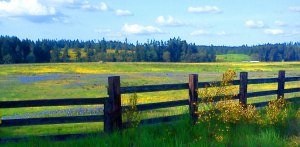
Blue camas and wild mustard on the Violet Prairie, Tenino Washington, in May 2014

The world of Neveyah is an alien environment, yet it’s extremely familiar to me. I based the plants and topography on the world I live in, the Pacific Northwest. The plants and geography are directly pulled from the forested hills and farmlands of Southern Puget Sound and Western Washington State.

Who did he meet (Jules Brendsson)? What did he see, and how did that meeting go?

When he realized he couldn’t go home, how did Wynn react to his new environment?

It was written as a game, so the environment plays a part in the characters’ learning curve. Coping with it is how the characters “level up” or grow in strength. While Wynn didn’t expect to fall into Neveyah, Jules had been sent specifically to meet and instruct him in the use of magic. Wynn and Jules must walk from the meeting place to a town.

As they are walking, Jules must get to know Wynn and teach him how to use a form of magic. What does Jules think about his student? Looking through Wynn’s eyes, what does he see in each scene?

This is where atmosphere comes into world-building, something we’ll go into detail about on Wednesday.

On this original world-building document, I wrote every detail I could think of, from the largest and most dangerous creatures down to the insects. Over the next four years, as I wrote the novel, I added to it whenever I thought of something new.

In the process of building the world that Wynn Farmer fell into, his storyline began to write itself.

The act of designing the immediate scenery builds the entire world in your mind. I go with the familiar, with some strange twists thrown in for fun.

You might tell me that you can’t picture a place you haven’t been to. But what does that really mean?

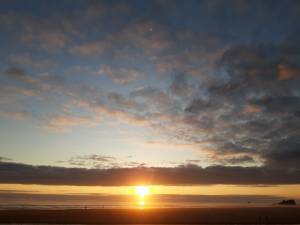
Sunset on Cannon Beach, August 2019

Open your eyes and look around. At this moment you have all the elements you need to create an alien or alternate world. These elements could exist before your eyes, or they exist in your memory.

Use what you know, reshape it, reuse it, and make it yours.

Everyone has a place they want to be more than anywhere else. For me, one place on earth represents my serenity, my creative happy place, and it exists in the real world but is a four-hour drive from my home.

Yet, when I need to, I can pull that place up in my mind. By visualizing my summer retreat, I recharge my serenity-batteries.

Open a new document, one that will be your world-building work sheet. What kind of place seems to build itself in your mind? This is an environment you are mentally connected to. In writing that that place, it will flow from you and convey itself to the reader. Write down the sights, smells, and the emotions you experience when thinking about it.

Perhaps it is a real place, and maybe you experience a sense of longing when remembering that place. If so, write how it makes your physical self feel.

This the point where cosmology and human nature intersect to create atmosphere, and we will continue this discussion on Wednesday.


Credits and Attributions:

Wikipedia contributors, “Channeled Scablands,” Wikipedia, The Free Encyclopedia, https://en.wikipedia.org/w/index.php?title=Channeled_Scablands&oldid=963105167 (accessed August 1, 2020).

All images and maps used in this post are the creation and intellectual property of Connie J. Jasperson.

2 Comments

Filed under writing

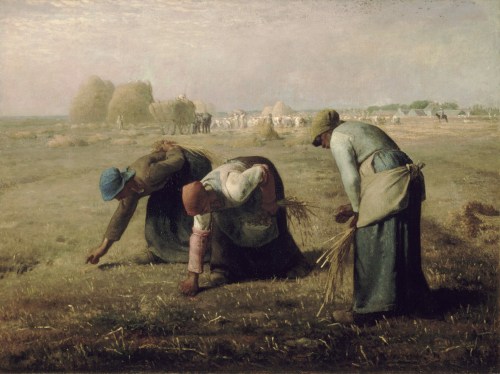
#FineArtFriday: The Gleaners by Jean-François Millet 1857

Title: The Gleaners by Jean-François Millet  (1814–1875)

Genre: genre art

Date: 1857

Medium: oil on canvas

Dimensions: Height: 83.5 cm (32.8 in); Width: 110 cm (43.3 in)

***

Wikipedia says: Gleaning is the act of collecting leftover crops from farmers’ fields after they have been commercially harvested or on fields where it is not economically profitable to harvest.

In nearly all paintings showing this labor, artists painted poor women doing the work of gleaning. Historically, the majority of impoverished families were headed by single, usually widowed, working women, who had few opportunities for employment and were paid less for their labor than men. This trend of lower pay for women overall continues, with the US Census reporting on Sep 10, 2019 that the median income for households maintained by single women  was $45,128,  as compared to households maintained by single men, who had a median income of $61,518 in 2018.

***

About the Artist: 

Jean-François Millet (October 4, 1814 – January 20, 1875) was a French artist and one of the founders of the Barbizon school in rural France. Millet is noted for his paintings of peasant farmers and can be categorized as part of the Realism art movement. Toward the end of his career he became increasingly interested in painting pure landscapes. He is known best for his oil paintings but is also noted for his pastels, conte crayon drawings, and etchings.

About The Gleaners (1857) via Wikipedia:

This is one of the most well known of Millet’s paintings. While Millet was walking the fields around Barbizon, one theme returned to his pencil and brush for seven years—gleaning—the centuries-old right of poor women and children to remove the bits of grain left in the fields following the harvest. He found the theme an eternal one, linked to stories from the Old Testament. In 1857, he submitted the painting The Gleaners to the Salon to an unenthusiastic, even hostile, public.

(Earlier versions include a vertical composition painted in 1854, an etching of 1855–56 which directly presaged the horizontal format of the painting now in the Musée d’Orsay.)

A warm golden light suggests something sacred and eternal in this daily scene where the struggle to survive takes place. During his years of preparatory studies, Millet contemplated how best to convey the sense of repetition and fatigue in the peasants’ daily lives. Lines traced over each woman’s back lead to the ground and then back up in a repetitive motion identical to their unending, backbreaking labor. Along the horizon, the setting sun silhouettes the farm with its abundant stacks of grain, in contrast to the large shadowy figures in the foreground. The dark homespun dresses of the gleaners cut robust forms against the golden field, giving each woman a noble, monumental strength.


Credits and Attributions:

The Gleaners, by Jean-François Millet / Public domain. Wikimedia Commons contributors, “File:Jean-François Millet – Gleaners – Google Art Project 2.jpg,” Wikimedia Commons, the free media repository, https://commons.wikimedia.org/w/index.php?title=File:Jean-Fran%C3%A7ois_Millet_-_Gleaners_-_Google_Art_Project_2.jpg&oldid=371550893 (accessed July 31, 2020).

Wikipedia contributors, “Gleaning,” Wikipedia, The Free Encyclopedia, https://en.wikipedia.org/w/index.php?title=Gleaning&oldid=952834082 (accessed July 31, 2020).

Wikipedia contributors, “Jean-François Millet,” Wikipedia, The Free Encyclopedia,  https://en.wikipedia.org/w/index.php?title=Jean-Fran%C3%A7ois_Millet&oldid=956877005 (accessed July 31, 2020).

2 Comments

Filed under #FineArtFriday

Four rules for writing conversations #amwriting

In my last post, we talked about internal dialogues, or thoughts our characters may have. But what about that which is spoken aloud?

How to punctuate dialogue can be confusing for those who are just starting out. I will warn you—from the reader’s perspective, punctuation is to writing what gravity is to the universe. It holds everything together.

We obey traffic signals when driving, so we don’t cause wrecks. In the same way, our written work must abide by specific fundamental rules, or it will be unreadable—a wreck.

What is spoken must be easily distinguished from the ordinary narrative. Therefore, punctuation is for the reader’s benefit. While we can take some liberties with grammar and dialect when writing conversations, following the established rules of punctuation is essential.

Many people are confused about how to punctuate conversations. It’s not that complicated. Here are four rules to remember:

Rule 1: Surround everything that is spoken with quotation marks. “I’m here,” she said.

Begin and end the dialogue with “double quotes.” These are called closed quotes. All punctuation goes inside the quotation marks. This is a universal, cast-iron rule that we must follow.

Rule 2: When quoting someone else as part of a conversation, you should set the quoted speech apart with single quotes (apostrophes, inverted commas) and keep it inside the closed quotes.

You can do this in two ways:

  • John said, “When I asked her, Grace replied, ‘I can’t go.’ But I’m sure she was lying.”
  • John said, “When I asked, Grace replied ‘I can’t go.’”

Note that in the second sentence, 3 apostrophes are placed after the period (full stop): 1 apostrophe and 1 double (closed) quote mark. This is in keeping with the rule that all punctuation in dialogue goes inside the quotation marks.

Indirect dialogue is a recapping of a conversation.

  • When asked, John said Grace couldn’t go.

We don’t use quotes in indirect dialogue. Also, in the above sentence, the word that is implied between said and Grace.

Rule 3: Commas—Do not place a period between the closed quotes and the dialogue tag. Use a comma because when the speech tag follows the spoken words, they are one sentence consisting of clauses separated by a comma:  “I’m here,” she said.

  • When leading with a speech tag, the comma is separating two clauses, so it is placed after the tag and is not inside the quotation marks: She said, “I’m here.”
  • Dialogue that is split with the speech tag is all one sentence: “The flowers are lovely,” she said, “but they make my eyes water.” Note that the first word in the second half of the sentence is not capitalized.

Rule 4: When a speaker’s monologue must be broken into two paragraphs, lead off each with quotation marks but only put the closed quote at the end of the final paragraph. A wall of dialogue can be daunting in a story but happens sometimes in essays and when quoting speeches.

In the following example, I tried to include all four of the rules:

    “We’ve forgotten one important thing,” Jan said, “barbarian or southerner, we’re all descended from the Remnant. We are all Aeos’s people, barbarian, southerner, or midlands farmer.

    “During my vision quest,  she told me two important things I didn’t understand until now. ‘Build my clergy’ and ‘lead my people back to the path of righteousness.’ I thought she only meant that I should guide the tribes, but now I know her true plan.”

The things readers won’t forgive are what I think of as the seven deadly sins of dialogue, often committed when writing the first draft:

  1. The info dump: “Ralph, remember how I told you (blah blah blah)?”
  2. Repetitively naming the characters being spoken to: “Ralph, remember how I told you (blah blah blah)?”
  3. Bizarre speech tags such as ejaculated or spewed.
  4. Long, drawn out thoughts and ruminations that are a wall of italics.
  5. Spelling out accents to the point they are visually incomprehensible. “Oive got a luverly bunch uv coconuts…”
  6. Leading off with verbal tics. “Aahhh…ummm…”
  7. Erratic and amateurish punctuation.

Something else I’ve mentioned before: Never resort to writing foreign languages by using Google Translate (or any other translation app). A single word used consistently here and there to convey the sense of foreignness is one thing, but in general, if you don’t speak the language, don’t write it.

These are the fundamental rules of the road that readers expect authors to be educated in. When authors don’t obey these rules, readers leave comments on Amazon like, “one star, could not finish.” Those are reviews of the worst kind.

If you have more questions about punctuation, good answers can be found in the Chicago Guide to Grammar, Usage, and Punctuation by Bryan A. Garner. This is a handy book I regularly refer back to whenever I have questions about grammar.

7 Comments

Filed under writing

Thoughts on Interior Dialogues #amwriting

It’s a fact that in the early stages of craft development, beginning authors can rely too heavily on thoughts as a way to insert information into a narrative. Most of the time, conversations can convey all the information the protagonist and the reader need.

A fact that may surprise you–most people do not speak words in their minds 24 hours a day, 7 days a week. Our random thought processes are often comprised of complex images of what we plan to do or create, arguments and interpersonal problems we’re occupied with, and flashes of memory.

And cognitive studies (verified by Descriptive Experience Sampling) have shown that 1/3 of people experience abbreviated inner speech, where an  entire complex thought is represented by a single word.

For most people, inner monologues are composed of short bursts of sentences that we “hear” as if spoken aloud.

Researchers say that most of the time, our inner monologue concerns how we see ourselves. These thoughts are often in whole sentences and phrased in a negative way. And most telling of all, we aren’t usually aware of our inner thoughts when we are having them.

However, this shouldn’t negate the usefulness of a properly deployed interior monologue.

In my opinion, there are times when revealing a critical bit of backstory can only be accomplished through the thought processes of the protagonist or a companion.

For me as a reader, the problem arises mostly when private thoughts are italicized. This is an accepted practice in the genres of Sci-fi, Fantasy, and YA novels. Many readers expect to see them presented in italics. However, we need to be aware of how daunting it is for a reader to be faced with a wall of words written in a leaning font.

And, the fact is, if the author makes it clear that the character is having the conversation with themselves, italics aren’t needed.

It was, he thought, one of those rare days, where the sun shone benevolently upon mankind. Aloud he said, “Enjoy the sun while you can, my friend. The rain is eternal here.”

A rather vocal contingent at any gathering of authors will say thoughts should not be italicized. While I disagree with that stance, I do see their point.

These authors feel that changing the font to italics creates a greater narrative distance. They think it halts the eye and sets readers apart from the character and the events of the scene.

As an avid reader, I disagree with that statement if it is applied broadly, and will argue the point, although more than a sentence or two of italicized mental dialogue does precisely that. This is a literary style choice that you, as an author, must make for yourself based on your personal preferences.

So why italicize thoughts?

  • If we choose to omit dialogue tags for these internal conversations and don’t set them off with italics or a “thought tag,” the reader can become confused.

I will add here that having the bulk of the narrative in one font, such as Garamond, and the thoughts in another, such as Times New Roman, does not eliminate the confusion. In fact, that visual contradiction makes focusing on the narrative more difficult.

If you are going to go to that much trouble, just use italics. At least the reader won’t be confused.

What is the best way to indicate that a sentence or two of interior monologue in the middle of a scene is the viewpoint character’s thoughts (and not the narrator narrating)? We have three options.

We could write the thought in first person, present tense (which is the way we actually think them) vs. writing it in the third person, past tense (so that they blend in with the rest of the text) and add a speech tag.

We can italicize vs. using standard text. I overused that in my early work, but it’s too late to go back and change that now. We all evolve as we go along in the craft, and our work reflects that growth.

As a reader, I would suggest you never use quotation marks around a character’s thoughts. Why?

The reader will assume the words are being said out loud. Then they see a “she thought” tag, rather than a “she said” dialogue tag. This throws the reader out of the narrative, and they may put the book down out of frustration, or worse, leave a “one-star, did not finish” review.

The third option is the external observation.

The following excerpt is from Benny’s Gambit, a short story. It illustrates how I write interior monologues now, ten years on in my quest to learn something about writing. My intention is that the protagonist’s thoughts are natural and organic to the flow of the narrative. I hope to write them in such a way that they fit as smoothly into the story as conversations.

Benny watched Charlotte as she left the office. Everyone knew she came from a wealthy family. The gold watch and the sleek sports car she drove could have been owned by any well-employed girl, but something about her screamed confidence and money.

Those thoughts are seen as external observations, Benny’s outside view of another character. I could verbalize all that by giving him a conversation with a co-worker, but why? This way, the reader is shown all they need to know about Charlotte, without resorting to a conversational info dump.

There are times when we want to convey information about the way the protagonists see themselves. I believe some things must be expressed as an interior monologue, if you want the reader in your protagonist’s head, as in the next paragraph.

Benny looked down at his mop. I’m such an idiot.

The first sentence is in the third person, past tense. The thought is italicized because it is in the first person present tense, showing his real-time experience. One could write it with a thought tag.

Benny looked down at his mop. I’m such an idiot, he thought.

However, at this point in my writing life I would probably write it this way:

Benny looked down at his mop and thought what an idiot he was.

In an early draft, I chose italics because it felt smoother to me. Nowadays, I would likely opt for the external view.

Whichever way you would choose to write them, the reader has gained a lot of information about Benny’s situation in two short paragraphs, but weren’t treated to an info dump.

Interior monologues are crucial to the flow of novels in which the author wants the reader firmly in the protagonist’s mind. However, these are tools we must use sparingly.

The majority of thoughts should be shown through actions or external observations by the characters. These ruminations are critical to creating an intimate portrait of your protagonist but shouldn’t take over the narrative.

So, to wind this up, interior monologues are an organic part of some narratives but are not right for all. Some stories don’t need thoughts displayed.

When they are done well and sparingly, interior monologues can create an intimate connection with the protagonist.

If an interior monologue is used in most speculative fiction, it should be short and set off by italics or phrased in the present tense and identified with the speech tag ‘thought.’

Please, if you choose to use italics, do your readers a favor, and avoid indulging in long paragraphs.

12 Comments

Filed under writing