Tag Archives: author interview

Darker Places, Shaun Allan

My Writing LifeOne of my favorite people is Shaun Allan, author of the bestselling novel, Sin–he  can write circles around me. Actually, he can write circles around ANYone.  Shaun has a new book out today, Darker Places. I was fortunate to be asked to edit this book, and I’m just going to say, very little effort on my part is ever required with Shaun’s work.

Darker Places is a dark, literary fantasy, comprised of thirteen poems and 13 short-stories, in the same vein as Dark Places,  his book of short works that was published in 2012.

Shaun has consented to answer a few questions about his writing life for us:

CJJ: Tell us a little of early life and how you began writing:

SA: Early life…  Can I remember that far back?  I’m not sure I can…  I can’t think of a time when I haven’t been writing.  I’m told (by my mother who also tells me I was a little terror as a young child, which I can’t quite believe) I used to write stories and draw the pictures to go along with them.  Nowadays, my artistic skills are probably somewhat lacking.  I’m hoping my writing skills have improved, though.  At school, English was easily my favourite lesson and I loved writing the essays.  I was a big fan of science fiction, back then (I still am a fan, of course), so read lots of Arthur C. Clarke and Isaac Asimov amongst others.  I moved on to fantasy, with David Eddings and Terry Brooks and then brought in horror.  All these found their way into my writing, with horror and the supernatural becoming the mainstay of my subject matter now.  I feel, without the darkness, you can’t appreciate the light.

CJJ: Those are books I loved too. Tell us about your most recent book.

SA: Darker Places, my new book, is the follow up to Dark Places.  It’s an anthology of 13 stories and 13 poems which walk the reader through the shadowy passages of my mind. There’s ome humour in there (with Gremlins and Little Dead Riding Hood), some touching stories (The Crow and Stolen Moments) and much darker ones (Home) where I kill off a number of my old school friends, with their permission!  And, we get to see what happened with Sin before the events of his novel.

CJJ: I have to say that is an awesome story–Sin is an amazing character. And Home is one of the best, short stories I have read in a long time. Now we come to the question people always want to know:  How did you come to write this novel?
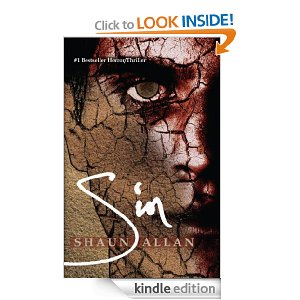
sin - Shaun AllanSA: Sin took me ten years to write.  As it’s a very personal book, I occasionally had to step away and wrote short stories.  Many of these were collected together in Dark Places, which was prompted by a comment a writer friend of mine made.  As my mind tends to write what it wants rather than what I want, and another friend, who lives in Australia, was very forthcoming with writing prompts I couldn’t refuse, Darker Places became more and more a reality.  I mean, if you’re given a starter sentence of “The bird fell and the sky was silent,” how can you not work with it?

CJJ: Do you have a specific ‘Creative Process’ that you follow, such as outlining or do you ‘wing it’?

SA: Oh, I wing it.  I know wonderful writers (Connie) who outline, but I can’t.  I’ve tried, but my mind doesn’t work like that.  It goes where it wishes, my Muse being a right royal pain in the posterior.  I sat down to write some of Mortal Sin and ended up writing a Christmas story about Rudolph, for example!  Sometimes, as with Mr. Composure, I can write the start and almost immediately know how it will end, with ‘only’ the path it takes to figure out, but often, I start and I have no idea at all.

CJJ: How does your work differ from others of its genre?

SA: I think because it’s personal.  There’s aspects of me, my life and my darkness in everything.  There’s also my sense of humour.  I set the stories where I live.  When I was starting, and everyone was saying “write what you know,” I struggled somewhat.  What did I know?  Where I lived seemed boring, for a start!  But then I read a Clive Barker book (Weaveworld, I think) and he described going down back alleys in a town.  I didn’t know, but felt it could have been the alleys where he grew up.  It wasn’t boring.  So I moved my stories to Grimsby and Lincolnshire – the places I knew.  Once they came home, they allowed me more freedom.

CJJ: Your work is dark, but you are such a cheerful, light-hearted person. Why do you write what you do?

SA: Good question.  Though I can write silly children’s poetry as well as paranormal and psychological thrillers, it’s the darker work which I find easiest.  I find it therapeautic.  I can get stresses and bad memories out and turn them into something I and others seem to enjoy.  As I say, without darkness, you can’t appreciate the light.

CJJ: I know why I chose the indie route for my work, but I’m curious as to why you’ve chosen this path.

SA: I did try to be ‘properly’ published, but, with the indie route, I’ve made some amazing friends and reached people all over the world.  I have full control over my work and the only deadline (in most cases) is the one I set myself.

CJJ: What advice would you offer an author trying to decide whether to go indie or take the traditional path?

SA: Well, you have to go for what you feel is right, but I have to admit, though the indie route is hard work, its immensely rewarding.  I’d definitely recommend giving it a go.

~~~~~~

Thank you Shaun, for taking the time to answer these questions, and for being here today!
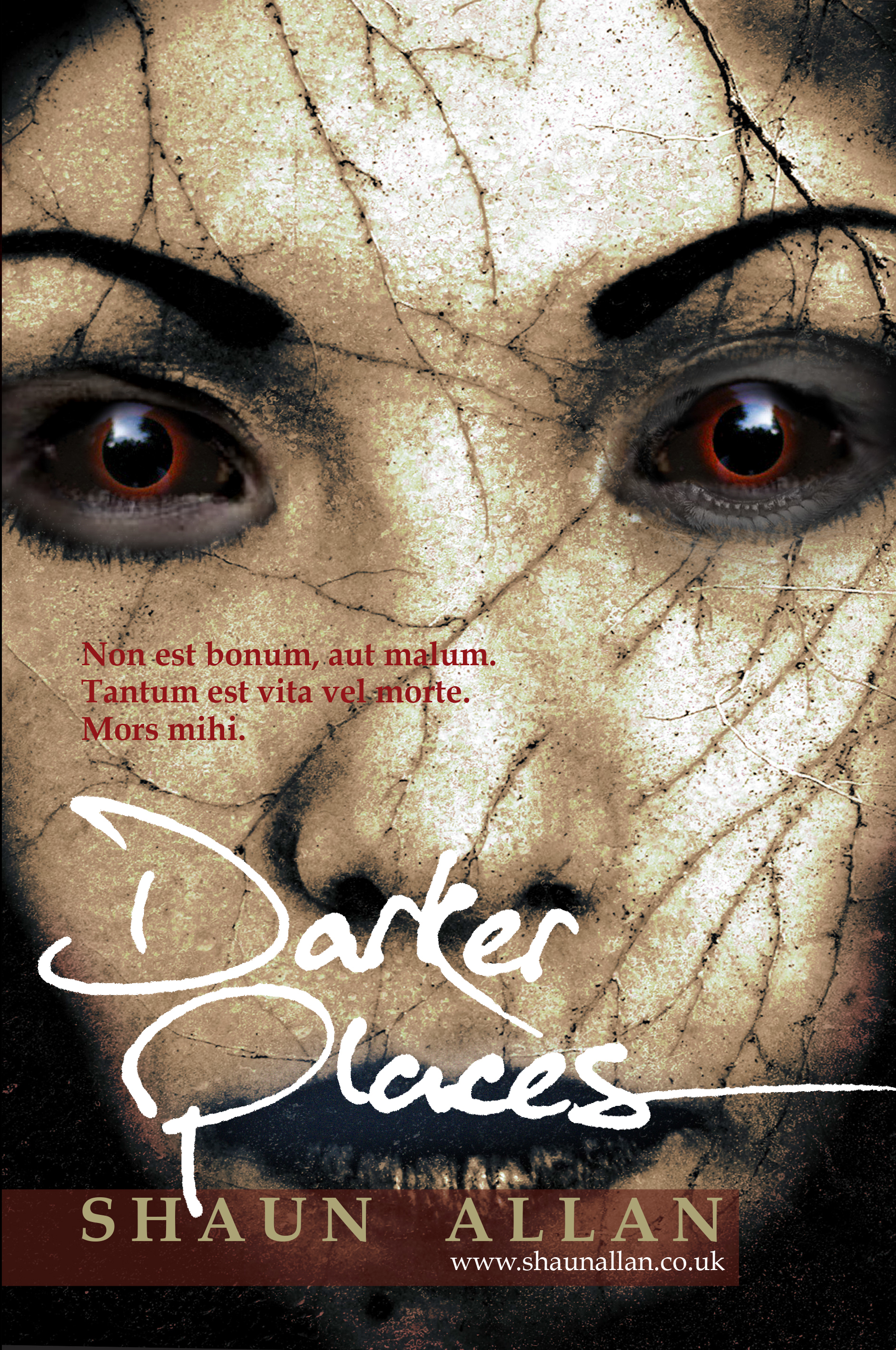
DarkerPlaces_96dpi_100%DARKER PLACES by Shaun Allan

What if you could steal the final moments from the dying? What if you had the darkest secret, but couldn’t think what it might be? What if you entered the forest in the deep of the night. Who is the melting man? And are your neighbours really whom they appear to be?

So many questions.

To find the answers, you must enter a darker place. Thirteen stories. Thirteen poems. Thirteen more doorways.

 ~~~~~

 

Shaun AllanA creator of many prize winning short stories and poems, Shaun Allan has written for more years than he would perhaps care to remember. Having once run an online poetry and prose magazine, he has appeared on Sky television to debate, against a major literary agent, the pros and cons of internet publishing as opposed to the more traditional method. Many of his personal experiences and memories are woven into the point of view and sense of humour of Sin, the main character in his best-selling novel of the same name, although he can’t, at this point, teleport.

A writer of multiple genres, including horror, humour and children’s fiction, Shaun goes where the Muse takes him – even if that is kicking and screaming. He has written for NBC Universal, and regularly holds writing workshops at local schools.

Shaun lives with his wife, two daughters and two cats. Oh and a manic dog. Though his life might, at times, seem crazy, he is not.

Honest.

~~~~~~

To see more of Shaun’s work, please visit Shaun’s author page at Amazon.com.
1 Comment

Filed under Adventure, Blogger, Books, Fantasy, Humor, Literature, Publishing, Self Publishing, Uncategorized, writer, writing

Hunted Heart, by Alison Deluca

Most avid readers of the fantasy genre are fans of the old fairytales as told by the Brothers Grimm and I am no exception. In fact it was my love of fairytales that inspired me to write in the first place. I am always interested in reading other authors’ takes on these fairy tales. It is amazing how differently two authors will tell what began as the same story.

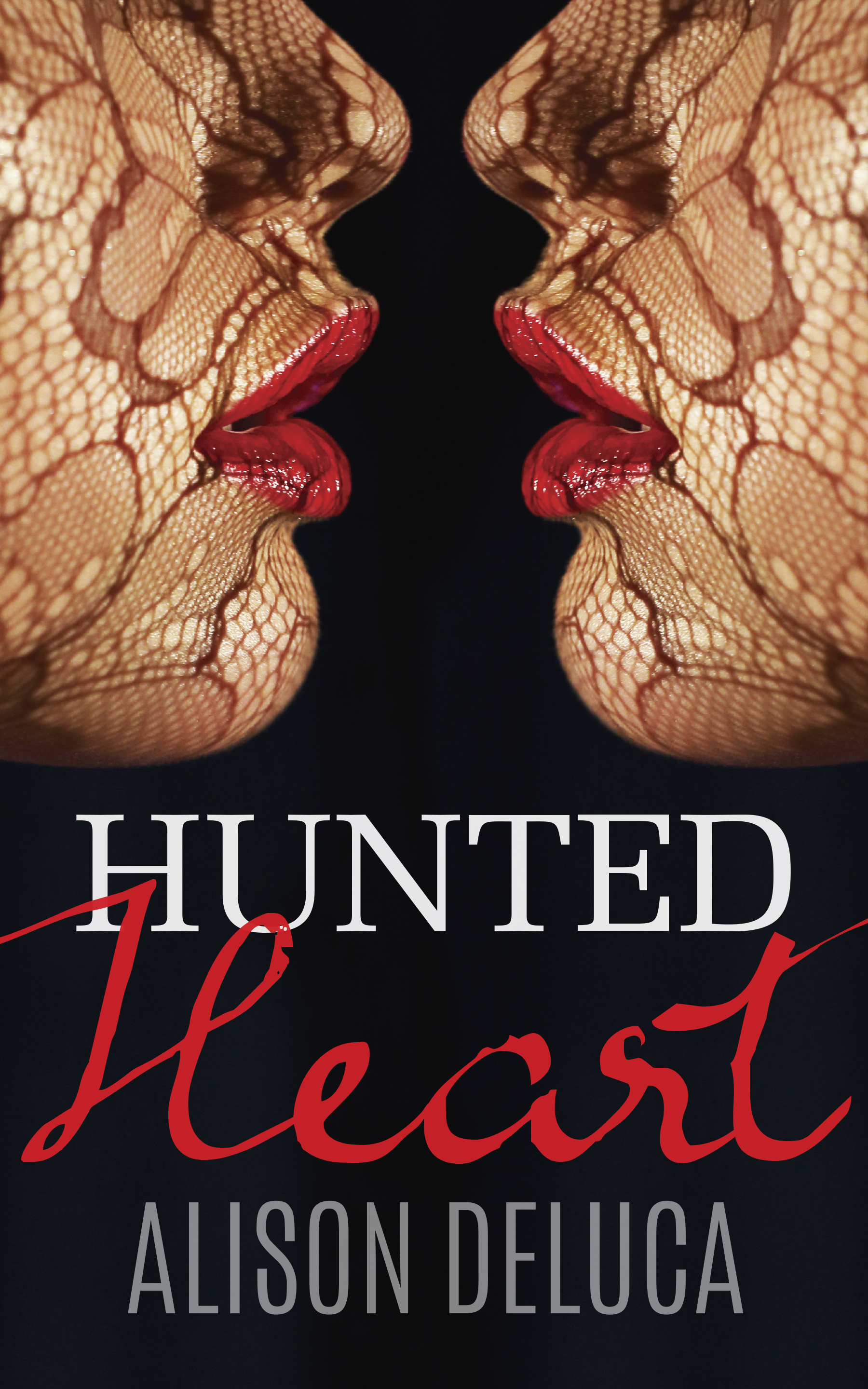
Today my good friend, Alison DeLuca, author of  the steampunk Crown Phoenix Series, has consented to answer a few questions for us, and allow me to share the wonderful cover of her new book, Hunted Heart. It is a standalone book, and is a true fairytale, the premise of which had really intrigued me.

CJJ: Alison, tell us a little of early life and how you began writing:

AD: I always loved reading. My early favorites were Alice in Wonderland, the Odyssey, Arabian Nights, and fairytales of all kinds.

CJJ: Tell us about your most recent book.

AD: Hunted Heart is an adult version of Snow White. Prince Kas is the one threatened by the wicked queen, and the huntress, Tali, is given the job of taking him to the forest to cut out his heart. They end up falling for each other, but not without a great deal of adventure along the way. Yes, there is a wicked queen and my version of a poisoned apple. And we mustn’t forget True Love’s Kiss…

CJJ: How did you come to write this novel?

AD: Someone I met online prompted me and begged me to write the story – she is the J.R. in my dedication. I loved her idea of making the hunter a strong female and ran with it.

CJJ: Do you have a specific ‘Creative Process’ that you follow, such as outlining or do you ‘wing it’?

AD: This book was an exercise in winging! The Snow White structure supported my story, and I was able to take off from there. Writing a fairytale redux is completely addictive – I might have to do a few others.

CJJ: How does your work differ from others of its genre?

AD: It is genderbent, and I’ve set the story in a mythical Norse country. I couldn’t resist including Freja, Iduna, and a few others from Norse tales. It’s also quite adult, with violence and some sexy scenes, and a charity project: Tali, my main character, suffers from some terrible abuse as a child, and so 100% of the royalties go to HelptheChildren.org.

CJJ: Why do you write what you do?

AD: Honestly, because I can’t help it. When I get an idea it needles me until I pin it down on paper. It’s like giving birth, to be honest.

CJJ: I so know that feeling! I know why I chose the indie route for my work, but I’m curious as to why you’ve chosen this path.

AD: I love the freedom indie publishing gives me. I’m able to write what I like and donate the proceedings when I do a charity project like this.

CJJ: What advice would you offer an author trying to decide whether to go indie or take the traditional path?

AD: Both have their merits and challenges. Being an indie does give you freedom but also relies on individual marketing. Traditional publishing gives more support but gives the author little choice on things like covers and presentation. Both are good in their way – each author must decide for herself how she would like to proceed!

 CJJ: Alison–I love the answers you gave my stock questions!  Thank you for giving me this opportunity to get the word out about your charity, HelptheChildren.org.

AD: Thank you so much for having me on your blog, Connie. This was a lot of fun!

And without further discussion, here is that amazing, most intriguing book cover:

HuntedHeart cover final


I confess I am blown away by this one, and I have become quite a fan of Alison’s graphic designer.

Alison DeLuca HeadshotAlison DeLuca is the author of several steampunk and urban fantasy books.  She was born in Arizona and has also lived in Pennsylvania, Illinois, Mexico, Ireland, and Spain.

Currently she wrestles words and laundry in New Jersey.

You can find Alison here:

Facebook – http://www.facebook.com/alison.deluca.author

OR http://on.fb.me/TNWEfb

Twitter – http://twitter.com/ – !/AlisonDeLuca

Google + http://bit.ly/ADGoogle

Author Central: http://amzn.to/ADeLucaAuthorCentral

Pinterest: http://pinterest.com/alisondeluca/

I have long been a fan of all of Alison’s work and have been fortunate enough to have some of my own work  included included along side of hers in a charitable anthology, Christmas O’Clock,  a book of wonderful short stories for children that is available in both paperback and for the kindle. (All proceeds for Christmas O’Clock go to Water Is Life to help children and families in an international effort.)


4 Comments

Filed under Adventure, Battles, blogging, Books, charity, Fairies, Fantasy, Humor, mythology, Romance, Self Publishing, Steampunk, WordPress, writer, writing

Kacey Vanderkarr, Poison Tree (Reflection Pond, Book 2)

As you know, I love to talk shop, and love to hear what other authors have to say about their work and the craft. Recently I read a deep, well-crafted novel written by indie author, Kacey Vanderkarr. The book is called Reflection Pond and I liked it enough to feature it on my book review blog, Best in Fantasy. (You can read my review of her wonderful book here.) Kacey has consented to answer my inelegant questions (further down this post) and what she has to say is quite interesting!

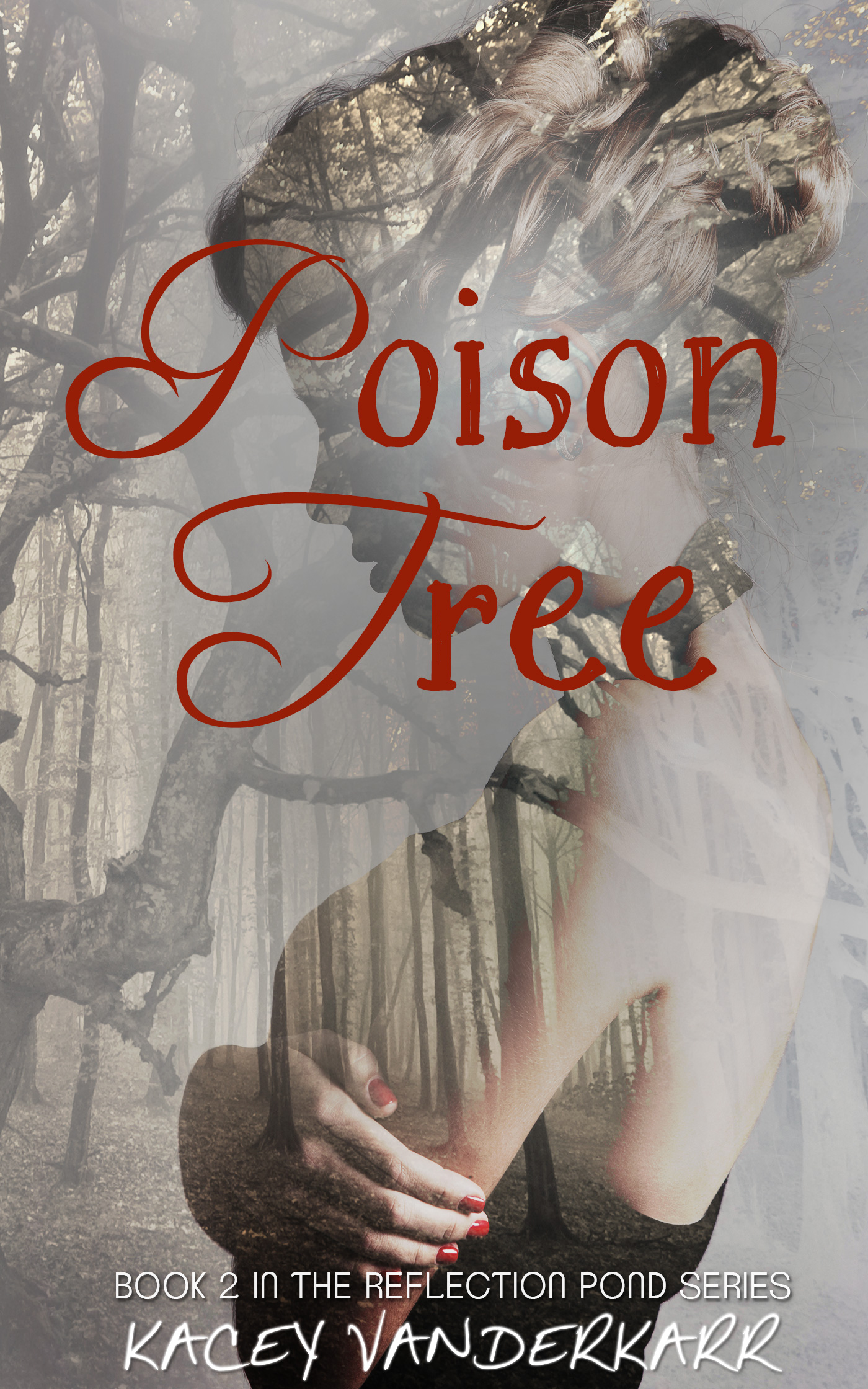
She has written a sequel, Poison Tree (Reflection Pond, Book 2),  and I am happy to have been offered the opportunity to be one of the first to reveal the cover–and a lovely cover it is. And she has also agreed to answer a few questions regarding her work and her life as an indie author–and wow, what great insight into the industry she has.  But first–THE BLURB:

Poison Tree

By Kacey Vanderkarr

Release date: December 2, 2014

The road to the City of War is dangerous.

With their home in ruins, Callie and Rowan are Eirensae’s last hope of stealing the cauldron back from Fraeburdh. They must travel into the human world where the Fallen hide. The banished fae wait for Callie, desperate to sacrifice her before she comes of age.

If Callie and Rowan survive the journey, something worse looms in Fraeburdh. Rowan is destined for a dark family legacy too horrifying to accept, and his father is anxious to welcome him home. Once the truth is revealed, will Callie ever look at Rowan the same way?

Trapped between feuding cities lost in a centuries’ old war, Callie and Rowan will face their biggest rivals yet, and neither of them will make it out unscathed.

>>><<<

(Just so you all know, I am definitely going to buy that book!)

>>><<<

And now the Cover:

poison-tree-ebook


>>><<<

That’s an awesome cover to go with such an intriguing blurb.  And now, we meet the author, an amazing woman who is a driving force in the writing life of Flint, Michigan.

CJJ: Tell us a little of early life and how you began writing:

KV: I began writing back in high school, though I didn’t officially consider myself a writer until I was on summer break from my first semester of Ultrasound school. Inspiration struck in that four-week break and I spent it writing my first complete novel, a YA Fantasy that I’ve since rewritten. I fell in love with those characters, and to this day, I still have a soft spot for them. It took some time, but I realized that I could fall in love with other, different, characters, and I have again and again, through novels and short fiction. I think writing is part neurosis and part pure joy. There are times when I love and hate it equally!

CJJ: Tell us about your most recent book.

KV: Poison Tree is Book 2 in the Reflection Pond Series. It’s the continuation of Callie and Rowan’s story as they make their way from home into the dark faerie city, Fraeburdh, which is also known as the City of War.

I’ve always been fascinated with fantasy. In doing some research, I found information on a legend involving four treasures. My own story is loosely based on the original four treasures of Tuatha Dé Danann.

CJJ: Do you have a specific ‘Creative Process’ that you follow, such as outlining or do you ‘wing it’?

KV: I am a certified winger. Swooper. Pantser. Whatever you want to call it. I usually have a general skeleton of a story when I start, a beginning, middle, end, though I never outline. There may be an idea for a scene or two as well. My joy doesn’t come from structure, but spontaneity. I’ve tried outlining before, and then I feel determined to stray as far from that plan as possible. I love the blank page, the possibility. I save the note taking for after I’ve written the rough draft.

CJJ: How does your work differ from others of its genre?

KV: I think that Reflection Pond and Poison Tree take risks. I had a reviewer suggest that Reflection Pond be marketed to ages 17+ because it has a “handful of profanity” and “alludes to child abuse.” It doesn’t allude. It happened, and I’m not going to apologize for it. I’m not scared to examine the dark parts of life, and I don’t condone blindfolding my readers to make them feel more comfortable. These books cover a lot of dark topics, and I’m proud of that, especially when reviewers say that it’s handled in a sensitive manner. The truth is, bad things happen to people who read YA, and everyone needs a character that they can relate to. Not everyone will be able to connect to my characters when they read and that’s okay. But for those who have suffered and survived, there is still hope, and I want them to find it when they read my books.

CJJ: Why do you write what you do?

KV: I write based on inspiration. A lot of that manifests as YA, though I have written a few adult short pieces, some new adult, and some straight up fantasy. I think young adult looks at a very transitional place in a character’s life. It gives a lot of options to the writer. That being said, I have absolutely no idea where my career will take me. Right now, I consider myself a YA writer, in the future? Who knows!

CJJ: I know why I chose the indie route for my work, but I’m curious as to why you’ve chosen this path.

KV: I am all over the place when it comes to publishing. My first book, Antithesis, was published by Inkspell Publishing, which is a small press. That was a great experience for me. I learned how to market, how much work it is to publish a book, how to work with an editor and cover designer. Inkspell is very supportive and patient with their authors. However, for my second book, Reflection Pond, I opted to self-publish. I’d sent it to agents, had a few bites of interest, but nobody wanted to pick up the series. At that point, I had to make a choice. Who did I write this book for? In the end, it was myself, and if I wanted it to be out there in the world, then I had to publish it myself, too. It was a long process with a lot of ups and downs and uncertainty, but I’m SO HAPPY I did it. Self-publishing has opened even more doors for me and widened my net of contacts. I’m proud of these books because every page is mine.

However, I still want an agent, which is why I’m now querying a different project. So, I’ve done a bit of everything. I’d love to have an agent and publish traditionally. The important thing is patience, which is what I keep telling myself!

CJJ: What advice would you offer an author trying to decide whether to go indie or take the traditional path?

KV: I think both traditional and self-publishing have their pros and cons and neither one is better than the other. What matters is the work. Traditional publishing is a bit like having good luck. Your writing can be amazing, but you have to attract the right agent at the right time, and then again with an editor and publisher. Self-publishing gives you more freedom. You get to choose who you work with, have say in what your cover looks like, make editing decisions.

Both paths are hard.

If you indie publish, I suggest making friends with someone who knows the ropes and can help you get it done. That’s the great thing about writers, we’re friendly and helpful, colleagues not competition, because we’re also readers who love good books.

The last bit of advice is DON’T GIVE UP. If you want to indie publish, do it. If you indie publish and still want an agent. Go for it. There is no wrong way. Don’t let the industry, your family or friends, or yourself keep you from your dreams. Just remember, the publishing industry moves SLOW, SLOW, SLOW, so have patience and trust your gut.

>>><<<

I have to say, I really enjoyed reading her answers–Kacey Vanderkarr has some awesome advice for all authors, not just indies there!


Kacey VanderkarrKACEY VANDERKARR is a young adult author. She dabbles in fantasy, romance, and sci-fi, complete with faeries, alternate realities, and the occasional plasma gun. She’s known to be annoyingly optimistic and listen to music at the highest decibel. Kacey is president of the Flint Area Writers and the Social Media Director for Sucker Literary. When she’s not writing, she coaches winterguard and works as a sonographer. Kacey lives in Michigan, with her husband, son, and crazy cats. In addition to her novels, Antithesis and Reflection Pond, Kacey’s short fiction is featured in Sucker Literary Vol III, Out of the Green: Tales from Fairyland, and will appear in Spark Vol VII and the inaugural issue of Ember: A Journal of Luminous Things. Check out her website: www.kaceyvanderkarr.com.

You can purchase the wonderful book that begins this series at:

Reflection Pond on Amazon

If I were you I would Add Poison Tree on Goodreads--I just did!

And here is her Author Facebook Page–go out and ‘like’ her–she’s an awesome person!

Kacey Vanderkarr’s Blog-check it out!

And finally–you can follow her on Twitter!

Comments Off on Kacey Vanderkarr, Poison Tree (Reflection Pond, Book 2)

Filed under Adventure, Blogger, blogging, Books, Fantasy, Humor, Literature, Publishing, Self Publishing, Uncategorized, writer, writing

Stephen Swartz, A Dry Patch of Skin

A patch of Dry Skin, Stephen SwartzToday, my dear friend, Stephen Swartz, author of the new book,  A Dry Patch of Skin has consented to answer a few questions for us. Stephen is a true renaissance man–an accomplished musician, and the author of seven published novels, he is also a professor of English at a well-known university in Oklahoma.

I became friends with Stephen in 2011 through ABNA, and we have remained good friends since. I find him hilarious, and I really enjoy his work. He has kindly consented to sit down and allow me to “virtually interview ” him. I am especially curious about his wonderful new book, which is a vampire tale. It’s most certainly not your mama’s sparkly vampires! If you are curious, here is my review: Best in Fantasy: A Dry Patch of Skin

CJJ: Tell us a little of early life and how you began writing:

Stephen Swartz 2007SS: It seems like I’ve always been making up stories, much to my parents’ chagrin. I began by drawing panel comics, then added dialog, then began writing paragraphs. I read a lot of science fiction and fantasy in my youth, plus the classics of literature. They influenced my writing mostly by pushing me to try to “out-do” those authors with my own stories. My early writing was limited by the limitations of typewriters and correction fluid. When I got my first computer in 1986, all of my vast library of stories finally could be written. And the world shuddered….


CJJ: Tell us about your most recent book.

SS: A DRY PATCH of SKIN is a contemporary vampire story, but not at all modeled after any of the current vampire TV shows, films, or the books they are based on. I deliberately tried to keep it real. Thus, I researched diseases which cause symptoms approximating the vampire’s condition. In that way, I wanted the reader to experience what it would be like to become a vampire. I decided to tell the story through the POV of a man who is transforming against his will into something he does not want to become. All the tropes and memes of vampire stories are there, but they are realized in a medically accurate fashion—as much as possible. It gets a bit religious at the end, so…call it magical realism.


CJJ: How did you come to write this novel?

SS: I had the idea in rough form ever since Twilight came out and I tried to explain to my daughter, who was hooked on the Bella/Edward story, what “real” vampirism was. For that explanation, I recalled a report years ago on one of those news magazine shows about a man suffering from porphyria, sometimes called the “vampire disease”; the medical explanations for his affliction made perfect sense in terms of why he might be called a vampire if he happened to live in a certain time and place rather than modern America. Watching that interview (he wore a hood to cover his face), I could truly feel the anguish of being in that situation, and given that my art is answering What-if questions, I sought a vehicle for illustrating that awful situation.


CJJ: Do you have a specific ‘Creative Process’ that you follow, such as outlining or do you ‘wing it’?

SS: For A DRY PATCH of SKIN, I worked a bit differently than usual. I began with snatches of my real life, anecdotes that were humorous or telling in some way, then fictionalized them. My initial goal was to explore the character I was inventing, to get down his personality, way of expressing himself, his identity, and so on. As a story set in 2014 in the same city where I live, it was quite schizophrenic to write fiction about the places I regularly visit.

Unlike some authors, I generally do not make lists of traits or compose background profiles of my characters; sometimes I do not know all about them when they come on stage and I get to know them as readers do. (Of course, I go back in revision and make it all fit together.) I do collect information as I create them but it stays in my head. Sometimes browsing the internet will bring me an image that fits what I see in my head.

I knew from the start the direction A DRY PATCH of SKIN would go but I did not have the exact action of the climactic scene until I was mid-way into the writing. Once I “knew” how it would end, the direction of the plot shifted a bit to head toward that conclusion. I found by the end, fortunately, that I happened to have dropped some good seeds along the way which conveniently blossomed in the final chapters—much as Chekhov’s musket in Act 1 must be fired by Act 3. I suppose it’s a matter of how my twisted mind works; I’m not always conscious of the big picture under the cacophony of surface features, but my deeper self knows…because he sleeps with my muses.

CJJ: How does your work differ from others of its genre?

SS: A DRY PATCH of SKIN was a personal challenge, something in a genre I have not written previously. The saving aspect for me, however, was that it is, at the core, a tragic love story. (Is that a spoiler?) The trappings of vampire transformation become the vehicle for pulling off that tragedy. Or is it that the transformation, the struggle to avoid it or prevent it, is made more tragic with the love interest? At any rate, I’ve consciously tried to go counter to all the usual tropes of the vampire genre. In fact, the characters often mention, critique, and spoof some of the popular works of the genre during their conversations. I hope this novel will be both a fun “review” of the vampire literature as well as a realistic portrayal of a biological problem; in that sense, it’s a medical thriller.

CJJ: Why do you write what you do?

SS: A DRY PATCH of SKIN was a departure from my usual kind of novel (contemporary anti-romance or sci-fi on a grand scale). I was intrigued by the question and wanted to see if I could write it if only to see how such a situation might play out. I seldom write as a challenge or game, but this time I did. For writing in general, I simply want to follow my desire to see what happens next for the people I create and the situations I put them in. I know that sounds cruel, but that’s how I roll. It probably keeps me out of jail or the mental hospital.

Next, I’ve been challenged to write an epic fantasy with dragons. Epic fantasy is no problem; dragons are—because it’s in my nature to try to explain them in an authentic zoological way.

CJJ: I certainly can’t wait to see what sort of spin you give dragons! I know why I chose the indie route for my work, but I’m curious as to why you’ve chosen this path.

SS: Strange you should ask because while I have always done things my way (Thanks, Frank!), the results have not always been glorious. After a health scare a few years back, I realized what I wanted most in whatever time I thought I had left was to publish one of the books I’d already written. Years before that, I had gone through the lengthy process of soliciting with actual reams of paper in mailing boxes and the 6-12 month wait for a response by paper form letter. But just a few years ago, the world apparently  changed and querying and soliciting were being done electronically, which opened up a whole new world of possibilities. I was impatient, for health reasons, so I caught the attention of a small publisher with a book I entered into a contest. That did not go so well but I did get a taste of the brave new world of publishing. The rest is what some call history—and others call serendipity.

CJJ: What advice would you offer an author trying to decide whether to go indie or take the traditional path?

SS: I suppose there are all kinds of reasons and they tend to be settled on an individual basis. I described my situation, but even without that push from Father Time I’d probably still discover the small and indie publishers and hook up with one of them eventually. If I were young and had a market-ready book with a ready-made audience, I’d query that thing to the farthest star. If you are short on time or believe your work is specialized and thus out of the mainstream, you probably have to go indie.

My goal the past four years has been to make the books I’ve previously written available, at least that, not so much for my ego as for being able to check them off my so-called bucket list. Then I wrote something new! And made it available, too. And I wrote something new again! I have to give credit to the publishing of my early books for the spark of creativity that caused me to write my new books.

Thank you Stephen, for answering my questions! For those readers who are interested in reading more of Stephen’s writing journey, you can find him blogging at:

Deconstruction of the Sekuatean Empire

 You can purchase all the books written by Stephen Swartz from this page at Amazon.com

stephen swartz's books

8 Comments

Filed under Blogger, blogging, Books, Dragons, Fantasy, Humor, Literature, Self Publishing, Uncategorized, vampires, WordPress, writer, writing

SomeWhen Over the Rain Clouds, Lisa M. Peppan interview

KCover-SWOtRCThe Pacific Northwest has been the home of many famous authors, Frank Herbert, Ken Kesey, Ursula K. Le Guin, and J. A. Jance among them.  There is something about the dark and the damp that encourages creativity. We have a huge community of authors, with critique groups and strong support for each other.

Recently one of my friends from Bellingham, Washington, author of historical fiction J. L. Oakley, introduced me to another friend of her’s, fantasy author Lisa M. Peppan. Lisa’s book, SomeWhen Over The Rain Clouds is an intriguing book I am currently reading on my vacation–I can’t put it down!

Here is the BLURB:

SWotRB blurb

Lisa has consented to answer a few questions about her writing process and where her book fits into the genre of fantasy.

CJJ: Tell us a little of your early life and how you began writing:

LMP: Once I got the hang of it, I became a voracious reader.  My favorite still is L. Frank Baum’s Oz books.  It’s his fault, me writing.  I tried my hand at a few short stories but it wasn’t until after reading a poorly written fantasy that I was inspired to write a better story.

CJJ: What are you currently working on?

LMP: While my cover-artist works on a cover for the sequel to “SomeWhen Over the Rain Clouds”, I’m working on a third book.  Might be a fourth, possibly a fifth.  Maybe more.  Same alternate universes and most of the same characters, all bundled together as The Geaehn Chronicles.  The Geaehn Chronicles has a Facebook page.

CJJ: Do you have a specific ‘Creative Process’ that you follow, such as outlining or do you ‘wing it’?

LMP: SomeWhen started life as 98 handwritten pages.  With a rough idea of the kind of people I wanted my characters to be, I ran astrological birth charts for them and compatibility charts for every possible combination of the four.  While mulling over potential plot complications, I wrote detailed biographies for my main characters, drafted maps, and re-read a selection of mythologies, and, well, once I knew my characters and the world I was sending them to, I wound them up and let them go.  So far, this has worked for two and half books.

CJJ: How does your work differ from others of its genre? Why do you write what you do?

LMP: In all the fantasy I’ve read, cab drivers were things that moved protagonists from Point A to Point B.  Three of my four main characters are Seattle cab drivers who recognize that they’ve become involved in a fantasy-novel-type situation; the fourth knows it’s so much more than that.   I drove a taxi cab for 11 years, did a little dispatching, and knew cab drivers were so much more than things (most of them), and wrote the kind of book I’d enjoy reading.

CJJ: I know why I chose the indie route for my work, but I’m curious as to why you’ve chosen this path.

LMP: In the Spring of 1984, on a particularly slow day as a taxi cab driver, SomeWhen Over the Rain Clouds was born.  Over the years, I got many really nice rejection slips.  Then along came a first novel contest on Amazon.  Though I shot myself in the foot for the contest (ask me why and how bad), I was among the 100 best entrants that year.  It also made me aware of that most marvelous purveyor of POD novels, CreateSpace.  When a long-published author friend went Indie, because it appeared to be the direction publishing was going, I took the plunge.

CJJ: What advice would you offer an author trying to decide whether to go indie or take the traditional path?

LMP: Most traditional brick-and-mortar publishers want to see smartly written synopses.  I tried but my best effort (to date) is 23 pages, and Indie doesn’t require one*.  Indie or traditional…?  If you write fantasy that you’ve given a truly fresh spin and you keep getting really nice rejection slips with handwritten notes saying things like, “Great premise” and “Best wishes finding a home for it!!”, go Indie.

*You won’t need the synopsis but you will want a snappy blurb for the back of the book

CJJ: Your experiences with traditional publishing rather closely mirror mine, Lisa!  Thank you for agreeing to be virtually here today, and for the insight into how your creative process works.

Here is a short excerpt of this wonderful book:

excerpt SWotRB

Intrigued?  Lisa’s book is SomeWhen Over The Rain Clouds and can be found at these fine stores — just click on the links:

www.amazon.com

Barnes & Noble

‘Like’ Lisa on Facebook

LMPeppan

Born in Seattle as the eldest of three, Lisa was a curious and adventuresome child who delighted in taking things apart to see just exactly how they worked.  It is a Testament to the Bravery of her parents that they went on to have two more children.

In 1981, after having held a number of jobs in a variety of fields, it was no real surprise to her parents or brothers when Lisa went to work as a cab driver for North End Taxi, a small mom-and-pop cab company in north Seattle.  During the summer of 1984, as a cab driver, after reading what she felt was a poorly written fantasy novel, she said, to no one in particular, “I can do better than that.”

Unplanned early retirement in 1992 gave Lisa time to learn about computers and html coding.  Armed with these new tools, she resumed her family research.  This led to a new hobby–19th century Living History–and from there she caught a glimpse of the scope and diversity of her Aboriginal heritage that spanned North America, north and south of the border.  What her father and his parents worked so very hard to hide, she works diligently to recover so the next generation will know who they are and where they came from; the time for hiding has passed.

When she isn’t reading, writing, researching, or playing in the past, Lisa enjoys quiet moments in the mountains, ferryboat rides on Puget Sound in November, windy days on any beach, hairy chests on men, rare steaks, and purple roses.

Lisa can be contacted at lisapeppan at gmail dot com

Comments Off on SomeWhen Over the Rain Clouds, Lisa M. Peppan interview

Filed under Adventure, blogging, Books, Fantasy, Humor, Literature, Publishing, Self Publishing, Uncategorized, WordPress, writer, writing