Tag Archives: creative writing

#ammwriting: Firing Chekhov’s gun

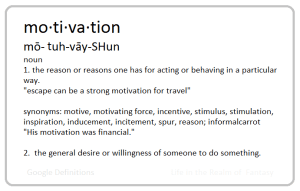
Motivation memeThis last weekend, I attended PNWA’s annual writing conference in Seattle, Washington. I garnered a great deal of advice from industry professionals and took seminars offered by well-known authors, agents, and editors.

I attend this conference every year. PNWA is where I come to learn both the craft of writing and business of publishing. Craft and business: two aspects of writing that every serious author must know whether they are going indie or taking the traditional route.

Today’s post is about identifying what motivates your characters. Well-known writing coach,  Lindsay Schopfer, gave a seminar on this, which unlocked ideas for my works in progress. That is how writers’ conferences work for me—they pry loose the ideas that have been stuck and help me verbalize them.

You have probably heard of the literary rule known as Chekhov’s Gun, which says nothing should appear in the scene that has no use. If a rifle is important enough to be shown hanging on the wall, someone had better fire it, or it should be removed from the setting.

Firing Chekhov’s gun brings us to motivation. When I was in elementary school, I was taught  “the 5 Ws” of journalism. I feel sure they still teach this, but just to remind you, they are:

  • Who
  • What
  • When
  • Where
  • Why

These five words form the core of every story. Who did what? When and where did it happen?

Why did they do it?

In some stories the author had made the what quite clear, but the why is murky. I hate it when the author is at a loss as to why their protagonist wants to do the task set before them.

If a character commits a murder, you’d better know why they were compelled to do it. Random events inserted to keep things interesting don’t advance the story.

When a character arrives at the inciting event, the things that motivate him/her should already be established. Identifying what makes your character do the things they do is the core of character development. Some characters are easy:

  • Edwin wants to save Marya.
  • Wynn wants to get back to his wife and his forge.
  • Huw wants to avoid being hanged for treason.

Some characters have motives that are more difficult to identify. Motives are driven by need, what a character desires, and what they are willing to do to attain it.

Suppose we have a protagonist who realizes her marriage is failing. We’ll call her Anna. Before we begin writing, we need to do a little brainstorming about Anna and find out who she is and what makes her tick.

She is a well-educated, professional woman, a writer of paranormal fantasy. She is married to another writer, David.

What motivates her? David is strong, charismatic and brilliant. There is nothing he doesn’t feel entitled to, and he will do anything to achieve his goals. Although she is a best-selling author of popular fiction and is the person paying the bills, Anna has made a habit of catering to his needs.

At first, she wants to keep her marriage together and presents herself as whatever she thinks David wants her to be. She feels as if she casts no shadow of her own. As the summer progresses and events unfold, she evolves, becoming an individual who no longer needs his validation. In the process, Anna finds that she is, and has always been, the strong one in the relationship.

With those paragraphs, we know the main protagonist’s desire—on the surface she has a deadline for her book and wants to save her marriage, but really she is seeking her sense of self-worth, trying to find who she is.

Now, let’s find out who the other characters are:

Anna and David rent a secluded house on the wild Washington coast for the summer. They invite 3 companions to join them for the summer, as a working retreat. All five characters have deadlines, and that is their official reason for accepting Anna’s invitation. However, the four other characters each have their own agendas. Other than Anna, they each have strong personalities, are charismatic, and are used to a certain amount of privilege. At first, although it is subtle, each of them uses and manipulates Anna for their own purposes.

Every member of the cast has a secret, including Anna. With the revelation of each secret to the reader, the motivations for subsequent actions become clear. Someone will attempt murder to ensure their secret is kept. In the end, three will die by accident, and two will be left to pick up the pieces.

With this information complete, we know the genre–this novel is a contemporary fiction, and is the story of Anna’s journey to self-knowledge. It will be slower paced than a thriller, and will be about the people and their relationships more than the events. However, the events will shape the people.

LOTR advance poster 2Unless each character’s wants and needs are clearly defined, the events won’t make any sense. Without clear motivations, it’s just a bunch of drama queens cooped up with a psychopath, in a house by the gloomy Washington North Pacific coast. Once we know their motivation, it becomes a story. And as a writer trying to flesh out characters, it becomes easy to picture these five people as individuals possessing depth and desires.

Motivation is the character’s quest to fulfill his/her deepest needs. Consider Frodo: he has seen what the ring did to Bilbo and Gollum, but more than that, he loves the Shire and does’t want it to fall to shadow. Without a real, personal motivation, there is no reason for Frodo to  agree to walk to Mordor and certain death just to toss a ring into an active volcano.
 

1 Comment

Filed under Literature, writing

#amreading: The Karaoke Novelist

BIF Blog Print ScreenI used to write an indie book review blog, before I got too busy to read as much as the blog required. The blog was called Best in Fantasy, and I still post reviews to it once in awhile, but only when something really rings my bells.

Sometimes I had to attempt to read six novels before I found one worth reviewing. In the process of searching Amazon for those really good fantasy reads, I’ve read a large share of badly written books. There is no  describing the agony of seeing a perfectly good idea for a plot destroyed by an author who was too eager to share their genius and rushed to publish what was clearly an excellent first draft .

You will get no snarky reviews from me—in fact I don’t review books I don’t like. I just move on to the next one in my pile and hope for the best.

Instead, I focus on the really awesome books I have enjoyed, some written by the famous, but most by the NOT so famous. Many of the great books I have enjoyed will never be best sellers because they are just one drop in an ocean of Kindle books.

It’s the wild west of indie publishing right now, and while it’s not necessarily a terrible thing, many untutored authors publish less than stellar works. These books are written and published by people who have no idea how the industry works.

Writing is like any other craft. There is a learning curve. Publishing is a separate craft, but nowadays the two go hand-in-hand.

At some point,  as indies gain the knowledge of what is involved in writing and publishing a good novel, the overall quality will  improve and level out. Those who are in it for the long haul will gain better visibility.

I have some hard-earned advice for new authors, those of you who want to leave the ranks of the Karaoke novelists, screeching their inept renditions of Wind Beneath my Wings. If you’re serious about your work, get your manuscript professionally edited.

Yes, it will cost you money, and you may get feedback you don’t want to hear. But that experience will enable you to put a book out there that you can be proud of, one that will stand up to any put out by the big publishers.

When I was writing a book review blog on a weekly basis, I often spent my week looking through five reasonably priced books only to discover they were

  1. Poorly formatted.
  2. Poorly edited.
  3. Rife with newbie errors such as beginning the book with a big info dump (been there done that).
  4. Thick, lush descriptions of “creamy blue eyes” (pardon, must barf now).
  5. Written by an author with no concept of a story arc.
  6. Boring filler conversations to fluff up the word count.
  7. Threads to nowhere,
  8. A random event that was intended as a cliff-hanger ending, but was obviously stuck there to entice the reader to get the sequel, which hadn’t been written yet and was now on my “No Way in Hell” list.

This also happens regularly with traditionally published books.  TOR can publish a novel that was poorly edited and no one will blink an eye, because they are one of the Big 5 Publishing houses.

Indies have to be better than that. Indies are scrutinized more closely and are held to a much higher standard. Flaws in our work are held up as an example of all that is wrong with the industry.

I used to curse at my Kindle when I read the first pages of books, both indie and traditionally published, that were  travesties. Many had gorgeous covers. I feel strongly the authors would be better served if they spent that money having their manuscript professionally edited.

I cringe when someone blithely tells me their friends edit for them. Most people aren’t best mates with a professional editor, and if you don’t have a degree in creative writing, you probably need a professional eye on your work.

Indies–aren’t you glad I only reviewed the books I liked? I didn’t want to be known for being a bitch, which is what I felt like when I read some of those travesties.

Thus, I say

  1. Go to writing craft seminars and conventions.
  2. Take writing classes at your local community college.
  3. Take online classes in writing.
  4. Buy and read books on the craft of writing.
  5. Write every day, even if it is only a paragraph.
  6. Hire a professional editor and consider following their suggestions.
  7. Have your manuscript proofread professionally before you publish it.

keep clam and proofreadI can’t stress this enough: before you publish that book you wrote during NaNoWriMo, please develop the craft of writing and rewrite that amazing novel.

You can join a writing group in your town and they will help you with these things. With the right group helping you grow, you will develop the skills needed to truly be a published author. And remember, if one group doesn’t really feel like a good fit, keep looking until you find a group you can work with.

2 Comments

Filed under writer, writing

#amwriting: learning from the masters: Kurt Vonnegut

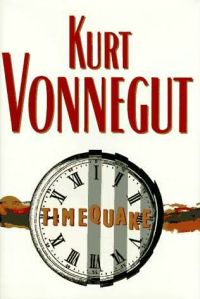
Timequake(Vonnegut)I haven’t written about Kurt Vonnegut in a while, and I believe it’s time to revisit him and his wisdom. I am dusting off a piece I wrote several years ago, as it has merit in my writing life today.

Kurt Vonnegut (November 11, 1922 – April 11, 2007) was one of my literary heroes. He was considered to be one of the most outrageously creative writers of our time, and indeed time figures prominently in much of his work – such as in his semi-autobiographical novel, Timequake. In this novel, he writes about trying to write a story. He understood writers’ block, because he had experienced it. Reading Timequake is like seeing my own struggle to write reflected in another author’s life.

His most famous work, Slaughterhouse-Five came out of his experiences in WWII as a prisoner of war. Vonnegut understood being a prisoner of war because he had experienced it.

In 1982, Vonnegut wrote a short piece for the International Paper Company, titled simply, ‘How to Write with Style.’ He began his essay by first considering the question of “why we should strive to improve our writing style”:

  1. “Do so as a mark of respect for your readers, whatever you’re writing. If you scribble your thoughts any which way, your readers will surely feel that you care nothing about them. They will mark you down as an egomaniac or a chowder-head — or worse, they will stop reading you.”

For me as both an editor and a reader, this is a critical point, because if you, as an author, become irate at hearing honest opinions from your beta readers or editors, you are doing them a disservice. We all experience this feeling of shock and dismay, but do take the medicine and try to understand what your reader saw that wasn’t up to par.

My most painful moments have been at the hands of editors who truly wanted to help me improve my work. I thank God they cared enough to tell me the truth.

If you’re doing this only for your ego, then, by all means, enjoy writing whatever falls out of your head. Do it and have fun, but don’t show it to anyone for if you do, your ego is in for a bruising.

That joy and abandonment is how a first draft should be written. But, if you have a first draft, don’t ask me what I think of it, no matter how proud you are unless you want my perspective because we all know every ms has flaws.

After Vonnegut had explained why authors must work to improve their knowledge of the craft, he went on to present 7 more concepts authors must strive to achieve:

  1. Find a subject you care about.

Let’s be real – if we don’t have a passion for our subject, it’s difficult to wax poetic about it. But when you are passionate, you can’t stop discussing it. It takes all your attention, and you find new things to say about it every day.

  1. Do not ramble, though.

What a sense of humor!  He was right – keep it brief!  Don’t spend 50 words when 10 will do.  The longer a sentence is, the more opportunity an author has to weaken it.  I am terrible at putting this concept into action.

  1. Keep it simple.

(note to self) Simplicity is the key to Not Rambling!

  1. Have the guts to cut.

Sometimes an author is in love with a particular sentence or paragraph – and it may be one which, to an editor, doesn’t really work. You must be prepared to divorce the sentences you are married to. This happens to me all the time – and now I try not to cry when my most beautiful, alliterative prose is given the boot.  Nine times out of ten tossing out the offending gibberish improves the reader’s experience. After all, this isn’t only an ego trip – it’s the reader I’m writing for, right?

  1. Sound like yourself.

You may find this to be a ‘Well, duh!’ moment, but take a moment to think about how you actually speak.  Do you say “I shall meet you anon.” …er…no… probably not.  I usually say, “I’ll meet you as soon as I can.”  Write it the way it feels most comfortable to say it. (Thank you, my many wonderful editors, for helping me to understand this concept!)

  1. Say what you mean to say.

Another ‘Well, duh!’ moment, you might say, but think about how hard it is to express your thoughts when you are trying to tell a stranger how to get from your house to the Walmart in the next town just south of you. Use the words that most clearly express your thoughts. Don’t use vague words to describe simple things – don’t say ‘red marks that started to bleed slightly’ if what you’re describing are ‘bloody scratches.’

  1. Pity the readers.

kurt-vonnegut_quoteDon’t make your readers want to put down your book at the end of the first page. Write the sort of story you want to read – put yourself in the reader’s place.  All we dedicated readers really want is the best tale we’ve ever read!

Is that too much to ask?

No, and maybe.  We’re only human after all so mixed in with our flashes of literary brilliance are the occasional things which do well for lining the bottom of the bird-cage.

As writers, we struggle to grow every day, and yes, there are times when what we put to paper isn’t our best work.  But that is where having the guts to cut is important.

I just hate it when one of my most beautiful turns of phrase during the first draft of a tale becomes not-so-pretty in the second draft and ends up on the verbiage-heap when the editing is done!

Sometimes we find ourselves writing in a desert, a place where the words won’t come. We feel that our work is dry and uninspiring, but I guarantee the most famous and well-loved authors have suffered the same dry-spells, suffered the same feelings of miserable failure we aspiring indies feel.

When I read their beautiful, harsh, and diverse work, I am inspired. I believe I can do this crazy thing. I remind myself that, for me, it’s not about numbers and sales, because it can’t be. For me, it has to be about improving the quality of my work and the telling of the tales I have locked in my brain and getting them out there in book form to the best of my ability.

Reading and understanding how the great authors write is one of the keys to unlocking our own potential. We indies have to use every tool we have available in this rough business, and we have to know what we want to achieve.

I want to achieve great sales, of course. But more than that I want to write compelling tales that move my readers. I may never achieve the first, but I think I can do the second.

6 Comments

Filed under writing

#amwriting: the rough draft

My Writing LifeI have begun a new novel set in Neveyah. It is the “how it all began” novel and takes place at the beginning of their recorded history. It’s been rolling around my head, and bits of this story are alluded to at various points all through the Tower of Bones series and also Mountains of the Moon.

The protagonist of this story is mentioned regularly in the Tower of Bones series as a character featured in children’s books. He’s portrayed as a kind of superhero, doing many impossible things.

But as always, there was a real man and real events at the core of the mythology.

I am taking the mythical man and giving him his place in history as the founder of the City of Aeoven, the College of Warcraft and Magic, and the first leader of the Temple of Aeos. I had the basic story drawn up back in 2009 when I began devising the world of Neveyah—three lines mentioning their childhood heroes.

The events that launch Aelfrid down the path of the mythic hero are all laid out. Now I must connect the dots and bring him to life.  If the story grows too large, it will be published as a two volume set, but my intention is to keep it to the same length as Valley of Sorrows.

As an indie, I must pay CreateSpace up front for my stock whenever I go to book fairs or signing events, so keeping my costs down is critical. CreateSpace costs are dependent on the length of the book, so if I have to pay $6.99 for each book, it limits  how much stock I can afford to keep on hand. I don’t want to run short of books, so I try to keep my costs to below  $5.00 per book. This also makes donating them to libraries and shelters affordable.

Even though Tower of Bones was published first, the rough draft of Mountains of the Moon was actually written first. In early 2009 I had been asked to write an epic fantasy story-line for a Final Fantasy-style anime-based RPG that was never built. For that reason, the world building was super-heavy.

Before I even had a story, I had to spend months

  • devising history and mythology
  • designing all the many environments where the story would take place
  • drawing maps
  • designing the creatures the characters do battle with
  • I also had to design the rules for magic, including its limitations

Having all these things so well-drawn and documented has been a bonus, as I can just write the story. The setting is clear in my head, laid out in a style sheet for that world, and the terrain is detailed on maps.

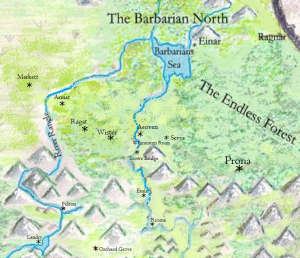
The north in the time of AelfridI have learned from the mistakes of others. Unlike the Saga of Recluce series, my maps for the early days detail the world as it was then, so there is no struggling to guess where the major towns are. (See my post, of  March 10, 2014, Spanking L.E. Modesitt Jr.)

I would definitely do two things differently, if I were to create that world today: the calendar, and the names of the days. I wouldn’t go with a 13-month lunar calendar, and I wouldn’t name the days after Norse gods.

But the calendar is canon now, and just as in real life, you must work with what you have. So, right now I am nearing the first plot point, where the first calamity occurs. Since this is the rough draft, everything to this point is really sketchy—a lot of “he said,” and “he went,” just to get the ideas down and everything in place.

These “telling and not showing” places are road marks, to guide me when I sit down to write the true first draft. My synopsis was about 3000 words. This rough draft will top out at about 55,000 words, and the first draft of the novel itself will be around 90,000 to 100,000 words.

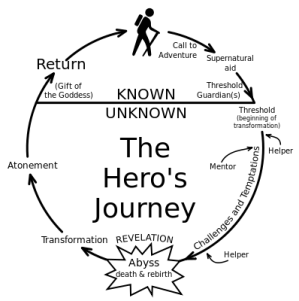
398px-Heroes journey by Christopher Vogler

Hero’s Journey, by Christopher Vogler, via Wikipedia

What I am doing at this point is setting the scene, introducing and developing the characters, and finding the reasons why they are who they are as people. I have a grip on my mentor’s character, and also the side characters.

I know my protagonist fairly well, although what initially motivates him is still a bit of a mystery. His personality and what he has to do are clear, but I haven’t yet discovered what lies within him that pushes him to achieve this thing. That is part of the journey for me.

For this book, I know exactly who my villain is, and how he came to be that person. He is new to me, but his motivation is clear and easy to imagine. I feel a real connection to him.

Altogether, if everything goes according to plan, writing this book will take about a year for me to get it to the final draft and into the editing process.

3 Comments

Filed under writing

#amwriting: advancing the plot

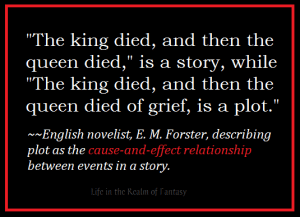
e.m. forster plot memeIn the previous post, I discussed the story arc, and how it relates to what E.M. Forster said about the plot: that plot is the cause-and-effect relationship between events in a story. The story arc is a visual description of where events should occur in a story. For me, knowing where they should happen is good, but it doesn’t tell me what those events are.

Planning what events your protagonist will face is called plotting, and I make an outline for that.

“Pantsing it,” or writing using stream-of consciousness, can produce some amazing work. That works well when we’re inspired, as ideas seem to flow from us. But for me, that sort of creativity is short-lived.

Participating in nanowrimo has really helped me grow in that ability, and one nanowrimo joke-solution often bandied about at write-ins is, “When your’re stuck, it’s time for someone to die.” But we all know that in reality, assassinating beloved characters whenever we run out of ideas is not a feasible option because soon we will run out of characters.

As devotees of Game of Thrones will agree, readers (or TV viewers) get to know characters, and bond with them. When cherished characters are too regularly killed off, the story loses good people, and we have to introduce new characters to fill the void. The reader may decide not to waste his time getting invested in a new character, feeling that you will only break their heart again.

The death of a character should be reserved to create a pivotal event that alters the lives of every member of the cast, and is best reserved for either the inciting incident at the first plot point or as the terrible event of the third quarter of the book. So instead of assassination, we should resort to creativity.

This is where the outline can provide some structure, and keep you moving forward.  I will know what should happen in the first quarter, the middle, and the third quarter of the story. Also, because I know how it should end, I can more easily write to those plot points by filling in the blanks between, and the story will have cohesion.

Think about what launches a great story:

The protagonist has a problem.

You have placed them in a setting, within a given moment, and shown the environment in which they live.

You have unveiled the inciting incident.

Now you need to decide what hinders the protagonist and prevents them from resolving the problem. While you are laying the groundwork for this keep in mind that we want to evoke three things:

  1. Empathy/identification with the protagonist
  2. Believability
  3. Tension

We want the protagonist to be a sympathetic character whom the reader can identify with; one who the reader can immerse themselves in, living the story through his/her adventures.

Also, we want the hindrances and barriers the protagonist faces to feel real to the reader. They must be believable so that the reader says, “Yeah, that could happen.” Within every scene, you must develop setups for the central events of that moment in their lives and show the payoffs (either negative or positive) to advance the story: action and reaction.

Each scene propels the characters further along, each act closing at a higher point on the story arc, which is where the next one launches from.

Some authors resort to “idle conversation writing” when they are temporarily out of ideas.  Resist the temptation—it’s fatal to an otherwise good story. Save all your random think-writing off-stage in a background file, if giving your characters a few haphazard, pointless exchanges helps jar an idea loose.

imagesDon’t introduce random things into a scene unless they are important. What if you had a walk-on character who was looking for her/his cat just before or just after the inciting incident? If the loss of the cat is to demonstrate the dangers in a particular area, make it clear that it is window dressing or remove it.

If the cat has no purpose it needs to be cut from the scene. To show the reader something  is to foreshadow it, and the reader will wonder why the cat and the person looking for it were so important that they had to be foreshadowed.

Every memorable element in a fictional story must be necessary and irreplaceable.  In  creative writing, this concept is referred to as “Chekhov’s Gun,” as it is a principal formally attributed to the great Russian playwright, Anton Chekhov.

Finally, we want to keep the goal just out of reach, to maintain the tension, and keep the reader reading to find out what will happen next. Readers are fickle, and always want what they can’t have. The chase is everything, so don’t give them the final reward until the end of the story.

But do have the story end with most threads and subplots wrapped up, along with the central story-line. Nothing aggravates readers more than going to all the trouble of reading a book to the end, only to be given no reward for their investment of time.

2 Comments

Filed under writer, writing

#amwriting: A Writer’s Armamentarium by Jennifer Vandenberg

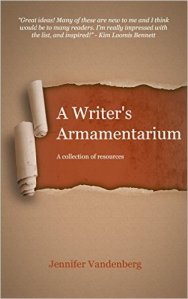
armamentarium coverWe all have times when we are at a loss for an idea. I love books that will give the creative muse a little kick in the pants. An intriguing little book in the writer’s arsenal is available for pre-order now.  A Writer’s Armamentarium, by Jennifer Vandenberg is a nifty little compendium of lists and writing prompts–things to  nudge your muse when you are a little bit stalled and blocked.

I came to know Jennifer through the online community of the Lewis County Writers Guild, a wonderful group of people I met at the 2015 Southwest Washington Writers Conference

CJJ: A Writer’s Armamentarium is an awesome title for book. What exactly is an Armamentarium?

JV: An armamentarium is a collection of resources used for an activity. It is often used in a medical context, but I loved the idea of creating a collection of lists that writers could use when they needed a bit of inspiration.

CJJ: Who did you create this book for?

JV: At first I created it for me and all the varied topics I’m interested in. As I started getting remarks from beta readers I learned that writers were more interested in these lists than non-writers so I included the chapters that writers would find most interesting. I hope that all writers, from hobbyists to professionals, can find inspiration for their stories among these lists.

CJJ: What made you decide to embark on such an ambitious project?

JV: I had dreamed of creating this book from my personal lists for about four years. I finally felt I had collected enough knowledge to fill out a book and I was excited to get started. Cleaning up and fact checking these lists took longer than I expected, but I loved every minute. This book is definitely a passion project for me.

CJJ: I was fortunate to read an advanced copy of this book, and loved the list of unusual words. What is your favorite unusual word, and why?

JV: I have so many favorite words that it is hard to pick just one. My favorite word from the Writer’s Armamentarium is omnology, which means the study of everything. I consider myself an omnologist, which sounds better than “someone who can’t decide what to focus on.”

CJJ: Let’s talk about your other work. Tell us about your Travis Eldritch series of short stories. Who is Travis, and how did you come to write about him?

JV: I love my Travis Eldritch series. He’s a private detective living on a moon in a system that has thirteen moons. In this system everyone is given a Problem at birth by the gods. Travis’s Problem is that he turns into a statue at random moments. This Problem has both advantages and disadvantages. Travis follows his gut more than his brains, but he and his partners manage to stop the bad guys eventually.

Each story is about 9,000 words. Six books have been published so far as eBooks on Amazon and in total there will be twelve books. Each story stands on its own, but there is an overarching subplot that connects all the books.

I’m a discovery writer and sometimes I just sit down and start writing with no idea of what is going to happen. I had this Sam Spade-like character talking to me so I started writing down his thoughts. Travis was born and he continues to tell me about his adventures.

CJJ: You have also written a book, Goofy Tips for a Happy Disney Vacation. What inspired that book?

JV: For three years I wrote a Disney travel blog at www.agoofyidea.com. New posts came out on Monday, Wednesday, and Friday. At the end of each post I wrote a Goofy Tip, a quick suggestion to improve the reader’s Disney vacation. I put all of the tips from the first year of the blog into a book so people could access helpful tips in one source.

This July I will be overhauling A Goofy Idea. I am creating a serial that is part fantasy, part Disneyland travelogue, about a teenage girl who was born in a book, but now lives in our world, and her fight with story spirits that want to pull her into their worlds. This story will be published on the website one chapter a week. It will be free to anyone who loves Disneyland and great stories.

CJJ: I love serials–some of the best work out there began as a serialized novels. I look forward to reading this. But, what has been the largest hurdle for you as an indie author?

JV: I love to write but I don’t love to market. My largest hurdle is balancing my time between the creative end and the business end of indie publishing. If I could have someone else do my marketing I would, but instead I’m working at finding techniques that are both successful and enjoyable.

CJJ: It is indeed a business, whether you are indie or traditionally published. The indie has a more difficult path as they must finance the entire endeavor on their own, and nothing happens overnight. So what advice do you have for the author just embarking on the indie path to publishing?

JV: Join Facebook groups. Join both virtual and in-person writing groups. Sign up for helpful blogs. Writers love to talk about writing and you can learn so much, but more importantly you need to surround yourself with a group of people who will support you as you embark on this exciting and sometimes difficult path.

CJJ: If you had it all to do over again, what would you do differently?

JV: I’d write more. Every day I didn’t write set me back from achieving my publishing dreams.

CJJ: Finally, where can the reader find your books?

JV: All of my books are published as eBooks on Amazon. All my books are listed on my author page.

CJJ: Thank you, Jennifer, for taking the time to talk with me today about your forthcoming book, A Writer’s Armamentarium.

This intriguing little book is a fun and useful little guide for the author who may need a little jump-start to their creative muse. Once Jennifer has it in paperback form, it will also be a nifty little book to have on the coffee table as a conversation piece, or as a gift for anyone who likes odd little self-help books.

>>><<<

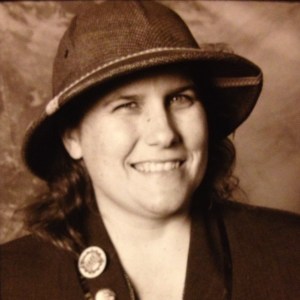
steampunk Jennifer - CopyGeology student, National Park ranger, secretary, tax preparer, swim instructor, Hallmark sales associate, school aide, library assistant, children’s bookseller, merchandise supervisor, property curator, volunteer, food service employee, farmer, and blogger. Jennifer has had all these jobs and she’s not even old enough to receive social security. However, no matter where she worked, Jennifer has always been a writer.

In 2014 she won the Short Fiction Writers Guild Flash Fiction award for her evil Christmas entry, Advice from Siblings. She was a panelist at 2015 Left Coast Crime and gives writing workshops around her southwest Washington community.

Check out her website www.jennifervandenberg.com to learn about all her various writing projects. She has turned her Mattie Garrets/Jackson Pierce mystery series into a podcast on iTunes and will be starting a YouTube channel in summer 2016. She also plans to publish her first non-fiction book in May and start a fantasy/Disney travelogue serial in July. There are no limits to Jennifer’s imagination.

You can find Jennifer at:

Jennifer’s Author Website:

2 Comments

Filed under Literature, Self Publishing, writing

#amwriting: using foreign languages in your dialogue

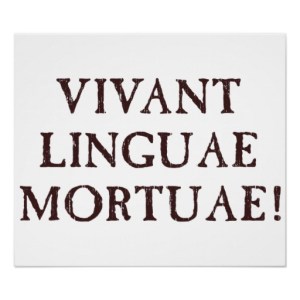
Long Live Dead Languages

At my Tuesday morning therapy writing group, a friend was telling me about a post she had seen in an online writers’ forum. The question ran something like this:

Questioner: “I have a main character in a fantasy novel who speaks no English. She speaks several other languages, though. Should I put the translations for her dialogue in italics or in parentheses?”

My friend gave the answer I would have: The answer to BOTH options is NO!!!

Translations should not be necessary at all. Never give a large amount of dialogue to a character who doesn’t speak the native language the book is written in. We don’t put the reader through that kind of torture, wading through a language they don’t understand, and then giving them the translation in italics. (Or large chunks of whatever in parentheses.)

We all laughed, but afterward, I was still thinking about this issue. The author whose post had begun this was writing a fantasy novel, and there are certain conventions readers expect authors to adhere to in this genre. When writing genre fantasy it’s a generally accepted practice that thoughts are set off with italics, not parentheses (aka Virginia Woolf), and so brackets have no place in the fantasy narrative.

Let me be clear on this: too many brackets clutter up the narrative just as much as large blocks of italics. In fantasy, the use of the em dash or ellipses fills the function of setting portions of the narrative off for emphasis.

Italics, parentheses, and foreign dialogue are like cayenne—a little goes a long way.

If you are writing a character who speaks a foreign  language, consider how they are commonly portrayed in novels that are traditionally published. Take any spy novel with a plot that takes place in both Mexico and the US. It has American characters, including the protagonist, who is a CIA agent and is fluent in both Spanish and English, and it features a large cast of Mexican citizens who may or may not be bilingual.

Because the book is intended for an English-speaking audience, when the Spanish-speaking characters are talking to each other in their native tongue the dialogue is still in English. At times, a few, commonly recognized words in español may be sprinkled in to lend the flavor of Spanish.

You must clearly establish that the characters are speaking their native language, Spanish, in the narrative. This is particularly important if you have a character who switches between languages or in certain situations where Spanish is the only language spoken.

I happen to read and understand some Spanish, and it is a language spoken by many US citizens, but our readers in the US are, for the most part, English-centric.

It’s all right to include an occasional foreign word or phrase, as long as it is done in such a way that the reader who most likely does not speak that language is not completely thrown out of the book.

yoda gibberish memeNow, why would I say this? Because I find it  irritating as hell (sorry for the editor speak) to stop reading, and hunt down translations.

It is hard enough when authors like Alexander Chee  put large amounts of words in French with no translation. Chee is from Canada and is writing for Canadians. His main character is Canadian, and French is one of his two national languages. For that reason, his mingling of French and English is acceptable, as his work is clearly understood by his intended audience.

My next thought when I was told about this particular virtual exchange was, does the writer speak the languages she is writing, or is she getting her Russian (or Spanish or German) from Google Translate? If that is the case, this author has a hot mess on her hands.

Original sentence in English: “It appears as if my dog may have fleas.”

Google translation in French: “Il semble que si mon chien peut avoir des puces.”

Re-run that French phrase through Google translator: “It seems as if my dog can have fleas.”

MSClipArt MP900390083.JPG RF PDNote the slight change in the translation—one word, “may” or “can”—these words are not always interchangeable, as they don’t mean the same thing in English—so that slight switching out of the word “can” for “may” changes the meaning of the sentence. The first sentence with “may” suggests it is possible the dog has fleas. The second translation with “can” gives the dog permission to have fleas.

These are two entirely different concepts.

English originally developed from a set of Anglo-Frisian or North Sea Germanic dialects originally spoken by Germanic tribes traditionally known as the Angles, Saxons, and Jutes.

Therefore, modern English is an offshoot of Frisian, as is Dutch. But even though we share the same roots, we have widely different syntax as our English is heavily influenced by Latin, thanks to the Roman Conquest of Britain after it was settled by the Frisians. In linguistics, syntax is the set of rules, principles, and processes that govern the structure of sentences in a given language, specifically word order.

How do you know that the Google translator understands syntax? The answer is: it doesn’t.

Your character from Amsterdam has bent a spoke on his bicycle wheel. He speaks Dutch. Filtered through the translator, it goes like this:

Dutch: “Oh nee. Ik heb een gebogen sprak op mijn fietswiel. Hoe kan ik het vast?”

English translation: “Oh no. I spoke bent on my bicycle wheel. How can I fix it?”

Note the misplaced words: In English, this implies he was speaking while bent over his bicycle wheel.

If you do use the occasional foreign word or phrase, it’s no big deal as long as it is used appropriately and in a context that will be understandable. It lends a certain realism, when done with a deft and sparing hand.

Just remember, forcing your reader to stop reading and check too many translations is suicide, especially for an indie. Never give your reader a reason to put the book down!

5 Comments

Filed under writing

#amwriting: know your style: hypocrisy in the industry

a writer's styleIn writing, style is far more than simply choosing to wear high-heeled shoes with jeans. Style is a multilayered representation of your voice and your knowledge of the craft of writing.

An author’s style affects the overall readability of his/her finished product. Good readability is achieved by:

  1. Understanding: Keeping to generally accepted grammatical practices. Purchasing and using a style guide when questions arise regarding a creative writing project
  2. Rebellion: if the author chooses to break the accepted rules, he/she does so in a consistent manner.
  3. Wordcraft: The way the author phrases things, and the words he/she chooses, combined with his/her knowledge of the language and accepted usage. Invented word combinations, such as wordcraft (word+craft) and the context in which they are placed.

Simply having a unique style does not make your work fun to read.

Ulysses cover 3Let’s take a look at James Joyce, the man I think of as the king of great one-liners. If you look up great lines quoted from modern classic literature, you will find excerpts from his novel Ulysses represented more often than many other authors.

Yet, while the average reader has heard and often used quotes from Joyce’s work, most people have not read it. They may have picked it up, but then put it down, wondering what all the critics loved so much about it.

The mind of the literary critic is as inscrutable as that of an ex-spouse: hard to understand but easy to run afoul of. I personally learned to love Joyce’s work when I was in a class, taking it apart sentence-by-sentence. Prior to that, I couldn’t understand it, despite the fact it was written in modern, 20th century English.

What makes Joyce’s work difficult for the average reader is his style: he was Irish and had the Irishman’s innate love of words and how they could be twisted, and often wrote using what we call stream-of-consciousness. In doing so, Joyce regularly, but consistently, broke the rules of grammar.

Consistency and context are absolutely critical when an author chooses to write outside the accepted rules of grammatical style. If you just don’t feel like enclosing your dialogue within dialogue tags, it is your choice. Simply tell your editor that is your decision, and she/he will make sure you have consistently omitted them throughout the manuscript.

Queen of the Night alexander cheeYou may, however, have written a book that is difficult for the average person to read, as Alexander Chee has in his brilliant novel The Queen of the Night. While his writing is sheer beauty, this particular style choice is a mystery to me. It makes the book difficult to get into, because you’re reading along, and suddenly you realize you’re reading dialogue, and you have to stop, go back, and reread it.

It is incomprehensible to me why an editor for a large publisher would accept a manuscript that is as annoying as that one flaw makes this otherwise amazing book. It is also proof that large publishers (Houghton Mifflin Harcourt in this case) are just as guilty as indies when it comes to making strange decisions that can negatively affect sales. They may have done this to elevate it to a “status” read,  a must-buy literary name-dropper for those who wish to appear fashionably cultured. If so, it’s a disservice to a work that is brilliant despite a flaw that would be fatal if it were to appear in an Indie author’s work.

Chee’s editor did one thing correct, however: the lack of closed quotes is consistent throughout the book, and so one can sort of get into the narrative—at least until the dialogue starts up again. This blemish is why I will only recommend the audiobook to readers who are easily discouraged.

Your style choices are critical. They convey your ideas to the reader, and if you make poor choices, you may lose a reader.

James Joyce and Alexander Chee made style choices in their writing that an Indie could never get away with. The world holds Indies to a higher standard, so the choice to omit something as vital as quotation marks would result in instant finger-pointing and mockery of the Indie publishing industry as a whole.

What you choose to write and how you write it is like a fingerprint. It will change and mature as you grow in your craft, but will always be recognizably yours. As you are developing your style, remember: we want to challenge our readers, but not so much that they put our work down out of frustration. Most of us who are Indies can’t rely on our names to sell our books.

9 Comments

Filed under Publishing, writing

#amwriting: Verbs: when to use “if I was” and “if I were”

epiphanyMost of my ideas for blog posts arise during work, or in conversation with other writers. Usually, these revolve around concepts I have a basic understanding of but haven’t really given a lot of thought to. Writing about them helps to clarify and cement them in my mind.

Every now and then a grammar topic comes up that I’ve never really thought about. If it’s a subject I am not really clear on, I will research it, and then try to distill my discoveries into bite sized chunks.

We writers often operate by instinctively using the knowledge we gained in school. Often, as in my case, that knowledge is a bit tarnished and worse for the wear.  Today’s topic is one fabulous instance of that very thing.

Last Tuesday, we were standing around the virtual watercooler at the virtual offices of Myrddin Publishing. We have authors and editors on three continents, so we use a virtual office. A grammar question arose, and this is how the conversation went:

Shaun Allan (UK) said: Grammar question, please. ‘As if it were’ or ‘as if it was’ ?

Ross Kitson (UK) said: Would it depend upon the subject of it? If it were an individual then I’d say “was” whereas if ‘it’ were an event then I’d say ‘were.’ Might be best to ask a non-Northerner.

Connie Jasperson (me) (US) said: Ross Kitson is correct (in my opinion).

Stephen Swartz (US) said: were.

Gary Hoover  (US) said: A HUGE issue with most people is the subjunctive tense. Anything that is not actual but could be is subjunctive (as your phrase indicates). “If I were a carpenter.” Is correct because the singer isn’t actually a carpenter. “I was a carpenter” is correct if he actually was. (Gary inserted the link to Wikipedia’s article on “English Subjunctive”)

Alison DeLuca (US) said: I’m a subjunctive slore! ‘Were’ all the way.

It turns out this conversation revolved around the “Past Subjunctive Tense.” Gary, Stephen, and Alison had it right.

As a result of this conversation, I did a little more digging, wanting to know more about this oddly named construct. It just so happens that on Saturday morning, Stephen Swartz and I both happened (at the same time) upon an excellent blog post by the Grammar Girl, Mignon Fogarty.

When you go out to Wikipedia the whole subjunctive verb thing looks quite complicated, but it doesn’t have to be. The subjunctive (in the English language) is used to form sentences that do not describe known objective facts. For the purposes of this post, we are only looking at Past Subjunctive definitionSubjunctives: the verbs was and were.

But first, what does “subjunctive” mean?:

Dictionary.com defines “Subjunctive.” as:

adjective

1.(in English and certain other languages) noting or pertaining to a mood or mode of the verb that may be used for subjective, doubtful, hypothetical, or grammatically subordinate statements or questions, as the mood of ‘be’ in ‘if this be treason.’

Compare imperative (def 3), indicative (def 2).

noun

2.the subjunctive mood or mode.

3.a verb in the subjunctive mood or form.

First, let’s consider what Past Subjunctive Tense covers: how to use the words ‘was’ and ‘were.’

Which is correct?

  • I wish I were a penguin. I would fly through the water.
  • I wish I was a penguin. I would fly through the water.

If I am only  only wishing I were a penguin, were is correct. If I actually could be a penguin, was would be correct and I would have to rewrite my sentence, by deleting ‘I wish’ and changing ‘would’ to ‘could.’

The Grammar Girl goes farther. She says: Believe it or not, verbs have moods just like you do. Yes, before the Internet and before emoticons, somebody already thought it was important to communicate moods. So, like many other languages, English has verbs with moods ranging from commanding to questioning and beyond. The mood of the verb “to be” when you use the phrase “I were” is called the subjunctive mood, and you use it for times when you’re talking about something that isn’t true or you’re being wishful.

I love that clue—that verbs can be wishful.

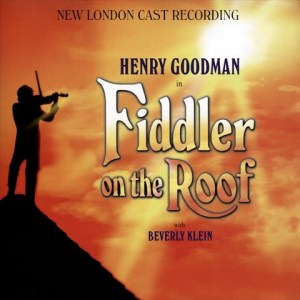
fiddler onthe roof soundtrackThe Grammar Girl gives us a great example: Think of the song “If I Were a Rich Man,” from Fiddler on the Roof. When Tevye sings “If I were a rich man,” he is fantasizing about all the things he would do if he were rich. He’s not rich, he’s just imagining, so “If I were” is the correct statement. This time you’ve got a different clue at the beginning of the line: the word “if.”

However, there are times when we use the verb ‘was’ even though the subject of the sentence has not yet happened, or may not happen at all. Grammar Girl says:  But “if” and “could” and similar words don’t always mean you need to use “I were.” For example, when you are supposing about something that might be true, you use the verb “was.”

Past subjunctive verb forms express a hypothetical condition in present, past, or future time:

  • Don’t complain about the food. What if I was a chef?
  • I wish I were reincarnated. What if I was a penguin?

If it’s only wishful thinking, we use “were.” If it might be true but we don’t know or it hasn’t happened, we use “was.”

So now, thanks to a bunch of editors hanging around the water cooler and the miracle of the internet, we know how and when to use our moody, past subjunctive verbs.

If you are a grammar junkie (as I am becoming) I highly recommend you check out Mignon Fogarty’s Grammar Girl blog, or pick up her books.

4 Comments

Filed under writing

#amwriting: the author’s voice

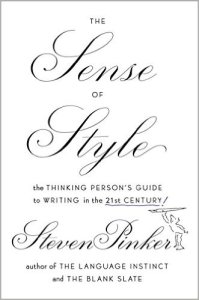
The sense of style steven pinkerAnyone who is a member of a writing group is regularly beaten over the head with certain basically good, but occasionally clichéd, rules. Improperly applied, this mindless interpretation of proper grammatic style can inhibit an author’s growth.

These rules are fundamentally sound, but cannot be rigidly applied across the board to every sentence, just “because it says so in Strunk and White.” I rely on the Chicago Manual of Style, but I also understand common sense.

English is a living language. As such it is in a continual state of evolution and phrasing that made sense one-hundred years ago may not work well in today’s English.

We may be writing a period piece, but we are writing it for modern readers.

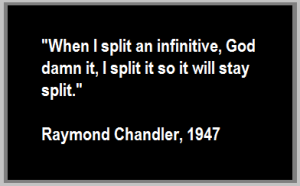
You can split an infinitive: it is acceptable to boldly go where you will.

You can begin a sentence with a conjunction if you so choose. And no one will die if you do.

Stephen Pinker discusses many rules in his controversial book, The Sense of Style, and finds that some of them no longer make sense.

For example, Pinker points out that “The prohibition against clause-final prepositions is considered a superstition even by the language mavens, and it persists only among know-it-alls who have never opened a dictionary or style manual to check.” 

He notes that rigidly following “the rules” would have you doing silly things like turning “What are you looking at?” into “At what are you looking?”  I don’t know about you, but for me the first example is preferable.

In the example, the word at is a preposition, and placing it after looking makes it a clause-final preposition.  Such a construct is technically a no-no, but I suggest you break that rule.

Stardust, Neil GaimanWe are constantly told that we need to make our verbs active, rather than relying on passive constructions, and for the most part, this is true. But Pinker reminds us that “The passive is a voice and not a tense.” There are times when the use of passive phrasing is appropriate.

Consider the difference between ‘the cat scratched the child’ and ‘the child was scratched by the cat.’  The second sentence is written in the passive voice, and in this context the active voice is the one I would choose because it is simpler and less fluffy.

Pinker agrees with me that there are contexts in which the passive is preferable. Quote from The Sense of Style: “Linguistic research has shown that the passive construction has a number of indispensable functions because of the way it engages a reader’s attention and memory.”

And in writing, context is everything. 

For most genre work, editors push for active voice, but truthfully, mainstream fiction and literary fiction can use the passive voice and still sell boatloads of books. Some of the most beautiful prose out there in genre fantasy mixes passive voice in with the active, and when done right  it is immersive.

name of the wind -patrick rothfussPatrick Rothfuss’s Name of the Wind is one example, and Neil Gaiman’s Stardust is another.

These books are best sellers because both Rothfuss and Gaiman understand how to craft prose that mingles passive and active phrasings, drawing us into their work. They choose when to use passive phrasing, and apply it appropriately so the narrative is a seamless blend of properly constructed sentences chosen to reflect their distinct voices.

The modern prohibition against passive phrasing exists for a reason: improperly and excessively used, the passive voice can weaken your narrative.

Knowledge of grammar and sentence construction is critical if you are an author: Sloppy grammar habits show that your work is badly crafted.

Your voice is the way you habitually phrase things despite your vast knowledge of how grammar is correctly used. Take a look at the great authors: Raymond Chandler, Ernest Hemingway, F.Scott Fitzgerald, and James Joyce: these authors each had such a distinctive voice that when you read a passage of their work, you knew immediately who you were reading.

They ALL broke the rules in their work and were famous for doing so.

Raymond chandler quote split infinitivesHowever, they understood the rules they were breaking and broke them deliberately and selectively in the crafting of their narrative.

Imagine a story set in an expensive restaurant. This story revolves around a marriage that is disintegrating. The couple, Jack and Diane, dine in silence. The food is important, but only because of what it represents. How do you convey this?

The steak was well-prepared and melted in Jack’s mouth. Nevertheless, Diane wielded her knife like a surgeon, cutting her meat into tiny, uniform chunks, chewing each bite slowly before swallowing. Jack imagined her carving his heart similarly, chewing it carefully and then spitting it out.

800px-Night_Sky_Stars_Trees_Quote“The steak was well-prepared and melted in Jack’s mouth” is written with a passive voice, and that is okay. The important thing is Jack’s observation of Diane and her mad knife skills. You don’t need to say “The chef had prepared the steak perfectly.” Unless he is having an affair with Jack or Diane, the chef who prepared the tender steak is not important and doesn’t need to be mentioned.

Steven Pinker has some words of wisdom for would-be editors: “It’s very easy to overstate rules. And if you don’t explain what the basis is behind the rule, you’re going to botch the statement of the rule—and give bad advice.”

Knowing what the rule is and why it exists allows you to choose to break it if that is your desire.

Writing style is a combination of so many things. It is how you speak through your pen or keyboard. Craft your prose with an eye to what is important to your story, and say it with your voice. With that said, your voice should not be so distinct and loud that it makes your prose obnoxious. A good editor will understand the difference and guide you away from bad writing, helping you find your voice in such a way that your work will be a joy to read.

8 Comments

Filed under Fantasy, Publishing, writing