Tag Archives: Editing

Phrasal verbs–minions of evil, or sometimes useful?

Book- onstruction-sign copyPhrasal verbs are usually two-or three-word phrases consisting of a verb plus an adverb, or a verb plus a preposition, or both. They are just another aspect of English vocabulary, and can be considered a form of compound verbs.  We use them all the time, but what, exactly, are they?

First, what is an adverb?

The term adverb is somewhat of a catchall word to describe many kinds of words having little in common other than the fact they don’t fit into any of the other available categories (noun, adjective, preposition, etc.) and they modify an action word—a verb.

The principal function of adverbs is to act as modifiers of verbs or verb phrases. An adverb used in this way gives information about the manner, place, time, frequency, certainty, or other circumstances of the activity denoted by the verb or verb phrase. Too many modifiers in your narrative and voila! Purple prose.

phrasal verbsThere are three main types of phrasal verb constructions depending upon whether the verb combines with a preposition, a particle, or both.

Wikipedia, the fount of all knowledge, has a good example of these three forms:

Verb + preposition (prepositional phrasal verbs)

  1. Who is looking after the kids? – after is a preposition that introduces the prepositional phrase after the kids.
  2. They picked on nobody. – on is a preposition that introduces the prepositional phrase on nobody.
  3. ran into an old friend. – into is a preposition that introduces the prepositional phrase into an old friend.
  4. She takes after her mother. – after is a preposition that introduces the prepositional phrase after her mother.
  5. Sam passes for a linguist. – for is a preposition that introduces the prepositional phrase for a linguist.
  6. You should stand by your friend. – by is a preposition that introduces the prepositional phrase by your friend.

Verb + particle (particle phrasal verbs)

  1. They brought that up twice. – up is a particle, not a preposition.
  2. You should think it over. – over is a particle, not a preposition.
  3. Why does he always dress down? – down is a particle, not a preposition.
  4. You should not give in so quickly. – in is a particle, not a preposition.
  5. Where do they want to hang out? – out is a particle, not a preposition.
  6. She handed it in. – in is a particle, not a preposition.

Verb + particle + preposition (particle-prepositional phrasal verbs)

  1. Who can put up with that? – up is a particle and with is a preposition.
  2. She is looking forward to a rest. – forward is a particle and to is a preposition.
  3. The other tanks were bearing down on my panther. – down is a particle and on is a preposition.
  4. They were really teeing off on me. – off is a particle and on is a preposition.
  5. We loaded up on Mountain Dew and chips. – up is a particle and on is a preposition
  6. Susan has been sitting in for me. – in is a particle and for is a preposition.

(end of quoted example, thank you Wikipedia)

We use phrasal verbs all the time in our daily speech and in our writing. However, whenever it’s possible we should look for simpler ways to phrase our thoughts when writing, unless we are writing conversations spoken in the local vernacular.

Why do I feel that way? The way I see them, phrasal verbs are  two-or-three words (an action word and modifiers) forming what can be considered a separate verb-unit with a specific meaning. In other words, they use more words than is really needed to express a thought:

  • Who is looking after (verb unit) the kids? == Who is watching the kids?
  • They brought that up (verb unit) twice. == They mentioned it twice.
  • Who can put up with (verb unit) that? == Who can endure that?

We use these phrasings because they sound natural to us—that is the way people in your area might speak. But when used too frequently in a written piece, phrasal verbs junk up the narrative. They subtly contribute to what we call “purple prose” because the overuse of them separates the reader from the story.

Unless you are writing poetry, simplicity is best, because you want to immerse your reader in the experience.

ok to write garbage quote c j cherryhWhen we are revising our first draft, and tightening our narrative we should be examining the prose for weak phrasing. Each time you come across phrasal verbs in your work, look at the sentence it occurs in as if it were an isolated incident and ask yourself if it needs to be there. Many times a phrasal verb really is  the only way to express what you are trying to say, but equally often a more concise way can be found.

Phrasal verbs have their places, but if you can simplify a thought and make the sentence stronger, do so.

2 Comments

Filed under Literature, Publishing, Uncategorized, writer, writing

#Proofreading is not #editing

Epic Fails signWhile some people will dispute this, proofreading is not editing.

Proofreading is done after the final revisions have been made, and hopefully it is done by someone who has not seen the manuscript before. That way, they will see it through new eyes, and the small things in your otherwise perfect manuscripts will stand out.

Anita Campbell, in her May 28, 2015 guest post for the SBA’s Blog-Industry Word says: “The first step of effective proofreading is understanding that not every typo or issue is alike.  Each needs to be attacked in a different way.” While she is speaking of editing blogposts, and short works, that profoundly true of longer manuscripts.

Even though an editor has combed your manuscript and you have made thousands of corrections, both large and small, there may be places where the reader’s eye will stop. Words have been left out, punctuation is missing–any number of small, hard-to-detect things can occur even after the most thorough of edits.

After the final edit we go over our work with a fine-toothed comb, trying to proof it ourselves. We read it aloud, and we read it from the bottom up, but our eye sees what it expects to see. We catch many things, but we don’t catch it all.

This is where the third person in the process comes in–the proofreader.

First of all, proofreading is not editing. Editing is a process that I have discussed at length elsewhere, and is completed long before we get to the proofreading stage.

SO, at the outset, the proofreader must understand that no matter how tempting it may be, they have not been invited to edit the manuscript for content. That has already been done and done again. If they cannot refrain from asking for large revisions regarding your style and content, find another proofreader.

What The Proofreader Should Look For:

Spelling—misspelled words, and homophones (words that sound the same but are spelled differently). These are words that spell-checker may or may not catch, so a human eye is critical for this.

  • Wrong:  Bobby wint out the door, slamming the screen.
  • Right:  Bobby went out the door, slamming the screen.
  • Wrong: There cat escaped and he had to chase it
  • Right: Their cat escaped and he had to chase it.

Repeated words and cut-and-paste errors. These are insidious and damned difficult to spot, and spell-checker won’t find always them. Sometimes they seem like unusually garbled sentences.

  • Wrong: First of all, First of all, it is accepted practice to italicize thoughts.
  • WrongFirst of all, it is accepted practice to practice thoughts.
  • Wrong: First of all, it is accepted to ot  thoughts.
  • Right: First of all, it is accepted practice to italicize thoughts.

Missing closed quotes:

  • Wrong: “Doctor Mendel, you’re new to the area. What do you know about the dead man? asked Officer Shultz.
  • Right: “Doctor Mendel, you’re new to the area. What do you know about the dead man? asked Officer Shultz.

Numbers that are digits:

  • Wrong: There will be 3000 guests at the reception.
  • Right: There will be 300 guests at the reception.

Dropped and missing words:

  • Wrong: Within minutes the place was crawling with cops, and Officer Shultz was sitting at my kitchen table me gently while I made hot water for tea.
  • Right: Within minutes the place was crawling with cops, and Officer Shultz was sitting at my kitchen table grilling me gently, while I made hot water for tea.

keep clam and proofread

Each time you create a new passage in your already edited manuscript, you run the risk of creating another undetected error.

At some point your manuscript is done. You have been through the editing process, and the content and structure is as good as you can get it, but you need one last eye looking for small flaws. Before you upload that masterpiece to Kindle or wherever, do yourself a favor and have it proofread by an intelligent reader, who understands what you are asking them to do and who is willing to do only that.

11 Comments

Filed under Books, Humor, Literature, Publishing, Uncategorized, writer, writing

Beta Reading, or Editing–what’s the difference?

Book- onstruction-sign copyIndies rely heavily on what we refer to as beta readers to help shape their work and make it ready for editing. But in many forums, I’ve seen authors  use the term used interchangeably with editing, and the two are completely different.

And unfortunately, some indie published works are clear examples of work by authors who don’t realize the importance of working with an editor, although it is apparent that they have had assistance from beta-readers.

What is quite disappointing to me, is the many traditionally published works that seem to fall into the same lack-of-good-editing category, and I am at a loss as to why this is so.

So what is the difference between a beta reader and an editor?

Well, there is a HUGE difference.

Editing is a process, one where the editor goes over the manuscript line-by line, pointing out areas that need attention: awkward phrasings, grammatical errors, missing quote-marks or a myriad of things that make the manuscript unreadable. Sometimes, major structural issues will need to be addressed. It may take more than one trip through to straighten out all the kinks.

  1. In scholastic writing, editing involves looking at each sentence carefully, and making sure that it’s well designed and serves its purpose. In scholastic editing, every instance of grammatical dysfunction must be resolved.
  2. In novel writing, editing is a stage of the writing process in which a writer and editor work together to improve a draft by correcting errors and by making words and sentences clearer, more precise, and more effective. Weak sentences are made stronger, nonessential information is weeded out, and important points are clarified, while strict attention is paid to the overall story arc.
  3. The editor is not the author She can only suggest changes, but  ultimately all changes must be approved and implemented by the author.

Beta Reading is done by a reader. One hopes the reader is a person who reads and enjoys the genre that the book represents. Beta reading is meant to give the author a general view of  the overall strengths and weaknesses of his story.

The beta reader must ask himself:

  1. Were the characters likable?
  2. Where did the plot bog down and get boring?
  3. Were there any places that were confusing?
  4. What did the reader like? What did they dislike?
  5. What do they think will happen next?

beta read memeBeta Reading is not editing, and  the reader should not make comments that are editorial in nature. Those kinds of nit-picky comments are not helpful at this early stage, because the larger issues must be addressed before the fine-tuning can begin, and if you are beta reading for someone, the larger issues are what the author has asked you to look at.

This phase of the process should be done before you submit the manuscript to an editor, so that those areas of concern will be straightened out first.

Editors and other authors make terrible beta readers, because it is their nature to dismantle the manuscript and tell you how to fix it. That is not what you want at that early point–what you want is an idea of whether you are on the right track or not with your plot and your characters, and whether or not your story resonates with the reader.

Do your self a favor and try to find a reader who is not an author to be a first reader for you. Then hire a local, well-recommended editor that you can work with to guide you in making your manuscript readable, and enjoyable.

If you notice a few flaws in your ms but think no one else will notice, you’re wrong. Readers always notice the things that stop their eye.

In my own work I have discovered that if a passage seems flawed but I can’t identify what is wrong with it, my eye wants to skip it. But another person will see the flaw, and they will show me what is wrong there.

That tendency to see our own work as it should be and not how it is, is why we need editors.

1 Comment

Filed under Books, Literature, Publishing, writer, writing

What I #amwriting

Alarm clock quote ray bradburyI normally begin my day at about 5:30 a.m. with editing for my clients–I like to do that when I am at my sharpest which is always in the morning.  I spend the afternoons writing, and right now I have two manuscripts that I am working on, and several short-stories. My evenings I either write blog posts or work on designing book covers.

Other than writing, most of my work these days centers around finishing up publishing the second editions of the Tower of Bones Series. The book itself, Tower of Bones, has been republished, and book II in the series, Forbidden Road, is in the process of being proofed and should be available soon–hopefully within two weeks.

In addition to revamping the TOB series, I hope to have the prequel to the series, a stand-alone novel, Mountains of the Moon, published by July 15, 2015, with a few copies to take to the PNWA conference. That means it has to be finished and ready to proof by June 25–which may be pushing it. However, things are moving so perhaps I will be able to meet this new deadline.

As I said, I have two novels in the works: concurrently with The Wayward Son, I am fleshing out the final book of the Tower of Bones series, Valley of Sorrows. This book deals with the aftermath of the events in Forbidden Road and winds up that story.

The road to hell Phillip Roth QuoteIn the aftermath of an incident that occurred in the last days of the war in Mal Evol, John lost the use of most of his magic. He has managed to keep that disability a secret for thirty years. The Wayward Son is the story of John’s redemption, and explains the events that happened in Aeoven while Edwin and the others were gone. These incidents culminated in John and Garran being sent to meet Edwin in Braden at the end of Forbidden Road. 

John Farmer’s story is intriguing to me, because he is a man concealing many secrets. A lot is going on under the surface–he suffers from survivor’s guilt and PTSD, which often develops after a person is exposed to one or more traumatic events. In The Wayward Son, John’s rocky relationship with Garran is explored, and also his love affair with the Abbess of Aeoven, Halee.

While I was re-editing the series to date, I took the liberty of changing several once-minor characters’ names, as they had suddenly become important in the two later books, and their names were too close to other, already prominent, characters’ names. Since I was changing them anyway, I made them widely different. Thus Marta Randsdottir is now Halee Randsdottir. Her original name was nearly identical to Edwin’s wife, Marya, a problem since the two women figure prominently in The Wayward Son.

The problem was inadvertently begun in 2009 when I was writing Tower of Bones as the story-line and walk-through for an RPG, and was scrounging around for good character names. I didn’t know at that time it would become a book, and it didn’t occur to me that NEVER naming any character with a similar sounding, looking, or rhyming name is something every author should take note of. This is important, no matter how minor the characters seem to be, because, just like Halee, they may have a larger part to play later and the confusion will ruin the story.

The magnitude of the problem first became evident when I was writing Forbidden Road, but I thought I was stuck with it. Referencing the two women in the same paragraph was dreadfully confusing, since their names were only one letter off from each other.

ok to write garbage quote c j cherryhFor a long time, I didn’t know what to do about the name problem. I thought I was stuck with it, but one of the beauties of being an indie is the freedom I have to make adjustments when a gross error is discovered. Since I was completely revamping the series anyway, it was the perfect time to take the plunge and rectify that mistake. The series now has new maps, new interiors, and new covers.

It was just another lesson I’ve learned since leaping into this mad circus of indie publishing, but now I know to never name two characters in the same book with names that begin and end with the same letters. Don’t do it!


Comments Off on What I #amwriting

Filed under Adventure, Battles, Books, Fantasy, Humor, Literature, Publishing, Self Publishing, Uncategorized, writer, writing

More Wisdom of the Ages: Write the Damned Book

tumblr_mxurcgAUxq1rbp59ao1_500

Yes. Even Loki loves my work and want’s me to just get on with it. But here I am, stalled and unable to concentrate. because of things…strange, annoying things…. And what about this word? Is it even real?

tumblr_mainykvINL1r0wqrdo1_500


Never mind. I’ll just sit here and. sulk for a while. What is my purpose? Why do I do this?

tumblr_ndi15fZRpu1syd000o1_500

But I have a gift–a gift, I tell you!  Someday people will say “I knew that loser back when she had a job!”

tumblr_ng6dg8wwg51u02tlio1_1280


But no…I must hold fast to my dreams of someday selling vast quantities of kindle downloads! Someday I will sell more books than Hugh Howey. And he sold a bunch…so many that he scared the big publishers into acting like dumbasses…they showed up  at his house with pitchforks and Hachettes….

tumblr_ng6esx01YT1syd000o1_1280


Someday I will be more than just the crazy old lady locked in the office for everyone’s safety. Someday I will be famous for having written a fantasy series that rivals Tolkien…someday.

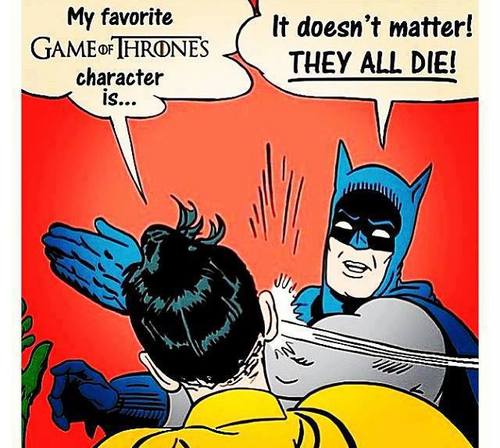
batman-game-of-thrones-meme-quotes-Favim.com-896707

Special thanks to Tumblr for providing me with all the diversions!

4 Comments

Filed under Adventure, Books, Humor, Publishing, Uncategorized, writing

Creating Conversations

Socks and Sandals MemeConversations are easy to write…badly.

Unless the author thinks about it carefully, they can be stilted, stiff, and an unnatural wall of blah-blah-blah. Good writing involves learning the craft, and nowhere is that more apparent than in a conversation.

So how does the intrepid author write this phenomenon in such a way that it sounds natural? I always think of a conversation as having an arc: It begins, rises to a peak, and ebbs, an integral part of the scene, propelling the story forward to the next scene.

We might jabber about nothing, but in writing,  a good conversation is about something and builds toward something. J.R.R. Tolkien said that good dialogue must have a premise and moves toward a conclusion of some sort. If nothing comes of it, the dialogue is a waste of the reader’s time.

First, when we write about conversations between our characters, we want to ensure they don’t all sound like the same person. Imagine you are at a party. If you look around you, observing the conversations going on in small clusters, you will notice that every person has different mannerisms. The same is true of your characters when you see them in your head. With that image in mind,  you want to include those differences in their gestures, and their manner of speech.

When people talk, they rarely follow grammatical rules. Any English class you’ve taken will have stressed the importance of using proper grammar and punctuation in your writing, and believe me, those rules are important. However, when we attempt to write dialogue, those same rules should be thrown out of the window. People speak in broken sentences, with pauses, and even use incorrect words.

Now we get to the part where my editor and I have our own little conversation—the one where I stick random bits of punctuation in at odd places and she puts them where they belong or removes them entirely:

She: “I agree with the grammar part. I take exception to the punctuation. Punctuation rules MUST be followed especially in dialogue so that the reader reads the dialogue in the same manner the writer intended it to be read.”

Me: “Yes, ma’am.” (Muttering as I find ways to insert action where I want the pauses to go.)

Leonard_Nimoy_William_Shatner_Spock's_Brain_Star_Trek_1968We all take breaths at different places. Some people speak quickly and off the cuff, with short bursts. Others consider their words before they say them and speak more slowly. Every person in a given room speaks with their own unique style and pattern.

What are the roots of these patterns?  Speech habits are born in the environment the speaker grows up in, but they become identifiable mannerisms acquired throughout our lives.

Consider how the conversation fits into the arc of the scene.

We’ve talked about this before, but it bears repeating: first we must identify what must be conveyed in our conversation.

  1. Who needs to know what?
  2. Why must they know it?
  3. And how many paragraphs do you intend to devote to it?

My rule of thumb is, keep the conversations short and intersperse them with scenes of actions that advance the plot. Walls of meaningless conversation don’t keep the action moving and will lose readers, so  the conversations you include in your narrative must be important—and intriguing.

Author James Scott Bell says dialogue has five functions:

  1. To reveal story information
  2. To reveal character
  3. To set the tone
  4. To set the scene
  5. To reveal theme

SHotel California Memeome people will have the characters discuss the back-story, and this can be good if done the right way, in small snippets at critical points, and only when that information is needed. But this can be bad, especially when used as away to dump history in long, bloated paragraphs of dialogue.

Don’t give your characters long paragraphs with lines and lines and lines of uninterrupted dialogue. Those are sometimes seen as a wall of words by the reader. When asked how to write a good book, Elmore Leonard said, “Try to leave out the part that readers tend to skip.”

That goes double for dialogue. When I think of the novels I’ve enjoyed the most, the important information in their conversations is dealt with up front, and the minor details emerge later as they become important.

We don’t want our characters to be just a bunch of talking heads, sitting around, yammering on. It’s unnatural and doesn’t happen in real life except on the nightly news.

I’ve mentioned this before, but your characters should pause in their conversations, and sometimes miss a few beats. Beats are what screenwriters call the little bits of physical action that are inserted into dialogue and which in a novel can serve to indicate who said what without a dialogue tag interfering with it. Actions serve to punctuate the dialogue, to give the scene movement, and to maintain a strong mental picture, especially when an author is trying to balance the use of dialogue tags.

e3-2013-trailer-final-fantasy-x-x-2-hd-remasterRemember, actions are best placed where there’s a natural break in the dialogue. They show the mood and personality of your characters and allow the reader to experience the same pause in the dialogue as the characters do, and increase the sense of immediacy, making the scene real in the reader’s mind. It’s through the small habits we give our characters that we convey a little bit of their back-story, without having to resort to an info dump.


3 Comments

Filed under Books, Fantasy, Humor, Literature, Publishing, Self Publishing, Uncategorized, writer, writing

Interior Monologues

MP900321209In writers’ forums you will find a great deal of discussion regarding interior monologues. It’s true that beginning authors can rely too heavily on them as an easy way to dump blocks of information into a narrative, instead of deploying it. A few people will even tell you they despise interior monologues, and while I disagree with them, I do see their point.

First of all, it is an accepted practice to italicize thoughts. But we are all aware of how daunting it is for a reader to be faced with a wall of italics.

A rather vocal contingent will say thoughts should not be italicized, that it creates a greater narrative distance, setting readers outside of the character and the events of the scene.

MSClipArt MP900390083.JPG RF PDAs an avid reader, I disagree, although more than a sentence or two does exactly that. If we choose to omit dialogue tags for them, and don’t set them off with italics, it becomes confusing. The finished book ends up looking like a bunch of closed quotes were left out, and gives the impression of an unedited manuscript, even if the publisher has subtly changed the font just for thoughts.

If you, as an indie publisher, do choose to leave them in the standard font but add dialogue tags such as she thought, it makes me wonder, why are you bothering to have an interior monologue at all? If you feel that strongly, skip it entirely and find a different way to express your ideas, because readers will have to stop and read it twice.

Interior monologues have their place, and when a writer is expressing a character’s most intimate thoughts, the current accepted practice for writing interior monologue is to use italics. We use them to represent a character’s thoughts in real time, as they actually think them in their head, or the precise words they use. For that reason, italicized thoughts are always written in:

  • First Person: I’m the queen! After all, we don’t think about ourselves in the third person, even if we really are the queen. We are not amused.
  • Present Tense: Where are we going with this? We think in present tense because we are in the middle of events as they happen, so while memories may reflect the past, our immediate actions and mental comments are unfolding in the present, and we want to convey that sense of immediacy. What a mess.

The Website, Novel Writing Help says:

It will be perfectly obvious to the reader that these words are the character thinking and not the author narrating. And the thought itself, as well as not becoming confused with the rest of the text, gains an extra emphasis, like in this example from Clare Morrall’s novel The Man Who Disappeared.

Felix, a man whose world has just fallen apart, is standing out in the street watching his family eat their evening meal without him…

   He wants to believe in this cosiness, this world of families, this labyrinth of deeply entwined love.
   That’s the key, of course: love. He has been told this for as long as he can remember. ‘We love you, Felix,’ one of his aunts used to say, ‘and that’s all that matters.’
   What have I done, Kate?
   Frost glints on the road, nearby car windscreens are clouded with ice. Felix blows on his hands and shuffles his feet around, trying to bring some feeling back to his toes. (End of quoted passage)

As you can see in the above passage, Felix has many thoughts, but only the most intimate, personal thoughts are shown through an interior monologue—the rest are written as part of the scenery, and they create the image of the situation he has found himself in. (Just so you know, I liked that passage so much that I just bought the Audible book.)

CAUTION INFO DUMP ZONE AHEADThis is how we want to write our interior monologues. They must be natural, and organic to the flow of the narrative. Thoughts must fit as smoothly into the narrative as conversations. My recommendation is to only voice the most important thoughts via an internal monologue, and in this way you will retain the readers’ interest. The rest can be presented in images that build the world around the characters:

Benny watched Charlotte as she left the office. Everyone knew she came from a wealthy family. The gold watch, the sleek sports car she drove could have been owned by any well-employed girl, but something about her screamed confidence and money.

You could put all of that into Benny’s interior monologue, but why? This way, the reader is shown all they need to know about Charlotte, without resorting to an info dump, and we aren’t faced with a wall of italics.

Some things must be expressed as an interior monologue, if you want the reader in your protagonist’s head.

Benny looked down at his mop. I’m such an idiot.

Now the reader has also gained a whole lot of information, in only two sentences.  They think they know who Benny is, and they have a clue about his aspirations. What they don’t know yet, but will discover as the plot unfolds, is that Benny is actually a detective working undercover, and Charlotte is the secretary of his quarry.

autumn leavesInterior monologues are crucial to the flow of novels in which the author wants the reader planted firmly in the protagonist’s mind. However, the actual monologues must be used sparingly, and the rest of his/her thoughts should be shown through their actions or external observations.

Those external observations are a subtle part of worldbuilding, when you are writing a narrative that is an intimate portrait of your protagonist.

So, to wind this up, I feel that:

  1. Interior monologues are an organic part of some kinds of narratives, but not necessarily all narratives.
  2. If used sparingly interior monologues can create an intimate connection with the protagonist.
  3. If an interior monologue is used, it should be short and set off by italics, and only rarely with the ‘speech tag’ thought.
  4. Italics should never be used for long passages.

That last one is hard–what do you, as an indie publisher, do for quoted passages or letters between protagonists? Those sorts of questions are a ‘whole nother’ blog post, as we say where I come from.

6 Comments

Filed under Adventure, Books, Fantasy, Humor, Literature, Publishing, Self Publishing, Uncategorized, writer, writing

Wordless Dictionaries

oxford_dictionaryWe are in the midst of an extreme shift in the English language, a continual evolution as impossible to stop as the  melting of the Antarctic ice-cap. This change is not necessarily a terrible thing, but it does come along with some interesting complications.

Robert Macfarlane discussed one negative aspect of our language shift in a blog post last week for The Guardian. He is not  saying that the rapid shift in our dialect and word-usage is bad–after all, language needs to be spoken and it is like water: it’s always on the move and incredibly difficult to contain.

cowslip

cowslip

But Macfarlane sees a negative in the modern view of this fluidity, one that struck a real chord with me: “Under pressure, Oxford University Press revealed a list of the entries it no longer felt to be relevant to a modern-day childhood. The deletions included acorn, adder, ash, beech, bluebell, buttercup, catkin, conker, cowslip,cygnet, dandelion, fern, hazel, heather, heron, ivy, kingfisher, lark, mistletoe,nectar, newt, otter, pasture and willow. The words taking their places in the new edition included attachment, block-graph, blog, broadband, bullet-point, celebrity, chatroom, committee, cut-and-paste, MP3 player and voice-mail. As I had been entranced by the language preserved in the prose‑poem of the “Peat Glossary”, so I was dismayed by the language that had fallen (been pushed) from the dictionary. For blackberry, read Blackberry.”

Now, admittedly Robert Macfarlane is an avid reader of literary fiction, and he also writes literary and travel books. However, many people are  still reading above the comic book level, and what he has to say in his piece concerns the dumbing-down or “flattening” of the language. Don’t try to tell me there isn’t enough room in the book for these words. Dictionaries are on-line now and there is in infinite amount of space in the internet for these words.

oxford school dictionaryDictionaries are the first reference book children will come into contact with in their schools, followed closely nowadays by Wikipedia. I admit that in a desk-reference form space is limited, but in a world where Blackberry means a smart-phone, there is no lack of space.

How will the landscape of our language look in fifty years? I sometimes doubt I would be understood, speaking in my ancient Northwest American dialect, using words that have no relevance. Without a comprehensive dictionary, how will the words I write today be understood by my great-grandchildren?

If I could say one thing to those who compile dictionaries it is that ALL the many words that make up our English language  have relevance and should be  included in what is being marketed as a truly comprehensive dictionary. At some point, a curious reader is going to want to know the meaning of a word, and if that word appeared in the dictionary  at one time, why must it be removed just because a committee of naive scholars with extremely limited experience feels it is not needed?

_72982736_vikings courtesy of BBCTo me, this is tantamount to a mass burning of books just because they contain “dangerous ideas.”

I have one thing to say to the modern publishers of dictionaries: You have unlimited space in an on-line dictionary. When you allow words to fall out of the dictionary because they have fallen out of common use in YOUR milieu,  your dictionary is not as comprehensive as you are pretending it is. You have lost YOUR relevance at that point.

These mongers of wordless dictionaries should feel some shame, because they are as responsible for the dumbing-down of the English language as is the casual speaker. Their own relevance is questionable, as more and more seekers of quick information will find it in the bowels of the fount of all knowledge, Wikipedia, OR they will Google it, as I did the word “inexorable.”

6 Comments

Filed under Adventure, Battles, Books, Fantasy, Humor, Literature, Publishing, Self Publishing, Uncategorized, writer, writing

The author’s voice

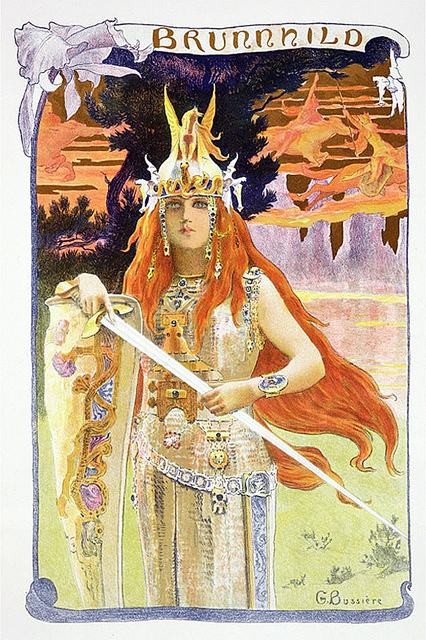
Brunhild_(Postkarte),_G._Bussiere,_1897All authors have a voice, although many can’t sing. I have 8 good notes and I’m not afraid to use them in singing the odd song now and again. Tad Williams can sing, and has the cd to prove it.

But what do I really mean when I speak of an author’s voice?

We become attached to certain authors because when we read their works, we hear their “voice.” We hear them speaking to us.

Each author writes with a certain style, or in other words, the words he or she habitually uses that makes his or her writing unique. “Voice” conveys the author’s attitude, personality, and character.

You have all heard me say that having a manuscript properly edited before publishing it is crucial for the indie author’s credibility. You may ask, “what is this process, and how do I retain my voice, and control of my work when someone else is intent on hijacking it?”

First of all, a good editor will never try to hijack your work. Writers intentionally use symbolism and thematic consistency. We sometimes intentionally repeat certain words for emphasis. These things are significant to us, and a good editor will recognize that.

So what does an editor look for in a manuscript?

Indies are looking for an editor who “helps a writer develop a book from idea or outline or initial draft. Makes sure the book will meet the needs of the publisher and its readers. Will work with the author through any number of drafts. Often works with writers of non-fiction. Guides the writer in topics to be covered in or omitted from the book.” quoted from the Editors Blog.

In other words indies want a structural editor.  What will this editor do for them?

The professional freelance editor will read your manuscript, looking for the rough spots and inconsistencies that work their way into every final draft. They will suggest you correct certain grammatical errors and habits that interfere with the flow of your work, and give you an idea of how those corrections could be made. They will also point out things that are unnecessary background–info-dumps that have slipped through, and suggest you remove them.

Also a structural editor may suggest that a section be moved to a different, more appropriate place in the manuscript. This editor will devote a month or more of their time to your manuscript. This is a hefty commitment on their part, and is one that is not lightly made.

Raymond chandler quote split infinitivesA good editor will not try to take over your manuscript and erase your voice.

You, as the author, have the final say on your manuscript–it is after all your intellectual property. If you don’t want to change something you feel is intrinsic to what you are trying to express, you don’t have to.

Sometimes editors don’t see the forest for the trees–and a good conversation with the author will straighten those areas out. If your editor does not respond to your emails, or indicate in some way that they have heard your concerns, you should not work with them.  

The best part of being an indie is having the control of your work. A good relationship with your editor is crucial to turning out a good product.

7 Comments

Filed under Adventure, Battles, Blogger, blogging, Books, Fantasy, Humor, Literature, Publishing, Self Publishing, WordPress, writer, writing

Clauses and Pauses

commaCommas–those mysterious, curving morsels of punctuation designed to contain clauses, but which, when used  irresponsibly, wreak havoc in the ordinary life of the author.

According to the wonderful website, Get it Write, there are two specific situations that call for the use of a comma before the word and:

The first instance is created when there are  three or more items in a series. This mark of punctuation is called the serial comma which I covered in a post called Comatose Ambiguity, (see link here)

“The second situation occurs when “and” is being used to coordinate two independent clauses. An independent clause—also known as a main clause—is a group of words that has a subject and a verb and can stand alone as a sentence. In the following example, the independent clauses are in brackets:

  • [Miguel took piano lessons for sixteen years], and [today he is an accomplished performer].

“The use of the comma would also apply when any of the seven coordinating conjunctions (and, but, or, nor, for, so, yet) join two independent clauses.

“Notice in the next example that we do not use a comma before “and” because it does not join two independent clauses but merely joins two verbs:

  • Miguel took piano lessons for sixteen years and today is an accomplished performer.

“Here we have only one independent clause—two verbs (“took” and “is”) but one subject (“Miguel”).” (Quoted directly from Get it Write, Sept 8, 2014)

I know this will be difficult for some to swallow, but commas do not serve as pausing places for the reader to breathe.  They join together clauses–short sentences–that would make your narrative sound choppy if they were left to stand by themselves. Take these short sentences, for instance:

Rall had seen to it that John sparred daily. He cut a swath through the ranks quickly. Even Garran had no legitimate complaints. He still needled John at every opportunity.

Each sentence  can technically stand alone, but they are boring and choppy that way.

Rall had seen to it that John sparred daily, cutting a swath through the ranks at such a rate that even Garran had no legitimate complaints, although he still needled him at every opportunity.

Another good online reference is Brian Wasko’s Write at Home Blog. His article called 7 Ways NOT to Use a Comma is good stuff. Of particular interest to this post on using commas for pauses: “The comma-by-ear method doesn’t work — at least not consistently. I inevitably inserted unnecessary commas all over the place.”

One rule he mentions (that is one of my personal weak areas) is rule number four (and I love his comments): 

4. Don’t use a comma to connect two clauses if the second clause is subordinate (i.e., dependent).

Frowny face:  Mrs. Johnson’s garden was ruined, because rabbits nibbled her cucumbers.

Smiley face: Mrs. Johnson’s garden was ruined because rabbits nibbled her cucumbers. (end quote)

I would have shot straight to sticking the comma in front of ‘because’ because it is a good place to pause. (Yep. I said because because.) (Snicker.)

Using commas for pauses is an invitation for comatose mayhem. Consider this: Every person reads aloud at a different rate and with a different cadence. If you indiscriminately throw your commas in wherever YOU think a pause should go, your prose will be filled with strange bumps in the road, because your reader won’t be pausing where YOU think they should. No matter how much of a control freak you are, you can’t force people to read the same way you do. This is why we follow common rules when using punctuation.

Commas separate independent clauses from each other and also from introductory words. In other words, they divide little sentences from each other in order to form compound sentences. 

Oh, the editorial agony.


7 Comments

Filed under blogging, Books, Fantasy, Humor, Literature, Publishing, Self Publishing, Uncategorized, WordPress, writer, writing