
Writers are entertainers. We write books for people who want a diversion from the daily grind. No matter the subject or genre, we write escapes for people who need to just get away for a while.
 Our stories take the reader to exotic places and introduce them to other realities. When we publish a book, we hope it will find a reader on the day they were looking for just such an escape.
If it does, we hope we have written something reader will stay with to the end. We hope they see life and vitality in the narrative, the kind of energy we thought we were imparting when we wrote it.
No matter how well edited a manuscript is, readers will only stay with us if we allow ourselves to write from the heart. We must write what we believe is true even though the story is about people and events that never happened. If we believe in what we write, the prose will have power.
 I wrote poetry and lyrics for a heavy metal band when I first started out. I was young, sincere, and convinced I had to impart a message with every word. I didn’t know until twenty years later when I came across my old notebook that my poems weren’t honest. Eighteen-year-old me was trying to make a point rather than offering ideas for further thought.
Paging through that notebook and looking back at my work, I could see the falseness clearly. My words were contrived – I was trying too hard to be the next Bob Dylan. The words that emerged hadn’t been good enough, so I went out of my way to be clever.
When I began writing stories for my children, I knew better than to get fancy. I still wrote crap but what I wrote then was honest crap because I no longer had anyone to impress.
 Children are unimpressed by the fact their parents might write a story or play music or paint or do any of the creative arts.
They are also blunt when they tell you where a story or a song or a picture fails to impress them and are upfront about why. Thanks to the tough audience that my children were in those beginning years, I found ways to write fairy tales with truths that weren’t shaded by what I thought art should be.
These stories were better, but they weren’t written by an educated author.
As my children left home, I had more time to learn how to write a literate, well-plotted story. I made connections with other writers and joined writing groups. That was when I discovered that an author needs to be consistent with punctuation even when writing from the heart.
I had no idea I was uneducated because I had done well in writing and literature in school. I navigated college courses with no problem other than laziness. Alas, members of my writing group pointed out that I hadn’t retained much of what I was taught in elementary school.
As Ursula K. LeGuin said in her excellent book, Steering the Craft, A 21st Century Guide to Sailing the Sea of Story, “If you aren’t interested in punctuation, or are afraid of it, you’re missing out on some of the most beautiful, elegant tools a writer has to work with.” [1]
So, I knew a lot of words but didn’t know a lot about how to shape them. I try to embrace what I fear, so I forced myself to re-learn the fundamentals of American English grammar. I’m not perfect, but I try to do as well as possible. My editor still finds habitual errors.
If you are a regular reader here, you know I enjoy reading books in every genre and style. While the books I love are scattered all across the spectrum, they have one thing in common—they are all written by authors with an understanding of the basic rules of punctuation.
Often, these authors break other grammar rules with style and abandon, but they do pay attention to punctuation.
Punctuation matters because it is the traffic signal telling the reader to go, yield, go again, or stop. If an author gets the punctuation right in most places, the reader can suspend their disbelief.
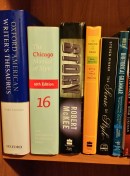
Writers begin as readers. In his book, On Writing, Stephen King gives us permission to read for six hours a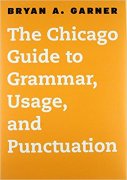 day, should we so desire. Reading is how we come to understand writing and the art of story. Mr. King also admonishes us to learn the fundamentals of punctuation and grammar.
In my quest to understand the art of constructing a story, I have come across some pretty awful books. As a freelance editor, I have twice had work submitted to me by authors who believed a convoluted mess was ready for the publisher and just needed a bit of proofreading. No editor has the time or desire to completely rewrite a story for a client, and they will decline that project.
We all suffer agonies on hearing criticism until we have been at it for a while. At first, our skin is thin and delicate and bleeds copiously when flaws are found in the precious child that is our work.
 Every editor will tell you no amount of money is worth the time and effort it would take to teach an author how to write coherent, readable prose. That is what seminars, books on craft, and books on style and grammar are for.
I have said this before—I don’t consider something awful and hard to read if it is written in an old-fashioned style. However, I do think a book is awful when its author wastes my time by not learning how to construct a sentence.
And when it comes to the narrative, poetry can’t be forced, but good prose can be ruined by trying to make it poetic.
I learned the hard way that contrived prose is not poetic, nor does it prove you are talented. When poetry or good imagery emerges naturally, rejoice and keep writing. Let the imagery flow when it will, and don’t force it. Every word we write doesn’t have to be golden.
 I want to read an honest story about people who seem real, who have the kind of problems we can all relate to on a human level. I want to read a story that comes from an author’s deepest soul. The setting doesn’t matter—it can be set on Mars or in Africa. Characters matter, and their story matters.
I read all genres and all settings. I will forgive the imperfections if the author has tried to be consistent and knows the fundamentals of punctuation and grammar.
I love nothing more than finding a great story that rings of truth and touches my heart. If it has passages that flow naturally and strike deep into my poetry-loving soul, all the better.
CREDITS AND ATTRIBUTIONS:
[1] Quote: Ursula K. LeGuin, Steering the Craft, A 21st Century Guide to Sailing the Sea of Story, ©1999 Ursula K. LeGuin, First Mariner Books Edition 2015, page 11.
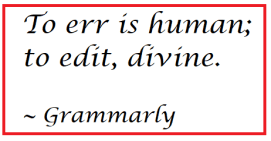 Today I am revisiting three wonderful quotes on these rules from
  Actually, my large dirty minivan is not as comfortable to ride in as it used to be. Grandma’s imaginary red Ferrari would be a lot more fun, but alas—if wishes were Ferraris, my driveway would look a lot fancier.
 Have you ever wondered why we say fiddle-faddle and not faddle-fiddle? Why is it ping-pong and pitter-patter rather than pong-ping and patter-pitter? Why dribs and drabs rather than vice versa? Why can’t a kitchen be span and spic? Whence riff-raff, mishmash, flim-flam, chit-chat, tit for tat, knick-knack, zig-zag, sing-song, ding-dong, King Kong, criss-cross, shilly-shally, seesaw, hee-haw, flip-flop, hippity-hop, tick-tock, tic-tac-toe, eeny-meeny-miney-moe, bric-a-brac, clickey-clack, hickory-dickory-dock, kit and kaboodle, and bibbity-bobbity-boo? The answer is that the vowels for which the tongue is high and in the front always come before the vowels for which the tongue is low and in the back. (Pinker, The Language Instinct, 1994:167) [3]
 Writing fiction allows me to put reality into more palatable chunks. It’s easier to cope with that way.
 We all draw inspiration from real life, whether consciously or not. However, if we are writing fiction, we must never detail people we are acquainted with, even if we change their names.
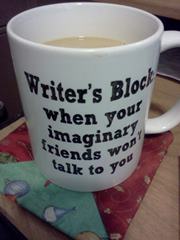 The best thing is that you don’t actually know a thing about them other than they like a Double Tall Hazelnut Latte. Peoples’ conversations are unguarded in coffee shops, openly talking about what moves them or holds them back. They are lovers or haters, quiet or loud, and most importantly, anonymous.
 Several years ago, I read a fantasy book where the author clearly spent many hours on the food of her fantasy world and the various animals. She gave each kind of fruit, bird, or herd beast a different, usually unpronounceable, name in the language of her fantasy culture.
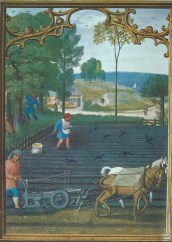 As many of you know, I have been vegan since 2012. However, during the 1980s, my second ex-husband and I raised sheep. Most of the meat we served in our home was raised on his family’s communal farm. Our chickens and rabbits roamed their yard and had good lives, and our family’s herd of twenty sheep was managed using simple, old-style farming methods.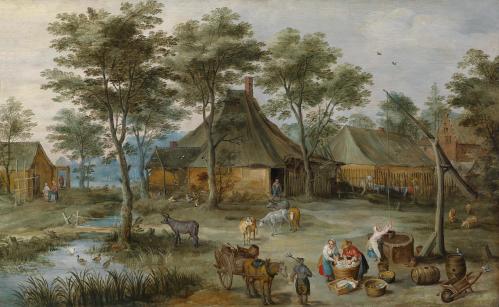
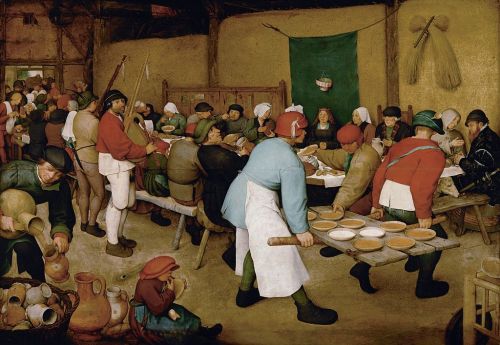
 Knowing what to feed your people keeps you from introducing jarring components into your narrative. In
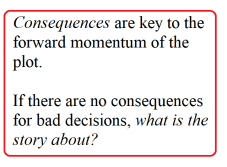
  Let’s look at both the meanings and synonyms for the word consequences.
 In the morning, after the unexpected (and unwanted) guests leave, he has two choices, to stay in the safety of Bag End, or hare off on a journey into the unknown. He chooses to run after the dwarves, and so begins the real story—how a respectable hobbit became a burglar and became a hero in the process.
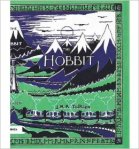 The blade does not acquire its name until later in the adventure, after Bilbo, lost in the forest of Mirkwood, uses it to kill a giant spider and rescue the Dwarves. This is when Bilbo’s decisions become more thoughtful, and his courageous side begins to emerge.
 This is an excellent time to look at the freedom we give our characters to act and react within the story. I have mentioned many times that I am a plotter. However, when I am in the process of writing the first draft of a novel, the characters sometimes take over. The plot veers far from what I had intended when I began writing it.
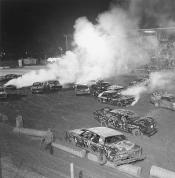 This happens because my work is character-driven, and sometimes, they’re like demolition derby drivers.
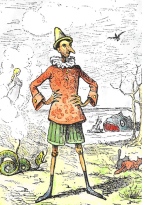 This is called giving your characters “agency.” Agency is an integral aspect of the craft of writing. It means that you allow your characters to make decisions that don’t necessarily follow the original plot outline. This gives them a chance to become real, the way
 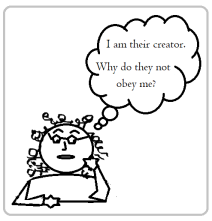 No matter how they respond, they will be placed in situations where they have no choice but to go forward. After all, I am their creator, the deity of their universe. I have an outline that predestines them to specific fates, and nothing they can do will stop that train.
 On November 1st, when we began setting the first words on the blank page, our minds formed images, scenes we attempted to describe. In his book, The Language Instinct,
  Once you find them, you need to go to the thesaurus to find alternatives that better express your intent.
 If you don’t have it already, a book you might want to invest in is
  Each chapter is comprised of one or more scenes. These scenes have an arc to them: action and reaction. These arcs of action and reaction begin at point A and end at point B. Each launching point will land on a slightly higher point of the story arc.
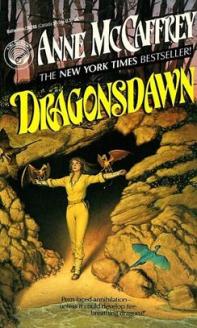 he scenes we are looking at today have two distinct environments to frame them: first the planet and then the abandoned colony ship, Yokohama. These scenes are filled with emotion, high stakes, and rising dread for the sure and inevitable tragedy that we hope will be averted. Not all the drama is in Sallah Telgar’s direct interaction with Avril Bitra. The environment heightens the drama, the sense of impending doom.
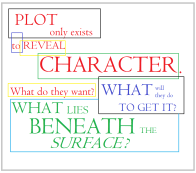 We see Avril taunting Sallah for her matronly body and move out again to see Avril tying a cord to Sallah’s crushed foot and forcing her to make the navigational calculations for Avril’s escape. We move close up and hear the interaction, Sallah pretending to do as Avril asks but really setting her enemy’s doom in action. The camera moves to the wide view again, and we hear the interaction with her frantic husband on the ground. We are caught up in her determination to seize this only chance, using her dying breaths to get the information about the thread spores to the scientists on the ground.
 But more importantly, even if you are traditionally published, you pay for the books you sell at shows.


 She also wrote the brilliant, hilarious standalone novel,
  About Ellen King Rice:


 Life in the Realm of Fantasy
