Tag Archives: #writetip

Writing Drabbles and Exploring Theme #amwriting

I think of writing as a muscle of sorts, working the way all other muscles do. Our bodies are healthiest when we exercise regularly, and with respect to our creativity, writing works the same way.

WritingCraft_short-story-drabbleDaily writing becomes easier once you make it a behavioral habit. The more frequently you write, the more confident you become. Spend a small amount of time writing every day and you will develop discipline.
If you hope to finish writing a book, personal discipline is essential.

Every morning, I take the time to write a random short scene or vignette. Some become drabbles, others short stories, but most are just for exercise. Writing 100-word stories is a good way to create characters you can use in other works.

Some of the best work I’ve ever read was in the form of extremely short stories. Authors grow in their craft and gain different perspectives with each short story and essay they write. Each short piece increases your ability to tell a story with minimal exposition.

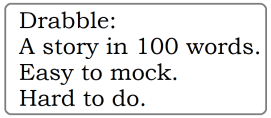
This is especially true if you write the occasional drabble—a whole story in 100 words or less. These practice shorts serve several purposes, but most importantly, they grow your habit of writing new words every day.

Writing such short fiction forces the author to develop an economy of words. You have a finite number of words to tell what happened, so only the most crucial information will fit within that space.

Writing drabbles means your narrative will be limited to one or two characters. There is no room for anything that does not advance the plot or affect the story’s outcome.

The internet is rife with contests for drabbles, some offering cash prizes. A side-effect of building a backlog of short stories is the supply of ready-made characters and premade settings you have to draw on when you need a longer story to submit to a contest.

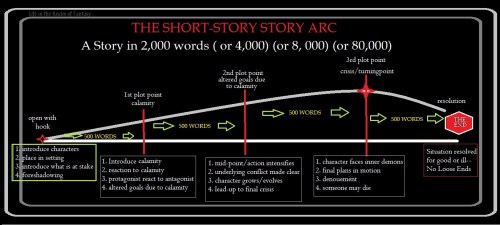
Below is a graphic for breaking down the story arc of a 2,000-word story. Writing a 100-word story takes less time than writing a 2,000-word story, but all writing is a time commitment.

short-story-arc

When writing a drabble, you can expect to spend an hour or more getting it to fit within the 100-word constraint.

To write a drabble, we need the same fundamental components as we do for a longer story:

  1. A setting
  2. One or more characters
  3. A conflict
  4. A resolution.

First, we need a prompt, a jumping-off point. We have 100 words to write a scene that tells the entire story of a moment in a character’s life.

Some contests give whole sentences for prompts, others offer one word, and others may offer no prompt at all.

Orange_Door_with_Hydrangeas_©_Connie_Jasperson_2019A prompt is a word or visual image that kick starts the story in your head. If you need an idea, go to 700+ Weekly Writing Prompts.
If a contest has a rigid word count requirement, it’s best to divide the count into manageable sections. I use a loose outline to break short stories into acts with a certain number of words for each increment, as illustrated in the previous graphic, the short-story story arc.

A drabble works the same way.

We break down the word count to make the story arc work for us instead of against us. We have about 25 words to open the story and set the scene, about 50 – 60 for the heart of the story, and 10 – 25 words to conclude it.

If you are too focused on your novel to think about other works, spend fifteen minutes writing info dumps about character history and side trails to nowhere. That is an excellent way to build background files for your world-building and character development and keeps the info dumps separate and out of the narrative.

Also, you have the chance to identify the themes and subthemes you can expand on to add depth to your narrative.

Theme is vastly different from the subject of a work. Theme is an underlying idea, a thread that is woven through the story from the beginning to the end.

An example I’ve mentioned before is the movie franchise Star Wars. The subject of those movies is the battle for control of the galaxy between the Galactic Empire and the Rebel Alliance. Two of the themes explored in those films are the bonds of friendship and the gray area between good and evil—moral ambiguity.

The best way to begin building your brand as an author is to submit your work to magazines and anthologies. But writing for magazines and anthologies is different than writing novels. Some aspects of short story construction are critical and must be planned for in advance, important elements of craft that show professionalism.

When you choose to submit to an open call for themed work, your work must demonstrate your understanding of what is meant by the word “theme” as well as your ability to write clean and compelling prose.

For practice, try picking a theme and thinking creatively. Think a little wide of the obvious tropes (genre-specific, commonly used plot devices and archetypes). Look for an original angle that will play well to that theme, and then go for it.

Most of my own novels fit in epic or medieval fantasy genres. They are based on the hero’s journey, detailing how events and experiences shape the characters’ reactions and personal growth. The hero’s journey is a theme that allows me to employ the sub-themes of brother/sisterhood and love of family.

These concepts are heavily featured in the books that inspired me, and so they find their way into my writing.

To support the theme, you must add these layers:

  • character studies
  • allegory
  • imagery

These three layers must all be driven by the central theme and advance the story arc.

Drabble_LIRF_1_jan_2018_cjjapWhen you write to a strict word count limit, every word is precious and must be used to the greatest effect. By shaving away the unneeded info in the short story, the author has more room to expand on the story’s theme and how it supports the plot.

Save your drabbles and short scenes in a clearly labeled file for later use. Each one has the potential to be a springboard for writing a longer work or for submission to a drabble contest in its proto form.

Good drabbles are the distilled souls of novels. They contain everything the reader needs to know about that moment and makes them wonder what happened next.

Write at least 100 new words every day. Write even if you have nothing to say. Write a wish list, a grocery list, or a sonnet—but no matter what form the words take, write. The act of writing new words on a completely different project can break you out of writer’s block—it nudges your creative mind.

14 Comments

Filed under writing

Identifying the Tropes of Genre and Subgenre #amwriting

I always suggest that authors build a backlog of short stories for submission to contests and various publications. But how do you know where to sell your work?

Tropes-writing-craft-seriesTo know that, you must know the genre of the work you are trying to sell. So, what exactly are genres? Publisher and author Lee French puts it this way, “Literary genres are each a collection of tropes that create expectations about the media you consume.”

So, genres are categories the publishing industry developed to enable shoppers in bookstores to quickly find what they are looking for. They’re like a display of apples at the grocery store – many baskets of apples are situated there, but each variety is a little different from its neighbor.

The difference in taste (tart or sweet) and texture (firm or soft) are what we gravitate to when we shop for apples.

In novels, the different flavors within a genre are created by the tropes the author has chosen to include in the narrative.

When you open the Submittable App and begin shopping for places to submit your work, you may find the list of open calls confusing. Many times, contests, publications, and anthologies are genre-specific. However, sometimes they don’t clarify which subgenres within that overarching category they are looking for.

Writers of nonfiction and poetry have no problem because their work is targeted to a magazine with a specific readership.

How do you decide who will be most receptive to your story? You must look at the tropes you have included in the narrative.

This list of genres and what they represent has appeared on this blog before. Genre is determined by the author’s intention, approach, how resolutions happen, and the ideas explored. The various tropes the authors employ form these industry-wide distinctions.

Nine_Perfect_Strangers_Liane_MoriartyMainstream (general) fiction—Mainstream fiction is a general term that publishers and booksellers use to describe works that may appeal to the broadest range of readers and have some likelihood of commercial success. Mainstream authors often blend genre fiction practices with techniques considered unique to literary fiction. It will be both plot- and character-driven and may have a style of narrative that is not as lean as modern genre fiction but is not too stylistic either. The novel’s prose will at times delve into a more literary vein than genre fiction. The story will be driven by the events and actions that force the characters to grow.
Science fiction—Futuristic settings, futuristic science and technology, space travel, time travel, faster than light travel, parallel universes, and extraterrestrial life are the core of science fiction. BE WARNED: if you use magic for any reason, you are NOT writing any form of sci-fi. The tropes that define subgenres are:

  • Hard Sci-fi is characterized by rigorous attention to accurate detail in physics, chemistry, and astrophysics. Emphasis is placed on accurately depicting worlds that more advanced technology may make possible.
  • Soft Sci-fi is characterized by works based on social sciences such as psychology, economics, political science, sociology, and anthropology.
  • Other main sub-genres of Sci-fi include Space-operasCyberpunk, Time Travel, Steampunk, Alternate history, Military, Superhuman, Apocalyptic, and Post-Apocalyptic. Go to the internet and look up the typical tropes of these subgenres. Then write me an awesome Space Opera – my favorite subgenre of sci-fi.

The main thing to remember is this: Science and Magic cannot coexist in the genre of science fiction. The minute you add magic to the story, you have fantasy.

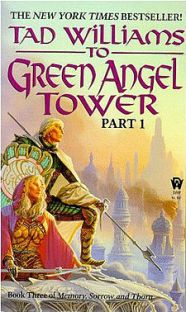
Green_Angel_Tower_P1Fantasy is a fiction genre that commonly uses magic and other supernatural phenomena as a primary plot element, theme, or setting.  Like sci-fi and literary fiction, fantasy has its share of snobs when it comes to defining the sub-genres. The tropes are:
  • High fantasy is defined as fantasy fiction set in an alternative, fictional world, rather than the real, or “primary” world, with elves, fairies, dwarves, dragons, demons, magic or sorcery, wizards or magicians, constructed languages, quests, coming-of-age themes, and multi-volume Often the prose is more literary, and the primary plot is slowed by many side quests. Think William Morrisand J.R.R. Tolkien.
  • Epic Fantasy is often serious in tone and epic in scope. It usually explores the struggle against supernatural, evil forces.Epic fantasy shares some typical characteristics of high fantasy and includes fantastical elements such as elves, fairies, dwarves, dragons, demons, magic or sorcery, wizards or magicians, constructed languages, quests, coming-of-age themes, and multi-volume narratives. Tad Williams’s Memory Sorrow and Thorn is classic Epic Fantasy.
  • Paranormal Fantasy–Paranormal fantasy often focuses on romantic love. It includes elements beyond scientific explanation, blending themes from all speculative fiction genres. Think ghosts, vampires, and supernatural.
  • Urban fantasy can occur in historical, modern, or futuristic periods, and the settings may include fictional elements. The prerequisite is that they must be primarily set in a city.

Horror—Every genre has a subgenre of horror: Wikipedia says, “Horror fiction, horror literature and also horror fantasy are genres of literature, which are intended to, or have the capacity to frighten, scare, or startle their readers by inducing feelings of horror and terror. Literary historian J. A. Cuddon has defined the horror story as “a piece of fiction in prose of variable length… which shocks or even frightens the reader, or perhaps induces a feeling of repulsion or loathing.” In Romance, the horror subgenre might be Gothic or Paranormal, but the focus must be on a developing romance. The roadblocks will not feature blood or gore, but terror and a perception of danger will be a feature the pair must overcome.

Romance—Novels of this type of genre fiction place their primary focus on the relationship and romantic love between two people and must have an emotionally satisfying and optimistic ending. The story will be character-driven, and the roadblocks must be believable but surmountable.

I mention Literary Fiction last because it is the most complicated and least understood genre of all.

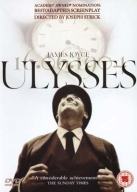
Ulysses_(1967_film_dvd_cover)Literary fiction can be adventurous with the narrative. The style of the prose has prominence and may be experimental, requiring the reader to go over certain passages more than once. Stylistic writing, heavy use of allegory, the deep exploration of themes and ideas form the core of the piece.
Be careful when presenting yourself and your work to the prospective publisher. Never submit anything that is not your best work, and do not assume they will edit it because they won’t. No publisher will accept poorly written work or sloppily formatted manuscripts.

Read a sample of the work they publish and only submit the work that best fits their publication.

And most of all, good luck! May your work land on an editor’s desk the day they are looking for a story just like that!

13 Comments

Filed under writing

The Author’s Toolbox #amwriting

Passive writing occurs when, as storytellers, we are separated from the moment by words that block our intimacy with the action. Beginning writers often choose stative verbs, the passive voice, and heavily depend on weak verb forms in their writing.

toolsOne step on the slippery slope of passive prose is the overuse of stative verbs. Stative verbs express a state rather than an action. 
They are “telling” words.

A few Stative Verbs as listed by Ginger Software:

adore

agree

appear (seem)

appreciate

be (exist)

believe

belong to

For a more comprehensive list of stative verbs, go to this article: Stative Verbs – List of Stative Verbs & Exercises | Ginger (gingersoftware.com). [1]

Let’s get real—at times, stative verbs are necessary to a balanced prose. We want a narrative that expresses the human condition, and how we feel at a given moment is often part of that story. But we must balance a little telling with far more showing.

When we are first starting in the craft, we lean heavily on subjunctives and the irrealis forms of mood words. Subjunctive verbs and all forms of the verb be are hard to spot in our own work.

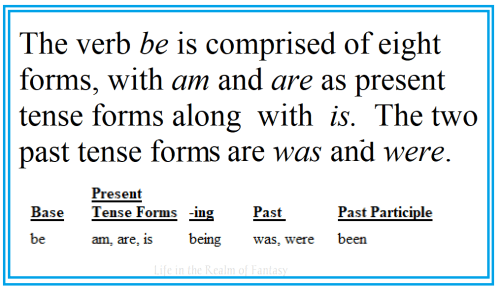
Be_Eight_Forms_LIRF05122019I think the habit of using one of the eight forms of the word be is more one of nurture, not nature. When we first start out in this craft, we tend to write weak sentences. This is because we are trained as children to tell what happened.
Writers often find the words and rules we use to describe existence convoluted and hard to understand.

The subjunctive (in the English language) is used to form sentences that do not describe known objective facts. These are words noting or pertaining to a mood or mode of a verb.

In grammar, mood and mode refer to verb forms. That mood or mode depends on how the clause the verbs are contained in relates to the speaker’s or writer’s wishes, intention, or claims about reality.

These verbs may be used for subjective, doubtful, hypothetical, or grammatically subordinate statements or questions. An example is the mood of the verb ‘be’ in ‘if this be treason.’

In other words, subjunctives describe unknown intangible possibilities.

chicago guide to grammarThe whole thing looks quite complicated on the surface, but it doesn’t have to be. We must begin assembling our writers’ toolbox. One important tool is Bryan Garner’s The Chicago Guide to Grammar, Usage, and Punctuation (Chicago Guides to Writing, Editing, and Publishing).

This is the book that will show you how to write a properly punctuated and formed sentence. It explains what a paragraph is and shows how to connect those sentences into understandable chunks of prose. The book also shows how to write and punctuate dialogue so that our work looks professional.

Soon, we have written a story and other people enjoy reading it.

In our first draft, we tell the story as if it were an event that we witnessed only a few moments before. Everything in our mind occurs in real-time, but once visualized, it becomes a memory. We tend to express our scenes and events as having a state of being, but we are looking back at them from a few moments in the future. So, the narrative is rife with they were, or it was.

We all start out writing that way, but with practice and self-education, we learn to write active prose. We begin by paying attention to our verb forms in the revision process.

I don’t have an education in journalism, yet I choose to write. Most of my friends who are authors don’t have degrees in either journalism or literature. So, if we wish to gain strength as authors, we must educate ourselves.

Learning the craft of writing is like learning the craft of carpentry. If you want to craft beautiful work, you must own the proper tools for the job and learn how to use them. My toolbox contains:

  • MS Word as my word-processing program. You may prefer a different program.
  • The Chicago Manual of Style (for editing work in American English).
  • The Oxford A-Z of Grammar & Punctuation (for editing work in UK English).
  • Trusted, knowledgeable beta-readers for my own work.
  • Books on how to craft a story/novel.
  • Having my work edited by good, well-recommended editors.
  • Taking free online writing classes.
  • Regularly attending seminars (not free, but worth the money).
  • Meeting with my weekly writing group (virtual meetings).
  • Daily reading in ALL genres.
  • Attending NaNoWriMo Write-Ins (virtual meetings).

What is in your toolbox? It takes a little effort, but you can educate yourself for free if you have the internet. You can learn how to express your ideas so that other people will enjoy them.

One step is to identify the habitual overuse of the Subjunctive Mood in your writing. Cut back on subjunctives and see how your prose improves.

blphoto-Orange-ScissorsI say cut back, not eliminate. Despite the misguided efforts of many gurus and Microsoft Word to erase all forms of ‘to be’ from the English language and replace it with ‘is,’ there are times when only a subjunctive will do the job.
One of the best ways to grow in the craft is to write short stories and send them off. Sometimes they are rejected, and sometimes not. Some stories aren’t really novel material, but maybe they are novellas. Send them to publications and expect rejection because that is how it often is. I can’t tell you how many rejections I have received over the years.

The truth is, we learn more from the rejections than we do the acceptances.

Rejection happens because at first, we write with WAY too many words. But a good writing group will both teach and support you through kind but honest critiques. I find it comforting to know my fellow authors will not tell me my work is awesome if it stinks like Bubba’s socks.

WritersjourneysmallA critique group may tear your work apart, which stings a wounded ego. But we grow from this experience. We learn that opinions are subjective, and writers are thin-skinned creatures. We develop a thicker skin and muck on.
In the revision process, we write mindfully, intentionally crafting lean, powerful prose.

It takes a lot of work to rise from apprentice to journeyman to master in any craft. I don’t know if I will ever achieve that status as an author, but I will keep working and learning. And above all, I will keep reading and will never stop writing.


Credits and Attributions:

[1] Quote from Stative Verbs – List of Stative Verbs & Exercises | Ginger (gingersoftware.com) Copyright 2021 Ginger Software.

10 Comments

Filed under writing

Transitioning from scene to scene #amwriting

In my previous post, I showed how each scene is a small area of focus within a larger story and has an arc of its own. Small arcs hold up a larger arc. These arcs are created by events, and all the arcs form a cathedral-like structure that we call the story arc, which is the outer shell or the novel’s framework.

transitionsBy creating small arcs in the form of scenes, we offer the reader the chance to experience the rise and fall of tension, the life-breath of the novel.
Pacing is created by the way an author links actions and events, stitching them together with quieter scenes: transitions.

Transitions can be fraught with danger for me as a writer because this is where the necessary information, the exposition, is offered to the reader. This is the “how much is too much” moment.

In my first draft, the narrative is sometimes almost entirely exposition. This happens because I am telling myself the story, trying to get the events down before I forget them.

Every narrative has a kind of rhythm. While the characters might be in the midst of chaos, we must ensure there is order in the layout of the narrative.

  • action,
  • processing the action,
  • action again,
  • another connecting/regrouping scene

These “processing” scenes are transitions, moving the plot forward while allowing the reader to make sense of what just happened.

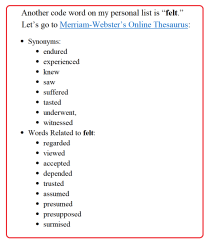
One word that slips into my first draft prose is the word “got.” It is a mental code word that I subconsciously used when laying down the story. This word signifies a small incident to revise in the second draft.

“Got” is on my global search list of “telling words.” The words in the list are signals to me, indications that a scene needs to be reworded to make it a “showing” scene.

Got:” He got the message = he understood.

Code_word_FeltCode words are the author’s first draft multi-tool—a compact tool that combines several individual functions in a single unit. One word, one packet of letters serves many purposes and conveys multiple mental images to the author.
In fact, all passive phrasing is a code. The author’s “subconscious writer” embeds signals in the first draft. It tells the author that the characters are transitioning from one scene to the next. They, or their circumstances, are undergoing a change. Is this change something the reader must know?

Each lull in the action should lead us into a new scene. When transitions are done right, readers won’t notice the narrative moving from one event to the next, as the progression feels natural.

Let’s look at two more code words for transitions:

  • Went
  • Thought

When I see the word “went,” I immediately know someone is going somewhere. It is a transition scene taking the characters to the next event.

I ask myself, “How did they go?” Went can be changed to any number of verbs:

  • walked
  • drove
  • rode
  • took
  • teleported
  • And so on and so on

You get the idea.

We can’t have non-stop action, as that is exhausting to write and more exhausting to read. The characters and the reader both need to process information, so the character arc should be at the forefront during these transitional scenes. That period of relative calm is when you allow your characters’ internal growth to emerge.

We allow the characters to justify the decisions that led to that point and plan their next move, making it believable.

The transition is also where you ratchet up the emotional tension.

We have more options than simply moving the characters from point A to point B, several paths to choose from.

strange thoughtsThought (Introspection):

  • Introspection offers an opportunity for new information to emerge.
  • It opens a window for the reader to see who the characters are and how they react and illuminate their fears and strengths. It shows that they are sentient beings, self-aware.

Keep the moments of mind wandering brief. Go easy if you use italics to set thoughts off. A wall of italics is hard to read, so don’t have your characters “think” too much if you use those.

  • Characters’ thoughts must serve to illuminate their motives at a particular moment in time.
  • In a conversation between two characters, introspection must offer information not previously discussed.
  • Internal monologues should not make our characters all-knowing. It should humanize them and show them as clueless about their flaws and strengths. It should even show they are ignorant of their deepest fears and don’t know how to achieve their goals.

Sometimes we have more than one character with information the reader needs to make sense of the next event.

The key is to avoid “head-hopping.” The best way to avoid confusion is to give a new chapter to each point-of-view character. Head-hopping occurs when an author describes the thoughts of two point-of-view characters within a single scene.

Visual Cues: In my own work, when I come across the word “smile” or other words conveying a facial expression or character’s mood, it sometimes requires a complete re-visualization of the scene. I look for a different way to express my intention, which is a necessary but frustrating aspect of the craft.

Fade-to-black is a time-honored way of moving from one event to the next. However, I don’t like using fade-to-black scene breaks as transitions within a chapter. Why not just start a new chapter once the scene has faded to black?

One of my favorite authors sometimes has chapters of only five or six hundred words, which keeps each character thread truly separate and flowing well. A hard scene break with a new chapter is my preferred way to end a fade-to-black.

Chapter breaks are transitions. As we write, chapter breaks fall naturally at certain places.

Conversations can serve as good transitions that propel the story forward to the next scene. However, they can easily become info dumps. In literary terms, a good conversation is about something we didn’t know and builds toward something we are only beginning to understand.

DangerThat is true of every aspect of a scene—it must reveal something we didn’t know and push the story forward toward something we can’t quite see.
The transition is the most challenging part of the narrative for me to formulate in the first draft. I get stuck, trying to decide what information needs to come out and what should be held back.

The struggle to connect my action scenes into a seamless arc is why writing isn’t the easiest occupation I could have chosen.

But when everything comes together, writing is the most satisfying job I have ever had.

4 Comments

Filed under writing

The Functions of the Scene #amwriting

Now that we are in the midst of December, many people are reviewing what they wrote during NaNoWriMo and trying to put it in order. This is a good time to look at the function of the scene.

ScenesNovels consist of a string of moments united by a common theme. These scenes combine to form a story when you put them together in the right order and link them with a plot featuring a compelling protagonist who must overcome adversity.
I see the scene as a story within a larger story, a moment with an arc of its own.

Scenes are the building blocks of the story. Small arcs of action form chapters, which form the larger arc of plot. They combine to form a cathedral-like structure: the novel.

If you ask a reader what makes a memorable story, they will tell you that the emotions it evoked are what they remember, and why they loved that novel.

Therefore, no scene can be wasted. Each moment of the story must have a function, or the story fails to hold the reader’s interest. I work to make each scene as emotionally powerful as I can without going overboard.

A few things a scene can show:

  • Capitulation
  • Catalyst
  • Confrontation
  • Contemplation/Reflection
  • Decision
  • Emotions
  • Information
  • Negotiation
  • Resolution
  • Revelation
  • Turning Point

Make one or more of these functions the core of the scene, and you will have a compelling story.

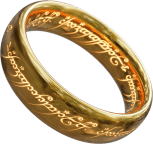
Let’s return to a watershed chapter I’ve discussed before. In the Fellowship of the Ring, book one of J.R.R. Tolkien’s Lord of the Ring series, the longest chapter in the book details the Council of Elrond. The scene is set in Rivendell, Elrond’s remote mountain citadel.

The characters attending the Council have arrived there on separate errands. Each has different hopes for what would ultimately come from the meeting.

Despite their various agendas, each is ultimately concerned with the One Ring. Each has their own idea of how to use it to protect the people of Middle-earth from the depredations of Sauron, who is desperate to regain possession of it. This chapter is comprised of several scenes and serves more than one function.

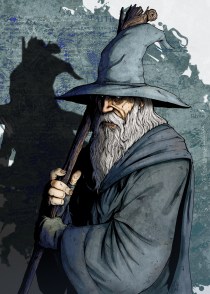
GANDALF

Gandalf the Grey, by Nidoart, CC BY-SA 3.0

Information/Revelation: The Council of Elrond conveys information to both the protagonists and the reader. It is a conversation scene, driven by the fact that each person in the meeting has knowledge the others need. Conversations are an excellent way to deploy required information.

Remember, plot points are driven by the characters who have vital knowledge.

The fact that some characters are working with limited information creates high emotional tension.

At the Council of Elrond, many things are discussed, and the history of the One Ring is explained. This is not done in an info dump; instead, each character offers a new piece of the puzzle at the moment the reader needs to know it.

The reader and the characters receive the information simultaneously at this point in the novel.

Confrontation: A scene comprised only of action can be confusing if it has no context. A properly placed confrontational conversation (an argument/dispute) gives the reader the context needed to understand the reason for the action.

At the Council of Elrond, long-simmering racial tensions between Gimli the Dwarf and Legolas the Elf surface. Each is possessed of a confrontational nature, and it isn’t clear whether they will be able to set aside their prejudice and work together or not.

Other conflicts are explored, and heated exchanges occur between Aragorn and Boromir.

Negotiation: What concessions will have to be made to achieve the final goal? These concessions must be negotiated. Tom Bombadil is mentioned as one who could safely take the ring to Mordor as it has no power over him. Gandalf feels he would simply lose the ring or give it away. He explains that Tom lives in his own reality and doesn’t see the conflict with Sauron as a problem.

Bilbo volunteers, but he is too old and frail. Others offer, but none are accepted as good candidates for the job of ring-bearer for one reason or another. Each reason that is provided for why these characters are deemed less than satisfactory by Gandalf and Elrond deploys information the reader needs.

Turning Point: After much discussion, many revelations, and bitter arguments, Frodo declares that he will go to Mordor and dispose of the ring, giving up his chance to live his remaining life in the comfort and safety of Rivendell. Sam emerges from his hiding place and demands to be allowed to accompany Frodo. This is the turning point of the story.

(The movie portrays this scene differently, with Pip and Merry hiding in the shadows. Also, in the book, the decision regarding who will accompany Frodo, other than Sam, is not made for several days, while the movie shortens it to one day.)

Within the story’s arc are smaller arcs of conflict and reflection, each created by scenes. The arc of the scene is like any other: it begins, rises to a peak, and ebbs, ending on a slightly higher point of the overall story arc than when it started.

The scene must reveal something new and push the story toward something unknown.

959px-One_Ring_Blender_Render

The One Ring, Peter J. Yost, CC BY-SA 4.0

We are also pushing the character arc with each scene, raising the stakes a little. Our protagonist grows and is shaped by receiving needed information through action and conversation, followed by reaction and regrouping. This allows the reader to experience the story as the protagonist does.

The reader can then reflect and absorb the information gained before moving on to the next scene.

I will continue this discussion in my next post, which will focus on transitioning from scene to scene. Transitions are vital as they affect pacing and keep the story moving forward.


Credits and Attributions:

Gandalf the Grey, by Nidoart, CC BY-SA 3.0 <https://creativecommons.org/licenses/by-sa/3.0&gt;, via Wikimedia Commons (artwork by Nidoart nidoart.blogspot.fr)

Wikimedia Commons contributors, “File:GANDALF.jpg,” Wikimedia Commons, the free media repository, https://commons.wikimedia.org/w/index.php?title=File:GANDALF.jpg&oldid=608049709 (accessed December 12, 2021).

The One Ring, Peter J. Yost, CC BY-SA 4.0 <https://creativecommons.org/licenses/by-sa/4.0&gt;, via Wikimedia Commons.

Wikimedia Commons contributors, “File:One Ring Blender Render.png,” Wikimedia Commons, the free media repository, https://commons.wikimedia.org/w/index.php?title=File:One_Ring_Blender_Render.png&oldid=575573354 (accessed December 12, 2021).

9 Comments

Filed under writing

The Story Arc: delivering backstory #amwriting

Many writers who managed to write the entire story arc of their novel during November are now going back and looking at what they have written. This can be a dangerous moment in the life of your book.

Info DumpIn my last post, I talked about the good and bad aspects of two editing programs that I am familiar with, the things they do and don’t help us identify in our work. One more thing these wonderful programs can’t help us with is identifying bloated backstory.
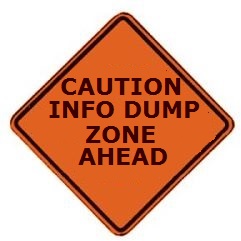
Walls of fictional history muck up the transitions and flatten the story arc. They block the doors from one scene to the next.

Every story has a past, a present, and hopefully, a future. We write the story of our characters’ present moments, no matter what narrative tense we are using. Each character emerges from our minds with a personality. That personality was formed in some way by an unwritten past.

That history shaped the characters even though it isn’t written, and at first, we don’t consciously think about it. We open a document and start writing—we envision our characters with unique personalities the moment they step onto the first page.

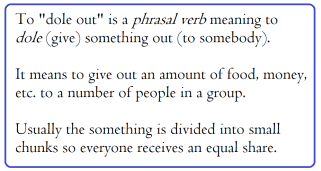
At some point, we realize that a bit of backstory is needed. But how much, and how should we dole it out?

This is where it gets dicey. In the revision process, it’s tempting to inform the reader of this history by placing blocks of information in the first pages. It seems logical: before a reader can understand this thing, they need to know this other thing.

We can provide the reader with the backstory in several ways:

  • In conversation.
  • Memory/flashbacks
  • A brief recap of events

Each of these methods is both good and bad. While a certain amount of backstory is necessary for character and plot building, too much outright telling halts the momentum, freezes the real-time story in its tracks.

The opening paragraphs must be active. The first lines must step onto the stage in a way that feels original, informative, and engaging. The passages that follow must reflect and build upon the tone and cadence of the opening lines.

Before we dump information, we should consider what must be accomplished in each scene and allow the backstory to inform the reader only when it’s necessary to advance the plot.

CAUTION INFO DUMP ZONE AHEADLook at the first scene of your manuscript. Ask yourself three questions.
  1. Who needs to know what?
  2. Why must they know it?
  3. How many words do you intend to devote to it?

Dialogue is the easiest way to dole out information.

It is also a great way to fall into an info dump.

Don’t allow conversations to deteriorate into bloated exposition detailing unimportant fluff just to fill up space.

“Jack, remember when you nearly blew up the ship? Remember how you spent two weeks in the brig?”

“Yes, Jill. That meant you were one gun short to save the day. I almost lost the war for you, but you prevailed. I’m lucky to be your sidekick.”

“Well, Jack, what we’re dealing with this time has nothing to do with that. I’m just pointing out the obvious.”

We’re all familiar with the term ‘flatlined’ as a medical expression indicating the patient has died. A story arc can flatline in two ways:

  • The pauses become halts, long passages of haphazard info dumps that have little to do with the action.
  • The action becomes random, an onslaught of meaningless events that make no sense.

One way to avoid a flatlined story arc is through character interaction. Your characters briefly discuss what happened and how to prevent it from happening again. Then, they bravely muck on to the next event.

Another way is to insert short moments of introspection between the action. Our character’s thoughts offer opportunities for doling out new information essential to the story.

Don’t ramble on, either in conversation or introspection. If you go on for too long, your reader will either skip forward or close the book.

When they are brief but informational, these moments open a window for the reader to see who the characters think they are. Their introspection illuminates their fears and strengths.

It shows that our characters have a sense of self.

The problem with conveying the backstory is that timing and pacing are essential. The moment to mention it in passing is when the character needs that information to make decisions as they go forward. If the character doesn’t need to know it, neither does the reader.

That way, you avoid the dreaded info dump, but the reader can extrapolate the needed backstory.

In the most gripping narratives I have read, character introspection is brief but delivers crucial information. Internal monologues are featured but are kept minimal, only addressing what is essential. They serve to illuminate a character’s motives at a particular moment in time.

So, conversation and introspection are where we only deliver information not previously discussed and that the reader needs to know at that moment. Repetition is monotonous and pads the word count with fluff.

I suggest you don’t stop the action with a prolonged recap of previous adventures. It’s all right to work in a brief mention. However, if the events were detailed in a previous book in that series, the reader will probably be aware of the history. As a reader, I can say that a longwinded rant about things I already know does not keep my interest.

No matter the genre, in all stories, complications create tension, and information is a reward.

A trick I have found for whittling down info dumps is this: look at the word count.

to dole out phrasal verbI look at each conversation and assess how many words are devoted to each character’s statement and response. Then, when I come to a passage that is inching toward a monologue, I ask myself, “what can be cut that won’t affect the flow of the story or gut the logic of the plot?”

Even with all the effort I apply to it, my editor will find places to shave off the unnecessary length.

Sometimes we write brilliantly, and those moments give us hope when we churn out less than stellar prose. Weeding that garden of words is not easy, but readers will be glad you tried.

2 Comments

Filed under writing

Editing Programs – the pros and cons #amwriting

With NaNoWriMo 2021 behind us, it’s time to talk about editing programs again. Several writers in our region have asked me if I use one in my own work.

MyWritingLife2021I do use Grammarly—but also, I don’t.

I rely on my knowledge of grammar and what I intend to convey more than I do an editing program. While they are good at alerting you to some errors, these helpful programs are not as useful as we wish they were.

No software can replace knowledge of grammar. An author must have confidence in what they intend to convey and how they wish to say it.

For this reason, editing software may not be a good tool for every author.

A person with no knowledge of grammar will not benefit from relying on an editing program for advice. There is no way to bypass learning the craft of writing.

You may have found that your word processing program has spellcheck and some minor editing assists. Spellcheck is notorious for both helping and hindering you.

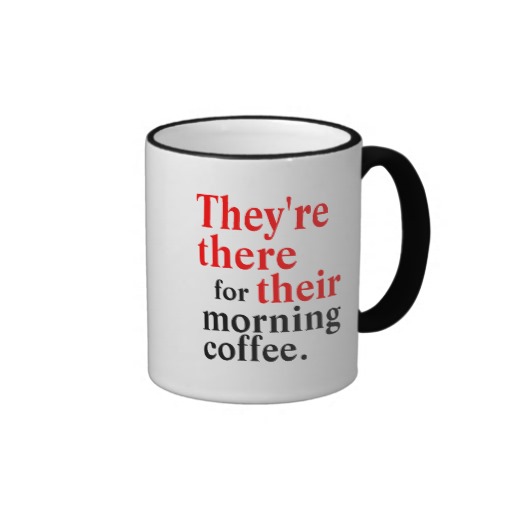
they're their there cupSpellcheck doesn’t understand context, so if a word is misused but spelled correctly, it may not alert you to an obvious error.
  • There, their, they’re.
  • To, too, two.
  • Its, it’s

Grammarly is an editing program I use for checking my own work, in tandem with Pro Writing Aid. I pay a monthly fee for the professional versions of these two programs. Each one has strengths and weaknesses.

For me, especially in my first draft, some words are like tics—they fall out of my fingers and into my keyboard randomly and out of my voluntary control. I don’t self-edit as I go because, at that point, I’m just trying to get the story down. The second and third drafts are where I shape my grammar and phrasing.

I want to write active prose, so I don’t want to use words with no power behind them.

Often removing an adjective or adverb strengthens the prose. Descriptors are easy to find because these words frequently end with the letters ‘ly.’

You could do a global search for the letters ‘ly,’ and a list will pop up in the left margin of your manuscript.

However, the most ludicrous advice I’ve ever heard at a critique group came from an author who was about to publish his first book. He had a great deal of enthusiasm for the craft but was armed with too little knowledge: he told a new writer to remove all adverbs from her narrative.

Unfortunately, he forgot that words like “later,” or “everywhere,” or “never” or “alone” are also adverbs.

That sort of wrong-headed advice survives because it is based on a writing truth: unnecessary adverbs and adjectives inflate the word count but add no value. Worse, they sometimes fail to tell us something that we need to know.

In other words, use adverbs and adjectives when they are necessary and cut them when they aren’t.

In my own work, I seek out adverbs, descriptors, qualifiers, and “weed words.” I look at how they are placed in the context of the sentence and decide if they will stay or go. Many will go, but some must stay.

The BIG problem for those who don’t understand the basics of grammar is this: editing programs cannot see the context of the work they are analyzing.

In one of my older manuscripts, this sentence triggered the algorithm:

“The tea was cool and sweet, quenching her thirst.”

Grammarly suggested replacing quenching with quenched and then suggested a comma at the end instead of a period.

Pro Writing Aid made the same suggestion but didn’t tell me to add a comma.

These programs operate on algorithms defined by finite rules. They will often strongly suggest you insert an unneeded article or change a word to one that is clearly not the right one for that situation. That is where your eye and understanding of context and grammar must prevail.

chicago guide to grammarNew writers should invest in the Chicago Guide to Grammar, Usage, and Punctuation and learn how grammar works. For people new to the craft and who don’t understand grammar or how to construct a sentence or a paragraph, or how to write dialogue, editing programs will confuse and mislead them.

To get the best out of editing software, you must know the basics of how to write.

At this stage in our technology, understanding context is solely a human function. Context is defined as the parts of a written or spoken statement that precede or follow a specific word or passage, usually influencing its meaning or effect.

A person with no knowledge of grammar will not benefit from relying on Grammarly or any other editing program for advice. There is no way to bypass learning the craft of writing.

Because context is so important, I am wary of relying on these editing programs for anything other than alerting you to possible comma and spelling malfunctions.

You might disagree with the program’s suggestions. You, the author, have control and can disregard suggested changes if, as illustrated above, they make no sense. I regularly reject weird suggestions.

However, when the editing program highlights something, I examine the problem sentence. Just knowing that the way I phrased a sentence tripped the program’s algorithms encourages me to look at that passage with a critical eye.

I may not use the program’s suggestion, but something triggered the algorithm. That means my phrasing might need work. I may need to find a better way to get my idea across.

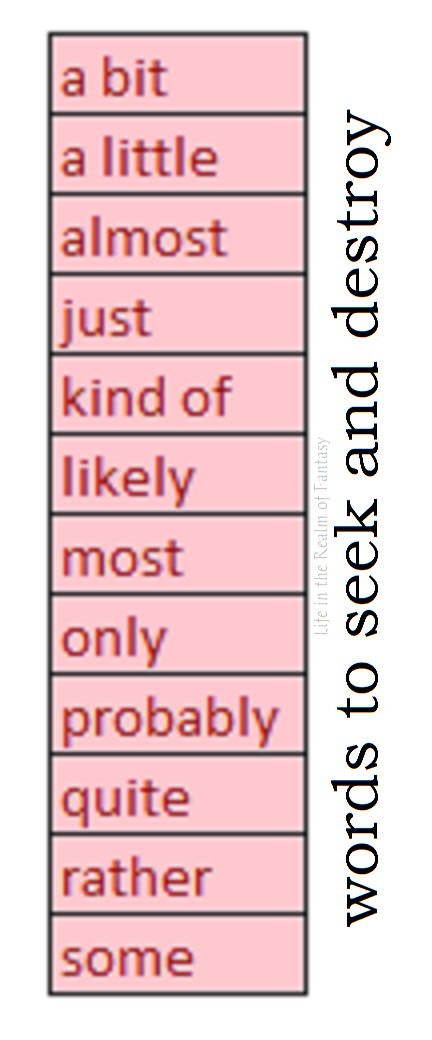
Timid WordsEven editors must have their work seen by other eyes. My blog posts are proof of this as I am the only one who sees them before they are posted. Even though I write them in advance, go over them with two editing programs, and then look at them again before each post goes live, I still find silly errors two or three days later.
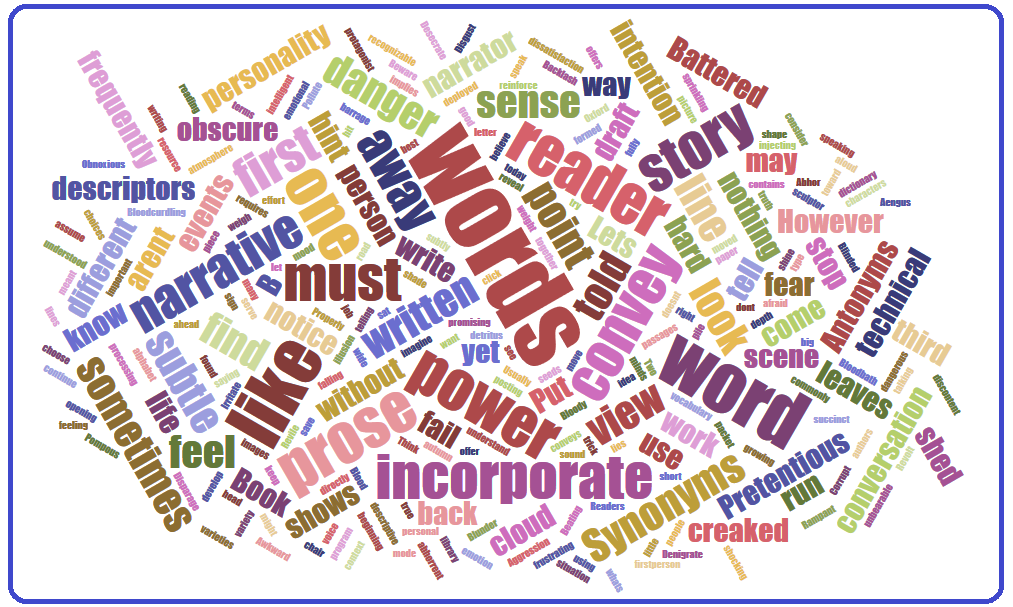
Certain words and phrases don’t add to the narrative and only increase the wordiness. Used too freely, they separate the reader from the experience.

In my first draft, these words are like tics. They fall out of my fingers and into my keyboard randomly and out of my voluntary control. I never self-edit as I write the first draft because I am just trying to get the story down. The second and third drafts are where you deal with grammar and phrasing.

When I begin revisions, I will seek out adverbs, descriptors, qualifiers, and other “weed words,” look at how they are placed in the context of the sentence, and decide if they will stay or go

You can’t take shortcuts. If you are too impatient and choose to “Replace All” without carefully thinking things through, you run the risk of making a gigantic mess of your work. Some weed words are parts of other words, for example:

  • very—every
  • has—hasten, chasten

powerwordsWordCloudLIRF06192021If you have decided something is a “crutch word,” examine the context. Inadvertent repetitions of certain words are easy to eliminate once we see them with a fresh eye.

Context is everything.

I can’t stress this enough: take the time to look at each example of the offending words individually.

It’s unfortunate, but there is no speedy way to do this. You will be rewarded, though, when your book is finished to the best of your ability.


17 Comments

Filed under writing

My Writing Life #amwriting

Someone recently suggested I write a post on the evolution of me as an author, so here it is.

MyWritingLife2021BFrom my earliest childhood, I always thought of myself as a writer. I just didn’t know how to write anything longer than a poem or a song in such a way that it was readable.

Most evenings, I listened to music on the stereo, writing my thoughts and ideas in a notebook while my kids did their homework.

My pen and ink ramblings weren’t “writing” as I see it now. They were more like frameworks to hold ideas that later became full-fledged stories.

Then, in 1987, my father bought me a secondhand IBM Selectric Typewriter, and my writing addiction took off.

For most of my writing life, I was like a five-year-old with a new set of paints. My enthusiasm for my stories was far greater than my ability to tell them.

I didn’t have the information I needed to make my work readable and didn’t know how to get it.

I felt embarrassed for even thinking that I could be an author.

orson_scott_card_write_scifi_fantasyOne day in 1990, I stumbled upon a book offered in the Science Fiction Book Club catalog: How to Write Science Fiction and Fantasy by Orson Scott Card. The day that book arrived in my mailbox changed my life.

I could become an author, and one of my favorite writers was going to tell me how to do it.

In the years since that book, I have amassed a library of books on the craft. Some are brilliant, some not so much, but I always learn something from them.

However, personal experience is a great teacher, and I’ve learned many things by trial and error.

So here in no particular order are six things I would like to pass on to you:

One: Make a style sheet as you go.

Build a glossary of words and spellings unique to your story and especially be sure to list names. I use an Excel spreadsheet, but you can use anything you like to help you stay consistent in your spelling.

And even though I think I am developing a thorough glossary, my editor will find many words to add to it.

Two: Develop a logical, consistent system for naming your files and save regularly.

Save each version of your manuscript with a different name so you can go back and retrieve bits you may need later. I use a system like this:

Heavens_Altar_V5.docx

That stands for Heaven’s Altar version five, and I work out of Word, so the extension is automatically a docx.

chicago guide to grammarThree: Find a local group of writers to meet with and talk about the craft.

Critique groups are great, but they are only one small part of the picture. Authors need to network with other authors because we need to discuss the craft with someone who doesn’t look at you with glazed eyes.

I gained a wonderful local group through attending write-ins for NaNoWriMo before the pandemic. While we haven’t been able to have in person meetings for a while, we meet weekly via zoom. They are a never-ending source of support and information about both the craft and the industry. We are a group of authors writing in a wide diversity of genres. We gladly help each other bring new books into the world, but more than that, we are good, close friends.

Four: Never stop educating yourself.

Learn how to say what you mean with your unique voice and your personal style. A college education is an expense we might not be able to wrangle. But you can buy books on grammar, books on style and substance, and books on writing craft.

Learn about structure and pacing from successful authors. Every coin you invest in your education will be returned to you with interest when your story makes a reader say they wished it hadn’t ended.

Self-education requires perseverance and a small investment of money, but you can do it.

storybyrobertmckeeSpend the money to go to conventions and attend seminars. You will learn so much about the craft of writing, the genre you write in, and the publishing industry as a whole—things you can only learn from other authors. I gained an extended professional network by joining The Pacific Northwest Writers Association and going to their conferences.

Five: Don’t even consider signing with the slick-talking publisher that contacts you out of the blue.

How can a publisher possibly want work they haven’t seen?

Make use of SFWA’s Writer Beware site. These predators want your work all right—and want to sell you publishing services you can do for yourself. You won’t benefit from the predator publisher’s “services,” but they will profit from your desperation to be published. They will publish your work in its raw unedited form, and you will never see a dime.

300px-Astound5006Six: My final suggestion is this: even though you are writing that novel, keep writing short stories too.

Short stories are a training ground, a way to hone your developing skills. They’re also the best way to get your name out there. My advice is to build a backlog of work from 2000 to 5000 words in length and keep them ready to submit to magazines, anthologies, and contests.

All those fabulous scenes and vignettes that roll through your head can be made into short pieces.

Get the Submittable App and see who is asking for the kind of stories you write. Start submitting your work, and don’t let rejections stop you. Just keep sending that work out to new places because someone will want it.

These are a few things that I wish I had known when I first started writing professionally but didn’t.

3 Comments

Filed under writing

The garden-path sentence #amwriting

As NaNoWriMo winds down, I am preparing to face a manuscript full of wandering, garbled sentences. These are the products of my fingers not being able to keep up with my brain. I might know what that sentence means, but my editor won’t. My job in December is to be alert and watch for ambiguous phrasings.

MyWritingLife2021About garden-path sentences, via Wikipedia, the fount of all knowledge:

(The term) garden path refers to the saying “to be led down the garden path,” meaning to be deceived, tricked, or seduced.

After reading, the sentence seems ungrammatical and makes almost no sense, requiring rereading to fully understand its meaning after careful parsing.” [1]

In this case, confusion arises because we attempt to understand sentences as we are reading them. The “garden-path sentence” begins by taking you toward a particular destination. Midway through, it takes a turn for the bizarre.

There are two types of garden-path sentences.  The first is a “local ambiguity,” meaning it can be cleared up easily with the addition of a word or punctuation, such as:

“The raft floated down the river sank.” Add one word to make it clear: “The raft that floated down the river sank.”

“We told the man the dog bit a medic could help him.” Add two words for clarity: “We told the man whom the dog bit that a medic could help him.”

Wikipedia offers this example: “The old train the young fight.” Adding a comma reads: “The old train, the young fight.” The addition of the comma makes sense of the words. One could also argue that the sentence means “The old train the young to fight.”

The other type of garden-path sentence is “globally ambiguous” because the meaning stays unclear no matter how many times you reread it when it is taken out of context.

A sentence should be understandable even when removed from its context. Wikipedia offers the sentence: “The cat was found by the shed by the gardener.”

Hydrangea_cropped_July_11_2017_copyright_cjjasperson_2017 copyWhen I have asked a beta reader to read a section of my work, they sometimes flag a paragraph as unclear. It might make perfect sense to me, but if I am the only one who understands it, it’s time to tear that paragraph down to see if each sentence can stand on its own.

Sara’s missing cat was found by the shed by the gardener. Mittens was frightened and hungry but safe.

Let’s break that paragraph down sentence by sentence:

  • Sara’s missing cat was found by the shed by the gardener.
  • Mittens was frightened and hungry but safe.

The first sentence is passive and ambiguous, open to interpretation. Was the cat by the shed? Or was the shed by the gardener? Or were the cat and the gardener both next to the shed?

Once I’ve taken it out of context, it’s easy to see why the reader didn’t understand it.

Usually, a simple rewording to make my phrasing more active is all that is required.

The gardener found Sara’s cat near the shed. Mittens was frightened and hungry but safe.

Often, a new author has been criticized for using the relative pronoun ‘that’ too freely. Thin-skinned and bleeding profusely, they will go to any length to avoid using the word that, which can lead to awkwardly phrased sentences.

Relative pronouns have a fundamental place in English. While it’s easy to turn them into crutch words, they are essential words that make nouns specific.

  • That dog bites, so watch out.
  • Harry Potter was the boy who lived.

The way to resolve the garden-path sentence is to:

  • Insert a relative pronoun (such as “that” or “who”) for clarity.
  • Insert proper punctuation for clarity.
  • Reword the sentence to make the prose active.

Readers want to read without bumps and hiccups. Anytime they have to stop and reread something, you risk losing them. Sentences that are ambiguous stop the eye, which throws the reader out of the story.

Clementines_Astoria_White_Hydrangea2019I don’t want to introduce vagueness into my work. Just because I like what I wrote doesn’t mean it has to stay in the finished product. Maybe I don’t see that it’s confusing, but my friends who read my raw manuscripts will.

Every time I participate in NaNoWriMo and then take that manuscript through revisions, my first draft skills become a little stronger. I write stronger sentences in my first drafts and have to make fewer changes, which feels like a victory.


Credits and Attributions:

[1] Wikipedia contributors, “Garden-path sentence,” Wikipedia, The Free Encyclopedia, https://en.wikipedia.org/w/index.php?title=Garden-path_sentence&oldid=1053287156 (accessed November 28

Comments Off on The garden-path sentence #amwriting

Filed under writing

The Credible Antagonist #amwriting

We are 21 days into November and NaNoWriMo. To this point, we have been writing a story around our hero. We have an idea of what they must overcome, but it may not be fully formed just yet.

depth-of-characterWho is the enemy, the true architect of that conflict? At this point, we may have a name, but who are they really?

It’s time to consider the opposition. Every hero needs an adversary, the evil that can take many forms. The evil that must be surmounted will be different in every story because it is up to you.

In some stories, an enemy is someone who stands in the protagonist’s way, blocking them from achieving their goal.

Other times, self-deceptions and inner conflicts frustrate the protagonist. After all, we’re usually our own worst enemy.

In this scene from my 2020 novel, Julian Lackland, Huw and Jack have cornered Beau, voicing their concerns about Lackland’s ability to continue as King Henri’s Lord Commander:

Huw refused to let go of his animosity. “It has to be Lackland then, but he’d better have all his wits about him. If anything happens to Culyn because Lackland has lost his mind, I’ll never forgive you.”

Julian_Lackland Cover 2019 for Bowkers“God! You honestly believe I’m stupid.” Despite his anger, Beau kept his voice low. “There’s no reasoning with you. You’re convinced I’m besotted and Julian is barking mad. Get out of my way! I feel like hurting you.” He pushed past Huw, saying, “Go home, since you have so little faith in me.” He opened the door, intending to leave.

“Beau,” Jack’s quiet voice called after him. “Come back. Let’s bury this now. I wanted to hear what you had to say because I’m a father. I worry about my boys.” [1]

The great enemy that Julian Lackland faces is his internal conflict and how his subsequent breakdown affects the people who love him.

If the enemy is a person, they always believe they are the heroes. In your story, what are their justifications for that belief?

When we create an antagonist, we take what is negative about a character and take it one step further, hiding it behind a lie.

This is where I like to get wordy: first, we assign the enemy a noun that tells us who they think they are: Good.

Once we know why they think they are the heroes, we assign them the noun that says who the protagonist believes they are: Evil.

The antagonist in a current work in progress is Coran. He is a complicated character. His story begins in abject poverty. Through his desire to climb out of that abyss at any cost, it will end tragically.

To further complicate life for our hero, we can go two routes when creating the antagonist. One way is to allow one of the characters to make choices that ultimately harm them, which is how I am going with Coran, allowing him to gradually become the visible antagonist.

Another way is to take the negative that is directed outward and turn it into an inner demon, which I did in the previous book of this series with my protagonist, Ivan. He had two enemies to fight, one was someone he loved but was forced to reject, and the other was himself.

This time, Ivan and Kai share an inner enemy—the deep desire to return home to their children and the growing fear that it won’t happen.

The MArtian Andy WeirIn other stories, there is the nebulous antagonist. This could be the faceless behemoth of corporate greed, characterized by one or two representatives who may be portrayed as caricatures. In some cyberpunk tales, the antagonists tend to be goons-in-suits. In hard sci-fi, they might be members of the military or scientists. Andy Weir in The Martian made the planet of Mars the antagonist.

In fantasy, the nebulous antagonist might be a powerful queen/king or sorcerer whose forces/minions the protagonist must defeat. The mind behind the conflict is a person they might not actually meet. How the protagonist reacts internally to the threat posed by the machinations of those distant antagonists is the story.

Emotion makes the risk feel genuine to the reader, gives it life. To show great evil in genre fiction, we take that which is negative to an extreme and show the emotion of that experience.

I should say that while I do write some dark scenes, I don’t write horror, so I can’t speak to that, exactly. However, I can speak to the perception of corruption, and the evil humans are capable of that sometimes horrifies us.

For a reader, perception and imagination are everything. As children, what we infer from the visible evidence in a dark room after the lights have been turned out can be terrifying.

The formless monster that lurks in the corner terrifies us until we discover the truth—it is only several toys piled there and never put away.

As adults, what we infer from the visible evidence in a dark story can be equally terrifying. Thus, you can write dark scenes but don’t have to be utterly graphic.

No matter how right the cause, war is an evil that is difficult to make sympathetic and shouldn’t be. But sometimes, war, a faceless blob of evil, is the right villain for the narrative.

What single word (and its synonyms) can characterize our antagonist? An example is the word perversion. We tend to think of it as referring only to sexual deviancy, but it has many meanings and uses. Its synonyms are corruption, corruptness, debasement, debauchery, decadence, decadency, degeneracy, distortion.

We view the antagonist through the protagonist’s eyes, so coloring the enemy with a perception of perversion (distortion, corruption) drives home the evil they represent.

Someone—and I wish I could remember who—said a few years ago in a seminar that the author is the character’s attorney, not their judge.

This is an important distinction. Credible villains become evil for sympathetic reasons. They care intensely, obsessively about something or someone. It is our job to make those deeply held justifications the driving force behind their story.

scienceA true villain is motivated, logical in their reasoning, and is utterly convinced of their moral high ground. They are creatures of emotion and have a backstory. As the author and their lawyer, you must know what their narrative is if you want to increase the risk for the protagonist.

As always, the reader doesn’t need to wade through an info dump, but you, the author, need to know those details. Having this backstory to draw on will make your characters easier to flesh out.

But more importantly, you will know what is at stake for your antagonist and how much they are willing to sacrifice for it.

And every word you write detailing the enemy’s background and view of themselves counts toward your goal of 50,000 words by November 30th.


Credits and Attributions:

[1] Quote from Julian Lackland, by Connie J. Jasperson, © 2020 Myrddin Publishing Group. Used by permission.

Comments Off on The Credible Antagonist #amwriting

Filed under writing