
Today we’re continuing to prep our novel by thinking about the plot and the story our characters inhabit. In post one, we thought about what kind of project we intend to write—novel, short stories, poems, memoir, personal essays, etc.
 Post two of this series introduced the protagonist(s), so we have an idea of who they are and what they do.
Post three explored the setting, so we already know where they are and their circumstances.
Post four detailed creating the skeleton of a plot.
Now we’re going to jump to the end. I know it’s rude to read the end of a book before you even begin it, but I am the kind of writer who needs to know how it ends before I can write the beginning.
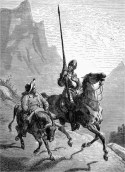
Don Quixote and Sancho Panza, Gustave Dore PD|100
Julian Lackland was my first nano novel. In its proto form, it was my 2010 NaNoWriMo project. That novel emerged from my mind because I had written a short story of about 2500 words featuring an elderly knight-at-large. Julian was a Don Quixote kind of knight, returning to the town where he had spent his happiest days in a mercenary crew.
He enters the town and finds it completely changed. The town has grown so large that he becomes lost. Julian talks to his horse, telling him how wonderful the place they are going is, and all about the people he knew and loved. When he does find the inn he’s looking for, nothing is what he expects. The innkeeper he was so fond of has died of old age, and stranger still, the old innkeeper’s middle-aged youngest son, is the man behind the bar. Most of the friends he’d ridden with are dead. The story ends with Lady Mags, the third leg of his love triangle, entering the tap room and their reunion.
On October 28, 2010, I was scrambling, trying to find something I could write, but my thoughts kept returning to the old man’s story. The innkeeper had referred to him as the Great Knight, stupidly brave but harmlessly insane. Had he always been that way? Who had he been when he was young and strong? Who did he love? How did Julian end up alone if Julian, Beau, and Mags were madly in love with each other?
What was their story?
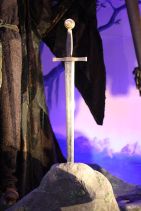
Excalibur London_Film_Museum_ via Wikipedia
On November 1, I still had nothing for a new novel, but I had committed to writing 50,000 words. The short story nagged at me. I found myself keying the hokiest opening lines ever, and from those lines emerged the story of an innkeeper, a bard, three mercenary knights, and the love triangle that covered fifty years of Julian’s life.
That book spawned Huw the Bard and Billy Ninefingers. While Julian Lackland was the last book in the Billy’s Revenge trilogy to be published, it was the first to be written.
The trials and tribulations of that first novel’s publishing path, the title change, and the numerous reasons it took so long for Julian to make it to the finish line is another story, but he did eventually make it.
If I know how the story will end, I can build a plot to that point. So, let’s look at my current project. I have one book that has been languishing for 5 years now because I don’t know how it ends. Unfortunately, the ending I’m detailing here is not for that book.
For my new novel, I have my characters in place. We’ll call them Marco and Dinah for this post. In reality, they have other names, but I am using their situation to show how I brainstorm my plots. I have my setting, and I know their place in that society.
This story is a murder mystery with no title as of yet. The exact details of solving the murders are still a bit murky. However, I know who is dead, how they died, and who the murderer is.
Right now, the end of the outline just says, “Marco and Dinah prevail, Klaus dead. Sarie and Jon safe.” That isn’t a lot to hang a story on, and when I begin writing the novel, I will need to know a little more, or I will lose the plot.
What I do is write an outline that will become the final chapters. This is what I came up with:
Klaus ties his barge up at the pier and goes to the inn while his crew offloads the cargo. He overhears that the mages have repaired the Temple. He decides there is only one way to end it: to take out the healers who had failed to save his daughter.
Dinah spots Klaus entering the Temple and is surprised because he didn’t pass through the gate. She recognizes him from down at the docks and wonders why he’s there when he’s been so anti-Temple. Something about him bothers her, so she follows him.
 Marco arrives at the inn. The innkeeper mentions Klaus was there, but now he’s gone. Marco sees his barge is still there, and the deckhands don’t know where he is. He goes to the gatehouse where Dinah is supposed to be on duty and immediately knows something is wrong. He fears Klaus has gotten to her, and instinct tells him to go to the Temple.
Dinah tracks Klaus toward the infirmary, where Sarie and Jon are working, treating an elderly man. They’re in a healing trance, unaware of anything other than their patient.
Loren is working in his study, unaware his wife and her journeyman are in danger. He glimpses Dinah sneaking through the shadows and knows something is wrong. He follows her, meeting up with Marco as he leaves his study. The two confer and move on to the infirmary.
Klaus senses he’s being followed. He steps behind a pillar, ambushing Dinah. He attempts to strangle her, but she grabs him by the hair. Her feet slip out from under her, and she falls, pulling him down to the floor. Twisting around, she pushes him away with her feet and manages to grab her staff as she stands. Klaus has also regained his footing and is coming for her, but as she swings her staff, she slips again, cracking his skull, just as Marco arrives and fires off a lightning bolt, killing Klaus.
Or something like that. I’ll choreograph the fight when I get to that spot, but I guarantee it will be quick. I dislike reading drawn-out fight scenes and usually skip over them.
Anyway, Sarie and Jon have no idea what has just gone on, and the patient is healed. Loren agrees the new floor is too slick after all, but at least it won’t burn. Dinah finally tells Marco she’s expecting, and they all live happily, at least for a while.
 In real life, people live happily, but no one really lives deliriously happy ever after. But that’s another story and a different genre.
So now I know how the novel ends, and I thank you all for listening to my mental ramblings—I hope they help you. All I need are a few paragraphs, a skeleton to hang the story on, dots to connect, and I can write the first draft.
Next up, we will decide where and how the story begins.
Posts in this series:
#NaNoWriMo prep part 1: Deciding on the Project #amwriting
#NaNoWriMo prep part 2: Character Creation #amwriting
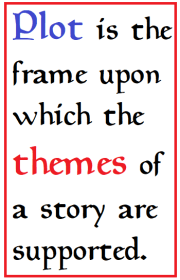 Now we’re going to design the conflict by creating a skeleton, a series of guideposts to write to. I write fantasy, but every story is the same, no matter the set dressing: Protagonist A needs something desperately, and Antagonist B stands in their way.
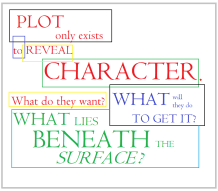 Where does our soldier’s story begin? We open the story by introducing our characters, showing them in their everyday world, and then we kick into gear with the occurrence of the “inciting incident,” which is the first plot point. That might be their arrival at their first camp in the Ardennes region.
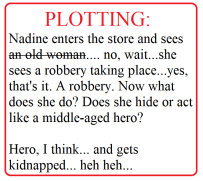 One thing that I do is make notes that help limit my tendency toward heavy-handed foreshadowing. I try to keep it brief, but what will be enough of a hint, and where should it go?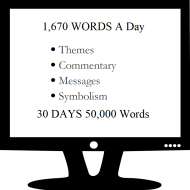
 So, for the two final weeks of November and the first two weeks of December, we will be firing up the Starship Hydrangea (our hydrangea-blue Kia Soul) and driving 30 miles a day to and from the clinic. This will happen four out of five days a week, barring snow.
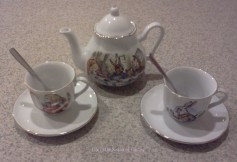 I have no problem getting the first draft done with the aid of a pot of hot, black tea and a simple outline to keep me on track. All that’s required is for me to sit down for an hour or two each morning and write a minimum of 1667 words per day.
 The real work begins after November. After writing most of a first draft, many people will realize they enjoy writing. Like me, they’ll be inspired to learn more about the craft. They discover that writing isn’t about getting a particular number of words written by a specific date, although that goal was a catalyst, the thing that got them moving.
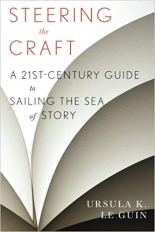 A good way to educate yourself is to attend seminars. By meeting and talking with other authors in various stages of their careers and learning from the pros, we develop the skills needed to write stories a reader will enjoy.
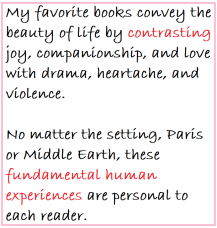 I aspire to write like my heroes, authors who create characters who come alive. While I’m in that world, I see the people and their stories as sharply as the author intends.
 Polarity gives the important elements strength. It provides texture but often goes unnoticed while it influences a reader’s perception.
 I use the
  Let’s have a look at how the Big 5 Publishers of literature did last year. You will note that the top players have changed since my last Big 5 article. Some of the big fish have been absorbed by the even bigger fish since we last looked at them.
 For indies, our most reliable royalties have always come from digital sales, although we do sell some print books. But the best route to gaining loyal readers has been book fairs, conventions, and signings at bookstores.
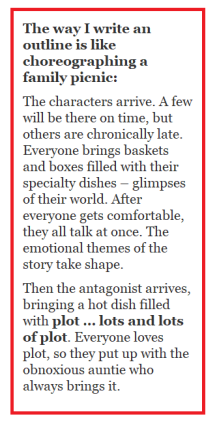 I am a planner, but I’m also a pantser. I’m just writing to a loose outline. All I need is a little free time in advance of November to let my mind wander.
 Next, I ask the creative universe who the protagonist is. I create a brief personnel file, less than 100 words. It’s a paragraph with all the essential background information. Sometimes it takes a while to know what a character’s void is (a deep emotional wound), but it will emerge. I note the verbs, adjectives, and nouns the character embodies, as those give me all the necessary information.
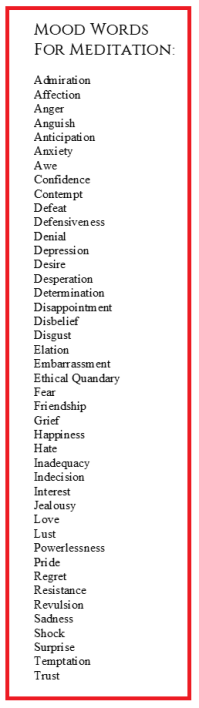 Meditating on mood words often precipitates a flash of brilliance that has nothing to do with anything. What if …
 The second master class was on the how of creativity. Those of you who follow my blog know how the subject of creativity fascinates me. If you haven’t read any of Jeff Wheeler’s work, here is the link to my 2013 review of his first book, the
 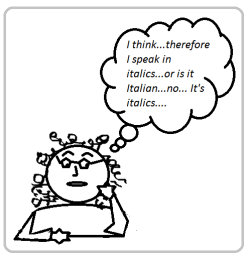 First, Lindsay pointed out that thinking is an action scene, as are conversations. He asked what a character does while thinking. He pointed out that Humphrey Bogart had a way of tugging on his ear when thinking, a habit that carried over into his movies. A side character with a certain amount of screen time but isn’t the POV character can be shown as real when they have a small personal habit that appears from time to time.
 When a character’s facial expressions take over the scene, they become cartoonish, two-dimensional displays of emotion with no substance. A landslide of microscopic showing can make your characters seem melodramatic. All that physical drama doesn’t show a character’s emotions. What is going on inside their heads?
 And this brings me to the core of this post. During NaNoWriMo, when I write new words as quickly as possible, I lean too heavily on the external, relying on a lot of smiling and shrugging. Conversations are action scenes, but too much “face time” is too much.
 In some circles, 40,000 words is a novel, but in fantasy, it is less than half a book.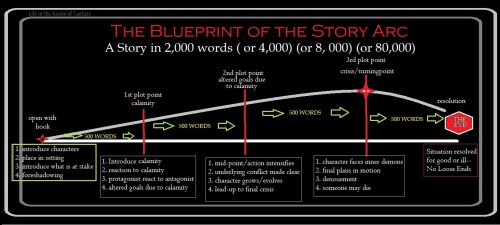
 Rather than obsess about my lack of creativity, I decided to have fun with it. Several young writers in my NaNoWriMo region have said they used a plot generator to jumpstart their ideas, so I thought I’d give that a try.
 Cursed
 This plot generator has clearly been studying J.R.R. Tolkien, as it has managed to plagiarize the first paragraph of The Hobbit right down to the punctuation.
 When I write poetry, I look for words that contrast vividly against each other. I choose action words that begin with hard consonants, emotion words that begin with softer sounds.
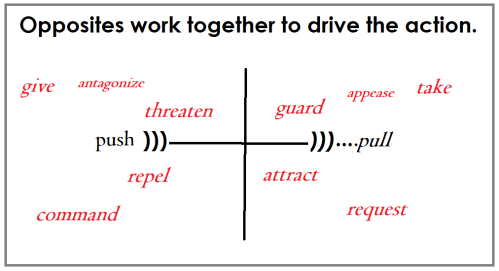 Concise writing is difficult for me because I love descriptors. So, I have to make my action words set the mood. To do that, I must use contrasts.
 The drive to understand why some books enthrall me and others leave me cold keeps me reading and looking for new stories.


 Life in the Realm of Fantasy