Tag Archives: writing craft

#amwriting: the paragraph

A paragraph is a group of sentences that fleshes out a single idea.

In scholastic and technical writing, a good paragraph begins with a topic sentence and is comprised of sentences that support the main idea.

While I do edit for people who are pursuing literary degrees, that is a different kind of writing and requires strict adherence to style policies as set down by the professor at the beginning of the semester.

This post pertains to the paragraphs in a literary narrative, whether the genre is contemporary, sci fi, fantasy, mystery, romance—or any kind of writing that is fiction. In writing for literature, we don’t begin with a topic sentence as such, but we do explore and expand on only one idea in each paragraph.

The rules are simple:

  • Present a single idea per paragraph.
  • Present the dialogue and reactions of only one person per paragraph.
  • Present the viewpoint of one character per paragraph.

Wrong:

Jamie said, “You cheated on me.” Kerry cringed and wept. “I don’t want to lose you.” He spat, “You disgust me.”

That is a confusing passage, but it doesn’t have to be. Three ideas are explored there: Jamie’s accusation, Kerry’s guilt and fear of losing him, and finally his disgust.

Jamie said, “You cheated on me.”

Kerry cringed and wept. “I don’t want to lose you.”

He spat, “You disgust me.”

While it makes for short paragraphs, you must break out Kerry’s reaction. One thought, one point of view per paragraph, no matter how short that makes it.

A good paragraph agrees with itself, is logical, and the central idea it contains is developed, which sometimes makes for long paragraphs.

With that said, some considerations must be taken into account in the modern world of eBooks. EBooks versions of novels containing long paragraphs tend to appear as an unbroken wall of words. The reader can be daunted by this and may decide to move on to a different book. This is especially a problem when the paragraph contains a long section of internal dialogue, which is frequently written in italics.

Thus, for a genre-fiction manuscript that you intend to publish as an eBook, you will want to keep your paragraphs shorter, dividing long passages at logical places, using two paragraphs to explore the idea.

In any type of writing, emails, literature, or scholastic, when a new idea comes into your writing, or a different character speaks, you must begin a new paragraph.

No matter what, you must have an amazing opening paragraph. One of the greatest hooks in literature is the following one by French author, Albert Camus, which opens the 1942 novel, The Stranger.

Mother died today. Or maybe yesterday, I don’t know. I had a telegram from the home: ‘Mother passed away. Funeral tomorrow. Yours sincerely.’ That doesn’t mean anything. It may have been yesterday.

One idea is explored here in ten short sentences, which combine to offer up a wealth of information. Put bluntly, Meursault received a telegram, possibly from an old-folks home, informing him his mother was dead and when the funeral was.

This is where the artistry of the author comes into play: he takes a simple idea and presents it in deliberately crafted prose that feels loose, almost indifferent. Rather than a plain statement of fact, the few sentences exploring that one thought makes us curious about the protagonist and his state of mind.

Authors, please present only one central idea per paragraph. However, you are free to offer up that idea with your own flair and style.


Credits and Attributions

Quote from The Stranger, by Albert Camus, Original title L’Étranger © 1942 (Gallimard, French) © 1946 (Hamish Hamilton, English)

Wikipedia contributors, “The Stranger (novel),” Wikipedia, The Free Encyclopedia, https://en.wikipedia.org/w/index.php?title=The_Stranger_(novel)&oldid=796803119 (accessed August 30, 2017).

2 Comments

Filed under writing

#amwriting: naming people and places

When I was laying down the first draft of my current work in progress, I somehow managed to give every walk-on a name, right down to the dog. That was immediately corrected, although the dog is an important side-kick and still has a name.

Because a reader can only keep so many character names straight in their mind, I was forced to whittle down my cast of thousands. An author should introduce however many characters it takes to tell the story, but should also use common sense.

In a scifi or fantasy tale, naming can get out of hand, sometimes with every single object or utensil, down to the  most common of tools being given a weird name. A hammer should just be be a hammer, please.

I consider that too much detail, and unnecessary. Think of all the names the reader must try to keep straight in a simple tale as if they were people you had just met at a party–that is what the reader faces in the opening chapters of a story.

  1. Character names, pet names, etc.
  2. Town names: Includes shops and restaurants.
  3. Country names, if part of the story .
  4. Myriad other named people, places, and things.

When you introduce a named character, ask yourself if it is someone the reader should remember. Even if he or she offers information the protagonist and reader must know, it doesn’t necessarily mean they need to be named. Some throw-away characters will give us clues to help our protagonist complete his/her quest, or show us something about the protagonist, give us a clue into their personality or past.

The same follows for places—if the village of Maldon has no bearing on the story, don’t mention it.

You must decide how important a character’s role is. If it’s a walk-on, a person who will only have a brief paragraph in the tale, consider not naming them. Ask yourself if the person will return later in the story or are they acting as part of the setting, part of the scenery in a coffee shop, or perhaps a store. If they are just part of the scenery, they don’t need a name.

Only give names to characters who advance the plot.

In an excellent article on screenwriting, Christina Hamlett of the Writer’s Store writes:

In a screenplay, the rhythm you’re attempting to establish–along with the emotional investment you’re asking a reader to make–is disrupted whenever you devote more than two lines of introduction to a character who is simply there to take up space. In order to justify their existence, each player in your script should perform a unique function or deliver a specific line that:

  1. Advances the plot,
  2. Thwarts the hero’s objectives,
  3. Provides crucial background, and/or
  4. Contributes to the mood of the scene.

If you’ve included characters who don’t fulfill one or more of these jobs, they’re probably not critical to the storyline and can be deleted.

While she is speaking of screenplays, this is true of a novel or short story. A name implies a character is an important part of the story. Sometimes a character is an example of “Chekhov’s Gun.” Does this character serve a purpose the reader must know and will they return? If not, don’t give them a name.

One of my works in progress has a passage that takes place in an inn and involves a conversation overheard from a table adjacent to my protagonists. Despite the fact the merchant and his sons give my protagonists information they needed, they are in this scene for only one purpose: to be overheard mentioning the Cardinal and don’t appear again. For this reason, only my protagonist and his party are named, while all you need to know about the merchant and his sons is shown by their conversation and brief descriptions as speech tags: The portly merchant spoke softly. “You never listen to me. Now here you are, on the run from the Cardinal. Getting you out of the country will be costly. If I beggar myself to bail you out of this mess, how will I support myself in my old age?”

Novelists can learn a great deal about how to write a good, concise scene from screenwriters. An excellent book I have gained a lot of knowledge from is Story by Robert McKee. If you can get your hands on a copy, I highly recommend it.

We want the reader to stay focused on the protagonist(s) and their story. The second draft is where we make every effort to find the distractions we may have inadvertently introduced in our rough draft, and extraneous named characters is an easy one to fix. Simply remove their name, and identify them in general terms. The reader will move on and forget about them.

The tendency to make every character a memorable person is one we can’t indulge. The reader will become confused if too many characters are named.

In one of my early books, I learned a difficult lesson the hard way about naming characters. In the Tower of Bones Series, I have a main character named Marya. She is central to the series. Also, in the first book, a side character was important enough to have a name, but my mind must have been in a rut when I thought that one up: for some stupid reason I named her Marta.

You can probably see where this is going—the two names are nearly identical.

What is even worse, halfway through the first draft of the second book in the series, Marta suddenly became a protagonist with a major storyline. She becomes Marya’s mother-in-law in the third book. Fortunately, I was in the final stage of editing book one, Tower of Bones, for publication, and immediately realized I had to make a major correction: Marta was renamed Halee.

My rule now is to NEVER name two characters in such a way that the first and last letters of their names are the same. To avoid that circumstance, I try to never have two that even begin with the same letter.

One last thing to consider: will you want to publish your book as an audiobook? If so, how will that name be pronounced when it is read out loud? You may not want to get too fancy with the spelling so that the narrator can easily read that name aloud. You may not think this is important, but it is. I only have one book that is an audiobook, but during the recording of that book, my narrator had trouble pronouncing the names of two characters, because I had written the names so they would look good on paper, not realizing they were unpronounceable as they were written. We ironed that out, but the experience taught me to spell names simply.

Because of my early “good ideas gone awry” when it comes to names, my rules for names are simple:

  1. Don’t confuse your readers by giving unimportant walk-on characters names.
  2. Never name two characters names that are nearly identical or that begin and end with the same letter.
  3. Consider making the spellings of names and places pronounceable in case you decide to have your book made into an audiobook.

Credits and attributions: 

Minor Characters Don’t Need Major Introductions, Christina Hamlett, Copyright © 1982 – 2017 The Writers Store ® Incorporated, accessed Mar. 11, 2017.

13 Comments

Filed under writing

#amwriting: do the reasearch

People always ask what you do for a living, as we are a society of people who define ourselves by our occupations. For many years, I was a bookkeeper, and also, I worked in data entry for several large corporations. Before that, during the 1980s and Reaganomics, I worked as a hotel maid, a field hand, and had several other odd occupations, often holding down three part-time jobs.

When you tell people you write books, they are, generally, interested. When you tell them you write speculative fiction, you get a range of reactions, from pitying condescension to confused, but sincere, respect.

Sometimes people laugh and tell me how easy it must be since I can make any old thing up and it will fly. Despite the old saying that “in wine there is truth,” nothing could be further from the truth.

Readers know when you have gone off the track and into the shrubs of “that can’t possibly happen.”

This means you can’t just make any old thing up because world building must combine enough realism with the created world to make the fantasy plausible. It involves research.

I spend hundreds of hours researching the most trivial details for every book I write. If I get it wrong, it’s because I failed to do the research in the right place.

In the process of writing Huw the Bard and the subsequent stories set in that world, I’ve learned as much as many medieval scholars about how people dressed, what they ate, how they earned a living, how they preserved food and every intimate detail of their lives that is researchable.

I know all of this because I read scientific papers written by experts on the subject, all of which are available to us via the internet. My files are full of the fruits of other people’s efforts, with the sources documented and the authors credited, so I know where to go to find out more if I need to. Lists of links to websites for further research is critical because when one book goes to press, a new book is already falling out of my fevered mind and onto the paper.

Readers are smart. If something is impossible, and you don’t somehow make it probable, you will lose your readers. The best way to make the impossible probable is to mix your fantasy with a good dose of real history. Be historically accurate as often as you can, so that when your blacksmith makes a weapon, readers who know about smithing will not be jarred out of the story by inaccuracy.

Most of the time, these things you spend untold hours researching will only get one line in your narrative, but if that line is inaccurate or impossible, your readers will know you were too lazy to do it right.

The following is my short list of go-to websites for in-depth, accurate information for when I am writing, including grammar questions. They are self-explanatory and are easy to make use of. Submit your questions via their query box and, while figuring out what you really need to know may take several tries, you will soon have answers.

Medieval Histories  http://www.medievalhistories.com

Academia http://www.academia.edu/

NASA https://www.nasa.gov/

Physics http://www.physics.org/

Wikimedia Commons https://commons.wikimedia.org/

Grammarist  http://grammarist.com/

I’ve learned a great deal from reading the literature of medieval times. If you really want to know how people lived, read a modern translation of Chaucer’s Canterbury Tales. They were bawdy, irreverent, and loved nothing more than a good joke.

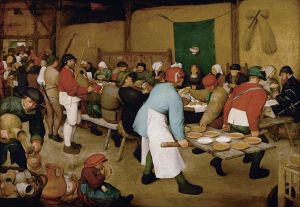
For example, if you are writing a story set in a medieval environment, you may need to know what clothing the common European people wore in medieval times. Or you might want to know what their home looked like, or a village. For that, I suggest you seek out the art of the Flemish Painters. There you’ll see what men and women looked like and how they dressed, both for celebrations, and for working. You will see what their towns looked like, and the public places they gathered in. The interiors of their homes are also found in the great Flemish painter’s works.

Any time you want an idea of average European village life in the Late Middle Ages through the 17th century, you need to look no further than Wikimedia Commons.  There, under the heading  Category: Painters from the Northern Netherlands (before 1830) you will find the brilliant works of the Dutch Masters. These were artists living in what is now The Netherlands, and who were creating accurate records of the everyday life of the common people, along with stylized religious images.

Pieter Bruegel the Elder – Peasant Wedding (1526/1530–1569) via Wikimedia Commons

They painted their subjects with a heavy dose of religious allegory, but that was a part of village life—both the Inquisition and the Reformation were under way, and the politics of religion was in the very air they breathed. If you are going to write medieval fantasy, you must understand how strong the influence of the Church was and how entangled it was in politics. You must inject that religious realism into your work, and show how the Church, even a fantasy religion, and its politics affect the common person’s life.

My regular readers know I love the work of one family of early Dutch painters from Flanders, the Brueghel Family. Five generations of their family were well-known painters and printmakers.

The internet is your friend, and researching your fantasy novel can be incredibly entertaining. Research is what slows me down more than anything. I spend far too many happy hours on Wikimedia Commons, looking at 16th-century Netherlandish paintings.

2 Comments

Filed under writing

#amwriting: Commas

Commas and their usage have arisen in my conversations with clients again lately, so I felt it was time to dust off a piece I wrote  last year on managing them. If you have seen this post already, there is nothing new here–commas and their usage don’t evolve with our changing language.

Since the usage of commas is slow to evolve,  why are they so difficult to figure out? And conversely, why do some people get so jacked up over misplaced commas?

The rules are a little confusing at first because there are several exceptions. Remember, for the casual reader, misplaced commas are like road signs gone rogue–one minute everything is fine and the next you are going the wrong way down a one way street and don’t know how you got there.

Commas and the rules for their use exist for a reason, and if we want the reading public to understand our work, we need to follow them.

I am a decent structural editor, but I don’t claim to have any special knowledge about commas.

However, I do know some things:

  1. Never insert commas “where you take a breath” because everyone breathes differently.
  2. Do not insert commas where you think it should pause, because every reader sees the narrative differently.
  3. Do not put a comma after a conjunction. If needed, commas go before conjunctions.

Commas are the rules of the road for writing. They are the universally acknowledged pausing and joining symbol. Readers expect to find their pauses between clauses and commas are sometimes the signifiers of those pauses.

One rule I had to unlearn the first time I sent my work to a professional line editor:

  1. Do not place a comma before ‘because’ unless the information that follows is necessary to the sentence.

What? That’s not what I was taught in school!

The Chicago Manual Online gives this example (and I quote):

He didn’t run, because he was afraid.

He didn’t run because he was afraid.

In the first sentence, “because he was afraid” isn’t necessary. The main thing is that he didn’t run, and the reason is incidental. The second sentence, which omits the comma, is unclear. It might mean that he ran, but fear was not the reason he did so.

Mignon Fogarty, the Grammar Girl, explains this well. “You don’t automatically put a comma before the word because, but sometimes you need a comma there to make sure your meaning is clear.”

We do use commas to set off introductory clauses:

  1. In the first sentence, “because he was afraid” isn’t necessary.

I italicized the introductory clause in the above sentence to show that it is not a stand-alone sentence. This clause introduces the clause that follows it, and its meaning is dependent on that following clause.

A comma should be used before these conjunctions: and, but, for, nor, yet, or, and so to separate two independent clauses. They are called coordinating conjunctions.

However, we don’t always automatically use a comma before the word “and.” This is where it gets confusing.

Compound sentences combine two separate ideas (clauses) into one compact package.

A comma should be placed before a conjunction only if it is at the beginning of an independent clause. So, use the comma before the conjunction (and, but, or) if the clauses are actually standalone sentences. If one of them is not a standalone sentence, it is a dependent clause, and you do not add the comma.

Take these two sentences: She is a great basketball player. She prefers swimming.

  1. If we combine them this way we add a comma: She is a great basketball player, but she prefers swimming.
  2. If we combine them this way, we don’t: She is a great basketball player but prefers swimming.

I hear you saying, “Now wait a minute! Mrs. Downing very clearly taught us to use commas to join clauses, and she was right.”

I’m sorry, but Mrs. Downing probably explained that. It just didn’t stick in your memory.

Two complete ideas can be joined with ‘and.’ Did I just contradict myself?

Sort of.

Think of it like a list: if there are only two things (or ideas) in a list, they do not need to be separated by a comma. If there are more than two ideas, the comma should be used to separate them, with a comma preceding the word ‘and’ before the final item/idea.

Dogs, cats, rabbits, and birds.

Oh YES, we DO use serial commas to prevent confusion! You’ve all seen the meme: I love cooking my pets and my family. On a personal level, I do love cooking, my pets, and my family. (But not in the same pot.) They’re happy that I use serial commas.

One of my favorite personal failings is the notorious comma splice. Apparently, it’s bad form to join two independent clauses with a simple comma. This error is called a comma splice.

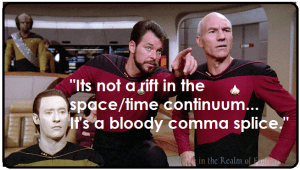
I have it on good authority that a comma splice will not cause a tear in the space-time continuum. But since this breach of humanity occasionally sends commacentrics into a frothing frenzy, we will use the conjunction and give these poor wretches a break.

From Wikipedia, the fount of all knowledge: “A comma splice is the use of a comma to join two independent clauses. For example: It is nearly half past five, we cannot reach town before dark. Although acceptable in some languages and compulsory in others (e.g., Bulgarian or French), comma splices are usually considered style errors in English.”

Commas and their proper use can drive you crazy when you are trying to get your work in order. And quite frankly, the rules are a little confusing.

Consistency is critical. UK usage can vary from US usage in some ways. Find a style guide that you can understand and consult it. Once you have a guide you can work with, use those suggestions consistently in all your work.

I use the Chicago Manual of Style for my work because I am a US citizen, and for creative writing, this is the most comprehensive manual and is what publishers and editors use. If you are strapped for cash, you can often buy secondhand copies of this manual through Amazon.

Commas can easily get out of control for me because I tend to hit the comma key whenever I pause in my thinking when I am in the first draft phase. At that point, I am more concerned with just getting the words down than I am form and style.

However, proper form and style must come into play when we get into the later drafts. Using established protocols for punctuation is important if you want your readers to understand what you meant when you wrote that amazing piece of literature.


Sources and Attributions:

Large portions of this post were first published by Connie J. Jasperson © 2016-2017 under the title, Commas, Morsels of madness or necessary evils? on Life in the Realm of Fantasy on January 25, 2016. It has been re-edited and recycled.

Commas, The Chicago Manual of Style Online, ©  http://www.chicagomanualofstyle.org/qanda/data/faq/topics/Commas/faq0018.html accessed 08-02-2017 The Chicago Manual of Style 15th edition text © 1982, 1993, 2003 by The University of Chicago. The Chicago Manual of Style 16th edition text © 2010 by The University of Chicago. The Chicago Manual of Style Online © 2006, 2007, 2010 by The University of Chicago. The Chicago Manual of Style is a registered trademark of The University of Chicago.

The Grammar Girl, Mignon Fogarty, Commas, ©2010-2017 http://www.quickanddirtytips.com/search/site/commas accessed 08-02-2017

9 Comments

Filed under writing

#amwriting: give your characters agency

In literature, the word agency is used to define an active vs. a reactive character. Active characters have agency, where passive characters are pushed into predictable actions and boring outcomes.

Chuck Wendig, in his wonderful post on this subject, nails down the heart of this issue: Character agency is, to me, a demonstration of the character’s ability to make decisions and affect the story. This character has motivations all her own. She is active more than she is reactive. She pushes on the plot more than the plot pushes on her. Even better, the plot exists as a direct result of the character’s actions.”

In other words, the character must drive the plot. Until you nail down just who your characters are and what they want, your plot will go nowhere. In this regard, you must give your characters permission to NOT BE PASSIVE.

I am an ‘outliner,’ but I am also a ‘pantser.’ By this I mean that I have an idea, a “What if…” moment, and that evolves into an outline, a guide that is the jumping off point. Once I begin writing, the story goes through a radical evolution, driven by the personalities who inhabit that world.

Because my work evolves drastically over the course of four drafts, the moment I set pen to paper, I start building a stylesheet, also known in the industry as a ‘bible,’ a list of names, places, and relationships, updating it as I go. This is critical so that in the editing process any subtle shifts of spellings or names (and a multitude of other horrible things) can be rectified and made consistent.

We begin with a static idea for the story. We think we know who goes where, what our characters will do, and we think we know how it will end.

You must give your plot structure. In other words, create a good story arc to begin with, but allow your characters to surprise you, taking the story indirections you didn’t originally envision.

We know that the way to avoid obviousness in a plot is to introduce a big threat. How our characters react to that threat should be unpredictable because they have agency.

When we give our characters agency, this threat removes the option of going about life as normal but leaves characters with several consequential choices, the final one of which will be made in a stressful situation.

I used the word consequential relating to the choices your characters must make. I chose that word intentionally. If there are no consequences for bad decisions a character might make, what is the story about?

Why would a random trip to a convenience store interest a reader if something out of the ordinary does not occur? After all—we go out for bread every day, and it’s not too exciting. Frankly, I’m not interested in reading about Bubba buying a loaf of bread. But make him the witness to a robbery and things begin to get interesting. Better yet, give him options:

  1. Bubba can hide and wait for the intruders to leave.
  2. Bubba can decide to be a hero.
  3. What other options does Bubba have? What does he see when he looks around the store?

Whatever Bubba chooses to do, there will be consequences. If things go awry, he could become a hostage. If he goes unnoticed but tells the police what he knows, he and his family could be in danger.

Once he is in the middle of these consequences, Bubba will have more crisis points to face, and a lack of bread for toast will only be one of them. He will have many decisions to make, and each choice will drive the plot.

The obstacles your characters face and the choices they make in those situations are the story. Giving your characters an active role and allowing them agency is what drives a great, absorbing story.


Quotes and Attributions:

Quote from JUST WHAT THE HUMPING HECK IS “CHARACTER AGENCY,” ANYWAY? ©2014 Chuck Wendig, posted June 03, 2014  http://terribleminds.com/ramble/2014/06/03/just-what-the-humping-heck-is-character-agency-anyway/ accessed July 25, 2017.

#amwriting: ensuring consistency: the stylesheet, © 2016 Connie J. Jasperson, posted August 3, 2016 https://conniejjasperson.com/2016/08/03/amwriting-ensuring-consistency-the-stylesheet/ accessed July 25, 2017.

7 Comments

Filed under writing

#amwriting: sit down and write

This last weekend, I attended the 2017 PNWA Conference. I had the chance to connect with friends whom I rarely get to see in person elsewhere, and met many, many new friends.

I immersed myself into four days of seminars on writing craft, with the intention of kickstarting the rough draft of the one manuscript which has stalled for the last two months.

Let’s be clear—I always have three or four projects in various stages of completion, so I always have one novel in the first, rough draft. Usually, I have no difficulty getting my idea onto the paper but, as I have mentioned before, life sometimes throws us curve balls. When that happens, I have no trouble writing blog posts or making revisions on finished manuscripts as requested by my intrepid beta readers and editor. But it is then that completing whatever story is in the rough draft form becomes a struggle for me.

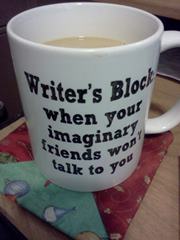
So, let’s talk about getting past that mysterious thing some people call writer’s block, the horrible nightmare that is only a temporary lull in the creative process. This is when you hear those voices mocking you, “you claim to be a writer but you haven’t written a new word in days.” (Or weeks, or months.)

First, you must understand that this is not a permanent, career killing disability. It is a fleeting, dry period where the project you want to work on is not moving forward. But other writing can and should happen!

My recommendation is to sit down and write your way through it—don’t abuse yourself over whatever project you have that is stalled. Clear your mind of those little mental voices of doom and guilt because they are the carrion birds whose songs of despair lure you along the path to failure.

Focus on writing something completely unrelated instead.

In a seminar I attended this last weekend, taught by the award-winning sci fi/fantasy author and current SFWA president, Cat Rambo, she admitted that rather than beat herself up for a momentary lapse of creativity, she works her way through the rough patches with timed stream-of-consciousness writing sessions. She does this every day and shoots for 2000 new words a day, whether they are good words or not.

The way I interpreted her comments, she does this in the NaNoWriMo style, where you set a timer and write whatever nonsense comes into your head for a certain length of time and do not stop writing for any reason whatsoever until the timer goes off.

Cat’s advice? If all you can do when you sit down for that timed writing session is to write “I can’t think of anything” repeatedly, just write that. She said (and she is right) that after a few minutes of that sort of boredom, your creative mind will rebel, your subconscious mind will take over and push you in new directions. When I do this, I usually end up with some of my best ideas embedded in those long strings of rambling words.

Those nuggets of good writing and ideas are straw I can spin into gold.

My personal advice is to not set absurdly unrealistic goals for your work. Target goals are good, but in my opinion, setting too a high wordcount for new words on your rough draft each day is a good way to set yourself up to fail, as you can’t sustain it. I find that when I am involved in NaNoWriMo, which is a different kind of writing, I can put down 2000 to 4000 words each morning–but that kind of output is not sustainable over more than just the month of November. My usual output is 1000 to 2000 new words per writing session.

Consider setting your minimum goal of writing for at least one fifteen-minute increment per day, working straight with no stopping.  Repeat the fifteen-minute sessions as many times as you like each day, if you are really fired and inspired to write.

I am a fulltime author, but even when I was holding down three part-time jobs, I still managed to write every evening. When my children were still at home, I wrote when they were doing homework, or I wrote after they went to bed. I made my time to write by choosing to only watch the TV shows that meant the most to me and ditching the rest. That meant that most evenings I had at least one hour (but sometimes two or three) of good writing time after dinner was done and the kitchen was clean.

I understand if you are emotionally invested in some TV shows, but you must choose to make time to write—choose your entertainment wisely and don’t waste what could be writing time on shows you don’t absolutely love.

So, what about multiple projects? I find that having multiple projects in the works is good for me, as switching from one to another allows me to rest my writing mind. I am fortunate, in that writing is my full-time career.  Because it is my job, I always have three or four projects going, so I do have a certain, inviolable time of the day that I will work no matter what. On Sundays, I write all the blog posts I might need for that week, both for this blog and for several other websites where I have a regular column.

I need to keep regular office hours to be productive, so the morning hours of 6:00 a.m. to 12:00 p.m. are divided like this:

6:00 to 8:00, I work on adding new words to the current rough draft.

8:00 to 9:00, if I don’t have a writing group to attend, I handle my social media stuff—a nasty but necessary task that is part of the job if you don’t have a personal PR person but hope to connect with both readers and other writers.

I don’t have a PR person.

9:00-10:00, (again if I don’t have a writing group) I take a break from writing and make a stab at cleaning my house.

10:00 – 12:00 I do revisions on other projects as my editors ask for them or I edit for clients.

I always take a break at noon and either take a walk or sit on my back porch and just watch the world go by.

In the afternoon, I make maps or do other support work that may be required for one or another of my projects, depending which is firing my mind most intensely, or if I have a client’s manuscript to edit I will go back to that.

I’m no different than any other writer—I do have times when the well of creativity runs dry. But I have the support of other authors, and I have the mental tools I need to pull me out of those rocky spots. I hope this post offers you some idea of how to jumpstart your creativity, and remember–I am always here to talk you off the ledge.

5 Comments

Filed under writing

#amwriting: lay, lie, laid

A few days ago, a discussion in an  author’s’ online chat room raised a question, “Is it lay, lie, or what?”

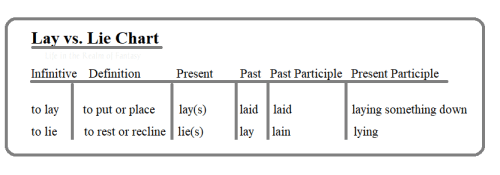
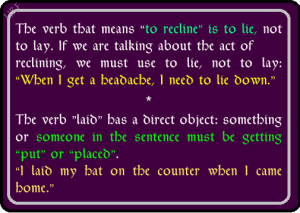
Thus, it’s time to revisit my post on one of the more misused verbs in the English language: the verb lay.’ In my own work, I often have to stop and make sure I am using it correctly. Do I mean to lay down or lie down? It boils down to a simple concept: is the object of the verb RECLINING  or was it PLACED THERE?

“Lay” is a verb meaning to put or place something somewhere. It has a direct object. Its principal parts are “lay,” “laid,” “laid,” and “laying.”

What the words refer to is the action: If you set it (object) there, it is laying there. Lay it there. Lay it on the pillow.

If it is resting or reclining, it is lying there. Lie down. Lying down. Lie down, Sally. (Clapton had it wrong? Say it isn’t so!)

The internet is your friend. Quote from the wonderful website Get it Write: The verbs to lie and to lay have very different meanings. Simply put, to lie means “to rest,” “to assume or be situated in a horizontal position,” and to lay means “to put or place.” (Of course, a second verb to lie, means “to deceive,” “to pass off false information as if it were the truth,” but here we are focusing on the meaning of to lie that gives writers the most grief.)

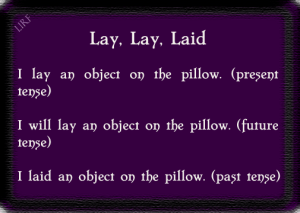
This is where things get tense: present, past, and future.

A ring lay on the pillow. 

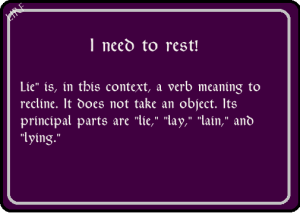
But I needed to rest:

So what this all boils down to is:


But just to confuse things:

A living body lies down and rests as is needed.

A dead body is cleaned up and laid out by other people if said corpse was important to them. However, after having been laid out the corpse is lying in state to allow mourners to pay their respects.


Attributions and Credits:

This post first appeared on Life in the Realm of Fantasy on July 15, 2015, as Lay, Lie, Laid, © 2015-2017 by Connie J. Jasperson, all rights reserved.

Quote from: To Lie, or To Lay, Get it Write online, http://www.getitwriteonline.com/archive/051402lielay.htm, accessed July 11, 2017

4 Comments

Filed under writing

#amwriting: personality and the fight scene

I am in the process of getting one of my works in progress, Billy Ninefingers, ready for publication. This tale takes place in the world of Waldeyn, and Huw the Bard makes an appearance, although not in the opening chapters.

The book opens on a sunny day, and my characters are wearing armor. Their conversation tells us they’re nervous about the trail they are on. Through their casual comments, we learn that the world they live in is dangerous, and people must hire guards to protect them from more than just highwaymen if they choose to travel. The three paragraphs of that conversation are all the reader needs to know about the work my characters do and the trail they are riding. That scene ends and the next scene takes them and the merchant they are guarding to their destination, the dark, dirty town of Somber Flats.

The second scene is the setup for the inciting incident, the moment we meet the first antagonist, Bastard John. When he enters the scene, it is one of the few times when the Bastard will be in such a place that we can see who he is as a person. The inciting incident makes no sense unless the reader knows that the Bastard is an obnoxious bastard, and proud to be so-named.

At this point, an argument ensues, which turns violent. Scenes involving fighting are controlled chaos—controlled on the part of the author. There must be a reason for the fight, one that goes beyond the need for livening things up. When it comes to fighting, I keep it concise and linear, as drawn-out fight scenes bore me to tears.

Most authors get hung up on the technical side of the fight–how they were dressed, who hit who with what weapon, and so on. These are necessary elements of the scene that good, responsible research and an author’s diligence can resolve.

But there is a larger consideration to your battle: you must have a good reason for the conflict. No one is going to stick with a novel where random, convoluted battles happen for no good reason. They hack, they slash, blood flows, the winner walks away–but why did it happen? What is the purpose of injecting that conflict into the narrative? In Billy Ninefingers, besides the obvious fact that he is seriously injured in the fight, which is the core plot point of the book, I had two other goals with that fight scene:

  1. I needed to show how the Bastard is jealous and acts on any thought that passes through his alcohol-soaked mind.
  2. In the resolution of that scene, my intention was to demonstrate that Billy, even with his life in ruins, has a sense of fair-play.

Each character in the fight is, and must remain, a unique individual. There should be no blurring of personalities, which can happen when an author focuses to intently on the action of the fight scene, writing it as if they lived it. For the author, acting out the action ensures that the moves are reasonable and make sense, but you aren’t done writing that scene just because the hacking, slashing, and gunshots are on paper. You must go back to the first part of that section, and make sure you haven’t lost the individuality of the characters in the chaos. Each character must be portrayed in the actions sequence in such a way the reader doesn’t say, “He wouldn’t do that.”

Consider the people you know. Picture the ones you like to spend time with. What is it about them that captured your interest in the first place? I’m not talking lovers here, so set the irresistible chemistry aside and think about their mannerisms, their habits.

That sense of uniqueness is what we must give our characters through their habitual movements and speech, and it is crucial we maintain those differences when we describe a fight scene.

Our bodies, as well as our faces, are in constant motion. You can show this in small, unobtrusive ways by sitting back and visualizing your scene as if you were the witness rather than a participant, making it real in your mind before you commit it to paper.

In conversation, people miss a few beats when they are speaking. They gather their thoughts and speak in short bursts. They shift in their chair, or stand up, or wave a hand to emphasize a point. They turn, and sometimes mumble.

Every character’s mannerisms are individual, uniquely theirs. You, as the author, visualize them this way, but the difference between success and failure as an author is the ability to commit their personalities to paper. Many authors don’t succeed at this—they either fail to give enough subtle clues to the reader, or they are too specific. The fine line between enough and too much is where the author’s artistry comes in.

Through physical actions and conversational interactions, we make our characters knowable and likable (or not, as the case may be). Their actions as they interact with their environment and each other illustrate the world they exist in. Each scene is your opportunity to convey the setting and the mood of your characters without resorting to an info dump.

Especially when describing a fight scene, the author must give the impression of detail, offering the reader a framework to hang his imagination on. We use our words sparingly and with intention, painting the idea and the atmosphere of the conflict as if painting  the scene in the style of the impressionists.

I love it when I can suspend my disbelief and become immersed in the story, getting wrapped up in the fight because the battle is crucial, and the good people must win.

4 Comments

Filed under writing

#amwriting: it’s #magic

Once magic enters your story, you must do some foot work, or your premise won’t be believable. It’s critical that you have finite rules for limiting how magic works. If your magic rules are too elastic, or you imbue too many amazing abilities into your main character, you will make them too good to be true. Readers won’t be able to relate to their story.

When I sit down to write a fantasy story, there will be magic, and I will have planned carefully for it. I have three worlds with three radically different systems of magic.

  1. In my serial, Bleakbourne on Heath, sorcerers use incantations sung to certain melodies.
  2. In Huw the Bard people can purchase magic (majik) amulets and potions.
  3. In the Tower of Bones series, magic and religion are intertwined. Aeos, the goddess, has decreed that all children who begin to show healing-empathy, or the ability to use the magic of the elements must be brought to the Temple and trained, for the protection of society in general. There are rules, certain things which can and can’t be done. As in real life, there are certain exceptions, but they too have limitations. No one is all-powerful.

Each time you make parameters and frameworks for your magic you make opportunities for conflict within your fantasy world. Remember, conflict drives the plot.

First, you must consider who has magic? What kind of magic–healing or offensive or both? What are the rules for using that magic and why do those rules exist? Magic is an intriguing tool in fantasy, but it should only be used if certain conditions have been met:

  • if the number of people who can use it is limited
  • if the ways in which it can be used are limited
  • if not every mage can use every kind of magic
  • if there are strict, inviolable rules regarding what each kind magic can do and the conditions under which it will work.
  • if there are some conditions under which the magic will not work
  • if the learning curve is steep and sometimes lethal

What challenges does your character have to overcome when learning to wield magic?

  • Is he unable to fully use his own abilities?
  • If that is so, why is he hampered in that way?
  • How does that inability affect his companions and how do they feel about it?
  • Are they hampered in anyway themselves?
  • What has to happen before your hero can fully realize his abilities?

Even if this aspect does not come into the story, for your own information, you should decide who is in charge of teaching the magic, how that wisdom is dispensed, and who will be allowed to gain that knowledge.

  • is the prospective mage born with the ability to use magic or
  • is it spell-based and any reasonably intelligent person can learn it if they can find a teacher?

Magic and the ability to wield it usually denotes power. That means the enemy must be their equal or perhaps their better. So, if they are not from the same school, you now have two systems to design. You must create the ‘rules of magic.’  Take the time to write them out.

In creating both social and magic systems, you are creating a hidden framework that will support and advance your plot. Within your magic system, there can be an occasional exception to a rule, but there must be a good reason for it, and it must be clear to the reader why that exception is acceptable.

Another important point to take note of is this: the only time the reader needs to know these systems exist is when they affect the characters and their actions. Dole this information out in conversations or in other subtle ways and it will become a natural part of the environment rather than an info dump.

It is a fact that sometimes books that were outlined to a certain storyline sometimes go off in their own directions, and the story is better for it. I haven’t experienced the sudden influx of magic into the story as that plot twist is always planned for, but I have had other random events throw a curveball at me.


Attributions:

Portions of this post have previously appeared here on Life in the Realm of Fantasy and also in my column on writing craft for the Northwest Independent Writers Association (NIWA).

Comments Off on #amwriting: it’s #magic

Filed under writing

#amwriting: compound words and hyphens

Compound words are frequently a source of grief when I receive my manuscript back from my editor. Despite my best efforts, unless I am on my toes in the writing process I habitually hyphenate words that should not be hyphenated.

Most people know that a compound word is a combination of two or more words that function as a single unit of meaning.

Most people also know that there are two types of compounds:

  • those written as single words, with no hyphenation and which are called “closed compounds”– such as the word “bedspread,”
  • “hyphenated compounds,” such as “jack-in-the-box” and “self-worth.”

But there is a third group, and they are the bane of my writing life–those mysterious, ephemeral denizens of the deepest corner of writer’s hell, called open compounds. These seemingly innocent instruments of torture are written as separate words–the nouns “school bus” and “decision making,” for example.

Fortunately, the English language has rules to guide us when deciding if it’s one word, two separate words, or a hyphenated word:  

Do not use a hyphen unless it serves a purpose. If a compound adjective cannot be misread or, as with many psychological terms, its meaning is established, a hyphen is not necessary.

The American Psychological Association  style guide gives of these examples:

covert learning techniques, health care reform, day treatment program, sex role differences, grade point average

Use a hyphen in a temporary compound that is used as an adjective before a noun

Use a hyphen if the term can be misread or if the term expresses a single thought.

  • “the children resided in two parent homes” means that two homes served as residences, whereas if the children resided in “two-parent homes,” they each would live in a household headed by two parents.  In that case, a properly placed hyphen helps the reader understand the intended meaning.

We also use hyphens for compound words that fall into these categories:

  • if the base word is capitalized: pro-African
  • when writing numbers: post-1910, twenty-two
  • an abbreviation: pre-ABNA manuscript
  • more than one word: non-achievement-oriented students
  • All “self-” compounds whether they are adjectives or nouns such as self-respect, self-esteem, self-paced.

We hyphenate words that could be misunderstood when there are diverse meanings if they’re unhyphenated:

  • re-pair (to pair again) as opposed to repair (to mend)
  • re-form (to form again) as opposed to reform (to improve)

We hyphenate words in which the prefix ends, and the base word begins with the same vowel:

  • metaanalysis
  • antiintellectual

The problem is unless you are a technical writer, how often are we going to use those terms? Hence, the confusion when we DO use them.

Get It Write online says, “One way to decide if a hyphen is necessary is to see if the phrase might be ambiguous without it. For example, “large-print paper” might be unclear written as “large print paper” because the reader might combine “print” and “paper” as a single idea rather than combining “large” and “print.” Another such example is “English-language learners.” Without the hyphen, a reader might think we are talking about English people who are learning any language rather than people who are learners of the English language.”

A good rule to remember is most words formed with prefixes and suffixes are written as one word with NO hyphen.

Prefixes: Afterglow, extracurricular, multiphase, socioeconomic

Sufixes: Arachnophobia, wavelike, angiogram

When I am laying down prose in the first draft, my natural inclination when writing these words would be to hyphenate them, but that is wrong, and my editor always kindly reminds me of this.

When in doubt, it is wisest to look the word up in an online dictionary to see the various different ways it can be combined. Just go to:

http://www.merriam-webster.com

What it all comes down to is this—when editing for another author I am able to see these things clearly. In my own work–it’s like my finger has a twitch that absolutely MUST add a hyphen to compound words that should remain separate, and separates words that should be joined.

This is why the editor has an editor for her own work.


Credits and Attributions:

When do you need to use a hyphen for compound words? The American Psychological Association, http://www.apastyle.org/learn/faqs/when-use-hyphen.aspx accessd June 25, 2017

Compound Words: When to Hyphenate, Get It Write, Nancy Tuten and Gayle Swanson  http://www.getitwriteonline.com/archive/042703compwdshyph.htm, 2017

Parts of this post were originally posted March 4, 2014, as Hyphen Help Us, by Connie J. Jasperson, © 2014-2017.

13 Comments

Filed under writing