Tag Archives: writing craft

#amwriting: Desires and Objectives

LOTR advance poster 2When we sit down to write a story of any length, whether a novel or flash fiction, we often begin with an idea for a plot, the possibilities of great characters, and little more. To make those two things into a compelling story, we must discover what the protagonist desires most, and find out what she/he is willing to risk to achieve it.

Objectives+Risk=Story

In The Lord of the Rings, by J.R.R. Tolkien, Frodo is just an ordinary young hobbit, with no particular ambitions. On the same day as his older cousin Bilbo’s “eleventy-eleventh” (111th) birthday, Frodo (Bilbo’s heir) celebrates his thirty-third birthday.

At the lavish double-birthday party, Bilbo departs from the Shire for what he calls “a permanent holiday.” He does so by using the magic ring (that he had found on the journey detailed in The Hobbit) to disappear. He is aided in that by Gandalf with a flash and puff of smoke, leading many in the Shire to believe Bilbo has gone mad.

He leaves Frodo his remaining belongings, including his home, Bag End, and after some heavy-handed persuasion by the wizard Gandalf, he also leaves the Ring. Gandalf departs on his own business, warning Frodo to keep the Ring secret. Seventeen years or so pass, and then Gandalf returns to inform Frodo of the truth about Bilbo’s ring. It is the One Ring of Sauron the Dark Lord, and is evil. It forges a connection between the wearer and Sauron, and whoever bears it will be slowly corrupted, eventually becoming a Ringwraith.

LOTR advance posterFrom the moment of learning the truth about the Ring, Frodo’s goal is clear to the reader: he must get rid of the ring. In Rivendell, he learns the only way to do so is to carry it into the depths of Mordor and cast the ring into the fires of Mt. Doom.

Frodo wants to achieve this goal badly enough to walk into an active volcano and certain death to accomplish this.

At no point in the narrative is the objective unclear. The path is blocked many times, and each of the characters is tested by the evil ring, some beyond their ability to resist it.

The objective creates the tension, which drives the plot forward.

But what about a book where the goal is not so clear? Let’s talk about Ulysses, by James Joyce.

Ulysses chronicles the wandering appointments and encounters of Leopold Bloom in Dublin, taking place over the course of an ordinary day, 16 June 1904. Ulysses is the Latinized name of Odysseus, the hero of Homer’s Odyssey. Joyce established a series of parallels between the epic poem and his novel. This book has one of the best opening lines of all time:

Stately, plump Buck Mulligan came from the stairhead, bearing a bowl of lather on which a mirror and a razor lay crossed.

Ulysses cover 3Structurally, there are strong correlations between the characters and experiences of Leopold Bloom with Odysseus, Molly Bloom with Odysseus’ long-suffering wife, Penelope, and Stephen Dedalus with Odysseus’s son, Telemachus. It is set in early twentieth century Dublin with the events and political tempests of of the time. Themes of antisemitism and the impact of Ireland’s rocky relationship with Britain as a it was felt in those days are the underlying pins of this novel. It is highly allusive and filled with allegories.

There is no obvious quest, although many minor quests are completed in the course of living through the day. The book opens with Stephen Dedalus, the first protagonist, having breakfast with Buck Mulligan, who is perhaps a friend, or maybe a rival. It’s James Joyce, so it’s complicated. Stephen shares his opinions about religion, especially as they relate to the recent death of his mother, with Buck Mulligan, who manages to offend him. They make plans to go drinking later that evening.  Stephen is not Leopold’s biological son as Telemachus is Odysseus’, but he fulfils that role.

What does Leopold desire? In Episode 4, the narrative shifts abruptly. The time is again 8 am, but the action has moved across the city and to the second protagonist of the book, Leopold Bloom, a part-Jewish advertising canvasser. He and his wife have a daughter, Milly Bloom, who, at the age of 15, has left home to study photography.  As the day unfolds, Bloom’s thoughts turn to the affair between his wife, Molly, and her manager.

He also thinks about the death of their infant son, Rudy Bloom, who died at the age of 11 days. The absence of a son is what leads him to form an attachment to Stephen, for whom he goes out of his way in the book’s latter episodes. He rescues him from a brothel, walks him back to his own home, and even offers him a place there to study and work.

Finally, we come to Molly. The significant difference between Molly and Odysseus’ wife, Penelope, is that while Penelope is eternally faithful, Molly is not. Molly is having an affair with Hugh ‘Blazes’ Boylan after ten years of her celibacy within the marriage.  In Dublin, Molly is an opera singer of some renown. Molly wants to be loved.
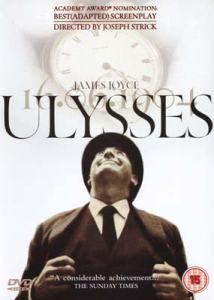
Ulysses_(1967_film_dvd_cover)The final chapter of Ulysses, often called “Molly Bloom’s Soliloquy,” is a long, un-punctuated stream-of-consciousness passage, which is arguably the most difficult passage to read and/or follow in the Western canon. (The body of books, music and art that scholars generally accept as the most important and influential in shaping Western culture.)

At the end of the day Molly allows Leopold into her bed, and worries about his health. She reminisces about their first meeting, and about when she knew she was in love with him. This long-winded monologue is comprised of some 20,000 words of her thoughts as she lies in bed next to Bloom, who is unaware of her internal rambling.

In The Lord of the Rings, we have a clear and obvious quest, straightforward and seemingly impossible. In Ulysses, we have a group of people who all want something, but just as in real life, what that may be is not as clear as we would like it. But there is an objective: they just want to get through the day and in the end, they each want to love and be loved, and perhaps be part of a family.

Once we know what our protagonist wants and what he/she is willing to risk to achieve it, we have our plot. Personally, I like a certain amount of literary prose, but I prefer reading books that are a little more straight-forward than Ulysses. That’s why Tolkien’s work spoke to me when I was still in grade school.

How we dress it up is up to us—and, while I admit James Joyce’s rambling is too daunting for me to read for pleasure, I am a confirmed fan of his magnificent one-liners.

History is a nightmare from which I am trying to awake.

Ulysses, Episode 2
4 Comments

Filed under Books, writing

#amwriting: don’t gut your novel

Excalibur London_Film_Museum_ via Wikipedia

This post has nothing to do with swords, but I felt one should be pictured, so here is Excalibur.

I have another novel in the editing process, one with many sections written before I embarked on my quest to discover how to write. I am now culling many unnecessary words and awkward phrases from the older sections.

If you’re a regular reader of my blog, you know the word “that” is like a keyboard tic for me. I use it a lot in my personal speech, and it falls into my work with a little too much regularity. I thought I had them pretty well under control, but one doesn’t see one’s own work with eyes of the disinterested reader.

Because of this, my editor and I are now combing each section for words I can eliminate and still retain the flow of the narrative.

Yes, I know I claim to be an editor. But I am first and foremost a writer, so I do have an editor because an unbiased eye is critical to producing a good, tight, manuscript.

When it comes to eliminating the word “that,” it’s crucial you look at each instance of how it is used.  Sometimes, “that” is the only word for a given situation. If a particular idea can’t be conveyed any other way, for the love of Tolstoy, use it. Don’t gut your prose just because some online guru tells you ‘that’ is the devil. If you remove every instance of “that” you’ll end up with a mess on your hands.

And just so you know, “that” and “which” are not interchangeable so you can’t just change every instance of “that” to “which.”

“That” is a pronoun used to identify a specific person or thing observed by the speaker, a determiner, an adverb, and a conjunction.

  1. “That’s his dog on the curb.” (Identifier)
  2. “Look at that red car.” (Determiner)
  3. “I wouldn’t go that far.” (Adverb)
  4. “She claimed that she was married.” (Conjunction)

In the case of number 4, the sentence would be stronger without it. Most of the time, prose is made stronger when the word “that” is simply cut and not replaced with anything. I say most, but not all of the time. Use common sense and if a beta reader runs amok in your manuscript telling you ax “this and that,” examine each instance of what has their undies in a twist and try to see why they are pointing it out.

There are cases where only “that” will suffice. When do we use the word “that?” We use it when we have something called a ‘Restrictive Clause’:

Quote from Grammar Girl, “A restrictive clause is just part of a sentence that you can’t get rid of because it specifically restricts some other part of the sentence.”  She goes on to give a specific example of a restrictive clause: “Gems that sparkle often elicit forgiveness.”  See?  Not just any gems elicit forgiveness in this sentence. Only gems that sparkle bring about clemency. In this sentence, forgiveness is restricted to one kind of gem.

“Which” is a pronoun asking for information. It specifies one or more people (or things) from a particular set, and it is also a determiner:

  1. “Which are the best diapers for newborns?” (Pronoun)
  2. “I’m looking at a house which is for sale on Black Lake.” (Determiner)

Go lightly with “which” and “that” but use them when they are required.

keep clam and proofreadThe same common sense approach goes for “very.” I seldom need to use it, but I do when it’s required. However, some people employ it too frequently, and it’s rarely needed in the context they  place it, fluffing up the word count. As with every word, there are times when it’s the only one that will convey an idea crucial to your story.

Mark Twain had a perfect comment regarding overusing “very.”

“Substitute ‘damn’ every time you’re inclined to write ‘very;’ your editor will delete it and the writing will be just as it should be.”

I’d love to be that editor.

6 Comments

Filed under writing

#amwriting: homonyms and honorifics

MSClipArt MP900390083.JPG RF PDAn editor once told me, “If you’re going to use grammar improperly, at least have the decency to misuse it consistently.” Since that day, I have made every effort to do so.

However, as a reader, I like to see that the author and editor both had a good grasp of the basics, and if a book is written with too many inconsistencies it ‘s hard to get involved in it.

We are all guilty of typos, homonym misuse, and the occasional comma splice. We sometimes are inconsistent with the words “sir” and “Son.” We make every effort to have our work read by editors and proofreaders, and still, invariably, some glaring blot of darkness sneaks through because certain aspects of the English language are as difficult to wrangle as a van full of toddlers on coca-cola.

One thing I’ve regularly noticed people have trouble with is the proper use of terms of endearment, such as “Sir,” or “Dad,” and “Mom.” The rules are basically simple to remember:

For people who are related, if you are saying it directly to them in place of their name, capitalize it.

  • “I love you, Son.”

If you are mentioning them in conversation, don’t capitalize it.

  • “My son is wonderful.”

Terms of endearment can also be relatively impersonal, denoting a friendship, or can even be slightly patronizing. If the speaker is not related to the person in question, do not capitalize it.

  • “I wouldn’t do that, son.”

Then there is the issue of the word “sir.” It is an honorific. Quoted from the Chicago Manual of Style section 8.32:

Honorific titles and respectful forms of address are capitalized in any context with several exceptions:

  • sir

  • ma’am

  • my lord

  • my lady

Where king/queen, Lord, or Sir is used as part of someone’s name, it is always capitalized, as are these honorifics:

  • King Olav, and Lucille, the Queen of Darkness
  • Lord John Davies; Lady Mary Shelton
  • Sir William Neville

Where king/queen is employed in the context of a general reference it is lowercased:

  • “Hello,” said the king.

But should one capitalize the word “sir” when it’s used in dialogue? Which of the following would be correct? “Yes sir.” OR “Yes Sir.”

If the reply is to a respected person in general, it is written with no capital, as it’s not a formal name. But you do need a comma just you would with a formal name:

“Yes, sir.”

“Yes, George.”

For a more in-depth exploration of that subject see my post of March 14, 2016: son and sir: to capitalize or not?

When writing dialogue: if your speaking character is in the military and the person he/she is addressing has a military rank above them, and is speaking in their military capacity you must capitalize it. The exception to this is if a younger person of lesser rank is talking to an older person of higher rank in an informal setting. At that point, the younger person is simply speaking respectfully to an older person, and “sir” does not need to be capitalized.

Remember, English is a strange and mysterious language, and is one even which even native-born speakers rarely master. While it has rules, it has many exceptions to those standards, so it is easy to be confused. Your word-processing program’s spell checker won’t notice these things because they aren’t misspelled.

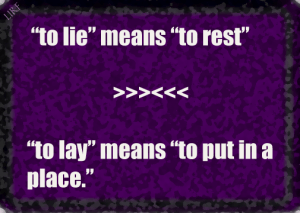
to lie means to restHomophones: Words that share the same pronunciation, regardless of how they are spelled and Homonyms: Words that sound alike, but have different meanings:

  • there, they’re, their
  • to, too, two

It’s also good to recognize homographs (words that share the same spelling) that have different pronunciations and meanings. These words include:

  • desert (to abandon) and desert (arid region)
  • tear (to rip) and tear (a drop of moisture formed in the eye)
  • row (to argue or an argument) and row (as in to row a boat or a row of seats—two words which are also a pair of homophones)
  • bark (the sound of a dog) and bark (the skin of a tree)

Capitonyms are words that share the same spelling but have different meanings when capitalized. They may or may not have different pronunciations. Such words include:

  • polish (make shiny) and Polish (from Poland)
  • march (walk or advance) and March (the third month of the year in the Gregorian calendar)

chicago manual of styleNegotiating the shoals of English grammar can be tricky, and it’s easy to get a fortune tied up in reference books. However, if you are on a tight budget, these two good references will help immensely with gaining some mastery of it:

I always recommend these two as they are the most comprehensive examples of their kind, and good, lightly used volumes are sometimes available second hand through Amazon.

Strunk and White’s Elements of Style is an excellent reference book if the Chicago Manual of Style is too daunting for you, as it’s not nearly as detailed and does hit the high points, and old copies are always available in second-hand bookstores.

Comments Off on #amwriting: homonyms and honorifics

Filed under writing

#amwriting: the rough draft

My Writing LifeI have begun a new novel set in Neveyah. It is the “how it all began” novel and takes place at the beginning of their recorded history. It’s been rolling around my head, and bits of this story are alluded to at various points all through the Tower of Bones series and also Mountains of the Moon.

The protagonist of this story is mentioned regularly in the Tower of Bones series as a character featured in children’s books. He’s portrayed as a kind of superhero, doing many impossible things.

But as always, there was a real man and real events at the core of the mythology.

I am taking the mythical man and giving him his place in history as the founder of the City of Aeoven, the College of Warcraft and Magic, and the first leader of the Temple of Aeos. I had the basic story drawn up back in 2009 when I began devising the world of Neveyah—three lines mentioning their childhood heroes.

The events that launch Aelfrid down the path of the mythic hero are all laid out. Now I must connect the dots and bring him to life.  If the story grows too large, it will be published as a two volume set, but my intention is to keep it to the same length as Valley of Sorrows.

As an indie, I must pay CreateSpace up front for my stock whenever I go to book fairs or signing events, so keeping my costs down is critical. CreateSpace costs are dependent on the length of the book, so if I have to pay $6.99 for each book, it limits  how much stock I can afford to keep on hand. I don’t want to run short of books, so I try to keep my costs to below  $5.00 per book. This also makes donating them to libraries and shelters affordable.

Even though Tower of Bones was published first, the rough draft of Mountains of the Moon was actually written first. In early 2009 I had been asked to write an epic fantasy story-line for a Final Fantasy-style anime-based RPG that was never built. For that reason, the world building was super-heavy.

Before I even had a story, I had to spend months

  • devising history and mythology
  • designing all the many environments where the story would take place
  • drawing maps
  • designing the creatures the characters do battle with
  • I also had to design the rules for magic, including its limitations

Having all these things so well-drawn and documented has been a bonus, as I can just write the story. The setting is clear in my head, laid out in a style sheet for that world, and the terrain is detailed on maps.

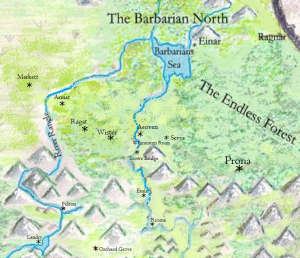
The north in the time of AelfridI have learned from the mistakes of others. Unlike the Saga of Recluce series, my maps for the early days detail the world as it was then, so there is no struggling to guess where the major towns are. (See my post, of  March 10, 2014, Spanking L.E. Modesitt Jr.)

I would definitely do two things differently, if I were to create that world today: the calendar, and the names of the days. I wouldn’t go with a 13-month lunar calendar, and I wouldn’t name the days after Norse gods.

But the calendar is canon now, and just as in real life, you must work with what you have. So, right now I am nearing the first plot point, where the first calamity occurs. Since this is the rough draft, everything to this point is really sketchy—a lot of “he said,” and “he went,” just to get the ideas down and everything in place.

These “telling and not showing” places are road marks, to guide me when I sit down to write the true first draft. My synopsis was about 3000 words. This rough draft will top out at about 55,000 words, and the first draft of the novel itself will be around 90,000 to 100,000 words.

398px-Heroes journey by Christopher Vogler

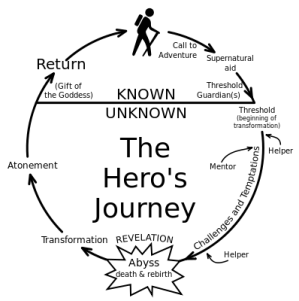
Hero’s Journey, by Christopher Vogler, via Wikipedia

What I am doing at this point is setting the scene, introducing and developing the characters, and finding the reasons why they are who they are as people. I have a grip on my mentor’s character, and also the side characters.

I know my protagonist fairly well, although what initially motivates him is still a bit of a mystery. His personality and what he has to do are clear, but I haven’t yet discovered what lies within him that pushes him to achieve this thing. That is part of the journey for me.

For this book, I know exactly who my villain is, and how he came to be that person. He is new to me, but his motivation is clear and easy to imagine. I feel a real connection to him.

Altogether, if everything goes according to plan, writing this book will take about a year for me to get it to the final draft and into the editing process.

3 Comments

Filed under writing

#amwriting: Thoughts on Italics

strange thoughts 2One of the virtues of being a part of a group of writers is that you can bounce questions and ideas off them. And, one thing the authors I hang out with all agree on is that italics are the devil.

We don’t like them because they are hard on the eyes, daunting, and difficult to read in large chunks when the main character is waxing internally poetic. Also, many readers subconsciously skip them, and so they have missed important information you may have imparted there. Having not read it, they may think your book is confusing and disjointed.

Yet the standard practice in genre fantasy is to set internal dialogue off in italics. For this reason, I no longer give my characters a lot of time to think, as such. In my more recent work, only rarely do my characters think in italics. I believe thoughts occur as an organic part of the narrative as a whole, and should be identified as if with a speech tag:

  • I wondered, why the red hat? Surely it meant something, as she was the second person I’d seen with a red hat. But perhaps I saw what I wanted, a conspiracy where none existed.
  • The flash of a purple stocking covering a shapely ankle, quickly hidden by her skirts, caught his attention. Was she a whore? He wondered. Some women working the streets wore red to advertise their profession, but she didn’t have the look of disillusionment the others wore beneath their masks of false desire. Why did she wear purple stockings?
  • His sword belt hung on the chair just as he’d left it the night before. But while the scabbard had been left behind, Caliburn was gone. His heart sank, and he cast his mind back, picturing his room before he’d gone down to breakfast. Nothing had seemed out of place, but had he seen the grip sticking out of sheath? He couldn’t recall.

Most thoughts don’t have to be italicized. My recommendation is to only voice the most important thoughts via an internal monologue, and in this way, you will retain the readers’ interest. The rest can be presented in images that build the world around the characters.

The exception to this is if the person who is thinking is also speaking with other people, and his thought could be mistaken as dialogue spoken aloud.

Many other, equally insidious reasons exist as to why authors may choose to use italics, most of which I think should be formatted in a better, easier to read style that still sets them off:

  • Mental telepathy, which is technically spoken dialogue
  • Letters, which are the written thoughts of people from far away
  • Emails, which are electronic letters
  • Text messages

Let’s consider correspondence between characters: some work is written in an epistolatory style. The entire narrative is told in the form of letters exchanged between the characters, as in the case of the brilliant steampunk Dawn of Steam series by Jeffrey Cook with Sarah Symonds. In that case, with each exchange of letters, the speaking character/author is made clear.

However, correspondences inserted into the body of a narrative should be formatted to set them apart, but not to throw the reader out of the story. For that passage, add an extra space both before and after, and inset both left and right margins by one-half inch (.5).

He looked at the missive from Father Rall, wondering how his day could get any worse.

Cayne,

I understand you are too unwell to duel lately. Your students’ health is at risk if you have a contagious disease. You must go to the infirmary today. If your illness is treatable, you should be back to dueling soon. If you are suffering from the prolonged use of magic, many treatments are now available that will help you live a long and productive life. Either way, Darlen is expecting to see you today.

Rall

Cursing, he wadded the note and threw it toward the wastebasket. 

To inset the margin in Microsoft Word: Highlight the section you want to inset. On the ribbon, go to the home tab. On the paragraph menu, click the little grey square on the lower right-hand corner to open the menu. Then on the indentation menu set both right and left to 1”. Click okay

inset_margin_how_to_printscreen_LIRF_cjj

Emails should also be represented this way, set in 1/2″ (.5), as they are the most common form of modern correspondence, but you want to show they are emails:

To: Ima.Fool@maildelivery.com

From:M.Jones@buenavuecorps.com

We regret to inform you that your manuscript “Under the Grandstand” is not what we are looking for at this time. 

Good luck in your future endeavors,

Maurice Jones

Editor, Buenavue Magazine

And what about text messages? They can be inset too.

Helen:

Hi. R U on ur way?

                 —-

Joe:

What? I only speak English. I’m on my way.

So that leaves us with mental telepathy. Mental telepathy is a commonly used trope in genre fantasy, and I have one series where it figures prominently. In writing groups you will hear of a variety of ways to deal with that.

Some authors will use italics.

  • I am always with you. Zan’s smile and supportive thought warmed her

Some authors use parentheses:

  • (I am always with you.) Zan’s smile and supportive thought warmed her.

Some authors will preface mental communication with a colon:

  • : I am always with you.: Zan’s smile and supportive thought warmed her.

When a story is mental-telepathy heavy, I personally will do anything to avoid throwing the reader out of the story.

  • Through their link, Zan said, “I am always with you.” His smile and supportive thought warmed her.

How you choose to portray thoughts and mental telepathy is purely your choice, and reflects what you see as your style. I was not always a purist—this lack of enthusiasm for italics has evolved along with other aspects of writing. But as an editor, when I am faced with large blocks of italics, I find them difficult to read. And frankly, some authors use internal monologues as a way to dump large amounts of background info.

When you have a thought-heavy narrative, I would suggest you find an alternative way to phrase your characters’ ruminations, making them an active part of the story. Avoiding italics will force you to write a stronger narrative, and your readers will thank you.

6 Comments

Filed under writing

#amwriting: so you want to be a writer

Dial-a-PlotSo, you want to be a writer. You have written several unpublished short works, and they were darned good, if you do say so yourself. Your novel is half finished, and your cousin, Phil, says he’s never read anything like it.

One of the many things I didn’t realize when I first began this crazy journey, is that your family and friends are not editors. Even if they are teachers, it’s likely they won’t notice anything but the most glaring errors in your work, and they will miss a great many of those.

Unless your cousin Phil is an author himself, he won’t mention places where you have repeated yourself ad nauseum, nor will he point out places that are phrased in a convoluted way.

Because these places are both annoying and confusing, Phil has most likely skipped over them, and didn’t mention it because he didn’t want to hurt your feelings. Large plot-holes, inadvertent use of clichés, and intriguing auto-correct mistakes get missed when your eager-to-help friends try to edit your work.

Your friends might know they don’t like what you wrote, but they don’t know why they don’t like it so they plow through it as fast as they can just to get the misery done with. They will spot a few problems, which helps, but isn’t going to make your manuscript readable.

Oh, your friends aren’t going to tell you they don’t like it, but they will think it: “This is awful. What’s up with the dog…is he an arsonist? No…it was apparently the Guinea pig but…no. God, this is the worst drivel I’ve ever read. How do I get out of this? Um…I’ll tell her it was great, I loved it.”

Consider joining an online beginners’ writing group. A lot of useful information can be found through these two free resources:

  • NaNoWriMo (National Novel Writing Month) nanowrimo.org They operate year round and have many resources available to help you get started.
  • Critters Workshop critters.org

Critter is an excellent place to get feedback on your work, in a way that doesn’t feel threatening. New authors should definitely consider joining the critters workshop.

a writer's stylePLEASE don’t publish your work without first having it edited professionally, or at the very least, read by an advanced writers group. You have no idea what your manuscript actually looks like. An advanced writing group will tell you the ugly truth, and they won’t be kind about it, but once they are done with you, you will reconsider your decision to not hire an editor.

If you plan to submit it to a large publisher, do hire an editor so that what you submit will be the best you can offer them.

If you are in the beginning stages of your writing career, invest in books on the craft of writing. Many books are available used through Amazon dot com, and many are available as affordable eBooks, also through Amazon. And you don’t need a Kindle, as you can download the free app for your PC, Mac, Android, or Apple device.

Books on the craft that are on my desk and in use today:

  • The Chicago Manual of Style
  • The Oxford American Writer’s Thesaurus
  • Rhetorical Grammar by Martha Kolln
  • Story: Substance, Structure, Style and the Principles of Screenwriting by Robert McKee
  • The Sense of Style by Stephen Pinker
  • The Sound on the Page by Ben Yagoda
  • Outlining Your Novel by K.M. Weiland

Books that help when I am stuck:

  • The Negative Trait Thesaurus by Angela Ackerman and Becca Puglisi
  • The First Five Pages by Noah Lukeman

Three websites a beginner should go to if they want instant answers in plain English:

Writing is not just a career for me—it is an obsession. Anything involving books is the proverbial shiny thing for me. All of my inspiration has come from the many excellent writers whose works moved me.

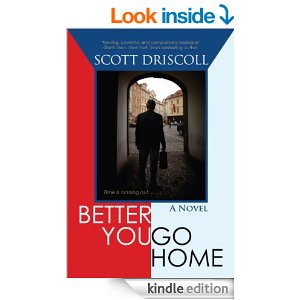
Better You Go Home, Scott DriscollI am also inspired by those authors whose workshops I have been fortunate enough to attend. Consider this high quality online option for learning the craft of writing:

Introduction to Fiction Writing at The Writer’s Workshop, instructor, Scott Driscoll.

This is admittedly not  free, but it is an exceptionally in-depth exploration of the craft. I have attended some seminars offered by Scott at several conferences and have never come away disappointed.

Remember, writing is a career path that requires dedication, and commitment to learning and growth. The money you spend going to workshops and conferences is an investment you make in your career. You not only learn about the craft of writing, but you will also learn the business aspect, and make no mistake: regardless of whether you are traditionally published or indie published, this is a business.

via buzzfeed

via buzzfeed

It’s not always easy, and sometimes it is hard to see progress. But with each completed project you gain strength and confidence. Your work evolves, growing in readability and your voice as an author becomes recognizably yours.

Writers finish their work. Many people will begin walking this path, believing they want to be writers. They like the idea of being a writer, and may claim to be a writer, but when you ask them about their work, they will tell you they don’t have time to write, and their work was only halfway begun when they had to stop.

The fact that you once sat in a Ferrari does not make you a Formula One driver.

I always urge writers to write every day, even if it is only for fifteen minutes. If you are not committed to writing regularly, your novel will never see the light of day.

Write regularly, and finish that book.

9 Comments

Filed under Literature, writer, writing

#amwriting: the truth about blogging

Who are youNothing improves your writing chops more than writing every day. Deadlines can be daunting but say what you will about not being able to write under pressure—I think that is when I do my best work.

Blogging regularly offers me that mix of self-imposed deadlines combined with the opportunity to riff on my favorite subject—the craft of writing. Much of what I have learned over the past four years has been through researching topics for this blog.

When I first began, I was only blogging under duress—my former publisher was forcing me to. This, he said, would help get my name out there, and give me a regular platform for my opinions. That blog is long gone, and those posts were pathetic attempts to write about current affairs as a journalist, something that has never interested me.

It wasn’t until I stopped trying fit into a mold someone else had designed for me and began writing about my interests that I learned to love the craft of blogging. That is also when I began to grow as a writer, because I have to work hard to proofread my own work and then publish it. If I am not vigilant, it posts with “warts and all.”

I don’t like warts in my work.

RALPH WALDO EMERSON QUOTE meme copyBlogging has made me a “thinking” author, as well as a “pantser.” I can write using the “stream of consciousness” method as I am now, or I can write it several days in advance by putting together a quick outline about whatever is interesting me at the time. I just do the research, and the post begins to write itself.

I use WordPress for this blog—and many of you know how aggravating I have found some of the changes recently implemented by WP. I am a contributor to two other blogs hosted by WordPress, and the other authors I am working with tend to find WordPress technical “support” just as exasperating as I do.

Giving me a list of canned questions and redirecting me to threads filled with complaints by other users is not “tech support.” It is, instead, clearly an effort to maintain separation from the user and any real-life problems he/she may have with using their product. (See my post of March 2, 2016: wanted: flatiron for curly quotes and other blogging twists.)

And just today they have introduced a new “less invasive” way of inserting links into the post, by which I mean with fewer options (unless you know the magic trick) and less useful. However, although it is evident the fine people at WordPress are not done messing with our heads, I am still not going to change this blog to a different platform—yet.

Instead, I will continue to work around things until they force me to switch to a platform run by people who are genuinely involved with their users and who care enough to respond to technical questions with more than circular, canned responses that go nowhere, like a snake eating its own tail.

I am a contributor to several blogs hosted on Blogger (Best In Fantasy is one), and I do like the way Blogger does NOT keep changing and fixing what isn’t broke. But I’ve been here at this little corner for several years now, and I hate moving so this will remain a WordPress blog.

I have made many friends through blogging, people all over the world who I may never meet in person, but who I am fond of, nevertheless.

This place is where I develop seminars on the craft of writing. I find that talking to you about my obsession helps me organize my thoughts. And, although I hate to say it, my first publisher (Lord Voldemort) was right about blogging. Blogging regularly does get your author name out there and showcases your work and your voice.

But only if you are passionate about what you are discussing.

I recommend blogging to anyone who has a craft they are fired up about. For novelists, I also recommend publishing short pieces—flash fiction. Little off-the-cuff pieces of less than a thousand words are fun to write and often find their way into your larger work, as they are a great way to brainstorm ideas.

If you want to know more about getting your own blog up and running, see my post of December 14, 2015, Blogging is Writing TooThis post talks about how to use the new default system here at WordPress so that you can insert pictures and make a nice looking post.

  • Keep it down to about 1000 words more or less.
  • Use the spellchecker tool to look for obvious errors.
  • Write in draft form and don’t publish it right away–come back and read it over again, and make corrections.
  • If you use information found elsewhere, quote it and credit the author
  • Use images that are either public domain, or that you have the right to use
  • Put links to other informative sites in the text

Rule number one: be consistent. I began by blogging once a week on a now defunct site—but my actual posts were more often made only once or twice a month. I dreaded it and didn’t want to do it. My blog stats were in the tank because I wasn’t applying myself to it.

One day it occurred to me that because I am a hermit and spend all day writing, my only way of communicating with my potential readers was through blogging. And it also occurred to me that communicating with other writers in the process could only benefit me.

I hated the thought of it but sucked it up. Once I realized that I could talk about whatever I wanted, Life in the Realm of Fantasy was born. My first posts stunk like last week’s garbage, but they were a beginning. With every post I wrote, I felt a sense of accomplishment, and the next post was better.

Kahlil Gibran MemeNow I am writing three posts a week on this blog, and at least one post a week for each of several other venues. I spend Sundays putting my blog posts together and look forward to the time I spend here, exploring the craft of writing.

Life in the Realm of Fantasy has evolved over the years because I have changed and matured as an author. Four years ago I would never have felt comfortable publishing my poetry. Now, I regularly post short works and poems on Fridays, some bad and some worse—but all them exercises in creative writing.

At first it took courage to lay my work out there because letting people see my work unedited by my editors made me feel like I was a teenager all over again, getting ready for the prom and hating my hair. I feared the flaws I saw in it.

Now I feel more like I am sharing it with my friends and I feel good about it.

To repeat myself ad nauseum: If you really want to grow as an author, you must write. Try to write daily, even if it is only a paragraph or two. Consider writing that paragraph as a short blog and dressing it up with a picture or two. Someone will read and enjoy it–and you may have made a fan.

2 Comments

Filed under blogging, Self Publishing, WordPress, writing

#amwriting: know your style: hypocrisy in the industry

a writer's styleIn writing, style is far more than simply choosing to wear high-heeled shoes with jeans. Style is a multilayered representation of your voice and your knowledge of the craft of writing.

An author’s style affects the overall readability of his/her finished product. Good readability is achieved by:

  1. Understanding: Keeping to generally accepted grammatical practices. Purchasing and using a style guide when questions arise regarding a creative writing project
  2. Rebellion: if the author chooses to break the accepted rules, he/she does so in a consistent manner.
  3. Wordcraft: The way the author phrases things, and the words he/she chooses, combined with his/her knowledge of the language and accepted usage. Invented word combinations, such as wordcraft (word+craft) and the context in which they are placed.

Simply having a unique style does not make your work fun to read.

Ulysses cover 3Let’s take a look at James Joyce, the man I think of as the king of great one-liners. If you look up great lines quoted from modern classic literature, you will find excerpts from his novel Ulysses represented more often than many other authors.

Yet, while the average reader has heard and often used quotes from Joyce’s work, most people have not read it. They may have picked it up, but then put it down, wondering what all the critics loved so much about it.

The mind of the literary critic is as inscrutable as that of an ex-spouse: hard to understand but easy to run afoul of. I personally learned to love Joyce’s work when I was in a class, taking it apart sentence-by-sentence. Prior to that, I couldn’t understand it, despite the fact it was written in modern, 20th century English.

What makes Joyce’s work difficult for the average reader is his style: he was Irish and had the Irishman’s innate love of words and how they could be twisted, and often wrote using what we call stream-of-consciousness. In doing so, Joyce regularly, but consistently, broke the rules of grammar.

Consistency and context are absolutely critical when an author chooses to write outside the accepted rules of grammatical style. If you just don’t feel like enclosing your dialogue within dialogue tags, it is your choice. Simply tell your editor that is your decision, and she/he will make sure you have consistently omitted them throughout the manuscript.

Queen of the Night alexander cheeYou may, however, have written a book that is difficult for the average person to read, as Alexander Chee has in his brilliant novel The Queen of the Night. While his writing is sheer beauty, this particular style choice is a mystery to me. It makes the book difficult to get into, because you’re reading along, and suddenly you realize you’re reading dialogue, and you have to stop, go back, and reread it.

It is incomprehensible to me why an editor for a large publisher would accept a manuscript that is as annoying as that one flaw makes this otherwise amazing book. It is also proof that large publishers (Houghton Mifflin Harcourt in this case) are just as guilty as indies when it comes to making strange decisions that can negatively affect sales. They may have done this to elevate it to a “status” read,  a must-buy literary name-dropper for those who wish to appear fashionably cultured. If so, it’s a disservice to a work that is brilliant despite a flaw that would be fatal if it were to appear in an Indie author’s work.

Chee’s editor did one thing correct, however: the lack of closed quotes is consistent throughout the book, and so one can sort of get into the narrative—at least until the dialogue starts up again. This blemish is why I will only recommend the audiobook to readers who are easily discouraged.

Your style choices are critical. They convey your ideas to the reader, and if you make poor choices, you may lose a reader.

James Joyce and Alexander Chee made style choices in their writing that an Indie could never get away with. The world holds Indies to a higher standard, so the choice to omit something as vital as quotation marks would result in instant finger-pointing and mockery of the Indie publishing industry as a whole.

What you choose to write and how you write it is like a fingerprint. It will change and mature as you grow in your craft, but will always be recognizably yours. As you are developing your style, remember: we want to challenge our readers, but not so much that they put our work down out of frustration. Most of us who are Indies can’t rely on our names to sell our books.

9 Comments

Filed under Publishing, writing

#amwriting: too many words

My Writing LifeI have been accused of using too many words to say what I mean—and my critics were right. For the last four years, I have been on a quest to learn how to convey a story and keep my reader involved. I’ve had some successes and also failures. The successes keep me going, and every failure inspires me to figure out what went wrong.

Most of the time it was my love of playing with words that derailed my story. Today’s example is a passage from an early work of mine. I will be rewriting this book over the course of the next few years, once the three books I am currently working on are published.

When I rewrite this book, I will eliminate the verbosity. I won’t change the basic story, only pare down the wordiness. This book was written for my first NaNoWriMo and was completely unplanned. I had no idea of what I was going to write until 12:01 a.m. on Nov. 1st, when I began writing it. In the back of my mind lurked Fritz Lieber’s great character, Fafhrd, although he’s not represented in this tale. Yet, Fafhrd and the Grey Mouser influenced this tale.

It still shocks me that over the course of 21 days, a 92,000 word story about a group of mercenaries in a medieval Alternate Earth emerged from my subconscious mind.

The original manuscript is a great example of everything that is both wrong and right about a  stream-of-consciousness first draft.

  1. Positive: It has a great, original plot,
  2. Positive: It has wonderful characters,
  3. Positive: It (surprisingly to me) has a basically good story arc.
  4. Positive: It ends well.
  5. Negative: I led off with an info dump.
  6. Negative: I used no contractions (Doh!)
  7. Negative: I made way too free with my adverbs and modifiers. This fluffed up the word-count by about 15,000 unnecessary words.
  8. Doubly negative: I used hokey phrasing, because I was trying to write well.
  9. Negative: Oh, and another info dump was inserted toward the end.

The example:

“I’ve brought along something so that we shall not have to boil the water to drink it,” ventured Lackland as he uncorked a bottle of wine. “Chicken Mickey was right about the trots you know, but I will never tell him that; the old thing enjoys mothering us so. It would take away the joy of nagging us to death if he thought we were able to care for ourselves.”

What? We shall not? From what hell hath this beast arisen? Still, once the hokey crap is pared away, something worth reading can be found.

SO, let’s take that unwieldy, 70-word behemoth of a paragraph apart and trim it down.

“I brought something so we won’t have to boil water to drink.” Lackland uncorked a bottle of wine. “Mick was right about the trots you know, but I’ll never tell him. It would take away the joy of nagging us to death.”

_72982736_vikings courtesy of BBCI trimmed it from 70 words to 42, and made it stronger without changing the meaning or intention. I changed the way Lackland refers to an absent friend, Chicken Mickey, the Rowdies’ supply-master. By this point in the ms, there is no need to use his full mercenary nickname every time he’s mentioned. Everyone knows Mick’s nickname and why he has it (he retired from the Rowdies to be a chicken farmer for a while, but that didn’t work out) so going with the short version of his given name, “Mick,” immediately helps that paragraph.

In the process, I axed one of my favorite sentences: “The old thing enjoys mothering us so.” It’s redundant as the sentiment is expressed in the sentence that follows, which also shows Mick’s character despite his absence.

Also of great benefit is the cutting away of unneeded words: along, to drink, ventured, as—these are words that can “go without saying” in the context of that paragraph. The reader understands they are there as silent partners: unwritten but understood. At this point, I feel that no dialogue tag is needed because Lackland has an action to perform, showing both who speaks and setting the scene.

Using contractions makes dialogue more natural. Some people would go even further than I did, and make “It would” a contraction. I don’t like the way “It’d” looks or sounds so I won’t do that—and that is part of what I think of as my voice. It is a deliberate usage choice, one that I prefer.

When I wrote the first draft of this manuscript, I was at a different stage in my writing development than I am at now. I had never been involved with a writing group, and I had never studied the mechanics of writing. The rudimentary skills I had were developed from trying to copy the styles of my favorite authors, but I had a limited understanding of the mechanics of writing fantasy fiction. The only writing I had done was for myself and my children, although I had done a lot of that.

While I had a standard high-school education and some college and had done a bit of writing in the course of my work, I realized I was woefully uneducated about the craft of writing. I made it my business to get an education, via the internet. It’s free and available to anyone who wants to learn. You just have to want to learn.

I began attending seminars, and writer’s conventions. I scavenged garage sales for books on the craft of writing and I joined local writing groups. I found other writers and made life-long friends, learning a great deal from them.

Nowadays, I have my own voice and my own style. I write far leaner prose in my first draft than I did in those days, and the editing process is not nearly such an ordeal as it was the first time I had one of my manuscripts edited professionally. I continue trying to learn the craft, updating my education constantly.

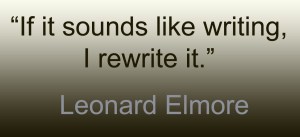
leonard elmore quoteChoose your words carefully, so they express what you want to say clearly, and in as few words as is possible, while still conveying the atmosphere and mood.

  1. Nothing can be included that does not advance the plot.
  2. There can be no idle conversations “just to show they’re human”: conversations must advance the story.
  3. We don’t need a chapter detailing the history behind the core conflict. Let that emerge as needed.
  4. Never use three words when one suffices.
  5. If you’re in love with a passage you wrote because it’s “great writing,” it probably should be cut.
  6. Ax all redundancies. It only has to be said once, unless the character has forgotten it, and that “forgetting” is a core part of the plot.
  7. Adverbs are important. They need to to be chosen carefully and used sparingly.
  8. If you occasionally love to wax poetic, go ahead and write poetry—just not in the middle of your political thriller. You have permission to love action-oriented genre fiction written with lean, mean prose, and still appreciate (and write) poetry.

What I didn’t know when I first began this journey is this: deleting the excess verbiage will add up to large gains, reducing the overall length of the book, increasing readability and (hopefully) the reader’s enjoyment.

9 Comments

Filed under Publishing, writing

#amwriting: The Garden Path

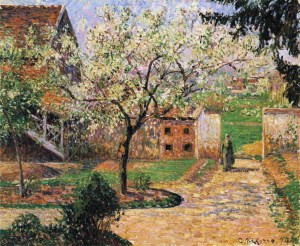
Plum Trees in Blossom, Pissaro 1894 via Wikimedia Commons

Plum Trees in Blossom, Pissaro 1894 via Wikimedia Commons

Today we are looking at the second of two creatively named structural errors that can introduce ambiguity to our work. On Monday we looked closely at “squinting modifiers” and today we are walking the “garden path sentence.”

Most of us are aware that many times a sentence is made stronger by the elimination of relative pronouns, such as that, which, and whom. Often, these words are understood and are therefore unneeded.

However, overzealous new authors recovering from a severe ego-bruising at the hands of a writing group sometimes get a little crazy and slash every instance of the “offending word” from their narrative. Such a knee-jerk reaction is ridiculous and can create the “garden-path sentence.”

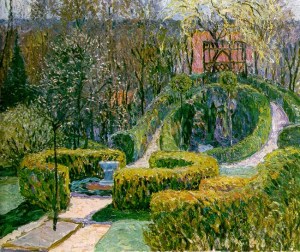
Spring Hedges in Bauerngarten, Heinrich Vogeler 1913 via Wikimedia Commons

Spring Hedges in Bauerngarten, Heinrich Vogeler 1913 via Wikimedia Commons

From Wikipedia, the fount of all knowledge:

“A garden path sentence, such as “The old man the boat,” is a grammatically correct sentence that starts in such a way that a reader’s most likely interpretation will be incorrect; the reader is lured into a parse that turns out to be a dead end or unintended.

“Garden path” refers to the saying “to be led down the garden path,” meaning to be deceived, tricked, or seduced.

After reading, the sentence seems ungrammatical and makes almost no sense, requiring rereading to fully understand its meaning after careful parsing.”

pac-man jpgIn this case, confusion arises because we read like Pac-Man eats: one word at a time, as fast as we can, following the line. We attempt to understand sentences as we are reading them. The “garden-path sentence” begins by taking you toward a particular destination, but midway through it takes a turn for the bizarre.

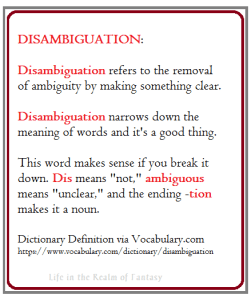
Disambiguation memeThere are two types of garden path sentences.  The first is “locally ambiguous,” meaning that it can be cleared up with minimal changes to the sentence. Many times the addition of a word or punctuation will resolve the issue:

  • “The raft floated down the river sank.”
  • “The raft that floated down the river sank.”
  •  “We told the man the dog bit a medic could help him.”
  • “We told the man whom the dog bit that a medic could help him.”

Wikipedia offers the sentence: “The old train the young fight.”

  • When you add a comma it reads: “The old train, the young fight.” The addition of the comma makes sense of the words.
  • One could also argue that the sentence means “The old train the young to fight.

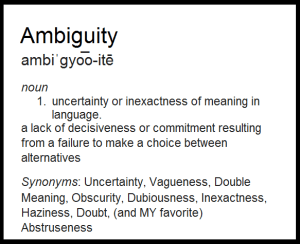
ambiguityThe other type of garden path sentence is “globally ambiguous” because when it is taken out of context the meaning is still unclear no matter how many times you reread it . It requires a complete rewording.

A sentence should always be understandable. Context is extremely important to the meaning of an ambiguously phrased sentence. What happens to a sentence when you take it out of context? It has to stand alone, and still make sense.

Again, Wikipedia offers an example of confusion: “The cat was found by the shed by the gardener.”  This sentence is open to several interpretations. Perhaps the cat was by the shed, or the shed was by the gardener, or both the cat and the gardener were next to the shed. When this sentence is isolated from its paragraph and taken out of context, the meaning is unclear.

Consider a more active phrasing and reword the sentence to say “The gardener found the cat near the shed.”

The way to resolve the garden-path sentence is to

  • Insert a relative pronoun (such as “that”) for clarity.
  • Insert proper punctuation for clarity.
  • Reword the sentence to make the meaning clear.
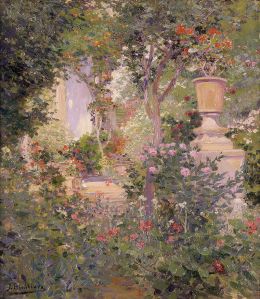
 The Garden of the Author, by José Benlliure Gil via Wikimedia Commons


The Garden of the Author, by José Benlliure Gil via Wikimedia Commons

Readers want to read without bumps and hiccups. Anytime they have to stop and reread something you risk losing them. Sentences that are ambiguous stop the eye.

We never want to introduce haziness into our work, and because we wrote it, we sometimes don’t see that it is confusing. If you have asked a beta reader to read a section of your work, and he flags a portion as being unclear, don’t just look at it and wonder why he can’t understand what seems so clear to you.

You must “parse” it. Tear that passage down to its component parts and find out what it is that the reader doesn’t understand. When you take the offending sentences out of their context, you can see if they will stand on their own. If they don’t, a simple rewording may be all that is needed.

6 Comments

Filed under Romance, writer, writing