Tag Archives: writing craft

#amwriting: son and sir: to capitalize or not?

Tom Hiddleston MemeTerms of endearment are often used in casual conversation. Each has their own implications which are highly dependent on tone of voice, body language, and social context.

They can be fairly impersonal, denoting a friendship. Conversely, they can be intimate, indicating a close relationship.

Used by perfect strangers they can also be patronizing and rude.

These words vary in creativity from the sublime to the ridiculous:

  • dear
  • mate
  • chum
  • darling
  • honey
  • baby-cakes
  • sweetheart
  • sugar
  • wuvvy-dovey

From Wikipedia, the fount of all knowledge: Saying “Hey baby, you’re looking good” varies greatly from the use “Baby, don’t swim at the deep end of the pool!” Certain terms can be perceived as offensive or patronizing, depending on the context and speaker. (end quoted text.)

This brings us to the word “son.” Again, as in so many other aspects of the writing craft, context is everything.

  • “I love you, Son,” said the doting father.
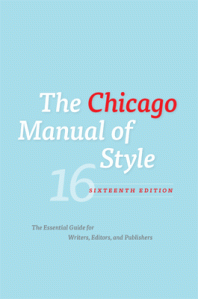
The_Chicago_Manual_of_Style_16th_editionFrom the Chicago Manual of Style, Section 8.35: Kinship names are lower-cased unless they immediately precede a personal name or are used alone:

  • my father and mother
  • Aunt Jane
  • the Bronte sisters
  • I believe Grandmother’s name was Marie
  • Please, Dad, let’s go.
  • She adores her aunt, Maud

But, in the past, instead of a boy’s name, men commonly called boys boy, kid or son, not as a name but as a neutral term of endearment. My interpretation of the word “son” in casual conversation is like this: I feel it should not be capitalized if it is being used to indicate friendship, or in a patronizing fashion.

Wikipedia claims that in an informal setting, such as a pub or gym, the use of terms of endearment is a positive politeness strategy among men. A term like “mate” or “son” shifts the focus toward the friendship existing between the speakers, yet maintains a slight emotional distance.

The problem here is the term “son.” In some cases, it is used when speaking to a man not related, but indicates friendship on the part of an older speaker in regard to a younger companion. I feel that, when used as a neutral form of endearment, the word “son” falls into the same class as:

  • Hand me the scissors, darling.
  • Have a beer, mate.
  • Gloria, dear—how’s your mother?
  • Grab that remote for me, love.
  • How’ve you been, old son?

The above endearments are not between speakers with a deep emotional attachment. They indicate camaraderie and nothing more–they are neutral. Therefore, “son” should not be capitalized if it is being used as a neutral term of endearment when speaking to a person you are not related to.

  • “Okay, son. Tell your ma I stopped by,” said his neighbor.
  • “Get off your high-horse, son,” said man next to him.

As stated above, The Chicago Manual of Style’s preference has always been to lowercase pet names, (which are terms of endearment) but in reality, you can’t go wrong unless you’re inconsistent, since the issue is guided by preference rather than rule.

The word preference means:

  1. a greater liking for one alternative over another or others.

synonyms: liking, partiality, predilection, proclivity, fondness, taste, inclination, leaning, bias, bent, penchant, predisposition

So, if you do choose to capitalize the word “son” when used as a term of endearment, be consistent. But also be aware that it’s not necessary.

Then there is the question of the word “sir.” It is an honorific. From the Chicago Manual of Style section 8.32
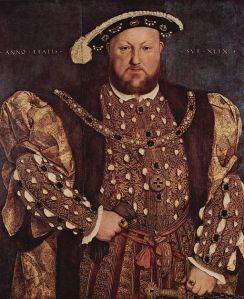
Portrait of Henry VIII (1491-1547) by Hans HolbeinHonorific titles and respectful forms of address are capitalized in any context with several exceptions:

  • sir
  • ma’am
  • my lord
  • my lady

Always capped:

  • Madam Speaker
  • Your Honor
  • Your Excellency
  • Her (His, Your) Majesty; His (Her, Your) Royal Highness
  • The Most Reverend William Ronstadt (Roman Catholic Bishop)
  • Lord John Davies; Lady Mary Shelton
  • The First Gentleman; the First Lady
  • The Right Honourable John Carter

Where king/queen is used as part of someone’s name, it is always capitalized:

  • King Bob, and Evelyn, the Queen of Darkness

Where king/queen is used as part of a general reference it is lower-cased:

  • “Hello,” said the king.

Should one capitalize the word sir when it’s used in dialogue? Which of the following would be correct? “Yes, sir.” OR “Yes, Sir.”

Paul-McCartney-on-playing-Rock-BandIf the reply is to a respected person in general, it is written with no capital, as it’s not a formal name. But you do need a comma just as you would with a formal name:

  1. “Yes, sir.” (General politeness.)
  2. “Yes, Sir Paul.” (Formally agreeing with a knight.)
  3. “Yes, Larry.” (Proper use of comma.)

When writing dialogue: if your speaking character is in the military and the person he/she is addressing has a military rank above them, THEN you must capitalize it.

If you are writing about Sir Paul McCartney’s favorite brand of socks, capitalize it.

You must also capitalize the words “sir” and/or “madam” when beginning a letter or an email. My favorite internet example of this is:

Dear Sir or Madam,

I am writing to inform you that you a related to a Nigerian prince. (Grammar Party Blog)

Just refer to me as “my lady” from here on out. Email doesn’t get better than that!
6 Comments

Filed under Publishing, writing

#amwriting: tips for writing clear dialogue

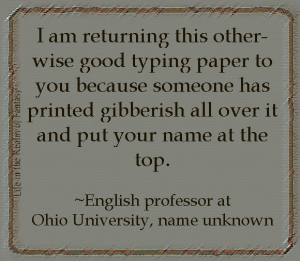
gibberish quoteDialogue can be tricky. Often, in our rush to get the ideas on paper, we have left off quotes, misplaced punctuation, and written interrupted dialogue with inconsistency.

While a certain amount of literary license in dialogue can enrich our work, our dialogue may be too rich with run-on sentences, and not in a good way.

Also, while everyone has read books that inspire them to become writers, some authors never learned how to write the kind of dialogue they envision. They don’t understand the fundamentals and don’t realize how their lack of understanding ruins their work.

Always begin what is actually spoken (dialogue) with a capitalized word, no matter where in the sentence it begins.

  • Mary glanced over her shoulder and said, “I’m sorry. I can’t go with you.” 

However, interrupted dialogue, when it resumes, is not capped, although the rules of punctuation and quotation marks still apply.

  • “I’m sorry to tell you,” said Mary, “but I can’t go with you.”

Direct dialogue is someone speaking to you or someone else and requires quotation marks.

  • I’m sorry. I can’t go with you,” said Mary.

I’m a US author, so I used double quotes, also called closed quotes. The UK usage is different and often uses apostrophes, or what they call inverted commas. Either way, be consistent and make sure ALL punctuation goes inside the quote marks.

Yes, I did say All punctuation. How does one set off a quote from someone else within dialogue? Set it apart with single quotes (apostrophes, inverted commas) and keep it inside the closed quotes.

George said, “When I asked her, Mary replied ‘I can’t go.’ But I’m sure she was lying.”

George said, “When I asked, Mary replied ‘I can’t go.'” Note there are 3 apostrophes there: 1 apostrophe and 1 double (closed) quote mark. This is in keeping with the rule that all punctuation in dialogue goes inside the quotation marks.

Indirect dialogue is a recapping of dialogue that someone previously spoke.

  • When asked, George said Mary couldn’t go.

Note there are no quotes used in indirect dialogue. Also in this sentence, the word that is implied between said and Mary.

Dialogue tags, or attributions, can come before the dialogue, especially if you want the dialogue tag to be noticed. To make them less noticeable put them in the middle or at the end of sentences. In my own work, I want the dialogue and not the attribution to stand out. However, when more than two people are involved in a conversation, I move the dialogue tags further to the front so the reader isn’t left wondering who is speaking.

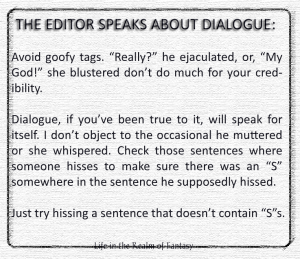
DialogueI’ve mentioned before that I prefer simple attributions such as said, replied, and answered because they are not as likely to stop the reader’s eye. People don’t snort, smirk, smile, or frown dialogue as it is physically impossible. They can say it with a smile, but the smile is a facial expression and does not speak.

Avoid verbal tics like “hmmm…” and “ahhh…” as they just take up space and add fluff to your narrative. When people in real life preface all of their sentences with drawn-out ahs and hmms it can be aggravating to listen to them. Consider how irritating it would be to read it.

Sometimes we have two ideas in a sentence that we think are one, and we connect them with commas.  But closer examination shows they are not.

  • “Hello, sir, we bathed your dog,” she said.

The above dialogue contains a run-on sentence, despite its shortness. We may actually speak it in this fashion, words run together, but for a reader, punctuation clarifies ideas.

The dialogue contains two separate ideas. “Hello, sir,” is an acknowledgment and a greeting. “We bathed your dog,” indicates an action was taken in regard to his dog. It should be:

  • “Hello, sir. We bathed your dog,” she said.
  • When we write our conversation using proper punctuation, it looks natural, and the reader will hear it the way it was intended.

When it’s done right, dialogue is, in my opinion, the best part of the story. It’s where we discover who the characters are, and how the larger events affect them. Conversations show the world as the protagonist sees it. We can take some style and voice liberties with dialogue, and indeed, we should, but adhering to industry standard rules of punctuation ensures your reader can remain immersed in the story, and forget they are reading.

And THAT is what we all hope for.

21 Comments

Filed under Literature, writer, writing

#amwriting and #amrevising: weeding the garden of words

Free-range pansies by cjjaspersonWhen I write a novel, I always end up with a lot of back story. These are details that are important for me to know, but not meant for the actual novel. It’s more a way for me to mentally talk my way through the first draft.

I think of my manuscript as a garden of words, and by the time the novel is complete, it will have been weeded, dug up, and replanted many times.

Every author has their own style, their own way of getting the story down on paper. My style is not the usual way, but it works for me.

The way I do a first draft is this: First, I put together an outline listing all the characters and plot points.  Second, I write the ending and then write the scenes for the large events and turning points. Once those are in place, I start at the beginning and write the story in a linear form, connecting the large events and finally meeting up with the end.

Along the way, my story evolves. A lot of fluff gets added in because I need to sort the story out in my head and writing it down is the way I do that. This fluff is all written in a passive, telling voice, and is part of my road map for creating the first draft–it was put down in that fashion so I would remember it later when I came back to rewrite the scene and turn it into an action sequence or cut it entirely.

I’ll give you an example of a telling sequence from Julian Lackland’s story, which is set in Waldeyn, Huw the Bard’s world. It was written down in this way so I would have a mental picture:

“In Port Lanque, the harbor itself was accessible only by one broad cobbled street, Quay Street, snaking down the steep cliffs to the piers. This wide boulevard ran through the center of town, twisting and turning in a sharp descent down to the piers, and had been kept in good repair by the pirates as it was the only way to move carts and drays down to the ships for off-loading loot. At the very top of Quay Street, in the worst part of town, an immense, rundown palace loomed. Now less than a filthy slum, it was once the home of generations of kings.”

Little or none of that passage will make it into the final manuscript because it doesn’t advance the plot. It was originally written to set the scene in MY mind. But I didn’t throw it away–I kept it in my file of outtakes along with some useful conversations further down the page that may come in handy in a different story:

“You’re wearing a dress, madam, not a crown. How can I be sure you’re the real king?” King Harry eyed the pirate. “You could be any old thief claiming to know how to sail a ship. I happen to like this ship, and I’m not disposed to give her away to some random old man in a dress.”  

That above passage is why I say you shouldn’t be married to your prose. I love the scene and the conversation, and the action that follows, but the plot thread it is part of does not advance Julian Lackland’s story. However, I intend to turn it into a short story set in Waldeyn.

By the time I finish a manuscript, I will have written the beginning three different ways, some names will have changed, and relationships will have evolved. But the major plot points and the ending will usually be the same as I had originally envisioned.  I say ‘usually’ because that was not the case for Valley of Sorrows. I ended up completely rewriting the end of that manuscript.

prnt screen 1 never delete cut passagesI can’t say it often enough: never delete any passage that you have cut from your manuscript. Save it in a separate file labeled ‘outtakes,’ because you may need that information later, or you may be able to turn that work into a short story.

A lot of authors use Scrivener for this, and it seems to work for them. I find it simpler to just copy and paste the work into a new file and save it in my outtakes for that particular novel. That way it’s out there in my dropbox or google drive and available no matter where I go or what happens to my computer.

Short stories are the bread-and-butter of many authors. You get paid a small sum for them, and your author name is published in one more place. The small story you toss out there could attract new fans to your other work.

Our work starts out full of passion and promise. Like a garden, it can grow wildly out of control. When you can’t see the flowers for the weeds, the garden must be cut back and pruned. The wild weed-words must be pulled in order for the reader to enjoy the real story.

Sometimes those weeds produce beautiful flowers when you get them into a different garden.

2 Comments

Filed under Self Publishing, writer, writing

#amwriting: the author’s voice

The sense of style steven pinkerAnyone who is a member of a writing group is regularly beaten over the head with certain basically good, but occasionally clichéd, rules. Improperly applied, this mindless interpretation of proper grammatic style can inhibit an author’s growth.

These rules are fundamentally sound, but cannot be rigidly applied across the board to every sentence, just “because it says so in Strunk and White.” I rely on the Chicago Manual of Style, but I also understand common sense.

English is a living language. As such it is in a continual state of evolution and phrasing that made sense one-hundred years ago may not work well in today’s English.

We may be writing a period piece, but we are writing it for modern readers.

You can split an infinitive: it is acceptable to boldly go where you will.

You can begin a sentence with a conjunction if you so choose. And no one will die if you do.

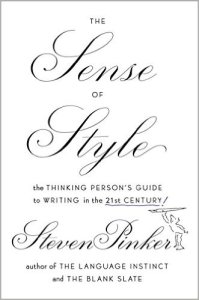
Stephen Pinker discusses many rules in his controversial book, The Sense of Style, and finds that some of them no longer make sense.

For example, Pinker points out that “The prohibition against clause-final prepositions is considered a superstition even by the language mavens, and it persists only among know-it-alls who have never opened a dictionary or style manual to check.” 

He notes that rigidly following “the rules” would have you doing silly things like turning “What are you looking at?” into “At what are you looking?”  I don’t know about you, but for me the first example is preferable.

In the example, the word at is a preposition, and placing it after looking makes it a clause-final preposition.  Such a construct is technically a no-no, but I suggest you break that rule.

Stardust, Neil GaimanWe are constantly told that we need to make our verbs active, rather than relying on passive constructions, and for the most part, this is true. But Pinker reminds us that “The passive is a voice and not a tense.” There are times when the use of passive phrasing is appropriate.

Consider the difference between ‘the cat scratched the child’ and ‘the child was scratched by the cat.’  The second sentence is written in the passive voice, and in this context the active voice is the one I would choose because it is simpler and less fluffy.

Pinker agrees with me that there are contexts in which the passive is preferable. Quote from The Sense of Style: “Linguistic research has shown that the passive construction has a number of indispensable functions because of the way it engages a reader’s attention and memory.”

And in writing, context is everything. 

For most genre work, editors push for active voice, but truthfully, mainstream fiction and literary fiction can use the passive voice and still sell boatloads of books. Some of the most beautiful prose out there in genre fantasy mixes passive voice in with the active, and when done right  it is immersive.

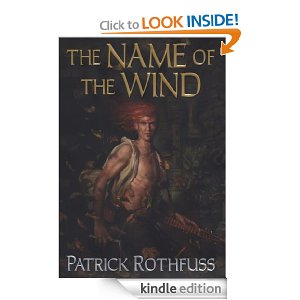
name of the wind -patrick rothfussPatrick Rothfuss’s Name of the Wind is one example, and Neil Gaiman’s Stardust is another.

These books are best sellers because both Rothfuss and Gaiman understand how to craft prose that mingles passive and active phrasings, drawing us into their work. They choose when to use passive phrasing, and apply it appropriately so the narrative is a seamless blend of properly constructed sentences chosen to reflect their distinct voices.

The modern prohibition against passive phrasing exists for a reason: improperly and excessively used, the passive voice can weaken your narrative.

Knowledge of grammar and sentence construction is critical if you are an author: Sloppy grammar habits show that your work is badly crafted.

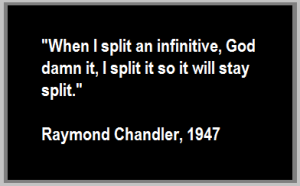
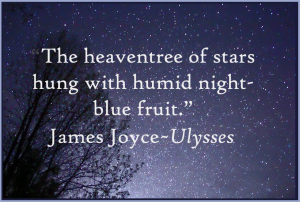
Your voice is the way you habitually phrase things despite your vast knowledge of how grammar is correctly used. Take a look at the great authors: Raymond Chandler, Ernest Hemingway, F.Scott Fitzgerald, and James Joyce: these authors each had such a distinctive voice that when you read a passage of their work, you knew immediately who you were reading.

They ALL broke the rules in their work and were famous for doing so.

Raymond chandler quote split infinitivesHowever, they understood the rules they were breaking and broke them deliberately and selectively in the crafting of their narrative.

Imagine a story set in an expensive restaurant. This story revolves around a marriage that is disintegrating. The couple, Jack and Diane, dine in silence. The food is important, but only because of what it represents. How do you convey this?

The steak was well-prepared and melted in Jack’s mouth. Nevertheless, Diane wielded her knife like a surgeon, cutting her meat into tiny, uniform chunks, chewing each bite slowly before swallowing. Jack imagined her carving his heart similarly, chewing it carefully and then spitting it out.

800px-Night_Sky_Stars_Trees_Quote“The steak was well-prepared and melted in Jack’s mouth” is written with a passive voice, and that is okay. The important thing is Jack’s observation of Diane and her mad knife skills. You don’t need to say “The chef had prepared the steak perfectly.” Unless he is having an affair with Jack or Diane, the chef who prepared the tender steak is not important and doesn’t need to be mentioned.

Steven Pinker has some words of wisdom for would-be editors: “It’s very easy to overstate rules. And if you don’t explain what the basis is behind the rule, you’re going to botch the statement of the rule—and give bad advice.”

Knowing what the rule is and why it exists allows you to choose to break it if that is your desire.

Writing style is a combination of so many things. It is how you speak through your pen or keyboard. Craft your prose with an eye to what is important to your story, and say it with your voice. With that said, your voice should not be so distinct and loud that it makes your prose obnoxious. A good editor will understand the difference and guide you away from bad writing, helping you find your voice in such a way that your work will be a joy to read.

8 Comments

Filed under Fantasy, Publishing, writing

#amwriting: L.E. Modesitt Jr.: creating depth without dumping info

Fall of AngelsOne of the most difficult aspects of writing is creating the sense of history without resorting to an info dump. It is a fine line to walk, because too much information will cause the reader to stop reading, and not enough will also make them close the book. What we are looking for is a happy medium, a narrative that incorporates some history, but only the bits that are needed to move the story forward.

That ability to create the past while describing the present is one that author L. E. Modesitt Jr. has, and is shown to its best advantage in his masterpiece Fall of Angels. Written in 1997, this is the sixth installment in one of the most enduring fantasy series of modern times, The Saga of Recluce.

This saga takes place over many generations and explores both sides of the conflict, with not usually more than two books dealing with a particular protagonist.

Modesitt Jr. knows his world. It is clear when you read his work that he understands the environments and societies he is writing about, and he knows the moral values of the three cultures who clash in this series of books. In Fall of Angels he takes the reader back  a thousand years, to the origins of the conflict that is explored in the previous five books, but the world the angels find themselves stranded on feels familiar–because the author knows every aspect of his world.

In this series as a whole, Modesitt Jr. examines two radically different magics–the black of order vs the white of chaos. This is the central theme of each tale in the saga, and the protagonist is either of the black or white persuasion. In a few books there is a grey area of magic where the protagonist embodies both, but always the price of magic and the responsibility of those who wield it is a central theme in this series.

In Fall of Angels, Modesitt explores the side of order, the black magic of healing and building.

The story opens on the bridge of a battle-cruiser, the Winterlance. The crew is human, and are in the military service of the UFA, which is comprised of the planets of Heaven.

The crew of the Winterlance is from the various cold planets of Heaven. Most are from Sybra, the coldest planet, but a few are from Svenn, a more moderate planet. This limits where the Angels can comfortably live, making high altitudes their favored homes.

They are about to enter a battle from which they will likely not return, fighting  against the Rationalists, the humans from warmer planets, and with whom they have been warring for thousands of years. The Rationalists are an extremely patriarchal society, and are also known as Demons.

In the opening pages we meet a crew that, by happenstance, is made up of women, with only three male crew members. Nylan is the ship’s engineer, and, as are all the officers, he is connected into the ships neuronet, the mental command center that completely controls the ship and its environment.

Ryba is the ship’s captain, and while she and Nylan have a sexual relationship, there is no doubt that she is in command. I didn’t say romantic, because though they sleep together and care for each other, there is no romance involved.

The energies expended during the battle are such that the Winterlance is thrown into an alternate universe, above a strange planet. With no way to return, they are forced to land.

Unfortunately the first thing that happens is they have landed on a world previously colonized. It probably happened in the same way, but by the Rationalists of the warmer worlds of Hell. The lord of the land immediately attacks them, and the conflict is on.

All Angels are not equal. Nylan is half-Svenn. The Sybrans cannot take the heat of their new world and are pretty much trapped in the cool mountains, but he can go lower, into the warmer areas, although he too suffers from the heat.

While the maps in this series are not very good, or really even useful, I feel sure the author must have a file with worldbuilding information for this series in it. Some forethought and planning went into creating Recluce, Candar, and the other continents that become locales for action in this series.

One type of tree is deciduous, with triangular gray leaves, and only loses half of them during the winter, the others curling up and remaining on the tree though the bitter cold. He knows the plant-life, and the animals native to this new world, and he knows the terrain and doesn’t contradict himself over the course of his narrative.

Modesitt Jr. shows us all of this, without resorting to telling. Information about the worlds of both Heaven and Hell and how the struggle to survive on the world of Recluce affects the marooned crew is doled out as needed, in conversations. The knowledge is dispensed organically, in such a way that the reader doesn’t see it as backstory.

Modesitt Jr. takes the concepts of traditional gender roles and twists them inside out. If she hadn’t been thrown out of her universe, Ryba would never have had the chance to rise any higher than she already had, as women are considered technically equal, but there is a glass ceiling that women rarely break through.

In their new world, Ryba makes sure the three men know they are now the ones with lesser stature. After viciously trouncing him bare-handed when he challenges her, Ryba coldly tells Gerlich, “I could amputate both your arms and you would still retain your stud value.” This comment is all we need: Ryba is determined to build a culture where women have all the power and men are simply a means to reproduction. She is deadly, calculating, and will ruthlessly use anyone to achieve her goal.

Her actions show us this. 

Nylan is a strong man but he is not a leader, and feels like he has no other options, other than to march along with plans Ryba sets down for them. Using their failing technology he forges the weapons and builds their tower so they can survive the first winter in their mountain home. Ryba develops a talent for prophecy and becomes a slave to ensuring her own visions come true, while Nylan develops the foundations of order magic.

the chaos balance l.e. modesitt jrAs events unfold and his relationship with Ryba disintegrates, he grows confused and unsure of what to do. He is a man with a temperate mind, believing in equality with neither sex having the upper hand. A few of the women feel the same way he does, but all are unwilling to go against Ryba, believing that while she is hard and unforgiving, she is better than the society created by the Rationalists, where women are property.

The characters themselves tell us this in their conversations, so the author doesn’t have to dump information.

Modesitt Jr. gives us a morality tale, as true speculative fiction does. But, rather than spelling everything out, he dishes it up through actions and conversations in such a way that the reader makes the connections themselves. While in many of his books Modesitt Jr. can be too cryptic, giving the reader little to no backstory to explain things, in Fall of Angels he strikes the perfect balance between too much information and not enough.

This balancing act between too much backstory and not enough creates a depth to the story that draws the reader in, suspending their disbelief, and holding their attention for the entire novel.

Comments Off on #amwriting: L.E. Modesitt Jr.: creating depth without dumping info

Filed under Publishing, writing

#amwriting: The second draft: effective revisions

My Writing LifeI am in the process of making revisions on Valley of Sorrows, the third book in the Tower of Bones trilogy. I’ve had trouble with this manuscript, not because I fell out of love with it, but because so many great characters have emerged that I lost the thread of the story.

Because I knew I had lost my way, I sent it to a friend, Dave Cantrell, who has done a structural edit and given me the pointers I need to get this back on track.

What happened to derail VOS is this: I lost track of the original story arc.

This is not an uncommon problem–writers tell me all the time how new and intriguing characters pop up and take their tale in a different direction.

Sometime this works out well. Other times, not so much. I have floundered for two years on this novel.

What Dave did at my request was far more intensive than a beta-read. He really went deep, looking at it from the standpoint of a reader and an editor, and asking himself what worked, what didn’t, and analyzing why.

So right now I am taking each chapter on an individual basis and looking at Dave’s comments. Every comment is designed to let me know why a particular plot point did or didn’t work, and where it became confusing. He was able to see where I lost the overall story arc and his comments give me a road-map to guide my efforts in building tension and ending this series with a strong finish.

I’ve said before that making revisions is not editing. Revising the first draft is a necessary part of the process that will get you to the editing stage.

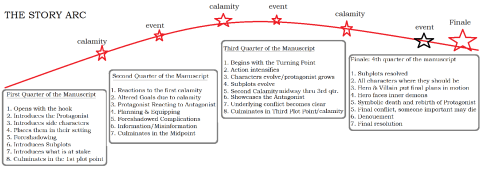
Most authors understand that there is an arc to the overall novel–the Story Arc  which  consists of :

  1. Exposition, where we introduce our characters and their situation.
  2. Rising Action, where we introduce complications for the protagonist
  3. Climax, the high point of the action, the turning point of the narrative
  4. Falling Action, the regrouping and unfolding of events that will lead to the conclusion
  5. Resolution, in which the problems encountered by the protagonist are resolved, providing closure for the reader.

The Story Arc

As I said, most of us understand this arc, but we can easily lose track of it when we are in the throes of writing our first draft.

At the 2014 PNWA Conference, in his seminar on the arc of the scene, author Scott Driscoll explained how the main difference in the arc of the scene vs the overall arc of the novel is this: the end of the scene is the platform from which your next scene launches.

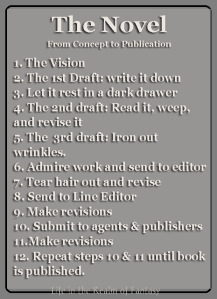
The Novel Meme LIRFSo as I am revising I am keeping in mind:

  1. Each chapter is a scene.
  2. These scenes have an arc to them: action and reaction.
  3. These arcs of action and reaction begin at point A and end at point B.
  4. Each launching point will land on a slightly higher point of the story arc.

I had lost the plot of this novel, so first I had to remind myself just what the series was about:

  1. This series deals with Edwin’s story.
  2. He is separated from his wife and child because of his task on behalf of the Goddess Aeos.
  3. Completion of his task takes us to the 3rd plot point of the novel
  4. Hunting  the acolyte of Tauron and the final battle in Aeoven resolves the story
  5. No conversation can happen unless it advances the plot of this story. EVERYTHING that does not pertain to this story can be cut, saved, and used later.

I have a goal of finishing this by the end of February. When I submit this to my editors, there will be more revisions–that is a given. But because of the work Dave has done, it won’t be the arduous rewrite it would have been.

8 Comments

Filed under Self Publishing, writing

#amwriting: Taking the #NaNoWriMo novel to the next level

NaNo-2015-Winner-Badge-Large-SquareYou took a leap of faith. You’d had this idea for a novel rolling around in your head for years. Someone told you about Nation Novel Writing Month, and on the spur of the moment you joined.

Then you were committed. Every day, no matter what disaster was occurring on the home-front, you sat down and wrote at least 1,667 words.  Some days it was hard, the words just weren’t there. But you persevered and some days you were on fire–everything flowed. Your story took you places that amazed you.

Now it’s November 30th and you have your 50,000 word manuscript, and the all-important winner’s certificate from NaNoWriMo dot org!

But now you don’t know what to do next.  Whatever you do, DON’T SHOW IT TO YOUR ADORING FANS JUST YET. This is not the time to ask for feedback unless you want to be lied to. They’ll look at you with a possum-in-the-headlights smile, and say “Wow…this is really…different.”

What they’re really thinking is, “Holy s**t. This disjointed, hokey mess sucks.” That friend will poke needles in their eyes before they read another piece of your work again.

What you must do is put it in a drawer for a month or two. Write some short stories, or start a new novel. You have to step back from this in order to see what need to be done with it, and you can’t do that right now. SO–in January or February:

First let’s talk about that manuscript.

When you were writing it, you were concerned about increasing your word-count. Someone told you not to use contractions, as the word ‘doesn’t’ counts as one word while ‘does not’ is two. Foolishly, you did just that.

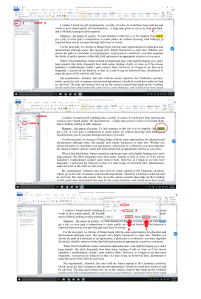
LIRF Global Search all steps

Global Search Print-Screen

Now you must go through and make that awkward, stilted phrasing into contractions. Do a global search:

  1. press control+F
  2. type the word you are looking for in the search box
  3. click on options
  4. click on replace
  5. in the ‘replace with’ box type the word you want to replace the wrong word with
  6. DO NOT replace all. Go to each instance of the words individually and replace them after you have seen the context of the sentence they are in.

Second, let’s look at how we are telling the story. In the rush of the first draft, of getting all our thoughts about the story-line down, we use a kind of mental shorthand and write things like:

Erving was furious.

Martha was discouraged.

Readers don’t want to be told how the characters felt—they want to see.  When you come across this in your first draft, now is the time to follow those road signs and expand on the scene a little. Instead of telling the reader that Martha was furious, you will show this emotion.

Martha stamped her foot.

Erving’s face went white, his body shook with rage.

When you go back through your manuscript, change each ‘telling scene’ to a ‘showing scene.’ When you show the reader the emotions it deepens the story and enables the reader to be involved.

Dialogue

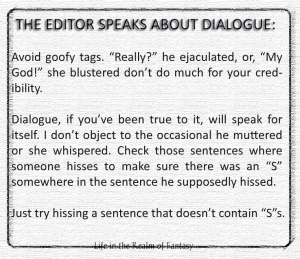
Third: too many dialog tags. When only two characters are in a scene readers should be able to keep track of speaker ID with ease. In those situations, speech tags are rarely, if ever, needed.

Instead of using a speech tag, consider inserting an action beat (a burst of action) before a line of dialogue. This identifies the speaker and offers opportunities for you to deepen character chemistry, conflict, and emotions.

Annie felt something trickling down her cheek. She wiped it, and her hand came away with blood. Her companion was covered with gore, but at least he was in one piece. “John, are you okay?”

 “Of course.”

 She reached toward his shoulder, toward the torn shirt, the ugly gash—but something held her back. “Your arm. I thought maybe ….”

 “You thought it was bad.” 

 The look in his eyes forced her to glance away. “Well, yes. But if you say you’re okay….” Her face burned.

John bent down, digging around in the medical kit, hiding his grin. His thoughts ran wild, but he said only, “Let’s get ourselves doctored up. We’ve a long way to go.”

Replace those empty speech tags with an emotion-infused narrative. However you must remember that the reader needs to have clear direction as to who is speaking to whom, otherwise you will lose them. Don’t make more than a few exchanges without dialogue tags, and make those you do use simple. Said, replied–we really don’t need to get fancy.

dump no infoFourth: Too Much Information. This is my personal bugaboo. As I am writing I spill my guts and write all the background as I am thinking it. The reader doesn’t need to know everything up front. These passages are really notes telling me as the author what direction this tale is supposed to go.

My beta readers always tell me the reader doesn’t want to read the history of the world–they want to get to the action. THEY ARE RIGHT!

Fifth: Make sure you have a good story arc:

  1. Exposition, where we introduce our characters and their situation.
  2. Rising Action, where we introduce complications for the protagonist
  3. Climax, the high point of the action, the turning point of the narrative
  4. Falling Action, the regrouping and unfolding of events that will lead to the conclusion
  5. Resolution, in which the problems encountered by the protagonist are resolved, providing closure for the reader.

The Story Arc

SO before we show this novel to anyone, we have a lot of work to do.

  1. Check for contractions
  2. Check for scenes that are telling and not showing
  3. Take a look at the dialogue tags and make action speak for you.
  4. Carve back the info dumps–keep what moves the story along and save the rest in a separate file.
  5. Make sure you have a good story arc.

Let this nano novel rest for several months before you do anything with it. Start a different novel, and come back to this one later. When you look at that original first draft with fresh eyes and begin looking for these things, you will be amazed at how well your novel will begin to come together. During this rewrite, your characters will grow and develop, and your plot will really begin to move along. This is when you really write your novel.

4 Comments

Filed under Humor, Publishing, Uncategorized, writing

#amwriting: consider the weather

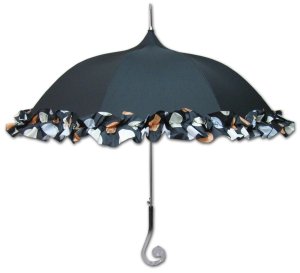
81UuqzVF-1L._SL1500_Something about the  wind-driven rain-bullets here in our part of the world can be death on umbrellas, even expensive ones. Even the cutest umbrellas frequently end up in street-corner trash-bins, ending their days as the tattered and broken relics of impulse purchases.

Despite the carnage, I feel compelled to keep buying umbrellas, feeling sure the next purchase will be the one–the true umbrella for all seasons, able to withstand 40 mph winds and sideways rain.  So far, the decidedly unromantic golf umbrella is the bumbershoot I carry.

But while golfers look fine carrying them, I long for beauty. I just know that my desire to have some cheery vestige of spring in the form of a floral print over my head will somehow work out and I will manage to remain both dry and stylish.

And this brings me to my point: You may not realize it but weather is a huge factor in your characters’ ability to go from point A to point B. For those of us who are writing fantasy, our characters are likely to be riding horses or walking. Weather will be a large part of what impedes them, or enables them to travel faster than they had planned.

Traveling on foot in the dark during a heavy storm is extremely difficult. Prior to the advent of the automobile, people didn’t travel during storms unless some terrible reason forced them to.

helly hansen raingear comboWeather is something I understand. In the 1980s, newly divorced and unqualified for any well-paying job, I worked for a Christmas tree grower. In the summer, we started work at 5:30 am so we could be finished and out of the field by 2:30, during the hottest part of the day.

I’ve never been a fan of using too much sunscreen—it’s greasy and full of things I can’t pronounce, it gets in your food, and I’m not so sure eating it is good for you. So, in those days I wore light, long-sleeved shirts to keep the sun off me, and wide-brimmed hats that kept the sun off my face. That is old-school, low-tech farm garb, and is how I still roll when it comes to dealing with the sun.

But when November arrived, we field hands were still working outside. With the advent of a Northwest Winter, we wore layers, 2 pairs of wool socks, barn-boots, and raingear. Good old Helly Hansen—his fine product kept me dry and warm while I worked to bring Christmas trees into every home. But, working outside in the cold and rain requires a certain amount of preparation, or you can become hypothermic, and unable to function.

Howey Christmas Tree Baler

Howey Christmas Tree Baler via Flicker

Every year, when cutting-and-baling season started we would have a new crop of people who had never worked out of doors, and who didn’t understand the sense of investing in long-johns and raingear. The company offered decent gear (boots, gloves, and raingear) at reasonable prices, but many would not  spend the money, refusing to believe that it was a war the weather would win.

So I discovered that if you were going to work outdoors year-round, you needed better quality gear than the company offered. In 1982, the best gear available was: LL Bean thermal underwear, and Helly Hansen foul-weather gear, and the mail-order catalogue was the place to get it.

My point with this is that if your novel’s setting is a low-tech society, weather affects what your characters can do. It affects the speed with which they can travel great distances, and it affects how they dress. It affects their horses, and that is a serious point to consider.

Medieval society had ways of dealing with the weather when they had to be out in it, and the internet is your friend. In medieval times, people of England, Wales, and Ireland didn’t have to deal with extreme temperatures the people of Northern Europe experienced in the 17th and 18th centuries, as it was a warmer time. However, they did get some occasional snow and cold in the winter, and at times they suffered heat waves during the summer.

How did they protect themselves against the weather? Here are several good websites for research:

Sarah Woodbury, Romance and Fantasy in the Middle Ages

Medieval Gloves, etc.

Castles and Manor Houses

In a cold, wet winter, a simple shawl won’t cut it. Layers are critical, and the materials they would use are simple and readily available—linen, and wool.

414-2-blue-robed-santa-claus-christmas-vintage-postcardIn a lower-tech society fur-trapping is a common way of earning money, but only the wealthier classes, merchants and nobility, can afford to buy those furs.

The average medieval agrarian society will have access to fleeces, though, especially if they are a Northern European type of society. Also, in the more urban centers of a low-tech society, the average person’s winter garments, hooded cloaks and gloves, and even bedding would be made of thick wool, layered and felted.

Wool has been a winter mainstay since humans first began making cloth. Some garments will be made of heavy canvas, or oil-cloth. Oilcloth, close-woven cotton canvas  or linen cloth with a coating of boiled linseed oil,  was a product available from the late middle ages on.

Clothing and cold weather gear will make their appearance in relatively few sentences in your novel, but a little research on your part regarding what technology might be plausible in your society will lend a sense of realism to your work.

2 Comments

Filed under Publishing, Uncategorized, writer, writing

#amwriting: creating religion within the context of the tale

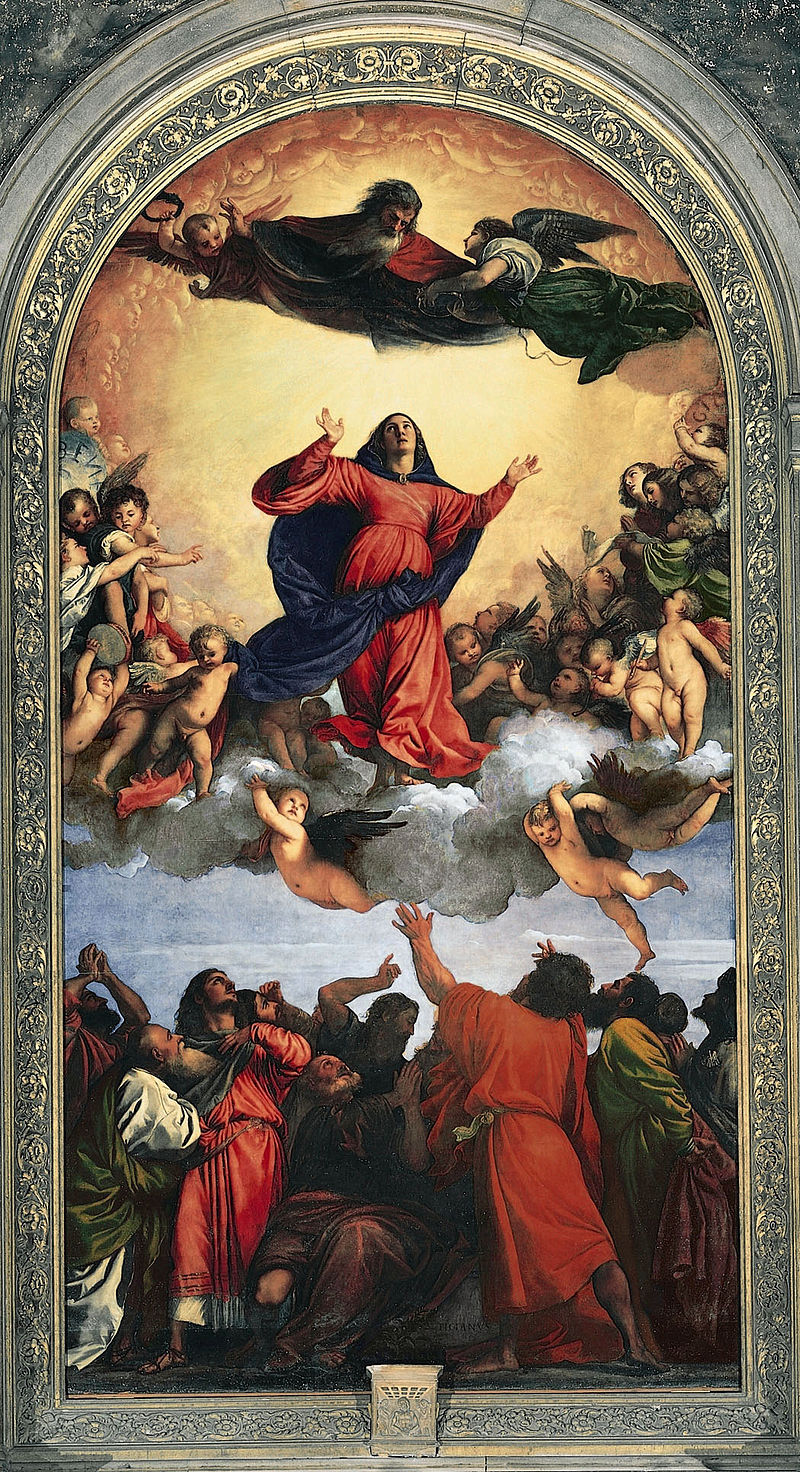
Assunta, by Titian, 1516-1518, via Wikimedia Commons

Assunta, by Titian, 1516-1518, via Wikimedia Commons

One thing we fantasy authors must occasionally deal with is developing religions within the context of the tale.

Most of what we will discuss here won’t actually make it into the written pages of your tale, but if you don’t have a good understanding of what you are writing about, you will inadvertently introduce discrepancies into your tale.

First, ask yourself “why does this religion matter?”  If it doesn’t matter, it doesn’t belong in your tale.

However, when you have a heavenly power-struggle, you have some intriguing opportunities for mayhem.

Are there many gods and goddesses? What is their relationship with each other and how does it play into your story?

If you choose to create a religion as a key plot point, here are some questions to ask:

  1. How central to the life of the protagonist or antagonist is religion? Is the protagonist a member of the priestly class, perhaps a priestess or priest of a particular god or goddess?
  2. What does the protagonist gain from following this deity?
  3. How jealous is this deity?
  4. What is the protagonist/antagonist willing to do for their faith? Will they die for their deity or is it a more abstract religion?
  5. The priesthood—who can join?
  6. Can only the nobility rise in the priesthood, or can anyone with the ability to learn gain power within the organization?
  7. How do the nobility and the priestly class get along? Do they have a good accord or are they jostling for power?
  8. And within that religious organization, who has the most power?
  9. What does that person do with their power?

How important is your religion politically? In Rome, the church was central to their government, in some cases having more power than the ruling nobility. During the Middle Ages, Rome slowly fell under the political control of the Papacy, which had settled in the city since the 1st century AD. In the 8th century, Rome became the capital of the Papal States, which lasted until 1870.

You don’t have to re-invent the wheel here–history is full of great ideas to draw upon.

A_Glass_of_Wine_with_Caesar_Borgia_-_John_Collier

Painting by John Collier, “A glass of wine with Caesar Borgia” via Wikimedia Commons

Consider the Borgias–Wikipedia, the fount of all knowledge says this about them: Especially during the reign of Alexander VI, they were suspected of many crimes, including adultery, incest, simony, theft, bribery, and murder (especially murder by arsenic poisoning). Because of their grasping for power, they made enemies of the Medici, the Sforza, and the Dominican friar Savonarola, among others. They were also patrons of the arts who contributed to the Renaissance.

See? Even George R.R. Martin knows that the renaissance offers great opportunity for good plot twists in your fantasy project.

Now let’s examine the political environments of the medieval city-states of Venice, Milan, Florence, Genoa, Pisa, Siena, Lucca, and CremonaRodney Stark, an American sociologist of religion, proposes that the city-state was a ‘marriage of responsive government, Christianity, and the birth of capitalism’ as we know it. He argues that these states were mostly republics, unlike the great European monarchies of France and Spain, where absolute power was vested in rulers who could and did stifle commerce.

It has been suggested (in Wikipedia, the fount of all knowledge) that by keeping both direct Church control and imperial power at arm’s length, the independent city republics of medieval Italy prospered because their commerce was based on early capitalist principles. The church was still involved in their daily lives, but this slight, deliberate separation of church and state ultimately created the societal conditions that brought about the artistic and intellectual flowering of the renaissance.

And for you, the author, understanding the commerce and economics of your fantasy society is extremely important, so that inconsistencies don’t get introduced. The reader won’t care, and doesn’t want the background info, but you need to know it.

If your protagonists are poor, why are they poor? Is poverty widespread, or is it only the one family? Where is all the money–is it in the hands of the church or is it in the hands of the middle-class? If it’s in the hands of the church–you’ve a good plot-point to work with.

Thus if religion of some sort is an integral part of your work, you as the author must have a good knowledge of what the influence of that institution is, the structure of the priesthood, the power they wield in society at large, how (or if) they control the economy, and how this organization is viewed by the ordinary citizen.

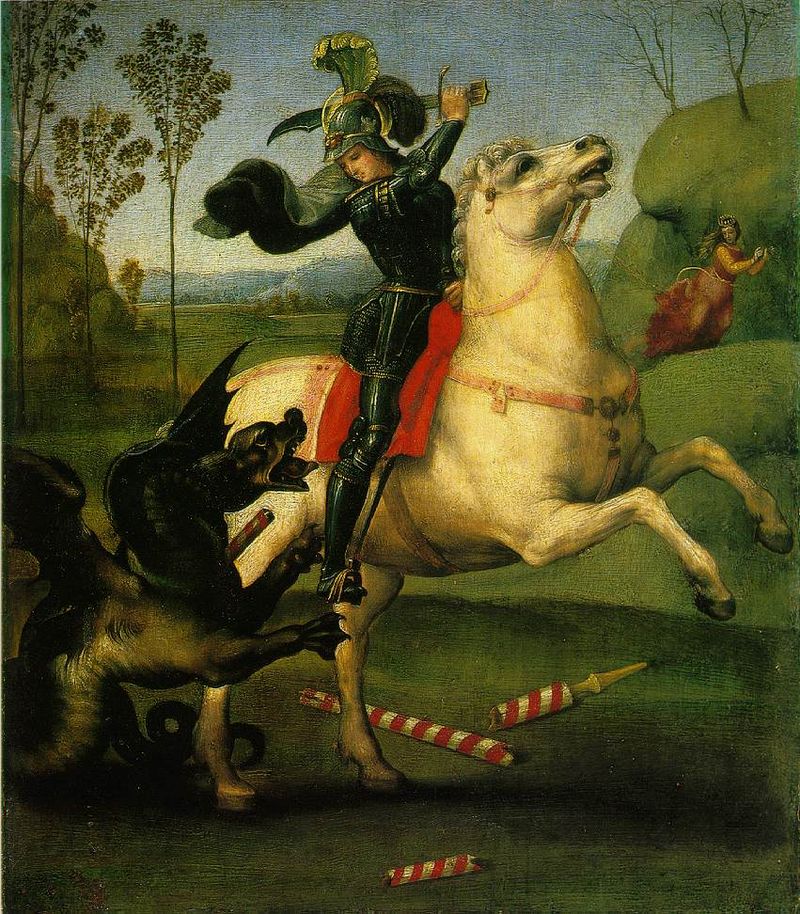
St. George and the Dragon, Raphael via Wikimedia Commons

St. George and the Dragon, Raphael via Wikimedia Commons

Many authors avoid this altogether, by having only a vague mention of religion, simply mentioning a connection with a particular deity as the reason for the ability to use and control magic.

Others make religion and opposing religions the foundation of their works. How you handle religion in your manuscript is up to you, but if you make it a central part of your tale, I suggest you create a document in which you establish the basics of your religion(s) clearly. Update it as the rules evolve, which they certainly will do over the first two drafts of your novel. During your writing process, refer back to this document regularly.

The reader doesn’t care about those details, and will put the book down if they are included. But if you don’t know what you are writing about, can’t remember what you wrote three chapter ago, and contradict yourself too often, your reader will lose the ability to suspend his disbelief.

Keeping the reader immersed in the tale, forgetting that it is only a fiction is the primary goal every author wants to achieve.

2 Comments

Filed under Fantasy, Publishing, Uncategorized, writing

#amwriting: the external eye

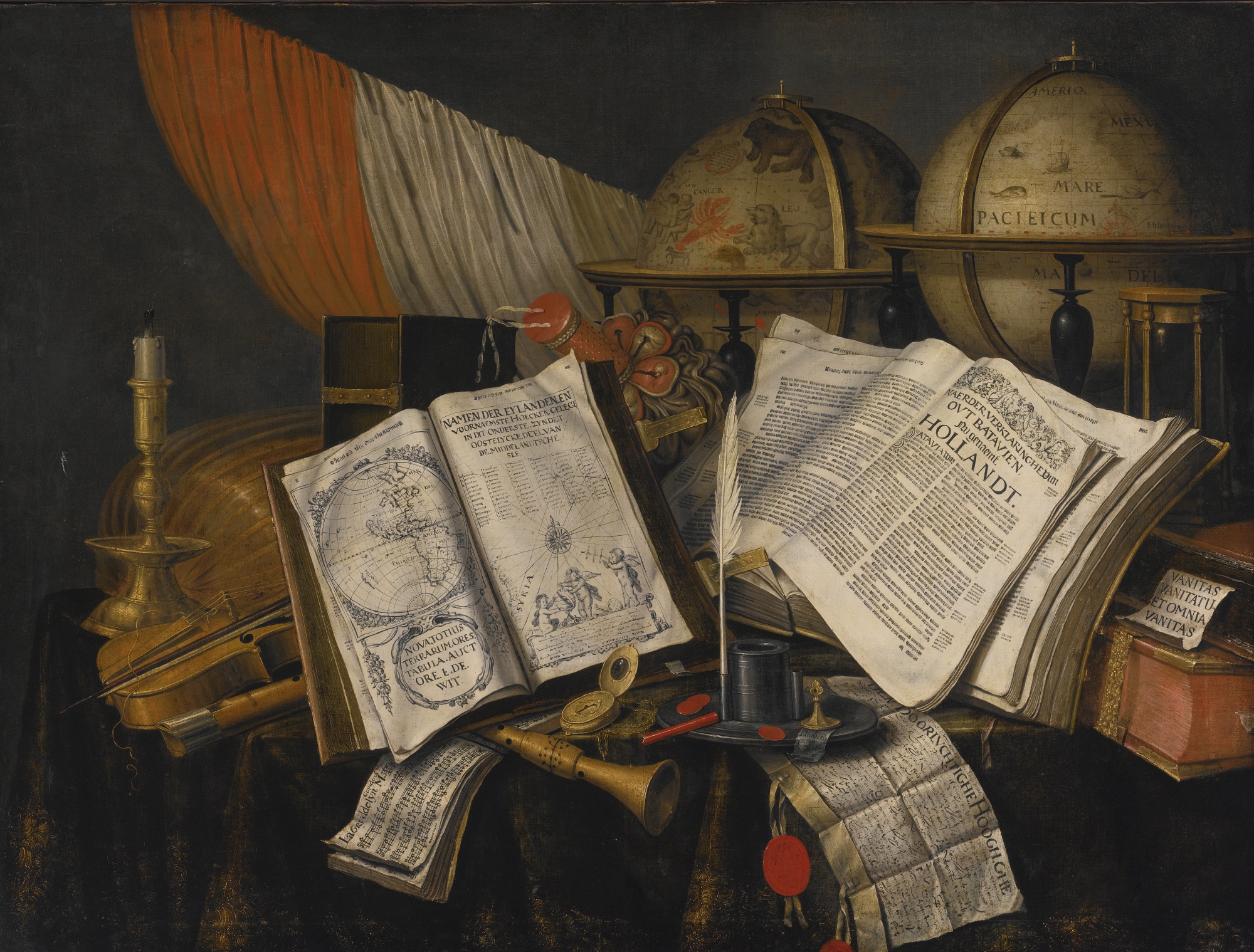
EDWAERT_COLLIER_VANITAS_STILL_LIFEMore people than ever are writing books. In today’s marketplace, every author must find ways to get his/her manuscript in as perfect shape as they can before they begin shopping for agents and publishers.  At every seminar I attend this one fact is stressed most firmly.

What this tells me is that agents and editors at the large publishing houses see so many submissions on a daily basis that they don’t have time to do more than look at the first page or two before deciding to look further. If it is not formatted to industry standard, or if it is a rough draft, it goes into the trash, based on that quick glance. (See my post, How to Format Your Manuscript for Submission.)

Therefore, we make our manuscript as good as we can before we send it off to an agent or a large publishing house, or take the plunge and self publish. To this end, during the second or third draft we may consult what has become known as the beta-reader, volunteers who read our work, knowing it is in its infancy.

You can find many good freelance editors who offer this service, but I do recommend you ask them what it involves and what kind of report you will get back before you commit your funds to it. I can also recommend Critters Writers Workshop, a free author-driven service. Or you may have a spouse or good friends who will help you with this.

A word to the wise: Editors and other authors make terrible beta readers, because it is their nature to dismantle the manuscript and tell you how to fix it.

But what if you don’t have the luxury of a reader who both likes the kind of work you write and who also is willing to spend the time reading your work?  Consider asking them to read a selected chapter, instead of asking them to read the whole thing.

I suggest this, because reading the rough-draft of an entire novel is a huge commitment to ask of someone. It is not reading for pleasure, although we hope they enjoy it.

Give your reader this list of questions, and ask him/her to please answer them, explaining that you can’t continue until you hear back from them:

  1. Were the characters likable?
  2. Where did the plot bog down and get boring?
  3. Were there any places that were confusing?
  4. What did the reader like? What did they dislike?
  5. What do they think will happen next?

You need a reader who reads your genre, reads fairly quickly, and won’t devolve into an editor.  Questions two and three are the most important: Where is it boring, and where is it confusing? Having it read in small chunks will give you a good idea of what you need to do with the ms as a whole.

I usually send my  manuscripts  in short pieces to my trusted crew when I need to know if I am on the right track. But the final ms in the Tower of Bones series is different. I hope to have it ready for publication by spring, so I have taken the plunge and sent Valley of Sorrows to David Cantrell for a structural edit. Dave and I have worked together on many projects.

Structural editing is digging deep. This is a tricky novel, because it tells two separate but entwined story-lines, Edwin’s and Lourdan’s, so I need an interested, but surgical, eye on it before I begin the final revisions. Dave has read Tower of Bones, and knows the world, the magic system, and the characters.

I hear you asking, what if he asks me to cut something I think is an integral part of the piece? I will have to decide what to do after I:

  • Re-read the section in question: Is it garbled? Was my intention not clear when I wrote it?
  • Look at the section in the context of the entire manuscript: Will losing this section change the story in a way that I don’t want? Or will cutting that section allow a more important point to shine?
  • Decide how married I am to that plot point. Sometimes divorce is the only answer.

In my own work I have discovered that if a passage seems flawed, but I can’t identify what is wrong with it, my eye wants to skip it.

But another person will see the flaw, and they will show me what is wrong there. That is why I rely on the external eye, and work with a structural editor.

4 Comments

Filed under Literature, Publishing, Uncategorized, writer, writing