
In most genres, whether it’s mystery, fantasy, sci-fi, thrillers, or horror, the characters are forced to do a certain amount of fighting. However, scenes involving physical action can become a wall of mindless mayhem.
 Scenes of conflict are crucial to the advancement of the story. They should be inserted into the novel as if one were staging a pivotal scene in a film.
For my own planning purposes, I have four levels of conflict, ranked by the escalation of action and the broadness of the conflict.
Level 1 – Quarrel – interpersonal disagreements, disputes, angry words, shouting, everyone walks away.
Level 2 – Skirmish – 1 to 5 combatants total, with one-on-one physical violence. Minor wounds, everyone walks away.
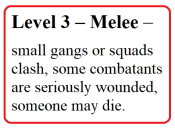
Level 3 – Melee – small gangs or squads clash, some combatants are seriously wounded, and someone may die.
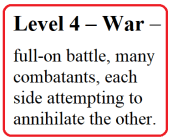
Level 4 – War – full-on battle, many combatants, each side attempting to annihilate the other.
 If you have no experience with combat or fighting, you don’t understand the limits of a normal athlete’s physical abilities. So, you must do the research. Think of how the human body works in reality. If your character knees a foe in the jaw, how is it possible?
Are you really going to go into that much detail to explain how Joe slapped Mary and then bent down for whatever reason, and Mary kneed him in the jaw?
I suggest you don’t include that particular assault because a knee to the jaw is a weird move if both combatants are standing. If Mary has a blackbelt in Tae Kwon Do, she could have clocked him with her foot, but not her knee.
 If you don’t show how such a strange hit could happen, the reader will say, “That’s impossible.” It’s a risky choice though, because going into that kind of detail bores the heck out of our readers. Our readers mind will fill in the details and if it’s confusing, they may stop reading.
We must consider what is physically possible and what is not.
After the action is laid down, the next step is fine-tuning it. The reactions and responses of your characters are what make the experience feel authentic to the reader. After you have established that Joe was somehow hit in the jaw, what happened next? Did it knock him out?
Many authors get hung up on the technical side of each fight—how they were dressed, what weapons they had, and so on.
 Don’t do this for every incident. After they are armed and armored as much as they are going to be the first time, just have them meet the enemy, skirmish, and continue on. The reader already knows what armor and weapons they had.
The fight must advance the story.
- Ask yourself why the quarrel happened.
- What is the purpose of injecting that conflict into the narrative?
- And once you establish that the fight happened, did you foreshadow it well enough, or does it seem gratuitous?
 In real life, conflict happens on a sliding scale. It begins with a disagreement and escalates to an all-out war. While my outline will have a note alerting me to the level of conflict that must happen, I choreograph my fights to reflect that sliding level of intensity.
Billy Ninefingers begins with a level 1 quarrel that escalates to a level 2 fight. Billy’s sword hand is wounded. Besides the fact Billy is seriously injured in this opening fight, which is the inciting incident and core plot point of the book, I had two other goals with that fight scene:
- I needed to show how the Bastard is jealous and acts on any thought that passes through his alcohol-soaked mind.
- In the resolution of that scene, I demonstrated that Billy, even with his life in ruins, has a sense of fair play.
Just as physical attacks are in real life, Billy’s confrontation with the Bastard was over in less than a minute. From personal fistfights to waging war, actual combat is quick, bloody, and brutal.
 Person-to-person combat doesn’t stretch for hours because no matter how well trained a fighter is, no one has that kind of strength.
Skirmishes may happen in bursts that take place over a length of time, but there are pauses between clashes, allowing the combatants to briefly rest and get their breath.
It may feel like an hour is passing while you are in the middle of each clash, but in reality, each one-on-one fight only lasts a few minutes. At that point, even the strongest fighters are exhausted. Exhausted people make mistakes, and someone will be injured or die.
I suggest that for your own purposes, you map your violence out. Describe it for yourself as you would a journey. On a background document, write every slap and curse word. Write every hack and slash or gunshot, and make sure each occurs at its proper point in the melee.
Then walk away from it. Let that scene rest and move on to something else. When you return to it, ask yourself how many blows and hits your characters have taken.
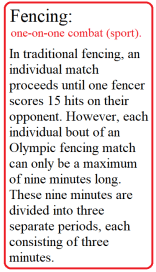 A typical fencing match goes until one has scored 15 hits on their opponent, and that match lasts nine minutes or less. Ask yourself how your fighter can survive the injuries that such blows would leave them with in real combat.
They most likely couldn’t.
Combatants block and defend as much as they attack. For the author, acting out each skirmish ensures that the moves are reasonable and make sense. But you aren’t done writing that scene just because the hacking, slashing, and gunshots are on paper.
Open a new document, take what you have already choreographed and consolidate it. While a war will justify ten paragraphs of description, a skirmish won’t. Write a one or two paragraph narrative that hits the high points and end it.
In each quarrel, we have to consider that every character in the fight is, and must remain, a unique individual. There should be no blurring of personalities, which can happen when an author focuses too intently on the action of the fight scene.
It’s a lot of work, but I go back to the first part of that section and make sure the character’s reactions are portrayed so the reader can suspend their disbelief.
 I try to show this discreetly by sitting back and visualizing the scene after the choreography is laid on paper. I replay it in my mind as if I were a witness to the events and look for each combatant’s facial expressions and reactions.
The strongest reactions get briefly mentioned in the story, the responses that push the plot forward. The other reactions are witnessed but given less prominence, becoming part of the scenery.
When I choreograph a fight, I think of it as if I were composing a conversation. In our literary conversations, we paint the impression of their individuality without boring the reader with insignificant details.
We must approach the fight scene the same way. I keep it concise and linear when it comes to fighting, as drawn-out fight scenes bore me to tears. Just the facts, the immediate emotional impact, and we move on to the recovery scene.
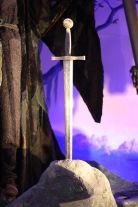
Excalibur, London Film Museum, via Wikipedia
While it feels chaotic to those who are involved, violence is orderly and happens in a sequence of actions within a fundamental framework of order.
They block, dodge, hack and slash or shoot – the swiftness of the event and the emotional impact of the violence do the work of conveying the overwhelming sense of chaos.
My next post will examine how to choreograph personal disasters.
 The first incident has a domino effect. More events occur, pushing the protagonist out of his comfortable life and into danger. Fear of death, fear of loss, fear of financial disaster, fear of losing a loved one—terror is subjective and deeply personal.
 However, the reader has an edge—they will be offered clues from the antagonists’ side, which the characters don’t know. The antagonist’s actions will affect the plot in the future. Even if the antagonist isn’t an overt enemy at the outset, the readers’ knowledge creates a sense of unease, a subliminal worry that things will go wrong.
 But not every author has that option.
 In most standard book contracts, royalty terms for authors are terrible, and this is especially true for eBook sales. Most eBooks are sold through online retailers like Amazon. If you’re a traditionally published author and your publisher priced your eBook at $9.99, this is how the Amazon numbers break out. No matter what you think of Amazon, it is still the Big Fish in the Publishing and Bookselling Pond:
 However, to be considered for a traditional contract, you should hire an editor, beta reader, and proofreader to ensure the manuscript you submit to an agent or editor demonstrates your ability to turn out a good, professional product.
 Regardless of your publishing path, you must budget for certain things. You can’t expect your royalties to pay for them early in your career – and many award-winning authors must still work at their day jobs to pay their bills.
 Conferences are an extension of the self-education process. I have discovered so much about the craft of writing, the genres I write in, and the publishing industry as a whole—things I could only learn from other authors. I gained an extended professional network by joining
 Sometimes I am invited to participate in panels or offer a workshop, and I can share my experiences with others. Either way, I learn things. In September, I will be on a panel with
  The plan or design is submitted to the client, who likes it. A mockup of the first iteration is submitted to the client, who still likes it, but … their needs have changed a little, and a new adjustment must be incorporated.
 Books are one area where project creep is not only appreciated but encouraged. Stories are particularly prone to this continual expansion of the original ideas. Short stories grow into novellas and then into novels, becoming a series of books.
 The first aspect of this is to Identify your Project Goals – create a rudimentary outline with names, who they are in relation to the protagonist, and decide who is telling the story. Remember, your story is your invention. Some inventions are in development for years before they get to market. Others are complete and ready to market in a relatively short time. Regardless of your production timeline, this is where project management skills really come into play.
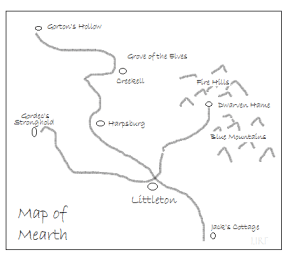 Your map doesn’t have to be fancy – all you need are some lines and scribbles telling you all the essential things, like which direction is north and what certain towns are named. Use a pencil, to easily update your map if something changes during revisions.
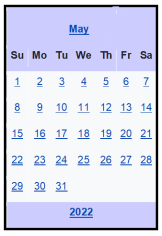 Time can get a little mushy when we are winging it through a manuscript. A calendar gives us a realistic view of how long it takes to travel from point A to point B, or how much time it will take to complete a task.
 Time interests me because I mostly write fantasy, although I write contemporary short fiction and poetry. Fantasy, and all speculative fiction, relies heavily on worldbuilding, and managing time is a facet of that skill.
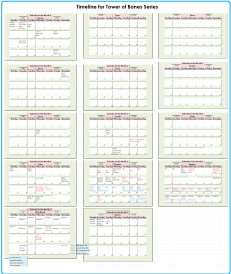 HERE is where I confess my great regret: in 2008, a lunar calendar seemed like a good thing while creating my first world.
 In an even worse bout of predictability, I went with the names we currently use when I named the days, only I twisted them a bit and gave them the actual Norse god’s name. (The gods and goddesses of Neveyah are not Norse.)
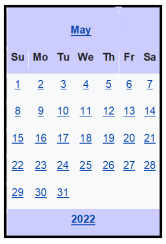 I LEARNED from my mistakes – the timeline for the Billy’s Revenge 3-book series, Huw the Bard, Billy Ninefingers, and Julian Lackland, uses the familiar calendar we use today.
 Thus, it makes sense to consider whether your story is complex enough to hold up well across a series.
 If you are done with your first draft and are just now realizing your novel could be the beginning of a saga, you should consider making notes as to what the future holds for your crew beyond the end. Otherwise, you may find yourself writing a continuation of book one, but with no goal, no purpose.
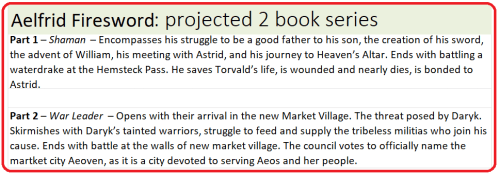 So, for a saga you might want to draw up an overall story arc for the entire series. For a standalone book featuring a recurring character, you likely won’t need to have an all-encompassing projected arc.
 Think about it – the universe contains all we can measure and know, all of space and time and their contents, including planets, stars, galaxies, and all forms of matter and energy. It likes balls and spirals and has a structure that repeats itself. This is reflected in the shape and behavior of the smallest particles to the largest quasars.
 First off, no matter our conscious thoughts regarding the universe and God, writers don’t exist in reality. We exist in what we think reality is, and collectively, we create it as we go along, for good or ill.
 But if you make a map of what you can see, your own
  As I wrote, the outline for that first book took its shape. The written universe is in constant flux, and the storyboard records the changes and keeps the fabric of time from warping.
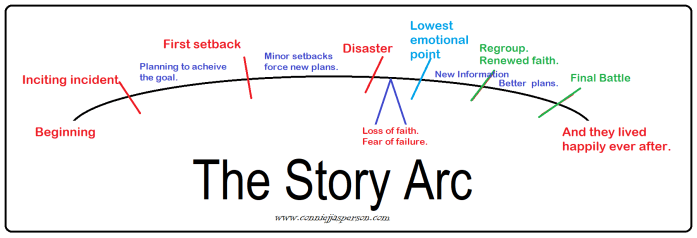 Once I have decided the proposed length, I know where the turning points are and what should happen at each. The outline ensures an arc to both the overall story and the characters’ personal growth.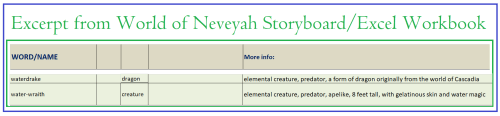
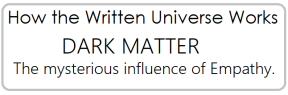 In other words, something we can’t see or measure is out there, shaping our known universe. For lack of a better term, scientists refer to it as “dark matter” and “dark energy.”
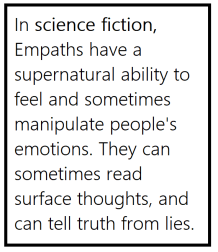 Unless your story is set in a school (such as the
 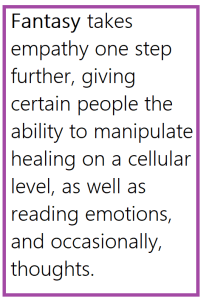 In real life, if a person had the kind of power that our fictional empaths wield, we would hope they were noble, compassionate, and above all, respectful of other people’s wish for privacy. One would want them to be circumspect and never rummage in people’s minds uninvited.
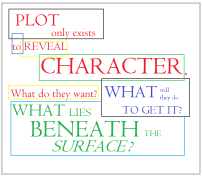 What does healing cost the healer? Does it exhaust them? Does some of the healing magic come from the patient? Do they need to sleep afterward?
 Magic should exist as an underlying, invisible layer of your written universe, the way gravity exists in reality. We know gravity works and accept it as a part of daily life.
 First, the ability to use magic is either learned through spells, an inherent gift, or both. Your world should establish which kind of path you are taking at the outset.
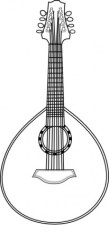 Consider musicians. A person who wins international piano competitions most likely won’t be a virtuoso at brass instruments.
 Like science and magic, superpowers are believable when they are limited in what they can do.


 Life in the Realm of Fantasy