
Much of my blog revolves around grammar and the mechanics of writing, the fundamental force that holds the written universe together. Grammar is gravity, and punctuation is the interdimensional traffic signal, ensuring our words don’t get jammed up and wreck the spacecraft that is our prose.
 Authors need to understand the rules of how the language we write in works. When we are just starting out, we might have a grip on the basics, but we don’t understand how or when to use the rare punctuations.
So, what about these rare beasts? First up is the ellipsis, the mysterious symbol we all love.
I recommend against using too many ellipses because many authors use them incorrectly or inconsistently.
This is because ellipses are not punctuation and shouldn’t be used as such. They symbolize omitted words and are not punctuation. When the conversation trails off, you must add ending punctuation.
Apples…more apples, rotten, lying on the ground. But I have no apple tree, so where did they…?
Hyphens are not always necessary. If the meaning of a compound adjective is apparent when written as two separate words, a hyphen is not needed.
- bus stop
If its meaning is understood when written as one word and common usage writes it as one word, again a hyphen is unnecessary.
- afternoon
- windshield
Some combinations of “self” must have a hyphen:
- self-editing
- self-promotion
Dashes are not hyphens and are used in several ways. One kind of dash we frequently use is the ‘en dash,’ which is the width of an ‘n.’ UK usage often employs the en dash in the place of the em dash.
En dashes join two numbers written numerically and not spelled, in US usage.
- 1950 – 1951
To insert an en dash in a Word document: type a single hyphen between two words, with a space on either side. When you hit the space bar after the second word, the en dash will lengthen a little, making it slightly longer than a hyphen.
Em dashes are the width of an “m” and are the gateway to a terrible addiction. To make one, key a word, don’t hit the spacebar but do hit the hyphen key twice, then key another word and then hit the spacebar: (word+hyphen+hyphen+word+space) word—word.
Authors and editors become habituated to using em dashes without thinking. After a while, the author types a word, and the little finger hits that hyphen key twice whenever the mind pauses—then types another word and bam!—em dash. Too many em dashes—like salt—ruin the flavor of the prose.
It often works best to rephrase things a little and use a comma or a period. I try to only use em dashes for emphasis, and only rarely.
 This bring us to creative punctuation, such as the symbol “!?.” An exclamation point followed by a question mark, these mutant morsels of madness are called “interrobangs.”
Editors working in the publishing industry will tell you that the interrobang is not an accepted form of punctuation for anything but comic books, graphic novels, manga, and possibly, text messages to your BFF.
Think about it. Comic book authors are limited to the words they can fit onto a panel and still leave room for the art. They must show events and emotions by combining pictures with as few words as possible to tell the story.
Writers of comics frequently employ creative punctuation to express as much as possible with few words. Interrobangs are a shorthand for the reader. They convey the emotions of shock and surprise without words.
Interrobangs are inappropriate in any other genre. It’s your narrative, so you will do as you see fit. However, more than one punctuation mark at the end of a sentence is not accepted in the literature of any genre but comic books. Interrobangs are a writing habit the professional writer will avoid if they want to be taken seriously.
 The semicolon. This joining punctuation is not complicated once you know the one rule about when to use semicolons:
- If you join two clauses with a semicolon, each clause must be a complete sentence, and they must relate to each other. In other words, they must be two short sentences expanding on ONE idea.
I drive a red Corvette, and we like it. Rover rides shotgun
I drive a red Corvette; we like it. Rover rides shotgun.
I drive a red Corvette and we like it, but Rover rides shotgun.
We don’t separate all three clauses with a comma in the first two examples because that creates a comma splice. The first sentence is one whole idea: they drive a red car that they like. The second sentence is an entirely different thought: the dog likes to sit in the passenger seat.
The comma splice is a dead giveaway that the author isn’t well versed in grammar. Microsoft’s editor app sometimes tells us to use a comma to join two independent clauses when they don’t relate to each other. Microsoft is wrong.
In my opinion, the third example is the best. Conjunctions and a comma join the three independent clauses, and they flow smoothly.
Colons are rarely used in narrative prose but are common in how-to guides. Their purpose is to lead off lists of items or tips.
So, how do we separate independent clauses, words that can stand on their own as a sentence, with proper punctuation instead of ellipses or hyphens? We use coordinating conjunctions.
A comma should be used before these conjunctions: and, but, for, nor, yet, or, and so to separate two independent clauses. They are called coordinating conjunctions because they join two elements of equal importance.
However, we don’t always automatically use a comma before the word “and.” This is where it gets confusing.
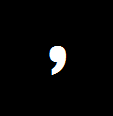 Compound sentences combine two separate ideas (clauses) into one compact package. A comma should be placed before a conjunction only if it is at the beginning of an independent clause. So, use the comma before the conjunction (and, but, or) if the clauses are standalone sentences. If one of them is not a standalone sentence, it is a dependent clause, and you do not add the comma.
Take these two sentences: She is a great basketball player. She prefers swimming.
- If we combine them this way, we add a comma: She is a great basketball player, but she prefers swimming.
- If we combine them this way, we don’t: She is a great basketball player but prefers swimming.
The omission of one pronoun makes the difference. In my opinion, it’s a better sentence.
Readers expect words to flow a certain way, but no author gets it right all the time. If you choose to break a grammatical rule, be consistent about it. Authors must know the rules to break them with style.
Most readers are not editors. They will either love or hate your work based on your voice, but they won’t know why. Voice is how you break the rules, but you must understand what you are doing. You must do it deliberately and do it consistently. Readers do notice inconsistencies.
Craft your work to make it say what you mean, in the way you want it said. Sometimes you will use commas in places where they ordinarily aren’t used. You will do this to make things clear. Conversely, you will omit them for the same reason.
If the editor you hired asks you to change something you did deliberately, you are the author.
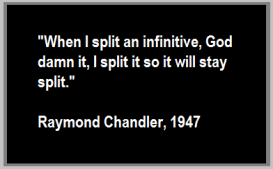 Explain why you want that particular grammatical no-no to stand, and your editor will most likely understand. If you know the rule you are breaking, you will be better able to explain why you are doing so.
Most good editors will do as you ask, but you must be prepared to break that rule consistently.
Much of what we consider powerful writing violates a number of grammar rules, but the author broke that rule in every sentence. Once the reader gets the feel for the author’s style, they don’t notice it.
I always think we are better for having read their work.
Previous posts in this series:
How the Written universe works part 1: the connecting particle
How the Written universe works part 2: the physics of conversation
How the Written Universe Works part 3: Lay, Lie, Laid
How the Written Universe Works part 4: Relativity and Possessives #amwriting
 However, we can learn a great deal from books embodying poorly executed plots and badly scripted dialogue.
 The first books of the series establish a science of magic. One can either use chaotic magic or ordered magic. Although some mages can only use one side or the other, the most powerful mages can manipulate both sides of the magic. The entire series explores this concept well. It is a well-planned magic system, with good rules.
 Structurally, the books in this subseries feel like he knew how to end it but struggled to fill in the arc. Past events and conversations get repeated verbatim to every new character. Long passages of remembering and agonizing over what is done and dusted fluffs up the narrative.
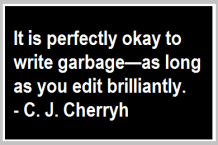 To me, book 21 reads as if (while books 19 and 20 were in the publishing gauntlet) he still had to fluff up the ending to make book 21 long enough to be considered a novel. The evidence of a lack of genuine inspiration is the absurd “scar” the protagonist is left with after winning an unbelievable victory and nearly dying.
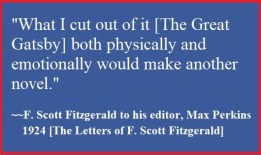 Everyone, even your favorite author, writes a stinker now and then.
  It deals with things like the mass of objects, the speed at which they travel, how speed and mass are converted to energy, and how mass warps the fabric of space and time.
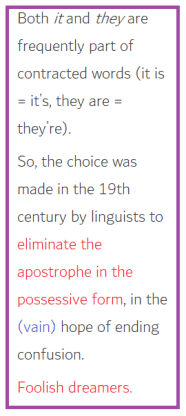 But what about “It?” Here, we are dealing with possession by the inanimate. We don’t need an exorcist, although a good maid service would resolve a great deal here at Casa del Jasperson. But in this case, we are referencing something owned by the inanimate:
 In the case of number 4, the sentence would be stronger without it. Most of the time, the prose is made stronger when the word “that” is cut and not replaced with anything. I say most, but not all the time.
 In the written narrative, the many forms of this verb are what
 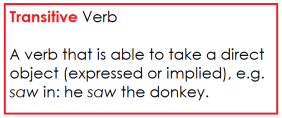 “Lay” is a transitive verb that refers to putting something in a horizontal position. At the same time, “lie” is an intransitive verb that refers to being in a flat position.
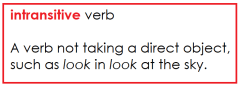 To lie is an intransitive verb: it shows action, and the subject of the sentence engages in that action, but nothing is being acted upon (the verb has no direct object).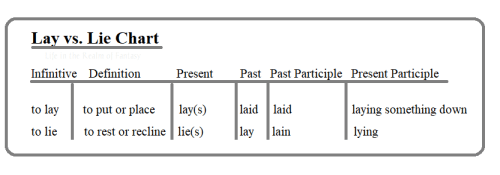
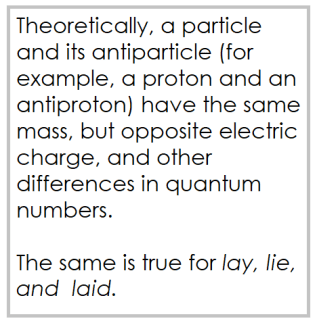 The verb that means “to recline” is “to lie,” not “to lay.” If we are talking about the act of reclining, we use “lie,” not “lay.” “When I have a headache, I lie down.”
 All around us, gravity works in hidden ways. Gravity on a small scale keeps everything securely stuck to the surface of Planet Earth.
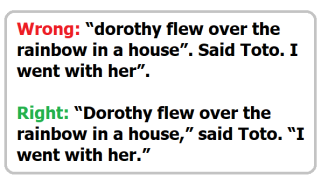
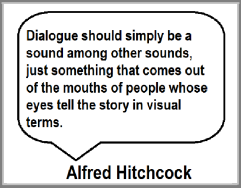 Creating memorable characters is the goal of all authors. After all, who would read a book with bland and uninteresting dialogue? Dialogue is where most information is given to the characters and the reader. However, when we are just beginning to write, many of us are confused about how to punctuate conversations. It’s not that complicated. Here are four rules to remember:
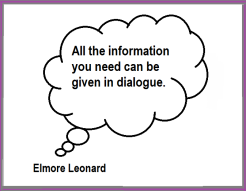 When you envision your characters in conversation, you must think about what the word natural means. People don’t only use their words to communicate. Bodies and faces tell us a great deal about a person’s mood and what they feel.
 For this reason, we don’t want to inject an excess of flushing, smirking, eye-rolling, or shrugging into the story. Those actions have a specific use in conveying the mood, but anything used too frequently becomes a crutch.
 First up is the particle. In grammar, a particle is a word with a specific purpose that depends on the words around it. It is a function word that is always associated with another word or phrase to impart meaning.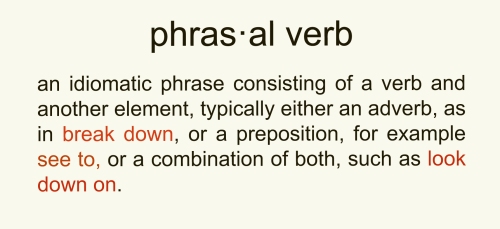
 Today’s readers have no patience with Tolkien’s style of paragraph-long compound sentences composed of clause after clause divided by conjunctions, commas, and semicolons.
 I try to limit idioms and phrasal verbs to speech, and then only to that of one character. When used in conversation, they sound natural, but even there, I go lightly. I want to show a specific character’s personality but don’t want my prose to feel cliché and overdone.
 We are emotional creatures. When we are just starting on this path, getting an unbiased critique for something you think is the best thing you ever wrote can feel unfair.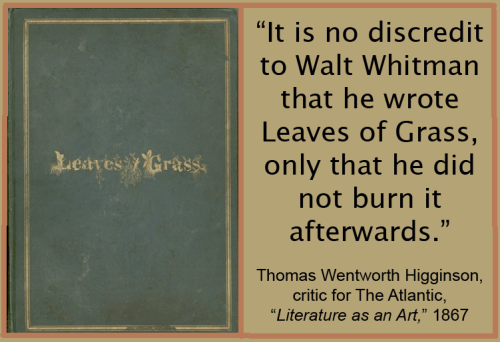
 I could have embarrassed myself and responded childishly, but that would have been foolish and self-defeating. When I really thought about it, I realized that particular plot twist had been done many times before. I thanked him for his time because I had learned something valuable from that experience.
 Treat all your professional contacts with courtesy, no matter how angry you are. Allow yourself some time to cool off. Don’t have a tantrum and immediately respond with an angst-riddled rant.
 Leah and Tom have no spare bedrooms until the remodel is done. So, we stayed at the Snohomish Inn, two blocks away. It’s an older place but clean.
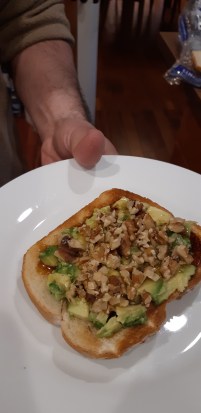 Sunday morning began with the best avocado toast I’ve ever had. Everyone who knows me has heard how much I love that particular dish. Tom’s version is incredibly simple: a good bread, toasted and topped with mashed avocado, chopped walnuts sprinkled over the top, and a teensy drizzle of honey. It sounds odd, but wow. That was a divine, filling breakfast. The picture I took doesn’t do it justice.
 And as a final twist to the craziness–we were finally getting ready for sleep in our hotel room, both of us tired but feeling good about our day. All our toiletries were in a small, dark zipper-bag.
 When you are pantsing it (writing-by-the-seat-of-your-pants), themes are like your drunk uncle. They hang out at the local pub until closing time and then weave their way home through dark alleys. Sometimes, as you are leaving for work in the morning, you find them under the neighbor’s shrubs. Other times they make it home.
 I often sit on my back porch and just let my thoughts roam, thinking about nothing in particular. Usually, I will end up considering the character’s quest or dilemma. I ask myself what the root cause of the issue is—if it is a crime, why is crime rampant? Is it a societal problem, such as poverty or war? If the core dilemma is unrequited love, what are the roadblocks to a resolution?
 These layers offer us an incredible amount of subliminal information about that surreal world and what is going on in reality, what the Matrix truly is.
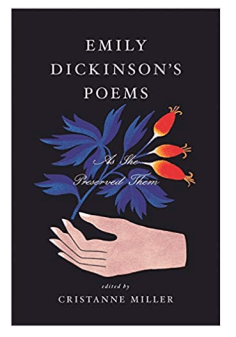
 Poets understand how central a theme is to the story. A poet takes the theme and builds the words around it. Emily Dickinson’s poems featured the themes of spirituality, love of nature, and death, which is why she appealed so strongly to me during my angsty young-adult life.
 But that would be wrong. Poets write words that range far more widely than their physical surroundings. Some poets are constrained by unrewarding jobs, others may be “on the spectrum,” as they now say, and still others are constrained by physical limitations.
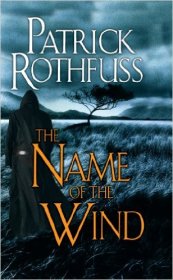 Fantasy author


 Life in the Realm of Fantasy