Category Archives: Books

Book signing events, the art of Paul Cornoyer, and inspiration

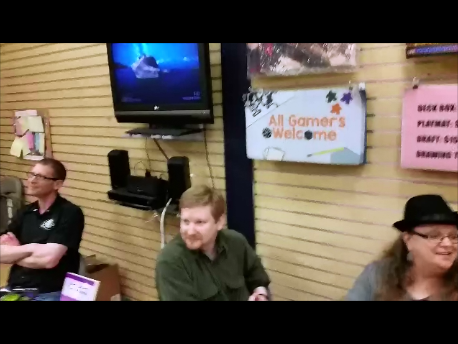
From left to right, Sechin Tower, Lindsay Schopfer and Connie J. Jasperson at Forever Knight Games 5-16-2015

From left to right, Sechin Tower, Lindsay Schopfer and Connie J. Jasperson at Forever Knight Games 5-16-2015

The signing at Forever Knight Games in Olympia went well. I met several wonderful authors I hadn’t had a chance to meet in person: Sechin Tower, Jolene Loraine, Rachel E. Robinson (Maquel A. Jacob), and Erik Kort. We were joined my my good friends, authors Lee French, Lindsay Schopfer, and Jeffrey Cook. These wonderful people write great books, and I was privileged to be counted among them!

We had a great time, and it was a good first event at that venue. I want to thank all my friends for coming out and meeting my favorite local authors. Tower of Bones was my big seller–which makes me happy.

paul cornoyer rainy day in madison square

Rainy Day in Madison Square, Paul Cornoyer

But then, after the big party was over (and it was a party–believe me) I had to drag myself back to reality. As I said the other day, sometimes my head isn’t in the right place for reading. At the event this last weekend, a friend asked me how that inability to read without the editor in my head making noise affects my ability to write. I had to answer that it does affect it to a certain extent.

The reason being in an editing frame of mind affects my writing is that while I am creative, it is like my creativity has to go through a maze to get to the ends of my fingers and into written form.

It’s a sloooooow process.
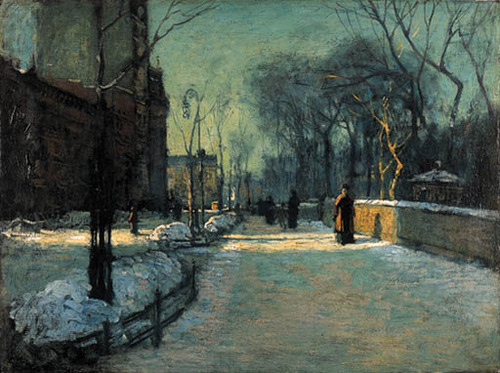
Paul Cornoyer Winter twilight along Central Park

Winter Twilight Along Central Park, Paul Cornoyer

I do a lot of things to jumpstart that creativity. I  clean things I don’t really care about under normal circumstances.  Something about a really orderly environment gets my mind relaxed enough to work properly.

Sometimes I write flash-fiction, 100 to 1000 word short stories.

I find great art that really makes my mind click–Wikimedia Commons is awesome for that.  Today I came across a download of a picture that, two years ago, sparked a 250 word flash-fiction. That  image, which I will get to later, was painted around the year 1910 by an American artist, Paul Cornoyer.
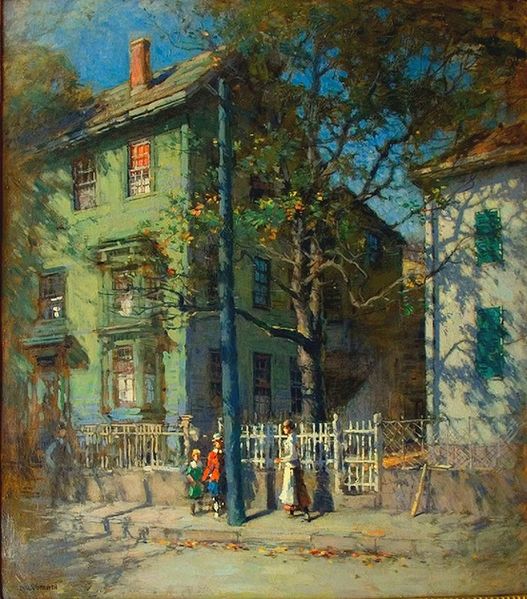
Paul Cornoyer -Gloucester

Glouster, Paul Cornoyer

His work is quite intriguing, and much of is done in an impressionistic style.

According to the Fount of all Knowledge, Wikipedia, Impressionism is a 19th-century art movement. Impressionist painting characteristics include relatively small, thin, yet visible brush strokes, open composition, emphasis on accurate depiction of light in its changing qualities (often accentuating the effects of the passage of time), ordinary subject matter, inclusion of movement as a crucial element of human perception and experience, and unusual visual angles.

The thing about the impressionists that so inspires my writing is that they don’t give you all the details–they give you what they saw including the mood of the piece.

Paul_Cornoyer_-_The_Plaza_After_Rain

The Plaza After Rain, Paul Cornoyer

In so many ways, good literature is like good art–all the important things are there, everything the eye needs to have a perfect vision of the mood, the setting, and characters–everything is there within the piece, but with economy. When you limit yourself to expressing the complete idea of the story in less than 300 words, you discover just how well (or how badly you can write.)

This last picture is the piece that inspired one of my better, short pieces of Flash Fiction, which will be featured later this month on Edgewise Words Inn. I will post links to that here when it goes up

It is called The Plaza After Rain. I love it because, even though it depicts New York City in a different time, it shows the way rain is in the springtime. The sky is dark, but the trees are just beginning to leaf out. The streets are wet with rain, but a hint of blue is showing through the dark sky. When you see this painting, you feel like sunshine could happen any minute.

That is what we try to convey in flash fiction, and that is why it’s so important to practice writing in short, complete bursts. You never know when one will become a longer tale, so you will have a backlog of  fodder to fuel your creativity when you need a good story idea. Being able to create an entire story in 3 paragraphs is an art. Sometimes I can do well at that, and sometimes not so much.
 

Comments Off on Book signing events, the art of Paul Cornoyer, and inspiration

Filed under Battles, Blogger, Books, Games, Humor, Literature, Publishing, Uncategorized, writer, writing

Reading for pleasure vs reading for editing

George R.R.Martin formatting issue 1 via book blog page views, margaret ebyI haven’t been able to read as much lately as I normally do–my editing and writing time has seriously cut into my reading time. In fact, I haven’t written a book review in over a month. I do miss the long hours I used to spend reading, but lately I am lucky to read two or three pages before fall asleep. Thus I have been reading poetry and short fiction.

This is not because the books I intend to read are boring–they aren’t! It’s just that when I am editing for a client, I can’t disengage my mind from that mindset. This means I have a terrible time reading for pleasure. When I am in editing mode I notice things a casual reader might not, and I can’t just enjoy the book. And I am not talking indies here–I am talking books published by the Big 5 traditional publishers.

Sometimes the errors and flaws are hilarious though.

Marked_Wicked_bibleThe thing is, errors do creep into even the most carefully examined texts and manuscripts. Usually, no one dies over it, however, in the case of the infamous Wicked Bible, the publishers paid a hefty price: Robert Barker and Martin Lucas, the royal printers in London,  were called to the Star Chamber and fined £300 (£43,586 as of 2015) and deprived of their printing license. The Star Chamber, which held court from the late 15th century to the mid-17th century,  was a branch of the English court of law and was established to ensure the fair enforcement of laws against socially and politically prominent people so powerful that ordinary courts would likely hesitate to convict them of their crimes.

SpelMistk14 Image credit- Jazarah! Hubspot_com 14 worst marketing errorsTypos and editing mistakes are pretty much taken for granted when left in mass-market paperbacks by the Big 5 Publishers, but woe to the indie who neglects to notice a repeated ‘and’ or any other editing error.

Indies are held to a far more rigid code by most readers than the traditional publishers are because the internet is rife with disparaging rhetoric pointing the finger at indies. And while the Big 5 traditional publishers are just as guilty of rushing-to-publish crap, the truth is, many new self-published authors haven’t yet gotten the hang of the publishing business, and often their books are rife with things they will later wish they hadn’t rushed-to-publish.

enhanced-buzz-20953-1398618489-5 courtesy reddit dot comHaving learned my own lessons the hard way, besides working closely with a professional editor, I now have a reliable group of friends who comb my completed manuscripts for errors and gross cut-and-paste errors, and we can only hope we have caught them all. When you are an indie, it takes a village to help you get your book fit for the public to read.

Anyway–my editor’s hat is firmly on my head these days, and that means I can’t enjoy casual reading for a while more. That’s not to say I don’t enjoy my clients’ books–I love them. I’ve made it clear that I only accept work I feel a strong attachment to, but editing is a different mindset from casual reading, and I can’t just fall out of it at the end of the day. Yes, this greatly slows my own writing, because I am stupidly self-editing instead of just letting the words flow. When I am editing I am looking for all varieties of mistakes–not just structural, grammatical, and obvious punctuation errors. I am also looking for things that will interfere with formatting the final ms for upload to Kindle or Smashwords and I hope I find them all for my client, but it makes writing my own work difficult.

George R.R.Martin bormatting issue 4 via book blog page views, margaret ebyAs an editor I do my best. But, nothing is ever sure, and I won’t see the ms after I send her the final suggested corrections. Mistakes can be made right up to the last minute while she is making those adjustments, so someone else will have to proof-read her work. The indie author has the responsibility for the final eye on his/her work. So when my client has finished her revisions, she will have her posse check the ms over for the slings and arrows of publishing fate.

I will be finished with my current editing project soon, and I plan to take a break from editing for a short while, when that happens. Then I will let my mindset slide back into the joy-of-reading mode.

I really do love to read–getting lost in a great book is the best thing I can think of, as comforting as a cute kitty purring, or my sister’s homemade chocolate truffles. I look forward to resting my editorial mind and over-indulging in the work of my many favorite authors.


7 Comments

Filed under Books, Humor, Publishing, Self Publishing, Uncategorized, writer, writing

Elements of the Story: Allegory

allegory

Proper use of the allegory is an integral tool in the author’s toolbox. An allegory is a metaphor, but it is not merely symbolism, although it is definitely symbolic. Authors, painters, and musicians can convey hidden meanings and discuss complex moral issues through the device of allegory.

Literary Devices.net describes  Edmund Spenser’s “Faerie Queen,” a moral and religious allegory, in this way:

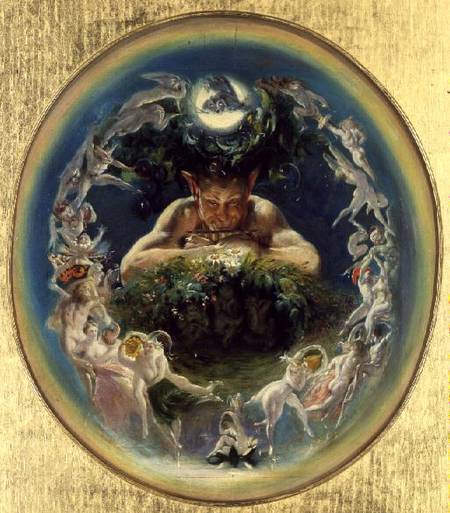
RAK9388 Faun and the Fairies, c.1834 by Maclise, Daniel

Faun and the Fairies, c.1834 by Daniel Maclise

“The good characters of book stand for the various virtues, while the bad characters represent vices. “The Red-Cross Knight” represents holiness while “Lady Una” represents truth, wisdom and goodness. Her parents symbolize the human race. The “Dragon” which has imprisoned them stands for evil. The mission of holiness is to help the truth, fight evil, and thus regain its rightful place in the hearts of human beings. “The Red-Cross Knight” in this poem also represents the reformed church of England fighting against the “Dragon” which stands for the Papacy or the Catholic Church.”

The Faerie Queene is an allegorical romance, and contains several levels of allegory, including praise for Queen Elizabeth I, who was Spenser’s great patron.

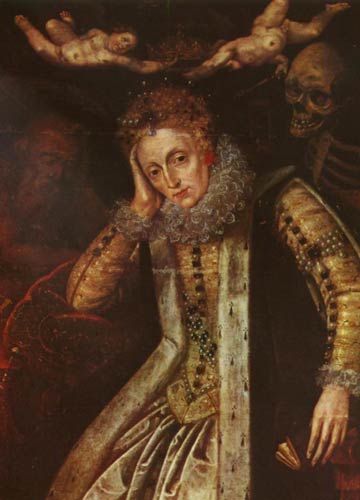
Elizabeth-I-Allegorical- painting  c.1610  by Unknown. Licensed under Public Domain via Wikimedia Commons

Allegory of Queen Elizabeth (c. 1610), with Father Time at her right and Death looking over her left shoulder. Two cherubs are removing the weighty crown from her tired head. Artist unknown.

Allegory is not always something that works well if you desire commercial success with your novels. This is because allegory is the sort of thing that only becomes apparent on further contemplation by the reader–which many casual readers don’t usually want to do and modern action-based literature does not encourage. A great many of today’s readers are action-junkies, so if you choose to present a moral concept through the use of allegory, you must take a page from Stephen King‘s work and  wrap it up in such a way that the average reader will enjoy it for the entertainment value, while the discerning reader will look deeper and find more layers to enjoy within your work.

ClassroomSynonym.com says: “At the foundation of a well-constructed allegory are carefully crafted parallels between two separate issues. To properly analyze an allegory it’s important to identify these parallels and explain why the parallels are such strong indicators that an allegory exists. Even though “The Crucible” is literally about a witch hunt, the unfair tactics for deciding who is a witch and who isn’t parallel the claims made during the McCarthy Era with little justification other than rumor and hearsay that certain people were communists. The unfair method of designation is the parallel.”

Crafting an allegorical narrative requires planning and intention. Clarity of thought on your part is absolutely crucial if your deeper story is to become clear to the reader. I suggest you outline so that the beginning, middle and end are clear before you begin.

An effective allegory narrative will have a clear moral or lesson that will become apparent at the end of the essay. Even if it is not stated directly the message will be implicit in the final resolution. You want to be sure that the ending reflects your final thought on the subject.

  1. Use Symbolism

The allegory is the symbol of your idea. This means your narrative or poem conceals the true theme you’re symbolizing. In other words, you are writing a cover story that will contain the primary one.

  1. Planning Your Characters Is Essential

Each character in an allegory represents an underlying element to your theme. Because the reader is expected to interpret the whole story and find what it means, no character can be introduced that does not directly pertain to and represent part of the underlying story. The moment you introduce a random character into it, your allegory devolves into chaos and your deeper meaning is lost.

  1. Planning Your Action is Essential

The arc of the scene becomes tricky. Every action is crucial–action must show something that pertains to the underlying theme, not just push the overlying story forward.

  1. Insert Hints Regarding the Deeper Meaning Into The Overlying Story

What that means is, you’ll be expected to leave evidence in your story for the discerning reader to grasp. Some authors have used irony, and sarcasm.  Others use large metaphors. No matter what you choose, subtle clues will guide the reader to the deeper story, and you want them to catch that underlying meaning, or you wouldn’t have written it. You don’t have to explain it baldly—readers love figuring out puzzles. But you do have to make sure a trail of breadcrumbs is there for your reader to follow.

E-how gives us this perfect, concise example: “For instance, if you want to show the damage done to the environment by humans, then the character symbolizing “everyman” could end up harming or hurting the character symbolic of the environment.”

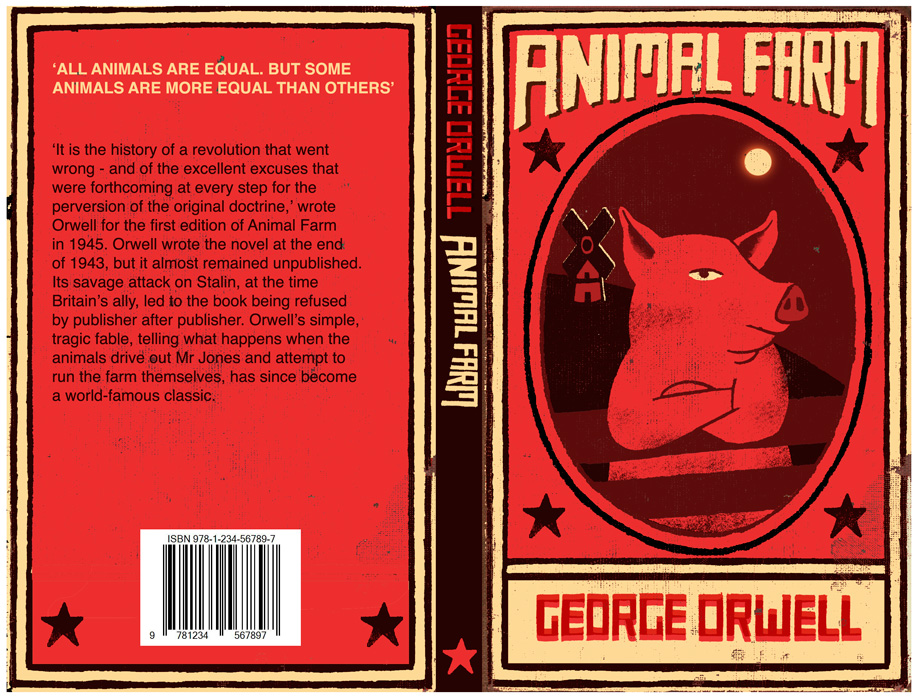
animal farm george orwellI love allegories, and I have written a great deal of poetry that is allegorical.

I have read The Faerie Queene and The Crucible, and was challenged by both, for different reasons. One reason for that challenge in The Faerie Queen is that Spenser used many words that were considered archaic even in Elizabethan times, so you have to interpret it as you go.

Some other famous allegorical novels I have read are:

Animal Farm by George Orwell

An allegorical and dystopian novella by George Orwell, first published in England on 17 August 1945. According to the author himself, the book reflects events leading up to the Russian Revolution of 1917 and then on into the Stalin era in the Soviet Union.

The Trial by Franz Kafka  Kafka’s descriptions of law and legality are considered allegories for things other than law, but it does clearly show how law and legality sometimes operate paradoxically.

Thinner by Richard Bachman (Stephen King writing under a pen name) Horror: An allegory about what lies beyond the limits of prosperous American complacency and where the responsibilities of human actions ultimately lie.

I will just say that allegorical novels are not written to be comfortable, cozy reads. They can be quite disturbing and thought provoking, as both Animal Farm and Thinner were to me. They were extremely disturbing, if you want the truth, but that was what makes them great literature. I was in the mood for a meatier read, and they took me out of my comfort zone, showing me disturbing aspects of the world I live in. These were things I could not change on a global level, but which I could possibly change within in my own sphere, thus my horizons were widened by reading them.

4 Comments

Filed under Adventure, Books, Fantasy, Humor, Literature, Publishing, Uncategorized, writer, writing

My Writing Life: David P. Cantrell

My Writing LifeToday indie author and blogger, David P. Cantrell, has consented to answer a few questions for us. Dave is a fellow staff-member at Edgewise Words Inn, a reader-oriented blog where Dave Cantrell, Lee French, and I post a variety of short articles, human interest stories, some short stories, memes, and generally have a great time just writing. At the end of this post, I will be reblogging Dave’s most recent post on Edgewise Words Inn, a little thing called “Ten Things I’ve learned as a Quadriplegic.” I think you’ll find that post as interesting and inspiring as I did.

But first, my virtual interview with Dave:

CJJ: Tell us a little of early life and how you began writing:
DPC: I grew up in Southern California after immigrating from Indiana at age five. I was a mediocre student in grade school, sports were much more interesting, but sadly, I was a mediocre athlete too. I wasn’t horrible at either of them, mind you—I got by.

I’ve often wondered where I’d be today if my family hadn’t moved to a new school district. I had completed one semester of eighth grade before the summer of the move. The new district couldn’t accommodate split semesters and required me to restart the grade. I became very bored in math and petitioned to join an experimental math class (eighth grade algebra—it sounds quaint now.)

The math teacher let me in for a semester with the proviso that I earn a Cee or better, otherwise it was back to regular math. I struggled, but the teacher worked with me, and I didn’t want to be put back. I think she took pity on me when she wrote a Cee on my report card. Whether she did or not, I’ll never know, but that Cee changed my life. Ultimately, I got a Bee in the subject, and took Geometry during the summer following middle school—No I wasn’t that nerdy, my girlfriend wanted company. I started high school taking a junior level math class.

I learned to enjoy reading in eighth grade. It’s difficult to remember which book lit the flame, but I think it was I Robot by Isaac Asimov. At any rate, reading eventually ignited the writing flame.

CJJ: You are right–the love of reading is the jumping-off-point to attempting to write. I happen to know what you are working on, but my readers don’t, so let’s talk about your current work in progress. 

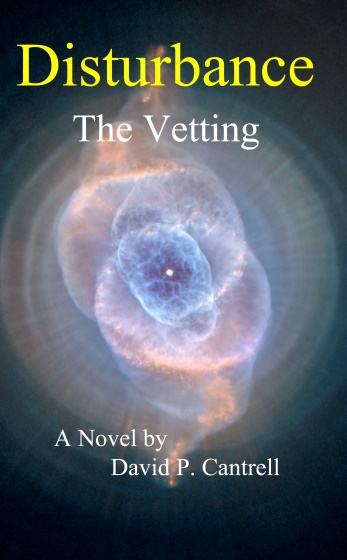
Disturbance - the VettingDPC: My one and only book is a work in progress. I published part one, Disturbance: The Vetting, in July 2014 and took it off the market in January 2015. The initial publishing was a mistake, but I’m glad I made it. I’ve learned a good deal about the process of writing, formatting and editing because of the mistake. I’ve met wonderful, supportive authors from around the globe as a result of it too.

CJJ: How did you come to write this novel?
DPC: Well-meaning idiots made me do it. That’s mean, but true in a sense. I started posting short “Slice-of-Life” stories on Facebook, items like “The Chicken Parmesan Saga.” I was encouraged to create a blog and gave it a go. I beta read Sci-Fi novels for a talented author, Jasper T. Scott. His comments gave me the idea that I might be able to write. I jumped into the deep-end.

CJJ: I’m mostly an outliner, myself. Do you have a specific ‘Creative Process’ that you follow, such as outlining or do you ‘wing it’?
DPC: Please define creative process. I tried to outline, but got hung-up on the order of things. What comes first, character or story? Can they exist independently? I’m a wing-it writer that prays for an outline to magically appear, and in it does sometimes.

CJJ: This is the question I hate to be asked, but here I am asking you: how does your work differ from others of its genre?
DPC: I want to write stories that make the reader think or learn something new. I love action oriented stories as much as the next person, but I want to write page turner’s that make the reader stop and think about what they’ve just read every once in a while. I get frustrated by the mantra to keep the story moving forward, if the words don’t keep it moving they are useless, not necessary.

CJJ: Why do you write what you do?
DPC: I write for the joy of research (I love an excuse to learn new things) and the hope to touch a stranger with my words.  Touching strangers is why I smile and say hello to them as they walk their dog down my block. Their response makes me feel good.

I recall a day my wife asked me to pick up something from our local grocer on my way home from work. It must have been summer because daylight abounded. I was a middle aged over-weight man walking across a parking lot and saw a stunning mid-twenties women dressed to the nines walking to her own car with a bottle of wine.  I worried if I said anything she’d think I was perverted. As I passed her we made brief eye contact and I said, “You look beautiful the evening.”  The smile on her face brings tears to my eyes as I write this.

CJJ: I like that little vignette you just painted for us, and feel somewhat the same myself when it comes to making people smile. So, when it comes to publishing, I know why I chose the indie route for my work, but I’m curious as to why you’ve chosen this path.
DPC: Is there a better way for an unknown to get their work before a world audience? I don’t care if I make a lot of money selling books. Don’t get me wrong, I’d love to do it, but it isn’t why I’m writing. I want to touch others, and honestly, I want the ego stroke that comes with it.

CJJ: What advice would you offer an author trying to decide whether to go indie or take the traditional path?
DPC: If money is your goal, try the traditional path. No one can promise better odds of making money on that path, but if you don’t give it a go you’ll always think you should have.

Dave Cantrell Author pictureDavid P. Cantrell lives with his wife of nearly four decades in the beautiful coastal community of Arroyo Grande< California. He is a retired CPA, enthusiastic (but not particularly good) home cook and avid reader. He enjoys history, historical novels, science fiction, non-fiction, fantasy, crime, thrillers, contemporary fiction and even a western now and again.

Before a spinal cord injury in 2009, he spent his creative efforts writing IRS defenses for his clients and on woodworking; building a variety of items, from chessboards to a Murphy Bed. The spinal cord injury left him paralyzed from the neck down, but with the help and love of his wife and caring therapists, he was able to recover significant function. Woodworking was behind him, and he accepted that.

Thank you Dave—you are a joy to know and to have as a friend, and you are an integral part of my personal writing life.

And now, “Ten Things I’ve learned as a Quadriplegic” By David P. Cantrell

(Reblogged from Edgewise Words Inn)

Being a quadriplegic (aka tetraplegic) is a learning opportunity. I found my opportunity when a confluence of events left me prostrate. Actually, I don’t remember being on the floor, I learned it later from my wife. She also told me I repeatedly asked if I’d had a heart attack while in the local ER. I don’t remember that either, but I’m not surprised. After all, I was an overweight, hypertensive, diabetic, chain-smoking CPA working on a deadline.

The first thing I clearly remember is the voice of an EMT talking to his ambulance driver as we arrived at a bigger hospital. I wasn’t sure why I was in the ambulance, but I knew something very strange was happening. I learned a good deal about myself over the following months.

  1. Paralyzed means: Crap, I can’t move and I don’t mean immobile.
    There’s a big difference between the two. Immobile means I can’t move right now because I’m drugged, strapped down or really-really sleepy, perhaps all three. Paralysis means so much more.
  1. Disrespect or abuse of a good woman’s love and support deserves retribution.
    If I’ve done either, shame on me. The memory of ICU, day one, is vague, but real. My teary-eyed wife held my hand, which I could not feel, and said, ‘I have your heart and your mind, that’s all I need.’ To this day, it’s our motto ….(To read the rest, click here to be transferred to Edgewise Words Inn and the rest of Ten Things I’ve Learned as a Quadriplegic)

Comments Off on My Writing Life: David P. Cantrell

Filed under Adventure, Battles, Books, Fantasy, Humor, Literature, Uncategorized, writer, writing

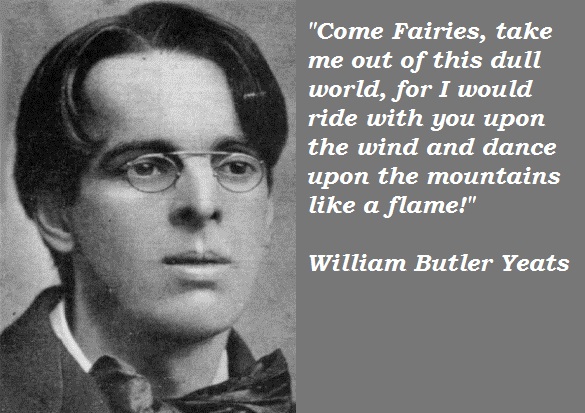
My love affair with Willam Butler Yeats

Yeats Mural and quoteWilliam Butler Yeats was an Irish poet and one of the foremost figures of 20th century literature. A pillar of both the Irish and British literary establishments, in his later years he served as an Irish Senator for two terms.

His poetry is one of my favorite sources of inspiration.  In his early years he  was not afraid to write of faeries, and mystical things that fired my childish imagination. Later, as he grew as both a writer and as a person, he also wrote wonderful works that were more firmly rooted in reality.

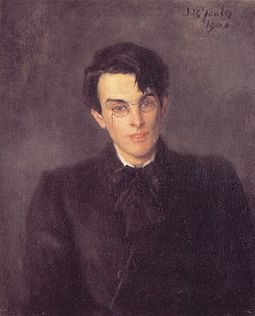
William Butler Yeats, painted by his father, John Butler Yeats, 1900

William Butler Yeats, painted by his father, John Butler Yeats, 1900

Born in Ireland on June 13 1865, Yeats was born into the Protestant, Anglo-Irish minority that had controlled the economic, political, social, and cultural life of Ireland. His free-thinking, bohemian parents counteracted that cultural bias, and raised him to be proud to be an Irish poet and writer. He was raised in a home where art and literature were celebrated, His father was a famous artist, John Butler Yeats, who was renowned for his portraits, though his work never earned enough to keep the family financially secure–thus they moved around a lot.

The entire Butler Yeats family were highly artistic; his brother Jack became an esteemed painter, while his sisters Elizabeth and Susan Mary—known to family and friends as Lollie and Lily—became involved in the Arts and Crafts Movement. That movement of decorative arts was exemplified by traditional craftsmanship using simple forms and it often used medieval, romantic or folk styles of decoration. It advocated economic and social reform and has been said to be essentially anti-industrial.

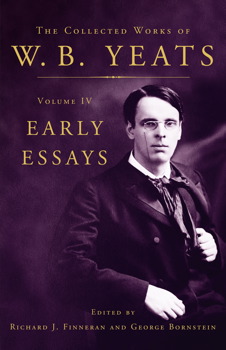
WB Yeats early essaysIn December 1923, Yeats was awarded the Nobel Prize in Literature, just after Ireland had gained independence. Fortunately, the prize led to a significant increase in the sales of his books, when his publishers Macmillan  capitalized on the publicity. He was able to repay not only his own debts, but those of his father–this was a huge source of relief for the whole family.

To a certain extent,  Yeats was a product of the arts and crafts movement. His poetry was whimsical and serious, and completely reflective of his passionate, turbulent life.  He has been quoted as saying a poet should labor “at rhythm and cadence, at form and style, ” and was a founding member of the Rhymers’ Club, a group of London poets who met to read and discuss their poems. The Rhymers placed a very high value on subjectivity,  how someone’s judgment is shaped by personal opinions and feelings instead of outside influences, and on craftsmanship.

william-butler-yeatss-quotes-4This emphasizes to me the value of a writing group–even Yeats had a group of people to bounce ideas off, and that group improved his craftsmanship.

Reading the work of W.B.Yeats greatly shaped my own view of poetry and literature in general. His life was unconventional, and chaotic, and his love affairs were famous, especially his life-long, frequently unrequited love for the Irish revolutionary/actress, Maud Gonne. He struggled with love and morality as did all free-thinking artists and writers in his day–but his struggles and the struggles of his contemporaries freed their imaginations, and they produced great works.

Of all his works, this is my favorite:

The Stolen Child by  W.B. (William Butler) Yeats

WHERE dips the rocky highland
Of Sleuth Wood in the lake,
There lies a leafy island
Where flapping herons wake
The drowsy water rats;
There we’ve hid our faery vats,
Full of berrys
And of reddest stolen cherries.
Come away, O human child!
To the waters and the wild
With a faery, hand in hand,
For the world’s more full of weeping than you can understand.

Where the wave of moonlight glosses
The dim gray sands with light,
Far off by furthest Rosses
We foot it all the night,
Weaving olden dances
Mingling hands and mingling glances
Till the moon has taken flight;
To and fro we leap
And chase the frothy bubbles,
While the world is full of troubles
And anxious in its sleep.
Come away, O human child!
To the waters and the wild
With a faery, hand in hand,
For the world’s more full of weeping than you can understand.

Where the wandering water gushes
From the hills above Glen-Car,
In pools among the rushes
That scarce could bathe a star,
We seek for slumbering trout
And whispering in their ears
Give them unquiet dreams;
Leaning softly out
From ferns that drop their tears
Over the young streams.
Come away, O human child!
To the waters and the wild
With a faery, hand in hand,
For the world’s more full of weeping than you can understand.

Away with us he’s going,
The solemn-eyed:
He’ll hear no more the lowing
Of the calves on the warm hillside
Or the kettle on the hob
Sing peace into his breast,
Or see the brown mice bob
Round and round the oatmeal chest.
For he comes, the human child,
To the waters and the wild
With a faery, hand in hand,
For the world’s more full of weeping than he can understand.

 >>><<<

Loreena McKennitt, the Stolen Child  (via You Tube)

6 Comments

Filed under Books, Fantasy, Humor, Literature, Publishing, Uncategorized, writer, writing

When inspiration fails…

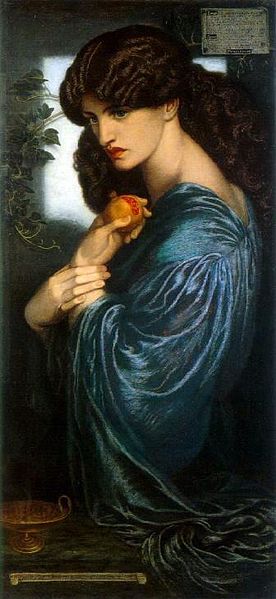
276px-Dante_Gabriel_Rossetti_-_ProserpineThere are days when I just can’t come up with a new idea. The creative juices are flowing, but they’re moving  more like unimaginative sludge. I don’t see these moments as writer’s block—the ideas are lying dormant. They just don’t want to bloom quite yet.

This is when I clean the house. For some reason, inspiration always strikes when I am doing some mindless task, and though you wouldn’t know it from my office, I work better when the house is in order. If that hasn’t jarred an idea loose, I put on some Loreena McKennitt or Blackmore’s Night and go out to the internet and search for ideas, by looking at fantasy images from Canstock or Dreamstime.

Sometimes I just peruse the old masters from the renaissance era out on Wikimedia Commons, like Dante’s Persephone.

Then there are times when I have a cornucopia of ideas. They can’t all be used, there are so many of them. I try to write them down for use later, and that helps when I have a temporary dry spell.

That is, they help unless I forget to make full notes about the whole idea—random notes like “Give the dog a biscuit” are just a bit too ambiguous to be really helpful. Know what dog would have been helpful–however that random note did inspire me to give Billy Ninefingers a hilarious sidekick, a dog named Bisket.

Sometimes I get going on a tale and all of a sudden my enthusiasm just sort of faints somewhere along the line and I don’t know why. It turns out that idea really wasn’t a novel—it was a short story and it just wanted to be done and over with.  Short stories are wonderful exercises for writing longer pieces. If you can, you should try to build up a backlog of short pieces under 7000 words in length, because you never know when a call for short stories will come along and you might have the chance to be published in an anthology.

Old Restored booksAlso, writing short fiction helps you get the hang of using a story arc in smaller increments, to help the layers of your longer pieces.

Sometimes I get stuck in the middle, and don’t know what is going to happen next. That is really frustrating, but I just set is aside to come back to it later. Other times I get a little bit of a jump-start by talking to members of my writing group.

But there are times the piece just has to be shelved for a while.  That’s okay, because when I pull it out, I will say, “Hey! This is awesome—I love this story.” I never fail to find that spark when I run across a tale I forgot I had half-written.

I never get bored with my characters, but I sometimes get bored with the drivel I write for them to do. That is why sometimes walking away from a stalled story for a short while is a good idea. At that point I am beating a dead horse and it’s a waste of time. Later I will see the manuscript through new eyes and a better way to get my heroes to the final battle will strike.

When I am stuck on a paragraph that I just can’t get right, I email a writing buddy and run it past them. We bounce it back and forth until it conveys the idea I think it needs to–or I throw it out.

I’m always happy to talk with them when they are stuck, so it all balances out.

GrandmasNoBakeCookiesMy point is that we all suffer from occasional lapses of the creative muse. I never let lack of inspiration for one project stop me from pushing forward—I just find something that does interest me and do that for a while until I have my fire back.

Sometimes I just have to make cookies for a while. Chocolate no-bakes...yummy….

4 Comments

Filed under Adventure, Battles, blogging, Books, Fantasy, Humor, Literature, Publishing, Self Publishing, Uncategorized, writer, writing

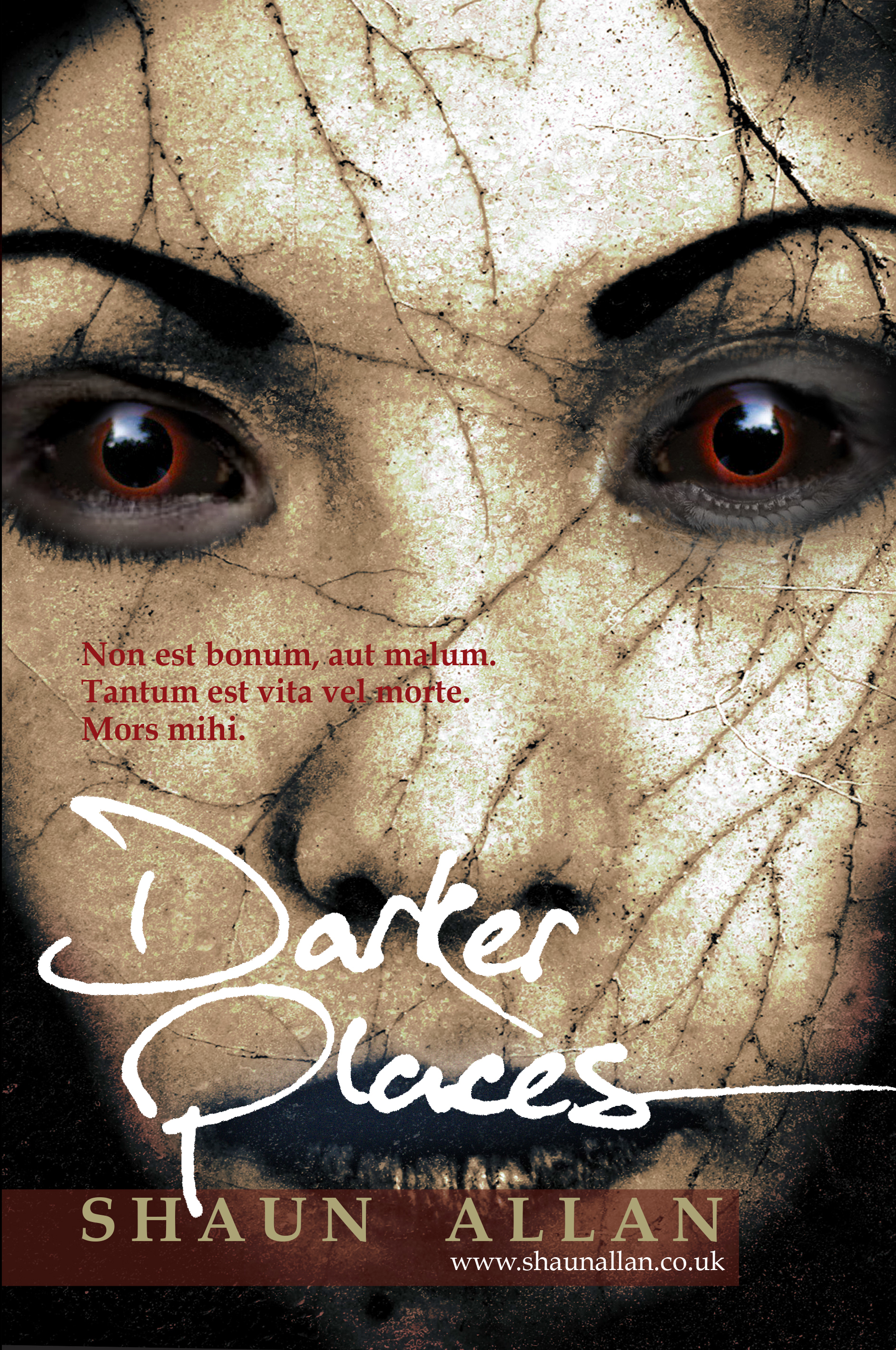
Darker Places, Shaun Allan

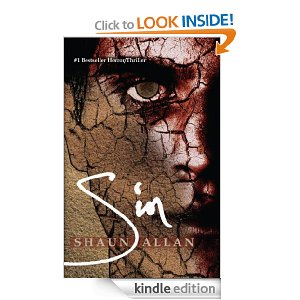
My Writing LifeOne of my favorite people is Shaun Allan, author of the bestselling novel, Sin–he  can write circles around me. Actually, he can write circles around ANYone.  Shaun has a new book out today, Darker Places. I was fortunate to be asked to edit this book, and I’m just going to say, very little effort on my part is ever required with Shaun’s work.

Darker Places is a dark, literary fantasy, comprised of thirteen poems and 13 short-stories, in the same vein as Dark Places,  his book of short works that was published in 2012.

Shaun has consented to answer a few questions about his writing life for us:

CJJ: Tell us a little of early life and how you began writing:

SA: Early life…  Can I remember that far back?  I’m not sure I can…  I can’t think of a time when I haven’t been writing.  I’m told (by my mother who also tells me I was a little terror as a young child, which I can’t quite believe) I used to write stories and draw the pictures to go along with them.  Nowadays, my artistic skills are probably somewhat lacking.  I’m hoping my writing skills have improved, though.  At school, English was easily my favourite lesson and I loved writing the essays.  I was a big fan of science fiction, back then (I still am a fan, of course), so read lots of Arthur C. Clarke and Isaac Asimov amongst others.  I moved on to fantasy, with David Eddings and Terry Brooks and then brought in horror.  All these found their way into my writing, with horror and the supernatural becoming the mainstay of my subject matter now.  I feel, without the darkness, you can’t appreciate the light.

CJJ: Those are books I loved too. Tell us about your most recent book.

SA: Darker Places, my new book, is the follow up to Dark Places.  It’s an anthology of 13 stories and 13 poems which walk the reader through the shadowy passages of my mind. There’s ome humour in there (with Gremlins and Little Dead Riding Hood), some touching stories (The Crow and Stolen Moments) and much darker ones (Home) where I kill off a number of my old school friends, with their permission!  And, we get to see what happened with Sin before the events of his novel.

CJJ: I have to say that is an awesome story–Sin is an amazing character. And Home is one of the best, short stories I have read in a long time. Now we come to the question people always want to know:  How did you come to write this novel?

sin - Shaun AllanSA: Sin took me ten years to write.  As it’s a very personal book, I occasionally had to step away and wrote short stories.  Many of these were collected together in Dark Places, which was prompted by a comment a writer friend of mine made.  As my mind tends to write what it wants rather than what I want, and another friend, who lives in Australia, was very forthcoming with writing prompts I couldn’t refuse, Darker Places became more and more a reality.  I mean, if you’re given a starter sentence of “The bird fell and the sky was silent,” how can you not work with it?

CJJ: Do you have a specific ‘Creative Process’ that you follow, such as outlining or do you ‘wing it’?

SA: Oh, I wing it.  I know wonderful writers (Connie) who outline, but I can’t.  I’ve tried, but my mind doesn’t work like that.  It goes where it wishes, my Muse being a right royal pain in the posterior.  I sat down to write some of Mortal Sin and ended up writing a Christmas story about Rudolph, for example!  Sometimes, as with Mr. Composure, I can write the start and almost immediately know how it will end, with ‘only’ the path it takes to figure out, but often, I start and I have no idea at all.

CJJ: How does your work differ from others of its genre?

SA: I think because it’s personal.  There’s aspects of me, my life and my darkness in everything.  There’s also my sense of humour.  I set the stories where I live.  When I was starting, and everyone was saying “write what you know,” I struggled somewhat.  What did I know?  Where I lived seemed boring, for a start!  But then I read a Clive Barker book (Weaveworld, I think) and he described going down back alleys in a town.  I didn’t know, but felt it could have been the alleys where he grew up.  It wasn’t boring.  So I moved my stories to Grimsby and Lincolnshire – the places I knew.  Once they came home, they allowed me more freedom.

CJJ: Your work is dark, but you are such a cheerful, light-hearted person. Why do you write what you do?

SA: Good question.  Though I can write silly children’s poetry as well as paranormal and psychological thrillers, it’s the darker work which I find easiest.  I find it therapeautic.  I can get stresses and bad memories out and turn them into something I and others seem to enjoy.  As I say, without darkness, you can’t appreciate the light.

CJJ: I know why I chose the indie route for my work, but I’m curious as to why you’ve chosen this path.

SA: I did try to be ‘properly’ published, but, with the indie route, I’ve made some amazing friends and reached people all over the world.  I have full control over my work and the only deadline (in most cases) is the one I set myself.

CJJ: What advice would you offer an author trying to decide whether to go indie or take the traditional path?

SA: Well, you have to go for what you feel is right, but I have to admit, though the indie route is hard work, its immensely rewarding.  I’d definitely recommend giving it a go.

~~~~~~

Thank you Shaun, for taking the time to answer these questions, and for being here today!

DarkerPlaces_96dpi_100%DARKER PLACES by Shaun Allan

What if you could steal the final moments from the dying? What if you had the darkest secret, but couldn’t think what it might be? What if you entered the forest in the deep of the night. Who is the melting man? And are your neighbours really whom they appear to be?

So many questions.

To find the answers, you must enter a darker place. Thirteen stories. Thirteen poems. Thirteen more doorways.

 ~~~~~


Shaun AllanA creator of many prize winning short stories and poems, Shaun Allan has written for more years than he would perhaps care to remember. Having once run an online poetry and prose magazine, he has appeared on Sky television to debate, against a major literary agent, the pros and cons of internet publishing as opposed to the more traditional method. Many of his personal experiences and memories are woven into the point of view and sense of humour of Sin, the main character in his best-selling novel of the same name, although he can’t, at this point, teleport.

A writer of multiple genres, including horror, humour and children’s fiction, Shaun goes where the Muse takes him – even if that is kicking and screaming. He has written for NBC Universal, and regularly holds writing workshops at local schools.

Shaun lives with his wife, two daughters and two cats. Oh and a manic dog. Though his life might, at times, seem crazy, he is not.

Honest.

~~~~~~

To see more of Shaun’s work, please visit Shaun’s author page at Amazon.com.

1 Comment

Filed under Adventure, Blogger, Books, Fantasy, Humor, Literature, Publishing, Self Publishing, Uncategorized, writer, writing

What I #amwriting

Alarm clock quote ray bradburyI normally begin my day at about 5:30 a.m. with editing for my clients–I like to do that when I am at my sharpest which is always in the morning.  I spend the afternoons writing, and right now I have two manuscripts that I am working on, and several short-stories. My evenings I either write blog posts or work on designing book covers.

Other than writing, most of my work these days centers around finishing up publishing the second editions of the Tower of Bones Series. The book itself, Tower of Bones, has been republished, and book II in the series, Forbidden Road, is in the process of being proofed and should be available soon–hopefully within two weeks.

In addition to revamping the TOB series, I hope to have the prequel to the series, a stand-alone novel, Mountains of the Moon, published by July 15, 2015, with a few copies to take to the PNWA conference. That means it has to be finished and ready to proof by June 25–which may be pushing it. However, things are moving so perhaps I will be able to meet this new deadline.

As I said, I have two novels in the works: concurrently with The Wayward Son, I am fleshing out the final book of the Tower of Bones series, Valley of Sorrows. This book deals with the aftermath of the events in Forbidden Road and winds up that story.

The road to hell Phillip Roth QuoteIn the aftermath of an incident that occurred in the last days of the war in Mal Evol, John lost the use of most of his magic. He has managed to keep that disability a secret for thirty years. The Wayward Son is the story of John’s redemption, and explains the events that happened in Aeoven while Edwin and the others were gone. These incidents culminated in John and Garran being sent to meet Edwin in Braden at the end of Forbidden Road. 

John Farmer’s story is intriguing to me, because he is a man concealing many secrets. A lot is going on under the surface–he suffers from survivor’s guilt and PTSD, which often develops after a person is exposed to one or more traumatic events. In The Wayward Son, John’s rocky relationship with Garran is explored, and also his love affair with the Abbess of Aeoven, Halee.

While I was re-editing the series to date, I took the liberty of changing several once-minor characters’ names, as they had suddenly become important in the two later books, and their names were too close to other, already prominent, characters’ names. Since I was changing them anyway, I made them widely different. Thus Marta Randsdottir is now Halee Randsdottir. Her original name was nearly identical to Edwin’s wife, Marya, a problem since the two women figure prominently in The Wayward Son.

The problem was inadvertently begun in 2009 when I was writing Tower of Bones as the story-line and walk-through for an RPG, and was scrounging around for good character names. I didn’t know at that time it would become a book, and it didn’t occur to me that NEVER naming any character with a similar sounding, looking, or rhyming name is something every author should take note of. This is important, no matter how minor the characters seem to be, because, just like Halee, they may have a larger part to play later and the confusion will ruin the story.

The magnitude of the problem first became evident when I was writing Forbidden Road, but I thought I was stuck with it. Referencing the two women in the same paragraph was dreadfully confusing, since their names were only one letter off from each other.

ok to write garbage quote c j cherryhFor a long time, I didn’t know what to do about the name problem. I thought I was stuck with it, but one of the beauties of being an indie is the freedom I have to make adjustments when a gross error is discovered. Since I was completely revamping the series anyway, it was the perfect time to take the plunge and rectify that mistake. The series now has new maps, new interiors, and new covers.

It was just another lesson I’ve learned since leaping into this mad circus of indie publishing, but now I know to never name two characters in the same book with names that begin and end with the same letters. Don’t do it!


Comments Off on What I #amwriting

Filed under Adventure, Battles, Books, Fantasy, Humor, Literature, Publishing, Self Publishing, Uncategorized, writer, writing

When this job becomes work: the book signing event

SUPPORT YOUR LOCAL AUTHORSI must admit, I am not really a people person. I’m a bit awkward, and not really sure of myself, and I have a sense of humor that is too off-the-wall for most people. That is one reason why being an author is such a good fit for me–I can work from home and most of my interactions are imaginary.

Nevertheless, there are times when I must put on the public persona of the Successful Author. I’m not really that good at this one-on-one public thing…yet. I’ve had the good fortune to be involved in multi-author events with other indie authors, with more experience at it, and I’ve been able to see how they approach the gig.

It’s tricky–you can’t just assault people, shouting “Buy my book!”

Walking the line between being obnoxious, and telling people what they want to know about the book is tricky. The minute someone asks me what Huw the Bard is all about, my mind grinds to a halt. It’s almost like I never even read it, although I do remember writing it.

My first public event was last month at NorWesCon, and that was interesting because I was a vendor, so I was there all four days, but in the vendors’ room. For me, that was a tee-shirt-and-jeans event, because I don’t own any costumes, or ren-fair clothes (yet).

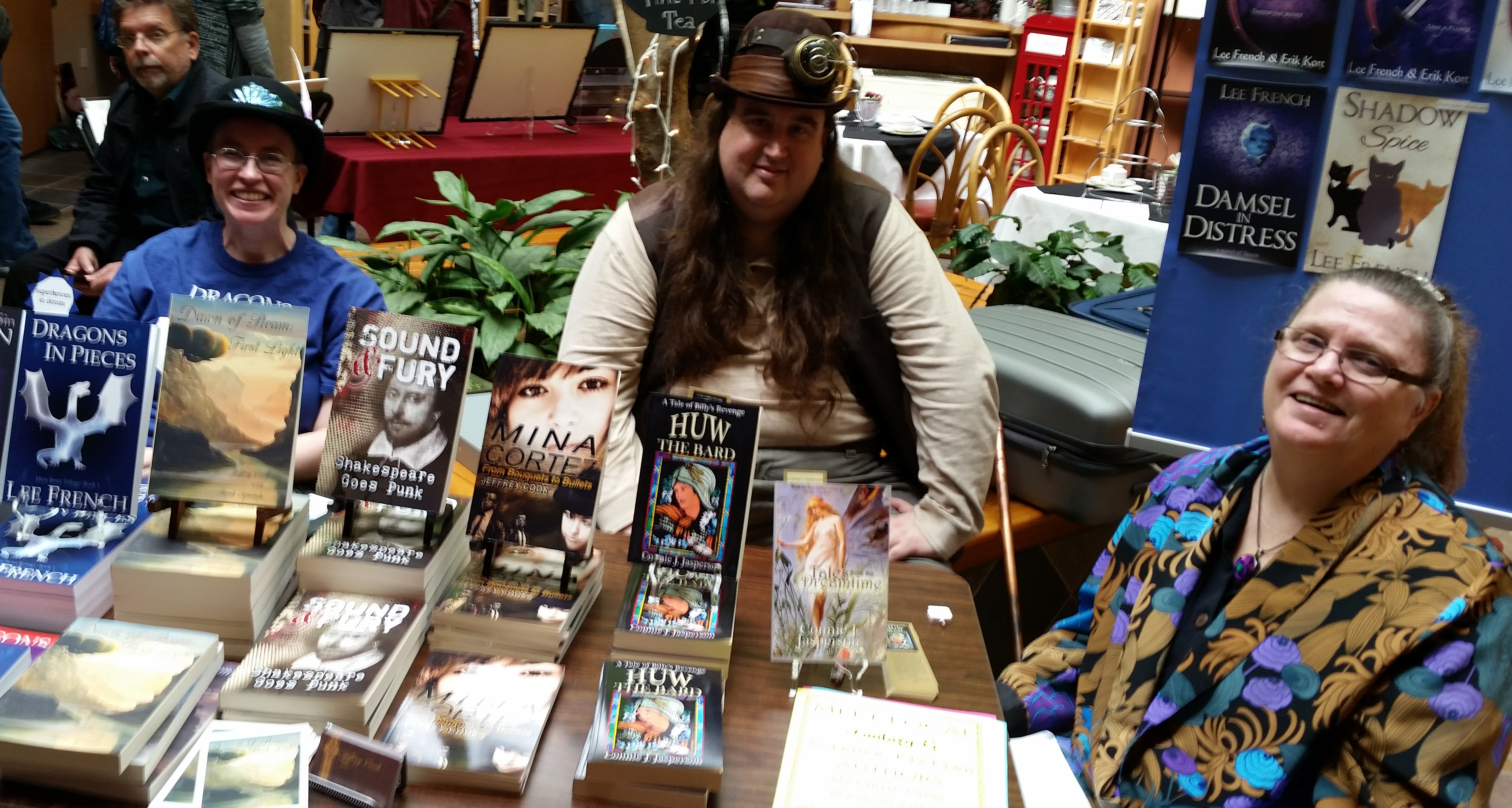
My second public event was this last Saturday. Two other local indies, fantasy author Lee French, and steampunk author Jeffrey Cook joined me at the Two Sister’s Tea Room in downtown Olympia for a book signing. This was a very different situation, and was much more pleasant. This signing was timed for the middle of one of the largest festivals in the the city, the annual Procession of the Species, so we had many people stopping and conversing with us.

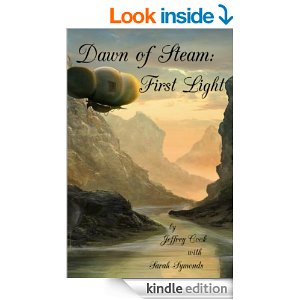
Dawn of Steam First LightSeveral people really stand out in my mind–I was moved to tears by one lady from Hawaii who bought Dawn of Steam, First Light, from Jeffrey.  She said she was a new reader, that she had come from a place where reading was not encouraged. She also said she was currently enjoying Charles Dickens’ classic novel,  The Pickwick Papers. I was awed by the absolute joy she took in the written word as she looked through Jeffrey’s book, and by how happy it made her that he signed it for her.

It was really brought home to me then that reading is still a privilege denied to many people of the world, often not by their wish, but by circumstances beyond their control.

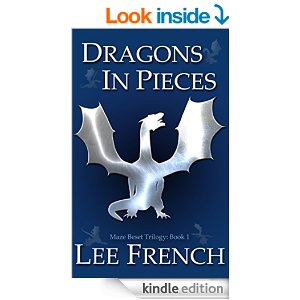
dragons in pieces lee frenchThen there was the wonderful character who was absolutely crazy for dragons. He not only bought Lee’s book, Dragons in Pieces, but insisted on buying one of the little plastic Dragon heads she had created with her 3-d printer as decorations.

Lee was selling books like she owned the only snocone stand in the desert.

I wasn’t, but I had a great time anyway, and handed out a lot of book marks.

From left: Lee French, Jeffrey Cook, Connie Jasperson

From left: Lee French, Jeffrey Cook, Connie Jasperson

For that event, I went all out clothing-wise. I went to the Goodwill and shopped the fat-lady rack on senior citizens’ half-price day, and found what seemed like the perfect, brilliantly-garish, machine-washable, fancy-label jacket to wear with my rather boring black blouse and black trousers. It was only about twenty years out of style, and was the perfect price for my tapped out pocket-book: $3.99, with my old-peoples’ discount.

I am still looking for the right event-outfits. I want something a little wonderful, but with not quite as much purple as the flashy jacket. I love purple, but as an accent color.

Our next event is in three weeks, so that gives me a lot of time to find something suitable for the comfy grandma who writes RPG game-based hack-and-slash epic adventures, and also sometimes writes literary fantasy.

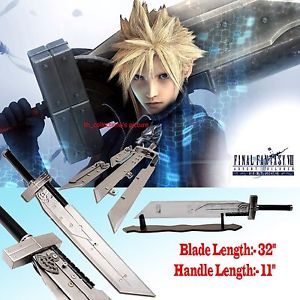
Maybe what I need is a green velvet renaissance faire dress, with Cloud’s buster-sword from Final Fantasy VII in a shoulder scabbard. That  should get my style of writing across well enough.

cloud strife and buster blade


2 Comments

Filed under Adventure, Battles, Books, Fantasy, Humor, Literature, Publishing, Uncategorized, writer, writing

The Gormenghast Novels

Gormenghast trilogyOne of the strangest, most compelling series of books I ever read was the literary, yet still fantastic, Gormenghast series of novels, written by the late Mervyn Peake during the years following WWII.

It has been said of this series that it is the the first true fantasy of manners.

Satirizing the manners and affectations of a social class or of multiple classes, often represented by stereotypical stock characters, a “Fantasy of manners” is fantasy literature that owes as much or more to the comedy of manners as it does to the traditional heroic fantasy of J. R. R. Tolkien and other authors of high fantasy.

The Washington Post Book World had this to say about the series:  “This extravagant epic about a labyrinthine castle populated with conniving Dickensian grotesques is the true fantasy classic of our time.” 

The immense,  labyrinthine Hayholt, featured in Tad Williams’ epic masterpiece, Memory, Sorrow, and Thorn,  seemed reminiscent of castle Gormenghast to a certain extent, when I first read that series. I don’t know if Williams is a Gormenghast fan–I’ve never asked him, although I should. I do know he is not afraid to write great literary fantasy.

The Gormenghast series opens with the book, Titus Groan. Although the book takes its name from Titus, and he  is technically the main character, the book only covers the first two years of his life. Titus-the-baby appears infrequently throughout, but is still an integral part of the plot, inciting change in the routine of the immense castle. At the age of one, he becomes the Earl of Groan. The great library has been deliberately burned, sending the old earl, his father, spiraling into madness. He vanishes, having been eaten by Death Owls (!) while attempting to hide the body of his murdered chef, Swelter, who was murdered by another of his servants.

225px-Titus Groan novel

Mark Robertson’s cover illustration for the Mandarin paperback edition

Wikipedia gives this as the plot introduction for the series: “The book is set in the huge castle of Gormenghast, a vast landscape of crumbling towers and ivy-filled quadrangles that has for centuries been the hereditary residence of the Groan family and with them a legion of servants.

“The Groan family is headed by Lord Sepulchrave, the seventy-sixth Earl of Groan. He is a melancholy man who feels shackled by his duties as Earl, although he never questions them. His only escape is reading in his library. His wife is the Countess Gertrude. A large-framed woman with dark red hair, she pays no attention to her family or the rest of Gormenghast. Instead, she spends her time locked away in her bedroom, in the company of a legion of cats and birds, the only things toward which she shows affection.”

GORMENGHAST-72dpiThese complicated, convoluted books of nonsense are not for everyone. They are beautifully written, but the less perceptive, more impatient type of reader will find this series confusing and plot-less. Despite being a dark, Gothic fantasy, the prose is literary. For some casual readers, this work will be considered too heavy on the descriptions  It may also contain too many “ten-dollar” English words–words of more than one syllable.

But for those readers like me, readers who adore beautiful prose, deep, involving  books, and darkly baroque settings peopled with unforgettable characters, the Gormenghast Novels strike a chord deep within the soul. These books must be savored, experienced in the fullest sense of the word. The focus is on the breathtaking visual descriptions, and while I am thrilled by it, the verbal beauty of Gormenghast is what will leave many impatient modern readers cold.

For me, Gormenghast is a surreal, visual painting, created of beautifully crafted words., and frankly, I say to hell with anyone who mocks my enjoyment of it.

Mark Robertson's cover illustration for the Mandarin paperback edition

Mark Robertson’s cover illustration for the Mandarin paperback edition

Just like J.R.R. Tolkien’s work, when you are reading this series of novels, the journey itself is more important than the destination. And speaking of J.R.R.–I just want to say that while this series is often compared to Tolkien’s work, there is very little similarity between the two, other than they are both extremely well written fantasy, written by authors with a good command of the English language and all its nuances.

Mervyn Peake was famous as a writer, portrait artist, and illustrator, and was considered brilliant in both fields. In 1959, after the publication of the third of his Gormenghast novels, the dreadful disease of dementia finally claimed him, eventually robbing him of his ability to draw.

Tragically Peake was unable to live normally for the last years of his life, and died in a nursing home 1968 at the age of 57, having left his literary masterpiece uncompleted in the way he had envisioned it.


10 Comments

Filed under Adventure, Books, Fantasy, Humor, Literature, Publishing, Self Publishing, Uncategorized, writer, writing