Category Archives: #FineArtFriday

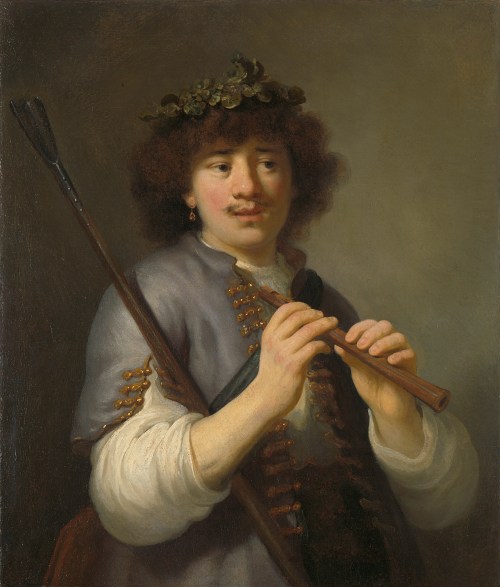
#FineArtFriday: Rembrandt as Shepherd with Staff and Flute, by Govert Flink 1636

About the artist: Born at Kleve, capital of the Duchy of Cleves, which was occupied at the time by the United Provinces, Govert Flinck was apprenticed by his father to a silk merchant, but in 1627 he was sent to Leeuwarden, where he boarded in the house of Lambert Jacobszoon. Jaobszoon was a Mennonite (one of the historic peace churches known for their commitment to pacifism). While Jacobszoon is better known as a preacher, he was a talented painter and an excellent teacher.

While studying there, Flinck met some of Jacobszoon’s neighbors, relatives of Saskia van Uylenburgh, who had married Rembrandt in 1634. That same year he began studying with Rembrandt.

Flinck is acknowledged as one of Rembrandt’s best pupils.

I really enjoy this romantic painting of Rembrandt dressed as a shepherd, holding a flute, and thinking about…what? Rembrandt’s contemplative expression seems peaceful.  The details are wonderful – from the finely worked trim on his garments down to the jewel dangling from his right ear, a gem that softly glows. The grains of the wood in both the flute and staff are subtle and real. The light falls perfectly – Flinck captured the personality of the master as a handsome young man during the happiest time of his life, and it seems as if Rembrandt himself enjoyed posing for it.

For more than a decade, Flinck’s work echoed that of Rembrandt, clearly influenced by the master’s style in the work which he executed between 1636 and 1648. As time passed, he began to desire to be a history painter, a genre in painting that  is defined by its subject matter rather than artistic style, and turned to the work of Peter Paul Rubens. In later years, Flinck had great commercial success, receiving many commissions for official and diplomatic paintings.


Credits and Attributions:

Wikimedia Commons contributors, “File:Rembrandt als herder met staf en fluit Rijksmuseum SK-A-3451.jpeg,” Wikimedia Commons, the free media repository, https://commons.wikimedia.org/w/index.php?title=File:Rembrandt_als_herder_met_staf_en_fluit_Rijksmuseum_SK-A-3451.jpeg&oldid=225225289 (accessed August 16, 2018).

Comments Off on #FineArtFriday: Rembrandt as Shepherd with Staff and Flute, by Govert Flink 1636

Filed under #FineArtFriday

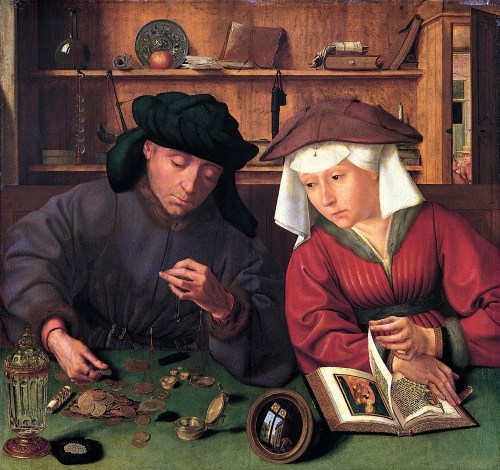
#FineArtFriday: The Money Changer and His Wife by Quentin Matsys, 1514

  • Artist: Quentin Matsys  (1456/1466–1530)
  • Title: The Moneylender and his Wife
  • Date: 1514
  • Medium: oil on panel
  • Dimensions: Height: 70.5 cm (27.7 in)
  • Current location: Louvre Museum
  • Inscriptions: Signature and date

The Money Changer and His Wife is a 1514 oil on panel painting by the Flemish renaissance artist Quentin Matsys.

What I love about this painting:

The colors are rich and vivid, and the lines sharp and clean. The artist included the smallest details in the prayer book, the pewter plate in the background, and the crystal jar by the man’s right hand, showing a prosperous, well-educated young couple. In some ways, Matsys’ style reminds me of the work of the lesser known Flemish painter, Pieter Brueghel the Younger, who was born long after Matsys’ death, but whose original works also leaned toward caricatures and grotesques.

About this painting, via Wikipedia:

A man, who is weighing the jewels and pieces of gold on the table in front of him, sits next to his wife who is reading a book of devotion with an illustration of the Virgin and Child. The couple is not dressed as members of nobility, but rather as well-to-do burghers of Antwerp, where the painting was made. At the time, Antwerp had grown with the influx of many southern immigrants fleeing the Spanish Inquisition. Among this international community there was a demand for money-changers and money-lenders, as international commerce was increasing in the port city.

About the Artist, via Wikipedia:

Most early accounts of Matsys’ life are composed primarily of legend and very little contemporary accounts exist of the nature of his activities or character. According to J. Molanus’ Historiae Lovaniensium, Matsys is known to be a native of Leuven with humble beginnings as an ironsmith. One of four children, Matsys was born to Joost Matsys (d. 1483) and Catherine van Kincken sometime between 4 April and 10 September 1466. Legend states that Matsys abandoned his career as a blacksmith to woo his wife, who found painting to be a more romantic profession, though Karel van Mander claimed this to be false, and the real reason was a sickness during which he was too weak to work at the smithy and instead decorated prints for the carnival celebrations.

Matsys work is considered to contain strong religious feeling—characteristic of traditional Flemish works—and is accompanied by a realism that often favored the grotesque. Matsys’ firmness of outline, clear modelling and thorough finish of detail stem from Van de Weyden’s influence; from the Van Eycks and Memling by way of Dirck Bouts, the glowing richness of transparent pigments. Matsys’ works generally reflect earnestness in expression, minutely detailed renderings, and subdued effects in light and shade. Like most Flemish artists of the time he paid a great deal of attention to jewelry, edging of garments, and ornamentation in general.


Credits and Attributions:

The Money Changer and His Wife by  Quentin Matsys, 1514 Public domain. The work of art depicted in this image and the reproduction thereof are in the public domain worldwide. The reproduction is part of a collection of reproductions compiled by The Yorck Project. The compilation copyright is held by Zenodot Verlagsgesellschaft mbH and licensed under the GNU Free Documentation License.

Wikipedia contributors, “The Money Changer and His Wife,” Wikipedia, The Free Encyclopedia, https://en.wikipedia.org/w/index.php?title=The_Money_Changer_and_His_Wife&oldid=937629150 (accessed June 26, 2020).

Wikipedia contributors, “Quentin Matsys,” Wikipedia, The Free Encyclopedia, https://en.wikipedia.org/w/index.php?title=Quentin_Matsys&oldid=960328863 (accessed June 26, 2020).


Comments Off on #FineArtFriday: The Money Changer and His Wife by Quentin Matsys, 1514

Filed under #FineArtFriday

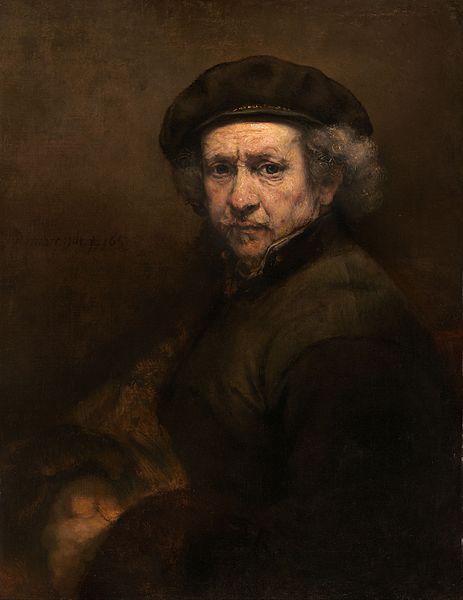
#FineArtFriday: Self Portrait, Rembrandt 1659

Rembrandt Harmenszoon van Rijn, commonly known simply as Rembrandt, is considered the finest artist of the 17th century. Some art historians consider him the finest artist in the history of art, and the most important artist in Dutch art history.

Speaking strictly as a Rembrandt fangirl and abject admirer, I consider his self-portraits to be more honest than those of any other artist.

Quote from Wikipedia: His self-portraits form a unique and intimate biography, in which the artist surveyed himself without vanity and with the utmost sincerity.

This honesty comes across in all his works featuring himself as the subject, even those where he portrays himself as a shepherd or the prodigal son. Each portrait shows an aspect of his personality, his sense of humor, his affection for his first wife, Saskia, who was the love of his life, and his wry acceptance of his own human frailties.

Money was a mystery to Rembrandt. He had no understanding of a budget, mishandled his son’s inheritance, spent far more than he earned, and didn’t pay his taxes. In short he was always in trouble with the authorities, always skirting the edges of disaster.

Rembrandt knew he was talented, but didn’t see himself as a creative genius. He was just a man with a passion for art, who lived beyond his means and died a pauper, as did Mozart, and as do most artists and authors.

I feel I know this man, more so than I do the person he was in his earlier self-portraits. He’s matured, lost some of the brashness of his youth. When I observe the man in this self-portrait, painted ten years before his death, I see a good-humored man just trying to live a frequently difficult life as well as he can. His face is lined and blemished, not as handsome as he once was. But his eyes seem both kind and familiar, filled with the understanding that comes from living with all one’s heart and experiencing both great joy and deep sorrow.

The art of Rembrandt van Rijn shows us his world as he saw it. Others may disagree with me, but I feel his greatest gift was the ability to convey personality with each portrait. This gift allowed him to portray every person he painted as they really were, blemished and yet beautiful. This is a gift he taught his students, and they were able to copy his style quite effectively, making discerning his true work difficult even for the experts.


Credits and Attributions:

Wikipedia contributors, “Rembrandt,” Wikipedia, The Free Encyclopedia, https://en.wikipedia.org/w/index.php?title=Rembrandt&oldid=844357531(accessed June 8, 2018).

Wikimedia Commons contributors, “File:Rembrandt van Rijn – Self-Portrait – Google Art Project.jpg,” Wikimedia Commons, the free media repository, https://commons.wikimedia.org/w/index.php?title=File:Rembrandt_van_Rijn_-_Self-Portrait_-_Google_Art_Project.jpg&oldid=292800848 (accessed June 8, 2018).

Comments Off on #FineArtFriday: Self Portrait, Rembrandt 1659

Filed under #FineArtFriday

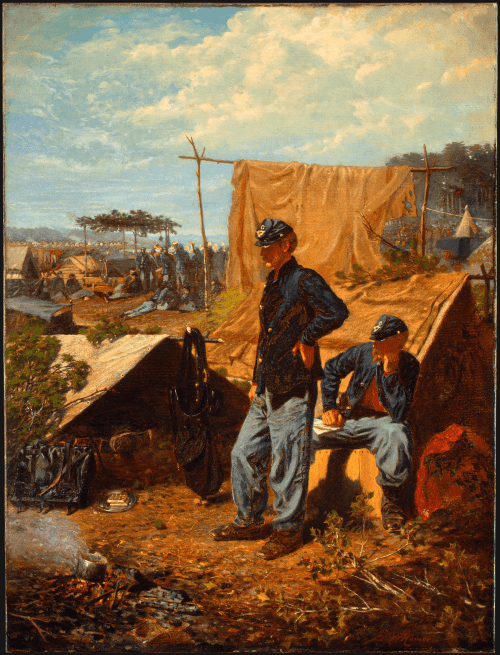
#FineArtFriday: Home, Sweet Home by Winslow Homer (reprise)

We now live in challenging times with the pandemic and social upheavals occupying our conscious minds and social media. I’ve chosen to revisit one of Winslow Homer‘s most poignant images as a reminder of our humanity, that we can come together and be better than we were.

Homer traveled with the Union Army, but the story of the moving event that he depicted in this painting is told by a Confederate soldier who was present. That story follows, toward the bottom of this article.

Home, Sweet Home is one of the most famous paintings of the American Civil War, depicting a moment in time, painted by Winslow Homer. On opposite shores of the Rappahannock River, opposing armies are caught up in an awareness of brotherhood, as music becomes the medium that lays bare the humanity of the soldiers on both sides.

Winslow Homer was best known for his landscapes featuring the many moods of the ocean, but he also painted many iconic images of that turbulent time before, during, and after the American Civil War. His art captures a sense of familiarity, a feeling that the viewer knows these people and their stories intimately.

Wikipedia says, “Harper’s (magazine) sent Homer to the front lines of the American Civil War (1861–1865), where he sketched battle scenes and camp life, the quiet moments as well as the chaotic ones. His initial sketches were of the camp, commanders, and army of the famous Union officer, Major General George B. McClellan, at the banks of the Potomac River in October 1861.

“Although the drawings did not get much attention at the time, they mark Homer’s expanding skills from illustrator to painter. Like with his urban scenes, Homer also illustrated women during wartime, and showed the effects of the war on the home front. The war work was dangerous and exhausting. Back at his studio, Homer would regain his strength and re-focus his artistic vision. He set to work on a series of war-related paintings based on his sketches, among them Sharpshooter on Picket Duty (1862), Home, Sweet Home (1863), and Prisoners from the Front (1866). He exhibited paintings of these subjects every year at the National Academy of Design from 1863 to 1866. Home, Sweet Home was shown at the National Academy to particular critical acclaim; it was quickly sold and the artist was consequently elected an Associate Academician, then a full Academician in 1865.[10]”

The story behind the painting, Home, Sweet Home, is told poignantly in the autobiography, Reminiscences of a Private, by Frank Mixson, who served in the Confederate Army.

“The Yankee band would play the popular airs of theirs amid much yelling and cheering; our bands would do the same with the same result. Towards the wind-up the Yankee band struck up “Yankee Doodle.” Cheers were immense. When they stopped our band struck up “Dixie,” and everything went wild. When they finished this, both bands, with one accord and simultaneously, struck up “Home, Sweet Home.” There was not a sound from anywhere until the tune was finished and it then seemed as if everybody had gone crazy. I never saw anything to compare with it. Both sides were cheering, jumping up and throwing up hats and doing everything which tended to show enthusiasm. This lasted for at least a half hour. I do believe that had we not had the river between us that the two armies would have gone together and settled the war right there and then.”

Quote from: Reminiscences of a Private, by Frank Mixson (1910)


Sources and Attributions:

Wikipedia contributors, “Winslow Homer,” Wikipedia, The Free Encyclopedia, https://en.wikipedia.org/w/index.php?title=Winslow_Homer&oldid=817253575 (accessed January 4, 2018).

Home, Sweet Home: “Had we not had the river between us,” posted by Marek,  https://civilwarfolkmusic.com/2013/12/15/1862-home-sweet-home/ accessed 04 January 2018.

Reminiscences of a Private, by Frank Mixson (published 1910 by Columbia, S.C., The State Company)

Home, Sweet Home (oil on canvas) by Winslow Homer – circa 1863 | Winslow Homer [Public domain], via Wikimedia Commons, accessed 04 January 2018.

Comments Off on #FineArtFriday: Home, Sweet Home by Winslow Homer (reprise)

Filed under #FineArtFriday, writing

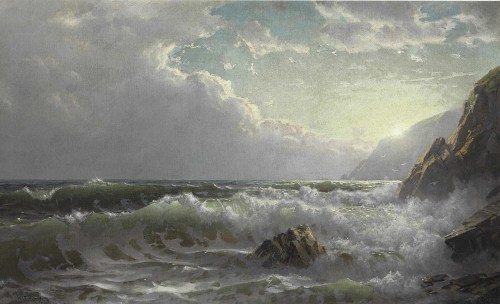
#FineArtFriday: Off the Coast of Cornwall by William Trost Richards 1904

Artist: William Trost Richards  (1833–1905)

Title: Off the Coast of Cornwall

  • Genre: landscape art
  • Date: 1904
  • Medium: oil on canvas
  • Dimensions : Height: 55.9 cm (22 in); Width: 91.4 cm (35.9 in)
  • Collection   Private collection
  • Inscriptions: Signature and date bottom left: W.T. Richards.04.

What I love about this painting:

It is a blustery day, along a rugged seacoast. Intermittent rain squalls blow through, and when one passes the sun peeps out, the bright lull between storms. The sea is that dark greenish color reflecting the sky, a quality stormy waters here in the North Pacific coast often have. It is of a shore in Cornwall, England, but it feels as familiar as if it were the coast of my home, Washington State.

What I love most about how Richards depicted the water is the milk-glass opaqueness of the green water and the way the light seems to shine through the waves.

About the Artist via Wikipedia:

William Trost Richards  rejected the romanticized and stylized approach of other Hudson River painters and instead insisted on meticulous factual renderings. His views of the White Mountains are almost photographic in their realism. In later years, Richards painted almost exclusively marine watercolors.

In the summer of 1874 Richards visited Newport, Rhode Island, and became enthralled with the area’s sublime coastline. He purchased his first of several Newport area homes in 1875 and continued to paint there for the rest of his life, dividing time between Newport and Chester County, Pennsylvania, where he purchased a farm near the Brandywine in 1884. Richards made many excursions to Europe, especially Britain and Ireland, where he produced an important body of work.

He was married to the the poet and playwright Anna Matlack, with whom he had eight children, only five of whom lived past infancy. Matlack educated the children at home to a pre-college level in the arts and sciences. One of their sons, Theodore William Richards, would later win the 1914 Nobel Prize in Chemistry. Anna Richards Brewster, their sixth child, went on to become an important painter in her own right, having received an early arts education from her father as well.

Richards was one of the few 19th century American landscape artists who was equally skilled as a watercolorist and a painter in oils. His drawings are considered among the finest of his generation. Many of his drawing still survive.

Today, Richards is highly regarded for the luminist seascapes, images imbued with light and atmosphere, that he created along the Rhode Island, New Jersey and British coasts. Luminist landscapes emphasize tranquility, and often depict calm, reflective water and a soft, hazy sky.


Credits and Attributions:

Off the Coast of Cornwall, by William Trost Richards / Public domain

Wikimedia Commons contributors, “File:William Trost Richards – Off the Coast of Cornwall.jpg,” Wikimedia Commons, the free media repository, https://commons.wikimedia.org/w/index.php?title=File:William_Trost_Richards_-_Off_the_Coast_of_Cornwall.jpg&oldid=288660467 (accessed June 4, 2020).

Wikipedia contributors, “William Trost Richards,” Wikipedia, The Free Encyclopedia, https://en.wikipedia.org/w/index.php?title=William_Trost_Richards&oldid=939570835 (accessed June 4, 2020).

Wikipedia contributors, “Anna Matlack Richards,” Wikipedia, The Free Encyclopedia, https://en.wikipedia.org/w/index.php?title=Anna_Matlack_Richards&oldid=933481876 (accessed June 4, 2020).

1 Comment

Filed under #FineArtFriday

#FineArtFriday: Silver Lake at Dusk, by Diego Delso

Silver Lake during dusk, Wrangell–St. Elias National Park and PreserveAlaska, United States, Photographed by Diego Delso on 23 August 2017. This image was selected as picture of the day on Wikimedia Commons for .

About the Photographer:

Diego Delso roams the world photographing nature and contributes his work to Wikimedia Commons. He is a free content and knowledge supporter, whose photographs are regularly featured as the Image of the Day, and several of his images have been selected as finalists for Image of the Year.

I love the mood and serenity of today’s image. The clarity and depth of both the water and the sky makes one feel as if we know this place.


Credits and Attributions

Silver Lake at Dusk, Diego Delso / CC BY-SA (https://creativecommons.org/licenses/by-sa/4.0)

Wikimedia Commons contributors, “File:Lago Plateado, Parque nacional y reserva Wrangell-San Elías, Alaska, Estados Unidos, 2017-08-22, DD 135.jpg,” Wikimedia Commons, the free media repository, https://commons.wikimedia.org/w/index.php?title=File:Lago_Plateado,_Parque_nacional_y_reserva_Wrangell-San_El%C3%ADas,_Alaska,_Estados_Unidos,_2017-08-22,_DD_135.jpg&oldid=419215168 (accessed May 29, 2020)


Comments Off on #FineArtFriday: Silver Lake at Dusk, by Diego Delso

Filed under #FineArtFriday

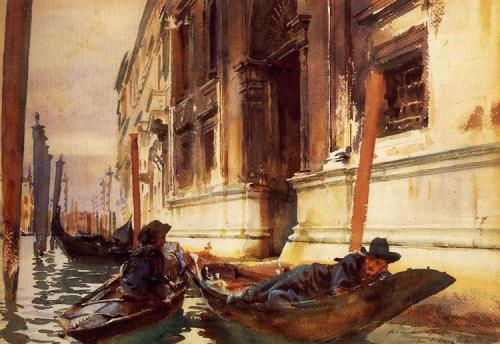
#FineArtFriday: The Gondoliers’ Siesta, John Singer Sargent 1904 

The Gondoliers’ Siesta, John Singer Sargent 1904  

Artist: John Singer Sargent  (1856–1925)

Title: English: Gondoliers’ Siesta

Date: circa 1904

Medium: watercolor

Dimensions: 35.6 x 50.8 cm

Collection: Private collection, courtesy of Adelson Galleries

Current location: New York

Source/Photographer   Beyeler Foundation

What I Love About this Painting:

John Singer Sargent shows us a moment in time, set in Venice of 1904. It is an image capturing the heat of midday and the well-deserved rest of two men whose lives are spent on the water. They are well-employed, earning a good living by ferrying passengers from one end of town to another. During their heyday as a means of public transports, teams of four men would share ownership of a gondola — three oarsmen (gondoliers) and a fourth person, primarily shore based and responsible for the booking and administration of the gondola (Il Rosso Riserva).

About Singer’s Watercolors, via Wikipedia:

During Sargent’s long career, he painted more than 2,000 watercolors, roving from the English countryside to Venice to the Tyrol, Corfu, the Middle East, Montana, Maine, and Florida. Each destination offered pictorial stimulation and treasure. Even at his leisure, in escaping the pressures of the portrait studio, he painted with restless intensity, often painting from morning until night.

His hundreds of watercolors of Venice are especially notable, many done from the perspective of a gondola. His colors were sometimes extremely vivid and as one reviewer noted, “Everything is given with the intensity of a dream.” In the Middle East and North Africa Sargent painted Bedouins, goatherds, and fisherman. In the last decade of his life, he produced many watercolors in Maine, Florida, and in the American West, of fauna, flora, and native peoples.

With his watercolors, Sargent was able to indulge his earliest artistic inclinations for nature, architecture, exotic peoples, and noble mountain landscapes. And it is in some of his late works where one senses Sargent painting most purely for himself. His watercolors were executed with a joyful fluidness. He also painted extensively family, friends, gardens, and fountains. In watercolors, he playfully portrayed his friends and family dressed in Orientalist costume, relaxing in brightly lit landscapes that allowed for a more vivid palette and experimental handling than did his commissions (The Chess Game, 1906). His first major solo exhibit of watercolor works was at the Carfax Gallery in London in 1905. In 1909, he exhibited eighty-six watercolors in New York City, eighty-three of which were bought by the Brooklyn Museum. Evan Charteris wrote in 1927:

To live with Sargent’s water-colours is to live with sunshine captured and held, with the luster of a bright and legible world, ‘the refluent shade’ and ‘the Ambient ardours of the noon.’

Although not generally accorded the critical respect given Winslow Homer, perhaps America’s greatest watercolorist, scholarship has revealed that Sargent was fluent in the entire range of opaque and transparent watercolor technique, including the methods used by Homer.

About the Artist, via Wikipedia:

John Singer Sargent born January 12, 1856 – died April 14, 1925, was an American expatriate artist, considered the “leading portrait painter of his generation” for his evocations of Edwardian-era luxury. He created roughly 900 oil paintings and more than 2,000 watercolors, as well as countless sketches and charcoal drawings. His oeuvre documents worldwide travel, from Venice to the Tyrol, Corfu, the Middle East, Montana, Maine, and Florida.

He was born in Florence to American parents, and trained in Paris before moving to London, living most of his life in Europe. He enjoyed international acclaim as a portrait painter. An early submission to the Paris Salon in the 1880s, his Portrait of Madame X, was intended to consolidate his position as a society painter in Paris, but instead resulted in scandal. During the next year following the scandal, Sargent departed for England where he continued a successful career as a portrait artist.

From the beginning, Sargent’s work is characterized by remarkable technical facility, particularly in his ability to draw with a brush, which in later years inspired admiration as well as criticism for a supposed superficiality. His commissioned works were consistent with the grand manner of portraiture, while his informal studies and landscape paintings displayed a familiarity with Impressionism. In later life Sargent expressed ambivalence about the restrictions of formal portrait work, and devoted much of his energy to mural painting and working en plein air. Art historians generally ignored “society” artists such as Sargent until the late 20th century.

Sargent’s early enthusiasm was for landscapes, not portraiture, as evidenced by his voluminous sketches full of mountains, seascapes, and buildings. Carolus-Duran’s expertise in portraiture finally influenced Sargent in that direction. Commissions for history paintings were still considered more prestigious, but were much harder to get. Portrait painting, on the other hand, was the best way of promoting an art career, getting exhibited in the Salon, and gaining commissions to earn a livelihood.


Credits and Attributions:

Wikimedia Commons contributors, “File:John Singer Sargent, Gondoliers’ Siesta.jpg,” Wikimedia Commons, the free media repository, https://commons.wikimedia.org/w/index.php?title=File:John_Singer_Sargent,_Gondoliers%E2%80%99_Siesta.jpg&oldid=149791025 (accessed May 22, 2020).

Wikipedia contributors, “John Singer Sargent,” Wikipedia, The Free Encyclopedia, https://en.wikipedia.org/w/index.php?title=John_Singer_Sargent&oldid=956888160 (accessed May 22, 2020).

Wikipedia contributors, “Gondola,” Wikipedia, The Free Encyclopedia, https://en.wikipedia.org/w/index.php?title=Gondola&oldid=950230627 (accessed May 22, 2020).

Comments Off on #FineArtFriday: The Gondoliers’ Siesta, John Singer Sargent 1904 

Filed under #FineArtFriday

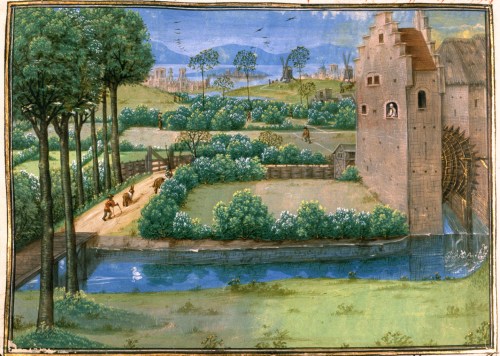
#FineArtFriday: Landscape with a Watermill – Le Tresor des Histoires (15th C) The Cotton Library

Description: Landscape with a Watermill

Date: 15th century

Collection: British Library

Accession number: Cotton Augustus V, f.345v

Source/Photographer: Image taken from Le Tresor des Histoires: a universal history from the Creation to the time of Pope Clement VI.

Originally published/produced in 15th century.

Held and digitised by the British Library

About the Cotton Library, via Wikipedia:

The Cottonian Library was the richest private collection of manuscripts ever amassed. Of secular libraries it outranked the Royal Library, the collections of the Inns of Court and the College of Arms. Cotton’s collection even included the original codex bound manuscript of Beowulf, written around the year 1000. Cotton’s house near the Palace of Westminster became the meeting-place of the Society of Antiquaries of London and of all the eminent scholars of England. the Library was eventually donated to the nation by Cotton’s grandson and is now housed in the British Library.

Robert Bruce Cotton organized his library in a room 26 feet (7.9 m) long by six feet wide filled with bookpresses, each with the bust of a figure from classical antiquity on top. Counterclockwise, these were:

This is an incomplete list of some of the manuscripts from the Cotton library that today form the Cotton collection of the British Library. Some manuscripts were destroyed or damaged in a fire at Ashburnham House in 1731, and a few are kept in other libraries and collections.

In each press, each shelf was assigned a letter; manuscripts were identified by the bust over the press, the shelf letter, and the position of the manuscript (in Roman numerals) counting from the left side of the shelf. Thus, the Lindisfarne Gospels, Nero B.iv, was the fourth manuscript from the left on the second shelf (shelf B) of the press under the bust of Nero. For Domitian and Augustus, which had only one shelf each, the shelf letter was left out of the press-mark.

The British Museum retained Cotton’s press-marks when the Cotton collection became one of the foundational collections of its library, so manuscripts are still designated by library, bookpress, shelf, and number (even though they are no longer stored in that fashion). For example, the manuscript of Beowulf is designated Cotton MS Vitellius A.xv, and the manuscript of Pearl is Cotton MS Nero A.x.

Today’s image is a gorgeous, highly detailed illustration from the 15th century book,  Le Tresor des Histoires. Universal history, from the Creation to Pope Clement VI (died 1342). 15th century copy. Lavishly illuminated, the beautiful art was most likely done by an unknown artist in either a monastery or nunnery, as both priests and nuns were known to work at copying and illustrating books. In fact, nuns were as likely to be found working as scribes as monks, friars, and priests were.

About Sir Robert Cotton, 1st Baronet – via Wikipedia:

Sir Robert Cotton began developing the works and manuscripts into a collection for his Library shortly after the birth of his son in 1594. From the period 1609 to 1614 the deaths of various people (including Lord Lumley, Earl of Salisbury, Prince Henry, William Dethick and Northampton) all contributed to Sir Robert Cotton’s purchase of works for his library. Sir Robert Cotton resided in London, while his wife and son remained in the country. During his father’s absence Thomas Cotton studied to eventually receive his BA on 24 October 1616 from Broadgates Hall—the very same year that Sir Robert Cotton returned to his wife Elizabeth and family (a result of a hiccup with the law involving the death of earl of Somerset). At that point, Sir Thomas Cotton had taken the responsibilities of the home and the library into his own hands.

(c) Trinity College, University of Cambridge; Supplied by The Public Catalogue Foundation

In 1620, Thomas Cotton married Margaret Howard with whom he had his first son, Sir John Cotton, just one year later in 1621. Sir Thomas Cotton’s marriage with Margaret Howard ended in 1622, which had been the year that Thomas Cotton’s father, Sir Robert Cotton, permanently moved residence to The Cotton House, along with the library which remained in the Cotton House until Sir Robert Cotton’s death nine years later in 1631. The relocation of the library and residence to the Cotton House gave members of Parliament and government workers better access to the matter within the library to be used as resources for their work.

The Cotton Library offered important and valuable sources of reference and knowledge to many people, such as John Selden, “a frequent borrower from the library, and probably its protector during the civil wars” as stated in the Oxford Dictionary of National Biography. Selden, in 1623 said of Cotton: “his kindness and willingness to make them [his collection of books and manuscripts] available to students of good literature and affairs of state”. In keeping with the notion that John Selden was a common presence in the Cotton library, The British Library holds a list of thirteen works, and the locations of those volumes today, that had been lent to Seldon by Sir Robert Cotton.

After another hiccup with the government, Sir Robert Cotton was forced to close the library by Charles I because the content within the library was believed to be harmful to the interests of the Royalists in 1629. In September 1630 Sir Robert Cotton and Sir Thomas Cotton, together, petitioned for renewed access to their library. One year later, in 1631, Sir Robert Cotton died without knowing what the future held for his library, but wrote in his will that the library be left to his son Thomas Cotton and that it be passed down accordingly. After the death of his father, Sir Thomas Cotton married his second wife, Alice Constable, in 1640 with whom they had their son Robert Cotton in 1644. Sir Thomas Cotton’s “ownership access to the Cotton library was more limited than under his father” according to the Oxford Dictionary of National Biography, and Thomas Cotton maintained his ability to “protect,” “improve” and “maximize the profits” received during the civil war, as he had earlier on in his life as a result of his father’s absence. Upon the death of Sir Robert Cotton on 13 May 1662, Sir Thomas Cotton obeyed the will of his father and passed down the library to his eldest son from his first marriage, Sir John Cotton.

On 12 September 1702, Sir John Cotton died. Prior to his death, Sir John Cotton had arranged for the Cotton Library to be bought for the nation of England through acts of Parliament. If the library had not been sold to the nation, despite the wish of his grandfather Sir Robert Cotton, the library would have been taken over and inherited by John Cotton’s two grandsons, who, unlike the rest of the college-educated Cotton family, had been illiterate and put the Cotton Library at risk of potentially getting broken up and sold to different divisions within the family.


Credits and Attributions:

Wikimedia Commons contributors, “File:Landscape with a watermill – Le Tresor des Histoires (15th C), f.345v – BL Cotton MS Augustus V.jpg,” Wikimedia Commons, the free media repository, https://commons.wikimedia.org/w/index.php?title=File:Landscape_with_a_watermill_-_Le_Tresor_des_Histoires_(15th_C),_f.345v_-_BL_Cotton_MS_Augustus_V.jpg&oldid=295714857 (accessed May 14, 2020).

Wikipedia contributors, “List of manuscripts in the Cotton library,” Wikipedia, The Free Encyclopedia, https://en.wikipedia.org/w/index.php?title=List_of_manuscripts_in_the_Cotton_library&oldid=919448324 (accessed May 14, 2020).

Wikipedia contributors, “Sir Robert Cotton, 1st Baronet, of Connington,” Wikipedia, The Free Encyclopedia, https://en.wikipedia.org/w/index.php?title=Sir_Robert_Cotton,_1st_Baronet,_of_Connington&oldid=948522337 (accessed May 14, 2020).

Portrait of Sir Robert Bruce Cotton, 1st Baronet, by Cornelis Janson van Ceulen Wikimedia Commons contributors, “File:Robert Cotton.jpg,” Wikimedia Commons, the free media repository, https://commons.wikimedia.org/w/index.php?title=File:Robert_Cotton.jpg&oldid=369753711 (accessed May 14, 2020).

3 Comments

Filed under #FineArtFriday

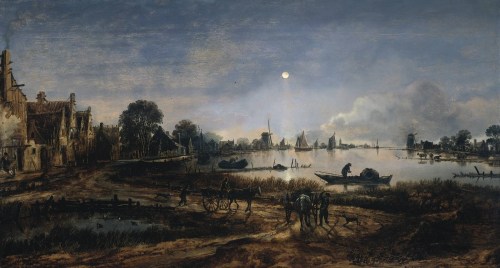
#FineArtFriday: River View by Moonlight, Aert van der Neer


River View by Moonlight, Aert van der Neer [Public domain], via Wikimedia Commons

Aert van der Neer, or Aernout or Artus (c. 1603 – 9 November 1677), was a landscape painter of the Dutch Golden Age, specializing in small night scenes lit only by moonlight and fires, and snowy winter landscapes, both often looking down a canal or river.

Description:
View of a village on a river by moonlight. In the foreground two horse and carriage on a dirt road. To the right a fisherman on a small boat on the water. On the horizon two windmills.
Date: Circa 1640-1650
Medium: oil on panel

What I love about this painting:

This image offers us context to history. It shows how a 17th century harbor looked and the people who worked there. Carters and haulers move cargo, and fishermen go out in the dark to fish for a living. Some freshwater fish, such as eels, are more commonly found after dark.


Credits and Attributions:

River View by Moonlight, Aert van der Neer [Public domain], via Wikimedia Commons / Wikimedia Commons contributors, “File:Rijksmuseum neer.jpeg,” Wikimedia Commons, the free media repository,  https://commons.wikimedia.org/w/index.php?title=File:Rijksmuseum_neer.jpeg&oldid=194438646 (accessed October 27, 2017).

Wikipedia contributors, “Aert van der Neer,” Wikipedia, The Free Encyclopedia, https://en.wikipedia.org/w/index.php?title=Aert_van_der_Neer&oldid=770891498 (accessed October 27, 2017).

Comments Off on #FineArtFriday: River View by Moonlight, Aert van der Neer

Filed under #FineArtFriday