Category Archives: #FineArtFriday

#FineArtFriday: View of Delft by Johannes Vermeer ca.1661

View of Delft by Johannes Vermeer

Genre: cityscape

Date: between circa 1660 and circa 1661

Medium: oil on canvas

Dimensions: Height: 96.5 cm (37.9″); Width: 117.5 cm (46.2″)

What I love about this painting:

The scene is as clear and sharp as if it were viewed through an open window. The colors are both bright and muted–true to life. The red of roof tiles contrast with the blue of both the sky and a blue painted shingle roof. The reflections on the water, the people on the shore show us a lovely morning in the Netherlands.

Vermeer is considered the master of light, and indeed, the quality of light in all his works is remarkable. The shadowy reflections on the dark, still waters look as real as a photograph.

About this Painting, via Wikipedia:

View of Delft  is an oil painting by Johannes Vermeer, painted ca. 1660–1661. The painting of the Dutch artist’s hometown is among his most popular, painted at a time when cityscapes were uncommon. It is one of three known paintings of Delft by Vermeer, along with The Little Street and the lost painting House Standing in Delft. The use of pointillism in the work suggests that it postdates The Little Street, and the absence of bells in the tower of the New Church dates it to 1660–1661. Vermeer’s View of Delft has been held in the Dutch Royal Cabinet of Paintings at the Mauritshuis in The Hague since its establishment in 1822.

The technical analysis shows that Vermeer used a limited choice of pigments for this painting: calcitelead whiteyellow ochre, natural ultramarine and madder lake are the main painting materials. His painting technique, on the other hand, is very elaborate and meticulous.


Credits and Attributions:

Wikipedia contributors, “View of Delft,” Wikipedia, The Free Encyclopedia, https://en.wikipedia.org/w/index.php?title=View_of_Delft&oldid=933182285 (accessed February 14, 2020).

Wikimedia Commons contributors, “File:Jan Vermeer van Delft 001.jpg,” Wikimedia Commons, the free media repository, https://commons.wikimedia.org/w/index.php?title=File:Jan_Vermeer_van_Delft_001.jpg&oldid=338278968 (accessed February 14, 2020).

Comments Off on #FineArtFriday: View of Delft by Johannes Vermeer ca.1661

Filed under #FineArtFriday

#FineArtFriday: Frost Fair on the River Thames near the Temple Stairs, by Thomas Wyke

Today I’m revisiting a painting, Frost Fair on the River Thames near the Temple Stairs. by Thomas Wijck (also Thomas Wijk, or Thomas Wyck; 1616–1677). He  was a Dutch painter of port views and genre paintings. This painting details a moment in history, the winter of 1686-1684, as seen though the eyes of one who lived it. I first published this post in January of 2018.

About the Artist, via Wikipedia:

Wijck was born into an artist family and received his training from his father. He journeyed to Italy, presumably by 1640, the year in which a ‘Tommaso fiammingo, pittore’ (Thomas the Fleming, painter) is documented as residing in Rome in the Via della Fontanella. Although this evidence of his residence in Rome around this time has been questioned,[1] a number of his pictures depict scenes in and around Rome which would indicate a visit to the city at some point.[2] He also resided in the environs of Naples, where he executed many sketches which he subsequently worked up into drawings of coast views.[3]

In 1642 Wijck returned to the northern Netherlands, where he became a member of the Haarlem Guild of St. Luke.[1] In 1660 he was appointed Dean of the Haarlem Guild.

He went to England about the time of the Restoration and was much employed. He was followed there by his son and pupil Jan Wyck, who remained in Britain for the rest of his career and played an important role in the development of English sporting painting. Thomas Wyck was also the teacher of the Haarlem painter Jan van der Vaart, who later also immigrated to England.

He died in Haarlem in August 1677. Pieter Mulier II was a follower of his style.

What I love about this painting:

Everywhere you look you see color. Red wheels on a cart, red tents, blue tents, and yellow–color is everywhere. We sometimes think of the 17th century as a dark colorless time, but clearly it was not. People were much the same then as they are today. We love to have fun and will find a way to enjoy ourselves even in the harshest conditions.

And winters during that time were harsh. Fuel for heating and cooking was expensive, food was expensive, and many people died from the cold and starvation.

Quoted from Wikipedia: During the Great Frost of 1683–84, the worst frost recorded in England, the Thames was completely frozen for two months, with the ice reaching a thickness of 11 inches (28 cm) in London. Solid ice was reported extending for miles off the coasts of the southern North Sea (England, France and the Low Countries), causing severe problems for shipping and preventing the use of many harbours. Near Manchester, the ground was frozen to 27 inches (69 cm), in Somerset, to more than 4 feet (1.2 m).

In the pedestrian tunnel under the south bank of Southwark Bridge, there is an engraving by Southwark sculptor Richard Kindersley, made of five slabs of grey slate, depicting the frost fair.[19]

The frieze contains an inscription that reads (two lines per slab):

Behold the Liquid Thames frozen o’re,
That lately Ships of mighty Burthen bore
The Watermen for want of Rowing Boats
Make use of Booths to get their Pence & Groats
Here you may see beef roasted on the spit
And for your money you may taste a bit
There you may print your name, tho cannot write
Cause num’d with cold: tis done with great delight
And lay it by that ages yet to come
May see what things upon the ice were done

The inscription is based on handbills,[20] printed on the Thames during the frost fairs.


Credits and Attributions:

Wikipedia contributors, “Thomas Wijck,” Wikipedia, The Free Encyclopedia, https://en.wikipedia.org/w/index.php?title=Thomas_Wijck&oldid=913753600 (accessed February 7, 2020).

#FineArtFriday: Frost Fair on the River Thames near the Temple Stairs, by Thomas Wyke was first published here on Life in the Realm of Fantasy on January 20, 2018.

Wikipedia contributors, “River Thames frost fairs,” Wikipedia, The Free Encyclopedia, https://en.wikipedia.org/w/index.php?title=River_Thames_frost_fairs&oldid=820904368 (accessed January 19, 2018).

Frost Fair on the River Thames near the Temple Stairs, by Thomas Wyke ca.1683-1684 via Wikimedia Commons (scan from FT magazine, 2007-09-30) [Public domain]

Comments Off on #FineArtFriday: Frost Fair on the River Thames near the Temple Stairs, by Thomas Wyke

Filed under #FineArtFriday

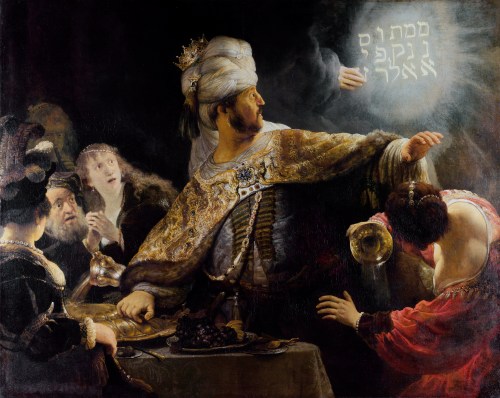
#FineArtFriday: Belshazzar’s Feast by Rembrandt ca. 1635-1638

Artist:  Rembrandt  (1606–1669):Rembrandt Harmenszoon van Rijn

Title:   Belshazzar’s Feast

Genre: religious art (history painting)

Description: According to Daniel 5:1-31, King Belshazzar of Babylon takes sacred golden and silver vessels from the Jewish Temple in Jerusalem by his predecessor Nebuchadnezzar. Using these holy items, the King and his court praise ‘the gods of gold and silver, bronze, iron, wood, and stone’. Immediately, the disembodied fingers of a human hand appear and write on the wall of the royal palace the words “MENE”, “MENE”, “TEKEL”, “UPHARSIN”

Depicted people: Belshazzar

Date: circa 1635-1638

Medium: oil on canvas

Dimensions: Height: 167.6 cm (65.9″); Width: 209.2 cm (82.3″)

Collection: National Gallery


What I love about this painting:

Rembrandt went to a great deal of expense and trouble to paint what he hoped would be seen as a masterpiece. He wanted to be a history painter, as that is where the fame was in his time. While the money was in portraits, Rembrandt also wanted fame. We know this painting was painted before his wife Saskia’s illnesses  and death in 1642, because she was the model for woman behind Belshazzar. She is depicted as being terrified by what is being written on the wall.

Every detail is there, from the finely worked golden ornaments and crown in Belshazzar’s headdress to the king’s golden earring in the shape of a crescent moon. His garments are covered in delicate embroideries in gold thread and sewn with pearls and beads of jet. The garments and jewelry of all the diners are rich and sumptuous; they too wear golden jewelry, with pearls and beads of jet. The shock of the diners, the combination of fear and indignation of the king at the appearance of the hand—these emotions are depicted as perfectly as are the extravagant garments.

About this painting, Via Wikpedia:

Rembrandt’s handling of painting materials and his painting technique in Belshazzar’s Feast are both exceptional and do not compare to any of his other works. The palette of this painting is unusually rich encompassing such pigments as vermilionsmaltlead-tin-yellowyellow and red lakesochres and azurite.


About the story, via Wikipedia:

Belshazzar’s feast, or the story of the writing on the wall (chapter 5 in the Book of Daniel) The story of Belshazzar and the writing on the wall originates in the Old Testament Book of Daniel. The Babylonian king Nebuchadnezzar looted the Temple in Jerusalem and has stolen the sacred artefacts such as golden cups. His son Belshazzar used these cups for a great feast where the hand of God appeared and wrote the inscription on the wall prophesying the downfall of Belshazzar’s reign. The text on the wall says “mene, mene, tekel, upharsin“. Biblical scholars interpret this to mean “God has numbered the days of your kingdom and brought it to an end; you have been weighed in the balances and found wanting; your kingdom is given to the Medes and Persians”.

The inscription on the wall is an interesting element in this painting. Rembrandt lived in the Jewish Quarter of Amsterdam and “derived the form of Hebrew inscription from a book by his friend, the learned Rabbi and printer, Menasseh ben Israel, yet mis-transcribed one of the characters and arranged them in columns, rather than right to left, as Hebrew is written.” This last detail is essential as it relates to the question of why Belshazzar and his advisers were not able to decipher the inscription and had to send for Daniel to help them with it.

The biblical story does not identify the language of the cryptic message, but it is generally assumed to be Aramaic, which, like Hebrew, is written in right-to-left rows, and not in right-to-left columns as in the painting. Although there is no accepted explanation why the Babylonian priests were unable to decipher the writing, the point of this unconventional arrangement – reading the text in the painting in the conventional row-wise left-to-right order results in a garbled message – may be to suggest why the text proved incomprehensible to the Babylonian wise men; indeed, this explanation is in accordance with the opinion of the amora Shmuel, which is mentioned in the Babylonian TalmudTractate Sanhedrin, 22a, among various dissenting views.


Sources and Attributions:

Belshazzar’s Feast by Rembrandt PD|100 via Wikimedia Commons. Wikimedia Commons contributors, “File:Rembrandt-Belsazar.jpg,” Wikimedia Commons, the free media repository, https://commons.wikimedia.org/w/index.php?title=File:Rembrandt-Belsazar.jpg&oldid=363468240 (accessed January 31, 2020).

Wikipedia contributors, ‘Belshazzar’s Feast (Rembrandt)’, Wikipedia, The Free Encyclopedia, 17 January 2020, 09:24 UTC, <https://en.wikipedia.org/w/index.php?title=Belshazzar%27s_Feast_(Rembrandt)&oldid=936202396> [accessed 31 January 2020]

2 Comments

Filed under #FineArtFriday

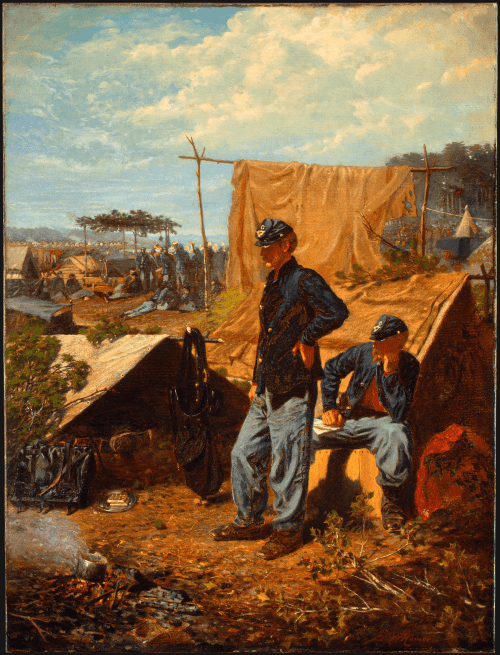
#FineArtFriday: Home, Sweet Home by Winslow Homer 1863 (reprise)

I’m out of town this week, listening to the radio in car, and to audio books. War and peace seem to be hot topics… That brings to mind this iconic painting by Winslow Homer, an image that evokes profound emotion in me, even though I am viewing it 157 years later. I first posted this article in January 2018. Every time I view this painting, I find something new in the details.

The mud on their ragged uniforms, the can heating food in the cookfire, the plate in front of the tent–they are living and fighting in hellish conditions, doing the best they can despite the struggle.


Home, Sweet Home is one of the most famous paintings of the American Civil War, depicting a moment in time, painted by Winslow Homer. On opposite shores of the Rappahannock River, opposing armies are caught up in an awareness of brotherhood, as music becomes the medium that lays bare the humanity of the soldiers on both sides.

Winslow Homer was best known for his landscapes featuring the many moods of the ocean, but he also painted many iconic images of that turbulent time before, during, and after the American Civil War. His art captures a sense of familiarity, a feeling that the viewer knows these people and their stories intimately.

Wikipedia says, “Harper’s (magazine) sent Homer to the front lines of the American Civil War (1861–1865), where he sketched battle scenes and camp life, the quiet moments as well as the chaotic ones. His initial sketches were of the camp, commanders, and army of the famous Union officer, Major General George B. McClellan, at the banks of the Potomac River in October 1861.

“Although the drawings did not get much attention at the time, they mark Homer’s expanding skills from illustrator to painter. Like with his urban scenes, Homer also illustrated women during wartime, and showed the effects of the war on the home front. The war work was dangerous and exhausting. Back at his studio, Homer would regain his strength and re-focus his artistic vision. He set to work on a series of war-related paintings based on his sketches, among them Sharpshooter on Picket Duty (1862), Home, Sweet Home (1863), and Prisoners from the Front (1866). He exhibited paintings of these subjects every year at the National Academy of Design from 1863 to 1866. Home, Sweet Home was shown at the National Academy to particular critical acclaim; it was quickly sold and the artist was consequently elected an Associate Academician, then a full Academician in 1865.[10]”

The story behind the painting, Home, Sweet Home, is told poignantly in the autobiography, Reminiscences of a Private, by Frank Mixson, who served in the Confederate Army.

“The Yankee band would play the popular airs of theirs amid much yelling and cheering; our bands would do the same with the same result. Towards the wind-up the Yankee band struck up “Yankee Doodle.” Cheers were immense. When they stopped our band struck up “Dixie,” and everything went wild. When they finished this, both bands, with one accord and simultaneously, struck up “Home, Sweet Home.” There was not a sound from anywhere until the tune was finished and it then seemed as if everybody had gone crazy. I never saw anything to compare with it. Both sides were cheering, jumping up and throwing up hats and doing everything which tended to show enthusiasm. This lasted for at least a half hour. I do believe that had we not had the river between us that the two armies would have gone together and settled the war right there and then.”

Quote from: Reminiscences of a Private, by Frank Mixson (1910)


Sources and Attributions:

Home Sweet Home by Winslow Homer, © Connie J. Jasperson,  first appeared here on Life in the Realm of Fantasy on January 5th 2018. It has been dusted off and reposted for your viewing pleasure.

Wikipedia contributors, “Winslow Homer,” Wikipedia, The Free Encyclopedia, https://en.wikipedia.org/w/index.php?title=Winslow_Homer&oldid=817253575 (accessed January 4, 2018).

Home, Sweet Home: “Had we not had the river between us,” posted by Marek,  https://civilwarfolkmusic.com/2013/12/15/1862-home-sweet-home/ accessed 04 January 2018.

Reminiscences of a Private, by Frank Mixson (published 1910 by Columbia, S.C., The State Company)

Home, Sweet Home (oil on canvas) by Winslow Homer – circa 1863 | Winslow Homer [Public domain], via Wikimedia Commons, accessed 04 January 2018.

2 Comments

Filed under #FineArtFriday, writing

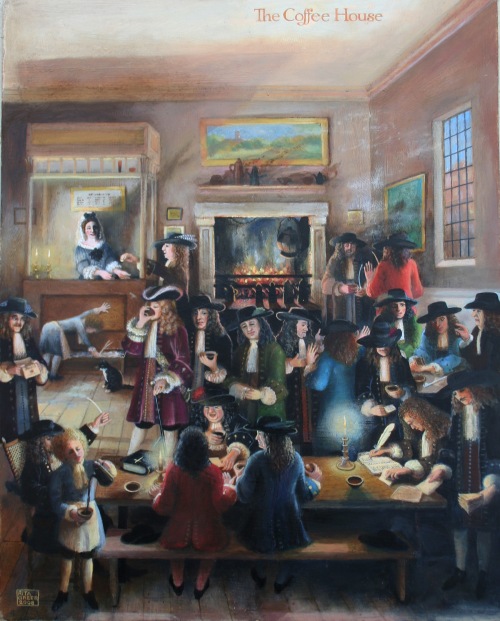
#FineArtFriday: Irene (poem)and The Coffee House, by Rita Greer 2008

The Coffee House


Portions of this post first appeared on Life in the Realm of Fantasy in 2015, as Flash Fiction Friday offering. The poem that follows, Irene, was written for a writer friend, a woman who moved to my Northwest town from Texas.

She participated in NaNoWriMo 2012, and we discovered we lived only a mile apart. Over the years she  became like a sister to me. Now, in 2020, one of her grandchildren has been hit with cancer, and she is temporarily relocating back to Texas to help care for him.

Believe me, she will be missed, as a neighbor, a dear friend, and as the heart and soul of my writing posse. My forthcoming novel, Julian Lackland, would still be languishing in limbo without her determined efforts over the last six years.

She and her husband quickly became members of our family, and no holiday will be the same with out them.


About this painting (quoted from Wikimedia Commons)

The original is an oil painting on board by Rita Greer, history painter, 2008. This was digitized by Rita and sent via email to the Department of Engineering Science, Oxford University, where it was subsequently uploaded to Wikimedia.

Coffee Houses played an important part in the social life of Robert Hooke. Only coffee and chocolate were served (no alcohol). Here news could be had, conversation, arguments, meetings, card games, wagers made, workmen could be paid, etc. (Hooke would sometimes carry out a scientific experiment in front of a coffee house audience as witnesses.) Hooke is shown writing (bottom left) at a table with people waiting to talk to him.

About the artist:

Rita Greer is a history artist, goldsmith, graphic designer, food scientist and author/writer. On retirement in 2003 Rita began the Robert Hooke project, “to put him back into history.”

According to Wikipedia: Much has been written about the unpleasant side of Hooke’s personality, starting with comments by his first biographer, Richard Waller, that Hooke was “in person, but despicable” and “melancholy, mistrustful, and jealous.” Waller’s comments influenced other writers for well over two centuries, so that a picture of Hooke as a disgruntled, selfish, anti-social curmudgeon dominates many older books and articles. For example, Arthur Berry said that Hooke “claimed credit for most of the scientific discoveries of the time.” Sullivan wrote that Hooke was “positively unscrupulous” and possessing an “uneasy apprehensive vanity” in dealings with Newton. Manuel used the phrase “cantankerous, envious, vengeful” in his description. More described Hooke having both a “cynical temperament” and a “caustic tongue.” Andrade was more sympathetic, but still used the adjectives “difficult”, “suspicious”, and “irritable” in describing Hooke.

Back-biting and jostling for position was a hobby among the divas of 17th century science, apparently. Little has changed in the world of academics, it seems.

I spend a large portion of my life in coffee houses too, writing and meeting with other writers, and artists. The friend who inspired the poem today was introduced to me in a coffee house in Olympia, on a dark November night in 2012. It was the kick-off meeting for NaNoWriMo that year.


Irene

I met you in a coffee shop.

Knitters and authors vied for tables

In a dark, polished, coffee-scented room.

Texas wit met Northwest irreverence

And the world was never the same.

A sisterhood built on words

And books

And commonalities.

We met as old ladies, too wise to raise much hell.

We’d have been dangerous

Had Austin met Olympia in the young, wild days.

It must have been divine intent

That our lives converged in the quiet years.

Sisterhood binds and unites us

Because family is more

Than marriage or blood.


Irene © Connie J. Jasperson 2015, All Rights Reserved

Portions of this post first appeared here on Life in the Realm of Fantasy on December 12, 2015.

The Coffee House by Rita Greer, history painter, 2008. Wikimedia Commons contributors, “File:10 The Coffee House.JPG,” Wikimedia Commons, the free media repository, https://commons.wikimedia.org/w/index.php?title=File:10_The_Coffee_House.JPG&oldid=304207824 (accessed January 16, 2020).

3 Comments

Filed under #FineArtFriday, writing

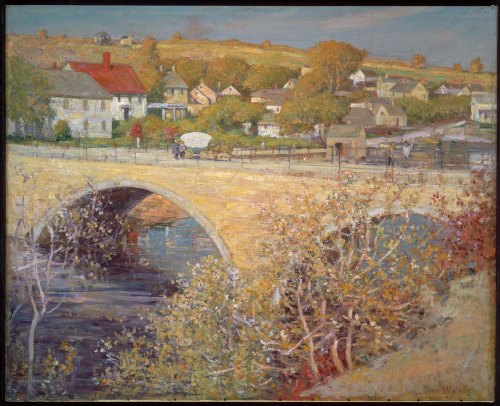
#FineArtFriday: Bridge at Ipswich by Theodore Wendel ca. 1905

  • Artist:  Theodore Wendel  (1859–1932)
  • Title:    Bridge at Ipswich        Date:   circa 1905
  • Medium: oil on canvas
  • Dimensions: Height: 61.5 cm (24.2 ″); Width: 76.2 cm (30 ″)
  • Collection: Museum of Fine Arts

One of the artists whose work I viewed at the Tacoma Art Museum last Friday is a little known Impressionist painter,  Theodore Wendel. I had never heard of him and have had a difficult time finding information on him. By digging around, I was able to cobble together some of this very intriguing artist’s story.

Most of the photos  that I shot with my cell phone while at the museum are not useful other than to identify the artists whose work I viewed. For that reason, I have returned to Wikimedia Commons to find a good example of his sterling work. Today’s image, Bridge at Ipswich, is a perfect example of his best work.

What I find interesting about this painting is how small the sky is and how large the bridge. Most plein air painters make the sky a prominent feature of their work. I like the way the land beyond the bridge dominates the painting, despite the size and solid feeling of the bridge.

About the Artist:

Theodore Wendel was born on July 19, 1857, in Midway, Ohio. He studied at the McMicken School of Design. In 1876 he traveled to Munich, where he enrolled in the Royal Academy. He associated with a group of artists, including Frank Duveneck. He studied at Duveneck’s school of art until returning to the US in 1882. In 1886 he went to Giverny, France, where he met and became close friends with Claude Monet.

Monet and the art of his circle impressed Wendel. He was one of the first artists to change their style from the heavier palette of classical realism to the lighter palette of Impressionism.

He returned to America in 1889 and adapted this new influence to the landscape of New England. He taught at Cowles Art School and at Wellesley College until his marriage in 1897. He married one of his students, Philena Stone.

He and his wife purchased a farm in Ipswich. Both painting and the craft of managing his farm consumed him—he loved both occupations equally.

Unfortunately, after an infection in the jaw in 1917, Wendel was mostly unable to paint until his death in 1932.


Credits and Attributions:

Wikimedia Commons contributors, “File:Theodore M. Wendel – Bridge at Ipswich – 1978.179 – Museum of Fine Arts.jpg,” Wikimedia Commons, the free media repository, https://commons.wikimedia.org/w/index.php?title=File:Theodore_M._Wendel_-_Bridge_at_Ipswich_-_1978.179_-_Museum_of_Fine_Arts.jpg&oldid=358706162 (accessed January 10, 2020).

Most of the information for this article was gleaned from Theodore Wendel, an American impressionist, 1859-1932, by John I.H, Baur.

I also found information on Wendel at the Vose Galleries website, Theodore Wendel, 1859 – 1932.

Comments Off on #FineArtFriday: Bridge at Ipswich by Theodore Wendel ca. 1905

Filed under #FineArtFriday

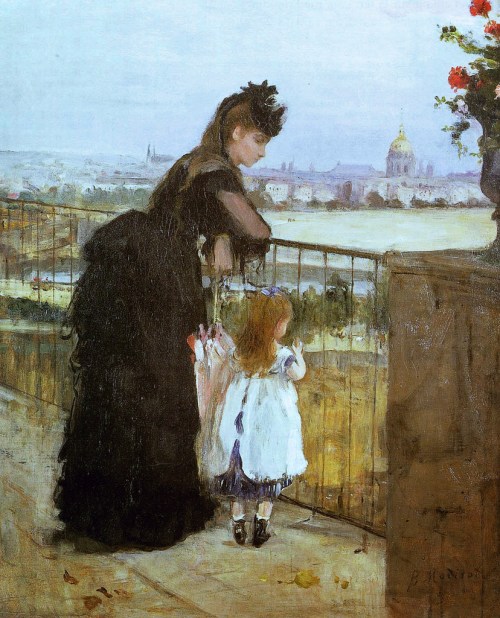
Woman and Child on a Balcony, Berthe Morisot ca. 1872

Title: Woman and Child on a Balcony

Artist: Berthe Morisot  (1841–1895)

Date: 1872

Medium: oil on canvas

Dimensions: Height: 61 cm (24 ″); Width: 50 cm (19.6 ″)

Today, Friday January 3, 2020, my hubby and I are visiting the Tacoma Art Museum, to see an exhibit of Impressionist paintings: Monet, Renoir, Degas, and Their Circle: French Impressionism and the Northwest. I will post about the experience next Friday, and hope to have photographs.

In the meantime, I present you with a female artist, Berthe Morisot, who was the sister-in-law to Eduard Manet. I hope to see her work represented there.

What I love about this painting:

It is only when you stand back from it that you realize how deftly Morisot conveyed the impressions of a pleasant day, a busy harbor, and a curious child. Up close, it is nearly indecipherable, but from a distance—which is how art in the impressionist style should be viewed—it is a delightful image. Is the  young woman a nanny or mother? The small girl seems happy in her company. The two take in the view on a hazy afternoon—there is a sense of affluence and harmony in moment captured by the artist.

About the Artist, vis Wikipedia

Berthe Morisot came from an eminent family, the daughter of a government official and the great-niece of a famous Rococo artist Jean-Honoré Fragonard.  She met her longtime friend and colleague, Édouard Manet, in 1868. Morisot was married to Édouard’s brother, Eugène Manet, in 1874.

Eugene was also a French painter but did not achieve the high reputation of his older brother, Édouard Manet, or his wife, Berthe. He devoted much of his efforts to supporting his wife’s career.

On November 14, 1878, she gave birth to her only child, Julie, who posed frequently for her mother and other Impressionist artists, including Renoir and her uncle Édouard.

It is hard to trace the stages of Morisot’s training and to tell the exact influence of her teachers because she was never pleased with her work and she destroyed nearly all of the artworks she produced before 1869.

Morisot’s mature career began in 1872. She found an audience for her work with Durand-Ruel, the private dealer, who bought twenty-two paintings. In 1877, she was described by the critic for Le Temps as the “one real Impressionist in this group.” She chose to exhibit under her full maiden name instead of using a pseudonym or her married name. As her skill and style improved, many began to rethink their opinion toward Morisot. In the 1880 exhibition, many reviews judged Morisot among the best, even including Le Figaro critic Albert Wolff.

Correspondence between Morisot and Édouard Manet shows warm affection, and Manet gave her an easel as a Christmas present. Morisot often posed for Manet and there are several portrait painting of Morisot such as Repose (Portrait of Berthe Morisot) and Berthe Morisot with a Bouquet. Morisot died on March 2, 1895, in Paris, of pneumonia contracted while attending to her daughter Julie’s similar illness, and thus making her an orphan at the age of 16.


Credits and Attributions:

Wikimedia Commons contributors, “File:Berthe Morisot 001.jpg,” Wikimedia Commons, the free media repository, https://commons.wikimedia.org/w/index.php?title=File:Berthe_Morisot_001.jpg&oldid=359873236 (accessed January 2, 2020).

Wikipedia contributors, “Berthe Morisot,” Wikipedia, The Free Encyclopedia, https://en.wikipedia.org/w/index.php?title=Berthe_Morisot&oldid=931800099 (accessed January 2, 2020).

Wikipedia contributors, “Eugène Manet,” Wikipedia, The Free Encyclopedia, https://en.wikipedia.org/w/index.php?title=Eug%C3%A8ne_Manet&oldid=895506929 (accessed January 2, 2020).

2 Comments

Filed under #FineArtFriday

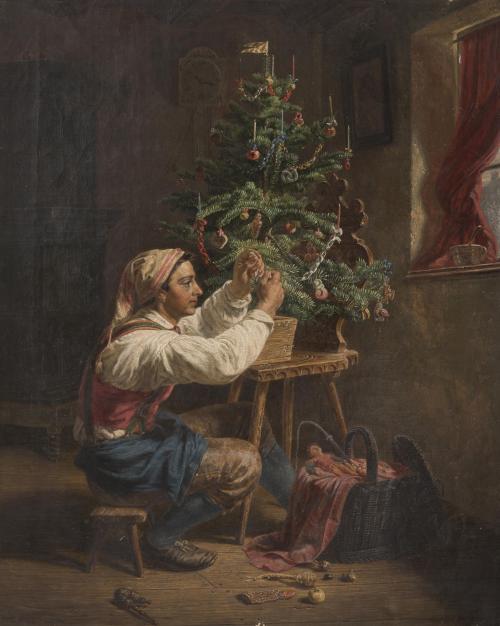
#FineArtFriday: Christmas Tree Decoration, artist unknown, 19th century

I finally got around to putting up our Christmas tree here at Casa del Jasperson, and I must say it looks rather gaudy as compared to the one in this painting.

I always dread the ordeal of moving furniture and getting all the decorations out of their hiding place in the garage. But once the tree is up and the work is out of the way, we love having it.

I say I enjoy it–until it’s time to take it down and figure out where to stash the boxes of ornaments in our overstuffed garage.

About this Picture:

  • Artist: Unknown
  • Title: Christmas Tree Decoration
  • Date: second half of the 19th century
  • Medium: oil on canvas
  • Dimensions : Height: 52.5 cm (20.6 ″); Width: 42 cm (16.5 ″)
  • Location: Private Collection (sold through Dorotheum Auction House)

What I love about this painting:

A young man sits on a low bench and decorates a small fir tree. The furnishings, other than the tree, all are painted in the shadows of the room. A doll lies in the basket at his feet, a toy for his daughter perhaps?

In the background is a beautiful white clock. It has been painted and finely crafted. Poor people would not have owned such an expensive clock.

That clock tells me that while this man may not be rich, he isn’t poor. Even the tree has nice glass ornaments along with decorations of cookies and plain paper.

Chains of colored paper, historically an expensive crafting commodity, also decorate it.

Most poor families didn’t have cut trees, or lavish presents. But the children might wake to find their stockings with an apple or nuts in them, special treats for families that were always on the edge of starvation.

Here in America, in less affluent homes during the early decades of the 20th century, paper chains might have been hung on the tree, along with ornaments made of baked salt-dough and cut-paper. A lot of work went into to creating these ornaments every year, which was part of the fun of getting ready for Christmas.

My maternal grandmother, who was born in 1909, always made paper snowflakes and angels, and strung popcorn and cranberries to decorate her tree.

The man in this painting is dressed in traditional well-made craftsman’s clothing—a simple shirt and vest, apron, leather breeches.

There are curtains of a heavy material at the window, and the tree is set on a beautifully carved table. Is he a woodworker or a clock maker? Who knows, but this man earns enough to live comfortably and celebrate modestly.

This is a quintessential image of old-fashioned Christmas in all its homey prosperity.

According to Wikimedia Commons, the artist who painted this picture is unknown. The Dorotheum Website attributes the painting to an unknown Central European artist.

To me, it is an example of the best of 19th Century European romantic art. It’s a perfect example of a subject near and dear to Victorian souls—that simple, romanticized version of Christmas that we still love today.

This painting makes me think of a Christmas card. Whoever the artist was, they were talented and trained in the craft of painting. They had the knack for conveying homey simplicity in their work.

About Dorotheum via Wikipedia:

The Dorotheum (German pronunciation: [ˌdoːʀoˈteːʊm] (listen)), established in 1707, is one of the world’s oldest auction houses.[1] It has its headquarters in Vienna on the Dorotheergasse and is the largest auction house in both Continental and German-speaking Europe.  Besides auctions, the retail sector also plays a major role in Dorotheum’s business.[3] In the Dorotheum, works of art, antiques, furniture, and jewelry from various centuries are put up for auction. The building is constructed in the neo-classical style.


Credits and Attributions:

Wikimedia Commons contributors, “File:Christmas Tree Decoration.jpg,” Wikimedia Commons, the free media repository, https://commons.wikimedia.org/w/index.php?title=File:Christmas_Tree_Decoration.jpg&oldid=378771434 (accessed December 20, 2019).

Wikipedia contributors, “Dorotheum,” Wikipedia, The Free Encyclopedia, https://en.wikipedia.org/w/index.php?title=Dorotheum&oldid=921309125 (accessed December 20, 2019).


Comments Off on #FineArtFriday: Christmas Tree Decoration, artist unknown, 19th century

Filed under #FineArtFriday

#FineArtFriday: The Lacemaker by Nicolaes Maes ca. 1656

The Lacemaker

  • Artist   Nicolaes Maes
  • Year    c. 1656
  • Medium           oil paint, canvas
  • Dimensions     45 cm (18 in) × 53 cm (21 in)

About this image, via Wikipedia:

The Lacemaker (circa 1656) is an oil on canvas painting by the Dutch painter Nicolaes Maes. It is an example of Dutch Golden Age painting and is part of the collection of the Metropolitan Museum of Art.

This painting is typical of many paintings of women in interiors painted by Maes in the 1650s. The woman is making bobbin lace using a lace pillow that can be seen in other Maes paintings of lacemakers.

The child in a highchair was a popular subject for many Dutch genre painters, and this painting shows how it was used as a safe place to play as well as for eating. The empty bowl of porridge is on the floor along with some other items the boy has let fall. He is wearing a red valhoed or falling cap, which seems to indicate that confinement in the chair is necessary if any lacemaking is going to get done.

baby bumper headguard cap, also known as a falling cap, or pudding hat, is a protective hat worn by children learning to walk, to protect their heads in case of falls.

Known as a pudding or black pudding, a version used during the early 17th century until the late 18th century was usually open at the top and featured a sausage-shaped bumper roll that circled the head like a crown. It was fastened with straps under the chin.

About the Artist via Wikipedia

From Wikipedia: Nicolaes Maes, also known as Nicolaes Maas (January 1634 – November 24, 1693 (buried)) was a Dutch Golden Age painter of genre and portraits. In about 1648 he went to Amsterdam, where he entered Rembrandt‘s studio. Before his return to Dordrecht in 1653 Maes painted a few Rembrandtesque genre pictures, with life-size figures and in a deep glowing scheme of colour, like the Reverie at the Rijksmuseum in Amsterdam, the Card Players at the National Gallery, and the Children with a Goat Carriage. So closely did his early style resemble that of Rembrandt, that the last-named picture, and other canvases in the Leipzig and Budapest galleries and in the collection of Lord Radnor, were or are still ascribed to Rembrandt.

In his best period, from 1655 to 1665, Maes devoted himself to domestic genre on a smaller scale, retaining to a great extent the magic of colour he had learnt from Rembrandt. Only on rare occasions did he treat scriptural subjects, as in Hagar’s Departure, which has been ascribed to Rembrandt. His favorite subjects were women spinning, or reading the Bible, or preparing a meal. He had a particular fascination with the subject of lacemaking and made almost a dozen versions on this subject.

While he continued to reside in Dordrecht until 1673, when he settled in Amsterdam, he visited or even lived in Antwerp between 1665 and 1667. His Antwerp period coincides with a complete change in style and subject. He devoted himself almost exclusively to portraiture, and abandoned the intimacy and glowing color harmonies of his earlier work for a careless elegance which suggests the influence of Van Dyck. So great indeed was the change, that it gave rise to the theory of the existence of another Maes, of Brussels. His registered pupils were Justus de GelderMargaretha van GodewijkJacob Moelaert, and Johannes Vollevens.[1] Maes died in Amsterdam.


Credits and Attributions:

Wikipedia contributors, “The Lacemaker (Maes),” Wikipedia, The Free Encyclopedia, https://en.wikipedia.org/w/index.php?title=The_Lacemaker_(Maes)&oldid=799625637 (accessed December 12, 2019).

Wikipedia contributors, “Baby bumper headguard cap,” Wikipedia, The Free Encyclopedia, https://en.wikipedia.org/w/index.php?title=Baby_bumper_headguard_cap&oldid=914539353 (accessed December 12, 2019).

Wikipedia contributors, “Nicolaes Maes,” Wikipedia, The Free Encyclopedia, https://en.wikipedia.org/w/index.php?title=Nicolaes_Maes&oldid=815679835 (accessed July 12, 2018).

3 Comments

Filed under #FineArtFriday

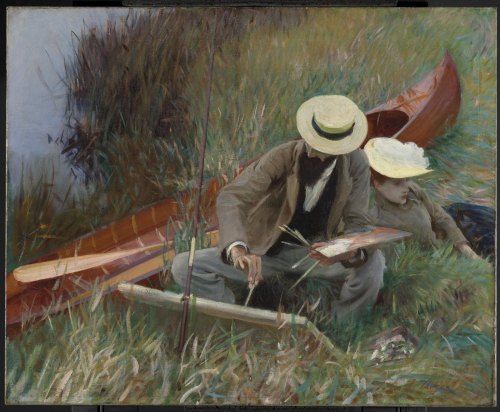
#FineArtFriday: An Out-of-Doors Study by John Singer Sargent

Artist: John Singer Sargent  (1856–1925)

Title: An Out-of-Doors Study

Description: English: Paul César Helleu Sketching with his wife Alice

Signature bottom right: John S. Sargent

Date: 1889

Medium: oil on canvas

Dimensions: Height: 65.9 cm (25.9 ″); Width: 80.7 cm (31.7 ″)

Today’s image, An Out-of-Doors Study, 1889, is by expatriate American artist, John Singer Sargent. It depicts fellow artist and great friend, Paul César Helleu sketching with his wife Alice Guérin.

What I love about this painting:

This painting depicts a day in the life of two great artists. The grass looks very like that which grows beside streams in my part of the world. The colors are that mix of green and brown that long grass has when summer is just beginning. The blue sky is reflected in the water. They had taken advantage of a fine day in late May or June perhaps, fortunate to have an outing before high summer turns the meadow grass crisp and brown.

The quality of light that day was perfect for a picnic beside the water. One can imagine the two artists working on their individual projects and chatting, having a relaxing lunch, and then taking a quiet walk. We can even wonder if, later, they might have taken the canoe out.

This is a pleasant scene, brightening up my dark December day.

About the artist, via Wikipedia:

Sargent’s early enthusiasm was for landscapes, not portraiture, as evidenced by his voluminous sketches full of mountains, seascapes, and buildings. Carolus-Duran’s expertise in portraiture finally influenced Sargent in that direction. Commissions for history paintings were still considered more prestigious, but were much harder to get. Portrait painting, on the other hand, was the best way of promoting an art career, getting exhibited in the Salon, and gaining commissions to earn a livelihood.

In a time when the art world focused, in turn, on ImpressionismFauvism, and Cubism, Sargent practiced his own form of Realism, which made brilliant references to VelázquezVan Dyck, and Gainsborough.


Credits and Attributions:

Wikimedia Commons contributors, “File:Sargent – Paul Helleu Sketching with his Wife.jpg,” Wikimedia Commons, the free media repository, https://commons.wikimedia.org/w/index.php?title=File:Sargent_-_Paul_Helleu_Sketching_with_his_Wife.jpg&oldid=273586527 (accessed December 5, 2019).

Wikipedia contributors, “John Singer Sargent,” Wikipedia, The Free Encyclopedia, https://en.wikipedia.org/w/index.php?title=John_Singer_Sargent&oldid=927728162 (accessed December 5, 2019).

Comments Off on #FineArtFriday: An Out-of-Doors Study by John Singer Sargent

Filed under #FineArtFriday