Category Archives: #FineArtFriday

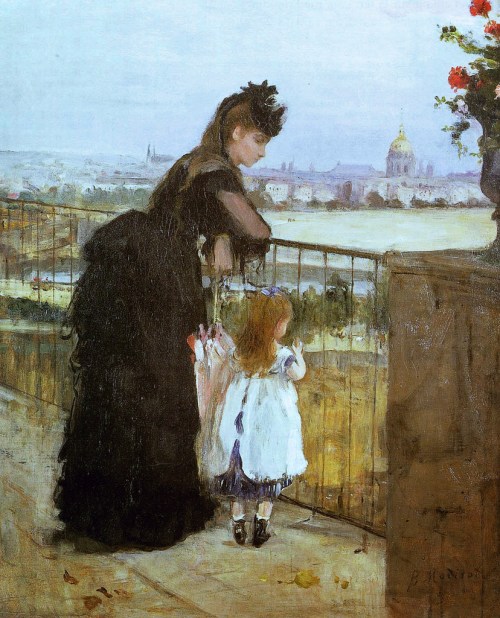
Woman and Child on a Balcony, Berthe Morisot ca. 1872

Title: Woman and Child on a Balcony

Artist: Berthe Morisot  (1841–1895)

Date: 1872

Medium: oil on canvas

Dimensions: Height: 61 cm (24 ″); Width: 50 cm (19.6 ″)

Today, Friday January 3, 2020, my hubby and I are visiting the Tacoma Art Museum, to see an exhibit of Impressionist paintings: Monet, Renoir, Degas, and Their Circle: French Impressionism and the Northwest. I will post about the experience next Friday, and hope to have photographs.

In the meantime, I present you with a female artist, Berthe Morisot, who was the sister-in-law to Eduard Manet. I hope to see her work represented there.

What I love about this painting:

It is only when you stand back from it that you realize how deftly Morisot conveyed the impressions of a pleasant day, a busy harbor, and a curious child. Up close, it is nearly indecipherable, but from a distance—which is how art in the impressionist style should be viewed—it is a delightful image. Is the  young woman a nanny or mother? The small girl seems happy in her company. The two take in the view on a hazy afternoon—there is a sense of affluence and harmony in moment captured by the artist.

About the Artist, vis Wikipedia

Berthe Morisot came from an eminent family, the daughter of a government official and the great-niece of a famous Rococo artist Jean-Honoré Fragonard.  She met her longtime friend and colleague, Édouard Manet, in 1868. Morisot was married to Édouard’s brother, Eugène Manet, in 1874.

Eugene was also a French painter but did not achieve the high reputation of his older brother, Édouard Manet, or his wife, Berthe. He devoted much of his efforts to supporting his wife’s career.

On November 14, 1878, she gave birth to her only child, Julie, who posed frequently for her mother and other Impressionist artists, including Renoir and her uncle Édouard.

It is hard to trace the stages of Morisot’s training and to tell the exact influence of her teachers because she was never pleased with her work and she destroyed nearly all of the artworks she produced before 1869.

Morisot’s mature career began in 1872. She found an audience for her work with Durand-Ruel, the private dealer, who bought twenty-two paintings. In 1877, she was described by the critic for Le Temps as the “one real Impressionist in this group.” She chose to exhibit under her full maiden name instead of using a pseudonym or her married name. As her skill and style improved, many began to rethink their opinion toward Morisot. In the 1880 exhibition, many reviews judged Morisot among the best, even including Le Figaro critic Albert Wolff.

Correspondence between Morisot and Édouard Manet shows warm affection, and Manet gave her an easel as a Christmas present. Morisot often posed for Manet and there are several portrait painting of Morisot such as Repose (Portrait of Berthe Morisot) and Berthe Morisot with a Bouquet. Morisot died on March 2, 1895, in Paris, of pneumonia contracted while attending to her daughter Julie’s similar illness, and thus making her an orphan at the age of 16.


Credits and Attributions:

Wikimedia Commons contributors, “File:Berthe Morisot 001.jpg,” Wikimedia Commons, the free media repository, https://commons.wikimedia.org/w/index.php?title=File:Berthe_Morisot_001.jpg&oldid=359873236 (accessed January 2, 2020).

Wikipedia contributors, “Berthe Morisot,” Wikipedia, The Free Encyclopedia, https://en.wikipedia.org/w/index.php?title=Berthe_Morisot&oldid=931800099 (accessed January 2, 2020).

Wikipedia contributors, “Eugène Manet,” Wikipedia, The Free Encyclopedia, https://en.wikipedia.org/w/index.php?title=Eug%C3%A8ne_Manet&oldid=895506929 (accessed January 2, 2020).
2 Comments

Filed under #FineArtFriday

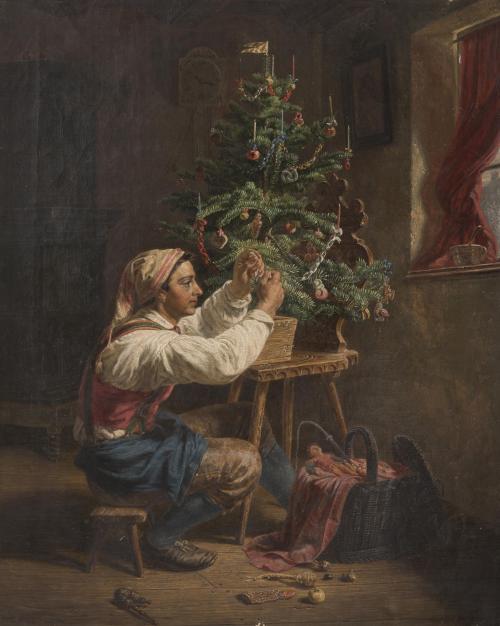
#FineArtFriday: Christmas Tree Decoration, artist unknown, 19th century

I finally got around to putting up our Christmas tree here at Casa del Jasperson, and I must say it looks rather gaudy as compared to the one in this painting.

I always dread the ordeal of moving furniture and getting all the decorations out of their hiding place in the garage. But once the tree is up and the work is out of the way, we love having it.

I say I enjoy it–until it’s time to take it down and figure out where to stash the boxes of ornaments in our overstuffed garage.

About this Picture:

  • Artist: Unknown
  • Title: Christmas Tree Decoration
  • Date: second half of the 19th century
  • Medium: oil on canvas
  • Dimensions : Height: 52.5 cm (20.6 ″); Width: 42 cm (16.5 ″)
  • Location: Private Collection (sold through Dorotheum Auction House)

What I love about this painting:

A young man sits on a low bench and decorates a small fir tree. The furnishings, other than the tree, all are painted in the shadows of the room. A doll lies in the basket at his feet, a toy for his daughter perhaps?

In the background is a beautiful white clock. It has been painted and finely crafted. Poor people would not have owned such an expensive clock.

That clock tells me that while this man may not be rich, he isn’t poor. Even the tree has nice glass ornaments along with decorations of cookies and plain paper.

Chains of colored paper, historically an expensive crafting commodity, also decorate it.

Most poor families didn’t have cut trees, or lavish presents. But the children might wake to find their stockings with an apple or nuts in them, special treats for families that were always on the edge of starvation.

Here in America, in less affluent homes during the early decades of the 20th century, paper chains might have been hung on the tree, along with ornaments made of baked salt-dough and cut-paper. A lot of work went into to creating these ornaments every year, which was part of the fun of getting ready for Christmas.

My maternal grandmother, who was born in 1909, always made paper snowflakes and angels, and strung popcorn and cranberries to decorate her tree.

The man in this painting is dressed in traditional well-made craftsman’s clothing—a simple shirt and vest, apron, leather breeches.

There are curtains of a heavy material at the window, and the tree is set on a beautifully carved table. Is he a woodworker or a clock maker? Who knows, but this man earns enough to live comfortably and celebrate modestly.

This is a quintessential image of old-fashioned Christmas in all its homey prosperity.

According to Wikimedia Commons, the artist who painted this picture is unknown. The Dorotheum Website attributes the painting to an unknown Central European artist.

To me, it is an example of the best of 19th Century European romantic art. It’s a perfect example of a subject near and dear to Victorian souls—that simple, romanticized version of Christmas that we still love today.

This painting makes me think of a Christmas card. Whoever the artist was, they were talented and trained in the craft of painting. They had the knack for conveying homey simplicity in their work.

About Dorotheum via Wikipedia:

The Dorotheum (German pronunciation: [ˌdoːʀoˈteːʊm] (listen)), established in 1707, is one of the world’s oldest auction houses.[1] It has its headquarters in Vienna on the Dorotheergasse and is the largest auction house in both Continental and German-speaking Europe.  Besides auctions, the retail sector also plays a major role in Dorotheum’s business.[3] In the Dorotheum, works of art, antiques, furniture, and jewelry from various centuries are put up for auction. The building is constructed in the neo-classical style.


Credits and Attributions:

Wikimedia Commons contributors, “File:Christmas Tree Decoration.jpg,” Wikimedia Commons, the free media repository, https://commons.wikimedia.org/w/index.php?title=File:Christmas_Tree_Decoration.jpg&oldid=378771434 (accessed December 20, 2019).

Wikipedia contributors, “Dorotheum,” Wikipedia, The Free Encyclopedia, https://en.wikipedia.org/w/index.php?title=Dorotheum&oldid=921309125 (accessed December 20, 2019).


Comments Off on #FineArtFriday: Christmas Tree Decoration, artist unknown, 19th century

Filed under #FineArtFriday

#FineArtFriday: The Lacemaker by Nicolaes Maes ca. 1656

The Lacemaker

  • Artist   Nicolaes Maes
  • Year    c. 1656
  • Medium           oil paint, canvas
  • Dimensions     45 cm (18 in) × 53 cm (21 in)

About this image, via Wikipedia:

The Lacemaker (circa 1656) is an oil on canvas painting by the Dutch painter Nicolaes Maes. It is an example of Dutch Golden Age painting and is part of the collection of the Metropolitan Museum of Art.

This painting is typical of many paintings of women in interiors painted by Maes in the 1650s. The woman is making bobbin lace using a lace pillow that can be seen in other Maes paintings of lacemakers.

The child in a highchair was a popular subject for many Dutch genre painters, and this painting shows how it was used as a safe place to play as well as for eating. The empty bowl of porridge is on the floor along with some other items the boy has let fall. He is wearing a red valhoed or falling cap, which seems to indicate that confinement in the chair is necessary if any lacemaking is going to get done.

baby bumper headguard cap, also known as a falling cap, or pudding hat, is a protective hat worn by children learning to walk, to protect their heads in case of falls.

Known as a pudding or black pudding, a version used during the early 17th century until the late 18th century was usually open at the top and featured a sausage-shaped bumper roll that circled the head like a crown. It was fastened with straps under the chin.

About the Artist via Wikipedia

From Wikipedia: Nicolaes Maes, also known as Nicolaes Maas (January 1634 – November 24, 1693 (buried)) was a Dutch Golden Age painter of genre and portraits. In about 1648 he went to Amsterdam, where he entered Rembrandt‘s studio. Before his return to Dordrecht in 1653 Maes painted a few Rembrandtesque genre pictures, with life-size figures and in a deep glowing scheme of colour, like the Reverie at the Rijksmuseum in Amsterdam, the Card Players at the National Gallery, and the Children with a Goat Carriage. So closely did his early style resemble that of Rembrandt, that the last-named picture, and other canvases in the Leipzig and Budapest galleries and in the collection of Lord Radnor, were or are still ascribed to Rembrandt.

In his best period, from 1655 to 1665, Maes devoted himself to domestic genre on a smaller scale, retaining to a great extent the magic of colour he had learnt from Rembrandt. Only on rare occasions did he treat scriptural subjects, as in Hagar’s Departure, which has been ascribed to Rembrandt. His favorite subjects were women spinning, or reading the Bible, or preparing a meal. He had a particular fascination with the subject of lacemaking and made almost a dozen versions on this subject.

While he continued to reside in Dordrecht until 1673, when he settled in Amsterdam, he visited or even lived in Antwerp between 1665 and 1667. His Antwerp period coincides with a complete change in style and subject. He devoted himself almost exclusively to portraiture, and abandoned the intimacy and glowing color harmonies of his earlier work for a careless elegance which suggests the influence of Van Dyck. So great indeed was the change, that it gave rise to the theory of the existence of another Maes, of Brussels. His registered pupils were Justus de GelderMargaretha van GodewijkJacob Moelaert, and Johannes Vollevens.[1] Maes died in Amsterdam.


Credits and Attributions:

Wikipedia contributors, “The Lacemaker (Maes),” Wikipedia, The Free Encyclopedia, https://en.wikipedia.org/w/index.php?title=The_Lacemaker_(Maes)&oldid=799625637 (accessed December 12, 2019).

Wikipedia contributors, “Baby bumper headguard cap,” Wikipedia, The Free Encyclopedia, https://en.wikipedia.org/w/index.php?title=Baby_bumper_headguard_cap&oldid=914539353 (accessed December 12, 2019).

Wikipedia contributors, “Nicolaes Maes,” Wikipedia, The Free Encyclopedia, https://en.wikipedia.org/w/index.php?title=Nicolaes_Maes&oldid=815679835 (accessed July 12, 2018).

3 Comments

Filed under #FineArtFriday

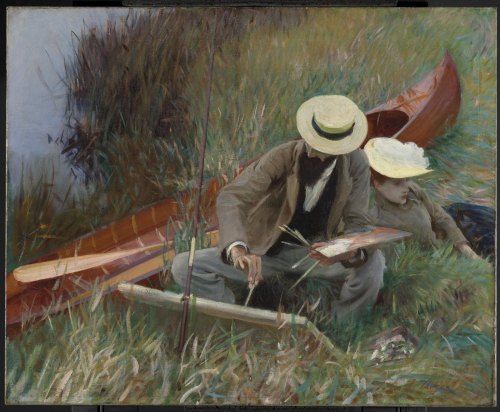
#FineArtFriday: An Out-of-Doors Study by John Singer Sargent

Artist: John Singer Sargent  (1856–1925)

Title: An Out-of-Doors Study

Description: English: Paul César Helleu Sketching with his wife Alice

Signature bottom right: John S. Sargent

Date: 1889

Medium: oil on canvas

Dimensions: Height: 65.9 cm (25.9 ″); Width: 80.7 cm (31.7 ″)

Today’s image, An Out-of-Doors Study, 1889, is by expatriate American artist, John Singer Sargent. It depicts fellow artist and great friend, Paul César Helleu sketching with his wife Alice Guérin.

What I love about this painting:

This painting depicts a day in the life of two great artists. The grass looks very like that which grows beside streams in my part of the world. The colors are that mix of green and brown that long grass has when summer is just beginning. The blue sky is reflected in the water. They had taken advantage of a fine day in late May or June perhaps, fortunate to have an outing before high summer turns the meadow grass crisp and brown.

The quality of light that day was perfect for a picnic beside the water. One can imagine the two artists working on their individual projects and chatting, having a relaxing lunch, and then taking a quiet walk. We can even wonder if, later, they might have taken the canoe out.

This is a pleasant scene, brightening up my dark December day.

About the artist, via Wikipedia:

Sargent’s early enthusiasm was for landscapes, not portraiture, as evidenced by his voluminous sketches full of mountains, seascapes, and buildings. Carolus-Duran’s expertise in portraiture finally influenced Sargent in that direction. Commissions for history paintings were still considered more prestigious, but were much harder to get. Portrait painting, on the other hand, was the best way of promoting an art career, getting exhibited in the Salon, and gaining commissions to earn a livelihood.

In a time when the art world focused, in turn, on ImpressionismFauvism, and Cubism, Sargent practiced his own form of Realism, which made brilliant references to VelázquezVan Dyck, and Gainsborough.


Credits and Attributions:

Wikimedia Commons contributors, “File:Sargent – Paul Helleu Sketching with his Wife.jpg,” Wikimedia Commons, the free media repository, https://commons.wikimedia.org/w/index.php?title=File:Sargent_-_Paul_Helleu_Sketching_with_his_Wife.jpg&oldid=273586527 (accessed December 5, 2019).

Wikipedia contributors, “John Singer Sargent,” Wikipedia, The Free Encyclopedia, https://en.wikipedia.org/w/index.php?title=John_Singer_Sargent&oldid=927728162 (accessed December 5, 2019).

Comments Off on #FineArtFriday: An Out-of-Doors Study by John Singer Sargent

Filed under #FineArtFriday

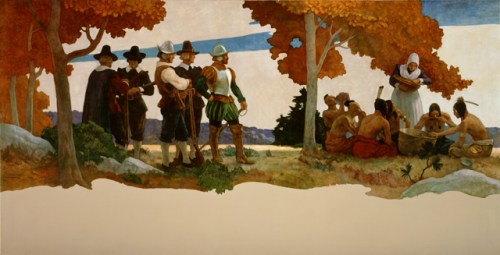
#FineArtFriday: Thanksgiving with Indians by N. C. Wyeth (mural, 1940)

Artist: Newell Convers Wyeth  (1882–1945)

Title: Thanksgiving with Indians

Date: 1940

Medium: oil on canvas

Dimensions: Height: 108 ″ (274.3 cm); Width: 212 ″ (538.4 cm)

Collection: Brandywine River Museum

Place of creation: Mural, Metropolitan Life Insurance Company, New York

Inscriptions: middle left: N.C. Wyeth (underlined)


About the Artist (via Wikipedia):

Newell Convers Wyeth (October 22, 1882 – October 19, 1945), known as N. C. Wyeth, was an American artist and illustrator. He was the pupil of artist Howard Pyle and became one of America’s greatest illustrators.[1] During his lifetime, Wyeth created more than 3,000 paintings and illustrated 112 books,[2] 25 of them for Scribner’s, the Scribner Classics, which is the work for which he is best known.[1] The first of these, Treasure Island, was one of his masterpieces and the proceeds paid for his studio. Wyeth was a realist painter at a time when the camera and photography began to compete with his craft.[3] Sometimes seen as melodramatic, his illustrations were designed to be understood quickly.[4] Wyeth, who was both a painter and an illustrator, understood the difference, and said in 1908, “Painting and illustration cannot be mixed—one cannot merge from one into the other.”[3]

He is the father of Andrew Wyeth and the grandfather of Jamie Wyeth, both well-known American painters.


Credits and Attributions

Wikimedia Commons contributors, “File:N.C. Wyeth – Thanksgiving with Indians.jpg,” Wikimedia Commons, the free media repository, https://commons.wikimedia.org/w/index.php?title=File:N.C._Wyeth_-_Thanksgiving_with_Indians.jpg&oldid=344521415 (accessed November 29, 2019).

Wikipedia contributors, “N. C. Wyeth,” Wikipedia, The Free Encyclopedia, https://en.wikipedia.org/w/index.php?title=N._C._Wyeth&oldid=927997095 (accessed November 29, 2019).

Comments Off on #FineArtFriday: Thanksgiving with Indians by N. C. Wyeth (mural, 1940)

Filed under #FineArtFriday

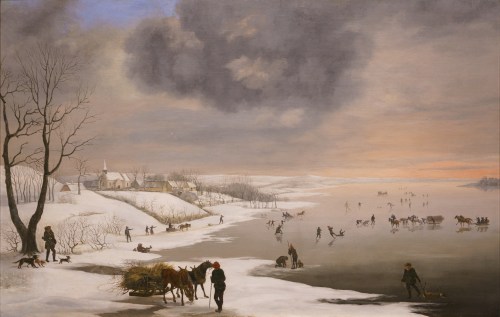
#FineArtFriday: Winter Landscape with Brabrand Church, by Christian David Gebauer (reprise)

NaNoWriMo is drawing near the end–one week remains. During that week, many of us in the US will prepare Thanksgiving feasts for our families and still try to find time to write new words. Here at Casa del Jasperson, we will host a large family gathering, but I will get some writing done before they arrive.

In the mean time, I hope you enjoy the re-run of this article detailing my impressions of a wonderful painting, Winter Landscape with Brabrand Church, by Christian David Gebauer. Much of my work deals with life in pre- and emerging industrial era societies, and paintings like this are critical to my understanding of how life was lived and enjoyed.


The above painting, Winter Landscape with Brabrand Church, by Christian David Gebauer, is a perfect illustration of a day in the life of a Danish village as captured by the eye of an artist. One of the last paintings made before Gebauer’s death in 1831, it is considered a centerpiece work of the Danish Golden Age, a period of exceptional creative production in Denmark during the first half of the 19th century. Gebauer was heavily influenced by the works of the Dutch Golden Age, a period in Dutch history roughly spanning the 17th century, during and after the later part of the Eighty Years’ War (1568–1648) for Dutch independence.

If you are writing fantasy, which is often set in rural late-renaissance-era environments, you can find all the details you need in the art of the past.

Artists painted details, not visible from a distance, but which combine to give the mood of the piece. They painted not only what they saw, but what they felt. They gave us a hint of how people really lived, laughed, and loved before the industrial revolution transformed the world into the modern, technologically driven place we see today.

In Winter Landscape with Brabrand Church, Christian David Gebauer shows us villagers dressed for warmth, enjoying themselves on the ice. Others are working, bringing in sledges filled with hay. A hunter and and his dogs are returning, perhaps empty handed. A bag hangs at the hunter’s side but isn’t full. The ice-fishermen are having better luck.

A woodcutter admonishes a boy, perhaps his son, to stop fooling around. His machete hangs in his right hand, as he fights what he knows is a losing battle. It’s evening, the day has been long, and children who have worked all day just want to play and have fun.

The sky takes up fully half of the painting–the church and the people are small beneath it. Beneath the powerful sky, there is an air of busy enjoyment to the painting. The hilarity of those skaters unable to keep their balance is juxtaposed against the hard-working laborers and the cozy prosperity of horses pulling laden sleds.

The entire story of one winter’s evening in this village lives within this painting, all of it captured by an artist nearly two-hundred years ago.

Is there magic here? Maybe. Is there life and passion? Definitely. There is a story in this image. Certainly the details will emerge in my work in the form of setting and atmosphere.

Regardless of how I use it, this window opens onto a time I can now visualize more clearly, less blurred by my modern perspective.


Credits and Attributions:

#FineArtFriday: Winter Landscape with Brabrand Church, by Christian David Gebauer by Connie J. Jasperson first appeared on Life in the Realm of Fantasy on 08 Dec. 2017.

Winter Landscape with Brabrand Church, Christian David Gebauer [Public domain], via Wikimedia Commons

Comments Off on #FineArtFriday: Winter Landscape with Brabrand Church, by Christian David Gebauer (reprise)

Filed under #FineArtFriday

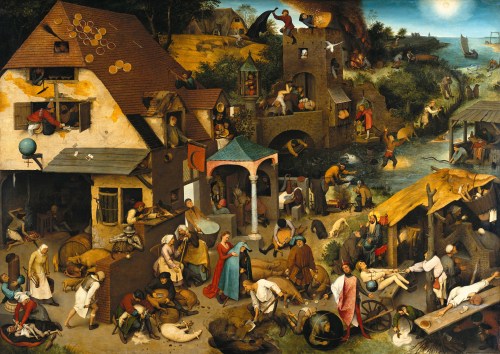
#FineArtFriday: The Netherlandish Proverbs by Pieter Brueghel the Elder (revisited)

Because it is November, and NaNoWriMo is in full swing,  we are going back to the archives for a Fine Art Friday rerun! This post first appeared on May 4, 2018. Anytime we can enjoy a good allegorical painting I’m happy. The artist, Pieter Brueghel the Elder, must have had an amazing sense of humor.


One of the best allegorical paintings of all time is The Netherlandish Proverbs (also known as The Dutch Proverbs) by Pieter Brueghel the Elder, which was painted in 1559. A master at humor, allegory, and pointing out the follies of humanity, Brueghel the Elder is one of my favorite artists.

Quote from Wikipedia:

Critics have praised the composition for its ordered portrayal and integrated scene. There are approximately 112 identifiable proverbs and idioms in the scene, although Bruegel may have included others which cannot be determined because of the language change. Some of those incorporated in the painting are still in popular use, for instance “Swimming against the tide”, “Banging one’s head against a brick wall” and “Armed to the teeth”. Many more have faded from use, which makes analysis of the painting harder. “Having one’s roof tiled with tarts”, for example, which meant to have an abundance of everything and was an image Bruegel would later feature in his painting of the idyllic Land of Cockaigne (1567).

The Blue Cloak, the piece’s original title, features in the centre of the piece and is being placed on a man by his wife, indicating that she is cuckolding him. Other proverbs indicate human foolishness. A man fills in a pond after his calf has died. Just above the central figure of the blue-cloaked man another man carries daylight in a basket. Some of the figures seem to represent more than one figure of speech (whether this was Bruegel’s intention or not is unknown), such as the man shearing a sheep in the centre bottom left of the picture. He is sitting next to a man shearing a pig, so represents the expression “One shears sheep and one shears pigs”, meaning that one has the advantage over the other, but may also represent the advice “Shear them but don’t skin them”, meaning make the most of available assets.

You can find all of the wonderful proverbs on the painting’s page on Wikipedia, along with the thumbnail that depicts the proverb.

My favorite proverbs in this wonderful allegory?

Horse droppings are not figs. It meant we should not be fooled by appearances.

He who eats fire, craps sparks. It meant we shouldn’t be surprised at the outcome if we attempt a dangerous venture.

Now THAT is wisdom!


Credits and Attributions:

The Netherlandish Proverbs (Also known as The Dutch Proverbs) by Pieter Brueghel the Elder 1559 [Public domain], via Wikimedia Commons.

Wikipedia contributors, “Netherlandish Proverbs,” Wikipedia, The Free Encyclopedia, https://en.wikipedia.org/w/index.php?title=Netherlandish_Proverbs&oldid=829168138  (accessed May 3, 2018).

1 Comment

Filed under #FineArtFriday

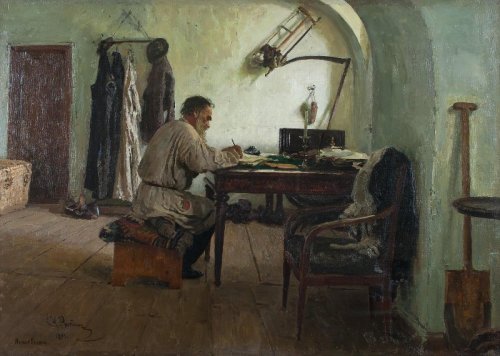
#FineArtFriday: Portrait of Leo Tolstoy by Ilya Repin 1891

Artist: Ilya Repin  (1844–1930)

Date: 1891

Medium: oil on canvas

Dimensions Height: 64 cm (25.1 ″); Width: 90 cm (35.4 ″)

About the Subject of this painting, via Wikipedia:

Born to an aristocratic Russian family in 1828,[3] (Count Lev Nikolayevich Tolstoy) Leo Tolstoy is best known for the novels War and Peace (1869) and Anna Karenina (1877),[8] often cited as pinnacles of realist fiction.[3] He first achieved literary acclaim in his twenties with his semi-autobiographical trilogy, ChildhoodBoyhood, and Youth (1852–1856), and Sevastopol Sketches (1855), based upon his experiences in the Crimean War. Tolstoy’s fiction includes dozens of short stories and several novellas such as The Death of Ivan Ilyich (1886), Family Happiness (1859), and Hadji Murad (1912). He also wrote plays and numerous philosophical essays.

About the Artist, via Wikipedia:

Repin was born in Chuguyev, in Kharkov Governorate, Russian Empire (now Chuhuiv in UkraineKharkiv Region) into a family of “military settlers”.[2] His father traded horses and his grandmother ran an inn. He entered military school to study surveying. Soon after the surveying course was cancelled, his father helped Repin to become an apprentice with Ivan Bunakov, a local icon painter, where he restored old icons and painted portraits of local notables through commissions. In 1863 he went to St. Petersburg Art Academy to study painting but had to enter Ivan Kramskoi preparatory school first. He met fellow artist Ivan Kramskoi and the critic Vladimir Stasov during the 1860s, and his wife, Vera Shevtsova in 1872 (they remained married for ten years). In 1874–1876 he showed at the Salon in Paris and at the exhibitions of the Itinerants’ Society in Saint Petersburg. He was awarded the title of academician in 1876.

In 1880 Repin travelled to Zaporizhia to gather material for the 1891 Reply of the Zaporozhian Cossacks. His Religious Procession in Kursk Province was exhibited in 1883, and Ivan the Terrible and His Son Ivan in 1885. In 1892 he published the Letters on Art collection of essays. He taught at the Higher Art School attached to the Academy of Arts from 1894. In 1898 he purchased an estate, Penaty (the Penates), in Kuokkala, Finland (now Repino, Saint Petersburg).

In 1901 he was awarded the Legion of Honour. In 1911 he traveled with his common-law wife Natalia Nordman to the World Exhibition in Italy, where his painting 17 October 1905 and his portraits were displayed in their own separate room. In 1916 Repin worked on his book of reminiscences, Far and Near, with the assistance of Korney Chukovsky. He welcomed the February Revolution of 1917, but was rather skeptical towards the October Revolution. Soviet authorities asked him a number of times to come back, he remained in Finland for the rest of his life. Celebrations were held in 1924 in Kuokkala to mark Repin’s 80th birthday, followed by an exhibition of his works in Moscow. In 1925 a jubilee exhibition of his works was held in the Russian Museum in Leningrad. Repin died in 1930 and was buried at the Penates.


Credits and Attributions:

Leo Tolstoy by Ilya Repin PD|100 via Wikimedia Commons

Wikimedia Commons contributors, “File:Leo Tolstoy02.jpg,” Wikimedia Commons, the free media repository, https://commons.wikimedia.org/w/index.php?title=File:Leo_Tolstoy02.jpg&oldid=369738785 (accessed November 8, 2019).

Wikipedia contributors, “Ilya Repin,” Wikipedia, The Free Encyclopedia, https://en.wikipedia.org/w/index.php?title=Ilya_Repin&oldid=922774203 (accessed November 8, 2019).

Comments Off on #FineArtFriday: Portrait of Leo Tolstoy by Ilya Repin 1891

Filed under #FineArtFriday

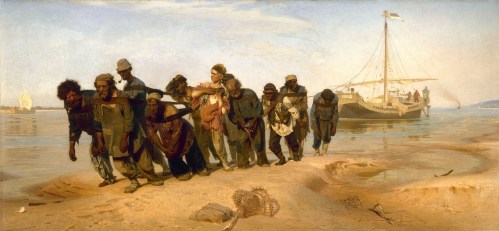
#FineArtFriday: Barge Haulers on the Volga by Ilya Repin, 1870

Barge Haulers on the Volga by Ilya Repin  (1844–1930)

  • Date: 1870
  • Medium: oil on canvas
  • Dimensions: Height: 131.5 cm (51.7 ″); Width: 281 cm (110.6 ″)
  • Current location: Ж-4056 (Russian Museum)
  • Inscriptions: Signature and date: И. Репин / 1870-73

What I love about this painting:

A burlak was a person who hauled barges and other vessels upstream from the 17th to 20th centuries in the Russian Empire. Most burlaks were landless or poor peasants.

These men are shown working, painted with brutal truth. They are beyond exhausted. Their skin is darkened and weathered from years of work in the unremitting sun, except for the young man in the middle. One day he will be like the older men, hardened to the misery and enduring his lot in life.

Each face is filled with emotion, with a story of their own. Who knows what tragedies brought them to agree to this terrible existence, this seasonal slavery of physically towing boat upriver?

For the women and men who towed the barges, winter was even worse, because once the river froze over these burlaki were unemployed. Their life was a constant circle of starvation and hellish labor under the harshest conditions.

About this Painting (via Wikipedia)

Barge Haulers on the Volga or Burlaki (Russian: Burlaki na Volge, Бурлаки на Волге) is an 1870–73 oil-on-canvas painting by artist Ilya Repin. It depicts 11 men physically dragging a barge on the banks of the Volga River. They are at the point of collapse from exhaustion, oppressed by heavy, hot weather.[1][2]

The work is a condemnation of profit from inhumane labor.[3] Although they are presented as stoical and accepting, the men are defeated; only one stands out: in the center of both the row and canvas, a brightly colored youth fights against his leather binds and takes on a heroic pose.

Repin conceived the painting during his travels through Russia as a young man and depicts actual characters he encountered. It drew international praise for its realistic portrayal of the hardships of working men, and launched his career.[4] Soon after its completion, the painting was purchased by Grand Duke Vladimir Alexandrovich and exhibited widely throughout Europe as a landmark of Russian realist painting. Barge Haulers on the Volga has been described as “perhaps the most famous painting of the Peredvizhniki movement [for]….its unflinching portrayal of backbreaking labor”.[5]

The characters are based on actual people Repin came to know while preparing for the work. He had had difficulty finding subjects to pose for him, even for a fee, because of a folklorish belief that a subject’s soul would leave his possession once his image was put down on paper.[8] The subjects include a former soldier, a former priest, and a painter.[9] Although he depicted eleven men, women also performed the work and there were normally many more people in a barge-hauling gang; Repin selected these figures as representative of a broad swathe of the working classes of Russian society. That some had once held relatively high social positions dismayed the young artist, who had initially planned to produce a far more superficial work contrasting exuberant day-trippers (which he himself had been) with the careworn burlaks. Repin found a particular empathy with Kanin, the defrocked priest, who is portrayed as the lead hauler and looks outwards towards the viewer.[10] The artist wrote,

“There was something eastern about it, the face of a Scyth…and what eyes! What depth of vision!…And his brow, so large and wise…He seemed to me a colossal mystery, and for that reason I loved him. Kanin, with a rag around his head, his head in patches made by himself and then worn out, appeared none the less as a man of dignity; he was like a saint.”[11]


Credits and Attributions:

Wikipedia contributors, “Barge Haulers on the Volga,” Wikipedia, The Free Encyclopedia, https://en.wikipedia.org/w/index.php?title=Barge_Haulers_on_the_Volga&oldid=918607811 (accessed November 1, 2019).

Comments Off on #FineArtFriday: Barge Haulers on the Volga by Ilya Repin, 1870

Filed under #FineArtFriday

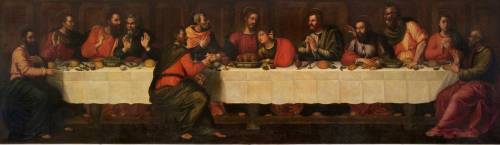
#FineArtFriday: The Last Supper by Sister Plautilla Nelli (1524–1588)

The Last Supper by Sister Plautilla Nelli  (1524–1588)

Date: 16th century

Medium: oil

Collection: Basilica of Santa Maria Novella

What I love about this painting:

The Last Supper, a 7×2-meter oil-on-canvas, preserved in the Basilica of Santa Maria Novella, is the only signed work by Plautilla Nelli known to survive. Her signature, in the upper left corner, reads S. Plavtil – La Ora Te Pro Pictora (Sister Plavtil, Pray for the Paintress).

I love the intimacy of this composition. Jesus hold bread in his left hand as he comforts Saint John.

According to Karen Chernick for her article of October 17, 2019 in Atlas Obscura:

Nelli didn’t paint her “Last Supper” background to look like the dining hall it was designed for, a trick other artists used to make the scene relatable. Instead, she showed Jesus and his apostles dining on the same food that Santa Caterina’s Domincan nuns ate: a whole roasted lamb, bread, wine, heads of lettuce, and fresh fava beans—the last two dishes unprecedented in any depiction of Christ’s last meal. The fava beans were a wink to local cuisine, a Florentine specialty normally eaten by peasants (and nuns).

“Pray for the Paintress,” is a thought I will keep in my heart.

About this painting, via Wikipedia:

Plautilla Nelli’s Last Supper is a first in the history of art rendered by a woman. Painted in the 1560’s, Last Supper was under restoration for four years.[11] The work went on exhibit in October 2019.[12] No female artist had ever painted this subject before Nelli. Florence has the richest tradition of paintings with the theme of last supper in the world. Nelli’s Last Supper, her most significant work because of its size and subject, is a seven-meter long, oil on canvas. After restoration her Last Supper will be exhibited at the Santa Maria Novella Museum in Florence across from Alessandro Allori’s painting with the same theme, also painted in the sixteenth century.

About the Artist (via Wikipedia)

Sister Plautilla Nelli (1524–1588) was a self-taught nun-artist and the first-known female Renaissance painter of Florence. She was a nun of the Dominican convent of St. Catherine of Siena located in Piazza San Marco, Florence, and was heavily influenced by the teachings of Savonarola and by the artwork of Fra Bartolomeo.

Pulisena Margherita Nelli was born into a wealthy family in the San Felice area of Florence. Her father, Piero di Luca Nelli, was a successful fabric merchant and her ancestors originated from the Tuscan valley area of Mugello, as did the Medici dynasty. There is a modern-day street in Florence, Via del Canto de’ Nelli, in the San Lorenzo district, named for her family, and the New Sacristy of the Church of San Lorenzo is the original site of her family homes.[1]

She became a nun at the age of fourteen, taking on the name Suor Plautilla, at the convent of Santa Caterina di Cafaggio; she would later be prioress on three occasions. The facility was managed by the Dominican friars of San Marco, led by Savonarola. About half of all educated girls in that era were placed into convents to avoid the cost of raising a dowry. Savonarola’s preachings promoted devotional painting and drawing by religious women to avoid sloth, thus the convent became a center for nun-artists. Her sister, also a nun, Costanza, (Suor Petronilla) wrote a life of Savonarola.


Credits and Attributions:

Quote from “A Nun’s 450-Year-Old ‘Last Supper’ Makes Its Museum Debut in Florence” by Karen Chernick © 2019 Atlas Obscura. All rights reserved. https://www.atlasobscura.com/articles/first-last-supper-woman-painter-florence

Wikimedia Commons contributors, “File:Plautilla Nelli – The Last Supper.jpg,” Wikimedia Commons, the free media repository, https://commons.wikimedia.org/w/index.php?title=File:Plautilla_Nelli_-_The_Last_Supper.jpg&oldid=371023591 (accessed October 24, 2019).

Wikipedia contributors, “Plautilla Nelli,” Wikipedia, The Free Encyclopedia, https://en.wikipedia.org/w/index.php?title=Plautilla_Nelli&oldid=922398829 (accessed October 24, 2019).

Comments Off on #FineArtFriday: The Last Supper by Sister Plautilla Nelli (1524–1588)

Filed under #FineArtFriday