Category Archives: #FineArtFriday

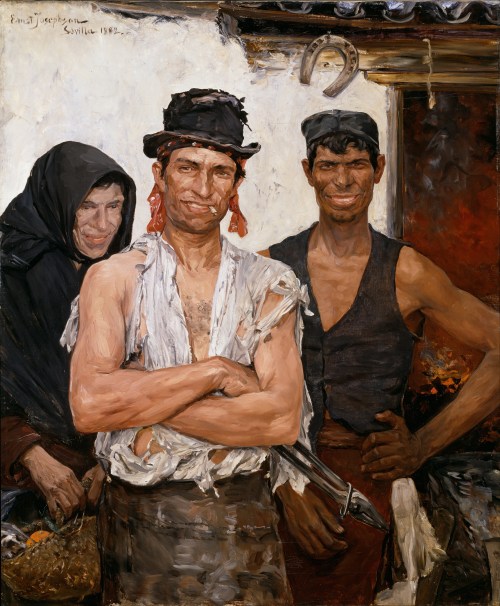
#FineArtFriday: Spanish Blacksmiths by Ernst Josephson 1882

Spanish Blacksmiths, by Ernst Josephson

  • Date: 1882
  • Medium: oil on canvas
  • Dimensions : width: 107 x height: 128.5 cm

What I love about this image:

This is a powerful painting. Josephson captures the boundless self-confidence and personalities of these young men. He has managed to portray their cock-of-the-walk swagger, and he has shown us the truth of their craft: that sparks fly and ruin their clothes; that the work is hard and their muscles strong. These men are full of life.

The influence of Josephson’s having studied Rembrandt’s works closely can be seen here in the style with which he has painted their features. He has painted the men with truth—they are not classically handsome, but they are in the prime of life and have immense charisma. They wear their burned and ragged hats with pride. These men are good at what they do, and they know it. Their eyes dance and flirt outrageously with you across the years—they are full to bursting with machismo, daring you to just try to walk past and not notice them.

About the Artist, Via Wikipedia

(Ernst Josephson) was born to a middle-class family of merchants of Jewish ancestry. His uncle, Ludvig O. Josephson (1832-1899) was a dramatist and his uncle Jacob Axel Josephson (1818-1880) was a composer. When he was ten, his father Ferdinand Semy Ferdinand Josephson (1814-1861) left home and he was raised by his mother, Gustafva Jacobsson (1819-1881) and three older sisters.

At the age of sixteen, he decided to became an artist and, with his family’s support, enrolled at the Royal Swedish Academy of Fine Arts. His primary instructors there were Johan Christoffer Boklund and August Malmström. He was there until 1876, when he received a Royal Medal for painting.

After leaving the Academy, he and his friend and fellow artist Severin Nilsson (1846-1918) visited Italy, Germany and the Netherlands, where they copied the Old Masters. His breakthrough came in Paris, where he was able to study with Jean-Léon Gérôme at the École des Beaux-Arts. He soon began concentrating on portraits, including many of his friends and fellow Swedes in France. For a time, he shared a studio with Hugo Birger (1854–1887). His personal style developed further during a trip to Seville with his friend, Anders Zorn, from 1881 to 1882.

His private life did not go well, however. By his late twenties, he was afflicted with syphilis. His romantic life suffered as a consequence, as he was forced to break off a promising relationship with a young model named Ketty Rindskopf.


Credits and Attributions:

Wikimedia Commons contributors, “File:Ernst Josephson – Spanish Blacksmiths – Google Art Project.jpg,” Wikimedia Commons, the free media repository, https://commons.wikimedia.org/w/index.php?title=File:Ernst_Josephson_-_Spanish_Blacksmiths_-_Google_Art_Project.jpg&oldid=354761584 (accessed August 16, 2019).

Wikipedia contributors, “Ernst Josephson,” Wikipedia, The Free Encyclopedia, https://en.wikipedia.org/w/index.php?title=Ernst_Josephson&oldid=888815743 (accessed August 16, 2019).
2 Comments

Filed under #FineArtFriday

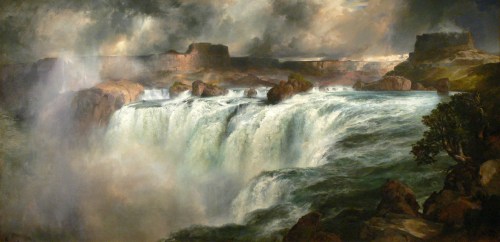
#FineArtFriday: Shoshone Falls on the Snake River by Thomas Moran 1900

About the Artist, Via Wikipedia:

Thomas Moran (February 12, 1837 – August 25, 1926) was an American painter and printmaker of the Hudson River School in New York whose work often featured the Rocky Mountains. Moran and his family, wife Mary Nimmo Moran and daughter Ruth, took residence in New York where he obtained work as an artist. He was a younger brother of the noted marine artist Edward Moran, with whom he shared a studio. A talented illustrator and exquisite colorist, Thomas Moran was hired as an illustrator at Scribner’s Monthly. During the late 1860s, he was appointed the chief illustrator for the magazine, a position that helped him launch his career as one of the premier painters of the American landscape, in particular, the American West. [1]

Moran, along with Albert Bierstadt, Thomas Hill, and William Keith are sometimes referred to as belonging to the Rocky Mountain School of landscape painters because of all of the Western landscapes made by this group. [1]

Shoshone Falls is a waterfall on the Snake River in southern Idaho, United States, approximately 3 miles (4.8 km) northeast of the city of Twin Falls. Once called the “Niagara of the West,” Shoshone Falls is 212 feet (65 m) high—45 feet (14 m) higher than Niagara Falls—and originally flowed over a rim nearly 1,000 feet (300 m) wide. However, in 1900, Ira Burton Perrine led the drive to divert the Snake River at Caldron Linn, a point approximately 24 miles (39 km) upstream of Shoshone Falls. Now a fraction of its original width and volume, the falls remain a tourist destination.

Senator William A. Clark and others who owned land at Shoshone Falls filed a lawsuit against the Twin Falls Land and Water Company but were defeated in the Idaho Supreme Court in 1904. Despite his efforts, the Milner Dam and the major canals required to deliver water were completed by 1905. [2]

“On March 1, 1905, Frank Buhl gave a ceremonial pull on the wheel on a winch, and the gates of Milner Dam were closed, and the gates to a thousand miles of canal and laterals were opened, and the Snake River was diverted, and that night Shoshone Falls went dry as the water rushed across the desert far above, and Perrine’s vision was realized, and 262,000 acres of desert were shortly transformed.” [3]

Shoshone Falls, Idaho viewed from the northwest 2013 Famartin [CC BY-SA 3.0]


Credits and Attributions:

Images:

Shoshone Falls on the Snake River by Thomas Moran 1900 [Public domain]

Shoshone Falls, Idaho viewed from the northwest 2013 Famartin [CC BY-SA 3.0 (https://creativecommons.org/licenses/by-sa/3.0)]

Wikimedia Commons contributors, “File:Gilcrease – Shenandoah River.jpg,” Wikimedia Commons, the free media repository, https://commons.wikimedia.org/w/index.php?title=File:Gilcrease_-_Shenandoah_River.jpg&oldid=354856726 (accessed August 1, 2019). (Shoshone Falls, Snake River, Idaho – original file uploaded by Gilcrease, river mislabeled)

Quotes:

[1]  Wikipedia contributors, “Thomas Moran,” Wikipedia, The Free Encyclopedia, https://en.wikipedia.org/w/index.php?title=Thomas_Moran&oldid=887900185 (accessed August 1, 2019).

[2] Wikipedia contributors, “Shoshone Falls,” Wikipedia, The Free Encyclopedia, https://en.wikipedia.org/w/index.php?title=Shoshone_Falls&oldid=904109934 (accessed August 1, 2019).

[3] Yost, Joe. “History of Milner Dam”; Twin Falls Canal Company. Retrieved 2016-06-27.

1 Comment

Filed under #FineArtFriday

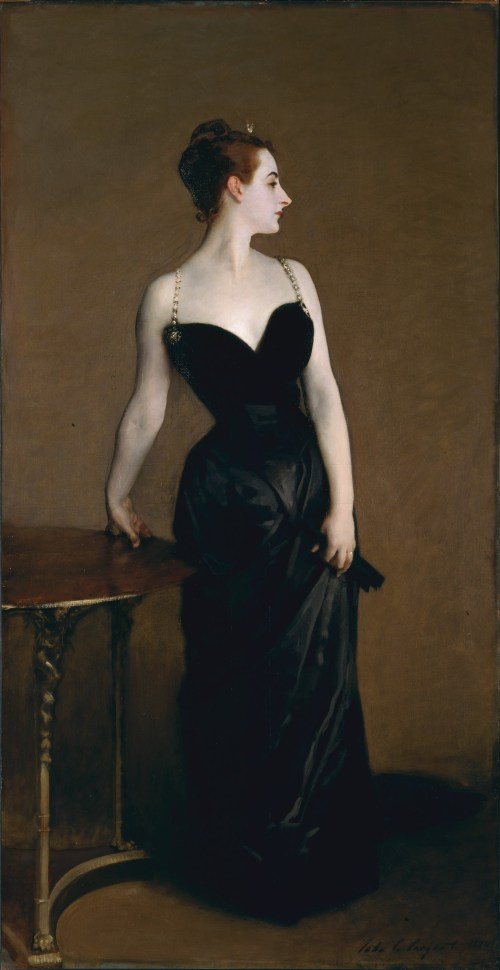
#FineArtFriday: Portrait of Madame X by John Singer Sargent 1884


What I love about this Painting:

I love everything–the moody colors and textures–she needs no necklace, no jewels to prove she is someone unforgettable.

Madame X is mysterious; she is a promise unspoken.

She is dangerous the way uncharted seas are.

Her pose, the elegance of the black dress, the turn of her head—this portrait shouts “Here is a woman to be reckoned with.” Everyone who knew Virginie Amélie Avegno Gautreau said that in this Portrait of Madame X, American expatriate artist  John Singer Sargent captured something real, something true about the woman, something well beyond the unashamed sexuality of the portrait.

About this painting, via Wikipedia:

(John Singer Sargent’s) most controversial work, Portrait of Madame X (Madame Pierre Gautreau) (1884) is now considered one of his best works, and was the artist’s personal favorite; he stated in 1915, “I suppose it is the best thing I have done.” When unveiled in Paris at the 1884 Salon, it aroused such a negative reaction that it likely prompted Sargent’s move to London. Sargent’s self-confidence had led him to attempt a risqué experiment in portraiture—but this time it unexpectedly backfired. The painting was not commissioned by her and he pursued her for the opportunity, quite unlike most of his portrait work where clients sought him out. Sargent wrote to a common acquaintance:

I have a great desire to paint her portrait and have reason to think she would allow it and is waiting for someone to propose this homage to her beauty. …you might tell her that I am a man of prodigious talent.

It took well over a year to complete the painting. The first version of the portrait of Madame Gautreau, with the famously plunging neckline, white-powdered skin, and arrogantly cocked head, featured an intentionally suggestive off-the-shoulder dress strap, on her right side only, which made the overall effect more daring and sensual. Sargent repainted the strap to its expected over-the-shoulder position to try to dampen the furor, but the damage had been done. French commissions dried up and he told his friend Edmund Gosse in 1885 that he contemplated giving up painting for music or business.

Writing of the reaction of visitors, Judith Gautier observed:

“Is it a woman? a chimera, the figure of a unicorn rearing as on a heraldic coat of arms or perhaps the work of some oriental decorative artist to whom the human form is forbidden and who, wishing to be reminded of woman, has drawn the delicious arabesque? No, it is none of these things, but rather the precise image of a modern woman scrupulously drawn by a painter who is a master of his art.”


Credits and Attributions:

Wikipedia contributors, “John Singer Sargent,” Wikipedia, The Free Encyclopedia, https://en.wikipedia.org/w/index.php?title=John_Singer_Sargent&oldid=904608954 (accessed July 25, 2019).

Madame X (Madame Pierre Gautreau), by John Singer Sargent, 1884 PD|100

Wikimedia Commons contributors, “File:Madame X (Madame Pierre Gautreau), John Singer Sargent, 1884 (unfree frame crop).jpg,” Wikimedia Commons, the free media repository, https://commons.wikimedia.org/w/index.php?title=File:Madame_X_(Madame_Pierre_Gautreau),_John_Singer_Sargent,_1884_(unfree_frame_crop).jpg&oldid=358225955 (accessed July 25, 2019).

1 Comment

Filed under #FineArtFriday

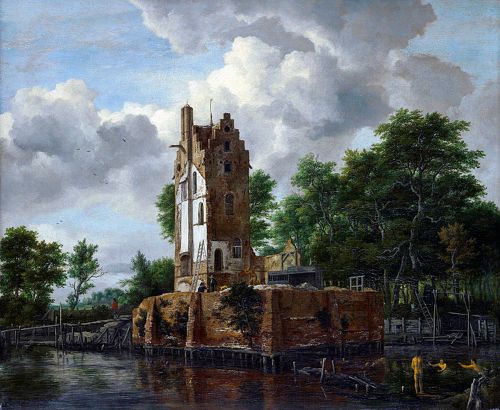
#FineArtFriday: The Huis Kostverloren on the Amstel by Jacob van Ruisdael ca.1660

About the Artist Via Wikipedia:

Ruisdael and his art should not be considered apart from the context of the incredible wealth and significant changes to the land that occurred during the Dutch Golden Age. In his study on 17th-century Dutch art and culture, Simon Schama remarks that “it can never be overemphasized that the period between 1550 and 1650, when the political identity of an independent Netherlands nation was being established, was also a time of dramatic physical alteration of its landscape”. Ruisdael’s depiction of nature and emergent Dutch technology are wrapped up in this. Christopher Joby places Ruisdael in the religious context of the Calvinism of the Dutch Republic. He states that landscape painting does conform to Calvin’s requirement that only what is visible may be depicted in art, and that landscape paintings such as those of Ruisdael have an epistemological value which provides further support for their use within Reformed Churches.

The art historian Yuri Kuznetsov places Ruisdael’s art in the context of the war of independence against Spain. Dutch landscape painters “were called upon to make a portrait of their homeland, twice re-won by the Dutch people – first from the sea and later from foreign invaders”. Jonathan Israel, in his study of the Dutch Republic, calls the period between 1647 and 1672 the third phase of Dutch Golden Age art, in which wealthy merchants wanted large, opulent and refined paintings, and civic leaders filled their town halls with grand displays containing republican messages.

>>><<<

Artist: Jacob van Ruisdael  (1628/1629–1682)

Title: English: The Huis Kostverloren on the Amstel

Date: between 1660 and 1664

Medium: oil on canvas

Dimensions: Height: 63 cm (24.8 ″); Width: 75.5 cm (29.7 ″)

Current Location: Amsterdam Museum


Credits and Attributions:

The Huis Kostverloren on the Amstel by Jacob van Ruisdael [Public domain]

Wikipedia contributors, “Jacob van Ruisdael,” Wikipedia, The Free Encyclopedia, https://en.wikipedia.org/w/index.php?title=Jacob_van_Ruisdael&oldid=905931531 (accessed July 19, 2019).

Wikimedia Commons contributors, “File:SA 38217-Het Huis Kostverloren aan de Amstel2.jpg,” Wikimedia Commons, the free media repository, https://commons.wikimedia.org/w/index.php?title=File:SA_38217-Het_Huis_Kostverloren_aan_de_Amstel2.jpg&oldid=326210473 (accessed July 19, 2019).

3 Comments

Filed under #FineArtFriday

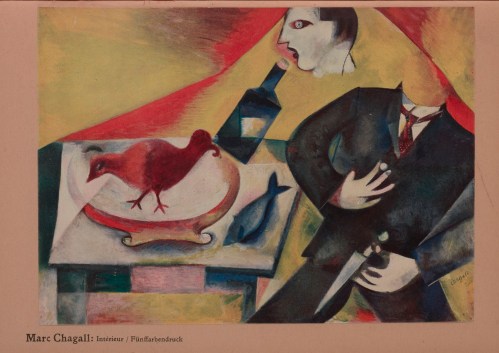
#FineArtFriday: The Drunkard by Marc Chagall 1911

In this image, Marc Chagall manages to capture the determined self destruction of the addict. His colors are vivid, intense, and the images slightly shocking. The addict has lost his head.

About the Artist via Wikipedia Commons:

Marc Zakharovich Chagall was born Moishe Zakharovich Shagal  6 July [O.S. 24 June] 1887 – 28 March 1985). (He) was a Russian-French artist of Belarusian Jewish origin. An early modernist, he was associated with several major artistic styles and created works in virtually every artistic format, including painting, book illustrations, stained glass, stage sets, ceramic, tapestries and fine art prints.

Art critic Robert Hughes referred to Chagall as “the quintessential Jewish artist of the twentieth century” (though Chagall saw his work as “not the dream of one people but of all humanity”). According to art historian Michael J. Lewis, Chagall was considered to be “the last survivor of the first generation of European modernists”.

Author Serena Davies writes that “By the time he died in France in 1985—the last surviving master of European modernism, outliving Joan Miró by two years—he had experienced at first hand the high hopes and crushing disappointments of the Russian revolution, and had witnessed the end of the Pale of Settlement, the near annihilation of European Jewry, and the obliteration of Vitebsk, his home town, where only 118 of a population of 240,000 survived the Second World War.”


Credits and Attributions:

Marc Chagall, 1911-12, The Drunkard (Le saoul), 1912, oil on canvas. 85 x 115 cm. Private collection Der Sturm, Volume 11, Number 3, 5 June 1920, p. 41 This image is in the public domain in the United States because it was first published outside the United States prior to January 1, 1924.

Wikipedia contributors, “Marc Chagall,” Wikipedia, The Free Encyclopedia, https://en.wikipedia.org/w/index.php?title=Marc_Chagall&oldid=903514404 (accessed July 12, 2019).

Comments Off on #FineArtFriday: The Drunkard by Marc Chagall 1911

Filed under #FineArtFriday

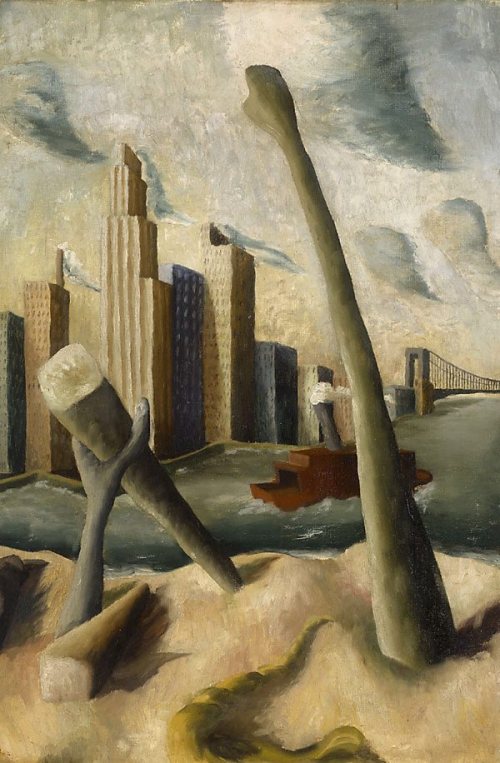
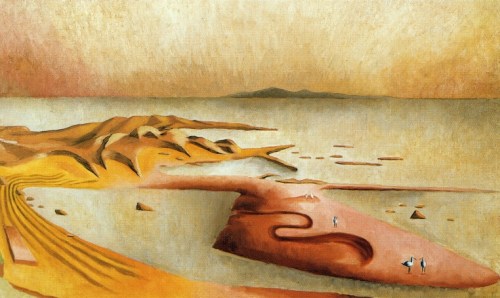
#FineArtFriday: Peter Purves Smith: New York, 1936, and Rickett’s Point, 1937

Usually, in literature, surrealism is shown through the thought processes of the characters rather than in alterations of the environment. On the surface, you believe what they say they think, but their perception of the world is skewed toward a hallucinogenic feel.

In art, the surface, the visual layer is what it is all about. Everything is displayed for you to view and interpret as you will.

Sometimes surrealism asks you to think deeper. Other times, surrealism says “enjoy the moment.” In “New York” Peter Purves Smith asks you to think deeper about our mania for building densely and tall. Skyscrapers grow like weeds, springing from the earth like dandelions in the lawn. What other concepts does he ask us to consider?

Progress and impermanence. Beauty versus utilitarian requirements. He asks us to think deeply.

In Ricketts Point, he asks you to just enjoy a sunny day at the beach.


Credits and Attributions

Wikimedia Commons contributors, “File:Peter Purves Smith – New York, 1936.jpg,” Wikimedia Commons, the free media repository, https://commons.wikimedia.org/w/index.php?title=File:Peter_Purves_Smith_-_New_York,_1936.jpg&oldid=149235926 (accessed July 4, 2019).

Wikimedia Commons contributors, “File:Peter Purves Smith – Ricketts Point, 1937.jpg,” Wikimedia Commons, the free media repository, https://commons.wikimedia.org/w/index.php?title=File:Peter_Purves_Smith_-_Ricketts_Point,_1937.jpg&oldid=296570789 (accessed July 4, 2019).

Comments Off on #FineArtFriday: Peter Purves Smith: New York, 1936, and Rickett’s Point, 1937

Filed under #FineArtFriday

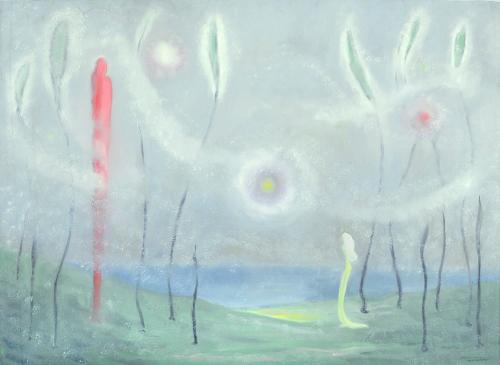
#FineArtFriday: The Oracle by Marguerite Blasingame


The Oracle – Hawaiian Symbolist by Marguerite Blasingame

Date: circa 1935

Marguerite Blasingame was a Hawaiian artist, world-famous for her sculptures, but less so for her paintings. She painted in a “Symbolist” style, which is very different than surrealism, although the two styles appear to share some commonalities.

About the symbolist style in art, via Wikipedia:

The symbolist painters used mythological and dream imagery. The symbols used by symbolism are not the familiar emblems of mainstream iconography but intensely personal, private, obscure and ambiguous references. More a philosophy than an actual style of art, symbolism in painting influenced the contemporary Art Nouveau style and Les Nabis.

What I love about this picture:

The dreamscape is captivating, inviting you to look closer. The water and the land seem to embrace the figures and the plants, and also cradles the sun. It is perfectly balanced. The colors are intense yet muted; the curving sinuous figures seem both familiar and alien. This painting gives the viewer much to think about.

As a writer, I’m attracted to symbolism in art and literature. When an artist goes to the trouble of offering me something of substance to think about, their work stays with me. I find myself thinking about it long after setting the book down or leaving the gallery.

About the Artist, via Wikipedia:

Marguerite Blasingame (1906 – 1947) founded the Hawaiian Mural Arts Guild in 1934, along with Isami Doi, Madge Tennent, and others. She died young, at the age of only forty one.

On Saturday 15 March 1947, fellow island artist Madge Tennent published the following tribute to Blasingame in The Honolulu Advertiser:

“To her many artist friends she represented a youthful and indomitable vitality in art, which was supported by a capacity for grueling hard work in her chosen field of true fresco and sculptured bas-relief in Hawaiian wood and stone. She was, by almost any way of thinking, too young to die. But the strangely wonderful thing is this, that she has in her sadly short young life, left more important works of art which have been placed where everybody may enjoy them, than any other island artist.”


Credits and Attributions:

Wikipedia contributors, “Marguerite Louis Blasingame,” Wikipedia, The Free Encyclopedia, https://en.wikipedia.org/w/index.php?title=Marguerite_Louis_Blasingame&oldid=885666667 (accessed June 27, 2019).

Wikimedia Commons contributors, “File:The Oracle – Hawaiian Symbolist by Marguerite Blasingame.jpg,” Wikimedia Commons, the free media repository, https://commons.wikimedia.org/w/index.php?title=File:The_Oracle_-_Hawaiian_Symbolist_by_Marguerite_Blasingame.jpg&oldid=276120985 (accessed June 27, 2019).

Wikipedia contributors, “Symbolism (arts),” Wikipedia, The Free Encyclopedia, https://en.wikipedia.org/w/index.php?title=Symbolism_(arts)&oldid=894767208 (accessed June 27, 2019).

Comments Off on #FineArtFriday: The Oracle by Marguerite Blasingame

Filed under #FineArtFriday

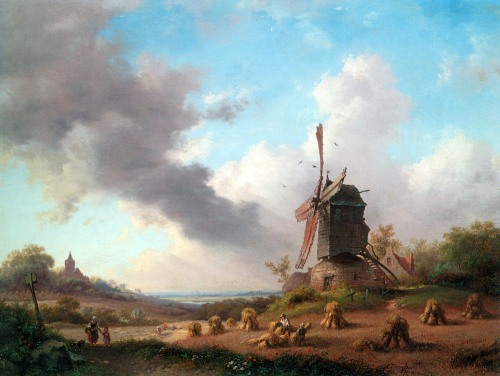
#FineArtFriday: Summer Landscape with Harvesting Farmers, by Fredrik Marinus Kruseman 1850


Author: Fredrik Marinus Kruseman  (1816–1882)

Title: Summer Landscape with Harvesting Farmers

Date:1850

Medium: oil on panel

Dimensions: Height: 28.5 cm (11.2 ″); Width: 38.1 cm (15 ″)

Collection: Art Renewal Center

About the Artist, via Wikipedia

Fredrik Marinus Kruseman was born as the fourth son of Philip Benjamin Kruseman (1781-1842) and Jacoba Magero. He received his first drawing lessons from Jan Reekers (1790-1858) and visited the City Tekenschool in Haarlem in 1832-1833. In 1833, Kruseman received painting lessons from Nicolaas Johannes Roosen Boom (1805-1880) and in 1835 he moved to the Gooi where He further qualified with Jan van Ravenswaay (1789-1869). He also followed education at the romantic landscape painter Barend Cornelis Kaf.

Fredrik Marinus Kruseman is best known for his romantic landscapes. In his entire oeuvre, which is estimated on 300-350 paintings, only 3 still lifes are known. The rest consists of landscapes.


Credits and Attributions:

Summer Landscape with Harvesting Farmers, by Fredrik Marinus Kruseman 1850 [Public domain] via Wikimedia Commons

Wikimedia Commons contributors, “File:Kruseman Fredrik Marinus Summer Landscape with Harvesting Farmers 1850 Oil On Panel.jpg,” Wikimedia Commons, the free media repository, https://commons.wikimedia.org/w/index.php?title=File:Kruseman_Fredrik_Marinus_Summer_Landscape_with_Harvesting_Farmers_1850_Oil_On_Panel.jpg&oldid=266178001 (accessed June 21, 2019).

Fredrik Marinus Kruseman, via Wikipedia The Free Encyclopedia, https://www.translatetheweb.com/?from=&to=en&ref=SERP&dl=en&rr=UC&a=https%3a%2f%2fnl.wikipedia.org%2fwiki%2fFredrik_Marinus_Kruseman accessed 20 June 2019.

Comments Off on #FineArtFriday: Summer Landscape with Harvesting Farmers, by Fredrik Marinus Kruseman 1850

Filed under #FineArtFriday

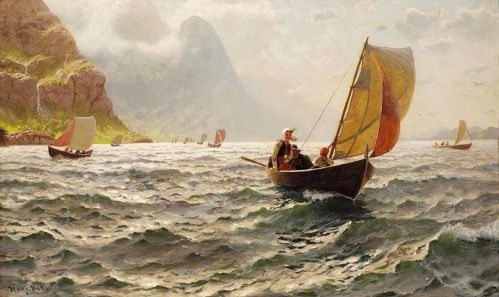
#FineArtFriday: Upon Sunny Waves, by Hans Dahl

Hans Dahl (19 February 1849 – 27 July 1937) was a Norwegian painter.

Trained in Germany, Hans Dahl is associated with the Düsseldorf school of painting, which was characterized by finely detailed imaginary landscapes. Despite later mean-spirited criticisms by other artists and art critics, Dahl remained true to his idealized fantasy art, resisting the movement from Romanticism to Modernism.

What I love about this painting:

Dahl captures the bold freedom of sailing on a sunny summer day. He captures the sense of flying on the water that makes sailing a small boat so much fun.

We aren’t on a leisurely fishing expedition here—this is boating for the sake of adventure. We’re running with wind and enjoying every minute of it.

About the Artist, via Wikipedia:

In the 1890s a new school of art arose, and artists like Dahl were not very popular in the leading circles in the capital. He was particularly criticized by the art historian Jens Thiis. He was severely criticized by fellow artists especially by Christian Krohg, who was one of the leading figures in the transition from romanticism to naturalism which characterized Norwegian art in this period. Throughout his life, he increasingly narrowed his range of topics. Dahl often described the scenery of the western part of Norway in brilliant sunshine with smiling people in national costumes. His vibrant colors and charming portrayals of young Norwegian girls in their national costume have always been very popular.


Credits and Attributions:

Wikipedia contributors, “Hans Dahl,” Wikipedia, The Free Encyclopedia, https://en.wikipedia.org/w/index.php?title=Hans_Dahl&oldid=827399492 (accessed June 13, 2019).

Upon Sunny Waves, by Hans Dahl PD|70 [Public domain]

Wikimedia Commons contributors, “File:Hans Dahl – Upon sunny waves.jpg,” Wikimedia Commons, the free media repository, https://commons.wikimedia.org/w/index.php?title=File:Hans_Dahl_-_Upon_sunny_waves.jpg&oldid=140877929 (accessed June 13, 2019).

2 Comments

Filed under #FineArtFriday

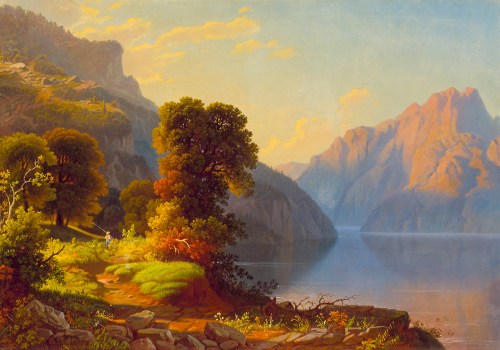
#FineArtFriday: A View of a Lake in the Mountains by George Caleb Bingham


  • Title: A View of a Lake in the Mountains
  • Artist: George Caleb Bingham
  • Medium: Oil on canvas
  • Date: between circa 1856 and circa 1859
  • Dimensions: Height: 53.9 cm (21.2 ″); Width: 76.5 cm (30.1 ″)
  • Current Location: Los Angeles County Museum of Art

What I love about this picture:

This scene depicts an hour of utter serenity in the turbulent life of the artist. The late afternoon sunlight falls gently on the rocky path above the calm waters. Shadows fall in all the right places but don’t darken the moment.  There is a dreamlike quality to the day, as if the artist painted his deepest wish. This is a pleasant, restful painting.

About the Artist, via Wikipedia:

George Caleb Bingham (March 20, 1811 – July 7, 1879) was an American artist, soldier and politician known in his lifetime as “the Missouri Artist”. Initially a Whig, he was elected as a delegate to the Missouri legislature before the American Civil War where he fought the extension of slavery westward. During that war, although born in Virginia, Bingham was dedicated to the Union cause and became captain of a volunteer company which helped keep the state from joining the Confederacy, and then served four years as Missouri’s Treasurer. During his final years, Bingham held several offices in Kansas City, as well as became Missouri’s as Adjutant General. His paintings of American frontier life along the Missouri River exemplify the Luminist style.

Bingham ran for election as a Whig to the Missouri House of Representatives the following year. He appeared to have won in 1846 by 3 votes but lost in a recount. In a reprise of the election in 1848, Bingham won the seat by a decisive margin, becoming one of the few artists to serve in elected political office. He actively opposed the pro-slavery “Jackson resolutions” in 1849, although their proponent was also a resident of Saline County. He would also represent Missouri’s eighth district at the Whig National Convention in June 1852. Bingham’s political interests would be reflected in his vivid paintings of frontier political life.

About the Luminist style, via Wikipedia:

Luminism is an American landscape painting style of the 1850s to 1870s, characterized by effects of light in landscape, through the use of aerial perspective and the concealment of visible brushstrokes. Luminist landscapes emphasize tranquility, and often depict calm, reflective water and a soft, hazy sky.

As defined by art historian Barbara Novak, luminist artworks tend to stress the horizontal, and demonstrate the artist’s close control of structure, tone, and light. The light is generally cool, hard, and non-diffuse; “soft, atmospheric, painterly light is not luminist light”. Brushstrokes are concealed in such a way that the painter’s personality is minimized. Luminist paintings tend not to be large so as to maintain a sense of timeless intimacy. The picture surface or plane is emphasized in a manner sometimes seen in primitivism. These qualities are present in different amounts depending on the artist, and within a work.

Luminism has also been considered to represent a contemplative perception of nature.

Novak states that luminism, of all American art, is most closely associated with transcendentalism. The definitional difficulties have contributed to over-use of the term.[5]

The artists who painted in this style did not refer to their own work as “luminism”, nor did they articulate any common aesthetic philosophy outside of the guiding principles of the Hudson River School.


Credits and Attributions:

A View of a Lake in the Mountains by George Caleb Bingham, via Wikimedia Commons.  Los Angeles County Museum of Art [Public domain].

Wikipedia contributors, “George Caleb Bingham,” Wikipedia, The Free Encyclopedia, https://en.wikipedia.org/w/index.php?title=George_Caleb_Bingham&oldid=900386053 (accessed June 6, 2019).

Wikipedia contributors, “Luminism (American art style),” Wikipedia, The Free Encyclopedia, https://en.wikipedia.org/w/index.php?title=Luminism_(American_art_style)&oldid=886912140 (accessed June 6, 2019).


2 Comments

Filed under #FineArtFriday