Category Archives: Humor

Kacey Vanderkarr, Poison Tree (Reflection Pond, Book 2)

As you know, I love to talk shop, and love to hear what other authors have to say about their work and the craft. Recently I read a deep, well-crafted novel written by indie author, Kacey Vanderkarr. The book is called Reflection Pond and I liked it enough to feature it on my book review blog, Best in Fantasy. (You can read my review of her wonderful book here.) Kacey has consented to answer my inelegant questions (further down this post) and what she has to say is quite interesting!

She has written a sequel, Poison Tree (Reflection Pond, Book 2),  and I am happy to have been offered the opportunity to be one of the first to reveal the cover–and a lovely cover it is. And she has also agreed to answer a few questions regarding her work and her life as an indie author–and wow, what great insight into the industry she has.  But first–THE BLURB:

Poison Tree

By Kacey Vanderkarr

Release date: December 2, 2014

The road to the City of War is dangerous.

With their home in ruins, Callie and Rowan are Eirensae’s last hope of stealing the cauldron back from Fraeburdh. They must travel into the human world where the Fallen hide. The banished fae wait for Callie, desperate to sacrifice her before she comes of age.

If Callie and Rowan survive the journey, something worse looms in Fraeburdh. Rowan is destined for a dark family legacy too horrifying to accept, and his father is anxious to welcome him home. Once the truth is revealed, will Callie ever look at Rowan the same way?

Trapped between feuding cities lost in a centuries’ old war, Callie and Rowan will face their biggest rivals yet, and neither of them will make it out unscathed.

>>><<<

(Just so you all know, I am definitely going to buy that book!)

>>><<<

And now the Cover:
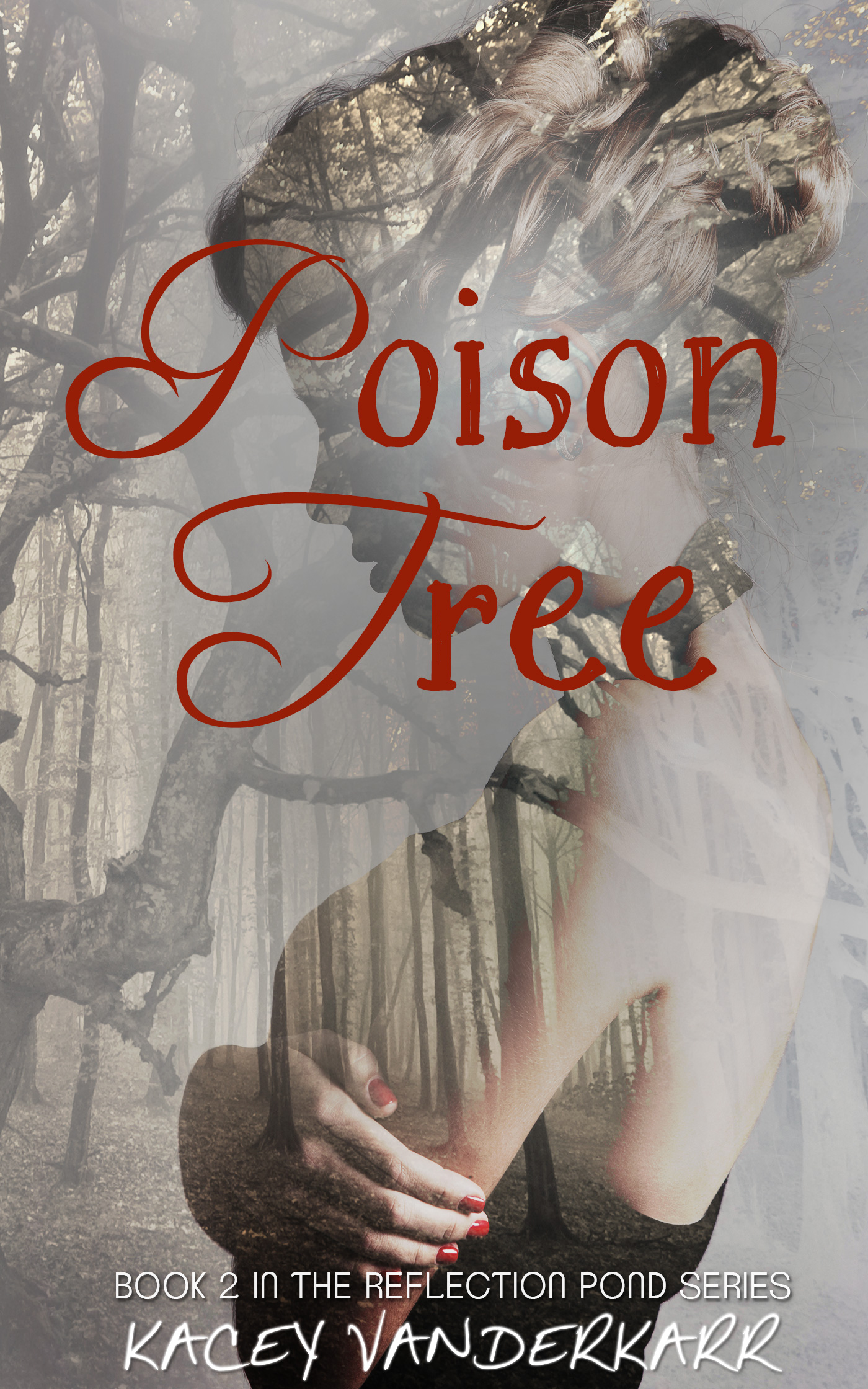
poison-tree-ebook


>>><<<

That’s an awesome cover to go with such an intriguing blurb.  And now, we meet the author, an amazing woman who is a driving force in the writing life of Flint, Michigan.

CJJ: Tell us a little of early life and how you began writing:

KV: I began writing back in high school, though I didn’t officially consider myself a writer until I was on summer break from my first semester of Ultrasound school. Inspiration struck in that four-week break and I spent it writing my first complete novel, a YA Fantasy that I’ve since rewritten. I fell in love with those characters, and to this day, I still have a soft spot for them. It took some time, but I realized that I could fall in love with other, different, characters, and I have again and again, through novels and short fiction. I think writing is part neurosis and part pure joy. There are times when I love and hate it equally!

CJJ: Tell us about your most recent book.

KV: Poison Tree is Book 2 in the Reflection Pond Series. It’s the continuation of Callie and Rowan’s story as they make their way from home into the dark faerie city, Fraeburdh, which is also known as the City of War.

I’ve always been fascinated with fantasy. In doing some research, I found information on a legend involving four treasures. My own story is loosely based on the original four treasures of Tuatha Dé Danann.

CJJ: Do you have a specific ‘Creative Process’ that you follow, such as outlining or do you ‘wing it’?

KV: I am a certified winger. Swooper. Pantser. Whatever you want to call it. I usually have a general skeleton of a story when I start, a beginning, middle, end, though I never outline. There may be an idea for a scene or two as well. My joy doesn’t come from structure, but spontaneity. I’ve tried outlining before, and then I feel determined to stray as far from that plan as possible. I love the blank page, the possibility. I save the note taking for after I’ve written the rough draft.

CJJ: How does your work differ from others of its genre?

KV: I think that Reflection Pond and Poison Tree take risks. I had a reviewer suggest that Reflection Pond be marketed to ages 17+ because it has a “handful of profanity” and “alludes to child abuse.” It doesn’t allude. It happened, and I’m not going to apologize for it. I’m not scared to examine the dark parts of life, and I don’t condone blindfolding my readers to make them feel more comfortable. These books cover a lot of dark topics, and I’m proud of that, especially when reviewers say that it’s handled in a sensitive manner. The truth is, bad things happen to people who read YA, and everyone needs a character that they can relate to. Not everyone will be able to connect to my characters when they read and that’s okay. But for those who have suffered and survived, there is still hope, and I want them to find it when they read my books.

CJJ: Why do you write what you do?

KV: I write based on inspiration. A lot of that manifests as YA, though I have written a few adult short pieces, some new adult, and some straight up fantasy. I think young adult looks at a very transitional place in a character’s life. It gives a lot of options to the writer. That being said, I have absolutely no idea where my career will take me. Right now, I consider myself a YA writer, in the future? Who knows!

CJJ: I know why I chose the indie route for my work, but I’m curious as to why you’ve chosen this path.

KV: I am all over the place when it comes to publishing. My first book, Antithesis, was published by Inkspell Publishing, which is a small press. That was a great experience for me. I learned how to market, how much work it is to publish a book, how to work with an editor and cover designer. Inkspell is very supportive and patient with their authors. However, for my second book, Reflection Pond, I opted to self-publish. I’d sent it to agents, had a few bites of interest, but nobody wanted to pick up the series. At that point, I had to make a choice. Who did I write this book for? In the end, it was myself, and if I wanted it to be out there in the world, then I had to publish it myself, too. It was a long process with a lot of ups and downs and uncertainty, but I’m SO HAPPY I did it. Self-publishing has opened even more doors for me and widened my net of contacts. I’m proud of these books because every page is mine.

However, I still want an agent, which is why I’m now querying a different project. So, I’ve done a bit of everything. I’d love to have an agent and publish traditionally. The important thing is patience, which is what I keep telling myself!

CJJ: What advice would you offer an author trying to decide whether to go indie or take the traditional path?

KV: I think both traditional and self-publishing have their pros and cons and neither one is better than the other. What matters is the work. Traditional publishing is a bit like having good luck. Your writing can be amazing, but you have to attract the right agent at the right time, and then again with an editor and publisher. Self-publishing gives you more freedom. You get to choose who you work with, have say in what your cover looks like, make editing decisions.

Both paths are hard.

If you indie publish, I suggest making friends with someone who knows the ropes and can help you get it done. That’s the great thing about writers, we’re friendly and helpful, colleagues not competition, because we’re also readers who love good books.

The last bit of advice is DON’T GIVE UP. If you want to indie publish, do it. If you indie publish and still want an agent. Go for it. There is no wrong way. Don’t let the industry, your family or friends, or yourself keep you from your dreams. Just remember, the publishing industry moves SLOW, SLOW, SLOW, so have patience and trust your gut.

>>><<<

I have to say, I really enjoyed reading her answers–Kacey Vanderkarr has some awesome advice for all authors, not just indies there!
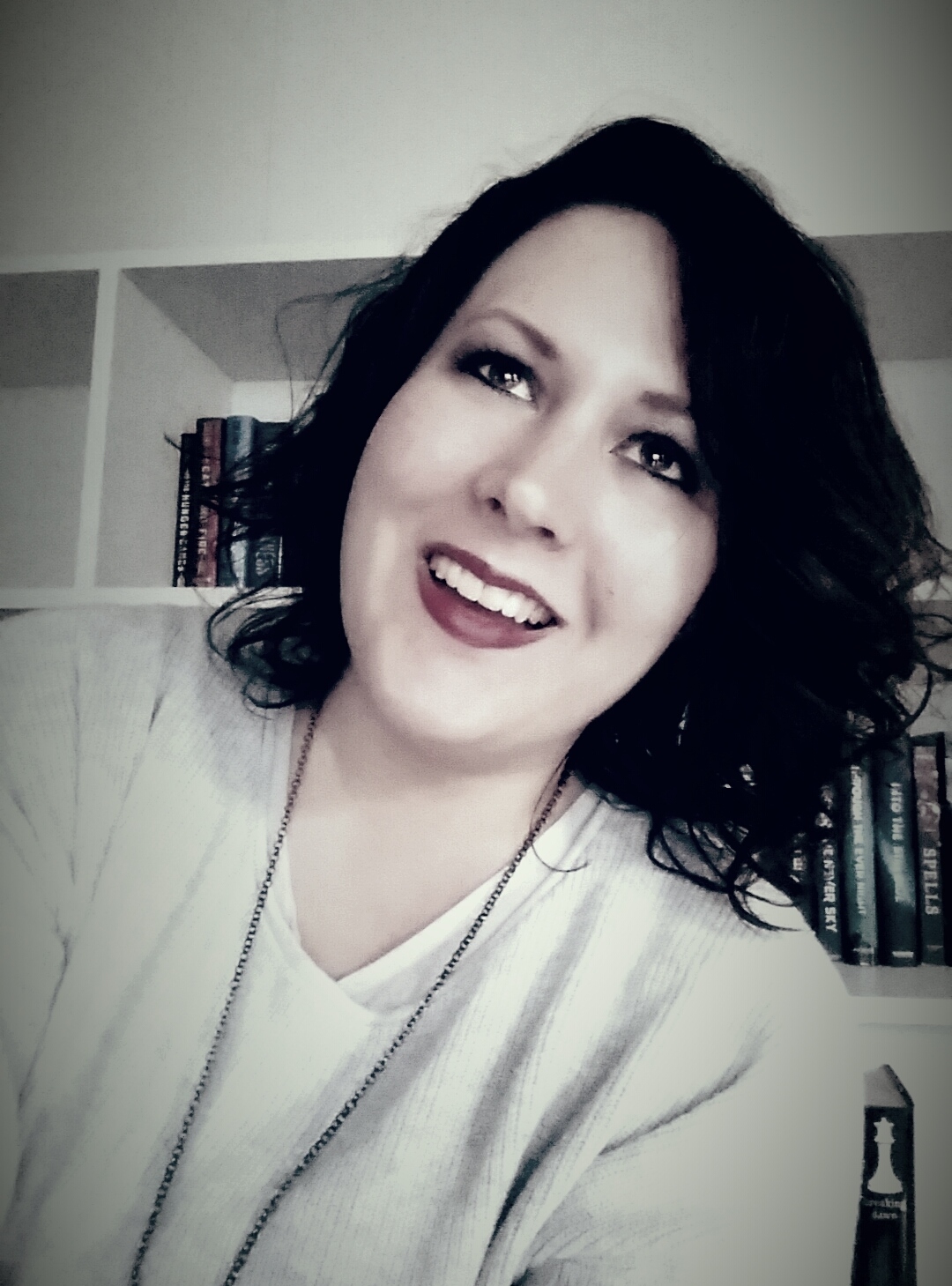
 

Kacey VanderkarrKACEY VANDERKARR is a young adult author. She dabbles in fantasy, romance, and sci-fi, complete with faeries, alternate realities, and the occasional plasma gun. She’s known to be annoyingly optimistic and listen to music at the highest decibel. Kacey is president of the Flint Area Writers and the Social Media Director for Sucker Literary. When she’s not writing, she coaches winterguard and works as a sonographer. Kacey lives in Michigan, with her husband, son, and crazy cats. In addition to her novels, Antithesis and Reflection Pond, Kacey’s short fiction is featured in Sucker Literary Vol III, Out of the Green: Tales from Fairyland, and will appear in Spark Vol VII and the inaugural issue of Ember: A Journal of Luminous Things. Check out her website: www.kaceyvanderkarr.com.

You can purchase the wonderful book that begins this series at:

Reflection Pond on Amazon

If I were you I would Add Poison Tree on Goodreads--I just did!

And here is her Author Facebook Page–go out and ‘like’ her–she’s an awesome person!

Kacey Vanderkarr’s Blog-check it out!

And finally–you can follow her on Twitter!
Comments Off on Kacey Vanderkarr, Poison Tree (Reflection Pond, Book 2)

Filed under Adventure, Blogger, blogging, Books, Fantasy, Humor, Literature, Publishing, Self Publishing, Uncategorized, writer, writing

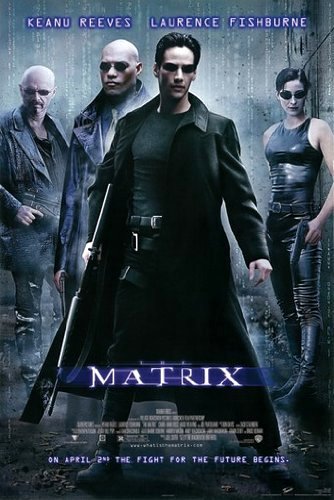
Plug in to The Matrix


the Matrix PosterNovels have layers. Theme is what the story is about on a deeper level than the plot details. It’s the big meaning, and often it’s a moral meaning. Love, honor, family, and revenge are all some common, underlying themes.

I think of the scenes in my books as if they were scenes in a movie. Each conversation is a scene.

Sometimes, we find ourselves in Outer Mongolia as we wrangle our words. Our mind is off chasing squirrels, and our fingers are madly keying dialogue. It happens, and then we find ourselves writing paragraphs of discussion regarding the vase on the kitchen table. Why are we discussing this vase?  If there is a reason that will emerge later, keep it. If it is just idle fluff, lose it.

I actually have a scene in one of my forthcoming books where the characters do just that. They are discussing a vase that was made by a child, but the conversation is not important for the sake of the vase, nor is it really about that object. It is there to expose how important an absent person is to one of the speakers, and the brief interaction between the two speakers endears to the reader one of the characters who will later meet a sad end. The underlying themes of this book are brotherhood, family, romantic love, honor, duty. The obvious theme is the successful resolution of a quest. The core plot device around which the story evolves is an ongoing War of the Gods, and the world in which the tale is set in is their battleground, offering all sorts of opportunities for mayhem.

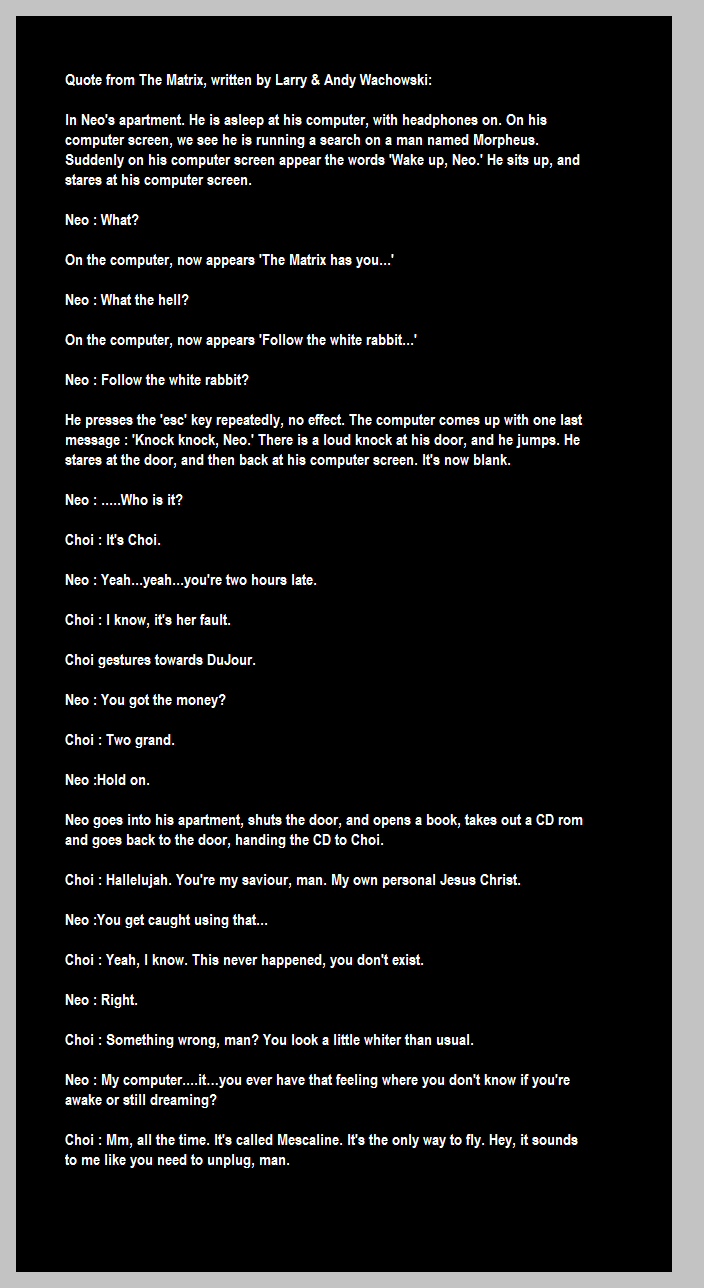
Consider the first scene of one of my favorite movies of all time, The Matrix. This movie has a lot of action, but it has a lot of dialogue also, and that dialogue advances the plot and never loses the theme of the story.

Quotes from the matrix

The conversation concerns a drug deal, but the underlying theme is never lost. The key words are in the first line, written on the computer, The Matrix has you, the third line, follow the white rabbit, and in that very last line, telling Neo to unplug. The Matrix is all about waking up, about what reality is, and about Neo as the potential savior of the world, which has been enslaved by a virtual reality program. It is about escaping that program. The conversations that happen in the course of the film all advance that theme, even the minor interactions, from the first conversation to the last.

The Arc of the StoryWe must approach conversations in our novels as if they were scenes in a movie. In a good movie, we don’t notice it, but there is an arc. In a story arc, a character undergoes substantial growth or change. It ends with the denouement in the last third or quarter of a story. The end of a narrative arc is the denouement, the final resolution. It shows what happens as a result of all the conflict that the characters have gone through.

If we don’t keep the arc of the story moving with each scene, we will lose our reader, and to that end, each conversation must reflect the underlying themes of the story without beating the reader over the head with it. As in real life, some of the people know more than others, and to advance the plot and the theme, small clues must come out over the course of each scene, each scene building to the finale.

I876MilanoDuomo‘ve said this before, but we must build the overall arc of the story from scenes, each of which is a small arc, in the same way a gothic cathedral is constructed of many arches that all build toward the top.  The underlying arches strengthen the overall construction. Without arches, the cathedral wouldn’t remain standing for very long. The novel is a cathedral and your scenes are the arches that hold it up. The conversations that form those scenes are miniature arches, each with a beginning, a high point, and a resolution.


4 Comments

Filed under Adventure, Battles, blogging, Books, Fantasy, Humor, Literature, mythology, Publishing, Self Publishing, Uncategorized, WordPress, writer, writing

The race is on!

Zuni Folk Tales Frank Hamilton CushingNational Novel Writing Month is in full swing.  I have 30 days in which I can do nothing but write, write, write. The wheels are turning in my head, and my new story is flowing at a slow but steady rate. I know who I am writing about, and I know what his story is. I know what the action is and where it goes within the framework of the novel.

My only problem is I can’t key fast enough. When I do key fast it becomes illeggiebble…illegeabngle… .

Doh!

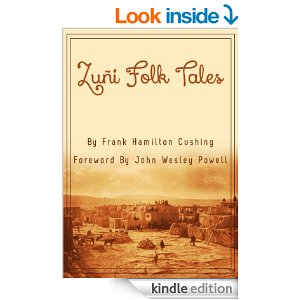
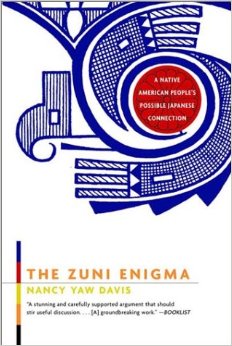
the Zuni EnigmaAnyway I have just received my newest textbook, The Zuni Enigma: A Native American People’s Possible Japanese Connection, written by Anthropologist Nancy Yaw Davis. I  have found some wonderful legends in the small book,  Zuni Folk Tales, by Frank Hamilton Cushing.

This book is an incredible departure for me.  Not only am I working in a world that exists in reality, I am working with a culture that is both known and unknown to me, and I must do it with respect.  This novel is a historical fantasy, but it is set in the 1890’s. I have to remain true to the period, to the two cultures this tale depicts, and I have to make my character real.

Zuni frank hamilton ushingWhat makes this even more tricky, is I am telling this story from the perspective of the main character–something I have not done before. But this tale is a diary in a way about one man’s journey, and the duality of his path in life. It is a stand-alone novel, and while it is definitely fantasy, I think it will be more of a literary novel than Genre Fantasy.

The Zuni are a private, mysterious people, and rightfully so. This makes it imperative that I know what I am talking about. Fortunately have been immersing myself in the Zuni culture through the work of early anthropologist Frank Hamilton Cushing.

Frank Hamilton Cushing’s stay at Zuñi pueblo from 1879 to 1884 made him the first professional anthropologist actually to live with his subjects. Learning the language and winning acceptance as a member not only of the tribe but of the tribal council and the Bow Priesthood, he was the original participant observer and the only man in history to hold the double title of “1st War Chief of Zuñi, U. S. Ass’t Ethnologist.”

My goal is to honor these amazing people, respect their privacy and maintain their mystery, and entertain my readers. The story is amazing–if only I can get it right.

6 Comments

Filed under Adventure, Battles, blogging, Fantasy, Humor, Japan, Literature, writer, writing

Mmmm…chocolate…

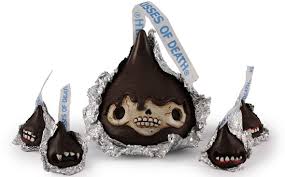
halloween kisses

Kisses of Death by artist Andrew Bell

I’ve always thought that if you really wanted to do something creepy for Halloween, you should hand out little mini-packs of chocolate covered ants, or something. I  just feel there is nothing scary about a Reese’s Peanut Butter Cup, and to do the most sinister night of the year justice, we should serve evil treats.

Halloween is the most important day of the year for many reasons–not the least of which is the annual midnight write in at Shari’s Restaurant for those intrepid heroes who can’t wait a minute longer to start their November Novel!

HTB New Front Cover with gold frameI wrote Huw the Bard in 2011 as my NaNoWriMo Novel–it had a different working title. In 2014 it was published, and the changes it went through in those two years was amazing. Fortunately I have a supportive husband who  regularly allows me to neglect him.

This year I am writing a novel that begins in the old west of northern New Mexico, where a journey to take a holy relic to be melted down at the smelters in Durango takes a terrifying turn into a world between the worlds. The first plan I had for this story was to co-write it with indie author Aura Burrows, but that didn’t pan out as various commitments made it impossible for us to get together on it, and she is unable to do it. But I fell in love with my main character, William Two Cats, and I am going to tell his story.

I have a working title, I have designed a placeholder book cover, I know who and what I am writing about, and tonight at midnight I am off to the races. On the National Novel Writing Month website I am Dragon_Fangirl, and you can see my book page and follow my progress here.

William Two Cats is a man of two worlds, the white-man’s world and the world of the A’shiwi–the people we call the Zuni Pueblo Indians,and yet he is a man of neither. His white mother insisted he be educated him in both cultures, and his Zuni father agreed. The tribal elders know he is destined to be firmly centered between the two worlds, and ensure he takes the path of the shaman. When we meet William, he has left the pueblo.

I can’t wait to get started on this new novel, counting down the hours to midnight…counting…counting….

Oh, look! We still have chocolate covered ants left! Yum!

What? They’re not vegan?

Curses….

ants


2 Comments

Filed under Blogger, blogging, Books, Food, Humor, Publishing, Self Publishing, Vegan, WordPress

Bloated exposition and the power of the “No!”


Book- onstruction-signTwo-year-olds are awesome little balls of angst and joy. It’s either all happiness or all misery for them. I just spent the last two days babysitting my youngest grandson, who is two, while my daughter, a well-known musician, was in the recording studio. The dialogue between me and my grandson went something like this:

Me: “Would you like to eat dinner?”

2 yr old: “No dinner!”

Me: “Do you have to potty?”

2 yr old: “No Potty!”

Me: “Would you like ice-cream?”

2 yr old: “No ice-cream!”

It doesn’t matter what you ask the child–he is currently hardwired to say “NO!” to everything, no matter how badly he really wants it.  Everything is high drama and terrible tragedy for him–and his gut reaction to every question is driven by his newly acquired “power of the NO,”  a super-power that regularly goes to his head.

Unlike the two-year-old with his simple cut-and-dried answer for everything, we authors have a large amount of backstory that we are just sure the reader must know every minuscule detail of, and in order to avoid info dumps, we write conversations to do just that, so that the reader will not lack for information.

But this is where we authors need to exercise the power of the NO. It is also one of the hardest things we do–trying to decide what is crucial to the advancement of the plot and what could be done without. I am currently looking quite closely at one of my manuscripts, and I may cut an entire chapter that is only background. It’s awesome background, and I love this background–but when looked at with an independent eye, it doesn’t do anything but stall the forward momentum of my book.

Don’t give your characters long paragraphs with lines and lines and lines of uninterrupted dialogue. Those can become info dumps laced with useless fluff and are sometimes seen as a wall of words by the reader. This is referred to, in the industry, as bloated exposition.

When the dialogue is trying to tell the reader too much, characters end up saying a lot of unnatural and awkward things.

 “Remember the first day at the academy? We showed up wearing identical uniforms. I was so humiliated. I hated you for that. I didn’t speak to you at all until Commander Janson forced us to be partners in the biology lab, but I managed to get us through that with all A’s. But look at you now, you lucky dog. You are fortunate enough to be my second in command.”

“I know, sir. I despised you too, especially when you made me do all the dirty work, cutting up that alien amphibian. And you took all the credit for it. But now here we are, the best of friends and in command of the finest ship in the fleet, the USS George Lucas. I really, really love being your flunky. It is just the awesomest gig ever.”

Probably not gonna happen. When two characters go back and forth explaining precisely what they are feeling or thinking, it doesn’t seem remotely real. The only time exposition works in a novel is when both the reader and the character being spoken to do not know the information being artfully dumped.

dump no infoWhen reading, even dedicated readers will skip over large, unbroken blocks of words. Elmore Leonard said, “Try to leave out the part that readers tend to skip.” I feel this goes double for dialogue.

Cut to the chase. In real life, you might want to talk at length about the small details, but most of the important information is dealt with right away, and the rest is just socializing. When I think of the novels I enjoy the most, the important information in their conversations is dealt with up front, and the minor details emerge later as they become important.

Consider a phone conversation at work or when you’re in a hurry, and a friend just had a car accident. Your friend has a story to tell, and you have questions. “Are you hurt? Can you drive the car? Do you need anything?” While the boss is glaring at the back of your head, you won’t ask if they had insurance or if your friend will sue (unless you work for a legal firm and you’re fishing for business.)

There’s another important reason to avoid fluff in your dialogue besides the fact it makes a book more enjoyable:

In the real world, Indies and self-publishers pay the costs to publish their works up front. In the ebook format, costs are minimal and it doesn’t matter, but a paper book by a new author that has to sell for more than $12.99 may not sell well. Remember, with a longer book, your costs are increased because until you’re established, you must purchase your own stock to sell on consignment in local book stores. You’ll also need to buy books for your table at trade shows, conventions, and at most book-signings. You’ll want to keep your cost as low as possible and still turn out a good book.

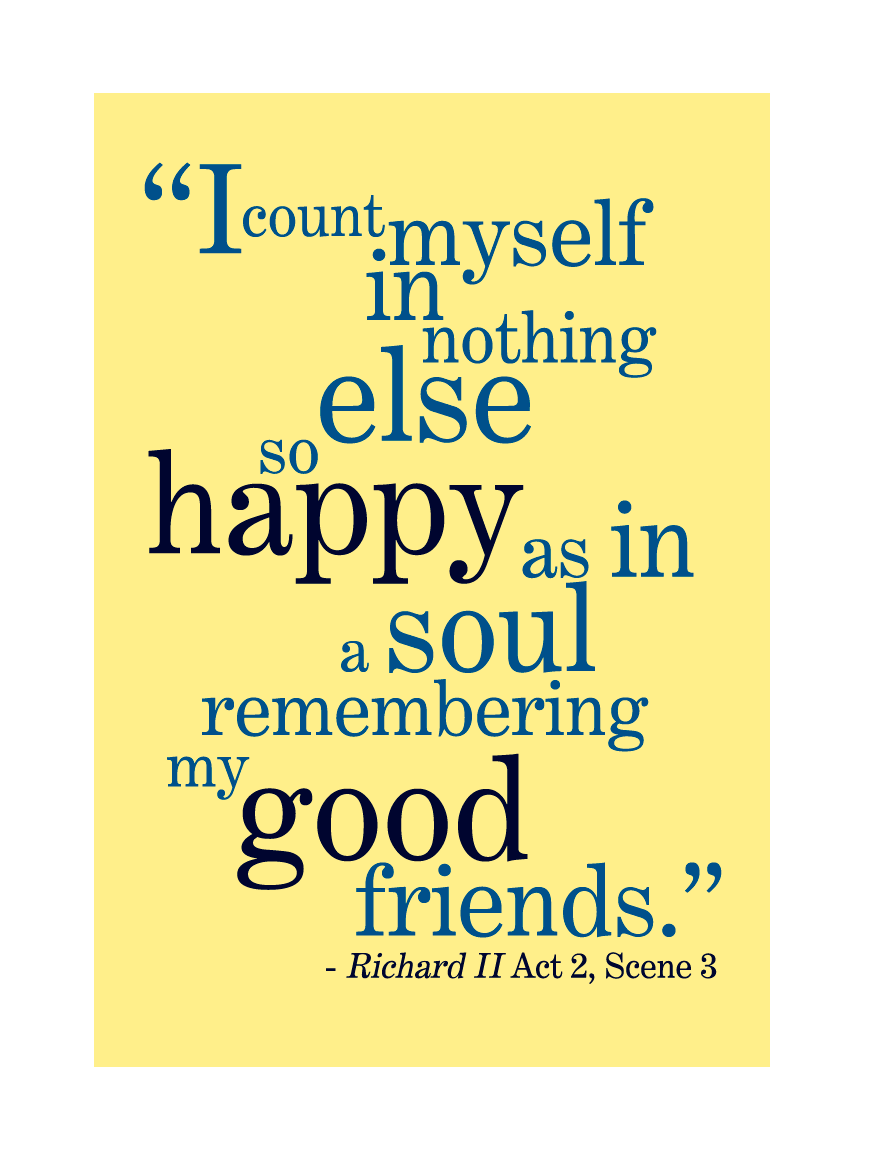
Shakespeare_ICountMyselfFor an indie who writes fantasy, which tends to be longer books and is my genre, it’s most cost-effective for you to keep your work to between 90,000 and 120,000 words if you intend to print through CreateSpace, which prints my paper books. So, wise authors will avoid empty filler in their conversations at all costs.

Having said to keep it short, I know there are times when a character will have a long story to tell, and if it’s done right, it works. Usually, these are stories within stories, and they’re a bit tricky to do right. Deploy the facts, and go light on the fluff.

Remember, what worked in a Shakespeare monologue does not work in a dialogue between two people. Fictional dialogue is about give and take, meant to sound realistic but sharpened by the fact that each character needs something, and by the fact that their needs do not mesh. You won’t get two-page speeches if you remember to visualize your conversation.

5 Comments

Filed under Adventure, Battles, Blogger, blogging, Books, Fantasy, Humor, Literature, Publishing, Self Publishing, Uncategorized, writer, writing

Dazed and confused

my sisters grave robert dugoniI am a a bit dazed and confused right now. I have been intensely preparing to give a seminar on writing dialogue at conference next weekend, but now the convention has been cancelled. Apparently not enough people pre registered. And I was all prepped to hear an announcement from Robert Dugoni!  Now I won’t know what it is until he tweets it. And his book, My Sister’s Grave was just named one of the top five thrillers of 2014.  I love it when an Indie goes viral!

But on the positive side, I am now free to focus on editing for clients, prepping for NaNoWriMo 2014 and several other things that demand my attention. Also, I don’t have to hope and pray I can find a vegan-friendly restaurant near the hotel (which I also cancelled.)

I had planned to talk about talking–at least about how your characters might talk, if they were talking to you in real life.

So how do we convey a sense of naturalness and avoid the pitfalls of the dreaded info dump and stilted dialogue? First, we must consider how the conversation fits into the arc of the scene.

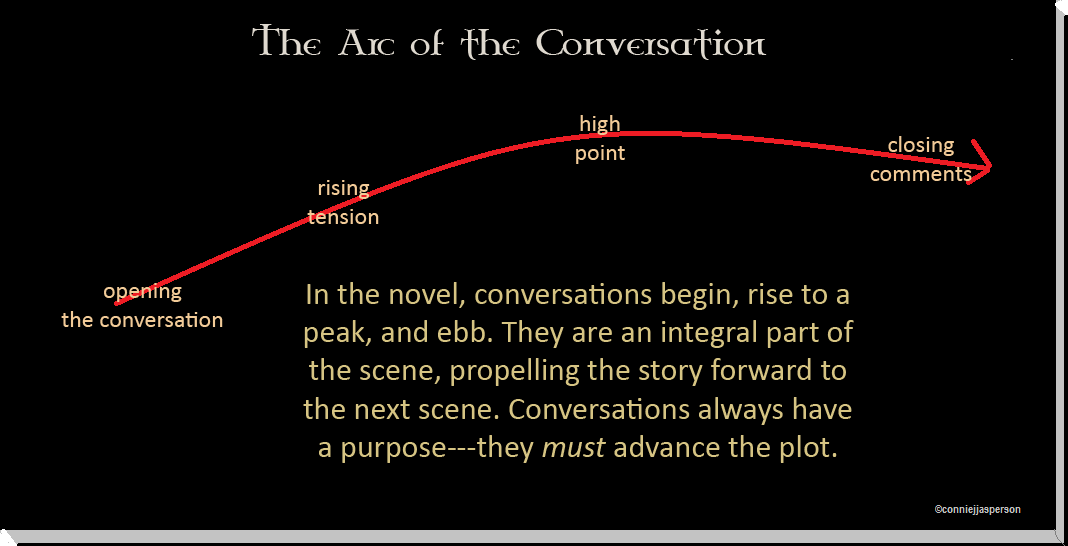
It begins, rises to a peak, and ebbs, an integral part of the scene, propelling the story forward to the next scene. A good conversation is about something and builds toward something. J.R.R. Tolkien said dialogue has a premise or premises and moves toward a conclusion of some sort. If nothing comes of it, the dialogue is a waste of the reader’s time.

First we must identify what must be conveyed in our conversation.

  1. Who needs to know what?
  2. Why must they know it?
  3. And how many paragraphs do you intend to devote to it?

My rule of thumb is, keep the conversations short and intersperse them with scenes of actions that advance the plot. Walls of conversation don’t keep the action moving and will lose readers, so make the conversations important—and intriguing.

Author James Scott Bell says dialogue has five functions:

  1. To reveal story information
  2. To reveal character
  3. To set the tone
  4. To set the scene
  5. To reveal theme

So now that we know what must be conveyed and why, we arrive in the minefield of the manuscript. That will be the subject of my next blogpost.

The Arc of the Conversation

2 Comments

Filed under Battles, Blogger, blogging, Books, Fantasy, Humor, Literature, Publishing, Romance, Self Publishing, Uncategorized, WordPress, writer, writing

What’s in YOUR belfry?

APPROACHING HELLI’ve got a jammed-up calendar right now. I’m preparing my presentation on writing natural dialogue for Northwest Bookfest, which will be held in Kirkland Washington at Northwest University on Nov. 1 & 2, 2014. I’m really looking forward to that, but they’ve given me a slot between 10:30 a.m and 12:00  on Sunday morning-so that’s a lot of talking about talking. I can do it– heck, you know me. If I talk myself hoarse, I’ll let everyone out a few minutes early for lunch because that’s the kind of girl I am.

But in the meantime, I am still finalizing my seminar and the worksheets to go with it, and I have to also publicize it via twitter, press releases, and blogposts. After all–I really do want people to attend this sock-hop!

NaNoWriMo-General-FlyerNot only that, but I’m trying to get a book-signing/talk about the self-publishing industry for myself and Lindsay Schopfer at a local bookstore (whose website has no working contact links and who rarely answers their phone and never answers their voice-mail.) The nice-but-vague young man whom I have spoken to so far seems to have rather a low opinion of indies, but I am going to conquer that bookstore yet!

I am also building my calendar for my nano group in preparation for NaNoWriMo, which also begins on November 1st. While I do this, I have to  get the Christmas promotions finalized for my published books. I fit all of this in the copious amounts of free time I have between editing for clients, and making required revisions of my own current work, and finishing my next novel.

Being an indie author means it’s all on me. I have to generate any buzz about my books that will be generated, and I have to do it in such a way that my friends don’t all unfriend me, and my husband still looks forward to coming home. Maybe I do have bats in my belfry, but at least I’m having fun.

330px-Title_page_William_Shakespeare's_First_Folio_1623I console myself with the thought that Shakespeare had the same trouble. I do have my Twitter campaign planned–the genuine not-too-annoying-please-buy-my-books-I’ll-do-anything campaign. I have a Goodreads Ad campaign currently ongoing. I will stand naked on a street corner until I sell a book.  I will get a Google Ad campaign going.

I have several ads to put in the local paper regarding NaNoWriMo, and also I have a press release for Christmas O’ClockMyrddin Publishing’s charity anthology. We want to push that book and hopefully double our sales this year as the royalties from all sales go to benefit Water is Life. This charity is very dear to my heart, as millions of people go without safe drinking water, and they seek to change that.

I am my own publicist, secretary, chauffeur, housekeeper, and chef–so I guess you know, nothing much is getting done around the house.

Watch out for that low flying grandma–this broom ain’t stopping anytime soon.

4 Comments

Filed under Adventure, Battles, Blogger, blogging, Books, Fantasy, Humor, Literature, Publishing, Self Publishing, Uncategorized, WordPress, writer, writing

Prepping for NaNoWriMo 2014

nano_14_ml_badge_300pxNational Novel Writing Month begins in just 15 days. I am the Olympia Washington municipal liaison, but this year I will not be able to attend the first two days of write-ins in my region, as I will be at Northwest Bookfest, a conference at Northwest University,  both as an attendee and as a presenter. On Sunday November 2, I will be talking about writing natural dialogue. As you know, I love to talk about the craft of writing, and can talk until the cows come home, to use a tired cliché.

However, I will be working at my word count through the evening in my hotel room–and cheering my fellow WriMos on with virtual write-ins. Beginning Monday the 3rd of November, my life will revolve around writing the rough draft of my novel, helping my friends get their rough draft written, and encouraging the young (and not so young) writers of our community to explore their storytelling abilities.

Patrick Rothfuss said in his pep talk last year, “Thou shalt not just think about writing. Seriously. That is not writing. The worst unpublished novel of all-time is better than the brilliant idea you have in your head. Why? Because the worst novel ever is written down. That means it’s a book, while your idea is just an idle fancy. My dog used to dream about chasing rabbits; she didn’t write a novel about chasing rabbits. There is a difference.”

Oly Nanos icon for fb 2That completely describes what NaNoWriMo is all about–getting that novel out of your head and on to paper. If you don’t write it, you will never see what a wonderful idea it really was–and even if it doesn’t go as well as you planned, who cares? This is about the journey, more than it is about the destination.

It will be a month of dirty dishes, dirty house, piled up laundry…oh wait, that’s normal for around here. But anyway, I will do nothing but attend as many write ins here in the local area as I can and find as many ways to encourage secret authors to get that book out of their head and on to paper as is humanly possible.

I can hardly wait to get started!

2 Comments

Filed under Adventure, Blogger, blogging, Books, Fantasy, Humor, Literature, Publishing, Self Publishing, WordPress, writer, writing

You split my what?

Raymond chandler quote split infinitivesRecently I was asked “What is an infinitive, and what’s so bad about splitting it?” My answer was “It’s a way of modifying a verb and it’s not like we’re splitting atoms here–the world will not explode.”

The words TO GO make an infinitive. When you put the word ‘to’ before any verb, you have an infinitive.

SO if I want to boldly go where no man has gone before, I’m going to have to sunder (or split off) the bare verb ( the basic dictionary form of the verb) GO from its infinitive marker (which happens to be a preposition) TO by inserting an adverb: BOLDLY. (It’s was edited to read its-thank you Irene Roth Luvaul♥)

So what’s the big deal? Why all the hullabaloo over such a simple, innocuous thing as separating the the infinitive TO GO with an adverb, BOLDLY?

Grammarians will fight to the death over the most picayune little points of contention. The split infinitive is one of those grammatical rules that wars have been fought over in the in the hallowed pages of usage guides for two-hundred years at least. Beer has been spilled over this particular grammatical construction.

_72982736_vikings courtesy of BBCThe battle really heated up in 1864 when Henry Alford wailed about it in his classic usage guide, Plea for the Queen’s English: 

A correspondent states as his own usage, and defends, the insertion of an adverb between the sign of the infinitive mood and the verb. He gives as an instance, “to scientifically illustrate“. But surely this is a practice entirely unknown to English speakers and writers. It seems to me, that we ever regard the to of the infinitive as inseparable from its verb. And, when we have already a choice between two forms of expression, “scientifically to illustrate” and “to illustrate scientifically,” there seems no good reason for flying in the face of common usage.

Meh. What, are we speaking Latin here? The rule forbidding a split infinitive comes from the time when Latin was the universal language of the world, and the English language was in a terrible state of flux. All scholarly, respectable writing used to be done in Latin and, in Latin, splitting infinitives is a no-no.

Henry Watson Fowler took a dim view of Henry Alford’s pickiness. “The ‘split’ infinitive has taken such hold upon the consciences of journalists that, instead of warning the novice against splitting his infinitives, we must warn him against the curious superstition that the splitting or not splitting makes the difference between a good and a bad writer.”

Douglas Adams quote, split infinitivesMerriam-Webster’s Dictionary of English Usage says, “the objection to the split infinitive has never had a rational basis.”

Indeed, according to Grammar Girl  Mignon Fogarty, “Today almost everyone agrees that it is OK to split infinitives.”


375px-RaymondChandlerPromoPhotoRaymond Chandler complained to the editor of The Atlantic Monthly about a proofreader who changed Chandler’s split infinitives:

“By the way, would you convey my compliments to the purist who reads your proofs and tell him or her that I write in a sort of broken-down patois which is something like the way a Swiss-waiter talks, and that when I split an infinitive, God damn it, I split it so it will remain split, and when I interrupt the velvety smoothness of my more or less literate syntax with a few sudden words of barroom vernacular, this is done with the eyes wide open and the mind relaxed and attentive. The method may not be perfect, but it is all I have.”

 I agree. I shall forever attempt to boldly split infinitives as needed, when and where I feel so inclined.

4 Comments

Filed under Battles, blogging, Books, Fantasy, Humor, Literature, Publishing, Self Publishing, Uncategorized, writer, writing

Stephen Swartz, A Dry Patch of Skin

A patch of Dry Skin, Stephen SwartzToday, my dear friend, Stephen Swartz, author of the new book,  A Dry Patch of Skin has consented to answer a few questions for us. Stephen is a true renaissance man–an accomplished musician, and the author of seven published novels, he is also a professor of English at a well-known university in Oklahoma.

I became friends with Stephen in 2011 through ABNA, and we have remained good friends since. I find him hilarious, and I really enjoy his work. He has kindly consented to sit down and allow me to “virtually interview ” him. I am especially curious about his wonderful new book, which is a vampire tale. It’s most certainly not your mama’s sparkly vampires! If you are curious, here is my review: Best in Fantasy: A Dry Patch of Skin

CJJ: Tell us a little of early life and how you began writing:

Stephen Swartz 2007SS: It seems like I’ve always been making up stories, much to my parents’ chagrin. I began by drawing panel comics, then added dialog, then began writing paragraphs. I read a lot of science fiction and fantasy in my youth, plus the classics of literature. They influenced my writing mostly by pushing me to try to “out-do” those authors with my own stories. My early writing was limited by the limitations of typewriters and correction fluid. When I got my first computer in 1986, all of my vast library of stories finally could be written. And the world shuddered….


CJJ: Tell us about your most recent book.

SS: A DRY PATCH of SKIN is a contemporary vampire story, but not at all modeled after any of the current vampire TV shows, films, or the books they are based on. I deliberately tried to keep it real. Thus, I researched diseases which cause symptoms approximating the vampire’s condition. In that way, I wanted the reader to experience what it would be like to become a vampire. I decided to tell the story through the POV of a man who is transforming against his will into something he does not want to become. All the tropes and memes of vampire stories are there, but they are realized in a medically accurate fashion—as much as possible. It gets a bit religious at the end, so…call it magical realism.


CJJ: How did you come to write this novel?

SS: I had the idea in rough form ever since Twilight came out and I tried to explain to my daughter, who was hooked on the Bella/Edward story, what “real” vampirism was. For that explanation, I recalled a report years ago on one of those news magazine shows about a man suffering from porphyria, sometimes called the “vampire disease”; the medical explanations for his affliction made perfect sense in terms of why he might be called a vampire if he happened to live in a certain time and place rather than modern America. Watching that interview (he wore a hood to cover his face), I could truly feel the anguish of being in that situation, and given that my art is answering What-if questions, I sought a vehicle for illustrating that awful situation.


CJJ: Do you have a specific ‘Creative Process’ that you follow, such as outlining or do you ‘wing it’?

SS: For A DRY PATCH of SKIN, I worked a bit differently than usual. I began with snatches of my real life, anecdotes that were humorous or telling in some way, then fictionalized them. My initial goal was to explore the character I was inventing, to get down his personality, way of expressing himself, his identity, and so on. As a story set in 2014 in the same city where I live, it was quite schizophrenic to write fiction about the places I regularly visit.

Unlike some authors, I generally do not make lists of traits or compose background profiles of my characters; sometimes I do not know all about them when they come on stage and I get to know them as readers do. (Of course, I go back in revision and make it all fit together.) I do collect information as I create them but it stays in my head. Sometimes browsing the internet will bring me an image that fits what I see in my head.

I knew from the start the direction A DRY PATCH of SKIN would go but I did not have the exact action of the climactic scene until I was mid-way into the writing. Once I “knew” how it would end, the direction of the plot shifted a bit to head toward that conclusion. I found by the end, fortunately, that I happened to have dropped some good seeds along the way which conveniently blossomed in the final chapters—much as Chekhov’s musket in Act 1 must be fired by Act 3. I suppose it’s a matter of how my twisted mind works; I’m not always conscious of the big picture under the cacophony of surface features, but my deeper self knows…because he sleeps with my muses.

CJJ: How does your work differ from others of its genre?

SS: A DRY PATCH of SKIN was a personal challenge, something in a genre I have not written previously. The saving aspect for me, however, was that it is, at the core, a tragic love story. (Is that a spoiler?) The trappings of vampire transformation become the vehicle for pulling off that tragedy. Or is it that the transformation, the struggle to avoid it or prevent it, is made more tragic with the love interest? At any rate, I’ve consciously tried to go counter to all the usual tropes of the vampire genre. In fact, the characters often mention, critique, and spoof some of the popular works of the genre during their conversations. I hope this novel will be both a fun “review” of the vampire literature as well as a realistic portrayal of a biological problem; in that sense, it’s a medical thriller.

CJJ: Why do you write what you do?

SS: A DRY PATCH of SKIN was a departure from my usual kind of novel (contemporary anti-romance or sci-fi on a grand scale). I was intrigued by the question and wanted to see if I could write it if only to see how such a situation might play out. I seldom write as a challenge or game, but this time I did. For writing in general, I simply want to follow my desire to see what happens next for the people I create and the situations I put them in. I know that sounds cruel, but that’s how I roll. It probably keeps me out of jail or the mental hospital.

Next, I’ve been challenged to write an epic fantasy with dragons. Epic fantasy is no problem; dragons are—because it’s in my nature to try to explain them in an authentic zoological way.

CJJ: I certainly can’t wait to see what sort of spin you give dragons! I know why I chose the indie route for my work, but I’m curious as to why you’ve chosen this path.

SS: Strange you should ask because while I have always done things my way (Thanks, Frank!), the results have not always been glorious. After a health scare a few years back, I realized what I wanted most in whatever time I thought I had left was to publish one of the books I’d already written. Years before that, I had gone through the lengthy process of soliciting with actual reams of paper in mailing boxes and the 6-12 month wait for a response by paper form letter. But just a few years ago, the world apparently  changed and querying and soliciting were being done electronically, which opened up a whole new world of possibilities. I was impatient, for health reasons, so I caught the attention of a small publisher with a book I entered into a contest. That did not go so well but I did get a taste of the brave new world of publishing. The rest is what some call history—and others call serendipity.

CJJ: What advice would you offer an author trying to decide whether to go indie or take the traditional path?

SS: I suppose there are all kinds of reasons and they tend to be settled on an individual basis. I described my situation, but even without that push from Father Time I’d probably still discover the small and indie publishers and hook up with one of them eventually. If I were young and had a market-ready book with a ready-made audience, I’d query that thing to the farthest star. If you are short on time or believe your work is specialized and thus out of the mainstream, you probably have to go indie.

My goal the past four years has been to make the books I’ve previously written available, at least that, not so much for my ego as for being able to check them off my so-called bucket list. Then I wrote something new! And made it available, too. And I wrote something new again! I have to give credit to the publishing of my early books for the spark of creativity that caused me to write my new books.

Thank you Stephen, for answering my questions! For those readers who are interested in reading more of Stephen’s writing journey, you can find him blogging at:

Deconstruction of the Sekuatean Empire

 You can purchase all the books written by Stephen Swartz from this page at Amazon.com

stephen swartz's books

8 Comments

Filed under Blogger, blogging, Books, Dragons, Fantasy, Humor, Literature, Self Publishing, Uncategorized, vampires, WordPress, writer, writing