Category Archives: writing

#FlashFictionFriday: Irene (and Robert Hooke)

The Coffee House

copyleft symbolArtist: Rita Greer, 2008

Title:    The Coffee House,  copyleft

About this painting (quoted from Wikimedia Commons)

English: Coffee Houses played an important part in the social life of Robert Hooke. Only coffee and chocolate were served (no alcohol). Here news could be had, conversation, arguments, meetings, card games, wagers made, workmen could be paid, etc. (Hooke would sometimes carry out a scientific experiment in front of a coffee house audience as witnesses.) Hooke is shown writing (bottom left) at a table with people waiting to talk to him.

Rita Greer is a history artist, goldsmith, graphic designer, food scientist and author/writer. On retirement in 2003 Rita began the Robert Hooke project, “to put him back into history.”

According to the Institute of Physics article of Jan. 12, 2012: “Chroniclers of his time called him ‘despicable’, ‘mistrustful’ and ‘jealous’, and a rivalrous Isaac Newton might have had the only surviving portrait of him burnt, but, three centuries on, Robert Hooke is now regarded as one of the great Enlightenment scientists.”

>>><<<

I spend a large portion of my life in coffee houses too, writing and meeting with other writers, and artists. The friend who inspired the poem today was introduced to me in a coffee house in Olympia, on a dark November night in 2012. It was the kick-off meeting for NaNoWriMo that year.

Irene

I met you in a coffee shop.

Knitters and authors vied for tables

In a dark, polished, coffee-scented room.

Texas wit met Northwest irreverence

And the world was never the same.

A sisterhood built on words

And books

And commonalities.

We met as old ladies, too wise to raise much hell.

We’d have been dangerous

Had Austin met Olympia in the young, wild days.

It must have been divine intent

That our lives converged in the quiet years.

Sisterhood binds and unites us

Because family is more

Than marriage or blood.

Leaf_Decoration 1_clip_art_small


Irene © Connie J. Jasperson 2015, All Rights Reserved

4 Comments

Filed under #FlashFictionFriday, Literature, writing

#amwriting: Voice vs lazy writing

Epic Fails signI find it aggravating when I read a book where the characters “begin” to do things.

If you watch them in real life, people don’t “begin” to pick up that knife. They don’t “start” to walk away. They pick up the knife. They walk away.

Using “begin” and “start” to commence a “doing” scene is a lazy writing habit we have to train ourselves out of. We are thinking the tale, and writing it as it falls from our head. Because we get into storytelling mode, the dog begins to bark, and the neighbors start to complain.

A narrative where people begin and start to do things separates the reader from the story.  And when we are in storytelling mode we pepper our manuscript with too many descriptors, and give too much information. All first drafts will have some instances of lazy writing–not because we’re lazy. It’s quicker to write your story down in this fashion and it gets the thoughts out on the paper before they vanish.

But these shortcuts are what we clean up in the second draft.

I let the words flow as they will when I am writing the story down. When an idea has me in its grip I don’t worry too much about phrasing. This is why first drafts are uneven and rough, and why they shouldn’t be shared with too many people. Sharing short snippets in your writing group is one thing, but for the love of Tolstoy, don’t publish that mess!

At the first draft stage, the most important thing is to simply get it out of your head and onto the paper.  Once that is done, it’s time to go through the ms on a paragraph by paragraph basis and tweak the weak sentences, making the story become in reality what it is in your mind’s eye. This is the second draft, where we wrangle the tale into something a reader might want to “test-drive” for us.  It may take more than two drafts to get a manuscript to that point. At least for me it frequently does.

Capote_cold_bloodEvery author, no matter how famous, has a unique way of getting the work out of their heads and on to the paper. Every author then has to go through the second phase of the process, which involves both cutting out whole sections, and tweaking what remains until you can’t see the forest for the trees.  Truman Capote said, ”Editing is as important as the writing. I believe more in the scissors than I do in the pencil.”

Capote died at the age of sixty having written one of the most highly acclaimed works of our time,  In Cold Blood.  He’s gone, but his words live on and when you look at his work, you can see he put his philosophy to practice.

I regularly read the works of other authors. But what makes some work a memorable experience? Why are others are okay, but lacking something?

It’s not only a great plot, crucial though it is. Even bad books often have a good idea for a plot.

Also, it’s not just having great characters, although no book is worth reading without them, in my opinion.

Every gripping story has both of those crucial things, but also has a third thing, something that is indefinable and can’t be duplicated: a style that is recognizably that particular author’s voice.

That combination is what hooks and lands me as a reader.

These things are the holy trinity that combine to make a classic tale:

  • gripping plot
  • great characters
  • unique voice

What is “Voice”? Wikipedia, the fount of all knowledge, says:  The writer’s voice is the individual writing style of an author, a combination of their common usage of syntax, diction, punctuation, character development, dialogue, etc., within a given body of text (or across several works).

Use your voice to create strong sentences that intrigue and capture the reader.  Passive, telling sentences lose the reader’s interest.

We all feel a flash of anger when certain flaws in our work are pointed out. However, when an editor corrects your lazy writing habits they aren’t trying to change your voice. They’ve seen something good in your work, and they’re pointing out places where you can tighten it up and grow as a writer. Remember, voice is how you use syntax, diction, punctuation, character development, and dialogue.

You have a unique voice. Hopefully, in your writing you also follow the commonly agreed upon rules of the English language (if your work is written in English). We shouldn’t write the way we speak. Our casual conversation is sprinkled with words and phrasing we shouldn’t use in our writing except in the dialogue portion of the manuscript. After all, we want our dialogue to feel comfortable when it is read aloud.

Lazy writers

  • Use too many quantifiers “It was really big.” “It was incredibly awesome.”
  • “Tell” the story instead of showing it: “Bert was mad.”
  • Swamp the reader with minute details: “Mary’s eyebrows drew together, her lips turned down, and her cheeks popped a dimple.”
  • Ruin the taste of their work with an avalanche of prettily written descriptors: “-ly” words
  • Have their characters natter on about nothing just to kill time. It doesn’t show them as human, it shows them as boring.

Johnathan_Livingston_SeagullWhether you write essays, novels, technical pieces, or flash fiction you should write something new every day, even if it is only a short passage. Writing daily develops your skills and over time your prose becomes leaner and your voice becomes well-defined. Richard Bach, author of the amazing novella, Jonathan Livingston Seagull, said, “Never stop trying. A professional writer is an amateur who didn’t quit.”

Tighten that prose. Comb the manuscript for telling words and be sparing with descriptors.

And be prepared to see red ink when the manuscript comes back from the editor despite your efforts to craft perfect prose.

That is just a part of this process.


6 Comments

Filed under Books, Publishing, writing

#amwriting: Version Control

tree_of_filing_LIRFYou would be amazed at how many authors I meet who don’t know how to properly save files, and who regularly lose or save over important documents.

Naming files consistently is a skill most people never had a reason to learn. Because they’ve never had more than a few personal files to manage, they have no concept of how easily something that should have been simple can veer out of control.

Fortunately, I worked as a bookkeeper and office manager for many years. I was responsible for naming and saving my employers’ files in a consistent and manageable way.

Now that I am writing full time I generate a lot of different work, that I want to submit to different places, so I have a large number of files within my writing folder.

This is where good system of version control comes in handy.

“Version control” is a system that records changes to a file or set of files over time so that you can recall specific versions later. The worst thing that can happen is when you accidentally save an old file over the top of your new file, or delete the file entirely.

First of all, you need to save regularly. I use a file hosting service called Dropbox. I have a lot of images on file, so I pay for an expanded version, but they do have a free version that offers you as much storage as a thumb drive. I like using a file hosting service because it can’t be lost or misplaced, and is always accessible. I work out of those files, so they are automatically saved and are where I want them when I close out.

330px-SanDisk_Cruzer_MicroBut you can use any storage system–Google Drive, Amazon S3 Storage (if your files are so large you require a server farm), or a standard portable USB flash drive. What I want to discuss today is naming your files so they are consistent and easy to identify.

You can make many different configurations for your filing system. Your decision as to what works best for you should ultimately be based on what you’re filing, how many files you have and how many sub-categories (sub folders) your system needs to be broken down into. The important thing is to use a consistent system of for naming your files.

Detailed below is the system I use for saving my writing files.

A filing system is quite simple, rather like a tree from the ground up. For most documents, my system  is a standard office-type system that consists of:

DIRECTORY> FOLDERS> SUB-FOLDERS> DOCUMENTS

version_control_3

In the second draft my goal is to condense my fluffy, fat prose to something readable. I will copy and save each individual chapter to a separate new document, and I will give them a specific name. Yes, I am separating each chapter out of the whole ms, but we will not lose their order because we have a reliable system for naming files and will ALWAYS use it!

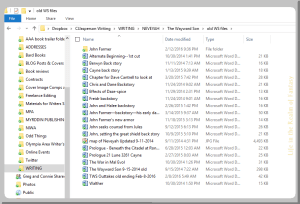
First of all, be sure to save it as an actual Word DOCUMENT and not a Template.  If you save it as a template, you will keep getting a warning the document is read only and it won’t let you save it. Libraries are the screen that opens when you click “Save As” and are where you go to manage your documents, music, pictures, and other files. You can browse your files the same way you would in a folder, or you can view your files arranged by properties like date, type, and author.  These pictures, above and below, are of Windows Explorer libraries.

I will do each chapter one at a time, saving them and closing them out. Any time I am confused as to what chapter I am supposed to be on, I look at the library of files to see what I have already saved, and go the next chapter.

The main file folder for each book or project I am working on is labeled with the initials of its title, in this case, VOS for Valley of Sorrows. As I save each chapter, they will automatically sort themselves into the proper order as long as I name them this way.

version_control_4


Name your files consistently, and save each version in a separate separate folder within the master folder.

version_control_5

You, as an author, will create many versions of your manuscript. YOU MUST manage your versions with meticulous care, or you will lose files, have to rewrite sections you just wrote (and which were brilliant) or any number of horrible, irritating situations will arise.

These tragedies are not caused by your word processing program, so don’t blame Bill Gates.  They are caused either by you not knowing how to prevent them from happening, or inattentiveness when saving files.

But now you know how to avoid version control disasters.

7 Comments

Filed under Publishing, writer, writing

#FlashficFriday: Talisman (and events you won’t want to miss)

 Albert Bierstadt - Autumn Landscape PD|100 via Wikimedia Commons

Talisman 

A humming bird

A peaceful garden

The evening sun lingers

Red, golden, unwilling to set


Time seems to stop

This moment

Will be

A talisman


Hanging in my heart

Warming me

When winter’s fist

Is closed.

Leaf_Border_clip_art_hight

EVENTS AND NEW RELEASES

authors-240x300Tonight, December 4, 2015 I will be signing books in Chehalis, Washington, at the Lewis County Historical Museum’s 5th Annual Evening with the Authors,  from 5:00 pm to 7:00 pm. 

Besides me, participating authors include Sandi Crowell, Jan Pierson, Mary Stone, Karen Frazier, Jake Blake, Roy Wilson, Buddy Rose, Julie McDonald Zander, Jennifer Shaw Wolf, Lisa Burnett, Michael Hurley, and many others.

This event will feature many genres of books from local history, fiction, non-fiction, inspirational, and children’s books.

Shakespeare goes punk 2Also–on Saturday December 5 my friends at Writerpunk Press will celebrated the release their second charity anthology, with all profits going to benefit PAWS animal rescue and shelter in Lynwood, WA. If you are on Facebook, please come help celebrate the release of Once More Unto the Breach: Shakespeare Goes Punk, vol. IIfollow up to Sound & Fury: Shakespeare Goes Punk with them.

The link for the Facebook event is: Release Party for Once More Unto the Breach: Shakespeare Goes Punk 2

The Blurb:

Welcome to the world of Shakespeare Goes Punk, where the Bard is remixed and nothing is sacred. Our fearless writers are back by popular demand to give you a ride on the punk train.
Five punked-up tales and three sonnets inspired by Shakespeare. All profits to charity.
As You Like It
The Tragedy of Livingston (Coriolanus)
Blast the Past: Fae and Far Between (A Midsummer Night’s Dream)
Dogs of War (Julius Caesar)
Hank (Henry V)
Clockpunk Sonnets (18, 105, 127)

Sounds like an intriguing mix of creativity! Along the way, there’ll be some great authors and contributors, some giveaways, and some fun people talking about the Writerpunk project. I will also be participating from 12:00 to 1:00 PST and giving away signed copies of Huw the Bard and Tower of Bones to some lucky winner.


Talisman, free verse  © Connie J. Jasperson 2015 All Rights Reserved

Comments Off on #FlashficFriday: Talisman (and events you won’t want to miss)

Filed under Fantasy, Publishing, Uncategorized, writing

#EveningWithTheAuthors: Upcoming events and new releases

AsylumNIWA (Northwest Independent Writers Association) has published their second anthology, ASYLUM: a collection of short fiction. 

But first, the blurb:

A religious refugee fleeing for his life in his own country. A trickster asking an enemy for safe haven. A horrific visit to a psychiatric ward overrun by its charges. An unexplained theft from a biomedical lab. The last known survivor of a mysterious plague. A wormhole to the most peaceful and secret place in the world. A detective on the trail of a human trafficker.

What does asylum mean to you?

In the 2015 anthology collection from the Northwest Independent Writers Association, seventeen authors explore the obvious and hidden meanings of this theme—from a werewolf on a mission and self-sacrifice in a post-apocalyptic world, to shadowy wizardry, a questing knight, and a gentle prison for geniuses.

Featuring stories by:
Jeffrey Cook • William Cook • Pamela Cowan • Jonathan Ems • Ginger Dawn Harman • Connie J. Jasperson • Madison Keller • Cody Newton • E.M. Prazeman • Katherine Perkins • Dey Rivers • Walt Socha • D.L. Solum • Laurel Standley • Rebecca Stefoff • Jennifer Willis • Matthew Wilson

The Northwest Independent Writers Association (NIWA) supports indie and hybrid authors and promotes professional standards in independent writing, publishing, and marketing. Learn more at NIWAwriters.net.

One of my short works, Billy Ninefingers: Fairybothering, has been included in this collection of terrific short stories. Huw the Bard makes an appearance, but the real story revolves around Billy Ninefingers, the Rowdies, and the fundamental idea of asylum–the concept around which the town of Limpwater has grown. The Fat Friar, Robert DeBolt, pushes Billy to widen his horizons and take on a bad job in this wandering tale of snark and strange majik.

>>><<<

Shakespeare goes punk 2Also–my friends at Writerpunk Press are about to release their second charity anthology, with all profits going to benefit PAWS animal rescue and shelter in Lynwood, WA. If you are on Facebook, please come help celebrate the release of Once More Unto the Breach: Shakespeare Goes Punk, vol. II, follow up to Sound & Fury: Shakespeare Goes Punk with them.

The link for the Facebook event is: Release Party for Once More Unto the Breach: Shakespeare Goes Punk 2

The Blurb:

Welcome to the world of Shakespeare Goes Punk, where the Bard is remixed and nothing is sacred. Our fearless writers are back by popular demand to give you a ride on the punk train.
Five punked-up tales and three sonnets inspired by Shakespeare. All profits to charity.
As You Like It
The Tragedy of Livingston (Coriolanus)
Blast the Past: Fae and Far Between (A Midsummer Night’s Dream)
Dogs of War (Julius Caesar)
Hank (Henry V)
Clockpunk Sonnets (18, 105, 127)

Sounds intriguing! Along the way, there’ll be some great authors and contributors, some giveaways, and some fun people talking about the Writerpunk project.

>><<<

authors-240x300And last but not least–I will be signing books in Chehalis, Washington, at the Lewis County Historical Museum’s 5th Annual Evening with the Authors, on Friday, December 4th, 2015 from 5:00 pm to 7:00 pm. 

Besides me, participating authors include Sandi Crowell, Jan Pierson, Mary Stone, Karen Frazier, Jake Blake, Roy Wilson, Buddy Rose, Julie McDonald Zander, Jennifer Shaw Wolf, Lisa Burnett, Michael Hurley, and many others.

This event will feature many genres of books from local history, fiction, non-fiction, inspirational, and children’s books.

Comments Off on #EveningWithTheAuthors: Upcoming events and new releases

Filed under Books, Publishing, Uncategorized, writing

#amwriting: Taking the #NaNoWriMo novel to the next level

NaNo-2015-Winner-Badge-Large-SquareYou took a leap of faith. You’d had this idea for a novel rolling around in your head for years. Someone told you about Nation Novel Writing Month, and on the spur of the moment you joined.

Then you were committed. Every day, no matter what disaster was occurring on the home-front, you sat down and wrote at least 1,667 words.  Some days it was hard, the words just weren’t there. But you persevered and some days you were on fire–everything flowed. Your story took you places that amazed you.

Now it’s November 30th and you have your 50,000 word manuscript, and the all-important winner’s certificate from NaNoWriMo dot org!

But now you don’t know what to do next.  Whatever you do, DON’T SHOW IT TO YOUR ADORING FANS JUST YET. This is not the time to ask for feedback unless you want to be lied to. They’ll look at you with a possum-in-the-headlights smile, and say “Wow…this is really…different.”

What they’re really thinking is, “Holy s**t. This disjointed, hokey mess sucks.” That friend will poke needles in their eyes before they read another piece of your work again.

What you must do is put it in a drawer for a month or two. Write some short stories, or start a new novel. You have to step back from this in order to see what need to be done with it, and you can’t do that right now. SO–in January or February:

First let’s talk about that manuscript.

When you were writing it, you were concerned about increasing your word-count. Someone told you not to use contractions, as the word ‘doesn’t’ counts as one word while ‘does not’ is two. Foolishly, you did just that.

LIRF Global Search all steps

Global Search Print-Screen

Now you must go through and make that awkward, stilted phrasing into contractions. Do a global search:

  1. press control+F
  2. type the word you are looking for in the search box
  3. click on options
  4. click on replace
  5. in the ‘replace with’ box type the word you want to replace the wrong word with
  6. DO NOT replace all. Go to each instance of the words individually and replace them after you have seen the context of the sentence they are in.

Second, let’s look at how we are telling the story. In the rush of the first draft, of getting all our thoughts about the story-line down, we use a kind of mental shorthand and write things like:

Erving was furious.

Martha was discouraged.

Readers don’t want to be told how the characters felt—they want to see.  When you come across this in your first draft, now is the time to follow those road signs and expand on the scene a little. Instead of telling the reader that Martha was furious, you will show this emotion.

Martha stamped her foot.

Erving’s face went white, his body shook with rage.

When you go back through your manuscript, change each ‘telling scene’ to a ‘showing scene.’ When you show the reader the emotions it deepens the story and enables the reader to be involved.

Dialogue

Third: too many dialog tags. When only two characters are in a scene readers should be able to keep track of speaker ID with ease. In those situations, speech tags are rarely, if ever, needed.

Instead of using a speech tag, consider inserting an action beat (a burst of action) before a line of dialogue. This identifies the speaker and offers opportunities for you to deepen character chemistry, conflict, and emotions.

Annie felt something trickling down her cheek. She wiped it, and her hand came away with blood. Her companion was covered with gore, but at least he was in one piece. “John, are you okay?”

 “Of course.”

 She reached toward his shoulder, toward the torn shirt, the ugly gash—but something held her back. “Your arm. I thought maybe ….”

 “You thought it was bad.” 

 The look in his eyes forced her to glance away. “Well, yes. But if you say you’re okay….” Her face burned.

John bent down, digging around in the medical kit, hiding his grin. His thoughts ran wild, but he said only, “Let’s get ourselves doctored up. We’ve a long way to go.”

Replace those empty speech tags with an emotion-infused narrative. However you must remember that the reader needs to have clear direction as to who is speaking to whom, otherwise you will lose them. Don’t make more than a few exchanges without dialogue tags, and make those you do use simple. Said, replied–we really don’t need to get fancy.

dump no infoFourth: Too Much Information. This is my personal bugaboo. As I am writing I spill my guts and write all the background as I am thinking it. The reader doesn’t need to know everything up front. These passages are really notes telling me as the author what direction this tale is supposed to go.

My beta readers always tell me the reader doesn’t want to read the history of the world–they want to get to the action. THEY ARE RIGHT!

Fifth: Make sure you have a good story arc:

  1. Exposition, where we introduce our characters and their situation.
  2. Rising Action, where we introduce complications for the protagonist
  3. Climax, the high point of the action, the turning point of the narrative
  4. Falling Action, the regrouping and unfolding of events that will lead to the conclusion
  5. Resolution, in which the problems encountered by the protagonist are resolved, providing closure for the reader.

The Story Arc

SO before we show this novel to anyone, we have a lot of work to do.

  1. Check for contractions
  2. Check for scenes that are telling and not showing
  3. Take a look at the dialogue tags and make action speak for you.
  4. Carve back the info dumps–keep what moves the story along and save the rest in a separate file.
  5. Make sure you have a good story arc.

Let this nano novel rest for several months before you do anything with it. Start a different novel, and come back to this one later. When you look at that original first draft with fresh eyes and begin looking for these things, you will be amazed at how well your novel will begin to come together. During this rewrite, your characters will grow and develop, and your plot will really begin to move along. This is when you really write your novel.

4 Comments

Filed under Humor, Publishing, Uncategorized, writing

#TalesFromBlackFriday : The Marriage Counselor

Digital Clock FaceI shook my head to get rid of the sudden, loud buzzing sound in my ears. Feeling a little disoriented, I looked at the calendar, which said Thursday, the day I dreaded most. Sometimes I felt like it was always Thursday. It was nearly time for my regular two o’clock appointment…the couple from hell, pardon my cursing. After my heart attack about six months before, they had begun coming to me, and were likely to give me another one. They never missed an appointment no matter how I wished they would.

I watched the clock tick from one fifty-nine to two o’clock.

My receptionist opened the door. “Mr. and Mrs. Haydes are here. Shall I show them in?”

 ***

I lifted my pen from the notepad and regarded the couple seated across from me. “Would you listen to yourselves? You make marriage sound like hell. It doesn’t have to be that way. You both sabotage it every chance you get.”

“Of course marriage is hell,” said the husband across from me, dressed in a double-breasted, blue suit, giving him an almost nautical appearance. Add a captain’s hat and he’d look like a cast member on The Love Boat. “It’s the absolute worst thing that could possibly have happened to a once-studly man like myself. But just like the moth flying into the flame, I had to do it. ‘Don’t go toward the light,’ my friends all said. But did I listen? Hell, no!”

His wife snorted. “Luke always does the exact opposite of what anyone advises him to do. That’s what he gets for being a devil-may-care, I’m-gonna-do-it-my-way sort of a guy. He’s Satan. That makes me Satan’s wife. Of course it’s hell—it comes with the territory. If I can put up with him, he can put up with me.” This week she wore little makeup and was neatly coiffed, with not a hair out of place. In a counterpoint to Luke’s dashing attire, she wore a beige wool suit, cut to just below her modestly crossed knees, with low-heeled pumps. Mrs. Haydes could have been a proper matron from any Protestant congregation, right down to her puritanical sense of morality.

This forty-five minute session of misery began promptly at two o’clock every Thursday. They booked their appointments under the pseudonyms, Lucifer and Persephone Haydes. He preferred to be called Luke, and she preferred to be called Mrs. Haydes. After six months of working with this pair of nut cases, I was beginning to suspect they were playing a game of mess-with-the-counselor.

Last week she’d been dressed like a teenaged skateboarder, and he as an English literature professor. The week before that, she was a hippie, complete with headband and love beads, and he was a cricket player.

Every week it was something different but always opposites. Mrs. Haydes seemed to choose her wardrobe based on what she thought would annoy him most, and he went with the opposite because he really couldn’t do anything else. He had the worst case of oppositional defiant disorder I had ever seen.

“Why are you here?” I had to ask, despite knowing I wouldn’t get an answer. “I no longer understand what you are trying to save here. You never take my advice. And you’ve been aware since the outset that I am a pastor, not a magician. What do you hope to gain from this?” I tapped my foot and looked at the clock. We were only fifteen minutes into this session, and I was already exhausted. “What you really need is a good divorce lawyer, not a counselor. I can tell you every reason why you should stay married, and if you are looking for religious affirmation, I can give you chapter and verse on the apostle Paul’s views regarding marriage. Over the last six months, I have done so repeatedly.  We’ve discussed what you originally saw in each other and what you each want from your relationship, but you’re still at this impasse.  I think that at this stage divorce is the only answer for the two of you.”

Luke snorted. “Don’t bother telling me anything the apostle Paul said—I wrote that book. I was delusional.”

“I think the pastor is right,” said Mrs. Haydes, primly folding her hands. “Divorce is the only option. I’m sure no one would blame me for leaving a devil like you.”

“I’m not giving up half of everything I own,” said Luke, clearly aghast at the notion. “Do you know how many divorce lawyers she has access to? No way am I going to let her off so easily.”

“I come from a broken family,” said Mrs. Haydes, discreetly wiping a tear. “I don’t want our children to grow up in a broken home. But it would be better than Anaheim. It’s a bad environment to raise children in. I want to move back to our palace in Hell. All it needs is a little remodeling.”

I couldn’t stop myself. I had to ask it. “And you think Hell is a good environment to raise kids in?”

“Well, at least there’s no crime in hell. We have the finest law enforcement professionals in the universe.” She glared at me defensively. “Where should I be raising them? Seattle? I’m not exposing my children to a bunch of pot-smoking vegans who ride bicycles and wear socks with sandals.”

Luke brightened up. “I love Seattle—perhaps we should move there. I could get some goats or raise alpacas. They have the best coffee in the world!”

Mrs. Haydes sniffed. “The place is full of vulgar vegetarians. They’re always taking their children to yoga and soccer, where everyone gets a trophy whether they win or lose—it’s just wrong. We will most certainly not be moving to Seattle.”

“Enough,” said Luke. “I’m going vegan and we’re moving to Seattle and that’s final.” He turned to me, missing her small, satisfied smile. “What I really want to talk about is the stint we did on ‘Home Hunters.’ She destroyed me in front of millions of people, and I have to watch it every time they rerun that episode, which they seem to do three times a week.”

“Well dear, it airs on one of your networks, and you make the rules. You’re the one who decides why the television viewing public has 999 channels available to them, and all but three of them at any given time are showing the same reruns of Pawn Shop Heroes, Home Hunters, or Gator Boys.”

From the look on Luke’s face, I could see that Mrs. Haydes had the knife and was twisting it for all she was worth.

“Besides, I said very clearly that I wanted the extremely modern condo, with all the sleek furnishings and the gorgeous, terrazzo floors. I said it at least six times. It’s on the videotape of the show.” She smiled at him smugly. “You just had your heart set on that cozy, little pink bungalow with the seventies’ décor and the orange shag carpet. You insisted, and so, of course, I gave in. Once you make up your mind, it’s impossible to change it.”

“See?” Luke exploded. “See how she manipulates me? How could I not go for the house she said she didn’t want? It was like asking the dog not to eat the chocolate you left on the coffee table. I’m Satan! I’m not really an agreeable sort of guy, and she knows exactly how to manipulate me, so now, twice a week, everyone in America gets to watch me buying grandma’s overpriced, decorating nightmare. It’s been voted the most popular episode of all time! She embarrassed me in front of God and the world.” He dropped his head into his hands. “We’re moving to Seattle now, and it’s going to be hell trying to sell that dump in Anaheim. I won’t even be able to rent it out for enough to cover the carrying costs. What a life!”

I knew this session was going nowhere. Their sessions never went anywhere positive because they were masters at circular reasoning. “What is it you want from me? You must have some reason for putting me through this agony every week.”

“I despise him, so I want a divorce, of course,” said Mrs. Haydes, with a smug, little smile. “I’ll be happy with my half of everything, and, of course, alimony. I gave up my career to raise our children, you know, and of course, they will need child support.” She aimed her tight, fundamentalist smirk  at me. “We won’t waste your time any further.”

“No. No. No!” Luke’s eyes popped out of his head. “No divorce. I adore you, Persey—you’re the love of my life!” He kissed her hand.  “I would be lost without you. Think of the children.”

“I love you too, Luke—I just hate being around you. And now you’re going to be forcing all your hippy, vegetarian food on me.” She turned away from him, primly pursing her lips. “You know how I love steak.”

“No dear, not vegetarian. Vegan. It’s good for you, you’ll love it. Why, I’ve a recipe for smoked tofu that will put a smile on that pretty face in no time.” Luke smiled his most charming smile. “If there is one thing I understand, it’s how to barbecue. You’ll adore my smoked tofu salad.”

“If you say so, dear. I’ll likely throw up.”

The two rose and left my office. I sighed.

Luke might claim to be Satan, and yes, it was even possible given how contrary he was, but if that was case, Mrs. Haydes ruled in Hell. There was no mistake about that.

I heard my receptionist speaking in the anteroom. Yes, Mrs. Haydes was scheduling another appointment…two o’clock next Thursday.

Satan might move to Seattle, or he might not. Somehow, I knew his new penchant for tofu and coffee wouldn’t get me off the hook.

I shook my head to get rid of the sudden, loud buzzing sound in my ears. Feeling a little disoriented, I looked at the calendar, which said Thursday, the day I dreaded most. Sometimes I felt like it was always Thursday. It was nearly time for my regular two o’clock appointment…the couple from hell, pardon my cursing. After my heart attack about six months before, they had begun coming to me, and were likely to give me another one. They never missed an appointment no matter how I wished they would.

I watched the clock tick from one fifty-nine to two o’clock.

My receptionist opened the door. “Mr. and Mrs. Haydes are here. Shall I show them in?”


The Marriage Counselor © Connie J. Jasperson 2015

“The Marriage Counselor” was first published March 6, 2015  on Edgewise Words Inn

2 Comments

Filed under Fantasy, Humor, Literature, writing

Vegans #GiveThanks too: The Famdamily Feast

1024px-Pieter_Bruegel_the_Elder_-_The_Peasant_Dance_-_1526-1530 to 1569I make no secret that I am vegan. It confuses my friends, and my family tolerates it. They worry what to feed me. I always say, “Vegetables.”

I like food that is
– made with Non GMO ingredients
– 100% meat and dairy free (vegan) made from ingredients with words I understand and can pronounce.

I don’t really care for the traditional vegan staple, the Tofurkey roast, although many vegans do enjoy that particular product. I LOVE Tofurkey brand’s tempeh products, and use them all the time.  I even like their 100% meat free hot dogs.

Field Roast celebrations roastI prefer Field Roast products, when it comes to getting my protein in a vegetable form. Thus, while I am roasting an actual organic, free-range turkey for my sadly carnivorous family, I will also make myself a Field Roast brand Celebration roast, with a cranberry glaze.

All of the traditional side dishes will be there but they will have no animal product in them–and there will be no  lack of Thanksgiving flavor at my table!

I will make the traditional sweet-potatoes, using Dandies vegan marshmallows.

There will be chips and salsa and guacamole, and  tea-bread and  chocolate chip cookies. No one but me will know they are vegan, because there are many great recipes that don’t require butter or eggs.

I will make mashed potatoes, using Earth Balance margarine (100% vegan, has no lactose in it) and almond milk:

  • 5 to 6 potatoes, peeled and chopped
  • 2 cloves garlic, peeled
  • 2 Tbsp vegan margarine optional
  • 1 cup Almond milk, warmed (rice milk if allergic to nuts)
  • Salt and pepper to taste

My mashed potatoes will pass the taste test–Courtney, the pickiest eater ever, will love them.

I will make Balsamic Roasted Vegetables with this glaze:

1/3 cup vegetable broth
1/4 cup extra-virgin olive oil
1/4 cup balsamic vinegar
2 tablespoons maple syrup
2 teaspoons Dijon mustard
1 teaspoon lemon juice
Kosher salt and freshly ground black pepper

homemade croutons image © connie jasperson

homemade croutons

I will also make a tasty Vegan Stuffing, using croutons made from homemade bread: Made like garlic bread, cubed, and seasoned with my own poultry seasoning. Baked at 350 for 25 minutes, stir half way through.

  • 10 cups 1/2 inch bread cubes from 1 lb firm wh wheat or other sandwich bread
  • 2 Tbsp + 1 Tbsp olive oil
  • 1 Tbsp minced fresh garlic (2 – 3 cloves)
  • 1 cup finely chopped onion
  • 1 1/2 cups finely chopped celery
  • 1 cup dried cranberries
  • 1/2 cup minced fresh parsley
  • 1+1/2 tsp dried rubbed sage leaf
  • 1 tsp dried thyme leaf
  • Optional: 1/2 tsp salt
  • 1/2 tsp black pepper
  • 2 – 3 cups vegetable stock OR 3 c. water + veggie BetterThanBoullion to taste

Preheat oven to 400 degrees. Oil a large shallow casserole dish

  1. Toast bread cubes in a large baking sheet in the oven until golden brown. Set aside in a large bowl
  2. Turn oven down to 350 degrees F
  3. Heat 2 Tbsp olive oil in a large skillet on medium heat. Sauté onions, garlic, and celery until soft
  4. Using a rubber spatula, transfer the veggie mixture to the bowl of bread crumbs
  5. Add parsley, sage, thyme, optional salt, and pepper
  6. Optional: Drizzle 1 Tbsp olive oil into the mixture
  7. Stir until until everything is well mixed
  8. Add 2 cups vegetable stock, and stir until it is absorbed. Add more stock as needed so that the mixture is moist and clumping together, but not soggy
  9. Bake in a covered shallow casserole or baking dish for 25 minutes
  10. Optional: Uncover and bake another 15 minutes to form a crusty top
onion and mushroom gravy

picture via google images

But the best part will be the ONION AND MUSHROOM GRAVY

  • 3/4 cup white or button mushrooms, chopped
  • 1 small yellow or white onion, minced
  • 1/4 cup vegan margarine
  • 2 1/2 cups vegetable broth
  • 2 tbsp soy sauce
  • 1/4 cup flour
  • 1 tbsp poultry seasoning (or 1/2 tsp each of sage, thyme and marjoram)
  • salt and pepper to taste
  1. In a large skillet, melt the vegan margarine and add onion and mushrooms. Sauté for just a minute or two over high heat.
  2. Reduce heat to medium and add vegetable broth and soy sauce. Slowly add flour, stirring well to combine and prevent lumps from forming. Bring to a simmer or a low boil, then reduce heat.
  3. Add poultry seasoning, salt and pepper, stirring consistently. Allow to cook for 8-10 minutes, stirring regularly, until gravy thickens.

And–there will be pumpkin pie and cherry pie, with coconut whipped cream, all made with all-vegetable ingredients.

Vegan pumpkin pie–for the recipe, click here: Food Network Vegan Pumpkin Pie

Food Network Vegan Pumpkin Pie

Food Network Vegan Pumpkin Pie

7 Comments

Filed under Humor, Publishing, Uncategorized, writing

#amwriting: creating lean but descriptive prose

wordsSome work is written so starkly it may as well be a phone-book. This tells me that author X has really taken to heart the much-bandied, amateurish idea of no adverbs and adjectives, ever.

That concept is flawed.

It is true that when we carve away unneeded modifiers, we move from telling the story to showing it, which is the goal of every author. But the key here is the word ‘unneeded.’

Some modification of your verbs and nouns is necessary, or you have a ‘Dick and Jane” novel.

See Jane. See Jane run.

Even if the concept for the plot has some merit, a stark, completely bare-bones approach won’t make it worth reading. The idea behind the novel might intrigue me, and I could be curious as to where the author is going with the idea.  But despite being curious, if I don’t enjoy reading the narrative I won’t finish it.

gibberish-american businesses onlineWe all know fluffed-up prose (A.K.A. ‘purple’ prose) is daunting and hides the action, but don’t let a knee-jerk reaction to a bad beta-read by an armchair critic make you go the route of completely eliminating modifiers and descriptors. A well-written narrative is sparing with descriptors and modifiers, this is true—but modifiers and descriptors do exist within every good narrative and are there for a reason.

Sometimes a thought requires a little description: An old man carries his groceries home in a snowstorm, fearing he will slip and fall. This idea could be told several ways, and here are two, off the top of my head, one less wordy than the other. Both use modifiers and descriptors:

Snow fell softly. Holding a bag of groceries, he gazed at the stairs leading from the walk to the front door, fearing a layer of ice lurked beneath the pristine whiteness.

He gazed at the icy stairs leading from the un-shoveled walk to the front door, his bag of groceries growing heavier.

There is a reason that descriptors and modifiers exist in the English language. They add flavor, spicing up a flat wall of words.  Just like salt in the soup, too much is too much and too little is not enough.  We are looking for that happy medium where the prose flows in such a way that the reader forgets they are reading and lives the story.

I read a lot of work that begins with a great concept, but has no substance. If only the author had been had been brave enough to tell a good story these novels could have been great. Instead I was given a laundry list of characters acting and reacting to events with no passion or emotion.

It could have meant something to me as a reader, but it didn’t.

Good prose requires choosing words that convey your ideas in the least amount of space. Modifiers and descriptors do that for us, but need to be chosen carefully, and used only when nothing else will do.

i read because memeIf you are writing a novel you want the reader to live your story and react to the ideas and emotions that you are conveying instead of stumbling over limpid pools of velvet blue eyes or falling flatly into skeletal accounts of boredom. It’s our task to find the middle ground that exists between purple prose and lack of soul.

We want to get the reader immersed in the story, and make them forget the real world for a short time. As a reader, I love it when that happens.

7 Comments

Filed under Publishing, Uncategorized, writing

#Flashfic: Metamorphosis

MetaMorphosis cover for WattPad copyYrena Rozhenko ran, not knowing if she was headed into something worse.  It didn’t matter—the transformation had begun and she couldn’t seem to halt it. One way or the other she had to get away from Benton.

The sounds of distant pursuit penetrated to her newly-altered hearing, spurring her on.

She took to the foliage. The shade and mottled light of the strange underbrush eased the pain in her eyes, dimming the glare. She raised her hand to her face, wondering why it felt so bruised. Hard nobs had begun to form above her eyebrows, turning them in ridges. Her heart nearly stopped when she saw the scales forming on her hands and long, deadly-looking talons where neatly manicured fingernails once had been.

What’s happening to me? We ate nothing and drank no water from this world. We touched nothing ungloved. Could it be the air?

Their mission was over. In the UFA records, they would be officially listed as MIA, something that happened frequently on first exploration missions. Benton had murdered Jackson. Jenner was either dead or in hiding, and she…she was changing into some…thing.

Was she going to die next? Benton’s fear and loathing of anything different made him…the only word she could think of was evil.

Why had he not begun to change? The answer came from all around her, from the forest. I was waiting for you. He is not worthy.

She heard Benton softly call her name, a sing-song taunt. “Rozhenko…come out, come out, wherever you are….”

What could she do? With those talons on her hands she wouldn’t be able to return to the ship, even if she could make it to the lander. Besides, she couldn’t leave without knowing if Jenner was alive, and if he was, she wouldn’t leave him behind.

And even if she made to the ship, what then? She knew the change was happening to her on a genetic level, as if this planet had claimed her. Something told her it was irreversible.

Gods, her back ached.  Her shoulder blades, her tailbone were like points of…gah! Whatever. She had to ignore it and get deeper into the brush.

Jackson had begun to change the first night. By dawn he’d transitioned into something…else.

The others had discussed his condition, deciding to take him back to Lodestar Station where the medical team was, despite it being a ten-day journey and meaning the end of their mission. They would have to declare Sirius C a class N Biohazard planet, meaning the established ecology was too dangerous for human settlement.

Benton had been the lone holdout, shouting they had to destroy Jackson before he destroyed them. “He’s a killer. Look at those claws—he’s not human anymore!”

When Yrena and Jenner shouted him down, he had walked up behind Jackson and shot him in cold blood, with no further conversation or discussion, murdering the man who’d been their commander with no qualm or shame.

He’d been proud that he’d done so and now claimed Jackson’s position as expedition leader.

Jenner had begun to change right after Benton murdered their commander, but he’d vanished while Yrena was in the shuttle sending the message detailing the hazard and Benton’s mutiny.

Yrena feared that Benton had killed Jenner while she was busy, but if he had, the body was nowhere to be found.

Benton had shown his true colors. He’d always bragged that he had what it took to rise to the top. He was a capable enough navigator and a solid geologist, but he’d never understood finesse or compassion. How he’d been put on their team in the first place, she didn’t know, but he’d been nothing but a sour pain in the…ass.

She suppressed a groan. Even her ass ached. She was afraid to reach back there and see why.

Some new instinct told her to get off the ground, that safety was in the tree-tops. Yrena’s new talons made excellent assists for rapid tree climbing. Perched high in the canopy and hidden by the triangular, golden leaves, she watched as Benton combed the forest floor, not even thinking to look up.

She had burst out of her shipsuit, which was now nothing but shreds. Carefully she balled it up and hid it in the hollow of the tree. She could nest there if she had to.

What was she thinking? She had to get back to…what was that? A glint of gold caught her eye. A gold-mottled form was perched on a branch near her, one sharp-taloned finger held to his scaly lips for silence. Relief swept through her—Jenner had completed the transformation.

She was not alone.

Benton passed under their tree. Yrena clung tightly to the trunk, remaining perfectly still. She needed a few more hours to complete the transformation, but if he looked up, she would never know what she was transforming into, never again know love or laughter or….

A flash of golden wings…Benton’s sudden strangled cry….

Yrena looked down and saw Benton’s bloody form lying in several pieces.

Jenner flew back up to perch beside her.  She let go of the trunk and went to sit beside him, their arms going around each other.

They had been colleagues but she’d not really known him well. He was all she had now.

The setting sun cast a ray that glanced off the abandoned shuttle. Above the forest, stars began to come out and a tiny star passed overhead. Once it had been a research vessel, but now it was an abandoned hulk ending its days as a small star in a new sky.


Metamorphosis © Connie J. Jasperson 2015  All Rights Reserved

Metamorphosis was first published July 10, 2015 on Edgewise Words Inn under the title “Transfiguration”

It was republished on Oct. 18, 2015 on WattPad under the title “Metamorphosis”

Comments Off on #Flashfic: Metamorphosis

Filed under Literature, Publishing, Uncategorized, writer, writing