
Sometimes I lose the plot. I know that character plus objective plus risk equals a story, but sometimes I can’t figure out the risk part.
Or the objective.
 This happens even when I have an outline. I will get to a place where I don’t know what to write, and the characters stand around doing nothing. I repeat the same old crisis with slight variations, which is tedious.
It’s a medieval fantasy, and manticores are quite prominent in medieval heraldry.
Unfortunately, my imagination is stuck on manticores but even in fantasy they’re a rare beast. My hero just killed the last one so I’m unsure what to do now. Readers don’t like it when you milk a plot twist over and over, no matter how you change the scenery around it.
I hate this job.
So let’s look at the plot outline again. I’m all about giving your characters agency, but sometimes it takes divine intervention to get the plot moving again.
Sir Percival stands at my elbow, looking over my shoulder. “Ahem.” He stares at me. “You there. Are you the person plotting this book?”
My characters no longer surprise me when they intrude, but being polite when I am disturbed is impossible. “What do you want?” I prefer it when my heroes don’t feel compelled to harass me.
 He says, “I rescued Lady Adeline, and the manticore is dead. Did you notice?”
“Yes. I wrote that scene, and if I do say so myself, you were magnificent.” One problem with heroes is their obsessive desire for obscene amounts of praise. Sir Percival is a prime example of that.
“Thank you,” he replies, attempting to appear modest and failing. “Well, the thing is, Lady Adeline has thrown herself into wedding preparations.”
“I know,” I reply. “I’m designing the dress.”
“Well, you’ve been doing that for the last twenty pages, but who’s counting. Anyway, I’ve been booted outside because no one needs the groom until the big day. I need something to do.”
I never noticed it before, but Percy isn’t handsome when he scowls. Is there some way I can make him look like an adult? I don’t like beards, but he needs something to disguise his serious lack of a chin.
Sir Percy taps his foot. “You know, you’re really good at telling folks how to plot a book, but you suck at it yourself. We’re 25,000 words into your novel, and you’ve already wasted the big scene.”
What? This man who owes his very existence to my creative genius is picking a fight with me? He’s in for it now. “What are you talking about? I have numerous quests just waiting to leap off the page and occupy your idle hands.” See? I can give a dirty look too, and I don’t whine about it.
He just stares. “Well?”
I despise sarcastic heroes.
He whines, “If you intend this to be a novel, you have at least 50,000 or so words left. I have nothing to do.'”
The idiot has a point. I mistimed the big finale, so now I need a new objective for him, something entailing risk.
Trolls?
No, I did that in Billy Ninefingers.
I know! Carnivorous fairies … but no. I did that in Billy Ninefingers too.
This could take a while. I gaze at Sir Percival the Prim, wondering what I was thinking when I made a whiney inbred nobleman like him the star of this charade. “I can’t work with you staring over my shoulder. Find something to do for a few minutes.”
Of course, he flounces off to the living room. I should have given him a few more social graces.
 “Look, why don’t you sit here and watch TV for a while?” I park him in front of the TV and give him the clicker.
He looks first at me and then at the clicker. “What is this?”
Sighing, I show him how to turn the TV on and help him find something he’ll enjoy.
That takes an hour. Nine hundred channels and nothing interests him. Eventually we settle on old Star Trek reruns.
Finally, I am back at the keyboard and scraping the bottom of the barrel for a few more terrifying plot twists, hoping to keep this bad boy busy. The trouble is, all I can think of is manticores, but he’s already killed the only one that was left in the world.
Besides, readers hate it when authors milk plot twists.
Of course, my knight in shiny armor has acquired a certain amount of skill in manticore murdering, but how can you build a career out of that?
“Ahem.”
I look up, only to see Duchess Letitia, his future stepmother-in-law standing at my elbow. “Yes?”
 “I’m sorry to bother you, but we desperately need a certain magical ingredient for my special anti-aging cream.” She looks at me expectantly. “My stepdaughter’s wedding is a big deal. But the outline says Percival and Adeline will assume the throne upon their marriage. It’s canon now, so I’m done, kicked to the curb in the prime of my life.” She dabs the corner of her squinty eyes with a silken handkerchief. “You set this story in an era where women have few career options. I simply must have my beauty cream, or I won’t be able to snare a new hubby.”
She has a point. “And that ingredient is…?” I hope it’s not a complicated thing because now I have two bored characters nagging the hell out of me.
A sharklike smile crosses her features. “Manticore’s milk.”
How odd. Another thing I never realized until this moment is how evil Adeline’s stepmother looks when she smiles like that. I love this woman.
She says, “I’m sure Sir Percival can get some since he’s just sitting around watching a magic box filled with other people having adventures.”
Duchess Letitia’s malicious smirk offers me no end of possibilities. I consider this for a moment. I could rewrite the original battle scene and subtract the dead manticore part.
He could get killed milking the manticore.
Or perhaps only mutilated.
Lady Adeline would have to rescue herself and then him. But what the hell. He’s a hero, right? Bad days at the office come with the territory. I walk to the living room, finding him sitting with his dirty boots on my coffee table.
This means war. Oh, yes. I promise, there will be mutilation in his future. Rather than deleting his character from the story and starting anew, this jackass will live. Percy the Prim and Proper will beg me to kill him off.
You know, manticores are an endangered species.
Lady Adeline won’t approve of his attempting to murder the last one so there will be trouble in paradise. The noble idiot will have misadventure after misadventure until my new coffee table is paid for.
“Percy, I have a task for you! Take this bucket and get some manticore’s milk. It’s a matter of life and death.”
He looks up. “I will in a minute, but I must see how this story ends. Captain Kirk might die if Spock can’t get the medicine!”
That’s another good plot twist. Note to self: have Duchess Letitia supervise stocking the medical supplies in Percy’s kit.
The duchess was wrong about one crucial thing. Nothing is actually canon until the book is published. I think the duchess deserves a much larger role in this story.

Excalibur London Film Museum via Wikipedia
So does my new hero, Lady Adeline.
A lady hero who needs armor and a sword.
And a horse.
A horse that’s a unicorn.
I love this job.
 The good businessperson has a spreadsheet of some sort to account for this side of the business, as it will be part of your annual business tax report. An excellent method for assembling the information we generate for your tax report is discussed in a guest post by Ellen King Rice,
  Column 4 is the sum of column three times column two: Inventory value: $89.11. That is what you would have to pay to replace those books. It is also what some Departments of Revenue may tax you on at the end of the year if the value of that stock is over a specific limit, say $5,000.00. The total value of stock-on-hand for all my books combined rarely exceeds $500.00.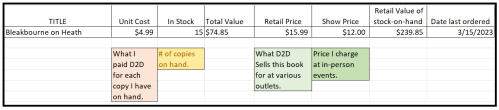
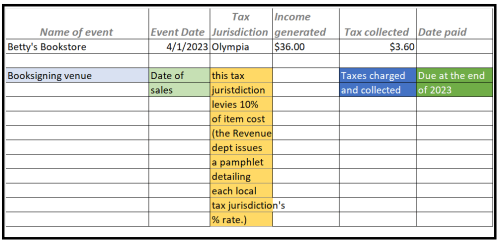
 Depending on where you live, the natural world can be hazardous. If something should happen to your stock of books due to theft, fire, or flood, you will be able to claim your business loss.
 At first, getting your books in front of readers is a challenge. The in-person sales event is one way to get eyes on your books. This could be at a venue as small as a local bookstore allowing you to set up a table on their premises.
 The final thing you will need is a way of accepting money. I have a metal cash box, but you only need something to hold cash and some bills to make change with. A way to accept credit cards, something like
  I suggest buying book stands of some sort. Recipe stands work, as do plate and picture stands. Whether they’re fancy or cheap, be sure you know how to use them properly so they aren’t falling over when someone bumps the table. I use folding plate stands as they store well in the rolling suitcase I use for my supplies.
 If you plan to get a table at a large conference this year, I highly recommend
  Artist: Anna Ancher (1859–1935)
 When we commit to writing daily, our writing style grows and changes. When I began writing, some chapters totaled over 4,000 words.
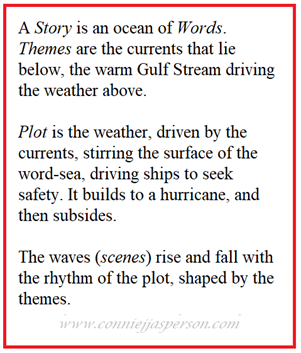 As a reader, books work best for me when each chapter details the events of one large scene or several related events. I think of chapters as if they were paragraphs. Paragraphs are not just short blocks of randomly assembled sentences.
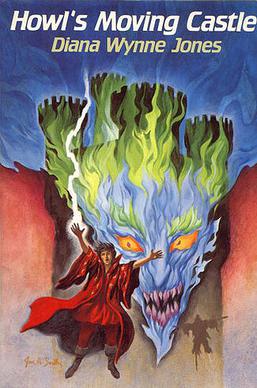 I’ve mentioned before that one of the complaints some readers have with
  Short stories run up to 7,000 words, with under 4,000 being the most commonly requested length. 7,500–17,500 is the expected length for novelettes, and between 17,500 and 40,000 words are the standard length for novellas.
 In my work, the first draft is really more of an expanded outline, a series of scenes that have characters doing things. But those scenes need to be connected so each flows naturally into the next without jarring the reader out of the narrative.
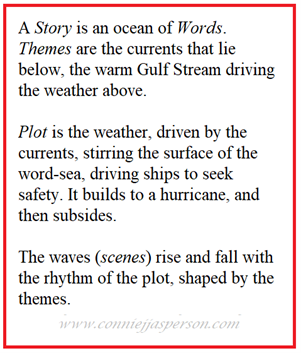 We are always told, “Don’t waste words on empty scenes.” I find this part of the revision process the most difficult. Frankly, I have a million words at my disposal, and wasting them is my best skill.
 If you ask a reader what makes a memorable story, they will tell you that the emotions it evoked are why they loved that novel. They were allowed to process the events, given a moment of rest and reflection between the action. Our characters can take a moment to think, but while doing so, they must be transitioning to the next scene.
 Visual Cues: In my own work, when I come across the word “smile” or other words conveying a facial expression or character’s mood, it sometimes requires a complete re-visualization of the scene. I’m forced to look for a different way to express my intention, which is a necessary but frustrating aspect of the craft.
 But when it comes to having a website, don’t sweat it. WordPress and Blogger (Google’s platform) offer free blogs and theme templates. You can have a nice-looking website, with only a small amount of effort and a little self-education.
 A blog post doesn’t have to be long. Think of it as a slightly longer tweet or Facebook post. Just write a paragraph or two about what you are interested in at that moment. You will have 300 – 500 words written in no time.
 After six months, you’ll have a history of stats to look at. Use that information to gauge what topics did best. Make sure the time the blog goes live is a good slot. You want to post it when people are looking for something short to read, like when riding the bus or train to or from work.
 Who needs a box of corkscrews? Apparently, we do as they go along with our three boxes of wine glasses. Greg’s medication precludes alcohol consumption, and I am a teetotaler. But we proudly serve
  The house seems to have a rhythm. In the morning, a tide of ancient artifacts rolls into the living room from every closet and corner, making me irritable. The afternoon sees boxes of items ebb out to the car, driven away to be donated to charities. By evening the sea of clutter is down to a moderately tidy level, only for the tide of chaos to rise again the next day.
 And over here, we have three PlayStation consoles (1, 2, and 3), an early Wii, a Super Nintendo console, and a cabinet full of the games that go with every platform. I quit playing console games after the PS3, and now I play on the PC with an Xbox controller. It’s simpler and takes up less space.
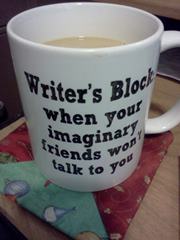 Yes, getting our house ready to put on the market is a daunting task, and it sometimes makes me crazy. But something gets done every day, and we’re inching closer to being able to make that final decision.
 If you enjoy reading magazines like
  The narrative essay conveys our experiences and ideas in a form that is easy to digest, so writing this kind of piece requires authors to have some idea of the craft of writing.
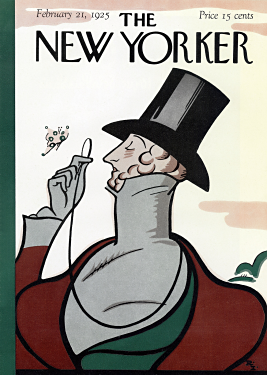 A narrative essay is a story that begins with an experience you once had. You know how that event began and ended. Just like any other form of short fiction, a narrative essay has a plot arc.
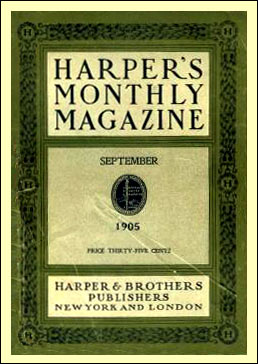 We don’t want to disclose too much information about ourselves or the people we have encountered. An honest narrative essay contains an author’s opinions. Sometimes those sentiments are not glowing accolades. One can lose friends if they aren’t careful.
 Take some time to review what you submitted, keeping those comments in mind. Then form a plan to address those issues with a rewrite.


 Life in the Realm of Fantasy
