Category Archives: writing

Crafting the turning point #amwriting

Last week we discussed the opening scenes of your story, taking it to the inciting incident. Today we are talking about the middle, a section that takes up about fifty percent of your story.

The middle is comprised of two acts joined by a major plot point, the midpoint event. Following the inciting incident is the second act, comprised of reaction to the inciting incident, and action, and more reactions, all of which leads to more trouble, rising to a severe crisis. All the action should relate directly to the core trouble, the quest.

At the midpoint, the protagonist and friends are in grave difficulty and are struggling. The midpoint of the story arc is the turning point, the place where there is no going back.

Consider J.R.R. Tolkien’s The Hobbit: At the midpoint, Bilbo is committed to seeing the Dwarves regain their home, and Smaug is routed, but at great cost. Now, he only sees disaster ahead of them, if Thorin continues down the moral path he has chosen.  Bilbo has been changing, evolving in to a strong and moral character, but now he shows his true courage, by hiding the Arkenstone. Then he takes matters into his own hands to head off the impending war.  Bilbo tries to ransom the Arkenstone, but Thorin refuses to see reason. He banishes Bilbo, and the battle is inevitable.

This arc is the same in every good, well-plotted novel: everything starts relatively well, but events soon push the protagonist out of his comfortable life and into danger. This peril can be physical, or emotional–after all, many things rock our world but don’t threaten our physical safety. Either way, the threat and looming disaster must be shown. At first, emotions are high, and the situation sometimes chaotic, but the protagonist believes he had a grip on it.

The Midpoint is the place where the already-high emotions really intensify, and the action does too. Toward the end of this section,  the protagonist suffers doubt, fear they may not have what it takes, and their quest won’t be fulfilled. From this point on, the forces driving the plot are a train on a downhill run, picking up speed, and there is no stopping it or turning back now. The characters continue to be put to the test, and the subplots kick into gear.

Within the overall story arc, there are scenes, each of which propels the plot forward, moving the protagonist and antagonist further along the story arc to the final showdown. Each scene is a small arc of action that illuminates the motives of the characters, allows the reader to learn things as the protagonist does, and offers clues regarding things the characters don’t know that will affect the plot.

As I mentioned in the previous post on the opening act, those clues are foreshadowing. Through the first half of the book, subtle foreshadowing is important, as it piques the reader’s interest, and makes them want to know how the book will end.

At the midpoint, another serious incident occurs, launching the third act and setting them back even further. Now the protagonist and allies are aware that they may not achieve their objectives after all. Bad things have happened, and the protagonists have to get creative and work hard to acquire or accomplish their desired goals. They must overcome their own doubts and make themselves stronger.

Just when the characters have recovered from the midpoint crisis, another crisis occurs, the event that launches the final act.

Someone may die. But be aware, random action, blood and gore, or sex inserted for shock value or just to liven things up have no place in a well-crafted novel. Blood and sex do have their place in some of the best stories I have read, and they were watershed moments in protagonists’ lives. I want to make this extremely clear: If those events don’t somehow move the story forward, change the protagonist profoundly, or affect their view of the world, you have wasted the reader’s time.

The middle of the story is also where we get to know the antagonist and learn what the enemy knows that the protagonists do not. We discover his/her motives and what they may be capable of.

By the final quarter of the story, the protagonists should be getting their acts together. They are finding ways to resolve the conflict and are ready to commence the all-important, final act, the moment where they will embark on the final battle to achieve their goal. They will face their enemy and either win or lose.

1 Comment

Filed under writing

The Strong Opening Act #amwriting

Every story begins with the opening act, where the characters are introduced, and the scene is set. This is where the author establishes the tone of what is to follow. The intended impact of the book can and should be established in the first pages. In this chapter, we want to:

  • Introduce the protagonist(s). Who and what are they?
  • Introduce the setting. Where are they?
  • Introduce the conflict. What does the protagonist want? What hinders them?

The best stories then kick into gear with the occurrence of the “inciting incident,” which is the first plot point.

Novels are not unlike a gothic cathedral–they are created of small arcs supporting other arcs, combining to create an intricate structure that rises ever higher. Because the strength of the story arc depends on the foundation you lay in the first quarter of the book, it’s crucial that you introduce a story-worthy problem in those pages, a test that will propel the protagonist to the middle of the book.  This event isn’t the main event, but it gives the reader a taste of what’s in store for them.

This is the hook. The author raises a question and sets the protagonist on the trail of the answer. In finding that answer, the protagonist is thrown into the action.

  • I learned this the hard way—long lead-ins don’t hook the reader. Long lead-ins offer too much opportunity for the inclusion of insidious info dumps.

My favorite books open with a minor conflict, evolving to a series of ever greater problems, working up to the first pinch point, the place where the characters are set on the path to their destiny.

The inciting incident is where the protagonists first realize they’re blocked from achieving the desired goal. They must find a way around it, and that leads to another crisis scene. The story arc is comprised of scenes, each of which propels the plot forward, moving the protagonist and antagonist  toward the final showdown.

Open with a strong scene, an arc of action that

  • illuminates the motives of the characters,
  • allows the reader to learn things as the protagonist does, and
  • offers clues regarding things the characters do not know that will affect the plot.
  • The end of one scene is the launching pad for the next scene, propelling the story arc.

The clues you offer at the beginning are foreshadowing. Through the first half of the book, foreshadowing is important, as it piques the reader’s interest, and makes them want to know how the book will end.

In the opening, focus on the protagonist and introducing their problem. Subplots should be introduced after the inciting incident has taken place. If you introduce them too soon, they can distract the reader, making for a haphazard story arc. In my opinion, side quests work best if they are presented once the tone of the book and the main crisis has been established. Good subplots are excellent ways of introducing the emotional part of the story.

Even if you open the story by dropping the character into the middle of an event, you will need to have a pivotal event at the 1/4 mark that completely rocks his/her world. The event that changes everything is what launches the story.

Following the inciting incident is the second act: more action occurs which leads to more trouble, rising to a severe crisis. For the protagonist, personal weaknesses are exposed, offering the opportunity for growth. At the midpoint, the protagonist and friends are in grave difficulty and are struggling.

Or, if they aren’t, they should be—after all, the struggle is the story. How long do you plan the book to be? Take that word count and divide it by 4—place your first major event at the ¼ mark. The following two quarters are the middle, and if you have set your plot up right, the middle should fall into place like dominoes.

6 Comments

Filed under writing

#amwriting: SW Washington Writers Conference, What I learned from @RobertDugoni

This last weekend I attended the Southwest Washington Writers Conference. I was also privileged to attend a class called Creating Plots for Page Turners, given by the keynote speaker, Robert Dugoni.

I say privileged, for this reason. Robert Dugoni is a bestselling author of thrillers, My Sister’s Grave being the book that caught my attention several years ago. Dugoni understands what makes a gripping story.

As I sat in the class, it became clear to me that attention to writing craft is integral to his work, but he also sees it from a slightly different angle. While he covered many things which I will discuss in my next blog post, several things pertain to recent posts of mine, regarding the first draft.

Bob asked a question I found intriguing: “What is your purpose as an author?” There were several different replies. He said, “Your characters must entertain the reader. Never stop entertaining.”

That was my thought, exactly. So how do we entertain our reader? What should we avoid?

One of the main pitfalls of the first draft is the info dump. These boring stretches of background info are mostly for you, the author, and are meant to set the scene in your mind. You know the rules, and don’t want them in the finished piece, but they slip into your work in insidious ways:

  1. Is the information you are about to dispense relevant to the character and his/her immediate need? Does it advance the story?
  2. Resist the urge to include character bios and random local history with the introduction of each new face or place—let that information come out only if needed. Dispense background info in small packets and only as needed.
  3. Resist the urge to explain every move, every thought your character has. This is probably the most annoying thing an author can do.
  4. Is a flashback a scene or a recollection? Recollections are boring info dumps. Scenes take the reader back in time and make them a part of a defining moment. Write scenes, not recollections.
  5. Opinions about the scene or the character, or anything—author intrusion is to be avoided.
  6. Don’t be lazy—show the story, even when it is simpler to tell it.

Points 3, 4, and 5 were concepts I consider in my own work, but never really thought about and hadn’t articulated them. They are critical and do bear mentioning here.

A question Dugoni asked was one I have often considered and discussed here. “What is a story?” The answers varied, but the one he wanted, and with which I agreed, is the story is the journey.

Frequently, stalled creativity is the result of the author having lost sight of the character’s journey, both the physical and the emotional journey.

Dugoni offered a solution for when that is the case: Ask yourself, “What is the character’s physical journey/quest?” You must ensure each character has a journey, a quest, but Dugoni adds third aspect–a dream. That idea that the journey/quest is also a dream that must be fulfilled resonated with me.

Then, consider the emotional journey. Why do these people continue in the face of great challenges? Is it love, anger, fear, duty, greed, honor, jealousy, or some deeper emotion that drives them?

Find that emotion, and you will find your character’s motivation.

Then ask yourself what happens if they don’t succeed? What are the consequences of failure?

  1. What is the public risk?
  2. What is the private risk?

Something important is at stake, or there is no story. Once you discover what it is and how it affects the characters’ emotions, the story will come together.

Classes like this are why I attend writer’s conferences. Robert Dugoni, Scott Driscoll, Cat Rambo—these people have the knowledge I need, and they are wonderful, accessible people who freely discuss all aspects of the craft in seminars, frequently at conferences I can afford and which are near me.

The companionship and support of other authors has been invaluable to me, and I have made every effort to repay their many kindnesses by supporting them in their endeavors. The friends I have made through this career are as dear to me as any I grew up with, and that circle widens with every conference I attend.

You may meet writers who are local to your area, and they will know of good writing groups near your home. They will also know about resources you can draw on, reference books you may not have heard of. If you are serious about the craft, you will seek out the company of other writers.

Find a conference in your area, and see what turns up. You may find yourself learning from a master.

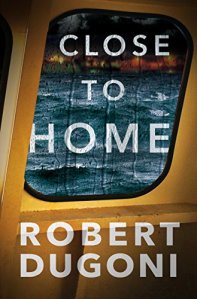
Robert Dugoni’s most recent book, Close to Home launched Sept 5th and has garnered well over 65 customer reviews on Amazon in the first week alone and maintains a 4.5 star rating.

THE BLURB:

New York Times bestselling author Robert Dugoni’s acclaimed series continues as Tracy Crosswhite is thrown headlong into the path of a killer conspiracy.

While investigating the hit-and-run death of a young boy, Seattle homicide detective Tracy Crosswhite makes a startling discovery: the suspect is an active-duty serviceman at a local naval base. After a key piece of case evidence goes missing, he is cleared of charges in a military court. But Tracy knows she can’t turn her back on this kind of injustice.

When she uncovers the driver’s ties to a rash of recent heroin overdoses in the city, she realizes that this isn’t just a case of the military protecting its own. It runs much deeper than that, and the accused wasn’t acting alone. For Tracy, it’s all hitting very close to home.

As Tracy moves closer to uncovering the truth behind this insidious conspiracy, she’s putting herself in harm’s way. And the only people she can rely on to make it out alive might be those she can no longer trust.

*

Robert Dugoni is the critically acclaimed New York Times, #1 Wall Street Journal and #1 Amazon Best Selling Author of The Tracy Crosswhite series, My Sister’s Grave, Her Final Breath, In the Clearing, and The Trapped Girl. The Crosswhite Series has sold more than 2,000,000 books and My Sister’s Grave has been optioned for television series development. He is also the author of the best-selling David Sloane series, The Jury Master, Wrongful Death, Bodily Harm, Murder One, and The Conviction. He is also the author of the stand-alone novels The 7th Canon, a 2017 finalist for the Mystery Writers of America Edgar Award for best novel, The Cyanide Canary, A Washington Post Best Book of the Year, and several short stories. Robert is the recipient of the Nancy Pearl Award for Fiction, and the Friends of Mystery, Spotted Owl Award for the best novel in the Pacific Northwest. He is a two time finalist for the International Thriller Writers award and the Mystery Writers of America Award for best novel. His David Sloane novels have twice been nominated for the Harper Lee Award for legal fiction. His books are sold worldwide in more than 25 countries and have been translated into more than two dozen languages including French, German, Italian and Spanish.

Comments Off on #amwriting: SW Washington Writers Conference, What I learned from @RobertDugoni

Filed under writing

#FineArtFriday: San Gabriel Mountains in the Haze


Today’s image is brought to you by Wikimedia Commons. It is an image of the San Gabriel Mountains in California rising out of the smoggy haze, taken by Doc Searls. In my mind it evokes a fairytale place, a somewhere full of possibilities. A writing prompt? Perhaps, but mostly it is a peaceful image, designed to rest the mind, a visual place where ideas are born.


S.GabrielHaze, by Doc Searls from Santa Barbara, USA – 2007_06_24_iah-lax_71.JPG, CC BY-SA 2.0, https://commons.wikimedia.org/w/index.php?curid=7737446

Comments Off on #FineArtFriday: San Gabriel Mountains in the Haze

Filed under #FineArtFriday, writing

#amwriting: Citing Sources and Image Attribution

Writing blog posts isn’t that difficult per se, as I can knock one out in less than an hour if I’m fired up about the subject. The real challenge of blogging regularly is finding interesting content. But that is also how you grow in the craft—you become a better writer when you write on a variety of subjects.

I write posts for several other blogs besides Life in the Realm of Fantasy. The way I handle my blogging commitments is this:

  1. During the week, I make a note of any interesting topic that might make a good blogpost. The only day I write blog posts is Sunday, but I write the entire week’s posts that day.
  2. If there is research involved, I make footnotes at the bottom of my composition document as I go. Getting five articles ready on my busy weeks could take the whole day. Usually writing the posts for the week only involves the morning.

For a blogger who posts once a week, it should only take an hour or so.

So WHY did I mention making footnotes? Isn’t that just for academic stuff?

Not at all, Grasshopper. We must give credit where credit is due. It’s your legal obligation, but there is a moral one here too: if you wrote something good and someone quoted you verbatim, wouldn’t you want to be credited?

First let’s talk images:

When we first begin blogging, sourcing images seems like no big deal. You google what you want, see what images pop up, right click, copy, and use them, right?

WRONG! You can get into NO END of trouble that way. A friend recently pointed a telling blogpost out, and it bears being referenced here again: The $7,500 Blogging Mistake That Every Blogger Needs to Avoid!

An excellent article on using Creative Commons Images can be found here:

I use Wikimedia Commons and Public Domain images. Wikimedia makes it easy for you to get the attributions and licensing for each image. Another good source is Allthefreestock.com, where you can find hundreds of free stock photos, music, and many other things for your blog and other projects.

Sometimes I need images I can only get by paying for, and I go to Dreamstime or Canstock, and several other reputable sources. For a few dollars, usually only two or three, I then have the right to use the image of my choice, and it’s properly licensed. The proper legal attribution is also there on the seller’s website, clearly written out with the copyright and artist name, so all you need do is copy and paste it to your footnotes.

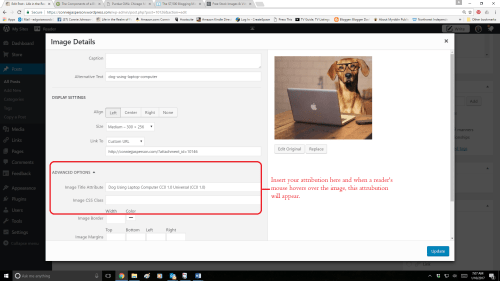
I keep a log of where my images are sourced, who created them, and what I used them in. I also insert the attribution into the image details on my website so that when a mouse hovers over the image, curious readers can go to the source. (In WordPress, you must be on the WP Admin dashboard. Click on the image and go to ‘edit details’). If you can do this, you won’t have to credit them in your footnotes.

We may want to quote another blogger or use the information we have learned from them. Plagiarism is an ugly word, and you never want to be accused of it. To that end, we cite our sources and only use images we have the legal right to use, also citing their source.

Citing sources:

First, I open a document in my word-processing program (I use Word), save it as whatever the title of the post is in that blog’s file folder, and compose my post the way I would write a story.

  • Composing the body of my post in a document rather than the content area of the blog-template allows me to spell check and edit my work first, and I feel more comfortable writing in a document rather than the content-window.

I keep a log at the bottom of my page of what website, who the author was, the date of publication, and the date I accessed it. I have found the simplest method is the Chicago Manual of Style method:

Purdue OWL Online Writing Lab,  General Model for Citing Books in the Chicago Notes and Bibliography System, Copyright ©1995-2017 by The Writing Lab & The OWL at Purdue and Purdue University. All rights reserved.

Website: https://owl.english.purdue.edu/owl/resource/717/03 Accessed Jan 10, 2017

When you quote from Wikipedia, you can click on the ‘cite this page’ link in the left-hand column, which is a menu of items pertaining to Wikipedia in general and to that article. ‘Cite this page’ is listed under ‘tools.’ Clicking on this link takes you to a page offering citations for that page in CMoS, APA, or MLA style, whichever suits your need. All you need to do is copy and paste the one you prefer into your footnotes, and your due diligence has been done.

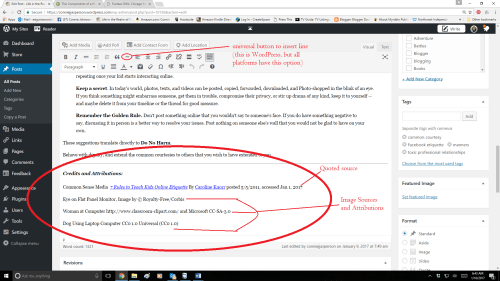
All this information for your footnotes should be inserted at the BOTTOM of your current document, so everything you need for your blog post is all in one place. When my blog article is complete and ready to post, I will insert a line to separate the body of the post from the credits and attribution notes.

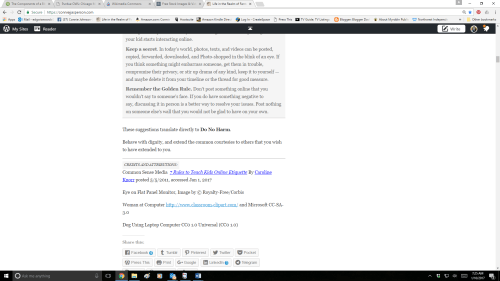
When readers view my blog, if my post were one that I did research for, they would see this at the bottom of the post:

Authors need to blog about who they are and what they do because they can connect with potential readers that way. Using pictures and quoting good sources makes blogs more interesting and informative.

Photographers and artists are just like writers—they are proud of their work and want to be credited for it. Protect yourself and your work by responsibly sourcing your images, giving credit to the authors and artists whose work you use.


Credits

Portions of this article and the screenshots first appeared on the Northwest Independent Writers’ Association  Blog in January of 2017, written by Connie J. Jasperson, All Rights Reserved.

10 Comments

Filed under writing

#flashfictionfriday: Foggy Autumn Morning Sunrise

September first has come to stay,

Summer’s moving on,

Cold and chill the break of day,

But we still greet the dawn.

Webs are hung with mist and dew,

Sparkling on the lawn,

I drink coffee on the porch with you,

And watch the rushing throng.


Foggy Autumn Morning Sunrise, © Connie J. Jasperson 2017, All Rights Reserved

Foggy Autumn Morning (sunrise) Arto J [CC BY-SA 3.0 (http://creativecommons.org/licenses/by-sa/3.0)%5D, via Wikimedia Commons


2 Comments

Filed under #FlashFictionFriday, Poetry, writing

#amwriting: the paragraph

A paragraph is a group of sentences that fleshes out a single idea.

In scholastic and technical writing, a good paragraph begins with a topic sentence and is comprised of sentences that support the main idea.

While I do edit for people who are pursuing literary degrees, that is a different kind of writing and requires strict adherence to style policies as set down by the professor at the beginning of the semester.

This post pertains to the paragraphs in a literary narrative, whether the genre is contemporary, sci fi, fantasy, mystery, romance—or any kind of writing that is fiction. In writing for literature, we don’t begin with a topic sentence as such, but we do explore and expand on only one idea in each paragraph.

The rules are simple:

  • Present a single idea per paragraph.
  • Present the dialogue and reactions of only one person per paragraph.
  • Present the viewpoint of one character per paragraph.

Wrong:

Jamie said, “You cheated on me.” Kerry cringed and wept. “I don’t want to lose you.” He spat, “You disgust me.”

That is a confusing passage, but it doesn’t have to be. Three ideas are explored there: Jamie’s accusation, Kerry’s guilt and fear of losing him, and finally his disgust.

Jamie said, “You cheated on me.”

Kerry cringed and wept. “I don’t want to lose you.”

He spat, “You disgust me.”

While it makes for short paragraphs, you must break out Kerry’s reaction. One thought, one point of view per paragraph, no matter how short that makes it.

A good paragraph agrees with itself, is logical, and the central idea it contains is developed, which sometimes makes for long paragraphs.

With that said, some considerations must be taken into account in the modern world of eBooks. EBooks versions of novels containing long paragraphs tend to appear as an unbroken wall of words. The reader can be daunted by this and may decide to move on to a different book. This is especially a problem when the paragraph contains a long section of internal dialogue, which is frequently written in italics.

Thus, for a genre-fiction manuscript that you intend to publish as an eBook, you will want to keep your paragraphs shorter, dividing long passages at logical places, using two paragraphs to explore the idea.

In any type of writing, emails, literature, or scholastic, when a new idea comes into your writing, or a different character speaks, you must begin a new paragraph.

No matter what, you must have an amazing opening paragraph. One of the greatest hooks in literature is the following one by French author, Albert Camus, which opens the 1942 novel, The Stranger.

Mother died today. Or maybe yesterday, I don’t know. I had a telegram from the home: ‘Mother passed away. Funeral tomorrow. Yours sincerely.’ That doesn’t mean anything. It may have been yesterday.

One idea is explored here in ten short sentences, which combine to offer up a wealth of information. Put bluntly, Meursault received a telegram, possibly from an old-folks home, informing him his mother was dead and when the funeral was.

This is where the artistry of the author comes into play: he takes a simple idea and presents it in deliberately crafted prose that feels loose, almost indifferent. Rather than a plain statement of fact, the few sentences exploring that one thought makes us curious about the protagonist and his state of mind.

Authors, please present only one central idea per paragraph. However, you are free to offer up that idea with your own flair and style.


Credits and Attributions

Quote from The Stranger, by Albert Camus, Original title L’Étranger © 1942 (Gallimard, French) © 1946 (Hamish Hamilton, English)

Wikipedia contributors, “The Stranger (novel),” Wikipedia, The Free Encyclopedia, https://en.wikipedia.org/w/index.php?title=The_Stranger_(novel)&oldid=796803119 (accessed August 30, 2017).

2 Comments

Filed under writing

#amwriting: naming people and places

When I was laying down the first draft of my current work in progress, I somehow managed to give every walk-on a name, right down to the dog. That was immediately corrected, although the dog is an important side-kick and still has a name.

Because a reader can only keep so many character names straight in their mind, I was forced to whittle down my cast of thousands. An author should introduce however many characters it takes to tell the story, but should also use common sense.

In a scifi or fantasy tale, naming can get out of hand, sometimes with every single object or utensil, down to the  most common of tools being given a weird name. A hammer should just be be a hammer, please.

I consider that too much detail, and unnecessary. Think of all the names the reader must try to keep straight in a simple tale as if they were people you had just met at a party–that is what the reader faces in the opening chapters of a story.

  1. Character names, pet names, etc.
  2. Town names: Includes shops and restaurants.
  3. Country names, if part of the story .
  4. Myriad other named people, places, and things.

When you introduce a named character, ask yourself if it is someone the reader should remember. Even if he or she offers information the protagonist and reader must know, it doesn’t necessarily mean they need to be named. Some throw-away characters will give us clues to help our protagonist complete his/her quest, or show us something about the protagonist, give us a clue into their personality or past.

The same follows for places—if the village of Maldon has no bearing on the story, don’t mention it.

You must decide how important a character’s role is. If it’s a walk-on, a person who will only have a brief paragraph in the tale, consider not naming them. Ask yourself if the person will return later in the story or are they acting as part of the setting, part of the scenery in a coffee shop, or perhaps a store. If they are just part of the scenery, they don’t need a name.

Only give names to characters who advance the plot.

In an excellent article on screenwriting, Christina Hamlett of the Writer’s Store writes:

In a screenplay, the rhythm you’re attempting to establish–along with the emotional investment you’re asking a reader to make–is disrupted whenever you devote more than two lines of introduction to a character who is simply there to take up space. In order to justify their existence, each player in your script should perform a unique function or deliver a specific line that:

  1. Advances the plot,
  2. Thwarts the hero’s objectives,
  3. Provides crucial background, and/or
  4. Contributes to the mood of the scene.

If you’ve included characters who don’t fulfill one or more of these jobs, they’re probably not critical to the storyline and can be deleted.

While she is speaking of screenplays, this is true of a novel or short story. A name implies a character is an important part of the story. Sometimes a character is an example of “Chekhov’s Gun.” Does this character serve a purpose the reader must know and will they return? If not, don’t give them a name.

One of my works in progress has a passage that takes place in an inn and involves a conversation overheard from a table adjacent to my protagonists. Despite the fact the merchant and his sons give my protagonists information they needed, they are in this scene for only one purpose: to be overheard mentioning the Cardinal and don’t appear again. For this reason, only my protagonist and his party are named, while all you need to know about the merchant and his sons is shown by their conversation and brief descriptions as speech tags: The portly merchant spoke softly. “You never listen to me. Now here you are, on the run from the Cardinal. Getting you out of the country will be costly. If I beggar myself to bail you out of this mess, how will I support myself in my old age?”

Novelists can learn a great deal about how to write a good, concise scene from screenwriters. An excellent book I have gained a lot of knowledge from is Story by Robert McKee. If you can get your hands on a copy, I highly recommend it.

We want the reader to stay focused on the protagonist(s) and their story. The second draft is where we make every effort to find the distractions we may have inadvertently introduced in our rough draft, and extraneous named characters is an easy one to fix. Simply remove their name, and identify them in general terms. The reader will move on and forget about them.

The tendency to make every character a memorable person is one we can’t indulge. The reader will become confused if too many characters are named.

In one of my early books, I learned a difficult lesson the hard way about naming characters. In the Tower of Bones Series, I have a main character named Marya. She is central to the series. Also, in the first book, a side character was important enough to have a name, but my mind must have been in a rut when I thought that one up: for some stupid reason I named her Marta.

You can probably see where this is going—the two names are nearly identical.

What is even worse, halfway through the first draft of the second book in the series, Marta suddenly became a protagonist with a major storyline. She becomes Marya’s mother-in-law in the third book. Fortunately, I was in the final stage of editing book one, Tower of Bones, for publication, and immediately realized I had to make a major correction: Marta was renamed Halee.

My rule now is to NEVER name two characters in such a way that the first and last letters of their names are the same. To avoid that circumstance, I try to never have two that even begin with the same letter.

One last thing to consider: will you want to publish your book as an audiobook? If so, how will that name be pronounced when it is read out loud? You may not want to get too fancy with the spelling so that the narrator can easily read that name aloud. You may not think this is important, but it is. I only have one book that is an audiobook, but during the recording of that book, my narrator had trouble pronouncing the names of two characters, because I had written the names so they would look good on paper, not realizing they were unpronounceable as they were written. We ironed that out, but the experience taught me to spell names simply.

Because of my early “good ideas gone awry” when it comes to names, my rules for names are simple:

  1. Don’t confuse your readers by giving unimportant walk-on characters names.
  2. Never name two characters names that are nearly identical or that begin and end with the same letter.
  3. Consider making the spellings of names and places pronounceable in case you decide to have your book made into an audiobook.

Credits and attributions: 

Minor Characters Don’t Need Major Introductions, Christina Hamlett, Copyright © 1982 – 2017 The Writers Store ® Incorporated, accessed Mar. 11, 2017.

13 Comments

Filed under writing

#amwriting: do the reasearch

People always ask what you do for a living, as we are a society of people who define ourselves by our occupations. For many years, I was a bookkeeper, and also, I worked in data entry for several large corporations. Before that, during the 1980s and Reaganomics, I worked as a hotel maid, a field hand, and had several other odd occupations, often holding down three part-time jobs.

When you tell people you write books, they are, generally, interested. When you tell them you write speculative fiction, you get a range of reactions, from pitying condescension to confused, but sincere, respect.

Sometimes people laugh and tell me how easy it must be since I can make any old thing up and it will fly. Despite the old saying that “in wine there is truth,” nothing could be further from the truth.

Readers know when you have gone off the track and into the shrubs of “that can’t possibly happen.”

This means you can’t just make any old thing up because world building must combine enough realism with the created world to make the fantasy plausible. It involves research.

I spend hundreds of hours researching the most trivial details for every book I write. If I get it wrong, it’s because I failed to do the research in the right place.

In the process of writing Huw the Bard and the subsequent stories set in that world, I’ve learned as much as many medieval scholars about how people dressed, what they ate, how they earned a living, how they preserved food and every intimate detail of their lives that is researchable.

I know all of this because I read scientific papers written by experts on the subject, all of which are available to us via the internet. My files are full of the fruits of other people’s efforts, with the sources documented and the authors credited, so I know where to go to find out more if I need to. Lists of links to websites for further research is critical because when one book goes to press, a new book is already falling out of my fevered mind and onto the paper.

Readers are smart. If something is impossible, and you don’t somehow make it probable, you will lose your readers. The best way to make the impossible probable is to mix your fantasy with a good dose of real history. Be historically accurate as often as you can, so that when your blacksmith makes a weapon, readers who know about smithing will not be jarred out of the story by inaccuracy.

Most of the time, these things you spend untold hours researching will only get one line in your narrative, but if that line is inaccurate or impossible, your readers will know you were too lazy to do it right.

The following is my short list of go-to websites for in-depth, accurate information for when I am writing, including grammar questions. They are self-explanatory and are easy to make use of. Submit your questions via their query box and, while figuring out what you really need to know may take several tries, you will soon have answers.

Medieval Histories  http://www.medievalhistories.com

Academia http://www.academia.edu/

NASA https://www.nasa.gov/

Physics http://www.physics.org/

Wikimedia Commons https://commons.wikimedia.org/

Grammarist  http://grammarist.com/

I’ve learned a great deal from reading the literature of medieval times. If you really want to know how people lived, read a modern translation of Chaucer’s Canterbury Tales. They were bawdy, irreverent, and loved nothing more than a good joke.

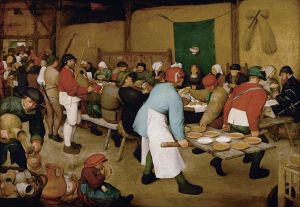
For example, if you are writing a story set in a medieval environment, you may need to know what clothing the common European people wore in medieval times. Or you might want to know what their home looked like, or a village. For that, I suggest you seek out the art of the Flemish Painters. There you’ll see what men and women looked like and how they dressed, both for celebrations, and for working. You will see what their towns looked like, and the public places they gathered in. The interiors of their homes are also found in the great Flemish painter’s works.

Any time you want an idea of average European village life in the Late Middle Ages through the 17th century, you need to look no further than Wikimedia Commons.  There, under the heading  Category: Painters from the Northern Netherlands (before 1830) you will find the brilliant works of the Dutch Masters. These were artists living in what is now The Netherlands, and who were creating accurate records of the everyday life of the common people, along with stylized religious images.

Pieter Bruegel the Elder – Peasant Wedding (1526/1530–1569) via Wikimedia Commons

They painted their subjects with a heavy dose of religious allegory, but that was a part of village life—both the Inquisition and the Reformation were under way, and the politics of religion was in the very air they breathed. If you are going to write medieval fantasy, you must understand how strong the influence of the Church was and how entangled it was in politics. You must inject that religious realism into your work, and show how the Church, even a fantasy religion, and its politics affect the common person’s life.

My regular readers know I love the work of one family of early Dutch painters from Flanders, the Brueghel Family. Five generations of their family were well-known painters and printmakers.

The internet is your friend, and researching your fantasy novel can be incredibly entertaining. Research is what slows me down more than anything. I spend far too many happy hours on Wikimedia Commons, looking at 16th-century Netherlandish paintings.

2 Comments

Filed under writing

#amwriting: the role of the #proofreader

I am nearly at the end of the editing process on my new novel, Billy Ninefingers, a tale set in Huw the Bard’s world. When I am finished with the revisions, I will format my manuscript to be uploaded as both eBook and paper books. At that point, I will be looking for proof readers.

This is where it gets sticky. At some point, I must draw the line and say this book is done. I want no more changes, no more fiddling with it. Thus, when the manuscript is as polished as I can possibly get it, I have one final step—the one that can either ruin a formatted manuscript or make it great: proofreading.

While some people will dispute this, proofreading is not editing.

Proofreading is done after the final revisions have been made, and hopefully it is done by someone who has not seen the manuscript before. That way, they will see it through new eyes, and the small things in your otherwise perfect manuscript will stand out.

Anita Campbell, in her May 28, 2015 guest post for the SBA’s Blog-Industry Word says: “The first step of effective proofreading is understanding that not every typo or issue is alike.  Each needs to be attacked in a different way.” While she is speaking of editing blogposts, and short works, that profoundly true of longer manuscripts.

Even though an editor has combed your manuscript and you have made thousands of corrections, both large and small, there may be places where the reader’s eye will stop. Words have been left out, punctuation is missing–any number of small, hard-to-detect things can occur even after the most thorough of edits.

After the final edit, we go over our work with a fine-toothed comb, trying to proof it ourselves. We read it aloud, and we read it from the bottom up, but our eye sees what it expects to see. We catch many things, but we don’t catch it all.

This is where the final person in the process comes in–the proofreader.

In case you didn’t see it when I mentioned it above, I will say it again: proofreading is not editingEditing is a process that I have discussed at length elsewhere, and is completed long before we get to the proofreading stage.

At the outset, the proofreader must understand that no matter how tempting it may be, they have not been invited to edit the manuscript for content. That has already been done and done again. If they cannot refrain from asking for large revisions regarding your style and content, find another proofreader.

What the Proofreader Should Look For:

Spelling—misspelled words, and homophones (words that sound the same but are spelled differently). These are words that spell-checker may or may not catch, so a human eye is critical for this.

  • Wrong:  Bobby wint out the door, slamming the screen.
  • Right:  Bobby went out the door, slamming the screen.
  • Wrong: There cat escaped and he had to chase it
  • Right: Their cat escaped and he had to chase it.

Repeated words and cut-and-paste errors. These happen when making revisions, even by the most meticulous of authors, and the editor won’t see any errors you introduce after they have completed their work on the ms. These are insidious and difficult to spot, and spell-checker won’t find always them. Sometimes they seem like unusually garbled sentences.

  • Wrong: First of all, First of all, it is accepted practice to italicize thoughts.
  • Wrong: First of all, it is accepted practice to practice thoughts.
  • Wrong: First of all, it is accepted to ot  thoughts.
  • Right: First of all, it is accepted practice to italicize thoughts.

Missing closed quotes:

  • Wrong: “Doctor Mendel, you’re new to the area. What do you know about the dead man? asked Officer Shultz.
  • Right: “Doctor Mendel, you’re new to the area. What do you know about the dead man?” asked Officer Shultz.

Numbers that are digits:

  • Wrong: There will be 3000 guests at the reception.
  • Right: There will be 300 guests at the reception. (For notes and emails, we can use digits.)
  • Right: There will be three hundred guests at the reception. (In literature, we write it out.)

Dropped and missing words:

  • Wrong: Within minutes the place was crawling with cops, and Officer Shultz was sitting at my kitchen table me gently while I made hot water for tea.
  • Right: Within minutes the place was crawling with cops, and Officer Shultz was sitting at my kitchen table grilling me gently, while I made hot water for tea.

Each time you (or a well-meaning editor) tweak the phrasing or create a new passage in your already edited manuscript, you run the risk of creating another undetected error.

Do not ask an editor to proofread your manuscript, as they will be unable to resist tweaking the phrasing and will ask for more changes, because it’s their nature and their job. This can go on forever, and you run the risk of

1. Ironing the life out of your manuscript and losing the feeling of spontaneity, making it feel contrived.

2. Putting up a manuscript that looks unedited because of the flaws that were introduced in the proofing process.

Don’t allow someone else, even an editor, to make the changes for you. Editors are human and can inadvertently make mistakes—after all, the eye sees what the author thinks should be there. Any person who makes changes to the final product has the chance to inadvertently ruin it.

At some point your manuscript is done. You have been through the editing process, and the content and structure is as good as you can get it, but you need one last eye looking for small flaws. Before you upload that masterpiece to Kindle or wherever, do yourself a favor and have it proofread by an intelligent reader, who understands what you are asking them to do and who is willing to do only that.

7 Comments

Filed under Publishing, writing