
As writers, our job is to take a one-dimensional idea and give it depth. Our goal is to make the reader believe our narrative unfolds in a real, three-dimensional world.
 We add depth and dimension to our work layer by layer. Some layers are more abstract than others, but each layer adds an element that gives a sense of reality to the fictional world.
When you add a layer of the unexpected to a scene, the reader becomes interested in discovering more. They keep turning the pages.
One literary device I enjoy when it’s done well in a novel is irony. Irony can be unexpected. Adding irony or satire gives a scene an element of surprise and the reader experiences a moment of “ah hah!” The mundane becomes special.
Wikipedia says this about irony:
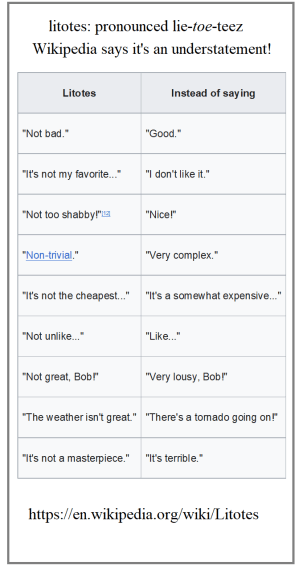
Irony can be categorized into different types, including verbal irony, dramatic irony, and situational irony. Verbal, dramatic, and situational irony are often used for emphasis in the assertion of a truth. The ironic form of simile, used in sarcasm, and some forms of litotes can emphasize one’s meaning by the deliberate use of language which states the opposite of the truth, denies the contrary of the truth, or drastically and obviously understates a factual connection.
I love authors who inject the different forms of irony and drama or both into their work without being heavy-handed.
Politics, even on a local level, offer plenty of opportunities for drama, which is why I don’t watch the evening news. But let’s plot the first quarter of a contemporary novel about a struggling marriage. We will make one spouse the mayor of their small town and the other a lawyer working for a large corporation. The corporation wants to establish more of a presence in the community, and it’s his job to lobby for that.
 The mayor likes their community’s small-town feeling and ambiance and doesn’t want it to change. Her husband is trapped, as his job is to ensure his employer gets their foot in the door. He struggled for years to rise to his current position and can’t imagine giving it up.
This is the source of friction in their relationship.
Soon after we establish the domestic dynamics of the couple, let’s create a scene where the mayor is doing her job, overseeing a meeting involving a committee’s conversation about what to do with a plot of land.
A third group who has an interest in the property has been deliberately excluded from the discussion. They are demanding the land be turned into community gardens. Their aggressive dialogue and confrontational picketing have led to the meeting being closed to the public.
In itself, the topic of choosing whether to fund a senior center/boys and girls club or sell it to a corporation that will hire hundreds of local people would be boring.
But by closing the meeting to all but two parties, we imply that something shady may be going on.
In the scenes leading up to the meeting, we meet the other influential people in this town. Their private conversations before the meeting will offer snips of background information as they move the story toward the scene in the conference room.
Once the meeting has been called to order, arguments will ensue as both sides present their case. Outside, the picketers who want the community gardens make their voices heard.
These dynamics offer many opportunities for ratcheting up the tension. The conversations inside the meeting and outside will be full of information only those parties have but which the reader must know. Irony could be injected in the blatant ignorance of some characters on all three sides and the comments they naively (or arrogantly) make.
So let’s add some dramatic irony to this scene. This literary device gives the reader information that at least one of the characters in the narrative is unaware of. This puts the reader a step ahead but is also a hook because wanting to see how this plays out raises the tension.
In our scene, an unknown woman makes her first appearance. She enters the empty conference room ahead of the meeting and places a backpack under the table. She isn’t involved with any of the three concerned groups, so who is she? What is her agenda? She is a member of a hidden group of anarchists who intend to bring down the corporation, and this is their opening volley.
This is where dramatic irony comes into play: the reader watches as she adjusts the backpack’s contents, sets the timer to go off at 19:25 (7:25 pm), and then departs, careful to leave no fingerprints.
Dramatic irony – the reader knows a device has been planted in the room, but the players in the scene do not.
Now every second that the conversation drags on ratchets up the tension. Each time a committee member gets up to get a glass of water or make a phone call, and the clock on the wall ticks toward 7:25, you wonder: will they escape death or terrible injury?
 And we, the readers, desperately want our protagonist, the mayor, to get up and go to the coffeemaker. We can’t rest until we know if she either gets up and steps away from the table or someone notices the abandoned backpack and clears the meeting room.
Drama works best when presented so the reader feels the emotion but hasn’t been told what to think. We want to experience the stories ourselves.
Satire, sarcasm, irony, and understatements in conversations can lend a lighter tone to a dark passage. These lighter moments make characters feel relatable, showing them as being self-aware.
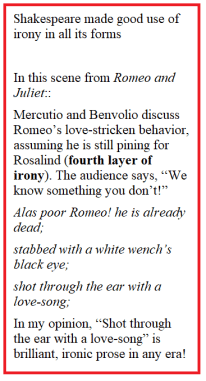
Dramatic irony is knowing something the players don’t. We know the backpack is beneath the conference table and fear the outcome.
But will that outcome be what we expect? Another layer of dramatic irony is applied when the backpack is detonated by the bomb squad, spraying the room with glitter and red paint.
 I will have to spend a day or two thinking about the story as a whole and writing an outline as a framework to guide the story. The plot points I originally planned to occur at each of the four quarters of the story will be met, but how?
 The midpoint of the story arc is often where the protagonists lose their faith or have a crisis of conscience. Something terrible happens, and they must learn to live with it.
 So, starting at the end, I look at my characters’ location when the story finishes. Then I ask myself what they were doing just before the final encounter.
 This happens even when I have an outline. I will get to a place where I don’t know what to write, and the characters stand around doing nothing. I repeat the same old crisis with slight variations, which is tedious.
 He says, “I rescued Lady Adeline, and the manticore is dead. Did you notice?”
 “Look, why don’t you sit here and watch TV for a while?” I park him in front of the TV and give him the clicker.
 “I’m sorry to bother you, but we desperately need a certain magical ingredient for my special anti-aging cream.” She looks at me expectantly. “My stepdaughter’s wedding is a big deal. But the outline says Percival and Adeline will assume the throne upon their marriage. It’s canon now, so I’m done, kicked to the curb in the prime of my life.” She dabs the corner of her squinty eyes with a silken handkerchief. “You set this story in an era where women have few career options. I simply must have my beauty cream, or I won’t be able to snare a new hubby.”
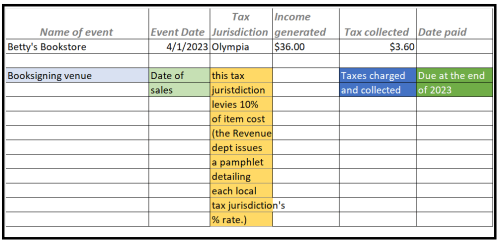
 The good businessperson has a spreadsheet of some sort to account for this side of the business, as it will be part of your annual business tax report. An excellent method for assembling the information we generate for your tax report is discussed in a guest post by Ellen King Rice,
  Column 4 is the sum of column three times column two: Inventory value: $89.11. That is what you would have to pay to replace those books. It is also what some Departments of Revenue may tax you on at the end of the year if the value of that stock is over a specific limit, say $5,000.00. The total value of stock-on-hand for all my books combined rarely exceeds $500.00.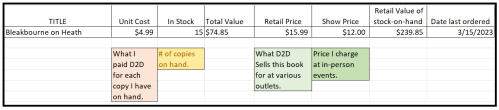
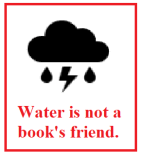 Depending on where you live, the natural world can be hazardous. If something should happen to your stock of books due to theft, fire, or flood, you will be able to claim your business loss.
 At first, getting your books in front of readers is a challenge. The in-person sales event is one way to get eyes on your books. This could be at a venue as small as a local bookstore allowing you to set up a table on their premises.
 The final thing you will need is a way of accepting money. I have a metal cash box, but you only need something to hold cash and some bills to make change with. A way to accept credit cards, something like
  I suggest buying book stands of some sort. Recipe stands work, as do plate and picture stands. Whether they’re fancy or cheap, be sure you know how to use them properly so they aren’t falling over when someone bumps the table. I use folding plate stands as they store well in the rolling suitcase I use for my supplies.
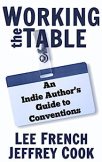 If you plan to get a table at a large conference this year, I highly recommend
  Artist: Anna Ancher (1859–1935)
 When we commit to writing daily, our writing style grows and changes. When I began writing, some chapters totaled over 4,000 words.
 As a reader, books work best for me when each chapter details the events of one large scene or several related events. I think of chapters as if they were paragraphs. Paragraphs are not just short blocks of randomly assembled sentences.
 I’ve mentioned before that one of the complaints some readers have with
  Short stories run up to 7,000 words, with under 4,000 being the most commonly requested length. 7,500–17,500 is the expected length for novelettes, and between 17,500 and 40,000 words are the standard length for novellas.
 In my work, the first draft is really more of an expanded outline, a series of scenes that have characters doing things. But those scenes need to be connected so each flows naturally into the next without jarring the reader out of the narrative.
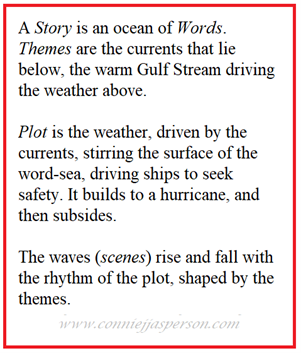 We are always told, “Don’t waste words on empty scenes.” I find this part of the revision process the most difficult. Frankly, I have a million words at my disposal, and wasting them is my best skill.
 If you ask a reader what makes a memorable story, they will tell you that the emotions it evoked are why they loved that novel. They were allowed to process the events, given a moment of rest and reflection between the action. Our characters can take a moment to think, but while doing so, they must be transitioning to the next scene.
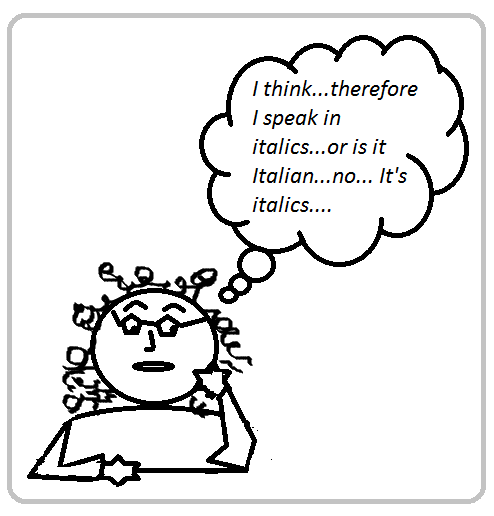 Visual Cues: In my own work, when I come across the word “smile” or other words conveying a facial expression or character’s mood, it sometimes requires a complete re-visualization of the scene. I’m forced to look for a different way to express my intention, which is a necessary but frustrating aspect of the craft.


 Life in the Realm of Fantasy
