
 In real life, we are drawn to certain people and get to know them better through conversations.
At first, they’re an unknown quantity. They become individuals to us once we’re introduced and we discover their speech habits, resonate with their sense of humor, and learn bits of their backstory.
On the opposite side of the coin, conversations can alert us to people we choose to avoid.
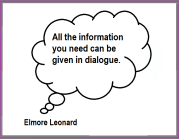 Good conversations and mental dialogues bring written characters to life and turn them into people we want to know, our closest friends.
Here are seven rules for adding depth to our characters through their conversations.
One: Don’t indulge in the exposition dump: “Bob, remember how I told you (blah blah blah)?”
In real life, we might say this and not notice it. However, when we see it written, it becomes word padding, adding fluff to the narrative. This is a classic example of something we don’t need to know.
Two: Don’t repetitively name the characters being spoken to: “Bob, remember how I told you (blah blah blah)?”
The reader knows Dave is talking to Bob. If it’s only the two of them, no direction is necessary—they can just say what they need to with a few speech tags to keep the “who said what” straight. If there are three or more characters in the conversation, have Dave turn to Bob and then speak.
Three: Don’t use bizarre speech tags.
I don’t care for reading graphic and disgusting speech tags such as ejaculated. “Telling” words do our narratives no favors when used as speech tags. We are creative and can do better than that by showing a character’s shock, dismay, or joy as they are speaking. We intersperse actions with simple speech tags that don’t stop the reader’s eye.
Bob’s eyes widened, and he grabbed the letter. “You idiot.”
Don’t make the mistake of getting rid of speech tags and attributions entirely. Even with only two characters in a scene, the verbal exchanges can become confusing. Use speech tags every third exchange or so to keep things clear for your reader. Nothing is worse than trying to figure out which character said what.
Four: Please don’t indulge in internal dialogues (thoughts) that are a wall of italics going on forever.
 Internal dialogues (rambling thoughts) are often a thinly disguised info dump in my first drafts. I seek those out in the second draft and either cut them to a line or two or eliminate them entirely. I try to avoid italics if possible, so this is how I write thoughts nowadays:
Dave fought down a wave of nausea, followed by a surge of anger so raw, it burned. The effort to stifle it took all he had. Brandon was at least ten years younger than her, barely old enough to legally drink beer.
Five: Don’t spell out accents to the point they are visually incomprehensible. “Oive got a luverly bunch uv coconuts….”
I refuse to review books I dislike. This is because some books I despise are beloved bestsellers, demonstrating that I don’t know everything. (What? Say it ain’t so!) As in all other things, it’s a matter of taste.
One of the many reasons I disliked “Where the Crawdads Sing” was how the accents were portrayed. They were shown in a demeaning way, in my opinion. I know that many readers didn’t see that as a problem; as I said, it is only my opinion.
 However, I have no problem understanding an accent and visualizing a character as foreign when the author consistently uses one or two well-known words that a non-native speaker might use, such as si, ja, or oui, in place of yes. Most English speakers recognize and know the meaning of these words when they see them. All it takes is a straightforward word to convey the proper foreign flavor.
Six: Please, please, please … pretty please … don’t make a habit of leading sentences off with drone words. “Aahhh … ummm …”
These are ‘thinking syllables.’ This is known as a ‘verbal tic’ and can be an ingrained habit that the speaker is unaware of.
Verbal tics are supremely annoying in real life and are excruciating to read when peppered throughout the narrative. Once in a while, a non-word like “Ah …” adds a moment for the character to show shock or another emotion in the narrative. But do go lightly with them.
You may have met someone who habitually opens every sentence with a meaningless syllable, such as “Aaaaaaaahh….” They continue droning while they gather their thoughts, holding the conversation hostage and not allowing the other person to speak.
The guilty party may suffer hurt feelings when you try to hurry them along.
Seven: Never use Google Translate (or any other translation app) to write foreign languages.
As mentioned in rule 5, a word or two used consistently here and there to convey the sense of foreignness is one thing, but in general, if you don’t speak the language, don’t write it.
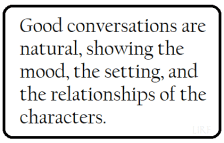 The laws of grammar sometimes break down on the quantum level in conversations with our friends. This is also true of written exchanges.
Many new authors are confused about how to punctuate conversations. It’s not complicated, so here are four simple rules for punctuating discussions (offered for your extra credit):
Rule 1: Surround everything that is spoken with quotation marks. “I’m back,” he said.
In the US, we begin and end the dialogue with “double quotes.” These are also called closed quotes and all punctuation goes inside them. This is a universal, cast-iron rule that we must follow because readers expect to see them and become confused when you don’t set dialogue off this way.
Rule 2: When quoting someone else (as part of a conversation), you should set the quoted speech apart with single quotes (apostrophes, inverted commas) and keep it inside the closed quotes.
You can do this in two ways:
- Dave said, “When I asked her, Jill replied, ‘I can’t go.’ But I’m sure she was lying.”
- Dave said, “When I asked, Jill replied, ‘I can’t go.'”
In the second sentence, 3 apostrophes are placed after the period (full stop): One apostrophe and one double (closed) quote mark. This is in keeping with the rule that all punctuation in dialogue goes inside the quotation marks.
Indirect dialogue is a recapping of a conversation:
- When asked, Dave said Jill told him she couldn’t go.
We don’t use quotes in indirect dialogue. Also, in the above sentence, “that” is implied between said and Jill.
 Rule 3: Commas—Do not place a period between the closed quotes and the dialogue tag. Use a comma because when the speech tag follows the spoken words, they are one sentence consisting of clauses separated by a comma: “I’m here,” he said.
- When leading with a speech tag, the commas are placed after the tag and are not inside the quotation marks: He said, “I’m here.”
- Dialogue split by the speech tag is all one sentence: “The flowers are lovely,” she said, “but they make my eyes water.” Note that the first word in the second half of the sentence is not capitalized.
Rule 4: When a speaker’s monologue must be broken into two paragraphs, lead off each with quotation marks but only put the closed quote at the end of the final paragraph. A wall of dialogue can be daunting in a story, but sometimes happens in essays and when quoting speeches.
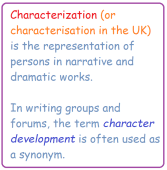 Conversations, both spoken and internal, light up and illuminate the individual corners of the story, bringing the immensity of the overall story arc down to a personal level.
In good dialogue, readers are given all the information they need and are shown the characters’ motives and deepest desires.
They illustrate our heroes and villains as the people we imagine them to be—without making them cartoonish.
 In his book,
  Batman is a
  Apollo 13 (April 11–17, 1970) was the seventh crewed mission in the
  No matter what genre we write in, when we design the story, we build it around a need that must be fulfilled, a quest of some sort.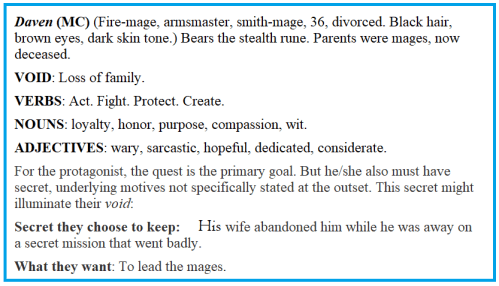
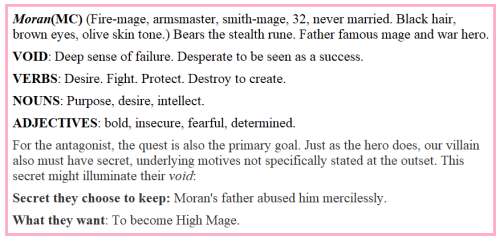
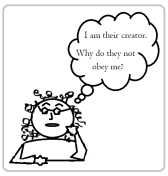 I recently had a manuscript undergo a complete change from what I originally planned. The original antagonist had such an engaging story that he had become more important to me than the protagonists.
 As a reader, I dislike discovering the author is at a loss as to what their protagonist wants. Without that impetus, they don’t have a good reason for the villain to be there either. Random events inserted to keep things interesting don’t advance the story, but motivation does.
 You’ve taken them through two revisions and think these characters are awesome, perfectly drawn as you intend. The overall theme of the narrative supports the plot arc, and the events are timed perfectly, so the pacing is good.
 But in real life, I often find little distinction between heroes and villains. Heroes are often jackasses who need to be taken down a notch. Villains will extort protection money from a store owner and then turn around and open a soup kitchen to feed the unemployed.
 Both heroes and villains must have possibilities – the chance that the villain might be redeemed, or the hero might become the villain. As an avid gamer, I think of this as the “
 In Final Fantasy VII, the 1997 game that started it all, we meet Cloud Strife, a mercenary with a mysterious past. Gradually, we discover that, unbeknownst to himself, he is living a lie that he must face and overcome to be the hero we all need him to be.
 I try to keep the ensemble narrow in my work, limiting points of view to only one, two, or three characters at most. I keep the core cast limited to four or five, as it takes a lot of effort to show more people than that as being separate and unique.
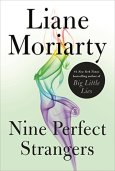 Moriarty’s characters are immediately engaging. They sucked me into their world in the opening pages. I couldn’t set the book down, as I wanted to know everyone’s dark secrets. I was hooked; I had to understand what led these people to book themselves into that exceedingly unusual health spa.
 The guests are immediately thrust into an unknown and possibly dangerous environment. The food they are offered is high quality but not what they are used to and varies from guest to guest.
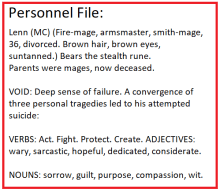 Character Names. I list the essential characters by name and the critical places where the story will be set.
 But what I realized is this—had he lived, my father would be turning one hundred. Our two oldest daughters will be turning fifty. Our two sons are in their mid and late forties, and our youngest daughter, the baby, will be forty.
 This diagnosis has prompted us to downsize and sell our home. We currently live in a tiny, rural town twenty miles south of Olympia, where all the services we need easy access to are located. So now we’re planning to move back to a city of politics, art, and creativity. Since leaving there in 2005, we have enjoyed the quiet of our little quarry town—but now we’re looking forward to seeing plays and attending concerts again.
 We have upped our garbage collection to weekly instead of bi-weekly, and we have no trouble filling that bin with things no sane person would have saved in the first place.
 This behavior occurs on a subatomic level, something to do with
  The most important things we will keep are the memories, things that take up no room and never need dusting. We’ve had family parties for every holiday, including Easter Egg hunts that are legendary among the grandchildren.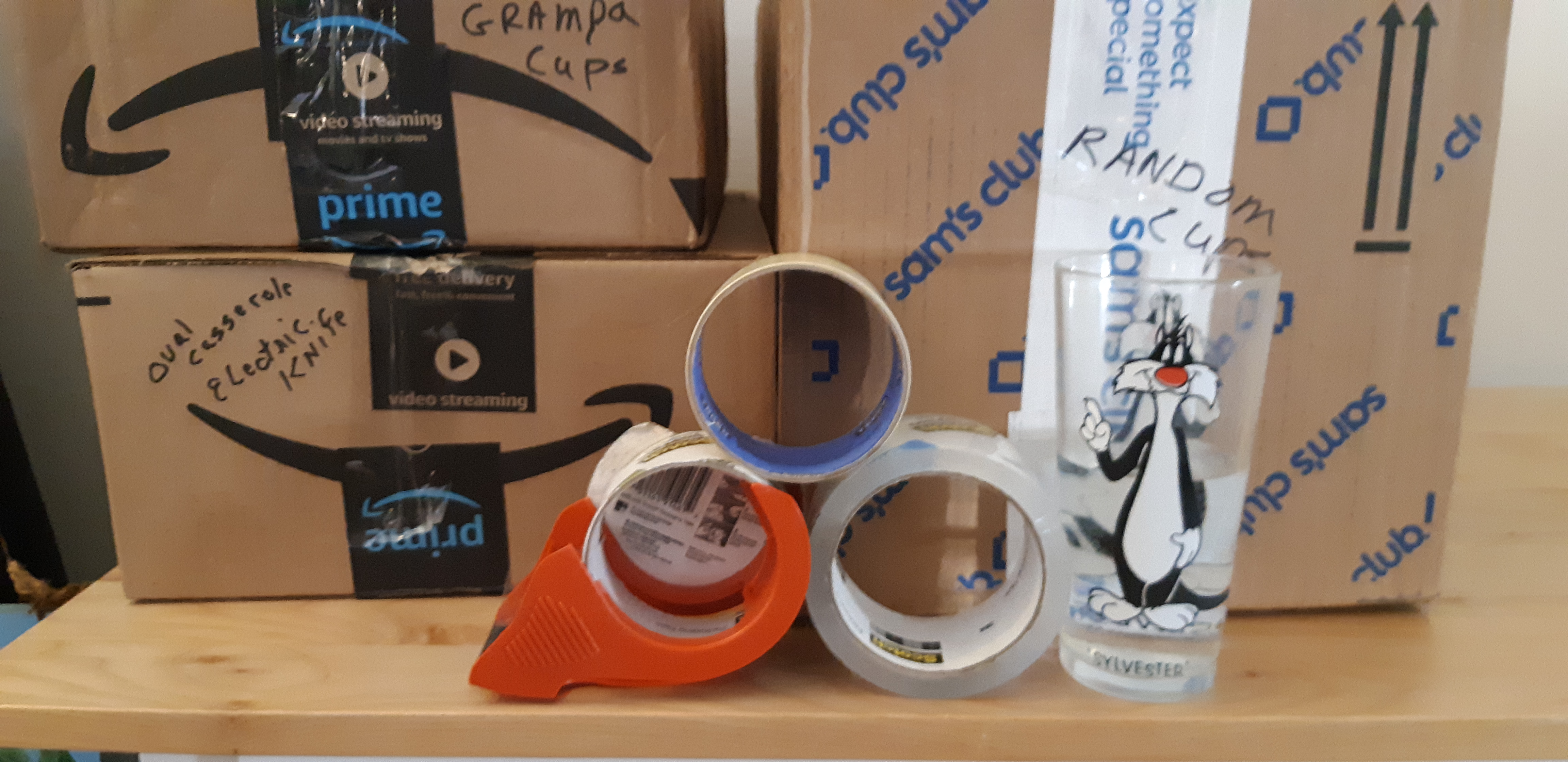
 No matter the level of our education or the dialect we speak, we use these rules and don’t realize we are doing so.
 Muddled phrasings often slip by when I revise my work because my mind sees the words as if they were in the correct order. This is the writer’s curse—the internal editor knows what should be there, and the eye skips over what we actually wrote.
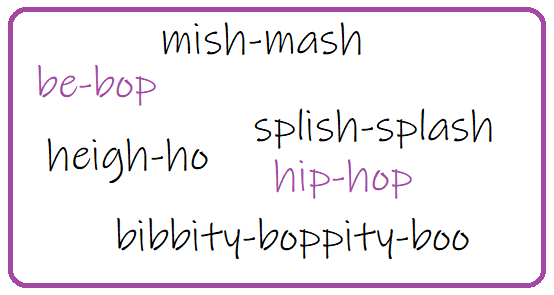 I adore mishmash words. They’re poetic and musical and roll off the tongue with a satisfying rhythm. Sadly, while I regularly bore my grandchildren with them, I hardly ever get to write them. Mishmash. Hip-hop.
 “Ing” words are a terrible temptation to those of us raised on Tolkien. He was writing a century ago, but that style of lush prose has fallen out of fashion. We open the gate to all sorts of verbal mayhem when we lead off with an “ing” word at the front of a sentence.


 Life in the Realm of Fantasy
