How the Written Universe Works part 3: Lay, Lie, Laid #amwriting

Every now and then, the most paradoxical mystery in the written universe rears its head—the question, “Is it lay, lie, or what?” Today we will revisit one of the more misused verbs in the English language: the many tenses and uses of the verb ‘lay.’
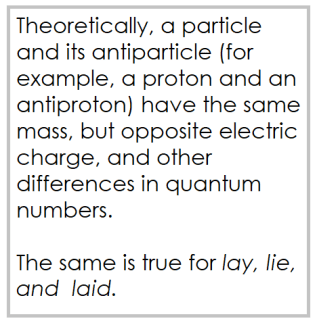
How the written universe works 3In the written narrative, the many forms of this verb are what antimatter is to ordinary matter. When used improperly, things unravel. The problem is, we routinely use the words lay and lie and all their forms incorrectly as a matter of habit in our daily speech.

We are accustomed to hearing the wrong use of verb forms in conversation. However, we notice incorrect usage when reading. This paradox causes confusion for our readers when we misuse the verb “lay” and all its tenses in a narrative.

Don’t feel alone in this. Even editors struggle with the words lay, lie, and laid and regularly refer to grammar guides to remind themselves of the correct usage.

I often have to stop in my own work and make sure I am using it correctly.

Do I mean to lay down or lie down?

It boils down to a simple concept: is the object of the verb RECLINING, or was it PLACED THERE?
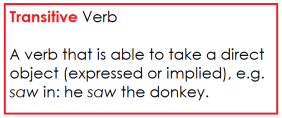
transitive verb“Lay” is a transitive verb that refers to putting something in a horizontal position. At the same time, “lie” is an intransitive verb that refers to being in a flat position.

“Lay” is a verb meaning to put or place something somewhere. It has a direct object. Its principal parts are “lay,” “laid,” “laid,” and “laying.”

The words refer to the action: If you place it (object) there, it is laying there. Lay it there. Lay it on the pillow.

If it is resting or reclining, it is lying there.

  • Lie down.
  • Lying down.
  • Lie down, Sally. (Clapton had it wrong? Say it isn’t so!)

The internet is your friend. The following is a quote from the website, Get it Write: 

[1] The verbs to lie and to lay have very different meanings. Simply put, to lie means “to rest,” “to assume or be situated in a horizontal position,” and to lay means “to put or place.” (Of course, a second verb to lie, means “to deceive,” “to pass off false information as if it were the truth,” but here we are focusing on the meaning of to lie that gives writers the most grief.)

Languages change, and we are certainly moving toward a time when style and grammar books no longer distinguish between lay and lie, but we aren’t there yet.

intransitive verbTo lie is an intransitive verb: it shows action, and the subject of the sentence engages in that action, but nothing is being acted upon (the verb has no direct object).

Put another way, the verb to lie does not express the kind of action that can be done to anything. Remember that it means “to recline” or “to rest.”

It is conjugated this way:

  • lie here every day. (Everyone lies here. They lie here.)
  • am lying here right now.
  • lay here yesterday.
  • will lie here tomorrow.
  • have lain here every day for years. [1]
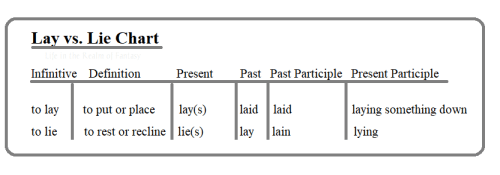
Lay, Lie, Laid chart

This is where things get tense: present, past, and future.

A ring lay on the pillow. 

  • Present tense: I lay an object on the pillow.
  • Future tense: I will lay an object on the pillow.
  • Past tense: I laid an object on the pillow.

But I needed to rest. In this context, lie is a verb meaning to recline. It requires no direct object, and its principal parts are lie, lay, lain, and lying.

  • I’m going to lie in bed for another hour.
  • I feel safe lying in my bed.
  • I had lain in bed long enough, so I got up.

So, what this all boils down to is:
matter antimatter LIRF04102022 The verb that means “to recline” is “to lie,” not “to lay.” If we are talking about the act of reclining, we use “lie,” not “lay.” “When I have a headache, I lie down.”

The verb laid must have a direct object. Something is put or placed: “I laid my papers on your desk after the meeting.” In our modern dialect, the verb laid is used far less often than put, set, or placed, so it has become confusing.

But just to confuse things a lot more:

A living body lies down and rests.

A dead body is cleaned up and laid out by other people if the said corpse is important to them. However, after being laid out, the corpse is lying in state to allow mourners to pay their respects.

 >>><<<

Previous posts in the series, How the Written Universe Works:

How the written universe works part 1: the connecting particle 

How the written universe works part 2: the physics of conversation 

This post: How the Written Universe Works part 3: Lay, Lie, Laid


ATTRIBUTIONS AND CREDITS:

[1] Quote from: To Lie, or To Lay, by Nancy Tuten, Get it Write online, To Lie or To Lay? | Get It Write Online, accessed April 10, 2022.
16 Comments

Filed under writing

#FineArtFriday: Undergrowth with Two Figures, Vincent van Gogh 1890

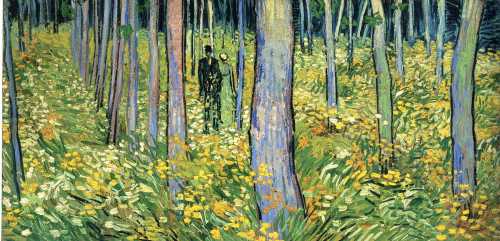
Vincent_van_Gogh_-_Undergrowth_with_Two_Figures_(F773)Artist: Vincent van Gogh (1853–1890)

Title: Undergrowth with Two Figures

Date: late June 1890

Medium: oil on canvas

Dimensions: height: 50 cm (19.6 in); width: 100.5 cm (39.5 in)

Collection: Cincinnati Art Museum

Today, Thursday, I was privileged to attend an immersive exhibit of Vincent van Gogh’s life through his work. I had hoped to write a post on my impressions of that exhibit when I arrived home, but frankly, words fail me, and so I hope you will forgive my settling for one of my favorites of his paintings.

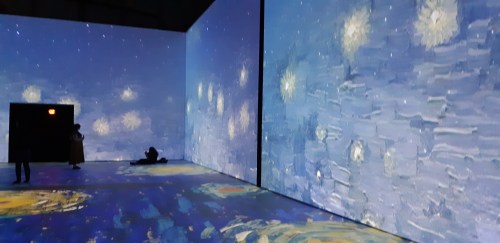
We were inside an everchanging exhibit that flowed through many of his most famous works and zoomed in on bits one wouldn’t ordinarily notice. I managed a few shots with my cell phone that offer some idea of the exhibition, and here is the one that best shows what we experienced:

Van Gogh immersive 1 connie j jasperson LIRF04072022

The exhibit was such a moving, emotional experience. It brings you into touch with the man as well as his art.

We were in, above, and surrounded by his work. The powerful soundtrack of classical music was paired perfectly to the images, complementing them like fine wine does good food.

The link to that exhibit is here: Van Gogh, The Immersive Experience.

What I love about Undergrowth with Two Figures:

This very late work was painted at the end of June 1890, a few weeks before Van Gogh’s death. It was one of several paintings in Auvers-sur-Oise, a commune on the northwestern outskirts of Paris, France. This was also the place where Vincent van Gogh died from injuries suffered in an attempted suicide.

This painting is one of several he made in the last weeks of his life, in an unusually elongated double-square format. The double-square painting is a painting made on uncommonly large canvases, which have one dimension that is twice the size of the other. His need to express his art couldn’t be contained on an ordinary canvas—he saw the world with a panoramic view.

One of the things I love about this painting is the use of violet and blue in the trunks of the poplars. They are tall, immense, like bars in a window framing the courting pair. The trees stand out against the black backdrop. They have power and are the soul of the painting, even more so than the flowers and undergrowth through which the couple walks.

It is a pleasing composition, with strong brush strokes and deep, dark colors. He saw the beauty in life and painted it.

[1] About this painting, via Google Arts and Culture:

In a letter to his younger brother, Theo, dated June 30, 1890, van Gogh explained the structure and brilliant colors of “Undergrowth with Two Figures”: “The trunks of the violet poplars cross the landscape perpendicularly like columns,” adding “the depth of Sous Bois is blue, and under the big trunks the grass blooms with flowers in white, rose, yellow, and green.”

“Undergrowth with Two Figures” has a silvery tonality characteristic of van Gogh’s works from Auvers. His brushwork may be swift and visceral, his colors strong and biting, his emotion raw and visible, but the composition reveals no hint of psychological torment.

It is painted on a double square canvas, twice as wide as it is high. Van Gogh explored the artistic possibilities of this panoramic format in several of his last paintings. [1]


Credits and Attributions:

[1] Google Arts and Culture Contributors, Undergrowth with two Figures, Vincent van Gogh 1890, Accessed April 7, 2022.

Wikimedia Commons contributors, “File:Vincent van Gogh – Undergrowth with Two Figures (F773).jpg,” Wikimedia Commons, the free media repository, https://commons.wikimedia.org/w/index.php?title=File:Vincent_van_Gogh_-_Undergrowth_with_Two_Figures_(F773).jpg&oldid=618842665 (accessed April 8, 2022).

View of Vincent’s Starry Night, © 2022 Connie J. Jasperson, own work,

4 Comments

Filed under #FineArtFriday

How the written universe works part 2: the physics of conversation #amwriting

The supermassive black hole known as Sagittarius A Star gives the spiral shape to our galaxy and keeps it together. Gravity is the force ensuring that “what goes into a black hole, stays in the black hole.”

How the written universe works 2All around us, gravity works in hidden ways. Gravity on a small scale keeps everything securely stuck to the surface of Planet Earth.
Except in my flying dreams. But I digress.

In writing, punctuation serves the same function as gravity, keeping paragraphs and sentences from flying apart, shaping prose. The physics that constrain the chaos of words and word clusters are the laws of grammar and punctuation. They are the quantum mechanics of writing.

What is spoken must be easily distinguished from the ordinary narrative. Therefore, punctuation is for the reader’s benefit. While we can take some liberties with grammar and dialect when writing conversations, following the established rules of punctuation is essential.

We want readers to be able to forget the punctuation and just enjoy the story. They only notice bizarre punctuations, such as:

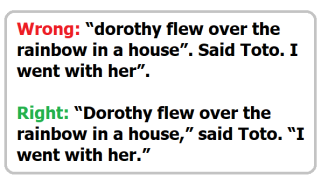
All, hands on deck”. Said the captain.

“What do we do with the drunken sailor? Blurted the First Mate!

“Put him in the scuppers at the lee rail. With the captain’s teddy bear,” replied the bosun

So, they put him in the scuppers, and all hands were finally on deck. Some were prone, but all were there until a rogue wave washed drunk dave and the soggy bear away.

I’m sure you noticed the problems when reading the above example.  I have several times been asked to edit work with problems of that magnitude. I respectfully declined the job. No editor has the time to teach a writer how to write.

The one place where the fundamental laws of grammar are allowed to deviate from the norm is in conversation. But even conversations have quantum laws we must follow.

I didn’t make these rules – readers make the rules because their ability to suspend disbelief is the universe we are writing to.

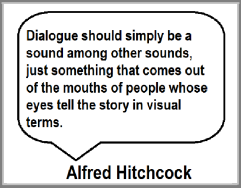
Alfred Hitchcock quote re dialogueCreating memorable characters is the goal of all authors. After all, who would read a book with bland and uninteresting dialogue? Dialogue is where most information is given to the characters and the reader. However, when we are just beginning to write, many of us are confused about how to punctuate conversations. It’s not that complicated. Here are four rules to remember:
Rule 1: Surround everything that is spoken with quotation marks. “I’m here,” Loretta said.

Begin and end the dialogue with “double quotes.” These are called closed quotes. All punctuation goes inside the quotation marks. This is a universal, cast-iron rule that we must follow.

Rule 2: When quoting someone else as part of a conversation, you should set the quoted speech apart with single quotes (apostrophes, inverted commas) and keep it inside the closed quotes.

You can do this in two ways:

  • George said, “When I asked her, Tammy replied, ‘I can’t go.’ But I’m sure she was lying.”
  • George said, “When I asked, Tammy replied, ‘I can’t go.'”

Note that in the second sentence, 3 apostrophes are placed after the period (full stop): 1 apostrophe and 1 double (closed) quote mark. This is in keeping with the rule that all punctuation goes inside the quotation marks in dialogue.

Indirect dialogue is a recapping of a conversation.

  • When asked, George said Tammy couldn’t go.

We don’t use quotes in indirect dialogue. Also, in the above sentence, the word that is implied between said and Tammy.

Rule 3: Commas—Do not place a period between the closed quotes and the dialogue tag. Use a comma because when the speech tag follows the spoken words, they are one sentence consisting of clauses separated by a comma: “I’m here,” she said.

  • When leading with a speech tag, the commas are placed after the tag and are not inside the quotation marks: She said, “I’m here.”
  • Dialogue that is split with the speech tag is all one sentence: “The flowers are lovely,” she said, “but they make my eyes water.” Note that the first word in the second half of the sentence is not capitalized.

Rule 4: When a speaker’s monologue must be broken into two paragraphs, lead off each with quotation marks but only put the closed quote at the end of the final paragraph. A wall of dialogue can be daunting in a story but sometimes happens in essays and when quoting speeches.

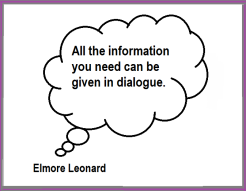
Elmore Leonard quote re dialogueWhen you envision your characters in conversation, you must think about what the word natural means. People don’t only use their words to communicate. Bodies and faces tell us a great deal about a person’s mood and what they feel.
Actions (also called beats) serve to punctuate the dialogue, give the scene movement, and maintain a strong mental picture in the absence of description.

George turned away, his expression cold. “She can’t go.”

These small actions can show a character’s mood and are often best placed where there is a natural break in the dialogue. They’re an effective tool and are essential to good conversations, but don’t rely entirely on them.

Just remember, certain facial actions are physically impossible to do while speaking. In life, they happen just before or after the words are spoken.

Try smiling and speaking at the same time. Or, try snorting the words out—it isn’t a pretty picture. Snorting=air goes in through the nose. Speaking=air goes out through the mouth.

They can be done at the same time—but it’s ugly.

Write those actions this way:

“Oh, she would say that.” Jane snorted.

“I love roses.” Tammy smiled. “But they make my eyes water.”

We do need speech tags of some sort. Nothing is worse than trying to figure out which character said what. I suggest using simple dialogue tags, like said or replied. Getting too creative with speech tags can cause the reader to stop reading out of disgust.

Even worse is when the action upstages the dialogue. The dialogue can fade into the background, obscured by the visual noise of the characters’ movements and facial expressions.

writng_dialogue_LIRFFor this reason, we don’t want to inject an excess of flushing, smirking, eye-rolling, or shrugging into the story. Those actions have a specific use in conveying the mood, but anything used too frequently becomes a crutch.
We must be creative, but speech tags must be unobtrusive. Achieving this balance is the hardest part of being an author.

To summarize, grammar and punctuation serve the same purpose as gravity, giving shape to the story and forming it into a familiar, identifiable structure.

Conversations, both spoken and internal, light up and illuminate the individual parts of the story, bringing the immensity of the overall story arc down to a personal level.

Good conversations and mental dialogues bring characters to life and turn them into our closest friends. The laws of grammar sometimes break down when our characters are speaking naturally.

But on the quantum level, punctuation is hard at work, holding the written universe together.

14 Comments

Filed under writing

How the written universe works part 1: the connecting particle #amwriting

The title sounds like we’re embarking on a lesson in physics. We are – in a way. We are embarking on a journey into the physics of how the written universe works. Our first dip into the atomic structure of a narrative will explore grammatical connections and how we make them.

How the written universe works 1First up is the particle. In grammar, a particle is a word with a specific purpose that depends on the words around it. It is a function word that is always associated with another word or phrase to impart meaning.
So, what is a pragmatic particle, and how does it differ from other particles? I suspect you use some form or another every day in your casual speech. English speakers use the pragmatic particle as a marker of empathy, a sound that indicates acknowledgment or agreement.

  • eh,
  • yo,
  • right,
  • oh,
  • well.

Pragmatic particles are short words and sometimes are prepositions. When used in conversations, these particles can express an entire sentence’s worth of meaning with just one word.

But use them sparingly, as they are annoying if used too frequently.

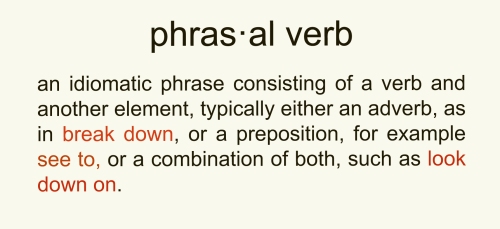
Many particles are action words, so they are technically verbs. But we don’t use them as stand-alone words. We instinctively use adverbs and prepositions as connectors and phrasal verbs. Adverbial particles are words like up or out, and we use them in expressions such as “break down” or “look up” or “knock out.” (Phrasal verbs.)

phrasal verbs

Some people habitually use the word “like” as a connection between thoughts.

Many other connecting words are prepositions. Some of the most common prepositions belonging to the particle category are: along, away, back, by, down, forward, in, off, on, out, over, around, under, and up.

And what of infinitive particles, like the word “to”? It is a word that signifies an unspecified place or ending. The possibilities of what “to” indicates are infinite unless we place a noun after it. We use it to provide a sense of where something is in relation to something else. We also use infinitives to supply a sense of when something is happening and compare two ideas, and express similarities.

  • to heaven
  • to work

Negative particles: not, never, doesn’t

Imperative particles: do and let.

In grammar, a conjunction is a connection: a part of speech that connects words, phrases, or clauses. Conjunctions are like any other essential part of English grammar. They have a particular use, and when they are used correctly, they blend into the background. Used too freely, they contribute to longwinded prose and bloated exposition.

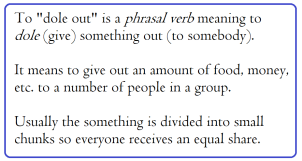
to dole out phrasal verbToday’s readers have no patience with Tolkien’s style of paragraph-long compound sentences composed of clause after clause divided by conjunctions, commas, and semicolons.
However, common conjunctions do have a place in our writing. They connect short, related sentences, preventing choppy, uneven prose.

And there are many other kinds of conjunctions.

What are coordinating conjunctions?

The Fount of All Knowledge, Wikipedia, says:

Coordinating conjunctions, also called coordinators, are conjunctions that join or coordinate two or more items (such as words, main clauses, or sentences) of equal syntactic importance. In English, the mnemonic acronym FANBOYS can be used to remember the coordinators for, and, nor, but, or, yet, and so.

Here are some examples of coordinating conjunctions in English and what they do:

For – presents a rationale (“They do not gamble or smoke, for they are ascetics.”)

And – presents non-contrasting item(s) or idea(s) (“They gamble, and they smoke.”)

Nor – presents a non-contrasting negative idea (“They do not gamble, nor do they smoke.”)

But – presents a contrast or exception (“They gamble, but they don’t smoke.”)

Or – presents an alternative item or idea (“Every day they gamble, or they smoke.”)

Yet – presents a contrast or exception (“They gamble, yet they don’t smoke.”)

So – presents a consequence (“He gambled well last night, so he smoked a cigar to celebrate.”)

Finally, we have correlative conjunctions. These words work in pairs to join words and groups of words of equal weight in a sentence. There are many different pairs of correlative conjunctions, but here are a few we often use without thinking about it:

  • Either / or
  • not only / but (also)
  • neither nor
  • both / and
  • whether or not
  • just as so
  • as much as
  • no sooner than
  • rather than not / but rather

Connecting words and phrasal verbs bind our prose together. They can create run-on sentences, but they can also smooth out choppy passages.

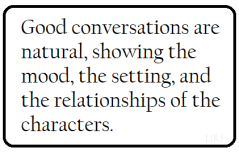
good_conversations_LIRFmemeI try to limit idioms and phrasal verbs to speech, and then only to that of one character. When used in conversation, they sound natural, but even there, I go lightly. I want to show a specific character’s personality but don’t want my prose to feel cliché and overdone.
We must use connecting words to ensure our narrative is easy to read and not too rough and uneven. But we must also avoid run-on sentences and tortuous paragraphs. When sprinkled too heavily throughout the narrative, idioms and phrasal verbs contribute to wordiness, bloating the prose.

Next up we’ll have a look at the quantum mechanics of grammar and the way to make those universal laws of physics work for you.


Credits and Attributions:

Wikipedia contributors, “Conjunction (grammar),” Wikipedia, The Free Encyclopedia, https://en.wikipedia.org/w/index.php?title=Conjunction_(grammar)&oldid=1076464370 (accessed March 31, 2022).

13 Comments

Filed under writing

#FineArtFriday: Sailboats by Jacoba van Heemskerck

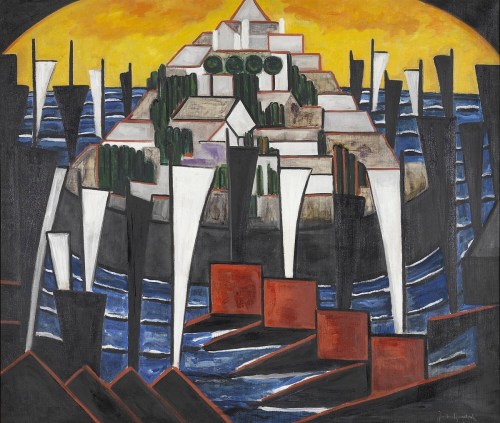
Sailboats by Jacoba van HeemskerckArtist: Jacoba van Heemskerck (1876–1923)

Title: Bild no. 15 (Segelboote) (English: Painting no, 15 – Sailboats)

Date: Circa 1914

Medium: oil on canvas

Dimensions: height: 97.5 cm (38.3 in); width: 113.5 cm (44.6 in)

Collection: Museum Boijmans Van Beuningen

What I love about this painting:

The sharp corners and geometry of this composition raises the viewer’s eye toward the horizon. It feels cubist, is abstract, and reflects a spiritual connection to her subject. I love the symbolism in this image. The sailboats are souls sailing toward the next life across a deep blue sea and beneath a golden sky. The island temple toward which the boats sail is shaped like a pyramid. The elongated sails of the many boats direct the eye up. Everything, including the island temple, points toward heaven.

In this painting, it is easy to see how she would later become involved in creating stained glass—the sharp black outlines and vivid colors of her paintings are perfect for that medium.

According to the Kunstmuseum Den Haag’s website:

“But whereas Mondrian’s artistic approach eventually became austerely geometrical, Van Heemskerck’s developed as a result of a variety of influences (including anthroposophy) into an open, unconstrained and intuitive style. Throughout her life, she would seek – like Kandinsky – to express spiritual experience. The recurring subjects in her oeuvre are therefore invariably symbolic in nature: sailing ships, bridges and trees, depicted in clear, vibrant colours and with firm outlines. Although she was never to abandon the representation of the real world, Van Heemskerck’s style was eventually so abstract that her subjects became virtually unrecognisable. This approach won her great success, especially in Germany, where she exhibited at the Berlin Expressionist gallery Der Sturm every year from 1913 until her death.” [1]

About the Artist, Via Wikipedia:

Jkvr. Jacoba Berendina van Heemskerck van Beest (1876-1923) was a Dutch painter, stained glass designer and graphic artist who worked in several modern genres. She specialized in landscapes and still-lifes.

Her first contact with Modern art came in Paris, where she took lessons from Eugène Carrière.[2][3] She remained in France until 1904, then went to live with her sister, Lucie, and was introduced to the art collector, Marie Tak van Poortvliet, who became her lifelong friend and later built a studio for her in the garden of her home.[1] After 1906, she spent her Summers in Domburg, where she came into contact with avant-garde painters such as Piet Mondrian[4] and Jan Toorop, who offered her advice. Around 1911, she was briefly interested in Cubism.

Shortly after, she became involved in Anthroposophy, possibly through the influence of her former teacher, Nibbrig, who was a Theosophist. She then became an avid follower of Der Sturm, an avant-garde art magazine founded by Herwarth Walden, and turned increasingly to Abstraction.[1] In 1913, she attended the Erster Deutscher Herbstsalon in Berlin, where she met Walden and started what would be a lifelong correspondence.[3] Thanks to his efforts, her work was popular in Germany, while it remained somewhat ignored in her home country.

After 1916, she developed an interest in stained glass windows, designing them for the naval barracks and the Municipal Health Department building in Amsterdam, as well as private residences.[1] From 1922, she lived in Domburg with her old friend and patron, Tak van Poortvliet.

She died suddenly, from an attack of angina.[3] Both Tak van Poortvliet and Walden mounted exhibitions of her work, in Amsterdam and Berlin respectively. In 2005, a major retrospective was held at the Gemeentemuseum Den Haag. [2]


Credits and Attributions:

[1] Kunstmuseum Den Haag contributors, “Jacoba van Heemskerck,” Jacoba van Heemskerck A REDISCOVERY, Jacoba van Heemskerck | Kunstmuseum Den Haag (accessed March 31, 2022).

[2]Wikipedia contributors, “Jacoba van Heemskerck,” Wikipedia, The Free Encyclopedia, https://en.wikipedia.org/w/index.php?title=Jacoba_van_Heemskerck&oldid=1078279427 (accessed March 31, 2022).

Comments Off on #FineArtFriday: Sailboats by Jacoba van Heemskerck

Filed under #FineArtFriday, writing

Critiques and Rejections #amwriting

Negative feedback is a necessary part of growth. When we submit our work to a critique group, we will get feedback, some of which will be perceived as unfavorable. The writing life is a rough playground. Some of us handle rejection or a thorough critique with grace and dignity, and others make an uncomfortable situation worse.

MyWritingLife2021BWe are emotional creatures. When we are just starting on this path, getting an unbiased critique for something you think is the best thing you ever wrote can feel unfair.

But it isn’t. No one writes perfect work all the time, but we have our moments of brilliance. It’s just they are moments, and some areas of a good work-in-progress will need revising and line editing to make it shine. A writers’ group can help you find the weaknesses in the overall story arc.

I have received my share of criticisms and rejections. At first, it hurt, but after a while of growing, I began to see what my fellow writers were trying to show me. I also began to understand why my work didn’t win prizes or get accepted into publications.

When I look back on my earlier work it is clear that I had no idea what a finished manuscript should look like. Nor did I understand how to get it to look that way. I didn’t understand how to write to a specified theme.

I didn’t understand how vital a strong, unifying theme is when an editor assembles the works of many authors into one book or magazine. That lack of knowledge on my part was why my work was rejected.

In those days, I always received a standard rejection that boiled down to “Sorry, but no.”

In my experience, boiler-plate rejections are bad only because they don’t tell us why the piece wasn’t acceptable. You never know whether the piece was merely not what the editor was looking for that day or if it is something they wouldn’t take for any reason.

When my work doesn’t make the cut, it’s because I have misread what the editors wanted, not quite nailing the theme as firmly as other writers did. Or, maybe what I thought was a great plot was cliched and boring, or perhaps it was too farfetched.

The key to peace of mind is to understand that most of what you write will NOT resonate with everyone you submit it to. Even if your writing group loved it.

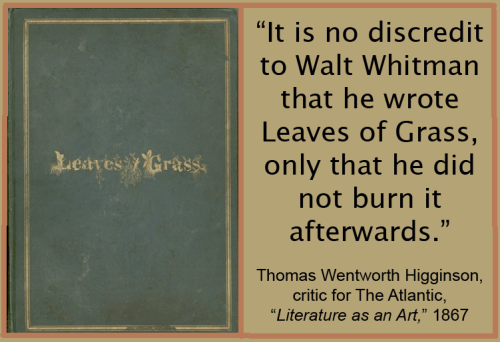
leaves of grass meme

If you put two people in a room and hand them the most thrilling novel you’ve ever read, you’ll get two different opinions.

Good rejections offer a little encouragement. “Try us again.” That means exactly what it says, so the next time you have something you think will fit with that anthology or magazine’s editor, send them a submission.

For me, the best kind of rejections are those that follow a story being optioned for an anthology, and then for one reason or another, the editor releases it back to you. Yes, it is disappointing when a story that was optioned doesn’t get printed after all, because money is nice.  But they are good, because the editor liked it enough to option it, and if you handle that disappointment with grace, they will probably print the next story you send them.

I know it doesn’t make sense, but the more an editor writes in a letter about why they have rejected a piece, the more likely the author will be hurt and angry. This is because it’s a rejection and may contain details about why it wasn’t acceptable for that publication.

I once got a rejection from an anthology in the form of a terse note with one handwritten sentence, signed by the editor. “This subject has been done before.”

I was surprised by the curtness of the note, but after a moment, I realized that was just this particular editor’s way. He’s a busy man but took the time to send me a note instead of a form letter.

The single blunt sentence was a bit off-putting, but I learned a lot from that particular rejection. I have to try harder to imagine original situations instead of trying to write what I think will sell. I have to write from the heart and not worry about whether or not I’m writing a commercially viable story.

War_and_Peace_Franklin_Library_By_Leo_Tolstoy_First_Edition_1981I could have embarrassed myself and responded childishly, but that would have been foolish and self-defeating. When I really thought about it, I realized that particular plot twist had been done many times before. I thanked him for his time because I had learned something valuable from that experience.
I still love the concept of that story and the characters, but it’s an unmarketable story the way it was written. I have that tale in a file, and someday I will rewrite it, but with a more imaginative quest for the plot.

We must have a care about the way we behave. We are judged by how we act and react in every professional interaction. If you respond to a peer’s criticism without cooling down and thinking it through, you risk irreparable damage to your career.

You really don’t want your name to be a prominent entry on that editor’s “no way in hell” list.

An editor’s personal response that is a rejection means they have read your work and gone to some trouble for you.

DO NOT respond to the letter with a flame-mail, and DO NOT bad-mouth that editor or publication in your favorite writers’ forums. Editors are also authors, and they have friends who are authors. They may be involved with the same forums and all the many social platforms you are, so have a care what you say online.

They’re just like the rest of us—and they’ve experienced their share of rejection. If you respond publicly and unprofessionally, innocent bystanders will remember you and won’t want to work with you either.

But what if you received a request for revisions? Don’t be insulted! Celebrate and get cracking. Make those revisions. Do what that editor has asked and make no complaint.

When an editor wants changes, they like the work but can see how it could be made stellar. Be a professional and work with them. You might learn something.

Finally, never be less than gracious to the editor when you communicate with them.

My Coffee Cup © cjjasp 2013Treat all your professional contacts with courtesy, no matter how angry you are. Allow yourself some time to cool off. Don’t have a tantrum and immediately respond with an angst-riddled rant.

Sometimes we forget that how we interact online with others is public information and is visible to the world. When an interested reader Googles our author name, our online interactions and petty tantrums on Goodreads, Twitter, and every other public forum will be available for eternity.

Be respectful, even if the magazine or anthology you were rejected from is a minor player in the publishing world. Don’t say, “Well, that editor’s a nobody.”

Every famous editor/author begins as a nobody. All editors receive work that must be rejected.

How you respond to criticisms and rejections is where you have the chance to cross the invisible line between amateur and professional. Always take the high ground. If an editor has sent you a detailed rejection, it’s appropriate to respond with a simple “thank you for your time.”

12 Comments

Filed under writing

Road Trip to Human Frailty #foodie

This last weekend we drove 100 miles north to the town of Snohomish to visit our oldest daughter and her family. We left our house early to avoid the worst of traffic, so we made it two hours.

road tripLeah and Tom have no spare bedrooms until the remodel is done. So, we stayed at the Snohomish Inn, two blocks away. It’s an older place but clean.
The first thing we did on arriving in Snohomish was to go with our daughter to our favorite lunch place, Grilla Bites. They have a fantastic menu with various vegan, vegetarian, and omnivore foods.

Every diner has a lot of choices in soups and sandwiches, so no one should go home hungry. I certainly didn’t.

Then we went back to the daughter’s house and watched 2 movies I hadn’t yet seen but wanted to. Pixar’s Coco and Soul—I loved them both. The storylines were uplifting and thought-provoking, brilliant storytelling, and brilliant voice acting.

And food?  OhMaGosh!

Thanks to my son-in-law, Tom, I seriously overate this weekend. Tom’s hobby is cooking fancy, restaurant-quality foods for us, and he outdid himself. He made a deep-fried chicken fillet and poutine for the omnivores, and a lovely meal for me, with plenty of his amazing homemade French fries. (Chips to you in the UK.)

Whether for the lone vegan (me) or the omnivores, everything was plated beautifully and tasted even better.

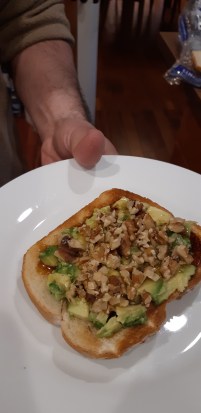
Tom's avocado Toast for the vegan mother-in-lawSunday morning began with the best avocado toast I’ve ever had. Everyone who knows me has heard how much I love that particular dish. Tom’s version is incredibly simple: a good bread, toasted and topped with mashed avocado, chopped walnuts sprinkled over the top, and a teensy drizzle of honey. It sounds odd, but wow. That was a divine, filling breakfast. The picture I took doesn’t do it justice.
After leaving Snohomish, we stopped in Bothell to visit our younger son. We met for lunch at the Beardslee Public House. They had several tasty-looking options for me, but the vegan Benedict was my choice. Even though I don’t do hollandaise sauce, I didn’t miss it because the charred avocado, spinach, and tomato were grilled perfectly. Paired with the pub’s signature russet potato hash, it was delicious.

So, while I didn’t get much writing done, we had a great weekend.

One of the good things about living here in the Pacific Northwest is the number of restaurants that also provide a variety of plant-based options for diners of all persuasions. I especially appreciate those chefs who care about all the people who might enter their premises. They don’t lump gluten-free and vegan into one carelessly planned, slightly bland, punishment meal.

Taste is a primary sensory experience, as is texture. I’m vegan, but every person has foods they will or won’t eat. They have good logical reasons behind those choices. Some people are strictly kosher, and others are halal. Others are vegetarian, and still others are omnivores. Every culture has standards of cleanliness and what food is fit for consumption–something you can work into your worldbuilding.

We can’t judge others by our standards, even though that is a time-honored human frailty. My son-in-law loves me, and he gets it. A simple dish like avocado toast goes a long way toward making me a happy diner!

So, what other human frailties did I deal with this week? I’ve been using Excel since 1993 and it still finds ways to aggravate me.

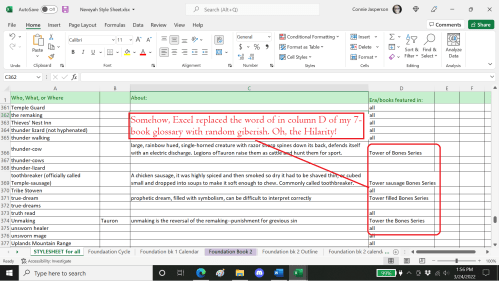
Somehow, Excel got crazy with the word “of” in my World of Neveyah glossary (covering 7 books). It replaced every instance of “of” in column D with random words drawn from the explanations in Column C. Two hours wasted, laughing and trying to straighten it out. Fortunately, it was only fifty or so words out of over 400.

Every time I ran across a new blooper, it cracked me up.

I have no idea how such a weird merge happened, but it was hilarious. It has to be some inadvertent thing I did when pasting a new section into it. I somehow merged column C and column D when I right-clicked to paste the new page of words and meanings. Unaware of that, I sorted the page alphabetically, which mixed the wonky errors all through the entire list.

It’s straightened out now, but it the fact it was only the word “of” that was replaced made me laugh so hard my husband thought I was nuts. See the screenshot below–every time I see this image, I can’t help laughing.

screenshot of Excel stupidnessAnd as a final twist to the craziness–we were finally getting ready for sleep in our hotel room, both of us tired but feeling good about our day. All our toiletries were in a small, dark zipper-bag.
I can only say from personal experience – hydrocortisone cream does not make a good toothpaste.

That is all I have to say on that subject.

And so my friends, may you eat well, write what you feel passion for, and laugh every chance you can.

7 Comments

Filed under writing

#FineArtFriday: The Lacemaker by Nicolaes Maes ca. 1656 (revisited)

The Lacemaker

  • Artist   Nicolaes Maes
  • Year    c. 1656
  • Medium           oil paint, canvas
  • Dimensions     45 cm (18 in) × 53 cm (21 in)

What I love about this painting:

Working from home is nothing new. Women have sewn, made lace, or taken in laundry to earn coins for as long as they have been mothers. Finding ways to earn a living and still raise the family has always been a struggle. Maes painted real women doing real work to support their families. Other artists painted women of the taverns and streets, but Maes had respect for the women he painted.

About this image, via Wikipedia:

The Lacemaker (circa 1656) is an oil on canvas painting by the Dutch painter Nicolaes Maes. It is an example of Dutch Golden Age painting and is part of the collection of the Metropolitan Museum of Art.

This painting is typical of many paintings of women in interiors painted by Maes in the 1650s. The woman is making bobbin lace using a lace pillow that can be seen in other Maes paintings of lacemakers.

The child in a highchair was a popular subject for many Dutch genre painters, and this painting shows how it was used as a safe place to play as well as for eating. The empty bowl of porridge is on the floor along with some other items the boy has let fall. He is wearing a red valhoed or falling cap, which seems to indicate that confinement in the chair is necessary if any lacemaking is going to get done.

baby bumper headguard cap, also known as a falling cap, or pudding hat, is a protective hat worn by children learning to walk, to protect their heads in case of falls.

Known as a pudding or black pudding, a version used during the early 17th century until the late 18th century was usually open at the top and featured a sausage-shaped bumper roll that circled the head like a crown. It was fastened with straps under the chin.

About the Artist via Wikipedia

From Wikipedia: Nicolaes Maes, also known as Nicolaes Maas (January 1634 – November 24, 1693 (buried)) was a Dutch Golden Age painter of genre and portraits. In about 1648 he went to Amsterdam, where he entered Rembrandt‘s studio. Before his return to Dordrecht in 1653 Maes painted a few Rembrandtesque genre pictures, with life-size figures and in a deep glowing scheme of colour, like the Reverie at the Rijksmuseum in Amsterdam, the Card Players at the National Gallery, and the Children with a Goat Carriage. So closely did his early style resemble that of Rembrandt, that the last-named picture, and other canvases in the Leipzig and Budapest galleries and in the collection of Lord Radnor, were or are still ascribed to Rembrandt.

In his best period, from 1655 to 1665, Maes devoted himself to domestic genre on a smaller scale, retaining to a great extent the magic of colour he had learnt from Rembrandt. Only on rare occasions did he treat scriptural subjects, as in Hagar’s Departure, which has been ascribed to Rembrandt. His favorite subjects were women spinning, or reading the Bible, or preparing a meal. He had a particular fascination with the subject of lacemaking and made almost a dozen versions on this subject.

While he continued to reside in Dordrecht until 1673, when he settled in Amsterdam, he visited or even lived in Antwerp between 1665 and 1667. His Antwerp period coincides with a complete change in style and subject. He devoted himself almost exclusively to portraiture, and abandoned the intimacy and glowing color harmonies of his earlier work for a careless elegance which suggests the influence of Van Dyck. So great indeed was the change, that it gave rise to the theory of the existence of another Maes, of Brussels. His registered pupils were Justus de GelderMargaretha van GodewijkJacob Moelaert, and Johannes Vollevens.[1] Maes died in Amsterdam.


Credits and Attributions:

Wikipedia contributors, “The Lacemaker (Maes),” Wikipedia, The Free Encyclopedia, https://en.wikipedia.org/w/index.php?title=The_Lacemaker_(Maes)&oldid=799625637 (accessed December 12, 2019).

Wikipedia contributors, “Baby bumper headguard cap,” Wikipedia, The Free Encyclopedia, https://en.wikipedia.org/w/index.php?title=Baby_bumper_headguard_cap&oldid=914539353 (accessed December 12, 2019).

Wikipedia contributors, “Nicolaes Maes,” Wikipedia, The Free Encyclopedia, https://en.wikipedia.org/w/index.php?title=Nicolaes_Maes&oldid=815679835 (accessed July 12, 2018).

2 Comments

Filed under #FineArtFriday

Exploring Theme part 4: Allegory #amwriting

Over the previous three posts, we’ve looked at the many ways themes can be employed in the stories we write. Themes exist in every story but can be difficult to identify if we have no plan to write to.

allegory2When you are pantsing it (writing-by-the-seat-of-your-pants), themes are like your drunk uncle. They hang out at the local pub until closing time and then weave their way home through dark alleys. Sometimes, as you are leaving for work in the morning, you find them under the neighbor’s shrubs. Other times they make it home.
If you still haven’t identified the defining theme when you have finished your first draft, look in the first chapters of your story. You may find clues sprinkled throughout the story, hints to point the reader toward the theme.

If you still haven’t identified the theme, you may be trying too hard. Often, the theme can be found in the things and events that are hindrances to happiness.

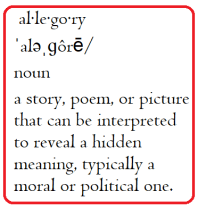
Allegory is an excellent tool to use when we want to emphasize a theme without beating our readers over the head. Allegories are objects within a story, poem, or picture that can be interpreted to reveal a hidden meaning,

A well-crafted allegory can subtly underscore your themes to drive home your point without resorting to an info dump.

Using symbolism and allegory allows an author to pack the most information into the least number of words. But it requires intention when you first begin creating the story arc. Words, phrases, and settings must be chosen, and the narrative’s prose must be purposefully crafted.

At the surface level, each genre looks widely different. But when you go deeper, you find that all literary genres have one thing in common: they have protagonists and side characters who all must deal with and react to the book’s underlying theme.

Highlighting a strong theme can be a challenge if you begin without an outline. A plan is not always required because, in some stories, the flash of inspiration we start with is a strong theme. The theme develops as you write, and immediately, you see what it is.

Personally, I need an outline most of the time.

Whatever the case, once you have identified the central theme, you can write the story in such a way that it is shown through:

  • Actions
  • Symbolic settings/places
  • Allegorical objects deliberately placed within the setting
  • Conversations

It can be difficult to decide the underlying theme, making the story weak. It has no legs and won’t ring true until you find what that unifying idea-thread is. This requires a little mind-wandering on your part.

allegoryI often sit on my back porch and just let my thoughts roam, thinking about nothing in particular. Usually, I will end up considering the character’s quest or dilemma. I ask myself what the root cause of the issue is—if it is a crime, why is crime rampant? Is it a societal problem, such as poverty or war? If the core dilemma is unrequited love, what are the roadblocks to a resolution?
Once I identify the root cause of the problem, I can see the themes. If the problem is poverty, dealing with and overcoming it becomes the theme throughout the story. You don’t have to say “they were dirt-poor” every scene. Yes, many of the poorest people are homeless. However, most people whose incomes are near or below the poverty line have homes and jobs.

People are not cliches. Most poor people work one or two jobs to keep food on the table and a roof over their family’s heads. They don’t have the time or money to be drunks or drug abusers—their wages go to providing as good a life as they can for their families. People can be shown as being basically happy in an environment that isn’t wealthy. Life has subtleties, and a strong theme can reinforce those nuances when it is shown through the use of allegories.

Poverty can be represented through many symbolic objects in their home or neighborhood:

  • Cracks in sidewalks
  • Cracks in mirrors
  • Chips in crockery
  • Peeling wallpaper
  • Broken-down vehicles

Whenever I talk about allegory, I like to use the movie, The Matrix as my example. Most people are familiar with the movie but aren’t consciously aware of the amount of symbolism and allegory that is laced into it. The films of The Matrix franchise pit man against machine in a clearly drawn battle, but they also reveal that the humans are more machinelike than they think and that the machines possess human qualities as well.

These are the prominent themes, but there are several simultaneous underlying concepts.

In the movie’s opening scenes, symbolism is used to underscore Neo’s unacknowledged dissatisfaction, a discontent he is unaware of. This unspoken unhappiness is shown in many ways. Allegory is built into their androgynous costumes and in the screenwriters/authors’ choice of words used in every conversation.

The symbolism continues in the way the setting is so sparsely dressed. Every object that is shown onscreen has a purpose and a meaning. Even the characters’ names are symbolic.

The themes are represented with heavy symbolism in the lighting used on the movie set:

>Inside The Matrix, the world is bathed in a green light as if filmed through a green-tinted lens.

>In the real world, the lighting is harsher, unfiltered.

In the movie, everything that appears or is said onscreen is symbolic and supports one of the underlying concepts. When Morpheus later asks Neo to choose between a red pill and a blue pill, he essentially offers the choice between fate and free will.

powerwordsWordCloudLIRF06192021These layers offer us an incredible amount of subliminal information about that surreal world and what is going on in reality, what the Matrix truly is.
I try to picture conversations, clothing, setting, and the broader environment as if I were creating a scene in a movie. How can I use allegory to support my story arc?

When we are immersed in reading a book or watching a movie, we don’t notice the heavy symbolism on a conscious level. However, it is all there on closer examination, making the imaginary real, solid, and concrete.

This post winds up our four-part dip into theme. Thank you for sticking with me! Below are the links to the previous posts in this series.

Exploring Theme part 1 – Henry James

Exploring Theme part 2 – Jane Austen

Exploring Theme part 3 – Learning from poetry

16 Comments

Filed under writing

Exploring theme part 3: learning from poetry #amwriting

Poems are stories told in a highly structured fashion. They are stories about the feelings one has for a place or a person, the emotions one feels when faced with shattering circumstances. Poems can be heroic and epic or tightly constrained to one moment, one person’s thoughts.

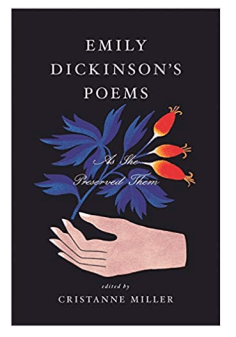
2WritingCraft_themePoets understand how central a theme is to the story. A poet takes the theme and builds the words around it. Emily Dickinson’s poems featured the themes of spirituality, love of nature, and death, which is why she appealed so strongly to me during my angsty young-adult life.
Via Wikipedia:

Emily Elizabeth Dickinson (December 10, 1830 – May 15, 1886) was an American poet. Little-known during her life, she has since been regarded as one of the most influential figures in American poetry.

Evidence suggests that Dickinson lived much of her life in isolation. Considered an eccentric by locals, she developed a penchant for white clothing and was known for her reluctance to greet guests or, later in life, to even leave her bedroom. Dickinson never married, and most friendships between her and others depended entirely upon correspondence.

While Dickinson was a prolific writer, her only publications during her lifetime were 10 of her nearly 1,800 poems, and one letter. The poems published then were usually edited significantly to fit conventional poetic rules. Her poems were unique for her era. They contain short lines, typically lack titles, and often use slant rhyme as well as unconventional capitalization and punctuation. Many of her poems deal with themes of death and immortality, two recurring topics in letters to her friends, and also explore aesthetics, society, nature and spirituality.

If one only knew that she had been agoraphobic and never left her room in an era where the internet didn’t exist, one would think she knew nothing of the world and had nothing to say that would be worth reading.

dickinsons poemsBut that would be wrong. Poets write words that range far more widely than their physical surroundings. Some poets are constrained by unrewarding jobs, others may be “on the spectrum,” as they now say, and still others are constrained by physical limitations.
Poetry is a craft that uses words to explore the interior life of a moment, a place, or an idea. Fleshing out and exploring every nuance of a theme is a core function of poetry.

A theme that Emily Dickinson often wrote about is “the undiscovered continent.” Literary scholars consider that Dickinson saw the mind and spirit as tangible visitable places she inhabited for much of her life.

As solitary as her life was, this interpretation of the undiscovered continent makes sense. It is the “landscape of the spirit,” embellished with nature imagery. It is imagery meant to convey a dwelling place of “oneself” where one resides with one’s other selves. It is an expansive, liberating force.

For example, in “They shut me up in Prose –,” she sets out the idea that society enforces limits upon the speaker, confining her to the acceptable female roles, concealing her to prevent her from expressing herself. But her prose is a product of her mind and refuses to be constrained.

Those constraints inspire her, fuel her drive to write. Society cannot limit her mind, no matter how they try. In the poem “I dwell in Possibility –”she shows us that limits are an illusion to one who dwells in possibilities.

Quote from GradeSaver:

“I dwell in Possibility –”is deeply interested in the power gained by a poet through their poetry. In the first stanza, the poem seems to just be about poetry as a vocation as opposed to prose and is explicit in comparing the two. The metaphors and similes used make it so that poetry is possibility, poetry is more beautiful, poetry has more doors and windows open for access, for different perspectives and interpretations, while prose by default, then, is more closed and limited and homely. [1]

Dickinson showed us how important employing themes can be when finding words to express our intent. Her work demonstrates that themes can be as common and ordinary as the juxtaposition of chaos and stability (or order), the fear of death, love of nature, or the expression of faith in God.

The 19th-century songwriter Stephen Foster employed the theme of rural poverty, using the term hard times to turn his simple songs into anthems that people embraced and are still singing. Tommy Fleming’s version can be heard here. The crowd embraces that song today as much as they did when it was written. Its popularity is due to the way Foster employed his theme, the way he presented it with words and melody.

‘Tis a sigh that is wafted across the troubled wave,
‘Tis a wail that is heard upon the shore
‘Tis a dirge that is murmured around the lowly grave
Oh! Hard times come again no more. [2]

But what of writers who don’t write poetry? How do we who write novels and short stories use themes in our work?

The possibilities are limitless.

An aspect of a setting can become a theme. These can be as solid and physical as a particular rock or tree that acquires an emotional meaning to the characters in the narrative. These physical objects gain a sense of presence that recurs throughout the story.

Or they can be as complex and intangible as a mental landscape that allows a prisoner to roam freely.

Poets have a lot to teach those of us who write narrative prose.

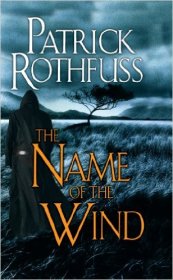
The Name of the Wind by Patrick Rothfuss 2nd coverFantasy author Patrick Rothfuss knows how to make use of a strong theme. He uses the theme of silence to create a powerful opening to his novel, The Name of the Wind. The opening paragraphs of that novel hooked me.

To wind up this dip into poetry, themes are the unifying threads woven through our work, connecting the dots and holding the plot together. The words we choose and other elements of the story, such as the setting, are how we present our themes. Themes, in turn, color our words and setting and steer the plot.


Credits and Attributions:

[1] Cullina, Alice. Chainani, Soman ed. “Emily Dickinson’s Collected Poems “I dwell in Possibility –” Summary and Analysis.” GradeSaver, 26 July 2009 Web. 20 March 2022.

[2] “Hard Times Come Again No More” (sometimes, “Hard Times“) PD|100. Written by Stephen Foster. Published in New York by Firth, Pond & Co. in 1854.

10 Comments

Filed under writing