
In the publishing world, there are several different kinds of editors: line editors, structural editors, submissions editors, and so on. Each does a specific job within the industry. When you look at the annual salaries, you can see that none of these jobs pay well, so it’s clear that, while they like to eat and pay the mortgage as much as any other person, editors in all areas of publishing work in the industry because they love a good story.
 Today we are discussing a particular kind of editor: the submissions editor. When I first began this journey, I didn’t understand how specifically you have to tailor your submissions for literary magazines, contests, and anthologies. Each publication has a specific market of readers, and their editors look for new works their target market will buy.
I’m just going to lay it out there for you: it’s not worth a publisher’s time to teach you how to be a writer. You have to learn that on your own.
So, if magazine editors aren’t going to edit your work, what does the editor for that publisher do? Magazine editors look for and bring new and marketable stories to the reading public.
Marketable is the keyword. If your submission doesn’t fit what that magazine’s readers expect, the editor will reject it.
 The quality of your work isn’t the problem, and you have selected a publication that features work in your chosen genre. But your subgenre may not match what the readers of that publication want to see. After all, both spaghetti Bolognese and bruschetta are created out of ingredients made from wheat and tomatoes, but the finished meals are vastly different.
A person who craves spaghetti Bolognese won’t be satisfied with an offering of bruschetta despite the fact they both feature wheat and tomatoes. The genre may be Italian, and they feature the same ingredients. But the delivery method is a subgenre that may not appeal to every diner.
Editors for contests and large publishers of books do the same—they find and bring work they enjoy to the public in specific genres. If your story makes it through the publisher’s door and into the first part of their process, their editor may ask you for minor revisions, small things you may have missed when self-editing.
But they won’t offer you technical advice.
This is because they shouldn’t have to. Before submitting your work to an agent or submissions editor, you must have the technical skill down.
For the indie author, magazines, contests, and anthologies are the most logical places for getting their names out to the reading world. You must ensure you have a clean manuscript that is marketable to the readers of the publication you are courting. You may need to have someone in your writing group proofread it before submitting it.
Professionals do the required work and don’t think twice about it—self-editing and proofreading are just part of the job.
 Some hobbyists expect special consideration and are offended when they don’t get it. Egos are rampant in this business, but in reality, no one gets to be treated like a princess.
Prominent publications have wide readerships. The more people who read and enjoy a short piece by you, the more potential readers you have for your novels. These people likely read books, and guess what? They might look for your novels when shopping for books at Amazon, Barnes & Noble, and other digital booksellers.
When you have a great story that you believe in, you must find the venue that publishes your sort of work. Know your genre. If you write fantasy, google magazines featuring fantasy and sci-fi. A good place to start would be the website Worlds Without End, an author resource site listing magazines that publish fantasy and science fiction.
Not all publications will be accepting new work, but some will. Be warned—finding magazines with open calls for submissions is a lot of work.
Anthologies with open calls might be more plentiful, but you have to know how to find them. Make connections through the many writers’ forums on Facebook and other social media platforms.
If you haven’t any short work ready for submission but would like to write something, do some research before setting pen to paper. Buy magazines, read them, and write to those standards.
For those of us who can’t afford to buy magazines, you can go to websites like Literary Hub and read excellent pieces culled from various literary magazines for free. This will give you an idea of what you want to achieve in a story and where you might consid er sending your work.
Go to the publisher’s website, find out their submission guidelines, and FOLLOW THEM. (Yes, they apply to EVERYONE, no matter how famous, even you.) If you skip this step, you can wait up to a year to hear that your manuscript has been rejected, and they most likely won’t tell you why.
Formatting your manuscript is crucial. When the editor of a contest, publication, or anthology opens the call for submissions, they will get hundreds of entries, perhaps thousands. Their editors will have no time to deal with badly formatted manuscripts when a call goes out.
Editors are only one person, and they want to read every submission. Publishers have specific, standardized formatting they want you to use, and these guidelines are clearly posted on their websites.
Time is always of the essence in the publishing world. Publication dates are set well in advance and must be adhered to. Unfortunately, some great stories won’t even be read out of all the entries they receive. This is because the author didn’t format the manuscript in the way the submission rules stated.
Expediency kicks in. If the first page shows the manuscript is not formatted to industry standards, the editor will reject it and move on to the next submission.
A few simple formatting rules are universal to most publications. You should ensure the font is Times New Roman .12 or Courier .12 font and the body of the manuscript is aligned left.
- 1 in. margins
- Double-spaced
- 1 space after each sentence (NOT 2 as we dinosaurs were taught in typing class)
- Each page is numbered in the upper right-hand corner
- Has formatted indented paragraphs (DO NOT USE THE TAB TO INDENT!)
- The header contains the title and author’s penname
- The first page includes the author’s legal name, mailing address, and phone or email contact information in the upper left-hand corner
 Please, if you consider yourself a professional, format your submissions properly. You want to stand out but getting fancy with your final manuscript is not the way to do that—you will be rejected out of hand if you don’t make this effort.
Below are the links to two posts (with screenshots) detailing how to make your manuscript submission-ready:
Formatting Short Stories for Submission
You have to keep trying, keep improving as an author, and keep believing in yourself and in your work. Most importantly, you must never give up.
 Most editors will ask to see the first twenty pages of your manuscript before they agree to accept the job. Sometimes, significant issues will need to be addressed. If so, an editor will probably refuse to accept your manuscript. However, they will tell you why and give you pointers on how to resolve the problems.
 For new and beginning authors, it may take an editor more than one trip through a manuscript to straighten out all the kinks. This may be a three-step process involving you making the first round of revisions and/or explanations, sending them back to the editor, who will make final round of suggestions. At that point, the editor is done. You have the choice to either accept or reject those suggestions in your final manuscript.
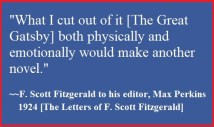 For creative writing, editing is a stage of the writing process. A writer and editor work together to improve a draft by correcting punctuation and making words and sentences clearer, more precise. Weak sentences are made stronger, info dumps are weeded out, and important ideas are clarified. At the same time, strict attention is paid to the overall story arc.
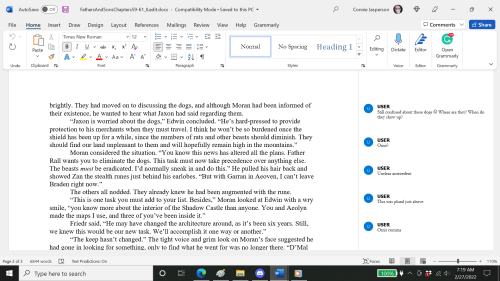 Editors who have been in the business for a long time find it much faster to use the markup function and insert inline changes. A new author or someone unfamiliar with how word-processing programs work might find it confusing and difficult to understand.
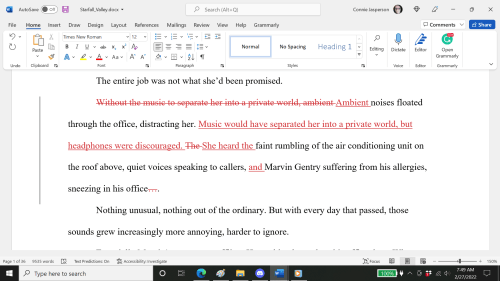 Inserting the changes and using Tracking cuts the time an editor spends on a manuscript. Writing comments takes time, and suggestions may not always be clear to the client.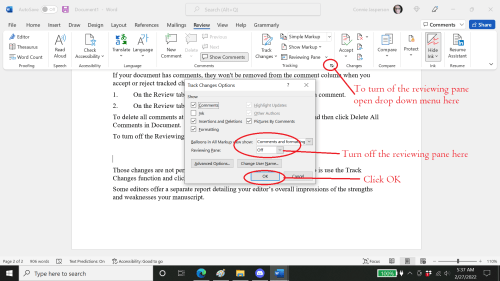
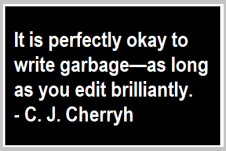 However, many authors don’t have the money to hire an editor. If that is the case, you may have a friend in your writing group who has some experience editing, and they will often help you at no cost. Your writing group is a well of inspiration, support, and wisdom, and they are invested in your book. They want you to succeed and most will gladly trade services.
 When I am finished with the revisions, I will format my manuscript as both ebooks and paper books. At that point, I will be looking for proofreaders.
 If you didn’t see it when I mentioned it above, I will repeat it: proofreading is not editing. We discussed self-editing in my previous post,
 Repeated words and cut-and-paste errors. These happen when making revisions, even by the most meticulous of authors. The editor won’t see any mistakes you introduce after they have completed their work on the manuscript.
 Unfortunately, my last book went live when I thought I was ordering a pre-publication proof.
 In some ways, novels are machines. Internally, each book is comprised of many essential components. If one element fails, the story won’t work the way I envision it.
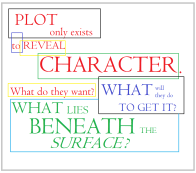 So, realizing I knew nothing was the first positive thing I did for myself. I made it my business to learn all I could, even though I will never achieve perfection.
 I use this function rather than reading it aloud myself, as I tend to see and read aloud what I think should be there rather than what is.
 This is a long process that involves a lot of stopping and starting, taking me a week to get through an entire 90,000-word manuscript. I will have trimmed about 3,000 words by the end of phase one. I will have caught many typos and miskeyed words and rewritten many clumsy sentences.
 This is the phase where I look for info dumps, passive phrasing, and timid words. These telling passages are codes for the author, laid down in the first draft. They are signs that a section needs rewriting to make it visual rather than telling. Clunky phrasing and info dumps are signals telling me what I intend that scene to be. I must cut some of the info and allow the reader to use their imagination.
 Editing programs operate on algorithms and don’t understand context. I am wary of relying on Grammarly or ProWriting Aid for anything other than alerting you to possible problems. If you blindly obey every suggestion made by editing programs, you will turn your manuscript into a mess.
 Our stories take the reader to exotic places and introduce them to other realities. When we publish a book, we hope it will find a reader on the day they were looking for just such an escape.
 I wrote poetry and lyrics for a heavy metal band when I first started out. I was young, sincere, and convinced I had to impart a message with every word. I didn’t know until twenty years later when I came across my old notebook that my poems weren’t honest. Eighteen-year-old me was trying to make a point rather than offering ideas for further thought.
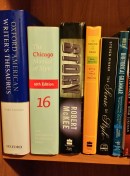 Children are unimpressed by the fact their parents might write a story or play music or paint or do any of the creative arts.
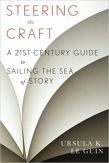 As Ursula K. LeGuin said in her excellent book,
 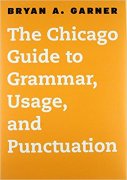 day, should we so desire. Reading is how we come to understand writing and the art of story. Mr. King also admonishes us to learn the fundamentals of punctuation and grammar.
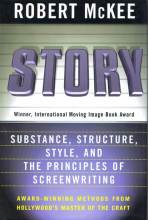 Every editor will tell you no amount of money is worth the time and effort it would take to teach an author how to write coherent, readable prose. That is what seminars, books on craft, and books on style and grammar are for.
 I want to read an honest story about people who seem real, who have the kind of problems we can all relate to on a human level. I want to read a story that comes from an author’s deepest soul. The setting doesn’t matter—it can be set on Mars or in Africa. Characters matter, and their story matters.
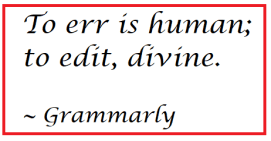 Today I am revisiting three wonderful quotes on these rules from
  Actually, my large dirty minivan is not as comfortable to ride in as it used to be. Grandma’s imaginary red Ferrari would be a lot more fun, but alas—if wishes were Ferraris, my driveway would look a lot fancier.
 Have you ever wondered why we say fiddle-faddle and not faddle-fiddle? Why is it ping-pong and pitter-patter rather than pong-ping and patter-pitter? Why dribs and drabs rather than vice versa? Why can’t a kitchen be span and spic? Whence riff-raff, mishmash, flim-flam, chit-chat, tit for tat, knick-knack, zig-zag, sing-song, ding-dong, King Kong, criss-cross, shilly-shally, seesaw, hee-haw, flip-flop, hippity-hop, tick-tock, tic-tac-toe, eeny-meeny-miney-moe, bric-a-brac, clickey-clack, hickory-dickory-dock, kit and kaboodle, and bibbity-bobbity-boo? The answer is that the vowels for which the tongue is high and in the front always come before the vowels for which the tongue is low and in the back. (Pinker, The Language Instinct, 1994:167) [3]
 Writing fiction allows me to put reality into more palatable chunks. It’s easier to cope with that way.
 We all draw inspiration from real life, whether consciously or not. However, if we are writing fiction, we must never detail people we are acquainted with, even if we change their names.
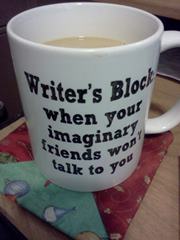 The best thing is that you don’t actually know a thing about them other than they like a Double Tall Hazelnut Latte. Peoples’ conversations are unguarded in coffee shops, openly talking about what moves them or holds them back. They are lovers or haters, quiet or loud, and most importantly, anonymous.
 Several years ago, I read a fantasy book where the author clearly spent many hours on the food of her fantasy world and the various animals. She gave each kind of fruit, bird, or herd beast a different, usually unpronounceable, name in the language of her fantasy culture.
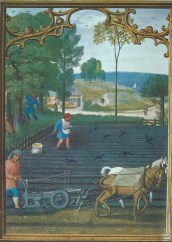 As many of you know, I have been vegan since 2012. However, during the 1980s, my second ex-husband and I raised sheep. Most of the meat we served in our home was raised on his family’s communal farm. Our chickens and rabbits roamed their yard and had good lives, and our family’s herd of twenty sheep was managed using simple, old-style farming methods.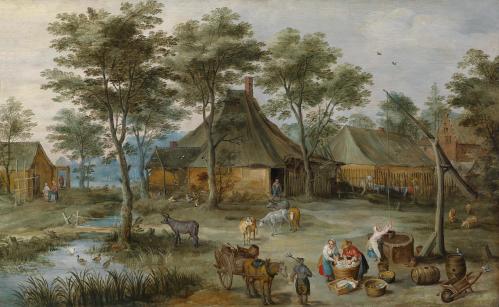
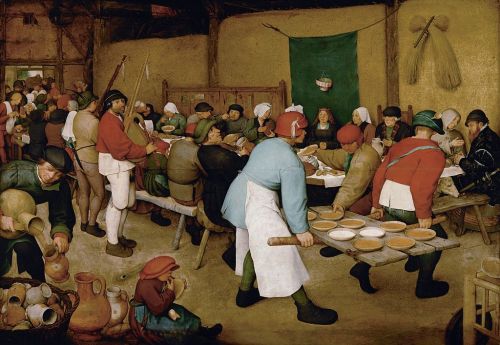
 Knowing what to feed your people keeps you from introducing jarring components into your narrative. In
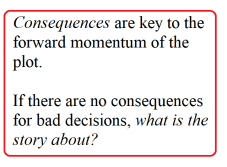
  Let’s look at both the meanings and synonyms for the word consequences.
 In the morning, after the unexpected (and unwanted) guests leave, he has two choices, to stay in the safety of Bag End, or hare off on a journey into the unknown. He chooses to run after the dwarves, and so begins the real story—how a respectable hobbit became a burglar and became a hero in the process.
 The blade does not acquire its name until later in the adventure, after Bilbo, lost in the forest of Mirkwood, uses it to kill a giant spider and rescue the Dwarves. This is when Bilbo’s decisions become more thoughtful, and his courageous side begins to emerge.
 This is an excellent time to look at the freedom we give our characters to act and react within the story. I have mentioned many times that I am a plotter. However, when I am in the process of writing the first draft of a novel, the characters sometimes take over. The plot veers far from what I had intended when I began writing it.
 This happens because my work is character-driven, and sometimes, they’re like demolition derby drivers.
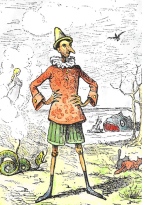 This is called giving your characters “agency.” Agency is an integral aspect of the craft of writing. It means that you allow your characters to make decisions that don’t necessarily follow the original plot outline. This gives them a chance to become real, the way
 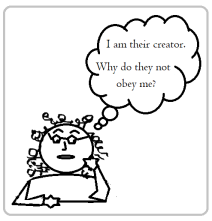 No matter how they respond, they will be placed in situations where they have no choice but to go forward. After all, I am their creator, the deity of their universe. I have an outline that predestines them to specific fates, and nothing they can do will stop that train.


 Life in the Realm of Fantasy
