Tag Archives: writing

Successful Self-Editing #amwriting

Books are machines, comprised of many essential components. If one of those elements fail, the book won’t work the way the author envisions it. So, what are these parts?
no_graceful_way_outLIRF02212021Prose, plot, transitions, pacing, theme, characterization, dialogue, and mechanics (grammar/punctuation).

As an editor, I’ve seen every kind of mistake you can imagine and written many travesties myself. This tendency to not see the flaws in our own work is why I have an editor. I need someone with a critical eye to see my work before publication.

I am in the process of revising my Accidental Novel, prepping it to send to my editor. I have a three-part method, using specific tools that come with my word-processing program.

Phase one: the initial read-through. This stage is put into action once I have completed the revisions suggested by my beta readers. At this point, the manuscript looks finished, but it has only just begun the journey.

I use Microsoft Word. On the Review Tab, I access the Read Aloud function and begin reading along with the mechanical voice. Yes, it’s annoying and doesn’t always pronounce things right, but this first tool shows me a wide variety of places that need rewriting.

ReviewTabLIRF07032021I use this function rather than reading it aloud myself, as I tend to see and read aloud what I think should be there rather than what is.

  1. I habitually key the word though when I mean through. These are two widely different words but are only one letter apart. Most miss-keyed words will leap out when you hear them read aloud.
  2. Run-on sentences stand out when you hear them read aloud.
  3. Inadvertent repetitions also stand out.
  4. Hokey phrasing doesn’t sound as good as you thought it was.
  5. You hear where you have dropped words because you were keying so fast you skipped over including an article, like “the” or “a” before a noun.

This is a long process that involves a lot of stopping and starting, taking me a week to get through the entire 90,000-word manuscript. By the end of phase one, I will have trimmed about 3,000 words.

Phase Two: The Manual Edit

The_Pyramid_Conflict_Tension_PacingThis phase is where I find my punctuation errors most often. I look for and correct punctuation and make notes for any other improvements that must be made. Usually, I cut entire sections, as they are riffs on ideas that have been presented before. Sometimes they are outright repetitions, which don’t leap out when viewed on the computer screen.

  1. Open your manuscript. Break it into separate chapters, and make sure each is clearly and consistently labeled. Make certain the chapter numbers are in the proper sequence and that they don’t skip a number. For a work in progress, Baron’s Hollow, I labeled my chapter files this way:
  • BH_ch_1
  • BH_ch_2
  1. Print out the first chapter. Everything looks different printed out, and you will see many things you don’t notice on the computer screen or hear when the voice reads it aloud.
  2. Turn to the last page. Cover the page with another sheet of paper, leaving only the last paragraph visible.
  3. Starting with the last paragraph on the last page, begin reading, working your way forward.
  4. With a yellow highlighter, mark each place that needs correction.
  5. Put the corrected chapter on a recipe stand next to your computer. Open your document and begin making revisions as noted on your hard copy.

This is the phase where I look for what I think of as code words. I look at words like “went.” In my personal writing habits, “went” is a code word that tells me when a scene ends and transitions to another stage. The characters or their circumstances are undergoing a change. One scene is ending, and another is beginning.

In fact, all info dumps, passive phrasing, and timid words are codes for the author, laid down in the first draft.

Clunky phrasing and info dumps are signals telling me what I intend that scene to be. In the rewrite, I must expand on those ideas and ensure the prose is active. I must cut some of the info and allow the reader to use their imagination.

I look for all of the eight forms of the verb “be” and change that passive phrasing to make it active if possible. The forms of “be” are subjunctives and are tricky words. They’re necessary in some cases, but not always and can become crutches.
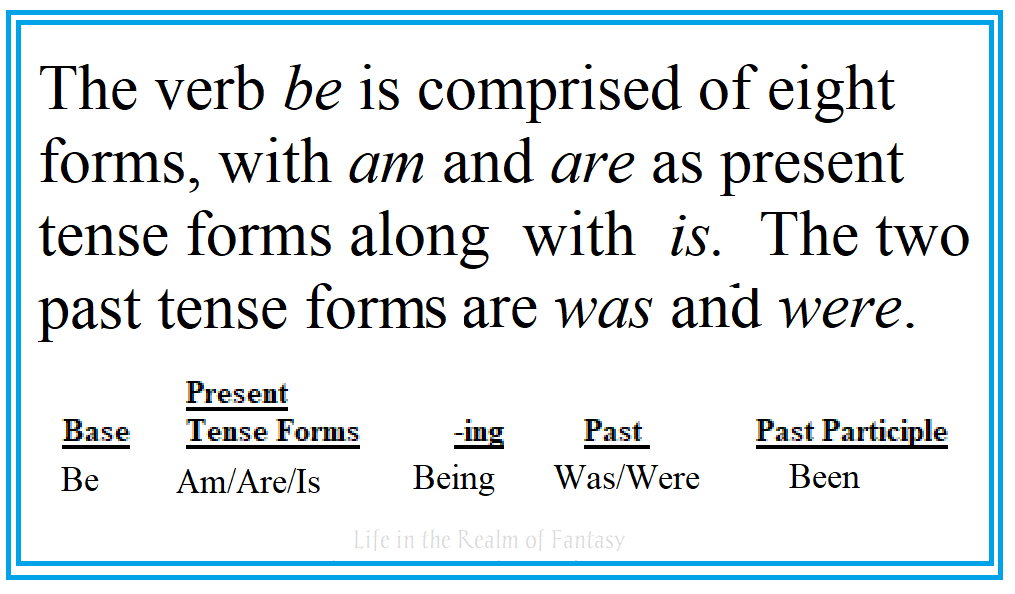
Be_Eight_Forms_LIRF05122019Passive phrasing does the job with little effort on the part of the author, which is why the first drafts of my work are littered with it. Active phrasing takes more effort because it involves visualizing a scene and showing it to the reader.

For example, when I see the word “went,” I immediately know someone goes somewhere. But “went” is a telling word and is passive phrasing. I ask myself, “How do they go?” Went can always be shown as a scene. Loretta opened the door, gave Burt the finger, and strode out.

By the end of phase two, I will have trimmed about 3,000 more words from my manuscript.

Phase three is the step that only works if you have an understanding of grammar and industry practices. Currently, at this stage in our technology, understanding context is solely a human function.

You may have found that your word processing program has spellcheck and some minor editing assists. Spellcheck is notorious for both helping and hindering you.

Tools like spellcheck don’t understand context, so if a word is misused but spelled correctly, it probably won’t alert you to an obvious error.

  • There, their, they’re.
  • To, too, two.
  • Its, it’s.

In the third phase of prepping my work to send to my editor, I go over each chapter one more time, this time using Grammarly. I have also used ProWriting Aid. Each one has strengths and weaknesses.

Context is critical. I am wary of relying on Grammarly or ProWriting Aid for anything other than alerting you to possible comma and spelling malfunctions.

If you don’t know anything about punctuation, don’t feel alone. Most of us don’t when we’re first starting out, and if this is your case, your best bet is to avoid these programs.
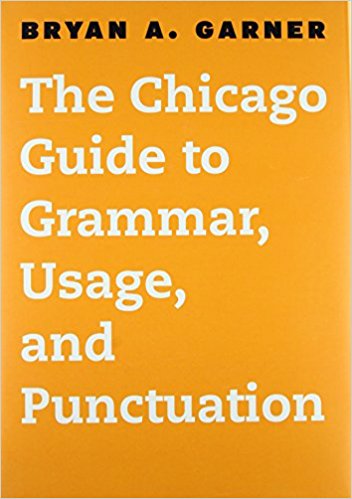
chicago guide to grammarUse that money to invest in a book like the Chicago Guide to Grammar, Usage, and Punctuation and learn how grammar works.

Good editing software is not cheap. But for my specific needs, it has been a worthwhile investment. If you do choose to invest in some, use common sense when reviewing the program’s suggestions.

This three-part process can take more than a month. When I’ve finished, I’ll have a manuscript to send my editor that won’t be full of distractions. She’ll be able to focus on finding as much of what I have missed as is humanly possible.

Hopefully, between the two of us, I’ll have a decent book to publish early in 2022.
 

10 Comments

Filed under writing

Random Thoughts on Writing #amwriting

I’ve mentioned before that I don’t review books I don’t like. So, without naming names, let’s talk about why some books are not on my review list.

WritingCraft_lazyWritersPassive phrasing: If you watch them in real life, people don’t “begin” to pick up that knife. They don’t “start” to walk away.
They reach for the knife. They take the knife from the drawer.

They walk away.

We’re thinking and writing the story as it falls from our heads. Because we get into storytelling mode, the dog begins to bark, and the neighbors start to complain. In real life, the dog barks, and the neighbors complain.

When you write with a passive voice, it’s easy to use too many quantifiers, such as “it was really big” or “it was incredibly awesome.” It becomes easy to “tell” the story instead of showing it: “Bob was mad.”

Then there is the opposite extreme, showing far too much.

Some authors have been told their prose is passive and are desperate to avoid that. But they have a lot of detail they want to convey, so they resort to clumsy lead-ins and awkward descriptions. This only announces that a lengthy exposition is forthcoming. 

Please, don’t use a phrase like: “She felt her eyes roll over her host’s attire” and then follow it with a paragraph describing the host in microscopic detail. That unfortunately phrased sentence is one of the less obnoxious lines from a book I was unable to finish reading several years back. It stuck with me because the paragraph that followed it was so awful.

Nothing gives me the creeps more than a 250-word description of eyeballs independently rolling up and down and all over a purple velvet suit of dubious origin. I could see what the author was trying to say, but the host’s suit was the least of the travesties in that train wreck: most people’s eyeballs do not leap from their head and roll over anything.

Instead, they could have written the entire 250-word encounter this way: Vincent wore a suit of purple velvet, threadbare, and looking as if it came from his grandfather’s closet.

It’s a struggle sometimes, but we must try to slip descriptions into the narrative in less obvious ways.

Some authors swamp the reader with minute details: “Marge’s eyebrows drew together, her lips turned down, and her cheeks popped a dimple. Hate glared from her eyes.”

Some authors ruin the taste of their work with an avalanche of prettily written descriptors: “-ly” words.

Others may want to show their characters as human, so they have them natter on about nothing: “Remember when….” If the memory doesn’t pertain to the story or explain something about a character that has been a mystery, it doesn’t advance the plot. Rather than showing them as human, it pads the word count, stalls the momentum, and the reader stops reading.

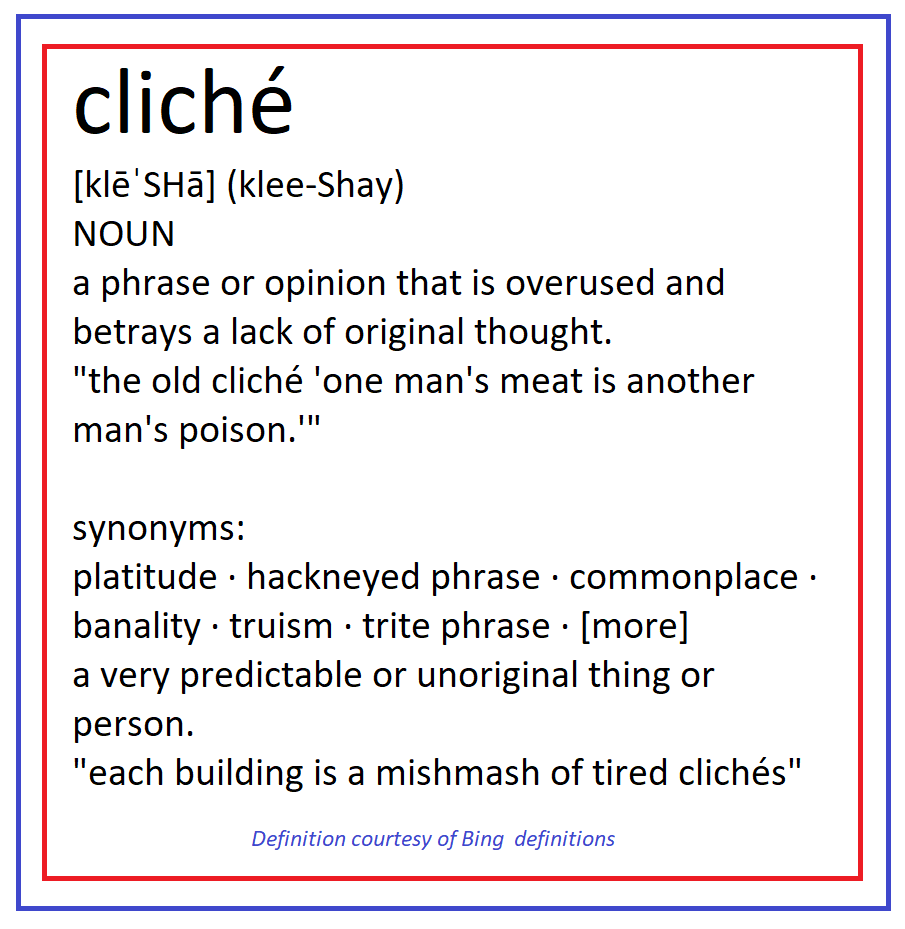
ClicheDefinitionBingLIRF06282021Use of clichés. Speaking as a reader, please don’t use the word alabaster to describe a woman’s skin. Make an effort to find a different way to describe her appearance. It’s an easy word that says smooth and pale, but it’s an overused word that has become cliché.

As a matter of reference, it’s not usually necessary to describe a character’s skin other than with broad generalizations because you want the reader to imagine them for themselves, and we all have different ideas of beauty.

Clichés and catchphrases will appear in the first drafts of our work, but they are signposts for the second draft. They tell us to spend some time finding a creative way to show a person or event.

Events that occur for no reason and take the story nowhere: I loved “The Hitchhiker’s Guide to the Galaxy” series of books written by the late Douglas Adams.

The books detail the adventures of Arthur Dent, a hapless Englishman traveling the galaxy in his pajamas. He and his friend are transported off the earth just in time to miss the destruction of the planet by the Vogons, a race of unpleasant and bureaucratic aliens, to make way for an intergalactic bypass.

Douglas Adams’ work is a little bit “out there,” but he understood that there must be a reason for the protagonist to leave his home wearing his pajamas and a robe. He used that opportunity to show the cozy, comfortable environment Arthur was about to be thrust out of.

Adams understood he first had to show Arthur in his happy home, and then his protagonist had to be quickly yanked out there and placed on that Vogon Constructor Ship.

For me as an author, the easiest part of writing is inadvertently slipping some clumsy bit of phrasing into my narrative, having an action scene go hilariously (and impossibly) wrong. I don’t usually notice the awkwardness until my editor points it out.

The_Pyramid_Conflict_Tension_PacingAs a reader, things will pull me out of the narrative, and I will probably stop reading at that point. Most of these issues are the result of lazy writing habits.

Research: Using real science requires research, which is time-consuming. Writing true history, writing medical dramas, and using police and military procedures involves effort. You must glean research from more sources than Wikipedia and old CSI episodes.

If you are writing historical fiction, you must read many books on your subject. Make notes as you read each, noting the book title, the author, and the page number where you found the info—you may need to know those things later. It’s work, but this is a job where you can’t skimp.

If you are writing speculative fiction, you will accumulate science or other background information in your world-building process. You will want to keep it organized, and this is where the style sheet or storyboard comes in handy.

What the style sheet/storyboard should cover:

  • All names, created or not: Aeos, Aeolyn, Beryl, Carl, Edwin, etc.
  • Real and created animal names: alligator, stinkbear, thunder-cow, waterdemon
  • Created words that are hyphenated: fire-mage, thunder-cow
  • All place names, real or created: Seattle, Chicago, Ragat, Wister, Sevya, Arlen, Neveyah
  • Any research note you have accumulated.

See my post, Designing the story for more on how to make a storyboard or style sheet.

good_stories_LIRFmemeKeep your notes/stylesheet in a clearly labeled file, and back them up on a thumb drive or file them in the cloud via Dropbox, OneDrive, or Google Docs. I use and work out of a file-saving service, so my files won’t be lost no matter what happens to my computer.
Turning those notes into your story is an integral part of the writing process.

Plagiarism – this is most important: never copy lines from another person’s work and pass them off as your own. That is plagiarism, and you never want to be accused of that. If you must quote someone verbatim in your book, contact their publisher and get their legal permission to do so, and credit them by using proper footnotes. If you do not receive written consent, do not use their work.

Keep this written permission on file with any other legal papers that pertain to that book.

An excellent article on this can be found here: Cite Unseen: 3 Bits for a Better Bibliography


11 Comments

Filed under writing

Designing the story #amwriting

July is Camp NaNoWriMo month. If you are interested, join Camp NaNoWriMo to take on any writing project, novel or not, and set a word-count goal of your own. Yes, any goal, any project.

Words-And-How-We-Use-ThemI think of stories as if they were ponds filled with words. A pond has layers, and so do good stories. I see the three layers of a story as:
Surface: The Literal Layer; the what-you-see-is-what-you-get layer. Characters live, and events happen. These are reflected in the surface of the story. We change the look of the surface layer by choosing either realism or surrealism or a blend of the two.

Realism is a common form of storytelling. It is the what-you-see-is-what-you-get kind of story. The setting can be anywhere and told using the tropes of any genre. The reality of that world is solid and never changes.

Surrealism takes the feeling of a real world and gives it a slightly hallucinogenic twist. Everything feels real, but on the surface, it makes no sense. One must find understanding in each small increment rather than the larger chunks we are used to absorbing.

Beneath the story’s surface lies the middle: This is the area of unknown quantity filled with cause and effect: events and reactions. We see why these characters’ lives are important enough to be portrayed and why events happened. This is where emotions muddy the waters. It is a layer where inference and implication come into play.

Bottom: The Interpretive Layer. This level is not only foundational; it contains and shapes the story:

  • Themes
  • Voice/style
  • Messages
  • Symbolism
  • Archetypes

The words in this pond behave like the waters of a pond in nature. While close scrutiny reveals that the waters of a pond are separated into layers by temperature, salinity, microbial life, or by the sheer weight and pressure of the volume of water, the overall structure is one large, important thing: a hole filled with water.

Without water, a pond is a depression in the ground filled with possibilities only. The same is true for a novel.

If you want to write anything, it’s best to sit down and get that first draft out of you while the story is fresh in your mind. You’ll spend a year or more rewriting a novel, but if you don’t get the original ideas and entire story down while they’re fresh, you’ll lose them.

Many people say they intend to write a book. They begin, get a chapter or so into it, and lose the thread. They can’t see how to get the story from the beginning, to the crisis, to the resolution.

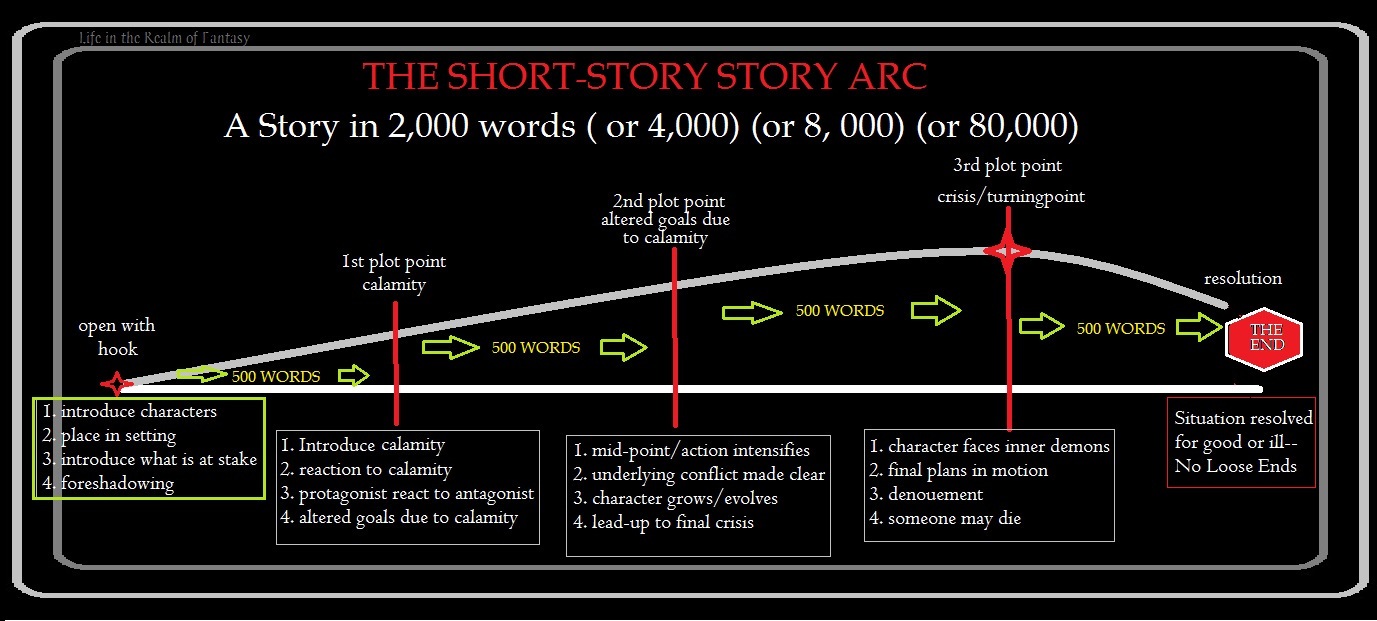
I draft a story plan in four acts. First, I tell myself how I believe the story will go. This only takes half an hour and gives me finite plot points, destinations where each section of the story will end. Once I have the four acts, I know where the turning points are and what should happen at each. The outline ensures there is an arc to both the overall story and to the characters’ growth.

A good way to discover what you are writing is to “think out loud.” Divide the story into four acts. Acts two and three are really one long extension of each other.

short-story-arcAct 1: the beginning: We show the setting, the protagonist, and the opening situation.
Act 2: First plot point: The inciting incident.

Act 3.: Mid-point: We show their dire condition and how they deal with it.

Act 4: Resolution: Let’s end this misery in a way that feels good.

Take a moment to analyze and plan what needs to be said by what point in the story arc. This method works for me because I’m a linear thinker.

PostItNotePadI have mentioned before that I use a spreadsheet program to outline my projects, but you can use a notebook or anything that works for you. You can do this by drawing columns on paper by hand or using post-it notes on a whiteboard or the wall. Some people use a dedicated writer’s program like Scrivener.
Everyone thinks differently, so there is no one perfect way to create that fits everyone.

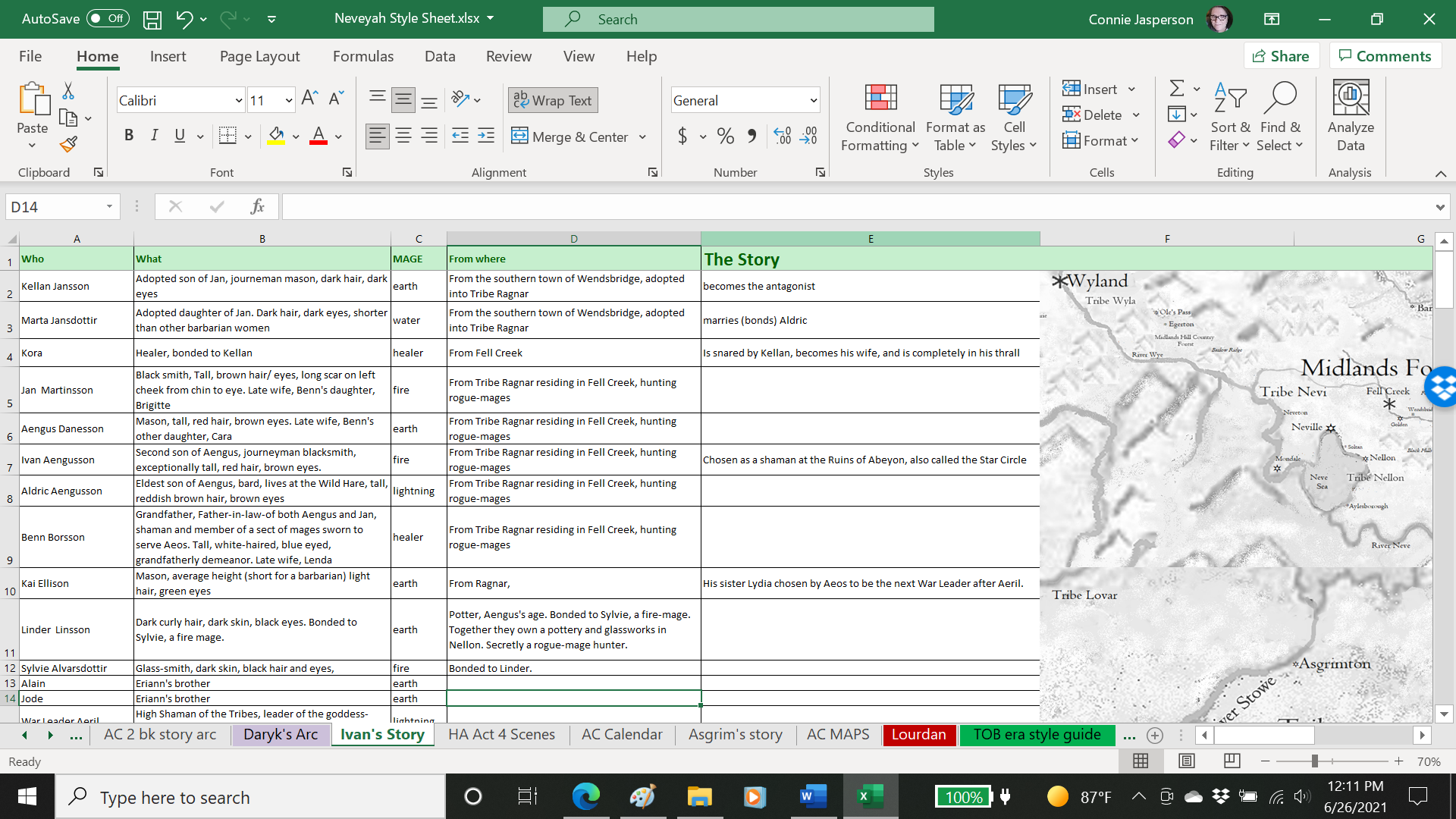
In Excel, the storyboard for my ideas works this way:

At the Top of page one: I give the piece a working title.

If it’s an idea for a short story, I include the intended publication and closing date for submissions (not needed if it’s for a novel). I make a note of the intended word count. Having a word count limit keeps me alert for unnecessary backstory.

Page one of the workbook contains the personnel files.

Column A: Character Names. I list the important characters by name and list the critical places where the story will be set.

Column B: About: What their role is, a note about that person or place, a brief description of who and what they are.

Column C: The Problem: What is the core conflict?

Column D: What do they want? What does each character desire?

Column E: What will they do to get it? How far will they go to achieve their desire?

On page two of the workbook, I create a page that outlines the projected story arc chapter by chapter.

Page three of the workbook is most important—it is the list of made-up words, names, and places. The way they appear on this list is how they should occur throughout the entire story or novel. This page ensures consistency and keeps the spellings from drifting as I plow along, laying down prose.

Update the glossary page anytime a name is added or changed, or new place or made-up word is added.

Page four will have maps and a calendar for that world. The calendar is a central piece that keeps the events happening in a logical way.

The workbook shown below is the stylesheet for the Tower of Bones series and has been evolving since 2009.

screenshotStyleSheetLIRF06262021We never really know how a story will go, even if we begin with a plan. The plan serves to keep us on track with length and to ensure the action doesn’t stall.

If you know the length of a book or story you intend to write, you know how many words each act should be and how many scenes/chapters you need to devote to that section.

As you write each event and connect the dots, the plot will evolve and change. You begin to explore the deeper aspects of the story. Emotions, both expressed and unexpressed, secrets withheld, truths discovered—all these details that emerge as you write will shape how the characters react to each other. In turn, these interactions will alter the shape of the larger story.

Creating a project for Camp NaNoWriMo is a good way to get into the habit of writing new words every day. When you write every day, you develop strengths and knowledge of the craft. Give yourself the gift of half an hour of private writing time every day.

You’ll never know what you’re capable of until you try.


Credits and Attributions:

DangApricot (Erik Breedon), CC BY-SA 3.0 <https://creativecommons.org/licenses/by-sa/3.0&gt;, via Wikimedia Commons. Wikimedia Commons contributors, ‘File:PostItNotePad.JPG’, Wikimedia Commons, the free media repository, 26 August 2020, 17:42 UTC, <https://commons.wikimedia.org/w/index.php?title=File:PostItNotePad.JPG&oldid=443715836> [accessed 26 June 2021]

10 Comments

Filed under writing

Fundamentals of Writing: delivering the backstory #amwriting

Every story has a past, a present, and hopefully, a future. The past is what forms what we see as the here-and-now and shapes the characters. Because they have a history, they are fully developed the moment they step onto the first page.

bloatedExpositionLIRF06202021New writers know the backstory is important. They sometimes feel it’s necessary to inform the reader by placing a wall of history at the novel’s beginning. It seems like logical thinking: “Before you can understand this, you need to know this.”
Don’t drop the history in the first five pages. Those are the pages that acquisition editors look at and decide whether or not to continue reading the submission. For those of us planning to go the indie route, those first five pages are what the prospective buyer sees in the “look inside” option when buying an eBook.

While the backstory is necessary for character and plot building, too much outright “telling” halts the momentum, freezes the real-time story in its tracks.

And most importantly, beginnings must be active. The first lines must step onto the stage in such a way that they are original, informative, and engaging.

The passages that follow must reflect and build upon the tone and cadence of the opening pages.

Walls of fictional history muck up the transitions and negate your hooks. They block the doors from one scene to the next.

So how do the professionals deliver the backstory and still sell books? First, they consider what must be accomplished in each scene and allow the backstory to inform the reader only when and if needed to advance the plot.

Look at the first scene of your manuscript. Ask yourself three questions.

  1. Who needs to know what?
  2. Why must they know it?
  3. How many words do you intend to devote to it?

Dialogue is the easiest way to dole out information, and it is also a great way to fall into an info dump.

strange thoughtsDon’t give your characters long paragraphs with lines and lines and lines of uninterrupted dialogue or internal monologues. We don’t want our conversations to deteriorate into bloated exposition.
We’re all familiar with the term ‘flatlined’ as a medical expression indicating the patient has died. When the story arc is imbalanced, it can flatline in two ways:

  • The action becomes random, an onslaught of meaningless events that make no sense.
  • The pauses become halts, long passages of random info dumps that have little to do with the action.

A good way to avoid a flatlined story arc is through character interaction. Your characters briefly discuss what is on their minds and bravely muck on to the next event.

Short moments of introspection offer opportunities for doling out new information essential to the story. If you go on for too long, your reader will either skip forward or close the book.

These moments open a window for the reader to see who the characters think they are. Their introspection shows how they really react and illuminates their fears and strengths.

It shows that our characters are self-aware.

Timing and pacing are essential. The moment to mention information in passing is when the character needs to know it in order to go forward. That way, you avoid the dreaded info dump, but the reader can extrapolate the needed backstory.

In the most gripping narratives I have read, character introspection is brief. Internal monologues are featured but are kept minimal, addressing only what is essential. They serve to illuminate a character’s motives at a particular moment in time.

So, conversation and introspection are where we only deliver information not previously discussed. Repetition is boring and pads the word count with fluff.

Consider the most popular genre: Romance novels. These things fly off the shelves. Why?

Because the path to love is never straightforward. It speeds up (a small reward), and then it is slowed (dangling the carrot). Then, it goes a little ahead (slightly larger reward) but is slowed (enticement) until finally, the two overcome the circumstances and things that have barred the way to their true happiness.

Romance novels average 50,000 to 70,000 words. In shorter novels, there is no room for backstory. Instead, information and backstory are meted out only as needed through conversations and internal dialogue/introspection.

All obstacles to the budding romance are followed by small rewards that keep the reader involved and make them determined to see the happy ending even more.

As a reader, I can say that a longwinded rant is not a reward.

This holds true in every book and story, no matter the genre: enticement, reward, enticement, reward. In all stories, complications create tension, and information is a reward.

The combination of those elements keeps the reader reading.

Right now, I am working on whittling info dumps out of my current manuscript. It’s difficult to see them in my own work, but one trick I have found is this: word count.

strange thoughts 2I look at each conversation and assess how many words are devoted to each character’s statement and response. Then, when I come to a passage that is inching toward a monologue, I ask what can be cut that won’t affect the flow of the story or gut the logic of the plot?
Even with all the effort I apply to it, my editor will find places to shave off the unnecessary length.

Sometimes we write brilliantly, other times not so much. Sorting the diamonds from the fluff is hard, but your readers will be glad you made the effort.

3 Comments

Filed under writing

Fundamentals of Writing: Power Words #amwriting

When we put the first words of a story on paper, the images and events we imagine as we write have the power to move us. Because we see each scene fully formed in our minds, we are under the illusion that what we have written conveys to a reader the same power that moved us. Once we’ve written “the end” it requires no further effort, right?

I don’t know about your work, but usually, at that stage my manuscript reads like a laundry list.  

usingpowerwordsLIRF06192021The trick is to understand that, while the first draft has many passages that shine, more of what we have written is only promising. The first draft contains the seeds of what we believe we have written. Like a sculptor, we must work to shave away the detritus and reveal the truth of the narrative.

One way we do this is by injecting subtly descriptive prose into our narrative. Properly deployed, power words can be subtle and serve as descriptors, yet don’t tell the reader what to feel.

Think of them like falling leaves in autumn. On their own, they weigh nothing, feel like nothing. Put those leaves in a pile, and they have weight. When we incorporate subtle descriptors into the narrative, they come together to convey a sense of depth.

These are words that convey an emotional barrage in a succinct packet.

Let’s consider a story where we want to convey a sense of danger, without saying “it was dangerous.” What we must do is find words that shade the atmosphere toward fear.

Power words can be found beginning with every letter of the alphabet. What are some “B” words that convey a hint of danger, but aren’t “telling” words?

Backlash

Blinded

Blood

Blunder

When you incorporate any of the above “B” words into your prose, you are posting a road sign for the reader, a notice that “ahead lies danger.” Mingle them with other power words, and you have an air of danger.

As authors, it is our job to convey a picture of events.

But words sometimes fail us.

oxford_synonym_antonymThe best resource you can have in your personal library is a dictionary of synonyms and antonyms. Your word processing program may offer you some synonyms when you right click on a word. However, to develop a wide vocabulary of commonly understood words, you should try to find a book like the Oxford Dictionary of Synonyms and Antonyms.
It’s important to keep your word choices recognizable, not too obscure. When a reader must stop and look up words too frequently, they will feel like you are talking over their head.

Even so, readers like it when you assume they are intelligent and aren’t afraid to use a variety of words. Yes, sometimes one must use technical terms, but I appreciate authors who assume the reader is new to the terminology and offer us a meaning.

Sprinkling your prose with obscure, technical, or pretentious words is not a good idea. As a reader, I find it frustrating to have to stop and look up big words too frequently.

Let’s look at the emotion of discontent. How can it affect the mood of a piece? What words can we incorporate to shape the mood of the narrative to reinforce a character’s growing dissatisfaction? A few words that most people know might be:

Aggression

Awkward

Corrupt

Denigrate

Disparage

Disgust

Irritate

Obnoxious

Pollute

Pompous

Pretentious

Revile

How we incorporate words of all varieties into our prose is up to each of us. We all sound different when we speak aloud, and the same is true for our writing voice. We can tell the story using any mode we choose but the first line of any piece must let the reader know what they are in for.

I meant to run away today.

If that were the opening line of a short story, I would continue reading. Two words, run away, hit hard in this context, feeling a little shocking as an opener. The protagonist is the narrator and is speaking directly to us, which is a bold choice. Right away, you hope you are in for something out of the ordinary.

That line shows intention, implies a situation that is unbearable, and offers us a hint of the personality of the narrator. Who are they, and what is so unbearable?

Here are lines from a different type of story, one told from a third person point of view:

The battered chair creaked as Aengus sat back. “So, what’s your plan then? Are we going to walk up to his front door and say, ‘Hello. We’re here to kill you’?”

This is a conversation, but it shows intention, environment, and personality. Battered is a power word, and so is creaked.

And here is one final scene, one told from a close third person point of view and showing yet another way to incorporate subtle power words into the prose:

Sera saw the vine-covered ruins of Barlow as an allegory of her past. A part of her past had been burned away. She’d been destroyed but was coming back to life in ways she’d never foreseen.

The power words are: ruins, burned away, destroyed. The stories we write come from deep within us. Words sometimes fail us and we lean too heavily on one word that says what we mean. This is hard for us to spot in our own work, but if you set it aside, you may notice repetitious prose.

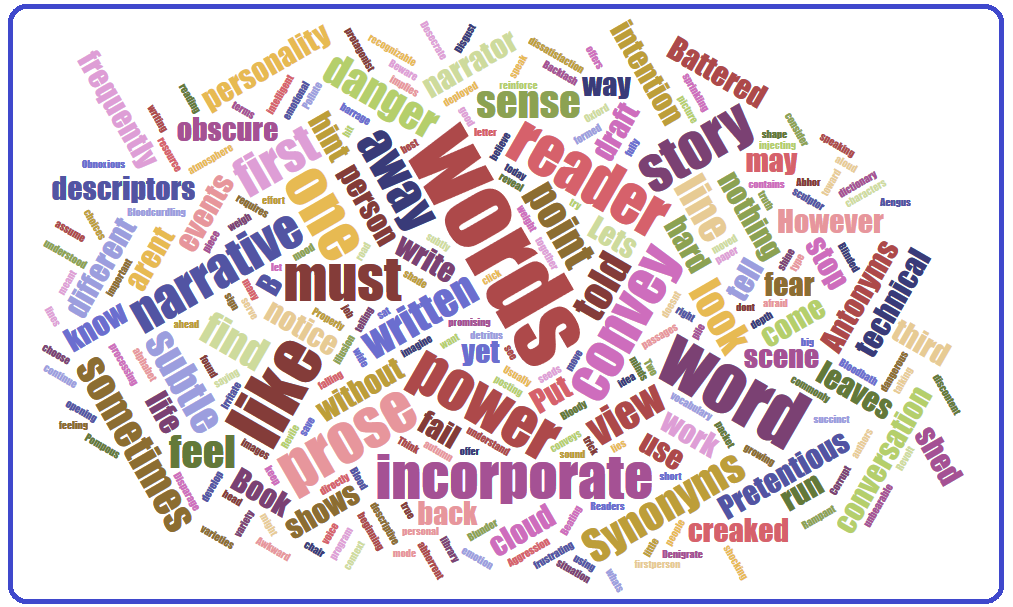
A friend of mine uses word clouds to show her crutch words. In a word cloud, the larger the word, the more often it appears in the text. Since I am notoriously short on words, let’s see how this post looks as a word cloud.

It came out surprisingly colorful!

powerwordsWordCloudLIRF06192021

10 Comments

Filed under writing

Submitting to Contests vs. Submitting to Magazines and Anthologies #amwriting

One question I frequently see in various writers’ forums, is “how can an indie get their name out there and gain fans for their work?”

WritingCraft_short-storyMy answer is simple. We write short stories and submit them to magazines, anthologies, and contests.
Every time your short work is published or places well in a contest, you stand the chance of getting your name out there and it’s nice to have a little extra cash in your pocket.

Despite the changes in the publishing industry as a whole, writing short stories is still the way to get your foot in the door and increase your visibility. Anthology calls from traditional large publishing houses and reputable small and mid-size publishers that are willing to pay for your work are sometimes open to new authors.

Also, magazines that are SFWA approved regularly post open calls for submission, so it pays to check each magazine and publisher’s website for opportunities.

Submitting to contests is good too.theRealStoryLIRF01102021 If you have a story that was a contest winner, you may be able to sell it to the right publication.
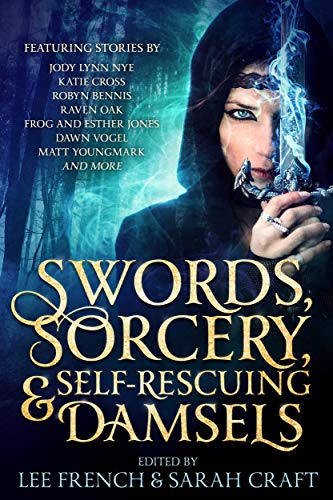
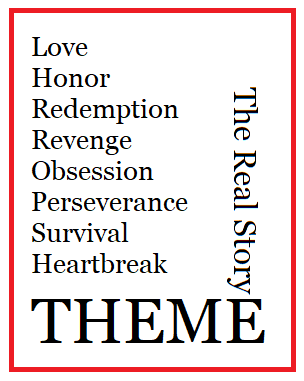
Writing for anthologies and contests have similar requirements. You must learn how to write to a specific length. Often, you must make use of a specific theme, one that may not be of your choosing.

So, what do editors of anthologies and magazines look for versus how contests are judged? Trust me, editors work hard, and more than anything, they love to read.

And all publisher and editors want to discover brilliant work written by new authors.

I have worked on both sides of the publishing industry. I know the frustrations of the author who waits to hear back regarding their submission, and I’ve seen the publisher’s inbox. I’ve read for many contests and edited several anthologies.

First, your work will receive a far closer inspection from a contest than from a publisher. Contests have readers who are either editors or authors, and who do their best to judge each entry on their merits. This means two people will have read the submission and each reader will have looked at the technical aspects of the piece as well as the overall story and characters.

Contest readers must judge:

  1. Plot: the sequence of events and the overall story arc.
  2. Setting: did the world building include a location, time, hints of the weather, and hints of the environment? Was the world solid to the reader?
  3. Viewpoint/narrative mode: how was the story told? Was the POV consistent or did it inadvertently drift, say between present tense to a few paragraphs in past tense, and then back to present. Was it consistently first-person, (or second, or third, or omniscient, etc.)?
  4. Characters: Were the characters believable, and did they have an arc?
  5. Did the dialogue, both spoken and internal, advance the story? Did each speaker have their own voice and style?
  6. Transitions and hooks: Did the opening lines hook the reader? Did the narrative move from scene to scene smoothly, without jarring the reader out of the story? Did each transition hook the reader, enticing them to keep reading?
  7. Showing versus telling: did the author understand how to show the action?
  8. Mechanics: Did the author have a good grasp of grammar, punctuation, and industry standards? Did they follow word count and length requirements, and obey formatting directions as listed in submission guidelines?

Editors for anthologies will look at each submission with the above guidelines in mind, but they will have two more caveats:

  1. Theme: did the author understand and incorporate the theme into their story?
  2. Appeal: did that story strike a chord, make them want to read more of that author’s work?

Contest readers/judges read every word in each submission and base their opinions on how well the first eight conditions were met.

Anthologies and magazines have a slightly different style of judging what they will accept.

The main difference between publishers of anthologies and those of magazines is the sheer volume of work that is submitted, and the number of people/editors available to read it.

51AvRGmiMQLAnthologies will close on a specific date, or after a certain number of submissions have been received.
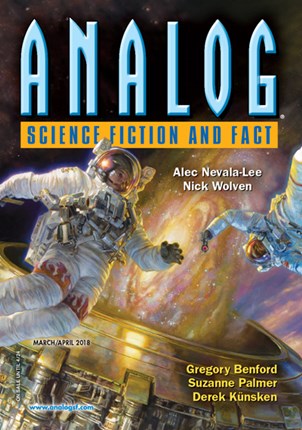
The inbox of a large publisher fills up every day. Larger publishers may have a gatekeeper reading submissions, but most editors do their own work. For this reason, the editor will look at the first page of the story and based on what she sees there, she will decide whether to continue reading or reject it.

If all ten of the above criteria are clearly shown in the first paragraphs, the editor will read further. If the work continues to be engaging and professional, they will read it to the end.

At that point, criteria number ten is most important condition to be met—your story must have wowed the editor.

Once you have written a short story  with the intention of submitting it to a specific publisher or contest, you must edit it. Then you must format the manuscript to make it submission-ready, by reading and following the guidelines published on their website.

I’ve said this before, but it bears mentioning again: if you don’t follow your prospective contest or publisher’s submission guidelines, you have wasted your time submitting it.

AFF_MarApr2018_400x570These steps demonstrate your level of professionalism. Editors at magazines, contests, and publishing houses have no time to deal with unedited, poorly formatted manuscripts. Their inboxes are full of well-written and properly formatted work, so they will reject the amateurs without further consideration.
I hope knowing the requirements your work will be judged by will help you find good homes for your work.

If you have any doubts about the quality of your work, consider running it past your critique group to hear their opinions on characterization, story arc, and other features of your work.

It’s hard to hear a bad verdict, but sometimes you should completely rethink certain aspects of a piece before you submit it, and this is where the external eye can help you.

7 Comments

Filed under writing

Fundamentals of Writing: The Strong Antagonist #amwriting

I gravitate to narratives featuring a strong antagonist, someone who could have been a brilliant hero if only they had made different choices.

depth-of-characterAuthors work hard to create a strong, credible hero. In genre fiction, the hero’s story evolves in a setting of our devising and is defined by their struggle against an antagonist.

Strong emotions characterize what and who we perceive as good or evil. Emotion is a constant force in our lives. When we write, the emotions we show must be credible, shown as real, or they will fail to move the reader.

Consider the forces of antagonism in the story. The antagonist can take many forms. In some stories, it will be a person or people who stand in the way. In other stories, an internal conflict and self-deceptions thwart the hero. When you think about it, we are usually our own worst enemy, constantly telling ourselves negative things that undermine our self-confidence.

When we create an antagonist, we take what is negative about a character and take it one step further: we hide it behind a lie.

First, we assign them a noun that says who the antagonist thinks they are. Good.

Then we assign them the noun that says who the protagonist believes they are. Evil.

So, in an overly simplistic example, the antagonist gets two nouns: Good/Evil. We hide that perception of evil behind a lie, a falsehood. This lie is the antagonist’s belief that they are the hero.

One of my antagonists in a current work in progress is Kellan. He and his younger sister were born into an abusive family. When their parents were murdered, they were adopted by a family who raised them with kindness and understanding. At the age of ten, Kellan’s basic character and gut reactions were already formed.

protagonist-antagonist-06082021LIRFKellan is a complicated character who believes he is the hero. His story begins as a member of the protagonist’s inner circle and ends tragically.

The people who love him describe him this way: Ivan saw Kellan as two people. One lashed out at the people he trusted and loved most, was filled with jealous anger, and the other was sweet, gentle, and mesmerizing. Rage sometimes owned him, a flaw the earth-mage might never overcome.

Life is complicated, and the relationships in a good novel should also be complex. Often, a protagonist faces a second antagonist: themselves. In real life, who is usually our worst enemy?

We are.

It is us, our own fears, the little voice whispering doubt, indecision, and impulsiveness into our subconsciousness.

So, to further complicate life for our hero, we can go two routes when creating the antagonist. One way is to allow one of the characters to make choices that ultimately harm them, which is how I went with Kellan, turning him into the visible antagonist.

Another way is to take the negative that is directed outward and turn it into self-hate, which I have done with Ivan. He has two enemies to fight, one is someone he loves but must reject, and the other is himself.

nebulousIn other stories, there is the nebulous antagonist—the faceless giant of corporate greed, characterized by one or two representatives, who may be portrayed as caricatures. In some cyberpunk tales, the antagonists tend to be thugs-in-suits, and in hard sci-fi, they might be members of the military or scientists. In fantasy, the nebulous antagonist might be a powerful queen/king or sorcerer, or both.

In that case, how the protagonist reacts internally to the threat these formless antagonists pose is the story. Emotion makes the risk feel genuine to the reader, gives it life.

To show great evil in genre fiction, we take the negative to the limit of human experience. And while I do write some dark scenes, I don’t write horror, so I can’t speak to that, exactly.

What I can speak to is the perception of corruption, which sometimes horrifies us.

Perception and imagination are everything. As children, what we infer from the visible evidence in a dark room after mother and father have turned out the lights can be terrifying.

We are frightened of the formless monster that we perceive as lurking in the corner until we discover the truth—it is only something that was piled there and was never put away.

As adults, what we infer from the visible evidence in a dark story can be equally terrifying. Thus, you can write dark scenes but don’t have to be utterly graphic.

War is an evil that is difficult to make sympathetic, and shouldn’t be. Sometimes a faceless blob of evil is the right villain.

However, I seek out stories that delve into the characters as people and show their motivations. Word choices are the key to success in showing the darkness a character embodies without going over the top. Think about the word perversion, a word with many meanings and uses. Its synonyms are: corruption, corruptness, debasement, debauchery, decadence, decadency, degeneracy, distortion.

Coloring an antagonist with a perception of perversion (distortion, corruption) drives home the evil they represent.

Someone—and I don’t remember who—said in a seminar a few years ago that the author is the character’s attorney, not their judge.

approval-f-scott-fitzgerald-quote-LIRF05312021This is an important distinction. Credible villains become evil for sympathetic reasons. They care intensely, obsessively about something, or someone. It is our job to make those deeply held justifications the driving force behind their story.
Therefore, a true villain is motivated, logical in their reasoning. They are creatures of emotion and have a backstory. You as the author and their lawyer, must know what that narrative is if you want to increase the risk for the protagonist. The reader doesn’t need to wade through an info dump, but you, the author, need to know those details.

You need to know why they feel justified in doing the sometimes-heinous things they do.

The greater the risk for the hero, the more interesting the story is. A strong protagonist requires a stronger antagonist if the risk is to be believable.

9 Comments

Filed under writing

Author Interview: Ellen King Rice on characters #amwriting

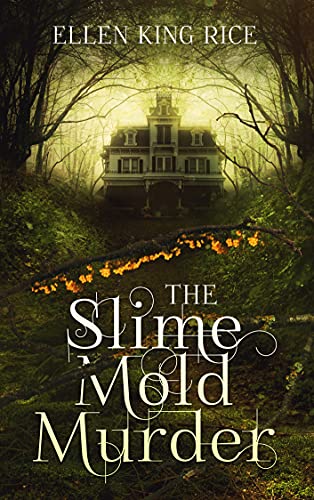
51v0Z1IolxSOne of the best ways to learn about the craft of writing is to talk with other authors. We all have different ways of creating our work, so hearing how another author works always gives me new ideas.

Ellen King Rice writes mysteries set in the South Puget Sound area of the Pacific Northwest. She is a wildlife biologist and is happiest when out in the woods on a fungi hunt with her camera.

Ellen has a new book out, The Slime Mold Murder, and as one the advance readers, I found it witty and the series of events are well-plotted. The characters are engaging, and their stories emerge as the plot unfolds. She has agreed to talk about her characters in this book, and how she came to know them.


CJJ: Tell us about Dylan. When did he first come into your mind as a protagonist?

EKR: Dylan was in my first book, The EvoAngel, as a precocious eleven-year-old with impulse-control challenges. He channels my own life as someone who speaks boldly and often irritates others.

CJJ: This book has number of credible characters. Which character was most difficult to write, and why?

5EKR06042021LIRFEKR: Mitchell and Mark are a gay couple, but I didn’t want to write them as caricatures. I spent a great deal of time trying out descriptions to come up with two men who are individuals in their own right but collectively a pair who would rattle the conservative county commissioner.

CJJ: Which character do you identify with on a personal level. Why?

EKR: Mari reminds me of myself at eighteen. I was keen to explore romance but terribly inept.

CJJ: Do you create an outline for structuring a character arc, or do you wing it?

EKR: Authors are often divided into the pantser or plotter groups. Some of us are plontsers – a lovely hybrid who think they have a plan but are really making it up as they go along. No kidding. I do start with a plan and then I get distracted with new ideas.

CoralRootEKR06042021LIRFjpgCJJ: Do you think your characters or events drive the plot? How are your characters shaped by the events they live through?

EKR: For me it is the events that drive the plot and the characters respond, hopefully growing as they take action.

CJJ: Are there any final words you would like to say regarding the characters and events of The Slime Mold Murder?

EKR:  The inclusion of the sclerotia in the story is meant to be inspirational. Slime molds can enter a dry phase where they do not grow. This phase can last for years, but when conditions improve, there can be a vibrant response. I so hope that we humans can move past months of a global pandemic to build a better world where more of us thrive.


Ellen, thank you for taking the time to talk about how you approach the craft of writing and creating your wonderful characters.

If you are curious about this book, The Slime Mold Murder is available at Amazon as a paperback, and will be released for the Kindle on June 24th, 2021: The Slime Mold Murder.


OLYMPUS DIGITAL CAMERA

About Ellen King Rice:

I am a wildlife biologist who suffered a spinal cord injury many years ago. Although my days of field work are over, biology continues to intrigue me.

I am fascinated by sub-cellular level responses to ecosystem changes. I also like the predictability of animal behavior, once it is understood.

A fast-paced story filled with twists is a fun way to stimulate laughs, gasps and understanding. I work to heighten ecological awareness. I want the details and your new insights to remain in your thoughts forever.

You can find me and my books at www.ellenkingrice.com

Please join me on Instagram at:

https://www.instagram.com/mushroom_thrillers.

And on Facebook:

https://www.facebook.com/mushroomthriller/


Credits and Attributions:

All photos copyright 2021 Ellen King Rice. All images used in this post are the work and intellectual property of Ellen King Rice. She has kindly given me permission to use them in this post.

Comments Off on Author Interview: Ellen King Rice on characters #amwriting

Filed under writing

Fundamentals of Writing: Conveying Depth and Revealing Character through Conversations #amwriting

As I mentioned in my previous post, depth is a vast word, a sea of information created of layers. It is complex, intense, and profound. We use the arc of the opening scene to lure the reader, to hint at what lies hidden below. The scene opens, the first character(s) step onto the stage, the action rises and ebbs, and the reader wants to know more.

WritingCraftSeries_depth-through-conversationSome scenes have no dialogue, are comprised of the actions that propel the plot forward. But often, conversations are the core of the passage, propelling the story onward to the launching point for the next act.

Dialogue is an opportunity to reveal who your characters are and hint at what lies beneath the surface they present to the world. Conversations must have a purpose and follow an arc: they open, disseminate information, and move toward a conclusion of some sort.

Dialogue that doesn’t reveal character and advance the story in some vital way is a waste of the reader’s time.

  • We use dialogue to show the personalities of our characters.
  • We use it to reveal secrets and create empathy.
  • We use conversation to convey knowledge when the characters and the reader need it and reveal motivations.

First, we must identify what should be conveyed in our conversation. Who needs to know what? Why must they know it? How many words do you intend to devote to it? Be wary—conversations can get out of hand and become an info dump.

Info dumps don’t add depth. They add fluff.

Depth consists of many layers. It is a combination of story/plot information and character revelations. It is the underlying theme and the atmosphere of the world the characters inhabit. It is the mood created by the words you habitually use.

If you look in a thesaurus, you can see that most words in the English language have more than one shade of meaning depending on the context in which we use them. Your word choices are essential in showing a world of many shades of color.

Each word adds to or detracts from the feeling of atmosphere. Those choices are critical in conveying personality and creating a sense of empathy for our characters.

Conversations are opportunities to show depth as well as convey information. Your habits, how you form your phrases, and your choice of words establishes the tone.

approval-f-scott-fitzgerald-quote-LIRF05312021This pertains to the thoughts of your characters too.

We have mental conversations with ourselves in real life. Sometimes we even speak our thoughts aloud.

Researchers say that most of the time, our inner monologue concerns how we see ourselves. These thoughts are often in whole sentences and phrased negatively. And most telling of all, we aren’t usually aware of our inner thoughts when we have them.

However, an interior monologue is useful for revealing motives. What they think but don’t speak aloud tells the reader a lot about the character.

It shows who they think they are as well as how they perceive others.

Conflict keeps the protagonists from achieving their goals. In real life, our internal conflicts create greater roadblocks to success than any antagonist might present.

These tiny inner voices of self-destruction are crucial to creating relatable characters. They reveal the inner layers that make the character who they really are beneath the surface they show the world.

Sometimes, revealing a critical bit of backstory can only be accomplished through the protagonist’s thought processes or those of a companion.

A loud contingent at any gathering of authors will say thoughts should not be italicized. While I disagree with that stance, I do see their point.

As a reader, I dislike it when long strings of private thoughts are italicized. This is an accepted practice in the genres of Sci-fi, Fantasy, and YA novels, so readers of those genres expect to see thoughts presented in italics. However, we need to be aware of how overwhelming it is for a reader to be faced with a wall of words written in a leaning font.

If the author makes it clear that the character is having the conversation with themselves, italics aren’t needed.

It was, he thought, one of those rare days, where the sun shone benevolently upon mankind, a day when the constant wind was gentle, benign. Aloud he said, “Enjoy the sun while you can, my friend. The rain is eternal here.”

Dialogue, both spoken and interior, sets the scene and unveils the theme. Your word choices reveal characters and their secrets, their personalities.

Your word choices reveal you, the author. Through those words, we hear your voice.

So, let’s consider that voice. Voice is a combination of word choices and grammar. It is distinct to each author.

From the reader’s perspective, grammar/punctuation is to writing what gravity is to the universe. It holds everything together.

We obey traffic signals when driving to avoid getting into wrecks. In the same way, our written work must abide by specific fundamental rules, or it will be unreadable—a wreck.

This is especially important when it comes to dialogue. What is spoken must be easily distinguished from the ordinary narrative.

Overall, most readers don’t see minor grammar glitches in the narrative, which is good because we all make them. Even editors write crap and need editors. But readers do notice unprofessional writing, especially when it comes to how dialogue is punctuated.

Readers notice amateurish writing.

If you are new to writing and are unsure of how to punctuate conversations so that readers can understand your work, see my post from July 29, 2020: Four Rules for Writing Conversations. The post details four simple, easy-to-remember rules of punctuation, rules for keeping the conversations flowing and understandable.

Epic Fails meme2I have said this before, but it bears mentioning again: Never resort to writing foreign languages using Google Translate (or any other translation app). Also, please don’t go nuts writing out foreign accents. It’s frustrating for readers to try to untangle garbled dialogue. A word or two, used consistently, is all that is needed to convey foreignness.
Information dispensed gradually reveals the plot, unveils hidden layers. What your characters think and say are the reader’s window into them and their world.

Conversations pull the curtain back, revealing the characters’ innermost secrets and their story.

With every sentence, a prism of information illuminates who the characters believe they are and is passed from the author to the reader. It is a light, filtered through the characters, that colors the narrative with the shades and moods of the words you habitually choose.

5 Comments

Filed under writing

Fundamentals of Writing: Character Depth – who do they think they are? #amwriting

Depth is a vast word, a sea of information created of layers. It is complex, intense, and profound. Characters with depth feel solid, alive, as real as your best friend.

depth-of-characterTo achieve a sense of depth, we begin with simplicity. Each character’s sub-story must be built upon who these characters think they are.

One of the most useful seminars I’ve ever attended was given by a Romance writer. He is a strong proponent of assigning verbs and nouns to each character at the outset as a way to get inside their heads.

If there is one thing Romance authors understand, it is how to create a strong impression of character.

When I plan a character, I make a simple word picture of them. The word picture is made of a verb and a noun, the two words that best describe each person. We want to know the good things about these characters, so we assign nouns that tell us how they see themselves at the story’s outset.

We also look at sub-nouns and synonyms, so put your thesaurus to work. In my book, Julian Lackland, I had four characters with significant roles, so I assigned them nouns that describe their principal defining quality.

This noun is the core characteristic thread that stays with them, is challenged by events, and either wins in the end or is their downfall.

Julian’s Noun is: Chivalry (Gallantry, Bravery, Daring, Courtliness, Valor, Love.) He sees himself as a good knight, a defender of innocence.

Beau’s Noun is: Bravery (Courage, Loyalty, Daring, Gallantry, Passion.) He aspires to chivalry but has a pragmatic side. He sees himself as a good knight but knows that good doesn’t always win.

Lady Mags’s Noun is: Audacity (Daring, Courage.) She is a good knight but is under no illusions about the people she defends. She is chivalrous but practical.

Bold Lora’s Noun is: Bravado (Boldness, Brashness.) She desires fame, is convinced that knights are defined by the celebrity their deeds bring them.

In real life, the way we see ourselves is the face we present to the world. Self-conceptions color how we react to events. We are gradually altered by events as life goes on. Our view of ourselves evolves, and our reactions are changed.

By the end of the story, the way our characters see themselves should have evolved. The circumstances you put them through must affect and remake them.

Once I know their nouns, I assign my characters a verb that describes their gut reactions. This word will shape the way they react to every situation that arises.

unreliable-narratorThey might think one thing about themselves, but this verb is the truth.
Julian has 2 Verbs. They are: Defend, Fight. Again, we also look at sub-verbs and synonyms: (Preserve, Uphold, Protect.)

Beau’s 2 Verbs are: Protect, Fight (Defend, Shield, Combat, Dare.)

Lady Mags’s 2 Verbs are: Fight, Defy (Compete, Combat, Resist.)

Bold Lora’s 2 Verbs are: Desire, Acquire (Own, Control, Imprison.)

When I wrote these characters, I knew how they believed they would react in a given situation and that knowledge drove the plot. Why was it so clear to me? Because I had drawn their portraits in a few descriptive words.

Julian must Fight for and Defend Chivalry. Julian’s commitment to defending innocents against inhumanity breaks his mind.

Beau must Fight for and Protect Bravery. Beau’s commitment to protecting Julian and concealing his madness breaks his health.

Lady Mags must Fight for and Defy Audacity. She’s at war with herself regarding her desire for a life with Julian and Beau. That war ruins her chance at happiness.

Bold Lora must Acquire Fame and Control Chivalry. Her thirst for notoriety destroys her.

When we uncover the nouns and verbs that describe who our characters think they are, we have a grip on creating characters who are alive to the reader.

How we phrase this when describing them in our outline is essential. Placing the verb before the noun describes a character’s core conflict. It lays bare their flaws and opens the way to building new strengths.

Knowing who our characters are before we meet them is important. Go ahead and make that personnel file detailing their backstory if you need to. Set that infodump aside because the real story will be built upon who they think they are on page one of this story.

Our characters’ preconceptions color their experience of events, which colors the readers’ view.

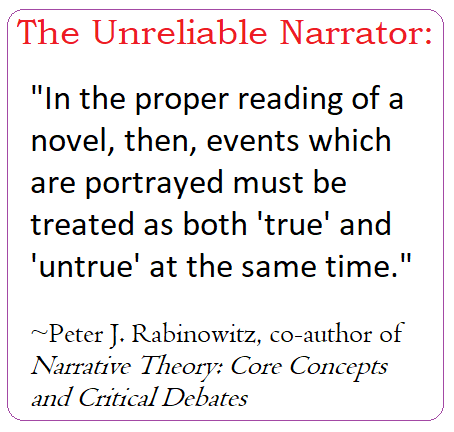
The characters we write are unreliable witnesses to the events that shape them. Their self-perception shades their reactions when they fail to live up to their own standards.

These are the watershed moments when our characters must examine their motives, and either face them or gloss over their failings.

Depth is instilled into to a scene where the characters prevail despite their flaws, succeeding against the odds. Or conversely, depth can be added when character flaws cause them to fail miserably at a point where they could have triumphed.

What two words describe the primary weaknesses of your characters, the factor that could be their ultimate ruin?

Julian Lackland: Obsession and Honor.

Beau Baker: Steadfast Loyalty.

Lady Mags De Leon: Stubbornness and Fear (of Entrapment).

Who are youKnowing the verb (action word) and the noun (object of the action) that best represented my characters made writing Julian Lackland easier. Their actions and reactions unfolded, and it was as if the story wrote itself.

So how do we get to know our characters and how they see themselves? Just as in real life, we meet and come to know them through conversations.

Conversations give shape to the story, turning what could be a wall of words into something personal.

Our next installment in this series will focus on revealing character through conversations.

17 Comments

Filed under writing