Tag Archives: writing

How writing drabbles develops mad skills #amwriting

Some of the best work I’ve ever read was in the form of extremely short stories. Authors grow in the craft and gain different perspectives when they write short stories and essays. With each short piece that you write, you increase your ability to tell a story with minimal exposition.

This is especially true if you write the occasional drabble—a whole story in 100 words or less. These practice shorts serve several purposes:

Writing such short fiction forces the author to develop economy of words. You have a finite number of words to tell what happened, so only the most crucial of information will fit within that space.

  1. You have a limited amount of space so your narrative will be limited to one or two characters only.
  2. There is no room for anything that does not advance the plot or affect the outcome of the story.
  3. The internet is rife with contests for drabbles, some offering cash prizes.
  4. Building a backlog of short stories gives you ready-made characters and a premade setting to draw on when you need a longer story to submit to a contest.

Writing a 100-word story takes less time than writing a 3,000-word story, but all writing is a time commitment. When writing a drabble, you can expect to spend an hour or more getting it to fit within the 100 word constraint.

To write a drabble, we need the same basic components as we do for a longer story:

  1. A setting
  2. One or more characters
  3. A conflict
  4. A resolution.

First, we need a prompt, a jumping off point. We have 100 words to write a scene that tells the entire story of a moment in the life of a character. Some contests give whole sentences for prompts, others offer one word, and still others no prompt at all.

A prompt is a word or visual image that kick starts the story in your head. The prompt for the following story is sunset.

In my previous post on writing short stories, I showed how I break short stories into acts. A drabble works the same way–we can break this down into its component parts and make the story arc work for us. We have about 25 words to open the story and set the scene, about 50 – 60 for the heart of the story, and 10 – 25 words to conclude it.

We sat on the beach near the fire, two old people bundled against the cold Oregon sunset. Friends we’d never met fished the surf.

Wind whipped my hair, gray and uncut, tore it from its inept braid. The August wind was chill inside my hood, but I remained, pleased to be with you, and pleased to be on that beach.

Mist rose with the tide, closed in and enfolded us, blotting out the falling stars.

Laughing at our folly, we dragged our weary selves back to our digs, rented, but with everything this old girl needed—love, laughter, and you.

The above drabble is a 100-word romance, with a beginning, a middle, and an end. The beginning places our protagonist on the beach with someone for whom she cares deeply.

The conflict in this tale? The mist and wind make it too cold for our protagonist to stay on the beach and gaze at the stars. A hard, cold wind and heavy mist are typical of the Washington and Oregon Coast in August, two things you wouldn’t think could coexist, but there, they do.

The resolution? A cozy evening indoors.

Drabbles are incredibly useful. They contain the ideas and thoughts that can easily become longer works. The above drabble, written in 2015, combined with a photograph I took while vacationing in Oregon with my husband in 2016, was the inspiration for what became a longer poem: Oregon Sunset, which you can read here.

Good drabbles are the distilled essences of novels. They contain everything the reader needs to know about that moment and fills them with curiosity to learn what happened next.

When you have a flash of brilliance, a shining moment of what if, write it in the form of a drabble. Save it in a file for later use as a springboard to write a longer work, or for submission to a drabble contest in its proto form. Spending an hour getting that idea and emotion down so you won’t forget it is a small gift you give yourself, as an author.

Whether you choose to submit a drabble to a contest or hang on to it doesn’t matter. Either way, the act of writing a drabble hones your skills, and you will have captured the emotion and ambiance of the brilliant idea.

That is what true writing is about.
26 Comments

Filed under writing

Crafting the very short story #amwriting

During the month of January I will be exploring the many aspects of the craft of writing short, salable works. I periodically discuss the importance writing to build stock for submissions to magazines, anthologies, or contests. However, many authors have difficulty keeping a story short, and there is an art to it.

Some authors are naturally skilled at this, so if you are one of those lucky people, this may be of no interest to you, but thank you for stopping by!

So, now we get down to business. First up is the short story, works that are 2,000 to around 7,000 words in length.

First, decide what length you want to write to—if you have no specific contest in mind, 2000 to 4000 is a good all purpose length that will fit into most submission guidelines. For those of you who have trouble writing short works for contests and anthologies with rigid word-count limits, this is where taking the time to do a little storyboarding becomes critical.

Let’s say you want to write a story that can be no longer than 2,000 words. You know what the story is, but when you sit down and begin writing, you think you have too much story for only 2,000 words. You need to map it out.

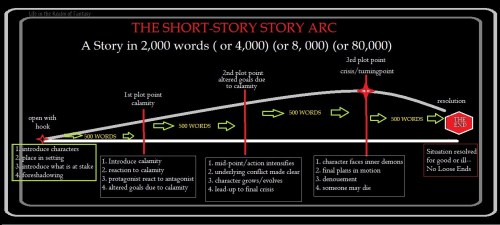
Short-stories are just like novels, in that they have an arc, and you can make it work for you.  By looking at it from the perspective of the story arc, you can see what you must accomplish, and how many words you must accomplish it in.

Every word in a 2,000-word story is critical and has a specific taskthat of advancing the plot. To that end, in a story of only 2,000 words:

  1. No subplots are introduced
  2. Minimal background is introduced
  3. The number of characters must be limited to 2 or 3 at most
  4. Every sentence must propel the story to the conclusion

For the purposes of this post, suppose we need to write a short story for submission to a fantasy anthology.

This method works for stories written in any genre and for essays, so the underlying method is not “fantasy” specific. I have used the following example before when talking about the (very short) short story, and I use it in my seminar on the subject.

First, we will carefully read the publisher’s guidelines, so we don’t waste our time writing something that won’t be accepted.

  • We discover that the guidelines stress that the wordcount limit is a strict 2,000 words, and longer submissions will not be considered.
  • The theme of this anthology is Truth and Consequences, and the theme must be strongly represented throughout the story.

Our submission will be titled A Song Gone Wrong.

The inciting incident happens off screen. We’re saving precious words by opening with our main character already in trouble, and everything the reader needs to know will be conveyed in the opening scene.

The Plot: Because he was a bit too specific when a putting a local warlord’s fling with another man’s wife into a song, our protagonist is now a wanted man in danger of being hung for treason.

Divide your story this way:

Act 1: the beginning: You have 500 words to show

  1. setting: the village of Imaginary Junction,
  2. general atmosphere: the weather is unseasonably cold
  3. introduce the protagonist and show him in his situation: In an alley, a bard, Sebastian, is  hiding
  4. introduce the antagonist(s): Soldiers of the lord he has inadvertently humiliated are searching for Sebastian.

Act 2: First plot point: You have 500 words to tell how

  1. the soldiers surround and capture Sebastian
  2. he is hauled before the angry lord and
  3. thrown into prison, sentenced to hang at dawn, but now you are at:

Act 3.: Mid-point: You have 500 Words to explain how

  1. Sebastian meets a dwarf, Noli, also sentenced to die.
  2. Noli is on the verge of managing an escape but needs help with one last thing.
  3. Noli and Sebastian manage to complete the escape route,
  4. but the guard seems suspicious, hanging around their cell door, hampering their escape

Act 4: Resolution–you have 500 words to show how

  1. The smart guard finally is relieved by a less wary guard, which allows
  2. Sebastian and Noli to squeeze through the escape route.
  3. They are spotted at the last minute, but Noli’s friends are waiting, and
  4. They are whisked to a dwarf safe-house, leaving Sebastian free to embark on his next short-story adventure

Once you have parsed out what needs to be said by what point, and in how many words, you can then get to the nitty-gritty of turning that far-fetched tale of woe into a good short-story.

You will see that to keep to the strict limit of words and still convey your story, you must choose your words carefully.

  • Use a wide vocabulary to show mood, setting, and reactions. You are an author, so you must craft the prose. It is your job to find words that best convey what you want to say, concisely in one or two sentences.
  • Sebastian can’t give Noli a recap of his troubles onscreen—all that will have to be off-stage.
  • Conversations are critical—they are the vehicle through which you convey the personalities and the minimal backstory of the piece.

You can quickly plot and write a story of any length this way, just by

  • Dividing the specified word count into four acts
  • Keeping the theme of the story in the forefront
  • Make use of your thesaurus. Put your large vocabulary to work by using words that say what you mean with the least amount of “helper” words (adjectives and adverbs).

After a few times of creating short stories using this method, you won’t need to think about it. Once you know the length a given tale has to be, you can mentally divide it into acts and just write for fun.

18 Comments

Filed under writing

#NewYears Advice from Grandma #amwriting

A new year is approaching, and as the resident grandma, I feel compelled to let you know that you are loved and worthy of the good things in life.

Every now and then I come across an author who is devastated by a lack of reviews, or sales, and is desperate to move into the “big kid’s pool.” I was that kid, once.

First, let me say that I read because I am an escape artist. I want to be completely immersed in a world elsewhere, anywhere that is not this world. I write because my favorite authors are unable to turn out a book a week, which would be what I require to satisfy my reading habit. So, I write the stories I want to read.

But I am a ‘niche’ reader. I love Tolkien, and his epic style, and Tad Williams with his lush story development. I adore Neil Gaiman and his meandering prose. I liked Robert Jordan’s side quests and multiple story lines.

I also adore George Saunders, and Patrick Rothfuss, and Erin Morgenstern.

This means my work doesn’t resonate with everyone.

I know! I was shocked to discover this too!

When I was first published in 2011, I would read my hard-earned reviews and be alternately elated or depressed. It came to a point where I couldn’t write because I was so concerned about what readers who also review would say, and that overwhelming concern stifled my ability to tell my stories.

I had allowed my damaged ego to become a vampire, sucking the joy from my creativity.

My own grandmother was right—listening to your ego is always a mistake. Your best bet is to put a gag on it and lock it in a closet.

Nowadays I don’t read my reviews, good or bad. I ignore them because they either feed my despair and lack of self-worth or they artificially inflate my ego. These mental conditions can’t coexist with my true desire to just write what I want to read. I have embraced the fact that I am writing the stories I want to read, and this means I can’t care about writing in commercially viable genres.

What I do have to care about is writing to the best of my ability, writing the story that makes me happy, and learning as much about the craft of writing that I am able.

My work is weird, it’s odd, it’s “out there.” My early books each have flaws I wouldn’t repeat if I were writing them now, but despite the flaws inherent in these early novels, they have life and passion and characters who are real to me, and I still love those stories. My growth as an author has been gradual, but the growth is clear in my more recent work.

We all have this desire to have the work we have so lovingly written and struggled to produce be accepted, and be as beloved by the world as we think it should be. We all want to write award-winning bestsellers.

But that star-struck need to be loved by millions of readers is just noise, wind in your ears distracting you from your real task. Ask yourself, “Am I an author writing a story I am passionate about, or am I calculatedly producing a marketable product?”

When I noticed my books were not easy to market, I asked myself that question. I had to also ask, “If I am pouring time and energy into creating a marketable product, who is going to market it?” The answer was “No one.” I certainly don’t have time to become a marketer if I am creating the product, nor do I have the funds to hire a marketing firm.

My point is this: if I must be strapped to the millstone, grinding away on a book I don’t love, why would I even do it? I retired from that sort of work in 2007, and believe me, working in a data entry pool gives the word “boring” new meaning.

I have no problem pegging out a short story to fit the theme and parameters of a contest or an anthology. In fact, I enjoy doing so, and try to write at least one a month. But an entire novel written to fit someone else’s idea of what my ‘genre’ should be?

No.

Ask yourself, “Do I write because I am passionate about a story? Or do I want to mindlessly enter data to fit some formulaic template readers will chew up and forget as soon as they’ve swallowed it?” Decide what you want to be known for, and pursue that goal.

I am an author. I have accepted that my head occasionally makes noise that steals my creativity. For the last few years, I have chosen to ignore the voices and immerse myself in my chosen craft, and I do this for a purely selfish reason: I want to tell my own stories.

I don’t care if my novels are acceptable to the general reading public or not. I am proud to be a niche reader and proud to be writing the niche stories I want to read, stories that don’t fit into the boxes that genre-Nazis would like to enforce on all authors.

This supremely selfish aspect of my personality keeps me going, keeps me pouring my heart, my life into something others likely won’t see, and if they do chance upon it, they may not find it to their taste.

The fact is, I am writing novels and doing the best I can to turn out a good book. This is all I care about, and I am proud of what I do, whether my work resonates with a broad spectrum of readers or not. I love what I write, and a niche group of readers seems to enjoy it, women more often than men.

That makes sense to me, as I am a woman, and this is what I want to read. While I’d like to have the world love my work, ultimately my own enjoyment is all that matters.

And that is the wisdom this old lady would like to impart to you: Write because you have a passion for a story, learn all you can about the craft, and develop your own voice.

Don’t listen to the voices on the wind, because they will suck the joy out of you. Listen to the still voice in your heart, and write something you will want to read.

I’m a reviewer as well as a reader, but don’t write your novel for me. Write it for yourself, and enjoy the ride. Chances are, I will see the good in your work and the good will more than outweigh the flaws.

3 Comments

Filed under writing

The Functions of the Scene #amwriting

A great story consists of a beginning, a middle and an end, and is made of scenes. We have action, emotion, ups and downs, a plot all sewn together by the thread that is the theme. But the entire structure of the novel is built scene by scene, connected by transitions.

Scenes may consist of conversations, or they may be action sequences, but put them together in the right order, link them with a plot featuring a good protagonist and a worthy antagonist, they combine to form a story.

I perceive the scene as a small area of focus within a larger story with an arc of its own, small arcs holding up a larger arc: the chapter. So, scenes are the building blocks of the story. Strong scenes make for a memorable novel and we all strive to make each scene as important as we can. Therefore, no scene can be wasted. Each scene must have a function, or the story fails to hold the reader’s interest.

Some things a scene can show:

  • Information
  • Confrontation
  • Revelation
  • Negotiation
  • Decision
  • Capitulation
  • Catalyst
  • Contemplation/Reflection
  • Turning Point
  • Resolution
  • Myriad deep emotions

Make one or more of these functions the core of the scene, and you will have a compelling story.

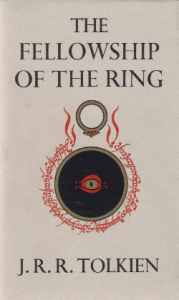
Let’s examine a watershed scene that occurs in the Fellowship of the Ring, book one of J.R.R. Tolkien’s Lord of the Ring series: The Council of Elrond. The scene is set in Rivendell, Elrond’s remote mountain citadel.

Each of those characters attending the Council has arrived there on separate errands, and each has different hopes for what will ultimately come from the meeting. Despite their different agendas, each is ultimately concerned with the Ring and protecting the people of Middle-earth from the depredations of Sauron, if he were to regain possession of it. This scene serves several functions:

Information/Revelation: The Council of Elrond serves the purpose of conveying information to both the protagonists and the reader. It is a conversation scene, driven by the fact that each person in the meeting has knowledge the others need. Conversations are an excellent way to deploy needed information. Remember, plot points are driven by the characters who have the critical knowledge.

The fact that some characters are working with limited information is what creates the tension. At the Council of Elrond, many things are discussed, and the full story of the One Ring is explained, with each character offering a new piece of the puzzle. The reader and the characters receive the information at the same time at this point in the novel.

Confrontation: Action/confrontation, conversation, reaction. A scene that is all action can be confusing if it has no context. A properly placed confrontational conversation (an argument/dispute) gives the reader the context needed to understand the reason for the action.

At the Council of Elrond, long simmering racial tensions between Gimli the Dwarf and Legolas the Elf surface. Each is possessed of a confrontational nature, and it isn’t clear whether they will be able to work together or not.

Other conflicts are explored, and heated exchanges occur between Aragorn and Boromir.

Negotiation: What concessions will have to be made to achieve the final goal? These concessions must be negotiated. Tom Bombadil is at first mentioned as one who could safely take the ring to Mordor as it has no power over him. Gandalf feels he would simply lose the ring, or give it away because Tom lives in a reality of his own and doesn’t see the conflict with Sauron as a problem. Bilbo volunteers, but he is too old and frail. Others offer, but none are accepted as good candidates for the job of ring-bearer for one reason or another. Each reason offered for why these characters are found to be less than satisfactory by Gandalf and Elrond deploys a small bit of information the reader needs.

Turning Point: After much discussion, many revelations, and bitter arguments, Frodo declares that he will go to Mordor and dispose of the ring, giving up his chance to live his remaining life in the comfort and safety of Rivendell. Sam emerges from his hiding place and demands to be allowed to accompany Frodo. This is the turning point of the story.

(The movie portrays this scene differently, with Pip and Merry hiding in the shadows. Also, in the book, the decision as to who will accompany Frodo, other than Sam, is not made for several days, while the movie shortens it to the one day.)

So, within the arc of the story are smaller arcs, arcs of conflict and reflection, each created by scenes. The arc of the scene is like any other: it begins, rises to a peak, and ebbs, ending on a slightly higher point of the overall story arc than when it began, leading to the brief transition scene.

Transitions can be as simple as a change of setting, one character leaving the room for a breath of air. They can be hard transitions, the scene ends and with it, so does that chapter. Within a chapter, conversations can serve as good transitions that propel the story forward to the next scene, offering a chance to absorb what just happened. If using a conversation as a transition, it’s important you don’t have your characters engage in idle chit-chat. In literary terms, a good conversation is about something we didn’t know and builds toward something we are only beginning to understand.

That is true of every aspect of a scene—it must reveal something and push the story forward toward something.

With each scene we are also pushing the character arc, raising the stakes a little. Our protagonist grows and is shaped by receiving needed information through action and conversation, followed by reaction and regrouping. This allows the reader to experience the story as the protagonist does, and then to reflect and absorb the information gained before moving on to the next scene.

All the arcs together  form a cathedral-like structure: the novel. By creating small arcs in the form of scenes, we offer the reader the chance to experience the rise and fall of tension, the life-breath of the novel.

2 Comments

Filed under writing

Day 8, #NaNoWriMo2017: The Detour

When I was planning my manuscript for NaNoWriMo and the month of November, I had intended to write nothing but short stories.

Unfortunately, the inspiration I had lacked for the rough draft of my current novel-in-progress (set in the Tower of Bones world of Neveyah) struck me at 2:30 a.m. on November 1st, taking us to the mid-point crisis in that story.

As a result, I have written the entire second quarter of that epic fantasy proto-novel, nearly 22,000 words in total over the last six days. But that is how NaNoWriMo sometimes goes for me. I plan to be a rebel, and end up following the rules.

On December 1st, I will copy those new chapters from my NaNo Manuscript and paste them into my original rough draft. Once that is done, the new words will bring the total up to around 60,000 words.

If all goes as planned, I will spend the rest of this month writing short stories, and won’t get back to that story until December 1st.

But as you may have noticed, things don’t always go as planned. When inspiration strikes, you must write, as some stories simply burn to be written. Write when you feel the passion, and you will have done your best work.

The creative process is different, from person to person. I use daydreaming and visual art to fire up the creative muse. With these prompts, I have little trouble getting submerged in my work.

As every writer knows, sometimes finding inspiration for what I am supposed to be working on can be elusive. But some random image or phrase will trigger my imagination. At that point I switch gears and write whatever that story is.

During most of the year, I usually have three manuscripts in various stages: one unfinished first draft, one in the second draft stage, and one near the finish line.  Every day I write new words on my rough draft first thing in the morning, unless I have an editing contract. By ten a.m. I move on to work on the others. Focusing on my rough draft first allows me to come to the more finished stories with a different, less biased eye.

At the end of the day, when my creative mind is tired, I find myself alternating between playing my game and adding a few words here and there to my rough draft.

But during November, my writing time is wholly devoted to writing new words. By the end of the day, my brain is fried, and my creative genius has died an untidy death.

As a result, some of my NaNoWriMo ramblings are brilliant—just ask me and I will tell you so. However, the majority of them not so much.

But every word I write can and will be recycled into something better, something useable, and something worth reading. In writing this stream-of-consciousness prose, I’m getting the ideas down before I forget them.

In 2015 and 2016, the manuscript I patched together for NaNoWriMo was like a quilt made up of short stories. This year’s manuscript will be a patchwork too. It will be made up of scenes and vignettes, parts of stories mingled with complete stories.

This jumble is like a bank, but instead of a place to keep money, it’s a depository of ideas and concepts for short stories, flash fictions, and essays. I will come back to this convoluted mish-mash of genres and prose again and again, whenever I need the core of a new story.

The first 22,000 words of this year have been different from the previous two years, in that my work has been a continuation of an established work-in-progress. However, I have now come to a stopping place.

Now I am experimenting with point of view through short stories. I thought of the perfect plot in which to use the little flâneur that lurks in all of us. Yes, I am leaving the fantasy genre for a brief stint in literary fiction. Besides the flâneur, I have an idea for the story of a woman, navigating the shoals of social ostracization because of her husband’s conviction for embezzlement.

Once those are done,  I will return to fantasy with an installment of Bleakbourne on Heath, and a short story set in Neveyah, the world where Tower of Bones is set.

As my homage to paranormal fantasy, I have the idea for another Dan Dragonsworthy story, set in the Drunken Sasquatch, the neighborhood tavern favored by Seattle’s ‘alternate’ population.

If I have time, Astorica, my gender-bent alternate universe, may see another flash fiction.

I have so many ideas and this month of madness is the time for me to get them all down. In fact, I’ve been talking to you long enough—I have to get back to writing!

Comments Off on Day 8, #NaNoWriMo2017: The Detour

Filed under writing

#NaNoWriMo Getting word count when you’ve fallen behind #amwriting

For some NaNoWriMo novelists, falling slightly behind becomes a death knell to their project. They feel there is no way they can make it up, that they are doomed, and therefore they quit.

In my experience, falling behind on your word count is the easiest problem to fix.

First, don’t let self-doubt creep in. This is human nature, but don’t let it defeat you.

Second, you must buckle down and write more than the minimum for a while. That is also hard, but if you catch it early, you can do it.

Do a little math. Figure out how many words per day you will need to write to make up what you missed. Add that number to your daily word goals. You might want to add a hundred or so words to that number, so you have a little wiggle-room.

Remember, what you are writing is a rough draft, so your story arc is going to be bumpy and uneven. It doesn’t have to be perfect so don’t fuss over making so. The goal of NaNoWriMo is to get that rough draft written in thirty days. So, every time you have fifteen minutes to spare, sit down and write as much as you can in that short time period. Spew your story as fast as you can in those moments before you are pulled away. With six or seven short bursts of writing, you can really rack up the word count, and perhaps make up the difference there.

We all must eat, so during NaNoWriMo, I am the queen of the crockpot and anything that can be baked in the oven. Think about it—once the food is in the oven, you will have at least half an hour of downtime. Set your laptop on the counter and write while things are baking/nuking. That is how I cook Thanksgiving dinner for my extended family—I start prepping food on Tuesday, and by writing every time I have a ten or fifteen minute pause in the preparations, I don’t fall behind. This also allows me to enjoy my family on Thanksgiving day, because most of the work is already done.

Yes, the vegan does roast 2 turkeys for the numerous carnivores, but everything else is plant based and homemade. Despite the extra work that Thanksgiving week adds to my life, I get my word count every day and still get my house ready for guests by using this method.

For much of my working life, I was a single parent, sometimes with three part-time jobs. My main job was as a bookkeeper, or working in data entry for corporate America, but though the 1990s I worked weekends and holidays as a hotel maid. I’m retired now, but although I’d never heard of NaNoWriMo, I was a secret novelist, and I couldn’t stop thinking about what I was writing.

What I did in those old days was this—I always took my lunch to work and wrote during my lunch half-hour. You don’t have to announce you are writing a book if you don’t wish to—I certainly didn’t feel comfortable doing so. If you want to spend your lunch time writing, politely let people know you’re handling personal business and won’t have time to chat.

Some offices will allow you to use your workstation computer for personal business, but most of my places of employment frowned on that. I brought a notebook and pen as I didn’t own a good laptop. By writing down all my thoughts and ideas, I had a great start when I finally did get a chance to write. If your work allows, bring your laptop or your iPad/Android. So you don’t get into trouble with the boss, sit in the lunchroom (if you have one).

I always wrote in the evenings while my children did their homework, which sometimes meant a lot of stopping and starting, but I did get some writing done. Some is better than none! You can also set aside a block of time on the weekend to make up some words, though that can be difficult, as setting aside an un-infringeable time on a weekend can become a hardship, especially if you have a young family.

But by writing in short bursts whenever you have the opportunity, you might get your first draft finished, and get that certificate that says you completed 50,000 words in 30 days.

One way to cultivate your emotional and poetic mind, and to improve your writing skills in general, is to write in the stream-of-consciousness style. This is unstructured, unedited writing. It reflects your (or your character’s) observations. Writing in this fashion mirrors the way internal thoughts in the human mind work – you are quickly processing thoughts and perhaps switching from one topic to another with a certain amount of abandon. Just go for it.

Remember what I said above? Don’t worry about perfection. The purpose of NaNoWriMo is to get that rough draft written in thirty days. In January or March, or whenever you go to rewrite your rough draft, you might be amazed to find that much of what you originally wrote has life and passion.

The point is to keep on writing even when you have fallen behind. Use whatever motivational tricks you need to encourage yourself, and don’t be too hard on yourself. Far more importantly than simply getting word count, the goal is to finish your novel.

And remember: you can do it.

12 Comments

Filed under NaNoWriMo, writing

Pantsing vs. Plotting or Somewhere in the Middle #NaNoWriMo2017 #amwriting

A friend of mine recently said, “I did what some gurus suggested for NaNoWriMo and planned out my book. All the joy is off the idea now, and I want to do something different.” This is not an uncommon occurrence. For some people, planning the outline makes them feel they have already written the story and they lose their enthusiasm.

I am a plotter, but I am also a pantser. A great article on this subject can be found at The Write Practice.

Quote: Simply put, a plotter is someone who plans out their novel before they write it. A pantser is someone who, “flies by the seat of their pants,” meaning they don’t plan out anything or plan very little.

Planning what events your protagonist will face is called plotting, and I make an outline for that.

“Pantsing it,” or writing using stream-of consciousness can produce some amazing work. That works well when we’re inspired, as ideas seem to flow from us. But for me, that sort of creativity is short-lived, unless I have a brief outline to follow, a road map of some sort.

Participating in NaNoWriMo has really helped me grow in the ability to write on a stream-of-consciousness level, but that only works for so long before I need a reminder of what my story was about in the beginning. My storyboard gets me back on track without making me feel like the creativity is already done.

One NaNoWriMo joke-solution often bandied about at write-ins is, “When you’re stuck, it’s time for someone to die.” Sadly, assassinating beloved characters whenever we run out of ideas is not a feasible option because we will soon run out of characters.

As devotees of Game of Thrones will agree, readers (or TV viewers) get to know characters and bond with them. When cherished characters are too regularly killed off, the story loses good people, and we must introduce new characters to fill the void. The reader may decide not to waste his time getting invested in a new character, feeling that you will only break their heart again.

The death of a character should be reserved to create a pivotal event that alters the lives of every member of the cast and is best reserved for either the inciting incident at the first plot point or as the terrible event of the third quarter of the book. So instead of assassination, we should resort to creativity.

This is where the outline can provide some structure, and keep you moving forward.  I will know what should happen in the first quarter, the middle, and the third quarter of the story. Also, because I know how it should end, I can more easily write to those plot points by filling in the blanks between, and the story will have cohesion.

Think about what launches a great story:

The protagonist has a problem.

You have placed them in a setting at a given moment, and shown the environment in which they live.

You have unveiled the inciting incident.

You know what they want, but you aren’t sure how far they will go to achieve it.

Now you need to decide what hinders the protagonist and prevents them from resolving the problem. While you are laying the groundwork for this keep in mind that we want to evoke three things:

  • Empathy/identification with the protagonist
  • Believability
  • Tension

We want the protagonist to be a sympathetic character whom the reader can identify with; one who the reader can immerse themselves in, living the story through his/her adventures.

But for NaNoWriMo, speed is everything. I need to get my 1,667 words every day, and I can’t take the time to sit back and ponder what to write next.

I find that this is where a loose outline helps me write quickly. Readers want the hindrances and barriers the protagonist faces to feel real. A loose guide helps me develop setups for the central events. This enables me to quickly lay down the narrative that shows the payoffs (either negative or positive) to advance the story: action and reaction.

Some authors resort to “idle conversation writing” when they are temporarily out of ideas.  If you can resist the temptation, please do so—it’s fatal to an otherwise good story. Save all your random think-writing off-stage in a background file, if giving your characters a few haphazard, pointless exchanges helps jar an idea loose. (However, for purposes of wordcount, if you wrote it, you can count it!)

One failing of NaNo Novels in their rough draft form is their unevenness. Try not to introduce random things into a scene unless they are important. Remember, to show the reader something is to foreshadow it, and the reader will wonder why a casual person or thing was so important they had to be foreshadowed.

Both over planning and under planning can lead to a book that is stalled and a writer who believes they have ‘writers’ block.’ For me a happy medium lies in a general outline, done as a brief storyboard:

What has prevented you from writing in the past? Did you get busy? Did you sleep in? Did you feel uncreative? These are mental roadblocks we all experience. The whole point of NaNoWriMo is to develop the ability to work through these hindrances.

Remember, you are a superhero with a keyboard, slaying the monsters of indolence and lack of creativity.

My dear friend, author Stephen Swartz, had this to say on the subject of over planning: “The story is your ship, the NaNo your ocean. Let the keyboard be your wind! May metaphors drive you to new lands!”

I completely agree. Do a little planning, but write like the wind, and let the story take you where it will.


Credits and Attributions

The Pros and Cons of Plotters and Pantsers by The Magic Violinist, The Write Practice, http://thewritepractice.com/plotters-pantsers/ © 2017

5 Comments

Filed under writing

Developing Discipline #NaNoPrep #NaNoWriMo2017

Every author knows that writing is about so much more than merely laying words down on a page.  Most people with a minimal education can do that, and can even whack out a creditable paragraph or two. However, sustaining the momentum and carrying that vision through an entire novel is quite another thing.

Over the years, I’ve seen disparaging articles where people have expressed their scorn and disdain of authors who participate in Nation Novel Writing Month, mocking the notion of a “competition,” deriding both the authors and work that emerges from this month of madness and frozen pot pies.

They’re missing one important point: to write a novel one must begin a novel and make the time to complete it. It takes discipline to write 50,000 words in 30 days. Most people don’t have what it takes to commit to that kind of regimen. Participating in NaNoWriMo forces the author to sit and write a minimum of 1,667 new words every day. If the participant does only that, they will have completed a 50,000 word novel in 30 days. I generally manage between 2,000 and 4,000 words a day during NaNoWriMo.

So, to the naysayers, I say, “Fine. If it takes a special month of writing and a group frenzy to get some people fired up about an idea they’ve had rolling around in their heads, who am I to complain?” I am a reader as much as I am an author. The more books that are written, the merrier I will be.

Here’s a short list of well-known novels to emerge from NaNoWriMo particpants:

  1. Water for Elephants, by Sara Gruen. On the best-seller lists for over a year, turned into a movie starring Reese Witherspoon and Robert Pattinson, started as a NaNo novel.
  2. The Night Circus, by Erin Morgenstern. What eventually became The Night Circus began life in 2004, seven years before it was finally published, started as a NaNo novel.
  3. Wool, by Hugh Howey. Howey’s dystopian sci-fi novel is one of those credited with putting self-publishing on the map, started as a NaNo novel.

Authors all begin knowing very little about how to write something another person would want to read. But if you maintain the dedication you develop in November, you can learn how to express what your heart feels. Work at learning the craft as hard as you worked to get your wordcount, and you will develop that talent for storytelling.

I think of the many authors to come who will gain both discipline and love of the craft through participating in NaNoWriMo. Many truly talented people are now embarking on learning a craft, committing their time and resources to educating themselves about how to write a novel that others will want to read. Several years down the road, who knows what wonderful works of fiction will have emerged from this year’s madness?

I only know that I am always looking for a good book, and so I will be first in line, hoping to be impressed by a fresh, new work of art. Therefore, I volunteer as a Municipal Liaison for NaNoWriMo. Every year we have new, young writers, with fresh, amazing ideas. But we also have many new older people who are writing their first novel, embarking on a dream they always had but never thought they could do.

The fact is, most people who begin a novel in November do not reach their goal of 50,000 words and never finish those novels. They do not have the discipline to sit down every day and dedicate a portion of their time to this project.

A great number of NaNo authors discover that doing NaNoWriMo is just like doing karaoke. They love to read, and they want to write the next Gone with the Wind, but their work reads as pleasantly as a tone-deaf drunk singing Wind Beneath my Wings. They are not talented writers, and their work isn’t stellar. Just because the rough draft was finished in thirty days and the author got the winner’s certificate of completion, it doesn’t mean that what they wrote was good. It just means they had the discipline to write it.

But despite the high number of would-be authors who fail to finish their novel, a few writers in each age group will continue writing after the month of madness is over. They will embark on the process of educating themselves in the craft.

These authors see the goal and are filled with the desire to finish what they started, knowing they will have to rewrite, edit, revise, and edit again to truly finish their book. When I talk to them and hear how fired up and passionate they are, I am proud to have been a part of their writing life.

Whatever gets a writer fired up and writing is fine by me, and we are all the better for the experience.

7 Comments

Filed under writing

Writing to a Theme #NaNoWriMo2017 #amwriting

November 1st begins the merry month of madness known as NaNoWriMo. Once again, as I have for the last seven years, I will spend the thirty days of November on an intensive writing binge.

Every day I will sit and write at least 1,667 NEW words on my current work in progress. If I do only that, I will have 50,000 words by Nov. 30th, which will bring the rough draft of that book nearly to completion.

But I generally manage between 2,000 and 4,000 words a day, and I work on several different projects. This year, while I WILL work on the rough draft of my current work-in-progress, my official project is another collection of short stories, poems, and flash fictions, all of which will be written to a variety of different themes.

The reason I need to build the backlog with a wide variety of themes is that most anthologies and many publications will call for submissions based around a central idea–such as  redemption, bridges, asylum–a large concept that  unifies the disparate stories.

So, my plan is to write to as many different themes as I can think of. Hopefully, if an opportunity presents itself later, I will have the perfect story ready, one that will only need some revising and editing.

One question I hear often is “how do I identify the theme of my story?” I have discussed this before, but it bears mentioning again. Theme is what the story is about on a deeper level than what is seen on the surface. It’s the big meaning, a thread that is woven through the entire story, and often it’s a moral. Love, honor, family, redemption, and revenge are all common, underlying themes.

Sometimes it’s difficult to write a short story unless you start out with a theme in mind. The same can be said for novels, although the theme can emerge more slowly than in short stories. For me, writing to a theme makes the process easier because half the work is done—I know what I’m writing about.

Several of the stories I will be working on are for themed anthologies with open calls for submission, but whose closing dates are rapidly approaching. When I made my list of proposed stories, I searched Submittable for open calls, so I know the desirable themes in advance. Some publications have submission dates that are quite a ways out, some have short deadlines.

Knowing the trending themes publishers are asking for is crucial to building your backlog with salable stories, so if you don’t have a Submittable account, you should get one.

What I hope to do in each story is to layer character studies, allegory, and imagery to emphasize the central theme and support the story arc. Sometimes I am successful, other times, not so much, but I still keep trying.

Most of my books are based around the hero’s journey, and how the events my protagonists experience shape their reactions and personal growth. The hero’s journey allows me to employ the theme of good vs. evil and the sub-themes of brotherhood, and love of family.

These concepts are important to me on a personal level, and so they find their way into my writing.

What themes are important to you? When you look for a book, what catches your interest? I am not talking genre here, I am speaking of the deeper story. When you look at it from a distance, what do all the stories you love best have in common?

Political thrillers: Set against the backdrop of a political power struggle. Political corruption, terrorism, and warfare are common themes.

Romance Novel: Two people as they develop romantic love for each other and work to build a relationship. Both the conflict and the climax of the novel are directly related to that core theme of developing a romantic relationship, although the novel can also contain subplots that do not specifically relate to the main characters’ romantic love.

Literary fiction focuses on the protagonist of the narrative, creating introspective. These are in-depth character studies featuring interesting, complex and developed characters. Action and setting are not the primary drivers of the story arc here. Instead, action and setting are carefully developed in such a way they frame the character, and provide a visual perspective. Allegory is a featured motif in many literary fiction novels.

Science Fiction: realistic speculation about possible future events, based solidly on adequate knowledge of the real world, past and present, and on a thorough understanding of the nature and significance of the scientific method. Science and technology are a dominant theme but based on current reality. Characters are still subject to sub-themes such as morality and love, but setting and science are the main themes.

Fantasy: Often set in alternate Earths, medieval times, or ancient worlds, the common themes are good vs. evil, hero’s journey, coming of age, morality, romantic love. Can also be set in urban settings with paranormal tropes.

On the surface, these types of books look widely different but all have one thing in common–they have protagonists and side-characters. These imaginary people will all have to deal with and react to the underlying theme of the book.

Morality, love, coming of age–these ideas can be found in nearly every book on my shelves or in my Kindle. These are the themes that were most powerfully depicted in the books that rocked my early reading world and are the sort I still seek out.

4 Comments

Filed under writing

The Stranded Novel #amwriting

Good first lines are critical. They have a singular duty, to involve the reader and kidnap them for the length of the book. For that reason, first lines and the opening chapters frequently become all that is ever written of a would-be author’s novel. Yet the authors of those few chapters have the entire book locked in their head.

Participating in NaNoWriMo teaches authors to write the entire book before they begin editing.

In your first draft, DON’T OBSESS over the small things and the finer details as these will derail your work. You will never get past the first chapter if all you can focus on is writing a brilliant opener. Write the entire story as quickly as you can, let it sit for a month or two while you do something completely different, THEN come back to it and focus on shaping the prose. Once you have the entire structure of the novel laid down on paper, you won’t be left wondering where to go next, writing and rewriting the same first chapter.

So, let’s assume the rough draft has been completed, and you are pleased with the way it ends. But you are looking at your early chapters, and they feel lackluster. Now is the time to shape the words, to write them so they are the words you would want to read if you were looking for a book to purchase.  The second draft is when you should obsess about your first lines.

One of the best first lines ever: George Eliot’s Middlemarch starts, “Miss Brooke had that kind of beauty which seems to be thrown into relief by poor dress.” That line makes one want to know Miss Brooke and the reader wonders who the observer is who chronicles this. It is a novel, but if it had been a short story, it would still have hooked the reader.

Good first lines make the reader beg to know what will happen next.  How about this first line from Ulysses, by the king of great one-liners, James Joyce: “Stately, plump Buck Mulligan came from the stairhead, bearing a bowl of lather on which a mirror and a razor lay crossed.”

Or, take the first line of Jane Austen’s Pride and Prejudice“It is a truth universally acknowledged, that a single man in possession of a good fortune, must be in want of a wife.” 

Should your first lines be required to introduce your main character? I think not.

Dickens introduced an era in the opening lines of A Tale of Two Cities: “It was the best of times, it was the worst of times, it was the age of wisdom, it was the age of foolishness, it was the epoch of belief, it was the epoch of incredulity, it was the season of Light, etc…” 

In his Wheel of Time series, Robert Jordan frequently opened with a glimpse into the side of evil, illuminating the foes whom Rand Al Thor must somehow prevail against, and that always hooked me.

All of the above books were begun as great ideas and the manuscripts were finished, which is why they were published. Admittedly, Robert Jordan did pass away before the final books were completed, but he wrote 12 of the 15 books and left a complete story arc with enough notes that Brandon Sanderson could finish the job. Jordan left behind a complete story, not just a first chapter.

If you are serious about writing, it’s necessary to read, to see how other authors have completed their work. Of course, you must read works published in your chosen genre, but to become an educated reader/author, you should look outside your favorite genre. You don’t have to spend your precious book purchasing funds on books you believe you won’t enjoy. Do a little advance research via the internet and then borrow the books from the library.

Most importantly–published authors, whether Indie or traditionally published, have finished their work. Maybe they didn’t do as great a job as some people think they could have done, but they did finish the job.

Grand ideas about what you intend to write mean nothing if you don’t finish the job. If you want to lay claim to being an author, write the ENTIRE novel! Get that story arc down on paper before you begin rewriting the first chapter! If all you have ever written is the first chapter, over and over, and over… perhaps you need to set that idea aside and begin one that interests you enough to inspire you to write a complete novel.

6 Comments

Filed under writing