Tag Archives: writing

#amwriting: Verbs: when to use “if I was” and “if I were”

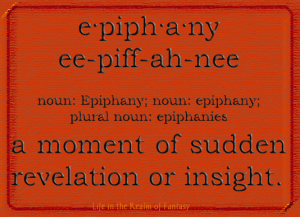
epiphanyMost of my ideas for blog posts arise during work, or in conversation with other writers. Usually, these revolve around concepts I have a basic understanding of but haven’t really given a lot of thought to. Writing about them helps to clarify and cement them in my mind.

Every now and then a grammar topic comes up that I’ve never really thought about. If it’s a subject I am not really clear on, I will research it, and then try to distill my discoveries into bite sized chunks.

We writers often operate by instinctively using the knowledge we gained in school. Often, as in my case, that knowledge is a bit tarnished and worse for the wear.  Today’s topic is one fabulous instance of that very thing.

Last Tuesday, we were standing around the virtual watercooler at the virtual offices of Myrddin Publishing. We have authors and editors on three continents, so we use a virtual office. A grammar question arose, and this is how the conversation went:

Shaun Allan (UK) said: Grammar question, please. ‘As if it were’ or ‘as if it was’ ?

Ross Kitson (UK) said: Would it depend upon the subject of it? If it were an individual then I’d say “was” whereas if ‘it’ were an event then I’d say ‘were.’ Might be best to ask a non-Northerner.

Connie Jasperson (me) (US) said: Ross Kitson is correct (in my opinion).

Stephen Swartz (US) said: were.

Gary Hoover  (US) said: A HUGE issue with most people is the subjunctive tense. Anything that is not actual but could be is subjunctive (as your phrase indicates). “If I were a carpenter.” Is correct because the singer isn’t actually a carpenter. “I was a carpenter” is correct if he actually was. (Gary inserted the link to Wikipedia’s article on “English Subjunctive”)

Alison DeLuca (US) said: I’m a subjunctive slore! ‘Were’ all the way.

It turns out this conversation revolved around the “Past Subjunctive Tense.” Gary, Stephen, and Alison had it right.

As a result of this conversation, I did a little more digging, wanting to know more about this oddly named construct. It just so happens that on Saturday morning, Stephen Swartz and I both happened (at the same time) upon an excellent blog post by the Grammar Girl, Mignon Fogarty.

When you go out to Wikipedia the whole subjunctive verb thing looks quite complicated, but it doesn’t have to be. The subjunctive (in the English language) is used to form sentences that do not describe known objective facts. For the purposes of this post, we are only looking at Past Subjunctive definitionSubjunctives: the verbs was and were.

But first, what does “subjunctive” mean?:

Dictionary.com defines “Subjunctive.” as:

adjective

1.(in English and certain other languages) noting or pertaining to a mood or mode of the verb that may be used for subjective, doubtful, hypothetical, or grammatically subordinate statements or questions, as the mood of ‘be’ in ‘if this be treason.’

Compare imperative (def 3), indicative (def 2).

noun

2.the subjunctive mood or mode.

3.a verb in the subjunctive mood or form.

First, let’s consider what Past Subjunctive Tense covers: how to use the words ‘was’ and ‘were.’

Which is correct?

  • I wish I were a penguin. I would fly through the water.
  • I wish I was a penguin. I would fly through the water.

If I am only  only wishing I were a penguin, were is correct. If I actually could be a penguin, was would be correct and I would have to rewrite my sentence, by deleting ‘I wish’ and changing ‘would’ to ‘could.’

The Grammar Girl goes farther. She says: Believe it or not, verbs have moods just like you do. Yes, before the Internet and before emoticons, somebody already thought it was important to communicate moods. So, like many other languages, English has verbs with moods ranging from commanding to questioning and beyond. The mood of the verb “to be” when you use the phrase “I were” is called the subjunctive mood, and you use it for times when you’re talking about something that isn’t true or you’re being wishful.

I love that clue—that verbs can be wishful.
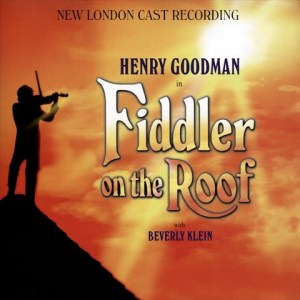
fiddler onthe roof soundtrackThe Grammar Girl gives us a great example: Think of the song “If I Were a Rich Man,” from Fiddler on the Roof. When Tevye sings “If I were a rich man,” he is fantasizing about all the things he would do if he were rich. He’s not rich, he’s just imagining, so “If I were” is the correct statement. This time you’ve got a different clue at the beginning of the line: the word “if.”

However, there are times when we use the verb ‘was’ even though the subject of the sentence has not yet happened, or may not happen at all. Grammar Girl says:  But “if” and “could” and similar words don’t always mean you need to use “I were.” For example, when you are supposing about something that might be true, you use the verb “was.”

Past subjunctive verb forms express a hypothetical condition in present, past, or future time:

  • Don’t complain about the food. What if I was a chef?
  • I wish I were reincarnated. What if I was a penguin?

If it’s only wishful thinking, we use “were.” If it might be true but we don’t know or it hasn’t happened, we use “was.”

So now, thanks to a bunch of editors hanging around the water cooler and the miracle of the internet, we know how and when to use our moody, past subjunctive verbs.

If you are a grammar junkie (as I am becoming) I highly recommend you check out Mignon Fogarty’s Grammar Girl blog, or pick up her books.
4 Comments

Filed under writing

#amwriting: son and sir: to capitalize or not?

Tom Hiddleston MemeTerms of endearment are often used in casual conversation. Each has their own implications which are highly dependent on tone of voice, body language, and social context.

They can be fairly impersonal, denoting a friendship. Conversely, they can be intimate, indicating a close relationship.

Used by perfect strangers they can also be patronizing and rude.

These words vary in creativity from the sublime to the ridiculous:

  • dear
  • mate
  • chum
  • darling
  • honey
  • baby-cakes
  • sweetheart
  • sugar
  • wuvvy-dovey

From Wikipedia, the fount of all knowledge: Saying “Hey baby, you’re looking good” varies greatly from the use “Baby, don’t swim at the deep end of the pool!” Certain terms can be perceived as offensive or patronizing, depending on the context and speaker. (end quoted text.)

This brings us to the word “son.” Again, as in so many other aspects of the writing craft, context is everything.

  • “I love you, Son,” said the doting father.

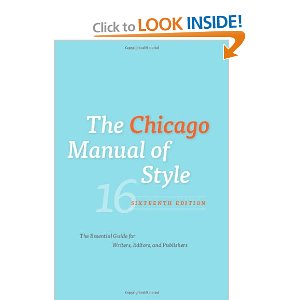
The_Chicago_Manual_of_Style_16th_editionFrom the Chicago Manual of Style, Section 8.35: Kinship names are lower-cased unless they immediately precede a personal name or are used alone:

  • my father and mother
  • Aunt Jane
  • the Bronte sisters
  • I believe Grandmother’s name was Marie
  • Please, Dad, let’s go.
  • She adores her aunt, Maud

But, in the past, instead of a boy’s name, men commonly called boys boy, kid or son, not as a name but as a neutral term of endearment. My interpretation of the word “son” in casual conversation is like this: I feel it should not be capitalized if it is being used to indicate friendship, or in a patronizing fashion.

Wikipedia claims that in an informal setting, such as a pub or gym, the use of terms of endearment is a positive politeness strategy among men. A term like “mate” or “son” shifts the focus toward the friendship existing between the speakers, yet maintains a slight emotional distance.

The problem here is the term “son.” In some cases, it is used when speaking to a man not related, but indicates friendship on the part of an older speaker in regard to a younger companion. I feel that, when used as a neutral form of endearment, the word “son” falls into the same class as:

  • Hand me the scissors, darling.
  • Have a beer, mate.
  • Gloria, dear—how’s your mother?
  • Grab that remote for me, love.
  • How’ve you been, old son?

The above endearments are not between speakers with a deep emotional attachment. They indicate camaraderie and nothing more–they are neutral. Therefore, “son” should not be capitalized if it is being used as a neutral term of endearment when speaking to a person you are not related to.

  • “Okay, son. Tell your ma I stopped by,” said his neighbor.
  • “Get off your high-horse, son,” said man next to him.

As stated above, The Chicago Manual of Style’s preference has always been to lowercase pet names, (which are terms of endearment) but in reality, you can’t go wrong unless you’re inconsistent, since the issue is guided by preference rather than rule.

The word preference means:

  1. a greater liking for one alternative over another or others.

synonyms: liking, partiality, predilection, proclivity, fondness, taste, inclination, leaning, bias, bent, penchant, predisposition

So, if you do choose to capitalize the word “son” when used as a term of endearment, be consistent. But also be aware that it’s not necessary.

Then there is the question of the word “sir.” It is an honorific. From the Chicago Manual of Style section 8.32

Portrait of Henry VIII (1491-1547) by Hans HolbeinHonorific titles and respectful forms of address are capitalized in any context with several exceptions:

  • sir
  • ma’am
  • my lord
  • my lady

Always capped:

  • Madam Speaker
  • Your Honor
  • Your Excellency
  • Her (His, Your) Majesty; His (Her, Your) Royal Highness
  • The Most Reverend William Ronstadt (Roman Catholic Bishop)
  • Lord John Davies; Lady Mary Shelton
  • The First Gentleman; the First Lady
  • The Right Honourable John Carter

Where king/queen is used as part of someone’s name, it is always capitalized:

  • King Bob, and Evelyn, the Queen of Darkness

Where king/queen is used as part of a general reference it is lower-cased:

  • “Hello,” said the king.

Should one capitalize the word sir when it’s used in dialogue? Which of the following would be correct? “Yes, sir.” OR “Yes, Sir.”

Paul-McCartney-on-playing-Rock-BandIf the reply is to a respected person in general, it is written with no capital, as it’s not a formal name. But you do need a comma just as you would with a formal name:

  1. “Yes, sir.” (General politeness.)
  2. “Yes, Sir Paul.” (Formally agreeing with a knight.)
  3. “Yes, Larry.” (Proper use of comma.)

When writing dialogue: if your speaking character is in the military and the person he/she is addressing has a military rank above them, THEN you must capitalize it.

If you are writing about Sir Paul McCartney’s favorite brand of socks, capitalize it.

You must also capitalize the words “sir” and/or “madam” when beginning a letter or an email. My favorite internet example of this is:

Dear Sir or Madam,

I am writing to inform you that you a related to a Nigerian prince. (Grammar Party Blog)

Just refer to me as “my lady” from here on out. Email doesn’t get better than that!

6 Comments

Filed under Publishing, writing

#amwriting: using repetition as a literary device

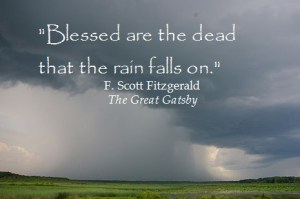
fitzgerald-great gatsby memeUnconsciously using the same words too often in our descriptions is one of the pitfalls of writing. It happens to all of us, and for me it occurs most often when I am laying down the first draft. I’m hurrying and trying to get the ideas out of my head and onto the paper and my vocabulary can’t keep up.

Many common words (the, and, etc.) don’t really stand out when used more than a few times in a paragraph, and you couldn’t write well if not for those words. However, some words will always stand out more than others, and if you use them more than once in a paragraph it looks like you’re unimaginative or a lazy writer. This is especially true if the word in question has a lot of synonyms you could have used instead of repeating the same word. Having a good thesaurus at hand is a great help to the brain-stranded author.

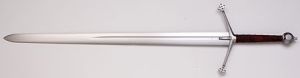
Scottish claymore replica Albion Chieftain, Søren Niedziella, CC BY 2.0

Some words don’t have a lot of obvious synonyms so you get hung up on the few you can find.  In my own work, the word sword is one of the main culprits. The type of blade my characters wield in the World of Neveyah books is a claymore, and four ensorcelled blades figure prominently in the Tower of Bones series.

Therefore, some obvious synonyms will not work as these are distinct blade types that are in no way like a broadsword.

  • Rapier
  • Epee
  • Foil

Because of this constraint, I am limited to:

  • Sword
  • Blade
  • Weapon
  • Steel (if I’m desperate, but I despise using that to reference a weapon that isn’t an epee or a rapier)

ozford american writers thesaurusHowever, sometimes we use intentional repetition:

Sometimes we want to emphasize a concept and repetition is the way to do it. Some of the best authors use the repetition of certain key words and phrases to highlight an idea or to show the scene. This technique is an accepted rhetorical device and is commonly found in mainstream fiction. It is used to evoke an emotional response in the reader, and can be exceedingly effective when done right.

Literarydevices.net says, “The beauty of using figurative language is that the pattern it arranges the words into is nothing like our ordinary speech. It is not only stylistically appealing but it also helps convey the message in much more engaging and notable way. The aura that is created by the usage of repetition cannot be achieved through any other device.”  (End quoted text)

Also according to literarydevices.net, repetition as a literary device can take these forms:

  • Repetition of the last word in a line or clause.
  • Repetition of words at the start of clauses or verses.
  • Repetition of words or phrases in opposite sense.
  • Repetition of words broken by some other words.
  • Repetition of same words at the end and start of a sentence.
  • Repetition of a phrase or question to stress a point.
  • Repetition of the same word at the end of each clause.
  • Repetition of an idea, first in negative terms and then in positive terms.
  • Repetition of words of the same root with different endings.
  • Repetition both at the end and at the beginning of a sentence, paragraph, or scene.
  • A construction in poetry where the last word of one clause becomes the first word of the next clause. (End quoted text)

Some famous examples of repetition as a literary device:

“Every book is a quotation; and every house is a quotation out of all forests, and mines, and stone quarries; and every man is a quotation from all his ancestors.”  Ralph Waldo Emerson, Prose and Poetry

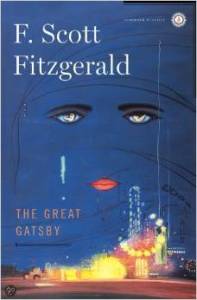
f scott fitzgerald The Great Gatsby“About half way between West Egg and New York the motor-road hastily joins the railroad and runs beside it for a quarter of a mile so as to shrink away from a certain desolate area of land. This is a valley of ashes—a fantastic farm where ashes grow like wheat into ridges and hills and grotesque gardens, where ashes take the forms of houses and chimneys and rising smoke and finally, with a transcendent effort, of men who move dimly and already crumbling through the powdery air.” F. Scott Fitzgerald, The Great Gatsby

When an author writes it intentionally to drive home a point, repetition is an effective tool. It is when words are inadvertently used with a lack of creativity that repetition ruins a narrative.

Consider buying a thesaurus or make use of the many online thesauruses that are available.

I have a well-worn copy of the Oxford American Writer’s Thesaurus. This book has become just as important to me as my copy of the Chicago Manual of Style. This large book of synonyms can be purchased used from Amazon, for as little as $9.99 in the hardcover form. I do recommend purchasing this as a paper book rather than an ebook. Once you see the amazing variety of words at your disposal, it’s one you will refer back to regularly.


4 Comments

Filed under Literature, writing

#amblogging: wanted: flatiron for curly quotes and other blogging twists

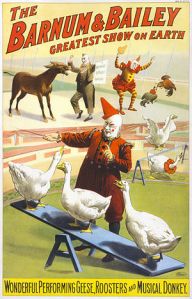
300px-Barnum_&_Bailey_clowns_and_geese2Blogging regularly is one of the best ways to improve your writing chops but it can be like working for the circus.  Even when you really know the vagaries of your platform, a lot of strange things can happen in your work. They go unnoticed, doing their thing in the background, keeping it interesting.

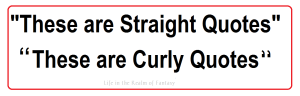
WordPress, the mighty bastion upon which my empire rests, uses ‘fancy quotes’ as the default format. While they do look better in a document, blogging can often be an off-the-cuff thing. Straight quotes are less apt to go awry.  I am not sure why this is the default, nor am I able to find a way to ‘unfancy’ them.

WordPress chooses to make things  fancy, but I don’t need fancy. Judging from the number of posts in their forums on the subject, I am not the only one.

In some places, these curvy morsels of madness are called ‘smart quotes.’ In others, they are ‘curly.’ I don’t like them because sometimes they end up facing the wrong way, and being a bit unobservant, I don’t catch that until after I’ve posted it.

I’ve discovered some out of date plug-ins that are no longer available for uncurling my curly quotes, but alas– ‘no longer available’ is not really helpful. I have a flatiron for my curly hair–I need one for WordPress’s curly quotes.

straight and curly quotesAnother seemingly random thing I’ve discovered the hard way: occasionally I will decide to cut a section and paste it elsewhere, only to find (after having published the post) that the cut section has magically reappeared, and I am now repeating myself, verbatim.

This happens so often that I neurotically look at the menu every time I right-click-cut anything, to make sure I am actually cutting and not merely copying.

I double-check the text. Yes, the cut piece is definitely cut and successfully pasted elsewhere. But when I click ‘save draft’ it magically reappears back in the place from which it was cut, and I am once again repeating myself.

gibberish-american businesses onlineThen there is the hinky formatting. Sometimes the formatting goes crazy  and no matter what I do, the spaces between the paragraphs vanish. My post becomes a wall of words. Highlighting the post and clicking on ‘clear formatting’ does not help.

The spaces will show up on the editing side of the piece, but they will have vanished when the post is saved and published. (Edit: removed repeated line. Cursed fluently.)

My hubby, the programmer, says this is most likely caused by some hidden formatting issue that happens when I am copying from a Word doc and pasting it into the post. I usually write my posts in a Word doc because I catch more mistakes that way. Then I paste it here and, using the ‘preview’ option, check, double-check, and check again for bloopers.

Randomly, the posts are rife with strange formatting that will not be removed no matter what remedy I try. If I was a programmer, I would know exactly what bit of code was causing it and fix it. Alas! I’m only an old lady with just enough knowledge to be dangerous.

Hinky formatting also occurs in my Blogger sites, but not as often. I love the way WordPress looks when it’s all going right, but I love the options Blogger offers and the compatibility with Google products such as YouTube videos. (Blogger is a Google product.)

Dealing with these little issues are why I try to write my posts several days in advance and schedule them for the time I want them to post. Once I have it scheduled, I will let it sit overnight and then come back and read it with fresh eyes. I catch a lot that way, but it’s amazing how many slip by me.

This is why I always say self-editing is not as effective as we’d like. No one sees my blog posts before they are published but me and invariably I miss some whopping eye stopper.

1024px-Trapeze_Artists_in_CircusThe most mysterious problem is the inadvertent posting of a piece that is

  • in the draft stage
  • full of bloopers
  • looks illiterate

Technically, that happens because I get side-tracked and instead of scheduling it as I normally do, for some crazy reason I click ‘publish’ instead of ‘save draft.’

I blame ghosts.

And curly quotes.

9 Comments

Filed under blogging, writing

St Albans… ‘render unto Caesar’

Photographer and author, Sue Vincent, takes us on a journey through British history via the architecture of St. Albans. It is in this village where the real influence of the Romans can still be seen. Roman and Victorian building styles collide and create something uniquely British.

5 Comments

Filed under Adventure

#amreading: the genesis of an author

Nymphenburg, View From the Seaside painting by Joseph Wenglein 1883

Nymphenburg, View From the Seaside painting by Joseph Wenglein 1883

I find the process of creativity as experienced by others intriguing, and am always curious about how they became authors.

My own journey to this place in my life was pretty tame. But some people  become authors via more adventurous, alternative paths.

This notion is explored in Elizabeth McKenzie’s frank, autobiographical post published on January 26, 2016, for LitHub.

Max Ernst, The Elephant Celebes 1921, Tate, London via WikipediaAppropriately titled “Surrealism and Decomposition. Or How I Wrote My Novel,”  McKenzie takes us on a journey through both her personal quest for enlightenment and creativity and the authors whose works colored her writing life. The quote that hooked me into reading this piece: “I read Rimbaud and Breton and Lautreamont and started according my dreams the respect I felt towards art. I wanted to have visions, I wanted, as Rimbaud put it, to take part in the systematic disordering of the senses.”

Her honest account of her sometimes psychedelic journey through alternate forms of consciousness and literary greatness is quite intriguing and took me back to my college days when many of my friends also chose that path for enlightenment.

Psychedelics were never an option for me, although in that way I was the odd one in my circle. The notion of them frightened me. Life in the early 1970s was surreal enough in its cold reality. My form of mind-expansion came in books.
The authors whose works influenced me as a young adult might surprise those who know me.

In my twenties, sci-fi and fantasy books were expensive and hard to get. The libraries stocked a few, but not as many as I required, as fast as I read.

When I was young, my parents were prolific readers and were members of both Doubleday Book Club and Science Fiction Book Club. They also purchased two to four paperbacks a week at the drugstore and subscribed to Analog and several other magazines.

samuel pepys diaryThere was always something new and wonderful to read around our house, and most of it was speculative fiction, although we had the entire 54 volume leather-bound set of the Great Books of the Western World, and our father insisted we attempt to read and discuss what we could.

Some were mostly understandable, such as William Shakespeare and Samuel Pepys.

Plato, not so much, and yet his work did influence me.

At the age of 14 I didn’t understand Pepys, but I read him, and while we were bass fishing on a Saturday morning, Dad would talk about the differences between life and morality in Pepys’ London and our life in suburban America in 1969. His thought was that I should learn about the 17th century and the Great Fire in London from an eye witness, just as I had learned about the war in the Pacific from John F. Kennedy‘s autobiographical novel,  PT 109.

But Pepys’ London of 1666 was so different from the ‘Mod’ subculture of the London of 1966 (and the Beatles) that I was familiar with thanks to Life magazine. To me, it was almost like speculative fiction. In many ways it was more difficult  for me to believe in historical London than Tolkien’s Middle-Earth.

When I married and left home, I still read every sci-fi or fantasy novel that came out in paperback, budgeting for books the way others of my acquaintance budgeted for beer. I read the classics for my irregular college classes, and learned to love Chaucer and James Joyce. For a variety of reasons I never earned a college degree, but I’ve never stopped reading and researching great literature.

But reading for entertainment was still my “drug.” I jonesed for new books by the great ones, Anne McCaffrey, Jack Chalker, and Roger Zelazny, reading and rereading them until they were shreds held together with duct tape.

As a married student attending college in Bellingham Washington, purchasing books for pleasure became a luxury. I found a secondhand bookstore where I could get a brown paper shopping bag full of novels in too poor a condition to sell on their shelves for $2.00 a bag if you had a bag of books to trade in.

As a college drop-out I went through a bag of books every week, and within a year, I had read every book they had.

Devils Cub Georgette HeyerThus, out of desperation, I discovered a whole new (to me) genre: regency romances written by Georgette Heyer, and other romance writers of that generation. Those books, along with beat up copies of bestsellers by Jack Kerouac, James Michener, and Jacqueline Susann began to show up in the pile beside my bed.

So at least some of my literary influences can be traced back to dragons, booze, morality, and England’s romantic Regency—lived vicariously through these authors’ eyes.

Always when the budget permitted, I returned to Tolkien, Zelazny, McCaffrey, Asimov, Bradbury, and as time passed, Piers Anthony, David Eddings, Tad Williams, L.E. Modesitt Jr., and Robert Jordan to name only a few.

And there were so many, many others whose works I enjoyed. By the 1990s, the genres of fantasy and sci-fi were growing authors like a field grows weeds, and I loved it.

All of the books I read as a child and young adult have influenced my writing. They still inspire me.

Nowadays I rarely am able to read more than a chapter or two before falling asleep. My Kindle is full of books, and I haven’t got the time to read them because I have to write my own story. Having the luxury to spend a day wallowing in a book is a treat to be treasured.

Old booksBut it is because of the uncountable authors whose works I have been privileged to read that I was inspired to think that my own scribblings might be worth pursuing.

Writing has always been necessary to me, as natural as breathing. In the beginning, my writing was unformed and was a reflection of whoever I was reading at the moment. As I matured and gained confidence, I found my own ideas and stories, and they took over my life.

Once that happened, I became a keyboard-wielding writing junkie.

Some days I write well, and others not so much, but every day I write something.

And every day I find myself looking for the new book that will rock my universe, a new “drug” to satisfy my craving, even if I know I won’t have time to read it.

I’m addicted to dreams and the people who write about them. Reading is my form of mind expanding inspiration. Without the authors whose books formed my world, I would never have dared to write.

Life would be so boring.

2 Comments

Filed under Publishing, writer, writing

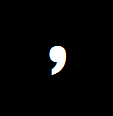
#amwriting: Commas: Morsels of madness or necessary evils?

commaNothing gets certain people jacked up more than misplaced commas. Why this rabid hysteria? Personally, I have no energy to waste, so I’m selective about my frenzies.

But commacentric grammarians do raise a few salient points. Commas and the rules for their use exist for a reason, and if we want the reading public to understand our work, we need to follow them.

I am a decent structural editor, but I don’t claim to have any special knowledge about commas.

However, I do know a couple of things:

  1. Never insert commas “where you take a breath” because everyone breathes differently.
  2. Do not insert commas where you think it should pause, because every reader sees the narrative differently.

Commas are the rules of the road for writing. They are the universally acknowledged pausing and joining symbol. Readers expect to find their pauses between clauses and commas are sometimes the signifiers of those pauses.

One rule I had to unlearn the first time I sent my work to a professional line editor:

  1. Do not place a comma before ‘because’ unless the information that follows is necessary to the sentence.

What? That’s not what I was taught in school!

The Chicago Manual Online gives this example (and I quote):

He didn’t run, because he was afraid.

He didn’t run because he was afraid.

Douglas Adams quote, split infinitivesIn the first sentence, “because he was afraid” isn’t necessary. The main thing is that he didn’t run, and the reason is incidental. The second sentence, which omits the comma, is unclear. It might mean that he ran, but fear was not the reason he did so.

Mignon Fogarty, the Grammar Girl, explains this well. “You don’t automatically put a comma before the word because, but sometimes you need a comma there to make sure your meaning is clear.”

We do use commas to set off introductory clauses:

  1. In the first sentence, “because he was afraid” isn’t necessary.

I italicized the introductory clause in the above sentence to show that it is not a stand-alone sentence. This clause introduces the clause that follows it, and its meaning is dependent on that following clause.

Another thing I had to unlearn:

  1. Do not automatically place a comma before the conjunction ‘and.’

Compound sentences combine two separate ideas (clauses) into one compact package. A comma should be placed before a conjunction only if it is at the beginning of an independent clause. So use the comma before the conjunction (and, but, or) if the clauses are actually standalone sentences. If one of them is not a standalone sentence, it is a dependent clause, and you do not add the comma.

Take these two sentences: She is a great basketball player. She prefers swimming.

  1. If we combine them this way we add a comma: She is a great basketball player, but she prefers swimming.
  2. If we combine them this way, we don’t: She is a great basketball player but prefers swimming.

I hear you saying, “Now wait a minute! Mrs. Downing very clearly taught us to use commas to join clauses, and she was right.”

I’m sorry, but Mrs. Downing probably  explained that. It just didn’t stick in your memory.

Two complete ideas can be joined with ‘and.’ Did I just contradict myself?

Sort of.

Think of it like a list: if there are only two things (or ideas) in a list, they do not need to be separated by a comma. If there are more than two ideas, the comma should be used to separate them, with a comma preceding the word ‘and’ before the final item/idea.

Dogs, cats, rabbits, and birds.

Oh YES, we DO use serial commas to prevent confusion! You’ve all seen the meme:

serial commas meme, martha stewartOn a personal level, I do love cooking, my pets, and my family. (But not in the same pot.) They’re happy that I use serial commas.

One of my favorite personal failings is the notorious comma splice. Apparently it’s bad form to join two independent clauses with a simple comma. This error is called a comma splice.

I have it on good authority that a comma splice will not cause a tear in the space-time continuum. But since this breach of humanity occasionally sends commacentrics into a frothing frenzy, we will use the conjunction and give these poor wretches a break.

From Wikipedia, the fount of all knowledge: “A comma splice is the use of a comma to join two independent clauses. For example: It is nearly half past five, we cannot reach town before dark. Although acceptable in some languages and compulsory in others (e.g., Bulgarian or French), comma splices are usually considered style errors in English.”

chicago manual of styleCommas and their proper use can drive you crazy when you are trying to get your work in order. And quite frankly, the rules are a little confusing.

Consistency is critical. UK usage can vary from US usage in some ways. Find a style guide that you can understand and consult it. Once you have a guide you can work with, use those suggestions consistently in all your work.

I use the Chicago Manual of Style for my work because I am a US citizen, and for creative writing, this is the most comprehensive manual and is what publishers and editors use. If you are strapped for cash, you can often buy secondhand copies of this manual through Amazon.

Commas can easily get out of control for me because I have a tendency to hit the comma key whenever I pause in my thinking when I am in the first draft phase. At that point, I am more concerned with just getting the words down than I am form and style.

However, proper form and style must come into play when we get into the later drafts. Using established protocols for punctuation is important if you want your readers to understand what you meant when you wrote that amazing piece of literature.

14 Comments

Filed under writer, writing

#amwriting: The second draft: effective revisions

My Writing LifeI am in the process of making revisions on Valley of Sorrows, the third book in the Tower of Bones trilogy. I’ve had trouble with this manuscript, not because I fell out of love with it, but because so many great characters have emerged that I lost the thread of the story.

Because I knew I had lost my way, I sent it to a friend, Dave Cantrell, who has done a structural edit and given me the pointers I need to get this back on track.

What happened to derail VOS is this: I lost track of the original story arc.

This is not an uncommon problem–writers tell me all the time how new and intriguing characters pop up and take their tale in a different direction.

Sometime this works out well. Other times, not so much. I have floundered for two years on this novel.

What Dave did at my request was far more intensive than a beta-read. He really went deep, looking at it from the standpoint of a reader and an editor, and asking himself what worked, what didn’t, and analyzing why.

So right now I am taking each chapter on an individual basis and looking at Dave’s comments. Every comment is designed to let me know why a particular plot point did or didn’t work, and where it became confusing. He was able to see where I lost the overall story arc and his comments give me a road-map to guide my efforts in building tension and ending this series with a strong finish.

I’ve said before that making revisions is not editing. Revising the first draft is a necessary part of the process that will get you to the editing stage.

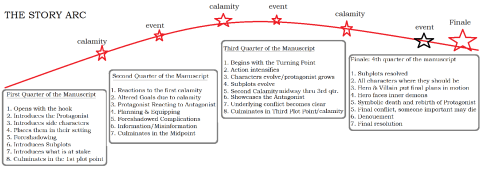
Most authors understand that there is an arc to the overall novel–the Story Arc  which  consists of :

  1. Exposition, where we introduce our characters and their situation.
  2. Rising Action, where we introduce complications for the protagonist
  3. Climax, the high point of the action, the turning point of the narrative
  4. Falling Action, the regrouping and unfolding of events that will lead to the conclusion
  5. Resolution, in which the problems encountered by the protagonist are resolved, providing closure for the reader.

The Story Arc

As I said, most of us understand this arc, but we can easily lose track of it when we are in the throes of writing our first draft.

At the 2014 PNWA Conference, in his seminar on the arc of the scene, author Scott Driscoll explained how the main difference in the arc of the scene vs the overall arc of the novel is this: the end of the scene is the platform from which your next scene launches.

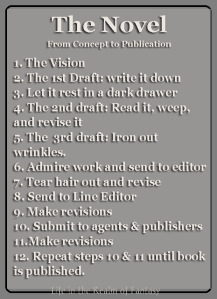
The Novel Meme LIRFSo as I am revising I am keeping in mind:

  1. Each chapter is a scene.
  2. These scenes have an arc to them: action and reaction.
  3. These arcs of action and reaction begin at point A and end at point B.
  4. Each launching point will land on a slightly higher point of the story arc.

I had lost the plot of this novel, so first I had to remind myself just what the series was about:

  1. This series deals with Edwin’s story.
  2. He is separated from his wife and child because of his task on behalf of the Goddess Aeos.
  3. Completion of his task takes us to the 3rd plot point of the novel
  4. Hunting  the acolyte of Tauron and the final battle in Aeoven resolves the story
  5. No conversation can happen unless it advances the plot of this story. EVERYTHING that does not pertain to this story can be cut, saved, and used later.

I have a goal of finishing this by the end of February. When I submit this to my editors, there will be more revisions–that is a given. But because of the work Dave has done, it won’t be the arduous rewrite it would have been.

8 Comments

Filed under Self Publishing, writing

#FlashFic Friday: A Million Lights

30_Doradus,_Tarantula_Nebula

Tarantula Nebula, Hubble Image courtesy NASA and Wikimedia Commons (PD)

A Million Lights

A million lights above me

Candles in the sky

Beacons in the dark of night

Cannot tell me why.


This fragile rock we live on

Trivial and lone

A home so small and simple

The only one we own.


Many voices on the wind

Striving to be heard

No matter how you dress us up

We’re petty and absurd.


A million lights above me

Darkness here below

Can’t we all just get along?

We’ve nowhere else to go.


A Million Lights © Connie J. Jasperson 2015, All Rights Reserved

4 Comments

Filed under #FlashFictionFriday, Literature, writing

#amwriting: Blogging is writing too

People wonder why I go to the trouble of blogging regularly. As an indie author, there is no better way for me to let the world know I am here. When a prospective reader googles my name, this blog is the first thing that comes up. WordPress’s stats tell us that over 409 million people view more than 20.3 billion pages each month.

That, my friends, is a LOT of potential readers, and every time I post a blog, I tap into that pool of readers.

So how do you go about getting a piece of that pie for yourself?

‘Life in the Realm of Fantasy’ is a WordPress blog, i.e. I use WordPress because it is a free, open-source blogging tool and content management system.  I also have several other blogs on Blogger (Blogspot), also a free, open-source blogging tool and content management system. I prefer Blogger for ease of use, but I love the way WordPress looks when you get to the finished product stage.

There is a small learning curve for each. But with very few skills, I have a decent-looking blog at no cost to me, using the fine tools and templates provided by the wonderful people at WordPress or Blogspot–and you can too. What you need to know is quite simple, and I’ll provide you with steps and screenshots below.

The thing that is so awesome about both these products is you have the option to use them in what my husband-the-programmer calls ‘wysiwyg’ (pronounced wizzy-wig) or ‘what-you-see-is-what-you-get.’ The user does not have to know any programming or coding–all that is done for you already, and you just organize it the way you want it, within certain limitations.

  1. If you want to use WordPress visit the WordPress home page and select the ‘Sign Up’ button to register for a WordPress account. You’ll need a valid email address (that has not been used to create another WordPress account) to sign up for a new WordPress account. Follow the steps and bam! You have a blog.
  2. But you can also do this via Blogger (blogspot), Google’s free blogging tool and content management system, also an extremely simple process.
  3. I suggest you use your author name. I used Connie J. Jasperson:  https://conniejjasperson.wordpress.com. This links your author name to your blog, which is why you are doing this in the first place. Pick a title for your blog–this one is Life in the Realm of Fantasy.
  4. Once you have your blog set up, and the catchy name picked out, etc it’s time to start writing. Both offer you ability to use html (Text) if you choose, which I don’t have a clue about, or to go with the Visual (what you see is what you get). Unless you are a programmer, stay with ‘Visual.’
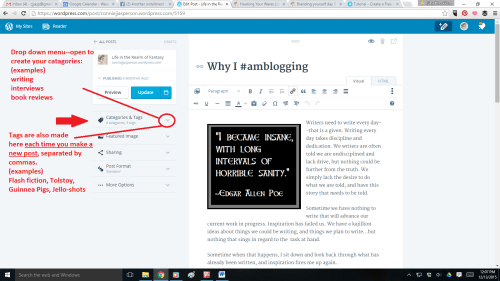
  5. In WordPress, choose a category now for your post–do it first so you don’t forget to do it. I published this post in the categories of Blogging, Self Publishing, Writing.  Each blog post may have a different category, but you decide what your categories are. If you should forget to choose the category, it will go into the ‘uncategorized’ pile–the dreaded WordPress slush-pile where blogs go to die.
  6. Also in WordPress, chose a few TAGS now, if you know what you’re writing about, so that you don’t forget to tag the post.That button is below the Categories list. Chose tags that most represent the core of your post, so that searcher for that subject will find it. For this post I am using ‘blogger, blogspot, blogging, how to use blogger, humor, self-publishing, WordPress, WordPress blog how-to.’
image © cjjasp 2015

image © cjjasp 2015

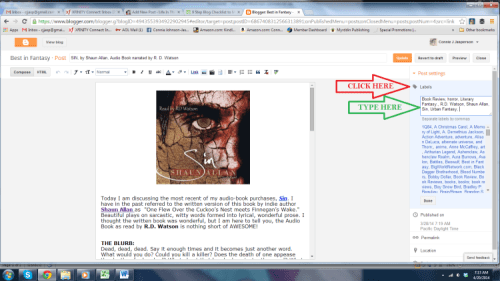
  1. If you are using Blogger, PICK YOUR LABELS NOW–Blogger doesn’t use categories, so your labels are very important. On the right hand side, click on ‘LABELS’ and simply type your key words into the BOX, separated by commas. In Blogger, LABELS are what TAGS are in WordPress, so use words that represent the core of what you are blogging about so that interested searcher will find your blog:

Blogger screen shot

Now that you have that out-of-the-way, it’s time to blog!

  1. Hook me with that catchy blog post title!  Today’s post is called “Blogging is writing too.” Pretty boring.
  2. Put that catchy title in the White box at the top of the page, and DO IT NOW so you don’t forget to give your post a title.

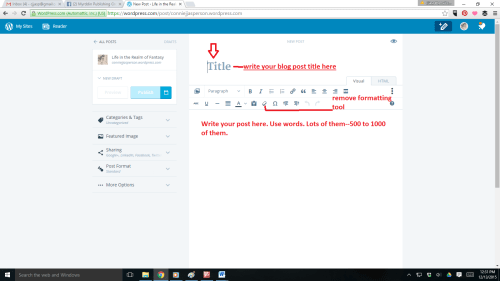
Now there are two paths for you.   You can wing it, keying directly into the post box as I sometimes do, or you can write it on a WORD document and copy and paste it into the body of the post. I have to do that for these posts, but don’t like to because word is rife with HINKY FORMATTING. Sometimes that screws up your blog posts for both Blogger and WordPress, and then you have to use the handy “REMOVE FORMATTING” button that is located in the ribbon (tool box) of both Blogger and WordPress:

WordPress new format screenshot remove formatting tool

Both Blogger and WordPress have spell check functions, and both will save at times as you go, but spell check only picks up misspelled worlds, not other errors.

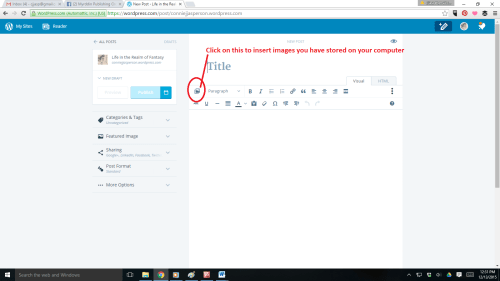
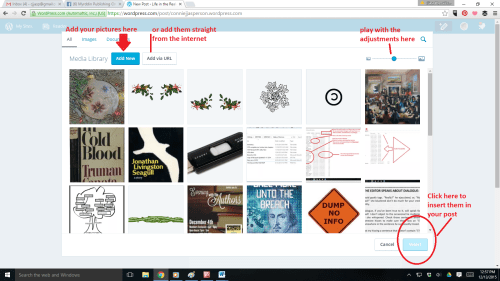
Now we want to add a picture. In WordPress, place your cursor in the body of the blog post and click once at the spot where you will want the image. Then scroll up to the left side of the ribbon (tool box) and click on the little picture in the ribbon (when you hover your mouse over it, it will say ‘insert image’ This menu will appear:

WordPress new format screenshot insert images


WordPress new format screenshot insert images 2

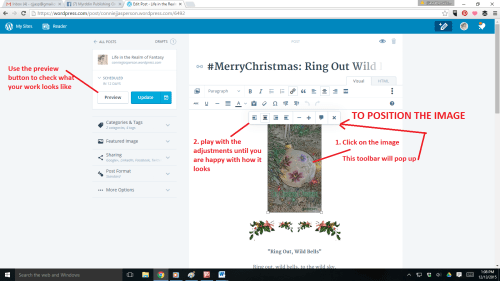
If this is your first blog post, you won’t have anything in your media library yet, so click on “Upload Files.” Practice uploading images and inserting them, playing with it until you feel comfortable and know how to ensure the image will appear where you want it, and will be the size you want it to be. Then, once the image in the body of the post you click on the picture, and a new toolbox opens up. That is where you make your adjustments for positioning and size. You can even add captions:

WordPress new format screenshot insert images 3

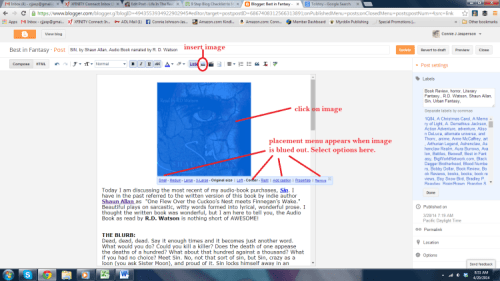
In Blogger you also click on the little picture in the ribbon (when you hover your mouse over it, it will say ‘insert image’). A pop-up menu will appear, and then you will upload the image, decide the placement and the size.  This nearly foolproof simplicity is why most people who have “never done this before” like Blogger more than WordPress.

Blogger screen shot 2

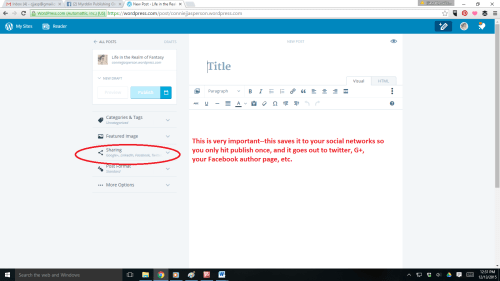
All you have to do now is post your links to Twitter, Facebook, Tumbler and all other  social media you can think of. It is quite easy to set up, and you rarely have to refresh those connections. This is where WordPress really excels:

WordPress new format screenshot sharing

Voilà! You are a blogger. It will take a long time for you to build up good traffic. Posting regularly and frequently gets you more visits and likes, which raises your visibility. This is your opportunity to write a 300 to 1000 word riff on whatever you are doing or thinking about. In my case, it is writing, and all aspects of book culture.

I highly recommend blogging if you are serious about being a author, as it helps develops your writing craft, especially when you have to go in and edit out your mistakes (use the preview option). People expect blogs to be a little rougher than other work as it is usually written on the wing, but try to do your best work—you want people to buy your books, and they won’t if your blogposts seem illiterate.

5 Comments

Filed under Blogger, blogging, writing