Tag Archives: writing

#amreading: the genesis of an author

Nymphenburg, View From the Seaside painting by Joseph Wenglein 1883

Nymphenburg, View From the Seaside painting by Joseph Wenglein 1883

I find the process of creativity as experienced by others intriguing, and am always curious about how they became authors.

My own journey to this place in my life was pretty tame. But some people  become authors via more adventurous, alternative paths.

This notion is explored in Elizabeth McKenzie’s frank, autobiographical post published on January 26, 2016, for LitHub.

Max Ernst, The Elephant Celebes 1921, Tate, London via WikipediaAppropriately titled “Surrealism and Decomposition. Or How I Wrote My Novel,”  McKenzie takes us on a journey through both her personal quest for enlightenment and creativity and the authors whose works colored her writing life. The quote that hooked me into reading this piece: “I read Rimbaud and Breton and Lautreamont and started according my dreams the respect I felt towards art. I wanted to have visions, I wanted, as Rimbaud put it, to take part in the systematic disordering of the senses.”

Her honest account of her sometimes psychedelic journey through alternate forms of consciousness and literary greatness is quite intriguing and took me back to my college days when many of my friends also chose that path for enlightenment.

Psychedelics were never an option for me, although in that way I was the odd one in my circle. The notion of them frightened me. Life in the early 1970s was surreal enough in its cold reality. My form of mind-expansion came in books.

The authors whose works influenced me as a young adult might surprise those who know me.

In my twenties, sci-fi and fantasy books were expensive and hard to get. The libraries stocked a few, but not as many as I required, as fast as I read.

When I was young, my parents were prolific readers and were members of both Doubleday Book Club and Science Fiction Book Club. They also purchased two to four paperbacks a week at the drugstore and subscribed to Analog and several other magazines.

samuel pepys diaryThere was always something new and wonderful to read around our house, and most of it was speculative fiction, although we had the entire 54 volume leather-bound set of the Great Books of the Western World, and our father insisted we attempt to read and discuss what we could.

Some were mostly understandable, such as William Shakespeare and Samuel Pepys.

Plato, not so much, and yet his work did influence me.

At the age of 14 I didn’t understand Pepys, but I read him, and while we were bass fishing on a Saturday morning, Dad would talk about the differences between life and morality in Pepys’ London and our life in suburban America in 1969. His thought was that I should learn about the 17th century and the Great Fire in London from an eye witness, just as I had learned about the war in the Pacific from John F. Kennedy‘s autobiographical novel,  PT 109.

But Pepys’ London of 1666 was so different from the ‘Mod’ subculture of the London of 1966 (and the Beatles) that I was familiar with thanks to Life magazine. To me, it was almost like speculative fiction. In many ways it was more difficult  for me to believe in historical London than Tolkien’s Middle-Earth.

When I married and left home, I still read every sci-fi or fantasy novel that came out in paperback, budgeting for books the way others of my acquaintance budgeted for beer. I read the classics for my irregular college classes, and learned to love Chaucer and James Joyce. For a variety of reasons I never earned a college degree, but I’ve never stopped reading and researching great literature.

But reading for entertainment was still my “drug.” I jonesed for new books by the great ones, Anne McCaffrey, Jack Chalker, and Roger Zelazny, reading and rereading them until they were shreds held together with duct tape.

As a married student attending college in Bellingham Washington, purchasing books for pleasure became a luxury. I found a secondhand bookstore where I could get a brown paper shopping bag full of novels in too poor a condition to sell on their shelves for $2.00 a bag if you had a bag of books to trade in.

As a college drop-out I went through a bag of books every week, and within a year, I had read every book they had.

Devils Cub Georgette HeyerThus, out of desperation, I discovered a whole new (to me) genre: regency romances written by Georgette Heyer, and other romance writers of that generation. Those books, along with beat up copies of bestsellers by Jack Kerouac, James Michener, and Jacqueline Susann began to show up in the pile beside my bed.

So at least some of my literary influences can be traced back to dragons, booze, morality, and England’s romantic Regency—lived vicariously through these authors’ eyes.

Always when the budget permitted, I returned to Tolkien, Zelazny, McCaffrey, Asimov, Bradbury, and as time passed, Piers Anthony, David Eddings, Tad Williams, L.E. Modesitt Jr., and Robert Jordan to name only a few.

And there were so many, many others whose works I enjoyed. By the 1990s, the genres of fantasy and sci-fi were growing authors like a field grows weeds, and I loved it.

All of the books I read as a child and young adult have influenced my writing. They still inspire me.

Nowadays I rarely am able to read more than a chapter or two before falling asleep. My Kindle is full of books, and I haven’t got the time to read them because I have to write my own story. Having the luxury to spend a day wallowing in a book is a treat to be treasured.

Old booksBut it is because of the uncountable authors whose works I have been privileged to read that I was inspired to think that my own scribblings might be worth pursuing.

Writing has always been necessary to me, as natural as breathing. In the beginning, my writing was unformed and was a reflection of whoever I was reading at the moment. As I matured and gained confidence, I found my own ideas and stories, and they took over my life.

Once that happened, I became a keyboard-wielding writing junkie.

Some days I write well, and others not so much, but every day I write something.

And every day I find myself looking for the new book that will rock my universe, a new “drug” to satisfy my craving, even if I know I won’t have time to read it.

I’m addicted to dreams and the people who write about them. Reading is my form of mind expanding inspiration. Without the authors whose books formed my world, I would never have dared to write.

Life would be so boring.
2 Comments

Filed under Publishing, writer, writing

#amwriting: Commas: Morsels of madness or necessary evils?

commaNothing gets certain people jacked up more than misplaced commas. Why this rabid hysteria? Personally, I have no energy to waste, so I’m selective about my frenzies.

But commacentric grammarians do raise a few salient points. Commas and the rules for their use exist for a reason, and if we want the reading public to understand our work, we need to follow them.

I am a decent structural editor, but I don’t claim to have any special knowledge about commas.

However, I do know a couple of things:

  1. Never insert commas “where you take a breath” because everyone breathes differently.
  2. Do not insert commas where you think it should pause, because every reader sees the narrative differently.

Commas are the rules of the road for writing. They are the universally acknowledged pausing and joining symbol. Readers expect to find their pauses between clauses and commas are sometimes the signifiers of those pauses.

One rule I had to unlearn the first time I sent my work to a professional line editor:

  1. Do not place a comma before ‘because’ unless the information that follows is necessary to the sentence.

What? That’s not what I was taught in school!

The Chicago Manual Online gives this example (and I quote):

He didn’t run, because he was afraid.

He didn’t run because he was afraid.

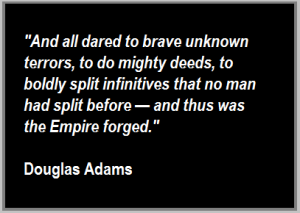
Douglas Adams quote, split infinitivesIn the first sentence, “because he was afraid” isn’t necessary. The main thing is that he didn’t run, and the reason is incidental. The second sentence, which omits the comma, is unclear. It might mean that he ran, but fear was not the reason he did so.

Mignon Fogarty, the Grammar Girl, explains this well. “You don’t automatically put a comma before the word because, but sometimes you need a comma there to make sure your meaning is clear.”

We do use commas to set off introductory clauses:

  1. In the first sentence, “because he was afraid” isn’t necessary.

I italicized the introductory clause in the above sentence to show that it is not a stand-alone sentence. This clause introduces the clause that follows it, and its meaning is dependent on that following clause.

Another thing I had to unlearn:

  1. Do not automatically place a comma before the conjunction ‘and.’

Compound sentences combine two separate ideas (clauses) into one compact package. A comma should be placed before a conjunction only if it is at the beginning of an independent clause. So use the comma before the conjunction (and, but, or) if the clauses are actually standalone sentences. If one of them is not a standalone sentence, it is a dependent clause, and you do not add the comma.

Take these two sentences: She is a great basketball player. She prefers swimming.

  1. If we combine them this way we add a comma: She is a great basketball player, but she prefers swimming.
  2. If we combine them this way, we don’t: She is a great basketball player but prefers swimming.

I hear you saying, “Now wait a minute! Mrs. Downing very clearly taught us to use commas to join clauses, and she was right.”

I’m sorry, but Mrs. Downing probably  explained that. It just didn’t stick in your memory.

Two complete ideas can be joined with ‘and.’ Did I just contradict myself?

Sort of.

Think of it like a list: if there are only two things (or ideas) in a list, they do not need to be separated by a comma. If there are more than two ideas, the comma should be used to separate them, with a comma preceding the word ‘and’ before the final item/idea.

Dogs, cats, rabbits, and birds.

Oh YES, we DO use serial commas to prevent confusion! You’ve all seen the meme:

serial commas meme, martha stewartOn a personal level, I do love cooking, my pets, and my family. (But not in the same pot.) They’re happy that I use serial commas.

One of my favorite personal failings is the notorious comma splice. Apparently it’s bad form to join two independent clauses with a simple comma. This error is called a comma splice.

I have it on good authority that a comma splice will not cause a tear in the space-time continuum. But since this breach of humanity occasionally sends commacentrics into a frothing frenzy, we will use the conjunction and give these poor wretches a break.

From Wikipedia, the fount of all knowledge: “A comma splice is the use of a comma to join two independent clauses. For example: It is nearly half past five, we cannot reach town before dark. Although acceptable in some languages and compulsory in others (e.g., Bulgarian or French), comma splices are usually considered style errors in English.”

chicago manual of styleCommas and their proper use can drive you crazy when you are trying to get your work in order. And quite frankly, the rules are a little confusing.

Consistency is critical. UK usage can vary from US usage in some ways. Find a style guide that you can understand and consult it. Once you have a guide you can work with, use those suggestions consistently in all your work.

I use the Chicago Manual of Style for my work because I am a US citizen, and for creative writing, this is the most comprehensive manual and is what publishers and editors use. If you are strapped for cash, you can often buy secondhand copies of this manual through Amazon.

Commas can easily get out of control for me because I have a tendency to hit the comma key whenever I pause in my thinking when I am in the first draft phase. At that point, I am more concerned with just getting the words down than I am form and style.

However, proper form and style must come into play when we get into the later drafts. Using established protocols for punctuation is important if you want your readers to understand what you meant when you wrote that amazing piece of literature.

14 Comments

Filed under writer, writing

#amwriting: The second draft: effective revisions

My Writing LifeI am in the process of making revisions on Valley of Sorrows, the third book in the Tower of Bones trilogy. I’ve had trouble with this manuscript, not because I fell out of love with it, but because so many great characters have emerged that I lost the thread of the story.

Because I knew I had lost my way, I sent it to a friend, Dave Cantrell, who has done a structural edit and given me the pointers I need to get this back on track.

What happened to derail VOS is this: I lost track of the original story arc.

This is not an uncommon problem–writers tell me all the time how new and intriguing characters pop up and take their tale in a different direction.

Sometime this works out well. Other times, not so much. I have floundered for two years on this novel.

What Dave did at my request was far more intensive than a beta-read. He really went deep, looking at it from the standpoint of a reader and an editor, and asking himself what worked, what didn’t, and analyzing why.

So right now I am taking each chapter on an individual basis and looking at Dave’s comments. Every comment is designed to let me know why a particular plot point did or didn’t work, and where it became confusing. He was able to see where I lost the overall story arc and his comments give me a road-map to guide my efforts in building tension and ending this series with a strong finish.

I’ve said before that making revisions is not editing. Revising the first draft is a necessary part of the process that will get you to the editing stage.

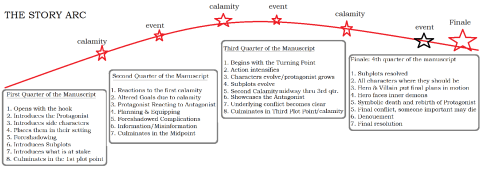
Most authors understand that there is an arc to the overall novel–the Story Arc  which  consists of :

  1. Exposition, where we introduce our characters and their situation.
  2. Rising Action, where we introduce complications for the protagonist
  3. Climax, the high point of the action, the turning point of the narrative
  4. Falling Action, the regrouping and unfolding of events that will lead to the conclusion
  5. Resolution, in which the problems encountered by the protagonist are resolved, providing closure for the reader.

The Story Arc

As I said, most of us understand this arc, but we can easily lose track of it when we are in the throes of writing our first draft.

At the 2014 PNWA Conference, in his seminar on the arc of the scene, author Scott Driscoll explained how the main difference in the arc of the scene vs the overall arc of the novel is this: the end of the scene is the platform from which your next scene launches.

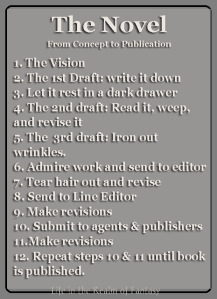
The Novel Meme LIRFSo as I am revising I am keeping in mind:

  1. Each chapter is a scene.
  2. These scenes have an arc to them: action and reaction.
  3. These arcs of action and reaction begin at point A and end at point B.
  4. Each launching point will land on a slightly higher point of the story arc.

I had lost the plot of this novel, so first I had to remind myself just what the series was about:

  1. This series deals with Edwin’s story.
  2. He is separated from his wife and child because of his task on behalf of the Goddess Aeos.
  3. Completion of his task takes us to the 3rd plot point of the novel
  4. Hunting  the acolyte of Tauron and the final battle in Aeoven resolves the story
  5. No conversation can happen unless it advances the plot of this story. EVERYTHING that does not pertain to this story can be cut, saved, and used later.

I have a goal of finishing this by the end of February. When I submit this to my editors, there will be more revisions–that is a given. But because of the work Dave has done, it won’t be the arduous rewrite it would have been.

8 Comments

Filed under Self Publishing, writing

#FlashFic Friday: A Million Lights

30_Doradus,_Tarantula_Nebula

Tarantula Nebula, Hubble Image courtesy NASA and Wikimedia Commons (PD)

A Million Lights

A million lights above me

Candles in the sky

Beacons in the dark of night

Cannot tell me why.


This fragile rock we live on

Trivial and lone

A home so small and simple

The only one we own.


Many voices on the wind

Striving to be heard

No matter how you dress us up

We’re petty and absurd.


A million lights above me

Darkness here below

Can’t we all just get along?

We’ve nowhere else to go.


A Million Lights © Connie J. Jasperson 2015, All Rights Reserved

4 Comments

Filed under #FlashFictionFriday, Literature, writing

#amwriting: Blogging is writing too

People wonder why I go to the trouble of blogging regularly. As an indie author, there is no better way for me to let the world know I am here. When a prospective reader googles my name, this blog is the first thing that comes up. WordPress’s stats tell us that over 409 million people view more than 20.3 billion pages each month.

That, my friends, is a LOT of potential readers, and every time I post a blog, I tap into that pool of readers.

So how do you go about getting a piece of that pie for yourself?

‘Life in the Realm of Fantasy’ is a WordPress blog, i.e. I use WordPress because it is a free, open-source blogging tool and content management system.  I also have several other blogs on Blogger (Blogspot), also a free, open-source blogging tool and content management system. I prefer Blogger for ease of use, but I love the way WordPress looks when you get to the finished product stage.

There is a small learning curve for each. But with very few skills, I have a decent-looking blog at no cost to me, using the fine tools and templates provided by the wonderful people at WordPress or Blogspot–and you can too. What you need to know is quite simple, and I’ll provide you with steps and screenshots below.

The thing that is so awesome about both these products is you have the option to use them in what my husband-the-programmer calls ‘wysiwyg’ (pronounced wizzy-wig) or ‘what-you-see-is-what-you-get.’ The user does not have to know any programming or coding–all that is done for you already, and you just organize it the way you want it, within certain limitations.

  1. If you want to use WordPress visit the WordPress home page and select the ‘Sign Up’ button to register for a WordPress account. You’ll need a valid email address (that has not been used to create another WordPress account) to sign up for a new WordPress account. Follow the steps and bam! You have a blog.
  2. But you can also do this via Blogger (blogspot), Google’s free blogging tool and content management system, also an extremely simple process.
  3. I suggest you use your author name. I used Connie J. Jasperson:  https://conniejjasperson.wordpress.com. This links your author name to your blog, which is why you are doing this in the first place. Pick a title for your blog–this one is Life in the Realm of Fantasy.
  4. Once you have your blog set up, and the catchy name picked out, etc it’s time to start writing. Both offer you ability to use html (Text) if you choose, which I don’t have a clue about, or to go with the Visual (what you see is what you get). Unless you are a programmer, stay with ‘Visual.’
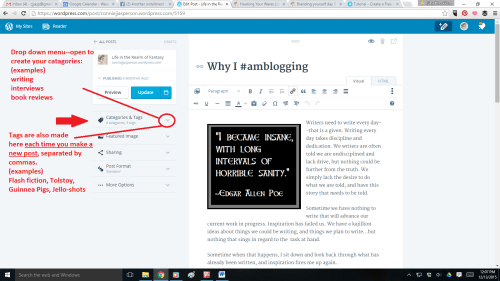
  5. In WordPress, choose a category now for your post–do it first so you don’t forget to do it. I published this post in the categories of Blogging, Self Publishing, Writing.  Each blog post may have a different category, but you decide what your categories are. If you should forget to choose the category, it will go into the ‘uncategorized’ pile–the dreaded WordPress slush-pile where blogs go to die.
  6. Also in WordPress, chose a few TAGS now, if you know what you’re writing about, so that you don’t forget to tag the post.That button is below the Categories list. Chose tags that most represent the core of your post, so that searcher for that subject will find it. For this post I am using ‘blogger, blogspot, blogging, how to use blogger, humor, self-publishing, WordPress, WordPress blog how-to.’
image © cjjasp 2015

image © cjjasp 2015

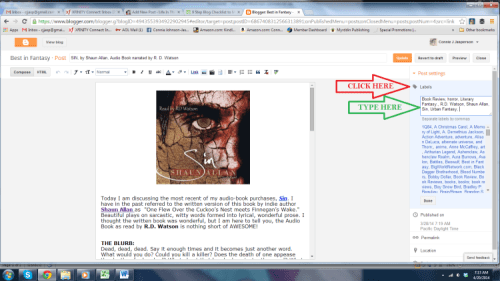
  1. If you are using Blogger, PICK YOUR LABELS NOW–Blogger doesn’t use categories, so your labels are very important. On the right hand side, click on ‘LABELS’ and simply type your key words into the BOX, separated by commas. In Blogger, LABELS are what TAGS are in WordPress, so use words that represent the core of what you are blogging about so that interested searcher will find your blog:

Blogger screen shot

Now that you have that out-of-the-way, it’s time to blog!

  1. Hook me with that catchy blog post title!  Today’s post is called “Blogging is writing too.” Pretty boring.
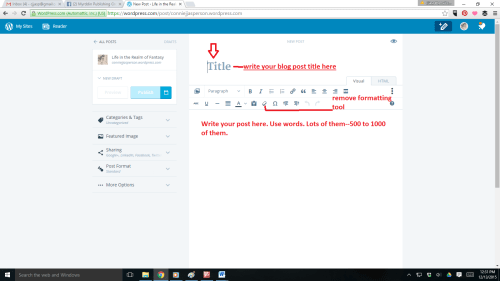
  2. Put that catchy title in the White box at the top of the page, and DO IT NOW so you don’t forget to give your post a title.

Now there are two paths for you.   You can wing it, keying directly into the post box as I sometimes do, or you can write it on a WORD document and copy and paste it into the body of the post. I have to do that for these posts, but don’t like to because word is rife with HINKY FORMATTING. Sometimes that screws up your blog posts for both Blogger and WordPress, and then you have to use the handy “REMOVE FORMATTING” button that is located in the ribbon (tool box) of both Blogger and WordPress:

WordPress new format screenshot remove formatting tool

Both Blogger and WordPress have spell check functions, and both will save at times as you go, but spell check only picks up misspelled worlds, not other errors.

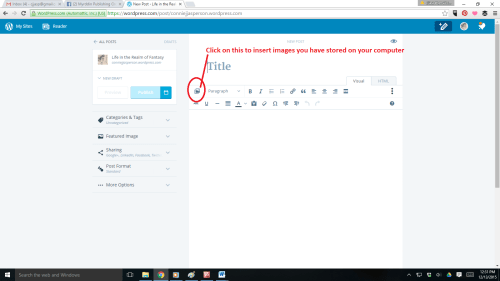
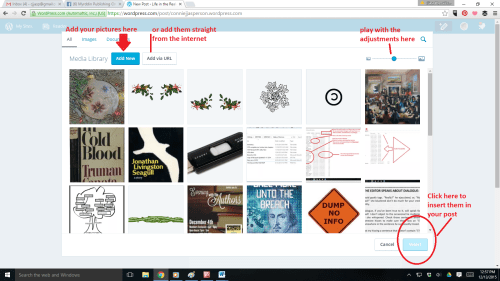
Now we want to add a picture. In WordPress, place your cursor in the body of the blog post and click once at the spot where you will want the image. Then scroll up to the left side of the ribbon (tool box) and click on the little picture in the ribbon (when you hover your mouse over it, it will say ‘insert image’ This menu will appear:

WordPress new format screenshot insert images


WordPress new format screenshot insert images 2

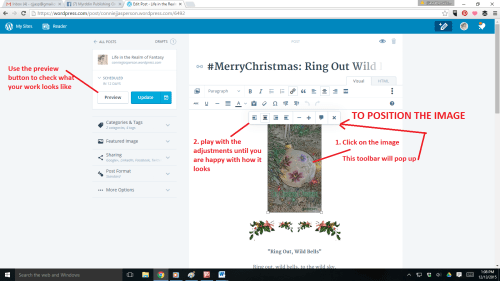
If this is your first blog post, you won’t have anything in your media library yet, so click on “Upload Files.” Practice uploading images and inserting them, playing with it until you feel comfortable and know how to ensure the image will appear where you want it, and will be the size you want it to be. Then, once the image in the body of the post you click on the picture, and a new toolbox opens up. That is where you make your adjustments for positioning and size. You can even add captions:

WordPress new format screenshot insert images 3

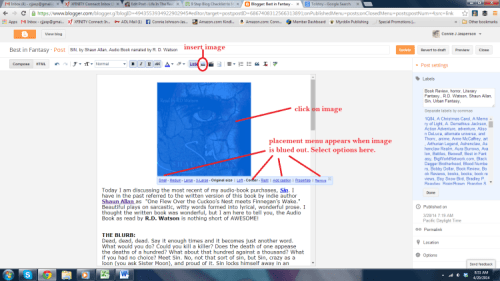
In Blogger you also click on the little picture in the ribbon (when you hover your mouse over it, it will say ‘insert image’). A pop-up menu will appear, and then you will upload the image, decide the placement and the size.  This nearly foolproof simplicity is why most people who have “never done this before” like Blogger more than WordPress.

Blogger screen shot 2

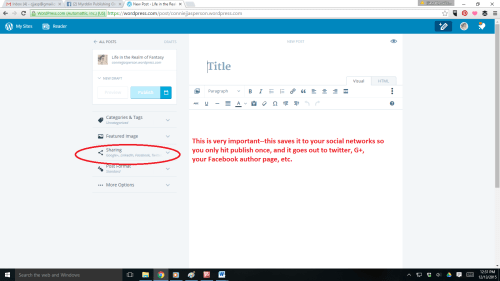
All you have to do now is post your links to Twitter, Facebook, Tumbler and all other  social media you can think of. It is quite easy to set up, and you rarely have to refresh those connections. This is where WordPress really excels:

WordPress new format screenshot sharing

Voilà! You are a blogger. It will take a long time for you to build up good traffic. Posting regularly and frequently gets you more visits and likes, which raises your visibility. This is your opportunity to write a 300 to 1000 word riff on whatever you are doing or thinking about. In my case, it is writing, and all aspects of book culture.

I highly recommend blogging if you are serious about being a author, as it helps develops your writing craft, especially when you have to go in and edit out your mistakes (use the preview option). People expect blogs to be a little rougher than other work as it is usually written on the wing, but try to do your best work—you want people to buy your books, and they won’t if your blogposts seem illiterate.

5 Comments

Filed under Blogger, blogging, writing

#FlashFictionFriday: Irene (and Robert Hooke)

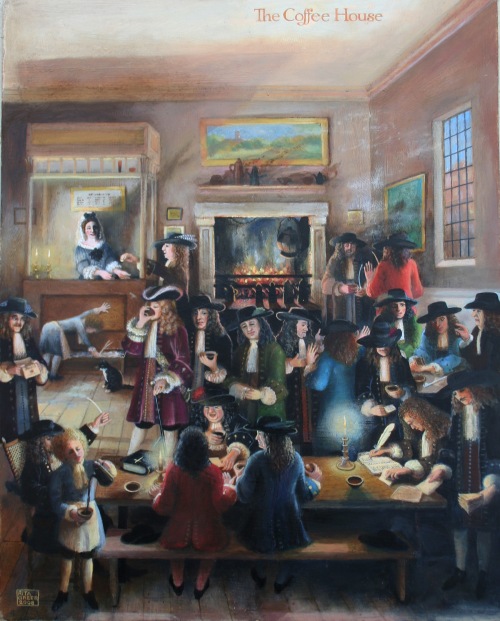
The Coffee House

copyleft symbolArtist: Rita Greer, 2008

Title:    The Coffee House,  copyleft

About this painting (quoted from Wikimedia Commons)

English: Coffee Houses played an important part in the social life of Robert Hooke. Only coffee and chocolate were served (no alcohol). Here news could be had, conversation, arguments, meetings, card games, wagers made, workmen could be paid, etc. (Hooke would sometimes carry out a scientific experiment in front of a coffee house audience as witnesses.) Hooke is shown writing (bottom left) at a table with people waiting to talk to him.

Rita Greer is a history artist, goldsmith, graphic designer, food scientist and author/writer. On retirement in 2003 Rita began the Robert Hooke project, “to put him back into history.”

According to the Institute of Physics article of Jan. 12, 2012: “Chroniclers of his time called him ‘despicable’, ‘mistrustful’ and ‘jealous’, and a rivalrous Isaac Newton might have had the only surviving portrait of him burnt, but, three centuries on, Robert Hooke is now regarded as one of the great Enlightenment scientists.”

>>><<<

I spend a large portion of my life in coffee houses too, writing and meeting with other writers, and artists. The friend who inspired the poem today was introduced to me in a coffee house in Olympia, on a dark November night in 2012. It was the kick-off meeting for NaNoWriMo that year.

Irene

I met you in a coffee shop.

Knitters and authors vied for tables

In a dark, polished, coffee-scented room.

Texas wit met Northwest irreverence

And the world was never the same.

A sisterhood built on words

And books

And commonalities.

We met as old ladies, too wise to raise much hell.

We’d have been dangerous

Had Austin met Olympia in the young, wild days.

It must have been divine intent

That our lives converged in the quiet years.

Sisterhood binds and unites us

Because family is more

Than marriage or blood.

Leaf_Decoration 1_clip_art_small


Irene © Connie J. Jasperson 2015, All Rights Reserved

4 Comments

Filed under #FlashFictionFriday, Literature, writing

#amwriting: Taking the #NaNoWriMo novel to the next level

NaNo-2015-Winner-Badge-Large-SquareYou took a leap of faith. You’d had this idea for a novel rolling around in your head for years. Someone told you about Nation Novel Writing Month, and on the spur of the moment you joined.

Then you were committed. Every day, no matter what disaster was occurring on the home-front, you sat down and wrote at least 1,667 words.  Some days it was hard, the words just weren’t there. But you persevered and some days you were on fire–everything flowed. Your story took you places that amazed you.

Now it’s November 30th and you have your 50,000 word manuscript, and the all-important winner’s certificate from NaNoWriMo dot org!

But now you don’t know what to do next.  Whatever you do, DON’T SHOW IT TO YOUR ADORING FANS JUST YET. This is not the time to ask for feedback unless you want to be lied to. They’ll look at you with a possum-in-the-headlights smile, and say “Wow…this is really…different.”

What they’re really thinking is, “Holy s**t. This disjointed, hokey mess sucks.” That friend will poke needles in their eyes before they read another piece of your work again.

What you must do is put it in a drawer for a month or two. Write some short stories, or start a new novel. You have to step back from this in order to see what need to be done with it, and you can’t do that right now. SO–in January or February:

First let’s talk about that manuscript.

When you were writing it, you were concerned about increasing your word-count. Someone told you not to use contractions, as the word ‘doesn’t’ counts as one word while ‘does not’ is two. Foolishly, you did just that.

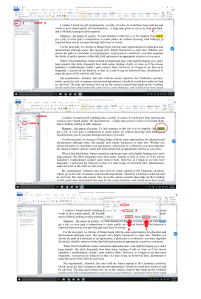
LIRF Global Search all steps

Global Search Print-Screen

Now you must go through and make that awkward, stilted phrasing into contractions. Do a global search:

  1. press control+F
  2. type the word you are looking for in the search box
  3. click on options
  4. click on replace
  5. in the ‘replace with’ box type the word you want to replace the wrong word with
  6. DO NOT replace all. Go to each instance of the words individually and replace them after you have seen the context of the sentence they are in.

Second, let’s look at how we are telling the story. In the rush of the first draft, of getting all our thoughts about the story-line down, we use a kind of mental shorthand and write things like:

Erving was furious.

Martha was discouraged.

Readers don’t want to be told how the characters felt—they want to see.  When you come across this in your first draft, now is the time to follow those road signs and expand on the scene a little. Instead of telling the reader that Martha was furious, you will show this emotion.

Martha stamped her foot.

Erving’s face went white, his body shook with rage.

When you go back through your manuscript, change each ‘telling scene’ to a ‘showing scene.’ When you show the reader the emotions it deepens the story and enables the reader to be involved.

Dialogue

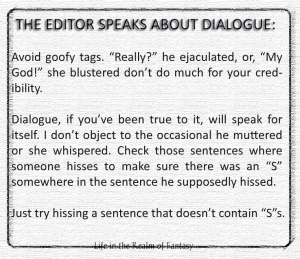
Third: too many dialog tags. When only two characters are in a scene readers should be able to keep track of speaker ID with ease. In those situations, speech tags are rarely, if ever, needed.

Instead of using a speech tag, consider inserting an action beat (a burst of action) before a line of dialogue. This identifies the speaker and offers opportunities for you to deepen character chemistry, conflict, and emotions.

Annie felt something trickling down her cheek. She wiped it, and her hand came away with blood. Her companion was covered with gore, but at least he was in one piece. “John, are you okay?”

 “Of course.”

 She reached toward his shoulder, toward the torn shirt, the ugly gash—but something held her back. “Your arm. I thought maybe ….”

 “You thought it was bad.” 

 The look in his eyes forced her to glance away. “Well, yes. But if you say you’re okay….” Her face burned.

John bent down, digging around in the medical kit, hiding his grin. His thoughts ran wild, but he said only, “Let’s get ourselves doctored up. We’ve a long way to go.”

Replace those empty speech tags with an emotion-infused narrative. However you must remember that the reader needs to have clear direction as to who is speaking to whom, otherwise you will lose them. Don’t make more than a few exchanges without dialogue tags, and make those you do use simple. Said, replied–we really don’t need to get fancy.

dump no infoFourth: Too Much Information. This is my personal bugaboo. As I am writing I spill my guts and write all the background as I am thinking it. The reader doesn’t need to know everything up front. These passages are really notes telling me as the author what direction this tale is supposed to go.

My beta readers always tell me the reader doesn’t want to read the history of the world–they want to get to the action. THEY ARE RIGHT!

Fifth: Make sure you have a good story arc:

  1. Exposition, where we introduce our characters and their situation.
  2. Rising Action, where we introduce complications for the protagonist
  3. Climax, the high point of the action, the turning point of the narrative
  4. Falling Action, the regrouping and unfolding of events that will lead to the conclusion
  5. Resolution, in which the problems encountered by the protagonist are resolved, providing closure for the reader.

The Story Arc

SO before we show this novel to anyone, we have a lot of work to do.

  1. Check for contractions
  2. Check for scenes that are telling and not showing
  3. Take a look at the dialogue tags and make action speak for you.
  4. Carve back the info dumps–keep what moves the story along and save the rest in a separate file.
  5. Make sure you have a good story arc.

Let this nano novel rest for several months before you do anything with it. Start a different novel, and come back to this one later. When you look at that original first draft with fresh eyes and begin looking for these things, you will be amazed at how well your novel will begin to come together. During this rewrite, your characters will grow and develop, and your plot will really begin to move along. This is when you really write your novel.

4 Comments

Filed under Humor, Publishing, Uncategorized, writing

#TalesFromBlackFriday : The Marriage Counselor

Digital Clock FaceI shook my head to get rid of the sudden, loud buzzing sound in my ears. Feeling a little disoriented, I looked at the calendar, which said Thursday, the day I dreaded most. Sometimes I felt like it was always Thursday. It was nearly time for my regular two o’clock appointment…the couple from hell, pardon my cursing. After my heart attack about six months before, they had begun coming to me, and were likely to give me another one. They never missed an appointment no matter how I wished they would.

I watched the clock tick from one fifty-nine to two o’clock.

My receptionist opened the door. “Mr. and Mrs. Haydes are here. Shall I show them in?”

 ***

I lifted my pen from the notepad and regarded the couple seated across from me. “Would you listen to yourselves? You make marriage sound like hell. It doesn’t have to be that way. You both sabotage it every chance you get.”

“Of course marriage is hell,” said the husband across from me, dressed in a double-breasted, blue suit, giving him an almost nautical appearance. Add a captain’s hat and he’d look like a cast member on The Love Boat. “It’s the absolute worst thing that could possibly have happened to a once-studly man like myself. But just like the moth flying into the flame, I had to do it. ‘Don’t go toward the light,’ my friends all said. But did I listen? Hell, no!”

His wife snorted. “Luke always does the exact opposite of what anyone advises him to do. That’s what he gets for being a devil-may-care, I’m-gonna-do-it-my-way sort of a guy. He’s Satan. That makes me Satan’s wife. Of course it’s hell—it comes with the territory. If I can put up with him, he can put up with me.” This week she wore little makeup and was neatly coiffed, with not a hair out of place. In a counterpoint to Luke’s dashing attire, she wore a beige wool suit, cut to just below her modestly crossed knees, with low-heeled pumps. Mrs. Haydes could have been a proper matron from any Protestant congregation, right down to her puritanical sense of morality.

This forty-five minute session of misery began promptly at two o’clock every Thursday. They booked their appointments under the pseudonyms, Lucifer and Persephone Haydes. He preferred to be called Luke, and she preferred to be called Mrs. Haydes. After six months of working with this pair of nut cases, I was beginning to suspect they were playing a game of mess-with-the-counselor.

Last week she’d been dressed like a teenaged skateboarder, and he as an English literature professor. The week before that, she was a hippie, complete with headband and love beads, and he was a cricket player.

Every week it was something different but always opposites. Mrs. Haydes seemed to choose her wardrobe based on what she thought would annoy him most, and he went with the opposite because he really couldn’t do anything else. He had the worst case of oppositional defiant disorder I had ever seen.

“Why are you here?” I had to ask, despite knowing I wouldn’t get an answer. “I no longer understand what you are trying to save here. You never take my advice. And you’ve been aware since the outset that I am a pastor, not a magician. What do you hope to gain from this?” I tapped my foot and looked at the clock. We were only fifteen minutes into this session, and I was already exhausted. “What you really need is a good divorce lawyer, not a counselor. I can tell you every reason why you should stay married, and if you are looking for religious affirmation, I can give you chapter and verse on the apostle Paul’s views regarding marriage. Over the last six months, I have done so repeatedly.  We’ve discussed what you originally saw in each other and what you each want from your relationship, but you’re still at this impasse.  I think that at this stage divorce is the only answer for the two of you.”

Luke snorted. “Don’t bother telling me anything the apostle Paul said—I wrote that book. I was delusional.”

“I think the pastor is right,” said Mrs. Haydes, primly folding her hands. “Divorce is the only option. I’m sure no one would blame me for leaving a devil like you.”

“I’m not giving up half of everything I own,” said Luke, clearly aghast at the notion. “Do you know how many divorce lawyers she has access to? No way am I going to let her off so easily.”

“I come from a broken family,” said Mrs. Haydes, discreetly wiping a tear. “I don’t want our children to grow up in a broken home. But it would be better than Anaheim. It’s a bad environment to raise children in. I want to move back to our palace in Hell. All it needs is a little remodeling.”

I couldn’t stop myself. I had to ask it. “And you think Hell is a good environment to raise kids in?”

“Well, at least there’s no crime in hell. We have the finest law enforcement professionals in the universe.” She glared at me defensively. “Where should I be raising them? Seattle? I’m not exposing my children to a bunch of pot-smoking vegans who ride bicycles and wear socks with sandals.”

Luke brightened up. “I love Seattle—perhaps we should move there. I could get some goats or raise alpacas. They have the best coffee in the world!”

Mrs. Haydes sniffed. “The place is full of vulgar vegetarians. They’re always taking their children to yoga and soccer, where everyone gets a trophy whether they win or lose—it’s just wrong. We will most certainly not be moving to Seattle.”

“Enough,” said Luke. “I’m going vegan and we’re moving to Seattle and that’s final.” He turned to me, missing her small, satisfied smile. “What I really want to talk about is the stint we did on ‘Home Hunters.’ She destroyed me in front of millions of people, and I have to watch it every time they rerun that episode, which they seem to do three times a week.”

“Well dear, it airs on one of your networks, and you make the rules. You’re the one who decides why the television viewing public has 999 channels available to them, and all but three of them at any given time are showing the same reruns of Pawn Shop Heroes, Home Hunters, or Gator Boys.”

From the look on Luke’s face, I could see that Mrs. Haydes had the knife and was twisting it for all she was worth.

“Besides, I said very clearly that I wanted the extremely modern condo, with all the sleek furnishings and the gorgeous, terrazzo floors. I said it at least six times. It’s on the videotape of the show.” She smiled at him smugly. “You just had your heart set on that cozy, little pink bungalow with the seventies’ décor and the orange shag carpet. You insisted, and so, of course, I gave in. Once you make up your mind, it’s impossible to change it.”

“See?” Luke exploded. “See how she manipulates me? How could I not go for the house she said she didn’t want? It was like asking the dog not to eat the chocolate you left on the coffee table. I’m Satan! I’m not really an agreeable sort of guy, and she knows exactly how to manipulate me, so now, twice a week, everyone in America gets to watch me buying grandma’s overpriced, decorating nightmare. It’s been voted the most popular episode of all time! She embarrassed me in front of God and the world.” He dropped his head into his hands. “We’re moving to Seattle now, and it’s going to be hell trying to sell that dump in Anaheim. I won’t even be able to rent it out for enough to cover the carrying costs. What a life!”

I knew this session was going nowhere. Their sessions never went anywhere positive because they were masters at circular reasoning. “What is it you want from me? You must have some reason for putting me through this agony every week.”

“I despise him, so I want a divorce, of course,” said Mrs. Haydes, with a smug, little smile. “I’ll be happy with my half of everything, and, of course, alimony. I gave up my career to raise our children, you know, and of course, they will need child support.” She aimed her tight, fundamentalist smirk  at me. “We won’t waste your time any further.”

“No. No. No!” Luke’s eyes popped out of his head. “No divorce. I adore you, Persey—you’re the love of my life!” He kissed her hand.  “I would be lost without you. Think of the children.”

“I love you too, Luke—I just hate being around you. And now you’re going to be forcing all your hippy, vegetarian food on me.” She turned away from him, primly pursing her lips. “You know how I love steak.”

“No dear, not vegetarian. Vegan. It’s good for you, you’ll love it. Why, I’ve a recipe for smoked tofu that will put a smile on that pretty face in no time.” Luke smiled his most charming smile. “If there is one thing I understand, it’s how to barbecue. You’ll adore my smoked tofu salad.”

“If you say so, dear. I’ll likely throw up.”

The two rose and left my office. I sighed.

Luke might claim to be Satan, and yes, it was even possible given how contrary he was, but if that was case, Mrs. Haydes ruled in Hell. There was no mistake about that.

I heard my receptionist speaking in the anteroom. Yes, Mrs. Haydes was scheduling another appointment…two o’clock next Thursday.

Satan might move to Seattle, or he might not. Somehow, I knew his new penchant for tofu and coffee wouldn’t get me off the hook.

I shook my head to get rid of the sudden, loud buzzing sound in my ears. Feeling a little disoriented, I looked at the calendar, which said Thursday, the day I dreaded most. Sometimes I felt like it was always Thursday. It was nearly time for my regular two o’clock appointment…the couple from hell, pardon my cursing. After my heart attack about six months before, they had begun coming to me, and were likely to give me another one. They never missed an appointment no matter how I wished they would.

I watched the clock tick from one fifty-nine to two o’clock.

My receptionist opened the door. “Mr. and Mrs. Haydes are here. Shall I show them in?”


The Marriage Counselor © Connie J. Jasperson 2015

“The Marriage Counselor” was first published March 6, 2015  on Edgewise Words Inn

2 Comments

Filed under Fantasy, Humor, Literature, writing

#Flashfic: Metamorphosis

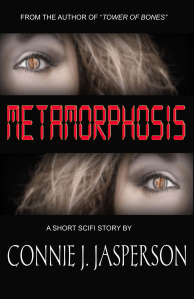
MetaMorphosis cover for WattPad copyYrena Rozhenko ran, not knowing if she was headed into something worse.  It didn’t matter—the transformation had begun and she couldn’t seem to halt it. One way or the other she had to get away from Benton.

The sounds of distant pursuit penetrated to her newly-altered hearing, spurring her on.

She took to the foliage. The shade and mottled light of the strange underbrush eased the pain in her eyes, dimming the glare. She raised her hand to her face, wondering why it felt so bruised. Hard nobs had begun to form above her eyebrows, turning them in ridges. Her heart nearly stopped when she saw the scales forming on her hands and long, deadly-looking talons where neatly manicured fingernails once had been.

What’s happening to me? We ate nothing and drank no water from this world. We touched nothing ungloved. Could it be the air?

Their mission was over. In the UFA records, they would be officially listed as MIA, something that happened frequently on first exploration missions. Benton had murdered Jackson. Jenner was either dead or in hiding, and she…she was changing into some…thing.

Was she going to die next? Benton’s fear and loathing of anything different made him…the only word she could think of was evil.

Why had he not begun to change? The answer came from all around her, from the forest. I was waiting for you. He is not worthy.

She heard Benton softly call her name, a sing-song taunt. “Rozhenko…come out, come out, wherever you are….”

What could she do? With those talons on her hands she wouldn’t be able to return to the ship, even if she could make it to the lander. Besides, she couldn’t leave without knowing if Jenner was alive, and if he was, she wouldn’t leave him behind.

And even if she made to the ship, what then? She knew the change was happening to her on a genetic level, as if this planet had claimed her. Something told her it was irreversible.

Gods, her back ached.  Her shoulder blades, her tailbone were like points of…gah! Whatever. She had to ignore it and get deeper into the brush.

Jackson had begun to change the first night. By dawn he’d transitioned into something…else.

The others had discussed his condition, deciding to take him back to Lodestar Station where the medical team was, despite it being a ten-day journey and meaning the end of their mission. They would have to declare Sirius C a class N Biohazard planet, meaning the established ecology was too dangerous for human settlement.

Benton had been the lone holdout, shouting they had to destroy Jackson before he destroyed them. “He’s a killer. Look at those claws—he’s not human anymore!”

When Yrena and Jenner shouted him down, he had walked up behind Jackson and shot him in cold blood, with no further conversation or discussion, murdering the man who’d been their commander with no qualm or shame.

He’d been proud that he’d done so and now claimed Jackson’s position as expedition leader.

Jenner had begun to change right after Benton murdered their commander, but he’d vanished while Yrena was in the shuttle sending the message detailing the hazard and Benton’s mutiny.

Yrena feared that Benton had killed Jenner while she was busy, but if he had, the body was nowhere to be found.

Benton had shown his true colors. He’d always bragged that he had what it took to rise to the top. He was a capable enough navigator and a solid geologist, but he’d never understood finesse or compassion. How he’d been put on their team in the first place, she didn’t know, but he’d been nothing but a sour pain in the…ass.

She suppressed a groan. Even her ass ached. She was afraid to reach back there and see why.

Some new instinct told her to get off the ground, that safety was in the tree-tops. Yrena’s new talons made excellent assists for rapid tree climbing. Perched high in the canopy and hidden by the triangular, golden leaves, she watched as Benton combed the forest floor, not even thinking to look up.

She had burst out of her shipsuit, which was now nothing but shreds. Carefully she balled it up and hid it in the hollow of the tree. She could nest there if she had to.

What was she thinking? She had to get back to…what was that? A glint of gold caught her eye. A gold-mottled form was perched on a branch near her, one sharp-taloned finger held to his scaly lips for silence. Relief swept through her—Jenner had completed the transformation.

She was not alone.

Benton passed under their tree. Yrena clung tightly to the trunk, remaining perfectly still. She needed a few more hours to complete the transformation, but if he looked up, she would never know what she was transforming into, never again know love or laughter or….

A flash of golden wings…Benton’s sudden strangled cry….

Yrena looked down and saw Benton’s bloody form lying in several pieces.

Jenner flew back up to perch beside her.  She let go of the trunk and went to sit beside him, their arms going around each other.

They had been colleagues but she’d not really known him well. He was all she had now.

The setting sun cast a ray that glanced off the abandoned shuttle. Above the forest, stars began to come out and a tiny star passed overhead. Once it had been a research vessel, but now it was an abandoned hulk ending its days as a small star in a new sky.


Metamorphosis © Connie J. Jasperson 2015  All Rights Reserved

Metamorphosis was first published July 10, 2015 on Edgewise Words Inn under the title “Transfiguration”

It was republished on Oct. 18, 2015 on WattPad under the title “Metamorphosis”

Comments Off on #Flashfic: Metamorphosis

Filed under Literature, Publishing, Uncategorized, writer, writing

#amwriting: 3 steps for keeping the story straight

1916 Momus Pinocchio via Wikimedia CommonsEvery liar knows it’s difficult to keep a story straight–the story keeps evolving and soon it’s out of control.  However, writers, those spinners of awesome lies on paper, must devise ways to avoid this little problem.

Some people use a program called Scrivener which is not too expensive, but which seems to have a tricky learning curve. I downloaded the free version but couldn’t make heads or tails of it and found it quite frustrating. Nevertheless, I understand that it works well for many people, and to them I say, “Good for you.”

For myself, I don’t want a fancy word-processing program. I just use MS Office, because I have been using the programs that come with that software since 1993, and I’ve been able to adapt to each upgrade they have made. It’s affordable, so I use Word to write and edit in, and occasionally use Excel  to make small charts that are my style guides for each  novel or tale I write, and also for every book I edit.

Helpful tip #1: Create a style sheet for every work-in-progress. Whether it is a handwritten list or spreadsheet–keep track of what you named people, places, and things.

Bleakbourne Style Sheet

By creating a visual guide that I can print out or  keep minimized until I need it, I will not inadvertently contradict myself later on in the tale. This particular chart is the style-sheet for a serial I am writing for Edgewise Words Inn, a small online blogzine.

Lets consider Lord Tenneriff, the name of a minor character. Because I noted it on the style sheet and gave a small explanation when I first used it, I will always remember that Lord Tenneriff was spelled with two ‘n’s and two ‘f’s, and with no ‘e’ at the end of it.  The heading of the sheet is like this:

Character Name       Word 1st appears      Other names       Meaning?

            Jason Tenneriff              chapter 1                                                      a local lord

                                                         chapter 2                   Bleakbourne             a village

By listing out the names of every character no matter how minor, even the horses, I will not have a continuity problem by the time I hit chapter 14 of this series. For my editing clients, I also list all magic spells, every god, demon or dwarf that comes into the tale. Anything that is named goes onto that style sheet exactly the way it was first mentioned, the chapter it was first mentioned in, and the brief description of what it means.

Every author has a different way of visualizing these things, and this is what works for me.

Helpful tip #2: Map it out:

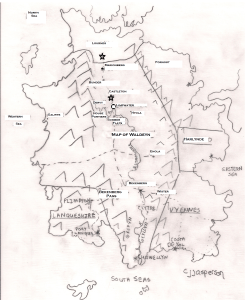
Map of WaldeynSo how do you visualize your country and the world you are creating? I have discussed this before–I draw maps.

They start out like this, all blotchy and hand-drawn, with whiteout covering the changes. After a while of refining them they end up looking more like real maps.

Its a gradual process, and the actual shapes and where the places are will evolve throughout writing the tale, but it will remain basically that way.

Many authors will use locales they are familiar with for their fantasy maps, just changing the names of major cities.  This is a good way to do it, because your world is already well defined for you, and Northwesterners know that Portland, Oregon is about 170 miles south of Seattle, Washington.  You are safe using currently existing terrain.

map of Waldeyn 2015 with lettering cooper black copyBut safe isn’t exactly my thing, so I had to invent both the world of Waldeyn (Huw the Bard), and the World of Neveyah (Tower of Bones). This is what the hand-drawn map of Waldeyn from above has evolved into————>

Helpful Tip #3: Version control:

When we first begin to write seriously we learn how critical it is to have proper naming of our files to ensure version control.  The most recent file will usually be the best edited unless you have accidentally saved an earlier version over it. ALWAYS use a separate file for each version, and ALWAYS use consistent file labeling practices to avoid this tragedy!

Use good file labeling practices, even if you have a fancy program that handles structuring your manuscript.

As an editor, I am particularly careful how I name the files of my clients.

  1. I use a specific sort of naming system. It will ALWAYS be Book_ AuthorName_script.doc .
    This is the main file folder for this book and this author!
  2.  The file folder will contain everything that pertains to this author and his work. There will be at least two folders in this file, and can have up to six. Version control is critical, so proper naming of the files is absolutely essential. If he should ever lose his files, I will have the most recent version on hand.
  3. The raw manuscript in its entirety is saved in this file, and I will name it:
  •  Book_ AuthorName_rawscript.doc

There will be 2 files for every step of the process this manuscript goes through with me: One file will be from the author’s desk to me, and the other will be from my desk to the author.  I will break the raw ms down into chapters, and label each chapter in that file consecutively:

  • Book title_Ch1_ author initials_cjj_edit_rnd1.doc

This tells me that this is Book A, chapter 1, by Author SoAndSo, and was edit round one of that ms.

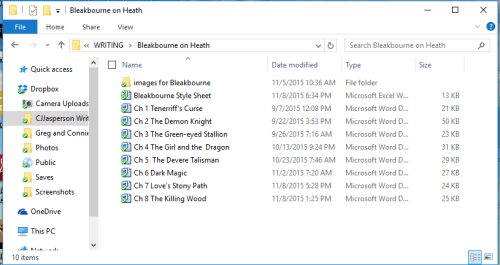
For my own work I label the files uniformly, like this: The main folder will be labeled with the working title, such as Bleakbourne on Heath. Inside the main folder will be the style sheet, and any images that will be used, including maps if needed.

Version Control 1

These three tips, creating a style guide, drawing a map, and labeling your files so you have good version control will help you navigate the shoals of the authoring business. You will always know who you are talking about, where you are, and you will be working in the most recent version of your work.

3 Comments

Filed under Publishing, writer, writing