Tag Archives: writing

Mmmm…chocolate…

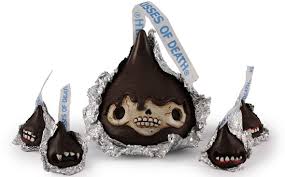
halloween kisses

Kisses of Death by artist Andrew Bell

I’ve always thought that if you really wanted to do something creepy for Halloween, you should hand out little mini-packs of chocolate covered ants, or something. I  just feel there is nothing scary about a Reese’s Peanut Butter Cup, and to do the most sinister night of the year justice, we should serve evil treats.

Halloween is the most important day of the year for many reasons–not the least of which is the annual midnight write in at Shari’s Restaurant for those intrepid heroes who can’t wait a minute longer to start their November Novel!

HTB New Front Cover with gold frameI wrote Huw the Bard in 2011 as my NaNoWriMo Novel–it had a different working title. In 2014 it was published, and the changes it went through in those two years was amazing. Fortunately I have a supportive husband who  regularly allows me to neglect him.

This year I am writing a novel that begins in the old west of northern New Mexico, where a journey to take a holy relic to be melted down at the smelters in Durango takes a terrifying turn into a world between the worlds. The first plan I had for this story was to co-write it with indie author Aura Burrows, but that didn’t pan out as various commitments made it impossible for us to get together on it, and she is unable to do it. But I fell in love with my main character, William Two Cats, and I am going to tell his story.

I have a working title, I have designed a placeholder book cover, I know who and what I am writing about, and tonight at midnight I am off to the races. On the National Novel Writing Month website I am Dragon_Fangirl, and you can see my book page and follow my progress here.

William Two Cats is a man of two worlds, the white-man’s world and the world of the A’shiwi–the people we call the Zuni Pueblo Indians,and yet he is a man of neither. His white mother insisted he be educated him in both cultures, and his Zuni father agreed. The tribal elders know he is destined to be firmly centered between the two worlds, and ensure he takes the path of the shaman. When we meet William, he has left the pueblo.

I can’t wait to get started on this new novel, counting down the hours to midnight…counting…counting….

Oh, look! We still have chocolate covered ants left! Yum!

What? They’re not vegan?

Curses….

ants


2 Comments

Filed under Blogger, blogging, Books, Food, Humor, Publishing, Self Publishing, Vegan, WordPress

Bloated exposition and the power of the “No!”


Book- onstruction-signTwo-year-olds are awesome little balls of angst and joy. It’s either all happiness or all misery for them. I just spent the last two days babysitting my youngest grandson, who is two, while my daughter, a well-known musician, was in the recording studio. The dialogue between me and my grandson went something like this:

Me: “Would you like to eat dinner?”

2 yr old: “No dinner!”

Me: “Do you have to potty?”

2 yr old: “No Potty!”

Me: “Would you like ice-cream?”

2 yr old: “No ice-cream!”

It doesn’t matter what you ask the child–he is currently hardwired to say “NO!” to everything, no matter how badly he really wants it.  Everything is high drama and terrible tragedy for him–and his gut reaction to every question is driven by his newly acquired “power of the NO,”  a super-power that regularly goes to his head.

Unlike the two-year-old with his simple cut-and-dried answer for everything, we authors have a large amount of backstory that we are just sure the reader must know every minuscule detail of, and in order to avoid info dumps, we write conversations to do just that, so that the reader will not lack for information.

But this is where we authors need to exercise the power of the NO. It is also one of the hardest things we do–trying to decide what is crucial to the advancement of the plot and what could be done without. I am currently looking quite closely at one of my manuscripts, and I may cut an entire chapter that is only background. It’s awesome background, and I love this background–but when looked at with an independent eye, it doesn’t do anything but stall the forward momentum of my book.

Don’t give your characters long paragraphs with lines and lines and lines of uninterrupted dialogue. Those can become info dumps laced with useless fluff and are sometimes seen as a wall of words by the reader. This is referred to, in the industry, as bloated exposition.

When the dialogue is trying to tell the reader too much, characters end up saying a lot of unnatural and awkward things.

 “Remember the first day at the academy? We showed up wearing identical uniforms. I was so humiliated. I hated you for that. I didn’t speak to you at all until Commander Janson forced us to be partners in the biology lab, but I managed to get us through that with all A’s. But look at you now, you lucky dog. You are fortunate enough to be my second in command.”

“I know, sir. I despised you too, especially when you made me do all the dirty work, cutting up that alien amphibian. And you took all the credit for it. But now here we are, the best of friends and in command of the finest ship in the fleet, the USS George Lucas. I really, really love being your flunky. It is just the awesomest gig ever.”

Probably not gonna happen. When two characters go back and forth explaining precisely what they are feeling or thinking, it doesn’t seem remotely real. The only time exposition works in a novel is when both the reader and the character being spoken to do not know the information being artfully dumped.

dump no infoWhen reading, even dedicated readers will skip over large, unbroken blocks of words. Elmore Leonard said, “Try to leave out the part that readers tend to skip.” I feel this goes double for dialogue.

Cut to the chase. In real life, you might want to talk at length about the small details, but most of the important information is dealt with right away, and the rest is just socializing. When I think of the novels I enjoy the most, the important information in their conversations is dealt with up front, and the minor details emerge later as they become important.

Consider a phone conversation at work or when you’re in a hurry, and a friend just had a car accident. Your friend has a story to tell, and you have questions. “Are you hurt? Can you drive the car? Do you need anything?” While the boss is glaring at the back of your head, you won’t ask if they had insurance or if your friend will sue (unless you work for a legal firm and you’re fishing for business.)

There’s another important reason to avoid fluff in your dialogue besides the fact it makes a book more enjoyable:

In the real world, Indies and self-publishers pay the costs to publish their works up front. In the ebook format, costs are minimal and it doesn’t matter, but a paper book by a new author that has to sell for more than $12.99 may not sell well. Remember, with a longer book, your costs are increased because until you’re established, you must purchase your own stock to sell on consignment in local book stores. You’ll also need to buy books for your table at trade shows, conventions, and at most book-signings. You’ll want to keep your cost as low as possible and still turn out a good book.

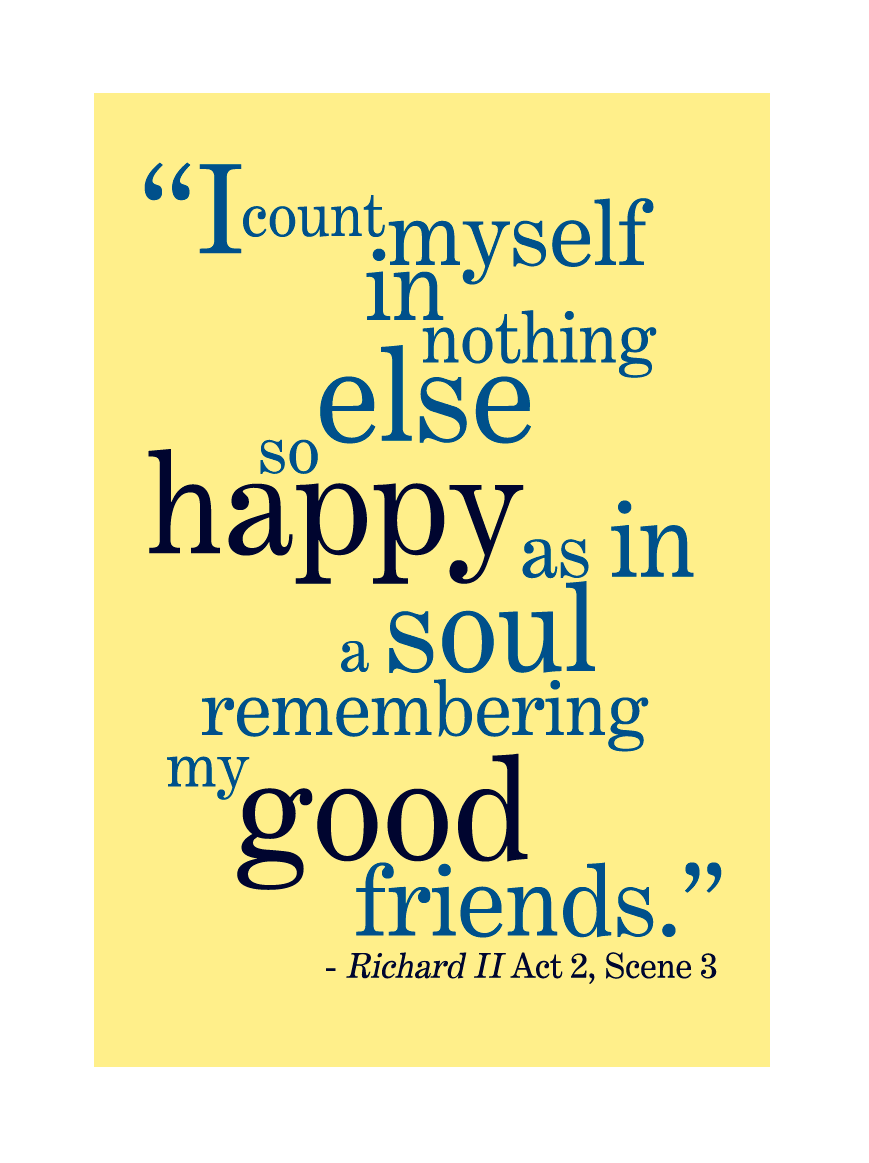
Shakespeare_ICountMyselfFor an indie who writes fantasy, which tends to be longer books and is my genre, it’s most cost-effective for you to keep your work to between 90,000 and 120,000 words if you intend to print through CreateSpace, which prints my paper books. So, wise authors will avoid empty filler in their conversations at all costs.

Having said to keep it short, I know there are times when a character will have a long story to tell, and if it’s done right, it works. Usually, these are stories within stories, and they’re a bit tricky to do right. Deploy the facts, and go light on the fluff.

Remember, what worked in a Shakespeare monologue does not work in a dialogue between two people. Fictional dialogue is about give and take, meant to sound realistic but sharpened by the fact that each character needs something, and by the fact that their needs do not mesh. You won’t get two-page speeches if you remember to visualize your conversation.

5 Comments

Filed under Adventure, Battles, Blogger, blogging, Books, Fantasy, Humor, Literature, Publishing, Self Publishing, Uncategorized, writer, writing

Prepping for NaNoWriMo 2014

nano_14_ml_badge_300pxNational Novel Writing Month begins in just 15 days. I am the Olympia Washington municipal liaison, but this year I will not be able to attend the first two days of write-ins in my region, as I will be at Northwest Bookfest, a conference at Northwest University,  both as an attendee and as a presenter. On Sunday November 2, I will be talking about writing natural dialogue. As you know, I love to talk about the craft of writing, and can talk until the cows come home, to use a tired cliché.

However, I will be working at my word count through the evening in my hotel room–and cheering my fellow WriMos on with virtual write-ins. Beginning Monday the 3rd of November, my life will revolve around writing the rough draft of my novel, helping my friends get their rough draft written, and encouraging the young (and not so young) writers of our community to explore their storytelling abilities.

Patrick Rothfuss said in his pep talk last year, “Thou shalt not just think about writing. Seriously. That is not writing. The worst unpublished novel of all-time is better than the brilliant idea you have in your head. Why? Because the worst novel ever is written down. That means it’s a book, while your idea is just an idle fancy. My dog used to dream about chasing rabbits; she didn’t write a novel about chasing rabbits. There is a difference.”

Oly Nanos icon for fb 2That completely describes what NaNoWriMo is all about–getting that novel out of your head and on to paper. If you don’t write it, you will never see what a wonderful idea it really was–and even if it doesn’t go as well as you planned, who cares? This is about the journey, more than it is about the destination.

It will be a month of dirty dishes, dirty house, piled up laundry…oh wait, that’s normal for around here. But anyway, I will do nothing but attend as many write ins here in the local area as I can and find as many ways to encourage secret authors to get that book out of their head and on to paper as is humanly possible.

I can hardly wait to get started!

2 Comments

Filed under Adventure, Blogger, blogging, Books, Fantasy, Humor, Literature, Publishing, Self Publishing, WordPress, writer, writing

Stephen Swartz, A Dry Patch of Skin

A patch of Dry Skin, Stephen SwartzToday, my dear friend, Stephen Swartz, author of the new book,  A Dry Patch of Skin has consented to answer a few questions for us. Stephen is a true renaissance man–an accomplished musician, and the author of seven published novels, he is also a professor of English at a well-known university in Oklahoma.

I became friends with Stephen in 2011 through ABNA, and we have remained good friends since. I find him hilarious, and I really enjoy his work. He has kindly consented to sit down and allow me to “virtually interview ” him. I am especially curious about his wonderful new book, which is a vampire tale. It’s most certainly not your mama’s sparkly vampires! If you are curious, here is my review: Best in Fantasy: A Dry Patch of Skin

CJJ: Tell us a little of early life and how you began writing:
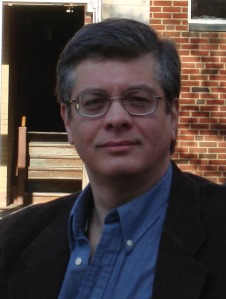
Stephen Swartz 2007SS: It seems like I’ve always been making up stories, much to my parents’ chagrin. I began by drawing panel comics, then added dialog, then began writing paragraphs. I read a lot of science fiction and fantasy in my youth, plus the classics of literature. They influenced my writing mostly by pushing me to try to “out-do” those authors with my own stories. My early writing was limited by the limitations of typewriters and correction fluid. When I got my first computer in 1986, all of my vast library of stories finally could be written. And the world shuddered….


CJJ: Tell us about your most recent book.

SS: A DRY PATCH of SKIN is a contemporary vampire story, but not at all modeled after any of the current vampire TV shows, films, or the books they are based on. I deliberately tried to keep it real. Thus, I researched diseases which cause symptoms approximating the vampire’s condition. In that way, I wanted the reader to experience what it would be like to become a vampire. I decided to tell the story through the POV of a man who is transforming against his will into something he does not want to become. All the tropes and memes of vampire stories are there, but they are realized in a medically accurate fashion—as much as possible. It gets a bit religious at the end, so…call it magical realism.


CJJ: How did you come to write this novel?

SS: I had the idea in rough form ever since Twilight came out and I tried to explain to my daughter, who was hooked on the Bella/Edward story, what “real” vampirism was. For that explanation, I recalled a report years ago on one of those news magazine shows about a man suffering from porphyria, sometimes called the “vampire disease”; the medical explanations for his affliction made perfect sense in terms of why he might be called a vampire if he happened to live in a certain time and place rather than modern America. Watching that interview (he wore a hood to cover his face), I could truly feel the anguish of being in that situation, and given that my art is answering What-if questions, I sought a vehicle for illustrating that awful situation.


CJJ: Do you have a specific ‘Creative Process’ that you follow, such as outlining or do you ‘wing it’?

SS: For A DRY PATCH of SKIN, I worked a bit differently than usual. I began with snatches of my real life, anecdotes that were humorous or telling in some way, then fictionalized them. My initial goal was to explore the character I was inventing, to get down his personality, way of expressing himself, his identity, and so on. As a story set in 2014 in the same city where I live, it was quite schizophrenic to write fiction about the places I regularly visit.

Unlike some authors, I generally do not make lists of traits or compose background profiles of my characters; sometimes I do not know all about them when they come on stage and I get to know them as readers do. (Of course, I go back in revision and make it all fit together.) I do collect information as I create them but it stays in my head. Sometimes browsing the internet will bring me an image that fits what I see in my head.

I knew from the start the direction A DRY PATCH of SKIN would go but I did not have the exact action of the climactic scene until I was mid-way into the writing. Once I “knew” how it would end, the direction of the plot shifted a bit to head toward that conclusion. I found by the end, fortunately, that I happened to have dropped some good seeds along the way which conveniently blossomed in the final chapters—much as Chekhov’s musket in Act 1 must be fired by Act 3. I suppose it’s a matter of how my twisted mind works; I’m not always conscious of the big picture under the cacophony of surface features, but my deeper self knows…because he sleeps with my muses.

CJJ: How does your work differ from others of its genre?

SS: A DRY PATCH of SKIN was a personal challenge, something in a genre I have not written previously. The saving aspect for me, however, was that it is, at the core, a tragic love story. (Is that a spoiler?) The trappings of vampire transformation become the vehicle for pulling off that tragedy. Or is it that the transformation, the struggle to avoid it or prevent it, is made more tragic with the love interest? At any rate, I’ve consciously tried to go counter to all the usual tropes of the vampire genre. In fact, the characters often mention, critique, and spoof some of the popular works of the genre during their conversations. I hope this novel will be both a fun “review” of the vampire literature as well as a realistic portrayal of a biological problem; in that sense, it’s a medical thriller.

CJJ: Why do you write what you do?

SS: A DRY PATCH of SKIN was a departure from my usual kind of novel (contemporary anti-romance or sci-fi on a grand scale). I was intrigued by the question and wanted to see if I could write it if only to see how such a situation might play out. I seldom write as a challenge or game, but this time I did. For writing in general, I simply want to follow my desire to see what happens next for the people I create and the situations I put them in. I know that sounds cruel, but that’s how I roll. It probably keeps me out of jail or the mental hospital.

Next, I’ve been challenged to write an epic fantasy with dragons. Epic fantasy is no problem; dragons are—because it’s in my nature to try to explain them in an authentic zoological way.

CJJ: I certainly can’t wait to see what sort of spin you give dragons! I know why I chose the indie route for my work, but I’m curious as to why you’ve chosen this path.

SS: Strange you should ask because while I have always done things my way (Thanks, Frank!), the results have not always been glorious. After a health scare a few years back, I realized what I wanted most in whatever time I thought I had left was to publish one of the books I’d already written. Years before that, I had gone through the lengthy process of soliciting with actual reams of paper in mailing boxes and the 6-12 month wait for a response by paper form letter. But just a few years ago, the world apparently  changed and querying and soliciting were being done electronically, which opened up a whole new world of possibilities. I was impatient, for health reasons, so I caught the attention of a small publisher with a book I entered into a contest. That did not go so well but I did get a taste of the brave new world of publishing. The rest is what some call history—and others call serendipity.

CJJ: What advice would you offer an author trying to decide whether to go indie or take the traditional path?

SS: I suppose there are all kinds of reasons and they tend to be settled on an individual basis. I described my situation, but even without that push from Father Time I’d probably still discover the small and indie publishers and hook up with one of them eventually. If I were young and had a market-ready book with a ready-made audience, I’d query that thing to the farthest star. If you are short on time or believe your work is specialized and thus out of the mainstream, you probably have to go indie.

My goal the past four years has been to make the books I’ve previously written available, at least that, not so much for my ego as for being able to check them off my so-called bucket list. Then I wrote something new! And made it available, too. And I wrote something new again! I have to give credit to the publishing of my early books for the spark of creativity that caused me to write my new books.

Thank you Stephen, for answering my questions! For those readers who are interested in reading more of Stephen’s writing journey, you can find him blogging at:

Deconstruction of the Sekuatean Empire

 You can purchase all the books written by Stephen Swartz from this page at Amazon.com
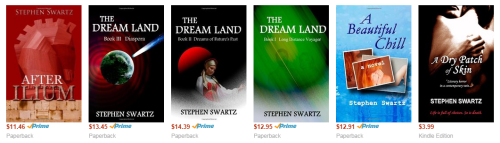
stephen swartz's books

8 Comments

Filed under Blogger, blogging, Books, Dragons, Fantasy, Humor, Literature, Self Publishing, Uncategorized, vampires, WordPress, writer, writing

What I’ve learned from Agatha Chistie

The_Body_in_the_Library_US_First_Edition_Cover_1942I don’t know about you, but I loved Agatha Christie’s novels as much for the great characters as for the mysteries. She had a way of putting the reader right into the society of the time. Take, for instance, Miss Marple.

She’s elderly and has no visible means of support, yet she is not poor. We think she must be living on inherited wealth, but while she is not poor, she also is not conspicuously rich. She is an elderly spinster who was once engaged, is obviously from a good family, and is godmother to a number of young men and women who sometimes get into trouble and need her sharp eyes to sort out mysteries.

She has a nephew, Raymond West, who must be a sister’s child as the name is different, yet no mention is ever made of Jane’s family beyond him. Did she raise him? She is quite close to him.

The_Moving_Finger_First_Edition_Cover_1942She is well-traveled, and can afford to go to Egypt, and to the Caribbean. Miss Marple has close friends in high society. She knows people with hyphenated names and large estates. She doesn’t let wealth or social standing blind her to the true frailties of human nature–she knows that greed and sex are the root cause of nearly every crime.

She owns her own cottage in St. Mary Mead, and it’s not small or mean in any way–she has the ability to hire a young lady to come in and help with the heavy cleaning, although it is difficult to find one who respects the china.

A_Caribbean_Mystery_First_Edition_Cover_1964Miss Marple takes great interest in the life of her village, and it is through her knowledge of that life that she is able to solve complicated, well planned murders. Her ability to work out the motives for each suspect is directly related to how their actions remind her of certain people she has known over the years in her village. Be careful what you say around her, because she will know what you did by connecting the dots between what you said and what happened.

All this information about Miss Jane Marple comes out in her conversations with other characters, delivered over the course of an entire book, and yet one feels as if one knows her right away.

The_Murder_at_the_Vicarage_First_Edition_Cover_1930In the first full book in which she appears, The Murder at the Vicarage, she isn’t really as likable as she is in later books–she seems a bit of a gossip, and rather mean-spirited at that, always expecting the worst of people.

But over the course of 12 books she evolves, and so does our knowledge of her–or does it?

She is genteel, slightly nosy, very comforting and she is on to you–so don’t even think about doing it.

What I have learned from Agatha Christie is that memorable characters grow on you over the course of the book–they are not delivered fully formed on the first page. They are intriguing and we don’t always know what they will do next. There is a hint of mystery about them, and at the end of the book we want to know more.

A_Murder_is_Announced_First_Edition_Cover_1950This sense of intrigue is what we want to instill in all our characters, whether we write sci-fi, romance, fantasy, pot-boilers, or cozy mysteries. If you think about your own experience in life, once it is apparent that you know everything there is to know about a person, they cease to intrigue you. It is the complexities of your friends that keep them interesting, the little things you never knew that amaze you when they are revealed.

Developing a character, deploying just enough information at the right moments to pique the reader’s curiosity is a balancing act, and I’ve come to believe that not everyone can do it with finesse.

Revealing the character over the course of time, and allowing them grow is crucial to keeping the reader’s interest. I think this can only happen if the author has a true understanding of who their character is. This person must be fully formed in the author’s mind so that when they emerge on to the paper they have a sense of realism, as if they are someone the reader would want to know.

nemesis agatha christieMiss Jane Marple was modeled on Agatha Christie’s step grandmother, and on her Aunt (Margaret West), and her friends. Observing these sharp old ladies taught Agatha how a little life-experience can cut through the smoke and mirrors to the truth of people’s’ motivations rather quickly, and that they were often correct in their sometimes mean-spirited assumptions.

I find that doing a small biography of my characters for my own records helps me to understand my people, and while I generally write in the genre of fantasy, people are who they are regardless of the setting you place them in. Characters will react and behave a certain way depending on their history and values. Some are brave, some are lucky, some are stupid beyond belief, but the ones who keep you reading are the ones who still have more to reveal about themselves when the last page has been turned.


Comments Off on What I’ve learned from Agatha Chistie

Filed under Adventure, blogging, Books, Fantasy, Literature, Publishing, Romance, Self Publishing, Uncategorized, writer, writing

The Great Dialogue Debate

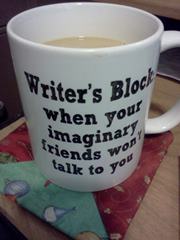
My Coffee Cup © cjjasp 2013We meet our friends on the street, or in a bar or a coffee shop and we talk talk talk.  And so do our characters.  Sometimes those wild and wacky imaginary friends of ours just won’t be quiet, and it drives us nuts. Other times they behave like a thirteen-year-old forced to go on the old family vacation,  sitting in stony silence staring at her signal-less phone, refusing to participate with those people who claim to be her parents and who dragged her off to the wilderness for something called ‘family time.’

Eww.

But when they DO choose to participate in the conversation, how do we make them sound natural? There is a lot of argument in writers forums on this subject, but I go from the point of view of the reader. What is easiest for the reader to follow?

Take a good long look at the works of established writers whose dialogue is crafted in such a way that you, as the the reader, didn’t feel like you were reading it: you felt like you were living it. Did they get too fancy, and uber creative?

No, they kept it simple, and showed you the conversation.

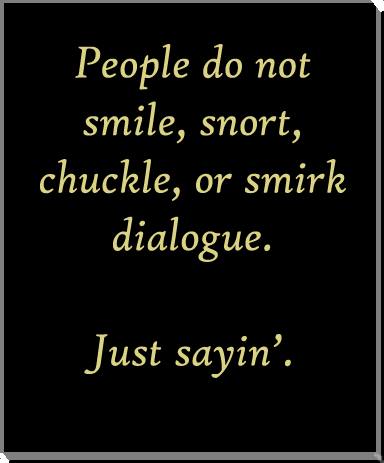
First off–my pet peeve: people do not smile, snort, chuckle, or smirk dialogue. They don’t giggle it either, but they DO say it, they reply it, and many times they ask it. As long as you mainly stick to said, replied, answered, and asked, your reader won’t even notice the attributions are there. If you are writing genre-fiction, there is no need to get creative with your attributions, or ‘dialogue tags’ as we call them: stick to ‘John said’ (not said John, which sounds too old-fashioned these days.) Unless you absolutely need a John screamed or a Sarah uttered or a Paula retorted (which you pretty much never do) just say it and let the reader do the rest. Fancy synonyms for ‘said’ are usually unnecessary and distracting.

You can skip using dialog tags altogether for a back-and-forth or two, but not if there are more than two speakers in the scene, and not for more than a few exchanges. Readers want to be able to track who is saying what.

Sometimes it’s okay to miss a few beats. Beats are what screen-writers call the little bits of physical action that is inserted into dialogue:

People do not snort dialogueBack in the office with the door shut tight, Junior and Pap plotted the special hunting trip for the nice tabloid man. Junior unbraided his hair and pulled it back into his customary long ponytail. Off came the blanket, which he told Pap smelled musty, and the headband. “Tell Johnny thanks for the loan of his buckskins,” he said as he stripped them off, stuffed them into a gym bag, and then pulled on a pair of slacks. “I’ll need them tomorrow for this picnic. That idiot wanted to leave at dawn! I told him after breakfast, so what do you think—about ten o’clock? I usually don’t go to bed until dawn.”

Beats or actions serve to punctuate the dialogue, to give the scene movement, and to maintain a strong mental picture in the absence of description.

Small actions showing the mood of a character are often best placed where there is a natural break in the dialogue, as they allow the reader to experience the same pause as the characters. They’re an effective tool and are essential to good dialogue, but don’t overdo it. If your characters are fluttering their eyelashes, gazing into the distance or opening their laptops between every second line of conversation, the scene becomes about the action and not the dialogue, and the impact is diluted or lost entirely.

This means that when we add gestures and actions to the conversation we want it to be meaningful,.  Otherwise, just use a simple dialogue tag, like said, or replied. This is why we don’t want to make the mistake of getting rid of attributions entirely—because the verbal exchanges become confusing and the action takes over, making the dialogue fade into the background noise of foot shuffling and paper rattling.

verbal tic memeBut what about exclamations and verbal tics?

We frequently speak this way  in real life, but we don’t want it in our work so I recommend you avoid using them. When a character overuses exclamations, it is exhausting for the reader to wade through paragraphs peppered with instance after instance of “Ahhhh…” “Ugh!” “Yuck!”  “Blech!”

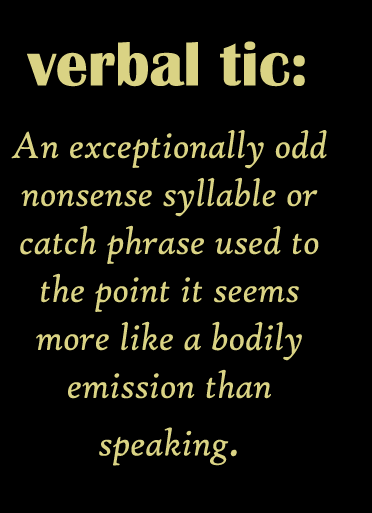
For example, have you ever met a person who drones on with a long “A-a-and a-a-ahhhhhhhhh….” holding conversations hostage with meaningless syllables? These are ‘thinking syllables.’ This is what is known as a ‘verbal tic’ and can be such an ingrained habit the guilty party is unaware they are doing it. They’re often quite hurt if you try to hurry them along.

It’s a habit that we don’t enjoy in a conversation, and don’t want to read in novel, so I recommend you don’t begin more than a few sentences with thinking syllables like  “Ahh…” or “Hmmm….”

These are difficult speech behaviors to convey, because they are supremely annoying in real life and are excruciating to read in a book. As a reader, I’ve come to feel your best bet when dealing with verbal tics is to give a brief instance of their speech pattern and after that, if it is important, mention occasionally the way their habits annoy other characters.

What about accents? Grammar Girl, Mignon Fogarty, says “When writing for a character with an accent, it is tempting to render the character’s speech phonetically using nonstandard spellings. However, this practice is risky and should be avoided, unless you specifically want to emphasize how a character speaks. First, there’s the question of how accurate to be. The more accurate the phonetic spelling, the more frustrating it will be to read.”  

Don’t overdo spelling them out.  You have no idea how hard it is to wade through that:

490px-Henry_Singleton_The_Ale-House_Door_c._1790“Me lempsor’ ‘urt an’ oi’m feelin’ dead knackered. Oi nade ter kip for a while.”

Translation: “My feet hurt and I’m feeling dead tired. I need to sit and rest a while.”  I think you could get away with just using knackered and kip to convey the general idea, and not lose the reader’s interest. If you choose to replace ‘to’ with ‘ter’ for a specific character, be sure to do it consistently and consider leaving it at that.

I have walk-on characters who are minotaurs, and the physical transformation from man to minotaur affects their ability to speak, some more than others. They also come from a different world. This posed a dilemma for me. Because the lower ranked minotaur soldiers make only brief appearances, I can get away with a bit more of a dialect or a speech impediment. The higher ranking ones made it through the remaking with more of their wit and abilities intact, and therefore speak more clearly. I mention they have an accent and leave it at that.

More and more, I am leaning away from writing heavy accents into my dialogue. I recommend going light and limiting the use of misspellings, bad grammar, and vulgar accents especially if you are trying to point out that the character is uneducated or from a rural background.  Use only a few well-chosen words to convey the idea of the accent and use them in a consistent manner for that character in such a way that it isn’t incomprehensible. It’s very easy to go over the top with it, and then the character becomes a parody, a cartoon of a person, instead of someone who feels real.

This winds up my rant on annoying habits we don’t want to inject into our dialogue. Accents, dialects, verbal tics–these are things we need to convey, but we must be mindful of our readers’ supply of patience. Show a little, and let the reader’s imagination do the rest.

5 Comments

Filed under blogging, Books, Fantasy, Humor, Literature, Publishing, Self Publishing, Uncategorized, writer, writing

Autumn’s advent

Larch Forest fwp.mt.gov

Larch Forest fwp.mt.gov

I love the changing of the seasons. In the native northwest forests, the colors of the big-leaf maples,  and alders paint the landscape in shades of yellow and gold, dotted with pops of red sumac and scarlet vine-maples. The gold of the larches in the high-country is startling to those who’ve never seen a deciduous conifer. I am awed by the majesty of the autumn forest.

The sky is also changing. The days grow shorter and the rains of the monsoon months approach.

The gray overcast tends to linger unending, eternal.  I wonder if the sun will ever shine again. And just as I am feeling desperately sorry for myself  the clouds part to reveal a patch of blue so beautiful my eyes hurt, and I must wear my sunglasses to shield my weak, northwesterner’s eyes.

Irene, who is from Texas, mocks me for needing protection from the rare occurrences of sun–but we who have grown up in the long dark winters have little tolerance for it; thus the cheap sunglasses become so much more than a fashion statement.

These are the writing months, the mad dash to finish that first draft, and the build up to NaNoWriMo. These are the days when inspiration knocks me in the head and takes me far, far away. These are the days when I dive into reading for pleasure and forget to cook dinner.

Autumn glory lingers for a brief few weeks, then the rain moves in and turns unraked leaves to soggy, moldy  messes waiting for the winds of November to set them free–free to fly from yard to yard as my mind soars in other realms.

But evening and morning still bring colors as the sun turns the clouds every shade of angry that is possible–gold, red, purple and even black–occasionally juxtaposed against that poignant shade of blue that makes my heart ache, and my eyes sting with tears unshed.


2 Comments

Filed under Adventure, Blogger, blogging, Books, Fantasy, Humor, Literature, Publishing, Romance, Self Publishing, Uncategorized, writer, writing

The Castle of Otranto, Northanger Abbey, and The Mysteries of Udolpho

the-castle-of-otranto-a-gothic-storyThe  late nineteenth century was a great era in which the seeds of the genre of fantasy were planted, a time when books chronicling magic, mayhem, and dark mysteries found fertile soil in the imaginations of thousands of educated, book-hungry middle-class men and women. This was the emergence of the Gothic Novel.

Gothic novels have common themes consisting of incidents of physical and psychological terror, remote, crumbling castles, seemingly supernatural events, a brooding, scheming villain, and (most importantly) a persecuted heroine.

The Castle of Otranto is a novel written in 1764 by Horace Walpole. Many consider it to be the first gothic novel, the beginnings of the literary genre that would spawn the likes of Bram Stoker, Edgar Allan Poe, and Daphne du Maurier.  Walpole chronicles the story of Manfred, lord of the castle, and his family. The book begins on the wedding-day of his sickly son Conrad and princess Isabella. Just before the wedding, however, Conrad is crushed to death by a gigantic helmet (!) that falls on him from above. This strange, unexplained event is particularly ominous in light of an ancient prophecy “that the castle and lordship of Otranto should pass from the present family, whenever the real owner should be grown too large to inhabit it.” This sets into motion terrible events.

It also suggests that decking your halls with heavy armor may not be a good idea, for all you medieval Martha Stewart(s) out there.

So anyway–Manfred decides the only way for him to avoid destruction is to marry Isabella himself, but first he must divorce his current wife. Isabella runs away, aided by a peasant named Theodore. ” It’s all very melodramatic and exciting, with Isabella hiding in caves, and the fortuitous appearance of mysterious knights, and dark curses.  Theodore is revealed to be the true prince of Otranto and Manfred’s daughter, Matilda, dies, leaving Manfred to repent. Theodore becomes king and eventually marries Isabella “because she is the only one who can understand his true sorrow.”

Even Jane Austen loved Gothic novels.

NorthangerAbbeyNorthanger Abbey  was the first of Jane Austen’s novels to be completed for publication, written circa 1798–99. It was originally written as a send-up of the gothic novel, the Mysteries of Udolpho. She died in 1817 and her book was posthumously published.

The book details the adventures of seventeen-year-old Catherine Morland. She is one of ten children of a country clergyman. Although a tomboy in her childhood, by the age of 17 she has read so many Gothic novels that she considers herself to be in training to be a heroine. Catherine reads voraciously, and Ann Radcliffe’s Mysteries of Udolpho is a favorite.

She meets and falls in love with Henry Tilney and after a bit of drama, is invited to visit at his family’s home. Catherine, because of her love affair with Gothic novels, expects the abbey to be exotic and frightening. Sadly, it turns out that Northanger Abbey is a pleasant home and decidedly not Gothic. However, (cue the dramatic music) the house includes a mysterious suite of rooms that no one ever enters. Catherine learns that they were Mrs Tilney’s, who died nine years earlier. Catherine decides that, since General Tilney does not now seem to be affected by the loss of his wife, he may have murdered her or even imprisoned her in her chamber.

I LOVED this novel when I read it while in college in Bellingham, Washington in the 1970s. I wore out three hard-bound copies of it!

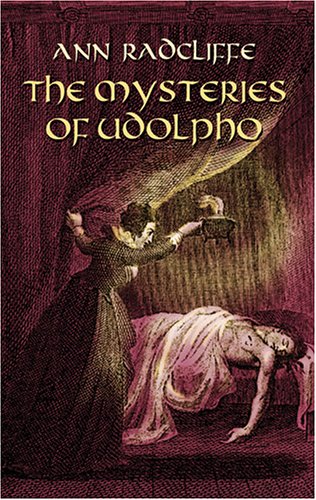
mysteries-of-udolpho-coverSo what inspired Jane Austen to write a Gothic novel? It was her own love of a work written an Englishwoman who, in turn, was inspired by the Gothic work of Horace Walpole.  The Mysteries of Udolpho by Ann Radcliffe, was published in four volumes on May 8, 1794. Walpole began the genre, but Radcliffe made it popular.

Set in the year 1584 in southern France and northern Italy, the novel details the plight of Emily St. Aubert, a young French woman. Her mother is dead, and while journeying with her father, she meets Valancourt, a handsome man who also feels an almost mystical kinship with the natural world. Emily and Valancourt quickly fall in love. After the death of her father she is sent to live with her aunt, Madame Cheron. Emily suffers imprisonment in the castle Udolpho at the hands of Signor Montoni, an Italian brigand who has married her aunt. Emily’s romance with the dashing Valancourt is frustrated by Montoni and others. Emily also investigates the mysterious relationship between her father and the Marchioness de Villeroi, and its connection to the castle at Udolpho.

Radcliffe’s fiction is characterized by apparently supernatural events that are then provided with rational explanations. She was a forward-thinking woman, as was Jane Austen, in that in all Radcliffe’s works traditional moral values are reinforced, the rights of women are strongly advocated, and reason always prevails. Sir Walter Scott was quoted as saying, in regard to Ann Radcliffe’s work, “Her prose was poetry and her poetry was prose. She was, indeed, a prose poet, in both the best and the worst senses of the phrase. The romantic landscape, the background, is the best thing in all her books; the characters are two-dimensional, the plots far-fetched and improbable, with elaboration of means and futility of result.”

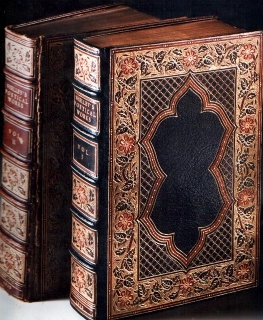
Old Restored booksThe roots of our modern fascination with all things dark and mysterious goes back to the first stories told by our tribal ancestors, under the stars around campfires. Every tribe (and in later millennia, every family) had a storyteller who wove tales of darkness, of good triumphing over evil, of sin and redemption. When written languages were invented, the upper classes in early societies had literature written for them by the likes of Homer and Li Fang .

In western societies, the renaissance began the great lust for books. With the advent of the printing press and the emergence of an affluent, educated middle-class, reading novels became a popular way to while away one’s well-earned leisure hours in the evening or on a Sunday afternoon. This habit survived, despite frequent, intense puritanical censure of such frivolity.

It is because of those nineteenth century pioneers of early popular literature that we modern readers have such a wide variety of work to entertain us. Kindles and other ebook-readers show up among the patrons of every coffee shop and in every airport-lounge and every doctor’s waiting room.

Much may have changed how we take delivery of that content–few books arrive at my house with thick paper and leather bindings nowadays, but nothing has changed in the desire to just quietly enjoy a good story when one has a little downtime.

2 Comments

Filed under Adventure, Battles, blogging, Books, Fantasy, History, Humor, Literature, Publishing, Self Publishing, Uncategorized, WordPress, writer

But let’s talk about books for a while

I noticed something this weekend–I’m obsessed with books.  No, it’s true! Apparently, and I have to agree, it’s all I can think of to discuss. Not only that, but my friends are all obsessed with what they are reading, too.

What a surprise!

So what have I read lately that really rings my bells? Several things, actually, in a wide range of genres.

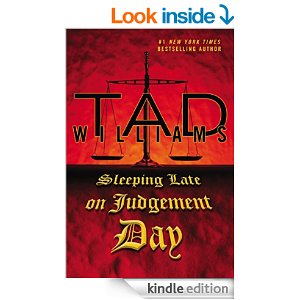
Sleeping Late on Judgement Day Tad WilliamsI just finished the third book in Tad Williams’s Bobby Dollar series, Sleeping Late on Judgement Day. Wow, my favorite bad angel, Bobby Dollar, finally gets a break. I love the twists and turns of William’s prose, as his hard-boiled angel gets down to the dirty business of cleaning up the mean streets of Heaven. He uses ordinary words in an extraordinary way, but never commits the sin of dropping the reader out of the story.  THIS is why I read his work.  I highly recommend this book to all those who like a bit of a hardboiled-detective twist to their paranormal fantasy. It is a smart, well-crafted journey into the human condition, set in an environment guaranteed to keep things interesting, and peopled with unforgettable characters. I gave it 5 full stars on my book review blog, Best in Fantasy.

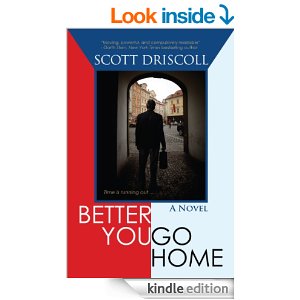
Better You Go Home Scott DriscollI also read Better You Go Home, by Seattle area author, Scott Driscoll.  This is not fantasy, it is literary fiction and a medical thriller. Chico Lenoch is an intriguing character. The tale is told in the first person, which I usually find difficult to get into as a reader, but didn’t in this case. Also something I usually find off-putting but didn’t in this case is the way Chico occasionally ‘breaks the fourth wall’–he sometimes addresses the reader directly. It works, because you are in his head the whole time and it feels perfectly natural. Driscoll is a professor at the University of Washington, and is work is both literate and intriguing. This is not genre fiction, instead it is written for mature, dedicated readers who want substance in a book. No fluff here, just good solid craftsmanship. I also gave it five full stars in my review.  But let’s be real–I don’t go to all the trouble of reviewing books I don’t love.

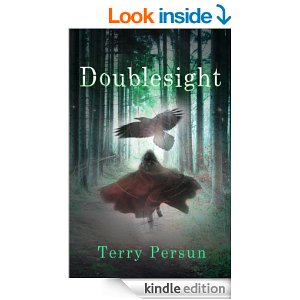
Doublesight--Terry PersunThen, in July I read a fantasy by another local author, Terry Persun: Doublesight. This was the most intriguing twist on the old shapeshifter theme I had ever read. Wholly human or wholly crow depending on what form she is in, Zimp is a great character, both endearing and aggravating. At first, she is weak and allows a less qualified, but more aggressive clan member, Arren, to make decisions for her. This book is as much about personalities and the need to remember their own commonality as it is about the great evil that threatens their kind. Each individual is sharply drawn, and has presence, struggling for their own place in their society while their world faces calamity. Zimp and Lankor, who is a doublesight dragon,  struggle to do what they know is right, in the face of treachery and occasional bad judgement.

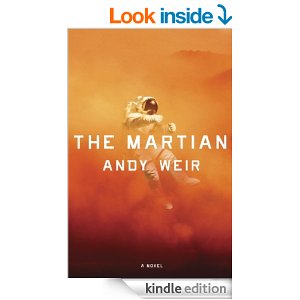
The MArtian Andy WeirMy mind is still blown by The Martian, by Andy Weir. This is hardcore science fiction and may well be the best book I read all year. Mark Watney is hilarious. He is the sort of man who gets through life by finding something positive in every disaster, and mocking the hell out of everything that is negative. A horrendous storm destroys much of their base, and his team is forced to abort their mission.  During the emergency evacuation of the Ares 3 landing site, he is severely injured in an accident that appears to have killed him. His body is unretrievable, and unaware that he is still alive, he is left behind. His companions begin the long journey back to Earth, grief-stricken at his sudden death. However, Mark is that rare breed of human, an astronaut, so of course he is extremely resourceful. He does what he has to in order to survive his injuries, and then figures out exactly what he must do to stay alive until the next mission.

I definitely read a mix of self-published and indie authors, but I like authors who take chances with their work, and who eschew the hamster wheel to hell of the Big Six publishing giants, who mindlessly chug out sequel after boring sequel. Tad Williams writes like an indie, rebellious and defiant. Scott Driscoll is also ‘a bit out there’ in the approach he takes in writing Chico’s story.

I love my job!


2 Comments

Filed under Adventure, Battles, Blogger, blogging, Books, Fantasy, Humor, Literature, Publishing, WordPress, writer, writing

What language are we speaking today? Understanding Stephen Swartz

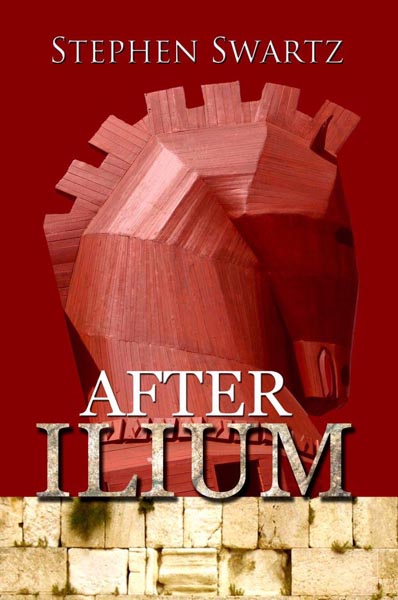
Swartz_After Ilium_FrontCvr_200dpi_3inOne of my dearest friends is author Stephen Swartz, a true renaissance man. A professor of English and a linguist, Stephen’s work frequently involves foreign settings, and with those exoctic places, come the exotic languages. He has devised a chart (you know how happy charts make me) to keep the many languages his characters speak straight. It is an easy way to do so, and is a great way to make what editors call a ‘style guide’ when you are working in different worlds.

For more about Stephen’s chart and his books, go to:

DeConstruction of the Sekuatean Empire: What language are we speaking today? Understanding the worlds of Stephen Swartz

But what if we don’t work in earthly languages? What if our reality is, in truth, UNreality?

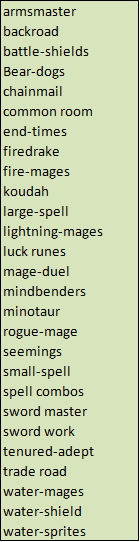
All the more important to make yourself a style guide for your project. This will ensure consistency, especially when you are making up words.  Readers will notice inconsistencies, even though we as authors rarely see them in our own work.

Some things to consider:

What words need to capitalized at all times? Temple

What words must be hyphenated at all times? Battle-mage

How do you spell that city’s name again? Ludwellyn

Stephen’s Chart can be adapted to create a style guide for your work quite easily.  I think I’ll have me some fun with excel today!

style guide for Neveyah


2 Comments

Filed under Battles, Books, Fantasy, Humor, Literature, Publishing, Self Publishing, Uncategorized, writer, writing