Category Archives: #FineArtFriday

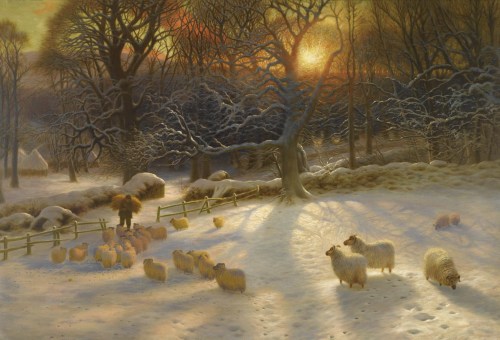
#FineArtFriday: Beneath the Snow Encumbered Branches by Joseph Farquharson 1903 (revisited)

Title: Beneath the Snow Encumbered Branches

Artist: Joseph Farquharson

Publisher: Hallmark Cards

Genre: landscape art

Date: Circa 1903

Medium: oil on canvas

Dimensions: 82 x 119.25 cm. (32 5/16 x 46 15/16 in.

What I love about this painting:

I first shared this painting in January of 2021. I found a haunting kind of nostalgia in it, an echo of times long gone. Joseph Farquharson perfectly captures the way the setting sun’s rays fall across the snow-covered landscape.

The snow is thick and heavy, and the sheep are fluffy in their long coats. Winter has come and the shadows are long, but the conical haystacks across the lane contain plenty to last through the harshest season.

I love how the afternoon light is reflected on the snowy landscape and in the branches. He shows it with a perfect golden luminosity, the hue that presages imminent dusk. 

About the Artist, via Wikipedia:

Joseph Farquharson DL RA (4 May 1846 – 15 April 1935) was a Scottish painter, chiefly of landscapes, mostly in Scotland and very often including animals. He is most famous for his snowy winter landscapes, often featuring sheep and often depicting dawn or dusk. The unusual titles of many of Farquharson’s paintings stand out and are sometimes long. Many of them were taken from poems by Burns, Milton, Shakespeare, and Gray. Farquharson was very patriotic and well versed in Scottish literature.

The remarkable realism of Farquharson’s work can be attributed to his desire to work en plein air. This had to be carried out in a unique way which was adapted to the harsh Scottish climate. Farquharson had constructed a painting hut on wheels, complete with a stove and large glass window for observing the landscape. Likewise to achieve as realistic a result as possible when painting the sheep which frequently appear in his snowscapes, he used a flock of “imitation” sheep which could be placed as required in the landscape of his choice. Farquharson painted so many scenes of cattle and sheep in snow he was nicknamed ‘Frozen Mutton Farquharson’.

Farquharson inherited the title of Laird in 1918 after the death of his elder brother Robert, a doctor and MP for West Aberdeenshire.

In 2008 the original of the 1901 painting Beneath the Snow Encumbered Branches came to light, for the first time in 40 years, when the lady owner put her house up for sale. The painting, which she had bought from a Bond Street dealer in the 1960s for £1,450, was expected to fetch up to £70,000 when it was offered for sale by auction at Lyon and Turnbull in Edinburgh. Nick Carnow, a director at the auctioneers, form said that the unnamed seller was moving to a smaller house and would not have room for the painting. In fact it sold for more than twice that estimate to another private collector in Scotland for £147,600.


Credits and Attributions:

Beneath the Snow Encumbered Branches Joseph Farquharson, Public domain, via Wikimedia Commons

Wikipedia contributors, “Joseph Farquharson,” Wikipedia, The Free Encyclopedia, https://en.wikipedia.org/w/index.php?title=Joseph_Farquharson&oldid=982764133 (accessed January 1, 2021).

Wikimedia Commons contributors, “File:The shortening winter’s day is near a close Farquharson.jpg,” Wikimedia Commons, the free media repository, https://commons.wikimedia.org/w/index.php?title=File:The_shortening_winter%27s_day_is_near_a_close_Farquharson.jpg&oldid=354603464 (accessed January 1, 2021).
2 Comments

Filed under #FineArtFriday

#FineArtFriday: View of Dordrecht by Aelbert Cuyp, ca. 1665

View of Dordrecht, by Aelbert Cuyp

View of Dordrecht *oil on canvas *97.8 x 137.8 cm *signed b.r.: A cuyp *circa 1655

Artist: Aelbert Cuyp  (1620–1691)

Title: View of Dordrecht

Date: circa 1665

Genre: marine art

Medium: oil on canvas

Size: 97.8 x 137.8 cm

Inscription: signature, A Cuyp

Collection: Kenwood House


What I love about this painting:

We see history in action, a working harbor alive and bustling with activity beneath a sky larger and more powerful than the sea. The eye is drawn to the center, to the majestic vessel moored in the harbor.

But that’s not where the action is.

In the bottom left, a barrel has fallen from a ship, perhaps during unloading, and floats freely. A small boat filled with sailors rows out to retrieve it. Beyond, at the docks, seagulls skim, sailing just above the water.

In the lower right, a raft of logs is guided past a moored ship, a small one perhaps waiting for a berth.

A fishing vessel heads out to sea.

The piers are jammed with ships. Stevedores in browns and dark colors blend into the background as they work the docks. They are laborers without whom the port would grind to a halt. They’re nearly invisible, yet Cuyp paints them with movement, bringing life to their anonymity.

This is a painting with many stories to tell.

About Aelbert Cuyp’s style, via Wikipedia:

Sunlight in his paintings rakes across the panel, accentuating small bits of detail in the golden light. In large, atmospheric panoramas of the countryside, the highlights on a blade of meadow grass, the mane of a tranquil horse, the horn of a dairy cow reclining by a stream, or the tip of a peasant’s hat are all caught in a bath of yellow ocher light. The richly varnished medium refracts the rays of light like a jewel as it dissolves into numerous glazed layers. Cuyp’s landscapes were based on reality and on his own invention of what an enchanting landscape should be.

Cuyp’s drawings reveal him to be a draftsman of superior quality. Light-drenched washes of golden-brown ink depict a distant view of the city of Dordrecht or Utrecht. [1]

About the Artist, via Wikipedia:

Aelbert Jacobszoon Cuyp (Dutch pronunciation: [kœyp]) (or Cuijp; 20 October 1620 – 15 November 1691) was one of the leading Dutch Golden Age painters, producing mainly landscapes. The most famous of a family of painters, the pupil of his father, Jacob Gerritszoon Cuyp (1594–1651/52), he is especially known for his large views of Dutch riverside scenes in a golden early morning or late afternoon light. Little is known of his life. He was born and died in Dordrecht. [1]


Credits and Attributions:

IMAGE: View of Dordrecht by Aelbert Cuyp, ca. 1665, PD|100.  Wikimedia Commons contributors, “File:View of Dordrecht, by Aelbert Cuyp.jpg,” Wikimedia Commons, the free media repository, https://commons.wikimedia.org/w/index.php?title=File:View_of_Dordrecht,_by_Aelbert_Cuyp.jpg&oldid=704142240 (accessed January 19, 2023).

[1] Wikipedia contributors, “Aelbert Cuyp,” Wikipedia, The Free Encyclopedia, https://en.wikipedia.org/w/index.php?title=Aelbert_Cuyp&oldid=1132221182 (accessed January 19, 2023).

6 Comments

Filed under #FineArtFriday

#FineArtFriday: The Beeches by Asher Brown Durand 1845

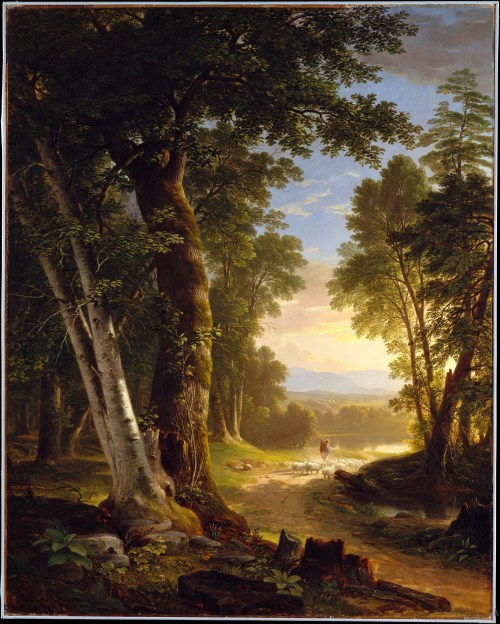
The_Beeches_MET_DT75Artist: Asher Brown Durand  (1796–1886)

Title: The Beeches

Genre: landscape art

Date: 1845

Medium: oil on canvas

Dimensions: 60 3/8 x 48 1/8 in. (153.4 x 122.2 cm)

Collection: Metropolitan Museum of Art

Current location: American Paintings and Sculpture

What I love about this painting:

It’s been storming here on the west coast of the US, dumping rain. California has been hard hit with so much rain the soil can’t absorb it. Yet, though the snowpack will bring relief (if the state doesn’t wash away) the drought is not over. California Storms Help Relieve Drought, But How Much Is in Question – The New York Times (nytimes.com)

Here in the Puget Sound area, we’re experiencing the usual wind and rain of a Northwest winter, hopefully a respite from the droughts we’ve suffered in the past decade. So, it’s good time to enjoy the image of sunny day painted in a calmer time.

Asher Brown Durand gives us a summer day on the shore of a large pond, in a grove of beech and birch trees. The large beech tree is magnificent, with its rough, moss-covered bark commanding the center stage. In the distance, as if they were accidentally included, a shepherd leads a flock of sheep, a minor part of the scene as compared to the superb majesty of the beech tree.

Yet, nothing in this painting is accidental. The sheep and their shepherd are painted in exquisite detail, with as much attention as he gives to the texture of the bark and the moss. Each leaf, each blade of grass, each stone—every part of this scene is painted with intention. Each component of this landscape painting is as true and perfect as they were in real life.

I love the natural feeling of the plants, the intense colors of nature, the sense of a place that is vibrant and alive.

This painting is not merely a photographic representation of a summer morning in 1845. It has a life, a sense that you are there. We can almost feel the warming sunshine and slight breeze lifting the morning haze, hear the sheep as they walk to the water, perhaps even catch the earthy scent of the woods around us.

Durand was a master in the Hudson River School, a group of artists who believed that nature in the form of the American landscape was a reflection of God. Durand himself wrote, “The true province of Landscape Art is the representation of the work of God in the visible creation.” [1] This painting demonstrates that conviction.

About the Artist, via Wikipedia:

Asher Brown Durand (August 21, 1796, – September 17, 1886). (He) was an American painter of the Hudson River School. was born in, and eventually died in, Maplewood, New Jersey (then called Jefferson Village). He was the eighth of eleven children. Durand’s father was a watchmaker and a silversmith.

Durand was apprenticed to an engraver from 1812 to 1817 and later entered into a partnership with the owner of the company, Charles Cushing Wright (1796–1854), who asked him to manage the company’s New York office. He engraved Declaration of Independence for John Trumbull during 1823, which established Durand’s reputation as one of the country’s finest engravers. Durand helped organize the New York Drawing Association in 1825, which would become the National Academy of Design; he would serve the organization as president from 1845 to 1861.

Asher’s engravings on bank notes were used as the portraits for America’s first postage stamps, the 1847 series. Along with his brother Cyrus he also engraved some of the succeeding 1851 issues.

Durand’s main interest changed from engraving to oil painting about 1830 with the encouragement of his patron, Luman Reed. In 1837, he accompanied his friend Thomas Cole on a sketching expedition to Schroon Lake in the Adirondacks Mountains, and soon after he began to concentrate on landscape painting. He spent summers sketching in the Catskills, Adirondacks, and the White Mountains of New Hampshire, making hundreds of drawings and oil sketches that were later incorporated into finished academy pieces which helped to define the Hudson River School.

Durand is remembered particularly for his detailed portrayals of trees, rocks, and foliage. He was an advocate for drawing directly from nature with as much realism as possible. [1]


Credits and Attributions:

Image:  The Beeches by Asher Brown Durand, PD|100. Wikimedia Commons contributors, “File:The Beeches MET DT75.jpg,” Wikimedia Commons, the free media repository, https://commons.wikimedia.org/w/index.php?title=File:The_Beeches_MET_DT75.jpg&oldid=617658539 (accessed January 12, 2023).

[1] Wikipedia contributors, “Asher Brown Durand,” Wikipedia, The Free Encyclopedia, https://en.wikipedia.org/w/index.php?title=Asher_Brown_Durand&oldid=1129313847 (accessed January 12, 2023).

2 Comments

Filed under #FineArtFriday

#FineArtFriday: Wanderer in the Storm by Carl Julius von Leypold 1835

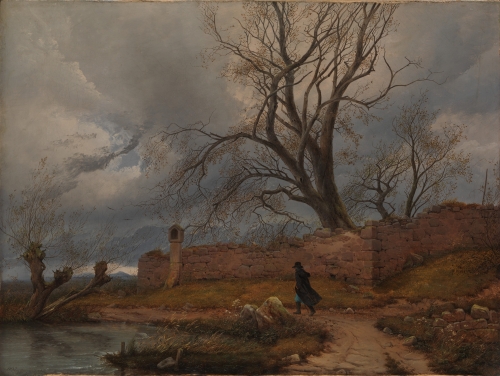
Karl_Julius_von_Leypold_-_Wanderer_im_SturmArtist: Carl Julius von Leypold  (1806–1874)
Title: Wanderer in the Storm

Date: 1835

Medium: oil on canvas

Dimensions: height: 42.5 cm (16.7 in); width: 56.5 cm (22.2 in)

Collection: Metropolitan Museum of Art

What I love about this painting:

This painting completely describes the weather we’re experiencing this week in the cold, dark, and stormy Pacific Northwest—wind and rain and rain and wind. Winter is in full swing. Hopefully, we will avoid having more snow and ice, but it’s only January. Anything can be lurking around the corner.

I love the dark and moody sky that von Leypold paints for us. It has movement, a sense of life, of wind and rain gathering momentum, a small pause while it builds toward a tantrum of the wintery kind.

One can almost hear the water lapping at the shore. Beyond the muddy lane, the trees are like me, old but strong, holding their barren branches defiant before the storm. They seem to shout, “We will bend but never break!” and by bending with the winds, those trees will survive to see yet another blossoming of spring.

The ancient stone wall stands firm, still doing its duty despite being long neglected and left to ruin. It refuses to abandon its purpose, although it no longer remembers what that might be.

The man trudges purposefully, despite the wind that whips at his long coat. Does he feel the cold, or is he walking quickly enough that he is warm? And where is he going? Who is he so intent upon seeing that he would brave the storm on foot?

There is a story in this painting.

About the Artist, via Wikipedia:

Carl Julius von Leypold (1806–1874) was a German Romantic landscape painter known for his painting, “Wanderer in the Storm.”
Von Leypold studied landscape painting with Johan Christian Dahl at the Dresden Academy of Fine Arts between 1820 and 1829. From 1826 onwards, Caspar David Friedrich influenced his choice of subjects and painting style. His landscapes are characterized by “a painterly, but at the same time sharp-brushed style, in which high painting culture is combined with Biedermeier objectivity.”

On March 5, 1857, he became an honorary member of the Dresden Art Academy. [1]


Credits and Attributions:

Image: Wanderer in the Storm by Carl Julius von Leypold PD|100. Wikimedia Commons contributors, “File:Karl Julius von Leypold – Wanderer im Sturm.jpg,” Wikimedia Commons, the free media repository, https://commons.wikimedia.org/w/index.php?title=File:Karl_Julius_von_Leypold_-_Wanderer_im_Sturm.jpg&oldid=675091985 (accessed January 5, 2023).

[1] Wikipedia contributors, “Carl Julius von Leypold,” Wikipedia, The Free Encyclopedia, https://en.wikipedia.org/w/index.php?title=Carl_Julius_von_Leypold&oldid=1095364695 (accessed January 5, 2023).

4 Comments

Filed under #FineArtFriday, writing

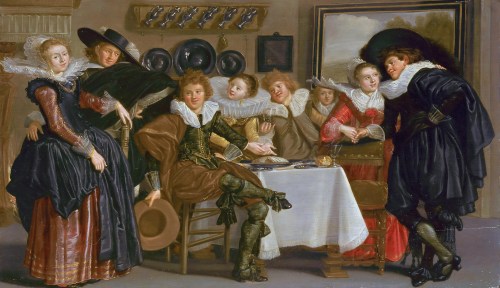
#FineArtFriday: Merry Company by Dirck Hals 1635

Vrolijke gezelschap

Merry company *oil on panel *30 x 51 cm *signed : D Hals 1635

Artist: Dirck Hals (1591–1656)

Title: Merry Company

Date: 1635

Medium: oil on panel

Dimensions: height: 30 cm (11.8 in); width: 51.1 cm (20.1 in)

Collection: Mauritshuis

What I love about this painting:

Perhaps we are celebrating the engagement of the young couple on the far right—a fashionably, yet modestly, dressed young woman and a gallant young man holding hands and gazing at each other.

The hostess, in the center, looks up and greets her guests who have entered to the left of us. She gestures to the food on the table, inviting them to sit. Are they the future in-laws?

The host looks directly at us, the viewer. He greets us as his guests and he too gestures to the table—join us! Sit, eat, and we’ll have an evening to remember. A single crystal wine glass shows us that wine is being served but companionship and food are what the party is really about. We are here to meet and get to know each other.

An engagement is a reason to gather and celebrate—so let us join this merry company and spend an evening with friends, partying like it’s 1635.

About the setting of this painting:

Dirck Hals has given us the image of friends partying in someone’s home. This is clearly not set in a tavern, as the walls are clean, freshly plastered and painted, and the fireplace at the far left has an ornate mantel. It is for heating the room only, not for cooking. The mantel’s aesthetics are part of the room’s decor.

The scene is set in a dining room. We see six pewter tankards proudly displayed on the wall above a sideboard, along with large pewter platters, signs that this is an intimate family room. We know they are pewter because of the dark bluish color of the metal. These are serving vessels every home needed in the 17th century, but only the wealthier middle-class could afford pewter.

And if you could afford to have a separate room just for dining, you would have your drinking vessels and platters displayed above a sideboard in the manner we see here.

In the background to the right, a fine, large landscape painting also indicates a prosperous home.

Everyone is dressed in their best clothes. The modest yet stylish dress of the guests also point to a domestic scene rather than a tavern. Their garments are made from expensive fabrics, silks and satins, and they wear the immense ruffs of crisp white lace that only the upper classes could afford. These are prosperous people, traders in cloth perhaps—but no matter what they trade, they are gathered to celebrate something, and we have been invited to join them.

Taverns and the poorer classes had either wooden tankards and bowls or fired clay mugs and platters. If they had an object made of pewter, it would be put away for safekeeping. The innkeepers and owners of public houses wouldn’t keep tankards where they could be knocked down or stolen.

About the Artist, Via Wikipedia:

Dirck Hals (19 March 1591 – 17 May 1656), born at Haarlem, was a Dutch Golden Age painter of merry company scenes, festivals and ballroom scenes. He played a role in the development of these types of genre painting. He was somewhat influenced by his elder brother Frans Hals but painted few portraits.

The Haarlem writer Samuel Ampzing mentions both brothers in his Praise of Haarlem with a poem stating that both brothers were exceptional; Frans painting his portraits “awake”, and Dirck painting his figures “purely”. [1]

About pewter, via Wikipedia:

Lidless mugs and lidded tankards may be the most familiar pewter artifacts from the late 17th and 18th centuries, although the metal was also used for many other items including porringers (shallow bowls), plates, dishes, basins, spoons, measures, flagons, communion cups, teapots, sugar bowls, beer steins (tankards), and cream jugs. In the early 19th century, changes in fashion caused a decline in the use of pewter flatware. At the same time, production increased of both cast and spun pewter tea sets, whale-oil lamps, candlesticks, and so on. Later in the century, pewter alloys were often used as a base metal for silver-plated objects. [2]


Credits and Attributions:

IMAGE: Merry Company by Dirck Hals, Public domain, via Wikimedia Commons (accessed December 29, 2022).

[1] Wikipedia contributors, “Dirck Hals,” Wikipedia, The Free Encyclopedia, Dirck Hals  (accessed December 29, 2022).

[2] Wikipedia contributors, “Pewter,” Wikipedia, The Free Encyclopedia, https://en.wikipedia.org/w/index.php?title=Pewter&oldid=1129247091 (accessed December 29, 2022).

4 Comments

Filed under #FineArtFriday, writing

#FineArtFriday: Frost Fair on the River Thames near the Temple Stairs, by Thomas Wyke (revisited)

Hello from Casa del Jasperson, and may you all have a Merry Holiday, no matter how you celebrate.

Today I’m revisiting a painting, Frost Fair on the River Thames near the Temple Stairs. by Thomas Wijck (also Thomas Wijk, or Thomas Wyck; 1616–1677). He  was a Dutch painter of port views and genre paintings. This painting details a moment in history, the winter of 1686-1684, as seen though the eyes of one who lived it. I first published this post in January of 2018.

About the Artist, via Wikipedia:

Wijck was born into an artist family and received his training from his father. He journeyed to Italy, presumably by 1640, the year in which a ‘Tommaso fiammingo, pittore’ (Thomas the Fleming, painter) is documented as residing in Rome in the Via della Fontanella. Although this evidence of his residence in Rome around this time has been questioned,[1] a number of his pictures depict scenes in and around Rome which would indicate a visit to the city at some point.[2] He also resided in the environs of Naples, where he executed many sketches which he subsequently worked up into drawings of coast views.[3]

In 1642 Wijck returned to the northern Netherlands, where he became a member of the Haarlem Guild of St. Luke.[1] In 1660 he was appointed Dean of the Haarlem Guild.

He went to England about the time of the Restoration and was much employed. He was followed there by his son and pupil Jan Wyck, who remained in Britain for the rest of his career and played an important role in the development of English sporting painting. Thomas Wyck was also the teacher of the Haarlem painter Jan van der Vaart, who later also immigrated to England.

He died in Haarlem in August 1677. Pieter Mulier II was a follower of his style.

What I love about this painting:

Everywhere you look you see color. Red wheels on a cart, red tents, blue tents, and yellow–color is everywhere. We sometimes think of the 17th century as a dark colorless time, but clearly it was not. People were much the same then as they are today. We love to have fun and will find a way to enjoy ourselves even in the harshest conditions.

And winters during that time were harsh. Fuel for heating and cooking was expensive, food was expensive, and many people died from the cold and starvation.

Quoted from Wikipedia: During the Great Frost of 1683–84, the worst frost recorded in England, the Thames was completely frozen for two months, with the ice reaching a thickness of 11 inches (28 cm) in London. Solid ice was reported extending for miles off the coasts of the southern North Sea (England, France and the Low Countries), causing severe problems for shipping and preventing the use of many harbours. Near Manchester, the ground was frozen to 27 inches (69 cm), in Somerset, to more than 4 feet (1.2 m).

In the pedestrian tunnel under the south bank of Southwark Bridge, there is an engraving by Southwark sculptor Richard Kindersley, made of five slabs of grey slate, depicting the frost fair.[19]

The frieze contains an inscription that reads (two lines per slab):

Behold the Liquid Thames frozen o’re,
That lately Ships of mighty Burthen bore
The Watermen for want of Rowing Boats
Make use of Booths to get their Pence & Groats
Here you may see beef roasted on the spit
And for your money you may taste a bit
There you may print your name, tho cannot write
Cause num’d with cold: tis done with great delight
And lay it by that ages yet to come
May see what things upon the ice were done

The inscription is based on handbills,[20] printed on the Thames during the frost fairs.


Credits and Attributions:

Wikipedia contributors, “Thomas Wijck,” Wikipedia, The Free Encyclopedia, https://en.wikipedia.org/w/index.php?title=Thomas_Wijck&oldid=913753600 (accessed February 7, 2020).

#FineArtFriday: Frost Fair on the River Thames near the Temple Stairs, by Thomas Wyke was first published here on Life in the Realm of Fantasy on January 20, 2018.

Wikipedia contributors, “River Thames frost fairs,” Wikipedia, The Free Encyclopedia, https://en.wikipedia.org/w/index.php?title=River_Thames_frost_fairs&oldid=820904368 (accessed January 19, 2018).

Frost Fair on the River Thames near the Temple Stairs, by Thomas Wyke ca.1683-1684 via Wikimedia Commons (scan from FT magazine, 2007-09-30) [Public domain]

11 Comments

Filed under #FineArtFriday

#FineArtFriday: The Straw Ride – Russley Park Remount Dep’t, Wiltshire by Lucy Kemp-Welch (revisited)

About this painting, via Wikipedia:

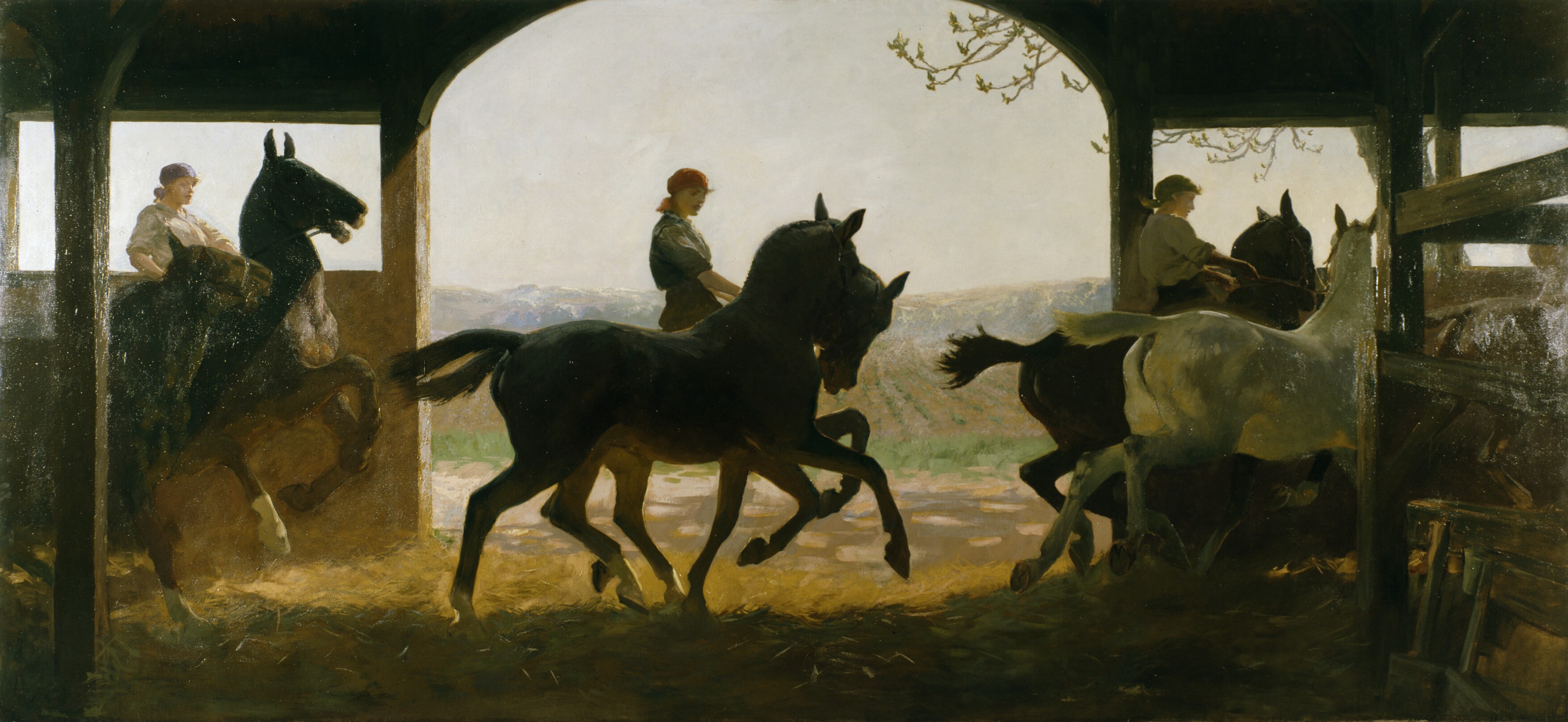
Three women exercising horses in a remount depot. They take their charges through their paces in an indoor straw ride. Each woman rides one horse and leads another.

During World War One women were employed at Army Remount Depots in training and preparing horses for military service. Kemp-Welch was commissioned by the Women’s Work Section of the Imperial War Museum to paint a scene at the largest such depot, one staffed entirely by women, at Russley Park in Wiltshire. The Museum authorities were unhappy with the painting, The Ladies Army Remount Depot, Russley Park, Wiltshire which Kemp-Welch first submitted but were aware of a larger and much better composition on the same subject that she had painted and intended to sell to a private client for £1,000. Kemp-Welch agreed that the second painting, The Straw-Ride- Russley Park, Remount Dep’t Wiltshire was the better of the two and agreed to sell it to the IWM to fulfill her commission. However, she was unable to agree a fee with the Women’s Work Section and after protracted discussions, donated it free of charge to the Museum.

About the Artist, via Wikipedia:

Lucy Elizabeth Kemp-Welch (20 June 1869 – 27 November 1958) was a British painter and teacher who specialized in painting working horses. She is best known for the paintings of horses in military service she produced during World War One and for her illustrations to the 1915 edition of Anna Sewell’s Black Beauty.

In 1924, for the Royal Exchange, Kemp-Welch designed and completed a large panel commemorating the work of women during World War One. From 1926 onwards she focussed on depicting scenes of gypsy and circus life and spent several summers following Sanger’s Circus, recording the horses.

She resided in Bushey, Hertfordshire for most of her life and a major collection of her works is in Bushey Museum. They include very large paintings of wild ponies on Exmoor, galloping polo ponies, the last horse-launched lifeboat being pulled into a boiling sea, heavy working horses pulling felled timber and hard-working farm horses trudging home at the end of the day.


Credits and Attributions:

Lucy Kemp-Welch, Public domain, via Wikimedia Commons

Wikimedia Commons contributors, “File:The Straw Ride- Russley Park Remount Dep’t, Wiltshire Art.IWMART3160.jpg,” Wikimedia Commons, the free media repository, https://commons.wikimedia.org/w/index.php?title=File:The_Straw_Ride-_Russley_Park_Remount_Dep%27t,_Wiltshire_Art.IWMART3160.jpg&oldid=262266456 (accessed March 18, 2021).

Wikipedia contributors, “Lucy Kemp-Welch,” Wikipedia, The Free Encyclopedia, https://en.wikipedia.org/w/index.php?title=Lucy_Kemp-Welch&oldid=996250015 (accessed March 18, 2021).

3 Comments

Filed under #FineArtFriday, writing

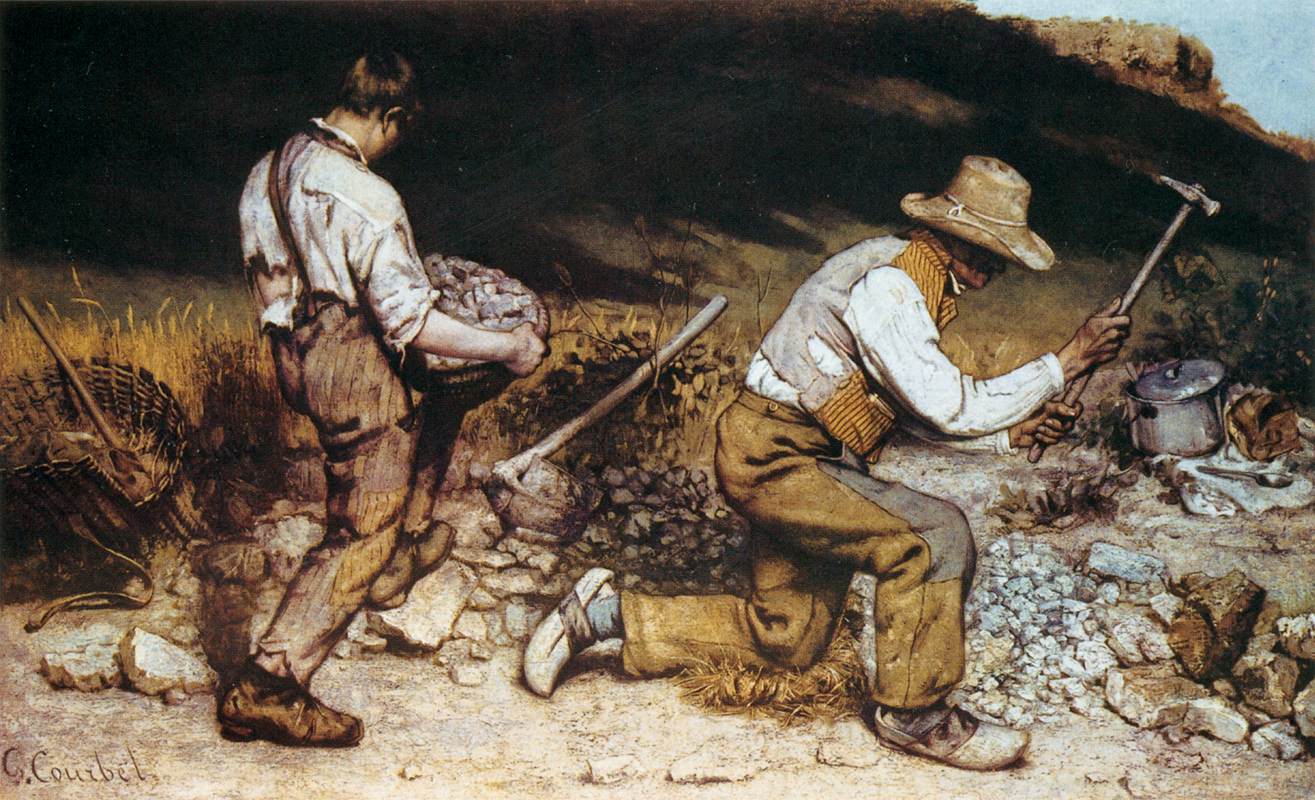
#FineArtFriday: The Stonebreakers by Gustave Courbet 1849

Gustave_Courbet_-_The_Stonebreakers_-_WGA05457Artist: Gustave Courbet  (1819–1877)

Title: The Stonebreakers

Date:1849

Medium: oil on canvas

Dimensions: height: 165 cm (64.9 in); width: 257 cm (101.1 in)

Current location: destroyed in fire, 1945 (Dresden, Germany)

Today’s image comes to us via the miracle of 20th century photography and modern digital photographic restoration.

The exact number of paintings and other art masterpieces that were either destroyed or are still missing since World War II is not known, but is estimated that during World War II, the Nazis looted some 600,000 paintings from Jews and Art Museums, at least 100,000 of which are still missing. Unfortunately, the original canvas of this painting was a casualty of war, destroyed in the bombing of Dresden.

About this image, via Wikipedia: Considered to be the first of Courbet’s great works, The Stone Breakers of 1849 is an example of social realism that caused a sensation when it was first exhibited at the Paris Salon in 1850. The work was based on two men, one young and one old, whom Courbet discovered engaged in backbreaking labor on the side of the road when he returned to Ornans for an eight-month visit in October 1848. On his inspiration, Courbet told his friends and art critics Francis Wey and Jules Champfleury, “It is not often that one encounters so complete an expression of poverty and so, right then and there I got the idea for a painting.”

While other artists had depicted the plight of the rural poor, Courbet’s peasants are not idealized like those in works such as Millet’s The Gleaners. [1]

Also via Wikipedia: The Stone Breakers (FrenchLes Casseurs de pierres) was an 1849 painting by the French painter Gustave Courbet. It was a work of realism, depicting two peasants, a young man and an old man, breaking rocks.

The Stone Breakers was first exhibited at the Paris Salon of 1850. As a work of realism the subject matter addressed a scene of everyday life. This painting was intended to show the hard labor that poor citizens experienced. Courbet did not show the figure’s faces, they represent the “every man” and are not meant to be specific individuals. At the same time the clothing of the figures implies some degree of individuality, the younger man’s pants are too short and the older man’s vest is striped.

The painting was destroyed during World War II, along with 154 other pictures, when a transport vehicle moving the pictures to the castle of Königstein, near Dresden, was bombed by Allied forces in February 1945. [2]

About the artist, via Wikipedia:

Jean Désiré Gustave Courbet (UK/ˈkʊərbeɪ/ KOOR-bay,[1] US/kʊərˈbeɪ/ koor-BAY,[2] French: [ɡystav kuʁbɛ]; 10 June 1819 – 31 December 1877) was a French painter who led the Realism movement in 19th-century French painting. Committed to painting only what he could see, he rejected academic convention and the Romanticism of the previous generation of visual artists. His independence set an example that was important to later artists, such as the Impressionists and the Cubists. Courbet occupies an important place in 19th-century French painting as an innovator and as an artist willing to make bold social statements through his work.

Courbet’s paintings of the late 1840s and early 1850s brought him his first recognition. They challenged convention by depicting unidealized peasants and workers, often on a grand scale traditionally reserved for paintings of religious or historical subjects. Courbet’s subsequent paintings were mostly of a less overtly political character: landscapesseascapeshunting scenesnudes, and still lifes. Courbet, a socialist, was active in the political developments of France. He was imprisoned for six months in 1871 for his involvement with the Paris Commune and lived in exile in Switzerland from 1873 until his death four years later. [1]

Credits and Attributions:

Image: Wikimedia Commons contributors, “File:Gustave Courbet – The Stonebreakers – WGA05457.jpg,” Wikimedia Commons, the free media repository, https://commons.wikimedia.org/w/index.php?title=File:Gustave_Courbet_-_The_Stonebreakers_-_WGA05457.jpg&oldid=661589775 (accessed December 1, 2022).

Wikipedia contributors, “Gustave Courbet,” Wikipedia, The Free Encyclopedia, https://en.wikipedia.org/w/index.php?title=Gustave_Courbet&oldid=1123079028 (accessed December 1, 2022). [1]

Wikipedia contributors, “The Stone Breakers,” Wikipedia, The Free Encyclopedia, https://en.wikipedia.org/w/index.php?title=The_Stone_Breakers&oldid=1070869064 (accessed December 1, 2022). [2]

4 Comments

Filed under #FineArtFriday

#FineArtFriday: The Dutch Proverbs by Pieter Bruegel the Elder, revisited

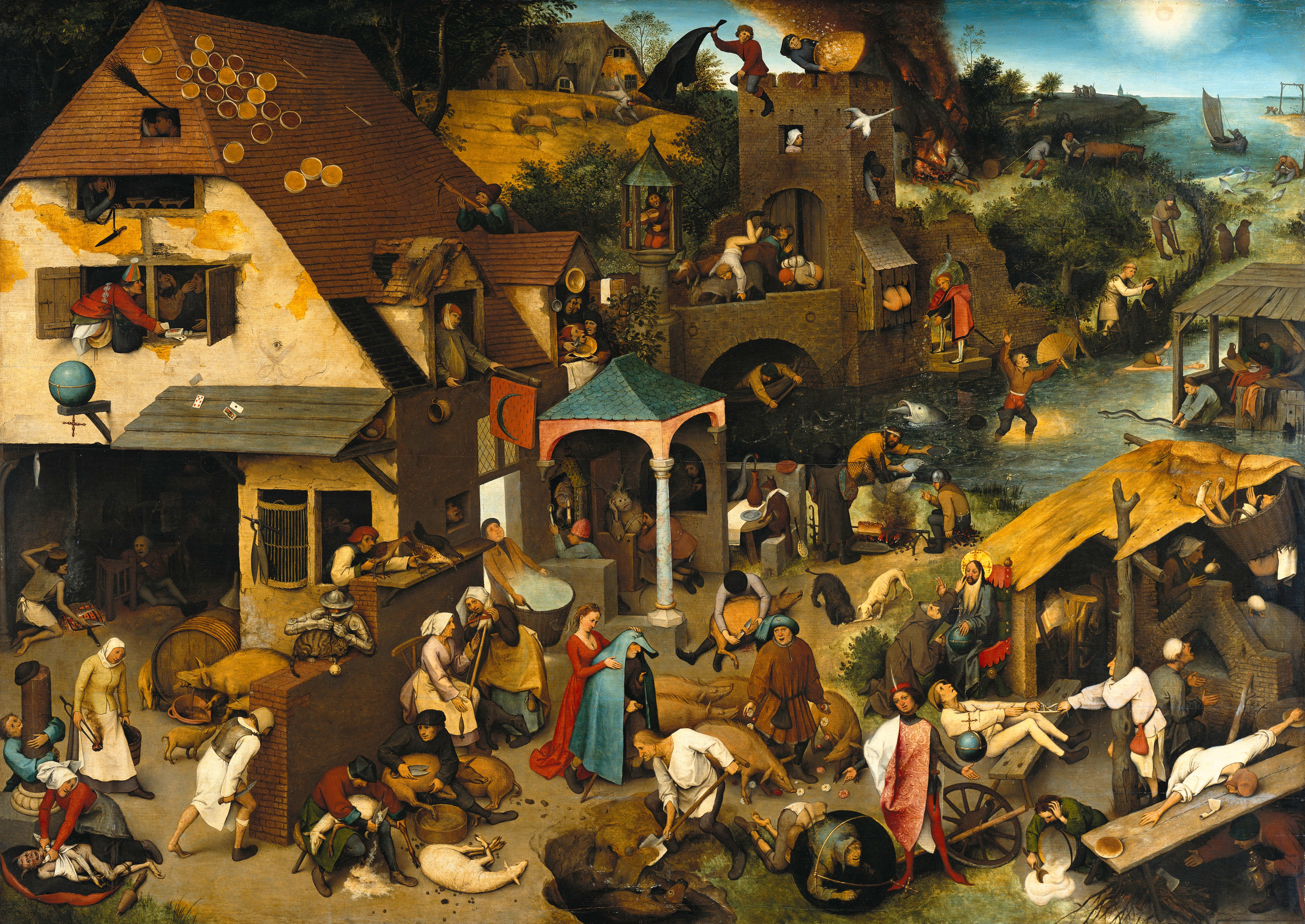
Pieter_Brueghel_the_Elder_-_The_Dutch_Proverbs_-_Google_Art_ProjectToday I’m revisiting one of the best allegorical paintings of all time, The Netherlandish Proverbs (also known as The Dutch Proverbs) by Pieter Brueghel the Elder, which was painted in 1559. A master at humor, allegory, and pointing out the follies of humanity, Brueghel the Elder is one of my favorite artists.
Artist: Pieter Bruegel the Elder
Year: 1559
Medium: Oil-on-panel
Dimensions: 117 cm × 163 cm (46 in × 64 in)
Location: Gemäldegalerie, Berlin

Quote from Wikipedia:

Critics have praised the composition for its ordered portrayal and integrated scene. There are approximately 112 identifiable proverbs and idioms in the scene, although Bruegel may have included others which cannot be determined because of the language change. Some of those incorporated in the painting are still in popular use, for instance “Swimming against the tide”, “Banging one’s head against a brick wall” and “Armed to the teeth”. Many more have faded from use, which makes analysis of the painting harder. “Having one’s roof tiled with tarts”, for example, which meant to have an abundance of everything and was an image Bruegel would later feature in his painting of the idyllic Land of Cockaigne (1567).

The Blue Cloak, the piece’s original title, features in the centre of the piece and is being placed on a man by his wife, indicating that she is cuckolding him. Other proverbs indicate human foolishness. A man fills in a pond after his calf has died. Just above the central figure of the blue-cloaked man another man carries daylight in a basket. Some of the figures seem to represent more than one figure of speech (whether this was Bruegel’s intention or not is unknown), such as the man shearing a sheep in the centre bottom left of the picture. He is sitting next to a man shearing a pig, so represents the expression “One shears sheep and one shears pigs”, meaning that one has the advantage over the other, but may also represent the advice “Shear them but don’t skin them”, meaning make the most of available assets.

You can find all of the wonderful proverbs on the painting’s page on Wikipedia, along with the thumbnail that depicts the proverb.

My favorite proverbs in this wonderful allegory?

Horse droppings are not figs. It meant we should not be fooled by appearances.

He who eats fire, craps sparks. It meant we shouldn’t be surprised at the outcome if we attempt a dangerous venture.

Now THAT is wisdom!


Credits and Attributions:

The Netherlandish Proverbs (Also known as The Dutch Proverbs) by Pieter Brueghel the Elder 1559 [Public domain], via Wikimedia Commons.

Wikipedia contributors, “Netherlandish Proverbs,” Wikipedia, The Free Encyclopedia, https://en.wikipedia.org/w/index.php?title=Netherlandish_Proverbs&oldid=829168138  (accessed November 24, 2022).

4 Comments

Filed under #FineArtFriday, writing

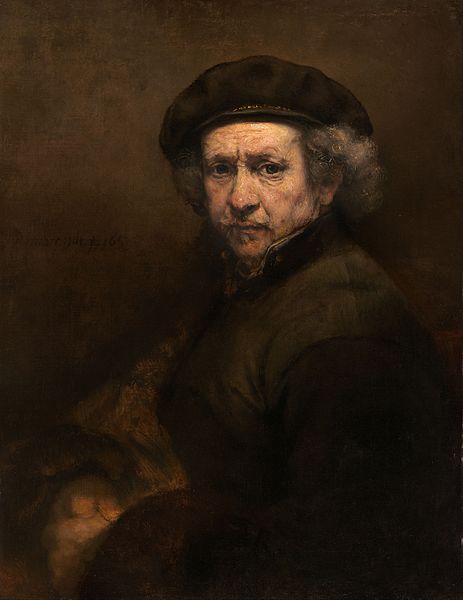
#FineArtFriday: Rembrandt through his own eyes, 1659 (revisited)

Rembrandt Harmenszoon van Rijn, commonly known simply as Rembrandt, is considered the finest artist of the 17th century. Some art historians consider him the finest artist in the history of art, and the most important artist in Dutch art history.

Speaking strictly as a Rembrandt fangirl and abject admirer, I consider his self-portraits to be more honest than those of any other artist.

Quote from Wikipedia: His self-portraits form a unique and intimate biography, in which the artist surveyed himself without vanity and with the utmost sincerity.

This honesty comes across in all his works featuring himself as the subject, even those where he portrays himself as a shepherd or the prodigal son. Each portrait shows an aspect of his personality, his sense of humor, his affection for Saskia who was the love of his life, and his wry acceptance of his own human frailties.

Rembrandt knew he was talented, but didn’t see himself as a creative genius. He was just a man with a passion for art, who lived beyond his means and died a pauper, as did Mozart, and as do most artists and authors.

I feel I know this man, more so than I do the person he was in his earlier self-portraits. He’s matured, lost some of the brashness of his youth. When I observe the man in this self-portrait, painted ten years before his death, I see a good-humored man just trying to live a frequently difficult life as well as he can. His face is lined and blemished, not as handsome as he once was. But his eyes seem both kind and familiar, filled with the understanding that comes from living with all one’s heart and experiencing both great joy and deep sorrow.

The art of Rembrandt van Rijn shows us his world as he saw it. Others may disagree with me, but I feel his greatest gift was the ability to convey personality with each portrait. This gift allowed him to portray every person he painted as they really were, blemished and yet beautiful. This is a gift he taught his students, and they were able to copy his style quite effectively, making discerning his true work difficult even for the experts.


Credits and Attributions:

Wikipedia contributors, “Rembrandt,” Wikipedia, The Free Encyclopedia, https://en.wikipedia.org/w/index.php?title=Rembrandt&oldid=844357531(accessed June 8, 2018).

Wikimedia Commons contributors, “File:Rembrandt van Rijn – Self-Portrait – Google Art Project.jpg,” Wikimedia Commons, the free media repository, https://commons.wikimedia.org/w/index.php?title=File:Rembrandt_van_Rijn_-_Self-Portrait_-_Google_Art_Project.jpg&oldid=292800848 (accessed June 8, 2018).

Comments Off on #FineArtFriday: Rembrandt through his own eyes, 1659 (revisited)

Filed under #FineArtFriday