Category Archives: #FineArtFriday

#FineArtFriday: Two Photographs, Two Years Apart

As I mentioned in my last post, The Summer Retreat, I am enjoying the last days of summer in Cannon Beach, Oregon. We will go back north to our home tomorrow. This has been a strange year, with unusual heat and a thick, smoky haze that marred the first three days.

This is the view of Tillamook Head as seen from Ecola Creek on August 13, 2016. That was a year of fabulous sunsets, deep blue skies and perfect kite flying winds.

This following image is the shot I took of  sunset three days ago on the same beach, with a more southern angle–the sea stacks are to the right, just out of the frame. At the time the photo was taken, the sun was still an hour above the horizon, and it should have been full daylight instead of twilight.

The brown haze is so thick, it looks as as if the image is grainy and overexposed, but as you can see by the red sun, it is just smoke obscuring the view of the ocean, hiding the rocks, and nearly hiding the sun. That was a difficult day for those of us with asthma, as the sun was obscured for most of the day, despite the intense humidity and 90 degree heat. The surf looks unreal, as if it were a badly composed painting.

Today the brown haze cleared and the temperatures dropped to the normal high 60’s to mid 70’s–which is perfectly comfortable. Not breathing the smoke from the West Coast Wildfires is a relief, although I suspect we will return to that misery once we return to our own inland valley.

Nevertheless, it will be good to be home. We love this place and this beach and return every year. And every sojourn here is  so different, so unique, always with something new to enjoy. Even when, as it was this year, it is a strange, nearly post apocalyptic year.


Credits and Attributions:

Images and text © 2018 Connie J. Jasperson, All Rights Reserved

Comments Off on #FineArtFriday: Two Photographs, Two Years Apart

Filed under #FineArtFriday, writing

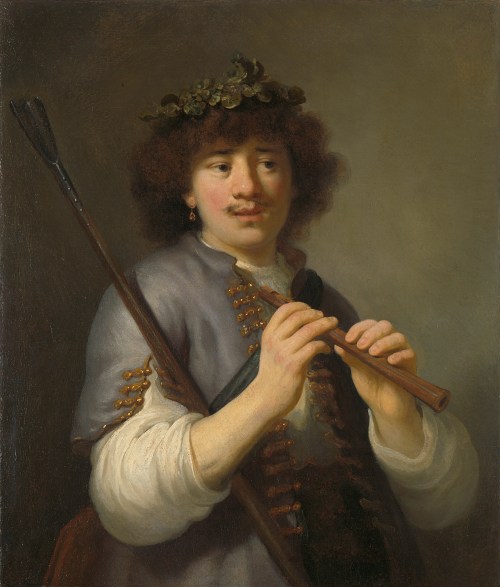
#FineArtFriday: Rembrandt as Shepherd with Staff and Flute, by Govert Flink 1636

About the artist: Born at Kleve, capital of the Duchy of Cleves, which was occupied at the time by the United Provinces, Govert Flinck was apprenticed by his father to a silk merchant, but in 1627 he was sent to Leeuwarden, where he boarded in the house of Lambert Jacobszoon. Jaobszoon was a Mennonite (one of the historic peace churches known for their commitment to pacifism). While Jacobszoon is better known as a preacher, he was a talented painter and an excellent teacher.

While studying there, Flinck met some of Jacobszoon’s neighbors, relatives of Saskia van Uylenburgh, who had married Rembrandt in 1634. That same year he began studying with Rembrandt.

Flinck is acknowledged as one of Rembrandt’s best pupils.

I really enjoy this romantic painting of Rembrandt dressed as a shepherd, holding a flute, and thinking about…what? Rembrandt’s contemplative expression seems peaceful.  The details are wonderful – from the finely worked trim on his garments down to the jewel dangling from his right ear, a gem that softly glows. The grains of the wood in both the flute and staff are subtle and real. The light falls perfectly – Flinck captured the personality of the master as a handsome young man during the happiest time of his life, and it seems as if Rembrandt himself enjoyed posing for it.

For more than a decade, Flinck’s work echoed that of Rembrandt, clearly influenced by the master’s style in the work which he executed between 1636 and 1648. As time passed, he began to desire to be a history painter, a genre in painting that  is defined by its subject matter rather than artistic style, and turned to the work of Peter Paul Rubens. In later years, Flinck had great commercial success, receiving many commissions for official and diplomatic paintings.


Credits and Attributions:

Wikimedia Commons contributors, “File:Rembrandt als herder met staf en fluit Rijksmuseum SK-A-3451.jpeg,” Wikimedia Commons, the free media repository, https://commons.wikimedia.org/w/index.php?title=File:Rembrandt_als_herder_met_staf_en_fluit_Rijksmuseum_SK-A-3451.jpeg&oldid=225225289 (accessed August 16, 2018).

Comments Off on #FineArtFriday: Rembrandt as Shepherd with Staff and Flute, by Govert Flink 1636

Filed under #FineArtFriday

#FineArtFriday: Perseid Meteor Shower; Aug.11, 2015, by Brad Sutton

This weekend, August 11th through the 13th, 2018, is the annual show of lights known as the Perseid Meteor Shower. My husband and I will watch them as we always do. Sometimes I fall asleep before they appear, but I always try to be awake for them. After midnight is the best time.

The National Park Service photographer, Brad Sutton, caught this dreamscape perfectly. The Joshua trees are black against the  sky and he managed an exposure that was perfect: the meteor was captured yet the brilliance of the stars and the color of the night wasn’t washed out.

That, my friends, is no easy trick. I know a little about photography, having worked as a darkroom tech during the 1980s. Processing and printing is a digital no-brainer now, but in those days it was a worthy career. During my time in that line of work, I was privileged to handle the work of many fine professional nature photographers, and have retained my appreciation for the art-form.

About the scene portrayed in this image:

From Wikipedia, the Fount of All Knowledge: The Perseids are prolific meteor showers associated with the comet Swift–Tuttle. The Perseids are so called because the point from which they appear to hail (called the radiant) lies in the constellation Perseus.

The other thing of beauty in this wonderful image is the setting, Joshua Tree National Park. It is an alien landscape to my northern eyes. The silhouettes of the Yucca against the clear, star-strewn sky calls to me in some lonely way.

Someday, I will travel to the American Southwest and see this place, and more. Perhaps I will see the Perseids from there. As all new experiences do, the feelings and emotions these places and events inspire will find their way into my work. I have been so privileged to see and touch the alien beauty that is our Planet Earth.

Also, from the Fount of Knowledge: Straddling the border between San Bernardino County and Riverside County, the park includes parts of two deserts, each an ecosystem whose characteristics are determined primarily by elevation: the higher Mojave Desert and the lower Colorado Desert. The Little San Bernardino Mountains traverse the southwest edge of the park.

Looking further into Wikipedia:

In a 2001 paper published in the journal Ecosystems, Joshua trees are one of the species predicted to have their range reduced and shifted by climate change. There is concern that they will be eliminated from Joshua Tree National Park, with ecological research suggesting a high probability that their populations will be reduced by 90% of their current range by the end of the 21st century, thus fundamentally transforming the ecosystem of the park. There is also concern about the ability of the species to migrate to favorable climates due to the extinction of the giant Shasta ground sloth (Nothrotheriops shastensis) 13,000 years ago; ground sloth dung has been found to contain Joshua tree leaves, fruits, and seeds, suggesting that the sloths might have been key to the tree’s dispersal.


Credits and Attributions:

Perseid Meteor Shower; 8-11-15 by Brad Sutton for the National Park Service. Taken in Joshua Tree National Park. © CC-BY-2.0 via Wikimedia Commons

Wikipedia contributors, “Perseids,” Wikipedia, The Free Encyclopedia,https://en.wikipedia.org/w/index.php?title=Perseids&oldid=853424957 (accessed August 9, 2018).

Wikipedia contributors, “Joshua Tree National Park,” Wikipedia, The Free Encyclopedia, https://en.wikipedia.org/w/index.php?title=Joshua_Tree_National_Park&oldid=852008844 (accessed August 9, 2018).

Wikipedia contributors, “Yucca brevifolia,” Wikipedia, The Free Encyclopedia, https://en.wikipedia.org/w/index.php?title=Yucca_brevifolia&oldid=854060539 (accessed August 9, 2018).

Comments Off on #FineArtFriday: Perseid Meteor Shower; Aug.11, 2015, by Brad Sutton

Filed under #FineArtFriday, writing

#FineArtFriday: Don Quixote in the Library, by Adolf Schrödter

An area of art I haven’t discussed, but which has often been a primary reason why I buy books, is the illustrations. The artwork that went into many books in the 19th and early 20th centuries was sometimes exquisite. Yet, these illustrators remained unknown for the most part and unsung. Today’s image is from Wikimedia Commons and is by a German artist, Adolf Schrödter.

Little is known about Schrödter other than he was born on June 28, 1805, and died Dec. 9, 1875, and was a genre painter of the Düsseldorf school of painting. According to Wikipedia, the Fount of All Knowledge:

The Düsseldorf School had a significant influence on the Hudson River School in the United States, and many prominent Americans trained at the Düsseldorf Academy and show the influence of the Düsseldorf School, including George Caleb BinghamDavid Edward CroninEastman JohnsonWorthington WhittredgeRichard Caton WoodvilleWilliam Stanley HaseltineJames McDougal HartHelen Searle, and William Morris Hunt, as well as German émigré Emanuel LeutzeAlbert Bierstadt applied but was not accepted. His American friend Worthington Whittredge became his teacher while attending Düsseldorf.

However, some of Schrödter’s art survives in the form of illustrations and a few prints have been sold at auctions.

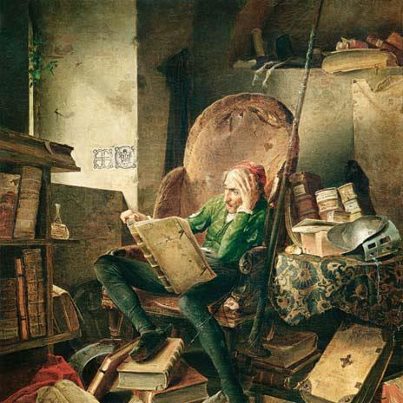
In today’s image what impresses me is the level of detail. Here we see Alonso Quixano reading, lounging in a room that is clearly a book lover’s sanctuary. He is a descendant of the family of “Gutierre Quijada” by direct lineage and is proud to be part of a long and noble tradition of knights. In the first part of the book, Alonso, later Don Quixote de la Mancha, is a dreamer, preferring to imagine himself as a superhero, living out a knightly story.

Books are strewn everywhere, beautiful, heavy leather-bound tomes. Schrödter shows him in a relaxed pose, deep into a book. The light of the room comes from a large window. He is a very human, ordinary middle-aged man, relaxing in the most cherished place in his universe: his library.

Alonso Quixano, the protagonist of the novel (though he is not named until much later in the book), is a retired country gentleman nearing fifty years of age, living in La Mancha with his niece and housekeeper. Although he is mostly a rational man, his excessive reading of books of chivalry has produced a skewed view of reality and what we might consider dementia. In keeping with the theories of the time, not sleeping adequately—because he was reading—has caused his brain to dry.

I love that notion.

As a result, Alonso is easily given to anger and believes every word of these fictional books of chivalry to be true. Don Quixote’s niece commits, what is to me, the most heinous crime–she and the Parrish curate burn his library, and lie to him, telling him it was the work of an evil magician.

He descends completely into his fantasy world and decides to become a knight-errant in search of adventure. Schrödter has captured the essence of the making of Don Quixote in this painting—the man who loves books is in his element, the one place where he fits. When that is taken from him, the story begins.


Credits and Attributions:

Don Quixote in the Library, by Adolf Schrödter, 1834 PD|100, via Wikimedia Commons.

Wikipedia contributors, “Düsseldorf school of painting,” Wikipedia, The Free Encyclopedia, https://en.wikipedia.org/w/index.php?title=D%C3%BCsseldorf_school_of_painting&oldid=822264175 (accessed August 3, 2018).

Comments Off on #FineArtFriday: Don Quixote in the Library, by Adolf Schrödter

Filed under #FineArtFriday

#FineArtFriday: Imogen, by Herbert Gustave Schmalz

Herbert Gustave Schmalz (1856–1935) was an English painter who named himself Herbert Gustave Carmichael in 1918. He is counted among the Pre-Raphaelites , and Imogen, which was painted in  1888 is a classic example of the hyper-romanticized Pre-Raphaelite style.

The Pre-Raphaelite Brotherhood produced some spectacularly beautiful work, as well as some rather awkwardly posed, overly sentimental pieces. Schmalz was famous for his romantic pictures depicting medieval scenes, Arthurian scenes, and vignettes from Shakespeare’s work.

Schmalz turned his brush to portraiture in his later work, as that was where the money was.

From Wikipedia:

The Pre-Raphaelite Brotherhood (later known as the Pre-Raphaelites) was a group of English painters, poets, and critics, founded in 1848 by William Holman HuntJohn Everett Millais and Dante Gabriel Rossetti. The three founders were joined by William Michael RossettiJames CollinsonFrederic George Stephens and Thomas Woolner to form the seven-member “brotherhood”. Their principles were shared by other artists, including Ford Madox BrownArthur Hughes and Marie Spartali Stillman.

A later, medievalising strain inspired by Rossetti included Edward Burne-Jones and extended into the twentieth century with artists such as John William Waterhouse.

The group’s intention was to reform art by rejecting what it considered the mechanistic approach first adopted by Mannerist artists who succeeded Raphael and Michelangelo. Its members believed the Classical poses and elegant compositions of Raphael in particular had been a corrupting influence on the academic teaching of art, hence the name “Pre-Raphaelite”. In particular, the group objected to the influence of Sir Joshua Reynolds, founder of the English Royal Academy of Arts, whom they called “Sir Sloshua”. To the Pre-Raphaelites, according to William Michael Rossetti, “sloshy” meant “anything lax or scamped in the process of painting … and hence … any thing or person of a commonplace or conventional kind”.[1] The brotherhood sought a return to the abundant detail, intense colours and complex compositions of Quattrocento Italian art. The group associated their work with John Ruskin,[2] an English critic whose influences were driven by his religious background.

The group continued to accept the concepts of history painting and mimesis, imitation of nature, as central to the purpose of art. The Pre-Raphaelites defined themselves as a reform movement, created a distinct name for their form of art, and published a periodical, The Germ, to promote their ideas. The group’s debates were recorded in the Pre-Raphaelite Journal.


Credits and Attributions

Wikipedia contributors, “Herbert Gustave Schmalz,” Wikipedia, The Free Encyclopedia, https://en.wikipedia.org/w/index.php?title=Herbert_Gustave_Schmalz&oldid=829134407 (accessed July 27, 2018).

Wikipedia contributors, “Pre-Raphaelite Brotherhood,” Wikipedia, The Free Encyclopedia, https://en.wikipedia.org/w/index.php?title=Pre-Raphaelite_Brotherhood&oldid=846744412 (accessed July 27, 2018).

7 Comments

Filed under #FineArtFriday

#FineArtFriday: Joos van Craesbeeck

Joos van Craesbeeck (c. 1605/06 – c. 1660) was an interesting character, standing out among the many interesting characters of the seventeenth century Flemish art community. He was a Flemish baker and an artist, a friend and contemporary of  Adriaen Brouwer. They most likely met while Brouwer was jailed in the citadel of Antwerp, although why he was imprisoned is unknown. But the bakery in the Antwerp citadel was operated at that time by Joos van Craesbeeck.

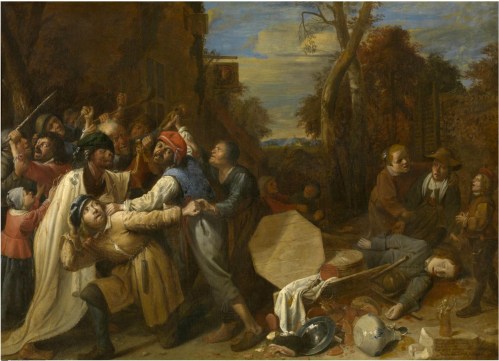
Van Craesbeeck was fascinated with the portrayal of violence and the senses of taste and smell. He painted the dissolute side of life, shocking in its intensity and honesty. Death is Violent and Fast: Quarrel in a Pub, is an excellent example of his almost brutish depiction of peasants brawling. Blood flows, one man lies dead, and in the lower right hand corner, Death smiles, pleased with that night’s work.

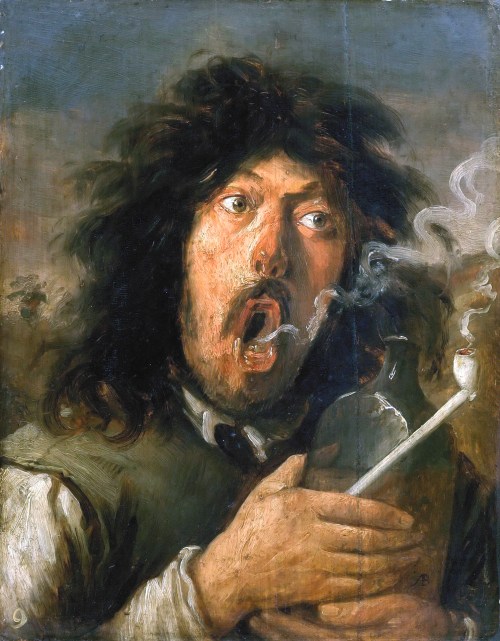
He often painted himself, as is seen in The Smoker, a self-portrait that was at one time attributed to Adriaen Brouwer, depicting the senses of smell and taste. He shows himself clutching both a bottle of hard liquor and a pipe, as if they are the dearest things to him. He exhales a stream of smoke, savoring it.

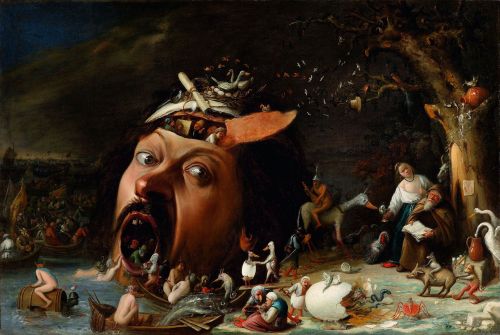
He also painted his own self-portrait as the central nightmare from which other nightmares spawn in the Temptation of St. Anthony. Note the way his mouth is full of little demons entering and leaving, and his head is open to reveal an artist painting beneath wild dark hair in which geese nest. St. Anthony himself is small, placed to the right, almost unnoticed in the onslaught of demons and temptations, both physical and moral. A cacophony of violence and evil rages as Anthony clings to the scriptures. This is a revealing portrait of how the artist viewed himself and the demons he battled, in my opinion.

The work of Joos van Craesbeeck is not comforting or warm. It is always allegorical, showing us something we don’t like about the world we live in. Violence and vice were as much a part of life in his time as they are today, and perhaps will always be.

Quote from Wikipedia: Van Craesbeeck painted at least five portraits which are presumed to be self-portraits and in which he depicts himself in a ‘dissolute’ manner. The dissolute self-portrait was a genre that had taken root in Dutch and Flemish genre painting in the 17th century. It was an inversion of the Renaissance ideal of the ‘pictor doctus’: the artist as an intellectual and gentleman. This ideal was replaced by the new model of the prodigal artist who is characterized by his creative inspiration and talents. These self-portraits emphasized the artists’ dissolute nature by creating associations with traditional moral themes such as the Five Senses and the Prodigal Son in the tavern. Van Craesbeeck painted himself four times in low-life guises depicting the sense of Taste.


Credits and Attributions:

Wikipedia contributors, “Joos van Craesbeeck,” Wikipedia, The Free Encyclopedia, https://en.wikipedia.org/w/index.php?title=Joos_van_Craesbeeck&oldid=823865809 (accessed July 20, 2018).

Death is Violent and Fast: Quarrel in a Pub, painting by Joos van Craesbeeck, ca. 1630 – 1635 PD|100 via Wikimedia Commons.

The Smoker, Joos van Craesbeeck ca.1635 – 1636 [Public domain], via Wikimedia Commons

The Temptation of St Anthony, Joos van Craesbeeck ca. 1650 [Public domain], via Wikimedia Commons

Comments Off on #FineArtFriday: Joos van Craesbeeck

Filed under #FineArtFriday

#FineArtFriday: Young Peasant with Sickle, Vincent Van Gogh

This week, for some reason I have been quite interested in Vincent van Gogh’s earlier work.  This painting is the earliest from his art-book, which is dated 1881. The mediums he used in this study were black chalk, charcoal, grey wash, and opaque watercolor on laid paper, a type of paper having a ribbed texture, that is especially good for watercolors.

I have been contrasting the preciseness of this early work with his later expressionism and imagery. I’m fascinated with the evolution of his choice of colors, from muted, yet somehow intense, in his early work, to brilliant and vibrant in his later pieces. In a way, it’s like reading the early works of a favorite author. You see everything you love about their work in that book written in their youth, but greatly admire the way their voice and style evolves in their later, more mature work.

Fortunately, Van Gogh was a prolific writer of letters, many of which have survived. Through his correspondence with his brother Theo Van Gogh, and to Anton van Rappard, a Dutch painter and draughtsman, we have a window into Vincent’s life.

Quote from Wikipedia: Theo kept all of Vincent’s letters to him;[10] Vincent kept few of the letters he received. After both had died, Theo’s widow Johanna arranged for the publication of some of their letters. A few appeared in 1906 and 1913; the majority were published in 1914.[11][12] Vincent’s letters are eloquent and expressive and have been described as having a “diary-like intimacy”,[9] and read in parts like autobiography.[9] The translator Arnold Pomerans wrote that their publication adds a “fresh dimension to the understanding of Van Gogh’s artistic achievement, an understanding granted us by virtually no other painter”.[13]

There are more than 600 letters from Vincent to Theo and around 40 from Theo to Vincent. There are 22 to his sister Wil, 58 to the painter Anthon van Rappard, 22 to Émile Bernard as well as individual letters to Paul SignacPaul Gauguin and the critic Albert Aurier. Some are illustrated with sketches.[9] Many are undated, but art historians have been able to place most in chronological order. Problems in transcription and dating remain, mainly with those posted from Arles. While there Vincent wrote around 200 letters in Dutch, French and English.[14] There is a gap in the record when he lived in Paris as the brothers lived together and had no need to correspond.[15]

Vincent’s comments regarding this picture, as quoted on Wikmedia Commons:

Letter 172 to Theo van Gogh. Etten, mid-September 1881. Vincent van Gogh: The LettersVan Gogh Museum. “Prompted as well by a thing or two that Mauve said to me, I’ve started working again from a live model. I’ve been able to get various people here to do it, fortunately, one being Piet Kaufmann the labourer… Diggers, sowers, ploughers, men and women I must now draw constantly. Examine and draw everything that’s part of a peasant’s life. Just as many others have done and are doing. I’m no longer so powerless in the face of nature as I used to be.”

Letter 178 to Anthon van Rappard. Etten, Wednesday, 2 November 1881. Vincent van Gogh: The LettersVan Gogh Museum. “Today I again drew a digger, and since your visit a boy cutting grass with a sickle as well.”


Credits and Attributions:

Young Peasant with Sickle, Vincent van Gogh [Public domain], via Wikimedia Commons

Wikipedia contributors, “Vincent van Gogh,” Wikipedia, The Free Encyclopedia, https://en.wikipedia.org/w/index.php?title=Vincent_van_Gogh&oldid=845634731 (accessed July 6, 2018).

Wikimedia Commons contributors, “File:Van Gogh – Kauernder Junge mit Sichel.jpeg,” Wikimedia Commons, the free media repository, https://commons.wikimedia.org/w/index.php?title=File:Van_Gogh_-_Kauernder_Junge_mit_Sichel.jpeg&oldid=286066347 (accessed July 6, 2018).

4 Comments

Filed under #FineArtFriday

#FineArtFriday: Worn Out by H. A. Brendekilde

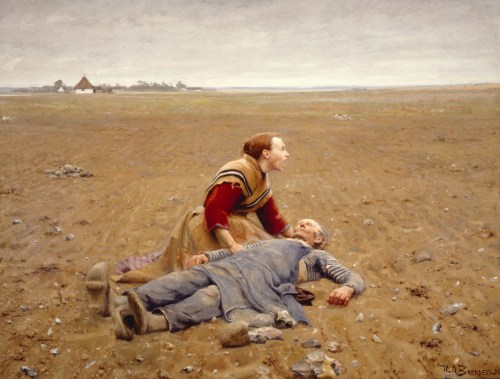
H.A. Brendekilde was a forerunner of the social realist style, embraced by Diego Rivera. His early work often depicted the daily lives of the rural working class. One of his most famous paintings, “Worn Out” (1889) shows an elderly man lying fallen on his back in the plowed field. I included this piece in a post on March 30, 2018, but I wanted to look more closely at it today.

Brendekilde’s genius shows in the way he depicts the central subject. The rocky, barren field is immense, nearly blending with the sky. Dirt and rocks dominate this painting–Dirt on their clothes, small rocks embedded in the soil, larger rocks gathered into piles to be carted from the field–this man’s life was the soil, hard and rocky though it was. Yet he clung to it, working to clear the rocks until he could go no further.

I love the detail in this painting. It’s easy to see how their day began: the man and woman spent the morning picking rocks from a field and making small piles of them, preparatory to plowing the field. Then, something happened. A heart attack? A stroke? One of the man’s clogs has fallen off his foot, lost when he stumbled and fell. The stones he was picking up and carrying in his apron have tumbled to the ground beside him.

Farming is working in the dirt, and dirt clings to his clothes. The woman wears a dress that has been patched many times, the loose, dry soil on her garments show she too has been picking rocks all morning. Is she his daughter? Or perhaps his wife? Even if only a friend, she is terribly concerned for him.

They are nearing the end of their winter stores and the first new vegetables have yet to be planted. Has he worked himself to death? Will he recover?

This old man’s entire world is this rocky barren field.  As I said in my earlier piece, a story is told in this stark painting.


Credits and Attributions:

Worn Out by H. A. Brendekilde [Public domain], via Wikimedia Commons


2 Comments

Filed under #FineArtFriday

#FineArtFriday: The Kiss, by Bernardien Sternheim

It is a rare treat when we can view modern art as painted by living authors via Wikimedia Commons. Today we are looking at The Kiss, by Bernardien Sternheim. It is dated 2001 and can be found on Wikimedia Commons, in the category Dutch Independent Realism.

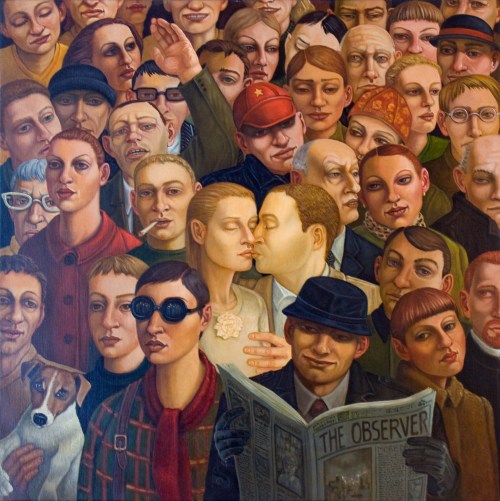
What I love about this painting: It is raw, and real, and speaks to the humanity of the throng who are gathered for… what? Are they watching a race? Perhaps they are waiting for a train.

Regardless of what they are waiting for, the crowd faces forward, not watching the man and woman who steal a kiss.

Yet a nod to voyeurism is found here, as one man is reading The Observer, a woman reads over his shoulder, and an elderly man whispers into the ear of a woman.

I love the colors, the detail, and the expressions on each individual in the crowd. This painting is sure and bold, a window showing us a view of… ourselves.

About the artist:

Quote from the artist’s website, Bernardien Sternheim: “Central to the work of Bernardien Sternheim is man, in all his vulnerability and strength.

“Bernardien was born in Amsterdam in 1948. Against the spirit of the age, she opts for realism, figurative art.

“That is how she had to develop herself, with as great examples Pyke Koch, Caravaggio and Rembrandt.”


Credits and Attributions:

The Kiss, by Bernardien Sternheim via Wikimedia Commons contributors, “File:WLANL – Marcel Oosterwijk – De Kus.jpg,” Wikimedia Commons, the free media repository,

https://commons.wikimedia.org/w/index.php?title=File:WLANL_-_Marcel_Oosterwijk_-_De_Kus.jpg&oldid=282201684 (accessed June 22, 2018).

Comments Off on #FineArtFriday: The Kiss, by Bernardien Sternheim

Filed under #FineArtFriday