Category Archives: Humor

Interior Monologues

MP900321209In writers’ forums you will find a great deal of discussion regarding interior monologues. It’s true that beginning authors can rely too heavily on them as an easy way to dump blocks of information into a narrative, instead of deploying it. A few people will even tell you they despise interior monologues, and while I disagree with them, I do see their point.

First of all, it is an accepted practice to italicize thoughts. But we are all aware of how daunting it is for a reader to be faced with a wall of italics.

A rather vocal contingent will say thoughts should not be italicized, that it creates a greater narrative distance, setting readers outside of the character and the events of the scene.

MSClipArt MP900390083.JPG RF PDAs an avid reader, I disagree, although more than a sentence or two does exactly that. If we choose to omit dialogue tags for them, and don’t set them off with italics, it becomes confusing. The finished book ends up looking like a bunch of closed quotes were left out, and gives the impression of an unedited manuscript, even if the publisher has subtly changed the font just for thoughts.

If you, as an indie publisher, do choose to leave them in the standard font but add dialogue tags such as she thought, it makes me wonder, why are you bothering to have an interior monologue at all? If you feel that strongly, skip it entirely and find a different way to express your ideas, because readers will have to stop and read it twice.

Interior monologues have their place, and when a writer is expressing a character’s most intimate thoughts, the current accepted practice for writing interior monologue is to use italics. We use them to represent a character’s thoughts in real time, as they actually think them in their head, or the precise words they use. For that reason, italicized thoughts are always written in:

  • First Person: I’m the queen! After all, we don’t think about ourselves in the third person, even if we really are the queen. We are not amused.
  • Present Tense: Where are we going with this? We think in present tense because we are in the middle of events as they happen, so while memories may reflect the past, our immediate actions and mental comments are unfolding in the present, and we want to convey that sense of immediacy. What a mess.

The Website, Novel Writing Help says:

It will be perfectly obvious to the reader that these words are the character thinking and not the author narrating. And the thought itself, as well as not becoming confused with the rest of the text, gains an extra emphasis, like in this example from Clare Morrall’s novel The Man Who Disappeared.

Felix, a man whose world has just fallen apart, is standing out in the street watching his family eat their evening meal without him…

   He wants to believe in this cosiness, this world of families, this labyrinth of deeply entwined love.
   That’s the key, of course: love. He has been told this for as long as he can remember. ‘We love you, Felix,’ one of his aunts used to say, ‘and that’s all that matters.’
   What have I done, Kate?
   Frost glints on the road, nearby car windscreens are clouded with ice. Felix blows on his hands and shuffles his feet around, trying to bring some feeling back to his toes. (End of quoted passage)

As you can see in the above passage, Felix has many thoughts, but only the most intimate, personal thoughts are shown through an interior monologue—the rest are written as part of the scenery, and they create the image of the situation he has found himself in. (Just so you know, I liked that passage so much that I just bought the Audible book.)
CAUTION INFO DUMP ZONE AHEADThis is how we want to write our interior monologues. They must be natural, and organic to the flow of the narrative. Thoughts must fit as smoothly into the narrative as conversations. My recommendation is to only voice the most important thoughts via an internal monologue, and in this way you will retain the readers’ interest. The rest can be presented in images that build the world around the characters:

Benny watched Charlotte as she left the office. Everyone knew she came from a wealthy family. The gold watch, the sleek sports car she drove could have been owned by any well-employed girl, but something about her screamed confidence and money.

You could put all of that into Benny’s interior monologue, but why? This way, the reader is shown all they need to know about Charlotte, without resorting to an info dump, and we aren’t faced with a wall of italics.

Some things must be expressed as an interior monologue, if you want the reader in your protagonist’s head.

Benny looked down at his mop. I’m such an idiot.

Now the reader has also gained a whole lot of information, in only two sentences.  They think they know who Benny is, and they have a clue about his aspirations. What they don’t know yet, but will discover as the plot unfolds, is that Benny is actually a detective working undercover, and Charlotte is the secretary of his quarry.
autumn leavesInterior monologues are crucial to the flow of novels in which the author wants the reader planted firmly in the protagonist’s mind. However, the actual monologues must be used sparingly, and the rest of his/her thoughts should be shown through their actions or external observations.

Those external observations are a subtle part of worldbuilding, when you are writing a narrative that is an intimate portrait of your protagonist.

So, to wind this up, I feel that:

  1. Interior monologues are an organic part of some kinds of narratives, but not necessarily all narratives.
  2. If used sparingly interior monologues can create an intimate connection with the protagonist.
  3. If an interior monologue is used, it should be short and set off by italics, and only rarely with the ‘speech tag’ thought.
  4. Italics should never be used for long passages.

That last one is hard–what do you, as an indie publisher, do for quoted passages or letters between protagonists? Those sorts of questions are a ‘whole nother’ blog post, as we say where I come from.
6 Comments

Filed under Adventure, Books, Fantasy, Humor, Literature, Publishing, Self Publishing, Uncategorized, writer, writing

Wordless Dictionaries

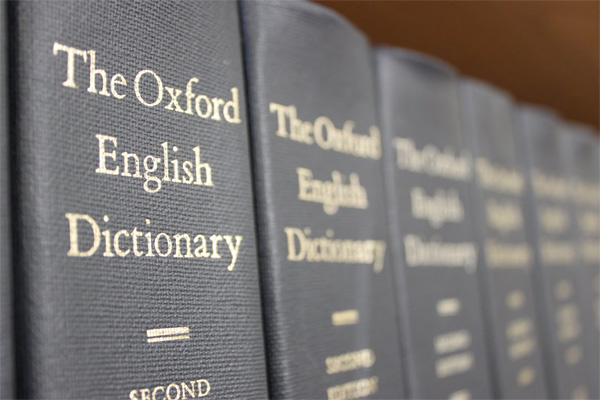
oxford_dictionaryWe are in the midst of an extreme shift in the English language, a continual evolution as impossible to stop as the  melting of the Antarctic ice-cap. This change is not necessarily a terrible thing, but it does come along with some interesting complications.

Robert Macfarlane discussed one negative aspect of our language shift in a blog post last week for The Guardian. He is not  saying that the rapid shift in our dialect and word-usage is bad–after all, language needs to be spoken and it is like water: it’s always on the move and incredibly difficult to contain.

cowslip

cowslip

But Macfarlane sees a negative in the modern view of this fluidity, one that struck a real chord with me: “Under pressure, Oxford University Press revealed a list of the entries it no longer felt to be relevant to a modern-day childhood. The deletions included acorn, adder, ash, beech, bluebell, buttercup, catkin, conker, cowslip,cygnet, dandelion, fern, hazel, heather, heron, ivy, kingfisher, lark, mistletoe,nectar, newt, otter, pasture and willow. The words taking their places in the new edition included attachment, block-graph, blog, broadband, bullet-point, celebrity, chatroom, committee, cut-and-paste, MP3 player and voice-mail. As I had been entranced by the language preserved in the prose‑poem of the “Peat Glossary”, so I was dismayed by the language that had fallen (been pushed) from the dictionary. For blackberry, read Blackberry.”

Now, admittedly Robert Macfarlane is an avid reader of literary fiction, and he also writes literary and travel books. However, many people are  still reading above the comic book level, and what he has to say in his piece concerns the dumbing-down or “flattening” of the language. Don’t try to tell me there isn’t enough room in the book for these words. Dictionaries are on-line now and there is in infinite amount of space in the internet for these words.

oxford school dictionaryDictionaries are the first reference book children will come into contact with in their schools, followed closely nowadays by Wikipedia. I admit that in a desk-reference form space is limited, but in a world where Blackberry means a smart-phone, there is no lack of space.

How will the landscape of our language look in fifty years? I sometimes doubt I would be understood, speaking in my ancient Northwest American dialect, using words that have no relevance. Without a comprehensive dictionary, how will the words I write today be understood by my great-grandchildren?

If I could say one thing to those who compile dictionaries it is that ALL the many words that make up our English language  have relevance and should be  included in what is being marketed as a truly comprehensive dictionary. At some point, a curious reader is going to want to know the meaning of a word, and if that word appeared in the dictionary  at one time, why must it be removed just because a committee of naive scholars with extremely limited experience feels it is not needed?

_72982736_vikings courtesy of BBCTo me, this is tantamount to a mass burning of books just because they contain “dangerous ideas.”

I have one thing to say to the modern publishers of dictionaries: You have unlimited space in an on-line dictionary. When you allow words to fall out of the dictionary because they have fallen out of common use in YOUR milieu,  your dictionary is not as comprehensive as you are pretending it is. You have lost YOUR relevance at that point.

These mongers of wordless dictionaries should feel some shame, because they are as responsible for the dumbing-down of the English language as is the casual speaker. Their own relevance is questionable, as more and more seekers of quick information will find it in the bowels of the fount of all knowledge, Wikipedia, OR they will Google it, as I did the word “inexorable.”

6 Comments

Filed under Adventure, Battles, Books, Fantasy, Humor, Literature, Publishing, Self Publishing, Uncategorized, writer, writing

Critique groups vs beta reading groups

Book- onstruction-sign copyEvery writer needs honest, constructive feedback in order to grow in their craft. Many will join critique or beta reading groups. These groups come in all sorts and sizes, some specializing in general fiction and some in genres like mystery, science fiction, fantasy, or romance.

Most communities have clusters of authors—after all, nowadays everyone either is an author or has a couple in the family . In your community you will find groups for beginners, or some that cater to more advanced crowds. I guarantee there will be one to fit your needs.

We’ve all heard the horror stories regarding critique groups, and perhaps even experienced one. Making a poor choice in writing groups can be devastating—it can undermine a budding author’s confidence and destroy a person’s joy in the craft. The seas are rough out there but many writing groups are really good, supportive gatherings of authors who stay for years and welcome new authors into their group with open arms.

Other groups can be cliquish, unwelcoming, and daunting to new arrivals. Authors just beginning to explore this necessary part of the craft will not come back to one of these groups if they were given the cold-shoulder the first time.

There is a difference in types of writing groups, too. Some are traditional critique groups, people who usually read a few pages aloud at their sessions and discuss it in detail in a round-table fashion. This sort of focus can be just right for some authors.

Because traditional critique groups focus only on 3 or 4 pages at a time, they lack the context to be able to discern if your protagonist has developed sufficiently along his character arc by the first 1/4 of the tale. However, they can tell you if you have made editing errors, and discuss small points of technique within those few pages.

Frankly, I am not interested in this kind of group.

These sorts of groups don’t have the ability to properly critique the larger picture—pacing, overall story arc, worldbuilding, character development, and on, and on–because these things can only be judged in larger context. So if, like me, that is the sort of input you are looking for, my advice is to find a beta reading group.

Critique groups cannot do what beta readers can.

But how do you select a group? Before you join a beta reading group, you have the right to know what that group focuses on. Ask yourself these questions:

beta read memeWhat do I want from this group? Orson Scott Card says the answers should be:

  1. Where did my chapter bog down?
  2. What did they think about my characters?
  3. Where did they get confused and what did they have to read twice?
  4. Did it become unbelievable or too convenient at any point?
  5. What do they think will happen to the characters now?

Then after you have sat in on one of their sessions and observed how they treat each others’ work, ask yourself, “What kind of vibes did I get from this group of people? Will I benefit from sharing my work with this group? Did the comments they made to each other sound helpful?” Hopefully, the answer to those questions will be a resounding “yes.”

If not, run now. Run far, far away.

There are common negatives to watch out for in all writing groups: If you have stumbled into a group where the most visible member is a self-important, read-all-the-books-on-writing-so-I-know-it-all kind of a person, don’t bother joining or you’ll be subjected to many accounts of how their writing group in Minnesota was so much better than this pathetic group.

Another author you might watch out for is the ubiquitous Famous-Author-Name-Dropper, a person who must be important because she has been to a great many seminars and conventions with these famous people, and hung out in the bar with one of them once. If it turns out she is in your prospective group, it may not be the group you are looking for. Sometimes they are the same person, sometime not, but either one of these wannabe-famous authors are poison—in their eyes the group only exists to admire them, and they will causally cut your work to shreds, dismissing it as merely amateur in the face of their “professional” experience.

When you are considering joining a group, ask the leader/chairperson these questions:

  1. If the group is a beta reading group focused on first drafts, what do they consider a first draft? Do you have to hire an editor and have it thoroughly edited before you submit it to this group? Because that is not a first draft, and that group would be a waste of your time.
  2. Will you receive insights into your manuscript on points you hadn’t considered, or will the focus of the discussion centered on minor editing issues that you are already aware of?
  3. Ask the leader to define for you the specific areas that readers will be looking at: Character development, pacing the arc of the scene, pacing the arc of the conversation, worldbuilding.

So let’s say you have found a group who seems to a good bunch of people, and yes, they read and write in your genre. You trust them enough to submit your first piece to the group. After the session is over, ask yourself:

  1. Do I feel positive about my work or do I feel like my work was treated as being less than important?
  2. Did I gain anything from the experience that would advance the plot or did I just hear a rehash of arm-chair editing from a wannabe guru?

The answers to these questions have to be that you feel good about your work, that you saw through their eyes the weaknesses, and that they can be fixed.

beta read meme 2If the strengths and weaknesses of the characters, and the overall arc of the chapter were overlooked in the face of fixable editing errors then you did not get the insight into the particular trouble-spot that you were looking for.

Ask yourself this: “When I was discussing the direction I wanted to take the tale in, did I sense that they were interested in my story?” If the answer is anything other than a resounding “yes” you have the right to leave the group.

New authors join writing groups feeling a great deal of trepidation, filled with uncertainty and fear. They fear being belittled and told their work is crap, and sometimes that happens. At the end of the day, you have to feel as if you have gained something from the experience.

Hopefully you will be as fortunate as I have been, and find a group of beta readers you can mesh with, people who will support and nurture you in the same way that you will them.

6 Comments

Filed under Battles, Books, Fantasy, Humor, Literature, Publishing, Self Publishing, writer, writing

Formatting a submission-ready manuscript

Félix_Vallotton_Nature_morte_à_l_assiette_bleue_1922 Félix Vallotton [Public domain], via Wikimedia CommonsMost editors have a great deal of work in their in-boxes, and don’t have time to deal with badly formatted manuscripts and these submissions are not even considered.  All agents, editors and publishing companies have specific, standardized formatting they want you to use, and these guidelines are posted on their websites.

If you intend to go the traditional route and submit your manuscript to a Big Publisher such as TOR Forge, you will want to make sure your work is submission-ready, and that it conforms to the exact standards they have laid out on their website.

But what makes a manuscript submission ready? TOR Forge clearly says: Standard manuscript format means margins of at least 1 inch all the way around; indented paragraphs; double-spaced text; and Times New Roman in 12 pitch. Please use one side of the page only. Do not justify the text. Do not bind the manuscript in any way. Make sure the header of the ms. includes your name and/or the title of the book as well as the page number (on every page).

Publishers who accept electronic submissions will most likely want them formatted similarly. For the most part this formatting is basically the same from company to company, so once you know what the industry standard is, it’s easy to make your manuscript submission-ready, at least in the area of formatting.

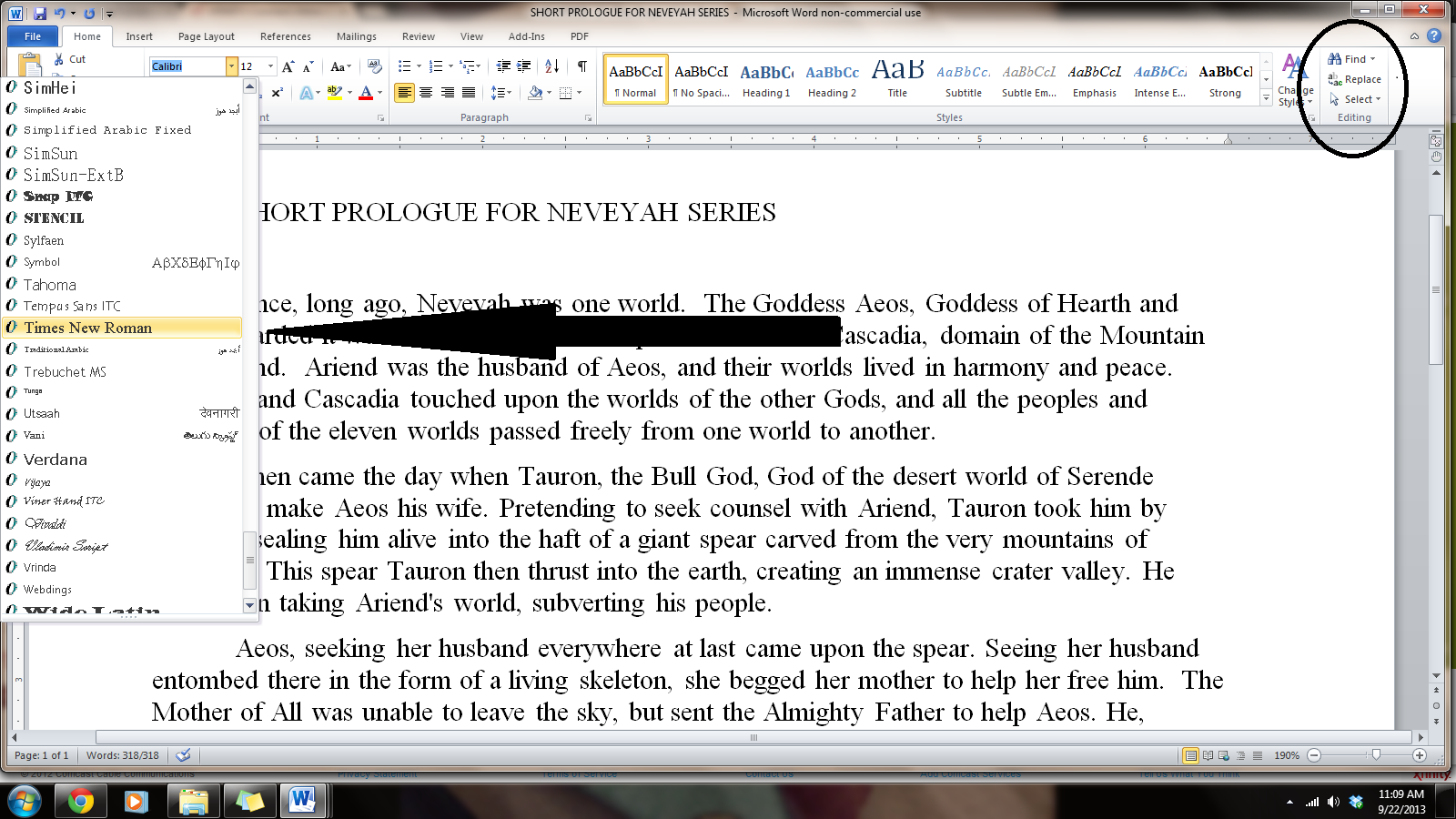
First of all, running across the top of the page is something called the ribbon, and this is your toolbox. Everything you need to create a manuscript is right there, waiting for you to learn to use it. On the right hand side, by the question mark is a tiny arrow for expanding or hiding the ribbon – and we are going to expand it so we have access to all the tools we will need.

First, we must select the font. I use Microsoft WORD, and like every other word-processing program, it has many fancy fonts you can choose from and also has many sizes.

You don’t want fancy. Stick with the industry standard fonts: Times New Roman or Courier in 12 pt.  Most say .11 is fine – for me, in a printout .10 is too small for my elderly eyes, I prefer .12. These are called ‘Serif’ fonts, because they have little extensions that make them easier to read when in a wall of words.

If you are using MS WORD, here are a few simple instructions: to change your fonts, open your manuscript document, and Click on the tab marked ‘Home’.  In the upper right-hand corner of the ribbon across the top of the page in the editing group, click:

select> select all. This will highlight the entire manuscript.

With the ms still highlighted, go to the font group, on the left-hand end of the ribbon. The default font, or predesigned value or setting, will probably say ‘Calibri (Body)’ and the size will be .11.

You can change this by clicking on the menu and accessing the menu. Scroll down to Times New Roman, as it is the easiest on the eyes. Click on that and the font for the entire ms will be that font. Any errors can be undone by clicking the back-arrow.  Once you are satisfied with your changes, click save.

fonts post 2 of word series


Now we are going to format our paragraphs and line spacing. Editors and publishers want their copies double-spaced so they can insert comments as needed in the reviewing pane, which will be on the right side of the page when you receive your work back for revisions. Having it double-spaced allows for longer comments, and makes it easier for reading.

Remember, TOR Forge says they want a standard manuscript formatted with margins of 1 inch all the way around; indented paragraphs; double-spaced text. Do not justify the text. In justified text, the spaces between words, and, to a far lesser extent, between glyphs or letters (known as “tracking”), are stretched or sometimes compressed in order to make the text align with both the left and right margins. This gives you straight margins on both sides, but this is not the time or place for this type of alignment.

I’ve said this before, and I will say it again: Do NOT ever use the tab key or the space bar to indent your paragraphs. You have no idea what a crapped up mess that makes out of a manuscript.  You will have to go in and remove these tabs by hand and it’s a tedious job, but do it now, if you have been using the tab key.

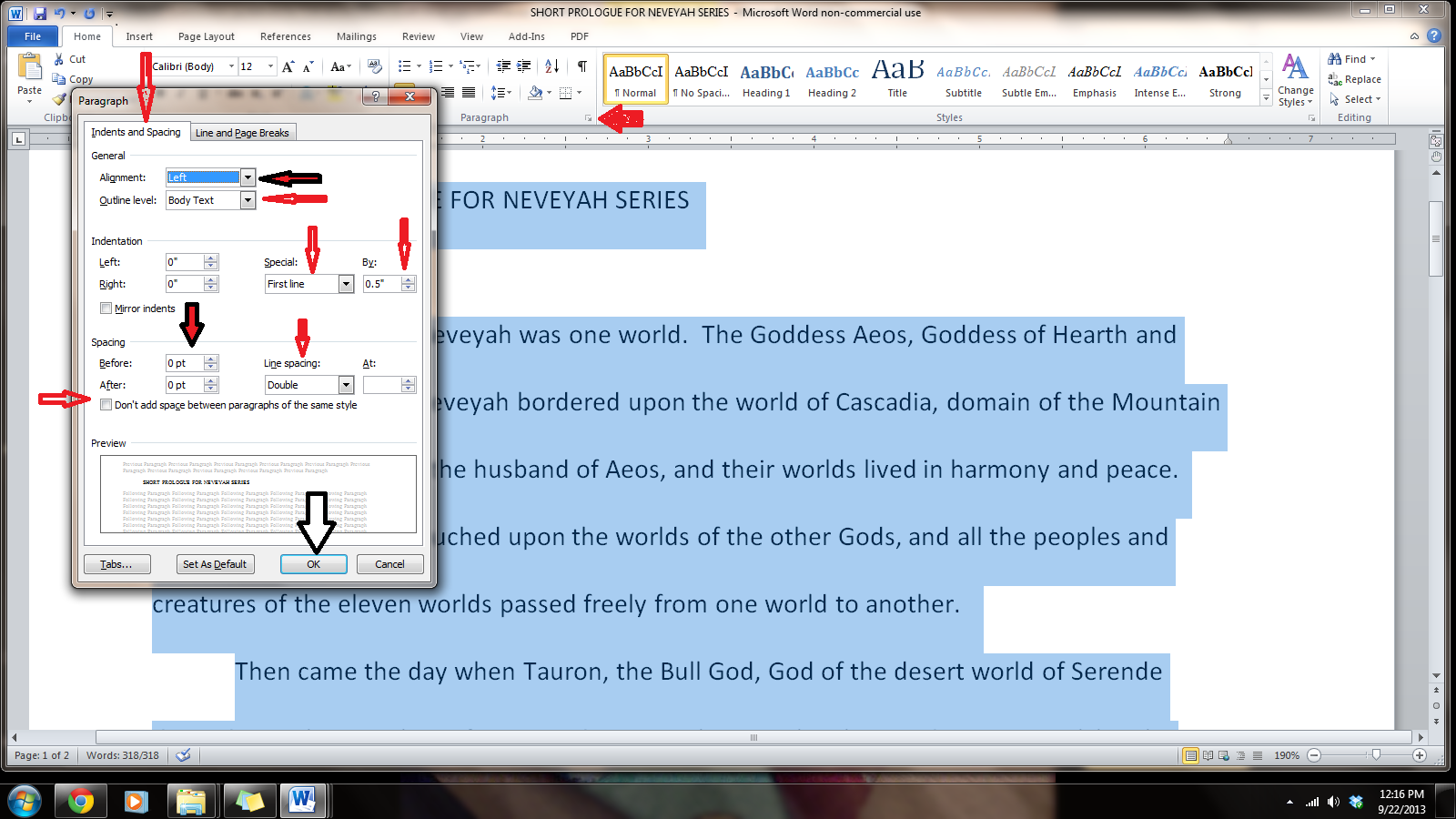
Instead of the tab key, a professional author who is writing in MS WORD uses the simple formatting tool:

On the home tab, look in the group labeled ‘Paragraph’. On the lower right-hand side of that group is a small grey square. Click on it .  A pop-out menu will appear, and this is where you format your paragraphs.

  1. On the indents and spacing tab of the menu: Use standard alignment, align LEFT. The reason we use this format is we are not looking at a finished product here. We are looking at a rough draft that will be sliced, diced and otherwise mutilated many times before we get to the final product.

The picture below has it all clearly marked out:

paragraphs post 2 pof word series

  1. Indentation: leave that alone or reset both numbers to ‘0’ if you have inadvertently altered it.
  2. Where it says ‘Special’: on drop-down menu select ‘first line’. On the ‘By’ menu, select ‘0.5’
  3. ‘Spacing’: set both before and after to ‘0’.
  4. ‘Line Spacing’: set to ‘double’

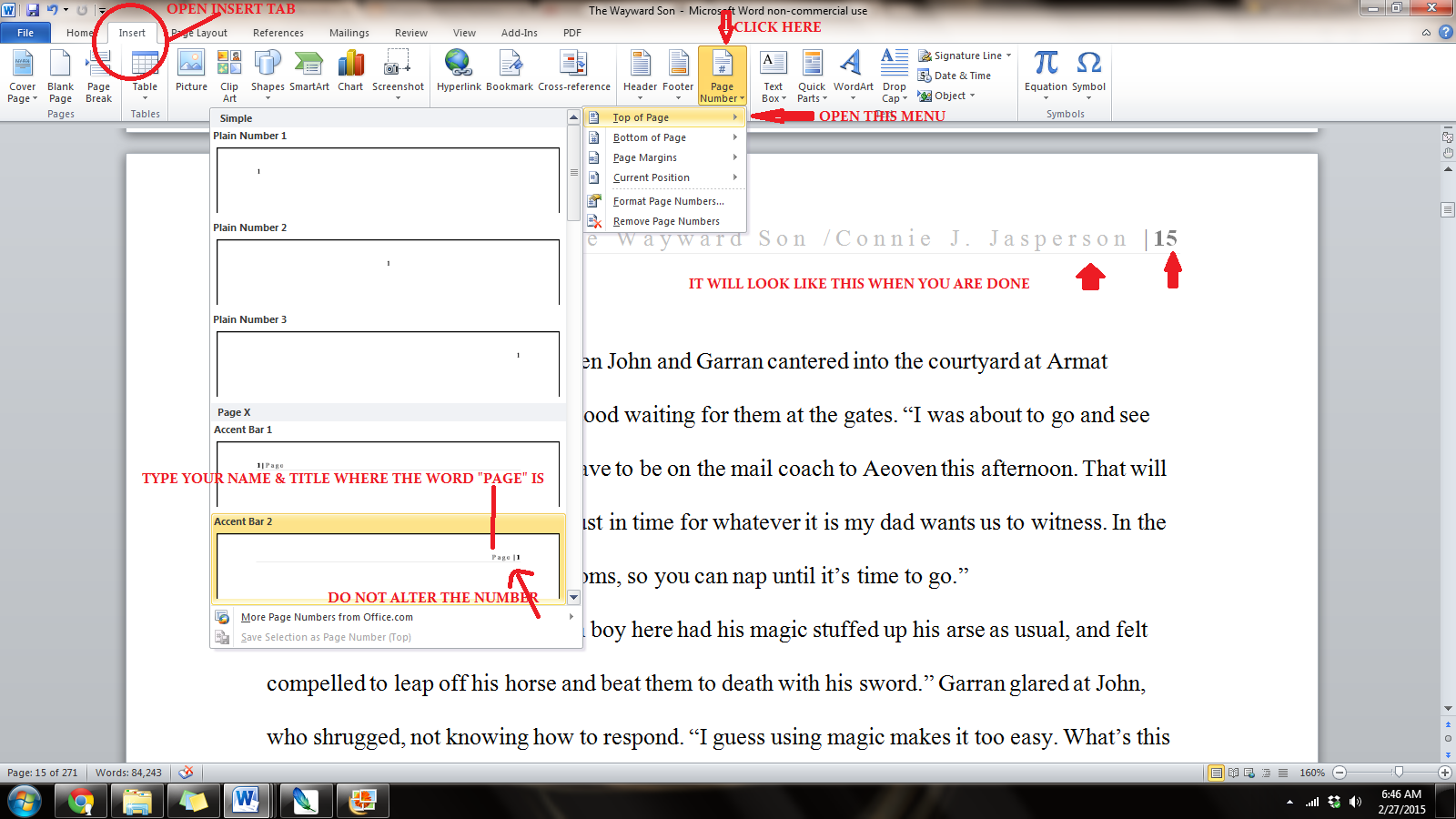
Now we need to make the “Header.”  This is the heading at the top of each page of a word-processed or faxed document, usually automatically inserted and, in this case, consisting of the title of the book and your name. Publishers and editors want this because when they receive a print copy, each page is clearly marked with your name and/or the title of the book as well as the page number. Remember, they want it UNBOUND. Accidents happen: if the ms accidentally falls off a desk, it can easily be reassembled and the editor will always know that brilliant work was written by you.

We insert this by opening the “insert” tab, and clicking on “page number.”  This opens up a new menu. We add the page numbers using this menu:

This is how it looks:header with page numbers

Now your manuscript is submission ready, and is

  1. Aligned left
  2. 1 in. margins
  3. Double-spaced
  4. Has indented paragraphs
  5. Header contains title and author name
  6. First page contains the author’s mailing address and contact information in upper left hand corner

This may seem like overkill to you, but I assure you, if you are really serious about submitting your work to agents, editors, or publishers, it must be in as professional a format as is possible.

I hope these instruction will help you find the way to format properly in other word-processing programs. MS WORD is most commonly used, and is the one I use, because it is easy and has all the tools I need. Just don’t get too fancy with formatting your novel before you submit it  because no matter how pretty you make that manuscript, if it doesn’t follow the submission guidelines for the place you are submitting it, you have wasted your time.

2 Comments

Filed under blogging, Books, Fantasy, Humor, Literature, Publishing, Self Publishing, WordPress, writer, writing

Comfort Books, the main course: The Wheel of Time, by Robert Jordan and Brandon Sanderson

The Eye Of The WorldFor the main course of this three course meal I’ve chosen a hearty 14-book trilogy. I warned you that many of the books I love and turn to when I need a good book are NOT comforting in any way, and for many people the incredibly long, epic series, the Wheel of Time, definitely falls into the UNcomfortable category. This is for a variety of reasons.

The Eye of the World was the opening volley in what would ultimately become one of the most controversial series in epic fantasy. Written by Robert Jordan and first published in 1990, this series of books has polarized the most dedicated fans of true fantasy into two groups: the lovers and the haters.  No reader walks away from this series unscathed.

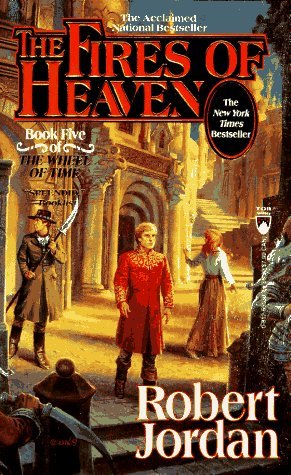
WoT05_TheFiresOfHeavenThe story begins in the exceedingly rural village of  Emond’s Field. They are so rural that they have no concept that they are still considered to be a part of a larger country. The village is suddenly attacked by Trollocs (the antagonist’s soldiers) and a Myrddraal (the undead-like officer commanding the Trollocs).  These creatures are intent on capturing the three protagonists, Rand al’Thor, Matrim (Mat) Cauthon, Perrin Aybara, although why they are being hunted is not revealed at first. To save their village from further attacks, Rand, Mat, Perrin, and Egwene (Rand’s first love interest) flee the village, accompanied by the Aes Sedai Moiraine Damodred, her Warder, Al’Lan Mandragoran, and gleeman, Thom Merrilin.They are later joined by Nynaeve al’Meara, who is their village’s medicine woman.

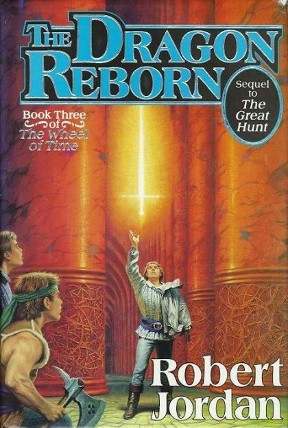
WoT03_TheDragonRebornThis huge range of characters and the many, many threads that weave an incredibly tangled plot are what polarizes the reading community over this series of books. Originally intended to be a trilogy, it eventually expanded to encompass fourteen LARGE, long books.

Robert Jordan passed away in 2007 while working on the final book, leaving the series uncompleted, but he left the rough draft and enough notes behind that Brandon Sanderson was able to finish the series, eventually breaking that final volume into three very large  books, and bringing the story to a satisfying conclusion.

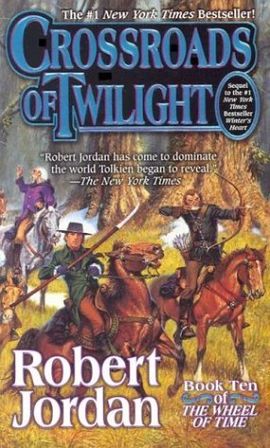
WoT10_CrossroadsOfTwilightSo what is the basis for the plot’s tension, what conflict could possibly draw the reader in and keep them reading for such a long, drawn out process? It’s Robert Jordan, folks–the eternal quest for power, and dominance through violence, religion and politics is the core of this tale. According to Wikipedia, the Fount of All Knowledge: The series draws on numerous elements of both European and Asian mythology, most notably the cyclical nature of time found in Buddhism and Hinduism, the metaphysical concepts of balance and duality, and a respect for nature found in Daoism. Additionally, its creation story has similarities to Christianity’s “Creator” (Light) and Shai’tan, “The Dark One” (Shaytan is an Arabic word which in religious contexts is used as a name for the Devil). It was also partly inspired by Leo Tolstoy’s War and Peace (1869).”

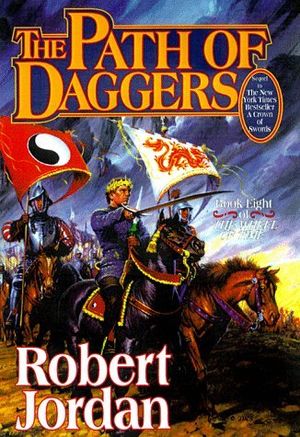
300px-WoT08_ThePathOfDaggersI loved the first three books in this series. I both enjoyed and endured the next three, hoping Robert Jordan would get to the point and finish the damned series. I had become a little irritated with book eight, Path of Daggers, but by the time Winter’s Heart came out, I was resigned to never seeing an end to it, and was back to simply enjoying each strange plot twist and new random thread for what it was–just a great tale.

When Robert Jordan died, I was thrilled that Brandon Sanderson was the author tapped to finally bring that unwieldy mess together. There were so many different stories within the greater story that the task of winding up each thread must have been incredibly daunting, and he did it magnificently.

The reason so many devoted fans abandoned the series somewhere around book six , Lord of Chaos, was that Rand al’Thor’s story ( and Mat’s and Perrin’s) stalled, and Jordan was sent way off track by the stories of Egwene, Nynaeve, and Elaine Trakand. In fantasy, there is a large contingent of readers who want instant gratification are not going to wait around for eight more books. They proved it by jumping ship and trash-talking his work.

TheGatheringStormUSCoverThroughout the series, the quality of the writing never faltered. The depth of story and the intensely alive characters whose stories graced those pages never failed to intrigue me. The fact that it felt like the conflict would never be resolved was, at times, upsetting to me as a reader, and is a lesson authors should take to heart with their own work.

To write a story that is so compelling that readers become so violently polarized over it is quite an accomplishment.  I see this happening with George R.R. Martin‘s fans right now. Although I adore him as a person, I’ve never cared much for his style of writing, as he jumps around too much even for me. Have patience, people! It looks like George has a large story there too, so it may take him a while.

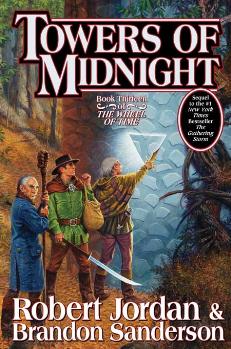
Towers_of_Midnight_hardcoverFor Brandon Sanderson to step into the wasps’ nest of controversy that was the Wheel of Time and complete the series with such grace and finesse is nothing short of amazing, and I am glad I stuck with it to the end. Brandon Sanderson has become one of my favorite authors because of what he did to wind up this epic series.

In the end, the final resolution was satisfying, and was well worth the journey.  I have gotten rid of most of my hard copies, and am down to only one room’s worth of hardbound books at our house. I don’t buy too many hard copies of books, being a fan of the Kindle, and  but I did make an exception for this book.   For me, some books need to be in hard copy form and the Wheel of Time Series is one of them, as are the Harry Potter books. There was a large contingent of people who were upset that the epub edition wasn’t released until 4 months after the paperbook, but this was a choice made by Robert Jordan’s widow and her publisher, TOR. It was a strange one in my opinion, but it was their choice.

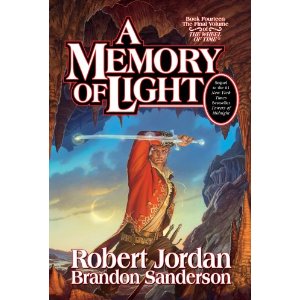
A_Memory_of_Light_coverAmazon’s early reviews of the later books in this series were rife with trolls and naysayers who couldn’t wait to emerge from the woodwork and have their say. Apparently very few of these people purchased the book, much less read it. That is the price of success and these days it’s almost an honor to have so many haters just spoiling to knock you down. But their strident caws and self-important rants should have no effect on the true fans of WoT. In my humble opinion these works are masterpieces and Brandon Sanderson’s three books are a triumphant finish to the series.

I love Brandon Sanderson’s handling of this series finale, and feel I more than got my money’s worth from this series of book, as I will definitely read it again and again–in my opinion it’s that good. If you love this series, you will love the way it ends!

The original cover artist for these amazing books was none other than the late Darrell K. Sweet, who was just as amazing a fantasy artist as is Michael Whelan. The newer covers are nice, but for me they lack the power of Sweet’s brilliant paintings.

And as we all know, I buy most books for their covers, even epubs, and then fall in love with the tale.

Comments Off on Comfort Books, the main course: The Wheel of Time, by Robert Jordan and Brandon Sanderson

Filed under Adventure, Battles, blogging, Books, Dragons, Fantasy, Humor, Literature, Politics, Publishing, Self Publishing, WordPress, writer, writing

Comfort books, second course: Dragonriders of Pern, by Anne McCaffrey

Michael-Whelan-Dragons-dragons-4284189-1204-827Today I am serving up the second course of our three course meal of books that are comfort food for my soul. Anne McCaffrey’s Dragonriders of Pern series directly motivated me to become a writerNo other series of books has had a more profound effect on me as both a reader, and as an author.

The artwork gracing many of her later covers was done by the same brilliant artist, Michael Whelan, whose work graces many of Tad Williams’ books.

I have read the entire series every year since I snuck my father’s Science Fiction Book Club copy of Dragonflight in the summer of 1969. Since that time I have worn out 6 hardbound copies of The Dragonriders of Pern, a collection comprised of the first three books based on the fantastic Weyrs of Pern, and the people and their dragons who live within them.   I can’t tell you how many fellow Pern fanatics tell me the same thing, “When I think of dragons, I think of Pern.”

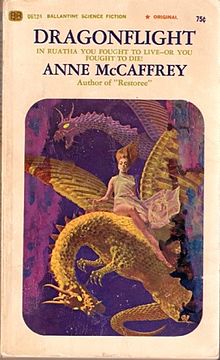
AnneMcCaffrey_DragonflightAnne McCaffrey’s 1968 novel, Dragonflight was the first book in the original trilogy, and is the book that launched an empire that now encompasses at least 23 novels and several anthologies of short stories that are just as compelling as the novels.  In 2003 McCaffrey began writing with her son, Todd McCaffrey and in 2005 Todd took over the series, and has acquitted himself well. I am still buying and enjoying the new entries in the series!

Dragonflight began life as a short story for Analog, Weyr Search which appeared in the October 1967 issue, followed by the two-part Dragonrider, with the first part appearing in the December 1967 issue. In 1969 the two award winning short stories were combined into the book Dragon Flight, and was published by Ballantine books.

Anne McCaffrey was the grand mistress of worldbuilding. Aspiring scifi and fantasy authors should read her work for the small clues and hints that are sprinkled within her work , the little brushstrokes that create the larger picture. She gave us a real planet, in Pern–and our minds built around her framework, believing the world of Pern to be as real as our own earth.

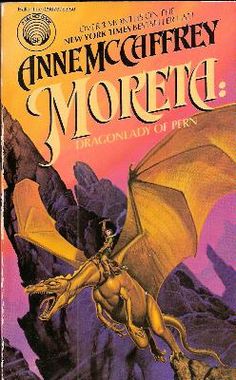
moretaPern is a planet inhabited by humans. In the forward of the book, we find that he original colonists were reduced to a low level of technology by periodic onslaughts of deadly Thread raining down from the sky. By taming and bonding to the indigenous flying, fire-breathing dragonettes called Fire-Lizards and then making genetic alterations to make them larger and telepathic, the colonists gained the upper hand. The dragons and their riders destroyed the Thread in the skies over Pern before it was able to burrow into the land and breed. The Threads would fall for fifty or so years, and then there would be an interval of 200 to 250 years.  However, an unusually long interval between attacks, 4 centuries in duration, has caused the general population to gradually dismiss the threat and withdraw support from the Weyrs where dragons are bred and trained. At the time of this novel, only one weyr, Benden Weyr, remains (the other five having mysteriously disappeared at the same time in the last quiet interval).  The weyr is now living a precarious hand-to-mouth existence, due to a series of ever weaker leaders over the previous fifty or so turns (years).

dragon flight 2The story begins with Lessa, the true daughter of the dead Lord Holder and rightful heir of Ruatha Hold.  She was ten years old the day her family’s hold was overrun by Fax, Lord of the Seven Holds.  Out of everyone in her family, she is the only full-blooded Ruathan left alive, and that was because she hid in the watch-wher’s kennel during the massacre.  Now she is a drudge, working in the kitchens or her family’s rightful home.  However, Lessa is gifted with the ability to use her mind to make others do her will; grass grows where it should not, and nothing grows where it should.  Every day of her life since the day Fax massacred her family she has used that power in secret to undermine him.  Now the mighty Fax only visits Ruatha when he is forced to, and has left the running of the hold to a series of ever more incompetent warders. Things have become quite grim there under Lessa’s vengeful care.

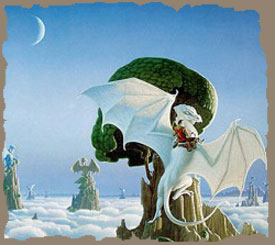
whitedragonThe action is vivid, the people and the dragons are clear and distinct as characters.  The social and political climate on Pern is clearly defined.  Each of the characters is fully formed, and the reader is completely immersed into their world. The way the dragons teleport, and their telepathic conversations with their riders makes for an ingenious twist in this seductive tale. And speaking of seductive, what I love the most about the entire series is the frank sensuality that never disappoints me.  Anne McCaffrey never drops into long graphic descriptions of the sex that is frequently part of her stories, and yet she manages to convey the deeply empathic and intensely sensual connection that the riders and their dragons share.

To the right here is the colorful book cover as was published in 1970 by Corgi.  I never liked this cover nearly so much as the Michael Whelan covers, though I did have several copies of this particular book.

This book changed my life as a reader of fantasy and science fiction.  I found myself incessantly combing the book stores for new stories by Anne McCaffrey, and eagerly read anything that even remotely promised to be as good as this book.  I read many great books in the process; some were just as groundbreaking, and some were not so good, but even after all these years, this series of books stands as the benchmark beside which I measure a truly great fantasy.

white dragon 2The Dragonriders of Pern series has captivated generations of fans. It was the first adult series of books my youngest daughter ever read once she left the Beverly Cleary books behind, having simply snuck them off my shelf (I wonder where she got that notion). Even though I have read the entire series every year since 1983, I find myself fully involved in the story.  Every year new books are to add to the series, and now if I were to sit down and begin reading the series it would take me two full weeks of nothing but reading to get through it, even as fast as I read.

5 Comments

Filed under Adventure, Battles, Books, Dragons, Fantasy, Humor, Literature, mythology, Publishing, Romance, Self Publishing, writer, writing

Friday Interview: Carlie M.A. Cullen

Photo of CarlieAs I promised a while back, today Carlie M A Cullen, author of The Heart Search trilogy, has consented to answer a few questions for us. She is a lovely, talented woman who has been one of my editors for several years now!

CC: Hi Connie! It’s lovely to be here. Thank you for the tea.

CJJ: Hello, and you’re welcome! Tell us a little of early life and how you began writing:

CC: I grew up as an only child. My parents worked full time and both had second jobs. As a result I was left to create my own entertainment. I loved the tales of Hans Christian Andersen and started to write my own fairy tales. I found myself disappearing into the stories I created and it made me feel less lonely. From there, I progresses to writing longer short stories and poems. It’s something I’ve continued to do into adulthood.

CJJ: As you know, I love this series. Tell us about your most recent book.

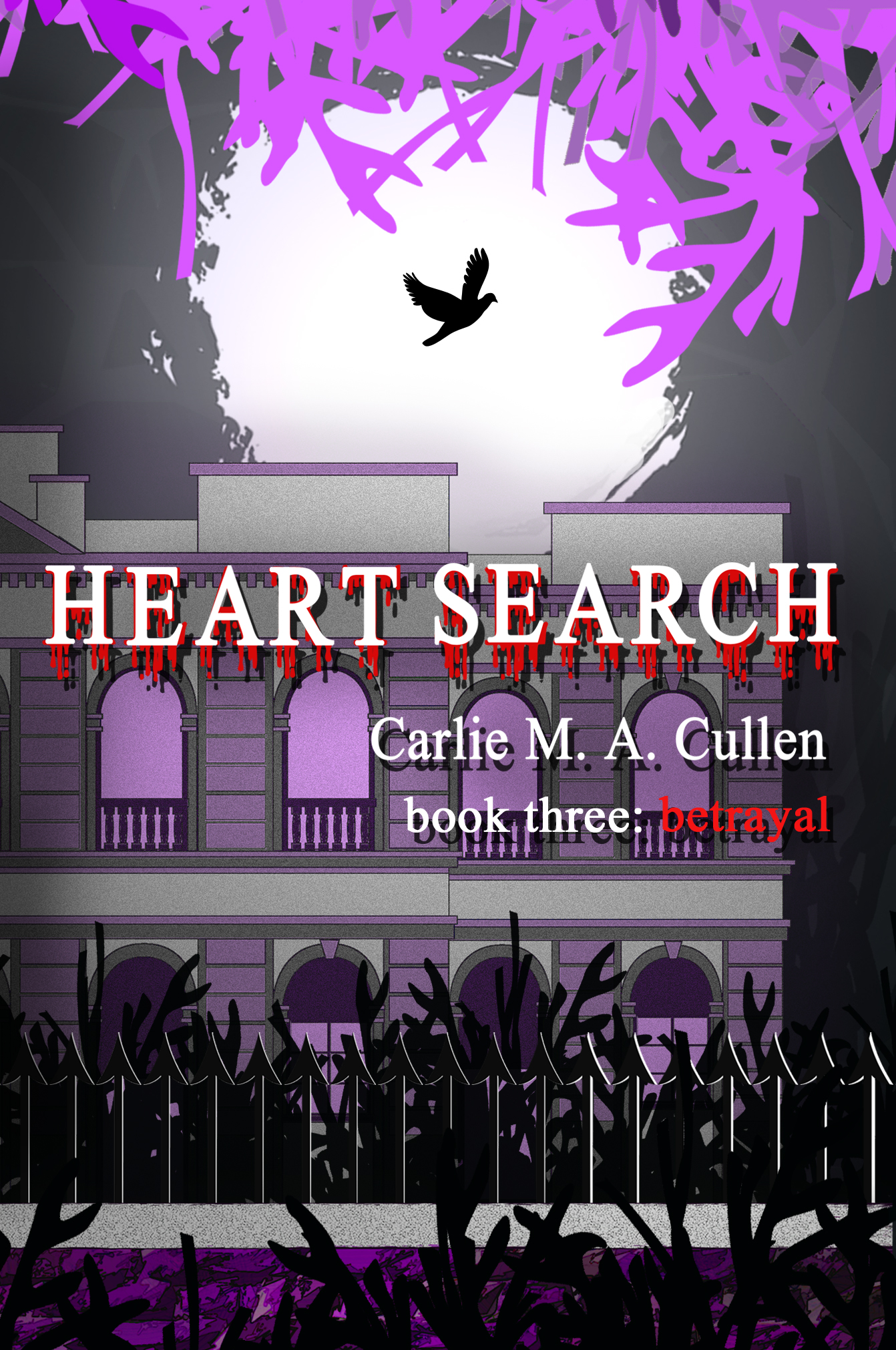
CC: I hope you’re not after any spoilers, Connie! [laughs] Heart Search: Betrayal is the final book in the trilogy and takes Remy and Joshua’s story to its natural conclusion. However, it’s not all hearts and flowers – far from it. There is a traitor who is passing copious amounts of information to someone who has a massive grudge against the coven, and who they are in league with. But there are four possible suspects. Which one is it and can the coven discover their identity before it’s too late? There are many twists and turns along the way, some good and some terrible. Certain characters really shine and there’s the discovery of new talents along the way. Unfortunately there are casualties, some of which may shock my readers.

CJJ: The story line in Betrayal is quite divergent from the previous two books. How did you come to write this novel?

CC: When I reached the halfway point in the first book, Heart Search: Lost, I knew there was too much of a story for just one. It was at that point I realized Heart Search would turn into a trilogy. I couldn’t leave the world I’d created and made the decision to complete the trilogy before moving onto other stories I had in my head.

CJJ: I always have that problem too. I think some stories are just larger than we originally thought. So, do you have a specific ‘Creative Process’ that you follow, such as outlining or do you ‘wing it’?

CC: It depends on what I’m writing really. With Heart Search, I had the first twelve chapters meticulously outlined, but around chapter five my characters decided they were going to take over and make me tell their story their way. I threw away the outline and have ‘winged it’ ever since. As I wrote this based on current day, it was easy to do.

With my next book, I’ve had to do some extensive world building and creating magic systems and the like before I began writing. However, as far as the story goes, again I’m winging it and seeing where my muse and characters takes me.

CJJ: Well your muse is taking you to some wonderful places! In your opinion, how does your work differ from others of its genre?

CC: I can only really talk about the Heart Search trilogy here. In the first book you have two POV’s: Remy in first person and Joshua in third person. Their stories run parallel to each other and every now and then they softly bump before going off again. I believe this is what makes it unique. In book two, I brought in extra character voices and gave them their own POV’s in third person. The final book takes even more POV’s into the mix, always in third person, whereas Remy has maintained a first person POV throughout.  I also believe (going by the reviews I’ve read) the storyline itself is completely different to what others have read before. Put all this together and that’s what I think makes my work so different from others in its genre.

CJJ: So now we get down to the question that I always wonder: Why do you write what you do?

CC: As I said earlier in the interview, I loved the Hans Christian Andersen fairy tales and that was a huge influence in my writing. Growing up I tried reading different genres, but I always came back to fantasy. There’s something so intriguing about the characters you can create, the worlds you can build, and adding to that those mystical creatures we all know so well: fairies, goblins, dragons, vampires, et al. It seemed only natural for me to write in this genre. It’s where I’m in my comfort zone.

CJJ: I know why I chose the indie route for my work, but I’m curious as to why you’ve chosen this path.

CC: Originally, I wanted the dream of getting an agent and a decent publishing deal, but I was new to the industry and quite naïve. After a few rejections, I decided that after all my hard work on the book it would be nice to give people a chance to read it. In addition, I had people I knew asking me for it. It was about that time I joined Myrddin Publishing. Everyone was so supportive from day one so I published it through them and haven’t looked back since.

Now I know more about the industry, I’m really glad I’ve taken this path. I have so much more control over where my books are sold, what sort of cover I want, what price to charge, and how much I want in royalties that I think I’d now be too stifled by a major publisher.

CJJ: I agree! Being a part of the Myrddin Group has been a blessing to me too, considering the assistance we give each other in every aspect of bringing a book to market. And the fact that you really are in control of your own work and profits makes this an adventure!  So what advice would you offer an author trying to decide whether to go indie or take the traditional path?

CC: This is a tricky one to answer because what’s right for one person isn’t necessarily right for another. I think the best thing they could do is talk to other authors, some who are indie and some who have gone the traditional route. Ask them about the pros and cons of both and then they can make an informed decision that’s best for them.

I wish I’d done that in the beginning as I was so green it was ridiculous, but I was one of the lucky ones who met some wonderful indie authors who helped me along the way.

But going back to the question, do your homework and don’t make any snap decisions or judgments that you may later regret.

CJJ: Very good advice! Thank you for taking the time from your busy schedule to visit with me, and for sharing your wisdom!

Alice in Wonderland Tea SetCC: Thanks so much for inviting me, Connie. I’ve really enjoyed chatting with you. Now, is there any more tea brewing?

CJJ: Yes, actually. This is a lovely citrus Lady Grey, I hope you like it! This tea set is my Alice in Wonderland set, which my children gave me last year!

>>>—<<<

Betrayal front coverCarlie M A Cullen was born in London. She grew up in Hertfordshire where she first discovered her love of books and writing.

She has always written in some form or another, but started to write novels in 2011. Her first book was published by Myrddin Publishing in 2012. She writes in the Fantasy/Paranormal Romance genres for New Adult and Adult.

Carlie is also a principal editor for Eagle Eye Editors.

Carlie also holds the reins of a writing group called Writebulb. They have published four anthologies so far, two for adults and two for children, all of which raise money for a local hospice.

Carlie currently lives in Essex, UK with her daughter.

>>>—<<<

Links for Carlie M A Cullen

Website: http://carliemacullen.com

Twitter: @carlie2011c

Facebook: http://www.facebook.com/CarlieMACullen

Linkedin: https://www.linkedin.com/profile/view?id=240655941&trk=nav_responsive_tab_profile

Amazon: http://www.amazon.co.uk/-/e/B009MWVL5A

About.me: http://about.me/CarlieCullen

Wattpad: http://www.wattpad.com/user/CarlieCullen

Goodreads: https://www.goodreads.com/author/show/6550466.Carlie_M_A_Cullen

BOOKS:

Heart Search, book one: Lost: http://smarturl.it/HeartSearch-Lost

Heart Search, book two: Found: http://smarturl.it/HeartSearch-Found

1 Comment

Filed under Blogger, blogging, Books, Fantasy, Humor, Literature, mythology, Publishing, Self Publishing, vampires, writer, writing

Comfort books, a three-course meal: 1st course, Memory, Sorrow, and Thorn

Dragonbone_ChairI’ve been reading a lot lately. I know, you’re surprised, right? Mostly I’ve been revisiting my old favorites. I have a group of what I call “comfort books.”  That is not to say these books are comfortable, because they’re quite the opposite: challenging, involving,  and at times a little horrifying. But they are books that I can go back to again and again and never be disappointed in either the writing or the tale. I always find some new thing, along with the themes and characters that enchanted me the first time I read them.

These are the books that inspired me to write, not because I thought I could write better, but because these authors were unable to keep up with my reading demand. So, in the lull between “real books” I began writing the stories I wanted to read. Today begins  the first course of this three-course meal. Two more will follow!

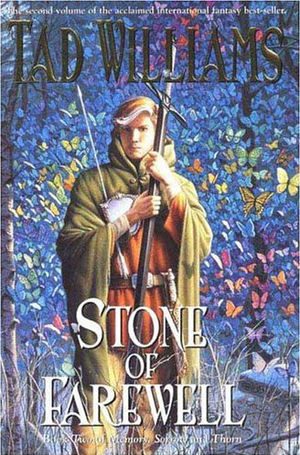
First up is Tad Williams’ epic masterpiece, Memory, Sorrow, and Thorn. This tale was so large he couldn’t fit it all into one book. Each book is quite large, and believe me, there is no fluff in any of them.

Stone_of_FarewellIn this gripping tale, Williams takes a traditional tale of a kitchen-boy turned hero, and turns it sideways, giving it depth and power. He puts his protagonist, who begins as Simon Mooncalf, though hell,forging strength of character and courage in a boy who always dreamed of adventure. Simon the dreamer is real, human; a man with flaws as well as strengths. As a boy he is afraid, but he is courageous when it counts. And as a warrior, Simon Snowlock is strong, and not always forgiving. He is a multilayered hero, as is the story in which he is set.

The quest for the swords of power, and the larger quest to save Osten Ard from the grip of Ineluki, the Storm King, are enclosed within the real dramas of human (and not-so-human) affairs.

What made this  series of books strike such a chord within me in the first place, was the way the world of Osten Ard reflects the history and folklore of our world. Several characters’ elements and experiences mirror the legends and mythology of Great Britain and other European cultures. I felt I knew these societies, and yet they were seen through a fractured mirror, similar, yet so different.

At the outset, the Erkynlanders are are the dominant society, and are ruled by King John Presbyter, also known as Prester John. He united them, but they’re still slightly clan-based and resemble the early medieval English of around the fifth to seventh centuries, with names that are  Saxon-ish and Biblical. It is a castle-based, feudal society right out of the dark ages. They have a religion that is similar to Christianity, as if they are a parallel reality.

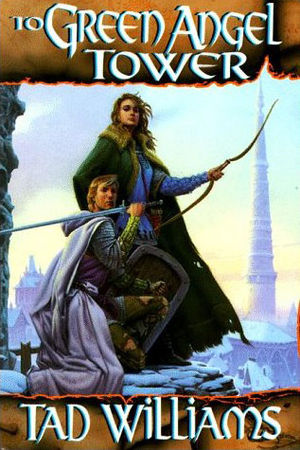
To_Green_Angel_TowerPrester John is the man who united Osten Ard, and carved their society, but he is dying. Like the great Plantagenet kings of our history, he has two strong sons who have a deep-rooted quarrel, and this sets up the conflict that evolves and encompasses an entire world.

After his death, the dark secrets of Prester John’s own checkered history drive the plot, sweeping Simon up in events which he has no control over.  His growth over the course of this series makes a gripping, compelling story, as does the parallel story of Miriamele, Prester John’s granddaughter.

Green_Angel_Tower_P1The other people of Osten Ard who have recognizable real-world parallels in their names and cultures, and who have strong, absorbing story-lines are:

Binabik—a Qanuc (based on Inuit, or Eskimo)

Jiriki—Sithi (distinct from a branch of their culture, the Norns, who are the root antagonists.  Based on Asian, Japanese) Ineluki, the Storm King is Norn.

Maegwin—Hernystiri (Celtic, perhaps Irish or Welsh)

Sir Camaris—Nabbanai: I just fell in love with this tragic man. These people felt reminiscent of Renaissance Italy, quite Roman

Tiamak—Wrannamen: Indigenous tribal  people who live close to the earth,

Sludig—Rimmersmen: Norse and early Germanic , quite Viking

Also included is another culture, the Thrithings: Horse nomads, reminiscent of the Mongols.

This is not a series you can read in a day or even a week. It is easy to get completely caught up in this tale, to the point that you forget to eat, and don’t hear when the dog wants out. I originally bought The Dragonbone Chair for the artwork on the cover. It was created by the brilliant fantasy artist, Michael Whelan. All the covers in this series are incomparable, and to my great joy, so was the story within.

TadWilliams200And the best part is: Tad is writing another trilogy based in Osten Ard, set thirty years later. Quote from his blogpost of April 3, 2014 : “I guess the cat has been debagged. Several of you have seen and shared the news that, yes, I am returning to Osten Ard for a series of books called (collectively) “The Last King of Osten Ard”. It will feature many of the same characters a generation later (and many new ones as well). The book titles will be (as of now):

The Witchwood Crown
Empire of Grass
The Navigator’s Children

This is assuming I don’t do my normal try-to-squeeze-two-books-into-the-last-volume trick.”

I don’t care how you do it Tad. I am just glad you are still young, and still writing amazing books in a kijillion settings. I am waiting patiently for the emergence of this series. Do your crazy thing, madman! Take your time and do it right! I will have it on pre-order the minute it becomes available, and when it arrives on my doorstep I will dance all the way to my cozy sofa, where I will sit and read until I am forced to set the book down in order to feed the hubby. Then I will continue reading until the next meal must be served.

2 Comments

Filed under Adventure, Battles, blogging, Books, Dragons, Fairies, Fantasy, Humor, Literature, Publishing, Romance, Self Publishing, writer, writing

Hyphens, style guides, and writing conventions

adult-footie-pjsYou need a good style guide. No, I am not suggesting that you need help with your wardrobe–those footie pajamas are awesome, and are the perfect uniform for the dedicated author. What I am suggesting is that you develop consistency in your writing, and there are guides to help you with that.

English is a completely wonky language, even for those of us who grow up speaking some form of it. My dialect is that of the western United States, specifically the Pacific Northwest, near the Canadian border. As in every other part of the world, we speak informally in our homes and with friends, but in writing, we should conform to certain standardized rules, or those who speak OTHER versions of English will not be able to follow us, despite the many similarities in our dialects.

Kathleen Cali, in an article at Learn NC, says: “Conventions are the surface features of writing — mechanics, usage, and sentence formation. Conventions are a courtesy to the reader, making writing easier to read by putting it in a form that the reader expects and is comfortable with.”

Since I am a US citizen, I use American writing conventions. In the United States, many non-journalistic professional writers use The Chicago Manual of Style, and this is the manual I use.

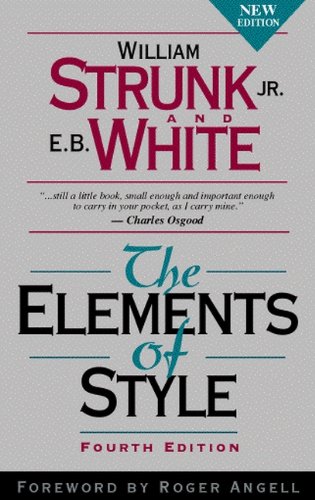
elements of styleA classic style guide for new authors and the general public is Strunk and White’The Elements of Style. This is a popular reference among writers just beginning in the craft. I sometimes use this guide, but as I have advanced as an editor, I find myself referring to the more in-depth Chicago Manual of Style. However, either one is excellent for the US author, and for any Europeans editing for a US author in this era of the internet and the global market for editing services.

Any author or editor who tries to tell you that one particular style guide is “the only” style guide is simply voicing an opinion, and if they are obnoxious and defensive about it, ignore them. Each style guide is an excellent reference tool, and each one plays to different requirements. But all of them are for the benefit of the reader.

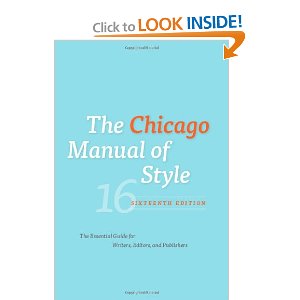
chicago manual of styleThe Chicago Manual of Style is one of the oldest and most comprehensive style guides available, and for me in my role as an editor, it’s an indispensable tool because it contains information that I can’t find anywhere else. While I could easily access it all via the online version, I do like having my large book at my fingertips.

As a writer I rely on a style guide because  it often feels  like every rule has an exception, and knowing what those are makes huge difference in a manuscript’s consistency and readability.

For example, sometimes we don’t know if we should hyphenate or not. Or, we are unsure when to capitalize a direction or an honorific. When this occurs, our work becomes uneven and hard to read, because it’s rife with  inconsistency, hyphenating words in one place but not another. This happens because not every set of words needs to be hyphenated, and how do you know which to decorate with that dear little dash?

There are answers to these questions, in the handy-dandy style guides we have available to us.

So how DO we employ those little morsels of madness that work their way into every corner of my manuscripts? I love them!

Unfortunately, hyphens are not toys. As I discovered when creating my world of Neveyah for the Tower of Bones series, they are the gate-way drug to writer’s hell. Take my advice and do not use a hyphen unless it serves a purpose. If a compound adjective cannot be misread or its meaning is established, a hyphen is not necessary.

  • An English-speaking country
  • A time-saving device
  • A thirty-floor building
Some compounds are created on the spot to fulfill a specific need (on-the-spot creations). Permanent compounds start out as improvised compounds, but become so widely accepted that they are included in the dictionary as permanent compounds. Examples of temporary compounds that have made the transition to permanent compounds are words like  know-it-all, heart-stopping, free-for-all, and down-at-the-heels.
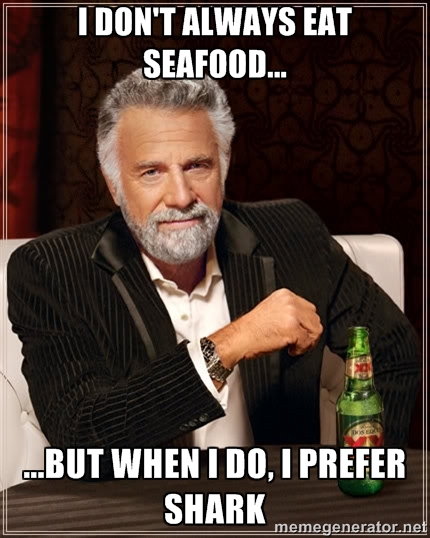
shark memeContext determines whether or not to hyphenate.  Ask yourself, “How will the words be interpreted by the reader if I don’t hyphenate?” Wikipedia offers the following examples:
  • Man-eating shark (as opposed to man eating shark, which could be interpreted as a man eating the meat of a shark)
  • Wild-goose chase (as opposed to wild goose chase, which could be interpreted as a goose chase that is wild)
  • Long-term contract (as opposed to long term contract, which could be interpreted as a long contract about a term)
  • Zero-liability protection (as opposed to zero liability protection, which could be interpreted as there being no liability protection).

And finally, especially if you are writing in a fantasy genre, as you are writing your tale down and creating your world, also make a style sheet that pertains to your manuscript noting what words must be capitalized and what the proper spellings for invented places are.

Refer back to it frequently, updating it as needed. I learned this the hard way. Whether it is handwritten or a WORD document, a simple directory of compound words and phrases that are unique to the world you have created will be as invaluable to you as your copy of The Elements of Style.

4 Comments

Filed under Adventure, Blogger, blogging, Books, Fantasy, Humor, Literature, Publishing, Self Publishing, WordPress, writer, writing

Weak Prose vs Passive Voice

Book- onstruction-sign copyI read voraciously, and I read in many genres. I love books written with passion, but I don’t always love passionate writing. By that I mean—be crafty with how you deliver your descriptions, because I don’t want to be told what to think.

In various writing forums I regularly see authors complaining that Beta Readers don’t understand their ‘voice.’

Several things could cause that disconnect:

  1. The person who agreed to Beta Read for you does not read your genre, and genuinely does not like the kind of books you write. This happens all the time, so find a reader who enjoys romantic, urban fantasy, if that is what you write. A woman who reads hard sci-fi likely won’t love a fantasy-romance involving elves and vampires.
  2. Also, perhaps the person reading as a Beta Reader does not understand that Beta Reading is NOT picking a manuscript to shreds, it is giving general opinions on the manuscript as a whole. This is why I am selective as to who I share a manuscript with—the reader must be familiar with and read my genre, and understand the rules for Beta Reading, as set down by Orson Scott Card.
  3. We also must consider the possibility that we are mistaking lazy writing habits for voice. We love our glorious, elegant prose, but our reader was not as impressed. I hate it when that happens!

I had a conversation with an author who said, “My editor wants to change my voice. She won’t let me use ‘there was,’ but I don’t know how to tell my story without using it.”

She was not trying to change his voice, she was trying to encourage him to be creative and to write strong sentences.  Weak prose tells the story, holds the reader away from the immediacy of the experience.

Passive voice also tells a story, but when done well, it can be beautiful and immersive.

What is passive voice? I absolutely adore this paragraph from the American Bar Association website article “Writing Clear and Effective Legal Prose” by George D. Gopen:

“Lawyers cannot write sophisticated, powerful prose without a skillful use of the passive voice. I could offer you a theological proof: God would not have created the passive had it no use. Or perhaps you might prefer the Darwinian argument: The passive could not have survived unless it was fittest for something. But I prefer this circular reasoning: The passive is better than the active in all cases in which the passive does a better job than the active. It only remains to learn what those cases are.”

Notice how he meanders through that thought, but eventually arrives at the point? He never devolves into weak prose. This is also the way many new authors approach writing genre fiction, and is where they run afoul of their readers. Readers of genre fiction expect lean, action-oriented prose driving each scene toward a final conclusion.

So now we come to another point—what is GENRE FICTION? Modern genre fiction avoids passive voice, opting for active, pared-down sentences that have one purpose—resolving a conflict. Literary fiction often uses passive voice, but knows how to apply it correctly. Literary fiction takes the reader on a journey, often where they witness events as seen through other eyes. Both styles of writing have to be carefully crafted, and both must immerse the reader in the experience. Stephen Petite, in his article, “Literary Fiction vs Genre Fiction” says:

“An argument can be made that there are two types of fiction when it comes to novels: Genre Fiction and Literary Fiction. The former includes many subcategories such as Mystery/Thriller, Horror, Romance, Western, Fantasy, Science Fiction, etc. The latter is more difficult to classify or break apart into subcategories. To put it simply, Literary Fiction is anything that does not fit into a genre.”

The fact that literary fiction is anything that does not fit into a genre offers authors the option of writing in a more leisurely style, if that is their desire. However—do not mistake bad craftsmanship for literary style.

I read genre fiction for entertainment, for a riveting story, an escape from reality.

Literary fiction is not about escaping from reality. It seeks to better understand the world and delivers real emotional responses, often though situations that are rooted in fantasy. I often read and enjoy literary fiction.

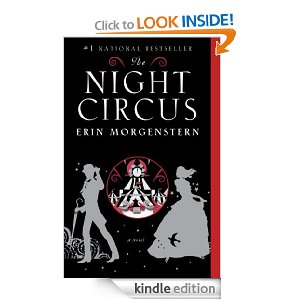
the night circus by erin morgensternDo you see the crossover there? Some fantasy qualifies as literary fiction because of the way in which the story is delivered. Erin Morgenstern’s beautiful fantasy, The Night Circus is a perfect example of this cross-over. Genre fantasy purists decry her lush, beautiful prose, and lack of direct conflict between the two magicians, while readers of literary fiction enjoy her lush, beautiful prose, and the deeper story that underlies the politely waged war between two magicians.

Know who your readers are. Select your beta readers from people who read in the genre you think you are writing for. It’s likely you are writing for yourself, so identify the sort of books you gravitate to, and choose your readers accordingly. If you’ve chosen the right beta readers, you will also know what your chosen market will be.

10 Comments

Filed under Books, Fantasy, Humor, Literature, Publishing, Self Publishing, writer, writing