Category Archives: Publishing

#amwriting: publishing overview, Indie vs. Traditional

Who are youThe publishing industry is in a state of growth. According to the annual report of the Association of American Publishers, published July 11, 2016, the  U.S. publishing industry’s annual survey revealed earnings of nearly $28 billion in 2015. The market showed an increased return to print purchases, and a significant growth in audiobook sales while the growth of eBooks sales lagged compared to previous years.

“The area of largest growth for the trade category was Adult Books, which grew by 6.0% from $9.87 billion in 2014 to $10.47 billion in revenue in 2015. For the second consecutive year, Adult non-fiction books, which includes adult coloring books, was the category that sold the most units and provided the most revenue in the trade category. Within the Adult Books category, the fastest growing formats in terms of units sold were downloaded audio (up 45.9%), hardback (up 15.1%) and paperback (up 9.1%).” Ebooks still comprised 17.3% of the market.

In this publishing world, what share of the market is claimed by Indie book sales? In October 2016 Author Earnings reported that overall, Indie sales were down. In my view, this is to be expected, because eBook sales were down, and most Indie sales are in eBook format. It is the availability factor—Indies have trouble getting their work into places like Walmart and Target, which are the big booksellers in America, right behind Amazon.

Author Earnings reported:

Amazon’s 2016 online print book sales are nearly 18% higher than they were in 2015.

When we integrate the area under the two curves, we find that:

Amazon sold over 255 million print books in the US in 2015.

Amazon is on track to sell well over 300 million print books in the US in 2016.

The above totals include at least 13 million annual print sales of non-expanded-distribution CreateSpace POD books by self-published authors, which Amazon does not include in the numbers they report to Nielsen Bookscan.

The implications are numerous:

In 2015, more than 40% of Nielsen Bookscan’s 652 million total reported annual US print sales–and the majority of Nielsen’s Retail & Club sector–were online print sales from Amazon.com, rather than brick-and-mortar bookstore sales.

The fact that Nielsen Bookscan reports only 5% growth in the “Retail & Club” sector, when Amazon’s half of those “Retail & Club” numbers is up 18%, can only mean one thing:

The other half of the Bookscan Retail & Club sector, US physical bookstore sales, must be down by at least 8%.

What do these numbers mean when you are trying to decide whether to self-publish or attempt to go the traditional route? In my opinion, they really mean nothing. Authors, either Indie or traditionally published, rarely earn enough in royalties to support their families. Publishers, large and small, don’t waste budgets promoting work by unknown authors the way they do the few who have risen to the ranks of their guaranteed bestseller lists.

This means you will be doing the work of getting your name out there regardless of whether you choose the traditional route or not. What are the perks of going traditional if you’re an unknown? Why go to the trouble of wooing an agent and trying to court a publisher?

  • The traditional publishing industry offers many valid perks to those who get their foot in the door.
  • Once you are in their flock, you have an editor who works with you personally. Most of the time you can forge a good working relationship with this editor. If you go Indie, you must hire a copy editor, which is not cheap. (And should not be.)
  • While they may not treat a new author the way they do Stephen King, traditional publishers will dedicate a small budget to marketing your work for its launch, and it will be more money than you might be able to pony up as an Indie.
  • Traditional publishers can get your work into markets like Target, Walmart, Costco, airports, and grocery stores. That is a huge thing, assuming your publisher considers your work worthy of such a commitment on their part. Their confidence will have to be earned. You must expect to find your work on the slow track for a while as the publisher tests the water and sees how well your work is received at Amazon and Barnes & Noble.
  • Once you are an established author, you will have a wider distribution, make far more sales. With those sales, your work will meet the criteria to be considered for industry honors and awards, which will help sell your books.
  • There is an air of ‘respectability’ that still clings to being able to claim you’re traditionally published.

These are all extremely valid reasons for attempting to go the traditional route.

However, there are equally valid reasons for going Indie:

  1. Your book will be published. If you seek a legacy book contract, you must pass a gauntlet of gatekeepers: literary agents, acquisition editors, editorial committees, and publishing-house CEOs. These people must answer to the international conglomerates that actually own the majority of American publishing companies. This is why you are most likely to be stopped by a rejection letter. It’s not the quality of your work, it’s their perception of what the reading market will purchase and what it means to the accountants, who in turn must answer to their share-holders.
  2. You may not become a bestseller, but you’ll make more money on what you do sell. In most standard book contracts, royalty terms for authors are terrible, and this is especially true for eBook sales. Most eBooks are sold through online retailers like Amazon. If you’re a traditionally published author, and your publisher priced your eBook at $9.99, this is how the Amazon numbers break out (and remember, Amazon is still the Big Fish in the Publishing and Bookselling Pond):
  • Amazon takes 30% of the list price, leaving about $7.00 for the publisher, agent, and you to split.
  • The publisher will keep 75% of that $7.00, or $5.25.
  • The publisher will pay you 25% of that $7.00—just $1.75.
  • You then must pay your agent his 15% commission—or 26 cents.
  • You net just $1.49 on each $9.99 eBook sale. This is assuming your publisher honestly reports your sales and royalties and in my personal experience, some do not.

If you self-publish your eBook at that same price, for each sale of your $9.99 eBook, Amazon takes its 30%, leaving you $7.00. I don’t recommend such a high eBook price, but at  $4.99 or even $2.99, you stand to sell books and make a decent profit.

  1. You’ll get paid quickly. When a publisher accepts your book, he offers you an advance against sales. These are often paid in installments stretched out over long periods and are tied directly to how well or how poorly your book is doing in real market time. Publishers report sales and pay royalties slowly, as royalty statements are usually issued semiannually. Your royalty checks arrive later, so you can’t rely on this income until you have become an established author in their world.

Conversely, most eBook distributors like Kindle Direct Publishing and Barnes and Noble’s Pubit, and print-on-demand services such as Amazon’s CreateSpace, report your sales virtually in real time. Best of all, they pay your royalties monthly, with just a sixty-day lag from the time sales began.

Finally, and from my point of view, most importantly:
  1. Quill_pen smallYou retain all rights to your work. Legacy book contracts are a terrible danger zone for the author. The sheer complexity of negotiating a contract can be confusing and intimidating. You must hire a lawyer specializing in literary contracts, or risk unwittingly signing away secondary and subsidiary rights to your own work forever.

Quote from the Authors Guild post of July 28, 2015

Diamonds may be forever, but book contracts should not be. There’s no good reason why a book should be held hostage by a publisher for the lifetime of the copyright, the life of the author plus seventy years—essentially forever. Yet that’s precisely what happens today. A publisher may go bankrupt or be bought by a conglomerate, the editors who championed the author may go on to other companies, the sales force may fail to establish the title in the marketplace and ignore it thereafter, but no matter how badly the publisher mishandles the book, the author’s agreement with the original publisher is likely to remain in effect for many decades.

As I said before, you must do the work of getting your name out there regardless of whether you choose the traditional route or not. You must still work your day job to feed your family either way. Both paths are valid, and both have positive reasons for choosing that direction, as well as negatives. This is a critical choice for an author to make and is one that deserves deep consideration of all the many pros and cons.


CREDITS & ATTRIBUTIONS:

Annual Report, Marissa Bluestone © Copyright 2016, The Association of American Publishers http://newsroom.publishers.org/us-publishing-industrys-annual-survey-reveals-nearly-28-billion-in-revenue-in-2015, accessed March 5, 2017

A Publishing Contract Should Not Be Forever, The Authors Guild, © 2015 https://www.authorsguild.org/industry-advocacy/a-publishing-contract-should-not-be-forever/, accessed March 5, 2017

Do I Really Need A Literary Attorney, Arielle Ford, © 2011 Huffington Post http://www.huffingtonpost.com/arielle-ford/do-i-really-need-a-litera_b_927120.html

Image: Quill Pen, PD|by author, BWCNY at English Wikipedia.

Image: Who Are You © Connie J. Jasperson 2011-2017 Life in the Realm of Fantasy

4 Comments

Filed under Publishing, writing

#amwriting: thoughts on the industry

IBM_SelectricThe ease with which anyone possessing the ability to access a computer and use the internet can publish their work independently has sparked a revolution in the publishing industry. Unfortunately, revolutions are NOT easy nor are they bloodless and pain-free.

For every book I feel good about recommending, I see on average 6 that are just plain awful. I’m not only talking Indies here–some are books that should never have made it past the gateway editor of a large publishing house, much less an agent.

It’s true that some indie books are so abysmally edited it is apparent the author is the only person who has ever seen the manuscript.

Others are moderately edited but not by a professional, or someone who knows how to write. This is a flaw that can drive away of all but the most determined readers, people who would ignore most typos and slight inconsistencies for a really good tale. For these books, the unbiased eye of the editor could have made a great novel out of a promising tale.

The core of this problem lies in the incredible number of people who are writing but have no concept of what it takes to write a good novel. Once they have rewritten the rough draft to their satisfaction, they believe they are done.

Then, they publish it.

Sadly, this sometimes happens with traditionally published books as well. I see this as evidence that editing and proofreading by the large houses for many successful traditionally published authors is sometimes overlooked in the rush to cash in on a commercial success. These publishers set impossible deadlines and race to launch what they hope will be a follow-up best seller, but because they were rushed, these books sometimes fail to live up to the hype.

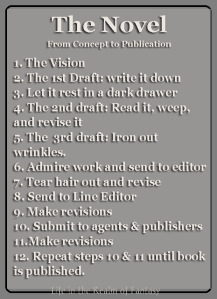
The Novel Meme LIRFAnd while this means that they publish crap too, the stink washes off the traditional houses but clings to the Indie industry as a whole.

This brings me to my point: The big 5 traditional publishers pretend everything they publish is sheer magic, while loudly pointing out the faults inherent in self-publishing. And, while it makes me laugh that they decry us as worthless but leap to publish us the minute we show any sign of real success, there are hard truths here we indies who are committed to the craft of writing must face.

First off, I feel strongly that we shouldn’t rush to churn out more than one or two books a year. Romance novels can be a different kind of animal, but unless you are producing pulp fiction, the same applies. (Click here to read an article by romance novelist Merry Farmer on this subject.)

Traditional publishers fail us (as readers) by pushing successful authors to spew several books a year, beating dead horses and creating long-winded series that lose the way after the third book. We Indies have the luxury to take our time to craft a good book, as we don’t have externally imposed deadlines.

Some of the worst books I’ve read were written by traditionally published authors who also wrote books I loved. But their best (in my opinion) books were written in the early days when they weren’t book-producing machines.

Some general things for any author to do when they are first starting out:

  1. Learn the mechanics of how to write in your native language. Grammar and Punctuation are essential, even in modern literature.
  2. Join a writing group and meet other authors, either in your local area or on-line. This will help you with steps 3 and 4. Enter writing contests and participate in the boards and threads. Ignore the trolls; they pop-up everywhere (usually with badly written ego-stroking crap to their publishing credit.)
  3. Develop a thick hide, and find an unbiased eye among your trusted acquaintances to read your work as you are writing it, so you can make changes more effectively and not be overwhelmed at the prospect of rewriting an entire manuscript from scratch.
  4. Lose your ego. Your ego gets in the way of your writing.  Are you writing for yourself or for others to read and enjoy your work?
  5. Find a good, professional editor. There are hidden aspects to every great book, and they are all centered around knowledge of the craft. An external eye is essential to the production of a good book. Check their references, and when you do engage their services, do not take their observations personally. This editor must be someone you can work closely with, who makes suggestions and lets you make the changes on your masterpiece yourself. They must understand it is your work and you have the right to disagree with any suggested changes. If you have this symbiotic relationship, you will turn out a good final product.
  6. Don’t give up your day job. Even authors receiving hefty advances have to struggle to make ends meet. (Read Thu-Huong Ha’s article, A New Book Shows the Financial Cost of Leading a Creative Life.)

EDWAERT_COLLIER_VANITAS_STILL_LIFEIt’s far more affordable now for a dedicated reader to buy enough books to keep themselves happy, but making your way as a reader through the many offerings in our eBookstores is a perilous journey, and you can’t always trust the quality by reading the publisher’s label. You just have to realize that whether a novel is traditionally published or Indie, some books are frogs, and some are princes.

You may have to read a few books you wish you hadn’t on your way to finding the book that sweeps you away. For me, that’s just part of the journey.


Sources and Attributions:

How Many Books Should You Write Per Year, by Merry Farmer, Nov 13, 2013

A New Book Shows the Financial Cost of Leading a Creative Life,  by Thu-Huong Ha, Jan 11, 2017, Flipboard

IBM Selectric, By Oliver Kurmis (Self-photographed) [CC BY 2.5], via Wikimedia Commons

Still Life, By Evert Collier (1642-1708) [Public domain], via Wikimedia Commons

8 Comments

Filed under Publishing, writing

#amwriting: consider the short story

via buzzfeed

For the author struggling to get their name out there, one of the best ways is writing and submitting short stories to magazines, contests, and anthologies. You might earn a little cash, and you have the added thrill that someone liked your work enough to publish it.

But how does one go about writing a short story? First, you need a theme, an idea or message that flows through a story from beginning to end. The theme is what readers think the work is about, but it is also what the work itself says about the central subject.

In a given work the theme might never be mentioned outright, but the characters’ actions are motivated by it, and the plot revolves around it. (In case you need it, here is a list of 101 common themes in books.)

The structure of the short story is the same as for a novel: it consists of the Story Arc, which is the term that describes plot structure, or the sequence of events that occur within a story.

Plot Structure is the way the story is arranged:

*the setup

*the obstacle

*the turning point

*the resolution/outcome

THE SETUP: You must have a good hook. In some cases, the first line is the clincher, but especially in a short story, by the end of the first page you must have your reader hooked and ready to be enthralled.

One of the best first lines ever: George Eliott’s Middlemarch starts, “Miss Brooke had that kind of beauty which seems to be thrown into relief by poor dress.” That line makes you want to know Miss Brooke. And the reader wonders who the observer is who chronicles this. It is a novel, but if it had been a short story, it would still have hooked the reader.

Good first lines make the reader beg to know what will happen next.  We have to think about that first line, those first paragraphs, and how to land our reader.

After the hook, you must immediately get down to business, as you have no words to waste. Consider these things when writing the opening paragraphs:

  1. The opening lines set the tone for the story.
  2. The opening lines introduce the dramatic question that is the core of the story.
  3. The opening lines introduce the sense of place, the setting of the story.

Sometimes you have a short story you can’t seem to get off the ground. Something stalls it. It could be that you are trying to place too much background in at the beginning. Ask yourself where the story truly begins and start there.

Consider the length of the story you intend to write. Most literary magazines want stories of 1000 to 4000 words in length, but many will say no more than 2000 words. That places a real constraint on you as the storyteller because, to sell your work to that magazine, you must fit your story into a very small box. Every word in a 2000-word story is critical and has a specific task — that of advancing the plot. To that end, in a story of only 2,000 words:

  • No subplots are introduced
  • Minimal background is introduced
  • The number of characters must be limited to 2 or 3 at most

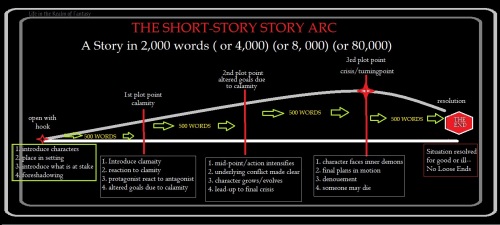
How do you fit a story into 2000 words? Make the Story Arc your friend.

Divide your story into four acts and assign a word limit to each of those acts: in a 2000 word story, each act would be 500 words long.

short story arc

Writing short fiction forces the author to become more economical and yet poetic in how they lay down their prose.

  • Each word must set the scene and convey the atmosphere, and every conversation must impart both information and give the reader a sense of who these characters are.
  • Every sentence must propel the story to the conclusion.
  • By the end of the first ¼ of the manuscript, the reader should have an idea of who the character is, what their moral compass is, what the character wants, and what they are willing to do to acquire it.

Be economical with your words: If you are writing a less formal story, make liberal use of contractions in the narrative as well as in the dialogue: hasn’t, he’d, wasn’t, didn’t, couldn’t, etc. A contraction is a “Two-fer” word – you get two words for the price of one.

Ditch the “crutch” words. You will lower your word-count when you look at each instance and see if you can get rid of these words. Removing them tightens your prose and makes room for important words that will convey the story more effectively.

“Crutch” words are overused words that fall out of our heads along with the good stuff as we are sailing along:

  • so
  • very
  • that
  • just
  • literally
  • there was
  • to be

We all use them too liberally in the rough draft. When we are doing revisions, we look at each instance of those words and decide if the sentence is stronger without it. Nine out of ten times, it is.

As I have said before, writing short stories gets you writing more:

  • more often,
  • more widely on a broad range of topics, and
  • more creatively using a variety of styles.

Using and building on the skills gained in writing short stories can only grow you as an author. Your prose will become stronger and tighter, and you will have a better grip on story construction.

9 Comments

Filed under Publishing, writing

#amwriting: bloated conversations are bad for business

SUPPORT YOUR LOCAL AUTHORSBeing an author is a business. It is a retail business, and you must look at it from that point of view, even if your work isn’t selling like hotcakes at the local diner. Big, fat books that are full of bloated exposition and conversations to nowhere are more expensive to publish and are unlikely to sell once the prospective reader has leafed through them.

Once you have a book published, you have a business, whether you are an Indie or traditionally published, and you must think about it from that angle. Wouldn’t you like to see some money from your work? Your best chance of this is at trade shows and book signing events. However,

  • In the real world, authors must pay for each book that is stocked on their table.

“This won’t apply to me,” you say.  “I’m going the traditional route. Once I sell my book to that Big Publisher in the Sky, he will provide me with all the copies of my books that I will ever need when I do signings, at no cost to me.”

Not so, my deluded friend.

A traditional publisher who is really excited about your book might arrange for you to have a table at a convention and will advance you copies of the books for you to sell and sign, but the cost of those books will come out of your earned royalties. You will see no money from your publisher until your book has out-earned all the advances they have paid you. So, just like an Indie, you pay for the books for your table at trade shows, conventions, and at most book-signings. The fact is, many traditionally published authors never out-earn their advances. Retail sales at shows are where they stand the most chance of bringing home money from book sales.

Consider how many copies of each book you can afford to take to the book signing event. You must weigh this cost against what you think the demand will be. Books that cost YOU more than $5.99 each are not a good thing for an Indie, because you must pony-up the cash at the time you order them. If you buy too many and they don’t sell, you have a lot of cash tied up in stock-on-hand that is earning you nothing.

For an indie who writes epic fantasy, it’s most cost-effective to keep your work to between 90,000 and 120,000 words if you intend to print through CreateSpace, which prints my paper books. If you have written a 300,000-word epic fantasy, consider dividing it into three volumes of 100,000 words each. Otherwise, you will be required to charge $17.99 to $20.00 per book just to make a minimal profit through Amazon.

How do we keep this cost down? We get a grip on the fluff that has worked its way into our work, and trust me, I didn’t understand this when I first began writing full time.

In the first draft, we have created a large amount of backstory. This is because we needed it to get a grip on the characters, their world, and the situation in order to write it. This is work the reader does not need to know the minuscule details of. To avoid info dumps and yet deploy the background as it is needed, we write conversations.

We need to exercise restraint. In the second draft, we decide what is crucial to the advancement of the plot and what could be done without. In recent years, I have begun cutting entire chapters that, when I looked at them realistically, were only background. In some cases, it was my favorite work, but when looked at with an independent eye, it didn’t do anything but stall the forward momentum of my book.

So how do we convey a sense of naturalness and avoid the pitfalls of the dreaded info dump and stilted dialogue? First, we must consider how the conversation fits into the arc of the scene.

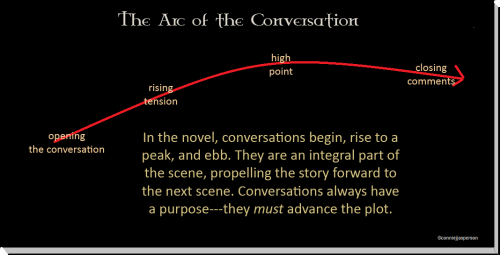
The Arc of the Conversation

It begins, rises to a peak, and ebbs, an integral part of the scene, propelling the story forward to the launching point for the next scene. A good conversation is about something and builds toward something. J.R.R. Tolkien said, “Dialogue has a premise or premises and moves toward a conclusion of some sort. If nothing comes of it, the dialogue is a waste of the reader’s time.”

First, we must identify what must be conveyed in our conversation.

  1. Who needs to know what?
  2. Why must they know it?
  3. How many paragraphs do you intend to devote to it?

My rule of thumb is, keep the conversations short and intersperse them with scenes of actions that advance the plot. Think like a screenwriter–visualize the conversation as if you are viewing it on a stage. Does the thought of two heads yammering about the weather for half an hour really interest you? No. Show the weather and spend your conversations on the important things. Walls of conversation don’t keep the action moving and will lose readers.

Author James Scott Bell says dialogue has five functions:

  1. To reveal story information
  2. To reveal character
  3. To set the tone
  4. To set the scene
  5. To reveal theme

So now that we know what must be conveyed and why, we arrive in the minefield of the manuscript:

  • Delivering the backstory.

CAUTION INFO DUMP ZONE AHEADDon’t give your characters long paragraphs with lines and lines and lines of uninterrupted dialogue. Those can become info dumps laced with useless fluff and are sometimes seen as a wall of words by the reader.

When the dialogue is trying to tell the reader too much, characters end up saying a lot of unnatural and awkward things. Characters go back and forth explaining precisely what they are feeling or thinking, and it doesn’t seem remotely real.

  • Background information must be deployed on a “need to know” basis. If it is not important at that moment, the reader does not need to know it.
  • The only time exposition works is when both the reader and the character being spoken to do not know the information being artfully dumped.

When reading, even dedicated readers will skip over large, unbroken blocks of words. Elmore Leonard famously said, “Try to leave out the part that readers tend to skip.”

I feel this goes double for dialogue.

4 Comments

Filed under Publishing, writing

#amwriting: the craft of Indie Publishing: the manuscript

Book- onstruction-sign copyIn every manuscript, there will be inconsistencies, and no matter how hard you and your friends comb it, some will slip through.

You are about to publish your first book. The manuscript is as pristine as human eyes can make it. However, to ensure this, the wise indie will follow these steps, in this order:

First, as they are writing the manuscript, they will create a list of made-up words and usages that are unique to their manuscript. This is called a style-sheet, or in some circles, a Bible. The author will refer back to it and update it. They will supply the editor with it, who will also refer back to it and update it, which will ensure that fewer inconsistencies make it through to the final product. Once the manuscript is submission ready, the wise author will:

  1. Have it professionally line-edited (yes, this does cost, but it is SO worth it)
  2. Have it beta read by people who read in the genre you write in
  3. Have the final manuscript proofread by a professional (again, this has a cost attached to it)
  4. After it is proofed, the wise indie author will make use of the narrator app that comes with MS Word or use a free app such as Natural Reader. Read along with it, and you will spot the inconsistencies.

I made use of all these steps for my most recent manuscript, The Wayward Son, and still, the narrator app helped me locate several small inconsistencies, one of which (lighting versus lightning) could have thrown a reader out of the narrative. (There is no such thing as a lighting-mage in my books, although I do have lightning-mages.)

My global search list to correct inconsistencies found by Natural Reader narrator app in final MS for TWS:

  1. Andresson/Andreson (found 0)
  2. Lighting/lightning (found 2)
  3. Stefan/Stefyn (found 1)
  4. Abacci/Abbaci (found 0)
  5. Sparing/Sparring (found 0)
  6. Jerika–change name to Erika (found 3)
  7. Johnny/Jonny (found 1)

Despite my best efforts, some of these inconsistencies (those I marked in red) were found in the ARC and have been corrected. I accept that it’s possible that other inconsistencies will still exist in the published book, but not because I haven’t done due diligence and made every effort to eliminate them.

The Wayward Son, a companion book to Forbidden Road, has been uploaded to CreateSpace and is set to launch on September 15th.

Indies who want their work to be looked upon as professional will follow these suggestions. We can’t afford to be less than diligent with our process of preparing the manuscript for publication, as the industry’s reputation rides on our finished products.

Because the publishing industry as a whole holds indies in such low regard, we must ensure what we produce is a book the reader will like or dislike based on our work, our style of writing and the story we are telling. We owe it to our potential readers to give them a well-edited book, written with attention to the craft of writing AND publishing (yes, publishing is a craft) as well as with the passion of an author with something to say.

8 Comments

Filed under Publishing, writing

#amwriting: The Query Letter

My Writing LifeEvery author, indie or traditionally published, comes to a point in their career where they must craft a query letter. For many, avoiding having to do that is one of the reasons they went indie in the first place.
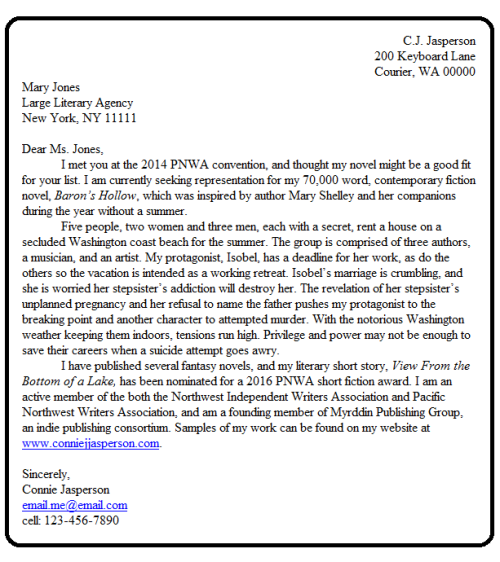
Most editors and publishers want a 1 page, 300-word description of your novel. They want the hook and the essence of that novel in 2 paragraphs, and they want to get a feel for who you are. Both aspects of this 1-page extravaganza must intrigue them. Every editor and agent has a website detailing the way they want queries submitted. In general, they want letters/emails that follow a certain pattern, and that basic format is readily available via the internet.

The www.NYBookEditors.com website has this to say about query letters: “You must walk a very fine line between selling your manuscript without coming across like the parent who knows his kid is the best player on the bench.”

That, my friends, is more complicated than it sounds. Of course, we are firm believers that what we wrote IS the best player on the bench. I’ve always known that about my children and my books!

Anyway, back to the query letter. I’ve attended several seminars on the subject and written many of them. I’ve had good results and also bad results with mine. The best place I have found with a simple description of what your query letter should look like is at the NY Book Editors website.

In essence, what they tell you is this:

  1. Format your letter this way:
  • Your address at the top of the page, right justified.
  • The agent’s address, this time left justified.
  1. Use a personalized greeting where you acknowledge the agent or editor by name.
  2. Keep the body of your query letter to three to five paragraphs.

The 1st paragraph is where you introduce yourself. If you have a connection with the agent or editor you are approaching, say you met at a convention or seminar, or you are a fan of one the authors they represent, mention that. Briefly.

If you have no previous connection, NY Editors suggest you get down to business right away with your attempt to sell your book. Their point of view on this is that you only have a few paragraphs to sell your book, so make those words count.

In the 1st paragraph are the 3 most important things to include:

  1. Title
  2. Genre
  3. Word count

The 2nd paragraph must give a brief description of the work—showcase the plot, and show why you think it is a good fit for this agent/editor. Do this in one paragraph, and don’t give it the hard sell.

The 3rd paragraph should be a quick bio of you, your published works, and whatever awards you have acquired. If samples of your work are available on your website, say so.

This is most important: don’t forget to double-check your letter for typos and spelling errors. We all make them and we don’t want them to be our legacy.

As I have said, my luck with queries has been uneven. I think query letters are like ice cream—you just have to cross your fingers and hope your query arrives on a day when the person in question is in the mood for a story exactly like what you are selling.

Query letter image

2 Comments

Filed under Publishing, writing

#amwriting: Setting and keeping your preferred font in Microsoft Word

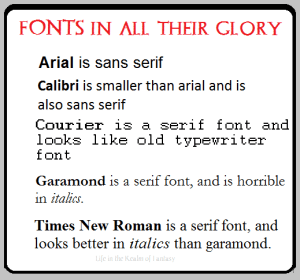
Fonts in all their gloryOkay. We all know that Microsoft Word is a hinky behemoth of a program, but it is what many of us are using. Publishers all want their manuscripts in a serif font, and will usually specify Times New Roman .12 or Courier .12 and want it double-spaced.

Microsoft Word comes with Calibri .11 as the default font, set at 1.5 spacing which is not wide enough for most editors and publisher’s purposes. Also, Calibri is a sans serif font and does not comply with the requirements of publishers and editors. Reading it large chunks is difficult as the spacing between the letters is identical and it is hard to distinguish some letters.

One major problem with Calibri font is a visible homoglyph, a pair of easily confused characters: the lowercase letter L and the uppercase letter i (l and I) are virtually indistinguishable.

Font differences in sentences

Publishers hate confusion.

If the manuscript is not formatted to their requirements as posted on their submissions page, your work will not be considered.

So to comply with their guidelines, we format the manuscript according to their needs. Most use what has become the industry standard fonts: Times New Roman or Courier in .12.

These are called ‘Serif’ fonts because they have little extensions that make them easier to read when in a wall of words.

209px-Serif_and_sans-serif_03.svg

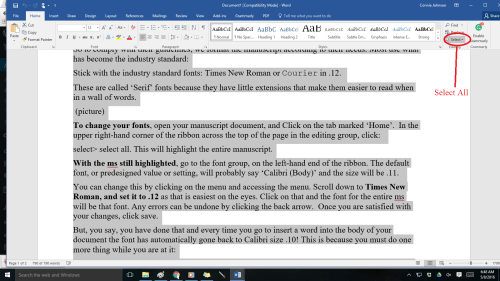
To change your fonts, open your manuscript document, and Click on the tab marked ‘Home’.  In the upper right-hand corner of the ribbon across the top of the page in the editing group, click:

select> select all. This will highlight the entire manuscript.

Select all printscreen

With the ms still highlighted, go to the font group, on the left-hand end of the ribbon. The default font, or pre-designed value or setting, will probably say ‘Calibri (Body)’ and the size will be .11.

You can change this on the home tab by clicking on the little grey square in the right-hand corner of the font menu and accessing the drop-down menu. Scroll down to Times New Roman, and set it to .12 as that is easiest on the eyes. Click on that and the font for the entire ms will be that font. Follow these steps to reset your default formatting, but only click “set as default” if this is what you really want. You can reset it to what you you want if you find you don’t like your new settings. Once you are satisfied with your changes, click save.

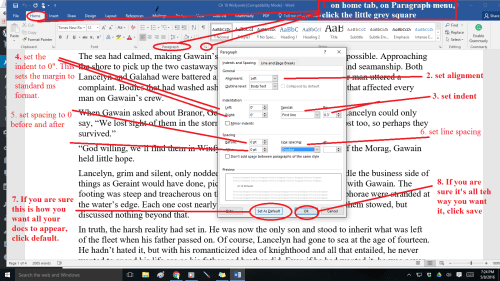
Format paragraphs printscreenBut, you say, you have done that and every time you go to insert a word into the body of your document the font for what you are inserting has automatically gone back to Calibri size .10! And every new document is still formatted with Calibri.

On the home tab, in the Styles pane (click on the lower right-hand arrow of the styles box), click the Manage Styles button. In Word 2016 that is on the bottom of the list, the far right-hand button (just before the word options).

Word 2016 font change steps

On the Set Defaults tab, specify the settings that you want. The changes will apply to the current document, but if you select “New documents based on this template” before clicking OK, the settings will be transferred to the attached template. All your documents after that should have your preferred font as the default font. In my case, it is Times New Roman .12, double spaced, with a .03 indent. You may want a different font, single spaced and a different indent.

Word 2016 font change steps 2

But say you need to format your manuscript differently, for a unique purpose.

To change your fonts, open your manuscript document, and Click on the tab marked ‘Home’.  In the upper right-hand corner of the ribbon across the top of the page in the editing group, click:

select> select all. This will highlight the entire manuscript.

With the ms still highlighted, go to the font group on the left-hand end of the ribbon. The default font, or predesigned value or setting, will show up, and you will change this by clicking on the menu and accessing the menu.

Scroll down to the new font, and set it to the desired size. Click on that and the font for the entire ms will be that font. Again, any errors can be undone by clicking the back arrow. Once you are satisfied with your changes, click save.

Standard manuscript format means margins of 1 inch all the way around, indented paragraphs, and double-spaced text. For more on this subject, see my post of Feb. 27, 2015, Formatting a submission-ready manuscript.

Do not justify the text. In justified text, the spaces between words, and, to a far lesser extent, between glyphs or letters (known as “tracking”), are stretched or sometimes compressed to make the text align with both the left and right margins. Justifying gives you straight margins on both sides, but this is not the time or place for this type of alignment.

For my purposes, I have found it is easiest on my eyes to use Times New Roman .12, aligned left, double-spaced, with a 0.3 indent for all my work, so that is what my default settings are. I always reformat my manuscript to comply with whatever the requirements are for every magazine or publisher I submit my work to.

2 Comments

Filed under Publishing, Self Publishing, writer, writing

#amreading: Working the Table: An Indie Author’s Guide to Conventions

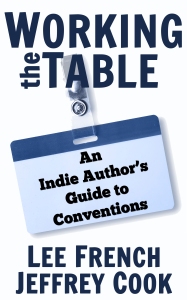
IndieGuideCoverOne aspect of an author’s career that we are often temperamentally unsuited for, is the book signing event. Many of us are, by nature, not outgoing or able to sell our own work. But the book signing event is crucial–it is is a way for you to meet with potential readers in person, and for them to develop a sense of connection to you and your work.

A book every indie author should have in their arsenal is Working the Table, by authors Lee French and Jeffrey Cook.  The advice within those pages will pay for the book many times over, because whether you are an indie or traditionally published, most likely you will have to sell your book, and a way to generate a little bit of a buzz is the good, old-fashioned book signing. You will also attract readers at conventions, if you are careful to select cons that play to your genre and your style.

I had the chance to speak to Lee and Jeffrey over the weekend about their book.

CJJ: Working the Table is a useful book in the indie author’s arsenal. What made you decide to embark on such an ambitious project?

Jeffrey: Honestly? Other authors were responsible. Take a look at the dedication page — the people named there were some of the primary culprits, but not the only ones. We’d do shows; people would see us putting up the table, arranging it, putting out set deals, and then handling customers, and tell us we needed to write a book.

For quite a while, we laughed at the suggestion. Then we got an ultimatum at Orycon last year — “You guys write it, or I will.”

We still laughed. Then, that same night, staying with Madison Keller in Portland, I couldn’t sleep. I stayed up until 3:30 AM jotting down notes and ideas. I didn’t know it, but Lee would be up not long after I finally went to bed.

We compared notes on the drive home and got started.

Lee: Even at that point, though, it wasn’t a done deal. The speed with which the book came together is what really made it happen. This project could easily have been one that festers and simmers and takes a while, especially with the demanding publishing schedule both Jeff and I maintain. But it took almost no time to write the first draft between us, and we did a few shows in the middle of the revision process where we turned to each other and said, “The thing that just happened needs to be in the book.” Two days later, it was in the book.

CJJ: Authors are by nature rather introverted. But you two both have a strong presence when you are behind the table at an event. How did you develop the persona you have for events?

Jeffrey: Frankly, I’m not an introvert. I’m not an extrovert either. I like my space and quiet time, but in this job, I have a reasonable amount of it. When convention or activity time rolls around, I’m pretty happy to talk to people.

As it notes in the book, that’s part of what I bring to the partnership. I like talking to people. I’ve traveled all over the US and Canada between moving and a lot of road trips when I was younger, and I’m fairly good at dealing with new people.

Part of the presence you mention also has to do with developing a coordinated plan based around our soft-sell approach. When people come up to the table, our primary aims are to make them feel comfortable there and to match them up with the book or books they want, instead of trying to push any particular thing.

Lee: While I’m on the introvert side of the scale, and I have some moderate social anxieties, I’ve found that being behind the table is a relatively comfortable place. There’s an expectation for behavior and interactions not present in other types of people encounters.

My job at the table is a known quantity, both to myself and to people who approach. When you walk up, I want to help you find a book, and you know that’s what I’m going to try to do. That makes the interaction much easier to pursue. No one walks up to an author table expecting to talk about anything other than books, writing, publishing, the surrounding environment, and whatever fandom is dearest to them. With those boundaries pre-established, and the subjects (mostly) ones I can speak on with a certain amount of expertise, the anxieties inherent in relating to strangers are significantly lessened.

CJJ: How do you select the convention with the right buyers for your work?

Jeffrey: Right now, we’re doing a lot of different conventions. Comic-cons, scifi/fantasy cons, street fairs, literary events, etc. Next year, we’re hoping to narrow down the field from about 32 planned events this year (for me, anyway, though most of those are working with Lee) down to about 18 of the best. Then maybe 12-15 in years beyond that.

We know that we both primarily write science fiction and fantasy, so we definitely favor events with a strong scifi/fantasy convention audience and tend to do the best at those. Thankfully, that’s a big market in the Pacific Northwest.

Lee: When I first started looking at picking conventions, my first question was, “Which conventions would I like to attend?” Like most writers, the things that interest me wind up in my writing, making my audience people who are, at least generally, like me. That means gaming conventions are high on my list, as are general fantasy and science fictions shows of all types. Then it comes to subgenre niche conventions, so long as one of us has something in that subgenre, we’ll try it. I actually do well at steampunk conventions despite not having steampunk books because I share a table with Jeff, who has some high quality steampunk. But I wouldn’t go to a steampunk convention by myself.

CJJ: What has been the largest hurdle for you in most dealers’ rooms?

Jeffrey: The unpredictability of some of these shows can be frustrating. We’re pretty good at selling books as long as there’s an audience. Sometimes there’s just not. The long, slow periods can be kind of difficult too, especially because you at least need someone at the table looking engaged and interested, no matter how long it’s been since someone came by.

Lee: Getting into them in the first place. Some conventions are very popular and getting in requires sacrificing your first born child under the full moon with a sprig of fresh mistletoe… Once you’re in, you’re usually in as long as you want to be, but jamming your foot in the door can be challenging. The best bet is usually to keep submitting and when you do get into something, be excellent to the volunteers and staff. Word about vendor behavior gets around.

CJJ: What advice do you have for the author just embarking on the roller-coaster ride that is the dealers’ room?

Jeffrey: Keep your expectations reasonable. When you’re just starting out, conventions aren’t going to be a big money-maker. You’re trying to get your book out there, but also start connecting with fans and potential fans. The investment of time and money can still be worth it in the long run, but you need to look at it as exactly that: an investment.

Lee: That’s also my number one piece of advice. The goal of working conventions is to break even, not to have fabulous financial windfalls. It’s not an end-all, be-all marketing tactic, it’s a piece of a larger picture. One of the most important things we do at conventions is hand out business cards and meet people. Selling books matters, because we have to make enough to afford to do this. Making connections matters more for the long term.

CJJ: If you had it all to do over again, what would you do differently?

Jeffrey: In broad general terms, I’d have liked to have been better about listening to my editor and her general advice. She had a lot better perspective on some things early in my writing career, and I’d be better off and further ahead today if I’d been a better listener.

In terms of shows and conventions specifically: I’d have loved to have spent some serious time learning how to use media better. Press releases, getting newspaper attention, etc.  It’s important and helpful – and something I’m still not great at.

Lee: For the bigger picture of publishing, I’ve made a number of horrifying mistakes in my career that I wish I could go back and do right the first time. It would take to long to discuss them all. For those considering jumping into this madness that is writing novels, I definitely recommend getting your feet wet with short story publication before throwing your first novel out there. Short story writing teaches the art of brevity, a skill many novelists struggle with.

CJJ: Finally, where can the reader find you two this summer?

Jeffrey: In May, I’ll be at Lilac City Comiccon in Spokane with Lee (May 14th), then Gearcon Day Out in Portland (May 21).

In June, I’ll be at Oddmall in Everett from the 3rd through the 5th, working with Freevalley Publishing, then Maple Valley Days, all of 7 blocks from my home, from the 10th through the 12th. Our books will be at the Brass Screw Confederacy (also the 10th through the 12th), and then we’ll be at the Fremont Solstice Festival from the 17th through the 19th.

In July, we’ll be at Westercon in Portland from the 1st to the 4th. Then we’ll be running our own book fair at Evergreen State University in Olympia on the 16th. Then I’ll be on my own one more time at the Fairhaven Steampunk Festival in Bellingham on the 23rd as a guest of Village Books.

Finally, in August, we embark on the epic road trip — which we’ve kind of planned the year around. We’re still waiting on hearing about a show in Minnesota, but we’re confirmed for Gencon in Indianapolis from the 4th to the 7th, then Malcon in Denver from the 12th to the 14th, and finally, the long haul of Worldcon in Kansas City from the 17th to the 21st.

Lee: I don’t have any additional appearances beyond those Jeff listed scheduled at this point. I’ll just note the name of the book fair on July 16—CapitalIndieBookCon—for anyone interested in a book fair in Olympia.

CJJ: I will be at the CapitolIndieBookCon also, putting your wisdom to work! Thank you, Jeffrey and Lee, for taking the time to talk with me about Working the Table.  In my opinion, any author who intends to get out and do book signing events or work the dealer’s rooms at conventions should consider purchasing this book. The advice contained within was hard earned and is priceless. I have my copy and it is already looking a little well-used!

>>><<<

Jeff1Jeffrey Cook lives in Maple Valley, Washington, with his wife and three large dogs. He was born in Boulder, Colorado, but has lived all over the United States. He’s the author of the Dawn of Steam trilogy of alternate-history/emergent Steampunk epistolary novels, the YA Sci-fi thriller Mina Cortez: From Bouquets to Bullets, and the YA Fantasy novel Foul is Fair. He’s a founding contributing author of Writerpunk Press and has also contributed to a number of role-playing game books for Deep7 Press out of Seattle. He is part of a speculative-fiction authors’ co-op, Clockwork Dragon (www.clockworkdragon.net). When not reading, researching, or writing, Jeffrey enjoys role-playing games and watching football.

You can find Jeffrey Cook’s books by visiting his author page at Amazon.com:

Jeffrey Cook on Amazon.com:

  • Dawn of Steam: First Light
  • Dawn of Steam: Gods of the Sun
  • Dawn of Steam: Rising Suns
  • Foul is Fair
  • Street Fair
  • A Fair Fight
  • Sound & Fury: Shakespeare Goes Punk
  • Once More Unto the Breach: Shakespeare Goes Punk 2
  • Merely This and Nothing More: Poe Goes Punk
  • Mina Cortez: From Bouquets to Bullets
  • Airs & Graces (Angel’s Grace 1)
  • There But for the Grace (Angel’s Grace 2)
  • Working the Table: An Indie Author’s Guide to Conventions

www.Authorjeffreycook.com

www.Clockworkdragon.net

Jeffrey Cook on Facebook

Dawn of Steam Trilogy on Facebook

Follow Jeff on twitter: @jeffreycook74

>>><<<

Lee1Lee French lives in Olympia, WA with two kids, two bicycles, and too much stuff. She is an avid gamer and member of the Myth-Weavers online RPG community, where she is known for her fondness for Angry Ninja Squirrels of Doom. In addition to spending too much time there, she also trains year-round for the one-week of glorious madness that is RAGBRAI, has a nice flower garden with one dragon and absolutely no lawn gnomes, and tries in vain every year to grow vegetables that don’t get devoured by neighborhood wildlife.
You can find Lee French’s books by visiting her author page at Amazon.com:

Lee French on Amazon:

  • Maze Beset #1: Dragons In Pieces
  • Maze Beset #2: Dragons In Chains
  • Maze Beset #3: Dragons In Flight
  • The Greatest Sin #1: The Fallen
  • The Greatest Sin #2: Harbinger
  • The Greatest Sin #3: Moon Shades
  • The Greatest Sin #4: Illusive Echoes (coming soon)
  • Spirit Knights #1: Girls Can’t Be Knights
  • Spirit Knights #2: Backyard Dragons
  • Spirit Knights #3: Ethereal Entanglements (coming soon)
  • Damsel In Distress
  • Shadow & Spice (short story)
  • Al-Kabar
  • Working the Table: An Indie Author’s Guide to Conventions
  • Into the Woods: a fantasy anthology
  • Merely This and Nothing More: Poe Goes Punk
  • Missing Pieces VII: short stories from GenCon’s Author’s Avenue (coming in August)
  • Unnatural Dragons: a science fiction anthology (coming soon)

www.authorleefrench.com

www.Clockworkdragon.net

Lee French on Facebook

Clockwork Dragon on Facebook

Follow Lee on Twitter: @AuthorLeeFrench / @DragonClockwork

14 Comments

Filed under Books, Publishing, Self Publishing, writer, writing

#amwriting: Valley of Sorrows

Map of Aeoven Centaur font full color harvest colorsOn May 1st the final book in the Tower of Bones series, Valley of Sorrows,  will launch. I can’t tell you how much this means to me, to have Edwin’s story complete.

This story winds up two threads, and takes place partly in the Braden Gap, and partly in Aeoven. That gave me the opportunity to draw some new maps, which really made me happy.

And, this book may wind up Edwin’s story, but there will be more tales set in Neveyah–I love that world and the people too much to just walk away from it.

Valley of Sorrows spawned a spin-off book:The Wayward Son. That book is on the editor’s desk and set to be published in August 2016. It is a companion book that takes place concurrently with Forbidden Road and details some, but not all, of the events that occurred in Aeoven during Edwin’s absence.

BradenThe way I ended up writing a companion book is that the original manuscript of Valley of Sorrows was really two separate stories. I didn’t want John’s thread to take away from Edwin, Freidr and Zan’s story, but his background is intriguing–so I took him back to the day he returns to Aeoven, the same day Forbidden Road opens.

While the two stories dovetail in some places, and characters make cameo appearances, this book is not so much a book about the action as it is about a man learning to live again, despite his battle related PTSD.

Two years ago, when I pulled Tower of Bones and Forbidden Road for re-editing I made a bold move–I changed the name of a once-minor character, from Marta to Halee.  I did this, because she suddenly had a major role to play in the both the Wayward Son and the last quarter of Valley of Sorrows. and her name was only one letter off from Marya’s name: Marta…Marya–and they were often in the same scene together. Both books have been selling fairly well and so far, if anyone has noticed, they have not complained.

I really like the way Edwin’s story has gone. In this book he is a good, decent man, who has been pushed to nearly the breaking point, but he is still doing what he has to. As I said, this story ends very differently from what I had originally planned, and I wrote the ending both ways. If you really are curious as to how it ends the book is available for preorders now at Amazon and will go live on May 1,2016:

>>><<<

LAUNCHING MAY 1, 2016:

The long-awaited conclusion to the Tower of Bones Series

VOS sword left graphics no tower front Cover copyBook III, Valley of Sorrows

A grieving man whose life has gone to hell in his absence,

A son whose action sealed his father’s fate,

A crippled warrior facing his future,

A broken soldier seeking redemption for an unspeakable crime…

Driven by prophecies and racing against time, four mages sacrifice everything in a final bid to save their world from the Children of the Bull God. Can Edwin Farmer  raise the new shield before Lourdan and the Legions of Tauron arrive to conquer Braden?

The Gods are at War, and Neveyah is the Battlefield.

Click here to pre-order Valley of Sorrows

><<<

Happy Earth Day!

I will be celebrating Earth Day in Olympia, Washington at the Procession of the Species and the Arts Walk. Local authors Shannon L Reagan, Jeffrey CookLindsay Schopfer, Lee French, and I will be down at The Pet Works at 4th and Adams for both days of Arts Walk, which runs 5 pm-8 (or maybe 10) on Friday, 4/22 and also from 12 pm-8 on Saturday, 4/23. We’ll be signing books and generally having a blast. A lot will be happening in the parking lot, and several other artists will be sharing the space with us.

3 Comments

Filed under Publishing, Self Publishing, writer, writing

#amwriting: know your style: hypocrisy in the industry

a writer's styleIn writing, style is far more than simply choosing to wear high-heeled shoes with jeans. Style is a multilayered representation of your voice and your knowledge of the craft of writing.

An author’s style affects the overall readability of his/her finished product. Good readability is achieved by:

  1. Understanding: Keeping to generally accepted grammatical practices. Purchasing and using a style guide when questions arise regarding a creative writing project
  2. Rebellion: if the author chooses to break the accepted rules, he/she does so in a consistent manner.
  3. Wordcraft: The way the author phrases things, and the words he/she chooses, combined with his/her knowledge of the language and accepted usage. Invented word combinations, such as wordcraft (word+craft) and the context in which they are placed.

Simply having a unique style does not make your work fun to read.

Ulysses cover 3Let’s take a look at James Joyce, the man I think of as the king of great one-liners. If you look up great lines quoted from modern classic literature, you will find excerpts from his novel Ulysses represented more often than many other authors.

Yet, while the average reader has heard and often used quotes from Joyce’s work, most people have not read it. They may have picked it up, but then put it down, wondering what all the critics loved so much about it.

The mind of the literary critic is as inscrutable as that of an ex-spouse: hard to understand but easy to run afoul of. I personally learned to love Joyce’s work when I was in a class, taking it apart sentence-by-sentence. Prior to that, I couldn’t understand it, despite the fact it was written in modern, 20th century English.

What makes Joyce’s work difficult for the average reader is his style: he was Irish and had the Irishman’s innate love of words and how they could be twisted, and often wrote using what we call stream-of-consciousness. In doing so, Joyce regularly, but consistently, broke the rules of grammar.

Consistency and context are absolutely critical when an author chooses to write outside the accepted rules of grammatical style. If you just don’t feel like enclosing your dialogue within dialogue tags, it is your choice. Simply tell your editor that is your decision, and she/he will make sure you have consistently omitted them throughout the manuscript.

Queen of the Night alexander cheeYou may, however, have written a book that is difficult for the average person to read, as Alexander Chee has in his brilliant novel The Queen of the Night. While his writing is sheer beauty, this particular style choice is a mystery to me. It makes the book difficult to get into, because you’re reading along, and suddenly you realize you’re reading dialogue, and you have to stop, go back, and reread it.

It is incomprehensible to me why an editor for a large publisher would accept a manuscript that is as annoying as that one flaw makes this otherwise amazing book. It is also proof that large publishers (Houghton Mifflin Harcourt in this case) are just as guilty as indies when it comes to making strange decisions that can negatively affect sales. They may have done this to elevate it to a “status” read,  a must-buy literary name-dropper for those who wish to appear fashionably cultured. If so, it’s a disservice to a work that is brilliant despite a flaw that would be fatal if it were to appear in an Indie author’s work.

Chee’s editor did one thing correct, however: the lack of closed quotes is consistent throughout the book, and so one can sort of get into the narrative—at least until the dialogue starts up again. This blemish is why I will only recommend the audiobook to readers who are easily discouraged.

Your style choices are critical. They convey your ideas to the reader, and if you make poor choices, you may lose a reader.

James Joyce and Alexander Chee made style choices in their writing that an Indie could never get away with. The world holds Indies to a higher standard, so the choice to omit something as vital as quotation marks would result in instant finger-pointing and mockery of the Indie publishing industry as a whole.

What you choose to write and how you write it is like a fingerprint. It will change and mature as you grow in your craft, but will always be recognizably yours. As you are developing your style, remember: we want to challenge our readers, but not so much that they put our work down out of frustration. Most of us who are Indies can’t rely on our names to sell our books.

9 Comments

Filed under Publishing, writing