#amwriting: creating religion within the context of the tale

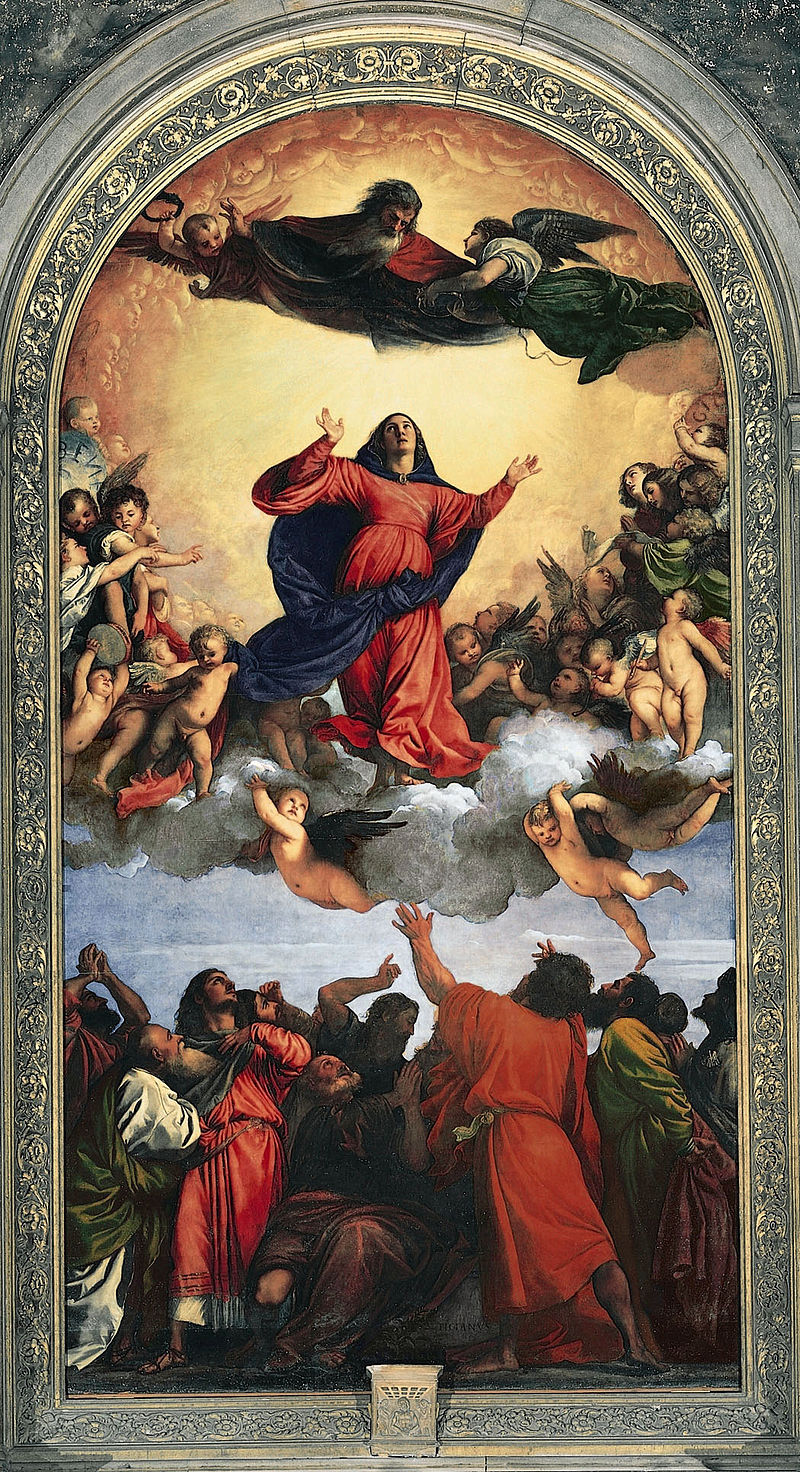
Assunta, by Titian, 1516-1518, via Wikimedia Commons

Assunta, by Titian, 1516-1518, via Wikimedia Commons

One thing we fantasy authors must occasionally deal with is developing religions within the context of the tale.

Most of what we will discuss here won’t actually make it into the written pages of your tale, but if you don’t have a good understanding of what you are writing about, you will inadvertently introduce discrepancies into your tale.

First, ask yourself “why does this religion matter?”  If it doesn’t matter, it doesn’t belong in your tale.

However, when you have a heavenly power-struggle, you have some intriguing opportunities for mayhem.

Are there many gods and goddesses? What is their relationship with each other and how does it play into your story?

If you choose to create a religion as a key plot point, here are some questions to ask:

  1. How central to the life of the protagonist or antagonist is religion? Is the protagonist a member of the priestly class, perhaps a priestess or priest of a particular god or goddess?
  2. What does the protagonist gain from following this deity?
  3. How jealous is this deity?
  4. What is the protagonist/antagonist willing to do for their faith? Will they die for their deity or is it a more abstract religion?
  5. The priesthood—who can join?
  6. Can only the nobility rise in the priesthood, or can anyone with the ability to learn gain power within the organization?
  7. How do the nobility and the priestly class get along? Do they have a good accord or are they jostling for power?
  8. And within that religious organization, who has the most power?
  9. What does that person do with their power?

How important is your religion politically? In Rome, the church was central to their government, in some cases having more power than the ruling nobility. During the Middle Ages, Rome slowly fell under the political control of the Papacy, which had settled in the city since the 1st century AD. In the 8th century, Rome became the capital of the Papal States, which lasted until 1870.

You don’t have to re-invent the wheel here–history is full of great ideas to draw upon.

A_Glass_of_Wine_with_Caesar_Borgia_-_John_Collier

Painting by John Collier, “A glass of wine with Caesar Borgia” via Wikimedia Commons

Consider the Borgias–Wikipedia, the fount of all knowledge says this about them: Especially during the reign of Alexander VI, they were suspected of many crimes, including adultery, incest, simony, theft, bribery, and murder (especially murder by arsenic poisoning). Because of their grasping for power, they made enemies of the Medici, the Sforza, and the Dominican friar Savonarola, among others. They were also patrons of the arts who contributed to the Renaissance.

See? Even George R.R. Martin knows that the renaissance offers great opportunity for good plot twists in your fantasy project.

Now let’s examine the political environments of the medieval city-states of Venice, Milan, Florence, Genoa, Pisa, Siena, Lucca, and CremonaRodney Stark, an American sociologist of religion, proposes that the city-state was a ‘marriage of responsive government, Christianity, and the birth of capitalism’ as we know it. He argues that these states were mostly republics, unlike the great European monarchies of France and Spain, where absolute power was vested in rulers who could and did stifle commerce.

It has been suggested (in Wikipedia, the fount of all knowledge) that by keeping both direct Church control and imperial power at arm’s length, the independent city republics of medieval Italy prospered because their commerce was based on early capitalist principles. The church was still involved in their daily lives, but this slight, deliberate separation of church and state ultimately created the societal conditions that brought about the artistic and intellectual flowering of the renaissance.

And for you, the author, understanding the commerce and economics of your fantasy society is extremely important, so that inconsistencies don’t get introduced. The reader won’t care, and doesn’t want the background info, but you need to know it.

If your protagonists are poor, why are they poor? Is poverty widespread, or is it only the one family? Where is all the money–is it in the hands of the church or is it in the hands of the middle-class? If it’s in the hands of the church–you’ve a good plot-point to work with.

Thus if religion of some sort is an integral part of your work, you as the author must have a good knowledge of what the influence of that institution is, the structure of the priesthood, the power they wield in society at large, how (or if) they control the economy, and how this organization is viewed by the ordinary citizen.

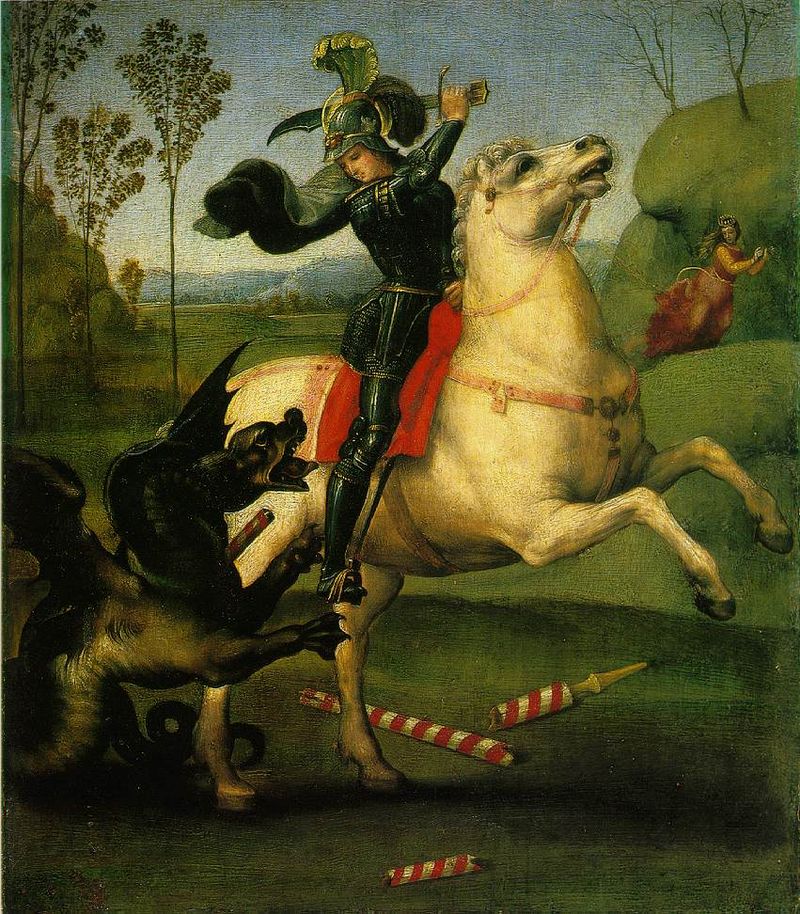
St. George and the Dragon, Raphael via Wikimedia Commons

St. George and the Dragon, Raphael via Wikimedia Commons

Many authors avoid this altogether, by having only a vague mention of religion, simply mentioning a connection with a particular deity as the reason for the ability to use and control magic.

Others make religion and opposing religions the foundation of their works. How you handle religion in your manuscript is up to you, but if you make it a central part of your tale, I suggest you create a document in which you establish the basics of your religion(s) clearly. Update it as the rules evolve, which they certainly will do over the first two drafts of your novel. During your writing process, refer back to this document regularly.

The reader doesn’t care about those details, and will put the book down if they are included. But if you don’t know what you are writing about, can’t remember what you wrote three chapter ago, and contradict yourself too often, your reader will lose the ability to suspend his disbelief.

Keeping the reader immersed in the tale, forgetting that it is only a fiction is the primary goal every author wants to achieve.

2 Comments

Filed under Fantasy, Publishing, Uncategorized, writing

#flashficfriday: TED (a drabble)

large dragon courtesy www.wallpaperfreehd.com

large dragon courtesy http://www.wallpaperfreehd.com

Drabbles are little short stories of 100 words in length, and writing them is good exercise.

Each time you write a drabble, you create possibilities that could evolve into larger stories. In 2013 I participated in a challenge to write a drabble every day for the month of May. The original prompt went as follows:

Write A 100 Word Story (“Drabble”) . . . although a 100 word story will probably take longer than expected, it can be done in a manageable amount of time.

To make a drabble work,
-Choose one or two characters
-Take one single moment/action/choice and show us how it unfolds
-Give one or two vibrant details in as few words as possible
-Hint at how this moment/action/choice is more significant than the characters probably realize in the moment

 Here is my first drabble, written May 1st, 2013:

TED

Edna stirred her coffee and looked out the window toward the shed.

“Did you feed the chickens?” Marion always asked, despite knowing Edna had.

Edna tore her gaze from the shed. “Of course.” Her eyes turned back to the small building. “We won’t be able to keep him in there much longer. He’s growing too big. We should have a barn built for him.”

“Ted was always a greedy boy.” Marion stirred her coffee. “I warned him he behaved like a beast, and now look.”

A rumbling bellow shook the shed. A long green tail snaked out of the door.

Garden Shed, Albatross Cottages, San Diego Public Domain Via Wikimedia

>><<<

I love that scene. I keep wondering about the two ladies, and also Ted. Who is he in relation to them, who are they in relation to each other, and what is their life like, apart from the secret in the shed?

Ted will become a longer short story in November, as part of my NaNoWriMo project. I will be writing a book of short stories this year, as I need to build my repertoire. I hope to have fifteen or twenty new short tales of 2000 to 5000 words in length by November 30.

Comments Off on #flashficfriday: TED (a drabble)

Filed under #FlashFictionFriday, Humor, Literature, Uncategorized, writing

#epilepsy: Life in the Fast Lane

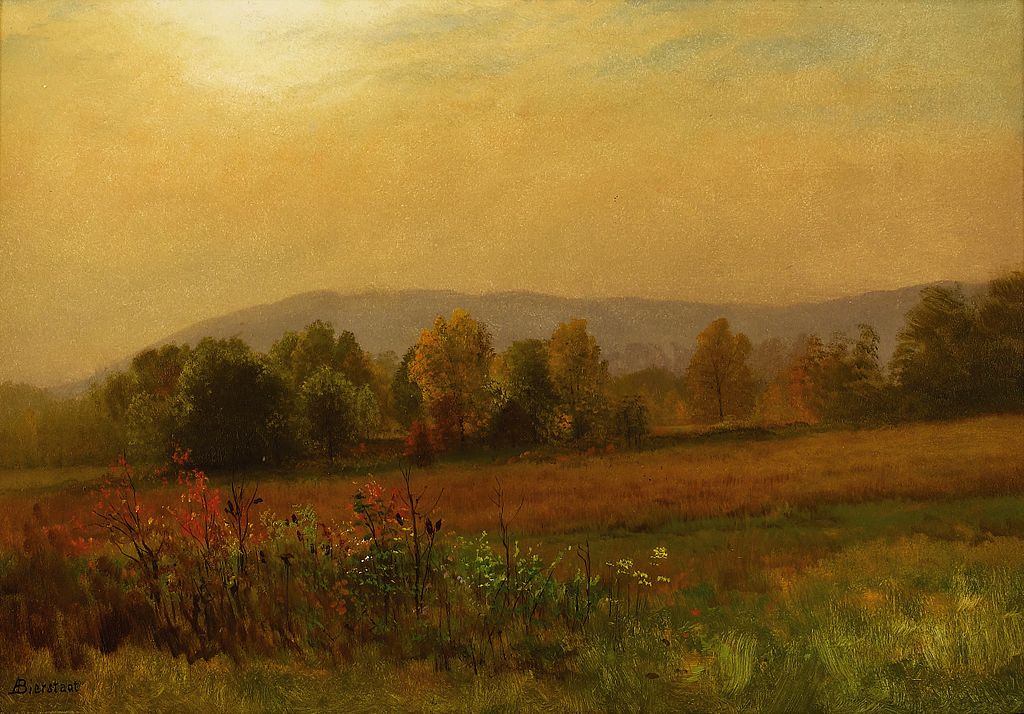
Albert Bierstadt - Autumn Landscape PD|100 via Wikimedia Commons

Albert Bierstadt – Autumn Landscape PD|100 via Wikimedia Commons

We have two adult children with epilepsy. Both were adults when they had their first seizures, with no prior warning signs.

Our daughter’s first serious seizure was at the age of 29. She has only been hospitalized once with serious injuries, and her medication controls her seizures well. She doesn’t like that she has it, but it doesn’t rule her life, and only rarely causes her trouble.

For our son, it hasn’t been that easy. He was 32 when he began having seizures. He has had more difficulty with his, both in accepting it and in getting it under control. Since the first major seizure, he has woken up in the hospital with serious injuries many times, not knowing how he got there.

Two weeks ago, our son had a breakthrough seizure and fell in a concrete parking lot, fracturing his skull. He had a severe concussion, an epidural hematoma, and lost a liter of blood.

This son is a software engineer and an entrepreneur. He was employed by Amazon for ten years, and was well compensated during his tenure there. He had just started his own company, writing software. He was completely focused on this, and was working 12 to 16 hour days, and getting little sleep, which is very bad for him.

But being who he is, he didn’t realize he was courting disaster.

We live two hours south of where this son lives. We got the phone call at 4:30 pm and threw our clothes into suitcases. Running out the door, we called a hotel near the hospital, and made the nerve-wracking trip up Interstate 5 to Redmond, Washington.

During the harrowing journey north, we discussed his possible long-term care, wondering how he could survive such a terrible injury with his intellect intact, wondering how we could care for him if his motor skills were too severely compromised.

But in a four-hour surgery, a wonderful neurosurgeon not only saved his life, but saved his quality of life. He emerged from the experience with no brain damage, and no loss of motor skills.

Our son’s head-injury was the same sort of thing that killed actors Ben Woolf and  Natasha Richardson. When you look at the way head head-injuries can kill otherwise healthy people, our son’s recovery is a miracle for which we are grateful.

Something intriguing happened with this incident. Our son has embraced life in a way he never has before. He woke up from the surgery in an incredibly different frame of mind.

Instead of wondering why this wretched condition has happened to him and focusing on the negativity of his situation, he is now looking at his life and appreciating it in a way he had not really done before.

When he left the hospital this time, his epilepsy was just something he has to deal with sometimes, and the rest of the time his life is good. His spirits are high and his recovery has been nothing short of miraculous.

If you couldn’t see the large wound on his head and the long, curving line of  stitches, reminiscent of a baseball seam in the way the long scar curves around his temple, you would never know he had undergone brain surgery only 12 days ago.

He is full of energy and ambition, and though he does tire easily, he will soon be back on track and moving forward with his current project which he intends to have on the market before January.

Sometimes, we find ourselves going for a spin in the blender of life. We never know what will happen next, and we have no control over how life affects us. But through all of this, the community of our friends supported us, and faith carried us through the dark hours when we didn’t know what his future would be.

There is so much worse out there–things that make this epilepsy thing pale in comparison. We are praying for a dear friend in Australia whose young daughter is fighting for her life, dealing with terrible complications of flu-b, necrotizing myositis. Her prognosis is grave, and  I know her parents are living in that land of fear and disbelief that I lived in for 24 hours.

We are supporting another friend here in the US, who is undergoing yet another surgery for kidney stones. What we have been through was scary, no doubt about it, but thanks to a wonderful neurosurgeon, it was nothing in the face of these ongoing life and death battles.

Epilepsy is a bitch, but it doesn’t have to rule our lives. Seizure incidents are inconvenient, and yes, we know they will occur when we least expect them. They can and will have a seriously negative impact on us. We know that the next time may not have such a good outcome but we can’t let fear ruin the joy and beauty that we have today.

The real news is not that our children have epilepsy–it is what happens the rest of the time.

We have five adult children with great careers and bright futures, two of whom also happen to have epilepsy.

8 Comments

Filed under Epilepsy, Humor, Uncategorized, writing

#amwriting: getting the word out

Old Restored booksYou have finished your book. It has been professionally edited and proofed. You hired an expensive cover designer to make the perfect cover that is both professional and eye-catching. You’ve done all the important things at Amazon and Goodreads, making author pages at both places.

You made a professional Facebook page, you are blogging once a week, you’ve joined twitter and use TweetDeck or Hootsuite to schedule tweets, and check it every day and sometimes retweet interesting things for other folks you are following. You’ve even joined Pinterest and  Instagram.

This all good, but even so, after the first rush, sales have dwindled off, and now you are at a loss of what to do to increase the visibility of your work.

Some folks join mutual promotion groups on Facebook. I have found them to be more aggravating than helpful as I get spammed by the same two authors daily–they are nice people, but they have no sense of how irritating that is. People on Facebook lose interest when they see the same books all the time.

Also, I have found the “99 cent boost groups” to be not as beneficial in the long-run as they promote themselves to be.

I’ve not figured out the magic key to gaining traction rapidly, but I do know that my Goodreads ad pays off in terms of sales, as when I receive more clicks on the ad, I sell more of those books.

Writing short stories and publishing my work gets my name out there, and each time I publish a chapter of the Bleakbourne on Heath series, on Edgewise Words Inn, I see a jump in sales. From what I can see, the only way to get your author name out there is to publish your work.

Shaun Allan has had great success getting his name out via WattPad, as has Paul Coelho. Yes, you are giving your work away, but it introduces YOUR work to potential readers who will buy your other work–and these two authors’ sales are excellent.

Asking other authors to promote your work is not really a good idea, because they have their own work to promote, and your agenda doesn’t always mesh with theirs.

If you have been out in the indie world for any length of time, you may have observed this scenario: Author A, charming and talented Facebook friend, asks Author B to be a part of their personal fan-club, working to get Author A more recognition. Author B does not have time for that–he is trying to get his own name out there. The author who was ‘recruited’  is shocked, and saddened that a friend has so little understanding and such a lack of respect for his work that she would expect that of him, but he doesn’t want to be unfriendly and thinks “well, maybe it’s only this once.”

But it’s not only the once. It’s a never-ending stream of “push my book, push my book.”

When he realizes he is being used as her personal assistant and free publicity agent, he refuses, as he feels that she has no respect for him as an author. She has a temperamental fit and unfriends him. He warns his other friends to beware of that author. While her rudeness may have been unintentional, it was a bit of an eye-opener to those who know her casually, a clue about her true character.

I’ve seen that scenario unfold several times–sometimes talented people are supremely egotistical and only associate with others if they will gain something from that association. Once they have achieved what they wanted, they have no further use for their ‘friend’ and quickly move on to more important pastures.

I try to stay away from toxic professional relationships, and believe me, the opportunities for that are plentiful in many author groups. When I like another author’s work, I would love to see that author succeed. If we are friends and they need a signal boost for a new book or an event, I will gladly tweet and perhaps mention what I like about their work on my blog. I will even mention that they are having an event, and will be signing books.

But I will not be their private publicity agent.

MetaMorphosis cover for WattPad copySo even though you desperately want to increase your visibility and sales, you have to be careful how you go about it. For indies, this is the sort of thing that has to flow two ways–Author A must support Author B as much as he/she expects Author B to support him/her.  Boosting the signal is a real bonus, and if a friend does this for you it should be reciprocated.

So do yourself a favor: post short stories on WattPad, and keep submitting to magazines and anthologies. Success is rarely an overnight thing–it is the culmination of the long hours and efforts you put into it.

Read METAMORPHOSIS on WattPad.

4 Comments

Filed under Publishing, Uncategorized, writing

#MindWandering: The Power of Downtime

Veneto,_Bartolomeo_-_Lucrezia_Borgia_(alleged),_detail_of_portraitDaydreaming…wasting time…selfish indulgence, or fountain of creativity?

WebMD says, quote:  “Daydreaming is looked upon negatively because it represents ‘non-doing’ in a society that emphasizes productivity,” says John McGrail, a clinical hypnotherapist in Los Angeles. “We are under constant pressure to do, achieve, produce, succeed.”

Wikipedia, the fount of all knowledge, describes Daydreaming as “a short-term detachment from one’s immediate surroundings, during which a person’s contact with reality is blurred and partially substituted by a visionary fantasy, especially one of happy, pleasant thoughts, hopes or ambitions, imagined as coming to pass, and experienced while awake.”

Apparently we daydream less as we get older. I wonder, is this nature, or nurture?

What really happens when we allow ourselves to just sit and think about nothing in particular? What happens on a neurological level when we let our minds off the leash, to run free and unencumbered?

One interesting fact is that apparently, if we daydream about the past, we tend to forget what we were doing before the daydream started. This happens to me all the time.

But most people don’t ponder the past. “Daydreaming is often about anticipating the future, especially in a fantasy context,” noted Peter Delaney, a psychologist at the University of North Carolina, Greensboro, in the July 3, 2013 issue of National Geographic.

'A_Girl_Copying_a_Drawing'_by_Martin_Drolling,_Pushkin_Museum PD 100 via wikimedia commonsAnd according to the Daily Mail, Prof. Moshe Bar, of the Gonda (Goldschmied) Multidisciplinary Brain Research Center, said, “Over the last 15 or 20 years, scientists have shown that – unlike the localized neural activity associated with specific tasks – mind wandering involves the activation of a gigantic default network involving many parts of the brain.”

Also, I have just learned that daydreaming turns off parts of your brain. It’s true–our brain has an analytic part that helps us make reasoned decisions, and an empathetic part that allows us to relate to others. Researchers have discovered that when you are daydreaming, your mind naturally cycles through the different modes of thinking, analytic and empathetic. Apparently, during this time the analytic and empathetic parts of your brain tend to turn each other off.

Another intriguing thing I have only just found out is that the physiology of the brain itself, and not the “mind” controls our daydreams. Anthony Jack, a cognitive scientist at Case Western Reserve University in Ohio says, “How we daydream and think depends on the brain’s structure. …(That) structure is constantly changing in small ways—as we learn new things the connections between nerve cells change.” (Read “Beyond the Brain” in National Geographic magazine.)

We have long known that creative people are often guilty of daydreaming, but researchers have shown that daydreaming makes you more creative.

“Many times the ‘dialogue’ that occurs when the daydreaming mind cycles through different parts of the brain accesses information that was dormant or out of reach,” notes Eugenio M. Rothe, a psychiatrist at Florida International University. “Likewise, the daydreaming mind may make an association between bits of information that the person had never considered in that particular way.”

Autumn_Landscape_With_Pond_And_Castle_Tower-Alfred_Glendening-1869According to a study published in the Proceedings of the National Academy of Sciences, a wandering mind can impart a distinct cognitive advantage.

This means that daydreaming is actually good for you. It boosts the brain, making our thought process more effective. Apparently letting the mind wander allows a kind of ‘default neural network’ to engage when our brain is at wakeful rest, as in meditation, rather than actively focused on the outside world. When we daydream, our brain is freed up to process tasks more effectively.

This is good to know, because as an author I spend an astounding amount of time daydreaming, and I would hate to be simply wasting time!

(This post was first published September 15, 2015 on Edgewise Words Inn)

9 Comments

Filed under Publishing, Uncategorized, writer

#amwriting: Theme: chaos or stability

Fall of Angels L E Modesitt JrA common theme in fantasy is the juxtaposition of chaos and stability, or order. Good versus evil is a trope of the genre, and  evil is usually portrayed by taking one or the other of these concepts to an extreme.

Author L.E. Modesitt Jr. has taken the theme of chaos and order and built his Magic of Recluce series around the comparison and contrasts of the two, with each side being given the protagonists’ POV in different books as the series progresses. He has been able to really explore the way each side’s magic is expressed, and the moral and ethical values that each side holds dear.

Both sides consider themselves morally superior, and both sides are wary of those who walk that gray path in the middle, which allows Modesitt real opportunities to put his protagonists through the wringer.

Trumps_of_doomThe late Roger Zelazney’s brilliant Chronicles of Amber series also details the distinctions between Chaos and Order, and moral and ethical challenges of those who travel from reality to reality through the shadows, with each shadow growing more radical depending on the distance from Castle Amber (which represents Order).

In several of his works, elements of each are combined freely and interchangeably. Jack of Shadows and Changeling, for example, revolve around the tensions between the two worlds of magic and technology, or order and chaos.

But what is chaos, and what is order ?

Google defines Chaos as

Chaos definition

Google also defines Order as:

order definition

Either side of the coin, when taken to an extreme, can be truly evil.

Consider chaos, or AnarchyWhen a culture descends into anarchy, you have an absence of government and absolute freedom of the individual. While this frequently begins as an attempt to allow for individual freedoms without state interference, history shows that what follows is the emergence of a violent culture that is beyond the reach of law.  There is no law and no one capable of enforcing it. The strongest, most violent thugs rise to the top and frequently war with each other, while the common person is caught in the middle. Followers of each warlord are rewarded with the spoils of conquest, which are often goods taken from the common citizen who must somehow survive under that tyranny.

war and peaceNow let’s look at order: totalitarianism, or total order can also be a form of tyranny: everything is static and nothing changes. There is centralized control by an autocratic authority, combined with the political concept that the citizen should be totally subject to an absolute state authority. No divergence from the norm can be tolerated, and good, obedient citizens are rewarded, while deviants who are seen to be free-thinkers, intellectuals, and artists are persecuted and imprisoned, or killed.

Anarchy=instability and a breakdown of society. Totalitarianism=lack of growth and stagnation of society. For most people’s comfort, a good society allows for both law and creativity.

In extreme types of societies, power is everything, and drawing negative attention to yourself is dangerous. Thus chaos-based societies are usually represented in literature as having an underlying order that holds them together, and order-based societies are often represented as requiring the ability to grow and change, but within certain parameters.

The theme of order and chaos can really power a story-line, and the way you perceive them will not be the way another author sees them. L.E. Modesitt, Jr. and Roger Zelazney couldn’t be more different in the way they portrayed these concepts.

If you haven’t read Zelazney’s works, I highly recommend them.

Comments Off on #amwriting: Theme: chaos or stability

Filed under Fantasy, Publishing, Uncategorized, writing

#FlashFictionFriday: The Unfairness of Life

Flash Fiction Friday

THE UNFAIRNESS OF LIFE

pub-709319_1280 CC0 Public DomainI used to shoot pool down at the Drunken Sasquatch, the local watering-hole over on 15th  frequented by those of us who travel in…different…circles.

But not anymore.  I’m no longer welcome there, and it’s not my fault. I warned Alfredo that I don’t handle certain substances well.

But no, he just had to see if I was truthin’ when I said that…which I was.

But how is it only my responsibility?

When a person says they can’t handle a certain substance, don’t sneak it into their glass. I spit it out as soon as I recognized the tongue-tingling zing, but it was too late—I’d swallowed some.

So now I’m liable for a table and several chairs, the burn marks on the floor, and Sylvia Wannamaker’s new coat.

That’s okay, I do have a bit of gold stashed. But the embarrassment—to say nothing of being no longer allowed to play in November’s pool tournament—

I may not get over that anytime soon.

I’m just going to say it once.

If a dragon tells you he can’t handle carbonated beverages, believe him.

_____________________________________________

The Unfairness of Life © Connie J Jasperson 2015

Fantasy Dragon Wallpaper by NIM101 courtesy of wallpaperabyss.com

Fantasy Dragon Wallpaper by NIM101 courtesy of wallpaperabyss.com


If you happen to be at out and about Saturday the  10th of October, in the Renton area south of Seattle, stop in at the AFK E&E, and visit my friends who will be signing books and having a great time in general. They will be Reading in the Dark, and the event will run from 2:00pm to 9:00pm in the back left of the restaurant.

  • AFK Elixers & Eatery
  • 3750 E Valley Rd.
  • Renton, WA 98057

You will find these great authors: A.J. Downey, Jeffrey Cook, Lee French, Sechin Tower, Tina Shelton, and Shannon L. Reagan and several more. I can’t wait to see what they are offering us!

3 Comments

Filed under #FlashFictionFriday, Fantasy, writing

#GraceUnderFire: Mary Shelley

Mary Shelley Meme copyThe commonly publicized stories of famous men and women are generally focused on their great victories and glorious successes, and rarely touch for long on the less-than-glorious moments in their careers.

And, while I am always inspired by great successes, I am far more intrigued by how the heroes and heroines of history handled the most crushing, personal defeats.

One woman I deeply admire as much for the way she handled disgrace and loss as for her literary success, is Mary Shelley.

elopement memeThe year was 1814, and Mary Wollstonecraft Godwin was 17–young, even by the standards of the day–when she ran away with a married man. That man was Percy Bysshe Shelley, who was (until he eloped with Mary) a close friend of her father.

Mary was the daughter of the famous political philosopher William Godwin, and her mother was the pioneering philosopher and feminist, Mary Wollstonecraft.  Her father was the first modern proponent of anarchism, and (until recently) her late mother’s tempestuous history overshadowed her brilliant work as a writer, philosopher, and advocate of women’s rights. Her parents were Free Thinkers, and were notorious in their own rights.

Percy was the eldest legitimate son of Sir Timothy Shelley, 2nd Baronet of Castle Goring. Sir Timothy had himself produced an illegitimate child, which (in Percy’s eyes) made his  pious horror at his son’s transgressions seem rather hypocritical.

William Godwin was frequently in danger of going to debtors’ prison as his businesses regularly failed.  Good friends always rescued him, and long before beginning his relationship with Mary, Percy Shelley had agreed to bail the man he admired out of debt.

After their elopement, the enraged William Godwin refused to see them, but still demanded money to be given to him under another name, to avoid scandal. Their assertions that marriage was a matter of mind and God rather than the law fell on primly deaf ears.

640px-RothwellMaryShelleyMary viewed her father’s reaction to their elopement as both sanctimonious and motivated by greed. It does appear that way, in view of his past and his political views, and also in view of the liberal way in which he had raised her after her mother’s death.

But beyond Sir Timothy Shelley and William Godwin’s hypocrisy, the couple faced intense censure from society at large, and paid a heavy price for the choices they had made.

After the suicide of Percy’s 1st wife, Harriet, and his subsequent marriage to Mary, the Chancery Court ruled Percy Shelley morally unfit to have custody of his children, despite Mary’s desire to raise them. In what was a well-publicized case, Percy’s children were placed with a clergyman’s family.

Mary ShelleyDespite having her personal business widely discussed and being snubbed by people she had believed to be her friends, Mary refused to behave as an outcast, writing and living as normal a life as she was able. Forced to live abroad to escape creditors, Mary and Percy found their exile from England hard to bear, despite their famous (and infamous) circle of friends who were exiled for much the same reasons.

When faced with the suicide of her sister Fanny and the deaths of three of her children, Mary suffered a deep depression. She retreated into her writing, and her husband retreated into confusion. Nevertheless, in public she carried herself with grace and dignity, no matter what was said or implied about her. During that time, Percy wrote:

My dearest Mary, wherefore hast thou gone, And left me in this dreary world alone? Thy form is here indeed—a lovely one—But thou art fled, gone down a dreary road That leads to Sorrow’s most obscure abode. For thine own sake I cannot follow thee. Do thou return for mine.

frankenstein (1)At the age of twenty-two she found herself a widow, and spent the rest of her life raising her only living son, writing, and getting Percy’s works published. Her life with Percy had been a struggle in many ways, far beyond the obvious, but no man ever captivated her more than he had. The wild passion she felt for him was as much spiritual as it was carnal, a true meeting of minds.

They were young, and although he loved her body and soul, he was not entirely faithful to her, and didn’t hide his infidelity from her. They lived beyond their means and were hounded by creditors, which could have meant debtor’s prison. In Mary’s eyes, that lack of security was far more difficult to endure than sly comments about her perceived bad behavior.

Mary Shelley was brave in what she published, and wrote her political thoughts into her novels and essays boldly, despite women having no right to voice their ideas. She believed in the Enlightenment idea that “People can improve society through the responsible exercise of political power,” but she also feared that the reckless exercise of power would lead to chaos, and her works reflect this belief.

the last man, shelleyHer works reveal her as much less optimistic than her radical parents, Godwin and Wollstonecraft. She doubted her father’s theory that humanity could eventually be perfected.

Even her early works are critical of the way in which 18th-century thinkers, such as her parents, believed radical political changes could be brought about. It has been pointed out that the creature in Frankenstein reads books associated with radical ideals, but the education he gains from them is ultimately useless.

Mary supported her son with her writing, and a small stipend she managed to squeeze from Sir Timothy, who wrote into his will that she should pay it back when her son inherited the title and estate. She was never accepted or acknowledged by her father-in-law, although her son did live to inherit his title and estate.

How people find the strength to hold their heads up in the face of public humiliation, personal tragedy, and intense social ostracism is, to me, a far more intriguing story than their successes. Anyone can ride the wave of glory–it takes a person of great character to surf the shoals of public disaster with grace and step on shore with confidence and their dignity intact.

6 Comments

Filed under Literature, Uncategorized, writing

#Inspiration: Seeking truth and beauty via Wikimedia Commons

Seljalandsfoss,_Suðurland,_Islandia,_2014-08-16,_DD_201-203_HDR

Inspiration.

It can be found in nature, and through the eyes of the artist or photographer. Through the miracle of the internet, I can find inspiration any time of the day or night, just by seeing what the picture of the day at Wikimedia Commons is. This was today’s gorgeous, surreal image: Sunset view from the back of the Seljalandsfoss waterfall, photo by Diego Delso, Wikimedia Commons, License CC-BY-SA 4.0.

Stiftskirche_Herzogenburg_Deckenfresken_01Several days ago, the image of the day was architectural: The ceiling frescos in Herzogenburg Monastery Church (Lower Austria). The church was consecrated on October 2nd, 1785. This image was uploaded by an author who uploaded with the user name Uoaei1, but who has won many awards for his/her images.

Roosa_hommikuudu_Tolkuse_rabasThen there was this gorgeous photograph by Märt KoseMorning in Tolkuse bog, Luitemaa Nature Conservation Area, Pärnu County, Estonia.

Inspiration in breathtaking images, free of cost, available for anyone, rich or poor. Everyday, a new picture is chosen as the image of the day, and if you like the artist, you can check out more of his/her works as, I did Diego Delso:

Iglesia_de_San_Colmano,_Schwangau,_Alemania,_2015-02-15,_DD_15Winter landscape of St Coloman church (de), photographed by Diego Delso, and located in Schwangau, Bavaria, southern Germany. St Coloman church is of baroque style and was constructed, the way it is today, in the 17th century in honor to Saint Coloman, replacing a chapel of the 15th century. The Irish pilgrim is said to have taken a break at this spot in his pilgrimage to the Holy Land in 1012.

I can visualize the crusaders riding in this winter landscape. I would have stopped there too!

The imagination transforms the beauty around us, and we create “what ifs” via the written word or the canvas and paint. This is why I always find myself looking at paintings too, when I am visiting Wikimedia Commons. I leave you with two images of a palace, seen though the eyes of two different artists:

Palacio_de_Nymphenburg,_Múnich,_Alemania,_2015-07-03,_DD_01-18_HDR_PAN

Panoramic View of the Nymphenburg Palace, Diego Delso, Wikimedia Commons, License CC-BY-SA 4.0

Nymphenburg, View From the Seaside painting by Joseph Wenglein 1883

Nymphenburg, View From the Seaside painting by Joseph Wenglein 1883 PD|100

The first is a photograph is the Panoramic View of the Nymphenburg Palace as seen through Diego Delso’s camera-eye and posted on Wikimedia Commons using the License CC-BY-SA 4.0. The painting below that is the palace as seen through the artist Joseph Wenglein‘s eye, A Seaside View of Nymphenburg Palace

Both images are the creations of artists using different mediums, both are of the same baroque palace in Munich, Bavaria (southern Germany). The palace is the main summer residence of the former rulers of Bavaria of the House of Wittelsbach. It was designed by Agostino Barelli and constructed by order of Ferdinand Maria and Henriette Adelaide of Savoy in 1664. Famous for its symmetry and extravagant beauty, the palace was expanded and redesigned several times until the last modifications in 1826.

More than 125 years separate their visions, but I am connected with and inspired by both artists because I, a middle-class woman in a rural town, can view and admire their work.

1 Comment

Filed under Fantasy, Humor, Uncategorized, writing