WordPress Block Editor work-around part 1: how to find and use the classic editor toolbar #amblogging #wordpressfail

WordPress has decided to force us all to use Gutenberg, their Block Editor. This has created a new, less intuitive, and needlessly complicated “blogging experience” for those of us who regularly write posts. I’ve been at this since 2011 and despise being told I’m having a “blogging experience.” I write words and add pictures, for the love of Tolstoy. All I need is a simple, easy-to-use toolbar, which we did have in the classic editor and the old Admin Dashboard.

I don’t “experience,” and I don’t want to.

block editor failLIRF04042021While this mess of a blogging experience is utterly the worst example of bored people who aren’t bloggers deciding to fix a product that wasn’t broken, there are ways to make it work. Since we’re stuck with it, I will share what I’ve figured out.

There are two significant aspects of writing blog posts that I intend to cover this week. Today I am focusing on the easiest way to produce a decent-looking post despite WordPress’s efforts to the contrary. In the next post, I will cover the easiest way to insert and position images.

Step one: Write your post in a document. I use Word, but Google Docs or Open Office are great—any kind of word-processing document is fine.

Step two: After you’ve written it, let it sit for a day or two and then come back to it and check it for spelling and typos.

  1. Have the Read Aloud Function read it back to you and make changes as required. Trying to accurately make changes once it has been uploaded is a nightmare, so make it as perfect as you can before you upload it to WordPress.
  2. Use Grammarly or Pro Writing Aid to check for spelling and typos if you have access to them. They’re not cheap, so go out online and use the free versions—you’ll be glad you did.

Step three: Open WordPress by clicking on My Sites in the upper left corner of your website. Click on Posts and click on Add new Post.

Step four: Schedule your post now so that it posts when you want it to. You have to click on the word “Immediately” in the right-hand menu, but when you do, a calendar will pop out, and you can schedule it then. Click on the calendar when you’re done but hit save draft.
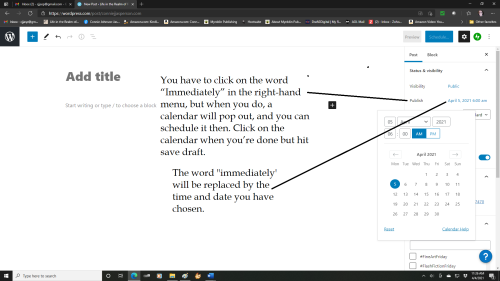
schedulingPostsLIRF04042021

Step five: Select a category and add your tags, and hit save draft.

Step six: Hit the little blue square with the white plus sign in the upper left. It will turn black when you select it. An extensive, complicated menu will open. Look for the tiny little icon that looks like a keyboard. THIS IS THE CLASSIC EDITOR TOOLBAR. Click on it. A gray bar will appear on your screen. Click on that, and the old classic editor toolbar will appear.

Classic Editor Icon

BE WARNED: Any time you click on the body of your post, it may revert to the Block Editor. You may have to keep clicking on the classic editor.
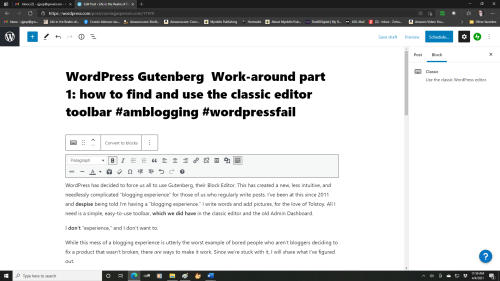
classic editor toolbar

Open your document and copy the title. Paste the title into the place marked title and hit save draft.

Step seven: Copy your document and paste it into the body of your post. Hit save draft.

When it comes to Grammarly and Pro Writing Aid, look at each instance the program flags, and then decide to change or keep it. Don’t just blindly accept their suggestions because they work on algorithms, not intuition.

I write my posts in advance because I want to make my work as clean and free from bloopers as possible. However, as my regular readers know, I don’t always catch typos and other things. In my word document, I use Grammarly to spell check and find most errors. Then I have the Read Aloud function of Word read my post to me. Hearing the mechanical voice read it back, I always find things Grammarly missed.

First of all, you must understand that each paragraph is a “block.” If you write your posts in a word document as I do and then copy and paste them, each paragraph will be its own entity. Try to remember this if you must make edits after you’ve pasted it into the body of the post, even if you use the classic editor.

Inserting and positioning images is much easier with the classic editor toolbar. I will discuss this in my next post.
13 Comments

Filed under writing

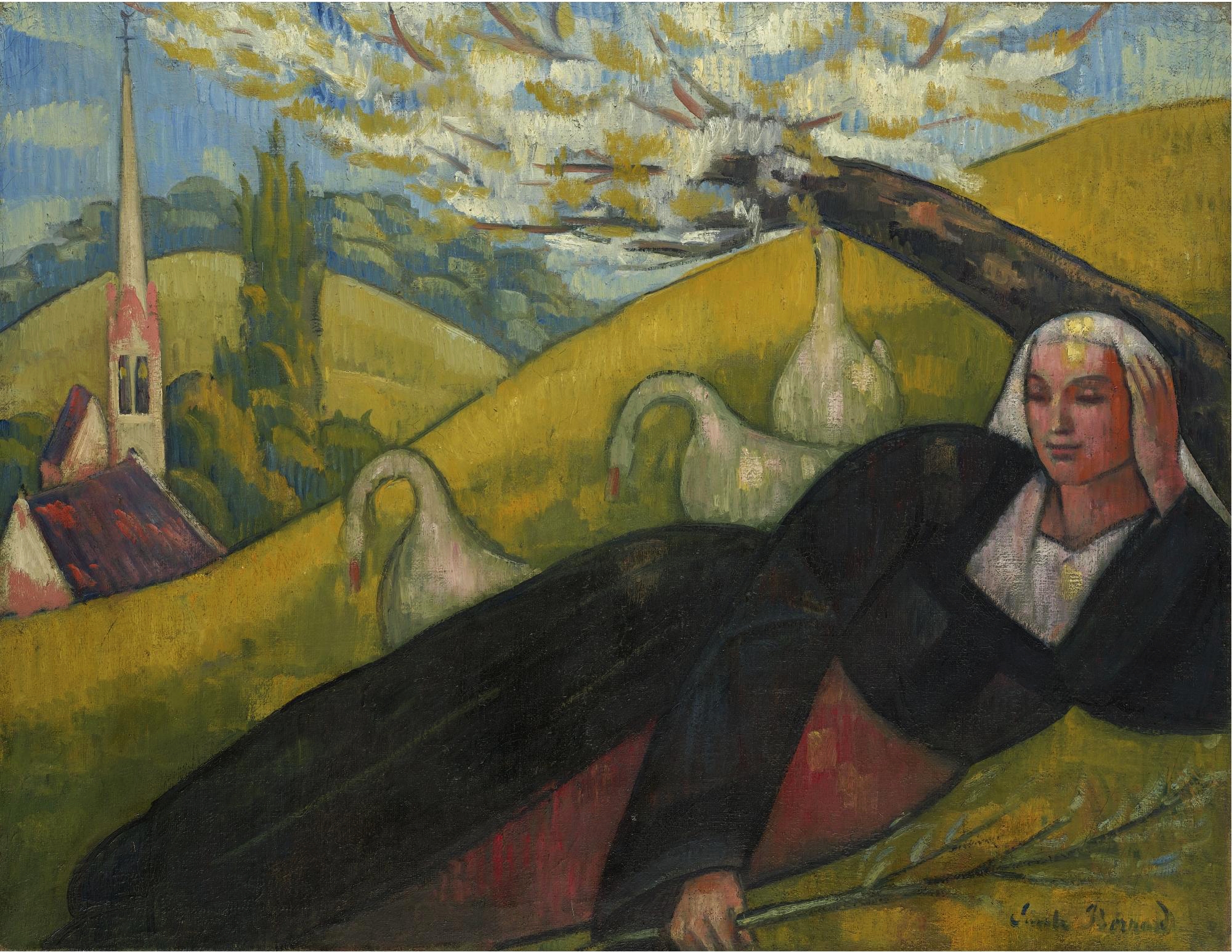
#FineArtFriday: Le repos à Pont-Aven (La gardeuse d’Oise) by Émile Bernard

Émile_Bernard_-_Le_repos_à_Pont-Aven

Artist: Émile Bernard  (1868–1941)

Title: Le repos à Pont-Aven (La gardeuse d’Oise) [English: Rest in Pont-Aven (The Keeper of Oise)]

Medium: oil on canvas mounted on cardboard

Dimensions: Height: 85.1 cm (33.5 in); Width: 110 cm (43.3 in)

Inscriptions    Signature bottom right: Emile Bernard

What I love about this painting:

Whoever this woman is, she is determined to enjoy the day. The geese don’t mind, and spring is in full swing. The tree (an apple tree?) leans sharply above as if to shade her. Why shouldn’t a hard-working woman take a well-deserved rest?

The style is intriguing, straight lines of the church against the round lines of the landscape, the woman, and the geese.

About the Artist, Via Wikipedia, the Free Encyclopedia:

Émile Henri Bernard (28 April 1868 – 16 April 1941) was a French Post-Impressionist painter and writer, who had artistic friendships with Vincent van GoghPaul Gauguin and Eugène Boch, and at a later time, Paul Cézanne. Most of his notable work was accomplished at a young age, in the years 1886 through 1897. He is also associated with Cloisonnism and Synthetism, two late 19th-century art movements. Less known is Bernard’s literary work, comprising plays, poetry, and art criticism as well as art historical statements that contain first-hand information on the crucial period of modern art to which Bernard had contributed.


Credits and Attributions:

Wikimedia Commons contributors, “File:Émile Bernard – Le repos à Pont-Aven.jpg,” Wikimedia Commons, the free media repository, https://commons.wikimedia.org/w/index.php?title=File:%C3%89mile_Bernard_-_Le_repos_%C3%A0_Pont-Aven.jpg&oldid=292287019 (accessed April 1, 2021).

Émile Bernard, Public domain, via Wikimedia Commons

Wikipedia contributors, “Émile Bernard,” Wikipedia, The Free Encyclopedia, https://en.wikipedia.org/w/index.php?title=%C3%89mile_Bernard&oldid=1014462432 (accessed April 1, 2021).

Comments Off on #FineArtFriday: Le repos à Pont-Aven (La gardeuse d’Oise) by Émile Bernard

Filed under #FineArtFriday, writing

Writing the Short Story part 2: indirect speech #amwriting

In a short story, our words are limited, so we must craft our prose to convey a sense of naturalness. Scenes have an arc of rising and ebbing action, so let’s consider how conversation fits into the arc of the scene.

J.R.R. Tolkien said that dialogue must have a premise or premises and move toward a conclusion of some sort. If nothing comes of it, the conversation is a waste of the reader’s time.

What do we want to accomplish in this scene? Ask yourself three questions.

  1. Who needs to know what?
  2. Why must they know it?
  3. How many words do you intend to devote to it?

My rule of thumb is, keep the conversations short and intersperse them with scenes of actions that advance the plot.

Author James Scott Bell says dialogue has five functions:

  1. To reveal story information
  2. To reveal character
  3. To set the tone
  4. To set the scene
  5. To reveal theme

So now that we know what must be conveyed and why, we find ourselves in the minefield of the short story: 

  • Delivering the backstory.

Don’t give your characters long paragraphs with lines and lines and lines of uninterrupted dialogue. A short story has no room for bloated exposition.

Let’s look at a scene that opens upon a place where the reader and the protagonists must receive information. The way the characters speak to us can take several forms:

  1. Direct discourse. Nattan said, “I was going to give it to Benn in Fell Creek, but he wasn’t home, and I had to get on the road.”
  2. Italicized thoughts: Nattan stood looking out the window. Benn’s not home. What now?
  3. Free indirect speech: Nattan stood looking out the window. Benn wasn’t home, so who should he give it to?

Examples two and three are versions of indirect speech, which is a valuable tool in your writer’s toolbox

Wikipedia describes free indirect speech this way:

Free indirect speech is a style of third-person narration which uses some of the characteristics of third-person along with the essence of first-person direct speech; it is also referred to as free indirect discoursefree indirect style, or, in Frenchdiscours indirect libre.

Free indirect discourse can be described as a “technique of presenting a character’s voice partly mediated by the voice of the author” (or, reversing the emphasis, “that the character speaks through the voice of the narrator”) with the voices effectively merged. This effect is partially accomplished by eliding direct speech attributions, such as “he said” or “she said”.

The following is an example of sentences using direct, indirect and free indirect speech:

  • Quoted or direct speechHe laid down his bundle and thought of his misfortune. “And just what pleasure have I found, since I came into this world?” he asked.
  • Reported or normal indirect speechHe laid down his bundle and thought of his misfortune. He asked himself what pleasure he had found since he came into the world.
  • Free indirect speechHe laid down his bundle and thought of his misfortune. And just what pleasure had he found, since he came into this world?

According to British philologist Roy Pascal, Goethe and Jane Austen were the first novelists to use this style consistently and nineteenth century French novelist  Flaubert was the first to be consciously aware of it as a style. [1]

When I began writing seriously, I was in the habit of using italicized thoughts and characters talking to themselves as a way to express what was going on inside of them.

That isn’t necessarily wrong. When used sparingly, thoughts and internal dialogue have their place. When they are used as a means for dumping information, they can become a wall of italicized words.

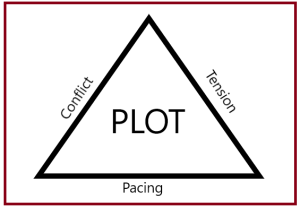
The_Pyramid_Conflict_Tension_Pacing

In the last few years, as I’ve evolved in my writing habits, I am drawn more and more to the various forms of free indirect speech as a way of showing who my characters think they are and how they see their world.

The main thing to watch for when employing indirect speech in a short story is to stay only in one person’s head. Remember, short stories are limited for space, so it’s essential to only tell the protagonist’s story.

In  longer pieces, such as novels, you could show different characters’ internal workings provided you have clear scene or chapter breaks between each character’s dialogue.

If you aren’t careful, you can slip into “head-hopping,” which is incredibly confusing for the reader. First, you’re in one person’s thoughts, and then another—it’s like watching a tennis match.

When you are limited in word count, you must find the most powerful ways to get the story across with a minimum of words. Showing important ruminations as an organic part of the unfolding plot is one way to give information and reveal a character while keeping to lean, powerful prose.


Credits and Attributions:

[1] Wikipedia contributors, “Free indirect speech,” Wikipedia, The Free Encyclopedia, https://en.wikipedia.org/w/index.php?title=Free_indirect_speech&oldid=817276599 (accessed March 30, 2021).

7 Comments

Filed under writing

Writing the Short Story part 1: experimenting #amwriting

Before we begin, I hope you’ll bear with me as I learn to use the unnecessarily complicated dashboard WordPress calls “Gutenberg.” For a person who relies on images as much as I do, this isn’t a good fit, but I will make it work. They have removed the Admin Dashboard, which was perfect for uploading and positioning images and text. Please bear with me as I find ways to write my posts despite being forced to use the least intuitive dashboard the geniuses at WordPress could have come up with.


When it comes to learning how to write, experimentation is good. The best form for learning learning to write in different styles and genres is the short story.

Last week, we discussed why authors should write short stories and looked at one way to lay out the story arc. There are other ways, but that is my most commonly used method. If you are curious, this is the post: Gaining Readers Through Writing Short Stories.

This week we are going deeper into the many elements of writing a good, gripping story. Most of these features will be found in any length of story, from drabbles to novels. Today we are still focusing on getting all the elements into a piece that is less than 2,000 words long.

Before we go on, we need to remember that setting, atmosphere, and mood are intertwined.

Today’s example is from The Iron Dragon, a 1,025-word story I wrote during NaNoWriMo 2015. That was the year I focused on experimental writing, putting out at least one short story every day, and sometimes two.

The first paragraph of the Iron Dragon begins in the middle of a story:

Earl Aeddan ap Rhydderch turned his gaze from the mist to the strange iron road that emerged from it and then to where the road entered the cave. “Tell me again what happened.”

The opening sentences establish the story, set the scene, and introduce the first protagonist. The following three paragraphs show the world and establish the mood:

The peasant who had guided the earl and his men said, “The mist, the iron road, and the cave appeared yesterday, sir. We saw the beast entering its lair, and a fearful thing it is, too. No one dares to approach it, but the monster can be heard in there. It’s a most dreadful dragon — we found the carcass of a large wolf that had been torn to shreds, trampled until it was nigh unrecognizable.”

The man’s companion said, “Everyone knows wolves are Satan’s hounds. It must have angered its hellish master. We found it lying cast to one side of the Devil’s Road.”

Aeddan looked back to the iron road, seeing where it emerged from the mist. He walked to the low-hanging fog bank, seeing that the road vanished just after it entered the mist, leaving no marks upon the soil. He turned and strode back to the peasants. “I agree it’s the work of the Devil, but why does the Lord of Hell require an iron road that leads nowhere?”

The paragraphs that follow present the danger, the problem Aeddan must overcome:

A faint grumbling sounded beneath Aeddan’s feet. “A light! Look to the mist!” shouted one of his men.

Turning, Aeddan saw a white glow forming in the fog as if a large lamp approached from a great distance. “That’s no ordinary lantern. Mount up!” Moving quickly, he leaped into his saddle and turned his steed to face the demon.

A few sentences further on, I showed more of the world at the same time as I introduced the antagonist:

The light deep within the fog grew and strengthened, as did the rumbling noise.  It waxed brilliant, and the earth shuddered as if beneath the pounding of a thousand hooves. Smoke filled the night air, reeking of the sulfurous Abyss, combined with a howling as cacophonous as the shrieks of all the damned in Hell.

What emerged from the mist was impossible — an Iron Dragon of immense height and girth.

At this point, Aeddan knows that he must resolve the problem and protect his people:

The fiery light emanating from the burning maw lit the night, and the ground shook as the beast roared and raced ever closer. As the beast sped toward him, a burning wind blowing straight out of Hell knocked Aeddan and his horse to the side of the Devil’s Road, and using that opportunity, the Iron Dragon thundered past him, heading into its lair.

Stunned, Aeddan scrambled to his feet, staring as the beast passed him by, the body taller than a house and long, like an unimaginably giant, demonic centipede. The length of the beast was incomprehensible, lit by the fire within and glowing with row upon row of openings. The faces of the damned, souls who’d been consumed by the ravening beast peered out as they flashed by. Sparks flew from its many hooves.

Terrified his men would be crushed by the immense creature, he shouted for them to back off, his voice drowned by the din.

There is more to Aeddan’s side of the story, of course. But in what you have read already, you have made some guesses and are already aware that this is a story with two sides. Aeddan’s point of view is not the entire story.

Again, we must set the scene and establish the mood and characters. Here we meet the second protagonist, an engine driver named Owen:

Mist shrouded the small valley just outside of the village of Pencader. Engine Driver Owen Pendergrass looked at his pocket watch and opened the logbook, noting the time and that they had just departed Pencader Station. He said to the fireman, Colin Jones, “We should be approaching the tunnel, though it’s hard to tell in this mist. We’re making good time despite the fog. We’ll be in Carmarthen on schedule.”

“Sir! Look just ahead! What…?” Colin pointed ahead.

A group of mounted men dressed as medieval knights, complete with lances lowered as if prepared to joust, appeared out of the mist, attempting to block their path. “God in heaven — what next!” Blowing the whistle to scare them off the tracks, Owen pulled the brake cord, but there was no way the train could stop soon enough. In no time at all, the train was upon the knights, scattering them and blowing past. Owen looked out the window to see if they’d survived, but they were gone as if they’d never been.

The final paragraphs wind it up. They also contribute to the overall atmosphere and setting of the second part of the story. The story in its entirety can be read here: The Iron Dragon. It is an imperfect story, but as a practice piece, it has good bones. I didn’t feel that particular piece was suitable for submission to a magazine or contest.

Word choices are essential in showing a world and creating an atmosphere that feels believable. I had challenged myself to write a story that told both sides of a frightening encounter in 1000 words, give or take a few. I also wanted to show two aspects of a place in Wales but tell one story as lived by two protagonists separated by twelve centuries and a multitude of legends.

This brings me back to the layout aspect of a short piece. Some speculative fiction stories work well when the flow of the story arc is shaped like an infinity sign, a figure-eight laying on its side:

Instead of the usual bridge shape, the story arc begins in the middle, circles around, comes back to the middle, and circles around a different way. It ends where it began.

Writing short fiction offers me the chance to experiment with both style and genre. It challenges me to build a world in only a few words and still tell a story with a beginning, a middle, and an end.

Sometimes what I turn out is worth sharing, and other times, not so much. The act of writing something different, a little outside my comfort zone, stretches my ability to “think widely.” It makes me a better reader as well as a better writer.

>>><<<                                   >>><<<                                   >>><<<

Credits and Attributions:

Excerpts from The Iron Dragon, by Connie J. Jasperson, ©2015-2021 All Rights Reserved.

Comments Off on Writing the Short Story part 1: experimenting #amwriting

Filed under writing

#FineArtFriday: Self-Portrait as a Distressed Poet by Augustus Leopold Egg

About the Artist, via Wikipedia:

Leopold Augustus Egg was born to Joseph and Ann Egg, and baptised in St James’s Church, Piccadilly, on 30 May 1816. He had an elder brother, George Hine Egg.

His father Joseph Egg was a wealthy gunsmith from the distinguished gun making family, who immigrated to London from Huningue, Alsace. Egg was educated in the schools of the Royal Academy, beginning in 1836. Egg was a member of The Clique, a group of artists founded by Richard Dadd and others in the late 1830s (c. 1837). Egg sought to combine popularity with moral and social activism, in line with the literary work of his friend Charles Dickens. With Dickens he set up the “Guild of Literature and Art”, a philanthropic organisation intended to provide welfare payments to struggling artists and writers. He acted the lead role in “Not So Bad As We Seem,” a play written by Edward Bulwer-Lytton to raise funds for the organization. His self-portrait in the role is in Hospitalfield House in Arbroath.

Egg’s early paintings were generally illustrations of literary subjects. Like other members of The Clique, he saw himself as a follower of Hogarth. His interest in Hogarthian moral themes is evidenced in his paired paintings The Life and Death of Buckingham, depicting the dissolute life and sordid death of the Restoration rake George Villiers, 2nd Duke of Buckingham. Yet his paintings often took a humorous look at their subjects, as in his Queen Elizabeth Discovers she is no longer Young (1848).

———————————————————————————–

Credits and Attributions:

Wikimedia Commons contributors, “File:Self Portrait as a Distressed Poet Augustus Leopold Egg (1816–1863) Hospitalfield.jpg,” Wikimedia Commons, the free media repository, https://commons.wikimedia.org/w/index.php?title=File:Self_Portrait_as_a_Distressed_Poet_Augustus_Leopold_Egg_(1816%E2%80%931863)_Hospitalfield.jpg&oldid=530289957 (accessed March 26, 2021).

Wikipedia contributors, “Augustus Egg,” Wikipedia, The Free Encyclopedia,https://en.wikipedia.org/w/index.php?title=Augustus_Egg&oldid=1005078766 (accessed March 26, 2021).

Comments Off on #FineArtFriday: Self-Portrait as a Distressed Poet by Augustus Leopold Egg

Filed under #FineArtFriday, writing

Gaining readers through writing short stories #amwriting

We all want to gain readers. How do you, as an indie, get your name out there and gain awareness of your work? You earn your “street creds” by writing short stories and submitting them to magazines, anthologies, and contests.

Every time your short work is published or wins an award, you gain a little respect. You stand the chance of gaining fans, and it’s nice to have a little extra cash in your pocket.

Despite the changes in the publishing industry as a whole, writing short stories is still the way to increase your visibility. Reputable magazines that are SFWA approved are seeking submissions.

Submitting to contests is good too. If you have a story that was a contest winner, you may be able to sell it to the right publication. By doing this, you learn how to write to a specific length and theme.

I have a system for this. The following story has been used as an example here before. I wrote the original story for a 2015 contest with the theme of Truth and Consequences. The genre was epic fantasy, and the word limit was 2,000 words.

This meant my story had to adhere to that theme and word count, or it would not make the cut, no matter how well it was written.

My story was titled A Song Gone Wrong.

The Premise: Because he was a bit too specific when putting a local warlord’s fling with another man’s wife into song, our protagonist is now a wanted man. I had 2,000 words to show what happened.

I divided the story into four acts:

Act 1: the opening. I had 500 words to show these plot points:

  • Setting: the weather was unseasonably cold.
  • In an alley, a bard, Sebastian, hid from the soldiers of the lord he had humiliated.

My task in the first ¼ of the story was to introduce the protagonist so that his personality was clearly defined at the outset. I had to place him in the setting by showing the scents and sounds of his environment.

The theme, Truth and Consequences, had to be strongly shown throughout the story. Sebastian had told the truth and now faced consequences he was unprepared for.

My bard’s thoughts and observations were critical in this tale, but I had to be reasonable. At 2,000 words, I didn’t have a lot of room for mind wandering, especially in italics.

Another thing to consider was point of view—I went with first-person as I felt the protagonist could best show and interpret events and relate emotions while keeping to the number of words allotted.

Act 2: First plot point: I had 500 more words to show how:

  • The soldiers surrounded and captured Sebastian.
  • The irate lord threw him into prison and sentenced him to hang at dawn.

What Sebastian saw, smelled, and heard were the crucial means of showing the environment with a minimum of description from the first paragraph to the last.

Those noises and odors helped drive home the consequences part of the theme. Sebastian’s reactions told us a lot about who he was as a person.

So, where was this story going to go? I asked myself, “Does Sebastian regret being imprudent in mocking the nobleman, or does his punishment fire rebellion in him?” This was an opportunity for the circumstances to reveal his courage and still keep the plot moving forward.

I went with rebellion.

Act 3: Mid-point: I had 500 words to explain how:

  • Sebastian met a dwarf, Noli, also sentenced to die.
  • Noli was a member of an underground society trying to overthrow the current lord. He was on the verge of managing an escape, but time was short. He needed help with one last thing.
  • Noli and Sebastian managed to complete the escape route. Unfortunately, the guard seemed suspicious, hanging around their cell door, hampering their escape.

The whispered conversations between Noli and Sebastian gave us the background information. Noli had information Sebastian didn’t know.

This was the point when the reader also needed to know that information. Everything the reader already knew didn’t need repeating. Conversations were critical as they conveyed the personalities and the minimal backstory of the piece.

At this point, I set the final obstacle in their path.

This is where I have to emphasize one of my mantras: when writing to a strict word count limit, you must choose your words carefully. Find and use words that are strong and evocative, words that convey the most information concisely in one or two sentences.

Act 4: Resolution–I had 500 words to show how:

  • The smart guard was finally relieved by a less wary guard, which allowed Sebastian and Noli to squeeze through the escape route.
  • They were spotted at the last minute, but Noli’s friends were waiting, and they made their escape.

The fourth act is where you wind up the story and end it so that the reader feels satisfied. You hope they are left thinking about it, wondering what might have happened next.

Once you know how many words you are writing to and what must be done at what point within your story’s arc, you divide it into 3 or four acts. That is the way I structure most of my work.

This is true for any story, from 2000 to 20,000 to 200,000 words. Once you know the length a given tale must be, you can mentally divide it into acts and just write for fun.

I always outline short pieces that are intended for submission to contests, magazines, and anthologies. Magazines especially have strict parameters for what they accept, so you will have better success if you tailor that work to that particular publisher.

The contests and anthologies that are challenging to figure out are those whose guidelines tell you the theme but give you no indication of what genre they are looking for. You have no idea if the person reading your work prefers hard sci-fi or romance, so their personal preference can go against you.

That is a risk we all take. Remember, you have no control over what a prospective editor likes or dislikes. Rejections are more common than acceptance and shouldn’t be taken to heart. What one editor rejects, another will buy, so save it and submit it elsewhere.

Write short stories and only submit your best work. Expect to have them rejected and don’t take it personally. Turn them around and submit them elsewhere, because someone will accept it.

And always, always—celebrate the stories that you do sell.

11 Comments

Filed under writing

Writing Around the Distractions #amwriting #writerlife

Life has hit one of those inevitable snags, where writing has become more of a refuge than ever. My amateur nursing skills have been called into battle once again, as hubby has undergone a total hip replacement.

Four hours after the surgery, he was in the car, and we were going home. The minute the anesthesia wears off, they check the patient to make sure they’re alive and able to urinate, then send them home.

To be cared for by enthusiastic, panicking amateurs.

Two days in the hospital would have been better for him, but this is life in the USA. Even before COVID19, they sent patients home before they were able to care for themselves.

Thanks to having two children with seizure disorders and other family members with debilitating illnesses, I have acquired some of the skills necessary to handle this. My only problem is that he is 6’ 3” tall, and suffers from severe arthritis, so he has limited strength. I am just glad my brother is here to help when I need it.

We are 3 days into it, and hopefully, things will become easier as this next week progresses.

Everyone has family, jobs, external demands that limit the amount of time you can devote to writing. For me, the most important thing is to care for my family first. That means I do whatever housework is on for that day, make sure everyone is clean and fed, and if one of them is ill, I make sure they are comfortable and can rest.

I’m not a superwoman, so I do what I can around the house and don’t worry about what I didn’t get done. Some days that means just keeping a path cleared to the front door. Other days, the place is “fit for company,” as my grandma would say.

After surgery, blood clots can be a problem, so modern technology has devised an $80.00 solution, the PlasmaFlow Sequential Compression System. They are prescribed by a physician for use in the home to help prevent the onset of DVT (deep vein thrombosis) in post-surgical patients by stimulating blood flow in the extremities. They do this by stimulating muscle contractions. These are battery-operated, rechargeable cuffs that go around the patient’s calves.

The surgery was on Friday, so of course, they failed at about noon Saturday. This didn’t seem to surprise the on-call physician at the other end of the telephone. They quit charging, and we can’t get replacements until Monday. So, I am making sure he does some extra exercises and helping him do the ones he can’t yet do independently. Regular massage and exercise should do the trick.

Sleep the first night was like the first night you bring the newborn baby home. Sleep for an hour, get up to resolve something, sleep for an hour, get up to resolve something—not a lot of rest. But the second night, he was able to sleep straight through, so that was good.

I have plenty of downtime between things, though. That is when I write or work on whatever revisions are needed. You would be amazed at what you can get done in ten-minute bursts.

The fact is, I rarely watch television. While I do play a little Stardew Valley (see my game review here), my real interests are reading and attempting to write the stories I wish I could read.

This week I have been trying to think up decent titles for two of my works in progress. So far, nothing has risen to the top. “Accidental Novel” is a fair enough working title but probably won’t sell the book.

Before hubby went in for surgery, I sent my Accidental Novel to my structural editor for a beta read. I have a gut feeling that the ending is weak, so I asked her to give me any thoughts on reworking it. All the rough spots will be resolved once I get Irene’s revision notes back. The external eye is crucial at this stage. Having a trusted reader who is also an excellent editor is a gift from heaven.

So, all in all, life is good. Once we get through this week, my husband should be on the road to better health, and we will be able to settle into a routine.

Life can be a bumpy road. The key is to focus on the good things and laugh at the annoyances. Make a little time to do what you love, and always make time for the people you love.


Credits and Attributions:

We Can Do It, by J. Howard Miller, Restored by Adam Cuerden, Public domain, via Wikimedia Commons

4 Comments

Filed under writing

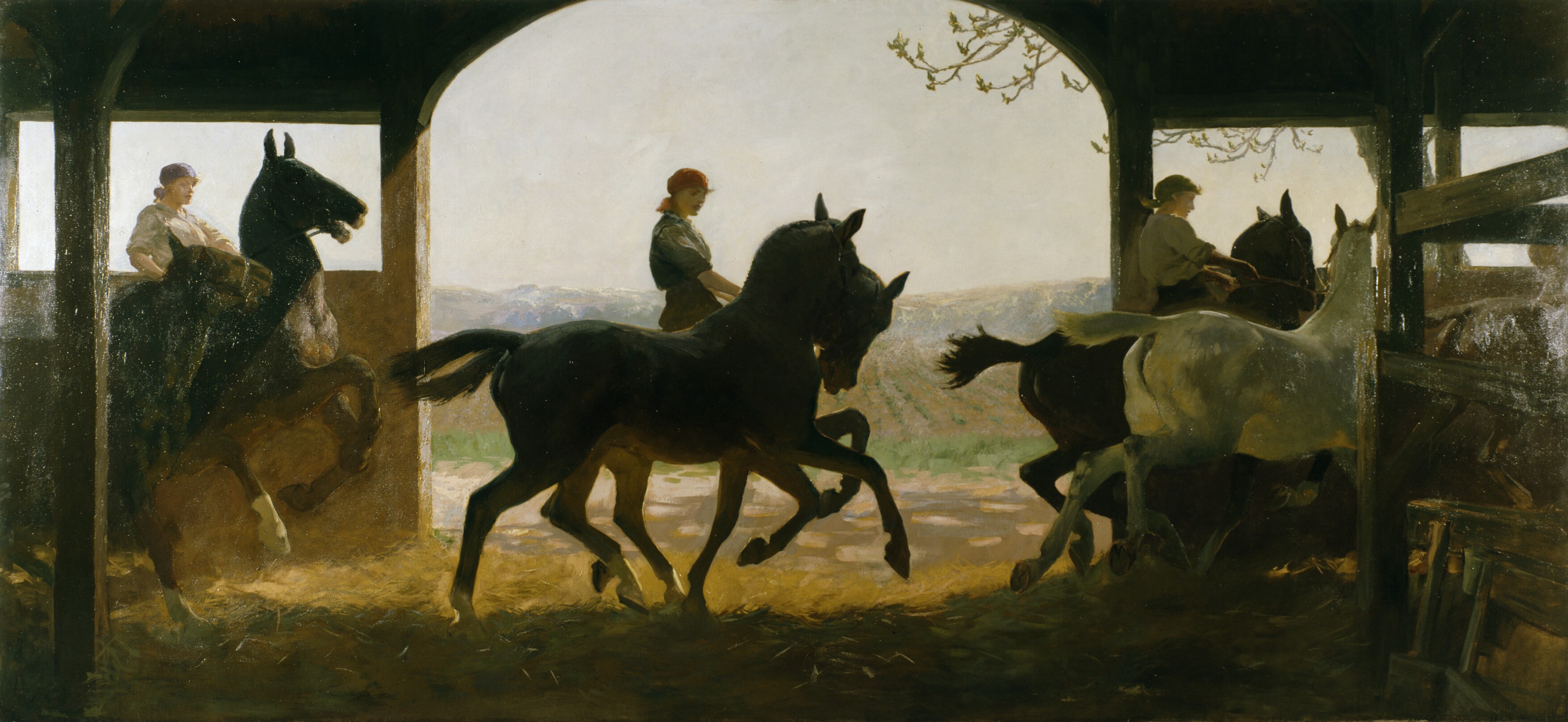
#FineArtFriday: The Straw Ride – Russley Park Remount Dep’t, Wiltshire by Lucy Kemp-Welch

About this painting, via Wikipedia:

Three women exercising horses in a remount depot. They take their charges through their paces in an indoor straw ride. Each woman rides one horse and leads another.

During World War One women were employed at Army Remount Depots in training and preparing horses for military service. Kemp-Welch was commissioned by the Women’s Work Section of the Imperial War Museum to paint a scene at the largest such depot, one staffed entirely by women, at Russley Park in Wiltshire. The Museum authorities were unhappy with the painting, The Ladies Army Remount Depot, Russley Park, Wiltshire which Kemp-Welch first submitted but were aware of a larger and much better composition on the same subject that she had painted and intended to sell to a private client for £1,000. Kemp-Welch agreed that the second painting, The Straw-Ride- Russley Park, Remount Dep’t Wiltshire was the better of the two and agreed to sell it to the IWM to fulfill her commission. However, she was unable to agree a fee with the Women’s Work Section and after protracted discussions, donated it free of charge to the Museum.


About the Artist, via Wikipedia:

Lucy Elizabeth Kemp-Welch (20 June 1869 – 27 November 1958) was a British painter and teacher who specialized in painting working horses. She is best known for the paintings of horses in military service she produced during World War One and for her illustrations to the 1915 edition of Anna Sewell’s Black Beauty.

In 1924, for the Royal Exchange, Kemp-Welch designed and completed a large panel commemorating the work of women during World War One. From 1926 onwards she focussed on depicting scenes of gypsy and circus life and spent several summers following Sanger’s Circus, recording the horses.

She resided in Bushey, Hertfordshire for most of her life and a major collection of her works is in Bushey Museum. They include very large paintings of wild ponies on Exmoor, galloping polo ponies, the last horse-launched lifeboat being pulled into a boiling sea, heavy working horses pulling felled timber and hard-working farm horses trudging home at the end of the day.


Credits and Attributions:

Lucy Kemp-Welch, Public domain, via Wikimedia Commons

Wikimedia Commons contributors, “File:The Straw Ride- Russley Park Remount Dep’t, Wiltshire Art.IWMART3160.jpg,” Wikimedia Commons, the free media repository, https://commons.wikimedia.org/w/index.php?title=File:The_Straw_Ride-_Russley_Park_Remount_Dep%27t,_Wiltshire_Art.IWMART3160.jpg&oldid=262266456 (accessed March 18, 2021).

Wikipedia contributors, “Lucy Kemp-Welch,” Wikipedia, The Free Encyclopedia, https://en.wikipedia.org/w/index.php?title=Lucy_Kemp-Welch&oldid=996250015 (accessed March 18, 2021).

Comments Off on #FineArtFriday: The Straw Ride – Russley Park Remount Dep’t, Wiltshire by Lucy Kemp-Welch

Filed under #FineArtFriday, writing

Choosing a publishing path: Traditional vs. Indie #amwriting

The publishing industry is in a state of flux, as is the rest of the world.

According to the December 2020 Statshot of participating publishers, the Association of American Publishers, published February 25, 2021, total revenues across all categories for December 2020 were down 8.5% compared to December 2019, coming in at $1.1 billion.

In terms of physical paper format revenues during the month of December, in the Trade (Consumer Books) category, Hardback revenues were up 14.2%, coming in at $312.5 million; Paperbacks were up 2.4%, with $248.1 million in revenue; Mass Market was down 1.6% to $25.9 million; and Board Books were up 6.2%, with $16.7 million in revenue.

eBook revenues were up 18.4% for the month as compared to December of 2019 for a total of $89.7 million.  The Downloaded Audio format jumped 30.0% for December, coming in at $66.0 million in revenue. Physical Audio declined 6.7% coming in at $1.9 million. [1]

In this publishing world, what share of the market is claimed by Indie book sales? For Indie books, those published without ISBNs, the Amazon market share accounts for roughly 83% of US purchases.

What do these numbers mean when trying to decide whether to self-publish or attempt to go the traditional route?

In recent months, the traditional publishing industry has undergone a shrinkage. Where they once were the Big Five, they are now the Big Four: HarperCollins, Simon & Schuster, Hachette, and Penguin Random House.

Literative.Com says: Authors who publish with them may still not have boatloads of money (depending on how many books they publish in a year), but they certainly have prestige. [2]

The fact is authors, either Indie or traditionally published, rarely earn enough in royalties to support their families. This is because publishers, large and small, don’t waste budgets promoting work by unknown authors. They spend their money on the few who have risen to the ranks of their guaranteed bestseller lists.

So, why should an author consider going traditional? Why go to the trouble of wooing an agent and trying to court a publisher?

The fact is, the traditional publishing industry offers many legitimate perks to those who get their foot in the door.

  1. Once you are signed with a reputable publisher, you have an editor who works with you personally. Most of the time, you can forge a good working relationship with this editor. If you go Indie, you must hire a copy editor, which is not cheap. (And should not be.)
  2. While they may not treat a new author the way they do Stephen King, traditional publishers will dedicate a small budget to marketing your work for its launch. It will be more money than you might be able to pony up as an Indie.
  3. Once you have proven yourself, traditional publishers can get your work into markets like Target, Walmart, Costco, airports, and grocery stores.

That is a huge thing, assuming your publisher considers your work worthy of such a commitment on their part. Their confidence will have to be earned. You must expect to find your work on the slow track for a while as the publisher tests the water and sees how well your work is received at Amazon and Barnes & Noble.

  1. Once you have proven yourself, you will have a wider distribution, make far more sales. With those sales, your work will meet the criteria to be considered for industry honors and awards, which will help sell your books.
  2. There is an air of respectability, the cachet of being able to claim you’re traditionally published.

These are valid reasons for attempting to sell your work to the traditional publishing industry.

However, if you seek a legacy book contract, you must go through a gauntlet of gatekeepers. You must pass the assessments of literary agents, acquisition editors, editorial committees, and publishing-house CEOs.

These people all must answer to the international conglomerates that actually own the majority of American publishing companies.

This is why you are most likely to be stopped by a rejection letter. It’s not the quality of your work; it’s the publisher’s perception of what the reading market will purchase and what it means to the accountants, who in turn must answer to their shareholders.

As an Indie, you may not become a bestseller, but you’ll make more money on what you do sell. In most standard book contracts, royalty terms for authors are terrible, especially for eBook sales. Most eBooks are sold through online retailers like Amazon.

For the traditionally published author, if a publisher prices their eBook at $9.99, this is how the Amazon numbers break out (and remember, Amazon is still the Big Fish in the Publishing and Bookselling Pond):

  • Amazon takes 30% of the list price, leaving about $7.00 for the publisher, agent, and you to split.
  • The publisher will keep 75% of that $7.00, or $5.25.
  • The publisher will pay you 25% of that $7.00—just $1.75.
  • The author then must pay their agent a 15% commission—or 26 cents.
  • The author nets just $1.49 on each $9.99 eBook sale.

This is assuming the publisher honestly reports your sales and royalties. In my personal experience, while most small presses are honest, some small presses fail to pay royalties and can have an author’s work tied up in legal limbo for years. Investigate small presses before you sign with them. This is where knowing your legal rights and having a lawyer read your contract before you sign is a good idea.

If you self-publish your eBook at $4.99 or even $2.99, you stand to sell books and make a decent profit.

If you self-publish, you’ll get paid quickly. When a publisher accepts your book, he offers you an advance against sales. Advancements are often paid in installments stretched out over long periods and are tied directly to how well or how poorly your book is doing in real market time. Publishers report sales and pay royalties slowly, as royalty statements are usually issued semiannually. Your royalty checks arrive later, so you can’t rely on this income until you have become an established author in their world.

Conversely, most eBook distributors like Kindle Direct Publishing and Draft2Digital report your sales virtually in real-time. Best of all, they pay your royalties monthly, with just a sixty-day lag from the time sales began.

Finally, and from my point of view, most importantly, you retain all rights to your work. Legacy book contracts are a terrible danger zone for the author.

Most of us are not lawyers. The complexity of negotiating a contract can be confusing and intimidating.

You must hire a lawyer specializing in literary contracts or risk unwittingly signing away secondary and subsidiary rights to your own work forever.

Quote from the Authors Guild post of July 28, 2015:

Diamonds may be forever, but book contracts should not be. There’s no good reason why a book should be held hostage by a publisher for the lifetime of the copyright, the life of the author plus seventy years—essentially forever. Yet that’s precisely what happens today. A publisher may go bankrupt or be bought by a conglomerate, the editors who championed the author may go on to other companies, the sales force may fail to establish the title in the marketplace and ignore it thereafter, but no matter how badly the publisher mishandles the book, the author’s agreement with the original publisher is likely to remain in effect for many decades. [3]

Regardless of whether you choose the traditional route or not, you must do the work and absorb the initial costs of getting your name out there. You must find bookstores willing to host you for a signing, and you must get yourself to conventions and conferences.

You must still work your day job to feed your family either way.

Both paths are valid, and both have positive reasons for choosing that direction, as well as negatives.

How you go forward in publishing your first book is a serious decision. Choosing your publishing path deserves deep consideration of all the many pros and cons.


CREDITS & ATTRIBUTIONS:

[1] AAP December 2020 Statshot Report © 2021Association of American Publishers https://publishers.org/news/aap-december-2020-statshot-report-publishing-industry-down-8-5-for-month-up-0-1-for-calendar-2020/  (Accessed March 16,2021)

[2] Literative.com Popular Books Published by the Big Four, by Jennifer Mendez © https://literative.com/writers-resources/popular-books-published-big-four/#:~:text=HarperCollins,%20Simon%20&%20Schuster,%20Hachette%20and%20Penguin%20Random,in%20a%20year),%20but%20they%20certainly%20have%20prestige. (Accessed March 16, 2021)

[3] A Publishing Contract Should Not Be Forever, The Authors Guild, © 2021 https://www.authorsguild.org/industry-advocacy/a-publishing-contract-should-not-be-forever/, (Accessed March 16, 2021)

Image: Quill Pen, PD|by author, BWCNY at English Wikipedia.

13 Comments

Filed under writing

Speculative Fiction: the Liberation of Ideas #amwriting

The overarching genre of speculative fiction can be broken into two main categories: science fiction and fantasy. Each of them is subdivided into many smaller sub-genres.

Consider what the words “speculative fiction” mean for our purposes.

Speculative = conjectural, suppositional, theoretical, hypothetical, academic, abstract, risky, hazardous, unsafe.

Fiction = novels, stories, creative writing, prose literature, narration, storytelling, romance, fable, imaginative writing, works of the imagination.

Put together, speculative fiction takes risky abstract ideas and expresses them through prose.

Those words give an author permission to leave the boundaries of our known world and go off to explore profound and meaningful concepts through a fictional environment.

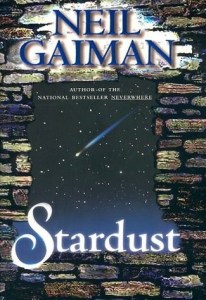
Neil Gaiman’s Stardust qualifies as a speculative fiction novel that is a “literary fantasy.” This is because it is a fairytale told with beautiful prose in an unhurried fashion. Lean prose can be leisurely, poetic, and still pack a punch.

That is what true writing is all about, conveying a story in a crafted style with a voice that is uniquely that of the author.

Fairytales always offer us morals, and in Stardust, Gaiman shows us truth. He lays bare the lies we tell ourselves through the simple fairytale motif that real love is not gained through prodigious deeds. All through the narrative, we see the difference between desiring a person and loving them. By the end, we know that love requires truth if it is to survive.

Neil Gaiman trusts his readers. That is something we all need to do. Sometimes a story needs to emerge slowly and be told with beautiful, immersive prose, and we need to trust that our readers will enjoy it if we craft it well.

There is room in the bookstore for books with a less urgent story to tell, as well as those that ambush the reader and beat them bloody with non-stop action.

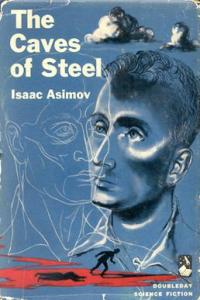
In 1953’s Caves of Steel, Isaac Asimov took us into the future, a time when humanity had divided into two factions—spacers and earthmen. The Blurb:

Like most people left behind on an over-populated Earth, New York City police detective Elijah Baley had little love for either the arrogant Spacers or their robotic companions. But when a prominent Spacer is murdered under mysterious circumstances, Baley is ordered to the Outer Worlds to help track down the killer. 

The relationship between Baley and his Spacer superiors, who distrusted all Earthmen, was strained from the start. Then he learned that they had assigned him a partner: R. Daneel Olivaw.  Worst of all was that the “R” stood for robot—and his positronic partner was made in the image and likeness of the murder victim!

In 1953, racism was endemic, institutionalized. When Asimov wrote this novel, he took on bigotry and equality in a palatable way by showing us a civilization where androids are denied equality. To murder a human is a crime, but in this society, many otherwise good people doubt that robots are sentient beings with a right to life. Yet, in R. Daneel Olivaw, we meet a sentient being and feel compassion for him.

Isaac Asimov trusted his readers too.

We write because we have a story to tell and concepts to convey. To that end, every word we put to the final product must count if every idea is to be expressed.

Asimov showed us that tight, straightforward prose works.

Gaiman shows us that sometimes you can just have a little fun with it.

The genre of speculative fiction grew out of the the repression of the 1940s and 1950s, and has always been the literary field in which ideas that challenge the norm were sown. Radical concepts could be conveyed when couched fantasy and set in fictional worlds.

Dedicated authors are driven to learn the craft of writing, and it is a quest that can take a lifetime. It is a journey that involves more than just reading “How to Write This or That Aspect of a Novel” manuals. Those are important, but they only offer up a part of the picture. The rest of the education is within each of us, an amalgamation of our life experiences.

Whenever I come across an author whose work shocks, rocks, and shakes me out of my comfort zone, I go back and reread it. The second time, I take notes. I study how they crafted their work, look at their word choices. I ask myself why it moved me.

I do the same with those whose work left me feeling robbed—where did they go wrong? What can I do to avoid this in my work?

I always learn something new from looking at how other authors combine and use words to form the moods and emotions that drive the plot. For me, writing is a journey with no finite destination other than the satisfaction of making small steps toward improvement.

Sometimes my work is good, other times not so much. But when I look back at my early work, I see improvement over time, which is all we can ever hope for.

Don’t lose heart, and don’t give up just because you think you can’t write like your favorite author. Write for yourself and write because you have something to say.

And don’t quit until you arrive at the place where you write “the end” on the last page.

5 Comments

Filed under writing