Revisions part 2: Efficient self-editing #amwriting

In the new millennium, the traditional publishing world has changed and evolved in how they do business. In some ways, they haven’t changed enough, and in others, they’ve gone too far.
All authors must create a social media platform to promote their work. In most cases, the amount of help the Big Four publishers (Simon & Shuster, HarperCollins, Penguin Random House, and Hachette) offer their new, unknown authors is minimal. So, whether you go indie or not, you’re on your own.

Whether you intend to publish your work independently or try to go the traditional route, you are responsible for editing your work.  Unedited work shouts “amateur” to an agent or editor, so never submit work that isn’t your best effort.

If you can’t afford a full professional edit, there is a way to make a pretty good stab at revising your own manuscript. However, it is time-consuming, which is why an editor’s services are not cheap.

Open your Manuscript. Save a copy of your original manuscript in its bloody, raw form with a file name that denotes exactly what it is.

If you are using MS Word, your manuscript title will look like this: Book_Title_version_1.docx. My current work is: Gates_of_Eternity_version.docx.
Do save the original draft in a separate file on a thumb drive or in a file storage service such as Dropbox, Google Drive, or OneDrive. You will have a fallback manuscript in case something happens to your working files.

Break it into separate chapters and save them in a new master file labeled with the word ‘revisions.’ I would name the master file: Gates_of_Eternity_revisions_02-17-2021.

First, I divide my manuscript, saving each chapter as a separate document within the master file. Clearly and consistently name each chapter. Make sure the chapter numbers are in the proper sequence, and don’t skip a number.

For a work in progress, Gates of Eternity, I labeled my individual chapter files this way:

  • GoE_ch_1
  • GoE_ch_2

The reason we divide it into chapters for the editing process will be made clear further down this post.

The next step requires pencils, yellow highlighters, a printer, paper, and a good supply of ink, which may be a cost outlay. Another, more affordable option is to save your work to a USB Flash Drive, take it to an office supply/print shop, and print all the files at one go. In the US, FedEx Office, formerly known as Kinkos, provides printing and copying services.

I am currently in need of a new printer, so I feel your pain. My ancient thing is still limping along, but soon it will go to the recycling center. Once you have the required equipment, print out the first chapter.

Everything looks different printed out, and you will see many things you don’t notice on the computer screen.

Step 1: Turn to the last page of that chapter. Cover the page, leaving only the final paragraph visible.

Step 2: Starting with the last paragraph on the last page, begin reading, working your way forward.

Step 3: Look for typos and garbled sentences.

Step 4: With a yellow highlighter, mark each place that needs correction. In the margin, pencil in notes of how you want to correct them.

Some things you should consider in this step: consistency in spelling, consistency in punctuation, crutch words, repetitious paragraphs/ideas, and long, rambling sentences.
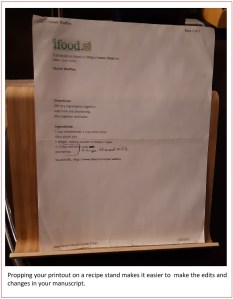
Step 5: I use a recipe stand for this step. Take the corrected printout and lean it where you can easily read it while you make corrections. (Amazon sells copy stands, but recipe stands are cheaper.)

In your word-processor, open the chapter file. Save as a new file:  GoE_ch1_edit1. It’s important to clearly label it as edited, so you don’t mix edited with unedited files. Reading from your corrected printout, make your revisions.

Step 6: At the end of it all, reassemble the corrected files into one manuscript, again making sure you haven’t skipped a chapter. Save that manuscript with a new label: GoE_manuscript_edit1_16-Feb-2021.

The date at the end of the file name is essential as you will know what the most recent edit is (not the most recent time you saved the file) and will have the previous version to go back to if needed.

For this method to work, YOU MUST UNDERSTAND AND OBEY THE BASIC RULES OF GRAMMAR.

First, you need something called a style guide. As an editor, I regularly refer to my copy of The Chicago Manual of Style. If you are an author writing fiction you someday hope to publish and have questions about sentence construction and word usage, this is the book for you. Another option is the online version: The Chicago Manual of Style Online.

The researchers at CMOS realize that English is a living, changing language. When generally accepted practices within the publishing industry evolve, they evolve too.

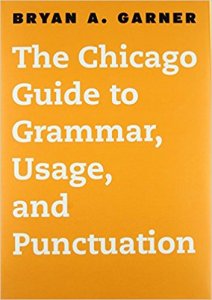
A less expensive option you might consider investing in is Bryan A. Garner’s Chicago Guide to Grammar, Usage, and Punctuation. This is a resource with all the answers to questions you might have regarding grammar and sentence structure. It takes the CMOS and boils it down to just the grammar.
Here is a list of links to articles I’ve previously posted on the basics of grammar:

Those who think the common rules of grammar don’t matter to readers are doing their work and their reputation a disservice.

You don’t have to be perfect, but readers want to enjoy the book, not struggle through rambling, garbled sentences.

Self-editing is not an easy task. You will still want another person, perhaps from your writing group, to read your work before you send it off or publish it. Then you may need to make some revisions.

However, all that hard work pays off when you put your best product possible in the hands of a reader, and they like what they read.
10 Comments

Filed under writing

Revisions part 1: Spotting the Code Words and Mental Shorthand #amwriting

When we set the first words on a  blank page, our minds begin forming images, scenes we want to describe. In his book, The Language Instinct, Steven Pinker notes that we are not born with language, so we are NOT engineered to think in words alone—we also think in images.

It follows that certain words become a kind of mental shorthand, small packets of letters that contain a world of images and meaning for us. These words will be used with frequency in the first draft as they are efficient. We write as fast as we can when we are in the mood, and these words are a speedy way to convey a wide range of information.

Because we use them, we can get the first draft of a story written from beginning to end before we lose the fire for it.

One code word that slips into my first draft prose is the word “got.”

It is a word that serves numerous purposes and conveys so many images. “Got” is on my global search list of “telling words.” The words in the list are signals to me, indications that a scene needs to be reworded to make it a “showing” scene.

Got:”  He got the message = comprehension. He understood.

Some other instances where we use “got” as a code word for our second draft:

  • He got the dog into the car.
  • He got the mail.
  • He got

Code words are the author’s multi-tool—a compact tool that combines several individual functions in a single unit. One word, one packet of letters serves many purposes and conveys a myriad of mental images.

Every author thinks a little differently, so your code words will be different from mine. One way to find your secret code words is to have the Read Aloud tool read each section. I find most of my inadvertent crutch words that way.

Another code word on my personal list is “felt.” Let’s go to Merriam-Webster’s Online Thesaurus:

Synonyms:

  • endured
  • experienced
  • knew
  • saw
  • suffered
  • tasted
  • underwent,
  • witnessed

Words Related to felt:

  • regarded
  • viewed
  • accepted
  • depended
  • trusted
  • assumed
  • presumed
  • presupposed
  • surmised

It’s natural to overuse certain words without realizing it, but that is where revisions come in. Anytime I’m working on showing interactions between characters, certain words will be hauled into play over and over.

As you go along, you’ll discover that some words have very few synonyms that work.

Consider the word “smile.” It’s a common code word, a five-letter packet of visualization. Synonyms for “smile” are few and usually don’t show what I mean:

  • Grin
  • Smirk
  • Leer
  • Beam

When I come across the word “smile” in my work, it sometimes requires a complete re-visualization of the scene. I look for a different way to convey my intention, which can be a frustrating job.

Our characters’ facial expressions display happiness, anger, spite, and all the other emotions. Their eyebrows raise or draw together; foreheads crease and eyes twinkle; shoulders slump, and hands tremble.

I refuse to drag the reader through a long list of ever-moving facial expressions, lips turning up, down, drawing to one side, etc., but sometimes the brief image of a smile is what you need.

When done sparingly and combined with a conversation, this can work.

But… by sparingly, I mean no more than one facial change per interaction, please. Nothing is more boring than reading a story where a person’s facial expressions take center stage. We must be more concerned with what is happening inside our characters than about the melodramatic outward display.

When you discover one of your first draft code words, go to the thesaurus and find all the synonyms you can and list them in a document for easy access. If it is a word like smile or shrug, you have your work cut out, but consider making a small list of visuals.

Think about the expressions and body language an onlooker would see if a character were angry.

  • Crossed arms.
  • A stiff posture.
  • Narrowed eyes.

A little list of those mood indicators can keep you from losing your momentum and will readily give you the words you need to convey all the vivid imagery you see in your mind.

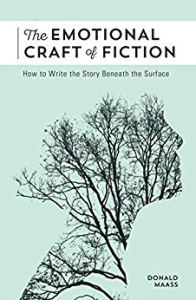
Literary agent Donald Maas has good advice in his book, the Emotional Craft of Fiction.

If you don’t have it already, another book you might want to invest in is The Emotion Thesaurus by Angela Ackerman and Becca Puglisi. Some of the visuals they list aren’t my cup of tea, but they do have a grip on how to show what people are thinking.

This aspect of the revision process is sometimes the most difficult.  It takes time when we look at each instance of our code words. They don’t always need changing—sometimes, a smile is a smile and that is okay.


Credits and Attributions:

Wikimedia Commons contributors, “File:Victorinox Multitool.jpg,” Wikimedia Commons, the free media repository, https://commons.wikimedia.org/w/index.php?title=File:Victorinox_Multitool.jpg&oldid=484117422 (accessed February 14, 2021).

6 Comments

Filed under writing

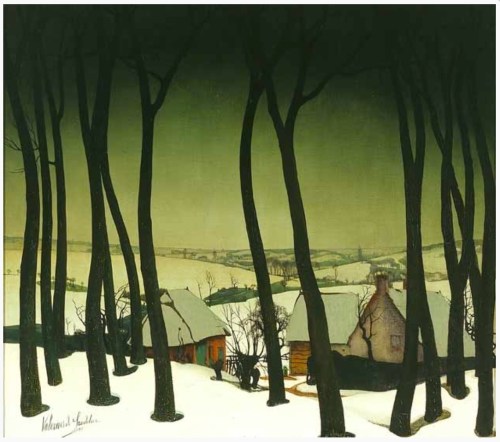
#FineArtFriday: Winter in Flanders by Valerius de Saedeleer 1927

Artist:   Valerius de Saedeleer  (1867–1941)

Title: Winter in Flanders

Date: 1927

Medium: oil and canvas

Dimensions: Height: 84 cm (33 in) Width: 96 cm (37.7 in)

Collection: Royal Museums of Fine Arts of Belgium

Inscriptions: Signature and date bottom left: Valerius de Saedeleer / 1927

What I like about this painting:

I like the bold color of the houses against the snow. Viewing the farmstead through the zen-like simplicity of the dark trees is soothing. I particularly like way he portrays green-golden sky of an afternoon in a dark northern winter.

This is a pleasant, relaxing painting.

About the artist, via Wikipedia:

Valerius de Saedeleer  (4 August 1867 – 16 September 1941) was a Belgian landscape painter, whose works are informed by a symbolist and mystic-religious sensitivity and the traditions of 16th-century Flemish landscape painting. He was one of the main figures in the so-called first School of Latem which in the first decade of the 20th century introduced modernist trends in Belgian painting and sculpture.

From 1914 de Saedeleer and his family lived in Wales as refugees from the First World War. Together with his family and the family of his friend George Minne he lived a number of years in CwmystwythGustave van de Woestijne and George Minne and their families also resided in Wales during the war. The family de Saedeleer and other Belgian artists were brought to Wales by David, Gwendoline and Margaret Davies. The two Davies sisters were best known for putting together one of the great British art collections of the 20th Century. The initiative of the Davies family in inviting Belgian artists to Wales was prompted by their expectation that these artists would be able to inject local cultural life with their expertise. 

De Saedeleer’s daughters studied weaving, binding and tapestry at Aberystwyth. The second daughter Elisabeth became acquainted with William Morris‘ daughter Mary from whom she learned tapestry weaving. The family became so accomplished at weaving that they even started giving courses in the craft themselves. De Saedeleer may have undertaken some conservation work on items from the Aberystwyth University Collection. He also exhibited his paintings of local views in the University’s Alexandra Hall and was able to earn a living from his art. 

De Saedeleer remained in Wales until 1920, when he moved to Etikhove. In 1933 he became an honorary citizen of the city of Aalst. In 1937 he moved to Leupegem.  The work of de Saedeleer became gradually more decorative and he developed a luxuriant and whimsical calligraphy. His compositions often included a row of trees in the foreground, a Japanese-style effect with which he had already experimented before the war. This device is clear in the composition Winter in Flanders. He was also an accomplished colourist.  


Credits and Attributions:

Wikimedia Commons contributors, “File:Valerius De Saedeleer – Winter in Flanders.jpg,” Wikimedia Commons, the free media repository, https://commons.wikimedia.org/w/index.php?title=File:Valerius_De_Saedeleer_-_Winter_in_Flanders.jpg&oldid=402112537 (accessed February 12, 2021).

Wikipedia contributors, “Valerius de Saedeleer,” Wikipedia, The Free Encyclopedia, https://en.wikipedia.org/w/index.php?title=Valerius_de_Saedeleer&oldid=1005028837 (accessed February 12, 2021).

Comments Off on #FineArtFriday: Winter in Flanders by Valerius de Saedeleer 1927

Filed under #FineArtFriday

What I #amreading, and #amwriting

Hello from a dark and rainy town somewhere near Olympia, Washington, USA. The time of year that I like to think of as “baking weather” has arrived. It’s cold and rainy, with the promise of snow in the next few days.

Let’s face it: when the house feels cold, Grandma gets cooking.

Bread, cookies, lentil loaf—in my family, food is love. My house is full of good smells and tasty treats, and my clothes are shrinking.

Hunkering down with a cup of hot tea and a good book is another enjoyable activity for this time of year.

I’m currently reading a book by Dr. Michio Kaku, The Future of Humanity: Terraforming Mars, Interstellar Travel, Immortality, and Our Destiny Beyond Earth.  This book was published by Random House in February of 2018. The way I learn requires a more in-depth approach to reading it, as I need to read slowly and take notes, so it’s been several weeks and I’m only halfway through it. This book is a journey, not a speed-read.

I’m drawn to a wide variety of books on philosophy and natural history and have them on my reading list because they offer new ways of looking at the world. I love learning but don’t have the patience to take college courses anymore.

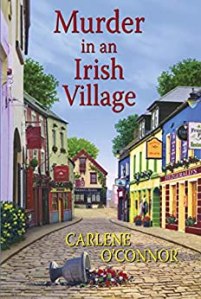
I just finished reading “Murder in an Irish Village,” a cozy mystery by American author Carlene O’Connor. Published by Kensington Books in 2016, it’s the first book in a series of seven so far. It was a fun little mystery, well-plotted. Siobhán O’Sullivan is an enjoyable protagonist, and the cast of characters and suspects were believable. It kept me guessing to the end. I had one dislike, which is the abundance of relatively obscure Irishisms—at some points it’s rough going. I suspect even native Irish speakers have to look some words up. I understood all the dialogue only because I was reading on a Kindle and could easily search for the meanings of words I didn’t know. Despite that minor flaw I give the book four stars, because it’s a good novel.

So, what am I writing? I finished the first draft of Gates of Eternity, my accidental novel. That’s the working title, but I have no idea what the final title will be. I have a lot of work ahead of me before it’s ready for my editor, but I’m satisfied with how the storyline has fallen into place.

I am setting that book aside now to finish working on Bleakbourne on Heath. This Alternate Arthurian novel grew out of a serial I began writing in 2016. The ending has been written, but a certain amount of work remains, as the plot is a little thin in some places.

Committing to write that serial back then was how I discovered that writing and publishing a chapter a week is NOT my strong suit!

This last week, I entertained myself by creating a digital map for a friend’s next novel, a mystery set in the general area my husband grew up in. She gave me a hand-drawn basic layout, and I took it from there. I love drawing maps for my own work and have often thought I missed my calling as a cartographer.

Jasperson Back Yard, May 2020

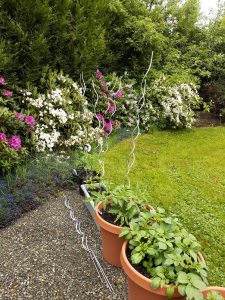
On the homefront, we’ve been getting the yard tidied, small preparations for spring whenever the weather allows. The tree man was here to prune the apple tree and cut back the maple that loves to block my front window. He also trimmed up the cedar hedge which had gotten out of control, suffocating our rhododendrons, so we’re good to go for another year.

As always, writing for this blog requires a small commitment of time and creativity, but it is one of my great joys, a diversion when things get a little hectic.

All in all, it has been a busy month, with plenty of books to read, lots to write, and new recipes to try out. I hope you’re enjoying life as much as is possible during this pandemic and the lockdown, and staying safe.

Comments Off on What I #amreading, and #amwriting

Filed under writing

Subjunctives: The Hamlet Paradox #amwriting

Writers often find the words and rules we use to describe existence convoluted and hard to understand.

The subjunctive (in the English language) is used to form sentences that do not describe known objective facts.

In other words, subjunctives describe unknown intangible possibilities.

William Shakespeare said it best in his tragedy, Hamlet: “To be or not to be… that is the question.”

Should he exist, or should he not exist—for the deeply depressed Dane, suicide or not suicide is the question. In his soliloquy, Hamlet contemplates death and suicide. He regrets the pain and unfairness of life but ultimately acknowledges that the alternative might be worse.

Be–a simple word, a verb that is a subjunctive. But sometimes the many forms of this word are overused in the narrative. The whole subjunctive thing looks quite complicated on the surface, but it doesn’t have to be. As writers of genre fiction, we have to identify the habitual overuse of subjunctives in our writing.

We must make our prose stronger by not using them except where nothing else will do. Most of the time, dialogue is the place for subjunctives, as in Hamlet’s monologue.

In writing fiction, subjunctives work well when used in conversations but create a passive voice when used in the narrative. They separate us from the story, remove the sense of immediacy that we as readers hope to experience.

But first, what does “subjunctive” mean?

http://www.Dictionary.com defines “Subjunctive” as:

adjective

  1. (in English and certain other languages) noting or pertaining to a mood or mode of the verb that may be used for subjective, doubtful, hypothetical, or grammatically subordinate statements or questions, as the mood of ‘be’ in ‘if this be treason.’

  2. the subjunctive mood or mode.

  3. a verb in the subjunctive mood or form.

First, let’s consider existence and what Past Subjunctive Tense covers: how to use the words ‘was’ and ‘were,’ which are forms of the verb ‘be.’

English Club says: The English subjunctive is a special, relatively rare verb form that expresses something desired or imagined.

We use the subjunctive mainly when talking about events that are not certain to happen. For example, we use the subjunctive when talking about events that somebody:

  • wants to happen

  • anticipates will happen

  • imagines happening [1]

Which is correct?

  • I wish I were a penguin. I would fly through the water.
  • I wish I was a penguin. I would fly through the water.

If I am only wishing that I were a penguin, were is correct.

However, if I could actually be a penguin, was would be correct, and I would have to rewrite my sentence by changing ‘would’ to ‘could.’

The Grammar Girl gives us a great example: Think of the song “If I Were a Rich Man,” from Fiddler on the Roof. When Tevye sings “If I were a rich man,” he is fantasizing about all the things he would do if he were rich. He’s not rich, he’s just imagining, so “If I were” is the correct statement. This time you’ve got a different clue at the beginning of the line: the word “if.” [2]

There are times when we use a form of the verb ‘was’ even though the subject of the sentence has not yet happened or may not happen at all:  the past subjunctive verb form. It is unreal and may remain that way. “If I were.”

When you suppose about something that might be true, you use a form of the verb “was” and don’t sweat it.

If it’s likely real: Was (possibly is): I heard he was training his dog to fetch.

If it’s likely unreal: Were (possibly isn’t): If I were a penguin, I wouldn’t need to rent a tuxedo.

The past subjunctive verb forms express a hypothetical condition that may exist in a present, past, or future time:

  • What if I was…
  • I wish I were…
  • If this be treason…
  • To be or not to be…

Perhaps you are writing a technical manual, a dissertation, or an email to a client or coworker.

Despite the misguided efforts of many critique groups and Microsoft Word to erase all forms of ‘to be’ from the English language and replace it with ‘is,’ there are times when only a subjunctive will do the job.

When your intent is formal, subjunctives may abound, often in the form of commonly used phrases:

  • Be that as it may.
  • So be it.
  • Suffice it to say.
  • Come what may.

Steven Pinker is a Harvard professor whose discussions on the connections between language and what we see as humanity are eye-opening. He writes at a college level, but in his book, The Sense of Style: The Thinking Person’s Guide to Writing in the 21st Century, he raises a point that is important to this blogpost:

Subjunctives are hard to spot. Forms of “to be” can be found in subordinate clauses where something is mandated or required:

  • I demand the prisoner be fed the same as anyone else.

A verb like “see” also has a subjunctive form when something is mandated or required:

  • It’s essential that I see your report before you send it.

In ordinary writing, we rarely need to use subjunctives in clauses with mandates except perhaps in conversation.

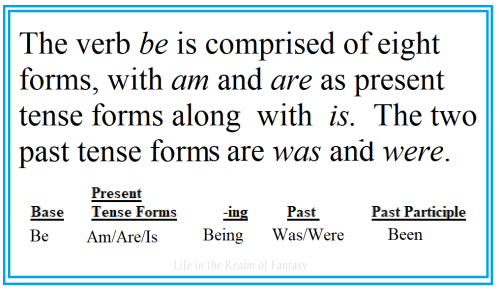
Feel free to copy and save the above graphic for your personal use: right click>copy>save as: .jpeg or.png.

We often “think aloud” in writing the first draft. We insert many passive phrasings into the raw narrative, words that I think of as traffic signals. These words are a shorthand that helped us get the story down, a guide that now shows us how we intend the story to go.

Subjunctives are small verbs of existence, but just like adverbs, they are telling words. In the rewrite, we look for these telling words, places where they have crept out of conversations and into the narrative.

We look at each instance and rewrite the paragraph to show the event, rather than tell about it.

  • They were hot and thirsty could be shown as: They trudged on with dry, cracked lips, yearning for a drop of water.

That’s not a perfect example, but hopefully, you can see what I am trying to say.


Credits and Attributions:

EnglishClub contributors, Subjunctives © 1997-2021 EnglishClub.com All Rights Reserved https://www.englishclub.com/grammar/subjunctive.htm [1]

Subjunctive Verbs, by Mignon Fogarty, http://www.quickanddirtytips.com/education/grammar/subjunctive-verbs, Copyright © 2021 Macmillan Holdings, LLC. Quick & Dirty Tips™ [2]

“File:Penguin Front.png.” Wikimedia Commons, the free media repository. 12 Sep 2020, 08:35 UTC. 6 Feb 2021, 17:14 <https://commons.wikimedia.org/w/index.php?title=File:Penguin_Front.png&oldid=456325700>.

12 Comments

Filed under writing

#FineArtFriday: While reading the newspaper by H. A. Brendekilde 1912

Artist: H. A. Brendekilde  (1857–1942)

Title: While reading the newspaper news

Date: 1912

Medium: oil on canvas

Dimensions: Height: 61 cm (24 in); Width: 85 cm (33.4 in)

Inscriptions: Signature and date bottom right: H. A. Brendekilde / 1912

What I love about this painting:

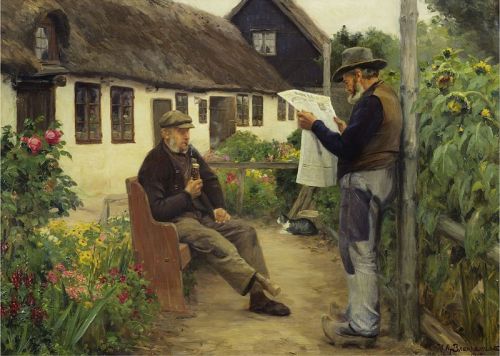
There is a story in this well-executed painting. I particularly like the details: the patched trousers of the gardener, the mud on his clogs, the other man’s wooden leg— I like the way they are juxtaposed against the lush spring garden and prosperous village life of Denmark in 1912.

Their hands and clothes indicate they have stopped work to read the newspaper. Both men seem stunned. Are they perhaps reading of the death of King Frederick VIII, who died on 14 May 1912?

Whatever they are reading, the cat remains undisturbed by the news.

H. A. Brendekilde was a forerunner of the social realist style, embraced by Diego Rivera. His early work often depicted the daily lives of the rural working class.


Credits and Attributions

While reading the newspaper  by H. A. Brendekilde 1912 [Public domain], via Wikimedia Commons

Wikimedia Commons contributors, “File:H. A. Brendekilde – Mens du læser avisen nyheder (1912).jpg,” Wikimedia Commons, the free media repository, https://commons.wikimedia.org/w/index.php?title=File:H._A._Brendekilde_-_Mens_du_l%C3%A6ser_avisen_nyheder_(1912).jpg&oldid=300367623 (accessed February 5, 2021).

Comments Off on #FineArtFriday: While reading the newspaper by H. A. Brendekilde 1912

Filed under writing

Genre and Tropes #amwriting

When we first begin writing, we know what genre of book we usually like to read, and our work will probably fall into that category.

So, what exactly are genres? Author Lee French puts it this way, “Literary genres are each a collection of tropes that create expectations about the media you consume.”

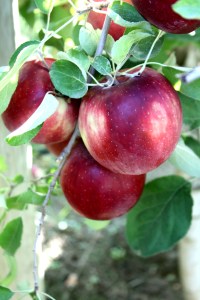
Genres are categories the publishing industry developed so that shoppers in bookstores can easily find what they are looking for. They’re like a display of apples at the grocery store – many baskets, each filled with a different variety of apple. I always head straight to the Cosmic Crisps.

On the display of each overarching genre, such as sci-fi, romance, mystery, etc., are baskets. Each contains a subgenre. Each subgenre is a different variety of that particular genre and features tropes that readers expect to see as fundamental aspects of the story.

But what are tropes?

Wikipedia defines literary tropes this way: The word trope has come to be used for describing commonly recurring literary and rhetorical devices motifs or clichés in creative works. [1]

Let’s look at the big display of sci-fi. On those shelves are many subgenres, so many that I don’t have the time or patience to list them all here.

Each subgenre includes tropes that are not usually found in other sci-fi subgenres. However, some features are common to the overarching genre, which is why they fall in the sci-fi category.

For instance, ScifiIdeas.com describes the subgenre of CyberPunk this way: Fiction relating to the science of cybernetics, which views nature as a series of interconnecting mechanical systems. Specifically, cyberpunk deals with the link between biology and computer technology, and explores humanity’s changing relationship with computer systems. Virtual reality, prosthetics, cyborgs and internet fraud are all part of the cyberpunk niche, and usually go hand-in-hand with social decline. [2]

For more of their article on the many different subgenres of sci-fi and the expected tropes therein, go to A Guide to Science Fiction Subgenres (scifiideas.com)

What about other genres? Fantasy is another set of shelves full of subgenres. Just as in sci-fi, each has a particular set of tropes their readers expect to see.

Let’s look at the subgenre of Portal Fantasy.

Nicola Alter at Thoughts on Fantasy has this to say about Portal Fantasy: A fantasy where characters travel from the real world into a fictional fantasy world, often through a portal or gateway. They are usually swept up in the problems and politics of the fantasy world and become important to the course of history there, then return to the real world greatly changed by their experience.

Typical Elements: Magical portals, magical objects, evil kings or queens, problematic family relationships in the real world, time discrepancy between the two worlds. [3]

For more of what Nicola has to say about the tropes unique to the many subgenres of fantasy, go to 17 Common Fantasy Sub-Genres | Thoughts on Fantasy.

Sometimes, we hear the comment that “certain tropes are overused.” This blanket statement is incorrect because a literary trope is a fundamental aspect of subgenre.

Therefore, one can’t say a trope is overused.

However, readers can and do eventually become bored with the books available in their favorite genres and no longer find those tropes attractive. Maybe you’re tired of Epic Fantasy’s central trope, tired of the Hero’s Journey.

In that case, it’s time to widen your reading horizons and move on to a different subgenre. Maybe you’d like a space opera.

I hear a wailing on the wind, the pathetic cries of the ghosts of bad books past. “But what if I don’t like it?”

No one says you have to finish a book you hate just because a friend said they loved it. If you’re tired of the commonalities in the books you are reading, be bold.

If you don’t try reading outside your favorite genre, you’ll never know what you are missing.

It’s like trying to get a child to eat guacamole for the first time. It’s a green paste and different looking. They don’t want to try it. But once they do taste it, they may love it. Then, keeping them out of the guacamole bowl will be a challenge.

Go out and research the many different tropes that make up the subgenres of each of the main literary genres. I have written several portal fantasies, but I also write medieval fantasy and Arthurian fantasy (two different subgenres).

If you want to know what reader to market your novel to, you need to know what the tropes are that you have written into your work. Each subgenre has a niche of avid readers, so make sure you understand what you have written.

Readers of vampire romances won’t like a story with no happy ending, so if that is what you write, you’d better have both vampires AND a traditional Romance ending.

The genre of Romance always ends with a happily ever after.

For me as a reader, if a novel is character-driven and the plot is believable, I don’t really notice the tropes. If I like a book, the labels don’t matter.


Credits and Attributions:

[1] Wikipedia contributors, “Trope (literature),” Wikipedia, The Free Encyclopedia, https://en.wikipedia.org/w/index.php?title=Trope_(literature)&oldid=1003372690 (accessed 02 February, 2021).

[2] Quote from A Guide to Science Fiction Subgenres (scifiideas.com), ©2021 ScifiIdeas contributors, https://www.scifiideas.com/posts/a-guide-to-science-fiction-subgenres/, accessed 02 February 2021.

[3] Quote from  17 Common Fantasy Sub-Genres | Thoughts on Fantasy, © 2015/2021Nicola Alter, https://thoughtsonfantasy.com/2015/12/07/17-common-fantasy-sub-genres/, accessed 02 February 2021.

“File:Cosmic Crisp.jpg.” Wikimedia Commons, the free media repository. 24 Oct 2020, 15:25 UTC. 3 Feb 2021, 13:08 <https://commons.wikimedia.org/w/index.php?title=File:Cosmic_Crisp.jpg&oldid=499534971>.

5 Comments

Filed under writing

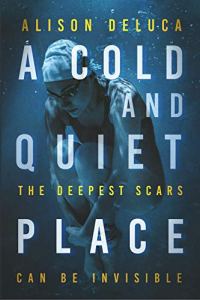
#BookReview: A Cold and Quiet Place by @AlisonDeLuca #amreading

I read many books, and while most novels have some redeeming qualities, a few stand out as stellar. A Cold and Quiet Place by Alison DeLuca is one of those.

While I no longer have the time to put out a weekly book review blog, I do still review the books I love, and when I come across one that is worth sharing, I will gladly share it here.

Everyone who was ever a teenager knows the years between childhood and adulthood are fraught with danger, as the social skills we form either help or handicap us, and the traumas we suffer haunt us forever after.

The novel opens with a girl on the edge of adulthood and takes us through a powerful coming-of-age story.

But first, THE BLURB:

A Cold and Quiet Place by Alison DeLuca

Publisher : Myrddin Publishing Group (December 27, 2020)

Publication date : December 27, 2020

Language : English

Print length : 183 pages

The deepest scars can be invisible. Lily’s swimming career is jeopardized when she dates Tyler, her attractive teammate. At first he seems like the perfect boyfriend. But Tyler’s insults and demands increase, and Lily has to decide if her relationship is worth the emotional torture. Between Tyler, the pressure of competition, and an anonymous online bully, Lily risks losing everything she has fought for as a 15-year old swimmer. A Cold and Quiet Place is a YA novel about competitive swimming and the dark world of emotional abuse.

MY REVIEW:

This book is an emotional rollercoaster, powerful and deeply moving. DeLuca’s prose is lean and evocative, and her narrative transitions smoothly from scene to scene. The story is so compelling I was halfway through the book before I knew it.

This is a novel of achievement and despair. It details the chaotic mystery of Lily’s situation and the cold calculation of her abuser, laying bare the toxic high school relationships that are a terrible rite of passage many young people go through in their teen years.

High School in the US generally encompasses grades 9 through 12, and ages 14 to 18, with some variations depending on the school district.

When I began reading this novel, I knew nothing about competitive swimming other than as an Olympic level sport, one I watch every four years when the world meets to compete. I knew nothing of the athletes’ personal journey to get to that place.

Now, I see the humanity of each competitor, the person who has a life apart from their sport. Yet with each event, they challenge themselves to be better than their previous best.

Lilly’s story as an athlete and young woman is both heartbreaking and empowering. When I finished the last page, I felt as wrung as if I had lived that story, and in many ways, I had.

There is no blunting of the trauma, no dancing around the issues. DeLuca takes us into Lily’s world and tells a gripping story that has to be read to the last page. This is a powerful story of a girl growing into womanhood.

I give A Cold and Quiet Place by Alison DeLuca 5 stars.

Comments Off on #BookReview: A Cold and Quiet Place by @AlisonDeLuca #amreading

Filed under Book Reviews, writing

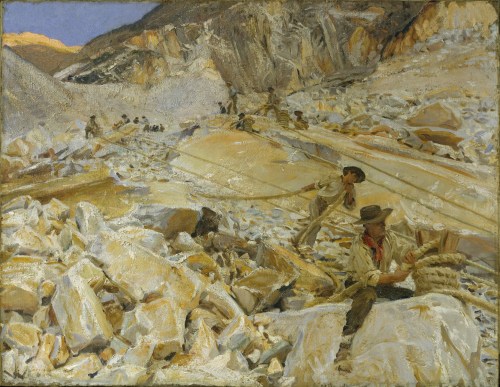
#FineArtFriday: Bringing down marble from the quarries to Carrara, Sargent 1911

Artist: John Singer Sargent  (1856–1925)

Title: Bringing down marble from the quarries to Carrara

Date: 1911

Medium: oil on canvas

Dimensions: Height: 71.4 cm (28.1 in); Width: 91.8 cm (36.1 in)

Collection: Metropolitan Museum of Art

Inscriptions: Signature bottom left: John S. Sargent

What I love about this painting:

This picture details the relentless heat of the day, the back-breaking labor of men cutting marble. This is how quarrying was done prior to World War I, with steam-donkeys and great physical peril. The ropes are huge and heavy, and these men secure the dangerous load with practiced ease.

Carrara Italy is an important center for the extraction and processing of marble. The famous stone is white and exceedingly valuable.

One of Sargent’s great skills was the ability to convey the sensory impressions of an environment, depicting his characters outdoors in all the seasons.

About the Artist, via Wikipedia:

John Singer Sargent, January 12, 1856 – April 14, 1925) was an American expatriate artist, considered the “leading portrait painter of his generation” for his evocations of Edwardian-era luxury. He created roughly 900 oil paintings and more than 2,000 watercolors, as well as countless sketches and charcoal drawings. His oeuvre documents worldwide travel, from Venice to the Tyrol, Corfu, the Middle East, Montana, Maine, and Florida.

Born in Florence to American parents, he was trained in Paris before moving to London, living most of his life in Europe. He enjoyed international acclaim as a portrait painter. An early submission to the Paris Salon in the 1880s, his Portrait of Madame X, was intended to consolidate his position as a society painter in Paris, but instead resulted in scandal. During the next year following the scandal, Sargent departed for England where he continued a successful career as a portrait artist.

From the beginning, Sargent’s work is characterized by remarkable technical facility, particularly in his ability to draw with a brush, which in later years inspired admiration as well as criticism for a supposed superficiality. His commissioned works were consistent with the grand manner of portraiture, while his informal studies and landscape paintings displayed a familiarity with Impressionism. In later life Sargent expressed ambivalence about the restrictions of formal portrait work, and devoted much of his energy to mural painting and working en plein air. Art historians generally ignored artists who painted Royalty and “Society” – such as Sargent – until the late 20th century.


Credits and Attributions

John Singer Sargent, Public domain, via Wikimedia Commons

“Carrara.” Wikipedia, The Free Encyclopedia. 16, 2021, 12:36 utc. 29 Jan 2021, 03:23 <//en.wikipedia.org/w/index.php?title=Carrara&oldid=118022943>.

“File:John Singer Sargent – Bringing Down Marble from the Quarries to Carrara (1911).jpg.” Wikimedia Commons, the free media repository. 15 Jun 2019, 13:13 UTC. 29 Jan 2021, 03:24 <https://commons.wikimedia.org/w/index.php?title=File:John_Singer_Sargent_-_Bringing_Down_Marble_from_the_Quarries_to_Carrara_(1911).jpg&oldid=354733943>.

Comments Off on #FineArtFriday: Bringing down marble from the quarries to Carrara, Sargent 1911

Filed under #FineArtFriday

Conveying Mood part 2: adverbs #amwriting

Today is the second installment of a series on modifiers, words we use to describe nouns and verbs. I’m on a quest to find ways to use fewer of them and make the most of the ones I do use.

In the previous post, I  mentioned going to an online thesaurus and looking up your overall mood word. This is where you will find synonyms for your mood words and also the opposites.

In the root form, adverbs are adjectives, words that modify nouns. Add the suffix ‘ly’ to them, and they become words that modify verbs.

Adverbs tend to be fluffy. Most readers don’t like fluffy prose. I suggest you don’t muck up your modifiers by adding ‘ly’ at the end of them unless it is the only thing that works.

With that said, my rule is don’t write clumsy prose just to avoid using ‘ly.’

In the first draft, modifiers are brain-storming words. They show us what we intended to convey when we first wrote the narrative.

For that reason, they are essential parts of English and can’t be completely discarded as some deluded authors loudly swear they have done.

I suppose one could write a novel without using any modifiers whatsoever, but I wouldn’t want to read it. However, modifiers can weaken verbs by telling the story rather than showing it.

I don’t self-edit my first drafts as I write, so my prose is always a mess when I begin revisions.

This year’s NaNoWriMo novel was written with no outline, so it’s an example of my worst “thinking habits.” It is a sea of adverbs and adjectives, but these words are the roadmap that tells me what prose need reshaping to show the story.

At the time, I was imagining the scenes and plotting as I wrote. When I look back, the early drafts for all my work are littered with adverbs.

When you imagine your adverbs as signals from your creative mind, you see them a guide leading you to the story you really wanted to write.

In the second draft, I want to inject impact into the opening paragraphs and all the sentences that follow right to the grand finale. But I also want them to show what I envision.

That requires rewording the sentences to make them active. Look at your sentence structure.

Sentence structure matters.

Where you place an adjective relative to the noun they are modifying affects how a reader perceives it. Noun-verb is a strong lead in. Nouns work best when one strong, well-chosen adjective shows us what the point-of-view characters sees, hears, smells, touches, and tastes, rather than fluffing the verbs and hindering the action.

Sunlight glared over the ice, a cold fire in the sky that cast no warmth but burned the eyes.

The example sentence contains four nouns, one modifier (an adjective), and three verbs. The sentence is structured this way: noun-verb (sunlight glared) adjective-noun (cold fire), verb-adjective-noun (cast no warmth), and finally, verb-article-noun (burned the eyes).

Verb followed by noun shows us what the noun did. Verb-adjective-noun shows us how the noun looked (smelled, tasted, or felt) during the action.

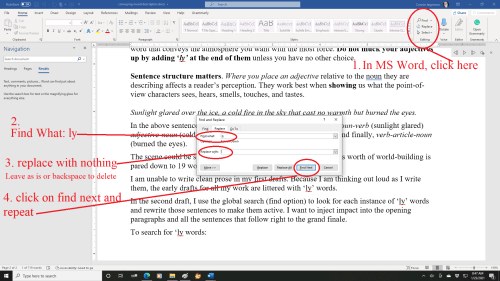
To search for unnecessary adverbs, look for ‘ly’ words in MS Word:

1: Click replace in the upper right corner of the Home tab.

2: Type ly into the “Find What” box.

3: Leave the “Replace With” box blank.

4: Look at each instance individually and decide to keep the ly or delete it. Many words, such as early or easily, have ly as their suffix, so look at each instance and decide if it stays or goes.

5: Once you have decided, click find next and repeat the process.

The above instructions are for MS Word, but Google Docs and Open Office both have some kind of search and replace function. Go to the internet and find the instructions!

In the first draft, the important thing is to get the idea down without self-editing. For this reason, we don’t publish our first drafts.

If you are like me in your first drafts, cleaning up and strengthening the prose could take a while, especially in a large manuscript. However, it is part of the revision process and is well worth the time you put into it.

The English language has evolved over the last century. The word very has become a ‘fluff word’ that sticks out when we see it written too freely in a narrative. It has a purpose but is easy to overuse. In that case, it adds nothing of value to the prose, so editors will suggest you remove it to make your sentences stronger.

Below is a list of modifiers, words that paint an image of the world our characters inhabit. Some will change the voice from active to passive, so be wary of how you use them.

When you do use a modifier, be creative. Sometimes, using an unexpected adjective lends life to an otherwise ordinary scene.

Nouns like a well-placed modifier, but most of the time, verbs are stronger when they work alone.

313 Modifiers for Nouns

  • Abnormal
  • Absentminded
  • Accidental
  • Adventurous
  • Afterward
  • Almost
  • Always
  • Annual
  • Anxious
  • Arrogant
  • Awkward
  • Bashful
  • Beautiful
  • Bitter
  • Bleak
  • Blind
  • Blissful
  • Boastful
  • Bold
  • Brave
  • Brief
  • Bright
  • Brisk
  • Broad
  • Busy
  • Calm
  • Careful
  • Careless
  • Cautious
  • Certain
  • Cheerful
  • Clear
  • Clever
  • Close
  • Coaxing
  • Colorful
  • Common
  • Continual
  • Cool
  • Correct
  • Courageous
  • Cross
  • Cruel
  • Curious
  • Dainty
  • Dear
  • Deceiving
  • Deep
  • Defiant
  • Deliberate
  • Delightful
  • Diligent
  • Dim
  • Doubtful
  • Dreamy
  • Easy
  • Elegant
  • Energetic
  • Enormous
  • Enthusiastic
  • Equal
  • Especial
  • Even
  • Even
  • Eventual
  • Exact
  • Excited
  • Extreme
  • Fair
  • Faithful
  • Famous
  • Far
  • Fast
  • Fatal
  • Ferocious
  • Fervent
  • Fierce
  • Fond
  • Foolish
  • Fortunate
  • Frank
  • Frantic
  • Free
  • Frenetic
  • Frightful
  • Full
  • Furious
  • General
  • Generous
  • Gentle
  • Glad
  • Gleeful
  • Graceful
  • Grateful
  • Great
  • Greedy
  • Happy
  • Hasty
  • Healthy
  • Heavy
  • Helpful
  • Helpless
  • High
  • Honest
  • Hopeless
  • Hungry
  • Immediate
  • Innocent
  • Inquisitive
  • Instant
  • Intense
  • Intent
  • Interesting
  • Inward
  • Irritable
  • Jagged
  • Jealous
  • Jovial
  • Joyful
  • Joyous
  • Jubilant
  • Judgmental
  • Just
  • Keen
  • Kidding
  • Kind
  • Kindhearted
  • Knavish
  • Knowing
  • Knowledgeable
  • Kooky
  • Lazy
  • Less
  • Light
  • Like
  • Limp
  • Live
  • Lofty
  • Longing
  • Loose
  • Loud
  • Loving
  • Loyal
  • Mad
  • Majestic
  • Meaningful
  • Mechanical
  • Merry
  • Miserable
  • Mocking
  • Month
  • More
  • Mortal
  • Most
  • Mysterious
  • Natural
  • Near
  • Neat
  • Nervous
  • Never
  • Nice
  • Noisy
  • Not
  • Obedient
  • Obnoxious
  • Odd
  • Offensive
  • Official
  • Often
  • Open
  • Optimistic
  • Overconfident
  • Painful
  • Partial
  • Patient
  • Perfect
  • Physical
  • Playful
  • Polite
  • Poor
  • Positive
  • Potential
  • Powerful
  • Prompt
  • Proper
  • Punctual
  • Quaint
  • Queasy
  • Queer
  • Questionable
  • Quick
  • Quicker
  • Quiet
  • Quirky
  • Quizzical
  • Random
  • Rapid
  • Rare
  • Ready
  • Real
  • Reassuring
  • Reckless
  • Regular
  • Reluctant
  • Repeated
  • Reproachful
  • Restful
  • Righteous
  • Rightful
  • Rigid
  • Rough
  • Rude
  • Safe
  • Scarce
  • Scary
  • Searching
  • Sedate
  • Seldom
  • Selfish
  • Separate
  • Serious
  • Shaky
  • Sharp
  • Sheepish
  • Shrill
  • Shy
  • Silent
  • Sleepy
  • Slow
  • Smooth
  • Soft
  • Solemn
  • Solid
  • Sometimes
  • Soon
  • Speedy
  • Stealthy
  • Stern
  • Strict
  • Successful
  • Sudden
  • Supposed
  • Surprising
  • Suspicious
  • Sweet
  • Swift
  • Sympathetic
  • Tender
  • Tense
  • Terrible
  • Thankful
  • Thorough
  • Thoughtful
  • Tight
  • Tomorrow
  • Too
  • Tremendous
  • Triumphant
  • True
  • Truthful
  • Ultimate
  • Unabashed
  • Unaccountable
  • Unbearable
  • Unethical
  • Unexpected
  • Unfortunate
  • Unimpressive
  • Unnatural
  • Unnecessary
  • Upbeat
  • Upright
  • Upside-down
  • Upward
  • Urgent
  • Useful
  • Useless
  • Usual
  • Utter
  • Vacant
  • Vague
  • Vain
  • Valiant
  • Vast
  • Verbal
  • Very
  • Vicious
  • Victorious
  • Violent
  • Vivacious
  • Voluntary
  • Warm
  • Weak
  • Weary
  • Well
  • Wet
  • Whole
  • Wild
  • Willful
  • Wise
  • Woeful
  • Wonderful
  • Worried
  • Wrong
  • Yawning
  • Year
  • Yearning
  • Yesterday
  • Yielding
  • Youthful
  • Zealous
  • Zest
  • Zestful

Previous in this series:

Conveying Mood Part 1: Adjectives

Short Story part 1: word choice

The Short Story part 2: Setting and Atmosphere 

Theme part 1

Theme part 2

7 Comments

Filed under writing