The literal layer #amwriting

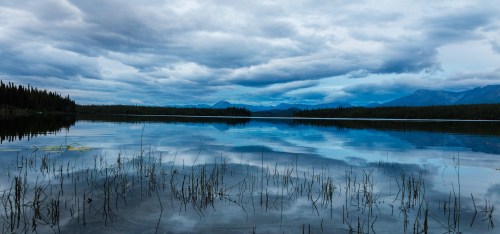
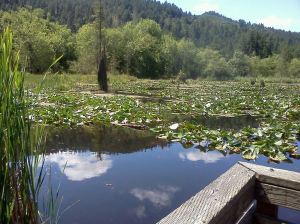
McLane Pond, taken in July 2018

Stories are created from countless layers. Today we are looking at the many outwardly visible aspects of a story. These are the surface features that define not only genre but which either attract or repel a reader at first glance.

If you’ve ever seen a pond on a calm day, you may have noticed the sky and any overhanging trees reflected on the still surface. The picture I’ve included at the top here is one my husband and I took while walking the McLane Nature Trail, not far from our home. We took it in July of 2018.

If you were there on a stormy day, things were different. The waters were gray, reflecting the color of the clouds. Ripples and waves stirred the waters.

The surface of a story is the Literal Layer, the what-you-see-is-what-you-get layer.

In a story, events and the way our characters move through them stir the surface, creating the image our reader sees.

This surface is comprised of

  • Setting
  • Action and Interaction
  • All visual/physical experiences of the characters as they go about their lives.

When we look at the surface, we immediately see something recognizable.

Setting and props – things such as:

  1. Objects the characters see in their immediate situation
  2. Ambient sounds that form the background
  3. Odors/scents of the immediate environment
  4. Objects the characters interact with
  5. Weapons (swords, guns, phasers)

The mechanical order of events forms the structure of the literal layer because they appear to be the story. This framework is the easel on which the setting and props are displayed:

  1. The opening.
  2. The inciting incident.
  3. Rising action and events that evolve from the inciting incident.
  4. The introduction of new characters.
  5. The action that occurs between the protagonist and antagonist as they jockey for position.
  6. The final showdown

How do we shape this literal layer to entice the casual reader? We can add tropes common to a particular genre. Sci-fi or fantasy elements offer an immediate clue to a prospective buyer.

Many sci-fi and some fantasy novels are set in close-to-real-world environments. The settings are familiar, akin to what we know. As readers, we could be in that world.

Good world-building creates a literal layer that is immediately accepted by the reader.
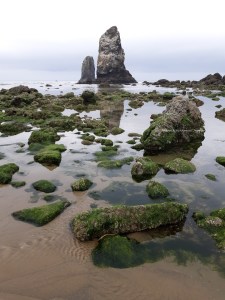
Sentinel, 05 August 2019

An obvious point I still want to make, is that the literal layer is also comprised of word combinations and word choices. This aspect distinguishes the level at which the intended reader will be able to comprehend and enjoy.

I prefer the prose in my casual reading material to be suitable for the average adult, not too pretentious, and not dumbed down. I seek that happy medium when I peruse the paperbacks or use the “Look Inside” option for eBooks at the big store in the sky.

What we put into the surface layer of our story draws the reader to look more closely at the depths. Setting, action, interaction—these most obvious components should give the reader a hint that there are profound aspects of the story, more than what-you-see-is-what-you-get.

While the surface elements of the story ruffle the surface and stir things up on the literal layer, they are only a glimpse of the deeper waters.

A memorable story has soul and hidden depths. It makes you think about larger issues you might not have considered before.

Plot charts the twists and turns of events, but depth opens our eyes, enabling us to see how other people think, feel, and experience life.

Depth changes observers into participants.

Prose and how we choose words to express emotion and ideas most powerfully is the medium by which we convey depth.

Writing to formal constraints, as I’ve discussed in several previous posts, forces us to find words that drill down and say what we really mean. By using the dictionary of synonyms and antonyms, we can find ways to write concise prose that isn’t repetitive, isn’t longwinded, but still has a cadence to it that is our voice, our style.

Have you read the opening page of The Name of the Wind by Patrick Rothfuss yet? That is your homework.
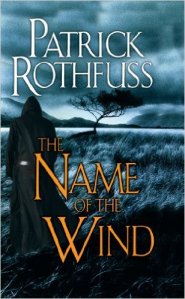
Go to the eBook section of the library or go to the online store of your choice and use the “look inside” option or the “download sample” option. You don’t have to do more than read the first paragraphs to complete this task.

Use one of the above cost-free methods to see how a master wordsmith uses prose to stir the surface in the opening pages of a fantasy novel.

With that ruffling of the waters in the first paragraphs, you are given a glimpse into the depths that lurk below.


Credits and Attributions:

Photograph, McLain Pond in July, © 2018 by Connie J. Jasperson, from the author’s private photos.

Sentinel, 05 August 2019 (One of the Needles, Cannon Beach) © 2019 by Connie J. Jasperson, All Rights Reserved (author’s own work).
7 Comments

Filed under writing

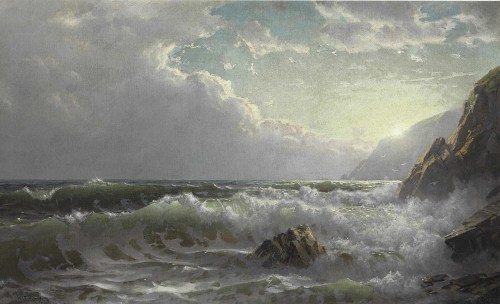
#FineArtFriday: Off the Coast of Cornwall by William Trost Richards 1904

Artist: William Trost Richards  (1833–1905)

Title: Off the Coast of Cornwall

  • Genre: landscape art
  • Date: 1904
  • Medium: oil on canvas
  • Dimensions : Height: 55.9 cm (22 in); Width: 91.4 cm (35.9 in)
  • Collection   Private collection
  • Inscriptions: Signature and date bottom left: W.T. Richards.04.

What I love about this painting:

It is a blustery day, along a rugged seacoast. Intermittent rain squalls blow through, and when one passes the sun peeps out, the bright lull between storms. The sea is that dark greenish color reflecting the sky, a quality stormy waters here in the North Pacific coast often have. It is of a shore in Cornwall, England, but it feels as familiar as if it were the coast of my home, Washington State.

What I love most about how Richards depicted the water is the milk-glass opaqueness of the green water and the way the light seems to shine through the waves.

About the Artist via Wikipedia:

William Trost Richards  rejected the romanticized and stylized approach of other Hudson River painters and instead insisted on meticulous factual renderings. His views of the White Mountains are almost photographic in their realism. In later years, Richards painted almost exclusively marine watercolors.

In the summer of 1874 Richards visited Newport, Rhode Island, and became enthralled with the area’s sublime coastline. He purchased his first of several Newport area homes in 1875 and continued to paint there for the rest of his life, dividing time between Newport and Chester County, Pennsylvania, where he purchased a farm near the Brandywine in 1884. Richards made many excursions to Europe, especially Britain and Ireland, where he produced an important body of work.

He was married to the the poet and playwright Anna Matlack, with whom he had eight children, only five of whom lived past infancy. Matlack educated the children at home to a pre-college level in the arts and sciences. One of their sons, Theodore William Richards, would later win the 1914 Nobel Prize in Chemistry. Anna Richards Brewster, their sixth child, went on to become an important painter in her own right, having received an early arts education from her father as well.

Richards was one of the few 19th century American landscape artists who was equally skilled as a watercolorist and a painter in oils. His drawings are considered among the finest of his generation. Many of his drawing still survive.

Today, Richards is highly regarded for the luminist seascapes, images imbued with light and atmosphere, that he created along the Rhode Island, New Jersey and British coasts. Luminist landscapes emphasize tranquility, and often depict calm, reflective water and a soft, hazy sky.


Credits and Attributions:

Off the Coast of Cornwall, by William Trost Richards / Public domain

Wikimedia Commons contributors, “File:William Trost Richards – Off the Coast of Cornwall.jpg,” Wikimedia Commons, the free media repository, https://commons.wikimedia.org/w/index.php?title=File:William_Trost_Richards_-_Off_the_Coast_of_Cornwall.jpg&oldid=288660467 (accessed June 4, 2020).

Wikipedia contributors, “William Trost Richards,” Wikipedia, The Free Encyclopedia, https://en.wikipedia.org/w/index.php?title=William_Trost_Richards&oldid=939570835 (accessed June 4, 2020).

Wikipedia contributors, “Anna Matlack Richards,” Wikipedia, The Free Encyclopedia, https://en.wikipedia.org/w/index.php?title=Anna_Matlack_Richards&oldid=933481876 (accessed June 4, 2020).

1 Comment

Filed under #FineArtFriday

The Inferential Layer: Drama #amwriting (reprise)

Today’s post is a reprise of one first posted August 26, 2019. Circumstances beyond my control meant I didn’t have a post ready for today–sorry! The reason I chose this post to reprise is that it deals with drama, and how we instill it into our work. I feel it dovetails nicely with the discussions we’ve had recently regarding poetry. We want to instill emotion and impact into our work so the words we use must be powerful.


Whether you are writing a screenplay, a short story, or a novel, you are writing something that you hope will resonate with the reader and move them. A lesson that screenwriters learn early on is that each scene must be viewed as a mini-story; a complete story within the larger story. They learn this early because they don’t have the luxury of space that we who write novels have. The entire story of a screenplay must be told within a finite framework of time, so the writer must wring the most emotional impact out of the least amount of words.

I’m still working on this, myself. But I’m getting there.

So, where do we start? We begin with the most fundamental reason people purchase books or go to plays and movies—drama. The inferential layer of the Word-Pond we call Story is all about the drama, and I’m not talking over-the-top hysterics here. We combine emotional highs and lows with action and reaction in each passage to create dramatic scenes that leave a mark on the reader.

Of course, we understand large, emotionally charged, outwardly noisy dramatic scenes. They impact us and leave us reeling. But the only way those events have power is if they have context. They must be balanced by quieter, more introspective moments.

Drama can happen in the mildest of scenes, places where it looks as if nothing important is happening. The follow-up/regrouping scenes are places where you have the opportunity to waylay the reader with something unexpected. This is where you show the reader what is happening beneath the surface, the inner demons and fears the characters now face.

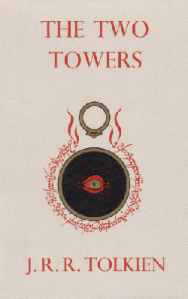
Consider  The Two Towers by J.R.R.Tolkien. Let’s look at the emotional impact of the scene that takes place in Shelob’s Lair. Frodo and Sam have survived incredible hardships and have made it to Cirith Ungol.  The passage is an excellent example of the dramatic story within a story that advances the overall plot.

Drama is the hope we feel in the moment when Frodo faces Shelob with the Phial of Light. Drama is the moment Frodo fails, the moment he is stung.

It is the shock, the horror, the moment where Sam reluctantly takes up Frodo’s sword, Sting.

It is triumph when Shelob impales herself on Sting, a weapon made of Mithril and a sword in the hands of a hobbit. But really, Sting is only a long-knife, and despite its mythic properties, it is not long enough to kill the giant arachnid, Shelob.

Still, she is wounded and scuttles away.

Drama is in the despair, the quiet moment afterward, where Samwise realizes that everything they have just endured was for nothing.

Drama is the moment of sharp introspection, the internal conversation when Sam fears his own weakness; the moment when his faith is not just shaken—it is lost. It is that moment of profound despondency in Shelob’s Lair, the dark night of the soul where Sam believes the spider has killed Frodo.

What about love? Few emotions have as much dramatic potential as that of love. It has many shades, from friendship to affection, to desire, to passion, to obsession, to jealousy, to hate.

Let’s look at the Pulitzer Prize winning short story, Brokeback Mountain, by Annie Proulx (synopsis via Wikipedia):

In 1963, two young men, Ennis del Mar and Jack Twist, are hired for the summer to look after sheep at a seasonal grazing range on the fictional Brokeback Mountain in Wyoming. Unexpectedly, they form an intense emotional and sexual attachment, but have to part ways at the end of the summer. Over the next twenty years, as their separate lives play out with marriages, children, and jobs, they continue reuniting for brief liaisons on camping trips in remote settings.

Ennis and Jack are tied to each other, but they love their wives and children. They are products of their society, and their personal reactions to the intensity of their relationship are both hurtful and understandable in the context of their time and situation. People have love affairs in books all the time, and we often find them forgettable. It is the complexity of external societal pressure and deep, confusing emotion that makes Ennis and Jack’s attachment memorable.

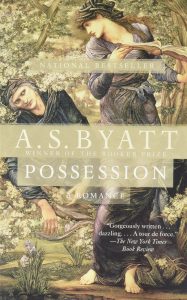
Then there is the novel, Possession, by A.S. Byatt, winner of the 1990 Booker prize. This is a complex relationship that begins in a rather boring manner – it opens in a library when Roland Michell, a scholar and professional man of high morals commits a crime: he steals the original drafts of letters he has come across in his research. This act has the potential of becoming his professional suicide. The synopsis via Wikipedia:

(Roland Mitchell) begins to investigate. The trail leads him to Christabel LaMotte, a minor poet and contemporary of Ash, and to Dr. Maud Bailey, an established modern LaMotte scholar and distant relative of LaMotte. Protective of LaMotte, Bailey is drawn into helping Michell with the unfolding mystery. The two scholars find more letters and evidence of a love affair between the poets (with evidence of a holiday together during which – they suspect – the relationship may have been consummated); they become obsessed with discovering the truth. At the same time, their own personal romantic lives – neither of which is satisfactory – develop, and they become entwined in an echo of Ash and LaMotte. The stories of the two couples are told in parallel, with Byatt providing letters and poetry by both of the fictional poets.

Love, whether unacknowledged or returned, physical or platonic, is complicated. The sections of movies, books, and short stories where the arc of the scene showcases true emotional complexity stick with me. I find myself contemplating them long after the story has ended.

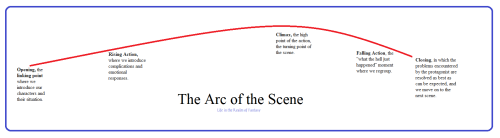
In all three literary examples, The Lord of the Rings, Brokeback Mountain, and Possession, it is the interpersonal relationships entwined with the action that illuminates the drama. Action scenes require some sort of emotion to give them context, to shape them into an arc:

  1. Opening, the linking point where we introduce our characters and their situation.
  2. Rising Action, where we introduce complications and emotional responses.
  3. Climax, the high point of the action, the turning point of the scene.
  4. Falling Action, the “what the hell just happened” moment where we regroup.
  5. Closing, in which the problems encountered by the protagonist are resolved as best as can be expected, and we move on to the next scene.

The resolution of one scene is the linking point to the next, the door that takes us further into the story. The dramatic arc of each scene ends at a higher point in the overall story arc.

The emotions surrounding the drama in our literature attracts us, captivates us, keeps us interested. In every story, drama is the moment you, the reader, realize you must take up the hero’s task; you must carry the evil One Ring to Mount Doom.

Drama done well can take the reader from joy to despair to resignation and back to hope within the arc of the scene. This is good pacing and urges the reader to keep turning the page to see what is coming next.


Credits and Attributions:

Wikipedia contributors, “Brokeback Mountain (short story),” Wikipedia, The Free Encyclopedia, https://en.wikipedia.org/w/index.php?title=Brokeback_Mountain_(short_story)&oldid=902058091 (accessed August 24, 2019).

Wikipedia contributors, “Possession (Byatt novel),” Wikipedia, The Free Encyclopedia, https://en.wikipedia.org/w/index.php?title=Possession_(Byatt_novel)&oldid=909067002 (accessed August 24, 2019).

The Two Towers, by J.R.R. Tolkien, first edition cover, Publisher George Allen & Unwin, © 11 November 1954, Fair Use.

Possession by A.S. Byatt, first edition cover, Publisher Chatto and Windus, © 1990, Fair Use.

Comments Off on The Inferential Layer: Drama #amwriting (reprise)

Filed under writing

The Drabble #amwriting

Right now, we have a lot of opportunities to sell our extremely short stories. Many online publications are looking for drabbles (100-word stories) and flash fictions under 750 words.

These editors are looking for new, unpublished work, so get out your pens and start writing.

You might ask why you would want to write something that short, and I do see your point. But if not having the time to sit down and write a novel is holding you back from writing, you have another option: extremely short fiction.

When you force yourself to create within strict wordcount limits, you increase your ability to tell a story with minimal exposition. We grow in the craft and gain different perspectives when we write short stories and essays.

This is especially true if you practice writing drabbles. Trying to tell a story in 100 words or less teaches you several skills.

  • You are forced to develop economy of words.
  • You begin to see what the core plot elements of a story might be.

When you have a backlog of short stories, you also have a vault full of ready-made characters and premade settings to draw on.

I hear you saying that any investment of time is difficult if it takes you away from your longer works. It’s hard to not feel jealous of the scant time we have for that.

Look at this as a muscle-building routine. Writing a 100-word story takes far less time than writing a 2,000 word short fiction, or a 70,000-word novel.

Something you should consider: you are more likely to sell a drabble than a short story, and more likely to sell a short story than a novel.

Just saying.

Writing a drabble is like any other form of writing. You should expect to spend an hour or so writing and then editing it to fit within the 100-word constraint.

A 100-word story has the same basic components as a longer story:

  1. A setting.
  2. 1 or 2 characters.
  3. A conflict.
  4. A resolution.
  5. No subplots are introduced.
  6. Minimal background is introduced.
  7. Every sentence propels the story to the conclusion.

First, we need a prompt, a jumping-off point. Some contests give whole sentences for prompts, others offer one word, and still others no prompt at all.

A prompt is a word or visual image that kickstarts the story in your head. The prompt for the following drabble was sunset.

I break short stories into acts by taking the number of words I plan to fit the story into and dividing it into 3 sections.

A drabble works the same way. We break it down to make the story arc work for us.

For a drabble, we have about 25 words to open the story and set the scene, about 50 – 60 for the heart of the story, and 10 – 25 words to conclude it.

For this drabble, I used:

24 Words (opening): We sat on the beach near the fire, two old people bundled against the cold Oregon sunset. Friends we’d never met fished the surf.

51 words (middle and crisis): Wind whipped my hair, gray and uncut, tore it from its inept braid. The August wind was chill inside my hood, but I remained, pleased to be with you, and pleased to be on that beach.

Mist rose with the tide, closed in and enfolded us, blotting out the falling stars.

25 Words (conclusion): Laughing at our folly, we dragged our weary selves back to our digs, rented, but with everything this old girl needed—love, laughter, and you.

The above drabble is a 100-word romance, one I have used here before. It has a beginning, a middle, and an end. The opening shows our protagonist on the beach with someone for whom she cares deeply.

The conflict in this tale is the weather. Wind and blowing mist make it too cold for our protagonist to stay on the beach and forces her indoors.

The resolution is a romantic evening spent in front of the fireplace.

Drabbles contain the ideas and thoughts that can easily become longer works, such as this drabble did in my poem, Oregon Sunset.

I think of drabbles as the distilled essences of novels. In 100 words, they offer everything the reader needs to know. A good drabble makes the reader ponder what might have happened next.

In this way, writing drabbles teaches us how to write a good hook. Knowing how to write a great hook is critical. The first paragraphs of our longer works must intrigue the reader or they will set it aside.

Write your story ideas in the form of drabbles and flash fictions. Save them for later use as they could hold the seeds of a longer work.

Save the drabble/flash fiction for submission to a publication or contest, as it won’t spoil whatever novel you think it might grow into.

When you can’t write on the project you’ve given your soul to, it’s time to take a break. The act of writing random ideas and emotions down is a kind of vacation from your other work. It rests your mind and clears things so you can return to your main project with all your attention.

Whether you choose to submit a drabble or hang on to it doesn’t matter. The idea is written down and accessible for when you need a new project.

In that regard, drabbles are the literary equivalent of dried beans and rice. They are resources we can set aside for a rainy day.

9 Comments

Filed under writing

#FineArtFriday: Silver Lake at Dusk, by Diego Delso

Silver Lake during dusk, Wrangell–St. Elias National Park and PreserveAlaska, United States, Photographed by Diego Delso on 23 August 2017. This image was selected as picture of the day on Wikimedia Commons for .

About the Photographer:

Diego Delso roams the world photographing nature and contributes his work to Wikimedia Commons. He is a free content and knowledge supporter, whose photographs are regularly featured as the Image of the Day, and several of his images have been selected as finalists for Image of the Year.

I love the mood and serenity of today’s image. The clarity and depth of both the water and the sky makes one feel as if we know this place.


Credits and Attributions

Silver Lake at Dusk, Diego Delso / CC BY-SA (https://creativecommons.org/licenses/by-sa/4.0)

Wikimedia Commons contributors, “File:Lago Plateado, Parque nacional y reserva Wrangell-San Elías, Alaska, Estados Unidos, 2017-08-22, DD 135.jpg,” Wikimedia Commons, the free media repository, https://commons.wikimedia.org/w/index.php?title=File:Lago_Plateado,_Parque_nacional_y_reserva_Wrangell-San_El%C3%ADas,_Alaska,_Estados_Unidos,_2017-08-22,_DD_135.jpg&oldid=419215168 (accessed May 29, 2020)


Comments Off on #FineArtFriday: Silver Lake at Dusk, by Diego Delso

Filed under #FineArtFriday

On Poetry: Interview with Alan Shue, creator of the Bug Rhymes Stories

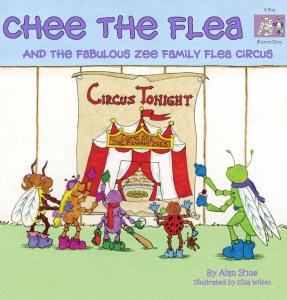
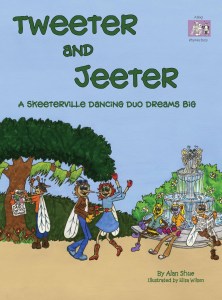
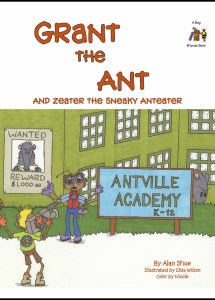
This is the fourth and final installment in my series of interviews on the craft of writing poetry. Today Alan Shue, author of the hilarious Bug Rhymes Stories series of children’s books, talks to us about his approach to the craft.

Writing for children is a bit different than for older readers, and Alan kindly explains why.


CJJ: When did you begin to write poetry?

AS: I began to write poetry in small amounts during the 1960s and 70s, mainly in the form of song writing (little of which I can find now). In the 80s I started writing poems mainly for Christmas, family birthdays and other events to send out with cards and found I really enjoyed it. After a while I branched out into writing just for fun, playing with alliteration and various rhyming patterns and broadening my mix of topics to include humorous, romantic, and more serious themes. When I retired in 2008 I also started writing rhyming stories for children.

CJJ: Your published work is primarily children’s books. When did you realize this was your calling as an author? Have you written in other genres?

AS: I’m not sure I’ve had a calling as an author per se – I more or less stumbled into writing children’s books. When I reached retirement I knew I wanted to spend more of my newfound free time writing poetry and maybe also take a shot at writing short stories or novels. One warm summer day in 2008 I lay on my back in a grassy area in a park, looked up into a clear blue sky, and casually thought about what kind of writing I’d like to do. Within moments a few rhyming lines and silly plot ideas about fleas and other bugs popped into my mind. They felt fun and funny enough that I decided to give rhyming children’s stories a try, to see if I could create something I liked. That impulse turned into a series I call Bug Rhymes stories.

I have tried a few other genres. In the poetry realm I have written lyrics for a set of “New Age” compositions whose melodies I loved so much I felt compelled to put words to them. In the past five years I have also tried my hand at adult prose in the form of a short story (more like a novelette) and a fiction novel currently in progress. I find writing prose for an adult audience to be far more difficult than writing goofy rhymes for kids.

CJJ: What do you enjoy most about your work?

AS: I like the creative process of trying to communicate ideas and stories via rhyme. I enjoy the challenge of finding unusual and clever rhymes, giving rhythm to poetic verse, and employing alliteration to make lines and quatrains “roll off the tongue” (although admittedly I sometimes create tongue twisters). I’m a member of a local writing group and like the learning process involved in receiving critiques of my work and making improvements to it. It also has been a pleasure to visit elementary schools to read my books aloud and talk to students about writing. My greatest enjoyment comes when I receive feedback from kids and adults who have had a good laugh or a nice feeling from my ditties and stories.

CJJ: What do you find easiest about writing for children, and conversely, what is most difficult?

AS: My children’s stories tend to “anthropomorphize” bugs, i.e. they put bugs into situations faced by humans. I think having bugs as characters allows me the freedom to make the stories as humorous or dramatic as I want while still appealing to a child’s sense of fun and fantasy. I can create my own culture and world, e.g. a pair of bedbug bicycle cops on the trail of a bedbug bed burglar.

My greatest difficulty is keeping my children’s stories as short as most publishers recommend. Many children’s books are just a few hundred words long. My stories sometimes creep up to around a thousand, plus or minus, which can exceed the attention span of some who are in my target 3 to 9 year age range.

CJJ: What advice would you give other authors who want to write for children and who may be just starting out?

AS: My books are all self-published, which is far easier to do now than it was in 2008, so I would suggest considering that approach as it is far quicker and easier than acquiring an agent or publisher. By all means join a good critique group where you can get constructive criticism from other authors. I was not academically trained as a writer and listening to other writers has resulted in far better finished work from me. Read as many children’s books as you can to see what is getting published, what the market is looking for, and what your niche could be. Think about your goals. My niche has been the adventures of bugs scorned or overlooked by most other children’s book writers (e.g. fleas, mosquitoes, bedbugs, gnats, etc., no butterflies) and my goal has been to write stories kids and adults will enjoy, not necessarily to achieve commercial success.

CJJ: Finally, what are you currently working on?

AS: I’m about 35,000 words into my first full length novel. I’ve discovered that it takes far more research and skill for this type of writing – to make it realistic and keep adults engaged – than for fantasy-based rhyming stories for children. Additionally, I have several more finished Bug Rhymes stories that need illustration to become books. Kudos to my wife Linda (creative director and colorist) and my illustrator Elisa Wilson for the three Bug Rhymes books completed so far. I’ve found my participation in the illustration process immensely interesting and rewarding, but expensive, so am not sure what the future holds for additional books. I am also still writing poetry as new ideas, events and holidays stimulate.


Thank you for allowing me to prevail upon you, Alan.

I highly recommend Alan’s books for the fun rhymes, the overall stories, and the wonderful, detailed art.

My 7-yr-old grandson, Byron, loves “Grant the Ant.” We had a long discussion on the phone about the redemption of Zeater and what a great ending the book has.  After all, in Byron’s mind, the best stories have fun words, a lot of action, and a certain amount of “ew!”

Also, Byron thinks I should add a glossary at the end of my books as he liked the one at the end of “Grant the Ant.” I’ve always listened to marketing advice from my grandsons, as they are rarely wrong.

This series of interviews with working poets/novelists has been fun. I’m always interested in how other authors work. In case you missed them, here are the links to the three previous interviews:

Stephen Swartz

Shaun Allan

Maria VA Johnson

Writing poems doesn’t stop us from writing novels, or vice versa. We can give ourselves permission to approach the craft of writing in whatever way makes us happy.

Beginning Monday, I’ll continue the series on poetry and short fiction with Drabbles (100 word stories).


About Alan Shue:

Raised in Las Vegas, Alan moved to the Pacific Northwest to attend Oregon State University and then made Olympia, WA his home. As a published author Alan has a not-so-secret love for the written word and rhymes in particular. In addition to writing children’s stories, over the years he has written a great deal of poetry for family, holidays, and just fun.

As a contrast, during his career Alan wrote thousands of pages of information systems analysis and technical design. So, a little right brain here … a little left brain there … add in some bugs, rhymes, goofiness and imagination, and you have the origins of his Bug Rhymes Books series.

Alan lives with his wife of 50+ years, Linda, who has been instrumental in the illustration of his books. His published works so far include: Chee the Flea, Tweeter and Jeeter, and Grant the Ant. Alan is coordinator for the 150+ member Olympia Writers Group.

To find out more about Alan’s books visit his web site: http://bugrhymesbooks.com/

Comments Off on On Poetry: Interview with Alan Shue, creator of the Bug Rhymes Stories

Filed under writing

On Poetry: Interview with Maria V A Johnson @amwriting

One week ago, I asked three good friends who write both novels and poetry, Stephen Swartz, Shaun Allan, and Maria V.A. Johnson to each answer the same 5 questions about how they approach writing both poetry and novels. (Which is why my questions might seem familiar.) It’s amazing how differently they have answered.

Each author has shared a different aspect of how they tap into their inner poet.

Part 1, Stephen Swartz can be found if you click on this link.

Part 2, Shaun Allan can be found if you click on this link.

I first met Maria when she joined Myrddin Publishing Group, the indie publishing cooperative I have been involved with since 2012. Maria is a meticulous editor and is easy to work with, and her poems are moving and inspirational.


CJJ:  When did you begin to write poetry?

MVAJ: I first started writing poetry when I was 16. My Nan died and I wanted to write something for the funeral. It drew heavily on inspiration found online, but I discovered I enjoyed it and haven’t looked back since.

CJJ: What is your favorite form, rhyming or free?

MVAJ: When it comes to forms, I’m a very modern girl and prefer free, though I did experiment a lot while at University.

CJJ: For me, poetry becomes an emotional catharsis. Where do you find the emotional strength to write and publish something as deeply personal as poetry?

MVAJ: I like to think that I’m not unique and others are in the same place as me. If my poetry can help them in some way, then I believe it is worth the emotional upheaval of sharing this part of myself. On the plus side, having a form of Autism (known as Aspergers) means that I struggle to connect with my emotions. While I can do it, my natural state is slightly distanced which lessens the pain of sharing. It does have a downside though – when I do connect to write, it can be quite overwhelming.

CJJ: We all write what we are in the mood for. Which literary form, novel or poetry is easiest for you today?

MVAJ: I’ve discovered that the best form for my poetry is modern free. This type is more focused on imagery than anything else, and I find that this works best with the hyperfocus that is part of being autistic.

CJJ: What are you currently working on?

MVAJ: At the moment I’m not working on anything. All my projects have been on hold since I bought a puppy in January. She was just reaching the stage where I could get back to work when the Covid-19 Lockdown took effect and I haven’t been in the right frame of mind to do anything, so I’ve been making greeting cards instead. However, I have a couple of projects to return to when I can. One is a poetry collection about disabilities, and one is a short novel about a damaged girl post-coma. I tend to flit between the two as the muse moves me.


Thank you, Maria, for giving us a glimpse of your writing world. I think many authors are finding it difficult to be creative right now.

On Wednesday, for the final post in this interview series, I have the good fortune of featuring Alan Shue. He is a poet and the author of three hilarious children’s books. Alan lives in my area and is active in local writing groups where we have mutual friends—so I prevailed on a member of my writing group to connect us via email.

(That was bold, I know, but nothing ventured, nothing gained!)

I can’t wait to share Alan’s interview with you. I’ve changed up the questions and he’s been a good sport about it.


About Maria V A Johnson:

Maria V A Johnson is a voracious reader, professional editor, and published author and poet with a Bachelor of Arts Honours Degree in English and Creative Writing. She loves the challenge of taking a raw manuscript and turning it into a polished novel. She specialises in Fantasy, however she can edit any genre. She first started writing seriously, when at sixteen she wrote a poem for her grandmother’s funeral and she grew to love poetry and writing from there.

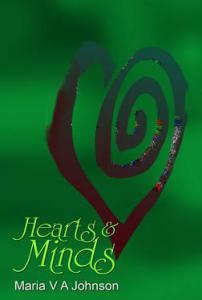
She has collaborated in several anthologies which raise money for Farleigh Hospice in Chelmsford, Essex. She also has a poetry collection called Hearts and Minds released November 2012 and has been published in several anthologies since. Her first novel is currently in editing and she is working on her second as well as another poetry collection.

She has been diagnosed with Autism Spectrum Disorder, though she doesn’t consider it a disability, but rather a different way of looking at the world. If you want to know more about it, visit the National Autistic Society page at: https://www.autism.org.uk/

Maria’s book of poetry, Hearts and Minds, is available at Amazon.

You can find her at: https://maria7627.wordpress.com/

3 Comments

Filed under writing

#FineArtFriday: The Gondoliers’ Siesta, John Singer Sargent 1904 

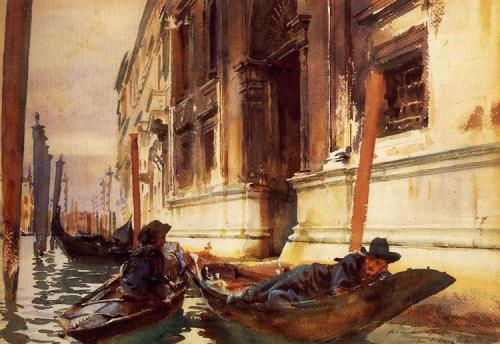
The Gondoliers’ Siesta, John Singer Sargent 1904  

Artist: John Singer Sargent  (1856–1925)

Title: English: Gondoliers’ Siesta

Date: circa 1904

Medium: watercolor

Dimensions: 35.6 x 50.8 cm

Collection: Private collection, courtesy of Adelson Galleries

Current location: New York

Source/Photographer   Beyeler Foundation

What I Love About this Painting:

John Singer Sargent shows us a moment in time, set in Venice of 1904. It is an image capturing the heat of midday and the well-deserved rest of two men whose lives are spent on the water. They are well-employed, earning a good living by ferrying passengers from one end of town to another. During their heyday as a means of public transports, teams of four men would share ownership of a gondola — three oarsmen (gondoliers) and a fourth person, primarily shore based and responsible for the booking and administration of the gondola (Il Rosso Riserva).

About Singer’s Watercolors, via Wikipedia:

During Sargent’s long career, he painted more than 2,000 watercolors, roving from the English countryside to Venice to the Tyrol, Corfu, the Middle East, Montana, Maine, and Florida. Each destination offered pictorial stimulation and treasure. Even at his leisure, in escaping the pressures of the portrait studio, he painted with restless intensity, often painting from morning until night.

His hundreds of watercolors of Venice are especially notable, many done from the perspective of a gondola. His colors were sometimes extremely vivid and as one reviewer noted, “Everything is given with the intensity of a dream.” In the Middle East and North Africa Sargent painted Bedouins, goatherds, and fisherman. In the last decade of his life, he produced many watercolors in Maine, Florida, and in the American West, of fauna, flora, and native peoples.

With his watercolors, Sargent was able to indulge his earliest artistic inclinations for nature, architecture, exotic peoples, and noble mountain landscapes. And it is in some of his late works where one senses Sargent painting most purely for himself. His watercolors were executed with a joyful fluidness. He also painted extensively family, friends, gardens, and fountains. In watercolors, he playfully portrayed his friends and family dressed in Orientalist costume, relaxing in brightly lit landscapes that allowed for a more vivid palette and experimental handling than did his commissions (The Chess Game, 1906). His first major solo exhibit of watercolor works was at the Carfax Gallery in London in 1905. In 1909, he exhibited eighty-six watercolors in New York City, eighty-three of which were bought by the Brooklyn Museum. Evan Charteris wrote in 1927:

To live with Sargent’s water-colours is to live with sunshine captured and held, with the luster of a bright and legible world, ‘the refluent shade’ and ‘the Ambient ardours of the noon.’

Although not generally accorded the critical respect given Winslow Homer, perhaps America’s greatest watercolorist, scholarship has revealed that Sargent was fluent in the entire range of opaque and transparent watercolor technique, including the methods used by Homer.

About the Artist, via Wikipedia:

John Singer Sargent born January 12, 1856 – died April 14, 1925, was an American expatriate artist, considered the “leading portrait painter of his generation” for his evocations of Edwardian-era luxury. He created roughly 900 oil paintings and more than 2,000 watercolors, as well as countless sketches and charcoal drawings. His oeuvre documents worldwide travel, from Venice to the Tyrol, Corfu, the Middle East, Montana, Maine, and Florida.

He was born in Florence to American parents, and trained in Paris before moving to London, living most of his life in Europe. He enjoyed international acclaim as a portrait painter. An early submission to the Paris Salon in the 1880s, his Portrait of Madame X, was intended to consolidate his position as a society painter in Paris, but instead resulted in scandal. During the next year following the scandal, Sargent departed for England where he continued a successful career as a portrait artist.

From the beginning, Sargent’s work is characterized by remarkable technical facility, particularly in his ability to draw with a brush, which in later years inspired admiration as well as criticism for a supposed superficiality. His commissioned works were consistent with the grand manner of portraiture, while his informal studies and landscape paintings displayed a familiarity with Impressionism. In later life Sargent expressed ambivalence about the restrictions of formal portrait work, and devoted much of his energy to mural painting and working en plein air. Art historians generally ignored “society” artists such as Sargent until the late 20th century.

Sargent’s early enthusiasm was for landscapes, not portraiture, as evidenced by his voluminous sketches full of mountains, seascapes, and buildings. Carolus-Duran’s expertise in portraiture finally influenced Sargent in that direction. Commissions for history paintings were still considered more prestigious, but were much harder to get. Portrait painting, on the other hand, was the best way of promoting an art career, getting exhibited in the Salon, and gaining commissions to earn a livelihood.


Credits and Attributions:

Wikimedia Commons contributors, “File:John Singer Sargent, Gondoliers’ Siesta.jpg,” Wikimedia Commons, the free media repository, https://commons.wikimedia.org/w/index.php?title=File:John_Singer_Sargent,_Gondoliers%E2%80%99_Siesta.jpg&oldid=149791025 (accessed May 22, 2020).

Wikipedia contributors, “John Singer Sargent,” Wikipedia, The Free Encyclopedia, https://en.wikipedia.org/w/index.php?title=John_Singer_Sargent&oldid=956888160 (accessed May 22, 2020).

Wikipedia contributors, “Gondola,” Wikipedia, The Free Encyclopedia, https://en.wikipedia.org/w/index.php?title=Gondola&oldid=950230627 (accessed May 22, 2020).

Comments Off on #FineArtFriday: The Gondoliers’ Siesta, John Singer Sargent 1904 

Filed under #FineArtFriday

On Poetry: Interview with Shaun Allan @singularityspnt #amwriting

Welcome to a special Thursday edition of Life in the Realm of Fantasy. Last weekend, I asked three friends who write poetry, Stephen Swartz, Shaun Allan, and Maria V.A. Johnson to each answer the same 5 questions. It’s amazing how differently they have answered.

Part 1, Stephen Swartz can be found if you click on this link.

For the second installment in this 3-part series, my dear friend, poet and novelist Shaun Allan, has consented to talk to us about his writing life and how important the medium of poetry is to him.

The following Haiku is one written to a prompt posted in our publishing group’s chat room:

The Soldier on the Bridge by Shaun Allan

As the darkness comes
I see the soldier guarding
Death’s bridge to life lost


CJJ:  When did you begin to write poetry?

SA: I had an assistant once. She wanted to be in a band – she could play the sax very well – which could have been useful as she was pretty much useless at her job. She wrote songs when she should have been working, for example. I’d only ever written fiction up until then (apart from an article about my hometown), and she challenged me to write a song.

I had a go. It was a poor excuse for a song, but it wasn’t a bad poem. My fiction writing had tailed off a bit. I wasn’t in a very good point in my life at the time. I hadn’t written anything at all for a whole year. That not-quite-song prompted something. I was seeing poetry everywhere. I’d go out on site (I worked and still work on an oil refinery) and so many things I’d look at or work on would prompt something.

I was in a ‘dark place’, something that became the title for my first anthology. Most of my poetry was introspective, therapeutically bringing out the shadowy parts of my mind. I still write that type of poetry even now, though I’m in a much better place. I’ve also written a couple of books of children’s Dr. Suess-inspired work, which brings the light to the darkness.

CJJ: What is your favorite form, rhyming or free?

SA: I only recently got into Haiku. I hadn’t written any before this year, now I love it. I have a couple of collections of horror stories that are almost all 31 (creepy) words, so am used to evoking moods and ideas with only a few words. As such, I’ve found it quite easy to write the 5/7/5 format.

I edge, though, towards free verse. At any point, the poem will take the form it does. In most cases, I don’t plan to write one more than another, it’s just as it comes, but it tends to be free verse more than anything.

CJJ: For me, poetry becomes an emotional catharsis. Where do you find the emotional strength to write and publish something as deeply personal as poetry?

SA: I totally agree. Writing Sin was much like this too. In my poetry, with the exception of most of the children’s work, it is very much a peek into my fears. I’ve spent a lot of my life feeling like an outsider. Not so much now, but the remnants are there. I find it easy, and sometimes comforting, to enter the frame of mind where I can write the poetry I do. It’s often dark. Perhaps this is also why I write horror so much. It’s like I take a step away from the world and look inside.

CJJ: We all write what we are in the mood for. Which literary form, novel or poetry is easiest for you today?

SA: I think, now I’m actually thinking about it, poetry is easier. I have lots of ideas for stories and, when I sit down to write, I don’t find it too difficult (especially once I get going) to produce the story. With poetry, however, almost every poem is written immediately and without edit. If I have a prompt or an idea, I can sit down or pick up my phone and just write it. If the prompt is for Haiku, then it’s haiku. If not, it can take any form. Whichever it is, I don’t seem to have a problem. If I do, on very rare occasions, need to write one for something (such as the death of a relative), I might have to think of the first line, but the rest always flows thereafter.

CJJ: What are you currently working on?

SA: Oh, so many things. I could even say too many things! The novel I’m currently writing is called HERO. It’s about the only boy in a world of superpowers, who is ‘normal’. He desperately wants powers like everyone else – and goes to dangerous lengths to try and get them – because he wants to be the new kind of normal. Things don’t go to plan and he discovers you don’t need to be able to fly to be a hero.

I’m also 75% of the way through a book called Into Darkness, about a killer who goes inside his own mind to stop the dark part of himself. Add to that a mostly written origin story of the Queen of Hearts (think Wicked), my second book of 31 creepy words stories, a book about a surgeon who fakes illnesses in people so he can harvest tissue, and at least 3 more, I’m quite busy.

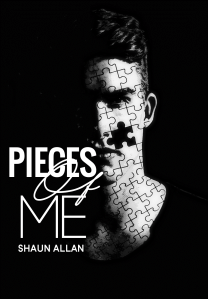
Then there’s my ongoing poetry book Pieces of Me.

I need to clone myself or find a way to fit 48 hours into a day!


Thank you, Shaun, for these wonderful insights into how you manage to squeeze time to write into your working life, and still find time to spend with your family. We all need to earn a living, and you have proven that one will find time to write if one chooses to.

On Monday, Maria V.A. Johnson has agreed to talk about writing poetry from an autistic person’s perspective. And, for next Wednesday,  I may have an interview with a Northwest author who writes children’s poetry–that is still in the works, but keep your fingers crossed!

Credits:

The Soldier on the Bridge, Shaun Allan © 2020 All Rights Reserved, used by permission.


About Shaun Allan:

Shaun Allan is a Wattpad Star, featured author and Wattys winner.  Having appeared on Sky TV to debate traditional vs electronic publishing against a major literary agent, he writes multiple genres but mainly delves into his Dark Half to produce psychological horror.  He has worked with Warner Brothers, Universal, Goosebumps, Blumhouse and DC Comics, working with such movies as The Purge: Anarchy, Sinister II, The Boy, Incarnate, IT and A Quiet Place and holds writing workshops at local schools.  He lives with his wife, two daughters, two dogs and two cats, but isn’t building an ark.

He works full time and also owns a barbers salon.  He writes between his heartbeats as it’s the only spare time he gets! 

Website  Wattpad  Facebook  Twitter  Instagram  Subscribe

Shaun Allan is the author of the bestselling psychological thriller/horror Sin, the ‘savage and beautiful’ And the Meek Shall Walk, and commissioned for the movies, Mr. Composure (The Purge: Anarchy), Suffer the Little Children (Sinister 2), Whispers (The Boy), Tender Walks the Demon (Incarnate), The Loser’s Club (IT) and Voice (A Quiet Place).


5 Comments

Filed under writing

On Poetry – interview with @StephenSwartz1 #amwriting

This is the first in 3-part series of short interviews with novelists who also write poetry. Today features Stephen Swartz, a good friend who came though on short notice! But first, I’ll need to lay a little groundwork.

When I think of the Romantic movement in poetry, I think of poets like William Wordsworth, Samuel Taylor Coleridge, John Keats, Percy Bysshe Shelley, William Blake, and Lord Byron.

According to Wikipedia, “The Romantic movement emphasized intense emotion as an authentic source of aesthetic experience, placing new emphasis on such emotions as apprehension, horror and terror, and awe—especially that experienced in confronting the new aesthetic categories of the sublimity and beauty of nature.”

I have a reason for opening with “the big guns of Romantic poetry,” so to speak. The roots of my guest’s writing life were shaped by Romanticism.

For some who write poetry, the muse, the inspiration to bend words is not always a constant companion. For some of us, our writing career begins with poetry, but as we branch out into other genres, the poetic muse slips into the background and emerges at odd times.

Yet we sometimes feel we are the only one who have wandered away from that beginning.  It helps to know that others experience this wandering too, that writing a novel doesn’t make us less of a poet.

Poetry is always waiting to be rediscovered, accepting of the fact it will be set aside when something shiny catches our authorly attention.

Unlike most spurned lovers, Poetry forgives us when we abandon it for greener writing pastures. When we return to it, Poetry welcomes us home with no recriminations.

And now, my good friend, author Stephen Swartz, has kindly consented to answer a series of questions regarding both his current work and his life as a poet.


CJJ:  When did you begin to write poetry?

SS: I probably dabbled at silly rhymes early on, but I would count my poetic career beginning at age 12 when I became a Romantic…and have remained a member to this day. I used to write love poems to the girls in high school and college – mostly unappreciated. My first poem publication (school newspaper) was a set of rhyming quatrains about a young knight fighting a dragon and saving the town.

CJJ: What is your favorite form, rhyming or free?

SS: Depends on the subject. Although serious subjects still can lend themselves to rhyming, modern poetry favors free verse. In the past two years I’ve dabbled in Twitter poetry (from posted prompts) and for the sake of the short format I often write haiku or limerick.

CJJ: For me, poetry becomes an emotional catharsis. Where do you find the emotional strength to write and publish something as deeply personal as poetry?

SS: In the past few years, poetry has been more a mental exercise (like for the Twitter prompts), although I do try to say something. Otherwise, I write when I feel an emotional knot that needs to be untied or cut and putting it out in poetic form is cathartic. They also help me remember what I felt at various times in my life, like emotional postcards.

CJJ: We all write what we are in the mood for. Which literary form, novel or poetry is easiest for you today?

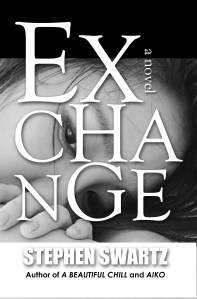
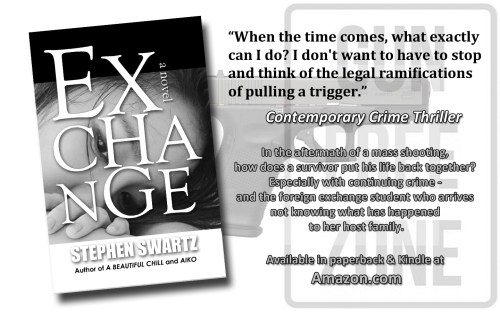
SS: I just finished a contemporary crime novel set in my own city. It was easy in the sense I did not need to “make up” anything because the real features of the setting were right there. However, previous novels in sci-fi and fantasy had their easier parts when I was able to simply invent something rather than having it conform to known facts. I tend to shift back and forth with regard to genre. I feel the urge now to swing back to something more fabulous than realistic.

CJJ: What are you currently working on?

SS: I am rather in limbo at the moment. I should finish a sci-fi book I’ve been working on since my first NaNoWriMo. I started an apocalyptic plague novel when the lockdown began but lost interest at 5000 words; I may yet return to it. I also need to get back to Book 4 of my vampire trilogy, sitting at 35,000 words. And there’s Epic Fantasy *With Zombies to work on. Now that my summer staycation has begun, I may yet be productive!


Thank you, Stephen! You came though beautifully on exceedingly short notice to help me kick off this 3-part series of interviews with working poets who are also novelists.

Tomorrow, Thursday, I will feature an interview with poet/novelist  Shaun Allan, and on Monday, Maria V.A. Johnson has agreed to talk about writing poetry from an autistic person’s perspective.


ABOUT AUTHOR STEPHEN SWARTZ

Stephen Swartz grew up in Kansas City where he was an avid reader of science-fiction and quickly began emulating his favorite authors. Since then, Stephen studied music in college and, like many writers, worked at a wide range of jobs: from French fry guy to soldier, to IRS clerk to TV station writer, before heading to Japan for several years of teaching English. Now Stephen is a Professor of English at a university in Oklahoma, where he teaches many kinds of writing. He still can be found obsessively writing his latest manuscript, usually late at night. He has only robot cats.

SOCIAL MEDIA

Blog: http://stephenswartz.blogspot.com/

Facebook: Author Stephen Swartz

Twitter:

  • @StephenSwartz1 (general use)
  • @dreamlandtrilogy (The Dream Land trilogy specifically)

Follow Stephen on Goodreads

You can find all of Stephen’s books on his Amazon Author Page


5 Comments

Filed under writing