Tag Archives: Fine Art Friday

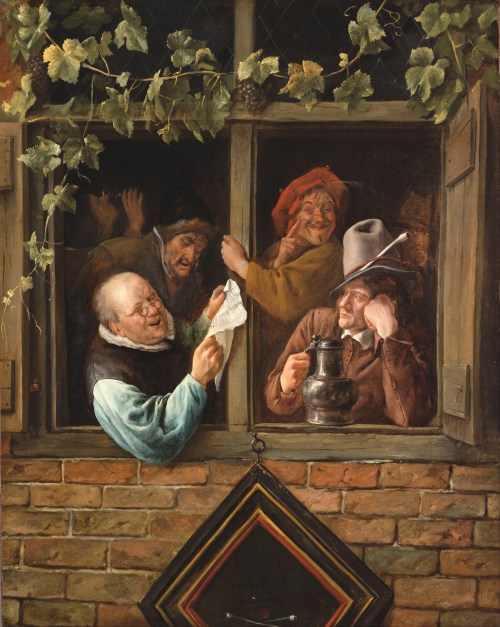
#FineArtFriday: Rhetoricians at a Window by Jan Steen ca. 1666

Artist: Jan Steen  (1625/1626–1679)

Title: Rhetoricians at a Window

Genre: genre art

Date: c. 1661-66

Medium: oil on canvas

English: Oil on canvas

Dimensions: Height: 759.46 mm (29.90 in); Width: 586.23 mm (23.07 in)

Collection: Philadelphia Museum of Art

What I love about this painting:

The reading of a poem or play was clearly the opportunity for the performers to have a good time. From the drinker in the shadows of the background to the grapevines growing around the window, Steen tells us that wine and rhetoric are clearly entwined.

I love the inclusion of both “the critic” who leans his head on his hand and listens analytically, and the man behind him, who is clearly “a little over the limit,” and supports himself by grasping the window frame and heartily agreeing with some point.

The reader is clearly enjoying himself, as are the others.

About the Artist (Via Wikipedia):

Jan Havickszoon Steen (c. 1626 – buried 3 February 1679) was a Dutch Golden Age painter, one of the leading genre painters of the 17th century. His works are known for their psychological insight, sense of humour and abundance of colour.

Daily life was Jan Steen’s main pictorial theme. Many of the genre scenes he portrayed, as in The Feast of Saint Nicholas, are lively to the point of chaos and lustfulness, even so much that “a Jan Steen household”, meaning a messy scene, became a Dutch proverb (een huishouden van Jan Steen). Subtle hints in his paintings seem to suggest that Steen meant to warn the viewer rather than invite him to copy this behaviour. Many of Steen’s paintings bear references to old Dutch proverbs or literature. He often used members of his family as models, and painted quite a few self-portraits in which he showed no tendency of vanity.

Steen did not shy from other themes: he painted historical, mythological and religious scenes, portraits, still lifes and natural scenes. His portraits of children are famous. He is also well known for his mastery of light and attention to detail, most notably in Persian rugs and other textiles.

Steen was prolific, producing about 800 paintings, of which roughly 350 survive. His work was valued much by contemporaries and as a result he was reasonably well paid for his work. He did not have many students—only Richard Brakenburgh is recorded—but his work proved a source of inspiration for many painters. [2]

About this painting, Via Wikipedia:

Chambers of rhetoric (Dutch: rederijkerskamers) were dramatic societies in the Low Countries. Their members were called Rederijkers (singular Rederijker), from the French word ‘rhétoricien’, and during the 15th and 16th centuries were mainly interested in dramas and lyrics. These societies were closely connected with local civic leaders and their public plays were a form of early public relations for the city. [1]

In 1945, Sturla Gudlaugsson, a specialist in Dutch seventeenth-century painting and iconography and Director of the Netherlands Institute for Art History and the Mauritshuis in The Hague, wrote The Comedians in the work of Jan Steen and his Contemporaries, which revealed that a major influence on Jan Steen’s work was the guild of the Rhetoricians or Rederijkers and their theatrical endeavors.

It is often suggested that Jan Steen’s paintings are a realistic portrayal of Dutch 17th-century life. However, not everything he did was a purely realistic representation of his day-to-day environment. Many of his scenes contain idyllic and bucolic fantasies and a declamatory emphasis redolent of theater.

Jan Steen’s connection to theater is easily verifiable through his connection to the Rederijkers. There are two kinds of evidence for this connection. First, Jan Steen Steen’s uncle belonged to the Rhetoricians in Leiden, where Steen was born and lived a substantial part of his life. Second, Jan Steen portrayed many scenes from the lives of the Rederijkers, an example being the painting Rhetoricians at a Window of 1658–65. The piece is currently held in the Philadelphia Museum of Art which was established in February 1876. The humanity, humor and optimism of the figures suggest that Jan Steen knew these men well and wanted to portray them positively.

With his lavish and moralising style, it is logical that Steen would employ the stratagems from theater for his purposes. There is conclusive evidence that the characters in Steen’s paintings are predominantly theatrical characters and not ones from reality. [2]


Credits and Attributions:

[1] Wikipedia contributors, “Jan Steen,” Wikipedia, The Free Encyclopedia, https://en.wikipedia.org/w/index.php?title=Jan_Steen&oldid=950709901 (accessed September 10, 2020).

[2] Wikipedia contributors, “Chamber of rhetoric,” Wikipedia, The Free Encyclopedia, https://en.wikipedia.org/w/index.php?title=Chamber_of_rhetoric&oldid=975283829 (accessed September 10, 2020).

Wikimedia Commons contributors, “File:Jan Steen, Dutch (active Leiden, Haarlem, and The Hague) – Rhetoricians at a Window – Google Art Project.jpg,” Wikimedia Commons, the free media repository, https://commons.wikimedia.org/w/index.php?title=File:Jan_Steen,_Dutch_(active_Leiden,_Haarlem,_and_The_Hague)_-_Rhetoricians_at_a_Window_-_Google_Art_Project.jpg&oldid=355150081 (accessed September 10, 2020).
2 Comments

Filed under #FineArtFriday

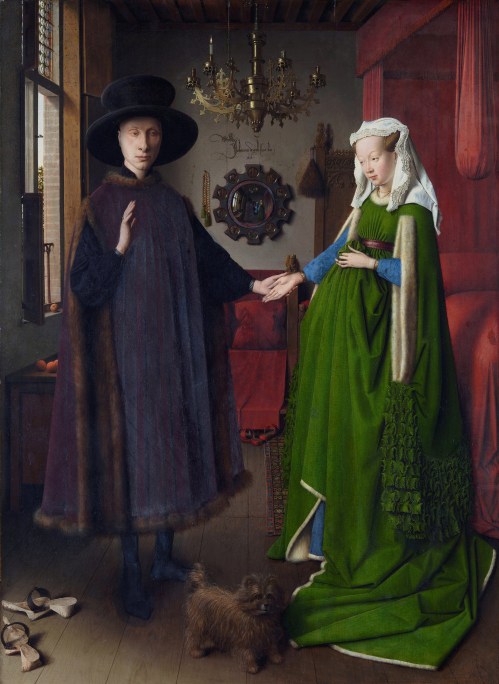
#FineArtFriday: The Arnolfini Portrait by Jan van Eyck 1434

Artist: Jan van Eyck  (circa 1390 –1441)

Title: The Arnolfini Portrait

Genre: portrait

Date: 1434

Medium: oil on panel

Dimensions: Height: 82 cm (32.2 in); Width: 59.5 cm (23.4 in)

Collection: National Gallery

About this painting, via Wikipedia:

The Arnolfini Portrait (or The Arnolfini WeddingThe Arnolfini Marriage, the Portrait of Giovanni Arnolfini and his Wife, or other titles) is a 1434 oil painting on oak panel by the Early Netherlandish painter Jan van Eyck. It forms a full-length double portrait, believed to depict the Italian merchant Giovanni di Nicolao Arnolfini and his wife, presumably in their residence at the Flemish city of Bruges.

What I love about this painting:

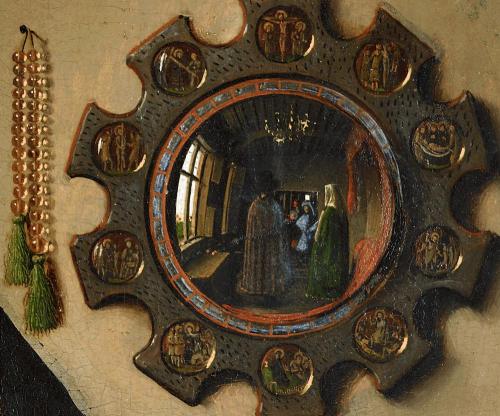
The painting is signed, inscribed, and dated on the wall above the mirror: “Johannes de eyck fuit hic 1434” (Jan van Eyck was here 1434).  This signature, made to look as if it were an inscription explaining the mirror over which it is centered, is a shining example of the sharp wit the later Netherlandish painters frequently inserted into their pictures.

I suspect his inclusion of subtle humor in his works gave permission to those painters who followed in his footsteps, such as the great Bruegel dynasty.

The colors of the garments are deep and rich. These were expensive clothes, completely befitting a wealthy merchant and his wife. In regard to the controversy which is explained below – yes, this painting is steeped in allegory and symbolism, down to the clogs in the left hand corner placed as if they are going out of the picture. In some cultures, a pair of shoes placed like that symbolizes an imminent departure, usually death.

All van Eyck’s work was heavily symbolic. But she appears to be in the late stages of a pregnancy. To me, given the societal norms of the Netherlands in the year 1434, this means the picture shows a married couple. If they were not actually married, it seems unlikely they would have commissioned a portrait showing her in that condition. In fact, and this will probably expose my self-taught ignorance of art history, it makes me wonder why there is a controversy about their marital status at all.

And the mirror…oh my. That mirror is brilliant.

The Controversy, via Wikipedia:

In 1934 Erwin Panofsky published an article entitled Jan van Eyck’s ‘Arnolfini’ Portrait in the Burlington Magazine, arguing that the elaborate signature on the back wall, and other factors, showed that it was painted as a legal record of the occasion of the marriage of the couple, complete with witnesses and a witness signature. Panofsky also argues that the many details of domestic items in the painting each have a disguised symbolism attached to their appearance. While Panofsky’s claim that the painting formed a kind of certificate of marriage is not accepted by all art historians, his analysis of the symbolic function of the details is broadly agreed, and has been applied to many other Early Netherlandish paintings, especially a number of depictions of the Annunciation set in richly detailed interiors, a tradition for which the Arnolfini Portrait and the Mérode Altarpiece by Robert Campin represent the start (in terms of surviving works at least).

Since then, there has been considerable scholarly argument among art historians on the occasion represented. Edwin Hall considers that the painting depicts a betrothal, not a marriage. Margaret D. Carroll argues that the painting is a portrait of a married couple that alludes also to the husband’s grant of legal authority to his wife. Carroll also proposes that the portrait was meant to affirm Giovanni Arnolfini’s good character as a merchant and aspiring member of the Burgundian court. She argues that the painting depicts a couple, already married, now formalizing a subsequent legal arrangement, a mandate, by which the husband “hands over” to his wife the legal authority to conduct business on her own or his behalf (similar to a power of attorney). The claim is not that the painting had any legal force, but that van Eyck played upon the imagery of legal contract as a pictorial conceit. While the two figures in the mirror could be thought of as witnesses to the oath-taking, the artist himself provides (witty) authentication with his notarial signature on the wall.


Credits and Attributions:

Wikimedia Commons contributors, “File:Van Eyck – Arnolfini Portrait.jpg,” Wikimedia Commons, the free media repository, https://commons.wikimedia.org/w/index.php?title=File:Van_Eyck_-_Arnolfini_Portrait.jpg&oldid=446521642 (accessed September 4, 2020).

Wikimedia Commons contributors, “File:The Arnolfini Portrait, détail (2).jpg,” Wikimedia Commons, the free media repository, https://commons.wikimedia.org/w/index.php?title=File:The_Arnolfini_Portrait,_d%C3%A9tail_(2).jpg&oldid=428220496 (accessed September 4, 2020).

Wikimedia Commons contributors, “File:Arnolfini Portrait 3.jpg,” Wikimedia Commons, the free media repository, https://commons.wikimedia.org/w/index.php?title=File:Arnolfini_Portrait_3.jpg&oldid=428554231 (accessed September 4, 2020).

2 Comments

Filed under #FineArtFriday, writing

#FineArtFriday: Spanish Blacksmiths by Ernst Josephson 1882 (revisited)

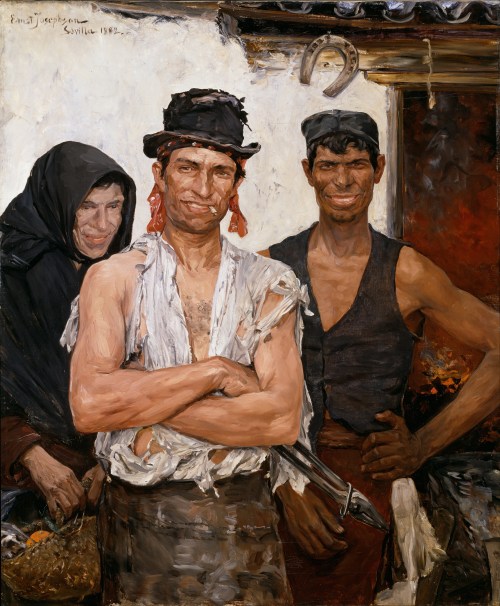
Spanish Blacksmiths, by Ernst Josephson

  • Date: 1882
  • Medium: oil on canvas
  • Dimensions : width: 107 x height: 128.5 cm

What I love about this image:

This powerful painting is one of my all-time favorites. Josephson captures the boundless self-confidence and personalities of these young men. He has managed to portray their cock-of-the-walk swagger, and he has shown us the truth of their craft: that sparks fly and ruin their clothes; that the work is hard and their muscles strong. These men are full of life.

The influence of Josephson’s having studied Rembrandt’s works closely can be seen here in the style with which he has painted their features. He has painted the men with truth—they are not classically handsome, but they are in the prime of life and have immense charisma. They wear their burned and ragged hats with pride. These men are good at what they do, and they know it. Their eyes dance and flirt outrageously with you across the years—they are full to bursting with machismo, daring you to just try to walk past and not notice them.

About the Artist, Via Wikipedia

(Ernst Josephson) was born to a middle-class family of merchants of Jewish ancestry. His uncle, Ludvig O. Josephson (1832-1899) was a dramatist and his uncle Jacob Axel Josephson (1818-1880) was a composer. When he was ten, his father Ferdinand Semy Ferdinand Josephson (1814-1861) left home and he was raised by his mother, Gustafva Jacobsson (1819-1881) and three older sisters.

At the age of sixteen, he decided to became an artist and, with his family’s support, enrolled at the Royal Swedish Academy of Fine Arts. His primary instructors there were Johan Christoffer Boklund and August Malmström. He was there until 1876, when he received a Royal Medal for painting.

After leaving the Academy, he and his friend and fellow artist Severin Nilsson (1846-1918) visited Italy, Germany and the Netherlands, where they copied the Old Masters. His breakthrough came in Paris, where he was able to study with Jean-Léon Gérôme at the École des Beaux-Arts. He soon began concentrating on portraits, including many of his friends and fellow Swedes in France. For a time, he shared a studio with Hugo Birger (1854–1887). His personal style developed further during a trip to Seville with his friend, Anders Zorn, from 1881 to 1882.

His private life did not go well, however. By his late twenties, he was afflicted with syphilis. His romantic life suffered as a consequence, as he was forced to break off a promising relationship with a young model named Ketty Rindskopf.


Credits and Attributions:

Spanish Blacksmiths by Ernst Josephson 1882 PD|100,  First published on Life in the Realm of Fantasy on August 16, 2019

Wikimedia Commons contributors, “File:Ernst Josephson – Spanish Blacksmiths – Google Art Project.jpg,” Wikimedia Commons, the free media repository, https://commons.wikimedia.org/w/index.php?title=File:Ernst_Josephson_-_Spanish_Blacksmiths_-_Google_Art_Project.jpg&oldid=354761584 (accessed August 16, 2019).

Wikipedia contributors, “Ernst Josephson,” Wikipedia, The Free Encyclopedia, https://en.wikipedia.org/w/index.php?title=Ernst_Josephson&oldid=888815743 (accessed August 16, 2019).

Comments Off on #FineArtFriday: Spanish Blacksmiths by Ernst Josephson 1882 (revisited)

Filed under #FineArtFriday

#FineArtFriday: Time, the Pandemic, and the Monarch of the Beach

Today I am revisiting a post from August 2019, and contrasting a beloved holiday retreat with how we must experience this place today.

Last year I offered you two images instead of one, but this year I am giving you five. The first image was found on Wikimedia Commons, taken in 2013 on a spring day in Cannon Beach Oregon. It is a wonderful shot of what I think of as the Monarch of the Beach, the God-Rock dominating the shores of my favorite beach.

The second image is one I shot in 2018, an unusually hot year, when we were plagued with massive wildfires here on the west coast of America. The sunsets that year were unbelievable.

The third image in this post is one I shot in 2019 with my cell-phone, and little did I know that it would be the last image I would ever get of that particular sea-stack. The two final images were also shot on my cell phone.

In the first image, Haystack Rock, shot and uploaded to Wikimedia Commons by Tiger635, the sky is perfect; an amazing shade of blue with stratus clouds overhead and sea below, all converging on Haystack. The photographer did everything right to capture the beauty of this place.

This tiny resort town is home to me, although I only live here one week out of the year.

Before the Pandemic, on Sundays, the streets of Cannon Beach were crowded with cars and throngs of people. The cafes, galleries, trinket shops, bookstores, wine shop, and bodega—all were jammed, alive with a seething mass of humanity.

On Mondays, it became briefly walkable, and that is how it is now, during the pandemic. People wear face-masks in town, and give space to each other while walking on the sidewalk. It’s still a place where temporary neighbors become socially distant friends, glad to know they aren’t alone.

This year I have the view I love most, that of Tillamook Head, as pictured in my photo from 2o18. When the fog that seems eternal this year lifts, we can see  Terrible Tilly, the most notorious lighthouse on the west coast. So far this year, the sunsets have not been quite as spectacular as 2018 was, but I did get one beautiful shot, which is the final image in this post.

I can walk out my front door to the the seawall’s stairs to Ecola Creek, walking out to where it emerges into the Pacific Ocean.

The stairs are precipitous, and as I said last year, they are familiar; old friends greeting me in their sand-encrusted steepness, bidding me, “Welcome back, Pilgrim! Welcome home.”

On sunny days here at the north end of the beach, the sandbar between Ecola Creek estuary and the sea is dotted with people carrying chairs and chasing children. It’s not the throng we had last year, but still a bit of a crowd. While many aren’t wearing masks on the beach, everyone seems willing to maintain respectful distance.

Unaware of COVID-19, excited dogs, all with leashes securely attached to their people, push along toward the waves, dragging tired humans faster than they can comfortably walk.

Most days, when it is cold, foggy, or rainy, we only have to share the beach with the few hardier folks who love the soul of this place as much as they do the sun and sand.

The beach stretches four miles from Ecola Creek to Arch Cape. It’s a sandy shoreline, dotted with sea stacks. Several smaller sea stacks surround the grand master, the Monarch of the Beach who sits near the center, the megalith known as Haystack Rock.

This is the annual Jasperson family pilgrimage to a  place that assumes mythic proportions when we are away from it. The pandemic made its mark this year, with no grandchildren in attendance, no hand-dug sandpits waiting for unwary grandparents to stumble into, and so far no wind for my kite.

But every year is different. Regardless, like the seabirds nesting on the sea stacks, my husband and I return here every year, as do as any family members who can get these few days away from work. We come to regain the internal balance that we gradually lose over the course of the year, seeking connectedness as a family.

The Needles, those acolyte sea stacks gathered around Haystack’s knees are slowly disintegrating. We see them diminished a little more every year, noticed especially when we compare pictures from one year to another. This next image is one I shot on Monday August 5, 2019. The sky that year was a shade of gray that is impossible to describe. I particularly love the way the tidal pools came out in my photo, the green of the sea moss, and the reflection of the spires across the shallow sea.

Last year the most visible change was in this sister-spire of the three Needles—one of the larger ones had been sundered into two spires rising from a common base.

This year, the change is graphic.

Now it is only a low hump, not too different from any other lump of basalt cresting the waves in the shallows. Where once there were three, now there are only two.  In the final two pictures, you can just barely see what is left of the middle sister.

Haystack Rock and the Two Needles, 20 August 2020 © 2020 by Connie J. Jasperson, All Rights Reserved

Time eventually wears everything to sand. All these sea stacks will one day be gone, shattered to rubble, a testimony to the violence of the wild Northeast Pacific winters. That is the way life is, and I find it reflected in myself.

I’m not quite crumbling into the sea, but I’m definitely showing the effects of weathering.

It’s comforting to know that, still standing strong and unchanged, Haystack Rock, the Monarch of the Beach rules. Pelicans, puffins, terns, seagulls, and rare wide-winged wanderers from far out to sea still come to nest on the Monarch of the Beach, Haystack Rock and his attendants.

Tidal pools still shelter starfish, anemones, and a multitude of other small creatures. These tiny water-worlds remind us that we are part of something larger.

The sea is ever-changing. Untamed and dangerous one day, it is calm and serene the next.

The most fundamental thing I’ve learned from my walks among the tide pools at the foot of the Monarch is this: we humans are not islands—we are part of a world that extends below the surface and conceals secrets and lives we surface dwellers can only dimly imagine.

Above the eternal sea, on the strand below the Great Rock, we remember who we are, and we are made stronger.

The bonds my family forges in this hallowed place bind us together. They won’t be broken no matter how far apart we are, or how long we are separated, not even after the Monarch of the Beach crumbles into the sea.

Sunset Haystack Rock, with the two remaining needles. Author’s own work.


Credits and Attributions:

Haystack Rock, by Tiger635 [CC BY-SA 3.0 (https://creativecommons.org/licenses/by-sa/3.0)]

Tillamook Head at Sunset © Connie J. Jasperson 2018 All Rights Reserved

Sentinel, 05 August 2019 (One of the Needles, Cannon Beach) © 2019 by Connie J. Jasperson, All Rights Reserved (author’s own work).

Haystack Rock and the Two Needles, 20 August 2020 © 2020 by Connie J. Jasperson, All Rights Reserved (author’s own work).

Sunset at Haystack, 19 August 2020 © 2020 by Connie J. Jasperson, All Rights Reserved (author’s own work).

4 Comments

Filed under writing

#FineArtFriday: The Gleaners by Jean-François Millet 1857

Title: The Gleaners by Jean-François Millet  (1814–1875)

Genre: genre art

Date: 1857

Medium: oil on canvas

Dimensions: Height: 83.5 cm (32.8 in); Width: 110 cm (43.3 in)

***

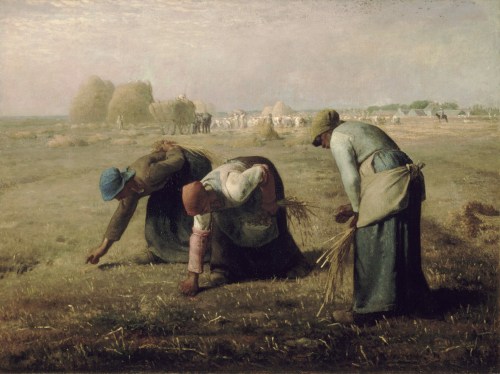
Wikipedia says: Gleaning is the act of collecting leftover crops from farmers’ fields after they have been commercially harvested or on fields where it is not economically profitable to harvest.

In nearly all paintings showing this labor, artists painted poor women doing the work of gleaning. Historically, the majority of impoverished families were headed by single, usually widowed, working women, who had few opportunities for employment and were paid less for their labor than men. This trend of lower pay for women overall continues, with the US Census reporting on Sep 10, 2019 that the median income for households maintained by single women  was $45,128,  as compared to households maintained by single men, who had a median income of $61,518 in 2018.

***

About the Artist: 

Jean-François Millet (October 4, 1814 – January 20, 1875) was a French artist and one of the founders of the Barbizon school in rural France. Millet is noted for his paintings of peasant farmers and can be categorized as part of the Realism art movement. Toward the end of his career he became increasingly interested in painting pure landscapes. He is known best for his oil paintings but is also noted for his pastels, conte crayon drawings, and etchings.

About The Gleaners (1857) via Wikipedia:

This is one of the most well known of Millet’s paintings. While Millet was walking the fields around Barbizon, one theme returned to his pencil and brush for seven years—gleaning—the centuries-old right of poor women and children to remove the bits of grain left in the fields following the harvest. He found the theme an eternal one, linked to stories from the Old Testament. In 1857, he submitted the painting The Gleaners to the Salon to an unenthusiastic, even hostile, public.

(Earlier versions include a vertical composition painted in 1854, an etching of 1855–56 which directly presaged the horizontal format of the painting now in the Musée d’Orsay.)

A warm golden light suggests something sacred and eternal in this daily scene where the struggle to survive takes place. During his years of preparatory studies, Millet contemplated how best to convey the sense of repetition and fatigue in the peasants’ daily lives. Lines traced over each woman’s back lead to the ground and then back up in a repetitive motion identical to their unending, backbreaking labor. Along the horizon, the setting sun silhouettes the farm with its abundant stacks of grain, in contrast to the large shadowy figures in the foreground. The dark homespun dresses of the gleaners cut robust forms against the golden field, giving each woman a noble, monumental strength.


Credits and Attributions:

The Gleaners, by Jean-François Millet / Public domain. Wikimedia Commons contributors, “File:Jean-François Millet – Gleaners – Google Art Project 2.jpg,” Wikimedia Commons, the free media repository, https://commons.wikimedia.org/w/index.php?title=File:Jean-Fran%C3%A7ois_Millet_-_Gleaners_-_Google_Art_Project_2.jpg&oldid=371550893 (accessed July 31, 2020).

Wikipedia contributors, “Gleaning,” Wikipedia, The Free Encyclopedia, https://en.wikipedia.org/w/index.php?title=Gleaning&oldid=952834082 (accessed July 31, 2020).

Wikipedia contributors, “Jean-François Millet,” Wikipedia, The Free Encyclopedia,  https://en.wikipedia.org/w/index.php?title=Jean-Fran%C3%A7ois_Millet&oldid=956877005 (accessed July 31, 2020).

2 Comments

Filed under #FineArtFriday

#FineArtFriday: Kidd’s Omnibus outside the Angel Inn, Brentford, c. 1840, by James Pollard

Title: Kidd’s Omnibus Outside the Angel Inn, Brentford

Artist: James Pollard

Genre: Genre Calendar Illustrations

Medium: Aquatint

Date: circa 1840 [1]

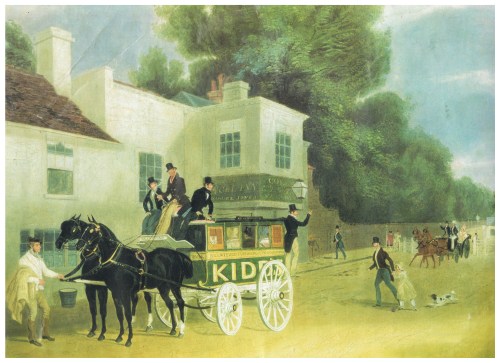
Today’s Fine Art Friday offering is Genre Art, a scene originally published in a calendar. In most working class homes, the only secular art that was hung on the walls were prints, many of which originated in calendars, as most people couldn’t afford to buy original art.

Since the mid-1700s, printed wall calendars have historically been a good source of advertising for small to large businesses. To this day, many supermarkets and hardware companies give illustrated wall calendars away for free to customers as promotional merchandise.

About the Artist, via artnet and Wikipedia:

James Pollard was a British painter best known for his depictions of horse-drawn carriages, fox hunting, and other equestrian scenes. Born in 1792 in Islington, United Kingdom to the painter and publisher Robert Pollard the Elder, he went on to work for his father’s firm as a draftsman and engraver. While working for his father, he was commissioned by a print seller named Edward Orme to paint an inn’s signboard, which would depict a mail-coach with horses and passengers. This commission launched the artist’s career, for the signpost was seen by many prospective patrons. Pollard went on to exhibit his work at the Royal Academy and the British Institution in London. Today, his works are in the collections of the Art Institute of Chicago, the National Gallery of Art in Washington, D.C., the Tate Gallery in London, and the Denver Art Museum, among others. Pollard died in 1867 in London, United Kingdom. [2]

Between 1821 and 1839, James Pollard exhibited at the Royal Academy. He exhibited at the British Institution in 1824 and 1844. During his career, he also worked with John Frederick Herring, Sr. on several horse racing paintings in which he painted the backgrounds and spectators while Herring painted the horses. [3]

What I like about this image:

This painting of Kidd’s Omnibus was created for a circa 1840 calendar by James Pollard, who was considered an adequate draftsman and illustrator in his day. It was most likely printed in his father, painter and publisher, Robert Pollard’s, printshop, as he was his father’s primary illustrator. [4]

In this illustration, we see the historical origination of urban public transportation – the Horsebus, or Omnibus. We have shortened the term to just ‘bus’ in the context of public transportation. Most  omnibuses were like cabs, in that they were owned by the drivers. However, since the drivers plied their trade on a regular route, they could carry more people. They could charge a lesser fare that the working class could afford, and still make a living.

According to Wikipedia:

horse-bus or horse-drawn omnibus was a large, enclosed and sprung horse-drawn vehicle used for passenger transport before the introduction of motor vehicles. It was mainly used in the late 19th century in both the United States and Europe and was one of the most common means of transportation in cities. In a typical arrangement, two wooden benches along the sides of the passenger cabin held several sitting passengers facing each other. The driver sat on a separate, front-facing bench, typically in an elevated position outside the passengers’ enclosed cabin. In the main age of horse buses, many of them were double-decker buses. On the upper deck, which was uncovered, the longitudinal benches were arranged back to back. [5]


Credits and Attributions

[1] Kidd’s Omnibus outside the Angel Inn, Brentford, c. 1840, by James Pollard, via Wikimedia Commons contributors, “File:Kidd’s Omnibus outside the Angel Inn, Brentford, c. 1840, by James Pollard.jpg,” Wikimedia Commons, the free media repository, https://commons.wikimedia.org/w/index.php?title=File:Kidd%27s_Omnibus_outside_the_Angel_Inn,_Brentford,_c._1840,_by_James_Pollard.jpg&oldid=195379488 (accessed July 23, 2020).

James Pollard (Life time: (1792–1867) – Transferred from en.wikipedia to Commons. (Original text: Original publication: UK Immediate source: Sammlung Fane de Salis: ephemera, from an old calendar.) This work is in the public domain in the United States because it was published (or registered with the U.S. Copyright Office) before January 1, 1925.

[2] James Pollard, Biography, artnet contributor, via artnet: http://www.artnet.com/artists/james-pollard/ accessed 23 July 2020.

[3] James Pollard, Wikipedia contributors, “James Pollard,” Wikipedia, The Free Encyclopedia, https://en.wikipedia.org/w/index.php?title=James_Pollard&oldid=838787787 (accessed July 23, 2020).

[4] Wikipedia contributors, “Robert Pollard (engraver),” Wikipedia, The Free Encyclopedia, https://en.wikipedia.org/w/index.php?title=Robert_Pollard_(engraver)&oldid=918903796 (accessed July 23, 2020).

[5] Wikipedia contributors, “Horsebus,” Wikipedia, The Free Encyclopedia, https://en.wikipedia.org/w/index.php?title=Horsebus&oldid=956355839 (accessed July 23, 2020).


Comments Off on #FineArtFriday: Kidd’s Omnibus outside the Angel Inn, Brentford, c. 1840, by James Pollard

Filed under #FineArtFriday

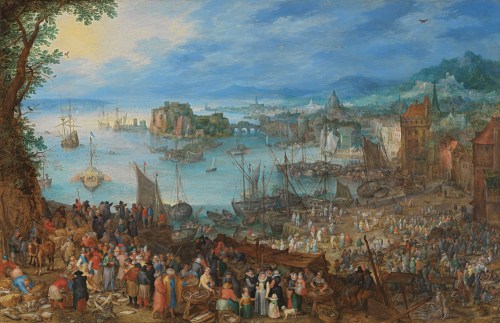
#FineArtFriday: The Great Fish Market by Jan Brueghel the Elder 1603

Title: Great Fish Market

Artist: Jan Brueghel the Elder  (1568–1625)

Date: 1603

Medium: oil on canvas

Dimensions:  Height: 59 cm (23.2 in); Width: 92 cm (36.2 in)

Collection: Alte Pinakothek  Current location: room 19

Inscriptions: Signature and date, bottom left: BRVEGHEL 1603

What I love about this painting:

Here we see a composite of all the places Jan Brueghel the Elder had visited. The scene is a fusion of his Flemish homeland and impressions of places he’d sketched on his travels.

In the middle of the picture is the Neapolitan Castel dell’ Ovo, on the right, in the distance, is St. Peter’s Basilica in Rome. We have a little of Italy thrown in with the Flemish, his effort to create the feeling of a busy, prosperous market. He shows his imaginary city from a high perspective, the god-like view.

In writing, this would be the omniscient point of view.

The elements presented in this painting, the harborscape, the ruins, and even the sections that are simply landscapes are all features that later became genres in their own right.

The scene contains many elements of Mannerist landscape painting. According to the Tate website, mannerist is a sixteenth-century style of art and design characterized by artificiality, elegance, and an aesthetic portrayal of the human figure.

In other words, they painted fantasy. And why not?

Flemish genre painting is strongly tied to the traditions of Pieter Bruegel the Elder. It was a style that continued directly into the 17th century through copies and new compositions made by his sons Pieter Brueghel the Younger and Jan Brueghel the Elder.

In this painting, the story opens with a view across a downward-sloping foreground. It teems with life, hundreds of figures of many races, grouped around the stalls and booths of a fish market. The group at the center of the foreground is thought to be a self-portrait of the artist and his family. It was common for artists to insert self-portraits in their works, and Jan often included his family.

One of Jan Brueghel’s most significant contributions to the craft of painting landscapes was how he depicted perspective. The eye is drawn towards the harbor in the background. We look out across the bay, along the coastline, and see entire towns, with ruins, wharves, and castles. Beyond that, we see distant mountains, painted with a blue that merges with the blue of the sea.

This blending of shape and color into the distance is how a landscape appears in real life.

These painters, and the Brueghel family in particular, were the generation who paved the way for artists like Rembrandt. Their works were the foundation upon which the masterpieces of the middle-to-late 17th century were built.

About the Artist, via Wikipedia:

Jan Brueghel was the son of the eminent Flemish Renaissance painter Pieter Brueghel the Elder.  A close friend and frequent collaborator with Peter Paul Rubens, the two artists were the leading Flemish painters in the first three decades of the 17th century.

He was born in Brussels as the son of Pieter Brueghel the Elder and Maria Coecke van Aelst. His mother was the daughter of the prominent Flemish Renaissance artists Pieter Coecke van Aelst and Mayken Verhulst. His father died about a year after Jan’s birth in 1569. It is believed that after the death of his mother in 1578, Jan, together with his brother Pieter Brueghel the Younger and sister Marie, went to live with their grandmother Mayken Verhulst, who was by then widowed. Mayken Verhulst was an artist in her own right. The early Flemish biographer Karel van Mander wrote in his Schilder-boeck published in 1604 that Mayken was the first art teacher of her two grandsons. She taught them drawing and watercolor painting of miniatures. Jan and his brother may also have trained with local artists in Brussels who were active as tapestry designers.

Jan Brueghel the Elder is regarded as an important innovator of landscape art. By introducing greater naturalism in his Alpine mountain settings, his father had expanded on the world landscape tradition that had been founded mainly by Joachim Patinir. Some of Pieter the Elder’s works also foreshadowed the forest landscape that would start to dominate landscape painting around the turn of the 16th century. Pieter the Elder also developed the village and rural landscape, placing Flemish hamlets and farms in exotic prospects of mountains and river valleys.

Jan developed on the formula he learned from his father of arranging country figures traveling a road, which recedes into the distance. He emphasized the recession into space by carefully diminishing the scale of figures in the foreground, middle-ground, and far distance. To further the sense of atmospheric perspective, he used varying tones of brown, green, and blue progressively to characterize the recession of space. His landscapes with their vast depth are balanced through his attention to the peasant figures and their humble activities in the foreground.

Like his father, Jan Brueghel also painted various village landscapes. He used the surrounding landscapes as the stage for the crowds of anecdotal, colorfully dressed peasants who engage in various activities in the market, the country roads and during the rowdy kermesses. Jan Brueghel’s landscape paintings with their strong narrative elements and attention to detail had a significant influence on Flemish and Dutch landscape artists in the second decade of the 17th century. His river views were certainly known to painters working in Haarlem, including Esaias van de Velde and Willem Buytewech, whom Brueghel may have met there when he accompanied Peter Paul Rubens on a diplomatic mission to the Dutch Republic in 1613.

Jan Brueghel was, along with artists such as Gillis van Coninxloo one of the prime developers of the dense forest landscape in the 17th century. Jan Breughel in fact experimented with such works before Coninxloo’s first dated wooded landscape of 1598. In his forest landscapes Brueghel depicted heavily wooded glades in which he captured the verdant density, and even mystery, of the forest. Although on occasion inhabited by humans and animals, these forest scenes contain dark recesses, virtually no open sky and no outlet for the eye to penetrate beyond the thick trees.


Credits and Attributions:

Wikimedia Commons contributors, “File:Jan Brueghel the Elder-Great Fish market.jpg,” Wikimedia Commons, the free media repository, https://commons.wikimedia.org/w/index.php?title=File:Jan_Brueghel_the_Elder-Great_Fish_market.jpg&oldid=406069557 (accessed July 9, 2020).

Wikipedia contributors, “Jan Brueghel the Elder,” Wikipedia, The Free Encyclopedia, https://en.wikipedia.org/w/index.php?title=Jan_Brueghel_the_Elder&oldid=963723468 (accessed July 9, 2020).

1 Comment

Filed under #FineArtFriday

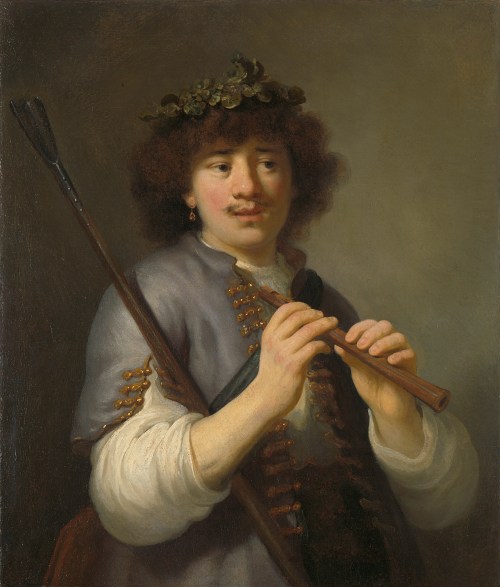
#FineArtFriday: Rembrandt as Shepherd with Staff and Flute, by Govert Flink 1636

About the artist: Born at Kleve, capital of the Duchy of Cleves, which was occupied at the time by the United Provinces, Govert Flinck was apprenticed by his father to a silk merchant, but in 1627 he was sent to Leeuwarden, where he boarded in the house of Lambert Jacobszoon. Jaobszoon was a Mennonite (one of the historic peace churches known for their commitment to pacifism). While Jacobszoon is better known as a preacher, he was a talented painter and an excellent teacher.

While studying there, Flinck met some of Jacobszoon’s neighbors, relatives of Saskia van Uylenburgh, who had married Rembrandt in 1634. That same year he began studying with Rembrandt.

Flinck is acknowledged as one of Rembrandt’s best pupils.

I really enjoy this romantic painting of Rembrandt dressed as a shepherd, holding a flute, and thinking about…what? Rembrandt’s contemplative expression seems peaceful.  The details are wonderful – from the finely worked trim on his garments down to the jewel dangling from his right ear, a gem that softly glows. The grains of the wood in both the flute and staff are subtle and real. The light falls perfectly – Flinck captured the personality of the master as a handsome young man during the happiest time of his life, and it seems as if Rembrandt himself enjoyed posing for it.

For more than a decade, Flinck’s work echoed that of Rembrandt, clearly influenced by the master’s style in the work which he executed between 1636 and 1648. As time passed, he began to desire to be a history painter, a genre in painting that  is defined by its subject matter rather than artistic style, and turned to the work of Peter Paul Rubens. In later years, Flinck had great commercial success, receiving many commissions for official and diplomatic paintings.


Credits and Attributions:

Wikimedia Commons contributors, “File:Rembrandt als herder met staf en fluit Rijksmuseum SK-A-3451.jpeg,” Wikimedia Commons, the free media repository, https://commons.wikimedia.org/w/index.php?title=File:Rembrandt_als_herder_met_staf_en_fluit_Rijksmuseum_SK-A-3451.jpeg&oldid=225225289 (accessed August 16, 2018).

Comments Off on #FineArtFriday: Rembrandt as Shepherd with Staff and Flute, by Govert Flink 1636

Filed under #FineArtFriday

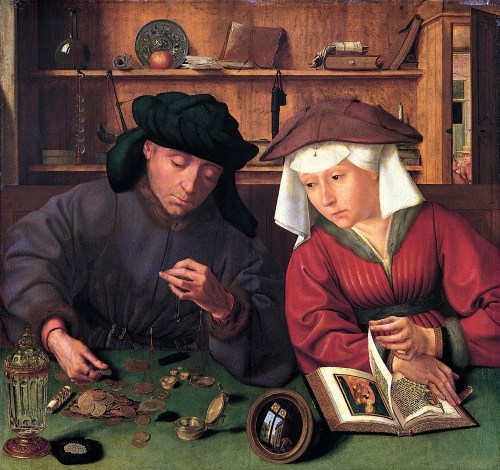
#FineArtFriday: The Money Changer and His Wife by Quentin Matsys, 1514

  • Artist: Quentin Matsys  (1456/1466–1530)
  • Title: The Moneylender and his Wife
  • Date: 1514
  • Medium: oil on panel
  • Dimensions: Height: 70.5 cm (27.7 in)
  • Current location: Louvre Museum
  • Inscriptions: Signature and date

The Money Changer and His Wife is a 1514 oil on panel painting by the Flemish renaissance artist Quentin Matsys.

What I love about this painting:

The colors are rich and vivid, and the lines sharp and clean. The artist included the smallest details in the prayer book, the pewter plate in the background, and the crystal jar by the man’s right hand, showing a prosperous, well-educated young couple. In some ways, Matsys’ style reminds me of the work of the lesser known Flemish painter, Pieter Brueghel the Younger, who was born long after Matsys’ death, but whose original works also leaned toward caricatures and grotesques.

About this painting, via Wikipedia:

A man, who is weighing the jewels and pieces of gold on the table in front of him, sits next to his wife who is reading a book of devotion with an illustration of the Virgin and Child. The couple is not dressed as members of nobility, but rather as well-to-do burghers of Antwerp, where the painting was made. At the time, Antwerp had grown with the influx of many southern immigrants fleeing the Spanish Inquisition. Among this international community there was a demand for money-changers and money-lenders, as international commerce was increasing in the port city.

About the Artist, via Wikipedia:

Most early accounts of Matsys’ life are composed primarily of legend and very little contemporary accounts exist of the nature of his activities or character. According to J. Molanus’ Historiae Lovaniensium, Matsys is known to be a native of Leuven with humble beginnings as an ironsmith. One of four children, Matsys was born to Joost Matsys (d. 1483) and Catherine van Kincken sometime between 4 April and 10 September 1466. Legend states that Matsys abandoned his career as a blacksmith to woo his wife, who found painting to be a more romantic profession, though Karel van Mander claimed this to be false, and the real reason was a sickness during which he was too weak to work at the smithy and instead decorated prints for the carnival celebrations.

Matsys work is considered to contain strong religious feeling—characteristic of traditional Flemish works—and is accompanied by a realism that often favored the grotesque. Matsys’ firmness of outline, clear modelling and thorough finish of detail stem from Van de Weyden’s influence; from the Van Eycks and Memling by way of Dirck Bouts, the glowing richness of transparent pigments. Matsys’ works generally reflect earnestness in expression, minutely detailed renderings, and subdued effects in light and shade. Like most Flemish artists of the time he paid a great deal of attention to jewelry, edging of garments, and ornamentation in general.


Credits and Attributions:

The Money Changer and His Wife by  Quentin Matsys, 1514 Public domain. The work of art depicted in this image and the reproduction thereof are in the public domain worldwide. The reproduction is part of a collection of reproductions compiled by The Yorck Project. The compilation copyright is held by Zenodot Verlagsgesellschaft mbH and licensed under the GNU Free Documentation License.

Wikipedia contributors, “The Money Changer and His Wife,” Wikipedia, The Free Encyclopedia, https://en.wikipedia.org/w/index.php?title=The_Money_Changer_and_His_Wife&oldid=937629150 (accessed June 26, 2020).

Wikipedia contributors, “Quentin Matsys,” Wikipedia, The Free Encyclopedia, https://en.wikipedia.org/w/index.php?title=Quentin_Matsys&oldid=960328863 (accessed June 26, 2020).


Comments Off on #FineArtFriday: The Money Changer and His Wife by Quentin Matsys, 1514

Filed under #FineArtFriday

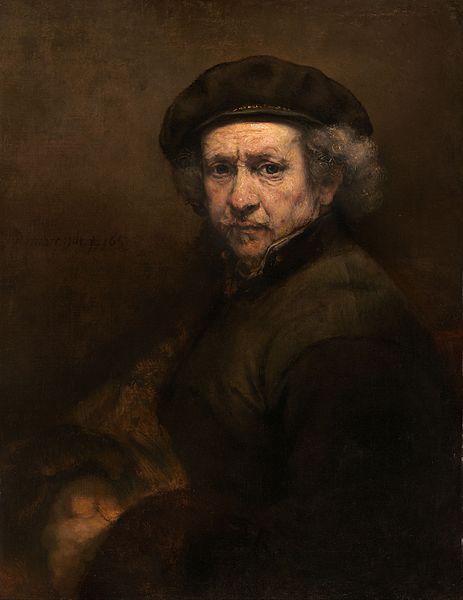
#FineArtFriday: Self Portrait, Rembrandt 1659

Rembrandt Harmenszoon van Rijn, commonly known simply as Rembrandt, is considered the finest artist of the 17th century. Some art historians consider him the finest artist in the history of art, and the most important artist in Dutch art history.

Speaking strictly as a Rembrandt fangirl and abject admirer, I consider his self-portraits to be more honest than those of any other artist.

Quote from Wikipedia: His self-portraits form a unique and intimate biography, in which the artist surveyed himself without vanity and with the utmost sincerity.

This honesty comes across in all his works featuring himself as the subject, even those where he portrays himself as a shepherd or the prodigal son. Each portrait shows an aspect of his personality, his sense of humor, his affection for his first wife, Saskia, who was the love of his life, and his wry acceptance of his own human frailties.

Money was a mystery to Rembrandt. He had no understanding of a budget, mishandled his son’s inheritance, spent far more than he earned, and didn’t pay his taxes. In short he was always in trouble with the authorities, always skirting the edges of disaster.

Rembrandt knew he was talented, but didn’t see himself as a creative genius. He was just a man with a passion for art, who lived beyond his means and died a pauper, as did Mozart, and as do most artists and authors.

I feel I know this man, more so than I do the person he was in his earlier self-portraits. He’s matured, lost some of the brashness of his youth. When I observe the man in this self-portrait, painted ten years before his death, I see a good-humored man just trying to live a frequently difficult life as well as he can. His face is lined and blemished, not as handsome as he once was. But his eyes seem both kind and familiar, filled with the understanding that comes from living with all one’s heart and experiencing both great joy and deep sorrow.

The art of Rembrandt van Rijn shows us his world as he saw it. Others may disagree with me, but I feel his greatest gift was the ability to convey personality with each portrait. This gift allowed him to portray every person he painted as they really were, blemished and yet beautiful. This is a gift he taught his students, and they were able to copy his style quite effectively, making discerning his true work difficult even for the experts.


Credits and Attributions:

Wikipedia contributors, “Rembrandt,” Wikipedia, The Free Encyclopedia, https://en.wikipedia.org/w/index.php?title=Rembrandt&oldid=844357531(accessed June 8, 2018).

Wikimedia Commons contributors, “File:Rembrandt van Rijn – Self-Portrait – Google Art Project.jpg,” Wikimedia Commons, the free media repository, https://commons.wikimedia.org/w/index.php?title=File:Rembrandt_van_Rijn_-_Self-Portrait_-_Google_Art_Project.jpg&oldid=292800848 (accessed June 8, 2018).

Comments Off on #FineArtFriday: Self Portrait, Rembrandt 1659

Filed under #FineArtFriday