Tag Archives: Fine Art Friday

#FineArtFriday: Imogen, by Herbert Gustave Schmalz

Herbert Gustave Schmalz (1856–1935) was an English painter who named himself Herbert Gustave Carmichael in 1918. He is counted among the Pre-Raphaelites , and Imogen, which was painted in  1888 is a classic example of the hyper-romanticized Pre-Raphaelite style.

The Pre-Raphaelite Brotherhood produced some spectacularly beautiful work, as well as some rather awkwardly posed, overly sentimental pieces. Schmalz was famous for his romantic pictures depicting medieval scenes, Arthurian scenes, and vignettes from Shakespeare’s work.

Schmalz turned his brush to portraiture in his later work, as that was where the money was.

From Wikipedia:

The Pre-Raphaelite Brotherhood (later known as the Pre-Raphaelites) was a group of English painters, poets, and critics, founded in 1848 by William Holman HuntJohn Everett Millais and Dante Gabriel Rossetti. The three founders were joined by William Michael RossettiJames CollinsonFrederic George Stephens and Thomas Woolner to form the seven-member “brotherhood”. Their principles were shared by other artists, including Ford Madox BrownArthur Hughes and Marie Spartali Stillman.

A later, medievalising strain inspired by Rossetti included Edward Burne-Jones and extended into the twentieth century with artists such as John William Waterhouse.

The group’s intention was to reform art by rejecting what it considered the mechanistic approach first adopted by Mannerist artists who succeeded Raphael and Michelangelo. Its members believed the Classical poses and elegant compositions of Raphael in particular had been a corrupting influence on the academic teaching of art, hence the name “Pre-Raphaelite”. In particular, the group objected to the influence of Sir Joshua Reynolds, founder of the English Royal Academy of Arts, whom they called “Sir Sloshua”. To the Pre-Raphaelites, according to William Michael Rossetti, “sloshy” meant “anything lax or scamped in the process of painting … and hence … any thing or person of a commonplace or conventional kind”.[1] The brotherhood sought a return to the abundant detail, intense colours and complex compositions of Quattrocento Italian art. The group associated their work with John Ruskin,[2] an English critic whose influences were driven by his religious background.

The group continued to accept the concepts of history painting and mimesis, imitation of nature, as central to the purpose of art. The Pre-Raphaelites defined themselves as a reform movement, created a distinct name for their form of art, and published a periodical, The Germ, to promote their ideas. The group’s debates were recorded in the Pre-Raphaelite Journal.


Credits and Attributions

Wikipedia contributors, “Herbert Gustave Schmalz,” Wikipedia, The Free Encyclopedia, https://en.wikipedia.org/w/index.php?title=Herbert_Gustave_Schmalz&oldid=829134407 (accessed July 27, 2018).

Wikipedia contributors, “Pre-Raphaelite Brotherhood,” Wikipedia, The Free Encyclopedia, https://en.wikipedia.org/w/index.php?title=Pre-Raphaelite_Brotherhood&oldid=846744412 (accessed July 27, 2018).
7 Comments

Filed under #FineArtFriday

#FineArtFriday: Joos van Craesbeeck

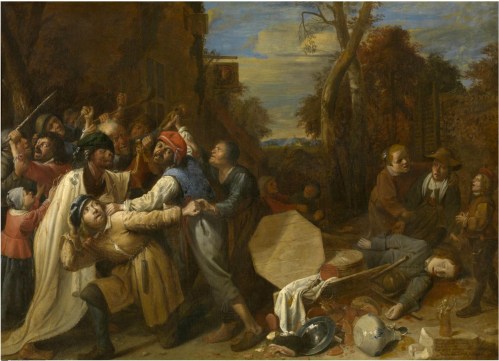
Joos van Craesbeeck (c. 1605/06 – c. 1660) was an interesting character, standing out among the many interesting characters of the seventeenth century Flemish art community. He was a Flemish baker and an artist, a friend and contemporary of  Adriaen Brouwer. They most likely met while Brouwer was jailed in the citadel of Antwerp, although why he was imprisoned is unknown. But the bakery in the Antwerp citadel was operated at that time by Joos van Craesbeeck.

Van Craesbeeck was fascinated with the portrayal of violence and the senses of taste and smell. He painted the dissolute side of life, shocking in its intensity and honesty. Death is Violent and Fast: Quarrel in a Pub, is an excellent example of his almost brutish depiction of peasants brawling. Blood flows, one man lies dead, and in the lower right hand corner, Death smiles, pleased with that night’s work.

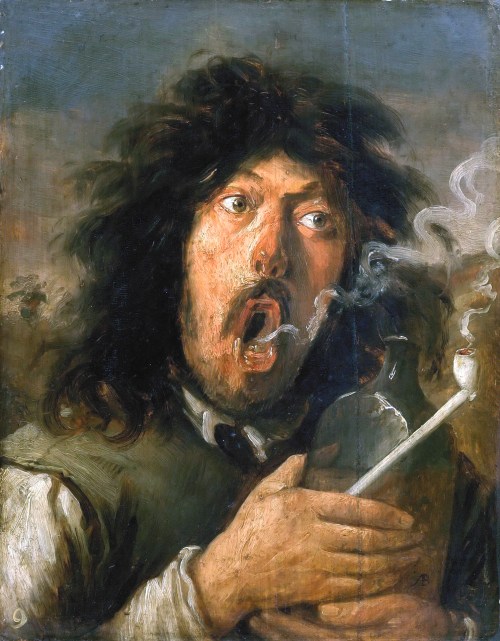
He often painted himself, as is seen in The Smoker, a self-portrait that was at one time attributed to Adriaen Brouwer, depicting the senses of smell and taste. He shows himself clutching both a bottle of hard liquor and a pipe, as if they are the dearest things to him. He exhales a stream of smoke, savoring it.

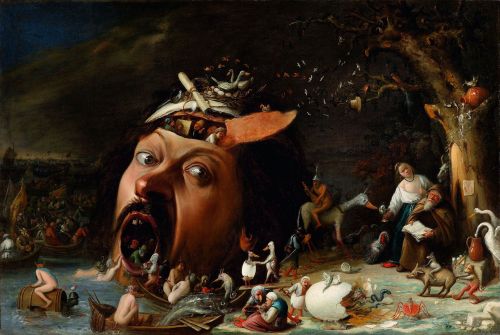
He also painted his own self-portrait as the central nightmare from which other nightmares spawn in the Temptation of St. Anthony. Note the way his mouth is full of little demons entering and leaving, and his head is open to reveal an artist painting beneath wild dark hair in which geese nest. St. Anthony himself is small, placed to the right, almost unnoticed in the onslaught of demons and temptations, both physical and moral. A cacophony of violence and evil rages as Anthony clings to the scriptures. This is a revealing portrait of how the artist viewed himself and the demons he battled, in my opinion.

The work of Joos van Craesbeeck is not comforting or warm. It is always allegorical, showing us something we don’t like about the world we live in. Violence and vice were as much a part of life in his time as they are today, and perhaps will always be.

Quote from Wikipedia: Van Craesbeeck painted at least five portraits which are presumed to be self-portraits and in which he depicts himself in a ‘dissolute’ manner. The dissolute self-portrait was a genre that had taken root in Dutch and Flemish genre painting in the 17th century. It was an inversion of the Renaissance ideal of the ‘pictor doctus’: the artist as an intellectual and gentleman. This ideal was replaced by the new model of the prodigal artist who is characterized by his creative inspiration and talents. These self-portraits emphasized the artists’ dissolute nature by creating associations with traditional moral themes such as the Five Senses and the Prodigal Son in the tavern. Van Craesbeeck painted himself four times in low-life guises depicting the sense of Taste.


Credits and Attributions:

Wikipedia contributors, “Joos van Craesbeeck,” Wikipedia, The Free Encyclopedia, https://en.wikipedia.org/w/index.php?title=Joos_van_Craesbeeck&oldid=823865809 (accessed July 20, 2018).

Death is Violent and Fast: Quarrel in a Pub, painting by Joos van Craesbeeck, ca. 1630 – 1635 PD|100 via Wikimedia Commons.

The Smoker, Joos van Craesbeeck ca.1635 – 1636 [Public domain], via Wikimedia Commons

The Temptation of St Anthony, Joos van Craesbeeck ca. 1650 [Public domain], via Wikimedia Commons

Comments Off on #FineArtFriday: Joos van Craesbeeck

Filed under #FineArtFriday

#FineArtFriday: Young Peasant with Sickle, Vincent Van Gogh

This week, for some reason I have been quite interested in Vincent van Gogh’s earlier work.  This painting is the earliest from his art-book, which is dated 1881. The mediums he used in this study were black chalk, charcoal, grey wash, and opaque watercolor on laid paper, a type of paper having a ribbed texture, that is especially good for watercolors.

I have been contrasting the preciseness of this early work with his later expressionism and imagery. I’m fascinated with the evolution of his choice of colors, from muted, yet somehow intense, in his early work, to brilliant and vibrant in his later pieces. In a way, it’s like reading the early works of a favorite author. You see everything you love about their work in that book written in their youth, but greatly admire the way their voice and style evolves in their later, more mature work.

Fortunately, Van Gogh was a prolific writer of letters, many of which have survived. Through his correspondence with his brother Theo Van Gogh, and to Anton van Rappard, a Dutch painter and draughtsman, we have a window into Vincent’s life.

Quote from Wikipedia: Theo kept all of Vincent’s letters to him;[10] Vincent kept few of the letters he received. After both had died, Theo’s widow Johanna arranged for the publication of some of their letters. A few appeared in 1906 and 1913; the majority were published in 1914.[11][12] Vincent’s letters are eloquent and expressive and have been described as having a “diary-like intimacy”,[9] and read in parts like autobiography.[9] The translator Arnold Pomerans wrote that their publication adds a “fresh dimension to the understanding of Van Gogh’s artistic achievement, an understanding granted us by virtually no other painter”.[13]

There are more than 600 letters from Vincent to Theo and around 40 from Theo to Vincent. There are 22 to his sister Wil, 58 to the painter Anthon van Rappard, 22 to Émile Bernard as well as individual letters to Paul SignacPaul Gauguin and the critic Albert Aurier. Some are illustrated with sketches.[9] Many are undated, but art historians have been able to place most in chronological order. Problems in transcription and dating remain, mainly with those posted from Arles. While there Vincent wrote around 200 letters in Dutch, French and English.[14] There is a gap in the record when he lived in Paris as the brothers lived together and had no need to correspond.[15]

Vincent’s comments regarding this picture, as quoted on Wikmedia Commons:

Letter 172 to Theo van Gogh. Etten, mid-September 1881. Vincent van Gogh: The LettersVan Gogh Museum. “Prompted as well by a thing or two that Mauve said to me, I’ve started working again from a live model. I’ve been able to get various people here to do it, fortunately, one being Piet Kaufmann the labourer… Diggers, sowers, ploughers, men and women I must now draw constantly. Examine and draw everything that’s part of a peasant’s life. Just as many others have done and are doing. I’m no longer so powerless in the face of nature as I used to be.”

Letter 178 to Anthon van Rappard. Etten, Wednesday, 2 November 1881. Vincent van Gogh: The LettersVan Gogh Museum. “Today I again drew a digger, and since your visit a boy cutting grass with a sickle as well.”


Credits and Attributions:

Young Peasant with Sickle, Vincent van Gogh [Public domain], via Wikimedia Commons

Wikipedia contributors, “Vincent van Gogh,” Wikipedia, The Free Encyclopedia, https://en.wikipedia.org/w/index.php?title=Vincent_van_Gogh&oldid=845634731 (accessed July 6, 2018).

Wikimedia Commons contributors, “File:Van Gogh – Kauernder Junge mit Sichel.jpeg,” Wikimedia Commons, the free media repository, https://commons.wikimedia.org/w/index.php?title=File:Van_Gogh_-_Kauernder_Junge_mit_Sichel.jpeg&oldid=286066347 (accessed July 6, 2018).

4 Comments

Filed under #FineArtFriday

#FineArtFriday: Worn Out by H. A. Brendekilde

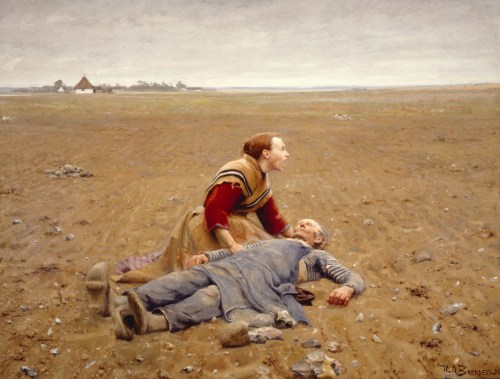
H.A. Brendekilde was a forerunner of the social realist style, embraced by Diego Rivera. His early work often depicted the daily lives of the rural working class. One of his most famous paintings, “Worn Out” (1889) shows an elderly man lying fallen on his back in the plowed field. I included this piece in a post on March 30, 2018, but I wanted to look more closely at it today.

Brendekilde’s genius shows in the way he depicts the central subject. The rocky, barren field is immense, nearly blending with the sky. Dirt and rocks dominate this painting–Dirt on their clothes, small rocks embedded in the soil, larger rocks gathered into piles to be carted from the field–this man’s life was the soil, hard and rocky though it was. Yet he clung to it, working to clear the rocks until he could go no further.

I love the detail in this painting. It’s easy to see how their day began: the man and woman spent the morning picking rocks from a field and making small piles of them, preparatory to plowing the field. Then, something happened. A heart attack? A stroke? One of the man’s clogs has fallen off his foot, lost when he stumbled and fell. The stones he was picking up and carrying in his apron have tumbled to the ground beside him.

Farming is working in the dirt, and dirt clings to his clothes. The woman wears a dress that has been patched many times, the loose, dry soil on her garments show she too has been picking rocks all morning. Is she his daughter? Or perhaps his wife? Even if only a friend, she is terribly concerned for him.

They are nearing the end of their winter stores and the first new vegetables have yet to be planted. Has he worked himself to death? Will he recover?

This old man’s entire world is this rocky barren field.  As I said in my earlier piece, a story is told in this stark painting.


Credits and Attributions:

Worn Out by H. A. Brendekilde [Public domain], via Wikimedia Commons


2 Comments

Filed under #FineArtFriday

#FineArtFriday: The Kiss, by Bernardien Sternheim

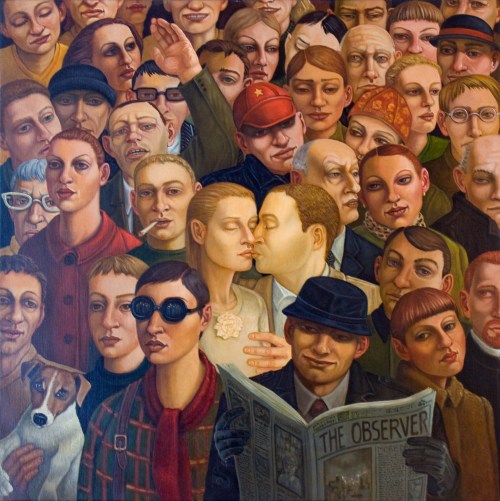
It is a rare treat when we can view modern art as painted by living authors via Wikimedia Commons. Today we are looking at The Kiss, by Bernardien Sternheim. It is dated 2001 and can be found on Wikimedia Commons, in the category Dutch Independent Realism.

What I love about this painting: It is raw, and real, and speaks to the humanity of the throng who are gathered for… what? Are they watching a race? Perhaps they are waiting for a train.

Regardless of what they are waiting for, the crowd faces forward, not watching the man and woman who steal a kiss.

Yet a nod to voyeurism is found here, as one man is reading The Observer, a woman reads over his shoulder, and an elderly man whispers into the ear of a woman.

I love the colors, the detail, and the expressions on each individual in the crowd. This painting is sure and bold, a window showing us a view of… ourselves.

About the artist:

Quote from the artist’s website, Bernardien Sternheim: “Central to the work of Bernardien Sternheim is man, in all his vulnerability and strength.

“Bernardien was born in Amsterdam in 1948. Against the spirit of the age, she opts for realism, figurative art.

“That is how she had to develop herself, with as great examples Pyke Koch, Caravaggio and Rembrandt.”


Credits and Attributions:

The Kiss, by Bernardien Sternheim via Wikimedia Commons contributors, “File:WLANL – Marcel Oosterwijk – De Kus.jpg,” Wikimedia Commons, the free media repository,

https://commons.wikimedia.org/w/index.php?title=File:WLANL_-_Marcel_Oosterwijk_-_De_Kus.jpg&oldid=282201684 (accessed June 22, 2018).

Comments Off on #FineArtFriday: The Kiss, by Bernardien Sternheim

Filed under #FineArtFriday

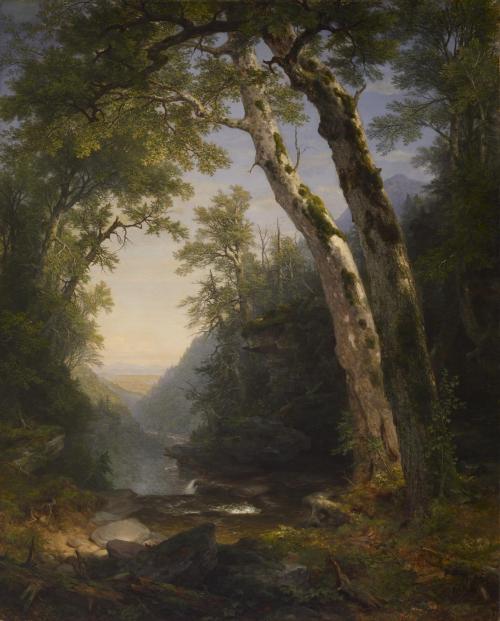
The Catskills, by Asher Brown Durand 1858

Quote from Wikimedia Commons on The Catskills: This painting was commissioned by William T. Walters in 1858, when the 62-year-old Durand was at the height of his fame and technical skill. The vertical format of the composition was a trademark of the artist, allowing him to exploit the grandeur of the sycamore trees as a means of framing the expansive landscape beyond. Durand’s approach to the “sublime landscape” was modeled on that of Thomas Cole (1801-48), founder of the Hudson River school of painting. The painters of this school explored the countryside of the eastern United States, particularly the Adirondack Mountains and the Catskills. Their paintings often reflect the Transcendental philosophy of Ralph Waldo Emerson (1803-82), who believed that all of nature bore testimony to a spiritual truth that could be understood through personal intuition.

>>><<<

Quote from Wikipedia (the fount of all knowledge): Asher Brown Durand is remembered particularly for his detailed portrayals of trees, rocks, and foliage. He was an advocate for drawing directly from nature with as much realism as possible. Durand wrote, “Let [the artist] scrupulously accept whatever [nature] presents him until he shall, in a degree, have become intimate with her infinity…never let him profane her sacredness by a willful departure from truth.”

Like other Hudson River School artists, Durand also believed that nature was an ineffable manifestation of God. He expressed this sentiment and his general opinions on art in his essay “Letters on Landscape Painting” in The Crayon, a mid-19th century New York art periodical. Wrote Durand, “[T]he true province of Landscape Art is the representation of the work of God in the visible creation…”

I grew up in a forested place, not unlike that depicted here. That sentiment has endeared this style of art to me. I have become attached to the modern fantasy painters, those modern artists like Michael Whelan and the late Darrell K. Sweet, who paint images in this style for fantasy novels and RPG games. Their style is called Imaginative Realism.

What strikes me the most about this particular painting is not only the attention to detail, but the fairy-tale quality of Durand’s vision of realism. Viewed as a whole, this composition has an otherworldly quality to it, almost as if Elrond or Galadriel lurk just out of view, beyond the edges.


Credits and Attributions

Wikipedia contributors, “Asher Brown Durand,” Wikipedia, The Free Encyclopedia, https://en.wikipedia.org/w/index.php?title=Asher_Brown_Durand&oldid=845716778 (accessed June 14, 2018).

Wikimedia Commons contributors, “File:Asher Brown Durand – The Catskills – Walters 37122.jpg,” Wikimedia Commons, the free media repository, https://commons.wikimedia.org/w/index.php?title=File:Asher_Brown_Durand_-_The_Catskills_-_Walters_37122.jpg&oldid=164572034 (accessed June 14, 2018).

4 Comments

Filed under #FineArtFriday, writing

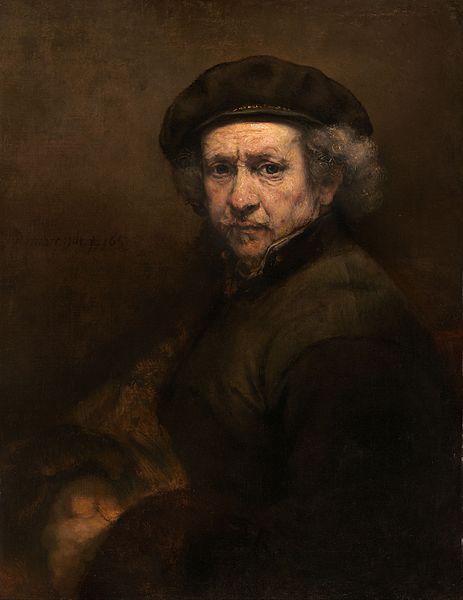
#FineArtFriday: Rembrandt through his own eyes, 1659

Rembrandt Harmenszoon van Rijn, commonly known simply as Rembrandt, is considered the finest artist of the 17th century. Some art historians consider him the finest artist in the history of art, and the most important artist in Dutch art history.

Speaking strictly as a Rembrandt fangirl and abject admirer, I consider his self-portraits to be more honest than those of any other artist.

Quote from Wikipedia: His self-portraits form a unique and intimate biography, in which the artist surveyed himself without vanity and with the utmost sincerity.

This honesty comes across in all his works featuring himself as the subject, even those where he portrays himself as a shepherd or the prodigal son. Each portrait shows an aspect of his personality, his sense of humor, his affection for Saskia who was the love of his life, and his wry acceptance of his own human frailties.

Rembrandt knew he was talented, but didn’t see himself as a creative genius. He was just a man with a passion for art, who lived beyond his means and died a pauper, as did Mozart, and as do most artists and authors.

I feel I know this man, more so than I do the person he was in his earlier self-portraits. He’s matured, lost some of the brashness of his youth. When I observe the man in this self-portrait, painted ten years before his death, I see a good-humored man just trying to live a frequently difficult life as well as he can. His face is lined and blemished, not as handsome as he once was. But his eyes seem both kind and familiar, filled with the understanding that comes from living with all one’s heart and experiencing both great joy and deep sorrow.

The art of Rembrandt van Rijn shows us his world as he saw it. Others may disagree with me, but I feel his greatest gift was the ability to convey personality with each portrait. This gift allowed him to portray every person he painted as they really were, blemished and yet beautiful. This is a gift he taught his students, and they were able to copy his style quite effectively, making discerning his true work difficult even for the experts.


Credits and Attributions:

Wikipedia contributors, “Rembrandt,” Wikipedia, The Free Encyclopedia, https://en.wikipedia.org/w/index.php?title=Rembrandt&oldid=844357531(accessed June 8, 2018).

Wikimedia Commons contributors, “File:Rembrandt van Rijn – Self-Portrait – Google Art Project.jpg,” Wikimedia Commons, the free media repository, https://commons.wikimedia.org/w/index.php?title=File:Rembrandt_van_Rijn_-_Self-Portrait_-_Google_Art_Project.jpg&oldid=292800848 (accessed June 8, 2018).

4 Comments

Filed under #FineArtFriday

#FineArtFriday: The Netherlandish Proverbs by Pieter Brueghel the Elder

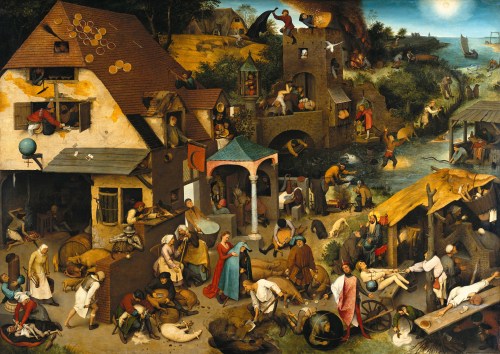
One of the best allegorical paintings of all time is The Netherlandish Proverbs (also known as The Dutch Proverbs) by Pieter Brueghel the Elder, which was painted in 1559. A master at humor, allegory, and pointing out the follies of humanity, Brueghel the Elder is one of my favorite artists.

Quote from Wikipedia:

Critics have praised the composition for its ordered portrayal and integrated scene. There are approximately 112 identifiable proverbs and idioms in the scene, although Bruegel may have included others which cannot be determined because of the language change. Some of those incorporated in the painting are still in popular use, for instance “Swimming against the tide”, “Banging one’s head against a brick wall” and “Armed to the teeth”. Many more have faded from use, which makes analysis of the painting harder. “Having one’s roof tiled with tarts”, for example, which meant to have an abundance of everything and was an image Bruegel would later feature in his painting of the idyllic Land of Cockaigne (1567).

The Blue Cloak, the piece’s original title, features in the centre of the piece and is being placed on a man by his wife, indicating that she is cuckolding him. Other proverbs indicate human foolishness. A man fills in a pond after his calf has died. Just above the central figure of the blue-cloaked man another man carries daylight in a basket. Some of the figures seem to represent more than one figure of speech (whether this was Bruegel’s intention or not is unknown), such as the man shearing a sheep in the centre bottom left of the picture. He is sitting next to a man shearing a pig, so represents the expression “One shears sheep and one shears pigs”, meaning that one has the advantage over the other, but may also represent the advice “Shear them but don’t skin them”, meaning make the most of available assets.

You can find all of the wonderful proverbs on the painting’s page on Wikipedia, along with the thumbnail that depicts the proverb.

My favorite proverbs in this wonderful allegory?

Horse droppings are not figs. It meant we should not be fooled by appearances.

He who eats fire, craps sparks. It meant we shouldn’t be surprised at the outcome if we attempt a dangerous venture.

Now THAT is wisdom!


Credits and Attributions:

The Netherlandish Proverbs (Also known as The Dutch Proverbs) by Pieter Brueghel the Elder 1559 [Public domain], via Wikimedia Commons.

Wikipedia contributors, “Netherlandish Proverbs,” Wikipedia, The Free Encyclopedia, https://en.wikipedia.org/w/index.php?title=Netherlandish_Proverbs&oldid=829168138  (accessed May 3, 2018).

4 Comments

Filed under #FineArtFriday

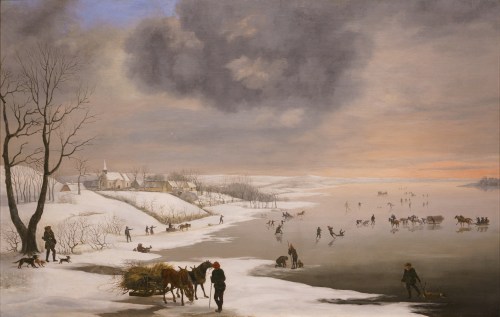
#FineArtFriday: Winter Landscape with Brabrand Church, by Christian David Gebauer


The above painting, Winter Landscape with Brabrand Church, by Christian David Gebauer, is a perfect illustration of a day in the life of a Danish village as captured by the eye of an artist. One of the last paintings made before Gebauer’s death in 1831, it is considered a centerpiece work of the Danish Golden Age, a period of exceptional creative production in Denmark during the first half of the 19th century. Gebauer was heavily influenced by the works of the Dutch Golden Age, a period in Dutch history roughly spanning the 17th century, during and after the later part of the Eighty Years’ War (1568–1648) for Dutch independence.

If you are writing fantasy, which is often set in rural late-renaissance-era environments, you can find all the details you need in the art of the past.

Artists painted details, not visible from a distance, but which combine to give the mood of the piece. They painted not only what they saw, but what they felt. They gave us a hint of how people really lived, laughed, and loved before the industrial revolution transformed the world into the modern, technologically driven place we see today.

In Winter Landscape with Brabrand Church, Christian David Gebauer shows us villagers dressed for warmth, enjoying themselves on the ice. Others are working, bringing in sledges filled with hay. A hunter and and his dogs are returning, perhaps empty handed. A bag hangs at the hunter’s side but isn’t full. The ice-fishermen are having better luck.

A woodcutter admonishes a boy, perhaps his son, to stop fooling around. His machete hangs in his right hand, as he fights what he knows is a losing battle. It’s evening, the day has been long, and children who have worked all day just want to play and have fun.

The sky takes up fully half of the painting–the church and the people are small beneath it. Beneath the powerful sky, there is an air of busy enjoyment to the painting. The hilarity of those skaters unable to keep their balance is juxtaposed against the hard-working laborers and the cozy prosperity of horses pulling laden sleds.

The entire story of one winter’s evening in this village lives within this painting, all of it captured by an artist nearly two-hundred years ago.

Is there magic here? Maybe. Is there life and passion? Definitely. There is a story in this image. Certainly the details will emerge in my work in the form of setting and atmosphere.

Regardless of how I use it, this window opens onto a time I can now visualize more clearly, less blurred by my modern perspective.


Credits and Attributions:

Winter Landscape with Brabrand Church, Christian David Gebauer [Public domain], via Wikimedia Commons

4 Comments

Filed under #FineArtFriday, writing