Tag Archives: humor

To swag or not to swag

HTB Bookmark side B copyI’ve several multi-author events coming along in the near future, and I’ve been preparing accordingly. I’m now technologically able to accept any sort of payment for my sales at these events: I actually own a portable store.

Now I have to consider swag–that portable bit of treasure to keep others thinking about you and your books.

It’s always hard to know what sort of swag to invest in, what is going to pay for itself. I can’t really afford to go nuts here, so I’m going to see what my author friends are pushing, and try to determine just what is going to be the right fit for me.  So I ordered the old standby indie swag-item, book marks.  I’ll make sure each book I sell has one in it, and if a passerby asks for one I will hand them out. Some folks like them so I’ll make sure I have some for them, but at various different conferences and conventions, I’ve observed that a lot of things like that just get tossed unless the person actually asked for it. Why invest in something that will just end up littering the mall?

I went to an event and met a lovely man from Alaska who practically forced me to take a cardboard replica of his book cover. As I said, he was friendly and nice, but…it must have been costly and I had no idea what to do with it. By the time I arrived home it was a mangled mess and went out with the recycling. Thus, I don’t even remember his name, or his book.

That incident got me to asking myself: what do I really want out of this? After all, I am selling my brand, and that brand is my author name.  I want people to remember it.

Business card MockupSO: Business Cards–These are an absolute must. They’re cheap and easy to make on my home computer and good to hand out when asked for one. Keep it simple and readable, with just the facts:

  • Your Author Name
  • Your website
  • Your Fan Email Address
  • Any other contact information you feel comfortable giving out
  • Your book title (s)

Remember: Don’t Junk It Up.  Simple and readable is the way to go with business cards.

I have another friend who is investing in postcards that have to do with his book, and each one will have a coupon to redeem a free paper copy of his forthcoming novella–and that’s a good idea, but also costly. I need to keep my costs a low as possible, so that will not be an option for me. Romance authors are encouraged to offer all sorts of little swag items–chap-stick, makeup mirrors, even tote bags–these are costly though. Whatever I do, it has to be effective and low-cost.

HTB Stamp copyI do think custom post it notes might be a good idea.  They seem reasonably priced, and fairly easy to do. Again, I think the key is to do it like business cards and book marks–keep it simple and just the facts: Author Name, website, and book title. If I decide to do those, I’ll let you know how it goes.

I had fun finding clip-art and designing a special Huw the Bard Stamp for an event that will happen in June–each participating author will have a stamp and will stamp the programs of the crowd as they pass through.  This was intriguing, and something I can use later in so many ways. Plus it was only $ 7.95 + shipping.

Anyway, I’m sure my little stamp will be great fun for the grandkids–heh heh…hold still and let grandma stamp this little tattoo on you….

7 Comments

Filed under Books, Fantasy, Humor, Literature, Publishing, Self Publishing, Uncategorized, writer, writing

Rainy Saturdays

I’ve been doing a little more reading lately. I like reading on my Kindle.  Might have some book review blogs to write for Best in Fantasy soon. I had to cut back on that because my editing business picked up rather sharply and my previously copious quantities of free time suddenly became  moot.

Also I’m a regular contributor at Edgewise Words Inn, which has been a LOT of fun. But this means I must occasionally write…doh!

mort - terry pratchettThe reading world suffered a great loss when we heard the news that Sir Terry Pratchett had died. His work was hilarious, irreverent and absolutely divine. Of all his many great characters, I think Death was his best, and Mort was my favorite book in the Discworld Series.

Losing him just emphasized the rain this weekend.  It’s been a strangely warm winter for us Pacific Northwesterners. For one thing, down in my valley we had no snow. Usually we get at least a small snowstorm. We’ve had a little frost, but nothing terrible.

Also, we’ve had very little black-ice this year, for which I am grateful, but truthfully that really is odd. Black ice, sometimes called clear ice, refers to a thin coating of glazed ice on a surface. While it’s not truly black, it is virtually transparent, allowing the black asphalt/macadam roadways or the surface below to be seen through it—hence the term “black ice.”  It’s been a winter staple here for the last few years–going to work in the morning on a safe, dry pavement takes all the adventure and high drama out of the morning commute.

It was a normal rainy March weekend, and I’m so spoiled by a winter of sunshine and warm weather, that I feel all whiny about it.

I know–how sad.

a medieval pieSo  on Saturday we got over the way most people do–we went shopping. I upgraded my phone and and got a fancy thing or two–and we bought food, and baked a pie in honor of Pi Day.  But not one this fancy—>

It was sort of fun– I don’t really do a lot of shopping in person, because the Drones of Amazon will deliver anything I need, from glittery hair clips to zebra print carpets. I get my music, kindle books, clothes, shoes–you name it, I get it from Amazon. They even sell books, and deliver them right to my house!

371px-Grim_reaper -courtesy offictional characters wiki by PigheadBut Sunday was a different thing. Dealing with a kidney stone. Didn’t sleep well–woke up at 2:30 am and couldn’t get back to sleep.  Suffered the agonies of the damned but survived another one. Stayed home and figured out how to use the new technology. Tried to catch up on my writing.

Accidentally blew off a write-in.

Oops.

Actually, when I am having a day like that, I doubt if I should be allowed behind the wheel of a vehicle… .

4 Comments

Filed under Battles, blogging, Books, Fantasy, Humor, Literature, Uncategorized, writer, writing

Worldbuilding part 3—Magic

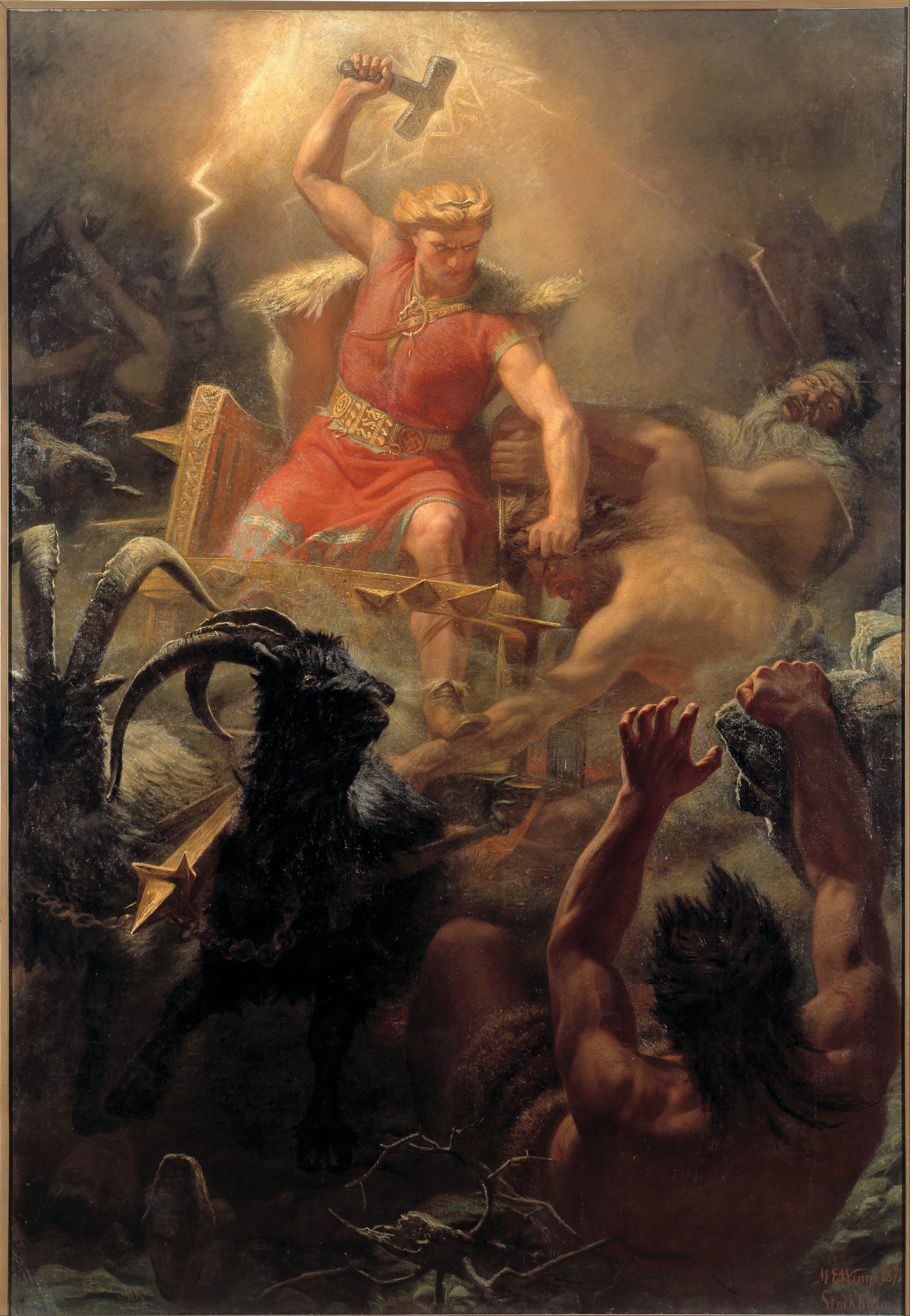
Mårten_Eskil_Winge_-_Tor's_Fight_with_the_Giants_-_Google_Art_ProjectEvery now and then I read a book where it’s clear the author has no concept of his own magic system.  You, as the reader,  are sailing; the story is flowing; and then suddenly you realize that Bart the Mage seems to have unlimited magic ability.  Well, that’s no good, because now there is no tension; no great ordeal for Bart to overcome. Bart can do anything–game over–end of story. The book goes into the recycling bin, unfinished and you never buy that author’s work again.

Every author has their own way of doing this, but I approach it from an engineering and scientific viewpoint–I spend time designing the system:

Let’s talk about Bart. He’s a lowly journeyman mage. For a multitude of reasons he has decided that he must rid the world of Evil Badguy; a very powerful, very naughty wizard.  Evil Badguy is very strong, and has great magic, and he seems unstoppable! But fortunately for our story, there are rules, so he is not omnipotent. He has a weakness and your protagonists now have the opportunity to grow and develop to their fullest potential in process of finding and exploiting that weakness.

Now let’s say that Bart is a mage with offensive magic – maybe he can cast lightning at an enemy, or perhaps he can set fires with his magic.  Can he also use magic to heal people?  Can he heal himself?  What are the rules governing these abilities and how do these rules affect the progress of the story?  When it comes to magic, limitations open up many possibilities for plot development.

Let’s say that Bart can only reliably use one sort of magic. This is good, because now you have need for other several characters with other abilities. They each have a story which will come out and which will contribute to the advancement of the plot. Each character will have limits to their abilities and because of that they will need to interact and work with each other and with Bart whether they like each other or not if they want to win the final battle against Evil Badguy.  This gives you ample opportunity to introduce tension into the story. Each time you make parameters and frameworks for your magic you make opportunities for conflict within your fantasy world, and conflict is what drives the plot.

VAYNE final-fantasy-xii_305674What challenge does Bart have to overcome in order to win the day?

  • Is he unable to fully use his own abilities?
  • If that is so, why is he hampered in that way?
  • How does that inability affect his companions and how do they feel about it?
  • Are they hampered in any way themselves?
  • What has to happen before Bart can fully realize his abilities?

Without rules, there would be no conflict, no reason for Bart to struggle and no story to tell.

So now, you realize that you must create the ‘rules of magic.’  Take the time to write it out, and don’t break the laws, without having a damned good explanation for why that particular breaking of the rules is possible.

Each world should be unique, and so we need to tailor the magic to fit each unique situation.

  • Who can use magic?
  • What kind of magic can they use?
  • How are they trained?
  • What happens to those who abuse their gifts?
  • How common is magic?
  • How does the ability to wield magic fit into the political system?

I have two worlds that I am currently writing in, and their magic systems are radically different.

The following was my first list from 2009 for creating the world when we were originally designing a game that eventually became The World of Neveyah series.

Elemental Battle Magic of Neveyah

 Water:   non battle-use can fill water jugs and basins

  • Water spout (novice)
  • Gully Washer (intermediate)
  • High Seas (Advanced)
  • Raging River (Advanced)

Earth:   non-battle use, putting out campfires, digging holes, gardening

  • Square Dance (novice)
  • Landslide (intermediate)
  • Mudslide (advanced)
  • Mountain Drop (Advanced)

Fire:  non battle use – can light candles, and ignite fire in fireplace

  • Hot Shot (novice)
  • Fire Ball (Intermediate)
  • Inferno (advanced)
  • Hell Fire (Advanced)

Lightning:  non-battle use for lightning: creating finish on armor, glazing pottery

  • Cat-Zapper (novice)   Zippety-Doo-Dah (novice-spell)
  • Thunder Fist (intermediate)
  • Curtain Call (Advanced)
  • Thunder Walking (Advanced)

This basic grocery list has since evolved into a complete curriculum for domestic uses, and the names for most of those spells has changed, but it remains relevant because it shows how I divided it. A game player would have had to gain in strength in order to use those spells, and that is how my characters do in the Neveyah books.

Saint_georges_dragon_grasset_beguleIt’s very different in the Billy’s Revenge series which set in Waldeyn, an alternate-medieval earth which is the setting for Huw the Bard. There, the actual environment is magic and Huw’s journey involves his overcoming its inherent dangers. The plants and animals of Waldeyn are shaped by the overwhelming abundance of magic in that world, like radioactivity affects and mutates life here.  Many of the most dangerous creatures are born of twisted magic, or as they call it, majik.

Mind-majik, healing, and the ability to imbue their healing majik into a potion or salve is the feminine side of majik, governed by the Sisters of Anan.

The ability to bind the elements into weapons and wield them is the male side, and they are governed by the Brotherhood of St. Aelfrid.

Part of their political/religious power comes from the fact that it has been determined the majik is a God-given gift, and all who’ve been granted that ability must be bound to the church.

There are strict rules, and if a gifted person doesn’t choose to serve the people through being bound to the church, the ability to sense majik is taken from them by the Mother Church.

I don’t have any main characters in Waldeyn who are majik wielders, although one side character in the forthcoming novel, Billy Ninefingers, is a member of the Brotherhood of St. Aelfrid: the Fat Friar, Robert DeBolt. However, many times these characters are in need of healing. (Heh heh.)

Because of my characters’ frequent tendency to bleed, gaining and acquiring good healing potions and salves is important.

In the World of Neveyah, which is where the Tower of Bones series is set, the situation was different—The Tower of Bones grew out of what was originally the walk-through for a computer-based RPG that was never built. Thus the constraints of magic are quite strict, but as you saw in the list above, they are game-based.

final-fantasy-guys-xii-basch_255851In the forthcoming prequel to Tower of Bones, Mountains of the Moon, a mage is either a healer or a battle-mage. Healing is building and preserving, battle-magic is death and destruction. It is thought that one can’t be both, because on the rare occasions that a dually-gifted mage is born, they go mad. There is a strict system in place for controlling magic and those who are able to use it, and this creates the conflict.

Once again, there is a governing body for mages–in Neveyah it is the Temple of Aeos. Children with the gifts are taken to the Temple and trained in the use of their gifts until they are adults. They are sworn to serve and protect the Goddess Aeos and her people, or die doing so.

But forty years after Wynn Farmer’s tale, during the time in which the Tower of Bones takes place, the clergy has been decimated by a great war that took place twenty years before. The goddess Aeos is in danger of losing the battle with Tauron the Bull God. She slightly changes the way her magic works. Wynn’s grandson, Edwin Farmer, is the first to be born with the ability to wield both sides of the magic who also has the force of character to survive the learning process. His biggest problem is there is no one who can teach him how to use his dual gifts—his teachers only know how one side or the other works.

That learning process forms a huge part of his story. Yes, Edwin has access to power, but so does the antagonist, Stefyn D’Mal, and he is completely mad. Even so, he has rigid constraints. These constraints create the conflict.

Remember, unlimited power in a mage equals unlimited boredom to the reader. Magic without rules is tiresome and unbelievable, and no one wants to read that story.

Thor-Everything-Loki


11 Comments

Filed under Adventure, Battles, Books, Fantasy, Humor, Literature, Publishing, Self Publishing, Uncategorized, writer, writing

Worldbuilding part 2: Geography

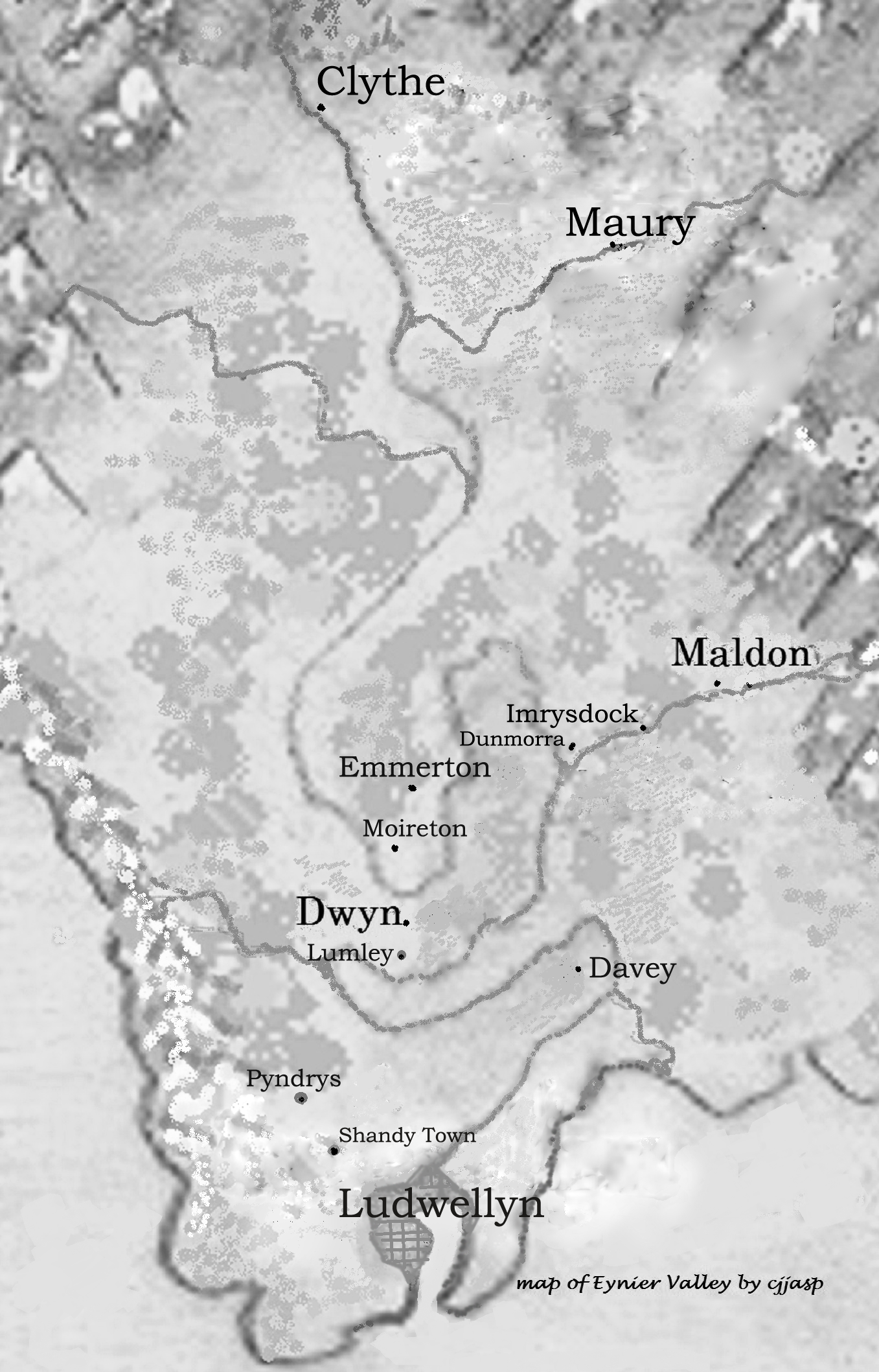
Map of Eynier Valley for HTB copy copyOne of the problems I have in my fantasy world is knowing where I am, how I got there and where I am going next.  Somehow it’s less of a mystery to the reader if I have some idea of the what world I am writing about looks like.

Many authors use locales that either currently exist or once existed in the real world.  This is a good way to do it, because your world is already well defined for you, and most everyone knows that Portland, Oregon is about 170 miles south of Seattle, Washington.  You are safe using currently existing terrain.

When we write a fantasy story, we start out with a great plot, but we are making the physical world up as we go along, and it evolves as the story does. This can be dicey unless you are really good at remembering what you said 3 months ago.  Epic fantasy often involves sending the hero off on a quest – and this means he/she will journey far from home.

Knowing where the protagonists are going, and when they’ll be there is crucial because readers notice inconsistencies; at least I do when reading other authors’ works.

I begin by drawing a sketchy map when I first begin the story. It is just a scribble at first, but this way I have an idea of where the towns are in relation to each other. I do it in pencil so at this stage nothing is finite; they are only approximations–artistic guesses.

Map of Neveyah, color copyAs I write, my map evolves with the story, becoming more complex as the topography becomes more clear to me. In the World of Neveyah, I began with a pencil sketch, and that evolved into a relief map that gave me the opportunities for injecting tension into the tale that I needed. It also provided me with a detailed explanation of where the resources were, so that funding my country was not an issue.

If you are writing epic fantasy, it is unlikely the hero will have a GPS to guide them.  By scribbling a map while I am setting the original story down, I know I have originally declared Armat is the nearest town to the portal, in Neveyah.  This is important because when I am really pounding out the words, I don’t always remember exactly what I wrote 22 chapters ago. Going back to make corrections is a  tricky business, as it is hard to know for sure if you have caught all your small errors in regard to places and the distances between them.

  1. Map your world:
  • How big are the continents, and what is their shape?
  • Are there inland seas? If so, are they fresh water seas like the Great Lakes?
  • Where are the oceans? Where are your port cities located?
  • How large is your protagonist’s country?
  • If they travel, what type of terrain will they be crossing?
  • Does your protagonist’s country have near neighbors?
  • What about mountain ranges? Mountains, swamps, rivers and oceans are all important when you are adding local color to your background.

The physical environment affects the hero’s journey.  Mountains are difficult to travel in, as are swamps and deserts; and these environments will greatly color the story.

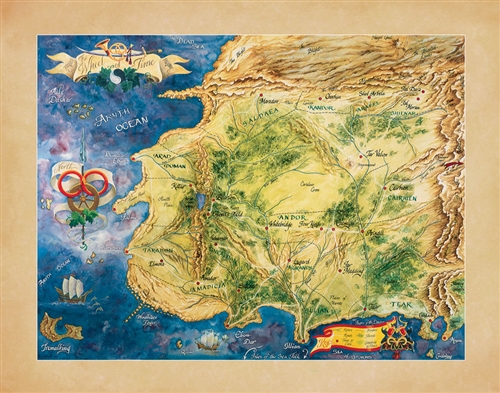
Wheel of time mapA map doesn’t have to be too detailed; it is only a bare-bones reference for you as the writer, and possibly for the reader later. Of all the books I have read, the books whose maps I have referred back to most while reading them are those in the Wheel of Time series, written by Robert Jordan and Brandon Sanderson.  The map is not too detailed, but it does give you an idea of where Tear is in relation to Amadicia – both of which figure prominently in the travels of all the main characters, and it remains accurate through the entire series.

The thing is—maps, unless they are drawn by satellite GPS–are inherently wrong in regard to actual distances and such. All they can do is provide a general idea of where the cartographer thought things were.

But what about sci-fi—how do you build an entire planet that may or may not exist?

This is where I brainstorm the possibilities: I spend hours on the internet researching the physics and the possibilities of each and every technological thing that appears in my work. Morgan Freeman, Michio Kaku and Stephen Hawking are my invisible friends, but the best hard facts are found through scouring the internet.

  1. Locate your planet:
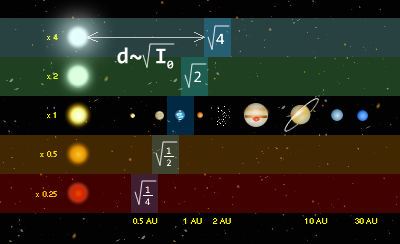
An example of a system based on stellar luminosity for predicting the location of the habitable zone around various types of stars. Planet sizes, star sizes, orbit lengths, and habitable zone sizes are not to scale.

An example of a system based on stellar luminosity for predicting the location of the habitable zone around various types of stars. Planet sizes, star sizes, orbit lengths, and habitable zone sizes are not to scale.

Situate your planet around its sun in what we arm-chair physicists refer to as “The Goldilocks Zone.” Life may exist in the most challenging places, but we humans can only exist in a narrow range of temperatures, in a world with a nitrogen/oxygen atmosphere, and where water exists in abundance. We need a magnetosphere to protect us from lethal radiation. We also need to be situated around a friendly-to-us kind of star, or a G-type main-sequence star. A K-type main-sequence  star may also support our kind of life, as may others, but we know the G-type will for sure. A good-sized moon is also optimal to stabilize the planetary wobble, but not having one opens the plot-possibilities of severe climate stresses due to an unstable orbit.

Alpharse is the setting for a future novel that grew out of a short scifi story. I’ve done a certain amount of prep for it: it’s a colony world, still in the terraforming process, and human habitation is still either underground or in the Asteroid Ships that originally brought the colonists to the system.

It’s located across the galactic arm from my protagonist’s home world of Lorann, and to travel the quickest route involves crossing an area of the galaxy inhabited by the Ernsaa, a race of methane-breathing beings who don’t want anyone coming near the worlds they claim. Thus, the closest route is now closed to them and it now takes twenty years real-time to get from Alpharse to Lorann even with the technology available to them. This means the colonists are on their own and can expect no help.

  1. Consider the Uninhabitable (by humans) Terrain:
  • What is the surface of the world like at this time?
  • What makes it dangerous?
  • Can humans breathe the air yet or must they wear protective suits?
  • Are there native organisms, or was it a young world when it was first colonized?

In regard to the maps you are drawing for your story: if you choose to incorporate your map into your book, that is an awesome addition—but for the love of J.R.R. Tolkien—don’t put maps in your books that have nothing to do with your story.

Candar Map. Recluce series, L.E. Mdesitt Jr.I have talked about this before: one of my favorite series of books, written by L.E. Modesitt Jr., has a huge failing–the maps suck!  In Fall of Angels, The Chaos Balance, Magii of Cyador, and Scion of Cyador, all of which take place before the world of Recluce is dramatically altered, the main characters are traveling all over the continent to places that don’t exist on the maps provided in the front of the books! The series span several thousand years, and the cities and geography changes radically, but the maps are stubbornly stuck in the timeframe of the first book in the series, Magic of Recluce, which actually details the last years of the story.

There is absolutely nothing on the map in the front of the book that pertains to the time frame of Scion of Cyador. Lorn, the main character, travels all over Cyador! I can only assume the crappy maps and the many typos and inconsistencies in several books of Modesitt’s Recluce series are the fault of his publisher, one the Big Boys of Publishing, TOR, who has done a great author a terrible disservice by not addressing these issues before publication. Despite the typos and stupid maps, I love Modesitt’s work and highly recommend it.

In conclusion, situating and building the physical world your characters will live in takes a day or two of your time, but once you have it all together, your work is so much easier. Taking notes and adding to your map and your style sheet as you go will keep your work consistent and make the setting of your story real to your readers. When you, as the author, have only a mushy idea of what sort of world in which your characters live, you will inadvertently write contradictions and inconsistencies into your work, so do your homework from the outset.

8 Comments

Filed under Adventure, Books, Fantasy, Humor, Literature, Publishing, Uncategorized, writer, writing

Worldbuilding part 1: Infrastructure

Book- onstruction-sign copyWorldbuilding is the term commonly used for the art of unobtrusively creating the world in which your characters live. Of course, fantasy and science fiction authors clearly need this skill, but all authors must be able to create the world in which their characters live, on the printed page. You, as the author, may know what Seattle looks and smells like, but the reader in London will not.

Many new authors say, “Well, just make it real in your mind, and it will feel solid in your story.”

That’s not precisely true, because things that are solid in your mind tend to evolve and change with every new day. That is bad for a fantasy world, which is what books are. We are going to make a style sheet, describing the rules of how our world works–because the universe has rules, and if we accidentally break them, the reader will throw our book away. Yes, you are going to write it down and refer back to it as the story progresses.

We begin by thinking about the basic necessities our characters will need to survive. Take a look at the world around us, and see what supports us, what nourishes and shelters us. This is called infrastructure. We need to have this support system completely solid in our minds as we write, so that the reader has the sense of a solid, well-thought out world.

  1. BUILD YOUR INFRASTRUCTURE: All societies have an economic component to them, whether they are set in space, in Middle Earth, or in Seattle. In any case, there’s nothing worse than a fictional world where there are elaborate social structures that seem completely disassociated from the realities of acquiring food, shelter and clothing. Authors of fiction don’t just write stories—we create whole societies and the economies that support them.
  • MH900438718FOOD and WATER: How do they eat? What do they eat? How does it get delivered? It doesn’t have to be central to the story, but it will come into it at some point because everyone, even vegans, likes to sit down and enjoy a conversation over a good meal, and a society that has no food descends into chaos and war ensues. Do they have certain rituals at meals, a prayer, or do they have formal manners? If they are at home, a small sentence mentioning a napkin or the kind of food will help to set the scene for the reader. If they are in a restaurant or a mess hall, most people will be able to build the picture just from that clue.

If your story is set on a space station or on a space ship, acquiring food becomes central to the tale, because a certain amount of space inside must be devoted either to storage or to hydroponic gardening.

If you set your tale in 1845 Paris, you must remember that this was the Little Ice Age, and was a time of global famine.

  • CLOTHING: People get cold, and need protection. What are they wearing? How do they get it? In some genres, clear descriptions of the garments is needed—most romance novels require some attention to clothing, and if your tale is set in another world or in the past, knowing what they wear becomes very important. You absolutely must understand the constraints certain kinds of clothing will add to your plot.

498px-Peter_Paul_Rubens_088If your romance is set in a medieval world, you will want to dress them with some accuracy. Readers are savvy—they will know you haven’t thought it out well if your fully armored knight is suddenly indulging in a moment of passion with fully dressed Lady Gwen. Think about the many layers of what your characters are actually wearing—it can’t be done! For that you must undress your characters, and if they are full armored or wearing Victorian undergarments, it becomes a bit involved. This means they must plan ahead for their romantic trysts and leave the armor at home.

My book, Huw the Bard is set in a mash-up world—one that has many elements of medieval Britain, but with a few Victorian amenities. I didn’t want clothes to take up a lot of space in the tale, but some mention had to be made.

The trouble Huw had at the outset of the tale was that he was on the run and traveling in disguise. The borrowed shirts of a common working man were made closer-fitting than his traditional bards’ robes, because cloth was expensive and no laborer could afford to waste it on something like big loose sleeves just for fashion. I had to make it so that the straps that ran up his arms and crossed his chest and kept his specially crafted knife sheaths in place didn’t show at all above the rawhide laces at his throat, even when he drew his knives.

It’s only given about three sentences in the actual book, but I had to research what real knife-sheathes are like and how cumbersome they are to wear. In the process I discovered how useless they truly can be. This concept created a certain amount of tension for my plot—he would have to get used to throwing his knives without giving himself away, as he didn’t have the robes to disguise his movements.

When writing fiction, it is important to remember that people are not really that much different nowadays than they ever were. They get cold, so they wear clothes, in many layers. The warmer the weather, the fewer the layers your characters will wear. Inside a warm building, they may be lightly clad. Keep that in mind as you are writing, and convey the idea of their attire with a minimum of words, and your reader will get more enjoyment from the tale.

So, Back to Infrastructure:

  • GARBAGE: Who takes away the garbage? Who deals with their bodily wastes? This also doesn’t have to a large part of the story, but in the morning my husband and I are sometimes woken up by the garbage trucks at our house, so it is a part of the environment. And I don’t know about you, but using an outhouse or emptying a chamber pot is the least romantic thing there is, so if your tale is set in the middle ages, be aware that sanitation was minimal and that dealing with it consumed a certain portion of their day.
  • TRANSPORTATION: How do they get around? Are they riding horses, or driving cars? If you’ve set your story on a space station, do they get around in some sort of shuttle? It’s a good idea to have some idea of distance, and how far people can travel in a day. Draw a map if your world is a fantasy world, or get a map if it is set in our world. You need to have some idea of where places are in relation to each other, and what the distances between those places are, and what the roads are like because that will have an affect your characters too. If people are flying between London and Toronto, there are certain time constraints that must be adhered to—it’s not an instantaneous thing. The wait at each airport, the time spent in a taxi, the time spent in flight—that is a good chunk of time, so make sure it is considered in your storyline.
  • 490px-Henry_Singleton_The_Ale-House_Door_c._1790

    The Ale-house door by Henry Singleton c. 1790

    WORK: What do the majority of your people do to survive? Are they working in a lawyer’s office, or a hospital? Are they farmers? People need to work to survive. In our society today, people identify themselves by their work—”I am an accountant” or “I am an office manager.” We spend 8-10 hours a day at our work, so it is crucial to have your characters’ employment clearly visualized for the reader.

When I decided to set my first book in a medieval setting, I did a certain amount of research on Wikipedia, and found it is actually a good source for quick reference.  However, many people whom I admire and respect regularly tell me it’s not the best source for real information about anything. (!!!) SO, ever the intrepid seeker of information, I resorted to investigating in some rather obscure places, but I did find what I needed.

It just took a little time, and a lot of effort. Do the research, and lay the groundwork for your infrastructure. Your readers won’t thank you, but they will be so immersed in the story, they won’t realize the world is a fantasy, and THAT is what you want.

The next installment of this series will explore the world itself–creating the environment and the geography.

6 Comments

Filed under Adventure, Books, Fantasy, Humor, Literature, Publishing, Self Publishing, Uncategorized, writer, writing

Interior Monologues

MP900321209In writers’ forums you will find a great deal of discussion regarding interior monologues. It’s true that beginning authors can rely too heavily on them as an easy way to dump blocks of information into a narrative, instead of deploying it. A few people will even tell you they despise interior monologues, and while I disagree with them, I do see their point.

First of all, it is an accepted practice to italicize thoughts. But we are all aware of how daunting it is for a reader to be faced with a wall of italics.

A rather vocal contingent will say thoughts should not be italicized, that it creates a greater narrative distance, setting readers outside of the character and the events of the scene.

MSClipArt MP900390083.JPG RF PDAs an avid reader, I disagree, although more than a sentence or two does exactly that. If we choose to omit dialogue tags for them, and don’t set them off with italics, it becomes confusing. The finished book ends up looking like a bunch of closed quotes were left out, and gives the impression of an unedited manuscript, even if the publisher has subtly changed the font just for thoughts.

If you, as an indie publisher, do choose to leave them in the standard font but add dialogue tags such as she thought, it makes me wonder, why are you bothering to have an interior monologue at all? If you feel that strongly, skip it entirely and find a different way to express your ideas, because readers will have to stop and read it twice.

Interior monologues have their place, and when a writer is expressing a character’s most intimate thoughts, the current accepted practice for writing interior monologue is to use italics. We use them to represent a character’s thoughts in real time, as they actually think them in their head, or the precise words they use. For that reason, italicized thoughts are always written in:

  • First Person: I’m the queen! After all, we don’t think about ourselves in the third person, even if we really are the queen. We are not amused.
  • Present Tense: Where are we going with this? We think in present tense because we are in the middle of events as they happen, so while memories may reflect the past, our immediate actions and mental comments are unfolding in the present, and we want to convey that sense of immediacy. What a mess.

The Website, Novel Writing Help says:

It will be perfectly obvious to the reader that these words are the character thinking and not the author narrating. And the thought itself, as well as not becoming confused with the rest of the text, gains an extra emphasis, like in this example from Clare Morrall’s novel The Man Who Disappeared.

Felix, a man whose world has just fallen apart, is standing out in the street watching his family eat their evening meal without him…

   He wants to believe in this cosiness, this world of families, this labyrinth of deeply entwined love.
   That’s the key, of course: love. He has been told this for as long as he can remember. ‘We love you, Felix,’ one of his aunts used to say, ‘and that’s all that matters.’
   What have I done, Kate?
   Frost glints on the road, nearby car windscreens are clouded with ice. Felix blows on his hands and shuffles his feet around, trying to bring some feeling back to his toes. (End of quoted passage)

As you can see in the above passage, Felix has many thoughts, but only the most intimate, personal thoughts are shown through an interior monologue—the rest are written as part of the scenery, and they create the image of the situation he has found himself in. (Just so you know, I liked that passage so much that I just bought the Audible book.)

CAUTION INFO DUMP ZONE AHEADThis is how we want to write our interior monologues. They must be natural, and organic to the flow of the narrative. Thoughts must fit as smoothly into the narrative as conversations. My recommendation is to only voice the most important thoughts via an internal monologue, and in this way you will retain the readers’ interest. The rest can be presented in images that build the world around the characters:

Benny watched Charlotte as she left the office. Everyone knew she came from a wealthy family. The gold watch, the sleek sports car she drove could have been owned by any well-employed girl, but something about her screamed confidence and money.

You could put all of that into Benny’s interior monologue, but why? This way, the reader is shown all they need to know about Charlotte, without resorting to an info dump, and we aren’t faced with a wall of italics.

Some things must be expressed as an interior monologue, if you want the reader in your protagonist’s head.

Benny looked down at his mop. I’m such an idiot.

Now the reader has also gained a whole lot of information, in only two sentences.  They think they know who Benny is, and they have a clue about his aspirations. What they don’t know yet, but will discover as the plot unfolds, is that Benny is actually a detective working undercover, and Charlotte is the secretary of his quarry.

autumn leavesInterior monologues are crucial to the flow of novels in which the author wants the reader planted firmly in the protagonist’s mind. However, the actual monologues must be used sparingly, and the rest of his/her thoughts should be shown through their actions or external observations.

Those external observations are a subtle part of worldbuilding, when you are writing a narrative that is an intimate portrait of your protagonist.

So, to wind this up, I feel that:

  1. Interior monologues are an organic part of some kinds of narratives, but not necessarily all narratives.
  2. If used sparingly interior monologues can create an intimate connection with the protagonist.
  3. If an interior monologue is used, it should be short and set off by italics, and only rarely with the ‘speech tag’ thought.
  4. Italics should never be used for long passages.

That last one is hard–what do you, as an indie publisher, do for quoted passages or letters between protagonists? Those sorts of questions are a ‘whole nother’ blog post, as we say where I come from.

6 Comments

Filed under Adventure, Books, Fantasy, Humor, Literature, Publishing, Self Publishing, Uncategorized, writer, writing

Wordless Dictionaries

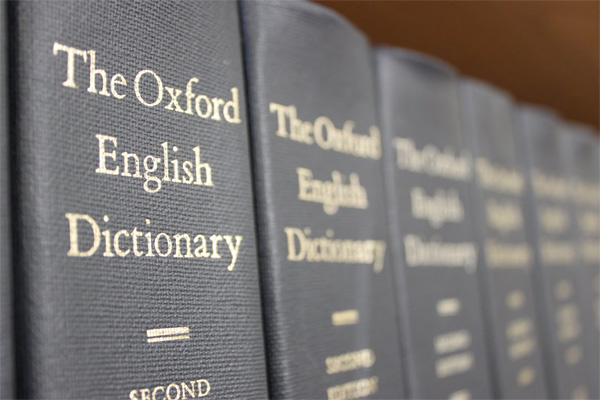
oxford_dictionaryWe are in the midst of an extreme shift in the English language, a continual evolution as impossible to stop as the  melting of the Antarctic ice-cap. This change is not necessarily a terrible thing, but it does come along with some interesting complications.

Robert Macfarlane discussed one negative aspect of our language shift in a blog post last week for The Guardian. He is not  saying that the rapid shift in our dialect and word-usage is bad–after all, language needs to be spoken and it is like water: it’s always on the move and incredibly difficult to contain.

cowslip

cowslip

But Macfarlane sees a negative in the modern view of this fluidity, one that struck a real chord with me: “Under pressure, Oxford University Press revealed a list of the entries it no longer felt to be relevant to a modern-day childhood. The deletions included acorn, adder, ash, beech, bluebell, buttercup, catkin, conker, cowslip,cygnet, dandelion, fern, hazel, heather, heron, ivy, kingfisher, lark, mistletoe,nectar, newt, otter, pasture and willow. The words taking their places in the new edition included attachment, block-graph, blog, broadband, bullet-point, celebrity, chatroom, committee, cut-and-paste, MP3 player and voice-mail. As I had been entranced by the language preserved in the prose‑poem of the “Peat Glossary”, so I was dismayed by the language that had fallen (been pushed) from the dictionary. For blackberry, read Blackberry.”

Now, admittedly Robert Macfarlane is an avid reader of literary fiction, and he also writes literary and travel books. However, many people are  still reading above the comic book level, and what he has to say in his piece concerns the dumbing-down or “flattening” of the language. Don’t try to tell me there isn’t enough room in the book for these words. Dictionaries are on-line now and there is in infinite amount of space in the internet for these words.

oxford school dictionaryDictionaries are the first reference book children will come into contact with in their schools, followed closely nowadays by Wikipedia. I admit that in a desk-reference form space is limited, but in a world where Blackberry means a smart-phone, there is no lack of space.

How will the landscape of our language look in fifty years? I sometimes doubt I would be understood, speaking in my ancient Northwest American dialect, using words that have no relevance. Without a comprehensive dictionary, how will the words I write today be understood by my great-grandchildren?

If I could say one thing to those who compile dictionaries it is that ALL the many words that make up our English language  have relevance and should be  included in what is being marketed as a truly comprehensive dictionary. At some point, a curious reader is going to want to know the meaning of a word, and if that word appeared in the dictionary  at one time, why must it be removed just because a committee of naive scholars with extremely limited experience feels it is not needed?

_72982736_vikings courtesy of BBCTo me, this is tantamount to a mass burning of books just because they contain “dangerous ideas.”

I have one thing to say to the modern publishers of dictionaries: You have unlimited space in an on-line dictionary. When you allow words to fall out of the dictionary because they have fallen out of common use in YOUR milieu,  your dictionary is not as comprehensive as you are pretending it is. You have lost YOUR relevance at that point.

These mongers of wordless dictionaries should feel some shame, because they are as responsible for the dumbing-down of the English language as is the casual speaker. Their own relevance is questionable, as more and more seekers of quick information will find it in the bowels of the fount of all knowledge, Wikipedia, OR they will Google it, as I did the word “inexorable.”

6 Comments

Filed under Adventure, Battles, Books, Fantasy, Humor, Literature, Publishing, Self Publishing, Uncategorized, writer, writing

Friday Interview: Carlie M.A. Cullen

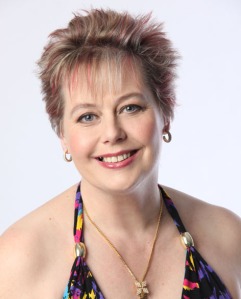
Photo of CarlieAs I promised a while back, today Carlie M A Cullen, author of The Heart Search trilogy, has consented to answer a few questions for us. She is a lovely, talented woman who has been one of my editors for several years now!

CC: Hi Connie! It’s lovely to be here. Thank you for the tea.

CJJ: Hello, and you’re welcome! Tell us a little of early life and how you began writing:

CC: I grew up as an only child. My parents worked full time and both had second jobs. As a result I was left to create my own entertainment. I loved the tales of Hans Christian Andersen and started to write my own fairy tales. I found myself disappearing into the stories I created and it made me feel less lonely. From there, I progresses to writing longer short stories and poems. It’s something I’ve continued to do into adulthood.

CJJ: As you know, I love this series. Tell us about your most recent book.

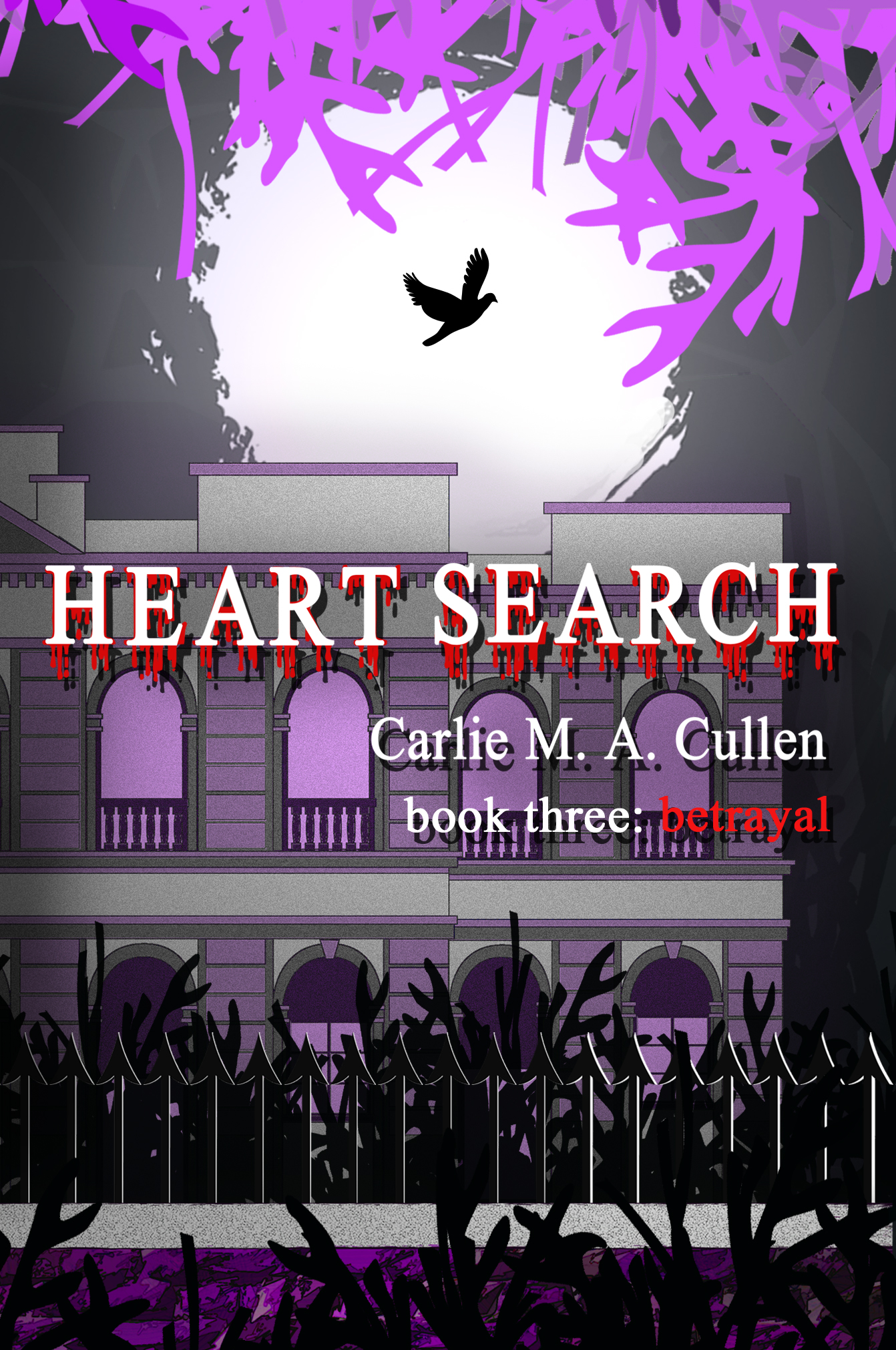
CC: I hope you’re not after any spoilers, Connie! [laughs] Heart Search: Betrayal is the final book in the trilogy and takes Remy and Joshua’s story to its natural conclusion. However, it’s not all hearts and flowers – far from it. There is a traitor who is passing copious amounts of information to someone who has a massive grudge against the coven, and who they are in league with. But there are four possible suspects. Which one is it and can the coven discover their identity before it’s too late? There are many twists and turns along the way, some good and some terrible. Certain characters really shine and there’s the discovery of new talents along the way. Unfortunately there are casualties, some of which may shock my readers.

CJJ: The story line in Betrayal is quite divergent from the previous two books. How did you come to write this novel?

CC: When I reached the halfway point in the first book, Heart Search: Lost, I knew there was too much of a story for just one. It was at that point I realized Heart Search would turn into a trilogy. I couldn’t leave the world I’d created and made the decision to complete the trilogy before moving onto other stories I had in my head.

CJJ: I always have that problem too. I think some stories are just larger than we originally thought. So, do you have a specific ‘Creative Process’ that you follow, such as outlining or do you ‘wing it’?

CC: It depends on what I’m writing really. With Heart Search, I had the first twelve chapters meticulously outlined, but around chapter five my characters decided they were going to take over and make me tell their story their way. I threw away the outline and have ‘winged it’ ever since. As I wrote this based on current day, it was easy to do.

With my next book, I’ve had to do some extensive world building and creating magic systems and the like before I began writing. However, as far as the story goes, again I’m winging it and seeing where my muse and characters takes me.

CJJ: Well your muse is taking you to some wonderful places! In your opinion, how does your work differ from others of its genre?

CC: I can only really talk about the Heart Search trilogy here. In the first book you have two POV’s: Remy in first person and Joshua in third person. Their stories run parallel to each other and every now and then they softly bump before going off again. I believe this is what makes it unique. In book two, I brought in extra character voices and gave them their own POV’s in third person. The final book takes even more POV’s into the mix, always in third person, whereas Remy has maintained a first person POV throughout.  I also believe (going by the reviews I’ve read) the storyline itself is completely different to what others have read before. Put all this together and that’s what I think makes my work so different from others in its genre.

CJJ: So now we get down to the question that I always wonder: Why do you write what you do?

CC: As I said earlier in the interview, I loved the Hans Christian Andersen fairy tales and that was a huge influence in my writing. Growing up I tried reading different genres, but I always came back to fantasy. There’s something so intriguing about the characters you can create, the worlds you can build, and adding to that those mystical creatures we all know so well: fairies, goblins, dragons, vampires, et al. It seemed only natural for me to write in this genre. It’s where I’m in my comfort zone.

CJJ: I know why I chose the indie route for my work, but I’m curious as to why you’ve chosen this path.

CC: Originally, I wanted the dream of getting an agent and a decent publishing deal, but I was new to the industry and quite naïve. After a few rejections, I decided that after all my hard work on the book it would be nice to give people a chance to read it. In addition, I had people I knew asking me for it. It was about that time I joined Myrddin Publishing. Everyone was so supportive from day one so I published it through them and haven’t looked back since.

Now I know more about the industry, I’m really glad I’ve taken this path. I have so much more control over where my books are sold, what sort of cover I want, what price to charge, and how much I want in royalties that I think I’d now be too stifled by a major publisher.

CJJ: I agree! Being a part of the Myrddin Group has been a blessing to me too, considering the assistance we give each other in every aspect of bringing a book to market. And the fact that you really are in control of your own work and profits makes this an adventure!  So what advice would you offer an author trying to decide whether to go indie or take the traditional path?

CC: This is a tricky one to answer because what’s right for one person isn’t necessarily right for another. I think the best thing they could do is talk to other authors, some who are indie and some who have gone the traditional route. Ask them about the pros and cons of both and then they can make an informed decision that’s best for them.

I wish I’d done that in the beginning as I was so green it was ridiculous, but I was one of the lucky ones who met some wonderful indie authors who helped me along the way.

But going back to the question, do your homework and don’t make any snap decisions or judgments that you may later regret.

CJJ: Very good advice! Thank you for taking the time from your busy schedule to visit with me, and for sharing your wisdom!

Alice in Wonderland Tea SetCC: Thanks so much for inviting me, Connie. I’ve really enjoyed chatting with you. Now, is there any more tea brewing?

CJJ: Yes, actually. This is a lovely citrus Lady Grey, I hope you like it! This tea set is my Alice in Wonderland set, which my children gave me last year!

>>>—<<<
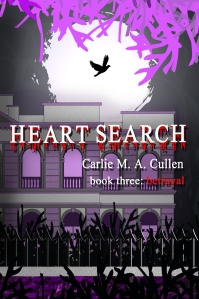
Betrayal front coverCarlie M A Cullen was born in London. She grew up in Hertfordshire where she first discovered her love of books and writing.

She has always written in some form or another, but started to write novels in 2011. Her first book was published by Myrddin Publishing in 2012. She writes in the Fantasy/Paranormal Romance genres for New Adult and Adult.

Carlie is also a principal editor for Eagle Eye Editors.

Carlie also holds the reins of a writing group called Writebulb. They have published four anthologies so far, two for adults and two for children, all of which raise money for a local hospice.

Carlie currently lives in Essex, UK with her daughter.

>>>—<<<

Links for Carlie M A Cullen

Website: http://carliemacullen.com

Twitter: @carlie2011c

Facebook: http://www.facebook.com/CarlieMACullen

Linkedin: https://www.linkedin.com/profile/view?id=240655941&trk=nav_responsive_tab_profile

Amazon: http://www.amazon.co.uk/-/e/B009MWVL5A

About.me: http://about.me/CarlieCullen

Wattpad: http://www.wattpad.com/user/CarlieCullen

Goodreads: https://www.goodreads.com/author/show/6550466.Carlie_M_A_Cullen

BOOKS:

Heart Search, book one: Lost: http://smarturl.it/HeartSearch-Lost

Heart Search, book two: Found: http://smarturl.it/HeartSearch-Found

1 Comment

Filed under Blogger, blogging, Books, Fantasy, Humor, Literature, mythology, Publishing, Self Publishing, vampires, writer, writing

Hyphens, style guides, and writing conventions

adult-footie-pjsYou need a good style guide. No, I am not suggesting that you need help with your wardrobe–those footie pajamas are awesome, and are the perfect uniform for the dedicated author. What I am suggesting is that you develop consistency in your writing, and there are guides to help you with that.

English is a completely wonky language, even for those of us who grow up speaking some form of it. My dialect is that of the western United States, specifically the Pacific Northwest, near the Canadian border. As in every other part of the world, we speak informally in our homes and with friends, but in writing, we should conform to certain standardized rules, or those who speak OTHER versions of English will not be able to follow us, despite the many similarities in our dialects.

Kathleen Cali, in an article at Learn NC, says: “Conventions are the surface features of writing — mechanics, usage, and sentence formation. Conventions are a courtesy to the reader, making writing easier to read by putting it in a form that the reader expects and is comfortable with.”

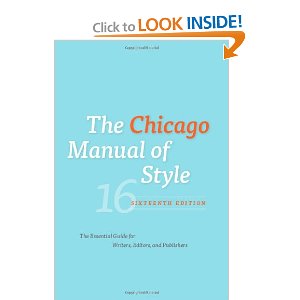
Since I am a US citizen, I use American writing conventions. In the United States, many non-journalistic professional writers use The Chicago Manual of Style, and this is the manual I use.

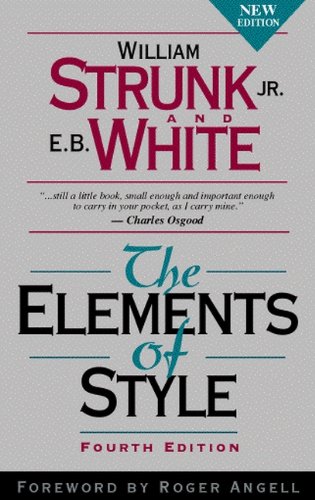
elements of styleA classic style guide for new authors and the general public is Strunk and White’The Elements of Style. This is a popular reference among writers just beginning in the craft. I sometimes use this guide, but as I have advanced as an editor, I find myself referring to the more in-depth Chicago Manual of Style. However, either one is excellent for the US author, and for any Europeans editing for a US author in this era of the internet and the global market for editing services.

Any author or editor who tries to tell you that one particular style guide is “the only” style guide is simply voicing an opinion, and if they are obnoxious and defensive about it, ignore them. Each style guide is an excellent reference tool, and each one plays to different requirements. But all of them are for the benefit of the reader.

chicago manual of styleThe Chicago Manual of Style is one of the oldest and most comprehensive style guides available, and for me in my role as an editor, it’s an indispensable tool because it contains information that I can’t find anywhere else. While I could easily access it all via the online version, I do like having my large book at my fingertips.

As a writer I rely on a style guide because  it often feels  like every rule has an exception, and knowing what those are makes huge difference in a manuscript’s consistency and readability.

For example, sometimes we don’t know if we should hyphenate or not. Or, we are unsure when to capitalize a direction or an honorific. When this occurs, our work becomes uneven and hard to read, because it’s rife with  inconsistency, hyphenating words in one place but not another. This happens because not every set of words needs to be hyphenated, and how do you know which to decorate with that dear little dash?

There are answers to these questions, in the handy-dandy style guides we have available to us.

So how DO we employ those little morsels of madness that work their way into every corner of my manuscripts? I love them!

Unfortunately, hyphens are not toys. As I discovered when creating my world of Neveyah for the Tower of Bones series, they are the gate-way drug to writer’s hell. Take my advice and do not use a hyphen unless it serves a purpose. If a compound adjective cannot be misread or its meaning is established, a hyphen is not necessary.

  • An English-speaking country
  • A time-saving device
  • A thirty-floor building
Some compounds are created on the spot to fulfill a specific need (on-the-spot creations). Permanent compounds start out as improvised compounds, but become so widely accepted that they are included in the dictionary as permanent compounds. Examples of temporary compounds that have made the transition to permanent compounds are words like  know-it-all, heart-stopping, free-for-all, and down-at-the-heels.
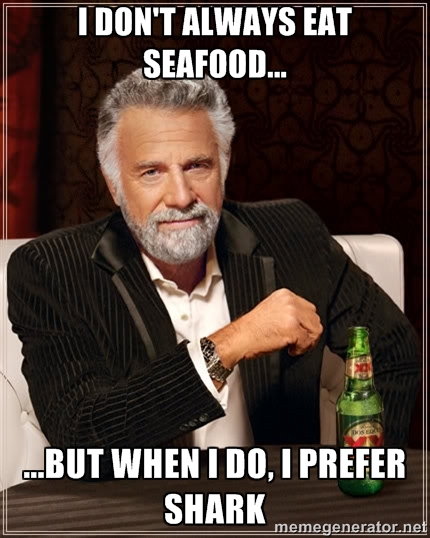
shark memeContext determines whether or not to hyphenate.  Ask yourself, “How will the words be interpreted by the reader if I don’t hyphenate?” Wikipedia offers the following examples:
  • Man-eating shark (as opposed to man eating shark, which could be interpreted as a man eating the meat of a shark)
  • Wild-goose chase (as opposed to wild goose chase, which could be interpreted as a goose chase that is wild)
  • Long-term contract (as opposed to long term contract, which could be interpreted as a long contract about a term)
  • Zero-liability protection (as opposed to zero liability protection, which could be interpreted as there being no liability protection).

And finally, especially if you are writing in a fantasy genre, as you are writing your tale down and creating your world, also make a style sheet that pertains to your manuscript noting what words must be capitalized and what the proper spellings for invented places are.

Refer back to it frequently, updating it as needed. I learned this the hard way. Whether it is handwritten or a WORD document, a simple directory of compound words and phrases that are unique to the world you have created will be as invaluable to you as your copy of The Elements of Style.

4 Comments

Filed under Adventure, Blogger, blogging, Books, Fantasy, Humor, Literature, Publishing, Self Publishing, WordPress, writer, writing

Don Quixote

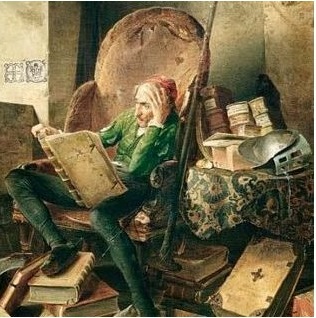
Don Quixote in the library Adolf Schrödter 1834

Don Quixote in the library by Adolf Schrödter 1834

Lately I have been on a Don Quixote binge. Published in two volumes, in 1605 and 1615, volume I, The Ingenious Gentleman Don Quixote of La Mancha, and volume II, The Ingenious Knight,  written by by Miguel de Cervantes Saavedrais considered the most influential work of literature from the Spanish Golden Age and the entire Spanish literary canon (a body of books traditionally accepted by scholars as the most important and influential in shaping culture.)

As a founding work of modern Western literature,and one of the earliest canonical novels, it regularly appears high on lists of the greatest works of fiction ever published, such as the Bokklubben World Library ( a series of classical books, mostly novels, published by the Norwegian Book Club since 2002) collection which cites Don Quixote as authors’ choice for the “best literary work ever written.” It is also said that the two parts of this masterpiece have been  translated into more languages than any book other than the Bible. 

Don Quixote had major influence on the literary community, as shown by direct references in Alexandre DumasThe Three Musketeers (1844) and Mark Twain’s Adventures of Huckleberry Finn (1884).

The Story:

Alonso Quixano, the protagonist of the novel (though he is not named until much later in the book), is a retired country gentleman nearing fifty years of age, living in La Mancha with his niece and housekeeper. Although he is mostly a rational man, his excessive reading of books of chivalry has produced a skewed view of reality and what we might consider dementia. In keeping with the theories of the time, not sleeping adequately–because he was reading–has caused his brain to dry. (I LOVE that!) As a result, he is easily given to anger and believes every word of these fictional books of chivalry to be true.

Don Quixote’s niece commits, what is to me, the most heinous crime–she and the Parrish curate burn his library, and lie to him, telling him it was the work of an evil magician. Criminal!!!

He decides to become a knight-errant in search of adventure. To these ends, he dons an old suit of armor, renames himself “Don Quixote”,  and renames his poor old horse “Rocinante.” Cervantes was a genius when he penned the horse–Rocinante is not only Don Quixote’s horse, but is a reflection of Don Quixote himself, ungraceful, past his prime, and in way over his head.

Don Quixote asks his neighbor, Sancho Panza, to be his squire, promising to make him governor of an island. Sancho agrees, and the pair sneak off in the early dawn. At this point their adventures begin, starting with Don Quixote’s attack on the windmills.

Miguel de Cervantes Saavedra created a wonderful, hilarious masterpiece when he penned Don Quixote. Even in today’s society the plot is relevant and and the characters leap off the pages. The extremes of the human condition are all laid out in glorious prose that has been beautifully translated to English in 2003 by Edith Grossman. The New York Times called Grossman’s translation a “major literary achievement.”

In the original version of Don Quixote there are basically two different types of Castilian Spanish: Old Castilian is spoken only by Don Quixote, while the rest of the roles speak a modern version of Spanish. The Old Castilian of Don Quixote is for comic relief – he copies the language spoken in the chivalric books that made him crazy; and many times, when he talks nobody is able to understand him because his language is too old. This comedic effect translates well to Modern English when the translator has Don Quixote use  Shakespearean English phrases.

I write fantasy, and I read widely. But to those purists who decry the work of genre fiction writers as being “created for the masses,” I would like to say this: it is quite clear that the modern perception of “fantasy” as having no literary merit is complete hogwash when you look at the books that make up the western cannon of great literature. ALL of them are fantasies of one sort or another, beginning with Don Quixote and going forward, and all of them were created for the enjoyment of the masses.

2 Comments

Filed under Adventure, Battles, Blogger, blogging, Books, Fantasy, Humor, knights, Literature, Publishing, Self Publishing, WordPress, writer, writing