
Real-life has moments that are far stranger than anything I could dream up. I’m not alone in this—everyone has a story. That story will have moments that are difficult to hear and others that are amazing.
 Writing fiction allows me to put reality into more palatable chunks. It’s easier to cope with that way.
One of the ways I design my worlds is by drawing on the real world to help develop the unreal. Reshaping and reusing the scenery and terrain around you are habits of good world-building.
However, crafting characters is different. We shouldn’t use the real names and exact situations of people we are acquainted with for any reason. Don’t thinly disguise your hated boss or neighbor with a different name because they could recognize themselves and sue you.
This was made clear by the late Betty MacDonald’s situation. Her first published book was picked up by J.B. Lippincott. The Egg and I is a fictionalized account of Betty’s life as a chicken farmer. It was set in Chimacum, a small community in rural Washington State.
Many members of my family were from that area of Puget Sound and still lived there during the post-WWII years, the time frame in which Betty’s book was set.
A wide disparity in education and social services existed between urban and rural communities at that time. Only a basic education was available to most families of loggers, brush pickers, and small farmers in Washington.
Thanks to the US government’s efforts, the indigenous people were in dire straits. Traditionally, Puget Sound tribes were mainly hunter/gatherers and now suffered extreme deprivation. They had lost access to their traditional hunting and fishing territories. They were losing the culture that had been their foundation for untold thousands of years.
Betty MacDonald’s book was a success in that era and moral climate, selling well over a million copies and spinning off several movie adaptations.
The Egg and I fell into disfavor in the 1970s because cultural awareness had changed the way we view indigenous people. Critics now saw a lack of understanding and cliched treatment of our local Native people in the book.
This post isn’t intended to address or pass judgment on a 1940’s treatment of cultural issues. These are things we avoid in our modern connected society, but which people took for granted in 1946 when the book was written. Instead, we need to focus on the moral and financial repercussions of writing fictional characters too close to life.
Betty’s book motivated several lawsuits against her and her publisher for defamation of character.
From Wikipedia:
Post-publication lawsuits
Following the success of the book and film, lawsuits were filed by members of the Chimacum community. They claimed that characters in The Egg and I had been based on them, and that they had been identified in their community as the real-life versions of those characters, subjecting them to ridicule and humiliation. The family of Albert and Susanna Bishop claimed they had been negatively portrayed as the Kettles. Their oldest son Edward and his wife Ilah Bishop filed the first lawsuit, which was settled out of court for an undisclosed amount.
The second lawsuit was filed against MacDonald, publisher J. B. Lippincott Company, and The Bon Marché (a Seattle department store which had promoted and distributed the book) for total damages of $975,000, as sought by nine other members of the Bishop family ($100,000 each) and Raymond H. Johnson ($75,000), who claimed he had been portrayed as the Indian “Crowbar.” The case was heard before a jury in Judge William J. Willkins’ (who was also one of the presiding judges at the Nuremberg Trials) courtroom in King County Superior Court beginning February 6, 1951. MacDonald testified that the characters in her book were composite sketches of various people she had met. The defense produced evidence that the Bishop family had actually been trying to profit from the fame the book and movie had brought them, including testimony that son Walter Bishop had had his father Albert appear onstage at his Belfair, Washington, dance hall with chickens under his arm, introducing him as “Pa Kettle.” On February 10, 1951, the jury decided in favor of the defendants. [1]
 We all draw inspiration from real life, whether consciously or not. However, if we are writing fiction, we must never detail people we are acquainted with, even if we change their names.
If you become a success, some people may see that as their ticket to a little extra money at your expense. This, despite the disclaimer we put on the copyright page:
This is a work of fiction. Names, characters, places, and incidents are products of the author’s imagination or are used fictitiously and are not to be construed as real. Any resemblance to actual events, locales, organizations, or persons, living or deceased, is entirely coincidental.
However, we can and will draw impressions from the people around us.
A common “coffee shop” game is a good way to develop characters for your stories and won’t get you sued. Now that the pandemic is winding down, many coffee shops offer indoor seating once again. Pick a place that is new to you and have your pen and notepad or laptop at the ready. Watch your fellow patrons. Observe their behavior, their speech habits, and their unconscious mannerisms. You can build an entire fantasy life for them.
Each character sketch is the kernel that can be the start of a short story or even a novel–and all of it is fiction.
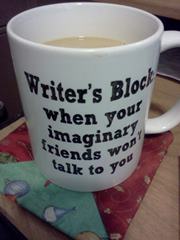 The best thing is that you don’t actually know a thing about them other than they like a Double Tall Hazelnut Latte. Peoples’ conversations are unguarded in coffee shops, openly talking about what moves them or holds them back. They are lovers or haters, quiet or loud, and most importantly, anonymous.
The moods and mannerisms, idiosyncrasies, and habitual quirks that you see can give rise to a character you can use without risking your financial security and your reputation. People-watching is a necessary habit for the author to develop.
Credits and Attributions:
[1] Wikipedia contributors, “The Egg and I,” Wikipedia, The Free Encyclopedia, https://en.wikipedia.org/w/index.php?title=The_Egg_and_I&oldid=1050662692 (accessed February 8, 2022).
 On November 1st, when we began setting the first words on the blank page, our minds formed images, scenes we attempted to describe. In his book, The Language Instinct,
 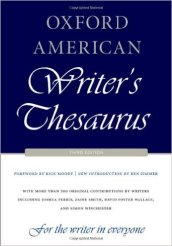 Once you find them, you need to go to the thesaurus to find alternatives that better express your intent.
 If you don’t have it already, a book you might want to invest in is
  Strolling along, watching the birds and animals that make their homes there grounds me. When we leave, I feel spiritually rested, more rooted in the earth, stronger and at peace with myself. It is a serene place, a place of stillness and calm.
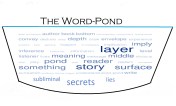 The components that form the visual layer appear to be the story. However, once a reader wades in, they discover unsuspected depths.
 The real story is how our characters interact and react to stresses within the overall framework of the environment and plot. Depth is found in the lessons the characters learn as they live through the events. Depth manifests in the changes of viewpoint and evolving differences in how they see themselves and the world.
 Foreshadowing is integral to a well-plotted story.
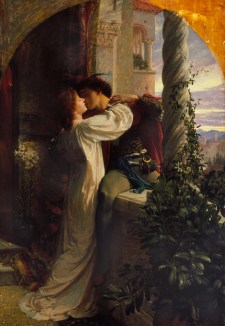 I often refer to the way that Shakespeare used both exposition and foreshadowing. In his works, more significant events are foreshadowed through the smaller events that precede them.
 In that moment, we see that Romeo is deeply aware that he has reached a point of no return.
 Once there, create a profile. You don’t have to get fancy unless you are bored and uber-creative.
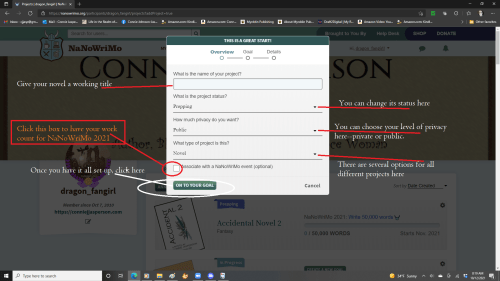 You can play around with your personal page a little to get used to it. I use my NaNoWriMo avatar and name as my Discord name and avatar. This is because I only use Discord for NaNoWriMo and one other large organization of writers. (Next week, we’ll talk about Discord and why NaNoWriMo HQ wants us to use it for word sprints and virtual write-ins.)
 Next, check out the community tabs. If you are in full screen, the tabs will be across the top. If you have the screen minimized, the button for the dropdown menu will be in the upper right corner and will look like the blue/green and black square to the right of this paragraph.
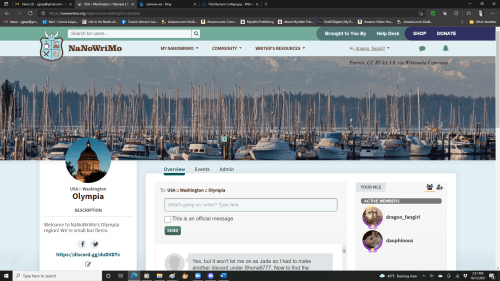 You may find the information you need in one of the many forums listed here.
 Make a master file folder that is just for your writing. I write professionally, so my files are in a master file labeled Writing.
 Give your document a label that is simple and descriptive. My NaNoWriMo manuscript will be labeled: Accidental_Novel_2.
 Still, we can come together and support each other’s writing via the miracle of the internet. My region is finalizing a schedule for “Writer Support” meet-ups via Zoom – little gab sessions that will connect us and keep us fired up.
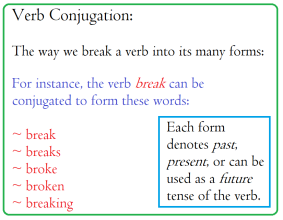 Today we’re discussing how narrative time, or what we call tense, affects a reader’s perception of character development. In
 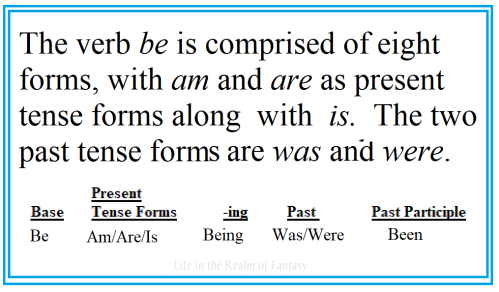 In the rewrite, we look for the code words that tell us the direction in which we want the narrative to go.
 Sometimes the only way you can get into a character’s head is to write them in the first-person present tense, which happened to me with Thorn Girl. I struggled with her story for nearly six months until a member of my writing group suggested changing the narrative tense and point of view.
 Every story is unique, and some work best in the past tense, while others need to be in the present. When we begin writing a story using a narrative time that is unfamiliar to us, we may have trouble with drifting tense and wandering narrative points of view.
 Happiness, anger, spite – all the emotions get a description. Eyebrows raise or draw together; foreheads crease and eyes twinkle; shoulders slump and hands tremble. Lips turn up, lips curve down, and eyes spark – and so on and so on.
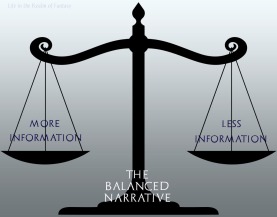 For me, the most challenging part of writing the final draft of any novel is balancing the visual indicators of emotion with the more profound, internal clues.
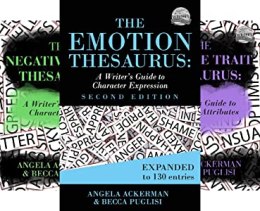 I have mentioned
  Open the thesaurus and find words that carry visual impact in your narrative, and you won’t have to resort to a great deal of description.
 The setting is a coffee shop.
 If you are writing a contemporary novel or historical work set in our real world, this is where you keep maps and maybe a link to Google Earth.
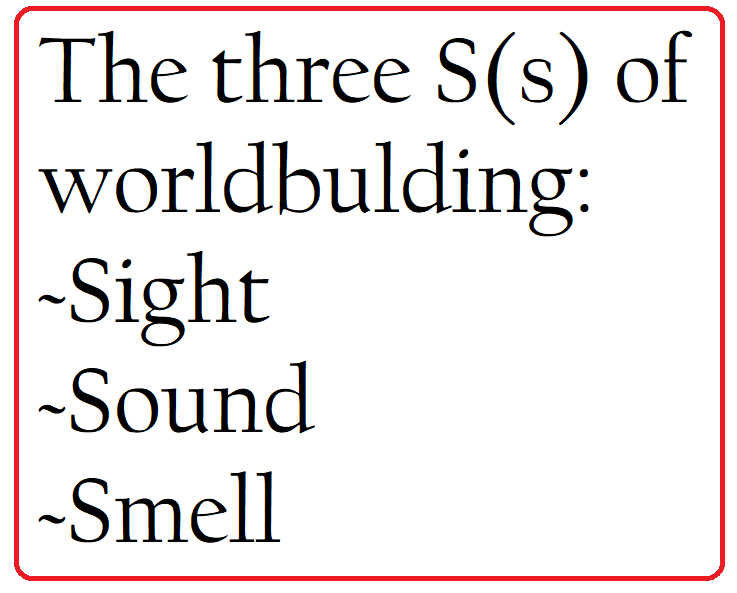 The “three S’s” of worldbuilding are critical: sights, sounds, and smells. Those sensory elements create what we know of the world. Taste rarely comes into it, except when showing an odor.
 At this moment, inside your room and outside your door, you have all the elements you need to create an alien or alternate world.
 I think of stories as if they were ponds filled with words. A pond has layers, and so do good stories. I see the three layers of a story as:
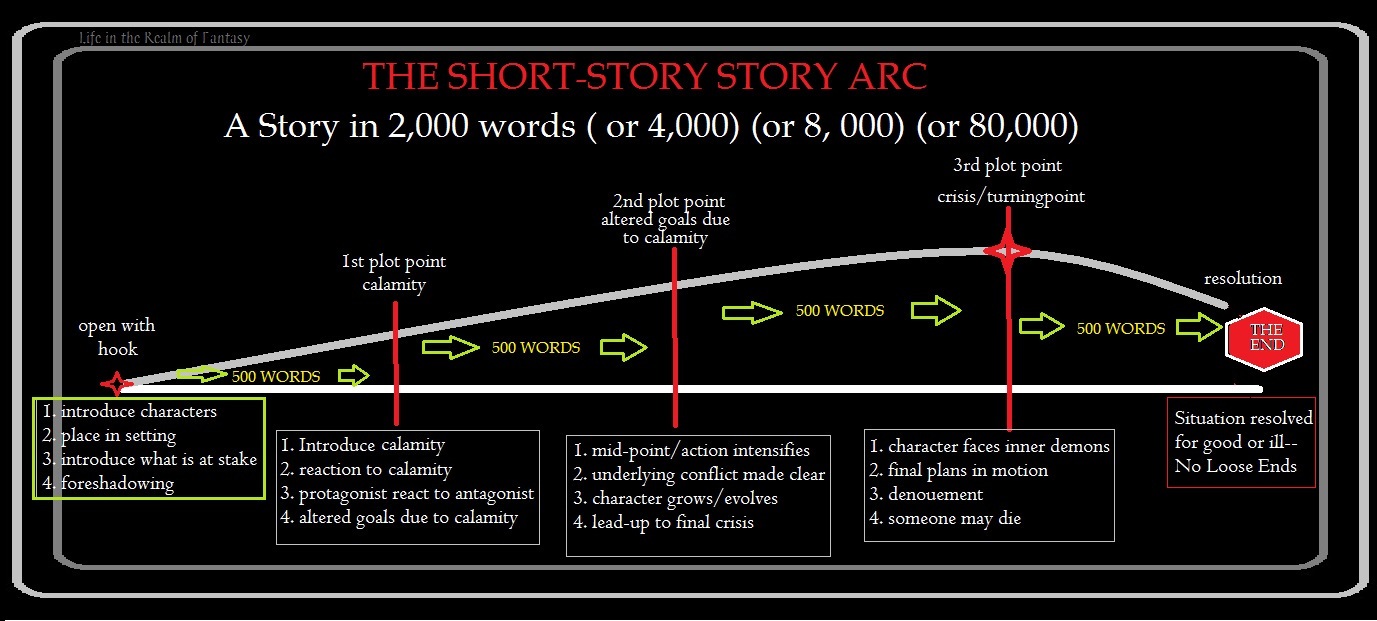 Act 1: the beginning: We show the setting, the protagonist, and the opening situation.
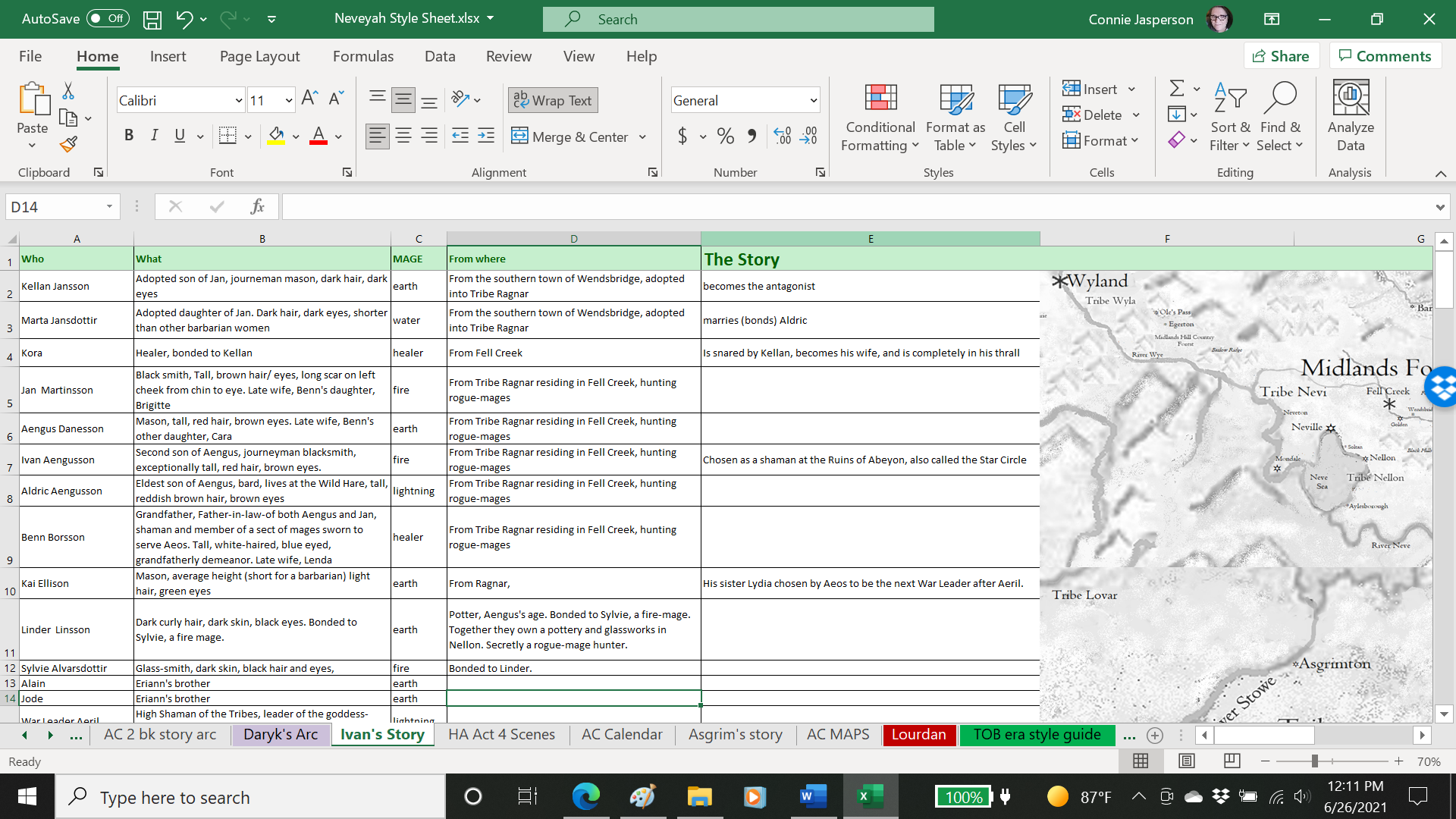
 I have mentioned before that I use a spreadsheet program to outline my projects, but you can use a notebook or anything that works for you. You can do this by drawing columns on paper by hand or using post-it notes on a whiteboard or the wall. Some people use a dedicated writer’s program like Scrivener.
 We never really know how a story will go, even if we begin with a plan. The plan serves to keep us on track with length and to ensure the action doesn’t stall.
 Then there is the marketing of the finished product, but that is NOT my area strength, so I won’t offer any advice on that score.
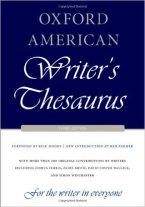
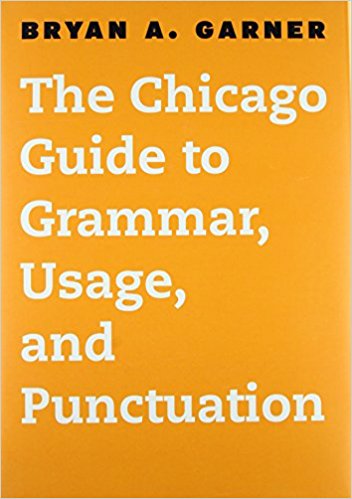 If you are writing in US English, I can highly recommend getting a copy of
 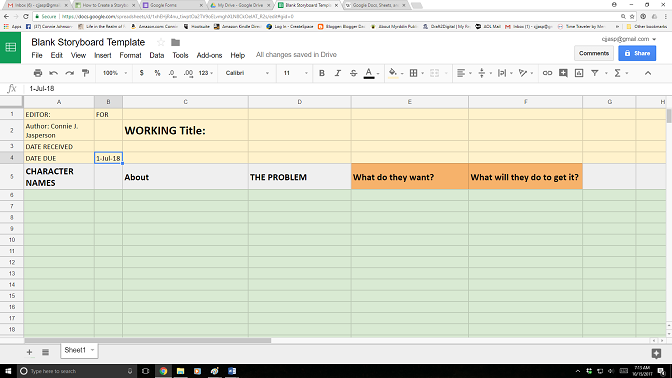 Creating a
  Write the basic story. Take your characters all the way from the beginning through the middle and see that they make it to the end. If you have completed the story and have it written from beginning to end, you can concentrate on the next level of the construction phase: adding depth.


 Life in the Realm of Fantasy
