Tag Archives: writing

How the Written Universe Works: Exploring Theme part 2, Don Quixote

The Ingenious Gentleman Don Quixote of La Mancha by Miguel de Cervantes Saavedra is known today as Don Quixote by Miguel Cervantes. If you are a regular here at Life in the Realm of Fantasy, you may know I am a Don Quixote fangirl.
how the universe works themeThe main character, Alonso Quijano, is possessed of a mighty imagination. In search of chivalric adventure, he becomes Don Quixote, the great knight of La Mancha.

I believe my early exposure to this book was the subconscious inspiration for the Achilles heel of my own great knight, Julian Lackland. Both men believe in the chivalric code, and both are a wee bit insane. However, the plots and narratives have no other commonalities.

I first came into contact with Don Quixote when I was given a children’s illustrated version of the novel for my eighth birthday. I read that book, cover to cover until it fell apart.
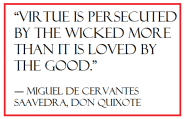
Virtue-miguel-de-cervantesThe summer I turned ten, I was scavenging the house for something to read and discovered my father’s personal library. He had the entire collection of Encyclopedia Britannica’s Great Books of the Western World. To my surprise, volume 29 was Don Quixote as translated by John Ormsby.

Several years ago, I bought Edith Grossman‘s modern translation, published in 2003. I think her translation is the best of all that I have read. This excellent version is available as an audiobook for those too impatient to read literary fiction. It does require a bit of perseverance.

Cervantes wrote a brilliant, enduring story that has survived intact since it was first published in 1605. He took many risks with the vocabulary of his native language. He had as immense an effect on the Spanish language as William Shakespeare did on English.

The themes in Don Quixote’s story are timeless, as are his quirks and flaws.

The conflict between the modern world and outmoded values – No one understands Don Quixote, and he understands no one. Sancho, a modern man of the peasant class (and with his own agenda), has a basic understanding of morality that is rooted in common sense. Sancho often agrees with the morals of his day but then surprises us by supporting Don Quixote’s outdated ethics and chivalry.
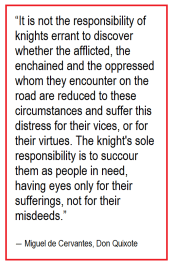
a-knights-responsibility-miguel-de-cervantesKnightly virtues – This is a morality tale. Don Quixote strives to present himself as an example, becoming a knight-errant as a way to force his contemporaries to face their failures. In his eyes, noble society has abandoned honor. They have turned their backs on the traditions of morality and the chivalric code. His duty is to show them the way back to righteousness.

The nature of reality – Don Quixote doesn’t understand the priest’s rational view of the world or his objectives. Conversely, Quixote’s belief in enchantment is ludicrous to the priest, but it is real to him. Only Sancho, his good-hearted, loyal friend, can mediate between Don Quixote and society. He interprets for Quixote, a buffer who translates his philosophies to the world, and in turn, explains the world to him.

The Distinction between Class and Worth – Cervantes gives us philosophers in the walk-on characters, the shepherds. He challenges the notion that social class and worth are entwined. Cervantes demonstrates that Nobility of Birth does not necessarily confer wisdom or kindness. In the characters of the Duke and Duchess, he gives us thoughtless cruelty, casually delivered purely for its entertainment value.

These themes share equally in supporting Don Quixote’s narrative. The plot may wander, and so does the protagonist, but the themes keep the narrative glued together.
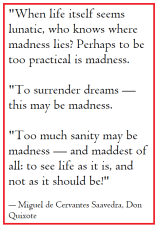
where-madness-lies-miguel-de-cervantesQuixote’s insanity is gentle and easy to sympathize with—he can’t understand the harshness of the people around him. He is a man of action and a champion of the oppressed.

And being a man of action, Don Quixote’s efforts frequently are not appreciated by those victims he steps up to help.

“For the love of God, sir knight errant, if you ever meet me again, please, even if you see me being cut into little pieces, don’t rush to my aid or try to help me, but just let me be miserable, because no matter what they’re doing to me it couldn’t be worse than what will happen if your grace helps, so may God curse you and every knight errant who’s ever been born in the world.”

~Miguel de Cervantes, The Ingenious Gentleman Don Quixote of La Mancha, 1605 [1]

The life of Miguel de Cervantes was worthy of a novel in its own right. In 1575, pirates kidnapped Cervantes and his brother and sold them as slaves to the Moors. Originally from Morocco, the Moors were the longtime adversaries of Catholic Spain, which they had once conquered.

Cervantes was taken to Algiers. His three or four attempts to escape his slavery were unsuccessful. Finally, he was ransomed in 1580 and returned to Spain.

He was a true indie author, a genius who never earned much from his writing and didn’t expect to. He just wanted to write.

After gaining his freedom from the Moors, he worked in many clerical capacities, notably as a purchasing agent for the Spanish navy (i.e., the Spanish King). His ill-placed trust in Simon Freire, an Andalusian banker with whom he had deposited Crown funds, led to his imprisonment for a few months in Seville after Freire went bankrupt. [2]
Don_Quijote_and_Sancho_PanzaHere are a few sayings you might hear every day in one form or another that were coined by Cervantes:

  • By a small sample we may judge of the whole piece.
  • Can we ever have too much of a good thing?
  • No limits but the sky.
  • Why do you lead me a wild-goose chase?
  • Thank you for nothing.
  • Let every man mind his own business.
  • The pot calls the kettle black.
  • Tilting at windmills.

Don Quixote’s story of insane genius and chivalric mayhem was born when Cervantes went to prison. All his life, Cervantes had to work a day job to support himself, writing at night and whenever he had the chance. Although he was wrongfully incarcerated, prison allowed him to spend his entire day writing.


Credits and Attributions:

[1] Quote: Miguel de Cervantes, The Ingenious Gentleman Don Quixote of La Mancha, 1605 PD\100.

[2] Information Source:
Royal provision of the judge of the Degrees of Seville, Bernardo de Olmedilla, to collect the assets of Simón Freire de Lima, amount that Miguel de Cervantes Saavedra had given him. Date 1595-08-07. Cervantes Universe (universocervantes.com)

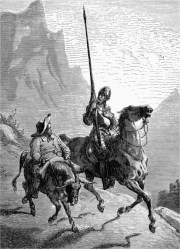
Image: Don Quijote de La Mancha and Sancho Panza, 1863, Gustave Doré [Public domain], via Wikimedia Commons.
Comments Off on How the Written Universe Works: Exploring Theme part 2, Don Quixote

Filed under writing

How the Written Universe works: Exploring Tropes #amwriting

Epic fantasy, like all genre fiction, has certain tropes that readers look for and expect to find in one way or another. Tad Williams injected new life into the genre in 1988 with the epic fantasy, The Dragonbone Chair. Simon’s story is volume one of the trilogy, Memory, Sorrow, and Thorn.

how the universe works tropesThe events set in this world are linked by family, warped by lies and secrets kept across three generations. Themes of hubris, truth vs. falsehood, heroism, and coming of age power this truly epic fantasy series.
In literature, the word trope describes commonly recurring literary and rhetorical devices or genre-specific themes and motifs. Literary tropes define almost every writing category, including poetry, television, and art. Tropes can be found in all literature.

What Williams did with The Dragonbone Chair was to take the tropes we expect to find and turn them on their head.

We lesser mortals hope to do that with our work, no matter the genre in which we write. We know what we want to read and attempt to make our work recognizably sci-fi, western, romance, or whatever.

We must play to the readers’ expectations and exceed them. To do that, we must give the expected tropes an original twist.

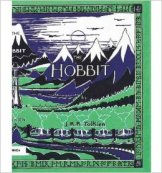
I love reading epic fantasy. Traditionally, epic fantasy features several recognizable elements, such as elves/fairies, dwarves, dragonsthe hobbit, demons, magic or sorcery, and multilayered quests. They often have constructed languages, coming-of-age themes, and multivolume narratives.
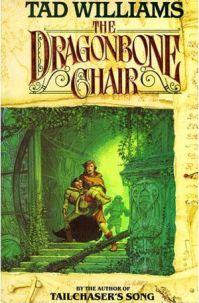
The way that Tad Williams changed epic fantasy was to take what J.R.R. Tolkien did with Middle Earth and create his own world, Osten Ard. It’s completely foreign, yet has a relatable flavor because it is built around a traditional fantasy model and takes clues from our real world history.

He peopled this world with human and non-human races, all of whom have roots in human history and folklore, but with his own spin on them.

With Jiriki, we have Williams’ introduction to his version of the fair folk. He and his people are recognizably elvish but with a trace that feels almost Japanese. They are a people who suffered a violent schism that split their society into two separate cultures, Norns and Sithi.

Norns are the bad elves.

Just sayin’.

300px-The_Dragonbone_ChairBinabik‘s people, the Qanuc, are called trolls by the humans and Sithi. They are a cross between Tolkien’s dwarves and hobbits, made wiser and less concerned about gold. The Hunën are brutish giants who serve the Norns and are often at war with the Qanuc.
There are often warriors embodying certain typical characteristics, such as the paladin or, conversely, the black knight. In Osten Ard, the broken knight, Sir Camaris, fills the paladin’s role. He is a noble knight serving the king and the religion of Usires Aedon, a riff on Medieval Christianity. Every death at his hands is a blot on his soul, and his commitment to honor is what ultimately ruins him.

As I mentioned in Monday’s post on Theme, Simon (the kitchen boy) and Miriamele (the princess) are the main protagonists and have the roles of unlikely heroes. Together and separately, they face overwhelming odds and must find courage in the darkest moments.

The hero represents hope, the human belief that salvation is just around the next corner.

Often in epic fantasy, the first villain is not the real villain. They may be the henchman of the true antagonist or a would-be usurper of the Evil One’s throne. Pryrates is evil. His henchman, Inch, is also evil.

They get what they deserve because they are not nearly as evil as the truly evil mind orchestrating the chaosIneluki, the Storm King. He is clever, immortal, and possesses a tragic backstory.

Inch and Pryrates are merely cruel and greedy for power over others.

When we write any novel, certain tropes will find their way into the narrative, often emerging from our subconscious without our noticing. The tropes appear because we know what we look for in a story and our subconscious mind wants to write that narrative.

Sometimes, we hear the comment that “certain tropes are overused.” This blanket statement is incorrect because a literary trope is a fundamental aspect of a subgenre.

They can be poorly written and framed by cliché treatments. Readers can and do eventually become bored with the books available when nothing written with a new and exciting spin emerges in their favorite genre.

Maybe you’re tired of Romance’s central trope, tired of happy endings.

magicIn that case, it’s time to widen your reading horizons and try reading something in a different subgenre. Maybe you’d like a space opera or a portal fantasy. You’ll never know what you are missing if you don’t read outside your favorite genre.

Maybe you will like it, and maybe not. But no one says you have to finish a book you hate.

Even if a friend swore that they loved it.

If you’re tired of the commonalities in the books you read, be adventurous. You might like something you wouldn’t usually read, which could inspire you to change up your palate.

You might paint the tropes of your genre with brilliant new colors.

And that can only be good for the readers.

Comments Off on How the Written Universe works: Exploring Tropes #amwriting

Filed under writing

#RoadTrip! The Resort, The Vegan, and June-uary #amwriting

Traveling, even in the Great Pacific Northwest can be—intriguing—if one is vegan. Sometimes the food is good, other times not so much. This week we are at Alderbrook Resort and Spa on the Olympic Peninsula of Washington State.

road tripNow, we probably wouldn’t have plumped for such a fancy getaway, but my husband has a conference there, and what with him not driving right now, I am along as chauffeur.
Anyway, the restaurant, like most here in the Northwest, does offer a few vegan entrees and I have been well (if unusually) fed.

I will get to the unusual part in a minute.

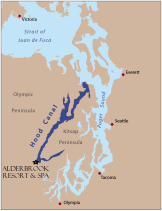
This place is built in the style of a Timber Chalet, but it wasn’t always so elegant. It was begun in 1909 by Henry Stumer, a Seattle business owner. He had previously owned the Hotel Stumer in Union City (now Union, WA). He and his friends at Seattle’s Swedish Club bought several parcels of beachfront property just east of Union City. The resort is situated on the fjord known as Hood Canal, which is a part of Puget Sound.

Locmap-hoodcanal-ssIt’s a fjord, not a canal, so why they named it that, I don’t know. But there it is, one more thing our pioneering ancestors have to answer for.
Stumer built tent cabins out of frames covered in black and orange striped canvas. They had no windows or electricity, only a wood stove for heat and cooking. The creek running through the property was used for refrigeration.

There was no road when Alderbrook opened in 1913, so guests arrived by boat from Union City or on horseback.

Alderbrook went through many iterations over the years, including a hotel. In 1959, Wes Johnson, a Hood Canal realtor from Hoodsport purchased the Alderbrook Inn. Johnson’s redevelopment plans included an indoor swimming pool, marina, 18-hole golf course, and 70-room hotel. To finance the redevelopment, Johnson sold the vacation cottages individually.

Zoom forward in time to 2022, and Alderbrook Resort is a posh palace for those with money to burn. Greg’s wallet is on fire! So much to do, so many ways to spend money, and so little time. The staff here is marvelous, and there are many activities for families. They have a fabulous spa, a high-end restaurant, yacht tours of Hood Canal, and numerous trails for hiking.

But I’m not into spa treatments, for which my husband’s budget is grateful. It’s peaceful and pleasant to just sit on my balcony and observe the waterfront and the forest around us. I have done quite a bit on my writing projects while visiting here.

I’ve spent a lot of time (and $$$) in the restaurant, where I have terrific views of the activities of my fellow guests.

I’ll just say I’ve seen some stuff worthy of a novel. Here is one people-watching moment that sticks out:

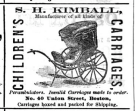
Kimball_BostonDirectory_1868The man and the baby: We arrived on Sunday afternoon. We sat at a romantic table for two for our first dinner, overlooking the beach. It’s the Pacific Northwest, so people come dressed for January in June (or June-uary as June is known here). The lawn chairs were full of guests lounging in their summer finery of Gore-Tex and wool, ignoring the intermittent misty rain and drinking steaming coffees. Off to one side was a young man sitting alone. Beside him was the fanciest baby pram I’ve ever seen.
Seated above it all in the restaurant, I had ordered grilled cauliflower. I was not disappointed in the quality of that entrée. It was seasoned perfectly, with just the right amount of tenderness, and was a delicious, satisfying dinner.

I just happened to look up from my meal in time to see the young man wheel the pram to the side of an enclosed area, park it, and walk away. This baby was very tiny, not more than a month old.

That was not a happy moment for me, as you don’t do that here in the US. I later discovered that the enclosure is an outdoor coffee bar on weekends, but I didn’t know it then. Here in America, you never leave a baby or small child unattended in a public place, whether outdoors or in a car. People will assume it’s been abandoned and call the police and Child Protective Services.

The longest five minutes I’ve ever lived passed while I watched that baby carriage like the hawk-eyed grandma that I am. Then a young man emerged from the coffee bar with a steaming cup. He walked to the pram, placed his cup in the cupholder, and pushed the baby out of my visual range.

I’m a terrible witness. I couldn’t remember if it was the same young man, but they both had red jackets. The author in me went into overload. Perhaps the baby was a doll, and I had witnessed a spy transaction, two men handing off secrets. Or maybe it was a big-time drug deal.

Ooh, the possibilities. Now, if Ellen King Rice will only write that novel!

So back to the food.

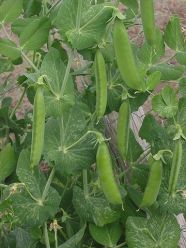
peas and vinesOn Monday, I decided to be adventurous. I thought I would try the spring salad with fresh peas, pea vines, fennel, watermelon radishes, and a champagne vinaigrette. I had never thought of eating pea vines, but I’m not afraid to try new things.

That was … interesting. The vinaigrette was divine, and the peas and radishes were delicious, as were the dandelion greens. Unfortunately, while the pea vines were good, they were difficult to get into my mouth without embarrassing myself.

Somehow, I had thought the vines would be cut to a manageable size, but alas, they were five to eight inches long and wiry. Not only that, but they were impossible to cut with the lovely silver flatware set so neatly beside our plates.

I tried wadding them up into little bales and pitchforking them as one might do spinach, but they sprang apart before I could get them into my mouth. Vinaigrette splattered all over my face and glasses.

I had been raised with manners, so I wiped my face with the white linen napkin and soldiered on.

I tried twirling them around a fork – with the same result.

I ended up leaving most of it on my plate, something I rarely ever do.

This supports my experience that punishment food is on the menu in the most unlikely places and is often labeled vegan. Usually, it’s soggy eggplant or limp portobello mushrooms, which are much easier to get into your mouth than my elegant pea vine salad was.

avacado dinner saladToday we are on our way home, where we will indulge in budget-friendly home-cooked meals and other economies for a few weeks to make up for this splurge.
And next Monday, here on Life in the Realm of Fantasy, we will delve into some of my favorite books and see how the authors employed themes to emphasize atmosphere and unite the threads of their stories.


Credits and Attributions:

Baby Pram, Wikimedia Commons contributors, “File:Kimball BostonDirectory 1868.png,” Wikimedia Commons, the free media repository, https://commons.wikimedia.org/w/index.php?title=File:Kimball_BostonDirectory_1868.png&oldid=463698022 (accessed June 14, 2022).

Map of Hood Canal, Wikimedia Commons contributors, “File:Locmap-hoodcanal-ss.png,” Wikimedia Commons, the free media repository, https://commons.wikimedia.org/w/index.php?title=File:Locmap-hoodcanal-ss.png&oldid=449541623 (accessed June 14, 2022).

Peas and vines, Wikimedia Commons contributors, “File:Doperwt rijserwt peulen Pisum sativum.jpg,” Wikimedia Commons, the free media repository, https://commons.wikimedia.org/w/index.php?title=File:Doperwt_rijserwt_peulen_Pisum_sativum.jpg&oldid=483824040 (accessed June 14, 2022).

2 Comments

Filed under Vegan, writing

How the Written Universe Works: 7 Rules of Construction #amwriting

Words, carefully chosen and arranged with care, have the power to bring your writing to life.

7 rules of constructionWe who write because we love words spend a great deal of time framing what our words say. We choose some words above others because they say what we mean more precisely, or they color our prose with the right emotion.
We take our chosen words and bind them into small packets we call sentences. We take those sentences and build paragraphs, which become novels.

The author’s job is to understand how the grammar of their native language works. The great authors use those rules to energize their prose.

However, when it comes to word choices, some things are universal to the best work in all genres, from literary fiction and poetry to sci-fi and fantasy, to thrillers and cozy mysteries, or even Romance.

The world is in a state of flux—money is tight. In the US, the cost of getting a university education is prohibitive, with students incurring massive debt that follows them for years afterward. Some people have the luxury and the desire to seek a degree in writing.

Others must rely on self-education. To that end, here are seven rules professional writing programs teach about sentence and paragraph construction.

One: Verbs—we choose words with power. In English, words that begin with hard consonants sound tougher and carry more power.

Verbs are power words. Fluff words and obscure words used too freely are kryptonite, sapping the strength from our prose.

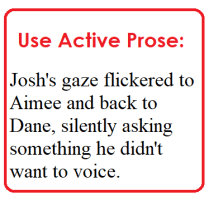
Use Active ProseTwo: Placement of verbs in the sentence can strengthen or weaken it.
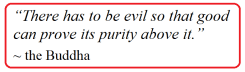
  • Moving the verbs to the beginning of the sentence makes it stronger.
  • Nouns followed by verbs make active prose.

I ran toward danger, never away.

Three: Parallel construction smooths awkward phrasing. When two or more ideas are compared in one sentence, each clause should use the same grammatical structure. They are parallel, and the reader isn’t jarred by them, absorbing what is said naturally.

What parallelism means can be shown by a quote attributed to Julius Caesar, who used the phrase “I came; I saw; I conquered” in a letter to the Roman Senate after he had achieved a quick victory in the Battle of Zela. Caesar gives equal importance to the different ideas of arriving, seeing, and conquering.

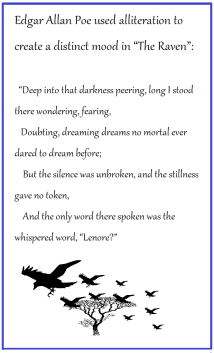
Buddha quoteFour: Contrast—In literature, we use contrast to describe the difference(s) between two or more things in one sentence. The blue sun burned like fire, but the ever-present wind chilled me.
Five: Similes show the resemblances between two things through the use of words such as “like” and “as.” The blue sun burned like fire.

Similes differ from metaphors, which suggest something “is” something else. The pale moon shone, a lamp in the sky that comforted me.

Six: Deliberate repetition used occasionally emphasizes emotion and atmosphere but doesn’t increase wordiness.

  • Repetition of the last word in a line or clause.
  • Repetition of words at the start of clauses or verses.
  • Repetition of words or phrases in the opposite sense.
  • Repetition of words broken by some other words.
  • Repetition of the same words at the end and start of a sentence.
  • Repetition of a phrase or question to stress a point.
  • Repetition of the same word at the end of each clause.
  • Repetition of an idea, first in negative terms and then in positive terms.
  • Repetition of words of the same root with different endings.
  • Repetition at both the end and beginning of a sentence, paragraph, or scene.
  • Repetition is a construction in poetry where the last word of one clause becomes the first word of the next clause.

Every book is a quotation, and every house is a quotation out of all forests, and mines, and stone quarries; and every man is a quotation from all his ancestors.”  Ralph Waldo Emerson, Prose and Poetry. [1]

alliterationSeven: Alliteration is the occurrence of the same letter (or sound) at the beginning of successive words, such as the familiar tongue-twister: Peter Piper picked a peck of pickled peppers. Alliteration lends a poetic feeling to passages and enhances the atmosphere of a given scene without creating wordiness.
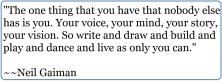
Once upon a midnight dreary, while I pondered, weak and weary, (The Raven, by Edgar Allan Poe 1845) [2]

When I see birches bend to left and right

Across the lines of straighter darker trees, (Birches, by Robert Frost 1916) [3]

The way we habitually construct our prose is our voice, and that voice determines the impact of our work. Different readers have widely different tastes, but no one enjoys bad writing.

Constructing our work to fit the market we are writing for is crucial to finding readers. However, all readers want to find good writing and are attracted to work that tells a story with atmosphere and emotion.

Neil_Gaiman_QuoteActive phrasing generates emotion. Sometimes, using similes, repetition, and alliteration in subtle applications enhances the worldbuilding without beating your reader over the head.
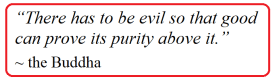
We all know worldbuilding must be organic and natural, but we don’t all know how to achieve it. Subtle application of these seven rules will empower your worldbuilding. The casual reader will be immersed but unaware of the mechanics. They won’t realize why the work is powerful.


Credits and Attributions:

[1] Ralph Waldo Emerson, The Complete Works. Published in 1904. Vol. VIII. Letters and Social Aims, VI. Quotation and Originality, Bartleby.com, accessed (June 11, 2022)

[2] Wikipedia contributors, “The Raven,” Wikipedia, The Free Encyclopedia, https://en.wikipedia.org/w/index.php?title=The_Raven&oldid=908701892 (accessed June 11, 2022).

[3] Wikipedia contributors, “Birches (poem),” Wikipedia, The Free Encyclopedia, https://en.wikipedia.org/w/index.php?title=Birches_(poem)&oldid=886359747 (accessed June 11, 2022).

6 Comments

Filed under writing

How the Written Universe Works: Choreographing Disaster #amwriting

The most powerful books in the Western Canon of Great Literature explore the human experience. Drama, heartache, disaster, and violence are the backdrop against which our lives play out.

Buddha quoteReaders connect with these stories across generations and across the centuries because the fundamental concerns of human life aren’t unique to one society, one technological era, or one point in time.
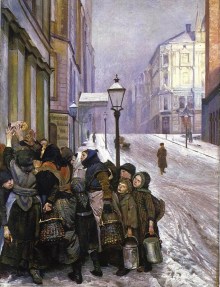
In my last post, we touched upon choreographing violence, but didn’t discuss some of the root causes. Violence often follows disaster.

Some disasters are caused by the cyclical ebb and flow of weather patterns, and others are the effects of human activity.

  • Possible effects of famine: food deprivation leads to starvation and disease.
  • Possible effects of severe drought: droughts lead to wildfires, famines, and pandemics.

Drought and famine feed societal unrest:

  • Lust for power: The bullies rise to the top, inciting their followers to violence against those perceived as weaker.
  • Lust for wealth: Bully warlords may mount an armed invasion to steal resources a neighboring society has acquired.

Even a slight lowering of the standard of living can feed civil unrest.

One disaster we may all face at some point is famine. Hunger exists in this world, and while many worthwhile charities do their best to alleviate it, famine is an enemy that takes no prisoners.

On a human level, hunger affects a person forever after. People can survive on very little, and unfortunately, many do. To have only enough food to keep you alive forms a person in a singular way. Their physical growth will be less than that of a well-nourished person, and their worldview is narrower. They have no energy to spare for anything beyond their day-to-day existence.

Christian_Krohg-Kampen_for_tilværelsen_1889Acquiring food becomes their first priority. Having a surplus of food becomes a reason to celebrate. To go without adequate food for any length of time changes a person and makes one determined to never go hungry again.
Unfortunately, for some, their desire to be well-fed will lead them to make choices that challenge the accepted morality of those who are not hungry.

Droughts often cause famines and worse. To go without water is to die. Thirst is a more immediate pain than hunger. The human animal can survive for up to three weeks without food but only three to four days without water. Rarely, one might survive up to a week.

Even brackish water must taste sweet when one suffers from a lack of potable water. And when one is without food, foods they would consider repugnant under other circumstances will fill their belly.

Look at the continual strife in third-world countries (not Ukraine, which is different and not a third-world country). You will see how long-term droughts have precipitated widespread famine, leading to civil unrest. Gang wars are fought over the right to own a water source, and these conflicts can erupt into revolution.

We forget this when we have plenty to eat and never have to worry if we will have water in our faucet as long as we can pay the bills.

But if we learn anything from the empty grocery store shelves in 2020 and the current supply chain crisis, it is that our well-fed lives are perched on a one-legged ladder.

Disaster on a wide scale can and will happen. But what of those small tragedies people face each day, deeply personal catastrophes, which only they are experiencing? These are also the seeds of a good story.

ContrastsLove and loss, safety and danger, loyalty and betrayal—the eternal themes of tragedy and resolution. Hardship contrasted against ease provides the story with texture, turning a wall of “bland” into something worth reading.
In real life, everything seems to be going along well. Life is good, calm, and peaceful. Then the tornado hits, the wildfire comes through, or the tidal wave—whatever the tool nature uses to destroy you, it decimates your home, your community, leaving you and your neighbors with nothing.

Then we must deal with the aftermath, cleaning up, searching for belongings, and searching for loved ones. This kind of disaster cuts deep into a person’s psyche.

Severe weather, fires, famines, and floods are terrible to live through, and many harrowing stories emerge from these experiences. Stories of apocalyptic catastrophes resonate because disaster drives humanity to bigger and better things, and those who survive and rise above it become heroes.

However, disasters regularly happen on what seems an unimportant level to people who have resources.

Consider the situation of a single mother working two part-time jobs. If she lives in my town, she lives where there is no public transportation. Other cities in my county have access to public transit, but not my community.

She struggles to pay for fuel, but what if her car breaks down? How will she get to work? All her money goes to fuel, childcare, rent, and utilities. What little she has left after those bills are paid goes to food.

She has no resources and no way to pay to repair her car. Without her car, she will lose both jobs. That is a profoundly personal disaster, one she and her children might not recover from.

How would you write her story?

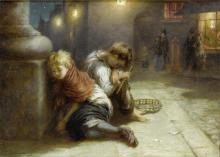
Augustus_Edwin_Mulready_Fatigued_Minstrels_1883We writers must make our words count. We have to show the comfort zone in the moments leading up to the disaster, not too much, but just enough to show what will soon be lost.
Then, we have to bring on the disaster and write it logically so that the events make sense. We can’t tell the story. We must show it as if we were painters—and we have to inject real, believable emotion into the experience.

Open a new document and save it to your background file. Describe the disaster in great detail. Then save and walk away from it. Let that scene rest and move on to something else. When you return to it, re-read it, and see what you can cut and condense and still have the bones of the action. Use verbs and power words and go light on descriptors.

The window shatters, and I stare, dumbstruck. A two-by-four impales itself in the wall beside David amid a slow-motion shower of glass shards. The wind roars, tearing the door from my hand and slamming it shut.

Verbs in that scene are: stare, impales, shower, roars, tearing, slamming. Show the bones of the event by using verbs with powerful visuals, and the reader’s mind will fill in the rest.

Once the events are in order, we must show the aftermath of the calamity and the roadblocks they must overcome to recovery. We add the characters’ real-time reactions and emotions. Finally, we must leave our characters in a place of comparative happiness and security.

Employing contrast—ease against hardship—gives texture to the fabric of a narrative. When an author makes good use of courage in the face of personal disasters, readers think about the story and those characters long after it has ended.


CREDITS AND ATTRIBUTIONS:

Struggle for Survival by Christian Krohg, 1889, oil on canvas.  Now hanging in the National Gallery of Norway. Wikimedia Commons contributors, “File:Christian Krohg-Kampen for tilværelsen 1889.jpg,” Wikimedia Commons, the free media repository, https://commons.wikimedia.org/w/index.php?title=File:Christian_Krohg-Kampen_for_tilv%C3%A6relsen_1889.jpg&oldid=301415583 (accessed June 7, 2022)

Fatigued Minstrels, by Augustus Edwin Mulready, 1883, oil on canvas. Wikimedia Commons contributors, “File:Augustus Edwin Mulready Fatigued Minstrels 1883.jpg,” Wikimedia Commons, the free media repository, https://commons.wikimedia.org/w/index.php?title=File:Augustus_Edwin_Mulready_Fatigued_Minstrels_1883.jpg&oldid=335802594 (accessed June 7, 2022)

6 Comments

Filed under writing

How the Written Universe Works: Choreographing Violence #amwriting

In most genres, whether it’s mystery, fantasy, sci-fi, thrillers, or horror, the characters are forced to do a certain amount of fighting. However, scenes involving physical action can become a wall of mindless mayhem.

toolsScenes of conflict are crucial to the advancement of the story. They should be inserted into the novel as if one were staging a pivotal scene in a film.

For my own planning purposes, I have four levels of conflict, ranked by the escalation of action and the broadness of the conflict.

Level 1 – Quarrel – interpersonal disagreements, disputes, angry words, shouting, everyone walks away.

Level 2 – Skirmish – 1 to 5 combatants total, with one-on-one physical violence. Minor wounds, everyone walks away.

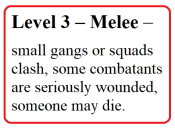
Level 3 – Melee – small gangs or squads clash, some combatants are seriously wounded, and someone may die.

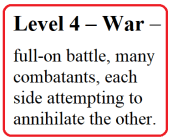
Level 4 – War – full-on battle, many combatants, each side attempting to annihilate the other.

level 1 confrontation LIRF06052022If you have no experience with combat or fighting, you don’t understand the limits of a normal athlete’s physical abilities. So, you must do the research. Think of how the human body works in reality. If your character knees a foe in the jaw, how is it possible?

Are you really going to go into that much detail to explain how Joe slapped Mary and then bent down for whatever reason, and Mary kneed him in the jaw?

I suggest you don’t include that particular assault because a knee to the jaw is a weird move if both combatants are standing. If Mary has a blackbelt in Tae Kwon Do, she could have clocked him with her foot, but not her knee.

level 2 skirmish LIRF06052022If you don’t show how such a strange hit could happen, the reader will say, “That’s impossible.” It’s a risky choice though, because going into that kind of detail bores the heck out of our readers. Our readers mind will fill in the details and if it’s confusing, they may stop reading.
We must consider what is physically possible and what is not.

After the action is laid down, the next step is fine-tuning it. The reactions and responses of your characters are what make the experience feel authentic to the reader. After you have established that Joe was somehow hit in the jaw, what happened next? Did it knock him out?

Many authors get hung up on the technical side of each fight—how they were dressed, what weapons they had, and so on.

level 3 melee LIRF06052022Don’t do this for every incident. After they are armed and armored as much as they are going to be the first time, just have them meet the enemy, skirmish, and continue on. The reader already knows what armor and weapons they had.
The fight must advance the story.

  • Ask yourself why the quarrel happened.
  • What is the purpose of injecting that conflict into the narrative?
  • And once you establish that the fight happened, did you foreshadow it well enough, or does it seem gratuitous?

level 4 war LIRF06052022In real life, conflict happens on a sliding scale. It begins with a disagreement and escalates to an all-out war. While my outline will have a note alerting me to the level of conflict that must happen, I choreograph my fights to reflect that sliding level of intensity.
Billy Ninefingers begins with a level 1 quarrel that escalates to a level 2 fight. Billy’s sword hand is wounded. Besides the fact Billy is seriously injured in this opening fight, which is the inciting incident and core plot point of the book, I had two other goals with that fight scene:

  1. I needed to show how the Bastard is jealous and acts on any thought that passes through his alcohol-soaked mind.
  2. In the resolution of that scene, I demonstrated that Billy, even with his life in ruins, has a sense of fair play.

Just as physical attacks are in real life, Billy’s confrontation with the Bastard was over in less than a minute. From personal fistfights to waging war, actual combat is quick, bloody, and brutal.

Author-thoughtsPerson-to-person combat doesn’t stretch for hours because no matter how well trained a fighter is, no one has that kind of strength.
Skirmishes may happen in bursts that take place over a length of time, but there are pauses between clashes, allowing the combatants to briefly rest and get their breath.

It may feel like an hour is passing while you are in the middle of each clash, but in reality, each one-on-one fight only lasts a few minutes. At that point, even the strongest fighters are exhausted. Exhausted people make mistakes, and someone will be injured or die.

I suggest that for your own purposes, you map your violence out. Describe it for yourself as you would a journey. On a background document, write every slap and curse word. Write every hack and slash or gunshot, and make sure each occurs at its proper point in the melee.

Then walk away from it. Let that scene rest and move on to something else. When you return to it, ask yourself how many blows and hits your characters have taken.

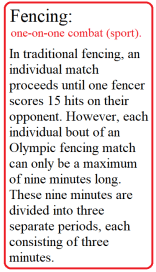
combat - fencing LIRF06052022A typical fencing match goes until one has scored 15 hits on their opponent, and that match lasts nine minutes or less. Ask yourself how your fighter can survive the injuries that such blows would leave them with in real combat.

They most likely couldn’t.

Combatants block and defend as much as they attack. For the author, acting out each skirmish ensures that the moves are reasonable and make sense. But you aren’t done writing that scene just because the hacking, slashing, and gunshots are on paper.

Open a new document, take what you have already choreographed and consolidate it. While a war will justify ten paragraphs of description, a skirmish won’t. Write a one or two paragraph narrative that hits the high points and end it.

In each quarrel, we have to consider that every character in the fight is, and must remain, a unique individual. There should be no blurring of personalities, which can happen when an author focuses too intently on the action of the fight scene.

It’s a lot of work, but I go back to the first part of that section and make sure the character’s reactions are portrayed so the reader can suspend their disbelief.

powerwordsWordCloudLIRF06192021I try to show this discreetly by sitting back and visualizing the scene after the choreography is laid on paper. I replay it in my mind as if I were a witness to the events and look for each combatant’s facial expressions and reactions.
The strongest reactions get briefly mentioned in the story, the responses that push the plot forward. The other reactions are witnessed but given less prominence, becoming part of the scenery.

When I choreograph a fight, I think of it as if I were composing a conversation. In our literary conversations, we paint the impression of their individuality without boring the reader with insignificant details.

We must approach the fight scene the same way. I keep it concise and linear when it comes to fighting, as drawn-out fight scenes bore me to tears. Just the facts, the immediate emotional impact, and we move on to the recovery scene.

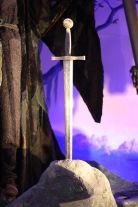
Excalibur London_Film_Museum_ via Wikipedia

Excalibur, London Film Museum, via Wikipedia

While it feels chaotic to those who are involved, violence is orderly and happens in a sequence of actions within a fundamental framework of order.

They block, dodge, hack and slash or shoot – the swiftness of the event and the emotional impact of the violence do the work of conveying the overwhelming sense of chaos.

My next post will examine how to choreograph personal disasters.

13 Comments

Filed under writing

How the Written Universe Works: The Inciting Incident #amwriting

Whether we show it in the prologue or the opening chapter, the first event, the inciting incident, is the one that changes everything and launches the story. The universe that is our story begins expanding at that moment.

the inciting incidentThe first incident has a domino effect. More events occur, pushing the protagonist out of his comfortable life and into danger. Fear of death, fear of loss, fear of financial disaster, fear of losing a loved one—terror is subjective and deeply personal.
I love stories about good people solving terrible problems, but I want them to mean something.

While I have experienced violent situations, I’ve also faced many things that shook my world but didn’t threaten my physical safety.

Arguments and confrontations are chaotic, leaving us wondering what just happened. We want to convey that sense of chaos in writing, but we must consider the reader. Readers want to see the scene and understand what they just read. We must design every action scene to ensure they fit naturally into a narrative from the first incident onwards.

The threat and looming disaster must be made clear to the reader at the outset. Nebulous threats mean nothing in real life, although they cause a lot of stress in our daily lives.

Those vague threats might be the harbinger of what is to come in a book, but they only work if the danger materializes quickly and the roadblocks to happiness soon become apparent.

Resolving disaster is the story. Hold the solution just out of reach for the following ¾ of the narrative. Every time we nearly have it fixed, we don’t, and things get worse.

The arc of the story begins with the first event, the inciting incident. The story’s arc occurs because the characters keep reaching for a resolution but can’t quite grasp it. Every attempt is blocked somehow.

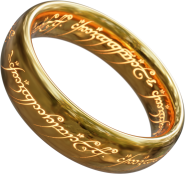
959px-One_Ring_Blender_Render

The One Ring, Peter J. Yost, CC BY-SA 4.0

The characters reap the rewards of minor successes but not the golden ring. Those small rewards keep hope alive and keep the reader involved.

If the first problem was taken care of too quickly, why? What sort of trap was laid, and why did the characters take the bait?

If we do this right, we will move our readers emotionally and they will remain invested in our book.

I mentioned that confrontations are chaotic. It’s our job to control that chaos and make a narrative out of it. Nothing upsets a reader more than a book where the author contradicts something that was said or that happened before.

I choreograph action sequences, which can take a little time. Each character’s reactions must be portrayed in such a way the reader doesn’t say, “He wouldn’t do that.”

In real life, people don’t all react the same way. So, our characters can’t all be superheroes in a fight scene. It’s easy to lose the characters’ individuality in the jumble of actions that a confrontation is.

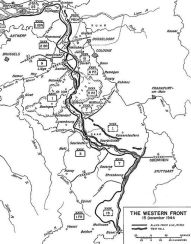
If your violence is war, go to history and see how battles were waged historically. Any war will do, but let’s say you are writing an account of a soldier’s experiences in modern warfare. Go to the Battle of the Bulgealso known as the Ardennes Counteroffensive.

512px-Western_Front_Ardennes_1944

US Army Center for Military History, Public domain, via Wikimedia Commons

I’ve used this battle as an example before because it was a pivotal point in World War II, and the placement of all the forces on both sides is well documented.

Also, one of my uncles fought and was wounded in that battle. Uncle Don came home with a metal plate in his head. American forces endured most of the attack, suffering their highest casualties of any operation during the war.

But you can look at any historical battle. Just remember that even though your book may explore a real soldier’s experiences, you are still writing a fantasy. The past is just hearsay, stories written by the victors. The future is a rumor that may not happen. The only moment that happens for sure is this moment, that moment you experience now.

Our characters exist in their own now, and the inciting incident kicks off their story. Perhaps the soldier’s inciting incident occurs when they join the army. From that point on, the actions and reactions of our soldiers must be logical even amidst the chaos of battle, or the reader will skip over that scene and possibly put the book down.

We make our characters knowable and likable (or not, as the case may be) through physical actions and conversational interactions. In the early part of the story, each scene should illuminate the characters’ motives. The reader must gain information at the same time as the protagonist does.

toolsHowever, the reader has an edge—they will be offered clues from the antagonists’ side, which the characters don’t know. The antagonist’s actions will affect the plot in the future. Even if the antagonist isn’t an overt enemy at the outset, the readers’ knowledge creates a sense of unease, a subliminal worry that things will go wrong.
Through the first half of the book, subtle foreshadowing is essential. This knowledge raises the stakes, increasing the tension.

Next week, we will look at ways to choreograph confrontations and violent encounters.

10 Comments

Filed under writing

The Business Side of the Business – Choosing your Publishing Path

Authors just starting out, either Indie or traditionally published, rarely earn enough royalties to support their families. Regardless of the path you choose, if your spouse makes enough to support you in your early days, you can devote more time to advancing your career.

Its a BusinessBut not every author has that option.

Before you embark on either path, consider this: publishers, large and small, don’t waste budgets promoting work by unknown authors the way they do the few who have risen to the ranks of their guaranteed bestseller lists.

You will do the work of getting your name out there regardless of whether you choose the traditional route or not.

So, what are the perks of going traditional if you’re an unknown? Why go to the trouble of wooing an agent and trying to court a publisher? Even today, an air of ‘respectability’ clings to those who are traditionally published.

The traditional publishing industry does offer incentives to those who get their foot in the door. Once you are in their flock, you have an editor who works with you personally. Most of the time, you can forge a good working relationship with this editor.

Conversely, Indies must find an independent editor and pay them out of their own pocket.

While the traditional publisher may not treat a new author the way they do their highest sellers, they may dedicate a small budget to marketing your work with newspaper ads, or swag posters for bookstores to place as decoration. That small amount will be more money than you might be able to pay as an Indie.

Traditional publishers have contracts with markets like Target, Walmart, Costco, airports, and grocery store chains. That is a huge thing, assuming your publisher considers your work worthy of such a commitment on their part.

However, your first book most likely won’t see the inside of a Walmart right away. The publisher’s confidence must be earned. You can expect to find your work on the slow track for a while as the publisher tests the water and sees how well your work sells through Amazon and Barnes & Noble.

These are all valid reasons for attempting to go the traditional route.

However, there are equally valid reasons for going Indie. Your book will be published. If you seek a book contract, you must pass a gauntlet of gatekeepers: literary agents, acquisition editors, editorial committees, and publishing-house CEOs.

These people must answer to the international conglomerates that actually own most American publishing companies. This is why you are most likely to be stopped by a rejection letter.

It’s not the quality of your work. It’s the publishers’ perception of what the reading market will purchase and what it means to the accountants, who in turn must answer to their shareholders.

As an Indie, you may not be a bestseller, but you’ll make more money on what you do sell.

McLaine_Pond_In_July_©_2018_ConnieJJapsersonIn most standard book contracts, royalty terms for authors are terrible, and this is especially true for eBook sales. Most eBooks are sold through online retailers like Amazon. If you’re a traditionally published author and your publisher priced your eBook at $9.99, this is how the Amazon numbers break out. No matter what you think of Amazon, it is still the Big Fish in the Publishing and Bookselling Pond:
  1. Amazon takes 30% of the list price, leaving about $7.00 for the publisher, agent, and you to split.
  2. The publisher will keep 75% of that $7.00, or $5.25.
  3. The publisher will pay you 25% of that $7.00—just $1.75.
  4. You then must pay your agent her 15% commission—or 26 cents.
  5. You net just $1.49 on each $9.99 eBook sale. This is assuming your publisher honestly reports your sales and royalties, and in my personal experience, a few small publishers do not.

Unfortunately, traditional publishers usually charge far more than $9.99 for eBooks, charging more than they do for paperbacks in their effort to keep eBook sales down and drive paper sales.

If you self-publish your eBook at that same price, for each sale of your $9.99 eBook, Amazon takes its 30%, leaving you $7.00. I don’t recommend such a high eBook price, but at  $4.99 or even $2.99, you stand to sell books and make a decent profit.

You’ll receive royalties sooner. When a publisher accepts your book, he offers you an advance against sales. These are often paid in installments stretched out over long periods and are tied directly to how well or how poorly your book is doing in real market time. Publishers report sales and pay royalties slowly, as royalty statements are usually issued semiannually. Your royalty checks arrive later, so you can’t rely on this income until you have become an established author in their world.

Conversely, most eBook distributors like Draft2Digital, Barnes & Noble, and print-on-demand services such as Amazon KDP, report your sales virtually. Best of all, they pay your royalties monthly, with just a sixty-day lag from the day sales began.

Finally, and from my point of view, most importantly: You retain all rights to your work.

Legacy book contracts are a terrible danger zone for the author. The sheer complexity of negotiating a contract can be confusing and intimidating. I recommend you hire a lawyer specializing in literary contracts or risk unwittingly signing away secondary and subsidiary rights to your work forever.

Please, read this article, A Publishing Contract Should Not Be Forever, published on the Authors Guild website on July 28, 2015. It is an eye-opening look at the industry and its practices.

Now we arrive at marketing. As I said before, you must do the work of getting your name out there regardless of whether you choose the traditional route or not. You must still work your day job to feed your family.

Being an indie author or being published by a small press means you are on your own as far as getting the word out about your books. Even some traditionally published authors find that if they want their books seen at a convention, they must pay for the table, find their own hotel accommodations, and pay their own way there.

You pay upfront for your book stocks if you are an indie.

If you are traditionally published, the costs of your stock are deducted from future royalties. Publishing houses are not charities, so you will pay for stocking and restocking your inventory either way you choose.

If you choose the indie path, you pay for editing, beta reading, and proofreading. You will also need a graphic designer for book covers and should seek professional formatting services to create the files for your paperback book.

lute-clip-artHowever, to be considered for a traditional contract, you should hire an editor, beta reader, and proofreader to ensure the manuscript you submit to an agent or editor demonstrates your ability to turn out a good, professional product.
Either way, it’s a business, and you must factor these costs into your budget.

Both paths are reasonable in today’s market. There are positive rationales for choosing either direction, as well as negatives. You will have to work hard no matter which path you choose.

The publishing path is a critical choice for an author to make and is one we shouldn’t make lightly. A decision that affects your career as strongly as this deserves deep consideration of the many pros and cons.

13 Comments

Filed under writing

The Business Side of the Business: conferences and conventions #amwriting

If you are a regular here at Life in the Realm of Fantasy, you may have seen my two-part series on the business side of being an author. If not, and if you are interested, I will put the links to those articles at the bottom of this post.

Its a BusinessRegardless of your publishing path, you must budget for certain things. You can’t expect your royalties to pay for them early in your career – and many award-winning authors must still work at their day jobs to pay their bills.

But conferences and conventions are one way to meet agents and editors. Also, if you have a table at sci-fi and fantasy fan conventions (or whatever your genre), you will meet readers and create a fanbase for your work.

No author, indie or traditionally published, can live on their royalties at first, so attending conferences requires planning, possibly up to a year in advance. I suggest you work with your budget and set aside the money for conventions and seminars.

I do have some ways to keep your costs down.

First: Join the association offering the conference, as members get reduced conference fees and many other perks all year long. Take advantage of the early-bird discount if you can. I belong to three writers’ associations, and each one offers something I can use all year long.

Second: Does your library system offer occasional seminars by local authors? If it is a public library, these will likely be free.

Third: Use the internet – google “writers’ conferences in my area.” If you can find a local one, you can eat food that fits your dietary needs and sleep at home, which means you only pay for the conference itself.

Fourth: If you are planning to attend a large convention or conference where you will need to stay in a hotel, take simple foods that can be prepared without a stove, and which are filling. Being vegan, I tend to be an accomplished hotel-room chef, as most coffee bars don’t offer many plant-based options. While that bias is changing, I still go prepared.

road tripConferences are an extension of the self-education process. I have discovered so much about the craft of writing, the genres I write in, and the publishing industry as a whole—things I could only learn from other authors. I gained an extended professional network by joining The Pacific Northwest Writers Association in 2011 and going to their annual conferences.

This last weekend, I attended the first of three conferences I have budgeted for 2022. The Science-fiction & Fantasy Author’s Association held the 2022 Nebula Conference this last weekend. It was a virtual conference again this year, so my only cost was the conference fee itself. That cost was quite reasonable because I took advantage of both my membership discount and the early bird discount.

The Nebula Conference is normally held in Southern California, and I am not a happy flyer, so a virtual conference was optimal for me. I may not attend in person again. However, since SFWA is a global association of professional science fiction and fantasy authors, their conferences will also be available in virtual form from here on out.

The following two conferences I have scheduled will be in September and are in-person events. The first, Southwest Washington Writers Conference (SWWC), is local enough that I can commute from my home. The last one for this year is Pacific Northwest Writers Association (PNWA) in the Seattle area. It’s a 70-mile commute, so I will stay in the hotel. September is the start of virus season, so I expect many people (like me) will wear masks at both events.

Me working in a starbucks, through the fishbowl, copyright Dan Riffero 2013

Me writing in a Seattle Starbucks, taken through a fish tank. I was the big fish in that tank! Photo by Dan Riffero.

As a small fish in a very big ocean, attending these two local conferences puts me in contact with other authors and industry professionals. The attending authors are people I don’t usually come into contact with as they hail from all over Washington State, Oregon, Idaho, and British Columbia.

I always attend as many panels and workshops as I can fit into my schedule. I do this because the seminars offered at each of the three conferences have taught me as much about the craft as about the business of writing.

This weekend at the Nebula Conference, I attended many outstanding panel discussions by famous authors. All the authors on the panels were people who have achieved success, and they shared their insights on current trends in the publishing industry.

My favorite seminar out of all those stellar panels was the one discussing Speculative Fiction Poetry, which was held on Sunday morning. I have always written poetry and love reading it. Many spec fic poets are experimenting with sestinas, which (thanks to the pandemic) became my new favorite poetic form to write in during lockdown. Trying to adhere to a strict structural form challenges my creativity and forces me to grow in all areas of writing craft.

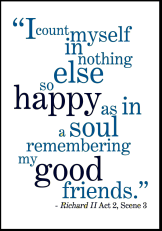
ICountMyself-FriendsSometimes I am invited to participate in panels or offer a workshop, and I can share my experiences with others. Either way, I learn things. In September, I will be on a panel with Lee French, Johanna Flynn, and Ellen King Rice at SWWC, talking about what we wished we had known when we first began writing professionally.
I feel honored (and a bit intimidated) to be a part of this group as they are award-winning writers. But more than that, they are women whose work I enjoy and respect. But facing your fear of public speaking is part of what growing your career entails – putting yourself out there, learning what you can, and sharing what you know.


Two previous posts on the Business side of the Business:

The Business Sequence for Writers, guest post by Ellen King Rice #writerlife | Life in the Realm of Fantasy (conniejjasperson.com)

The Business Side of the Business, part 2: Inventory #writerlife | Life in the Realm of Fantasy (conniejjasperson.com)

8 Comments

Filed under writing

How the Written Universe Works: Time, Maps, and Project Management #amwriting

Scope creep (aka project creep, requirement creep, or kitchen sink syndrome) in project management refers to the changes and continuous (or uncontrolled) growth of a project. This can occur at any point after the project commences.

ProjectManagementLIRF05232021The plan or design is submitted to the client, who likes it. A mockup of the first iteration is submitted to the client, who still likes it, but … their needs have changed a little, and a new adjustment must be incorporated.
Project creep sometimes occurs because we fail to envision and raise potential issues at the outset. Then, situations arise that are out of our control, and which affect production.

Everything takes longer than we thought it would.

We compound the problem by failing to evaluate new requests before approving them, not assessing whether fulfilling these add-ons is even feasible. At some point we must face the unpleasant truth.

These errors and oversights will either kill the entire project or alter it beyond recognition.

Requirement creep occurs when the project’s original scope is brilliant but nebulous, which is how novels are born – a glorious idea that isn’t fully formed but exponentially grows as we write.

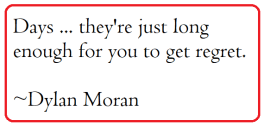
dylan moran quote TIMEBooks are one area where project creep is not only appreciated but encouraged. Stories are particularly prone to this continual expansion of the original ideas. Short stories grow into novellas and then into novels, becoming a series of books.
Nothing upsets a reader more than a book where the author contradicts something that has gone before. The storyboard is one visible, easy-to-comprehend way to keep on top of project creep. When creating a story, one must manage both time and distance, a difficult task.

Oh, as you are writing, you think you have it all straight in your head.

But as a child who has ever told a lie knows—stories grow and evolve in the telling. Eventually, it looks nothing like the way it started out.

Even on the surface, writing fiction is complex. Authors who want to take their books from idea to paperback must become project managers.

We don’t consciously think about this, but organizational skills are critical because we want the story to flow easily from scene to scene. This is why successful authors are project managers, even if they don’t realize it.

toolsThe first aspect of this is to Identify your Project Goals – create a rudimentary outline with names, who they are in relation to the protagonist, and decide who is telling the story. Remember, your story is your invention. Some inventions are in development for years before they get to market. Others are complete and ready to market in a relatively short time. Regardless of your production timeline, this is where project management skills really come into play.
I use a phased (or staged) approach. This method breaks down and manages the work through a series of distinct steps to be completed.

  1. Concept: The Brilliant Idea. Make a note of that idea, so you don’t forget it.
  2. The Planning Phase: create a raw outline. Some people don’t need this step, but I do.
  3. The Construction Phase—writing the first draft from beginning to the end and continuing through multiple drafts.
  4. Monitoring and Controlling—This is where you build quality into your product.

Write the basic story. Build your storyboard/stylesheet and note the changes you make as you go. See my post on stylesheets/storyboard’s here: Self-editing: Ensuring Consistency.

  1. Find beta readers and heed their concerns in the rewrites. Take the manuscript through as many drafts as you must, to have the novel you envisioned.
  2. Employ a good line editor to ensure consistency in the quality of your product.
  3. Find reliable proofreaders. (Your writing group is an invaluable resource.)

Completion or Closing—Employ a cover designer if you are going indie.

    1. Find an agent if you are taking the traditional route.
    2. Employ a professional formatter for the print version if you are going indie.
    3. Court a publisher if you are taking the traditional route.

Maps and calendars are essential tools for the author, no matter what genre you are writing in. Regardless of how you create your stylesheet/storyboard, I suggest you include these elements:

  1. GLOSSARY – A list of names and invented words as they arise, all spelled the way you want them.
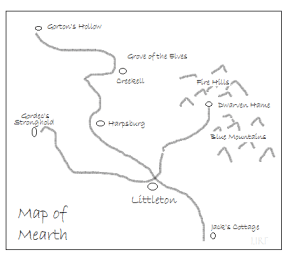
  2. MAPS – nothing fancy, just something rudimentary to show you the layout of the world.
  3. CALENDAR of events – especially important if the characters must travel.

A fourth thing your stylesheet/storyboard could include is the rough outline of your projected story arc. This is a good tool for fantasy authors because we invent entire worlds, religions, and magic systems. We don’t want to contradict ourselves.

sample-of-rough-sketched-mapYour map doesn’t have to be fancy – all you need are some lines and scribbles telling you all the essential things, like which direction is north and what certain towns are named. Use a pencil, to easily update your map if something changes during revisions.
If you aren’t artistic and want a nice map later, your scribbled map will enable a map artist to provide you with a beautiful and accurate product. You will have a map that contains the information needed for readers to enjoy your book.

If your story takes place in the real world, use Google Maps, and print out a copy for your reference, or scan a map into your storyboard.

You need to know how the land looks to your characters, mountains, lakes, oceans, etc. You also need to know what lies to the north, south, east, and west. You should have some notion of where rivers and forests are relative to towns because those landmarks will be mentioned at some point.

Readers remember the smallest details and use them to visualize the world they are reading about. This is why you need some idea of distances and how long it takes to travel using the common mode of transportation.

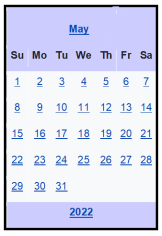
calendarTime can get a little mushy when we are winging it through a manuscript. A calendar gives us a realistic view of how long it takes to travel from point A to point B, or how much time it will take to complete a task.

It helps to know what season your events occur in, as foliage changes with the seasons and weather is a part of worldbuilding.

The map shows the terrain your story takes place on, and weather can affect the terrain. Your characters will interact with their environment in different ways, depending on the season and the weather.

Project management is a vital tool for the author. Maps and calendars are the author’s project management tools. They work together to help you visualize your story. They enable you to manage time and distance in a logical way that doesn’t intrude into the reader’s awareness.

And that is important.

1 Comment

Filed under writing