Category Archives: Battles

Wordless Dictionaries

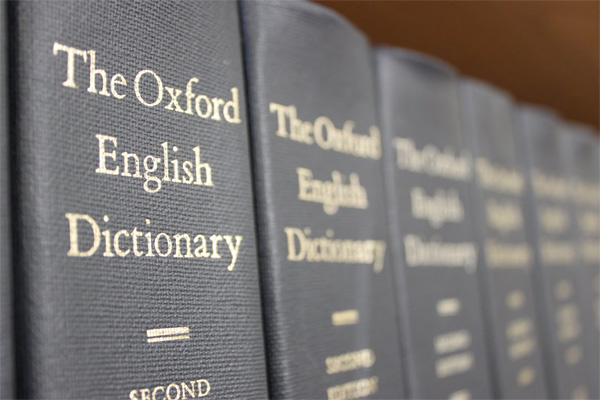
oxford_dictionaryWe are in the midst of an extreme shift in the English language, a continual evolution as impossible to stop as the  melting of the Antarctic ice-cap. This change is not necessarily a terrible thing, but it does come along with some interesting complications.

Robert Macfarlane discussed one negative aspect of our language shift in a blog post last week for The Guardian. He is not  saying that the rapid shift in our dialect and word-usage is bad–after all, language needs to be spoken and it is like water: it’s always on the move and incredibly difficult to contain.

cowslip

cowslip

But Macfarlane sees a negative in the modern view of this fluidity, one that struck a real chord with me: “Under pressure, Oxford University Press revealed a list of the entries it no longer felt to be relevant to a modern-day childhood. The deletions included acorn, adder, ash, beech, bluebell, buttercup, catkin, conker, cowslip,cygnet, dandelion, fern, hazel, heather, heron, ivy, kingfisher, lark, mistletoe,nectar, newt, otter, pasture and willow. The words taking their places in the new edition included attachment, block-graph, blog, broadband, bullet-point, celebrity, chatroom, committee, cut-and-paste, MP3 player and voice-mail. As I had been entranced by the language preserved in the prose‑poem of the “Peat Glossary”, so I was dismayed by the language that had fallen (been pushed) from the dictionary. For blackberry, read Blackberry.”

Now, admittedly Robert Macfarlane is an avid reader of literary fiction, and he also writes literary and travel books. However, many people are  still reading above the comic book level, and what he has to say in his piece concerns the dumbing-down or “flattening” of the language. Don’t try to tell me there isn’t enough room in the book for these words. Dictionaries are on-line now and there is in infinite amount of space in the internet for these words.

oxford school dictionaryDictionaries are the first reference book children will come into contact with in their schools, followed closely nowadays by Wikipedia. I admit that in a desk-reference form space is limited, but in a world where Blackberry means a smart-phone, there is no lack of space.

How will the landscape of our language look in fifty years? I sometimes doubt I would be understood, speaking in my ancient Northwest American dialect, using words that have no relevance. Without a comprehensive dictionary, how will the words I write today be understood by my great-grandchildren?

If I could say one thing to those who compile dictionaries it is that ALL the many words that make up our English language  have relevance and should be  included in what is being marketed as a truly comprehensive dictionary. At some point, a curious reader is going to want to know the meaning of a word, and if that word appeared in the dictionary  at one time, why must it be removed just because a committee of naive scholars with extremely limited experience feels it is not needed?
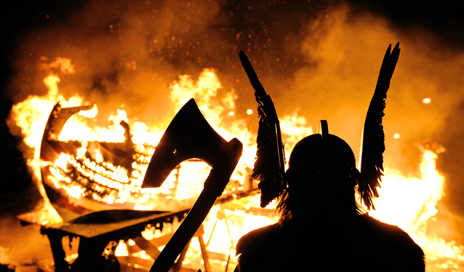
_72982736_vikings courtesy of BBCTo me, this is tantamount to a mass burning of books just because they contain “dangerous ideas.”

I have one thing to say to the modern publishers of dictionaries: You have unlimited space in an on-line dictionary. When you allow words to fall out of the dictionary because they have fallen out of common use in YOUR milieu,  your dictionary is not as comprehensive as you are pretending it is. You have lost YOUR relevance at that point.

These mongers of wordless dictionaries should feel some shame, because they are as responsible for the dumbing-down of the English language as is the casual speaker. Their own relevance is questionable, as more and more seekers of quick information will find it in the bowels of the fount of all knowledge, Wikipedia, OR they will Google it, as I did the word “inexorable.”
6 Comments

Filed under Adventure, Battles, Books, Fantasy, Humor, Literature, Publishing, Self Publishing, Uncategorized, writer, writing

Critique groups vs beta reading groups

Book- onstruction-sign copyEvery writer needs honest, constructive feedback in order to grow in their craft. Many will join critique or beta reading groups. These groups come in all sorts and sizes, some specializing in general fiction and some in genres like mystery, science fiction, fantasy, or romance.

Most communities have clusters of authors—after all, nowadays everyone either is an author or has a couple in the family . In your community you will find groups for beginners, or some that cater to more advanced crowds. I guarantee there will be one to fit your needs.

We’ve all heard the horror stories regarding critique groups, and perhaps even experienced one. Making a poor choice in writing groups can be devastating—it can undermine a budding author’s confidence and destroy a person’s joy in the craft. The seas are rough out there but many writing groups are really good, supportive gatherings of authors who stay for years and welcome new authors into their group with open arms.

Other groups can be cliquish, unwelcoming, and daunting to new arrivals. Authors just beginning to explore this necessary part of the craft will not come back to one of these groups if they were given the cold-shoulder the first time.

There is a difference in types of writing groups, too. Some are traditional critique groups, people who usually read a few pages aloud at their sessions and discuss it in detail in a round-table fashion. This sort of focus can be just right for some authors.

Because traditional critique groups focus only on 3 or 4 pages at a time, they lack the context to be able to discern if your protagonist has developed sufficiently along his character arc by the first 1/4 of the tale. However, they can tell you if you have made editing errors, and discuss small points of technique within those few pages.

Frankly, I am not interested in this kind of group.

These sorts of groups don’t have the ability to properly critique the larger picture—pacing, overall story arc, worldbuilding, character development, and on, and on–because these things can only be judged in larger context. So if, like me, that is the sort of input you are looking for, my advice is to find a beta reading group.

Critique groups cannot do what beta readers can.

But how do you select a group? Before you join a beta reading group, you have the right to know what that group focuses on. Ask yourself these questions:

beta read memeWhat do I want from this group? Orson Scott Card says the answers should be:

  1. Where did my chapter bog down?
  2. What did they think about my characters?
  3. Where did they get confused and what did they have to read twice?
  4. Did it become unbelievable or too convenient at any point?
  5. What do they think will happen to the characters now?

Then after you have sat in on one of their sessions and observed how they treat each others’ work, ask yourself, “What kind of vibes did I get from this group of people? Will I benefit from sharing my work with this group? Did the comments they made to each other sound helpful?” Hopefully, the answer to those questions will be a resounding “yes.”

If not, run now. Run far, far away.

There are common negatives to watch out for in all writing groups: If you have stumbled into a group where the most visible member is a self-important, read-all-the-books-on-writing-so-I-know-it-all kind of a person, don’t bother joining or you’ll be subjected to many accounts of how their writing group in Minnesota was so much better than this pathetic group.

Another author you might watch out for is the ubiquitous Famous-Author-Name-Dropper, a person who must be important because she has been to a great many seminars and conventions with these famous people, and hung out in the bar with one of them once. If it turns out she is in your prospective group, it may not be the group you are looking for. Sometimes they are the same person, sometime not, but either one of these wannabe-famous authors are poison—in their eyes the group only exists to admire them, and they will causally cut your work to shreds, dismissing it as merely amateur in the face of their “professional” experience.

When you are considering joining a group, ask the leader/chairperson these questions:

  1. If the group is a beta reading group focused on first drafts, what do they consider a first draft? Do you have to hire an editor and have it thoroughly edited before you submit it to this group? Because that is not a first draft, and that group would be a waste of your time.
  2. Will you receive insights into your manuscript on points you hadn’t considered, or will the focus of the discussion centered on minor editing issues that you are already aware of?
  3. Ask the leader to define for you the specific areas that readers will be looking at: Character development, pacing the arc of the scene, pacing the arc of the conversation, worldbuilding.

So let’s say you have found a group who seems to a good bunch of people, and yes, they read and write in your genre. You trust them enough to submit your first piece to the group. After the session is over, ask yourself:

  1. Do I feel positive about my work or do I feel like my work was treated as being less than important?
  2. Did I gain anything from the experience that would advance the plot or did I just hear a rehash of arm-chair editing from a wannabe guru?

The answers to these questions have to be that you feel good about your work, that you saw through their eyes the weaknesses, and that they can be fixed.

beta read meme 2If the strengths and weaknesses of the characters, and the overall arc of the chapter were overlooked in the face of fixable editing errors then you did not get the insight into the particular trouble-spot that you were looking for.

Ask yourself this: “When I was discussing the direction I wanted to take the tale in, did I sense that they were interested in my story?” If the answer is anything other than a resounding “yes” you have the right to leave the group.

New authors join writing groups feeling a great deal of trepidation, filled with uncertainty and fear. They fear being belittled and told their work is crap, and sometimes that happens. At the end of the day, you have to feel as if you have gained something from the experience.

Hopefully you will be as fortunate as I have been, and find a group of beta readers you can mesh with, people who will support and nurture you in the same way that you will them.

6 Comments

Filed under Battles, Books, Fantasy, Humor, Literature, Publishing, Self Publishing, writer, writing

Comfort Books, the main course: The Wheel of Time, by Robert Jordan and Brandon Sanderson

The Eye Of The WorldFor the main course of this three course meal I’ve chosen a hearty 14-book trilogy. I warned you that many of the books I love and turn to when I need a good book are NOT comforting in any way, and for many people the incredibly long, epic series, the Wheel of Time, definitely falls into the UNcomfortable category. This is for a variety of reasons.

The Eye of the World was the opening volley in what would ultimately become one of the most controversial series in epic fantasy. Written by Robert Jordan and first published in 1990, this series of books has polarized the most dedicated fans of true fantasy into two groups: the lovers and the haters.  No reader walks away from this series unscathed.

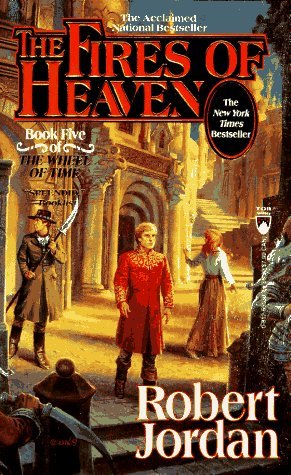
WoT05_TheFiresOfHeavenThe story begins in the exceedingly rural village of  Emond’s Field. They are so rural that they have no concept that they are still considered to be a part of a larger country. The village is suddenly attacked by Trollocs (the antagonist’s soldiers) and a Myrddraal (the undead-like officer commanding the Trollocs).  These creatures are intent on capturing the three protagonists, Rand al’Thor, Matrim (Mat) Cauthon, Perrin Aybara, although why they are being hunted is not revealed at first. To save their village from further attacks, Rand, Mat, Perrin, and Egwene (Rand’s first love interest) flee the village, accompanied by the Aes Sedai Moiraine Damodred, her Warder, Al’Lan Mandragoran, and gleeman, Thom Merrilin.They are later joined by Nynaeve al’Meara, who is their village’s medicine woman.

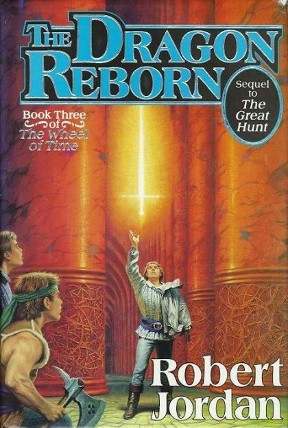
WoT03_TheDragonRebornThis huge range of characters and the many, many threads that weave an incredibly tangled plot are what polarizes the reading community over this series of books. Originally intended to be a trilogy, it eventually expanded to encompass fourteen LARGE, long books.

Robert Jordan passed away in 2007 while working on the final book, leaving the series uncompleted, but he left the rough draft and enough notes behind that Brandon Sanderson was able to finish the series, eventually breaking that final volume into three very large  books, and bringing the story to a satisfying conclusion.

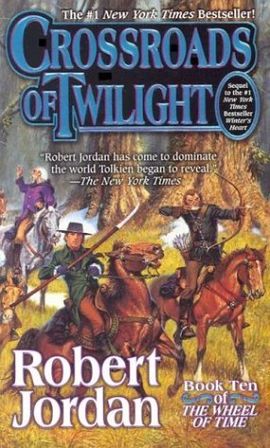
WoT10_CrossroadsOfTwilightSo what is the basis for the plot’s tension, what conflict could possibly draw the reader in and keep them reading for such a long, drawn out process? It’s Robert Jordan, folks–the eternal quest for power, and dominance through violence, religion and politics is the core of this tale. According to Wikipedia, the Fount of All Knowledge: The series draws on numerous elements of both European and Asian mythology, most notably the cyclical nature of time found in Buddhism and Hinduism, the metaphysical concepts of balance and duality, and a respect for nature found in Daoism. Additionally, its creation story has similarities to Christianity’s “Creator” (Light) and Shai’tan, “The Dark One” (Shaytan is an Arabic word which in religious contexts is used as a name for the Devil). It was also partly inspired by Leo Tolstoy’s War and Peace (1869).”

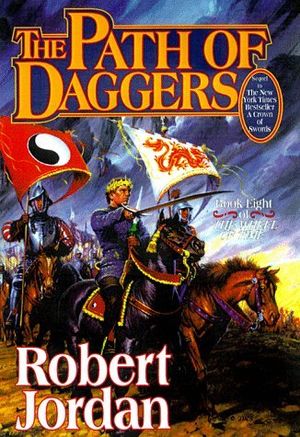
300px-WoT08_ThePathOfDaggersI loved the first three books in this series. I both enjoyed and endured the next three, hoping Robert Jordan would get to the point and finish the damned series. I had become a little irritated with book eight, Path of Daggers, but by the time Winter’s Heart came out, I was resigned to never seeing an end to it, and was back to simply enjoying each strange plot twist and new random thread for what it was–just a great tale.

When Robert Jordan died, I was thrilled that Brandon Sanderson was the author tapped to finally bring that unwieldy mess together. There were so many different stories within the greater story that the task of winding up each thread must have been incredibly daunting, and he did it magnificently.

The reason so many devoted fans abandoned the series somewhere around book six , Lord of Chaos, was that Rand al’Thor’s story ( and Mat’s and Perrin’s) stalled, and Jordan was sent way off track by the stories of Egwene, Nynaeve, and Elaine Trakand. In fantasy, there is a large contingent of readers who want instant gratification are not going to wait around for eight more books. They proved it by jumping ship and trash-talking his work.

TheGatheringStormUSCoverThroughout the series, the quality of the writing never faltered. The depth of story and the intensely alive characters whose stories graced those pages never failed to intrigue me. The fact that it felt like the conflict would never be resolved was, at times, upsetting to me as a reader, and is a lesson authors should take to heart with their own work.

To write a story that is so compelling that readers become so violently polarized over it is quite an accomplishment.  I see this happening with George R.R. Martin‘s fans right now. Although I adore him as a person, I’ve never cared much for his style of writing, as he jumps around too much even for me. Have patience, people! It looks like George has a large story there too, so it may take him a while.

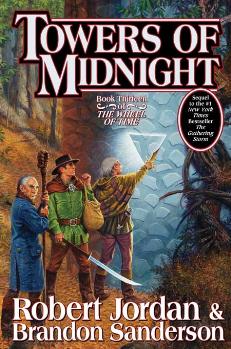
Towers_of_Midnight_hardcoverFor Brandon Sanderson to step into the wasps’ nest of controversy that was the Wheel of Time and complete the series with such grace and finesse is nothing short of amazing, and I am glad I stuck with it to the end. Brandon Sanderson has become one of my favorite authors because of what he did to wind up this epic series.

In the end, the final resolution was satisfying, and was well worth the journey.  I have gotten rid of most of my hard copies, and am down to only one room’s worth of hardbound books at our house. I don’t buy too many hard copies of books, being a fan of the Kindle, and  but I did make an exception for this book.   For me, some books need to be in hard copy form and the Wheel of Time Series is one of them, as are the Harry Potter books. There was a large contingent of people who were upset that the epub edition wasn’t released until 4 months after the paperbook, but this was a choice made by Robert Jordan’s widow and her publisher, TOR. It was a strange one in my opinion, but it was their choice.

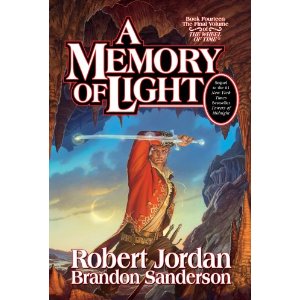
A_Memory_of_Light_coverAmazon’s early reviews of the later books in this series were rife with trolls and naysayers who couldn’t wait to emerge from the woodwork and have their say. Apparently very few of these people purchased the book, much less read it. That is the price of success and these days it’s almost an honor to have so many haters just spoiling to knock you down. But their strident caws and self-important rants should have no effect on the true fans of WoT. In my humble opinion these works are masterpieces and Brandon Sanderson’s three books are a triumphant finish to the series.

I love Brandon Sanderson’s handling of this series finale, and feel I more than got my money’s worth from this series of book, as I will definitely read it again and again–in my opinion it’s that good. If you love this series, you will love the way it ends!

The original cover artist for these amazing books was none other than the late Darrell K. Sweet, who was just as amazing a fantasy artist as is Michael Whelan. The newer covers are nice, but for me they lack the power of Sweet’s brilliant paintings.

And as we all know, I buy most books for their covers, even epubs, and then fall in love with the tale.

Comments Off on Comfort Books, the main course: The Wheel of Time, by Robert Jordan and Brandon Sanderson

Filed under Adventure, Battles, blogging, Books, Dragons, Fantasy, Humor, Literature, Politics, Publishing, Self Publishing, WordPress, writer, writing

Comfort books, second course: Dragonriders of Pern, by Anne McCaffrey

Michael-Whelan-Dragons-dragons-4284189-1204-827Today I am serving up the second course of our three course meal of books that are comfort food for my soul. Anne McCaffrey’s Dragonriders of Pern series directly motivated me to become a writerNo other series of books has had a more profound effect on me as both a reader, and as an author.

The artwork gracing many of her later covers was done by the same brilliant artist, Michael Whelan, whose work graces many of Tad Williams’ books.

I have read the entire series every year since I snuck my father’s Science Fiction Book Club copy of Dragonflight in the summer of 1969. Since that time I have worn out 6 hardbound copies of The Dragonriders of Pern, a collection comprised of the first three books based on the fantastic Weyrs of Pern, and the people and their dragons who live within them.   I can’t tell you how many fellow Pern fanatics tell me the same thing, “When I think of dragons, I think of Pern.”

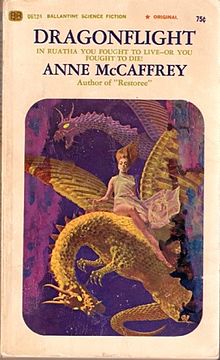
AnneMcCaffrey_DragonflightAnne McCaffrey’s 1968 novel, Dragonflight was the first book in the original trilogy, and is the book that launched an empire that now encompasses at least 23 novels and several anthologies of short stories that are just as compelling as the novels.  In 2003 McCaffrey began writing with her son, Todd McCaffrey and in 2005 Todd took over the series, and has acquitted himself well. I am still buying and enjoying the new entries in the series!

Dragonflight began life as a short story for Analog, Weyr Search which appeared in the October 1967 issue, followed by the two-part Dragonrider, with the first part appearing in the December 1967 issue. In 1969 the two award winning short stories were combined into the book Dragon Flight, and was published by Ballantine books.

Anne McCaffrey was the grand mistress of worldbuilding. Aspiring scifi and fantasy authors should read her work for the small clues and hints that are sprinkled within her work , the little brushstrokes that create the larger picture. She gave us a real planet, in Pern–and our minds built around her framework, believing the world of Pern to be as real as our own earth.

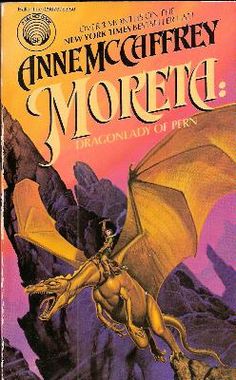
moretaPern is a planet inhabited by humans. In the forward of the book, we find that he original colonists were reduced to a low level of technology by periodic onslaughts of deadly Thread raining down from the sky. By taming and bonding to the indigenous flying, fire-breathing dragonettes called Fire-Lizards and then making genetic alterations to make them larger and telepathic, the colonists gained the upper hand. The dragons and their riders destroyed the Thread in the skies over Pern before it was able to burrow into the land and breed. The Threads would fall for fifty or so years, and then there would be an interval of 200 to 250 years.  However, an unusually long interval between attacks, 4 centuries in duration, has caused the general population to gradually dismiss the threat and withdraw support from the Weyrs where dragons are bred and trained. At the time of this novel, only one weyr, Benden Weyr, remains (the other five having mysteriously disappeared at the same time in the last quiet interval).  The weyr is now living a precarious hand-to-mouth existence, due to a series of ever weaker leaders over the previous fifty or so turns (years).

dragon flight 2The story begins with Lessa, the true daughter of the dead Lord Holder and rightful heir of Ruatha Hold.  She was ten years old the day her family’s hold was overrun by Fax, Lord of the Seven Holds.  Out of everyone in her family, she is the only full-blooded Ruathan left alive, and that was because she hid in the watch-wher’s kennel during the massacre.  Now she is a drudge, working in the kitchens or her family’s rightful home.  However, Lessa is gifted with the ability to use her mind to make others do her will; grass grows where it should not, and nothing grows where it should.  Every day of her life since the day Fax massacred her family she has used that power in secret to undermine him.  Now the mighty Fax only visits Ruatha when he is forced to, and has left the running of the hold to a series of ever more incompetent warders. Things have become quite grim there under Lessa’s vengeful care.

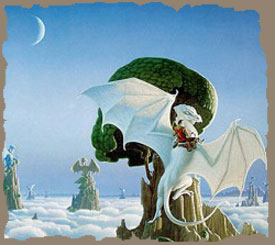
whitedragonThe action is vivid, the people and the dragons are clear and distinct as characters.  The social and political climate on Pern is clearly defined.  Each of the characters is fully formed, and the reader is completely immersed into their world. The way the dragons teleport, and their telepathic conversations with their riders makes for an ingenious twist in this seductive tale. And speaking of seductive, what I love the most about the entire series is the frank sensuality that never disappoints me.  Anne McCaffrey never drops into long graphic descriptions of the sex that is frequently part of her stories, and yet she manages to convey the deeply empathic and intensely sensual connection that the riders and their dragons share.

To the right here is the colorful book cover as was published in 1970 by Corgi.  I never liked this cover nearly so much as the Michael Whelan covers, though I did have several copies of this particular book.

This book changed my life as a reader of fantasy and science fiction.  I found myself incessantly combing the book stores for new stories by Anne McCaffrey, and eagerly read anything that even remotely promised to be as good as this book.  I read many great books in the process; some were just as groundbreaking, and some were not so good, but even after all these years, this series of books stands as the benchmark beside which I measure a truly great fantasy.

white dragon 2The Dragonriders of Pern series has captivated generations of fans. It was the first adult series of books my youngest daughter ever read once she left the Beverly Cleary books behind, having simply snuck them off my shelf (I wonder where she got that notion). Even though I have read the entire series every year since 1983, I find myself fully involved in the story.  Every year new books are to add to the series, and now if I were to sit down and begin reading the series it would take me two full weeks of nothing but reading to get through it, even as fast as I read.

5 Comments

Filed under Adventure, Battles, Books, Dragons, Fantasy, Humor, Literature, mythology, Publishing, Romance, Self Publishing, writer, writing

Comfort books, a three-course meal: 1st course, Memory, Sorrow, and Thorn

Dragonbone_ChairI’ve been reading a lot lately. I know, you’re surprised, right? Mostly I’ve been revisiting my old favorites. I have a group of what I call “comfort books.”  That is not to say these books are comfortable, because they’re quite the opposite: challenging, involving,  and at times a little horrifying. But they are books that I can go back to again and again and never be disappointed in either the writing or the tale. I always find some new thing, along with the themes and characters that enchanted me the first time I read them.

These are the books that inspired me to write, not because I thought I could write better, but because these authors were unable to keep up with my reading demand. So, in the lull between “real books” I began writing the stories I wanted to read. Today begins  the first course of this three-course meal. Two more will follow!

First up is Tad Williams’ epic masterpiece, Memory, Sorrow, and Thorn. This tale was so large he couldn’t fit it all into one book. Each book is quite large, and believe me, there is no fluff in any of them.

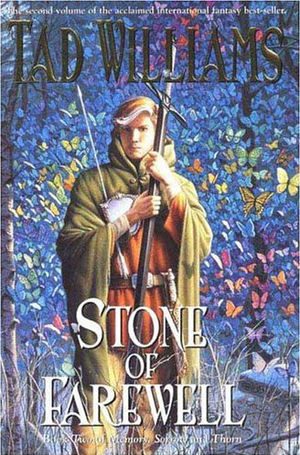
Stone_of_FarewellIn this gripping tale, Williams takes a traditional tale of a kitchen-boy turned hero, and turns it sideways, giving it depth and power. He puts his protagonist, who begins as Simon Mooncalf, though hell,forging strength of character and courage in a boy who always dreamed of adventure. Simon the dreamer is real, human; a man with flaws as well as strengths. As a boy he is afraid, but he is courageous when it counts. And as a warrior, Simon Snowlock is strong, and not always forgiving. He is a multilayered hero, as is the story in which he is set.

The quest for the swords of power, and the larger quest to save Osten Ard from the grip of Ineluki, the Storm King, are enclosed within the real dramas of human (and not-so-human) affairs.

What made this  series of books strike such a chord within me in the first place, was the way the world of Osten Ard reflects the history and folklore of our world. Several characters’ elements and experiences mirror the legends and mythology of Great Britain and other European cultures. I felt I knew these societies, and yet they were seen through a fractured mirror, similar, yet so different.

At the outset, the Erkynlanders are are the dominant society, and are ruled by King John Presbyter, also known as Prester John. He united them, but they’re still slightly clan-based and resemble the early medieval English of around the fifth to seventh centuries, with names that are  Saxon-ish and Biblical. It is a castle-based, feudal society right out of the dark ages. They have a religion that is similar to Christianity, as if they are a parallel reality.

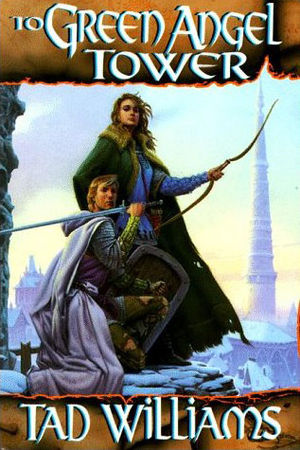
To_Green_Angel_TowerPrester John is the man who united Osten Ard, and carved their society, but he is dying. Like the great Plantagenet kings of our history, he has two strong sons who have a deep-rooted quarrel, and this sets up the conflict that evolves and encompasses an entire world.

After his death, the dark secrets of Prester John’s own checkered history drive the plot, sweeping Simon up in events which he has no control over.  His growth over the course of this series makes a gripping, compelling story, as does the parallel story of Miriamele, Prester John’s granddaughter.

Green_Angel_Tower_P1The other people of Osten Ard who have recognizable real-world parallels in their names and cultures, and who have strong, absorbing story-lines are:

Binabik—a Qanuc (based on Inuit, or Eskimo)

Jiriki—Sithi (distinct from a branch of their culture, the Norns, who are the root antagonists.  Based on Asian, Japanese) Ineluki, the Storm King is Norn.

Maegwin—Hernystiri (Celtic, perhaps Irish or Welsh)

Sir Camaris—Nabbanai: I just fell in love with this tragic man. These people felt reminiscent of Renaissance Italy, quite Roman

Tiamak—Wrannamen: Indigenous tribal  people who live close to the earth,

Sludig—Rimmersmen: Norse and early Germanic , quite Viking

Also included is another culture, the Thrithings: Horse nomads, reminiscent of the Mongols.

This is not a series you can read in a day or even a week. It is easy to get completely caught up in this tale, to the point that you forget to eat, and don’t hear when the dog wants out. I originally bought The Dragonbone Chair for the artwork on the cover. It was created by the brilliant fantasy artist, Michael Whelan. All the covers in this series are incomparable, and to my great joy, so was the story within.

TadWilliams200And the best part is: Tad is writing another trilogy based in Osten Ard, set thirty years later. Quote from his blogpost of April 3, 2014 : “I guess the cat has been debagged. Several of you have seen and shared the news that, yes, I am returning to Osten Ard for a series of books called (collectively) “The Last King of Osten Ard”. It will feature many of the same characters a generation later (and many new ones as well). The book titles will be (as of now):

The Witchwood Crown
Empire of Grass
The Navigator’s Children

This is assuming I don’t do my normal try-to-squeeze-two-books-into-the-last-volume trick.”

I don’t care how you do it Tad. I am just glad you are still young, and still writing amazing books in a kijillion settings. I am waiting patiently for the emergence of this series. Do your crazy thing, madman! Take your time and do it right! I will have it on pre-order the minute it becomes available, and when it arrives on my doorstep I will dance all the way to my cozy sofa, where I will sit and read until I am forced to set the book down in order to feed the hubby. Then I will continue reading until the next meal must be served.

2 Comments

Filed under Adventure, Battles, blogging, Books, Dragons, Fairies, Fantasy, Humor, Literature, Publishing, Romance, Self Publishing, writer, writing

Create a Hyperlinked Table of Contents

TOC 1One great convenience that an indie author can place in their Kindle, Nook or Smashwords e-book is a Hyperlinked Table of Contents. This is something I use all the time –it allows me to easily page back and forth.

The one I am using for this is an ancient file for the book that spawned Huw the Bard,  so ignore the page numbers. In those days I didn’t know that page numbers are like prisoners—they just weigh you down!  If you have seen my previous post on this subject you can quit now and I won’t hold it against you.  However, if you are in the middle of formatting your first manuscript, this post may be of use to you!

For print versions, I keep costs down by not wasting precious pages on something the reader won’t use. However, printed technical manuals, textbooks, and cookbooks must include a TOC. In print books, every page you can do without when publishing your novel in paper form will keep the final cost down and make your paperback more affordable for your prospective reader. Very few people will pay $18.99 for a book by an unknown author.

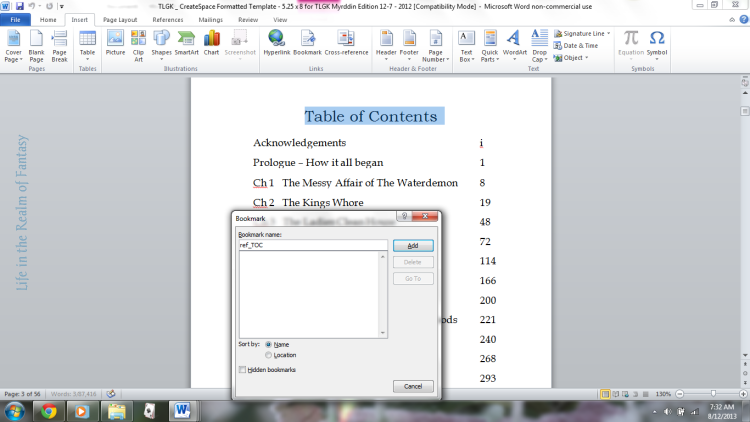
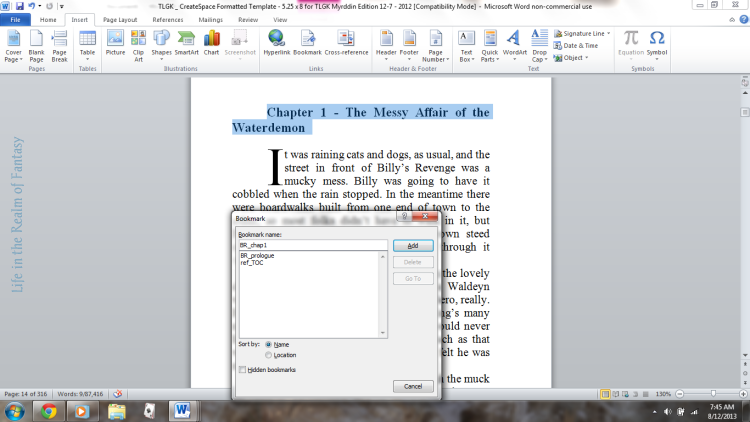
The first thing you want to do is create a bookmark.  First highlight the words  “Table of Contents” and then go to your ‘Insert’ tab.  Click on ‘Bookmark’in that ribbon. Type in the words ref_TOC

TOC 2

Then click “Add”.  In every ms it is important to name the Table of Contents bookmark exactly that, including the underscore, because that’s what Smashwords looks for and it is simply a good practice to have a uniform system for naming files.

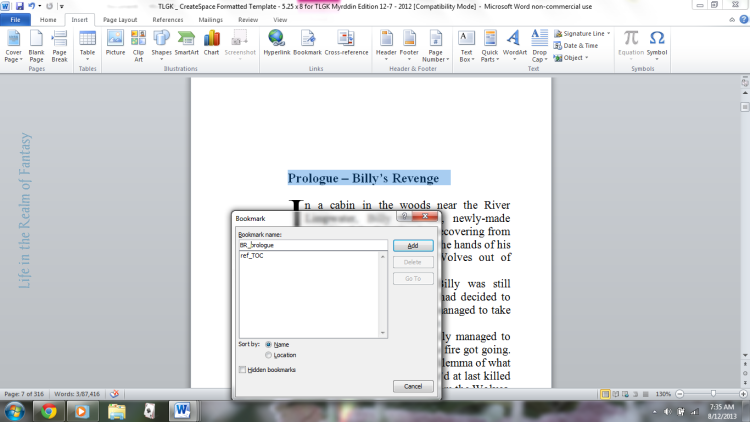
Now it’s time to bookmark  the prologue. Scroll down to your prologue and do it exactly the same way as you bookmarked the TOC, but for this ms let’s name it BR_prologue. You will name yours with your ms initials and the word prologue. If you have no prologue, skip this step.  See the picture below:

TOC 3

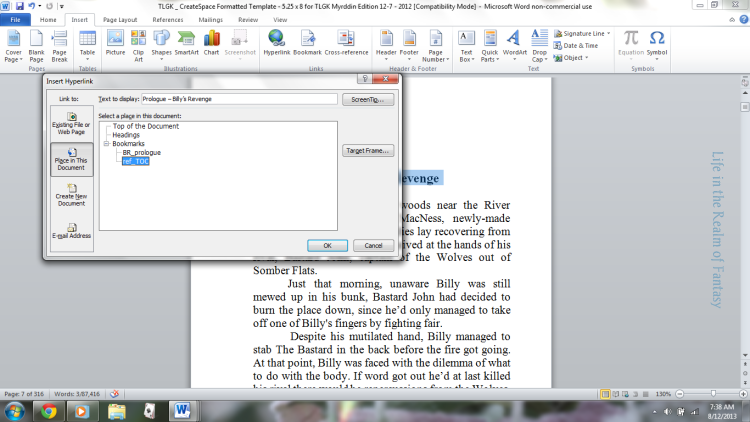
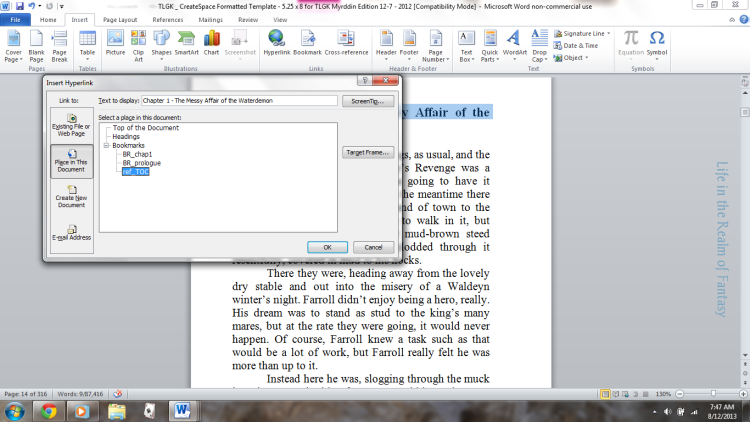
As long as you are there, with the chapter title highlighted, click “insert Hyperlink” on the ribbon. On the left, you want to ‘Link to:’  “Place in this Document”.  That will bring up your bookmarks. Select ‘ref_TOC’  and click OK.  This will turn your heading blue, which is called a ‘hyperlinky’. Press control and click on the link. it will take you back to the table of contents. Once you have used the hyperlinky it will turn purple. How cool is that! This is how that screen looks:

TOC 4

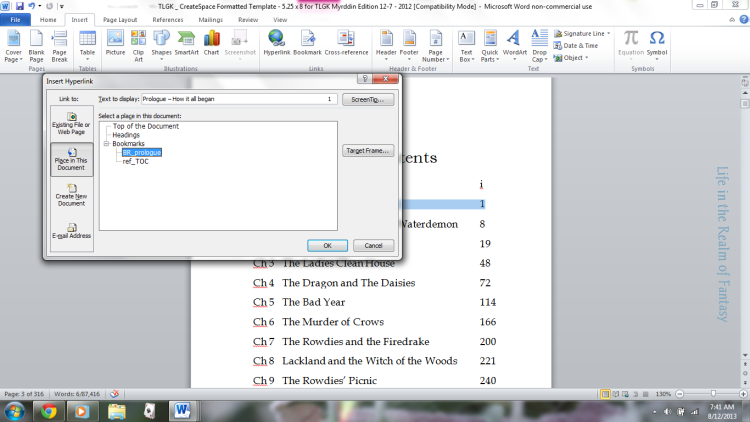
Now that you are back at the Table of Contents, highlight “Prologue and click “insert Hyperlink” on the ribbon. On the left, you want to ‘Link to:’  “Place in this Document”. That will bring up your bookmarks. Select ‘BR_prologue’  and click OK.  That will turn it blue. Press control and click on the link. it will take you back to the heading of your prologue.

Do this for the entire table of contents, always remembering to link your chapter heading back to “ref_TOC”, and test each link as you go.  Four more pictures just to help you remember:

TOC 5

—-

TOC 6

—-

TOC 7

—-

TOC 8

—-

I hope this helps you in formatting your eBook manuscript. All my books have Smart TOCs. I build the TOC into my final formatted manuscripts when I am assembling the final proofed chapters and inserting maps.

On a side note, a hyperlinked TOC is an incredibly useful tool to help you navigate within any long manuscript whether you intend to publish it or not. Although I had used bookmarks before in the course of my work, when I first began this journey I had no  idea that the fancy TOCs I admired so in other people’s e-books were such a simple thing to create.

But that’s the way it always goes–things that seem like they should be hard are often the most simple, while something that should be easy turns into a drama of epic proportions.

Here’s to less drama and more simplicity! Learning how to format an e-book isn’t really that hard, and the wonderful people at both Smashwords and at Amazon have a lot of information freely available to you. Remember, as an indie, you are your own publisher, and what you put out there has to be the best you can make it.

Making use of the free information that is out there on the internet can only help you in this regard!

24 Comments

Filed under Adventure, Battles, Books, Fantasy, Humor, Literature, Publishing, Self Publishing, writer, writing

Don Quixote

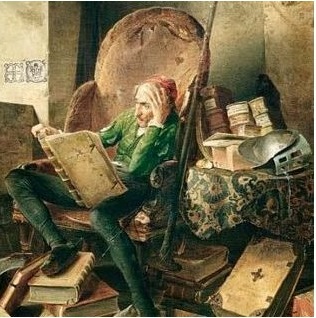
Don Quixote in the library Adolf Schrödter 1834

Don Quixote in the library by Adolf Schrödter 1834

Lately I have been on a Don Quixote binge. Published in two volumes, in 1605 and 1615, volume I, The Ingenious Gentleman Don Quixote of La Mancha, and volume II, The Ingenious Knight,  written by by Miguel de Cervantes Saavedrais considered the most influential work of literature from the Spanish Golden Age and the entire Spanish literary canon (a body of books traditionally accepted by scholars as the most important and influential in shaping culture.)

As a founding work of modern Western literature,and one of the earliest canonical novels, it regularly appears high on lists of the greatest works of fiction ever published, such as the Bokklubben World Library ( a series of classical books, mostly novels, published by the Norwegian Book Club since 2002) collection which cites Don Quixote as authors’ choice for the “best literary work ever written.” It is also said that the two parts of this masterpiece have been  translated into more languages than any book other than the Bible. 

Don Quixote had major influence on the literary community, as shown by direct references in Alexandre DumasThe Three Musketeers (1844) and Mark Twain’s Adventures of Huckleberry Finn (1884).

The Story:

Alonso Quixano, the protagonist of the novel (though he is not named until much later in the book), is a retired country gentleman nearing fifty years of age, living in La Mancha with his niece and housekeeper. Although he is mostly a rational man, his excessive reading of books of chivalry has produced a skewed view of reality and what we might consider dementia. In keeping with the theories of the time, not sleeping adequately–because he was reading–has caused his brain to dry. (I LOVE that!) As a result, he is easily given to anger and believes every word of these fictional books of chivalry to be true.

Don Quixote’s niece commits, what is to me, the most heinous crime–she and the Parrish curate burn his library, and lie to him, telling him it was the work of an evil magician. Criminal!!!

He decides to become a knight-errant in search of adventure. To these ends, he dons an old suit of armor, renames himself “Don Quixote”,  and renames his poor old horse “Rocinante.” Cervantes was a genius when he penned the horse–Rocinante is not only Don Quixote’s horse, but is a reflection of Don Quixote himself, ungraceful, past his prime, and in way over his head.

Don Quixote asks his neighbor, Sancho Panza, to be his squire, promising to make him governor of an island. Sancho agrees, and the pair sneak off in the early dawn. At this point their adventures begin, starting with Don Quixote’s attack on the windmills.

Miguel de Cervantes Saavedra created a wonderful, hilarious masterpiece when he penned Don Quixote. Even in today’s society the plot is relevant and and the characters leap off the pages. The extremes of the human condition are all laid out in glorious prose that has been beautifully translated to English in 2003 by Edith Grossman. The New York Times called Grossman’s translation a “major literary achievement.”

In the original version of Don Quixote there are basically two different types of Castilian Spanish: Old Castilian is spoken only by Don Quixote, while the rest of the roles speak a modern version of Spanish. The Old Castilian of Don Quixote is for comic relief – he copies the language spoken in the chivalric books that made him crazy; and many times, when he talks nobody is able to understand him because his language is too old. This comedic effect translates well to Modern English when the translator has Don Quixote use  Shakespearean English phrases.

I write fantasy, and I read widely. But to those purists who decry the work of genre fiction writers as being “created for the masses,” I would like to say this: it is quite clear that the modern perception of “fantasy” as having no literary merit is complete hogwash when you look at the books that make up the western cannon of great literature. ALL of them are fantasies of one sort or another, beginning with Don Quixote and going forward, and all of them were created for the enjoyment of the masses.
2 Comments

Filed under Adventure, Battles, Blogger, blogging, Books, Fantasy, Humor, knights, Literature, Publishing, Self Publishing, WordPress, writer, writing

Heart Search 3-Betrayal, Carlie Cullen

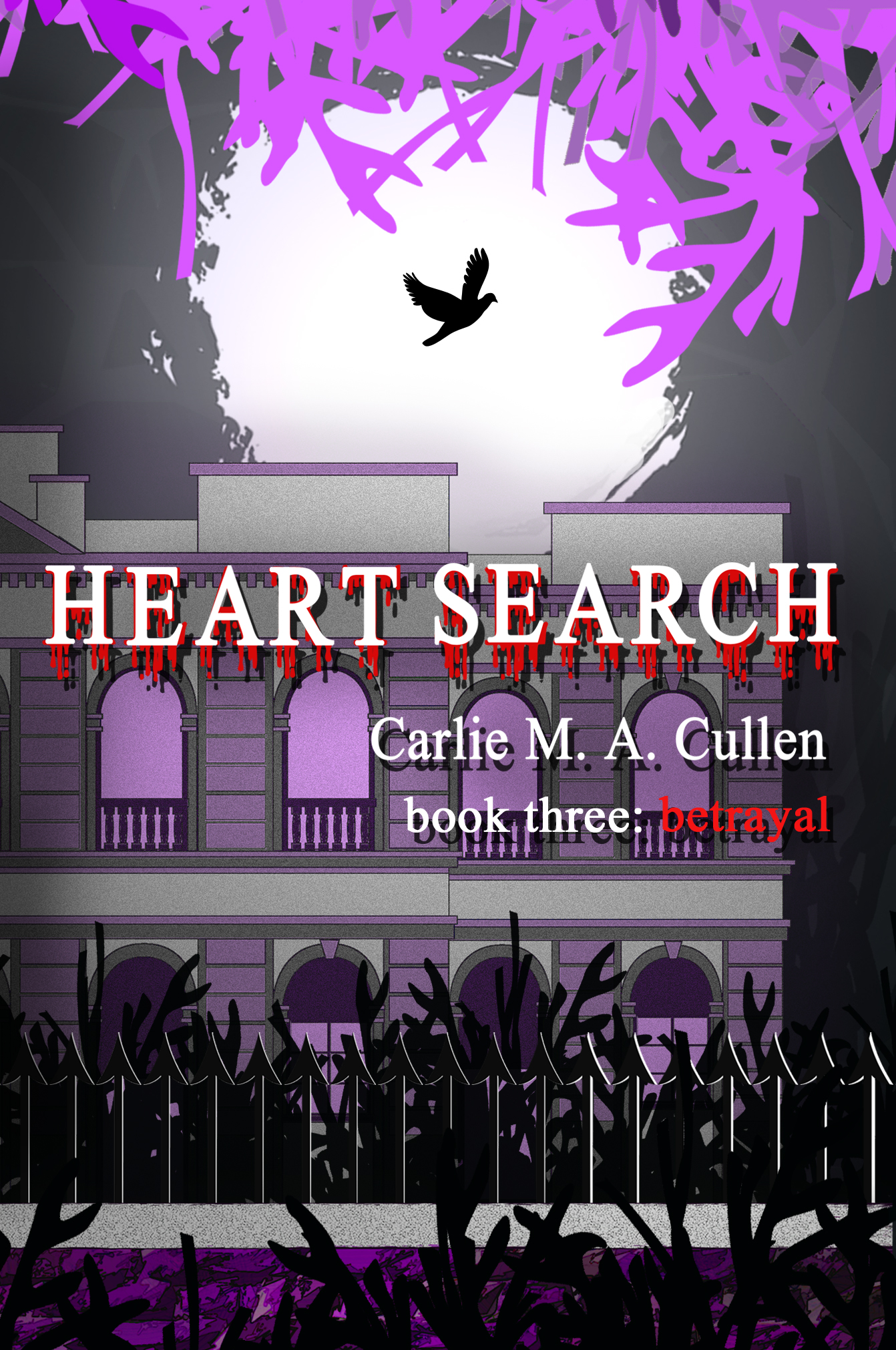
Betrayal front coverI read voraciously, in all genres and one of my not-so-secret vices is the occasional lust for a good paranormal fantasy.

One of my favorite authors in that genre is Carlie M.A. Cullen, who just happens have a new book coming out in her Heart Search Trilogy. Today she is revealing the cover for the final book in the series–and as with the first two covers, I  really love it. It totally speaks to the book’s dark theme. Her cover artist is Nicole Antonia Carro, who is one of the best indie graphic designers in the business, and an accomplished author in her own right.

I was fortunate enough to be one of the first to read this manuscript, and it is quite the finish to a bold trilogy.

What I find most intriguing about this series is that it revolves around people who have become vampires, and who no longer think the way humans do. But despite the real difference that having the kind of power they have makes in the way they view the world, they are family oriented and deeply committed to each other.

I’ve never considered writing about vampires and likely won’t, as my creativity doesn’t turn that way right now, but I confess I am curious about many things in regard to the conception of this series. To that end, I will be interviewing Carlie at a later date, and she has promised to answer most of my questions.

In the meantime here are the particulars for this book that is so beautifully covered:

Blurb for Heart Search: Betrayal

One bite started it all . . .

Joshua, Remy, and the twins are settled in their new life. However, life doesn’t always run smoothly. An argument between Becky and her twin causes unforeseen circumstances, an admission by Samir almost costs him his life, and the traitor provides critical information to Liam. But who is it?

As Jakki’s visions begin to focus on the turncoat’s activities, a member of the coven disappears, and others find themselves endangered.

And when Liam’s coven attacks, who will endure?

Fate continues to toy with mortals and immortals alike, and as more hearts descend into darkness, can they overcome the dangers they face and survive?

>>>—<<<

Carlie M.A. Cullen, Author

Photo of CarlieCarlie M A Cullen was born in London. She grew up in Hertfordshire where she first discovered her love of books and writing.

She has always written in some form or another, but started to write novels in 2011. Her first book was published by Myrddin Publishing in 2012. She writes in the Fantasy/Paranormal Romance genres for New Adult and Adult.

Carlie is also a principal editor for Eagle Eye Editors.

Carlie also holds the reins of a writing group called Writebulb. They have published four anthologies so far, two for adults and two for children, all of which raise money for a local hospice.

Carlie currently lives in Essex, UK with her daughter

>>>—<<<

You can find Carlie’s books at:

>>>—<<<

You can connect with Carlie via these social links:

>>>—<<<

Do take a look at her books–if you are a fan of paranormal romances, these books are a fun read, filled with characters that are larger-than-life, and adventures into the dark and mysterious world of the immortals who surround us.

Editors Note: I did make a typo in the Title of this post.  It is Heart Search : Betrayal, not Betrayed as was originally posted.

4 Comments

Filed under Battles, Blogger, blogging, Books, Fantasy, Humor, Literature, Self Publishing, Uncategorized, vampires, WordPress, writer, writing

Final Fantasy XV and Unremembered Things

225px-Ff12castI’m just going to come out and say it–I play console-based RPG video games, and I love it. I am still playing Final Fantasy XII, and finding new things to love about it.

I’m not a huge fan of first-person-shooter games, because I prefer swords and magic,  although I do like a good story-line with well-developed characters. That’s why I am a true Final Fantasy Fanatic–the stories are intricate and compelling, and the characters are multifaceted and strike a chord in the player’s psyche.

So I am quite intrigued by the upcoming release of Final Fantasy XV. Off the top, it looks a bit reminiscent of Final Fantasy VIII in that there are many elements of the first-person shooter in it, and the characters appear to be more real-world.

One of the things that interests me about this upcoming game is the dynamic weather system, with transient effects such as rain affecting things such as the characters’ clothing. In Final Fantasy XII, the  changing weather is an integral part of the game, and the type of creatures encountered changes when the weather does.

FF_XV_screenshotAnother element that intrigues me is Time: a day-and-night time system will affect the appearance of monsters on the world map. One in-game day equates to one hour real-time, and characters who do not sleep have decreased combat ability. Just like in the watershed RPG Final Fantasy VI, camping during the night is necessary for characters to maintain combat performance and level up. The cool thing here is that experience points earned in battle during the day are converted into new levels during camping periods. Camps form a safe haven during exploration, and cooking in them using ingredients from both towns and the wilds grants character bonuses. I expect that no time will be wasted by actually cooking, but I like the notion that the characters must adhere to real-world constraints, or become sickly.

The gamers’ website, VG24-7 released some screen-shots of the action on their  Monday, Jan . 26, 2015 blogpost , and I like the look of this thing. It will be released for PlayStation 4, which I currently do not own, and it may push me to get one.

5squallAs you can imagine, I normally go more for sword and sorcery games, but I adored Final Fantasy VIII, in which the main character, Squall Leonhart, used a gun-sword, and the characters were set in a more real-world type of society. You have to admit, that is an awesome concept for a weapon. Even I would never have thought that one up!

>>>—<<<

Since we are talking about new releases, and my other passion is books, Rachel Tsoumbakos has a new book that will be coming out soon, and it looks as awesome as her previous books. It’s called Unremembered Things, and I must admit that title has me quite intrigued. For an excerpt and a chance to enter the Rafflecopter Giveaway of some pretty awesome prizes, check out  Carlie M.A. Cullen‘s blog today! But wow! What a cover:

unremembered_things_cover_for_kindle

4 Comments

Filed under Adventure, Battles, Books, Fantasy, Games, Humor, Literature, Publishing, Self Publishing, writer, writing

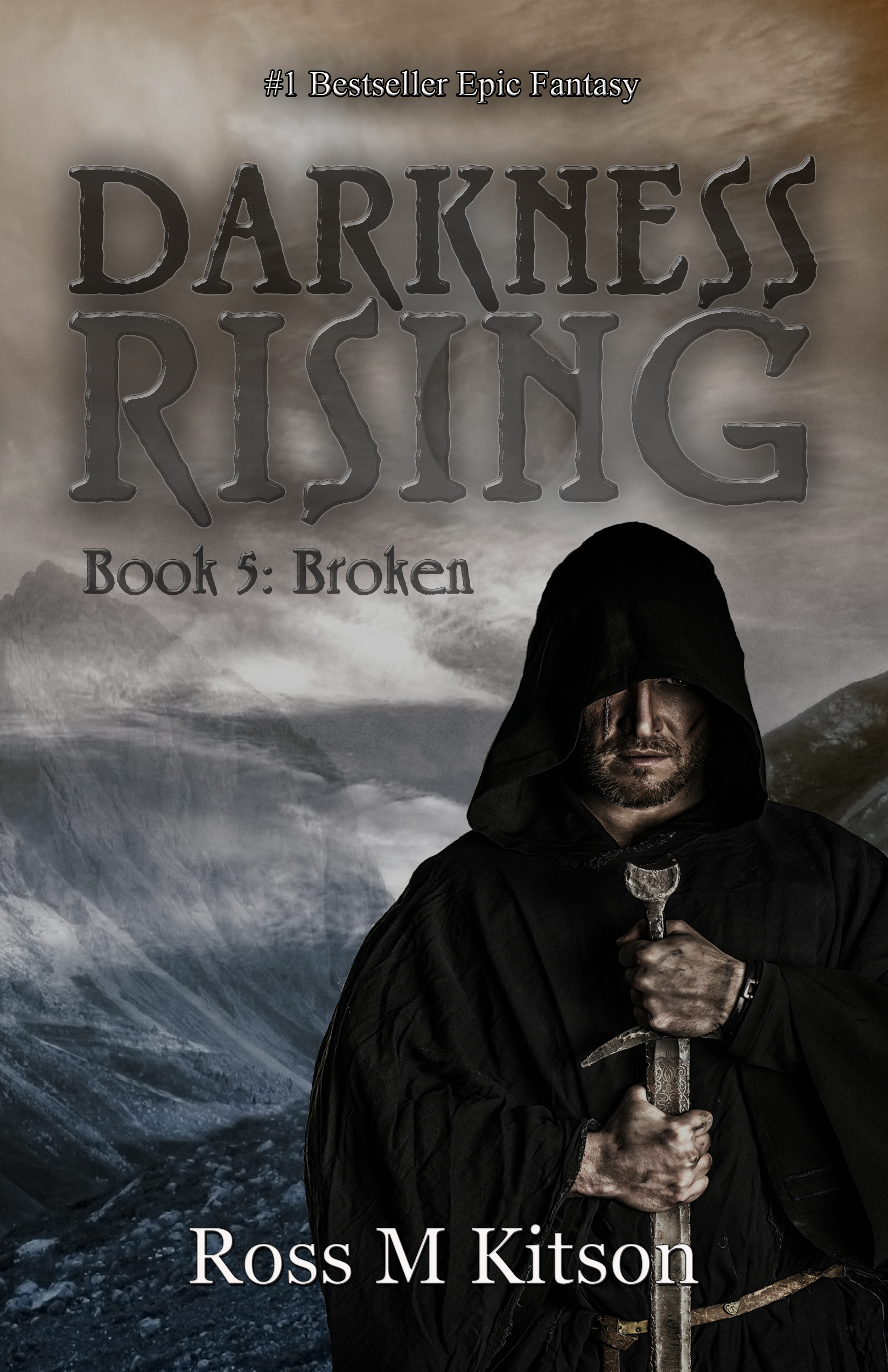
Cover Reveal Darkness Rising 5–Broken, by Ross M. Kitson

Darkness Rising 5 - BrokenOne the best aspects of my life is to be involved in the process as some of the finest fantasy authors out there make their work ready for publication. A longtime friend of mine is Ross M. Kitson, author of the Prism Series. Several years ago I had the privilege of working with him on Darkness Rising 3–Secrets, and I recently had the absolute joy of working with him on the soon-to-be-released Darkness Rising 5–Broken, the new cover of which has just been unveiled.

This new cover completely speaks to what is inside this book. And let me just say I LOVE that series of books–Kitson’s world is dark and dirty, and yet it teems with vibrant, colorful life. His characters leap off the page, and for those like me who love a really deep fantasy read, he creates an epic-fantasy that is truly original.

The Blurb:

‘Beneath the veneer, beneath the beauty, there is always the coldness of stone.’

Tragedy has torn apart Emelia and her companions, a terrible betrayal instigated by the Darkmaster, Vildor. A devastated Jem struggles to control the fearful power of the crystals, becoming distant from his closest friends. Hunor and Orla are tested by a secret from the past, a revelation that will change everything between them. In the Dead City, Emelia begins a search for her past, a journey that will plunge her deeper into the darkness of Vildor and his twisted schemes.

Desperate to seek aid in their battle against Vildor, the companions travel north to Belgo, capital of North Artoria. But everything is not what it seems in the palace, and danger lurks in every shadow, whether cast by friend or foe.
Separated and alone, can Emelia, Jem and Hunor hope to prevail? Or will the evils of the present and the past overcome them at last?

Darkness Rising 5 – Broken is the fifth in the epic fantasy series that reviewers are calling  ‘epic and spellbinding.’ It is a must read for fantasy fans the world over.

That’s pretty intriguing. But let me just say that Ross Kitson doesn’t rely on the great bastions of fantasy, Tolkien’s Lord of the Rings or Tad William’s Memory, Sorrow and Thorn for his inspiration, although he is a great fan of theirs. Kitson’s world is nothing like anything I’ve ever read, yet it is familiar enough that the reader becomes immersed. His characters are  uniquely individual, with great strengths and each with weaknesses that can and do create tension within the group.

If you are looking for a new, truly epic fantasy series, book one of the Prism Series is currently on sale for .99 for the ebook

Darkness Rising (Book One: Chained)


Ross M. KitsonAuthor Bio

Ross M Kitson is a published author in the fantasy genre, with an ongoing series (The Prism Series), a number of short stories on Quantum Muse web-zine and several stories in Steampunk and fantasy anthologies.

His debut series for Myrddin is due for release in October 2012, and is a sci-fi series set in modern-day York. It is written for ages 12+, although its combination of killer androids, steam-powered airships, kick-ass heroines and action packed chases will appeal to all ages.

Ross works as a doctor in the UK specializing in critical care and anaesthesia. He is happily married with three awesome children, who nagged him incessantly to write something that they could read. His love of speculative fiction and comics began at a young age and shows no signs of fading.

Follow Ross on Twitter:          @rossmkitson

Find Ross on Facebook:

http://www.facebook.com/TheNuKnights

http://www.facebook.com/ross.kitson.9

Websites:

For the infinity Bridge:         http://thenuknights.weebly.com/

Blogs:

http://mouseroar.blogspot.co.uk

http://rossmkitson.blogspot.co.uk

http://skulldustcircle.blogspot.co.uk

Comments Off on Cover Reveal Darkness Rising 5–Broken, by Ross M. Kitson

Filed under Adventure, Battles, Books, Fantasy, Humor, Literature, Publishing, Self Publishing, Uncategorized, writer, writing