
The new year has arrived, and we are getting back to work on our NaNoWriMo manuscripts. Over the next few months, we will generate many new files that pertain to this work. I meet many authors who don’t know how to properly save files. Unfortunately, they often lose or save over the top of important documents.
 In an instant, an entire manuscript is gone, wiping away hundreds of hours of work on their labor of love.
Hardware disasters or computer failures are unavoidable and always take us by surprise. That is why we must have a consistent system for saving and backing up the files in each project. If the computer dies, your files won’t be lost forever. You will have a backup.
Naming files consistently is a skill most people never had a reason to learn. They have no concept of how easily something that should have been simple can veer out of control.
Fortunately, I worked as a bookkeeper and office manager for many years. I was responsible for naming and saving my employers’ files in a consistent and manageable way.
I generate work in a variety of subgenres. Each project is intended for submission to different places, so I have a large number of files in my writing folder.
This is where a logical system of version control comes in handy.
“Version control” is a system that records changes to a file or set of files over time so that you can recall specific versions later. The worst thing that can happen to an author is accidentally saving an old file over the top of your new file or deleting the file entirely.
First, you must save regularly. I use a file hosting service called Dropbox. I have a lot of images on file, so I pay for an expanded version, but they do have a free version that offers you as much storage as a thumb drive. I like using a cloud-based file hosting service because it can’t be lost or misplaced. My files are always accessible even when working offline, so if the power goes out, I can access my work for as long as my computer’s battery holds out.
I work out of Dropbox, so when I save and close a document, my work is automatically saved and backed up to the cloud.
You can use any storage system for your backup—Google Drive, OneDrive, or a standard portable USB flash drive. But today, we are discussing how to name your files so they are consistent and easy to identify.
You can make many different configurations for your filing system. Your decision as to what works best for you should ultimately be based on what you’re filing, how many files you have and how many sub-categories (subfolders) your system needs to be broken down into.
Detailed below is the system I use for saving my writing files.
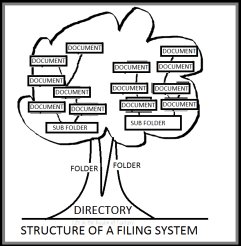
 A filing system is quite simple, rather like a tree from the ground up. For most documents, my system is a standard office-type system that consists of:
DIRECTORY> FOLDERS> SUB-FOLDERS> DOCUMENTS
My first draft of any manuscript will be given a Master File with a working title, a handle to carry it by, such as Ivan’s Story.
Within that master file, I have every version of the original manuscript and subfolders to contain the old versions and any research that pertains to that manuscript. One of my current works in progress is on version 18. It may never see publication.
Every version of that novel has some good things that I had to set aside for the sake of the story arc, but I never delete old files. You never know when you will need something you have already written. So, when I go back to work on that novel, I will have every version of it available in the HA_old_files subfolder because the file name of the current manuscript in the master file shows what version we are looking at: HA_version_18 (Heaven’s Altar version 18).
I make a separate subfolder for my work when it’s in the editing process. That subfolder contains two subfolders, one for the chapters the editor sends me in their raw state with all her comments, and one for the finished work with the completed revisions. My editor copies and saves each individual chapter to a separate new document, giving them a specific name, such as RoA_edit1_IL_01-10-22. (Ruins of Abeyon, Irene Luvaul edit 1, January 10, 2022.)
She does this because she edits one or two chapters a day and sends it to me that evening. I make the revisions she has suggested and save the chapter into a new file, such as RoA_chapter_1_cjj_revised_jan-11-22. (Ruins of Abeyon, chapter 1, Connie J. Jasperson, revised January 11, 2022.)
We don’t lose the order of chapters because we have a reliable system for naming files, and we ALWAYS use it.
One thing to be aware of is to save it as an actual Word DOCUMENT and not a Template. If you save it as a template, you will get a warning the document is read-only, and it won’t let you save it. That is quite frustrating but is simple to resolve. Just make sure you are clicking on .docx instead of template.
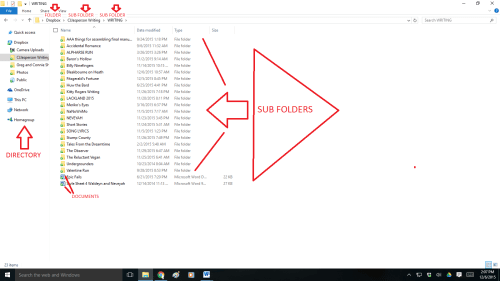
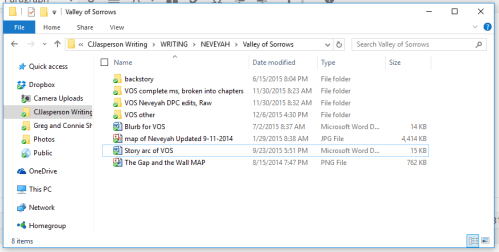
‘Libraries’ is the screen that opens when you click “Save As” and is where you go to manage your documents, music, pictures, and other files. You can browse your files the same way you would in a folder, or you can view your files arranged by properties like date, type, and author. These pictures, above and below, are of File Explorer libraries.
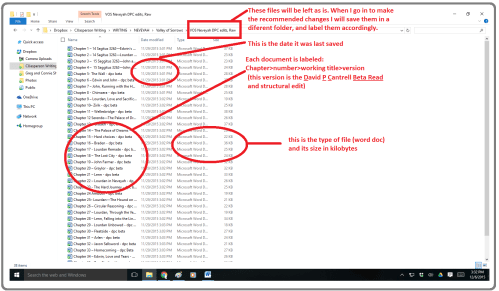 Name your files consistently and save each version in a separate folder within the master folder. Below is the master file for Valley of Sorrows.
 You may create many versions of your manuscript. YOU MUST manage your versions with meticulous care, or you will lose files, have to rewrite sections you just wrote, and which were brilliant, or any number of horrible, irritating situations.
These tragedies are not caused by your word processing program, so don’t blame your computer. They are caused either by you not knowing how to prevent them from happening or inattentiveness when saving files.
But now you know how to avoid the heartache of version control disasters.
 It’s a platform where you can advertise your books and discuss your interests, and most importantly, talk about what you are writing.
 Writing blogposts requires me to become a thinking author, as well as a pantser. I can write using the “stream-of-consciousness” method or from an outline of whatever interests me at the time. I do the research, and the post begins to write itself.
 I love to see what questions people might want to have answered. Sometimes topics crop up at my writing group that no one has an answer to, and then I get to do a little research—my favorite thing. Other times I find interesting questions in the writers’ forums that I frequent.
 If you feel that it’s too much work, consider how you update your other social media. Try posting a haiku, a tweet-length post, or an Instagram-style post once or twice a week. Any social media platform post can be converted to serve as a blog post.
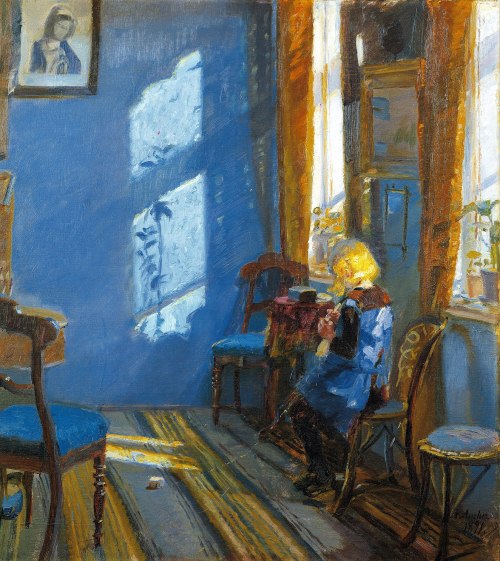 Artist: Anna Ancher:
 Today, we continue that discussion with four more genres, each with many subgenres. First up is westerns. This is a popular genre with several common tropes and can be tricky to write respectfully and find a publisher for.
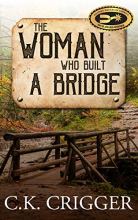 However, more and more, we are finding stories with female protagonists. An excellent example of this is the novel,
 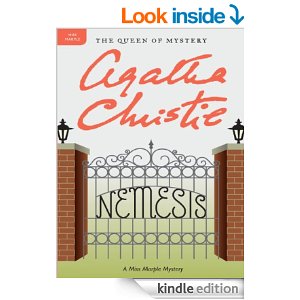 The Agatha Christie / Sherlock Holmes style of novel is the classic whodunnit. They feature a private detective with close ties to law enforcement but who is still an outsider. The detective sometimes has a sidekick who chronicles their cases. At times, the detectives butt heads with the police as resentment of the protagonist’s stepping on their turf crops up. This jealousy hinders the investigation. Clues are always inserted so that the reader doesn’t notice them until the denouement, and the sidekick never guesses right either.
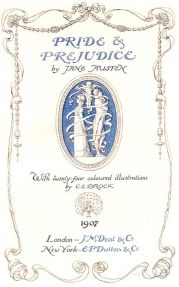 Definitions differ as to what constitutes a historical novel. On the one hand, the
  The rules of the category I am entering (Genre Fantasy/Sci-Fi) are clear: submissions must be of new, never-before-published novels. You can include only the first 25 pages of the manuscript, which will follow the synopsis.
 This is a task I would have found far more daunting without the support of my Tuesday morning writing group.
 Attend a few meetings as an observer to see if this group is a good fit for you.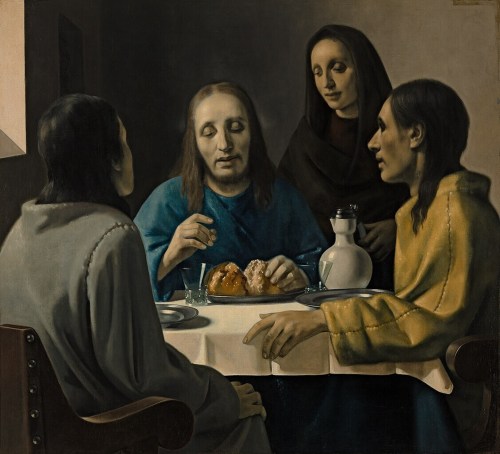
 Daily writing becomes easier once you make it a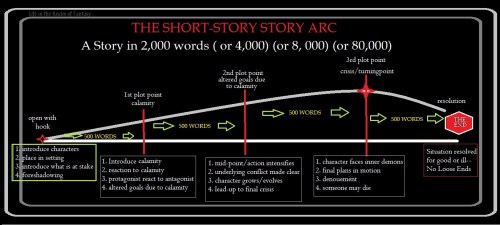
 A prompt is a word or visual image that kick starts the story in your head. If you need an idea, go to
 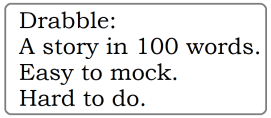 When you write to a strict word count limit, every word is precious and must be used to the greatest effect. By shaving away the unneeded info in the short story, the author has more room to expand on the story’s theme and how it supports the plot.
 To know that, you must know the genre of the work you are trying to sell. So, what exactly are genres? Publisher and author
  Mainstream (general) fiction—Mainstream fiction is a general term that publishers and booksellers use to describe works that may appeal to the broadest range of readers and have some likelihood of commercial success. Mainstream authors often blend genre fiction practices with techniques considered unique to literary fiction. It will be both plot- and character-driven and may have a style of narrative that is not as lean as modern genre fiction but is not too stylistic either. The novel’s prose will at times delve into a more literary vein than genre fiction. The story will be driven by the events and actions that force the characters to grow.
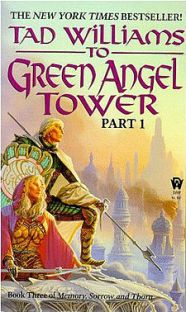 Fantasy is a fiction genre that commonly uses magic and other supernatural phenomena as a primary plot element, theme, or setting. Like sci-fi and literary fiction, fantasy has its share of snobs when it comes to defining the sub-genres. The tropes are:
 Literary fiction can be adventurous with the narrative. The style of the prose has prominence and may be experimental, requiring the reader to go over certain passages more than once. Stylistic writing, heavy use of allegory, the deep exploration of themes and ideas form the core of the piece.
 One step on the slippery slope of passive prose is the overuse of
 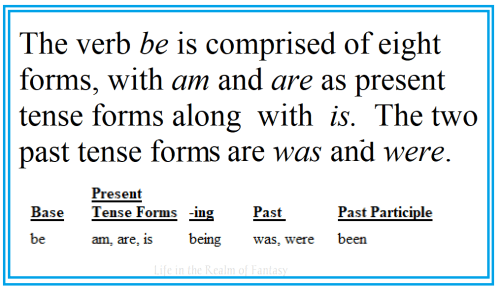 I think the habit of using one of the eight forms of the word be is more one of
 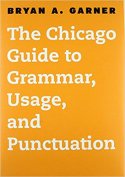 The whole thing looks quite complicated on the surface, but it doesn’t have to be. We must begin assembling our writers’ toolbox. One important tool is Bryan Garner’s
  I say cut back, not eliminate. Despite the misguided efforts of many gurus and Microsoft Word to erase all forms of ‘to be’ from the English language and replace it with ‘is,’ there are times when only a subjunctive will do the job.
 A critique group may tear your work apart, which stings a wounded ego. But we grow from this experience. We learn that opinions are subjective, and writers are thin-skinned creatures. We develop a thicker skin and muck on.


