Tag Archives: Tad Williams

Learning from the masters: @TadWilliams: contrast and texture #amwriting

tadwilliams-the-heart-of-what-was-lostOne of my favorite authors is Tad Williams, who wrote the watershed series, Memory, Sorrow, and Thorn. To my eternal joy, he has set another series of books in the world of Osten Ard. The first installment, The Heart of What Was Lost, is set to launch on January 3, 2017.

I have it on pre-order, as you might imagine—a Happy New Year present to me.

I became a confirmed fan of epic fantasy in 1988 when I first entered this world of Osten Ard and the books of Tad Williams. Each character was deserving of a novel, and the diverse races whose cultures were so clearly shown fascinated me. The arrogance some members of each race have with regard to their innate superiority struck me as illustrating a truth about the real world, something the Buddha once said: “We are what we think. All that we are arises with our thoughts. With our thoughts, we make the world.”  

Why did I become so captivated by Tad Williams’ work in the original series?

Contrast.

It is well-written, with harsh, beautiful prose, but more importantly an entire world is encapsulated in those pages. It is built from both good and evil, with all the many grey places between those two absolutes clearly defined. For each misery, some small glimmer of hope is introduced, offering a reason for the characters to keep struggling.

Tad Williams created the world of Osten Ard masterfully, exploring it through the diverse people’s thoughts and conversations. He used their impressions to show the setting, the history, and the core of the conflict. He started out slow, introducing Simon Mooncalf (Seoman) and the other players, showing a certain amount of background by Simon’s wandering path through the various places in his familiar environment.

Simon Mooncalf is an orphaned kitchen boy, serving in the immense castle, the Hayholt. He is in service to King John Presbyter, but he is a dreamer, unable to concentrate on the mundane tasks he’s been given. With the reputation of being an idiot, his fortunes change when he is apprenticed to the good Doctor Morgenes, the castle’s healer and wizard.
Green_Angel_Tower_P1Unfortunately, the king dies. Many dark, terrible events transpire, and ultimately Simon finds himself alone and on the run, carrying Dr. Morgenes’ true biography of the good King John.

The action then intensifies, as do Simon’s struggles. He finds friends who help him along the way, but they are also in danger. Love, friendship, and loyalty are tested when thrown against a lust for power, a desire for complete domination, and the endless desire of the ultimate mastermind behind the war, Ineluki, the immortal Storm King.

Tad Williams uses contrast. He opens in a place that feels comfortable and familiar, a place where food is plentiful and cats are lazy. He then slingshots the reader into a world of violence and darkness, hunger and fear. Simon is lost, alone, helpless, and terrified. Despite his being an orphan, he has only known comfort and now his life of deprivation is more than he can bear.

When I first began reading the series, it was clear to me that Tad Williams understood a fundamental truth of life: if you have never felt hunger, you can never understand what it is to have plenty. In the same context, if you have never known sorrow, how can you know joy? The contrasts of life are the flavors, the textures that give it meaning.

Since we are waxing philosophical, the Buddha also offered this morsel of wisdom for authors to consider, “There has to be evil so that good can prove its purity above it.”  

That contrast of good and evil is a fundamental truth for all writers of traditional fantasy fiction to consider when devising plots. It is one that J.R.R. Tolkien understood quite clearly. After all, what would have been the point of Frodo and Sam going to the depths of Mordor, suffering the hardships they endured if not to destroy the One Ring and negate the power of Sauron? And why would they do this, if Sauron was not the embodiment of evil?

In both the Lord of the Rings trilogy, and Memory, Sorrow, and Thorn, we have two of the most enduring works of modern fiction. Both feature an epic quest where through it all, we have joy and contentment sharply contrasted with deprivation and loss, drawing us in and inspiring the deepest emotions.

This use of contrast is why Tolkien’s work is the foundation upon which modern epic fantasy is built. It’s also why Tad William’s work changed the way people saw the genre of epic fantasy, turning it into hard fantasy. The works of these authors inspired a generation of authors: George R.R. Martin and  Patrick Rothfuss, to name just two of the more famous.
To_Green_Angel_Tower

In my own current work (as in all my work), good people have found themselves in bad situations. It’s my task to demonstrate the beauty of life through the drama, heartache, and violence.

Employing contrast gives texture to the fabric of a narrative. My intention is to use the emotions that are experienced when joys are contrasted against sorrows to draw the reader in. If I do this right, my readers will think about this story and these characters long after it has ended.

As a writer, if I can create a tale in which the reader experiences the full gamut of human emotion, I will have done my job.  The longer I am at this craft, the more I see that the rest of my life will be a training ground, teaching me new things, widening my writing horizons everyday. Reading and analyzing the works of the masters is a joy and a privilege, and is a necessary component of my education in the craft of writing.
1 Comment

Filed under writing

#amwriting: breaking the rules with style

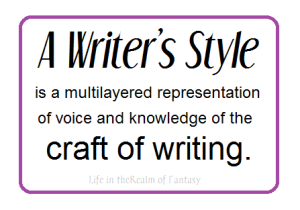
a writer's styleMuch of my blog time revolves around grammar and the mechanics of writing. As authors, it’s important to understand the rules of how the language in which we write works, no matter what that language is. Yet powerful writing often breaks those rules, and we are better for having read it.
So why am I always pressing you to buy and use the Chicago Manual of Style?

Authors must know the rules to break them with style.

Readers expect words to flow in a certain way. If you break a grammatical rule, know what you are breaking and  be consistent about it.

Ernest Hemingway, James Joyce, Alexander Chee, and George Saunders all have unique voices in their writing. Each of these writers has written highly acclaimed work. Their prose is magnificent. When you have fallen in love with one of these authors’ works, you will recognize their voice.
Ernest Hemingway used the word “and” in place of commas too freely.

Alexander Chee employs run-on sentences and dispenses with quotation marks.

James Joyce wrote hallucinogenic prose and at times dispensed with punctuation completely.

George Saunders writes as if he is speaking to you, and is, at times, choppy in his delivery.

But their voices work. They each break certain rules as set down by Strunk and White, but they produce brilliant prose that stands the test of time. Readers fall into the rhythm of their prose.

I will admit, I had to take a college class to be able to understand James Joyce’s work, and I did have to resort to the audio book for Alexander Chee’s work. It’s the hypercritical editor coming out in me, making it difficult for me to set that part of my awareness aside. It’s my job to notice those things.

I can hear you now: these are literary authors, and you are writing genre fantasy fiction or sci-fi. Shall I toss out a few more names?

Tad Williams mixes his styles. His Bobby Dollar series is Paranormal Film Noir: dark, choppy, and reminiscent of Chandler’s Philip Marlowe stories. In this series, he seems to be somewhat influenced by the style of crime authors, such as Raymond Chandler or Dashiell Hammett. It is a quick read and is commercial in that it is for casual readers.

Raymond Chandler was the creator of Philip Marlowe, the original hard-boiled, disillusioned, copper-turned-private-eye. His people take center stage, rather than the violence that characterizes so many detective novels of his era.

In his article, The Chandler Style, Martin Edwards writes:  Devising puzzles was always less important to him than style. He said, ‘I don’t really seem to take the mystery element in the detective story as seriously should,’ and joked about solving plot problems by having a man come to the door with a gun  Style mattered much more: ‘I had learn American just like a foreign language. To learn it I had to study and analyse it. As a result, when I use slang . . . I do it deliberately.’  And as he told one magazine editor whose proof-reader presumed to tidy up the Chandler grammar, ‘When I split an infinitive, God damn it, I split it so it will stay split.’

Chandler understood how grammar worked. He knew what he was doing and did it deliberately. He was able to convey (to those who didn’t appreciate his style) why he broke those rules and was secure enough in his choice to continue writing in his own voice.

But Chandler also had to deal with the sort of sniping we all must deal with in our writing groups. Wikipedia says: The high regard in which Chandler is generally held today is in contrast to the critical sniping that stung the author during his lifetime. In a March 1942 letter to Blanche Knopf, published in Selected Letters of Raymond Chandler, he wrote, “The thing that rather gets me down is that when I write something that is tough and fast and full of mayhem and murder, I get panned for being tough and fast and full of mayhem and murder, and then when I try to tone down a bit and develop the mental and emotional side of a situation, I get panned for leaving out what I was panned for putting in the first time.”

Yet, although he writes Bobby Dollar in a Chandler-esque style,  Tad Williams’s Memory Sorrow and Thorn Trilogy is true epic fantasy, with lush, poetic prose, multiple story-lines, and dark themes. It is written for serious fantasy readers who want nothing less than the big novel. The story starts slow, but the powerful writing has generated millions of fans who are thrilled to know he has set more work in that world.

Beginning slow, going off on side quests, writing poetic prose, and gradually working up to an epic ending is highly frowned upon in today’s writing groups, but Tad broke that rule and believe me, it works.

Roger Zelazny wrote one of the most famous fantasy series of all time, the Chronicles of Amber, and was famous for his crisp, minimalistic dialogue, and he was also heavily influenced by the style of wisecracking hard-boiled crime authors like Chandler.

Most readers are not editors. They will either love or hate your work based on your voice, but they won’t know why. Voice is how you break the rules, but you must understand what you are doing, and do it deliberately. Craft your work so it says what you want, in the way you want it said.

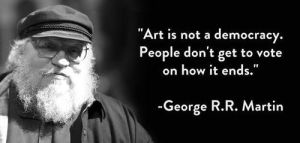
GRRM Meme 3If your editor asks you to change something you did deliberately, you are the author. Explain why you want that particular grammatical no-no to stand, and your editor will most likely understand. If you know the rule you are breaking, you will be better able to explain why you are doing so.

However, if I am your editor, you must be prepared to break that rule consistently. Readers do notice inconsistencies.

5 Comments

Filed under writing

Elements of the story: Crafting magic systems

Green_Angel_Tower_P1I am thrilled that Tad Williams is writing another series of books set in Osten Ard. Tad is an author who  absolutely understands the craft of writing fantasy. He knows what makes epic fantasy EPIC. There is just the slightest hint of the rebellious indie in his work, which makes it a little wild. But more than that, Tad understand how important it is to make the limitations and roadblocks forced on the protagonists power the narrative.

If you love epic fantasy and have not read his powerful trilogy, Memory, Sorrow, and Thorn–you should.

In Tad’s work, magic systems feel natural, organic and are not all powerful. I love epic fantasy books where the magic systems have been as well thought out as the political systems, and the characters are limited in what they can do with them.

I despise books where the hero/heroine can do anything, and be as awesome as she/he needs to be, all because he/she has a special power. No need to worry about planning that mission, because our hero can read minds and predict the future–he knows exactly how to thwart Evil Badguy. Several boring scenes later, an opportunity for something interesting turns up, but no! The author has blessed his favorite supercharacter with (cue the fanfare) amazing magic powers that have no explanation, and apparently no limits.

If you are writing fantasy, consider this–Infinite abilities instills infinite boredom in me as a reader.

Let’s talk about magic. Who has magic? What kind of magic–healing or offensive or both? What are the rules for using that magic and why do those rules exist? Magic is an intriguing tool in fantasy, but it should only be used if certain conditions have been met:

  1. if the number of people who can use it is limited
  2. if the ways in which it can be used are limited
  3. if not every mage can use every kind of magic
  4. if there are strict, inviolable rules regarding what each magic can do and the conditions under which it will work.
  5. if there are some conditions under which the magic will not work
  6. if the learning curve is steep and sometimes lethal

Even if it does not come into the story, you should decide who is in charge of teaching the magic, how that wisdom is dispensed, and who will be allowed to gain that knowledge.

  1. is the prospective mage born with the ability to use magic or
  2. is it spell-based, and any reasonably intelligent person can learn it if they can find a teacher?

Mists_of_Avalon-1st_edMagic and the ability to wield it usually denotes power. That means the enemy must be their equal or perhaps their better. So if they are not from the same school, you now have two systems to design. You must create the ‘rules of magic.’  Take the time to write them out, and don’t break the laws, without having a damned good explanation for why that particular breaking of the rules is possible.

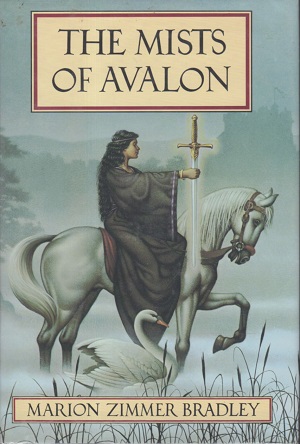
Limits make for better, more creative characters. In the Mists of Avalon, Marion Zimmer Bradley made the magic a natural outcome of religion, something only a few characters had access to, and they paid a great price each time they used it.

Lets pretend we have a mage, Gerald—we’ll make him a lowly journeyman mage, just allowed out of magic school on his own. Events beyond his control occur, and only he can rid the world of Stinky Sam. Sam is a very powerful, very naughty wizard, who will crush young, untried Gerald with no effort whatsoever.

Let’s say Gerald has a few skills at the beginning: he can draw water out of the air for drinking, and maybe he can use the elements of fire and lightning as weapons. Can he also use magic to heal people?  Can he heal himself?  What are the rules governing these abilities and how do these rules affect the progress of the story?  When it comes to magic, limitations open up many possibilities for plot development.

For this to be a good story, our bad guy, Stinky Sam, must be a master in whatever area Gerald has chosen–and he should have a few skills and abilities Gerald might never learn.

the night circus by erin morgensternThis means Gerald must work hard to overcome the obstacles set in his path by Stinky Sam.  With the successful completion of difficult tasks, and overcoming great hardships, Gerald will learn what he needs to know about his magic/gifts, and acquire the ability to counter Stinky Sam’s best efforts in the final showdown, although it will be difficult.

In great fantasy, evil is very strong, and has great magic–but there are rules.  The evil one might be a bully and he may have some awesome skills, but he’s not omnipotent, or there would be no story. All magic systems have limits, which means he has a weakness. With the discovery of the antagonist’s limitations, your character has the opportunity to grow and develop to his fullest potential in process of finding and exploiting it.

2 Comments

Filed under Fantasy, Publishing, writer, writing

Great Cover Ups

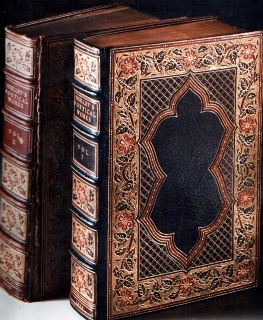
Old Restored booksBook covers. Remember when they were tooled, engraved leather, hand-made by monks? Yeah, me neither, but I do love good, well designed book covers.

We indies stress over them, and I suppose the Big 5 publishers do too, to a certain extent. But what, besides money and great designers who will make them for us, are elements that make a great book cover?

First up, in my opinion, a catchy cover has mystique. It expresses the central theme of the book, but it’s like a blurb–it can only capture one moment in time, so you have to choose what you will go for: mood, mystery, or great art.

Occam’s Razor (also known as Ockham’s Razor) comes into play here. According to iUniverse’s article on Cover Design Essentials, “…the essential theory is that unnecessary elements will decrease the overall efficiency and aesthetic appeal of a design. It can be a good indicator of why one design may succeed and another one will not. A good writer will spend hour after hour editing and re-editing their book, cutting words, paragraphs and so forth until it is “clean.” The cover designer’s method is not much different, other than it is a visual process rather than a written one.” 

In my own limited experience this is so true.  

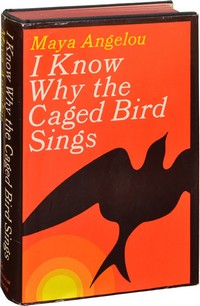
Caged_bird2Book covers have really evolved since my childhood. They used to be quite simple, with the art kept to a minimum. In the 1950’s and 60’s, book covers were stark, modern–and in my opinion, boring, such as Maya Angelou’s I Know Why the Caged Bird Sings.

My great problem is, I have always known what catches my eye, but not how to achieve it. So what are the simple, affordable elements of a good, catchy cover?

Again, iUniverse says (and I quote) good covers:

  1. Fall within the norms for your genre but visually stand out among other books.
  2. Appeal to readers and convince them to take a closer look at your book with a strong visual presence.
  3. Reflect the content of your book and expose readers to your writing style.
  4. Convince a potential reader to invest in a literary journey with your story.

Well, that is a hell of a lot to pack into a cover. And it’s hard to do! I am struggling with this aspect of being an indie. I am an artist, but until 2010 my work has been mostly in pastels and pencil. But I love Photoshop, and have been spending a lot of time designing covers and and learning how to make the graphics and the title a part of the art that captures the eye, but does not detract from the cover art.

I have been examining a lot of wonderful book covers, trying to define what it was about them that I liked so that my next book cover will be more true to what I want it to be. Being an old dog learning a new trick, I must learn from the masters.

So, here are only a few of my all-time favorite book covers, in no particular order:

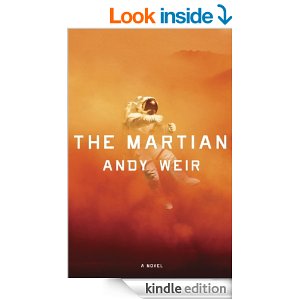
Simple and to the point: The Martian, by Andy Weir tells us everything we need to know–this is going to be a hell of an adventure.

The MArtian Andy Weir

♦♦♦♦

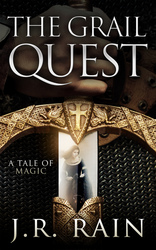
Grail Quest, by J.R. Rain, cover artist not credited–intriguing, and made me want to look inside.

Grail, JR Rain 2

♦♦♦♦

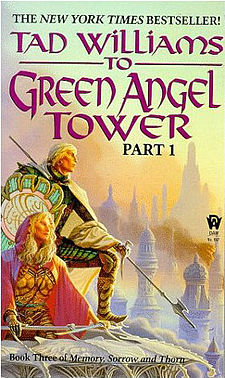
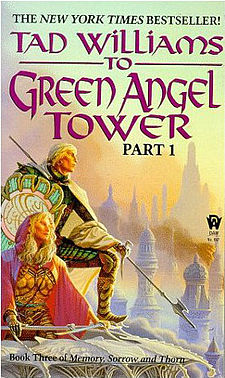
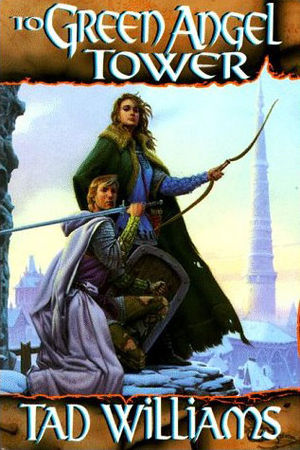
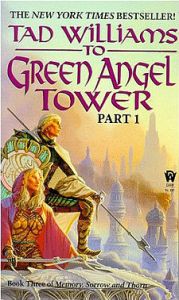
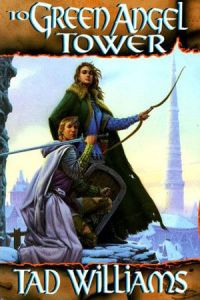
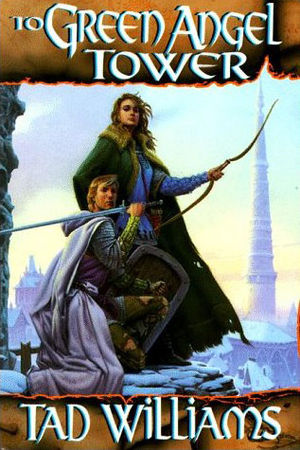
To Green Angel Tower, Tad Williams, as painted by the brilliant Michael Whelan–representing the mood, characters, and setting of the book, and visually stunning. I can’t replicate this sort of beauty, but I can admire it, nonetheless.

Green_Angel_Tower_P1

♦♦♦♦

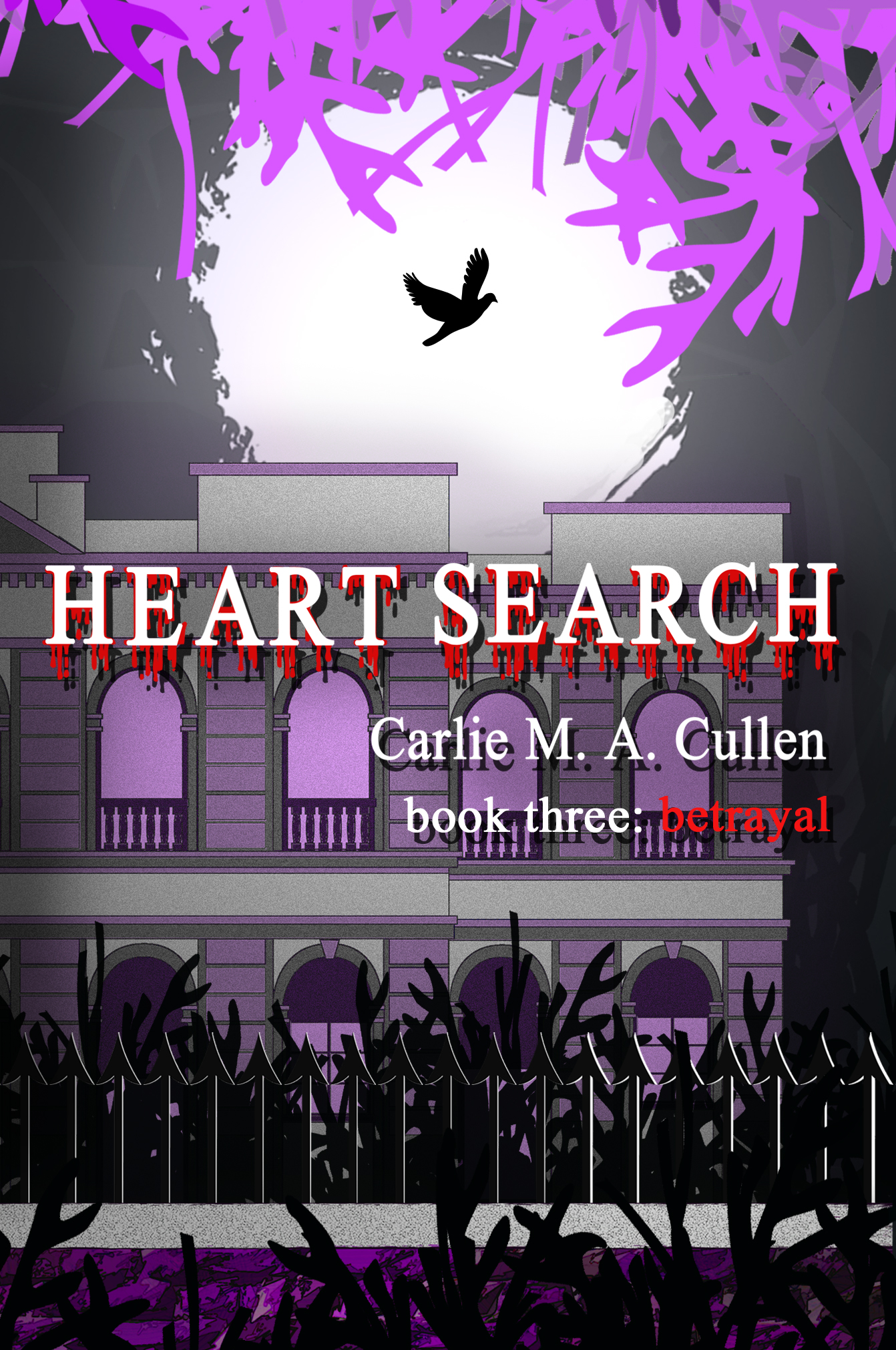
Heart Search book three: Betrayed, Carlie M.A. Cullen, cover by Nicole Antonia Carro. Completely speaks to what is inside the book–dark, mysterious, and a bit vampiric.

Betrayal front cover

♦♦♦♦

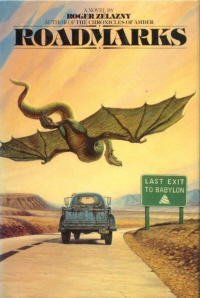
Roadmarks, Roger Zelazny, cover by the late Darrell K. Sweet. Simple, well-placed elements, promising a real roller-coaster ride inside.

Roadmarks_first

♦♦♦♦

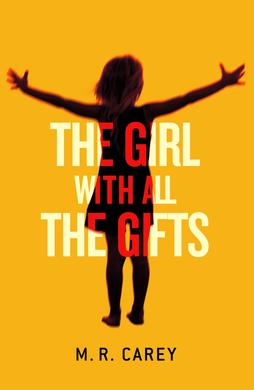
The Girl With All the Gifts, M.R. Carey–almost retro 1970s, yet intriguing. 

The_Girl_with_All_the_Gifts m.r. carey

♦♦♦♦

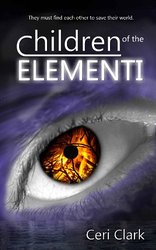
Children of the Elementi, Ceri Clark–this cover is a real winner, as much for the graphics as for the stunning yet simple art.

children of the  elementi

♦♦♦♦

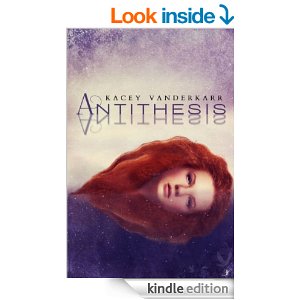
Antithesis, Kacey Vanderkarr — cover art by Najla Qamber.

Antithesis by Kacey Vanderkar

♦♦♦♦

For me, books that portray the features of the characters on the cover are a bit dicey. They never look the way I, as the reader, think they should. So, usually I find myself gravitating to the symbolic aspects of the cover and ignoring the artist’s conception of the characters. I want mystique, intrigue…the hint of danger and adventure. A book cover must flip the switch on my curiosity, make me wonder what is inside…and that particular trigger is subjective.

Each reader is lured by something different, which is what makes this aspect of indie publishing so difficult. However, I am beginning to understand what it is that I am looking for when I am drawn to a cover, so…I’ve been busy learning graphic design. I will be doing a cover reveal for my forthcoming book, Mountains of the Moon, a book based in the World of Neveyah, the same world as the as Tower of Bones series, and which is set to be released July 15, 2015.

My son, Dan, who is a graphic designer has really given me some pointers on this particular cover. I have been to “YouTube University,” and learned how to make vectors for this cover (I made two!) and I have learned several other unique little tricks of Photoshop. I have the layout finalized, and the graphics, and will be revealing it at the end of June.

6 Comments

Filed under Books, Humor, Literature, Publishing, writing

Elements of the Story: the story arc

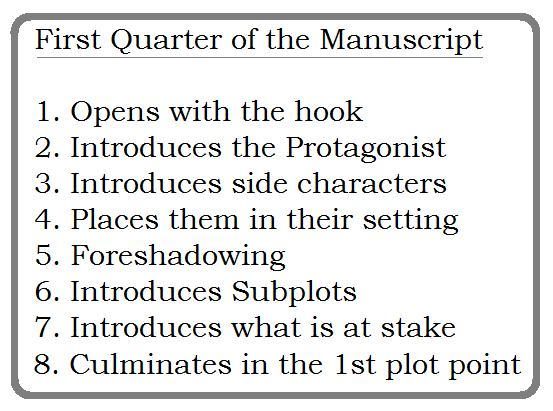
Elements of the Story 1st Quarter of the MSWhen I first began writing, I wasn’t concerned with the nuts-and-bolts aspects of a tale–I wrote stories to read to my children, and I wrote stories I wanted to read. The stories lived in my mind, and I got a great deal of pleasure from writing them. It never occurred to me to submit them to a publisher, and I wouldn’t have known how to do that anyway.

It wasn’t until my youngest child was in high-school that I began thinking about writing as a vocation, and began looking for places to submit my work. So my evolution as a writer was: I began by writing songs in high-school and also writing poetry, graduated to writing fairytales for my kids and short stories for myself, and finally began my serious attempt at a novel in 1996.

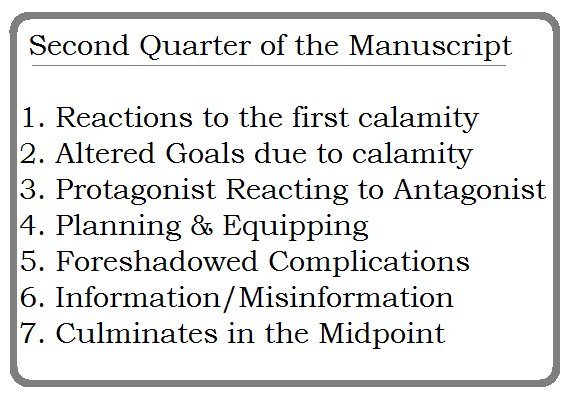
2nd quarter of the manuscriptI began writing for my own pleasure, and had no idea of how to plot a novel. Since that first attempt at a novel, I have completed six novels, and am working on 3 more at this time. Each book has been an improvement over the previous one. Through working with good editors and educating myself,  I feel like I finally understand how  a good novel is constructed.

In my early books, I didn’t understand the way a good story worked. I knew one when I read one, but I didn’t really understand what made that story immersive and memorable.

I had a grasp of how to create characters, and I had a good idea for the basic plot,  but I was weak in the area of structuring the novel. Once I realized that weakness, I set out to resolve it.

For the last two years, that has been the area I’ve worked hardest on putting into practice, and for those who have beta-read my yet to be published work, that change in my understanding of how to write a novel is clear.

Now, I have an instinctive understanding that the evolution of the story can be graphed out in an arc–the Story Arc. I had heard of this concept, and in writing groups some authors will talk about it as if they understand it, but when you read their work it’s clear they don’t.

It wasn’t until Scott Driscoll, author of Better You Go Home gave a seminar on it last year that the pieces fell into place for me.

The Story Arc copy

Some books are character-driven, others are event-driven. ALL of them follow an arc.  For my personal reading pleasure, I prefer Literary Fantasy, which has a character-driven plot. Events happen, often in a fantasy setting, but the growth of the characters is the central theme, and the events are just the means to enable that growth.

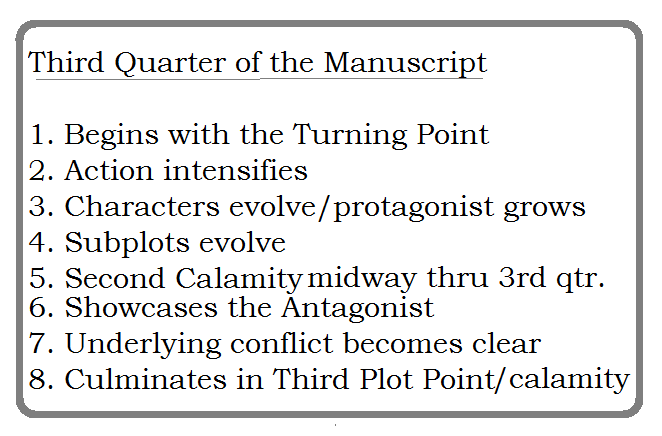
3rd qtr of manuscriptI write literary fantasy, with some emphasis on the fantasy. My own books, as in Huw the Bard, tend to be more character-driven than action oriented, as the Hero’s Journey is what intrigues me, but large events occur that cause personal growth. Whether your books are character- or event-driven, there must be an arc to the story.

We have talked about the way the manuscript can be divided into quarters.  Let’s consider the midpoint. The midpoint of the story arc begins the second half of the book. The first calamities have occurred and up to this point, the characters have been reacting to the antagonist’s moves.

The midpoint of the story arc is the Turning-Point, the place where there is no turning back. Consider J.R.R.Tolkien’s The Hobbit: At the midpoint, Bilbo is committed to seeing the Dwarves regain their home, and Smaug is routed, but at great cost. Now, he can see only disaster ahead of them, if Thorin continues down the moral path he has chosen.  Bilbo has been changing, but now he shows his true courage, by hiding the Arkenstone. Then he takes matters into his own hands in order to head off the impending war.  Bilbo tries to ransom the Arkenstone , but Thorin refuses to see reason. He banishes Bilbo, and battle is inevitable.

This arc is the same in every good, well-plotted novel: in the first half of the book everything had gone to hell, emotions were high, and the situation was sometimes chaotic, but the protagonist thought he had a grip on it. The Midpoint is the place where the already-high emotions really intensify, and the action does too. From this point on, the forces driving the plot are a train on a downhill run, picking up speed, and there is no stopping it or turning back now. The characters continue to be put to the test, and the subplots kick into gear.

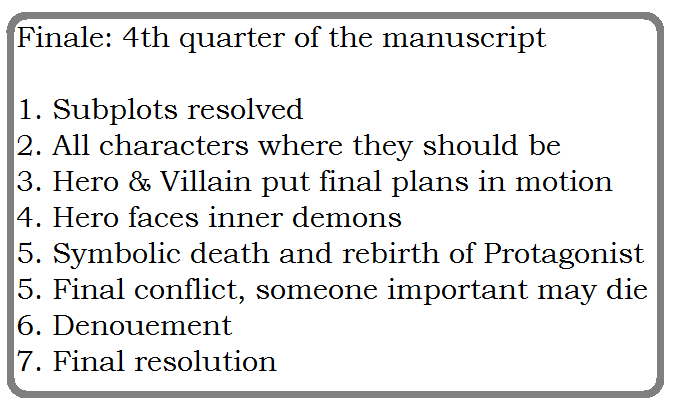
4th qtr of MSThe second half is where the villain shines–the evil one is on a roll and it’s his ballgame. The truth underlying the conflict now emerges, and it culminates in the third calamity, the third plot point. This is also where the villain’s weaknesses begin to emerge, and the hero must somehow exploit them.

The third quarter of the book, from the midpoint to the third plot point is critical. These events tear the hero down, break him emotionally and physically so that in the final fourth of the book he can be rebuilt, stronger, and ready to face the villain on equal terms.

The third quarter of the book frequently sets the hero on the path to enlightenment, but first he must undergo a symbolic death and rebirth.

If you want to read classic fantasy where this type of story arc is really clear and yet the stories are strongly character driven, you should read:

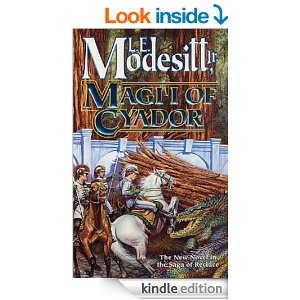
magii of cyador


Magi’i of Cyador and Scion of Cyador by L. E. Modessit Jr. (2 books)


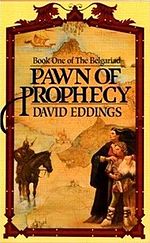
Pawn_of_Prophecy_cover


The Belgariad by David Eddings (5 book series)


Green_Angel_Tower_P1


Memory, Sorrow, and Thorn by Tad Williams (4 paperbacks, 3 hard bound or ebooks)

6 Comments

Filed under Books, Fantasy, Literature, Publishing, Self Publishing, writer, writing

Elements of a story: Identifying your protagonist

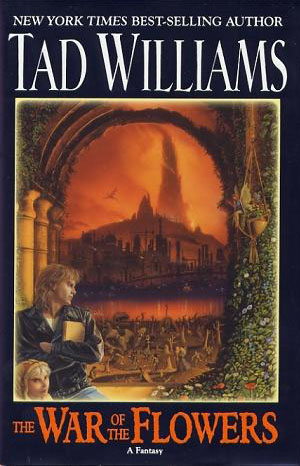
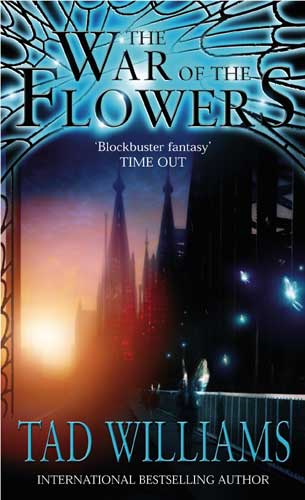
War_of_the_FlowersGreat plots drive great stories, but the best stories start with a character that really moved me. The trouble is, when we first begin to write a story, one character leads to another and soon, each character is vying to tell your their own story. It’s sort of like a family gathering, where they all talk at once, and you love them all.

This makes writing a true stand-alone book difficult. Tad Williams managed to do just that in 2003 with The War of the Flowers.  Theo Vilmos is a thirty-year-old lead singer in a marginally successful rock band. Fearing he is past his prime, he seeks refuge in a remote cabin in the woods. There, he reads a memoir written by a (perhaps) dead relative. This relative claimed he had visited the magical world of Faerie. A series of strange events occurs and before Theo knows it, he too is drawn into a place that is both strange and yet familiar to him, revealing the truth about many things that had always puzzled him.

war_flowersWilliams had another great character to draw on in his little fairy, Applecore, but he kept it contained in one wonderful novel detailing Theo Vilmos’ adventures rather than going too far afield and having to serialize it. This is a model we lesser-known fantasy authors might want to take a closer look at and somehow revive: the stand-alone novel.

We might have a great story in our head, and we may have an awesome cast of characters dying to leap onto the page, but until we know who the hero is, we have no story. From the first page to the last, Tad Williams knew who his hero was in The War of the Flowers, and it’s clear that he never doubted it was Theo Vilmos.

Sometimes  identifying just whose emotional and physical journey you will be following is easier said than done. When faced with a pantheon of great characters, ask yourself these questions (listed here in no particular order):

  • Who among these people has the most to lose?
  • Which character do you find the most interesting?
  • Who’s personal story inspired this tale in the first place?
  • Who will be best suited to taking full advantage of all this plot’s possibilities?

Dragonbone_ChairFrom my point of view, one of the best fantasy series of all time is Tad Williams’  epic, three-volume masterpiece, Memory, Sorrow, and Thorn. It opens with volume one, The Dragonbone Chair. This is a very different tale than The War of the Flowers, much larger, and encompassing several entire cultures on the edge of disaster.

In this opening volume, Tad had many great characters to draw on, all of whom had strong stories. Indeed, there is a large cast of characters with incredible possibilities, but as a reader I liked that he managed to tell their stories without losing sight of the original story that sparked the series in the first place.

The fact that Williams was able to weave the many threads of such a large cast of characters into one enthralling story and still leave (Seoman) Simon Snowlock as the main protagonist with a gripping story-line  is amazing.

Green_Angel_Tower_P1Yet in this series, Tad Williams does just that. He could have written it as the story of Prince JosuaPrincess Miriamele, Binabik the Troll, or even the Norn prince, Jiriki. They are each compelling characters, with deep, intriguing back-stories, and any of them would have been an awesome protagonist.

Each and every one of the many characters in this series was strong enough to warrant a book of their own, but Simon the kitchen boy remains the central character, and the other story-lines are detailed but remain subordinate to his, fleshing it out and defining his ultimate fate, driving the plot to the final denouement, and the cataclysmic events in Green Angel Tower.

To_Green_Angel_TowerThis juggling act, this ability to not become sidetracked by your wonderful side-characters while telling their story is critical to the progression of your plot. It’s excruciatingly easy to become so enthralled with the story-line of a minor player that you derail your novel in the first draft.

I’m a gamer and I play Final Fantasy type RPGs. I adore side-quests, and I love a little back-story to flesh out whatever tale I’m reading, but just like in a game, the protagonist and the core plot has to stay in motion. Memory, Sorrow, and Thorn has a lot of side-quests, and a lot of back-story, but despite the opportunities for derailment, it is propelled irresistibly toward the final catastrophic event, and does it in three admittedly large books.

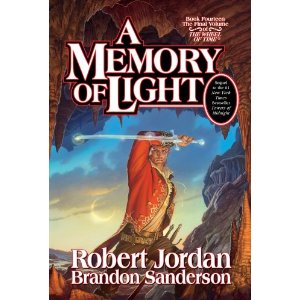
A_Memory_of_Light_cover (1)As much as I adored the Wheel of Time series, Robert Jordan seemed to fall into the trap of loving all his characters too much, and wanting to tell each of their truly epic stories in the one series–and it couldn’t be done without aggravating his fans.

Consider this: although it was originally planned as a six-book series, The Wheel of Time grew to encompass fourteen volumes, a prequel novel, and a companion book.  Jordan began writing the first volume, The Eye of the World, in 1984. It was published in January 1990. With Jordan’s death on 16 September 2007, the conclusion of the series was in question, but Brandon Sanderson stepped in and did a masterful job of taking Jordan’s incredible mass of notes and background, along with the rough draft and finished the series’ final three installments.

Stone_of_FarewellIt occasionally happens that you have chosen a protagonist, but another character suddenly seems to have a more intriguing way about him. It is up to you to make a decision–who will be the central character? If, after all is said and done, a different character than the one you originally thought was the protagonist comes to the fore, you must go back and rewrite your beginning to to reflect that.

Deciding who that protagonist will be is a matter of knowing which character has the most opportunity to take full advantage of all the possibilities. The other characters serve only to propel him/her to the final conflict.

Sometimes, as in Memory, Sorrow, and Thorn, that character is the 14 year old kitchen boy on the verge of manhood, and not the battle-hardened prince with the tragic history.


Comments Off on Elements of a story: Identifying your protagonist

Filed under Adventure, Books, Fantasy, Humor, Literature, Publishing, Uncategorized, writer, writing

Comfort books, a three-course meal: 1st course, Memory, Sorrow, and Thorn

Dragonbone_ChairI’ve been reading a lot lately. I know, you’re surprised, right? Mostly I’ve been revisiting my old favorites. I have a group of what I call “comfort books.”  That is not to say these books are comfortable, because they’re quite the opposite: challenging, involving,  and at times a little horrifying. But they are books that I can go back to again and again and never be disappointed in either the writing or the tale. I always find some new thing, along with the themes and characters that enchanted me the first time I read them.

These are the books that inspired me to write, not because I thought I could write better, but because these authors were unable to keep up with my reading demand. So, in the lull between “real books” I began writing the stories I wanted to read. Today begins  the first course of this three-course meal. Two more will follow!

First up is Tad Williams’ epic masterpiece, Memory, Sorrow, and Thorn. This tale was so large he couldn’t fit it all into one book. Each book is quite large, and believe me, there is no fluff in any of them.

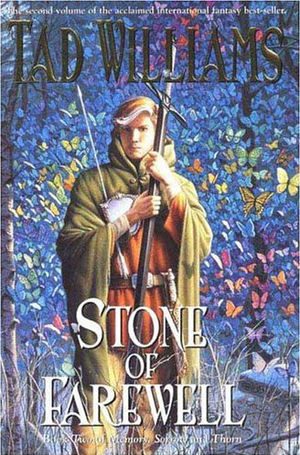
Stone_of_FarewellIn this gripping tale, Williams takes a traditional tale of a kitchen-boy turned hero, and turns it sideways, giving it depth and power. He puts his protagonist, who begins as Simon Mooncalf, though hell,forging strength of character and courage in a boy who always dreamed of adventure. Simon the dreamer is real, human; a man with flaws as well as strengths. As a boy he is afraid, but he is courageous when it counts. And as a warrior, Simon Snowlock is strong, and not always forgiving. He is a multilayered hero, as is the story in which he is set.

The quest for the swords of power, and the larger quest to save Osten Ard from the grip of Ineluki, the Storm King, are enclosed within the real dramas of human (and not-so-human) affairs.

What made this  series of books strike such a chord within me in the first place, was the way the world of Osten Ard reflects the history and folklore of our world. Several characters’ elements and experiences mirror the legends and mythology of Great Britain and other European cultures. I felt I knew these societies, and yet they were seen through a fractured mirror, similar, yet so different.

At the outset, the Erkynlanders are are the dominant society, and are ruled by King John Presbyter, also known as Prester John. He united them, but they’re still slightly clan-based and resemble the early medieval English of around the fifth to seventh centuries, with names that are  Saxon-ish and Biblical. It is a castle-based, feudal society right out of the dark ages. They have a religion that is similar to Christianity, as if they are a parallel reality.

To_Green_Angel_TowerPrester John is the man who united Osten Ard, and carved their society, but he is dying. Like the great Plantagenet kings of our history, he has two strong sons who have a deep-rooted quarrel, and this sets up the conflict that evolves and encompasses an entire world.

After his death, the dark secrets of Prester John’s own checkered history drive the plot, sweeping Simon up in events which he has no control over.  His growth over the course of this series makes a gripping, compelling story, as does the parallel story of Miriamele, Prester John’s granddaughter.

Green_Angel_Tower_P1The other people of Osten Ard who have recognizable real-world parallels in their names and cultures, and who have strong, absorbing story-lines are:

Binabik—a Qanuc (based on Inuit, or Eskimo)

Jiriki—Sithi (distinct from a branch of their culture, the Norns, who are the root antagonists.  Based on Asian, Japanese) Ineluki, the Storm King is Norn.

Maegwin—Hernystiri (Celtic, perhaps Irish or Welsh)

Sir Camaris—Nabbanai: I just fell in love with this tragic man. These people felt reminiscent of Renaissance Italy, quite Roman

Tiamak—Wrannamen: Indigenous tribal  people who live close to the earth,

Sludig—Rimmersmen: Norse and early Germanic , quite Viking

Also included is another culture, the Thrithings: Horse nomads, reminiscent of the Mongols.

This is not a series you can read in a day or even a week. It is easy to get completely caught up in this tale, to the point that you forget to eat, and don’t hear when the dog wants out. I originally bought The Dragonbone Chair for the artwork on the cover. It was created by the brilliant fantasy artist, Michael Whelan. All the covers in this series are incomparable, and to my great joy, so was the story within.

TadWilliams200And the best part is: Tad is writing another trilogy based in Osten Ard, set thirty years later. Quote from his blogpost of April 3, 2014 : “I guess the cat has been debagged. Several of you have seen and shared the news that, yes, I am returning to Osten Ard for a series of books called (collectively) “The Last King of Osten Ard”. It will feature many of the same characters a generation later (and many new ones as well). The book titles will be (as of now):

The Witchwood Crown
Empire of Grass
The Navigator’s Children

This is assuming I don’t do my normal try-to-squeeze-two-books-into-the-last-volume trick.”

I don’t care how you do it Tad. I am just glad you are still young, and still writing amazing books in a kijillion settings. I am waiting patiently for the emergence of this series. Do your crazy thing, madman! Take your time and do it right! I will have it on pre-order the minute it becomes available, and when it arrives on my doorstep I will dance all the way to my cozy sofa, where I will sit and read until I am forced to set the book down in order to feed the hubby. Then I will continue reading until the next meal must be served.

2 Comments

Filed under Adventure, Battles, blogging, Books, Dragons, Fairies, Fantasy, Humor, Literature, Publishing, Romance, Self Publishing, writer, writing

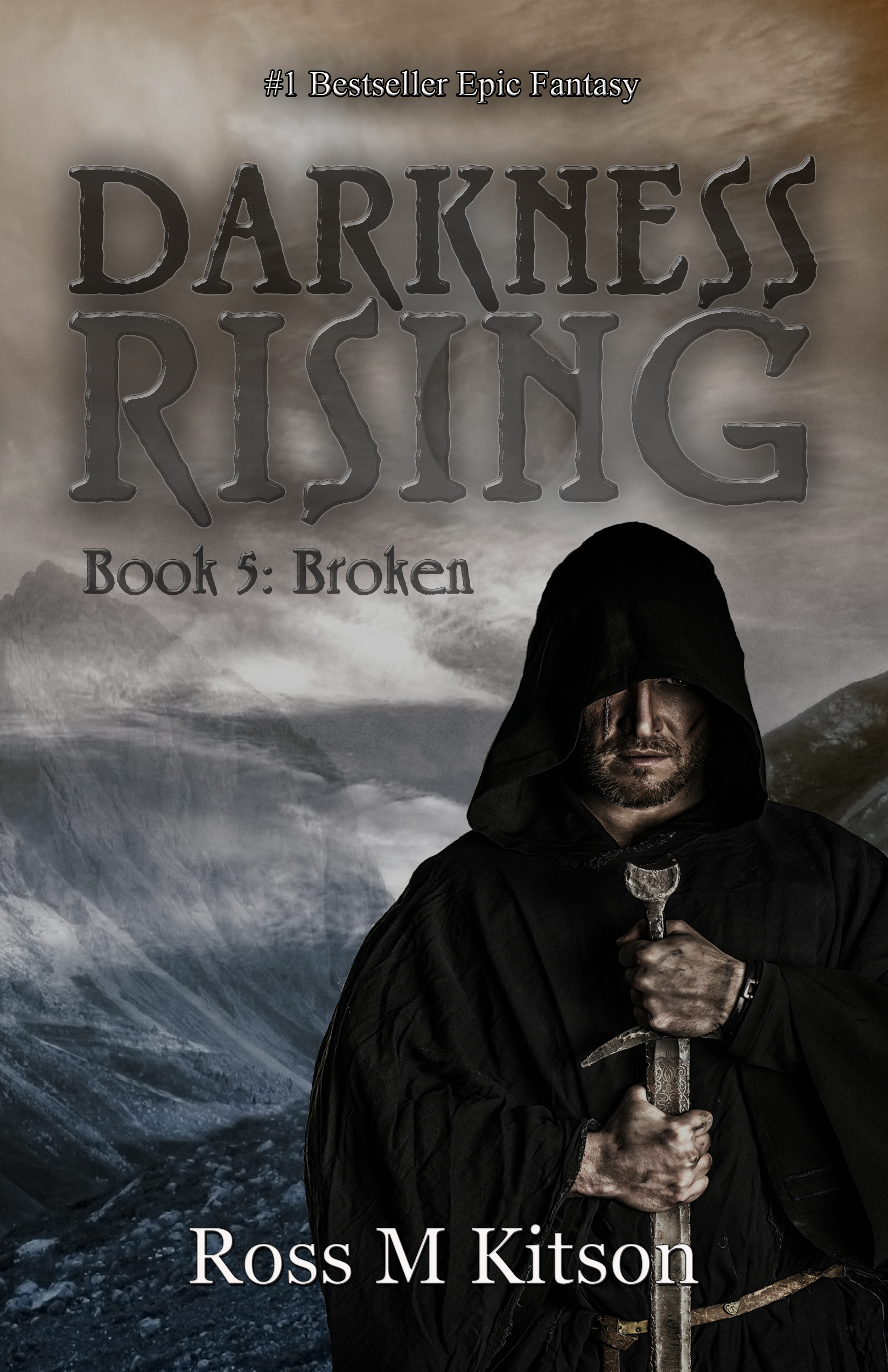
Cover Reveal Darkness Rising 5–Broken, by Ross M. Kitson

Darkness Rising 5 - BrokenOne the best aspects of my life is to be involved in the process as some of the finest fantasy authors out there make their work ready for publication. A longtime friend of mine is Ross M. Kitson, author of the Prism Series. Several years ago I had the privilege of working with him on Darkness Rising 3–Secrets, and I recently had the absolute joy of working with him on the soon-to-be-released Darkness Rising 5–Broken, the new cover of which has just been unveiled.

This new cover completely speaks to what is inside this book. And let me just say I LOVE that series of books–Kitson’s world is dark and dirty, and yet it teems with vibrant, colorful life. His characters leap off the page, and for those like me who love a really deep fantasy read, he creates an epic-fantasy that is truly original.

The Blurb:

‘Beneath the veneer, beneath the beauty, there is always the coldness of stone.’

Tragedy has torn apart Emelia and her companions, a terrible betrayal instigated by the Darkmaster, Vildor. A devastated Jem struggles to control the fearful power of the crystals, becoming distant from his closest friends. Hunor and Orla are tested by a secret from the past, a revelation that will change everything between them. In the Dead City, Emelia begins a search for her past, a journey that will plunge her deeper into the darkness of Vildor and his twisted schemes.

Desperate to seek aid in their battle against Vildor, the companions travel north to Belgo, capital of North Artoria. But everything is not what it seems in the palace, and danger lurks in every shadow, whether cast by friend or foe.
Separated and alone, can Emelia, Jem and Hunor hope to prevail? Or will the evils of the present and the past overcome them at last?

Darkness Rising 5 – Broken is the fifth in the epic fantasy series that reviewers are calling  ‘epic and spellbinding.’ It is a must read for fantasy fans the world over.

That’s pretty intriguing. But let me just say that Ross Kitson doesn’t rely on the great bastions of fantasy, Tolkien’s Lord of the Rings or Tad William’s Memory, Sorrow and Thorn for his inspiration, although he is a great fan of theirs. Kitson’s world is nothing like anything I’ve ever read, yet it is familiar enough that the reader becomes immersed. His characters are  uniquely individual, with great strengths and each with weaknesses that can and do create tension within the group.

If you are looking for a new, truly epic fantasy series, book one of the Prism Series is currently on sale for .99 for the ebook

Darkness Rising (Book One: Chained)


Ross M. KitsonAuthor Bio

Ross M Kitson is a published author in the fantasy genre, with an ongoing series (The Prism Series), a number of short stories on Quantum Muse web-zine and several stories in Steampunk and fantasy anthologies.

His debut series for Myrddin is due for release in October 2012, and is a sci-fi series set in modern-day York. It is written for ages 12+, although its combination of killer androids, steam-powered airships, kick-ass heroines and action packed chases will appeal to all ages.

Ross works as a doctor in the UK specializing in critical care and anaesthesia. He is happily married with three awesome children, who nagged him incessantly to write something that they could read. His love of speculative fiction and comics began at a young age and shows no signs of fading.

Follow Ross on Twitter:          @rossmkitson

Find Ross on Facebook:

http://www.facebook.com/TheNuKnights

http://www.facebook.com/ross.kitson.9

Websites:

For the infinity Bridge:         http://thenuknights.weebly.com/

Blogs:

http://mouseroar.blogspot.co.uk

http://rossmkitson.blogspot.co.uk

http://skulldustcircle.blogspot.co.uk

Comments Off on Cover Reveal Darkness Rising 5–Broken, by Ross M. Kitson

Filed under Adventure, Battles, Books, Fantasy, Humor, Literature, Publishing, Self Publishing, Uncategorized, writer, writing

Finding demographics is not finding Nemo

My New Year’s resolution this year is to identify who I am writing for, and tailor my marketing strategy to that segment of the population.

I should have picked something simple, like losing weight, or bringing about world peace.

I would be lying if I said I write for one particular type of person–although Huw the Bard falls into the not-for-children category. I like to think my books can be enjoyed by both men and women.

Who are youIt’s just that I write whatever I’m in the mood to read, and I read everything, Fantasy first, sci-fi second, then mystery, historical, paranormal, books of political intrigue, books filled with naughty vampires. Romance, YA, hard sci-fi, epic fantasy–I read it all. This makes it difficult to categorize myself .

Looking in the mirror doesn’t help.

At IHop, I am a 55+, getting discounts and a special old people’s menu. I am a senior, according to AARP, and am entitled certain discounts when I produce that all-important AARP card.

These things tell me I am an older person, as does the mirror.

However, these visible signs don’t show the woman with mad kick-ball-skills, who plays Lego Star Wars until the grandchild says she’s had enough games for one day, and he’d like to play outside now. They don’t shed any light on me. the person who will read and reread a book until it is nothing but shreds–if I fell in love with it. The gray hair, the slightly less-than-svelte physique–these clues don’t offer a hint about my obsession with Final Fantasy XII.

And that is the problem.

I write for me, and I don’t know who I am.

The Creative Penn offers 5 tips to assist me in this process:

1. First we must isolate what types and/or groups of people the content of the book would interest.

Well-that is just the problem, isn’t it…but they do give an idea on how to approach that:

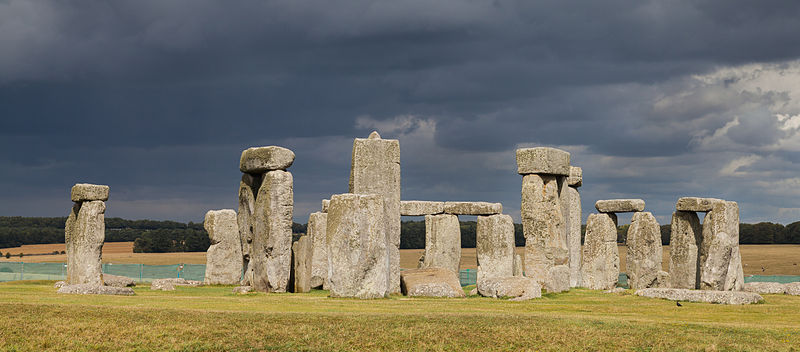
 "Diego Delso, Wikimedia Commons, License CC-BY-SA 3.0

“Diego Delso, Wikimedia Commons, License CC-BY-SA 3.0

“Example: If your book is about an archaeologist who uses Stone Henge to travel into the future, your book would probably interest history buffs as well as fans of speculative fiction/sci-fi.  If that hero happens to be a former Marine, your book might also interest military personnel and/or the families.” (It’s a direct quote, so I am ignoring the terrible itch to edit out the misspelling of Stonehenge.)

Okay–I think I can do this. My book details the adventures of a bard who is forced to  flee his comfortable existence and who finds himself running from one disaster to another with death-defying regularity.

2. Second, we must: identify other books that are comparable to your book and look at the profiles of those books’ main buyers/readers.

They also explain that concept a little further “The target audience isn’t always who the book was written for, but rather, who it ends up appealing to.  Twilight draws in tween and teenage girls with its premise involving a normal, everyday girl falling into a romance with an young, attractive male (the bread and butter of many young girls’ dreams), but it’s appeal stretched to the cross-section of middle-age female readers who love romance and enjoyed Anne Rice in her heyday.”  

Alrighty then–I was heavily drawn, as a reader, to David Eddings, Anne McCaffrey, Tad Williams, J.R.R. Tolkien, P.D. James, Carl Sagan, Agatha Christie, Piers Anthony, and Fritz Lieber–so I suppose my books reflects a certain amount of their (rather jumbled) influence.

Oh, and don’t forget Roger Zelazney. And Mercedes Lackey.

Well that has narrowed it down quite a bit! (Sarcasm–I know, it’s a nasty habit.) I could have included Tolstoy, James Joyce, Horace Walpole, and Louisa May Alcott, but I didn’t have time.

330px-Pin-artsy3. You are next encouraged to pinpoint what is special about your book.

Again, the Creative Penn offers us some insights on how to go about this: “If you tell someone you’re writing a book about a witch who uses her power of communing with animals to rescue a lost dog from an evil dog-napper, then A. Wow, you have an interesting imagination!  B. You may or may not have taken in 101 Dalmatians too much as a child and C. With such a premise, chances are, your story is more light-hearted than scary, so your target readers to which the mystery aspect of your story will entice are more cozy-type mystery consumers.” So what are the few key words, the hook I can use to sell Huw the Bard? How do I boil the plot down to a few key words? This could take a while, but I’m sure I can do it.

Honest.

4. Now we need to determine some demographics.

That’s the problem–I am the demographic, and I don’t know who I am. Mature Audiences, definitely. There is some graphic sex, although it doesn’t devolve into a porn-fest, There is violence, a witnessed rape, and murder. These are all there because they are watershed moments in Huw’s life, things that change his view of the world. There are also a haunted village and a bisexual knight who talks to his horse, so there is humor midst the misery.

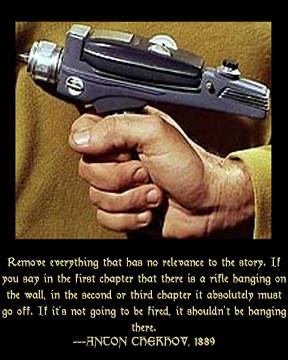
chekhov's gun5. Finally, the Creative Penn suggests we feed the previous four tips into each other to gain even more insight and narrow down who our target audience/s is/are.

Just give me Chekhov’s gunnow. I need to shoot something.

Several times.

Seriously–the article I’ve drawn these suggestions from is a good article, and it goes on to discuss how to use your target audience, which I did find somewhat illuminating.
At this point, if I can get even ONE concrete idea that works, I am feeling good about it. After all, it’s January! I’ve got a whole year to get this down, before I have to admit that this New Year’s resolution has gone the way of my weight-loss dreams and visions of world peace.

2 Comments

Filed under Adventure, Battles, Books, Fantasy, Humor, Literature, Publishing, Self Publishing, Uncategorized, writer, writing

The author’s voice

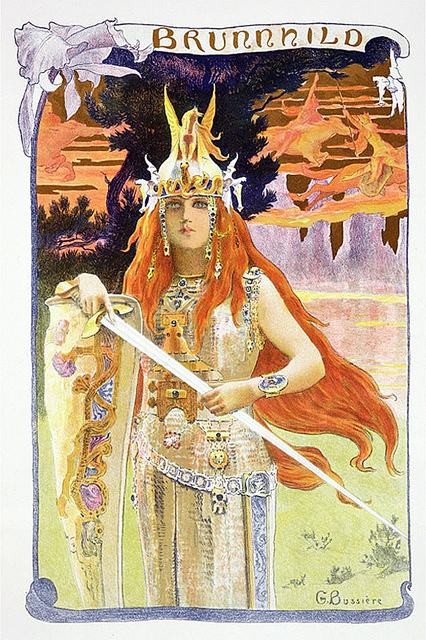
Brunhild_(Postkarte),_G._Bussiere,_1897All authors have a voice, although many can’t sing. I have 8 good notes and I’m not afraid to use them in singing the odd song now and again. Tad Williams can sing, and has the cd to prove it.

But what do I really mean when I speak of an author’s voice?

We become attached to certain authors because when we read their works, we hear their “voice.” We hear them speaking to us.

Each author writes with a certain style, or in other words, the words he or she habitually uses that makes his or her writing unique. “Voice” conveys the author’s attitude, personality, and character.

You have all heard me say that having a manuscript properly edited before publishing it is crucial for the indie author’s credibility. You may ask, “what is this process, and how do I retain my voice, and control of my work when someone else is intent on hijacking it?”

First of all, a good editor will never try to hijack your work. Writers intentionally use symbolism and thematic consistency. We sometimes intentionally repeat certain words for emphasis. These things are significant to us, and a good editor will recognize that.

So what does an editor look for in a manuscript?

Indies are looking for an editor who “helps a writer develop a book from idea or outline or initial draft. Makes sure the book will meet the needs of the publisher and its readers. Will work with the author through any number of drafts. Often works with writers of non-fiction. Guides the writer in topics to be covered in or omitted from the book.” quoted from the Editors Blog.

In other words indies want a structural editor.  What will this editor do for them?
The professional freelance editor will read your manuscript, looking for the rough spots and inconsistencies that work their way into every final draft. They will suggest you correct certain grammatical errors and habits that interfere with the flow of your work, and give you an idea of how those corrections could be made. They will also point out things that are unnecessary background–info-dumps that have slipped through, and suggest you remove them.

Also a structural editor may suggest that a section be moved to a different, more appropriate place in the manuscript. This editor will devote a month or more of their time to your manuscript. This is a hefty commitment on their part, and is one that is not lightly made.

Raymond chandler quote split infinitivesA good editor will not try to take over your manuscript and erase your voice.

You, as the author, have the final say on your manuscript–it is after all your intellectual property. If you don’t want to change something you feel is intrinsic to what you are trying to express, you don’t have to.

Sometimes editors don’t see the forest for the trees–and a good conversation with the author will straighten those areas out. If your editor does not respond to your emails, or indicate in some way that they have heard your concerns, you should not work with them.  

The best part of being an indie is having the control of your work. A good relationship with your editor is crucial to turning out a good product.

7 Comments

Filed under Adventure, Battles, Blogger, blogging, Books, Fantasy, Humor, Literature, Publishing, Self Publishing, WordPress, writer, writing